




Abstract
This article examined how elementary educators understood the experiences of Black students during remote learning and subsequently demonstrated empathy for Black students during the 2020–2021 academic year. While there is ample literature on the benefits of empathy on student outcomes, much of this research falls short in capturing the utility and complexity of empathy in remote settings. Moreover, much of the literature on empathy omits the role that identity plays in conceptualizations of empathy. Findings from this study suggest that in order for educators to bypass the physical and psychological distance created by remote instruction, educators must develop innovative and iterative practices that allow them to develop an in-depth understanding of their students, which will allow them to demonstrate appropriate empathic actions.
Introduction
The Coronavirus pandemic led to abrupt and unforeseen changes to education across the United States. As the deadly virus spread, particularly in the spring of 2020, schools across the country immediately transitioned from in-person learning to remote learning in an effort to protect students and school personnel. The unprecedented transition in the delivery of educational services led to a momentous disruption in teaching and learning that made it difficult for many teachers to teach and even more difficult for many students to learn (Marshall et al., 2020). At a time when deep-seated opportunity gaps already existed in schools (Milner, 2020), the pandemic in many ways led to even greater learning discrepancies, which may take years to understand and rectify.
Remote learning exposed numerous inequalities that have existed under the surface of American education for quite some time. For instance, the digital divide between affluent students and low-income students became more apparent than ever as certain student groups struggled to gain access to learning devices and internet hotspots (Ramsetty & Adams, 2020; van Dijik, 2006). Moreover, a disproportionate number of Students of Color, in particular those from low-income backgrounds, had unique experiences during remote learning, given how COVID had a more detrimental impact on communities and people of color (Thakur et al., 2020). This article places an intentional focus on Black students experiences with remote learning during the pandemic. Millions of Black youth across the country were uniquely impacted by both the devastating effects of the Coronavirus, as well as unforgettable images and videos of unarmed Black folks losing their lives to police and vigilante violence during 2020 (Ladson-Billings, 2021). Amid the Coronavirus pandemic and persistent overt racism, this study examined educator perceptions and experiences with Black students during remote learning, as well as how educators demonstrated empathy for Black students during remote learning. Though the voices of Black students are present in this research, educators are the primary unit of analysis. The focus on educators voices was done intentionally because of the tremendous impact educators have on students’ daily experiences but also with the aim of shifting normative discourse on Black student achievement away from individual and culturally deviant explanations such as the myth of meritocracy (Generett & Olson, 2020; Golden, 2017) or the fallacy of grit (Duckworth, 2016). And instead, focus on the ways educators understand and respond to the needs of the students they serve.
A study of this nature is critical because the education and wellness of Black youth matters. A perusal of relevant literature related to Black students’ in-school experiences reveals a harsh reality that many Black children are excessively over-surveilled, overdisciplined, and undereducated (Annamma et al., 2019; Love, 2019; Nxumalo & ross, 2019; Smith et al., 2007; Warren & Coles, 2020). Black youth are more likely to attend racially segregated, underfunded, and under-resourced schools (Orfield & Jarvie, 2020). Black youth are also are more likely to be served by inexperienced teachers (Carver-Thomas & Darling-Hammond, 2019), and are more likely to be suspended or expelled (Losen, 2014; Noguera, 2003). This data reveals the structural disadvantage that many Black students face in pursuit of an education. Besides the structural macro-level factors that yield disparate outcomes for Black youth, there is a wealth of literature that speaks to the micro-level social interactions that also harm Black youth in school.
Warren and Coles (2020), in their exploration of anti-Blackness in schools, found that Black faces are more likely to be thought of as negative (Axt & Trawalter, 2017), Black children are viewed as more threatening than their non-Black peers (Morris, 2016; Wilson et al., 2017), and Black students are often perceived as less intellectually capable than their non-Black peers (Warren & Coles, 2020). Bias, anti-Black perceptions of Black youth inevitably impact the way Black youth experience schools (Dumas & Ross, 2016; Grant et al., 2020). Many scholars have argued that these stereotypical perceptions of Black children are one of the reasons that Black children are disproportionately overrepresented in school discipline data (Frank, 2022; Losen, 2014). Negative perceptions of Black students also impact their in-school educational opportunities. For instance, Black students are among those most likely to be identified as needing special education services (Harry et al., 2007), but grossly underrepresented in AP and honors courses as well as gifted and talented course options (Ferrell & Black, 2019; Ford, 1998).
Disrupting the pervasiveness of racism and anti-Blackness in American public schools is one of the most pressing issues plaguing American education. As the United States and its schools become increasingly nonwhite, it is critical for schools to improve their ability to educate students from non-dominant backgrounds (Howard, 2016). One approach to improve the experiences and outcomes for diverse students that has gained traction recently in education literature is empathy (Carter, 2009; Dolby, 2012; Howard, 2010; Warren, 2018).
Research suggests that educators with empathic dispositions, whose actions are grounded in empathy, have a positive impact on students (Gordon, 1999; Hoerr, 2022). Empathy has been defined by a number of scholars across disciplines as the ability to understand and relate to the perspective and feelings of an “other,” and develop appropriate responses based on understanding (Decety & Ickes, 2011; Okonofua et al., 2016; Warren, 2014; Whitford & Emerson, 2019). Empathy is often divided into two primary domains: cognitive and affective (Decety & Ickes, 2011; Kerr-Gaffney et al., 2019; Warren, 2014). Cognitive empathy refers to one's ability to adopt the psychological perspective of others, while affective empathy relates to one's ability to respond to the emotions of another person appropriately (Davis, 1994; Kerr-Gaffney et al., 2019; Warrier et al., 2018). While this previous research on empathy provides a theoretical foundation for the field, there is a need for more nuanced research on how empathy differs based on identity. This study was a qualitative case study which examined educators’ demonstrations of empathy for Black students during remote learning utilizing the following questions: What are educators’ perceptions of the experiences of Black students during remote learning? What actions have educators taken to understand the needs of Black students during remote learning? With this understanding, how have educators responded to the academic and nonacademic needs of Black students during remote learning?
Background of Study: Black Youth, Empathy & Remote Instruction
A number of researchers have written about ways to support Black students in school (Gay, 2018; Milner, 2020; Nasir, 2011; Noguera, 2009). An area that has gained attention recently has been educator empathy as an approach to better support Black students (Warren, 2013; Whitford & Emerson, 2019). Previous research on the utility of empathy in schools has provided valuable insights into the benefits it can have for Black students both behaviorally and academically (McAllister & Irvine, 2002; Warren, 2014; Whitford & Emerson, 2019). However, the current research on empathy does not fully capture COVID-19. In the spring of 2020, the Coronavirus caused a dramatic shift in education. Educators and students no longer shared a common space, which inevitably meant that learning had to take place virtually. The transition to remote learning presented numerous challenges for schools, students, and families (Marshall et al., 2020). The purpose of this article is to explore some of the school-based factors, policies, and practices that contribute to the development of empathic actions, which can subsequently lead to enhanced experiences of Black students in schools during remote instruction.
Since the Coronavirus pandemic began Black folks have been among those mostly likely to be unemployed, unhoused, and uninsured (Kuhfeld et al., 2020). Additionally, Black folks have been among those groups most likely to contract the Coronavirus and die from complications associated with the virus (Vanek Smith, 2020). The devastating impact of COVID-19 on Black communities was not a coincidence, but rather the result of cumulative disadvantage created by structural racism (Gravlee, 2020). The United States’ deplorable history of redlining, exclusion, and racial segregation has relegated many Black folks to primarily urban, overcrowded communities that lack vital resources and access to basic necessities such as: quality healthcare, adequate housing, and employment opportunities (Eisenhauer, 2001; Flournoy, 2021; Rothstein, 2017). The accumulation of disadvantages was critical during the pandemic and created inordinate precarious circumstances for many Black folks.
In the midst of these tumultuous times for Black folks, throughout the summer of 2020 numerous videos and images appeared on television and social media of unarmed Black folks who were slain at the hands of officers and vigilantes. The deaths of George Floyd, Ahmad Arbery, and Breonna Taylor in particular were shown and discussed ad nauseam during the Spring of 2020. Research has shown that the mental wellness of Black folks is negatively affected by repeated exposure to traumatic racial images, such as the murders of unarmed people (Tynes et al., 2019). The racial climate of 2020 along with the devastation made social emotional supports, especially critical for Black students which motivated this study on empathy. This study seeks to provide researchers, teachers, and school leaders with insights how empathy can be applied to support Black students. It is important to note that remote learning is likely to remain a staple in education in some form for the foreseeable future (Schwartz et al., 2020). Schwartz et al. conduced one of the first education Coronavirus-related studies, and one of their most poignant findings was the permanence of remote learning: About two in ten districts have already adopted, plan to adopt, or are considering adopting virtual school as part of their district portfolio after the end of the COVID-19 pandemic. District leaders cited reasons related to student and parent demand for continuing various forms of online instruction in future year (p.1)
It is imperative that educators begin to develop strategies, practices, and policies that recognize the whole student while learning occurs from a distance. Moreover, remote learning must be done with attentiveness to larger social and political issues which are occurring around students (Camangian, 2019). Hence, an exploration of remote learning for Black youth during the spring of 2020 cannot be done without attention being provided to the racial unrest that occurred across the country in light of the George Floyd and Breonna Taylor deaths. Protests in the name of Black Lives Matter, and ending systemic racism were occurring nationally and globally while remote instruction was occurring. The reaction to Black lives being loss through violence is not a primary focus throughout the article; however, the findings of this study do shed light on practices that were utilized to support Black students in connection to the racial strife and national unrest. Research on Black students’ experiences during remote learning has primarily focused on deficits and what Black students have not been given (Francis & Weller, 2022; Morgan, 2022). While this research is vital, I believe it is equally as important to understand how teachers successful demonstrated empathy that supported Black students during this turbulent time period.
Why Empathy Matters in School: A Review of the Literature
This study centers empathy at the core of its analysis, because I wanted to examine to what degree, if any, teachers demonstrated empathy for Black youth during remote instruction. Psychologists were the first to bring attention to the importance of empathy in relation to teaching and learning (Rogers, 1969). In 1969, psychologist Carl Rogers argued that: When the teacher has the ability to understand the student's reaction from the inside, has the sensitive awareness of the process of how education and learning seems to the student. The likelihood of learning is significantly increased (p.157).
The literature on the enactment of empathy in school is strikingly similar to the literature on culturally responsive pedagogy. Since its inception, culturally responsive pedagogy has insisted on creating classroom environments that are reflective and inclusive of the students being served (Gay, 2018). According to Gay and other scholars, engaging in culturally responsive pedagogy requires educators to develop an in-depth knowledge of the students they serve in order to build environments conducive for their success (Hammond, 2014; Muhammad, 2020). These striking similarities are why Warren considered empathy an integral element to culturally responsive pedagogy. In the following excerpt, Warren explains the connection between the application of empathy and culturally responsive teaching: The application of empathy operationalized through perspective taking is one such model useful to preparing teacher candidates to make professional decisions that produce evidence of culturally responsive pedagogy. Engaging teacher candidates in perspective taking—adopting the social perspectives of others as an act and process of knowing— invites them to obtain (and reason with) new knowledge of students and the sociocultural context where she or he will teach. P.169
In their 2019 study, Whitford and Emerson utilized Warren's (2014) framework to examine the impact of an empathy promoting intervention on implicit bias with 34 preservice teachers. The authors measured implicit bias with the Implicit Association Test and discovered that their empathy promoting intervention had a substantial impact on reducing implicit bias toward Black students. The authors are clear that these findings do not necessarily translate to improvements in teachers’ pedagogical skills or effectiveness, but it remains an important area of study because empathy has shown to impact the way teachers view and understand culturally diverse students (Whitford & Emerson, 2019). While this study is useful, the implicit association test does not guarantee future behaviors of teachers.
A 2002 study conducted by McAllister and Irvine examined that utility of empathy in teaching culturally diverse students. McAllister and Irvine studied 34 racially diverse teachers who were participating in a professional development program designed to develop empathic orientations toward those of other cultures. Through their research they discovered that all 34 teachers viewed empathy as critical for their ability to teach diverse student groups effectively. Imagining the perspective of an “other” and engaging in cross cultural interactions allowed teachers to gain a better understanding of the cultural values and dynamics of those different from themselves. This in turn allowed them to connect with students and build positive relationships that benefited students academically and behaviorally (McAllister & Irvine, 2002).
Warren (2013, 2014, 2018) has utilized the concept of empathy to examine interactions between Black male students and White female teachers. In his 2014 study, Warren argued that the four White female teachers he studied were successful in their interactions with Black boys because of their capacity to convey empathy. Taking the perspective of Black boys allowed these teachers to understand the lived experiences of their Black male students, which in turn prevented them from making deficit-based assumptions that align with prevailing negative stereotypes related to Black boys. Warren contends, “Helping teachers find creative ways to acquire student social and cultural perspective should be an explicit goal of teacher educators and professional development programs” (p.416). As many teachers struggle to educate students from diverse racial, cultural, and ethnic backgrounds, Warren contends that empathic dispositions can play a critical role in improving the quality of education youth from non-dominant backgrounds receive. The aim of this study is not to create a new theorization of empathy, but to capture its enactment within a particular context for a specific population of students, Black youth during remote instruction the midst of a pandemic as well as great sociopolitical turmoil.
Conceptual Framework
The conceptual framework guiding this study is Chezare Warren's “Application of Empathy” (Warren, 2014). Though Warren's framework was conceptualized to examine teacher empathic practices, I believe one of the strengths of this framework is that its robust domains can be applied to other individuals within schools such as administrators. Warren's empathy framework was utilized in this study because it is one of few theoretical frameworks that seeks to investigate practical ways to demonstrate empathy within school. Moreover, Warren's empathy framework was beneficial because its overarching goals are to develop duplicaable practices that will help diverse student groups thrive in school.
Warren's application of empathy framework is a multiphase iterative process, that rests on three phases: perspective taking (empathic concern), application of new knowledge of students, and student feedback. In phase one, he contends that teachers must be willing to take the perspective of their students in order to demonstrate empathetic concern. Warren's understanding of perspective taking is adopted from psychology scholar Mark Davis (1994), who defines perspective taking as, “the tendence to spontaneously adopt the psychological point of view of the others in everyday life,” (p.57). Forms of perspective taking for Warren include, “Activities, strategies, rituals, and policies meant to obtain first-person, micro-level knowledge of students” (p.412). Empathic concern relates to educator's ability to demonstrate mutual care, concern, and interest with their students. The second phase of the application of empathy centers on the strategic negotiation of new knowledge. Warren asserts that once teachers understand the perspective of their students, they then must identify ways to adapt their classroom practices and pedagogy to meet the needs of their students. The process of applying new knowledge is constantly evolving and adaptive based on student feedback. Student feedback is characterized by Warren (2014) as both explicit and implicit reactions or outcomes students from students that reveal their feelings and attitude toward the learning environment. Feedback is therefore viewed as a direct reflection of student satisfaction with their experiences in the learning environment.
There have been studies on empathy within virtual learning settings (Anishchuk et al., 2022; Molka-Danielsen et al., 2009) however, these frameworks do not analyze how factors such as race, impact understandings of empathy. After a review of relevant literature on empathy, Warren's frameworks emerged as one of few frameworks that grappled with complex social factors like race. In Warren's (2014), work he makes it clear that part of what made the teachers in his study successful in their application of empathy for Black children, was recognizing the need to treat students differently based on race. The teachers reported adapting their practices to ensure Black male students succeeded but remained firm in their high expectations. Additionally, the application of empathy framework is an empirically supported instructional framework that aims to identify evidence-based practices for the application of empathy. While Warren utilized the application of empathy framework to examine empathic actions for Black boys from White female teachers, I sought to expand this framework by studying the enactment of empathy by both teachers and administrators within a virtual context as opposed to in-person.
Site of the Study
This study was conducted during the 2020–2021 academic year at Oakridge Elementary School (pseudonym) which is located in La Serrana (pseudonym), a large urban city located on the West Coast of the United States. Oakridge is located in a racially mixed lower end, and middle-class community in La Serrana. Oakridge services approximately 500 students in grades k-5. Nearly 80% of Oakridge's student body is considered socioeconomically disadvantaged; meaning they are eligible for free or reduced lunch and/or their caregivers do not have a high school diploma. The racial composition of Oakridge's student population is approximately 78% African American and 17% LatinX. The site was selected for my study for three primary reasons: 1) Oakridge serves a significant number of Black students (more than 50% of overall student populations), which was critical this study given that the focus was on Black students, 2) Oakridge has an established reputation of attending to the holistic needs of students beyond core content, 3) Oakridge is located in what researcher Rich Milner (2012) would call an urban intensive environment. It is critical to underscore the urban context of my research because the size, density, and lack of access to vital resources present in urban intensive environments such as La Serana created especially arduous circumstances for its inhabitants (Perry et al., 2021). The unique circumstances I believe place greater responsibilities on schools, as one of few indispensable public institutions within many urban intensive communities, to respond to the needs of the people in the community (Noguera, 2003). Moreover, because Black students disproportionately attend urban schools (Logan & Burdick-Will, 2017) it is paramount to conduct research in similar context in order to increase the of validity of recommended practices and policy (Drost, 2011).
Positionality
With race being a crucial aspect of their research, I believe it is critical to discuss my positionality as the researcher and author (Bourke, 2014; Milner, 2007). My identity as a Black man plays a significant role in this research because having attended public schools in the United States I have witnessed and experienced the plethora of ways schools can be locales of possibilities or peril for Black youth. Moreover, as a Black man I have an insider perspective (Serrant-Green, 2002) into the role race has played historically and currently in terms of access to opportunity in this country. My identity shapes my research perceptive when examining disparate educational outcomes between Black students and White students by rejecting the notion of an achievement gap, and instead looking at the historical educational injustices that have been inflicted upon Black folks and created an educational debt (Ladson-Billings, 2016; Milner, 2020). Though this perspective in some ways prevents me from being an objective researcher, I believe the benefits of an insider perspective on issues such as race provides a more in-depth analysis.
Participants & Data Collection
A qualitative case study was utilized for this study because it allowed me to investigate nuanced dynamics within complex social phenomenon (Njie & Asimiran, 2014; Yin, 2003). Data was collected throughout the duration of the 2020–21 academic year, while all students at Oakridge were learning remotely. The data was collected via interviews and document analysis. In line with existent literature around the utility of interviews in qualitative research, interviews were the primary mode of data collection in this study because it allowed me to understand the story and gather first hand insights into the experiences of my participants (Seidman, 2015). Moreover, due to the restrictions of remote learning, outside researchers were not permitted to observe virtual classrooms. Because of the restrictions related to COVID-19, interviews were used as an investigative tool to understand how each of my participants made sense of their own their reality during remote learning (Seidman, 2015).
I conducted one-on-one semi-structured interviews with two administrators, two teachers, and nine students at Oakridge. There was a total of 13 participants in this study: four educators, and nine students (The profiles of each of the participants are listed in Figure 1). Each school personnel participant was selected based on nominations by an administrator at Oakridge. The administrator recommended participants who she believed demonstrated cultural responsiveness and consistent care to students’ need during the pandemic. I then attended a parent site council meeting via Zoom and asked caregivers to recommend educators who had been especially helpful to their child during remote learning. After reviewing both lists, seven educators were recommended by both the school administrator, as well as more than one caregiver. Of those seven, four agreed to participate in the study. Selecting participants based on positive recommendations from administrators as well as caregivers was purposeful in hopes that educators who were “receiving praise” were successfully conveying empathy in their classrooms. Purposeful participant selection was critical for understanding a phenomenon such as empathy because I sought to examine a construct with a particular set of proclivities and characteristics that a random selection process would have failed to capture (Sargeant, 2012). All the staff participants I spoke with were Black, however; it was not purposeful to interview only Black educators at Oakridge, this sample was largely due to the fact that less than 5% of the staff at Oakridge is non-Black.
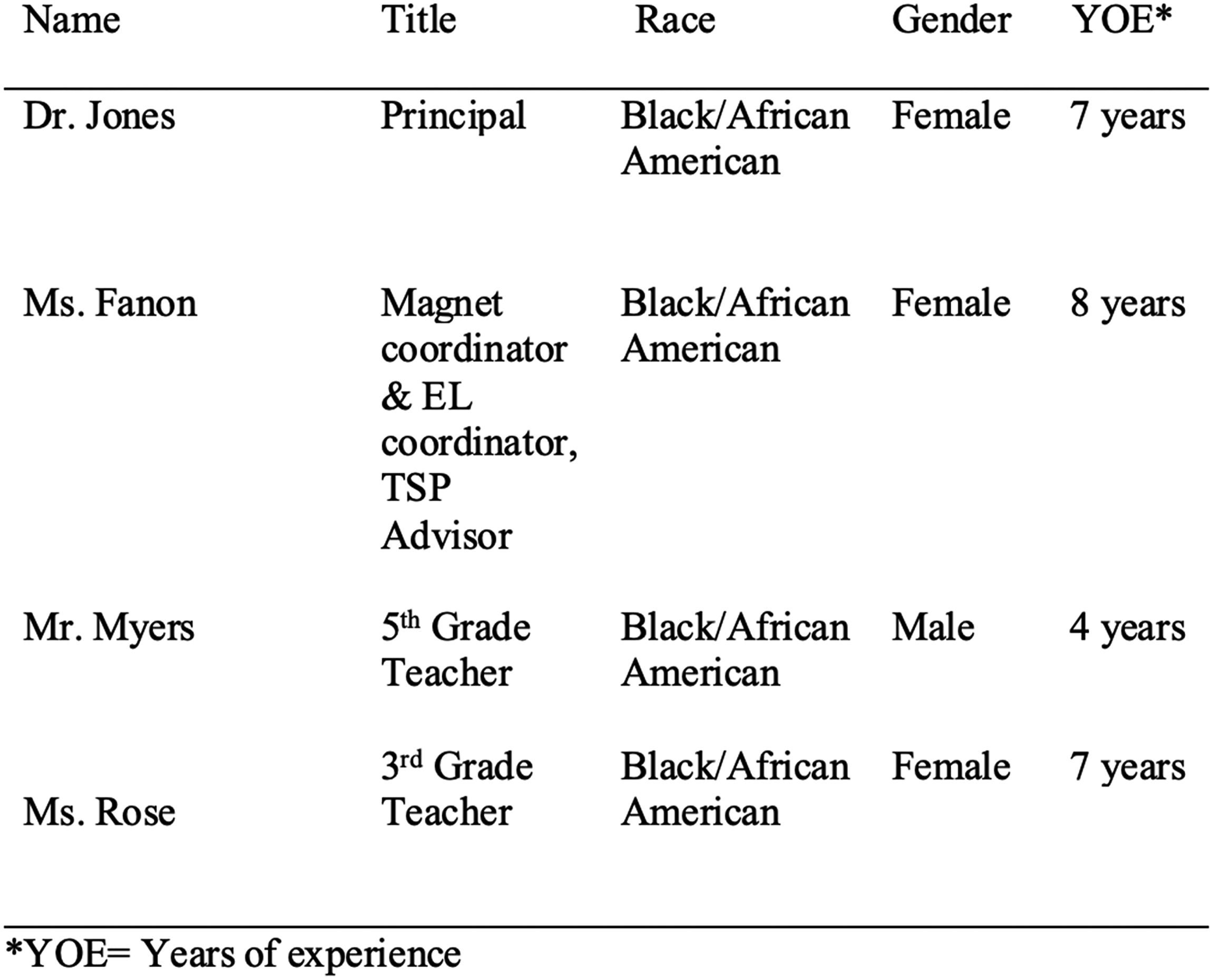
Details the staff participants involved in the study.
Student participants were recruited by a staff volunteer who asked all 5th graders for their interest in participating in a project about their learning during COVID. The criteria for student's participation were that they identify as Black, were students at Oakridge, and were in the 5th grade. Nine (9) students volunteered and gained parent/caregiver consent to participate in a one on-one, 20-min-long semi-structured interview via Zoom with a parent or guardian present. As previously stated, the intention of using interviews as a research strategy was motivated by the need to examine the first-hand narratives of those who are participating in their study (Seidman, 2006). Moreover, sociologist Franco Ferrarotti argues that understanding what he terms social abstractions, such as education is only possible if you speak with those interacting with the abstraction such as teachers, administrators, and students (Bertaux, 1981). Therefore, the purpose of these interviews was twofold; I wanted to understand teacher perceptions of the experiences of Black students during remote learning. Second, I wanted to uncover what empathic actions that educators took based on their understanding of the experiences of Black students to help them succeed during remote learning. And finally, I wanted to use student interviews to verify if the actions that teachers spoke about were deemed impactful or helpful by the students they were intended.
Data Analysis
Interview recordings were transcribed verbatim to ensure that the voice of participants was not altered in any way that would impact analysis or dilute the message of participants (Ravitch & Carl, 2015). After each interview was transcribed via Otter, I listened to the raw audio recording of each interview to clean-up any errors in the transcription, and separated transcripts into two categories: staff and students. Adult interviews were coded before student interviews, but the same coding strategy was used for all transcripts. Adult transcripts were analyzed first because my research questions are grounded in exploring educator perceptions of student experiences. Analyzing student transcripts second allowed me to get a sense of the convergence between what students shared and what educators reported.
Next, I conducted a round of pre-coding using NVivo to familiarize myself with the data and identify any emergent themes (Given, 2008). For the first round of coding, I used open coding methodology highlighting parts of the transcripts that I deemed relevant to my research topic (Ravitch & Carl, 2015). The second round of coding, I used a deductive coding strategy creating coding categories, based on relevance to my research question and Warren's three phases of empathy application. In the next round of coding, I created large coding categories using pattern codes which became the themes that will be detailed in my findings section (Flick, 2014; Ravitch & Carl, 2015). A final round of axial coding was used to compare student transcripts to educator transcripts, with the goal of understanding where educator perceptions of student's experiences either align or do not align. After concluding four rounds of the coding process five main themes emerged that I will discuss in the following section.
Findings
My findings yielded five themes that I will outline and describe in the following section: 1) educator disposition, 2) educators as learners, 3) a reflective school environment, 4) instructional flexibility, and 5) student impact. I will provide definitions of each of these themes and provide salient data points which help to exemplify how each thematic finding played out in the context of what teachers and administration did to support Black youth.
Educator Disposition
Our perspective on any issue impacts our subsequent actions. Hence, in educational research when discussing outcomes for Black students’ countless researchers and practitioners argue that bias or negative perceptions of Black students by educators inevitably impacts outcomes for Black students (Bradshaw et al., 2010). I struggle to characterize said educators as racist, but it is reasonable to suggest that many of these individuals are cultural hegemonist, that intentionally or unintentionally pathologize Black people and communities. Negative beliefs about Black students inevitably impact dispositions, and the way educators interact with and teach students. Therefore, improving teacher efficacy requires us to interrogate dispositions to understand which dispositions are beneficial for Black students. Warren (2018) contends that unpacking teachers’ dispositions is a critical aspect of the application of empathy. This first theme that emerged from my analysis of findings was that educator's dispositions provide insights into how they viewed the realities of their Black students and how that shaped their actions moving forward. This domain educator disposition draws on previous research that argues that educators’ disposition is a critical element of their overall efficacy (Thornton, 2006). Primarily derived from the field of philosophy and psychology, dispositions are understood as cumulative pattern of behaviors that reveals a belief system (Dewey, 1933; Katz, 1993). Educators’ dispositions in this study demonstrated habits of the mind that educators possessed, these habits of the mind provided insights into how empathy influences their practices.
My research at Oakridge revealed that teacher dispositions during and before remote learning were considerably influenced by the principal Dr. Jones. From teachers to parents to students, all of the stakeholders that I spoke with raved about Dr. Jones’ leadership and commitment to still providing students a rich educational experience in a virtual setting. This unwavering commitment to students and families was perfectly encapsulated in the following excerpt from Dr. Jones: We can't have this be a year that's just lost learning and saying, “oh, it's multiple crises going on, it's not real school, so it doesn't count.” Yeah, it still does. No, it's obviously not the same but for our children in particular. This just can't be a year of, “No that's better in person.” …The community needs it. Our teachers and staff, they're still getting full time checks to work from home
The culture of empathic dispositions that Dr. Jones established was present in virtual classrooms. The abrupt introduction of remote learning bred what some students described as “chaos” in their households. With a number of caregivers still having to work outside of the home during the pandemic, several Black students spoke about having to care for younger siblings or other relatives while still learning remotely. Students shared that navigating this reality was strenuous, but their teachers offered the necessary support. Ms. Rose (teacher) shared that she supported students by validating their experiences and responsibilities, rather than chastising or punishing students for not being fully present. The following except provides insights into how Ms. Rose views her students and the way it influences her actions and decision making: So, if a student has to watch little baby brother because mom had to run to the store real quick, then as a teacher, I have to now shift my thinking to still validate that they have a role in their house that I can't trump like…my lessons don't trump, a two-year old sitting on my students lap, let me say, I have had time with babies, all the time these babies in these houses have gotten used to my voice, and they crawl their way to the screen and I am not lying to you when I tell you that every day, the siblings come every day.
Educators Positioning Themselves as Learners
Educators cannot develop appropriate actions to meet the needs of their Black students, if they have not taken the time to understand the realities and experiences of their Black students (Howard, 2016). The educators I spoke with at Oakridge were intentional in positioning themselves as learners in their interactions with students and family, to ensure that the actions they took and the support they provided were congruent with the needs of the students they served. This domain: educators as learners encompasses educators shifting normative interactions between themselves and the people they service (students and families) in order to design an empathic virtual environment that attended to students’ academic and social emotional needs. Educators taking time to learn the students and families they serve are frequently cited as an effective strategy for educating student, in-particular students of color (Banks, 2021; Gay, 2018). Educators learning their students align with the cognitive element of empathy, where the individual demonstrating empathy must first comprehend the needs of the individual the empathy is intended for (Decety & Ickes, 2011).
For the staff that I spoke to at Oakridge, learning who students were was a foundational step in the education process. Ms. Fanon (administrator) explicitly stated the expectations for all teachers before they begin instruction in the following way, “You know you are going to consider their culture, consider their language, consider who is sitting in front of you before you ever pick up a pencil and decide what it is that you're going to teach.” Ms. Fanon stated that she ardently believes learning from students is a catalyst for achievement in school. She explained that by learning about the multitude of identities among their student body, Oakridge staff are able to create a more inclusive school environment. For example, though the majority of their students are Black, staff conversations with individual families revealed they have a number of students who are Black but are not African American, meaning they may be of Caribbean or Latin descent. The educators that I spoke to at Oakridge said that they considered the diversity in Black folks in their curriculum and were intentional in educating Black students about the African diaspora and diversity within Blackness. Additionally, Oakridge will invite families and community members in to educate both students and educators about other cultures that may be unfamiliar to them. Students are aware of the cultural inclusion at Oakridge as evident by the following students quote, “My teacher is a lot more accepting of like different cultures and stuff she's not like bias towards anyone because of their, like learning ability she asks us a lot of questions about ourselves to help us.” The preceding quote from Arianah speaks to the effect of learning attitudes on students. Learning others is a cultural staple for educators at Oakridge that proved especially critical during remote learning.
The principal, Dr. Jones described continual learning about families as a valuable way to get a sense of their, “babies and families.” During virtual instruction, learning from students meant understanding what Black students and families needed to be successful in remote settings. Dr. Jones detailed how the first three weeks of school were designed for each teacher to hold virtual one-on-one meetings with each family in their class to learn who they will be teaching. The teacher participants in this study talked about how these virtual meetings were vital for establishing connections and allowed as one teacher said, “to complete an informal assessment of who would be joining the classroom.” The teachers said that the information they gathered during this three-week time period was then used to inform pedagogy, curriculum, and classroom practices. Moreover, due to the extenuating circumstances of remote learning this three-week period was also used to understand the variance in support students and families may need to succeed during the school year. It is important to note that the district recommended that each school use only the first week of school to build community with students and families, but Oakridge extended this time because they felt it was an important building block for the rest of their school year.
Learning was also an experiential process for many educators at Oakridge. Due to their lack of familiarity and nonexistent training with remote instructions, teachers were required to learn best practices based on which strategies students were most responsive to. As an administrator, Ms. Fanon noted that the teachers who were succeeding were learning from their daily interactions with students, “We have to make it exciting because it does get very mundane, and the kids get bored with it. So, when you bring it. Then they bring it.” Keeping things fresh and exciting has required teachers to bring new and creative ideas to the remote environment. For example, in one classroom teachers talked about how they began to do themed dress days to increase student's engagement in the virtual space. Something as simple as “pajama day” brought a level of engagement and interest that let teachers know this is a strategy that can be built upon. Teachers at Oakridge said that they learned over time they were competing with the distractions that students had in their home environment.
Ms. Rose noticed early on that many students were hesitant to speak in virtual settings. After a few conversations she learned that students wanted alternative forms of expression such as utilizing the virtual chat option or even drawings to express appropriate content knowledge. Ms. Rose talked about this early learning as vital for student academic achievement but also as crucial step to avoiding student harm. Ms. Rose made that point clear in the following quote, “What hurts is when teachers do not look at where they're (students) coming from, who they are, the situations they are in. When the teacher doesn't do enough investigation, you know.” Let's imagine what would happen in the previous example of student expression if Ms. Rose did not take the time to learn. The lack of student communication would have likely been viewed as disengagement. Those disengaged students likely would be ignored or punished, neither of which would have helped their learning. This exclusion is particularly harmful for Black students because it only furthers their historical marginalization in school. Educators at Oakridge, similar to Ms. Rose talked about how they viewed learning about students not as a bonus or afterthought, but rather a requisite for effective teaching. This heightened attentiveness to their students and their needs allows educators to develop best practices for students. This directly aligns with aforementioned research on the application of empathy within school.
Reflective School Environment
The learning process that I detailed in the previous section is an intentional practice for educators at Oakridge because it informs subsequent actions taken by administrators and teachers. By developing school policies, practices, and procedures based on learning from students Oakridge is able to create a school environment that reflects the identity, values, and needs of the students it services. A reflective environment is a critical area of examination for this study because the literature on empathy insists that one's actions only qualify as empathic, if they have the desired impact on those they are attempting to empathize with (Warren, 2013; Warren, 2018). The domain: reflective school environment involves actions taken by staff at Oakridge to provide an educational space that is representative of and sensitive to the identities and current realties of their students. Similar to the previous domain, creating a reflective school environment aligns with much of the existent literature related to effective practices for educating diverse student groups (Hammond, 2014; Milner, 2020). Moreover, this connects to empathy because if done correctly a reflective school environment would be considered “appropriate action” based on the needs of an other.
One of the key aspects of Oakridge's reflective school environment is their curriculum. Because Oakridge is primarily compromised of Black students, they utilize a culturally responsive social justice-oriented approach to teaching and learning. The following quote from Dr. Jones describes the motivation behind the school's approach: The composition of our school is over 80% students and families of African descent, so it would be foolish if we didn't have that (culturally responsive) framing. We anchor everything on that, so children are able to see reflections of self, just ongoing throughout their journey at the school. “Okay so, after the protests and rioting started, and after what happened to George Floyd, we had a group listening session (k-5) and put it out there to talk about the uprising and the riots, and how they're feeling you know like just social emotional check in. So, for the little ones we talk to them about what they saw, and a lot of them were saying that you know the stealing and the fires…so I had to talk to them and get them to think about what caused that, why did that happen and get them back focused on what the problem is not what they see and what they're afraid of. Just redirecting them and having them draw pictures. For the second third graders we had them write a letter to [California Governor] Newsom, telling them what they think should be done to stop this behavior, so it doesn't happen. And the fourth and fifth graders did like iMovie. So, they went and they picked up footage and they put poetry and music to it.”
The above quote is once again an example of a reflective school environment because Oakridge is intentionally discussing topics that are relevant to the lives of their Black students. Educators at Oakridge understand that it can be difficult for Black children to focus and learn when Black folks are being oppressed and killed. Rather than ignoring this reality, the Oakridge staff who were part of this study said that they believe that intertwining current events such as the murders of George Floyd and Breonna Taylor into the school curriculum allows for a more robust and inclusive school experience. Moreover, as social unrest and race related hate crimes continued throughout 2021 school year, the staff participants that I spoke with all stated that Oakridge has been intentional about asking students how they are making sense of their current reality, and then inquiring about how they would like to be involved as change agents in the fight for racial justice.
Because the educators at Oakridge were intentional in their learning as described in the previous section, they were also able to create support structures that reflected student's needs. For instance, the leaders at Oakridge stated that after recognizing the variance in student experience during the pandemic the school decided to develop a number of targeted interventions for vulnerable students. For example, Oakridge developed small mentoring groups, divided by gender for students who may have been enduring trauma, social isolation, or a myriad of difficult circumstances during the pandemic. These mentoring groups were specifically designed around student need to provide students an emotional outlet and sense of community that they may have been missing during remote instruction.
Another intervention approach designed to reflect student needs was the development of office hours at Oakridge. Each of the student participants in this study spoke about how difficult it was for them to learn academic content in their virtual setting. This difficulty was made evident to many teachers by their students’ learning outcomes. Once again, attempting to develop structures that reflect students need, Oakridge implemented a new policy to improve student achievement. In the following excerpt Ms. Jones discusses how and why this decision was made: So, in my first round of professional growth chats with teachers that came up a lot and they were like, “hey I want to be able to pull this group,” I'm like well you know yeah that office hours’ time. It doesn't have to be every day but that's something you could do there like I hadn't thought of that. So, it's been helpful to be able to I mean, full groups, not just for academic segments been for just, you know, emotional checking stuff, and of course to check in with families.
Instructional Flexibility
The previous examples make it clear that part of creating a reflective environment for students during remote learning requires a great deal of flexibility. The conditions of teaching and learning in the 2020–2021 school year were abnormal; therefore, engaging in normal practice was often impossible or ineffective. The newness of remote learning and a global pandemic forced even the most experienced teachers to develop new strategies to engage and educate their students. This willingness to adapt reveals an empathic disposition many of the teachers possessed that guided their decision making. The third finding, instructional flexibility primarily centers on the way educators developed new practices to teach and assess student comprehension during virtual schooling. This draws on previous research from scholars such as Django Paris and Sammy Alim (2017), who argue that a critical part of educator responsiveness is the ability to adapt to students’ ever-changing reality. Adapting to students’ ever-changing realities requires an attentiveness that is foundational to empathy.
Teacher flexibility was crucial when it came to assessing student work and participation. As a veteran teacher, Ms. Rose talked about how she was accustomed to paper-based assignments and assessing student participation based on how often students spoke in class. Assessing students in a normative fashion clearly was not possible in a remote setting, and early on in the school year students were not turning in work with regularity or participating as often as she would have liked. Ms. Rose said she did not think failing students would be an appropriate response, so she instead expanded her notion of what participating and completed assignments look like in her class. Ms. Rose's describes her flexibility in the following quote, “I had to be much more open than I would normally be, because I know that those teacher norms that we have are pretty much out the window, everybody is a first-year teacher right now.” The flexibility Ms. Rose discussed then manifested itself in numerous ways, for instance, one of her students was struggling to finish writing assignments, so after meeting with the child one-on-one Ms. Rose said she allowed the students to do an alternative video assignment where they expressed what they knew orally. In another instance, Ms. Rose said that she had given a student a writing assignment that they were unable to finish due to insufficient resources, and she allowed the student to submit a lengthy text message as an alternative submission option. It is important to differentiate that Ms. Rose did not sympathize with students by lowering expectations or rigor for students, instead she applied empathy by maintaining rigorous standards but being flexible about what mastery may look like.
Instructional flexibility was also evident in the way teachers structured their virtual classroom and engaged in academic content. For example, numerous teachers shared that they quickly noticed that the COVID-19 pandemic along with remote instruction had a tremendous on their students’ social emotional wellness. Because of this they intentionally developed assignments that allowed students to grapple with and express their own emotions. In Mr. Myers (teacher) class during his English Language Arts block he said that he utilized poetry as a way to “attack social emotional stuff.” He explained this was dually beneficially to his virtual classroom because it allowed students to express themselves and provided him insights into how students were doing.
Instructional flexibility also meant that attentiveness to student level of engagement to build on what works and shift away from what is not. Mr. Myers said that he noticed student engagement decreased when students were given independent tasks that involved them practicing a skill on their own or that required them to sit at their computer for an extended period of time. Because of the disengagement he noticed Mr. Myers said that he began to utilize Microsoft-teams to create small groups for students to do group work. This shift to group work made a significant difference for Mr. Myers students, but he noticed students occasionally getting off task to casually chat with friends they had not had contact with for nearly a year. One of his students (Charles) shared the following “my issue online is that I can barely talk to my friends because the teachers, talking, most of the time, and I can't hang out with my friends or see my friends in person or play with my friends.” Many other students felt similar to Charles and needed opportunities to engage with their friends socially. Mr. Myers once again adjusted and began giving students brief “free time” and afternoon “workouts” as an external reward for positive behavior. Mr. Myers flexibility and willingness to make continuous adjustments provided the necessary breaks that students needed to succeed in the remote environment.
Mr. Myers shared that student burnout was one of the primary concerns among staff throughout the year, therefore he tried his best to develop pedagogical techniques that gave students a mental break. In an attempt to spark student interests, Mr. Myers said that he began to utilize game-based learning in a number of his lessons. Put simply, these were meticulously designed and meaningful academic activities that allowed students to learn in an informal game-like fashion. For example, Mr. Myers talked about how he found a way for students to do virtual escape rooms in small groups inspired by a specific academic task. He described how he would place students in groups of 4–5 and they could not exit their breakout room unless they provided the correct answer to a specific question. The student participants in this study who happened to be in Mr. Myers’ class raved about the breakout activity because it allowed them to work with friends to solve a complex academic task. Other students reported that their teachers used Jeopardy as a way to engage them in a creative fashion. Game-based learning was not a regular practice for teachers at Oakridge before the pandemic but is now practiced frequently based on the responses they received from students. This finding demonstrated that teachers remained stubborn about achieving their academic goals for their students, but flexible in how they reached said destination.
Student Impact
The fourth, and arguably most important, theme is an exploration of how the previously detailed empathic actions impacted students. The examples provided in the last few sections primarily focused on what educators did with little discussion from the perspective of students. This section, student impact draws directly from student voice and student outcomes to examine the efficacy of Oakridge's practices. Teasing out the impact that these empathic actions had on students served as a form of triangulation (Thurmond, 2001) to assess whether or not empathy was properly conveyed to the students it was intended for and the impact that it had.
Educators have argued for years that one indicator of positive interactions between students and teachers is attendance. Attendance trends received a great deal of attention during remote learning because the dominant narrative was that students, in particular Black students, were not showing up consistently. There are numerous explanations as to what contributed to attendance woes during the pandemic, but little attention has been paid to schools that maintained stellar attendance. None of the educators I spoke with reported any issues with student attendance during remote learning. The two teachers I spoke with each said that they had fewer than three student absences the entire school year. The teachers both attributed their attendance record to strong relationships that they had with students and families that allowed them to remain in constant contact throughout the pandemic. In the excerpt below Ms. Rose vividly described why she felt her students have consistently showed up during remote learning: My students have almost perfect attendance, since we started…unless they were sick. I have had kids in the car going to the grocery store. I've had parents go pick up lunch at the fish market. I've had students have a dentist's appointment, and they're right there with me on their iPads, on their cell phones. I mean I have more communication about, “Ms. Rose, we got to run to the store but we're gonna be right back.” You know? Or “Mr. Rose we have an appointment we're so sorry that we have to leave early.” I believe that I'm not only a voice of reason or safety for my children, but I'm also a voice of reason and safety for my parents, because they feel secure with me being there with their children, even though we're online. But that's because I've fostered that relationship with them.
For Ms. Rose, positioning herself as an advocate for both students and parents allowed her to create a sense of safety that she believes led to increased attendance. Moreover, Ms. Rose talked about how she viewed students attending her class regularly as feedback, and she shared her thoughts in the following excerpt: The fact that they come every day, speaks volumes, because they're in a space where they're safe, and they know that I'm gonna shoot it straight to them I'm not gonna play with them. I'm not going to lie to them. All of those virtues that we teach, I live by.
Treating attendance as feedback is a way that Ms. Rose continually assessed her student's safety and comfort level. Ms. Rose believed that if she could create a family type environment in her classroom it would help her students succeed.
Nearly half the students that I spoke with echoed this sentiment and said that Oakridge felt like family to them, and that was one of the primary reasons they were so fond of Oakridge. The students who were part of this study all reported having strong relationships with their teachers and could each identify multiple staff members they could go to in a time of need. For instance, in the following excerpt a student (Emeka) shared why one of her former teachers has remained one of her closest advocates at school: [Ms. Chelsea] was usually the person that gives me a lot of advice. Like, even when I got older and past second grade because she was my second-grade teacher…when I was there like in third and fourth grade she was still there. Then she used to got to my stuff when we were out of school, she used to give me advice for like for work or for just having friends in like in fights and stuff like she's the like my, she gives me a lot of advice.
Two of the student participants spent time at different schools and felt that the educators at Oakridge were starkly different from the teachers at their previous schools. One fifth grade student shared, “My teacher is a lot more accepting of like different cultures and stuff…And she's not like biased towards anyone because of their learning ability.” For some of the students, having an alternative frame a reference gave them a greater appreciation of Oakridge. The following excerpt is an example of what one student, (Tyson), noticed at Oakridge in comparison to his previous school: My old school the work was the same, but there wasn't as many people that, that were like…look like me…and at the other school we didn't talk as much about Black people as much as this school. At my old school. The only person that we learned about was Martin Luther King.
Students also shared critical feedback related to the unique curriculum at Oakridge. Each of my nine student participants shared that they enjoyed learning about their own culture in school. In the excerpt below Jaheim briefly described why learning about his culture in school is important:
Each of my student participants shared that Oakridge had impacted the development of their own racial understanding and racial identity in a positive way. One student, when discussing the curriculum at Oakridge shared that, “I want to learn more about my past and my ancestors and what they what they had to go through, back then and because I'm black that made me curious to understand my culture.” The students were all aware that the education they received at Oakridge was different because of its emphasis on African American culture and critical thinking. One student, Maya shared an interaction she had with a relative that made her more cognizant of her unique experience at Oakridge: Yeah, my cousin complained how like her teachers didn't really talk about the real truth of history and stuff, and how they used to white-wash it. And I said, not at Oakridge because the teachers are Black and then they don't really tell the lies that was told in the book. And they really dig deep and expose the truth.
This familial interaction that Maya shared was a primary example of what students said they appreciated most about their school. Maya's feedback is important to unpack because she went into detail about how having Black educators made it easier for her to communicate with them during remote instruction, which in turn made it easier for her to learn. Moreover, Maya also discussed how her teachers relentlessly encouraged her to think critically, and to not accept information as truth, simply because it is in a textbook. The qualitative feedback elicited from students was valuable in understanding what separates Oakridge from other schools in the area from a student point of view. Though students do not utilize the term empathy, these findings reveal the successful application of empathy for Black students.
Discussion
One of the primary reasons White, middle class, cis-gendered children outperform other students in public schools is because public schools are designed for their success (Banks, 2021; Leonardo, 2012). Irvine and Armento (2001) argue that school practices, pedagogy, and policies are designed to favor middle class white children. Designing school in this fashion is the crux of empathy, but we have failed to extend that same privilege to students from nondominant backgrounds. My study aimed to provide a counter narrative on Black students’ experiences during remote learning and contribute to the literature around evidence-based practices for demonstrating empathy for Black students.
My findings suggest that when educators position themselves as learners of Black students and families they are able to develop appropriate responses to the needs of Black students. But this begins with a disposition that allows one to see the best in Black children, and a willingness to work tirelessly to create optimal learning environments for them. Optimal learning environments for Black students whether remote or in-person are spaces where Black students curricular, pedagogical, and wholistic needs are properly attended to. My findings are aligned with previous research related to teacher empathy (Warren, 2014; Tettegah & Anderson, 2007) that argues informed educators are better able to provide supports that are necessary for student success. But my findings also extend our knowledge by revealing the dispositions that yield empathy and the pragmatic steps educators can take to demonstrate empathy in virtual context.
This article began by detailing the historical and contemporary issues plaguing Black students in their pursuit of an education. Empathy is foregrounded in this work under the premise that, if educators can understand the historical inequities and current hardships Black students face, they can use that information to do better by Black children. In this study, doing better by Black student first required listening. Warren's framework was critical for the field in uplifting the ways in which empathy is not just a “feel sorry” approach but cognitive action-oriented exercise (Warren, 2013). Listening provided insights for educators into who their students were and what they needed. Once they had the proper information, they manufactured the culturally responsive and resource rich virtual learning space their students needed. Applying empathy also required them to recognize the fluidity of their student circumstances. Meaning what students needed yesterday might not be what students need today, so they constantly changed practices and used formal and informal feedback to understand what was best for Black students. This study speaks to an urgent need for teacher preparation programs to educate future teachers on applying empathy for diverse student groups.
The findings in my study suggest that in order for teacher education programs to prepare educators to teach Black students they have to strengthen educator's ability to exercise empathy. The findings have implications for other student groups as well. If teachers regardless of race can begin to foreground the point of view of their students, and develop empathic actions based on that understanding, teachers can develop classrooms conducive for the success of all students. As the student population in the United States continues to become increasingly non-White, our teaching population has remained overwhelmingly White (Salle et al., 2020; Tooley & Atwood, 2022). The paucity of diversity among the teaching population means that more and more students are in classrooms with educators who are culturally, linguistically, and racially different. This lack of diversity does not mean that teachers will be unable to connect with students, but it does mean that teachers need to develop their capacity to connect with those that are different from them (Ladson-Billings, 2021; Rowan et al., 2021; Utt & Tochluk, 2020). If teachers are unable to do this, they are likely to cause unintentional harm to minoritized student groups by engaging in practices that are not culturally inclusive of Students of Color, further contributing to their marginalization in schools. Oakridge is one possibility model of the infinite potential of our schools, educators, and students when we prioritize students, exercising empathy, and build meaningful connections in our schools. This research has inspired me to do future research examining schools similar to Oakridge, that have found strategies to successfully educate students that historically struggle in public school.
Footnotes
Declaration of Conflicting Interests
The author(s) declared no potential conflicts of interest with respect to the research, authorship, and/or publication of this article.
Funding
The author(s) received no financial support for the research, authorship, and/or publication of this article.
