




Abstract
This study explores whiteness as property in parent engagement as experienced by Black and racialized parents in the Greater Toronto and Hamilton Area in Ontario, Canada. Drawing on counter-storytelling methodology, we explore the active harm endured by parents who have challenged racist educators, policies, and practices. We also explore how educators uphold whiteness as property (and intersections with “smartness” and “goodness”) through a spectrum of coercive power tactics, such as lies, denials, and cover-ups to protect their power and control at the expense of Black and racialized parents and students.
School districts in Ontario have numerous statements, policies, and structures that create the illusion of a commitment to equity, inclusion, and more recently, anti-oppression and anti-racism. This illusion is bolstered by a focus on parent conferences, parent and community engagement policies, parent advisory committees, family and community support workers, parent and family grants, and school advisory councils, which create an image of a strong commitment to parent engagement, with increasing attention to anti-Black racism, anti-Indigeneity, and other expressions of racism. Yet, the experiences of Indigenous, Black and racialized students and families remain far from equitable, inclusive, or welcoming, especially in urban contexts in which parents experience the effects of intersecting systems of oppression.
These experiences exist within the context of White normativity and dominance. As Matias and Mackey (2016) explain, if racism is the symptom, the enactment of whiteness, as a logic and discourse that upholds white supremacy, is the disease. The hegemony of whiteness is so naturalized in education that it oftentimes goes undetected, despite the implications on educational equity for Black and racialized students (Leonardo, 2013). In the context of parent engagement, whiteness is evident in the protection of racist educators and institutional scripts that uphold the status quo (Ishimaru & Takahashi, 2017), the limited attention to how school districts navigate district-level equity policies in response to outside pressures from White parents (Horsford et al., 2018), and in upholding white, middle-class notions of parent engagement (Pushor & Amendt, 2018).
Despite these experiences, there have always been parents, families, communities, and collectives that have resisted these racist practices and demanded education systems that are worthy of their children. In urban and suburban contexts in Southern Ontario, Canada, there is a growing movement of parents rising up against systemic racism and challenging schools and districts to create safer and more humane spaces for their children. This study explores the experiences of 11 Black parents, 1 Latinx parent and 1 South Asian parent in the Greater Toronto and Hamilton Area in Ontario, Canada involved in these efforts. Drawing on whiteness as property as an analytic construct of Critical Race Theory and connected to notions of “smartness” (Annamma et al., 2013, 2017) and “goodness” (Broderick & Leonardo, 2016) as property, these counter-stories explore not only the ways in which property is differentially afforded to Black and racialized parents, but the active harm they experience in the spectrum of coercion tactics used by educators when their power and control are questioned or challenged. Participants shared stories of educators and educational leaders lying to them, stories of denial of racist mistreatment, and stories about educators covering-up information to protect power and their proximity to it. We then explore the ways in which educators and educational leaders uphold whiteness to protect a narrative of schools and schooling as all-knowing and benevolent, and the legitimate threats that Black and racialized parents and students face when schools have the power to determine deservedness and disposability.
It is important to note that this study is limited in its ability to speak to the highly diverse experiences of racism faced by Indigenous, Black and differently racialized parents and children in Ontario. In particular, none of the participants identify as Indigenous to these lands. What this study does speak to, is how whiteness protects and maintains schooling at the expense of Black and racialized families while acknowledging that experiences of and responses to racism are mediated by Indigeneity, race and multiple, intersecting identities. We begin by exploring whiteness as property as a theoretical framing.
Whiteness as Property
Born out of American legal studies, Critical Race Theory (CRT) disrupts the ways in which race and racism are constructed legally and societally (Delgado & Stefancic, 2017; Ladson-Billings & Tate, 1995). CRT (Bell, 1992a; Bell, 1992b; Crenshaw et al., 2019; Delgado & Stefancic, 2017) explores both the normalization of race and the permanence of racism in systems, laws, structures, society, and the state, making both race and racism largely invisible to White people (Delgado & Stefancic, 2001). As Derrick Bell (1992a) states, “racism is an integral, permanent, and indestructible component of its society” (p. ix). CRT views race as a social construct and examines both historical and contemporary constructions of race and racism socially, politically, and economically (Matsuda et al, 1993), recognizing that racialization, racial meaning, and racial value change in response to the needs of White society, the nation-state and the labor market (Delgado & Stefancic, 2012). CRT disrupts liberal notions of objectivity and individualism that give rise to the myths of meritocracy, neutrality and colour-evasion, which both hide and perpetuate racial hierarchies by treating race as absolute and devoid of social meaning, and racism “as a series of randomly occurring, intentional, and individualized acts’’ (Matsuda et al., 1993, p. 6). CRT prioritizes the experiential knowledge of racialized people through counternarratives, and as such, constructs knowledge as subjective and contextual (Solórzano & Yosso, 2002). It also asserts that the abolition of racial injustice enables the abolition of other, intersecting forms of injustice (Crenshaw et al., 1995; Delgado & Stefancic, 2017; Ladson-Billings & Tate, 1995).
Whiteness as property is an analytic construct of CRT that has roots in both the genocide of Indigenous people in North America and the transatlantic slave trade. Cheryl Harris introduced the term whiteness as property in 1993 to explain the benefits, privileges and predispositions of White people based on a global legacy of conquest and domination (Harris, 1993; Mills, 1997). Harris (1993) theorized that whiteness as property refers not only to physical objects, but anything to which a person attaches value. Harris argues that whiteness as property became further entrenched and concealed in American society when it defined the legal status of White people as free in relation to Black people as property to be owned. Notions of property have shifted over time to include other concepts and benefits associated with labor, such as creativity, intellectual property, the benefits of education, and time, all of which have material benefits to property holders. Harris explains that the inherent domination and exclusion of racism has been masked by constructing the status quo as a neutral baseline.
In the context of public education, whiteness as property speaks to the direct and indirect benefits of access and opportunity to property owners. Ladson-Billings and Tate (1995) outline a number of ways in which this happens. First, the rights of disposition speak to the ways in which students are rewarded for “conformity to perceived ‘white norms’ or sanctioned for cultural practices” (p. 59). As such, Black and other racialized students that conform to whiteness are less punished and more accepted, albeit precariously. In outlining the tenets of DisCrit, Annamma et al. (2013, 2018) speak to the ways in whiteness, smartness, and goodness intersect as property drawing on and Gillborn (2016) who explains how racial hierarchies that have been normalized and naturalized are premised on notions of dis/ability and serve to sustain intersecting racialized and ableist discourses. Similarly. Broderick and Leonardo (2016) explain the ways in which “goodness”, behaviors most aligned with normative identities, constitute a form of property conferred on whiteness. Goodness is also a precondition for smartness, in that a “smart” student who is deemed “bad” does not benefit from constructions of goodness in this way, however a “good” student who is not perceived as “smart” is often perceived as smarter than indicated by their academic achievements. Of course, concepts of “goodness” are highly gendered and raced, a construct that is most harmful to Black boys, and in particular, disabled Black boys.
Second, the right to use and enjoyment speaks to the rights to school property and what the school offers, such as access to high quality curriculum and teaching, and learning resources. As Ladson-Billings and Tate (1995) explained, the notion of intellectual property is that those with “better property” are entitled to “better schools”. Annamma et al. (2013) identify “whiteness and ability as ‘property,’ conferring economic benefits to those who can claim whiteness and/or normalcy (Harris, 1993) and disadvantages for those who cannot lay claim to these identity statuses.”
Third, the right to reputation and status property speaks to the connection between one's reputation and one's property. In the context of schooling, concepts related to Blackness (such as “urban” and bilingualism) are associated with lower reputations, while concepts associated with Whiteness and property (presence in French Immersion, gifted, and speciality programs) are associated with higher reputations. The concept of reputation also protects individual reputations, bestowing innocence to White students and educators, and the presumed guilt, criminalization, and surveillance to Black and other racialized students and educators. Therefore, a related right is the right to innocence. The right to innocence is particularly important to this study, in which educators, White and some South Asian, were identified by participants as lying, denying, and covering up facts to protect their reputations and perceived innocence at the expense of Black and other racialized students and parents.
Finally, Ladson-Billings and Tate (1995) speak to the absolute right to exclude. As Harris (1993) first stated, “whiteness and property share a common premise – a conceptual nucleus – of a right to exclude” (1714). Historically, this referred to denying Black people access to schooling, which was followed by segregated schooling, a similarly shameful aspect of Canadian history (Maynard, 2017). More recently, the right to exclude speaks to practices such as academic streaming, programs and schools of choice, White flight (Donnor, 2021), and both covert and overt methods of excluding Black and racialized students from French Immersion, gifted programs, speciality programs, and other “desirable” programs. In “public” education, these practices maintain, yet conceal, the inequitable distribution of resources (Donnor, 2013). Evans (2021) examines the ways in which “school choice” of White, middle-class, urban, “progressive” parents claim to value diversity and enact anti-Black stereotypes in evaluating school choice, avoiding majority Black schools. Similar this this study, Evans (2021) moves away from constructions of unconscious and well-intentioned racism to overt racism that maintains white racial dominance. As Annamma (2015) states, “Whiteness as property has historically and continues to function as a tool to confer social benefits, from the intangible to the material, on those who possess it and to punish those who do not” (p. 298). As such, despite the appearance of an equal distribution of rights, they are unevenly protected (Aggarwal, 2016), further concealing whiteness as property. Aggarwal (2016) theorizes that whiteness as property “despite the universal rights to access, has come to be represented and resolved as a problem of psyche, capacities, and culture that dwell in the physical bodies of young people of color” (p. 132). In this study, we explore the ways in which educators lie, deny, and cover up the realities of students and families from the perspectives of parents, to protect whiteness as property benefits such as the right to reputation/status and the right to innocence. We begin with a literature review of experiences of racialized parent in “urban” contexts and then parents’ experiences of racism in Canadian schooling, more specifically.
Literature Review
Experiences of Racialized Parents in Urban Contexts
Much of the literature on parent engagement does not account for specificities in urban contexts (Boutte & Johnson, 2021). “Urban”, often a proxy to describe Black or racialized communities, communities marginalized by poverty, and communities with large numbers of immigrants or undocumented people, employs traditional and positivist models of urban parent engagement that are often framed through a Eurocentric lens. This lens leads to patronizing relations, and deficit assumptions about the capabilities, motivations, and needs of “urban” families that blame parents for gaps in student achievement and well-being (Boutte & Johnson, 2021). Deficit thinking is also evident in the institutional scripts that monopolize parent-teacher relationships and construct racialized, immigrant and refugee and lower-income parents as needy and deficient (Ishimaru & Takahashi, 2017). Many of these parents face economic, linguistic, and cultural barriers to involvement in their children's schooling (Posey-Maddox & Haley-Lock, 2016; Warren et al., 2009).
Much of the literature on the experiences of racialized parents in the school system speaks to cultural mismatch and position parents in neo-deficit terms (Baquedano-Lopez et al., 2013). Baquedano-Lopez et al. (2013) speak to the research in the United States that we see mirrored in a Canadian context. They argue that parents are framed in government policies and schools as subjects of problems, through a deficit lens, and in need of remedies. Therefore, to solve the “problem” of a “minority” population and to protect students, educational policies aid teachers in having more control in the education of students, diminishing the presence or need for parent involvement, particularly those of non-dominant groups. These framings often get coupled with the academic performance of racialized students in standardized testing, which then requires parent engagement, particularly of mothers, resulting in the development of policies that correlate parent and family engagement with student's academic achievement (Baquedano-Lopez et al., 2013). This notion of positioning parent involvement as a condition for student success shifts attention away from the social injustices experienced by Black and racialized families and focuses on the perception that racialized families do not participate in schooling; therefore, they do not deserve quality schooling (Nakagawa, 2000).
However, there are promising approaches to urban parent engagement that acknowledge differences in social capital, challenge long-standing deficit narratives, and account for broader conceptions of parent engagement that address historical power asymmetries in culturally relevant ways (Boutte & Johnson, 2021; Hamlin & Flessa, 2018; Horsford & Holmes-Sutton, 2012). For example, strength-based models position parent organizing as parent engagement (Horsford & Holmes-Sutton, 2012), recognizing the organizing efforts as both transformative and examples of leadership. Furthermore, conceptions of families include larger family constellations where family engagement is seen as a basic right (Gadsden, 2021) such as studies that explain important role of mothering in Black communities (Mullings & Mullings-Lewis, 2013) and Latinx communities (Jasis & Ordoñez-Jasis, 2012). For example, Allen and White-Smith (2018) counter deficit thinking by sharing counter-stories of how Black mothers support their sons in holding aspirational capital for their children, proactively socializing their children through their own racial capital, and enacting agency in their navigational capital in school choice and advocacy.
Other examples speak to the ways in which “urban” accounts for the ways in which both white flight (Posey-Maddox et al., 2014) and increased gentrification of “White, middle class, young adults and families” will have on “urban” communities (Gadsden, 2021). Guo (2011) also speaks to the ways in which the expertise of immigrant parents is unacknowledged and undervalued, especially when parents experience downward social mobility when they move to Canada. There are also important interventions that challenge deficit notions and instead speak to the capacities, strengths, and contributions of Black, Indigenous, and racialized communities and families (Baquedano-Lopez et al., 2013; Ishimaru, 2020; Posey-Maddox, 2017a). This shift requires that schools position themselves as learners and continue to reflect on how power and positionality mediate relations with parents and purposes of parent engagement (Boutte & Johnson, 2021). While discussions of moving from deficit-based to strength-based narratives is important, the focus remains on changing educators’ perceptions of Black and racialized parents; it does not identify the mechanisms that educators intentionally engage to maintain power and control, enacting harm on Black and racialized families that challenge whiteness.
Parents’ Experiences of Racism and Colonialism in Canadian Schooling
In the Canadian education context, examples of multiple racisms are often silenced or dismissed as schooling phenomena that largely occur south of the border. Clearly, this is not true. Canadian scholars (Dei, 2014; Saul, 2021; Stewart, 2014) are theorizing about parents’ relationships with the education system and their experiences with racism, connectedness and agency. Emily Milne (2016) in her paper “I have the worst fear of teachers’’ analyzed parent relationships and the moments of inclusion and exclusion experienced by Indigenous families in Southern Ontario. Her research uses in-depth interviews with fifty Indigenous families (Haudenosaunee, Anishinaabe and Metis) and non-Indigenous parents and educators. In this study, the author found that the “legacies of racial discrimination in schooling directly impact patterns of interactions between Indigenous families and schools” and identified social class as a determining factor in their interactions with schooling. For instance, parents marginalized by low-income expressed that their history of discrimination exacerbated feelings of distrust and discomfort with schooling. Milne (2016) suggests that educational policy needs to consider the problematization of standardization of expectations of parents’ participation, stating “not all parents are able to participate in their children's education in the same way (p.284).” While the participants in this study do not identify as Indigenous, and while the experiences and activism of Indigenous parents are beyond the scope of this paper, we acknowledge the tremendous efforts of Indigenous families, elders, and knowledge keepers in their ongoing resistance to colonial discourses and practices in schools. More research is needed that reflects the experiences of Indigenous families in schooling.
In a study of the experiences of Black families in their relations to schools in largely white suburban areas, Posey-Maddox (2017a) found that Black parents continue to be hyper-visibilized and invisibilized, presumed homogenous and criminal, and often questioned, underestimated and undervalued in their parent engagement. Similar to Posey-Maddox (2017a) in Canada and Ishimaru and Takahashi (2017) in the United States, we, Vidya Shah, in her role as a former classroom educator, and Diana Grimaldos, a parent, have seen that Black parents who voice their concerns here in Ontario become the “troublemaker” or “the problem parent”, and their engagement and contributions are dismissed, misrepresented, and minimized. Racialized and Black parents are often labeled as disengaged and marginalized while they confront racism at all levels of their engagement limiting their agency and sense of belonging (Pushor & Amendt, 2018). Lerona Dana Lewis (2018) explored the consequences that Black Anglophone parents perceive their children face because they are identified as Black in the Francophone school system. Her qualitative study uses narrative episodes of six parents that immigrated from Anglophone Caribbean Islands to Montreal to document parents’ accounts of racism. The author found that racial literacy is used by Black parents to “read” racism in school curriculum and in relations with authorities and help their children develop a Black identity, despite institutional structures that limit their agency and silence racism. Notions of Black parenting are also gendered and classed. In a study with 16 socioeconomically diverse Black fathers, Posey-Maddox (2017b) disrupts dominant portrayals of Black fathers as largely absent or uninvolved in their children's education. Cooper (2009) also speaks to the ways in which care is mischaracterized for Black mothers and mothering, drawing on Black feminist and womanist interpretations of the ethic of care to reframe deficit narratives and center justice-seeking efforts.
Lara-Villanueva (2018) uses counter-storytelling to dismantle whiteness and white resistance in the classroom by recounting her personal narrative as a queer Latinx immigrant mother of a Latinx Muslim boy with multiple exceptionalities. Lara-Villanueva (2018) argues that white women educators are complicit in policing the boundaries of whiteness and show minimal efforts in problematizing the effects of colorblind discourses that endorse liberal multiculturalism as a solution. Lara-Villanueva (2018) narrates one of her complaints to her son's teacher in which her son was being bullied for speaking Spanish. The teacher's response was, “That's just boys trying to be silly,” completely dismissing the racist content of the mockery and their own complicity with white supremacy. The author asserts that multiculturalism is used to cover-up white hegemony and the ongoing “othering” of racialized students and their families and uses her personal experience with the education system to “shatter complacency and attack deficit notions about racialized people (Love, 2014; Yosso 2006)” (p.7).
This study builds on this scholarship to expose how whiteness as property (and its connections to “smartness” and “goodness”) operate in the engagement of Black and racialized parents, and result in actively harm when the accompanying power and control of educators and the educational system is challenged. This study employs counter-narratives methodologies of racially unsafe schooling experiences that give rise to the activism of 11 Black parents, one Latinx parent, and one South Asian parent in Ontario. We shift the attention from the experiences of Black and racialized parents to the mechanisms of schooling that maintain whiteness as property and the expense of these parents.
Methods
Context
Participants in this study live and have children attending schools in the Greater Toronto and Hamilton area (GTHA) in Ontario, Canada. The GTHA is highly diverse on the basis of ethno-racial identity, social class, gender and gender identity, sexuality, ability, faith, creed, citizenship status, language, family status, and more. In these urban and suburban settings, schooling continues to reproduce social inequalities along lines of difference. The GTHA is part of the Ontario school system, as Canadian education is governed provincially. In addition to private schooling and homeschooling, the majority of students in Ontario attend one of four publicly funded school systems: French, French Catholic, English and English Catholic. Schooling is funded on a per-pupil basis, and similar to the US, enrollment is designated by zone/ward and is intended to provide equal educational opportunities for all students. However, this equal distribution leads to inequitable outcomes, as schools in lower-income neighborhoods spend their funding on students’ basic needs, whereas schools in affluent neighborhoods often spend their funds on non-necessities and can engage in massive fundraising efforts (Winton, 2016). So much like the US, affluent neighborhoods have higher academic scores and resources and the neighborhoods already at the margin struggle to meet the needs of its students. There are other significant differences between schooling in Ontario and the United States. Generally speaking, in Ontario, notions of education are more centralized, teachers’ unions are more influential, and diversity is much more inclusive and comprehensive. This increased diversity does not preclude rampant racism and intersecting injustices in every institution, despite images of Canada being more “inclusive”.
Countering-Storytelling as Methodology
Counter-storytelling is used in this study to expose, analyze and challenge dominant stories of racial privilege (Solórzano & Yosso, 2002) and offer counter-stories of parents that are subverting and dismantling systemic racism in Ontario's education system. Ladson-Billings (2013) asserts that for generations, storytelling has been used by many ancient cultures as a way to preserve their cultural knowledge and traditions and instill moral values. According to Delgado (1989, p. 2436), CRT “oppressed groups have known instinctively that stories are an essential tool to their own survival and liberation”. CRT scholars use storytelling and counter-stories to “cast doubt on the validity of assumptions and myths, especially ones held by those in power” (Delgado & Stefancic, 2001, p. 144). It can also serve to redeem the voices and end the silencing of those who have been the targets of racial discrimination (Delgado & Stefancic, 2001) as well as those who have been wilfully ignored by systemic racism. Counter-stories insist on the experiential knowledge of people of color (Matsuda et al., 1993) as a way to counteract the stories of the dominant group and have often been used to reposition stories of struggle and oppression to stories of possibilities for resistance (Reynolds & Mayweather, 2017). Leonardo (2013) states that “offering a counter-story does not make pretenses about truth value but begins the discussion from the lived experience of the people most affected by race” (p. 20).
Counter-storytelling has particular importance in the context of schooling. It is a “methodological tool to reveal and interrogate dominant stories of racial privilege, or majoritarian stories’’ (Yosso, 2006, p.10), often stories of “cultural deficit” that permeate society and schooling and continue to affect how schools (mis)educate racialized students. In education, counter-storytelling has been used by scholars to validate personal narratives as empirical data to document inequity and discrimination in experiences, learning and well-being, and identify examples of resistance to hegemony, thereby making space for the voices of people of color and allowing for a more fulsome analysis of the mechanisms of schooling (Ladson-Billings & Tate, 1995). In this study, counter-stories are used to deconstruct the dominant discourse of racialized and “hard to reach” parents, to expose stories of oppression and resistance experienced by racialized parents in schooling in Ontario, and to identify the knowledge(s) produced by racialized communities (Kraehe, 2015, Solórzano & Yosso, 2002).
Researcher Positionality
We identify the importance of reflecting on our positionality as researchers in this process. Vidya Shah identifies as a South Asian woman, former elementary classroom teacher, and a university professor at present. In her former role as a Lead Teacher in the Model Inner Cities program in the Toronto District School Board, she was intimately exposed to the politics of parent engagement and activism in one of the most diverse school boards worldwide. Since then, she has been engaged in initiatives both formally and informally to support parent and community activism as a necessary component of anti-racist school district reform and crosses boundaries between scholar, activist and educational practitioner. Importantly, she is not a parent, and has considered the ways in which this positioning both affords and forecloses opportunities for connection, and, as an aunty, helps to challenge traditional notions of “parents” and “parenting”.
Diana Grimaldos identifies as a Latina mother of two biracial school-age children. As a community organizer, she has supported parents who are newcomers, Black, racialized, immigrants and from lower-income communities in navigating complex systems. She brings an anti-racist approach to education as an activist and advocate and she is committed to sharing her own experiences as a racialized immigrant parent navigating the education system. She led and trained hundreds of community leaders in the Parent Ambassador program, designed for parents and caregivers to build on their leadership skills and deepen their understanding of school governance, equity and racial justice. She currently enacts her activism as chair of her children's school council, challenging traditional notions of parent engagement.
Fine’s (1994) concept of working the hyphen is particularly instructive here, in which researchers reflect on positionalities and power relations between “researchers” and “subjects”. Throughout this process, we have been in conversation about how dynamics of power and access influence how and why we come to this work, how we are conceiving of possibilities for this work, and how we are interpreting and sharing participant data. These conversations have been necessary and generative in helping us think about challenging the often-extractive process of research in and with communities that results in communities being overly researched, yet largely invisible (Tuck, 2009). We have been in ongoing dialog about what we might risk as both a necessary precursor and an ongoing relation to this research.
We have also been conscious of the ways in which participants have been researching us, deciding whether or not this is a research project worthy of their time and in support of the larger project of racial justice. This is an accountability and responsibility that we hold dear and have since secured funding for a free webinar series that highlights parent coalitions and activism, by Black and racialized parents. We continue to think about the ways in which we might redirect our access to create spaces for parents to share their wisdom and experiences, and these reflections have prompted additional collaborations. In this process of reflection, we have also considered that neither of us identify as Black, while eleven of the thirteen participants share their experiences as Black parents. We are committed to staying in difficult questions for which there are no complete or easy answers. How are we reading and responding to these narratives? What is our role as researchers in listening, learning, and responding to our findings in ways that share the collective burden of anti-Black racism, without attempting to save, speak for, or minimize the expertise and experiences of Black parents in the process? These are questions we continue to sit with and engage in dialog with our participants, scholarly literature, and anti-racist colleagues.
Participants
To protect the identities of participants, we provide participant details (gender, race/ethnicity/migration, parental level of education, and family characteristics as identified by participants), but deliberately avoid creating participant profiles. Below is a chart highlighting the demographic characteristics of participants. (Table 1)
Demographic Characteristics and Spectrum of Activism of Participants.
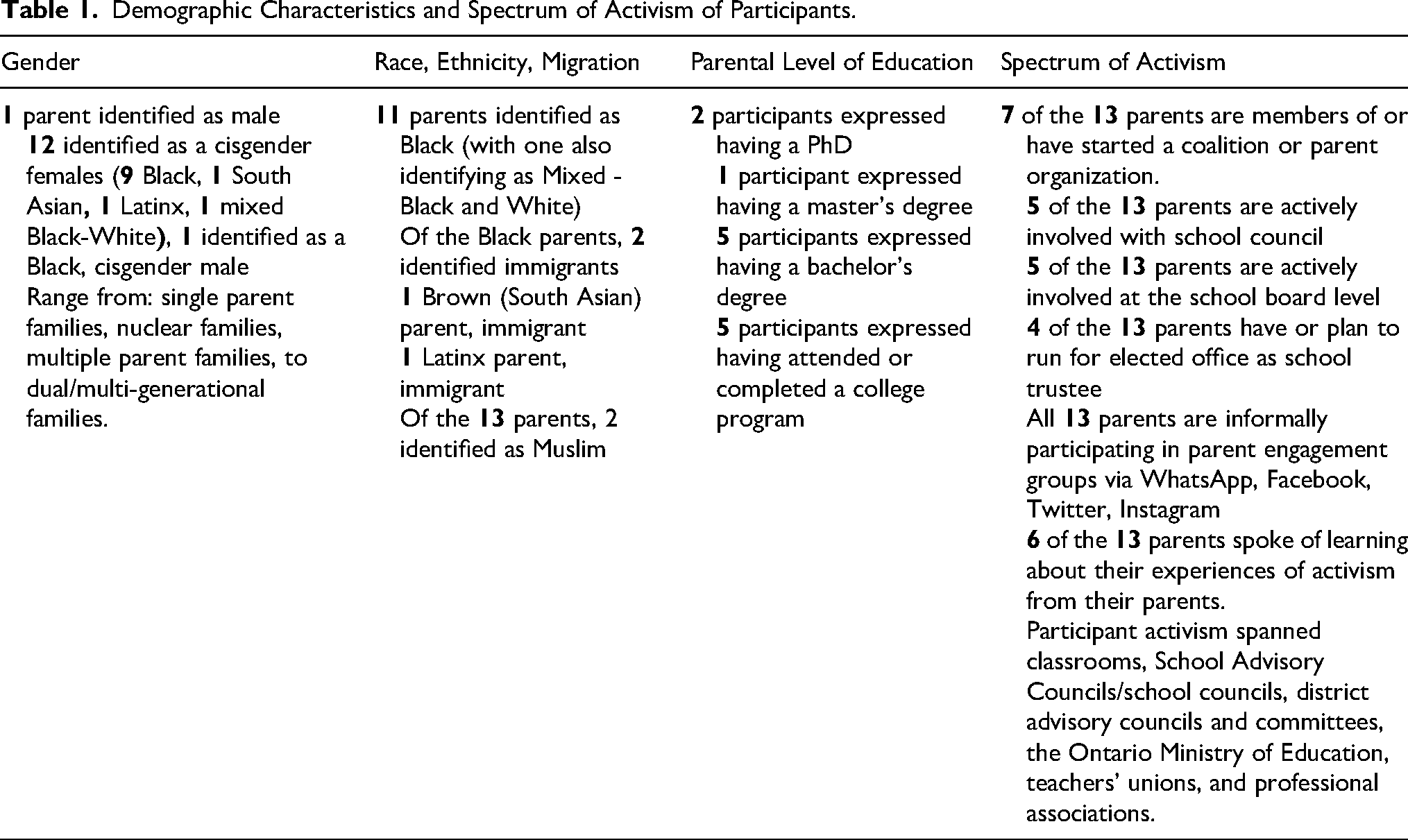
It is important to note that this chart clearly identifies that parents, especially Black parents, face racism regardless of their level of education or family structure, challenging the assumptions that “educated” or “professional” Black people do not face racism and that Black people are not educated. Participants have children in five school boards in the GTHA, four English school boards and one French school board and private school. Participants’ participation and activism in public schooling and governance range from school councils, to board-wide committees, to engagement with and as elected officials, to provincial programs supporting students. Their connections to other parents and families, groups, and coalitions range from informal, on-the-ground conversations and relationship-building, group chats on WhatsApp, Facebook, and other social media platforms, local and informal community groups, larger-scale, city-wide groups, and provincial parent advocacy organizations. Several participants speak to their journeys and associations changing over the years.
Snowball Sampling and Data Collection
Snowball sampling provides a level of safety to participants, draws on insider knowledge and trust, and as Noy (2008) states, when applied critically, “this popular sampling method can generate a unique type of social knowledge—knowledge which is emergent, political and interactional” (p. 327). The majority of the participants were known to us as parents who have publicly challenged racist policies and practices through social media and traditional media channels. Many of the participants have a relationship with one of both of us as researchers through activist and advocacy initiatives and collectives, and many of these relationships have strengthened during and after this study. Three of the participants were referred to us through participants we knew and were identified as parents who also challenged racist practices that were less publicized. One participant was introduced to us by an educator committed to racial justice.
In particular, we employed oral history methodologies, which provide tremendous insight into past events and reveal new perspectives on the present (Rogers & Blumenreich, 2013). Oral history methodologies can reveal subjugated knowledge(s), knowledge that has been devalued, silenced, or ignored in dominant understandings of power and knowledge (Foucault, 1980), and challenge taken-for-granted assumptions. Therefore, oral history counter-stories are well suited to an exploration of the experiences of racism for Black parents and racialized parents in schooling as they advocate for their children. These counter-stories also shed light on the mechanism of whiteness as property in the protection of white power as a metaphor for the mechanics of schooling.
Interviews were between 1.5–2 h and they all occurred over Zoom given COVID-19 restrictions. Both researchers interviewed all thirteen participants, and each participant was asked the same questions about key incidents of racism in their experiences and their children's experiences of schooling, how these stories and the subsequent learnings shifted over time, the impacts of these incidents on them as parents, and impacts on their children's experiences of schooling and sense of self. As participants shared stories, we asked additional follow-up questions to gain insights based on participant responses. Participants were given their transcripts for review and were invited to remove or change any parts that they were not comfortable with. In a few instances, participants shared additional details by email. This study is part of a larger project with the same participants. In the larger study, we also asked participants about their experiences as activists and advocates leading change for racial justice, the findings of which will be shared in a subsequent publication. These were often emotional experiences for participants and for us as researchers, as they simultaneously surfaced painful memories/present conditions and were experienced as “healing experiences” according to two participants.
Data Analysis
Our analysis happened in multiple stages. During the interviews, we each noted thoughts, ideas, themes, and hunches that were emerging for us. We were in continuous dialog about our thinking over the course of six months, returning to the literature, keeping a close eye on social media about perceptions of parent engagement and the activism of parents in challenging racial injustice. There were several iterations of codes and categories that emerged. Our coding processes moved from descriptive to analytical with time, considering our theoretical framing of whiteness as property. As such, our coding shifted from describing harm happening to parents passively to an analysis of the mechanisms used in schooling to engage active harm. Several months in, it became clear that one paper would focus on the experiences of Black and racialized parents and the ways in which whiteness as property operates to maintain racial injustice, while the other paper would speak to the strategies and approaches among Black and racialized parents and parent collectives towards racial justice. While these two concepts are intricately connected, it was important for us explore how whiteness and its intersections of goodness and smartness operated in the engagement of Black and racialized families. We delved deep into patterns and trends of why Black and racialized parents get involved in advocating for their children and how educators respond to threats to their power and control. We were also interested in what happened when constructs of whiteness (and connections to smartness and goodness) were challenged. Here, we identified a range of coercion tactics used by educators and educational leaders to maintain power and control as forms of property, some of which are evidenced in the title of this study. We mapped positional power and noted differences in harmful tactics depending on the level of positional power in the school district. We explore these narratives below and then theorize them through the four aspects of whiteness as property (Ladson-Billings & Tate, 1995) and the ways in which notions of whiteness, smartness, and goodness (Broderick & Leonardo, 2016; Gillborn, 2016) expose how mechanisms of schooling maintain whiteness as property at the expense of Black and racialized families. We have shared initial findings with participants for feedback, especially to ensure that as non-Black researchers, we are capturing the experiences and voices of Black parents with integrity. We have also been in regular communication with several of the participants about mobilizing knowledge for this particular research project, (such as the creation of the webinar series named above), as well as supporting collective advocacy efforts.
Findings
In the findings below, we begin by sharing background information about participants’ own experiences in schooling and why they became involved in advocacy to demonstrate how whiteness (and smartness and goodness) as property operates in parent engagement for Black and racialized parents. We then explore what happens when this property is challenged, exposing the spectrum of coercion tactics used by educators when their power and control were threatened. Importantly, while participants shared their own personal stories and experiences with schooling, they also shared reflections of Black parents and racialized parents more broadly based on their advocacy work.
Experiences of Black Parents and Racialized Parents in Schooling
Some of the participants spoke about their own experiences of schooling. Five of the participants shared positive schooling experiences, many in countries in which they were part of the racial majority and there was a lot of trust in and respect for schooling and educators. Six participants shared negative experiences with schooling, including exclusion, academic streaming, and racial harassment by teachers and students. For four of these six parents, watching their children experience similar patterns so many years later has been traumatizing for them and difficult for their parents who were also affected by these experiences. Two Black parents described the anxiety they experienced in becoming parents, anticipating what their children would experience in schooling and society. Half of the parents, all of whom were Black, were scared to send their children to school, especially their boys, knowing the ways in which Black boys are targeted, surveilled, and presumed guilty.
Parents shared examples of how they were constructed by educators. Several parents witnessed deficit and racist thinking in educators saying, “I don't understand them” or “they can't communicate”, speaking specifically to parents for whom English or French is a second language or parents with accents deemed “different”. The Latinx mother shared a memory of her daughter saying. “Mami, I don't want you speaking Spanish to me anymore”. She then reflected, “It's in these moments when I would like to run to the bathroom and cry, because now it's not just theory.” Participants identified educators’ assumptions that parents marginalized by poverty and parents who speak English as a second language do not have the skills and resources to navigate the system. All of the Black participants described being treated as the “angry Black parent”, “uneducated”, “difficult” and “aggressive” or witnessing other Black parents being treated this way. To disrupt this stereotype before it was enacted, one participant shared, “You know, right away, I set up a meeting with the principal as a doctor. I use that title and I use it very strategically knowing that, you know, how people read me as a Black woman, is very much contrary to how they imagine a doctor to look.” Other participants shared how nervous some parents were to speak up and demonstrate their knowledge of the system for fear that their advocacy would intimidate educators and ultimately harm their child.
The Incident(s)
What were the schooling incidents that led to the anti-racist advocacy of participants? In this section, we explore incidents directly involving children and incidents that involve the treatment of children more broadly.
Incidents directly involving their children
Nine of the ten Black participants described an initial incident or series of incidents directly involving their child as early as Kindergarten. For some of them, the incident involved a call, or several calls home, often within the first week or few weeks of school to complain that their child is too “fidgety”, too aggressive, or too disturbing to other children. As one mom explained: He couldn't do anything in that class without her calling us…He had scissors in his class. I didn't even know it was art at the time, but she told me that he was carrying scissors and it looked like he was going to harm another girl and he's a danger to himself and others. And then when I asked what class it was, it turned out it was art class. And I mean, just any and everything.
These presumptions of guilt were built on racist assumptions. As one Black mother shared, “The boy I drop off at eight o’clock… Like he just transformed into this devil because the boy they described to me didn't match who I know and who I’m around all the time.” These racist assumptions had direct effects on how children are mis/treated in schools. One Black mother shared: The very first day of school… I asked, you know, how was everything? And she came up and she said, ‘Oh, you know, he's really just so fidgety and just, you know, he's constantly moving.’ And so, I was watching him in the school yard, and I said, ‘Well, has he gone to the bathroom?’ And he hadn't. He didn't go to the bathroom all day, and he was holding it.
These assumptions, coupled with differential treatment of Black students and a lack of accounting structures that protect the rights of Black children, led to unfair and violent experiences for Black children. As one Black mother explained, she was called into the school after several instances of her child being restrained by educators in the early years of elementary school, and in one instance, after the police were called in her absence.
Incidents involving the treatment of children more broadly
The Latinx participant, the South Asian participant, and the participant that identified as both Black and Mixed experienced and/or witnessed racism, but they did not speak about significant incidents of racism towards their children that prompted their activism. Instead, they spoke about their activism being prompted by racial injustice they witnessed in the larger education system, especially towards Black children, and their anti-racist efforts in solidarity with Black communities. The Latinx mother shared her observations of the differential treatment of Black students while on a class field trip. The South Asian participant described the school and board's inadequate response to an educators’ public, Islamophobic comments. Five participants (Black, Latinx and South Asian) shared incidents connected to their advocacy involving language, accent, socioeconomic and faith discrimination, in which the school failed to acknowledge or intervene and protect children from harm.
Three of the ten Black participants described the incident that prompted their anti-racist advocacy involving other Black children being treated differently than non-Black children for the same incident/behavior. One Black mother explained that in their interactions, educators taught students to see innocence in White bodies and guilt in Black bodies by giving White students second chances, listening to and believing their stories, and finding evidence that supports an assumption of White innocence. Of course, this simultaneously involves teaching students to see the guilt in Black students, holding them to adult standards of behavior, not listening to or believing their stories, and finding evidence to support an assumption of guilt. Scripts of White innocence and Black guilt in students directly contribute to whiteness, smartness, and goodness as property. One Black mother explained that what is positioned as “safe for White students” is often dangerous for Black students, because White innocence necessitates Black guilt. In addition to the differential treatment of Black students, another participant described an incident in which a racialized, non-Black principal had a very different response to a Black parent group than the largely White school council. She explained, “So, we were told that we could not meet because of job action, [that we] could not be on property and there wouldn't be anybody there to supervise, whereas the school council meeting that was scheduled in the same week had no problem.” Here we see that constructions of whiteness, smartness, and goodness were also extended to parents.
Being treated differently also involved the school wanting to label the child with a learning disability or behavioral challenge without adequately supporting the child and holding the child to different standards for special education needs and behavioral/academic expectations. Every parent who spoke about the school wanting to label their child described the dangers of their child carrying this label for their entire academic career, allowing teachers to form and cement additional, negative impressions, before even meeting their children. Several parents were blamed for their children's “terrible” behavior. As one Black mother explained, “I saw teachers pointing fingers at me, telling me that it was my lack of parenting skills that allowed his violent animalistic child to behave in this manner.” Participants explained that the impacts of these actions prevented their children from academic pursuits, naming the guidance office and special education classes as the ultimate gatekeeping structures. Four Black participants shared their experiences with guidance counsellors blocking their children's academic goals, presuming their children did not have the necessary capacity or competence. These participants were dismayed to share that Black students were more likely to be labeled and streamed into special education classes and lower-level programming, and they were also less likely to have their dreams and seen and realized.
Impacts on Children
Almost every Black parent shared the impacts of ongoing harm to their children. One mother explained needing to buy a weighted blanket for her son so that he could sleep at night. Another mother described her son's stomach pains and being nauseated when he had to go to school. A third mother shared that she had to take her child to the Hospital for Sick Kids for his anxiety. In thinking about her son constantly navigating racism, a Black mother questioned: Where do you find time to dream? Where do you find time to be creative? Where do you find time to learn? Because you’re so busy being scared that you don't even find time to even grow and develop.
In addition to a learning experience that was inadequate and harmful, these children and their parents were navigating the physical, emotional, social, and psychological effects of this harm. It is no coincidence that five Black parents shared desires to keep their child home on days when their interactions with schools were fraught with conflict, wanting to homeschool their child, or being happy about virtual schooling during COVID-19 because they knew their children would be safe. Despite these desires, all but one parent actually homeschooled her children.
A Spectrum of Coercion Tactics
What happened when participants challenged whiteness as property, and associations with goodness and smartness? Several parents used the strategy of asking questions as a means of holding the school accountable. They asked questions of policies, structures, and practices, they asked questions of metrics and benchmarks used to assess their child, and they asked questions about how other children were treated in similar incidents. As one Black mother shared with increasing frustration: You know, another thing that I worked through was asking questions about policies. Like, show me, show me where it says that this and this and this has to happen before that. Or if I don't sign this, then that happens. But I felt, I really honestly felt like one of my hands was tied behind my back and I was backed into a corner.
11 of the participants (Black, South Asian, and Latinx) confronted the school directly and explained that they were uncomfortable and upset by the blatant racism they were experiencing or witnessing. It was at this point, when the power and control of both teachers and administrators was questioned, that we saw evidence of whiteness as property being protected at all costs. As one parent shared: I immediately started to meet resistance mostly from the principal…Once I started to question some of what was happening at his school and questioned them in particular ways, there was very little responsiveness or very little willingness to engage in any kind of critical reflections of what was happening at the school.
There was a high degree of correlation in the coercion tactics that all participants identified educators employing with them and with Black and racialized parents more broadly. In fact, there was a spectrum of coercion tactics that emerged in the data that educators use to maintain power and control in relation to parents, influenced by positional power and the level of alignment to whiteness.
Coercion tactics associated with less positional power
Participants shared that educators with less positional power may use coercion tactics such as condescension and telling Black and racialized parents “how to parent”, which perpetuates a deficit narrative that the “problem” is with the parent, the child, of the “culture”. As one participant shared: They say, (parent name), you need to do a parenting course. (Parent name) went and took a parenting course. (Parent name), you need to enlist the help of this community. There must have been six agencies in this house for nine months around the clock here. And they’re going to tell me I didn't do it. I didn't do enough.
The South Asian participant and several Black participants shared that several educators did not believe their experiences and the experiences of their children, saying, “this incident is not about race”. These statements also came from educators in Black and racialized bodies. Half of the Black participants described how they were passed from principal to Superintendent, to guidance counsellors, back to the principal, without any one person taking responsibility for the situation at hand, essentially tiring them out and distracting them from the issue requiring attention.
Coercion tactics associated with more positional power
Educators and educational leaders with greater positional power and more closely aligned to whiteness are expected to uphold whiteness as property with greater force, ensuring the power and control of the school and district. As such they engaged in more overt coercion tactics to reinstate their place of dominance in the educator-parent relationship. For example, several examples were shared of educators convincing Black and racialized parents that their educational expertise grants them more of a say in the lives of their children. Educators also tried to intimidate, confuse, and exclude participants from conversations about their children. In part, this included using “formal” policies and curriculum, “formal clothing” and “formal language” to directly and indirectly create distance and separation from the participants to make it easier to exert power over them.
Intimidation tactics also included the threat of involving the legal team, and several psychological and educational “experts” that “know” the child better than the parent and can therefore use “expertise” as a means of power and control. One Black parent shared that educators responded with statements like, “You know, I’ve been here 20 years and I know how to do my job. And I have seniority…You can't come in here and tell me how to do my job.” In this way, policy and curriculum were weaponized as tools of whiteness to discount, deny, and silence, while inconsistently enforcing these tools and strategically using them maintain confusion, fatigue, and distraction. Finally, intimidation also included the fear that schools could threaten the futures of their children out of anger or revenge. As one Black mother shared: At that point, we had about 30 incidents of microaggressions that I documented. And at that point, I was just terrified that they could set him up. They could plant stuff in his locker. That was my fear.
Three other Black participants shared a knowing that the school could blame them, set them up, confuse and intimidate them. Four Black participants also described educators exerting their power and control by coercing them into moving their child to a Special Education class if they didn't comply with their decision of positioning the decision as something that is “in the best interest of the child”. Several participants shared their fear that the school has the power and control to deem the parent unfit, remove the child from the parent, and place the child in protective services.
Finally, several Black parents described how educators lied about them to other education officials and to them about their children. They also described examples of educators covering-up or fabricating evidence. For example, four Black participants shared how some educators and administrators cover-up the mistakes of their colleagues, and at times lie about or to parents in order to whitewash these mistakes. Another Black mother shared, “I’ve seen them completely bypass process. I’ve seen things like documents not being signed and then show up signed two weeks later. In fact, I’ve seen the principal sign off that certain actions and meetings had taken place when they never did.” Other participants also described administrators hiding and fabricating information. For example, one Black mother described an educator withholding school-based and district-wide race-based data from her upon request.
Discussion
Findings in this study mirror the literature on the experiences of Black and racialized parents in schooling. Participants spoke to being viewed through narrow, deficit lenses, similar to findings in the literature on the experiences of Black, racialized, and immigrant parents in schooling (Baquedano-Lopez et al., 2013; Boutte & Johnson, 2021; Guo, 2011; Ishimaru, 2020; Ishimaru & Takahashi, 2017; Nakagawa, 2000 Posey-Maddox & Haley-Lock, 2016; Warren et al., 2009). Similar to Posey-Maddox (2017a), Black parents in this study spoke to being both invisible and hyper-visible. Invisibility occurred when White educators failed to acknowledge their experiences and their children's experiences of structural racism in the differential treatment of them or their children involving incidents of conflict, relationships with educators, access, and opportunities. Hyper-visibility occurred in constructions of Black parents as uneducated, difficult, and aggressive, and in their children being presumed guilty in the absence of fair processes, thereby maintaining white innocence. Similar to Guo (2011), participants also spoke to the ways in which immigrant parents experience structural barriers to engagement in their interactions with educators who devalue their expertise and assume deficit narratives with regards to knowledge and agency. Many of these findings are experienced by Black and racialized parents whether they challenge the system of not.
This study adds a dimension to these findings in that it explores the harmful mechanisms used by educators to maintain whiteness (and smartness and goodness) as property when Black and racialized parents challenge their power and control. Whiteness is a logic that upholds control and power among White people in institutions such as schooling, by privileging and normalizing the interests and needs of White students, families, and staff. This logic often exists in White bodies but can also exist in Indigenous, Black, and racialized bodies that have been socialized into whiteness and have been expected to conform to these logics for professional and personal protection and advancement. In the context of public education, Ladson-Billings and Tate (1995) describe whiteness as property as the in/direct benefits of access and opportunity to property owners. We position whiteness in this study as power and control and draw on notions of whiteness as property in education as the “rights” that accompany power and control, such as the rights of disposition, the rights to use and enjoyment, the right to reputation and status, (including the right to innocence), and the right to exclude (Ladson-Billings & Tate, 1995). Annamma et al. (2013, 2018), Gillborn (2016) and Broderick and Leonardo (2016) explore connections between notions of smartness, goodness and whiteness as property that align with and uphold normative identities. In this study, we explore how these interconnected notions of property are denied to Black and racialized parents and children and the intentional harm directed at them when they disrupt White, normative ideals by advocating for greater rights, access, opportunity, and fairness for their children. As such, we position property owners as educators and school district leaders that both uphold and receive protection and benefit from schools as property. In this section, we explore how whiteness as property operates in the engagement of Black and racialized parents.
Rights of Disposition
Rights of disposition reward compliance with white norms and punish deviance from these norms. Building on notions of white norms (Ladson-Billings & Tate, 1995) and “goodness” (Broderick & Leonardo, 2016), this study explored how educators and districts understood themselves to extend rights of disposition disproportionately. Specifically, schools and districts were constructed as all-knowing institutions that were not racist and educators as “experts” who never made mistakes. In the image of whiteness, educators were constructed as exceptionally good, caring, benevolent, and innocent people who provide just opportunities and learning environments for all students. These narratives of whiteness become the criteria against which schools determined which students, parents, families, and teachers are deserving of protection, care, and connection based on their willingness to uphold these narratives. Given the overwhelming presence of structural racism, the experiences of Indigenous, Black, and racialized students and families render this all-encompassing narrative of schooling, a charade at best. Participant responses revealed that parents who upheld and do not question this narrative, at least publicly, often suffered in silence but were afforded greater institutional protection and support for themselves and their children. Conversely, parents that questioned or threatened this narrative were at risk of greater harm, as were their children, especially those in Black and racialized bodies. These relational narratives of whiteness relied on the pathologization and exclusion of any person, community, organization, or structure that threatened its existence. Similar to findings of Ishimaru and Takahashi (2017), Posey-Maddox (2017a) and Lara-Villanueva (2018), participants in this study, especially the Black parents, were often spoken about, spoken down to, ignored, or treated as threats. They were lied to through omission and denial, they may have had information fabricated or hidden about them or their children, and they experienced intimidation tactics to coerce them into alignment with narratives of whiteness. As participants shared, these experiences created other constellations of harm in parent engagement when they intersected with language and accent discrimination, class discrimination, discrimination on the basis of faith, lone-parent status, and more.
Right to Use and Enjoyment
Rights of use and enjoyment correlate quality of property with quality of schooling experiences. Participants, especially Black parents, described their children being denied fair, equitable, and quality schooling experiences because of structures such as Special Education (e.g., being labeled, being moved into a segregated classroom for learning or behavioral challenges), guidance counselling, suspension and expulsion policies, academic streaming, English language programs, and being moved from grade to grade without any attention paid to learning gaps that have accrued from failed schooling. Furthermore, Black participants identified numerous barriers to their children and other Black students being tested and labeled for gifted programs, joining specialty programs, being placed in higher academic streams in secondary schools, or receiving the necessary support from guidance programs to graduate from secondary school and apply for post-secondary programs of their choice. As participants in this study demonstrated, the right to use and enjoyment also consisted of access to a safe and happy learning environment, which is often denied to Black students and some racialized students. Children must know and trust that their psychological, physical, social, and emotional needs will be understood, acknowledged, and protected by the adults in the building. Even when these needs were met in a given instance, there was an ever-present fear that they would be denied in the near future.
They also shared the ways in which they, as parents, are not able to use and enjoy the school in the same way as White parents, such as the example of the administrator having different “rules” for the White and Black parent groups, or the example of the principal withholding race-based school data from a Black parent upon request. Participants also shared how unwelcome they felt in school environments because of the assumptions made of them, the hostile interactions they experienced, and the unwillingness of educators and educational leaders to work with them in constructive ways to support their children. These interactions posed significant threats to their well-being as parents. Parent engagement for Black and some racialized parents, then, becomes the practice of navigating multiple levels of harm for both parent and child, while attending to the legal expectations of schooling.
Right to Reputation and Status
Educators have the power and control to heavily influence the reputation of children and parents formally and informally. They influence a child's reputation and status in how they formally choose to represent the child in report cards, the child's educational file, and official meetings, and how they informally talk about the child among other educators, to parents/guardians, and to the children themselves. Regardless of participants’ actual relations to property, participants described the ways in which Black, racialized, and immigrant parents were treated as parents with less access to property, evident in the lack of opportunity to engage in collaborative and constructive dialogs with educators without being constructed as difficult. In particular, findings suggested an infantilizing of participants as further evidence of their “inability” to parent according to predetermined, deficit-oriented White norms. Similar to Posey-Maddox (2017a) in Canada and Ishimaru and Takahashi (2017), participants that challenged or questioned the decisions of educators were constructed as problematic parents that needed to be managed. Furthermore, similar to findings in Pushor and Amendt (2018), participants’ examples of parent advocacy and activism were constructed as defiant and instigative instead of parental acts of care and concern. Therefore, while their Black children were often treated as adults and denied childhood innocence, Black participants were often infantilized and denied adult capabilities. Both patterns serve to perpetuate narratives of Black deficit and guilt, justifying the unquestioned power of the school over Black families. These influences on reputation and status are rooted in racist assumptions of capacity and care that follow the parents and children from grade-to-grade and school-to-school. Addressing these patterns requires an interrogation of how Black guilt is constructed in relation to white innocence between students, between students and educators, and between educators and parents, another example of the connections between notions of “goodness” (Broderick & Leonardo, 2016) and whiteness as property. It requires an examination of the differential treatment of White students/parents and Black students/parents, an interrogation of practices such as the hyper-surveillance and adultifaction of Black students and the infantilization of Black parents, and an interrogation of how we reproduce and protect white innocence in students, parents, and teachers in the absence of robust structures for racial accountability.
Absolute Right to Exclude
Schools and districts have the power and control to exclude parents and students from learning and engagement opportunities, and this happens in a number of different ways. The findings in this study outlined a spectrum of coercion tactics used by educators with lesser and greater levels of positional power. These tactics, ranging from reinforcing deficit narratives and being passed off from educator to the next, to being lied about and having information go missing or fabricated, had the explicit purpose of excluding Black and some racialized parents from decisions affecting their children. The majority of Black participants also experienced or feared their child being excluded from schooling and the larger society through structures of policing and student discipline, such as the Black mom who was scared that educators would “set up” her child or the Black mom whose young daughter was restrained after the police were called in her absence. As shared above, several participants also feared the school would deem them unfit parents and place their child in protective services. Adjei et al. (2018) explain: Black children are taught about how to conduct themselves when interacting with people in authority, such as police, teachers, social workers, and other state-sponsored institutions and agencies, because any act of open resistance can be read as a threat that can result in either imprisonment or shooting to death. Unfortunately, this practice of raising Black children within the confines of “racial rules of engagement” in Canada has often been misunderstood as “bad parenting” practices by child welfare agencies, resulting in high level of apprehension and placement into care of Black children.
This fear operates in a context of disproportionately higher rates of Black and Indigenous children in care in Ontario (Ontario Human Rights Commission, 2018). For many Black parents, the reasons, mechanisms, and limits to their engagement with schools are intimately connected to the threat of being forcibly separated from their children or the fear of their children being excluded from academic and life experiences altogether. Parental engagement for many Black parents is an ongoing risk for the right to raise, love, and teach their children.
Conclusion
Schools are often positioned in society as institutions of care and learning. This may be true for some students and families but is far from the truth for students and families at the margins of power. The 11 Black parents, one South Asian parent and one Latinx parent in this study described stories of harm, lack of belonging and grief in their experiences advocating for their children or other Black and racialized children. These stories turn the gaze upward, exposing how whiteness as property, as it relates to notions of “smartness” and “goodness”, operates to intentionally maintain the social reproduction of schooling as exclusive and harmful to Black and racialized parents and students. What this study lays bare, is that these experiences are not simply a result of cultural mismatch, differences in ideology, or a lack of awareness that accompanies explanations of “unconscious” bias or “unintentional” harm; these are stories of how the institution of schooling has allowed active harm to maintain compliance and conformity to whiteness. Until we acknowledge the intentionality and active engagement of harm towards racialized students and families, especially Black students and families, anti-racist efforts remain decorative and performative. The protection of whiteness as property allows racist actions of educators to be protected at the expose of Black and racialized students and parents that challenge the power and control of educators and schooling to protect their children.
The rights being denied and weaponized against Black families, in particular, necessitates a re/theorizing of parent engagement through multiple and intersecting frameworks that account for the multiple racisms and intersecting systems of oppression operating in Ontario schools. For example, Marchand et al.’s (2019) notion of critical parent engagement, a conceptualization that merges critical race theory and critical consciousness, including intersectional analysis of anti-colonial, anti-imperial, and anti-capitalist theories, provides a more dynamic and comprehensive analysis and way forward. Similar to Lewis Ellison (2019) and Allen & White-Smith (2018), this study urges parents and educators to be informed about and to humanize parents’ counter-stories, so that we challenge normalized, deficit, and school-centric narratives of Black and racialized parents by valuing their cultural wealth and funds of knowledge. Considering Yosso’s (2006) Community Cultural Wealth Framework, community-based family engagement programs can also be used to enhance families’ social and navigational capital (Gil & Johnson, 2021). However, we also need to seriously consider the limitations of schooling and imagine educational futures outside of institutions that serve the White, settler state by looking to abolitionist and liberatory pedagogies (Love, 2019; Stovall, 2018) that conceptualize education outside of the physical and psychic boundaries of schooling.
Footnotes
Declaration of Conflicting Interests
The author(s) declared no potential conflicts of interest with respect to the research, authorship, and/or publication of this article.
Funding
This study was funded by the Social Sciences and Humanities Research Council (SSHRC).
