



Abstract
This qualitative study explores one urban district's purpose, design, and implementation of a unique classroom management coaching program for first-year teachers (FYTs). Through interviews of coaches, assistant principals, and district administrators, we identify why and how this program supported FYTs’ struggles with classroom management. Results highlight difficulties related to culturally responsive classroom management, which was mitigated by district coaches who provided individualized support. Data also indicates specific misconceptions held by FYTs, strategic district decisions in designing the coaching program, and challenges encountered throughout implementation. Findings have implications for the preparation and support of culturally responsive classroom management for FYTs.
Keywords
Introduction
Discipline is not dispensed equally. Throughout many classrooms in the United States, students of color are likely to receive more frequent and harsher consequences (Santiago-Rosario et al., 2021; Skiba et al., 2011). This disproportionate administration of discipline stems in part due to the pronounced cultural gap defined by the diversifying student demographic juxtaposed against the stagnant White teaching workforce (Center for American Progress, 2017; Lowenstein, 2009). This gap can percolate issues pertaining to student discipline when teacher and students have disparate understandings of what constitutes as engagement and misbehavior that are left unaddressed (Bottiani et al., 2018; Carter et al., 2017; Gregory et al., 2010, 2016). Consequently, unfairly punished students then miss instructional time, exacerbated by difficulties in catching up alongside educator resistance (Bell & Puckett, 2020), perpetuates student difficulties and contributes to issues of the achievement gap (Gregory et al., 2010). This is particularly salient in urban contexts (Milner, 2020a) and figures to be prominent within beginning teachers’ classrooms.
One remedy for disciplinary disproportionately is effective classroom management (Skiba et al., 2014), which is the pedagogical skill of maintaining an environment by caring for students’ socioemotional and academic needs (Evertson & Weinstein, 2006). This skill is positively associated with student outcomes such as achievement and engagement (e.g., Pianta, 2006), as classrooms are more efficiently organized and students have less opportunities to misbehave. Effective classroom management is also related to teacher outcomes of evaluation, stress, retention, and development (Bottiani et al., 2019; Kwok, 2017; Wronowski, 2018), which is particularly striking for beginning teachers who tend to have developing understandings of classroom management fixated on behavior and authority (Kwok, 2019, 2020; Okonofua et al., 2016). This perspective could account for some of the aforementioned disciplinary inequalities because of an emphasis on control rather than attending to individual and cultural differences.
Instead, culturally responsive classroom management (CRCM; Weinstein et al., 2004) could more serviceably bridge issues between discipline and demographic differences, specifically, by prompting teachers to focus on the relational dynamics in the classroom. CRCM is the acknowledgement and utilization of race, culture, and context towards responsive management practices, and has been associated with student achievement (Bell & Puckett, 2020; Dee & Penner, 2017; Larson et al., 2018) and changes in teacher praxis (Caldera et al., 2019). These skills reframe teachers’ attention towards utilizing cultural differences to enhance classroom management strategies, which could be particularly meaningful for beginning teachers. That is, it can shift their attention from establishing authority regardless of the students towards building an environment specific for that classroom of individuals (Kwok et al., 2020). Unfortunately, the preparation of, and support in, CRCM is limited. While various intervention programs support teachers in classroom management (Bear, 2015), few contain content about or relate to CRCM (Milner, 2015), or focus on coaching beginning teachers.
Our qualitative study explores the purpose, design, and implementation of a classroom management coaching program focused on tenets of CRCM. We investigate how an urban district responded to persistent first year teachers’ (FYT) struggles and its corresponding ill effects on students, especially those of color. We interviewed three unique roles—district administrators, assistant principals, and classroom management coaches—to explicate the generation and execution of this district-wide program; that is, we piece how district leaders translated a theory of CRCM development into practice. Our descriptive analysis offers insight into practitioner-proposed solutions for beginning urban teacher development. We also discuss the strengths associated with the studied model, including the identified benefits of providing FYTs with context-specific support. The questions guiding this study are:
Purpose: Why did CISD design the Classroom Management Coach Program? Design: How did CISD strategically choose to support FYTs in classroom management? Implementation: What strengths and challenges did the Classroom Management Coach Program have during its first year of implementation?
Literature Review
Beginning Teachers & Classroom Management Programs
Beginning teachers often receive inadequate classroom management training (Greenberg et al., 2014; Stough & Montague, 2015). What little preparation they received, seldom factors student race and culture, or simply, the necessity of building student relationships (Pomerance & Walsh, 2020). Consequently, beginning teachers initially struggle to manage their classrooms (Bettini & Park, 2021) by experiencing psychological distress when unable to connect with their students and, as a result, have difficulties managing their classroom (Lee et al., 2020).
Districts attempt to support beginning teachers by offering various classroom management programs. Korpershoek et al. (2016) conducted a meta-analysis of 47 studies and found over 20 different programs implemented across hundreds of contexts, with specific attention paid to those most commonly used by districts. Overwhelmingly, programmatic focus was on student behavior (85.2%), though many had identified positive effects. However, just over half considered teacher behavior (53.7%) and only a fraction contained content about teacher-student relationship (3.7%). This is particularly troublesome given the stated importance of relationships (Wubbels et al., 2015), but more importantly, programs may need to prioritize guiding teachers towards effective actions. This is especially true in urban schools where beginning teachers struggle to implement professional development when not context-specific (Bettini & Park, 2021) and thus, need more initial support to utilize the benefits of such programs (Bear, 2015).
In one promising example, Hirsch et al. (2019) investigated elements of an urban district's practice-based professional development that sought to support universal classroom management skills with beginning teachers. This model influenced positive changes to participating teachers’ management knowledge and practice as well as student engagement. While limited in sample size, its findings suggest a potential benefit of targeting specific beginning teacher professional development rather than large-scale district application, complementing evidence identifying the value of buttressing individualized needs of teachers (Simonsen et al., 2014).
Further, district programs embedding teacher coaching appear to be particularly successful in supporting classroom management, as the personalized nature of the teacher-coach relationship could provide nuanced assistance (Kraft & Blazar, 2018; Kwok et al., 2021; Pas et al., 2016). For instance, Flynn et al. (2016) examined the use of a professional development intervention incorporating one-on-one coaching focused on classroom management strategies. Secondary large data analysis indicated that schools implementing this intervention significantly reduced school suspension. This has been shown in similar models, particularly within urban districts (e.g., Reinke et al., 2015) and separately, even amongst classrooms with higher levels of behavior problems (Tolan et al., 2019). However, despite reductions of disciplinary actions, these programs may not necessarily reduce racial and cultural discrepancies within these numbers. That is, disciplinary disproportionality may still be ever present.
Disciplinary Disproportionality
Even when adequately supported in foundational classroom management strategies, cultural differences could result in differential enactment and response. Disciplinary patterns often reveal that students of color receive disproportionate consequences upon no fault of their own as compared to their White peers (Skiba et al., 2011). While an issue nationally (Civil Rights Data Collection, 2016), this is particularly salient in Texas, where the average rate of Black students receiving an expulsion or suspension is nearly two times higher than the total proportion of said disciplinary actions in the state (Texas Education Agency, 2020). This is especially alarming for urban schools, which tend to have a higher proportion of diverse students being taught by educators of a different race and with less experience (Wronowski, 2018). Further, daily interactions between teachers and students reveal racial patterns and the disproportionate disciplinary practices that harm students of color (Diamond & Lewis, 2019; Peguero et al., 2021).
Schools and districts need to thoughtfully consider how to buck this trend, which is plausible given that these actions are often attributed to subjective teacher decisions (Girvan et al., 2016). These teacher decisions stem from cultural differences, which are particularly noticeable for beginning teachers. Culture shapes perceptions of (mis)behavior, engagement, and relationship building within the classroom (Sullivan et al., 2014; van Tartwijk et al., 2009), which can become problematic when teachers work with students from a different social, economic, and political background (Obidah & Howard, 2005). For instance, Watson et al. (2006) interviewed 17 teachers, 15 who were White, starting their first year. Most participants had matriculated through suburban schools that established a “normalcy” of those experiences and the expectation of similarly displayed student behavior. When prompted to describe urban teaching, participants communicated assumptions about student characteristics incorporating deficit language, which attributes educational and behavioral underachievement of minority groups on perceived deficiencies related to the students, families, and cultures (Cavanagh et al., 2014; Esteban-Guitart, 2021). As such, there is a mirroring of these deficit laden beliefs within the disciplinary decisions made by teachers. Rather than using discipline as a space for open dialogue and development, current practice often punishes student behavior in attempt to force compliance and perpetuate racial exclusion from the classroom (Milner, 2020b; Simson, 2013). This mindset is notably detrimental to students of color if their teachers hold lower academic and behavioral standards and expectations for success within the classroom (Kunesh & Noltemeyer, 2019; Sondel et al., 2019), which is then associated with receiving more disciplinary referrals (Santiago-Rosario et al., 2021). But this mindset can also affect non-minority students, who observe microaggressions towards their peers of color and then potentially integrate similar actions and perspectives into adulthood (Diamond & Lewis, 2019).
Fortunately, beginning teachers continue developing and exposure to diverse experiences could mitigate deficit or culturally deficient beliefs. Teachers who attended urban schools and then work in similar educational contexts often provide more empathic perspectives. Vernikoff et al. (2018) argue that these teachers bring a personal understanding of the cultural context, which facilitates an asset-based mindset of students’ behaviors and decisions. Even without direct experience, the acknowledgement of race, gender, and economic inequalities could promote an inclusive and positive mindset that alleviates aspects related to disciplinary disproportionality (Carter et al., 2017; Gregory & Roberts, 2017; Howard, 2010). This acknowledgement is foundational to CRCM, described next.
Conceptual Framework
Culturally Responsive Classroom Management
CRCM provides a framework in which teachers’ background and the lived experiences of students are used to develop culturally responsive praxis (Weinstein et al., 2004). CRCM facilitates a learning environment based on intentional teacher-student relationships and utilizes prior knowledge and experiences to construct appropriate, nuanced classroom structures (Cartledge et al., 2015). This is particularly valuable for teachers whose background differs from their students, most commonly within urban schools (Carter et al., 2017). However, with little to no formal training in CRCM throughout teacher preparation (Siwatu et al., 2017), it can require substantial effort to deconstruct equality or deficit-based beliefs (Kwok et al., 2020; Whitaker & Valtierra, 2018).
The effort is worthwhile given the stated benefits of CRCM. For teachers who approach classroom management prioritizing the cultural, linguistic, and behavioral assets of their students, there is an increase in both personalized interactions and positive student perspectives (Aronson, 2020; Larson et al., 2018). Furthermore, having teachers—specifically in the urban context—who view the cultural differences and experiences of their students as an additive part of the classroom can promote similar change within the school environment for both staff and students (Farinde-Wu et al., 2017). And this is not outside the scope of expectations for beginning teachers. Luet and Shealey (2018) studied the correlation between the management practices of urban teachers and their teacher preparation program, finding that programs that applied an asset-based frame to classroom management had graduates who advocated for their students and worked to change the deficit perception of colleagues. Other evidence similarly points to beginning teachers capably implementing CRCM or related actions in the classroom (Kwok, 2018; Milner & Tenore, 2010).
Fortunately, a call towards addressing disciplinary disproportionately (Gregory et al., 2010) has led to increased attention on CRCM-targeted programs. While some studies focused exclusively on the behavioral components and did not integrate issues around race and culture (Carter et al., 2017), some have exhibited success. For instance, the Double Check program (Hershfeldt et al., 2009) supported culturally responsive practices through professional development and coaching. Evidence indicates that teachers undergoing this program are more proactive with behavior management, report less disruptive behavior, and have higher student cooperation (Bradshaw et al., 2018). While initially designed for a special education setting, it seemingly has had positive effects towards reducing racially based disciplinary decisions as echoed within similar studies (e.g., Knight-Manuel et al., 2019).
Our study seeks to build on these examples by investigating an urban district's coaching program designed to support FYTs in CRCM. While all FYTs should be competent in CRCM, we believe it is particularly salient for urban education and those working in urban-type settings because of the challenges that they typically encounter given prototypical stark racial and cultural teacher-student differences alongside challenges with access to financial and human resources (Milner, 2012; Wronowski, 2018). Allocating resources towards intentional structures, such as CRCM support, provides all students with equal opportunities that they would not otherwise receive by equipping FYTs with necessary reflection and tools (Griner & Stewart, 2012). While the district under study does not specifically use the term CRCM, it is foundational to their work. They, and us, recognize that classroom management strategies alone are insufficient for diverse learners. Rather, cultural differences need to be exposited and utilized within a classroom to be effectively managed, which can best come to fruition by intentionally supporting FYTs. To that effect, we examine the purpose, design, and implementation of a CRCM coaching program to chart the overarching process of how a district can facilitate beginning teacher development.
Methodology
Context
This study is conducted in Central 1 Independent School District, located in central Texas, near a research I institution and correspondingly large teacher preparation program. While CISD is not in a metropolis, it contains nearly all other attributes associated with an urban characteristic district (Milner, 2012). According to 2018–2019 state data, the district's student population of nearly 16,000 is represented by 18% African American, 58.4% Latinx/Hispanic, and 20.5% White. Nearly 77% of the students are classified as economically disadvantaged with 26% English Learners, both of which are higher than the state average (61% and 20%, respectively). CISD's teacher demographics mirrors the national workforce with 67% White and 75.9% female (National Center for Education Statistics, 2020), though, many teachers (39.7%) have only 1–5 years of experience, which is higher than the state average (29.3%). The district's teacher turnover rate (23%) and student disciplinary rate (3.4%) are both higher than the state averages of 17% and 1.4%, respectively. More so, despite the African American students representing about a fifth of the overall student population, they account for over 40% of the total disciplinary actions reported to the state per year. This discrepancy undergirds the impetus for CISD to address persistent issues surrounding disciplinary disproportionality.
Data Collection
We conducted interviews to explore CISD's classroom management coaching (CMC) 2 program from a range of district perspectives. We identified three district roles that have responsibilities in supervising beginning teacher development: district administrators (DA), classroom management coaches (CMC), and assistant principals (AP). Similar to Knight-Manuel et al. (2019), we explore multiple perspectives involved in the construction of a culturally relevant program. We chose to interview supervisors in each of these roles to learn about the different but complementary high-level decisions made to create and enact a program supporting beginning teachers. Specifically, two DAs (Ms. Craig and Ms. Williams) oversaw district professional development for beginning teachers and guided the conception and administration of the CMC program. Ten CMCs were tasked with enacting individualized coaching for all CISD FYTs. Responses and descriptions of their responsibilities were collected from five of these individuals who consented to participate. Finally, APs were external to the program, but we selectively recruited three of them to provide campus-specific knowledge of the benefits and challenges of the CMC program balanced with their perspective overseeing campus discipline and the development of beginning teachers. APs are often considered the disciplinary gatekeepers (Williams et al., 2020) who have responsibilities to enact campus-level discipline while balancing the needs of principals, teachers, and students. A description of each of the twelve total participants is shown in Table 1.
Study Participants.
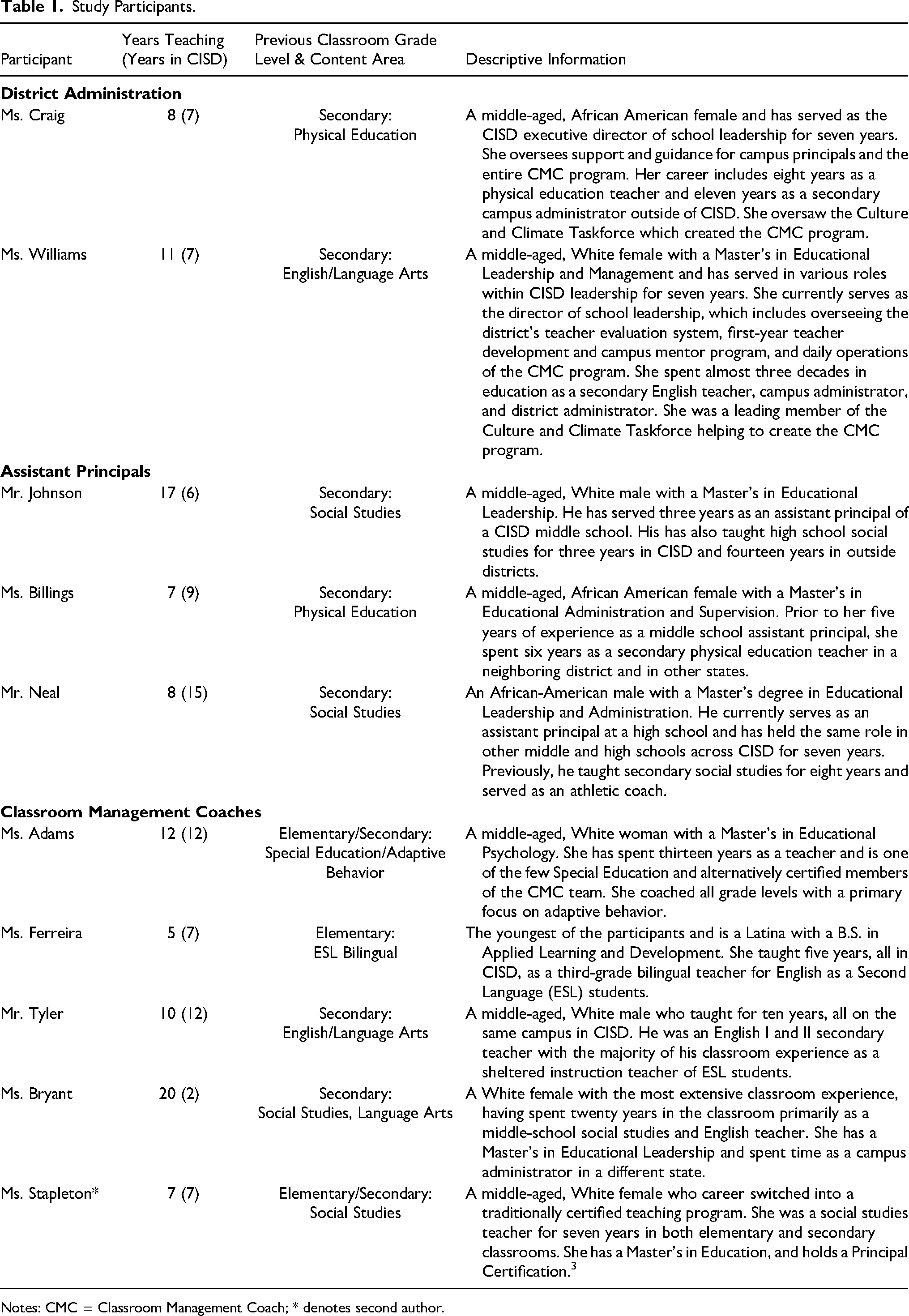
Notes: CMC = Classroom Management Coach; * denotes second author.
Each interview was semi-structured in nature and constructed for this study. Fifteen questions were modified to fit the participant's role to gather their understanding of the purpose, design, and enactment of the CMC program. We inquired about the participants’ background and educational experience, knowledge of the CMC program and why it was developed, beliefs about FYTs’ understanding of classroom management, and thoughts about the enactment of the program. The base interview protocol was piloted between the authors, as one author was a CMC inclusive in the study. Afterwards, the protocol was refined to ensure each item accurately addressed our research questions. Every interview was conducted in person by one of the authors during the 2018–2019 academic year, completed in approximately one hour, and transcribed verbatim.
Data Analysis
For our method of analysis, first we engaged in constant comparative analysis (Strauss & Corbin, 1998) with the twelve transcribed recordings to code for ideas. Each transcript was open-coded, analyzed at the level of the idea unit (Lincoln & Guba, 1985) for how participants described the CMC program. From this, we collectively created initial codes which generally held within a participant's response. The few responses that switched ideas and came back to the original idea were all counted as separate units.
Second, we grouped these initial codes according to three preset categories based on our research questions and the corresponding structure of the interview protocol: purpose, design, and implementation. We knew participants would focus their responses in these areas, but had little idea about what content they would discuss and to what extent. We created analytic memos (Charmaz, 2008) outlining how the data fit within these categories.
Third, we engaged in a second round of coding by focusing on each category individually and reviewing relevant initial codes. We grouped similar data pieces together and created emergent themes that represented the broad understanding. We again utilized analytic memos to conduct constant comparative analysis (Strauss & Corbin, 1998), where we consistently went back and forth between the data and our interpretations to ensure reliability in establishing these secondary codes. We also engaged in analytic discussions with one another to extend thoughts and upon solidifying these secondary codes, designated them as themes. We also attempted to analyze responses by participant groups—hypothesizing that certain themes would reside by their distinct role—but patterns held stronger with our preset categories. Figure 1 presents our final coding scheme illustrating each category, associated counts and frequencies, and corresponding themes.
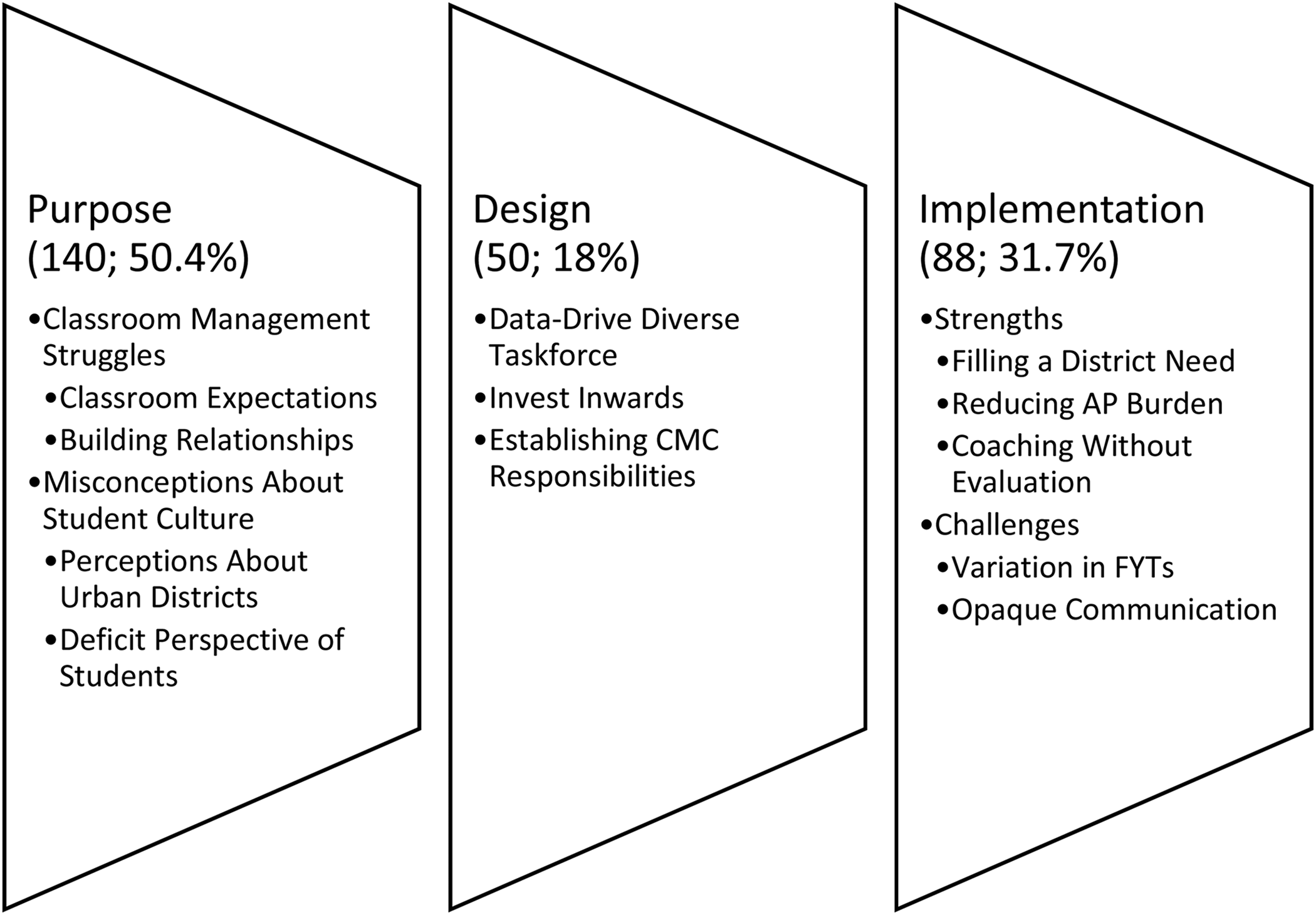
Classroom management coaching program coding scheme (code count; percentage).
Results
Purpose: Why Did CISD Design the Classroom Management Coach Program?
Longstanding issues with teacher turnover and student achievement spurred CISD to specifically focus on student discipline and supporting FYTs in this space. Participants spoke about two prominent areas within FYT development that prompted programmatic design: classroom management and student culture.
FYT Struggles With Classroom Management
Classroom Expectations
Participants consistently expressed how they observed FYTs struggle with classroom management. Notably, they shared about challenges in establishing and consistently enforcing classroom expectations. FYTs had difficulties with “maintaining their expectations, and the communication of expectations” (Mr. Neal, AP) and “with just reminding the kids of their expectations” (Ms. Stapleton, CMC). Relatedly, FYTs struggled “to praise for following expectations, they find it so much easier to praise for academic things…. But it's a lot harder for them to think about behavior” (Ms. Adams, CMC). Ms. Billings, who spent five years supervising and developing new teachers as an assistant principal, expressed the amount of time she spent supporting FYTs in this area by emphasizing the importance of: Setting limits. I tell them you kind of have to be, for lack of better words, a “hard ass” in the beginning, and then you can back off, you got to really let them know that you're going to hold them to the expectation…you just have to be a stickler on what the expectations are for the room and how you want the room to function before you can let the reigns go and let kids learn to be responsible. If you don't give them any limits, then it will be chaos. If communication isn't there then the kids keep thinking that ‘hey, this is okay.’ In actuality, it's not and so then later on, they're basically trying to go back and say, ‘Hey, well, I don't allow this.’ Well, you've allowed it…When things aren't addressed, it becomes a habit. Becomes normalcy in the classroom.
Building Relationships
Supervisors expressed how FYTs did not seemingly prioritize the value of building relationships with students. In fact, participants described how relationship building is intricately tied together with understanding students’ culture. Mr. Tyler, who taught high school English, stated, “If you’re making assumptions based on culture, no matter what it is, you’ve hurt that relationship, or you’ve hurt any chance for that relationship to grow.” Similarly, Mr. Johnson worked with various students as an AP and thought that much of FYT management issues existed because “a lot of it is they don't understand our children. They don't understand the kids. They don't understand the backgrounds that they come from and don't take that into account knowing and how to be relational with them.” His vast experience of 17 years teaching across Texas in multiple contexts from rural to suburban, and now in his third year in CISD, buffer his recognition of the disconnect between many FYTs and students.
There were two components specific to relationships that were mentioned. Many felt that FYTs simply did not prioritize this pedagogical skill. As Ms. Bryant noted from her interactions with FYTs that she worked with as a CMC, they: Didn't realize the importance of it and they didn't have the tools to do it. They're so pressured from their instructional coaches to get the curriculum done that they didn't feel like there was time to really sit down and build a relationship with a kid.
Complementarily, supervisors thought that FYTs did not always appreciate the impact of relationships on the classroom. FYTs may have been unaware that some students “will work their tails off…thus they aren’t creating discipline issues. And the reason for that is because these teachers were able to develop relationships with the kids” (Mr. Johnson, AP). Ms. Adams described how she coached FYTs to recognize that students “will come to class on time when they've got a good relationship with you. And they may not be as interested in coming to class on time if they don't. [Teachers] don't understand that that's part of it.” But relationships also played a role in other classroom aspects, such as consequences, where “teachers struggle to turn their dial back and give the kid a second chance…try to repair their relationship so that the class is productive” (Ms. Billings, AP). Inevitably, FYTs were defined by this action because “if you can’t build a relationship…you don’t last long in this district” (Mr. Johnson, AP).
FYT Misconceptions About Student Culture
Participants expressed two types of FYT misconceptions about student culture: perceptions about urban districts and a deficit perspective about their students.
Participants acknowledged an existent stereotype about CISD as an urban or high-needs district that some FYTs embraced. Mr. Tyler, a White CMC who has worked for the district for over 10 years, expressed how CISD “always had the negative outlook, thanks to media, of having the bad kids and the troubled kids…some teachers that come in with that perception, they’ve heard stories or things like that.” This perception has often defined CISD and participants thought FYTs needed to explicitly address it: “In this district, I think it's [about] understanding the way our children are going to, their background, and the way they're going to act and just what they do, you know?” (Mr. Johnson, AP). Several participants spoke of the need for FYTs “to spend time knowing your clientele … knowing their interests, and first year teachers fall flat on that” (Mr. Neal, DA). They wanted FYTs to invest in getting to know their students rather than hold onto any preconceptions that they may have.
Many participants disclosed that FYTs also exhibited a deficit perspective. CMCs recalled previous conversations that they had with FYTs, particularly around students’ home context: “Sometimes they will say, ‘They learned it from home; it's from there. There's not enough support at home.’ Which may or may not be true, but it's definitely not useful” (Ms. Adams). As a former secondary English teacher working primarily with ESL students, Mr. Tyler further explained his experiences with FYTs and these beliefs, “that because [students] can’t speak the language, then they’re not intelligent…. that assumption that if they can’t speak the language, then they don’t understand.” These thoughts were sometimes paired with racialized statements from FYTs, hopefully without malicious intent: “Several times teachers, who are predominantly White say, ‘well, these Black kids are behaving this way’” (Ms. Ferreira). Ms. Ferreira went on to explain how her role as a CMC was “to ensure that they feel the ability to teach all of their students. And so my goal is to give them the lens for them to see that all of their students are capable of behaving appropriately.” There was a tension she felt in dealing with separate but related ideas of setting classroom expectations and being culturally responsive.
Ms. Craig (DA), director of school leadership for 7 years and overseeing the CMC program, recognized through her analysis of district discipline data that many FYTs were likely misappropriating behaviors because of racial and cultural differences, saying: A lot of it was based on dress code, talking loud, disruptive behavior defined by the teacher, but things that we had seen in the classroom when we started getting down to the nitty gritty – it really wasn’t disruptive. It was just loud. And we do know that our African American population, they tend to be loud. We tend to be loud. And poverty's loud.
Ms. Billings (AP) further spoke to the misconception of student responsibility outside of school, and how that leads to conflict in the classroom. As an African American woman who spent over 11 years working in CISD, she recognized that FYTs were not necessarily understanding students’ home culture and the importance that had in student conflicts: Sometimes when addressing kids in this population, in this community, a lot of our kids have a lot more responsibility [outside of school] than what most teachers experienced as kids, and they don't necessarily see themselves as kids. They want to be treated like the adult that they really are at home. That's a fine line that teachers struggle with.
Design: How Did CISD Strategically Choose to Support FYTs in Classroom Management?
In response to these specific FYT developmental areas, CISD created the CMC program during the 2017–2018 school year. The district made several strategic decisions that constructed the foundation of this program. First, a new district superintendent desired a data-driven resolution to the chronic discipline issues plaguing CISD and created a taskforce with representation from across the district to devise a plan of action. Meeting weekly throughout the school year with focused conversations around data, one area of concern became an immediate priority. Ms. Williams—who was the director of professional development, a member of the taskforce, had 7 years teaching in CISD but over 3 decades in education—expressed: Discipline was what undergirded all of our work. We knew discipline needed to have a solution. And that's why we looked at different programs, different options. We looked at, like I said, longitudinal data, we studied hours and hours of folders about different kids and why this and why this? Why is the recidivism rate so high? The punitive measures aren't working.
This prompted the third strategic decision of establishing CMC responsibilities in consideration of other pre-existing district roles. CMCs, needing to be prepared to handle a range of classroom management scenarios, received training in socio-emotional learning, cultural competency, restorative discipline, targeted behavior functions, universal motivational systems, de-escalation strategies, as well as how to write and implement teacher and student support plans. CMCs were tasked with supporting FYTs across the district, in all grade levels and content areas. As discussed by Mr. Tyler, CMCs were expected to provide tailored support for teachers based on individual needs coupled with the expertise of the coach: It really just is based on their need. I met with a teacher this morning for almost 45 min, because she needed help…. We sat down, we discussed the various things that are involved in a behavior implementation plan, things like that. And then right after that, I went and visited with another teacher at the same campus for 10 min, and just kind of checked in to see how she was doing…which class does she want me to observe. Things like that. It really just depends on the need.
Implementation: What were Strengths and Challenges of the CMC Program?
Upon design, supervisors then worked towards enactment. As a pilot, there were inevitable areas of troubleshooting, which we document through strengths and challenges.
CMC Model Strengths
Supervisors consistently heard from their FYTs that they appreciated being assigned a CMC, and expressed how “they are so excited to have somebody in the room” (Ms. Adams, CMC) and “most of them were very happy to have someone there to bounce ideas off of and get feedback from” (Ms. Bryant, CMC). Some FYTs were nervous “but by the second week of school, vast majority of them were on board with it” (Ms. Stapleton, CMC). Other personnel expressed similar sentiments. Ms. Adams (CMC) adds that “it's a really good model. I think it helps a lot of people. It should be done more.” This was echoed by APs noting that CMCs are “there to support our baby teachers and new to the district teachers” (Mr. Johnson). They even stated a preference for the CMCs to “really work with our brand new baby teachers so that they have a strong foundation” (Ms. Billings) rather than focusing on veteran teachers.
Part of this success was predicated on reducing the burden of responsibility from APs. In comparing before and after the CMC program, Mr. Neal says, “It's effective, before…not enough time to dedicate to each new classroom. It will run you thin versus after being implemented, you now have help in doing that and you have another avenue to reach out to.” In discussing how the program allowed her to hone her responsibilities, Ms. Billings shares: I think it's been very helpful for us as administrators to have that classroom management support for the brand-new baby teachers. Just because it's one less thing we know we have. We don't have to spend a ton of time because with new teachers you have to spend a lot of time on teaching them and holding them accountable to managing the classroom the way it's supposed to be for the campus, and having the CMC in there to support with that, just kind of lessens the load. I think teachers sometimes feel if they come and ask their appraiser then they'll be judged like, ‘Oh, you don't have classroom management.’ And they think they'll get dinged or whatever. They feel a little more comfortable asking them [CMCs] about things that they are struggling with in the class. … the CMC being relational, to be effective. How relational they are with a teacher, because I mean, they are there to critique the teacher and everything else. So, it's important that they establish some kind of relationship, obviously, because they're going to be there to critique them. …it's built mostly on trust. And once they know that you're there for them and to support them, and not to be a tattletale or trying to catch [sic] them doing something wrong. But to just give them the feedback that they need to be the best teacher that they can be, just building that relationship and it takes time. You just can't do it overnight. You've got to prove yourself to them if they make a mistake and they know that you didn't run to the principal, then that helps build that relationship.
CMC Model Challenges
Despite strengths, there were still challenges throughout the CMC program. These challenges were defined by the CMC interactions with FYTs or those who work directly with FYTs.
Variation in FYTs
The initial challenges surfaced depending on the FYTs' individual personality. From an AP's perspective, Mr. Johnson explained: “A lot of that depends on how the teacher accepts the critiques and receives from the CMC…. But the success of it is more dependent upon the teacher that has the CMC, and how they respond to their critiques.” FYTs could have little desire to change or learn from someone else. Instead, CMCs expressed how some of these FYTs: Have their heels dug in so hard, that there's no use wasting your time anymore. At that point, that's when you say, ‘I tried everything I can do to help you. Keep attempting strategies we talked about. If you have any direct questions or anything specific, send me an email. I'll check in on you in a few weeks.’ (Ms. Stapleton, CMC) If you don't have a willingness to want to self-reflect and really be honest with yourself, there is nothing that I can tell you or that I can give to you out of my toolbox to make you better. You don't want to be better because you don't even want to look at what things you could be doing wrong.
Opaque Communication
Even upon having a coachable FYT, some CMCs struggled to navigate multiple contexts. Because CMCs were district personnel and stretched across multiple campuses, they were often uninformed of each campus culture. As expressed by Ms. Ferreira (CMC), “it's hard being on so many different campuses, where every campus is so different, and so I think maybe having a better understanding of the campus norms from an earlier point would be helpful.” She expounded on this from a classroom management perspective, “What happens at each of those campuses, how each principal leads is very different. Being someone that is not on the campus every day, it makes it hard to know what is best practice for each of those campuses.” This becomes problematic because CMCs needed to recognize and understand “their role. And the principal is still the leader of the campus, and whatever they're working with that teacher on, they need to keep the principal involved in the communication as well” (Ms. Craig, DA).
Conversely, APs expressed how they were not always aware of relatively simple information such as “knowing who is assigned to who, you don't really know until they show up and you kind of start asking questions” (Ms. Billings). Even one semester into the academic year, Mr. Johnson stated: “I don't even know who their CMC is off the top of my head. I could be wrong, but…I know I haven't had any face to face communication with a CMC over one of my…baby teachers.” This formed a barrier in “working with administration specifically on a campus, maybe they didn't understand what we were there for completely, they didn't support us completely. It was just new” (Ms. Bryant, CMC).
To guard against these interactional issues, CMCs had to build trust with each individual. They had to establish with APs that “they want the teachers to be successful just like we do” (Ms. Stapleton). Principals had to recognize and “trust the CMC knows what they're doing and they're spending the time in the classroom…and support them in that way to give them everything they need for that teacher” (Ms. Bryant), as well as recognize that “we're working together to hang on to the teachers” (Mr. Tyler).
Discussion
Our qualitative study examines one urban district's coaching program created to support FYTs’ classroom management skills. By interviewing three different district roles, we explore the purpose, design, and implementation of this unique, context-bound coaching structure. Results indicate three main findings.
First, FYTs struggle with classroom management, broadly, but most distinctly with aspects related to CRCM. This distinction is important because while participants expressed how FYTs struggled to establish consistent expectations and give appropriate consequences, the underlying issue was their disconnect to student culture. Supervisors felt that many FYTs did not always recognize their own experiences relative to their students, and that misalignment perpetuated various discipline-related issues. It is important to reiterate that CRCM was never explicitly mentioned; that is, practitioners emphasized tenets of CRCM as central to FYT success without ever using the term CRCM. Yet, every aspect of the framework, as described by Weinstein et al. (2004), permeated throughout the interviews. Participants recognized how building relationships and getting to know their students’ cultural backgrounds would help FYTs to be better classroom managers and succeed in the classroom. CISD chose to design an entire coaching program to support this one pedagogical skill in hopes to reduce disproportionate disciplinary issues. This pinpoints an area of growth that could translate across districts towards beginning urban teacher development. These results highlight the importance of CRCM (Carter et al., 2017; Whitaker & Valtierra, 2018) across multiple district personnel and outlines some methods towards supporting beginners in this area (Kwok, 2017, 2019; Milner & Tenore, 2010).
Second, the importance of relationships touched multiple aspects of FYT support. In fact, for nearly all interactions mentioned throughout the coaching program, positive relationships were central to its success. To begin, FYTs needed to understand the importance of building relationships with their students for classroom management success, which is well-stated within the previous research (Cartledge et al., 2015; Kwok, 2017; van Tartwijk et al., 2009). Additionally, CMC success hinged on their ability to build relationships with their FYTs by exhibiting their expertise and exclusively supporting development (as opposed to evaluation). This reiterates the importance of individualized coaching alongside defining positive interactions from the coaches’ perspective (e.g., Kwok et al., 2021). Finally, CMCs had to facilitate constant, open communication with APs to cultivate trust and a sense of collaboration. This complements the importance of relationship building for coaching (Kraft & Blazar, 2018; Pas et al., 2016), specifically for classroom management development (Bradshaw et al., 2018; Kraft & Blazar, 2016), but our study reiterates its importance from additional perspectives. Adding support personnel inevitably prompts interactions with other supervisors that ultimately should be considered. There needs to be a transparency in responsibility and cooperation to enhance individualized coaching and beginning teacher development.
Third, investing in contextually-bound, human-driven intervention work requires substantial effort, but it could pay dividends. CISD took a long-term approach by strategically deciding to involve multiple perspectives, invest in internal individuals, and tailor the program towards the known needs of their FYTs to curb persistent problems of practice. All participants appreciated this direction and the corresponding aid provided to FYTs. Despite areas of improvement, the benefits derived from the CMC program appeared valuable. While most previous research reports on the implementation of a pre-existing or researcher-generated program (Bear, 2015; Korpershoek et al., 2016), these results provide a foundation for a practitioner-designed program and the corresponding decisions, and to some extent the effects, that come from it. This allows for districts, if they choose, to take ownership of the program by addressing context-specific needs.
Limitations
Several limitations restrict the generalization of this study. First, the sample does not represent all CMCs and campus administrators. Only half of the CMCs participated in this study, and while diverse in their teaching backgrounds, lacked diversity otherwise. Mr. Tyler was the only male on the CMC team, and while there were two Black CMCs that year, they did not respond to multiple requests for participation. We believe that their experiences and perceptions of the model would have provided additional perspectives, though there may be an unfortunate reality that few people of color receive these opportunities to coach classroom management. Further, we also used a participant-researcher perspective, which mitigated the potential bias of information with other CMC voices. Assistant principals were conveniently sampled, meaning these perspectives may not depict that population accordingly; future research could solicit additional perspectives. Second, our data collection consisted of self-reported information. While interviews provide us with necessary depth to explore the generation of a district program, observational data could capture CMC interactions to strengthen current findings. Third, our study does not consist of FYTs’ perspectives, who would provide insight into their own teaching experiences, pedagogical struggles (CRCM-related or otherwise), and interactions with CMCs. Other studies have captured some of these perspectives (e.g., Kwok, 2018, 2019), but gathering them within this context would allow them to push back on perceived challenges as well as provide some measure of CMC program effectiveness.
Implications
Despite these limitations, our findings provide several implications for practice. Foremost, educators need the language and tools of CRCM. As CISD sought to identify FYT struggles and create a new program, district personnel inherently used the language of CRCM. Without the term being explicitly used, though, it questions whether the strategies and evidence surrounding CRCM is accessible to practitioners. For districts, having such knowledge could reduce time spent creating new professional development curriculum as opposed to editing pre-existing resources towards their specific needs. This would also allow districts to adapt their training to best fit their specific student demographic and context, which would provide contextual knowledge that could potentially promote FYTs to retain within district longer.
Relatedly, teacher preparation should emphasize CRCM as a central curricular component where educators examine student culture, their own ethnocentric biases, and how these experiences shape classroom management. Without proper support in utilizing such strategies and perspective-taking, there will be little impetus for FYTs to manage their classrooms in a culturally responsive manner. This could aid in a more seamless transition into the profession and reduce early attrition.
Finally, districts should invest in classroom management support for FYTs, but should do so in an intentional manner. CISD's design choice of not purchasing an external program to address their discipline issues was a strong statement, which could not have occurred without the funding and encouragement of their superintendent. But strategic decisions afterwards to create elements specific to their student population, district needs, and personnel allowed this program to flourish. Program design, just like classroom management, is not a “one-size fits all” approach for every district. Rather, understanding and embedding contextual information gathered from a diversity of perspectives created a solution that portrays a dedication towards student success. When districts meaningfully put the needs of students at the forefront, success is inevitable.
