




Abstract
Leading school turnaround has been conceptualized as a school-level issue focused on immediate change. There has been little consideration about how district leaders change systems to sustain school turnaround successes. This case study research conducted through the lens of Change Theory explores the leadership struggles of one mid-sized urban district’s effort to build on its successful launch of a school turnaround initiative for a subset of underperforming schools. The results suggest that the same pressures that spur initial action can interfere with sustaining success. The dual issues of systems leadership and a sustainable change process are considered as implications.
Keywords
Introduction
Early conceptualizations of school turnaround (e.g., Murphy & Meyers, 2008) advanced the concept as any school-level initiative designed to rapidly increase student achievement in low-performing schools. A federally published practice guide narrowed the focus to emphasize the need for substantial changes in school leadership, frequently signaled as changing the school principal (Herman et al., 2008). Subsequently, federal policies such as School Improvement Grants (SIG) advanced turnaround as a set of policy options—transformation, turnaround, restart, or closure—that were intentionally disruptive and required a new principal, among other things, unless the school was closed (Le Floch et al., 2016). In 2009, 26% of U.S. schools were located in either large or mid-sized cities, but approximately half of SIG-eligible (45%) and SIG-awarded (53%) schools were located in urban centers (Hurlburt et al., 2011). The state’s threat to take over schools in Turner School District (TSD) set up as yet another example of urban school reform churn in which the lowest scoring, most minoritized schools would be overhauled from the top down (Payne, 2008).
Since the legislation of the Every Student Succeeds Act of 2015, local initiatives to turn around low-performing schools have become increasingly diverse, including state operated school districts (Glazer & Egan, 2018) and takeover of schools (Welsh, 2018) and districts (Schueler, 2018), as well as district wide-scale reform initiatives (Strunk, Marsh, Hashim, Bush-Mecenas, & Weinstein, 2016). These new policy efforts to disrupt the status quo in low-performing schools often continue to rely on changing school leadership but also increasingly depend on strategic changes in data use, curriculum, teacher quality, and parental and community involvement. Throughout the research, policy, and practice churn of the last 15 years, however, one relative constant has been an insignificant amount of research on—or general policy or practical consideration of—sustaining initial turnaround progress (Hitt & Meyers, 2018). Examples of rapid student achievement gains or a turnaround jolt from “shock therapy” (Johnson, 2012) have seldom resulted in lasting achievement, instead plateauing with relatively modest gains or regressing to the mean soon after early improvements (Duke et al., 2013). Indeed, there are very few examples of permanent school turnaround.
Perhaps part of the struggle for schools to turn around and then sustain gains, even transition into a model of continuous improvement (Meyers & Smylie, 2017), is that turnaround work has focused primarily on schools and not systems. Federal policies have mostly allowed district leaders to choose how they engage underperforming schools (Peck & Reitzug, 2014), enabling central offices to avoid critical reflection about internal priorities and processes, and how they manifest for schools. Baroody (2011) underscores the importance of systems: “Successful school turnaround also requires district turnaround—fundamental changes in the way that districts think about and provide support for schools” (p. 1).
Not surprisingly, given the focus at all levels on immediate student achievement gains, there appears to have been relatively little consideration at any level about how to routinize policies, structures, and actions that contribute to sustained school turnaround success. Urban district leaders have an opportunity to play a much more substantial role in creating the space for lasting school turnaround by identifying preferred states of being and practices in schools and then providing stability in personnel, funding, and other requisite resources (Meyers & Smylie, 2017). Many recent policies and initiatives, however, have separated the low-performing school from its broader district context even though the district is often responsible for developing and enacting policy, supplying human, financial, and technological resources, and providing continued support.
This research builds on a case study of a Southern, mid-size urban district enrolling approximately 40,000 students in nearly 70 schools. Approximately two-thirds of the schools in the district are Title I eligible and almost exclusively enroll African-American students while the other one-third of schools are more affluent and almost exclusively enroll White students. The ten schools included in this study were labeled urban, recognized as Title I, enrolled African-American students almost exclusively, labeled persistently low-performing, and identified by the state for takeover. The district responded by hiring a new superintendent to “save the schools.” Among his initial decisions, the district partnered with the University School Turnaround Program (USTP) in the 2013 to 2014 academic year because of its history of assisting districts with setting a new organizational course (Herman et al., 2018). Within 3 years, student proficiency levels in eight of the ten schools had increased, principals and teachers in those schools had garnered awards and recognition locally and by the state department of education, which also retracted its threat to take the schools over. Despite indicators suggesting the district had successfully launched school turnaround across its lowest-performing schools (Meyers, 2019), within 4 years systems challenges emerged, seemingly destabilizing early progress.
This study focuses on the disruptions to one district’s efforts to preserve and advance initial successes from its turnaround launch. Although the district level has been studied only intermittently, researchers have identified a number of related challenges to making school systems change permanent, including the complexity of maintaining a focused moral purpose (Fullan, 1999), adapting infrastructures and strategies across time (Adelman & Taylor, 2007), and building leader and teacher capacities to match shifting demands (Peurach & Neumerski, 2015). To add to the sparse body of literature on urban school district turnaround efforts, especially in a more representatively sized urban district (i.e., not one of the largest systems), the following broad research question guided this case study: What significant challenges did the study district encounter in making permanent the changes enacted in its turnaround launch in support of its lowest-performing schools?
To answer this question, I analyzed various district and school documents, interview data from district leaders and school principals, and observation data of district and school leaders working interactively during USTP programming. The data were analyzed to provide insight into the challenges encountered when district leaders attempt to preserve and advance systems change that prioritizes their lowest-performing schools. These lessons are critical for policymakers, researchers, and practitioners to influence how the district’s role can be better conceptualized to achieve lasting school turnaround.
In what follows, I first briefly review three strands of relevant research before providing an overview of Change Theory, which is the theoretical lens informing this case study. Then, I discuss the methods, providing study context and data collection and analysis details. Following that, I report the results of the study. Finally, I conclude with a discussion that considers implications for policy and practice to preserve school turnaround change, as well as research possibilities to advance knowledge of turnaround in urban contexts.
Review of Relevant Research
To better frame this study of an urban school district’s effort to change permanently how it supports school-level turnaround, I briefly review related bodies of research literature on urban education, urban educational reform, and systems-level change in support of school turnaround.
The Churn of Urban Educational Reform for Schools
Urban educational reforms have been implemented “again, again, and again” (Cuban, 1990, p. 3). Payne (2008) succintly captured urban school reform more than a decade ago with his book entitled So Much Reform, So Little Change. The churn of urban educational reform has been attributed to a number of factors, including the misalignment of policy with context and inequitable distribution of and access to resources. Yet, urban education reformers continue to “tinker” (Tyack & Cuban, 1995) toward improvement at the school level (Johnson & Rose, 1999).
The federally backed Comprehensive School Reform (CSR) program established in the late 1990s provided low-performing schools with up to 3 years of grant funds to implement research-based holistic school reform strategies and methods (Datnow, 2000). The overall impact was determined to be largely ineffective (Berends et al., 2002). Subsequent “shock therapy” treatment (Johnson, 2012, p. 232) accompanying No Child Left Behind policy—including increased resources, school choice possibilities, and closure—might have increased student achievement overall (Dee & Jacob, 2011) but appears to have yielded relatively little change regarding urban school capacity and organizational structure (Leatherwood & Payne, 2016). The federal government phased out CSR in favor of School Improvement Grants (SIG) that ultimately totaled more than $7 billion to turn the nation’s lowest-performing schools around (Emma, 2015). The significant federal financial push of SIG accompanied by its four models of school turnaround is a recent policy initiative that continues to underscore an educational commitment to improving the nation’s lowest-performing schools by focusing primarily on schools (Le Floch et al., 2016).
Limited Consideration of the District Role in School Turnaround
Now a more than a decade old, school turnaround has come to be understood as a policy intervention that forces change in school leadership as a jolt to disrupt the status quo of low levels of school achievement (Herman et al., 2008). Born in the business world as a strategy to “save” failing businesses (Murphy & Meyers, 2008), societal conditions that have produced inequitable outcomes in urban schools have almost never been considered (Peck & Reitzug, 2014). Initial conceptualization of school turnaround placed limited emphasis on the systems failure contributing to schools’ low performance, and federal policy tied to SIG funding further established the notion that a school, and especially the school principal, was responsible for saving itself (Hurlburt et al., 2011). Generally speaking, district leaders have had wide latitude in determining their responsibility for and role in turning low-performing schools around. Federal policy has only required district leaders to conduct managerial responsibilities such as the oversight of funding pursuits and fiscal management (Meyers & Smylie, 2017). Some districts have been missing partners completely (Peck & Reitzug, 2014). Few have sufficiently attempted to address their own structural and operational deficiencies in service of schools (Smylie, 2016).
Almost all aspects of the systems hands-off approach to overseeing school turnaround have been reminiscent of past urban education school reforms that stalled from education policy often divorced from current urban infrastructures and organizational environments (Payne, 2008; Wilson, 2012). This seems especially important considering more than half of schools initially receiving SIG “turnaround grants” were urban and up to three-fourths were located in metropolitan areas (Klein, 2010). Thus, although not specifically an urban education reform policy, the preponderance of schools impacted by SIG and school turnaround initiatives have been urban.
There have been noticeable shifts, however, in how policymakers, practitioners, and scholars propose prioritizing the work of district leaders to rapidly improve low-performing schools. But to do this, organizational structures and priorities likely must change. This requires a reconsideration of schools as entities within a district but instead as a system governed by a central office that affects school structures and operations to varying degrees through resource dependencies, accountability relationships, politics and broader economic, socialcultural, and racial institutional contexts (Meyers & Smylie, 2017).
Contextualized Nature of Urban School District Change Initiatives
Increasingly evidence suggests that strategic policy initiatives can result in district-level operational changes that affect teaching and learning, resulting in student achievement increases (Schueler et al., 2017). The generalizability of study results, however, might be limited by contextual and policy nuances. District turnaround reform initiatives are mostly limited to large, urban districts that are some of the most structurally complex. Not only are they complex, their contexts are often distinct. For example, there is a considerable line of research on New Orleans schools since Hurrican Katrina (e.g., Jabbar, 2015) that suggests the conversion of traditional schools to charter schools and the formation of an education marketplace could result in districtwide student achievement gains while not necessarily being disaster capitalism (Salazar Perez & Cannella, 2011). The advent of a natural disaster and subsequent relocation of many students resulted in an unprecedented reform possibility in New Orleans that is not likely replicable elsewhere and could limit the generalizability of the lessons learned from that context.
Occasionally, large urban districts have attempted widescale reform to improve their lowest-performing schools. For example, a series of studies of the Los Angeles Unified School District’s Public Choice Initiative highlights the hopes and frustrations tied to such an initiative. Researchers found that three consecutive reform cohorts had widely divergent student achievement results. The first cohort had no statistical change. The second cohort, which relied on increased support and accountability along with only models of reconstitution and restart, had significant increases in reading scores. The third cohort, which had muddled implementation, resulted in student achievement declines (Strunk, Marsh, Hashim, Bush-Mecenas, & Weinstein, 2016). Change efforts and innovation remained primarily interest-based despite an intention to become more deliberate (Marsh et al., 2015). For example, even though the reconstitution model—a corrective action strategy in which school administrators and teachers must reapply for their positions but are frequently replaced—initially had levels of success as a disruptive innovation, the district eventually discontinued using it (Strunk, Marsh, Hashim, & Bush-Mecenas, 2016). Political dynamics in urban districts have substantial explanatory power for the uneven results (Marsh, 2016).
Regardless, the focus on school conversion to charters in New Orleans in the aftermath of Hurrican Katrina has little in common with widescale reform in the massive Los Angeles Unified School District. Neither has much commonality with various change initiatives in mid-size urban districts more typical in structure and complexity. As such, the research base on district-led school turnaround is quite limited. Thus, in the next section that explicates the conceptual framework for this study, I discuss aspects of Change Theory and how it allows for consideration of organizational changes broadly.
Change Theory: District Leaders Attempting to Refreeze the System
School turnaround initiatives are intentional efforts to change organizational processes in schools to increase student achievement. In this study school district, systems-level change was assumed to precede meaningful improvement for a set of low-performing schools. Elsewhere, I have reported the results of the district’s initial change attempt, which I described as a successful systems turnaround launch (Meyers, 2019). In this article, I extend the change process to consider the extent to which those early successes were preserved through Change Theory.
Lewin (1947) articulates a three-stage model in Change Theory. First, an organization must unfreeze, where it rejects prior learning, policy, or structures. Then, it can change, or alter its behaviors. Once the organization moves to a new level, it should refreeze, where the changes made become the new way of being or standard operating procedure. As an example from the district in this study, Turner School District (TSD) leaders determined that the lowest-performing schools could not improve if district structure was not reorganized to prioritize those schools. Results of the first study suggest that district leaders rejected a traditional practice in which schools received equal levels of support in favor of equitable levels of support, an illustration of the district unfreezing. As a result, the district established a transformation zone for the ten schools with separate reporting structures, increased resources, and higher levels of principal autonomy, an example of district change. These were critical aspects of the initiative’s successful turnaround launch. The extent to which district leadership would remain committed to such a structure and be able to protect the additional resources was unknown, however. In short, uncertainty about how much structural changes would “stick” or refreeze persisted. Thus, unfreezing and change occurred, but whether or not TSD was able to refreeze was unknown.
I prioritized Change Theory to guide my conceptualization of this study in large part because it is relatively broad. Since little is known about how a school district orchestrates a turnaround process for a subset of schools, Change Theory allows for an inductive analysis to determine if initial change became permament, and why or why not.
Study Context
Program Overview
The University School Turnaround Program (USTP) partners with districts for approximately 3 years of integrated activity. In a typical year, USTP begins new partnerships nationwide with approximately ten school districts (and 55 schools) of various sizes. The USTP model prioritizes work in two interrelated components of successful school turnaround: (a) district capacities and conditions necessary to initiate, support, and enhance transformational change; and (b) high-impact leadership at the school level that develops a change vision and acts with urgency to move the school toward achieving it. For more than 15 years, USTP has traditionally partnered with school districts focused on turning around their lowest-performing schools by prioritizing district leaders who will develop a strong support network that provides the resources, tools, and accountability necessary to turn around schools. USTP is one of only two school-leadership focused school improvement models with strong or moderate levels of evidence of impact on student achievement (Herman et al., 2018; Player & Katz, 2016).
The aspirational result for a district partnering with USTP is the development of a cohesive leadership system in support of low-performing schools. The partnership includes a launch year with key central office members culminating in weeklong executive education (including direct instruction, case method instruction, and aligned small group workshop tasks within district teams) in the spring. Then, in the subsequent two summers and winters, principals also attend executive education sessions with district leaders, learning about and collaborating on topics such as how to provide tailored supports and resources for school principals and then hold them accountable for performance; devise plans to increase the number of highly effective teachers; and ensure effective instructional infrastructure, including data systems and culture, curricular strategy, and instructional monitoring. In addition, USTP provides ongoing partner support with regular district and school visits to provide district leaders with coaching, feedback, and thought partnership.
At its core, USTP is not, however, a traditional program or intervention with easily articulated areas in which all participating district leaders are to grow and develop. Instead, the USTP model combines executive education, consultation, and tailored supports to assist district and school leaders in re-examining their own leadership capacities and how the district might better deliver differentiated support and accountability, prioritize staffing needs, and ensure an effective instructional infrastructure for its lowest-performing schools. District partners range from small rural districts to some of the largest urban districts in the U.S. Thus, the USTP’s approach to working with districts aligns with my use of Change Theory because the details of the USTP-district partnership varies somewhat in response to the contextual needs and systems issues of each district.
More recently, USTP developed an additional yearlong program focused on preserving and advancing changes made in the districts. This program extends USTP-district partnerships but touchpoints are reduced as USTP transitions out of districts. TSD leaders and principals from three schools participated in this additional year after a 1-year absence. The district renewed its partnership with USTP because the superintendent and chief academic officer believed that some changes made from the initial partnership were tenuous. They hoped to solidify what they perceived to be systemic improvements by branching out to include district personnel who were not part of the original partnership. The additional year of partnership included only three of the original principal participants because the district’s funds to send school leaders had been reduced, resulting in the selection of those identified as most committed to the change initiative.
The School District
TSD is a district with nearly 70 schools in a mid-sized city in a southern state. According to Common Core of Data from the National Center for Education Statistcs, the district enrolls approximately 40,000 students. Almost 70% of them are eligible for free- or reduced-priced lunch and about two-thirds are African-American, with nearly all other students being White. Approximately two-thirds of schools are Title I eligible. Although the district is identified as urban, it is also geographically diverse with 12 schools located in rural or town settings. School enrollments range from approximately 100 students to nearly 2,200 students.
TSD leaders partnered with USTP in the 2013 to 2014 academic year. In 2014 to 2015, the principals of the ten schools under threat of state takeover—two high schools, three middle schools, and five elementary schools—joined the collaboration. Shortly after, district leaders established these ten schools under threat of state takeover as a turnaround zone, or a collection of schools that would be prioritized in various ways in addition to their collaboration with USTP. As noted above, TSD continued its partnership with USTP by enrolling district leaders and principals from three of the original elementary schools in USTP’s Sustainability Program in 2017 to 2018. All ten schools in the initial partnership were traditional public schools identified as urban and Title I eligible. They mostly enrolled impoverished (89–98% free- or reduced-priced lunch), African-American students (95–99%). The schools’ annual state assessments scores were among the lowest in the district and state. See Table 1 for details and Table 2 for an overview of the timeline of TSD’s partnership with USTP.
Timeline of TSD Partnership with USTP (and Overview of Activities).

Study School Contextual Information.
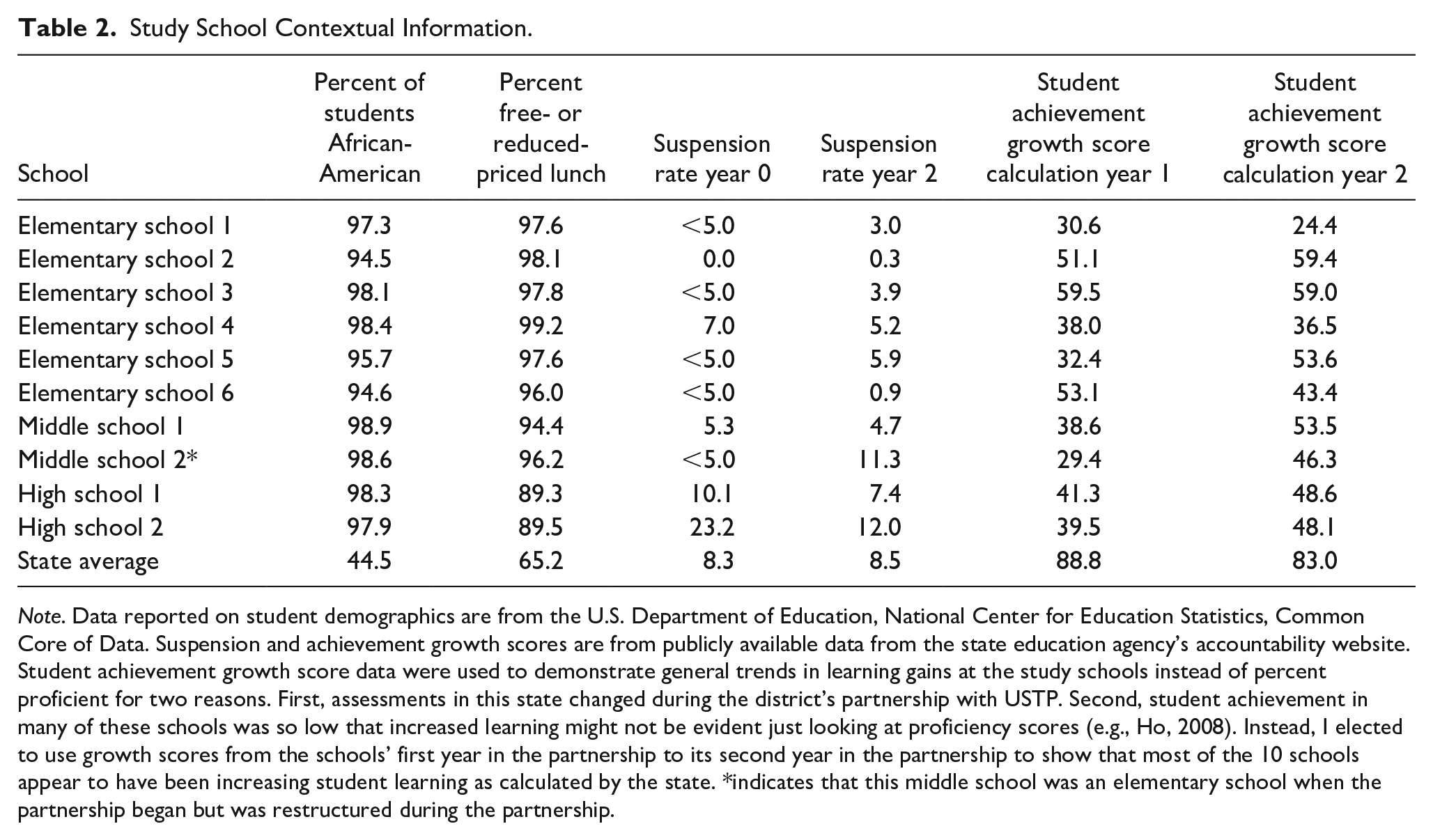
Note. Data reported on student demographics are from the U.S. Department of Education, National Center for Education Statistics, Common Core of Data. Suspension and achievement growth scores are from publicly available data from the state education agency’s accountability website. Student achievement growth score data were used to demonstrate general trends in learning gains at the study schools instead of percent proficient for two reasons. First, assessments in this state changed during the district’s partnership with USTP. Second, student achievement in many of these schools was so low that increased learning might not be evident just looking at proficiency scores (e.g., Ho, 2008). Instead, I elected to use growth scores from the schools’ first year in the partnership to its second year in the partnership to show that most of the 10 schools appear to have been increasing student learning as calculated by the state. *indicates that this middle school was an elementary school when the partnership began but was restructured during the partnership.
At the completion of the district’s initial partnership with USTP, seven of eight elementary and middle schools had increased in percent proficient in English/language arts and mathematics. In addition, six of the eight had gains in state-calculated growth scores. In that time, one school was designated as the top gaining school in the state and another received an innovation and change award from the state education agency. Yet, due to complications from the state changing its assessment multiple times and parallel unclear reporting of outcomes, it is difficult to determine the extent to which schools increased raw student achievement outcomes. There is little question, however, that USTP and TSD leaders believed that substantial organizational improvements had been made. The first phase of this study empirically identified the following results as critical to the district’s seemingly successful launch of turnaround across schools: Commitment to equity, including the redistribution of fiscal and human resources; structural reorganization, including the development of a zone of schools operating somewhat independently within the district; prioritizing school leader and teacher talent and skillsets, including reassignments and development; and changing mindsets within central office, schools, and communities about ethics and possibilities (Meyers, 2019). Perhaps more critically, the state education agency not only revoked its threat to take over TSD schools but actually underscored the district’s accomplishments at multiple points in its consolidated state education plan pursuant to the U.S. Department of Education’s Every Student Succeeds Act.
Methods
This case study research (Yin, 2018) builds on a partnership between TSD and a university-based in-service leadership program. As part of the district’s response to the threat of state takeover, TSD partnered with the University School Turnaround Program (USTP) to focus on improving district and school leadership to turn around ten schools under threat of takeover. Case study research was conducted to learn about the district’s successful turnaround launch in depth and was extended as TSD began to shift focus to preserving its initial organizational improvements. Given the limitations of research described in the review above, the exploratory nature of this case study is an appropriate way to identify and consider challenges to making permanent district policies, structures, and practices that improved schools (Mills et al., 2010).
Data Sources
This research was prompted in large part as a learning opportunity for TSD and USTP to reflect critically on challenges associated with preserving initial turnaround successes. Thus, much of the earliest data collection on TSD’s successful turnaround launch was retrospective (Mills et al., 2010) and limited to documents developed by district and school leaders as part of their partnership with USTP. This study builds on those data through multiple rounds of interviews with key informants—namely the district superintendent, chief academic officer, and former district shepherd (role described below) (Patton, 2002). These district leaders were able to speak to district history, motivation to partner with USTP, beginning successes, and emerging challenges. Interviews with these leaders and others constituted my primary source of evidence. Observations of TSD meetings and workshops as part of two separate 3-day engagements with USTP and related documents were analyzed as data sources to triangulate interview data (Leech & Onwuegbuzie, 2007).
Interviews
I conducted interviews with 15 district leaders and principals—multiple times with most of them—over the period of a year. The interviews began as TSD was committing to the additional partnership year with USTP. The first set of interviews was conducted to understand the perspectives of those involved in initiating change at the district and school levels. Subsequent interviews were conducted to learn more about ongoing challenges to preserve the change. Interview protocols, especially for those interviews conducted in the second round of data collection, were developed in three ways. Some questions were directly aligned with key aspects of USTP’s program (e.g., How, if at all, do you believe the district’s vision should change?). Others were direct follow ups to changes informants had previously indicated to be substantial in district policy, structure, or operation (e.g., How has the addition of new schools to the zone affected how the district provides support?). And lastly, more general questions intended to ellicit responses about challenges not yet widely identified in the district but could emerge as substantial roadblocks to refreezing (e.g., What is an instructional challenge that the district should begin proactively addressing to ensure long-term support of zone schools?).
I worked with district personnel to schedule interviews in Fall 2017. The two initial interviews conducted were unrecorded focus groups, one with district leaders and another with a subset of principals. For them, I took detailed notes. Subsequently, I conducted three audio-recorded focus groups with various district personnel to accommodate their schedules. All other interviews were conducted one-to-one, audio recorded, and transcribed by a professional service. In total, all district leaders and principals who were requested particpated in focus groups and/or interviews. Analytic memos were developed for all focus groups and interviews (Patton, 2002). Interviews ranged from 30 to 60 min in length.
District-level participants either had far-ranging authority in the district (e.g., superintendent and chief academic officer) or worked primarily with the subset of 10 turnaround schools (e.g., director of professional development, turnaround specialist). The district shepherd is a role akin to a principal supervisor who is responsible for developing/coaching principals while also playing a critical role as a district-level advocate for the needs of low-performing schools. All five school principals interviewed were principals of schools in the initial turnaround initiative and include the three who continued for an additional year with USTP. See Table 3 for a listing of interviewees by job/role, interview type (one-to-one or focus group), and frequency (one to three times).
Timeline of Formal Interviews and Observations.
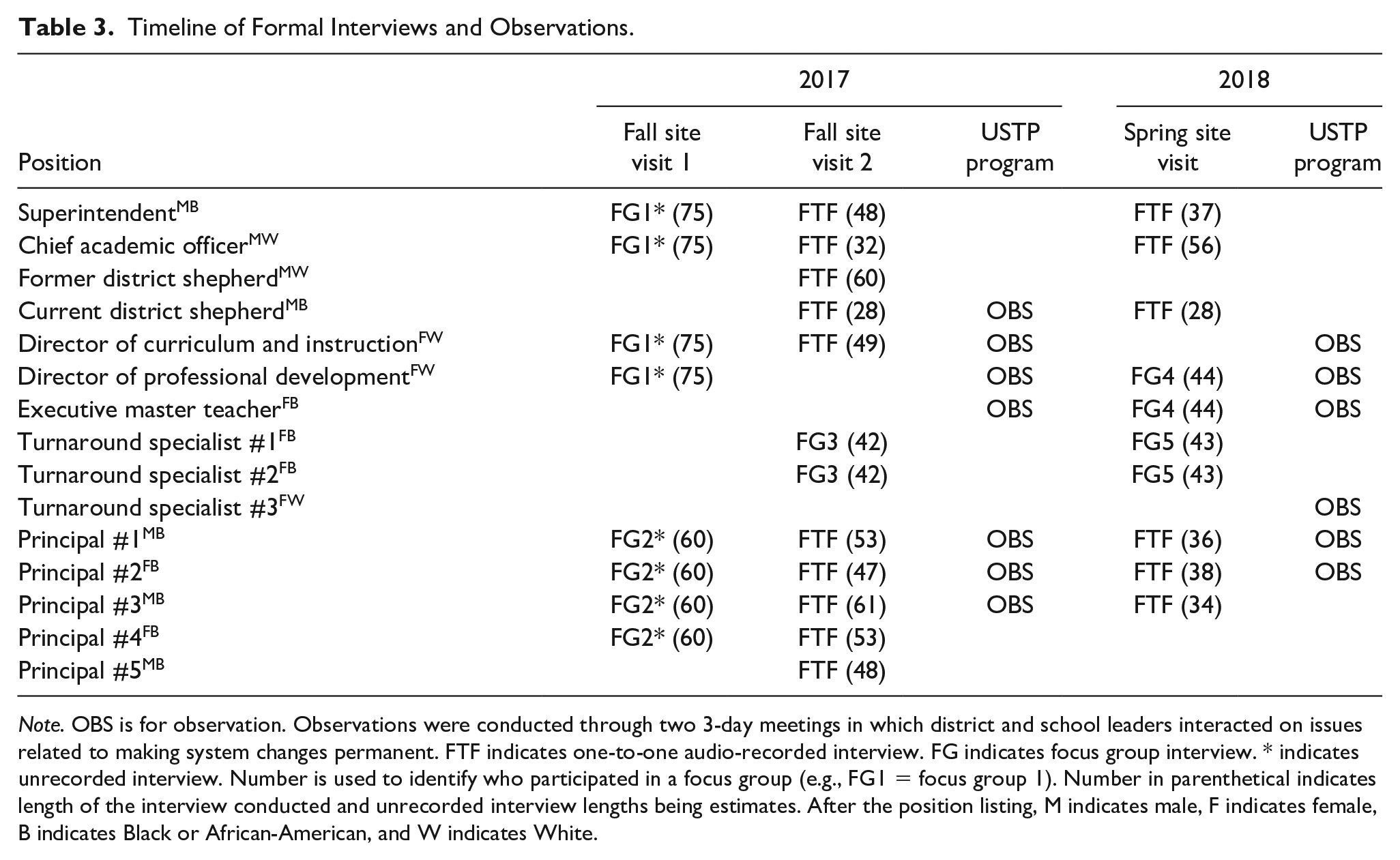
Note. OBS is for observation. Observations were conducted through two 3-day meetings in which district and school leaders interacted on issues related to making system changes permanent. FTF indicates one-to-one audio-recorded interview. FG indicates focus group interview. * indicates unrecorded interview. Number is used to identify who participated in a focus group (e.g., FG1 = focus group 1). Number in parenthetical indicates length of the interview conducted and unrecorded interview lengths being estimates. After the position listing, M indicates male, F indicates female, B indicates Black or African-American, and W indicates White.
Observations
District leaders and principals attended two 3-day professional learning sessions at USTP in which they engaged in interactive sessions to consider ongoing leadership challenges and apply learning to their context. Interactions between district leaders and principals focused on reviewing reasons for turnaround successes at launch and planning for next steps. I attended all sessions, taking detailed notes on their conversations and reviewing their products (e.g., chart paper lists or figures). While conducting site visits for interviews, I also attended ten informal classroom instructional rounds and ten district meetings focused on the turnaround initiative with all principals in attendance. Numerous other informal conversations and communications with district leaders and principals contributed to contextual understanding.
Documents
I also collected various documents from TSD’s original partnership with USTP, as well as other relevant documents from that timeframe, to inform background understanding. In addition, these documents often highlight short-term and long-term concerns about preserving change. District documents included an opening Commitment Plan, an Action Plan, and various self-assessments as part of TSD’s partnership with USTP. As part of the USTP partnership, principals from the ten inintial partner schools also developed and submitted rounds of 90-day school improvement plans. I also reviewed three USTP site visit reports (Fall 2014, Fall 2015, and Spring 2016) describing the extent to which district and school leadership were making satisfactory progress along a continuum of issues, most notably in the areas of leadership quality, support and accountability, instructional infrastructure, and talent management, were reviewed. Public documents such as school board meetings and proposals to the state education agency were also read.
Data Analysis
I conducted inductive data analysis (Merriam & Tisdell, 2016) of district documents, interviews, and observations using the analytic techniques of Strauss and Corbin (1998) with interviews as the key analytic unit. Throughout coding I actively searched for data suggesting a desire or intention to refreeze (Lewin, 1947) via district policy, structure, or practice and/or challenges to those initiatives (e.g., “We added a zone community engagement specialist. . .My concern is still we don’t have enough parents.” – Superintendent). I also continuously asked myself while coding whether or not, or in what ways, any type of data could drive or restrain the district’s ability to preserve initial change. In short, the following question was the driver of my analysis: What significant challenges did the study district encounter to making permanent the changes enacted in its turnaround launch in support of its lowest-performing schools?
Using NVivo software, I leveraged this approach to establish a systematic process of categorizing the data through reduction and connection (Miles & Huberman, 1984). I turn now to offer two quotations to illustrate the process. First, regarding the transition from the former district shepherd to the current one, the district’s Executive Master Teacher observed, [Zone school principals] are a group of people who were used to the actionable feedback, the coaching, the expectations being set forth, as well as the support being provided to help meet those goals. That is [now] missing.
Second, when discussing shifts in the work of the zone, the Chief Academic Officer stated the following: There used to be a document called The Work of the Zone. You know, here are the things we are attacking. . .Now it is the work of [this school or that school]. It has caused us to have many more conversations one-to-one with support teams instead of the work of the zone.
Data reduction processes resulted in my coding the first quotation as Changing Roles and the second quotation as Changing Interactions. Nodes for each topic, Changing Roles and Changing Interactions, were then developed as I identified more quotations and field notes as representative data. Then, subsequent consideration of the data resulted in connection, where I determined that these and other data all pointed to an unchanging vision as the district transitioned from turnaround launch to refreezing change, culminating in the following result that I discuss in detail below: The Initial Change Vision Had a Shelf Life.
This method supported the exploration and discovery of categorical relationships derived directly from the data and encouraged sensitivity to emergent patterns and regularities along with contrasts and irregularities within and across respondents (LeCompte, 2000). I informally conducted member checks (Lincoln & Guba, 1985) throughout the study, asking participants informally through conversation and email as a check on my understanding. More formally, I offered participants the opportunity to review materials to confirm accuracy and representativeness.
Methodological Limitations and Trustworthiness
School turnaround and the achievement of it remains relatively undefined (Lutterloh et al., 2016). As discussed in more detail elsewhere, the extent to which the schools in TSD achieved turnaround success is debatable (Meyers, 2019). At the end of the initial partnership with USTP, most of the TSD schools had reduced suspension rates and improved other markers of climate and increased growth scores on state assessments in both mathematics and reading, whereas state averages declined. Moreover, TSD and individuals within it received various recognitions, perhaps none bigger than the state lifting its threat of takeover. A cautious interpretation seems to be that a turnaround initiative was successfully launched but the impact remains relatively unknown.
Another limitation of this study is that it builds on a retrospective case study. Much of the data analyzed to set the foundation for learning about the districts effort to preserve turnaround success rests on dated materials and district leader and principal interviews reliant upon their memories of events, decisions, and intentions, which are subject to recall bias (Swanborn, 2010). Crosschecking documents with interviews and interview data with other interviews alleviates some of this concern.
It is also imperative to acknowledge my researcher positionality in relation to this study (Milner, 2007). I am a White university professor whose position is primarily funded by USTP to conduct research that informs and improves services. TSD leadership invited me to conduct this study because they were proud of their partnership, schools’ organizational improvements and student achievement gains, and removal from threat of state takeover. They wanted their successes and experiences captured to inform district leaders elsewhere. All school principals in the study were African-American and could have felt pressured by district enthusiasm and my position as a White, external researcher. I was diligent in reviewing documents and materials prior to interviews to better understand context. I made multiple trips to the district to observe informally, including principal meetings where I did not conduct formal data collection. Member checks (Kornbluh, 2015) were conducted with district leaders and principals intermittently.
Results: The Hard Work of Preserving Systems Change
The district turnaround launch began in the 2013 to 2014 academic year with noticeable organizational improvements (Meyers, 2019). Just 3 years later, a number of challenges to preserving those organizational improvements had surfaced. The Superintendent observed that “if you look at what the zone is today versus what it was when we started it. . .even if you look at some of the level of excitement. . .it’s not the same. . .Your hope is that those things that truly made the biggest difference will stay.” In this results section, I report on five of the most prominent inhibitors to TSD’s ability to preserve how it first achieved turnaround success: The zone structure became permeable; the initial change vision had a shelf life; succession planning for personnel change was inadequately considered; zone schools were not ready for shifts in educational priorities; and decreasing funding levels could impede lasting change.
The Zone Structure Became Permeable
The foundational successes of zone schools has been attributed, in part, to district leaders prioritizing staffing support, professional development opportunities, and instructional resources for the original ten zone schools. What some principals and teachers around the district saw as experimentation with a subset of schools shifted once those schools were perceived as successful. As a result, “the district has kind of mixed everything together and put some of those best practices into all schools. . .the zone schools were the guinea pigs” (Principal 1). Increasing pressures from leaders in schools outside of the zone challenged the district’s reconceptualization and reconfiguration.
In response, district leaders most notably elected to add more schools—none of which had received USTP professional learning or other organizational advantages at the outset of the change initiative—to the zone, fundamentally altering its integrity. Principals and teachers of the schools new to the zone had not received comparable professional development, and turnaround specialists regularly expressed frustrations with having to catch new zone principals up. Perhaps more importantly, more schools in the zone also increased the burden on district leaders to provide training, resources, and other supports, but the capacity of the district was unchanged. The directors of professional development and curriculum and instruction communicated being stretched too thin to be adequately responsive to four additional schools.
Increased pressures from schools outside of the zone to receive supports and services deemed effective in zone schools were also destabilizing. Agreements to funnel resources and supports to the lowest-performing schools were decreasingly acceptable to principals in other schools. As zone schools progressed, mindsets shifted in other schools from accepting equitable resource allocation to increasingly vocalizing their own needs or preferences. This was most apparent to district leaders overseeing the work of similarly low-performing schools not identified as zone schools: “I have other directors bringing schools that are very close to being where some zone schools (in achievement level) are saying I need that level of support. So the challenge really is how do you respond with limited resources?” (Chief Academic Officer). By adding schools to the zone, all of the strategies developed specifically for initial zone schools were redistributed in ways increasingly similar to how the district was previously structured.
The Initial Change Vision Had a Shelf Life
Vision was important to launching change. District leaders and school administrators in the work from the outset were all similarly able to articulate the vision and mission. Three years into the work with additional schools, new personnel at the district and school levels, and new responsibilities, district leaders were less aligned about TSD’s vision. TSD created the role of turnaround specialist, but evidence suggested that people moved into that role lacked direction: “I do not know what the vision for the zone is. That has not been communicated” (Turnaround Specialist #1). Missing initial USTP professional learning—and subsequently receiving mixed messages about her role in the partnership with USTP—resulted in a district leader asking, “Now what am I supposed to do? How am I supposed to support the zone?” (Director of Curriculum and Instruction).
Perhaps the lack of clarity stemmed from the splintering of the zone’s vision. Formerly, a centralizing document established the tenets of the zone. Moreover, the original ten schools were starting from similar places, so the work was advanced together. In the time since, zone coherence waned as school planning grew increasingly important. According to multiple district leaders, this splintering exemplified how systems processes that once applied to all schools had transitioned to become relevant for some schools but not others.
Relatedly, urgency across system actors appeared to decline as some schools performed better than others and improvement priorities became more contextualized. “Keeping the urgency” (Chief Academic Officer) and “sustaining that growth [and] that excitement” (Superintendent) were increasingly challenging aspects of district planning. Such challenges were only exacerbated when key personnel turned over, and interpretations of systems change, turnaround, and related issues became more diverse. This might best be exemplified by the past and current district shepherd (or principal supervisor), the former eagerly participating in USTP learning, constantly in zone schools, and relentlessly advocating for those schools while the latter demonstrated little interest in USTP and centered most interactions with district and zone school leaders on the importance of accountability.
Succession Planning for Personnel Change Was Inadequately Considered
Launching a system-led turnaround initiative required considerable effort, time, and resources. It was an intensive process. The turnaround launch was successful mostly because the district leaders were capable and focused on immediate change, but they did not seem to give as much consideration to long-term planning. Soon after leading the turnaround launch, however, the district shepherd left the district for a position elsewhere. All interviewees described him as dynamic, engaged, and available. He was also a lynchpin to how the district conceptualized its turnaround launch. Replacing him was, and continues to be, difficult. “I think to be able to lead the work, you have to have been part of the work or trained in the work. . .and then have a clear vision and mission for our work in the zone” (Director of Professional Development). “All of a sudden, you stop and you have a new leader come in, there’s a learning curve there and there’s an adjustment that has to take place. . .We’re moving toward those goals, but sometimes I feel like we’re splintered in our support, which causes confusion” (Director of Curriculum and Instruction). According to multiple district leaders, however, the former district shepherd’s departure should not have been surprising because he made his career ambitions plain when he was hired.
The disruption was intensified by the current district shepherd not being part of the original partnership with USTP or receiving any of the professional learning that other district leaders, and zone principals, did. “There are things that we did well in the zone [the new district shepherd] just had no knowledge of” (Superintendent). The current district shepherd has recognized that his leadership style is different but contended that reducing noise “down to just my voice” to avoid confusion and misalignment was imperative. This approach—and personality, even—stood in stark contrast to the former district shepherd. One principal made the distinction this way: When a problem emerged, the former district shepherd would be at the school within 20 min and say “‘Okay, let’s work it out.’ Those kind of lines haven’t happened yet with the current district shepherd. . .He’s the boss and everybody is working under him. . .[The former district shepherd] was kinda in the trenches with us” (Principal 1). Structural changes were made subsequently, including the creation of a community engagement specialist position to engage zone schools communities as a way to counteract the change and increase stability. The turnover of the district shepherd has continued to linger as a challenge to resolve.
Zone Schools Were Not Ready for Shifts in Educational Priorities
Much of the turnaround launch focused on improving the climate in zone schools and changing their cultures. Successes resulted in increased student learning opportunities previously hampered by poor classroom management, student attendance, and other distractions. As instructional time increased, district leaders began to see an opportunity for more consistent delivery of high-quality instruction but likely underestimated how much development their teachers needed. The superintendent underscored that culture and climate remained critical to continue to nurture because of the challenges students experience outside of school, but he also emphasized the need to transition focus to improved instructional practice. Multiple principals noted, however, that improving instructional practice was difficult, especially on the heels of improving climate. Many teachers felt a sense of relief—even lasting success—to have established a manageable classroom.
A large part of the district’s instructional improvement transition included the adoption of The System for Teacher and Student Achievement (STSA) program (formerly known as Teacher Advancement Program or TAP) in zone schools. District leaders believed the rigor of STSA to be a logical and critical next step to improving student achievement. They were surprised, however, to learn that the improvement of instructional quality would be slow. Turnaround Specialist 2 reflected, “It takes time to practice this work and to develop [instructional] skills in this work” (i.e., STSA-based instruction). Perhaps more realistically, Turnaround Specialist 1 communicated that “my vision for implementation of TAP in year 1 was just to have all of the structures in place on a consistent basis in all 14 schools.”
District instructional experts and zone school support personnel consistently relayed a belief that changing the climate was the easy part because people were excited and the effort required more will than skill. The transition to teaching “children at so many different levels” (Turnaround Specialist 1) proved to be more challenging. District leaders increasingly realized that extra support for zone school teachers would be critical to build on turnaround successes. For some schools, this was the first time in years that teachers were “digging into true content” (Chief Academic Officer). The load on teachers to keep climate positive, learn how to improve their instruction, and then implement better instructional practice was a significant undertaking that was insufficiently anticipated that could become even more daunting when funding is reduced.
In that vein, principals indicated understanding why district leaders wanted to transition from focusing primarily on school climate to improving instruction. They agreed that it was the right time to do so. However, their endorsement of the program selected was mixed. Multiple principals noted that the program was being implemented as a result of external funding and pressure from the state, and they never felt as though they were part of the decision-making process. The principals “will do whatever you ask. They will. But let’s not take them for granted. And I think that’s going to be another barrier, finding leaders that want to do this work. Because it’s hard work. I mean, it’s 24/7” (Turnaround Specialist 1). The difficulty of the work trickled down. One principal indicated that teachers have become “frustrated with the amount of work that it takes. . .in these schools, and then the students may or may not make any gains” (Principal 2). This frustration was more pronounced when zone teachers recognized that colleagues in higher-performing schools seem to get better results with easier workloads. Although zone school principals recognized this increasing dissatisfaction, district leaders had not yet made the connection. The pressures associated with rapidly improving instruction, while also stabilizing cultural changes, became demoralizing for teachers and leaders.
Decreasing Funding Levels Could Impede Lasting Change
Ongoing changes to the composition of the school board had been a continuous challenge, especially as funding levels decreased and financial decisions became more contested. District leaders had initially been vigilant in convincing new school board members why the financial structures had been designed in unequal-but-necessary ways. The message in the following quotation was a message many district leaders shared successfully during turnaround launch: “We are not a system of districts. . .And even though you are a school board member from a certain area, your job is to make policy, budget, and hiring decisions to impact all” (Chief Academic Officer).
The financial struggle for the district, however, continued to extend well beyond the launch. The superintendent reflected on how continuous decline in enrollment reduces financial flexibility. External fiscal support—especially donors pursued by the former district shepherd— that had been critical to the district’s ability to initiate change had fallen off quickly. The STSA was only available because of a grant the district had won. In combination, projections about how the district would be able to continue supporting many of the key programs, resources, and supports financially had become unfavorable.
Principals did not appear to be planning for systematizing the instructional practices learned from STSA, however. Instead, they seemed to view the eventual loss of STSA as the district “taking something away from me that you gave me” (Turnaround Specialist 2). While district leaders reflected on financial-programmatic challenges with their zone principals, the principals were thinking about how they could keep their teachers. Many of the teachers had benefited from their participation in STSA but were only teaching in zone schools because of the financial incentives tied to teaching in a school with STSA. Thus, district and school leaders were increasingly concerned that teachers who had received STSA training would leave zone schools, taking their newly learned instructional knowledge with them and again leave zone schools without high-quality instruction.
Discussion
This study adds to a limited body of literature on the complexities of urban districts responsible for turning around low-performing schools and underscores the centrality of district leaders heading such initiatives. Building on previous case study research that identified a number of areas where TSD had success launching turnaround across ten of its schools, this research extends that research to identify some of the more substantial challenges to the district preserving what was successful during the original turnaround initiative.
The concept of a zone of schools within an urban district is not novel, but little consideration has been given to how equitable opportunities for a subset of schools within an urban district can be maintained long-term. Establishing lasting structures that not only succeed in making impactful short-term changes, but also preserve changes to allow for a full consideration of what comes next organizationally, and what might come after that, was challenge enough for TSD leaders. The task is even more complex in the TSD context where many district and school leaders trying to preserve the zone did not participate in USTP or champion the initial equity-based framework. This reality is underscored by the study result identifying district shepherd turnover specifically and a lack of succession planning broadly as crippling factors to refreeze changes made. The current district shepherd declined attending the second session in the sustainability program because he viewed leading school turnaround differently than his predecessor, was uninspired by the program he did attend, and had never committed to the vision established by TSD. Dissension in such a critical position also highlights how difficult it is to maintain substructures as the vision changes, or is contested. Even supportive turnaround specialists could not clearly articulate their roles in the work of the transformation zone. The interrelated nature of these results only underscores how difficult refreezing a large system can be.
Significant successes have the power to counteract themselves when leaders fail to anticipate the consequences. The district’s vision to provide the ten schools with the expertise, resources, and other supports necessary to prop them up was executed successfully, prompting district leaders, principals, teachers, and community members outside of the transformation zone to question why their students were not receiving similar additional services, resources, etc., especially when their schools, too, were low-performing. More succinctly, what really separates the district’s 10th lowest-performing school from its 11th one? To accommodate such pressures would be to live out the new vision focused on equity, but it would also unsettle the foundation and structure on which the new vision had been executed.
Extending the consideration of this study’s conceptual framework, it seems as though TSD leaders were well prepared to promote and attend to practices that were primarily about launching the initiative (e.g., facilitating vision and mission development, strategically positioning schools for advantageous and preferential hiring and development of best teachers, and the like). The evidence suggests that district leaders had many strategies, even long-term ones, on their radar, but there was limited planning to enact them effectively. However, some of the sizable shifts in context—most notably altering the structure of the transformation zone and changing district shepherd—seem to have reduced the district’s ability to refreeze successful turnaround strategies likely for a number of reasons, including change in structures and key personnel imbalanced short- and long-term vision, and reduced the district’s adaptability or responsiveness to quickly correct course.
It is also worth considering how else the district could, or maybe should, have conceptualized preserving and building on its successful launch. Within both TSD and USTP framing and design—and turnaround conceptualization broadly, really (Hassel & Hassel, 2009; Meyers & Smylie, 2017)—there is a notion that initial turnaround and subsequent steps are distinct initiatives when they are more likely different stages of one process. Increasingly evidence suggests that school turnaround, or maybe any school system change initiative, is not the U-turn that has been pervasive for the last decade (see Hassel & Hassel, 2009) but instead a sharp improvement that transitions into a continuous improvement model in which organizational decisions are based on preferred states of being, allowing for multiple low-performing schools to arrive at improved performance through different means (Burke, 2017). This framing imposes at least two related considerations. First, if the turnaround change process requires subsequent preservation and advancement to be a complete success, no turnaround launch can be considered sufficiently comprehensive without the full consideration of what it should be organizationally beyond the turnaround jolt at launch. That is, significantly increasing student achievement rapidly alone does not make a turnaround successful. Second, if schools can arrive at improved performance through different means, district-initiated school turnaround likely requires a nuanced understanding of, preparation for, and commitment to each of the schools within the initiative to account for contextual differences from the outset.
This case study also suggests a final point for urban districts. Interdependencies between levels within the educational system are critical to advancing lasting school turnaround. In TSD, district leaders garnered widespread support from principals, school board, community members, and teachers in advance of its turnaround launch (Meyers, 2019). However, as the point about shifting to improved instruction suggest, subsequent decisions were not always as clearly presented or supported, and rapid change of technical strategies imposed in turnaround contexts continue to present challenges (Hamilton et al., 2013). Literature on school turnaround has suggested that district leaders must be more involved for schools to succeed (Schueler, 2018), but the results of this study put forward that principals likely also need to be more involved for district success. Limited inclusion of principals in the work to reconceptualize the district is akin to policies that focus only on schools: Lasting systems change needs both (Baroody, 2011). In TSD, some zone principals were regarded as instructional leaders, yet they were minimally consulted about the adoption of the new instructional program, undermining the district’s shift in instructional focus.
There are at least a few policy considerations to advance meaningful change in future district turnaround work. First, leaders must have an unwavering commitment to any policy that provides intensive, focused support to the lowest-achieving schools. Any early success schools achieve must be considered precarious for a substantial period of time, perhaps at least 5 years. Second, perhaps advocates for low-performing schools should include at least one or two principal representatives because, as this study demonstrates, district-level advocacy can be impermanent. Third, levers that require short-term and long-term planning at the district level in service of low-performing schools seems critical. Change leadership is not about the current moment or the next moments but instead how the current moment informs the next moments.
I close by also considering a few implications for research. This study generates some initial insight into at least two understudied areas. First, research foregrounding how urban district leaders can intentionally prioritize subsets of schools for improvement is surprisingly thin although notions of zones or other groupings of schools is not new. Furthermore, research on how urban district leaders attempt to preserve school improvement is almost nonexistent. Case study, ethnographic, observational, and other qualitative methods of study that tracks a complete initiative could add considerable knowledge to the base by not only highlighting what did and did not work, but by being able to more comprehensively track how policies, strategies, and relationships change over time, and why. Increased studies in districts more reflective of the size and complexity of urban U.S. districts would not only be more practically useful but also potentially result our ability to begin accumulating knowledge that is more generalizable. More substantively, urban school turnaround is not limited to school principals or district leaders but is instead a systems issue that requires an investment in learning more about how leaders from both levels can invest thought, energy, time, and resources in synced ways to address immediate challenges while thoughtfully planning for lasting, long-term change.
Footnotes
Declaration of Conflicting Interests
The author declared no potential conflicts of interest with respect to the research, authorship, and/or publication of this article.
Funding
The author received no financial support for the research, authorship, and/or publication of this article.
