




Abstract
This paper focuses on the evolution of community schools from a grassroots organizing effort to a formal initiative in Philadelphia. The authors implemented a critical participatory action research project to examine the process and impact of the education organizing. We present two narratives to illustrate the potential and limitations of two divergent community school approaches. We argue that education justice movements must develop processes and metrics of accountability to effectively organize for transformative community-driven education. Findings provide insights to communities organizing for public education in other contexts and locales and an example of how research can support social justice movements.
Philadelphians have long fought for neighborhood schools and quality public education for all students. The contemporary landscape of education in the city is situated in the sociopolitical history of School District of Philadelphia (SDP or District) and ongoing contestations for power and control at the nexus of local, state and federal politics (Dixson et al., 2014). A critical moment in this history occurred in 2001 when Republican state leadership took over Philadelphia schools and appointed the School Reform Commission (SRC), making it the largest urban district to be taken under state control. Since then, Philadelphia’s educational narrative has reflected ongoing political divisiveness in response to neoliberal education reforms, including: extreme austerity measures, mass school closures, charter expansion (Simon et al., 2011), attacks on teachers’ unions (Good, 2017) and a racially biased state funding formula (Mosenkis, 2016).
Philadelphia’s education justice movement has been on the leading edge of the national trend of grassroots community organizing fighting to preserve education as a locally controlled, adequately funded public institution (Ferman, 2017). Community schools have become an increasingly popular approach to improving schools that education advocates and organizers offer in opposition to neoliberal strategies. Broadly, community schools frame schools as “social centers” (integrating health and social services, academics, youth development, and community engagement) to ameliorate some of the oppressive conditions experienced by urban students and communities from globalization, post-industrialization, social and economic divestment, and suburbanization (Rogers, 1999). This paper focuses on the Philadelphia Coalition Advocating for Public Schools’ (PCAPS) advocacy and organizing to bring community schools to the city from 2014 to 2017. During that time, Philadelphia joined the wave of school districts across the United States (US) implementing community schools as a strategy for improving schools. We describe the evolution of community schools from a grassroots organizing effort led by a PCAPS’ Task Force (TF) to a formal initiative overseen by the Mayor’s Office of Education (MOE) within the School District of Philadelphia.
The authors were all members of the coalition organizing for community schools and we implemented a critical participatory action research (CPAR) project in 2017 to study the organizing and evolution of community schools in Philadelphia. This inquiry was guided by the following questions:
What are the promises and limitations of community schools as urban education reform?
What are the points of tensions and possibility across different visions for community schools? and
What is the role of accountability in organizing for community schools?
Our analysis is presented as a narrative of the grassroots organizing (PCAPS and the TF) and the formal community school initiative and a counternarrative based on the research and our experiences facilitating the TF’s community-based leadership program. The narratives illustrate the potential and limitations of two divergent community school approaches: the service provider model and a community-driven process. We build upon and extend conversations about the possibilities and limitations of community schools as a process for reclaiming parent and community control over their schools. We argue that education justice movements must develop processes and metrics of accountability to inform organizing for transformative community-driven education to effectively defeat neoliberal reform efforts. Our findings offers specific and practical insights to communities organizing for public education in other contexts and locales. Finally, our work provides an example of designing and implementing research in service of social justice movements.
The paper begins with a description of the context and background of this study. Second, we provide a select literature review on community schools and critical scholarship on organizing for public education. Third, we outline our conceptual framework for accountability from the ground up. Fourth, we describe the methods of this study. Fifth, we present the narrative of the Task Force and the first year of the MOE community schools initiative followed by the counternarrative of leadership development as a process for collective accountability. We conclude by addressing future implications and looking toward building places of possibility for transforming public education.
Situating the Story: The Philadelphia Context
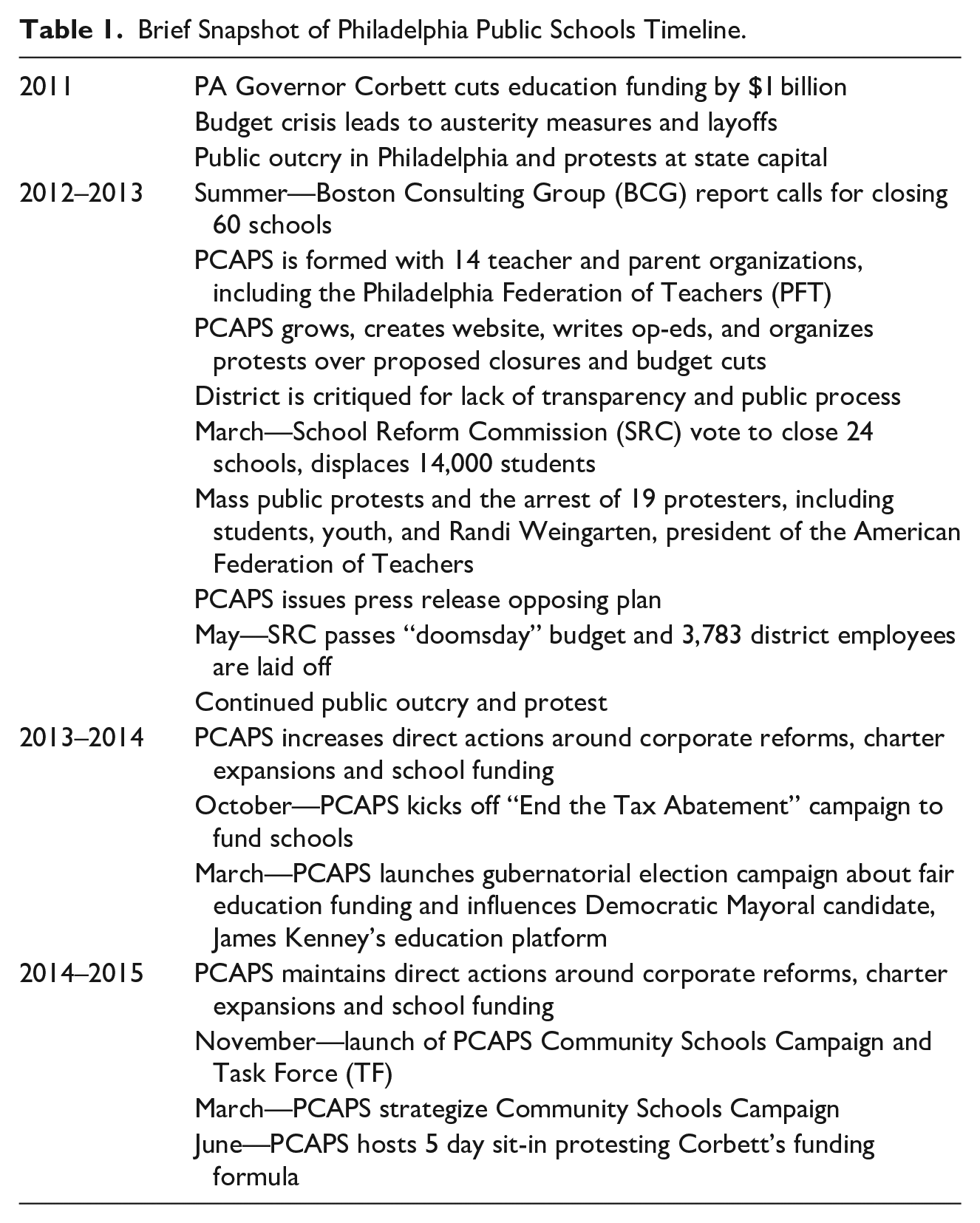
We begin by situating this work within Philadelphia in order to both illuminate the place-based specificity as well as the relevance of this work for those fighting for public education in cities across the nation. We provide a brief timeline (see Table 1) outlining key moments in the narrative of community schools in Philadelphia.
Brief Snapshot of Philadelphia Public Schools Timeline.
The landscape of education in Philadelphia is marked by neoliberalism and contemporary manifestations of historical disinvestment from capitalist white supremacist ideology. Philadelphia is a city of neighborhoods. It is also a diverse city with a racialized majority population and the fourth most segregated city in the country, resulting in de facto segregated schools. Similar to other US post-industrial cities, Philadelphia has been used as a test case for many neoliberal education experiments that have had detrimental consequences for students, communities, and educators, thereby reflecting a form of collective trauma.
In 2011, Pennsylvania’s new Republican Governor, Corbett cut nearly $1 billion from the state education budget. Corbett’s plan disproportionately affected Philadelphia, which educates 12% of the state’s students, but received 35% of the cuts (Perry & Weingarten, 2014). The District’s budget crisis ballooned to $629 million that year, prompting a massive lay off of school staff, counselors, and teachers (Graham, 2018). This manufactured crisis paved the way for the School Reform Commission’s (SRC) austerity plan and privatization agenda, which involved hiring the Boston Consulting Group (BCG), a key player in the privatization movement in the US. In June 2012, the SRC hired William Hite as superintendent of the District. Two months later, the BCG issued a report recommending 60 of the city’s public schools be closed by 2017 (Dixson et al., 2014). Through this, educators, families, students, and community members stood together against all of the actions the SRC was doing to undermine public education in the city.
PCAPS formed in 2012 and included all three-school unions and more than a dozen community-based groups. PCAPS was a significant organizational expression of the public fightback against the State-sanctioned war on public education (Simon et al., 2017). PCAPS was initially funded by the American Federation of Teachers (AFT) to oppose the proposed mass school closures and increasing threats to public education. The coalition deliberately bridged labor and community groups and attempted to move through past challenges related to different priorities, perceived betrayals, and interpersonal conflict (Simon et al., 2017). Broadly, PCAPS fought against top-down neoliberal reforms and to keep schools open and public. In addition to traditional organizing strategies, the coalition wrote a moratorium on school closures that accrued broad sign-on, published a community education plan and student bill of rights, fought for equitable funding, had a charter school accountability task force, and later a Task Force (TF) on community schools. PCAPS, as with most coalitions, consisted of members and groups with different priorities, accountability mechanisms, and theories of change.
In 2012, PCAPS successfully organized and limited the SRC’s call to close 60 public schools to 24 schools in total (Dixson et al., 2014). PCAPS’ organizing work activated many school community members and provided a better sense of what changes needed to happen for public schools, beyond keeping the doors open. This informed the expansion of PCAPS’s work to include advocating and organizing for community schools as an alternative to privatization and school closure turnaround strategies. This shift aligned the coalition with the growing national movement for education justice advocating for community school strategies as a way to address systemic inequality and ensure quality equitable education for all children. Community schools, as envisioned by PCAPS, could provide a process for repairing the harm caused by years of neglect and oppressive policies and practices through community and school level governance. The narrative below covers PCAPS community schools work from 2014 to 2017 and begins with the Task Force’s organizing work that brought community schools to Philadelphia through the first year of the formal community schools initiative that launched in 2016.
Approaches to Equity and Accountability in Education
This selective literature review provides a brief introduction to community schools to define key terms and concepts. We then review critical research on community organizing for public education. This section situates the present study in the contemporary context of public education in the US and two divergent approaches to improving urban schools that fall under the umbrella of community schools.
Community Schools: A Liberal Approach to Equity and Accountability
Neoliberalism connotes a pro-market philosophy, free-market policies, and small government rationality. Neoliberal reforms impose top-down strategies intended to undermine public education for privatization through policies and practices that impact curricula, teacher training, teacher evaluation, and high-stakes testing (Au, 2007; Brathwaite, 2017; Costigan, 2013). Top-down accountability in education builds upon an empiricist and instrumentalist view of learning, which assumes student learning is a direct outcome of instruction that is measurable, testable, and trackable. Testing data indicates whether students, teachers, and schools are a success or a failure and are forced to improve or shut down (Ewing, 2018). This is the most understood meaning of being accountable today in education.
Contemporary models of community schools draw from historical reform approaches that viewed education and schools as key to healthy citizenry and democratic society, such as Jane Addams and John Dewey (Lubell, 2011). Community schools are “both a place and a set of partnerships between the school and other community resources, [with an] integrated focus on academics, health and social services, youth and community development and community engagement” (Coalition for Community Schools). Oakes et al. (2017) conducted an extensive literature review of community schools and found they met the “evidence-based” standards of Every Student Succeeds Act (ESSA) as an intervention strategy for high-poverty high-risk districts and schools. They identified four pillars to successful community schools: (1) Integrated student supports, (2) Expanded learning time and opportunities, (3) Family and community engagement, and (4) Collaborative leadership and practices (Oakes et al., 2017).
The current landscape of community schools includes many different conceptualizations, definitions, and frameworks that converge and diverge in theory and practice. Most approaches are interdisciplinary and advance research-based, creative, and holistic practices to achieve positive outcomes that extend beyond academics to social, emotional, familial, developmental, and community level impacts (Frankl, 2017). Today, the most prevalent community schools model in the US builds on the tradition of “full-service” or “wraparound” schools. The “full-service” framework argues that schools should operate as “hubs” that are open extended hours to provide comprehensive services including: primary care and dentistry, social services, mental health, adult learning, and community development to students, families, and communities (Blank et al., 2003; Dryfoos, 2005). The underlying assumption of these models is that bringing in outside professional resources and services to address students’ and families’ non-academic needs will improve academic outcomes.
The service provider model addresses holistic needs and gaps in services that contribute to inequitable resources and opportunities for students. Often framed as strengths-based, this approach focuses on improving access to services and resources for students and communities. While well-intentioned, this model perpetuates a deficit or problem-focused model by prioritizing community/school needs as the starting point (Keith, 1999). Although full-service or “wraparound” models of community schools are not a radical approach to education reform, they reflect a paradigm shift which entails an understanding of the complex lives and realities of students and families that extend beyond traditional academic measures.
Organizing for Public Education: A Transformative Approach to Equity and Accountability
Critical education scholars have long advocated for a view of schools as community resources and sites of possible transformation (Hong, 2012; Milner & Lomotey, 2014; Noguera, 2001). A growing subfield of research focuses on grassroots community organizing for school reform (see Lopez, 2003; Mediratta et al., 2009; Oakes & Rogers, 2006; Orr & Rogers, 2011; Warren & Mapp, 2011). Contemporary definitions of organizing coalesce around three themes that contribute to building power: constructing relationships; developing a collective vision, plan, and goal; and taking action toward change (Ganz, 2004; Mediratta et al., 2009; Warren & Mapp, 2011). Education organizing brings together diverse stakeholders and groups to define the scope of the problems in their schools, co-create and publicly commit to a strategic solution, and take action to improve public education (Gold et al., 2004). Research on education organizing has demonstrated community-level outcomes and education performance indicators, including: improved parent-school relationships (Ishimaru, 2014), better school climate and culture (Annenberg Institute for School Reform, 2012; Hong, 2012), improved achievement and graduation rates (Jeynes, 2012), and racial justice (Welton & Freelon, 2018).
The organizing approach situates parents, students, teachers, and community members as knowledgeable experts whose voices are valued and amplified through decision making and leadership opportunities (Oakes & Rogers, 2006; Welton & Freelon, 2018). This shift reflects the collaborative and participatory approach to working with minoritized communities to collectively build power in order to take action to dismantle policies and practices that systematically undermine their schools and neighborhoods. By amplifying the voices and expertise of those most impacted, the organizing approach flips traditional hierarchical relationship between families, communities, and schools to a reciprocal relationship where there is a mutual exchange of knowledge and learning between families and communities and schools (Welton & Freelon, 2018). Meaningful engagement is made possible when schools build collaborative relationships with parents, schools, and communities that recognize and respect cultural, class, race, and differences toward a shared responsibility and power (Henderson & Mapp, 2002).
Both the traditional community schools literature and the critical community organizing scholarship consider parent involvement and community partnerships as vital to the success of students, families, schools and communities. Yet, the organizing approach creates reciprocal relationships between families and schools where both learn and share with each other. Further, the critical scholarship supports a radical approach to education reform that has a dual focus on dismantling systems of oppression through transformative praxis.
Conceptual Framework: Accountability “From the Ground up”
We offer a “from the ground up” approach to accountability that centers transforming relationships between schools and the students, families, and communities they serve. We draw upon Mediratta and Fruchter’s (2003) four indicators of community accountability: transparency, representation, power, and oversight, which are necessary for transformative change. This framework relies on the design and implementation of mechanisms that will improve the school system’s transparency by increasing family and community access to information, schools, and data that will enhance community representation and power in schools and districts (Mediratta & Fruchter, 2003).
Reimagining and reinvesting in new social relationships between parents, communities, and schools is essential for creating accountable equitable education and quality public schools (Vasques Heilig et al., 2014; Warren, 2011). Accountability from the ground up reflects a place-based relationship-driven approach to student and school success as defined by the community, building on the historical community control movements led by communities of color during the battle for school integration (Fantini et al., 1970). Community control of schools as self-determination is explicitly about oppressed groups “ability, autonomy and authority to make decisions” about all aspects of schooling (McSwinte, 1974, p. 12).
These accountability metrics entail a significant shift of power where politicians, districts, and administrators become accountable to families, communities, and community partners who are engaged at the school and neighborhood level. The redistribution of power brings parents and families to the table in a meaningful way—their voices and expertise about their students is valued in the same way that official knowledge about curriculum and pedagogy is. This framework identifies the central role of power, decision making, and relationships in enacting a transformative community school process rather than a model that reifies deficit narratives of schools and communities. From the ground up accountability entails metrics attached to the work of being responsible for that includes meaningful engagement of parents/communities, well-being and satisfaction of teachers, centering young people and families. This is in stark contrast to top-down accountability that values efficiency and standardized measures of success.
Critical Participatory Action Research for the Movement
Critical participatory action research (CPAR) is an epistemological and methodological approach to research grounded in democratic participation, critical analysis, and producing knowledge toward social change (Cammarota & Fine, 2008; Fine & Torre, 2006). Organizing and CPAR are underpinned by the premise that the people closest to the issue—neighborhood schools—are experts and best situated to make decisions and develop strategies for educational equity (Annenberg, 2012; Fals Borda, 1979). The authors were involved with PCAPS and/or the Task Force (TF) in some capacity for varying amounts of time. Our research collective is an example of a contact zone or border space of heterogeneous standpoints and research “designed by/alongside and in the interest of social justice movements” (Fine, 2016, p. 358). Among us, we represent broad positionalities and roles, including: parents, educators, higher education, community organizers and activists, community members, public school graduates, and so on.
Data Collection
Participants included: (1) Task Force (TF) members, and (2) Ambassador Program (AP) participants. All members of the TF were invited to participate and consented to this research. The TF participants included a diverse range of parents, teachers, education and youth organizers, advocates, students, community, faith and union leaders. The documentation of the TF included: participant observations, field notes, photographs, cultural artifacts, interviews, focus groups, storytelling and multimodal modes of data collection. The TF related cultural artifacts include internal documents (e.g., meeting agendas and notes) as well as public-facing artifacts (e.g., website, op-eds, blogs, and white papers). Participant observations and field notes documented organizing and research practices and in-depth interviews were conducted with 13 TF members.
Data collection took place at AP trainings and events, included: post-program surveys, participant observations, field notes, photographs, and cultural artifacts. There were approximately 40 participants in the 2016 to 2017 AP and almost half participated in this research. AP participants included a diverse group of education stakeholders who lived in or near Philadelphia, including: teachers, parents, grandparents, community members, university students, and service professionals. Two focus groups and 11 individual interviews were conducted with AP participants.
Data Analysis
Thematic analysis is a method of interpretation that involves the identification, analysis, and recording of patterns (themes) within data (Braun & Clarke, 2006) through numerous readings to categorize a set of data (Saldaña & Omasta, 2018). Analysis entailed two phases: first an inductive thematic analysis contributed to a coding scheme developed in conjunction with the conceptual framework to understand the possibilities and limitations of community schools for community-driven education reform. Phase one entailed the following steps:
The researchers reviewed the entire data-set to familiarize themselves with the data.
Researchers independently analyzed three interviews with multiple readings to identify key words, phrases, and patterns (themes) while taking careful notes of their process.
Groups of 2-3, researchers compared notes to establish an emergent coding structure.
All of the researchers compared their group notes and list of themes to determine inter-rater reliability and synthesize the coding structure.
The second phase involved reviewing the data in Dedoose with keyword searches, for example: “account” to capture accountable and accountability and “govern” to capture governance and to govern, power, decision, and so on. The coded data excerpts were exported to a word document organized into themes and subthemes. Finally, we reviewed the data with theory-driven questions: (1) what are the promises and limitations of community schools as urban education reform? (2) what are the tensions and possibility across different visions for community schools? and (3) what is the role of accountability in organizing for community schools?
The Evolution of Community Schools from a Grassroots Agenda to a Formalized Initiative (2014–2017)
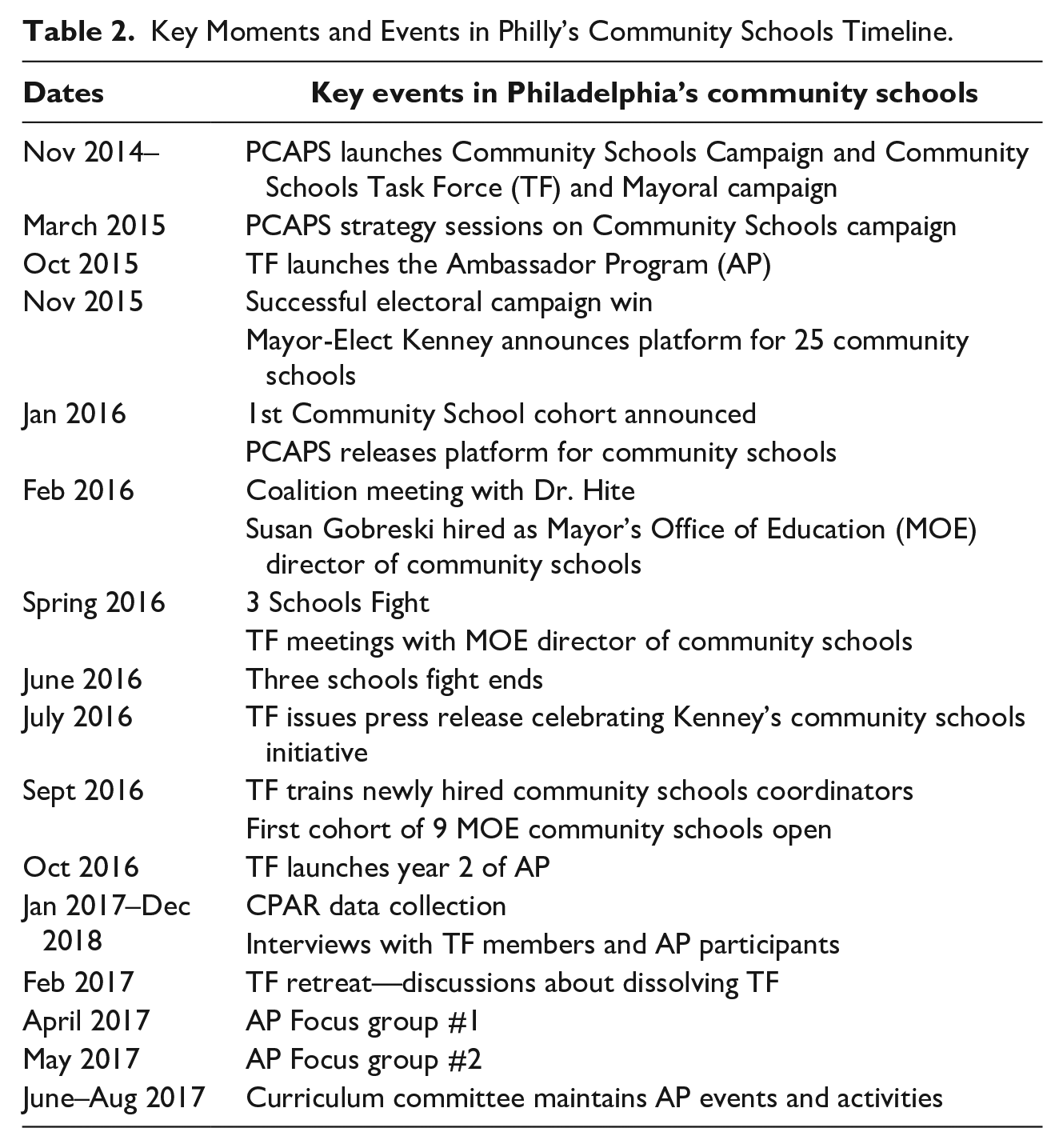
This section consists of two interdependent stories woven together to construct the narrative of community schools in Philadelphia from 2014 to 2017 (see Table 2). Told chronologically, we begin with the genesis of community schools in grassroots organizing and weave in the first year of the Mayor’s Office of Education (MOE) formal community school initiative. Key moments are
Key Moments and Events in Philly’s Community Schools Timeline.
In
Meanwhile, the TF continued organizing on-the-ground to push for community schools through the end of the school year. PCAPS partnered with three schools slated for charter takeover in Black, Brown and low-income neighborhoods in what came to be known as the three schools fight against the School Reform Commission (SRC). These schools had been increasingly disinvested from for at least 3 years leading up to the SRC’s announcement. The District justified the proposed closures by citing decreasing enrollment and low-test scores. Organizers saw these factors as evidence that families were feeling the impact of the disinvestment and did not trust their neighborhood schools. From there, they organized with parents and families to build power through relationships and develop a sense of shared ownership of education. Organizers worked with the three school communities to create community school plans as an alternative to privatization and closure.
In
Shortly after the publication of the platform, Susan Gobreski was hired to be the director of community schools in
Another outcome of the meeting for members was clarity around misaligned strategies and values within the coalition. Bunchy spoke about the Hite meeting in his interview with a rhetorical question about the coalition: who are you accountable to?”. . .”
1
based on all the shit that he’s [Hite] done in his tenure and I realized that the stake that I personally have in this fight is not the same as some of the leadership in this room and it would be criminal for me to continue operating in this space and not be true to my young people and the community that I’m accountable to.
Although tensions were rising within the coalition, there was no process for working through challenges directly as a collective. In response to interview questions about voice and decision-making within PCAPS, members articulated a clear division between voice and power. Luna, said: “People would just share them [opinions]. But I think it was like there was no process around differing perspectives. It was just kind of like, organizational power dynamics and then also like race, class, gender as well. Just like, who was willing to talk the most.” Another member, Erika, said, “It was a lot of disagreement. I wasn’t in the position of authority to make a decision” and Solomon similarly explained, “All those decisions came from a small group and then they would kind of like, go back to the other group without full clarity of what was happening or what was expected.” Soon after the Hite meeting, some member groups began to withdraw from the coalition.
From I think we botched the opportunity to seize more power, you know, and in some of those conversations she [MOE community schools Director] was interested and like, you know, our idea of a commission. I remember we were talking about, to like, to oversee a lot of that. And then we were like, we can’t even define the commission ourselves! We acted like we didn’t know how we wanted to do this. And then we’re like oh, who would be on it? Well damn it, we’ve been doing this for all these years, why don’t we be part of it?! We can be the commission!
The TF was explicit and clear in their platform and messaging that community schools should be the District’s primary turnaround strategy for low-performing schools. Further, they framed community schools were framed as a process of democratic engagement for governing and improving the city’s schools. Yet, envisioning a governance structure that put power back in the hands of parents, families, and the community within the ecosystem of education in the city and the SRC was a serious impediment. “This SRC system, because it doesn’t allow for—accountability or democratic process which I think is the issue of disconnection in the schools, you know? There’s literally no accountability to many of the decisions made (Lance, AP Interview). Although the proposal for the Commission on Education was never finalized, the long-term strategy was to take back control of the District and eradicate the SRC: “Such a commission is not intended as a substitute for democratic local control but rather an instrument that can help create the conditions for dismantling the current system and moving forward toward an elected school board” (Cultural Artifact, May 2016). By the end of the school year (
The MOE undertook a community engaged process from Between January and June, we spoke with more than 750 people from across the city through individual and group meetings, small roundtable discussions, and large town hall forums. We met with parents, teachers, community organizations (large and small), service providers, elected officials and more. In addition, more than 260 people completed a survey, sharing their feedback on what factors should be prioritized when selecting community schools. (https://gallery.mailchimp.com/48732a6251c09f25e0086d47a/files/Community_Schools_Hearing_from_the_Community.pdf)
From their outreach, the MOE determined the first year of community schools (2016-2017) would focus on three key themes: (1) Strengthen City Support for Schools, (2) Empower Parents and Community Members, (3) Increase Access and Opportunities (Mayor’s Office of Education, n.d.). In public forums and meetings, Gobreski described the first year goals as a thorough community needs assessment and strategic planning process.
The MOE and SDP negotiations around community schools lasted through the
In
The first cohort of nine community schools opened in ‘What we were looking for were places that were demonstrating the capacity to do this, opportunities for neighborhood growth, and where this type of strategy can play a role.’ Increasing the school’s enrollment by making it a more attractive place to attend was also a consideration (Mezzacappa, 2016).
Throughout Gobreski’s tenure, communication between the MOE and the coalition ebbed and flowed. Originally, the TF was to have a key role in orienting the new community schools coordinators. As the school year grew nearer, the TF’s role in preparing coordinators shrank to a 2-hr training on
Research for Action’s evaluation of the first year of the community schools initiative focused on two levels: (1) the system-wide conditions and supports for the initiative; and (2) implementation and early outcomes at the school level (Duffy & McCarty, 2018). The report documented challenges in collaboration across the SDP, MOE, and city departments and recommended stronger leadership and cross-sector partnerships. The lack of alignment between the MOE and SDP is a clear hindrance to the success of the initiative as well as its transformative potential. The report claimed the aim of the initiative was “to address poverty-related conditions that create barriers to successful student outcomes,” yet there is no coordination between the initiative and SDP efforts “to improve academic outcomes” (Duffy & McCarty, 2018, p. iii). Duffy and McCarty’s (2018) school-level findings were more promising and showed improvement across all of the measured indicators. Although student participation was reported as high, there was a lack of family and community member participation. A challenge noted in the report implicated the contemporary manifestations of decades of disinvestment and neglect suffered by Philadelphians “high levels of
Accountability from the Ground Up: A Work in Progress
This narrative illustrates key tensions of community schools as urban education reform. Weaving together stories from the coalition’s organizing work with the roll-out of the formal community schools initiative provides insights into the parallel processes of negotiating power, decision-making, transparency, and accountability. From the beginning, the Task Force (TF) was explicit about their vision of community schools as a way to protect public schools from neoliberal reforms (e.g., closure or privatization), called for new accountability metrics and a process that centered parents and families as decision-makers. Over time, some coalition members shifted to focus on bringing “a” community school model to the city, which was accomplished through their successful electoral win. After the initial groundswell of organizing and electoral campaign push, the coalition became increasingly fragmented and the organizing work more siloed. These internal dynamics and the lack of a cohesive vision of community schools within the coalition created an opportunity for the School District of Philadelphia (SDP) and Mayor’s Office of Education (MOE) to move forward with a service provider model rather than a transformative community school process.
Coalition members working with school communities were engaged in a different form of praxis than members solely focused on the electoral work. Their understanding and view of community schools evolved in tandem with their organizing as they began to see some of the potentials and limitations of the community schools strategy. When organizers brought what they were learning to the full coalition, they did not feel heard or seen, and the TF’s community school plan and platform did not evolve alongside the organizing. Pep noted, “[A]s an organizer, I felt a question of who I was accountable to that left me feeling at odds with our shortsighted vision. Our demands were not reflecting all that was needed to make the community schools model in Philly a success” (Field notes). For many involved in the three schools fight, the language in the platform was not strong enough and was missing the crucial governance piece that could institutionalize school-community decision making. The lack of a clear decision making process undermined trust across the coalition, which had a negative impact on their collective power and ability to influence the formal community school initiative.
The District’s culture of secrecy and lack of transparency have led to a broad sense distrust and anger among the public, unfortunately, the community schools initiative fell in line with the District culture. The details of the eventual partnership agreement and the selection process to become a community school are still vague or unknown. Beyond proving efficacy of the initiative, community schools have increased top-down accountability measures; they remain under the District’s purview for proving their academic progress and have new measures of non-academic progress and success imposed by the MOE. Additionally, due to lack of coordination between the two governing bodies a bifurcated, rather than holistic, approach to learning and education has been created and implemented from two disparate powers above. The arrangement between the SDP and MOE makes it impossible for the community schools initiative to reflect the emerging “best practices.” While the MOE talked about community engagement and planning as the central focus of the first year, the evaluation found that no new shared governance structures or strategies for inclusive city-wide leadership were developed. That the MOE has not created an accountability structure or defined outcomes and goals for partnerships is contradictory to most community schools models and best practice recommendations.
This narrative provides a lesson for other groups and communities organizing for community schools as an alternative to neoliberal reforms. The contemporary sociopolitical landscape makes it imperative that education organizers have a cohesive strategy and vision that entails mechanisms for accountability within their own formations that can transfer to external institutions, such as a school district. The lack of agreement and clarity within the coalition about key factors of community schools reforms undermined their power and contributed to a weakened stance on community accountability. The ambiguity created space for the MOE to push the coalition away from decision making tables and design the initiative without community oversight. Within 1 year of implementation, the initiative lost all references to grassroots, shared governance, and parent and community decision-making as it became an explicit service-provider model. While access to resources is an important factor in education reform, it does not transform the oppressive structural factors contributing to the conditions of inequality. Community organizing, like community schools, require new mechanisms of accountability that prioritize relationships, involve transparency, collective decision-making, and power. We believe if the TF had these metrics in place, their vision for community schools as a transformative community-driven process would have been more likely to overcome the struggle against the District and MOE’s service-provider model.
Negotiating Tensions to Create Catalytic Possibilities: The Ambassador Program and CPAR (2015-2017)
This section offers an approach to move toward the transformative possibilities of community schools as a community-driven process. This counter narrative begins with a brief description of the Ambassador Program (AP), the Task Force’s (TF) community-based leadership program. We then outline how the research practices informed the living curriculum of the AP, which evolved in tandem with the formal community schools initiative. We identify points of tension and possibility between the AP organizing approach and the service-provider model of community schools. Further, we illustrate the value of research and organizing as praxis that can create new metrics for community schools that foster social transformation.
Ambassador Program: Year 1
The TF designed a community-based leadership program (Ambassador Program) after Kenney won the primaries in
Ambassador Program: Year 2
The second year of the Ambassador Program took place during the 2016 to 2017 academic year with the first cohort of community schools. The first three authors were members of the TF curriculum committee that designed and implemented year 2 of the AP. We revised the AP curriculum during the
The first AP session of the year took place in I was asked to make sure you’re focusing on health and wellness because that’s your role and we don’t want you to going too much and get away from that role. . .you [to researcher] had a parent in that meeting that was so passionate. . .she showed that parents do want to take part and have a role in their children’s education. You have to find a way to engage them. Hearing the voice of a parent was possibly the most critical and important part of that meeting for me at that time.
Participants in the AP and our broader education justice network confirmed that the first cohort of community schools had not engaged with parents, families, and community members connected to those schools.
Creating Pathways for Collective Accountability: CPAR and a Living Curriculum
During the
As community-based facilitators and researchers we begin all events, gatherings, meetings with check-ins that include introductions and community agreements. The goal is to center people in the room and co-create a space that fosters relationships and respect. Kristen and Pep facilitated the first AP focus group in
Community Agreements: Together let’s introduce ourselves and create some expectations for our time together: What do we need from each other in order to feel comfortable sharing our experiences?
How should we hold each other accountable?
For example, Assume good intentions—ask for clarification/examples. . .
We (Kristen and Pep) realized immediately that the activity was not working. The focus group transcript showed that we were the only two speakers during the first 5 min. Kristen reflected: “[W]e were trying to both model this practice and also get feedback about what people needed in order to feel “safe” and open to talk; it did NOT work” (Field notes). Instead, participants simply stated that they felt comfortable and did not need anything special from us or the other participants. We moved to the questions and struggled throughout the focus group to create a natural flow of conversation across the group. The service providers at the table dominated the conversation by wielding professional language and stories that situated them as experts. Another challenge was the tendency for participants to speak on behalf of others who were not in the room in a deficit or blaming manner. Participants identified societal-level issues with education and the undermining of education within the system of capitalism, but then strayed to stereotypical explanations for issues they see in schools, such as a lack of male role models and importance of strong families (AP participant, Areef).
Based on this experience, we developed the Concentric Circles of Power activity piloted by Shivaani and Zakia piloted in the
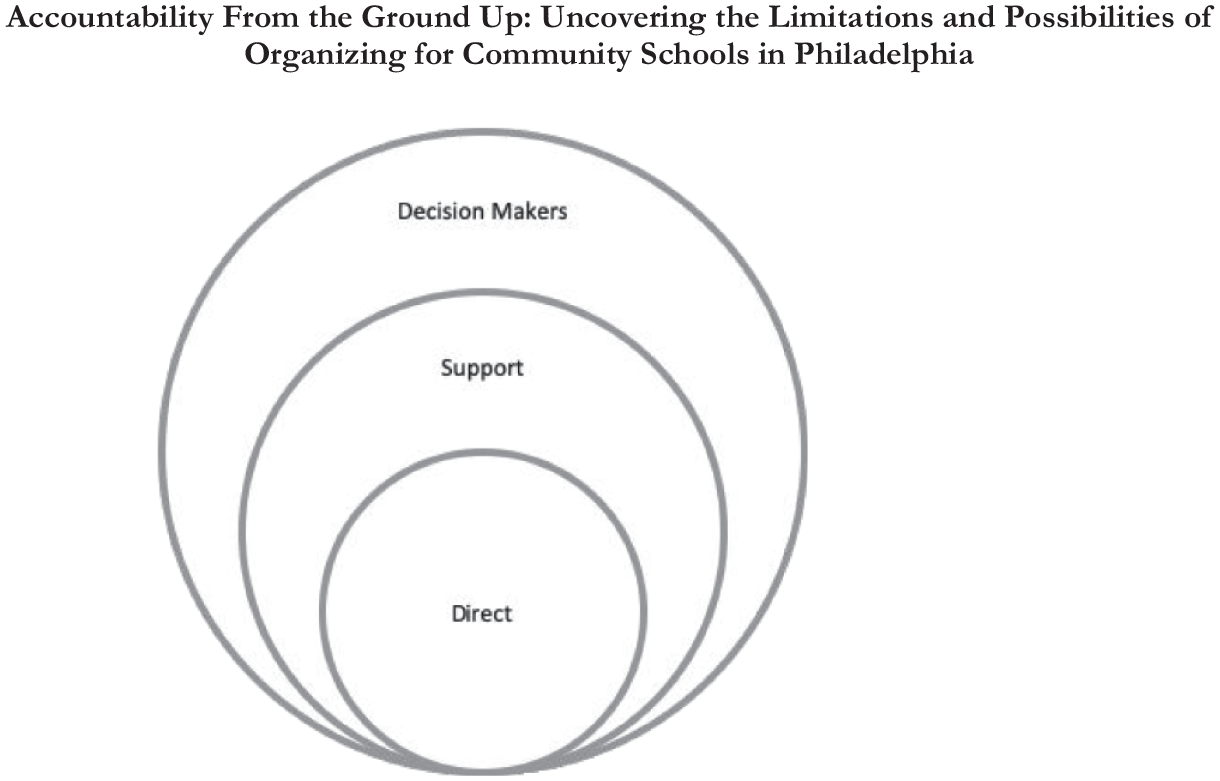
Concentric circles of power.
This activity immediately set a reflective and relational tone to the focus group. Lisa, began by identifying herself as a “recently unemployed” Black woman who previously identified as both directly impacted because she had a son in a boarding school and a supporter until she lost her job of 17 years at a social service agency. Next, a white male identified as a supporter and connected to Lisa by saying he expected to be “in the same boat” soon with fears about his job. Around the table, participants shared who they were, why they were there, and to whom and what they were accountable to.
Through this focus group, participants co-constructed a critique of the MOE initiative that paralleled the discussions happening within the TF. At the beginning of the focus group Evan remarked “but [am] I the only one that’s confused or lost? But I’m just inquiring. The relationship between what we’re doing here and the community school’s thing that happened at the Mayor’s office, what’s the relationship?” Many of the other participants expressed a shared confusion. A rich conversation about the conflation of the MOE community schools initiative with the TF ensued. David described the community schools initiative, “what I heard about was all these services that are dependent on funding and could be gone just like that {snaps fingers}, like Lisa’s job.” The facilitators shared about shifts in the TF and the evolution of education organizing that was emerging in the city. Zakia explained her view, “community school is not just to bring in partnerships to give people services or aid for a small period of time, but trying to make these schools more community run, more than necessarily what their namesake is,” and self-sustaining to support communities in utilizing the existing resources.
The conversation expanded to a power analysis and critique of the District’s top-down accountability. Danielle, a parent and educator, argued the transformative potential of community schools in Philadelphia was limited due to their accountability to District policy and procedure, such as access to buildings during summer and weekend hours. Evan connected this issue to local control and the School Reform Commission (SRC), which he explained “The SRC is not community-based so the schools underneath them are not going to be able to operate truly as a community school because they’re always going to be beholden to the SRC policies that they come up with.” Participants described issues of mismanagement of funds and resources across systemic layers, stories about service providers not providing the services they were expected to and not being held accountable, and with their own employers offering charity rather than essential programming to school communities. The discussion that followed toggled back and forth between critical analysis of structural factors and diverse lived experiences. Participants linked student behavior, policy and practices; critiqued the District as a business accountable for delivering a bottom line; and articulated the limited transformative potential for community schools under SRC control because they would ultimately be accountable to their policies and expectations.
Participants shared stories about their personal and professional experiences in their neighborhood schools. Toward the end of the dialog, they together around the idea that relationships are both essential and difficult. Evan described challenges he faced as a parent leader at his child’s neighborhood school that flipped the script on student behavior and called other adults to task for not having the skills to manage their reactions to children. Lisa agreed with Evan and argued that people recognize the power of relationships and trusting relationships. She elaborated that the work has to begin with a foundation of trusting and nurturing relationships to get parents buy-in. Amy described the challenge of building relationships, “I’m working with my boys now, so they won’t be like me when they grow up, you know, who shies away from relationships because you’re vulnerable, right?” Within this exchange the participants articulated their personal experiences and challenges underpinning their shared believe in the power and role of relationships within this work. Further, they built relationships with each other by sharing stories and strategies for creating the schools they want. They made plans to follow-up with each other to continue to share resources and tools. Evan summarized what he felt we were doing with the AP and succinctly articulated our approach to leadership development “being able to groom people to positions where they get to understand what their personal power is I think is like transformative.” Using the concentric circles as an opening activity—along with unique group dynamics—fostered a different type of dialog and social interaction. The simple shift in structure generated a relational space and a sense of community through a mutual sharing and listening practice.
The TF mobilized their vision of building upon and enhancing the capacity of parents and community members as educational leaders and decision makers through the AP. The living curriculum centered meaningful leadership development that prioritized relationship building and political education to facilitate critical awareness of and positionality within the ecosystem of education in the city. We consider this both a metric and a process for building community capacity for creating new metrics and accountability structures that are place-based and culturally sustaining. These goals underpinned the TF’s vision of Community Advisory Board for shared governance, which is essential for transformative community schools but did not come to fruition in Philadelphia.
Accountability as a Relational Process: Creating Pathways to Participation Together
The coalition played a key role in bringing community schools to Philadelphia. In so doing, they changed the deficit narrative put forth by the District and SRC of Philadelphia’s schools as failures to a narrative of schools and communities who were struggling due to structural and historical disinvestment. The power of the education justice movement in the city led to a Mayoral race where education was a core issue and directly informed the winning candidate’s (Kenney) education plan. These wins are monumental. Over time the fight to sustain the education justice movement in the city moved away from community schools as the formal initiative took shape and toward local control and disbanding the SRC (a fight won in November 2017).
Although the TF’s original vision of community schools as an alternative to neoliberal reforms was not realized, the coalition was forced to grapple with and learn from internal challenges and tensions. The research provided a systematic method (praxis) for examining, reflecting, revising, and improving our organizing. Analyzing the parallel process of the community schools initiative with the final year of the TF, we noted the subtle ways in which we reproduce the systems and practices we aim to dismantle in our organizing spaces. While this is broadly understood, living it, reflecting upon it, and analyzing it in real time provided a new more embodied understanding of this tendency. This insight allowed us to pivot the AP and experiment with new practices toward the original vision of transformative community-driven public schools.
As the service-provider model emerged in Philadelphia, we clarified the AP and our living curriculum as an alternative approach to community schools as a process, rather than a model, for co-creating new metrics for learning and schooling. The focus groups provided an opportunity to experiment with a more explicitly political curriculum. The concentric circles of power activity enabled the co-construction of a collective as participants developed knowledge and awareness of the ecosystem together. Participants reported feeling a sense of belonging and a broadened perspectives of the landscape of education in the city, which is vital for negotiating the fragmented and contentious sociopolitical context. While we struggled to influence the structure of the community schools model in Philadelphia, the AP influenced the ways in which individuals conceptualized and engaged with the schools, including community school staff. The concentric circles activity could be an effective intervention into service provider models by helping providers, staff, and community school coordinators to understand their positionality within the school and the broader education ecosystem. This is a subtle, yet significant shift that has implications related to power, voice, decision-making, and relationships.
Collective Conclusions and Future Possibilities
The evolution of community schools in Philadelphia from a grassroots vision for transforming public education to the formal MOE initiative illustrates many tensions and challenges of organizing for public education and governing in the contemporary sociopolitical context. Organizing and CPAR are different types of collaboration whose success and power depends upon people’s ability to build a process of accountability grounded in relationships and building collective power through praxis. We view community schools through the same lens to consider their potential for generating new types of relationships between schools, communities, families, and students. The official community schools initiative in Philadelphia became a wraparound model that prioritizes partnerships with outside professional services. Without demands and public pressure for new mechanisms of accountability and governance structures, the initiative failed to create new pathways for meaningful parent and community engagement. This is a key lesson for organizers and advocates fighting for community schools in other places: messaging around shared governance and community accountability must be explicit, loud, and cohesive.
From the ground up accountability for organizing and community schools entails metrics attached to the work of being responsible for that includes meaningful engagement of parents, families, communities, young people, and educators. These accountability metrics entail a significant shift of power where organizers, politicians, districts, and administrators become accountable to the people who are engaged at the school and neighborhood level. This framework identifies the central role of power, decision making, and relationships to strengthen the education justice movement and a catalytic transformative community-driven process for improving neighborhood public schools.
In this paper, we illustrated how CPAR supports and strengthens social movements by design. This meta-approach to organizing is rare in the crisis-filled ecosystem because it takes significant resources and time, but is invaluable for maintaining a critical edge within the contemporary sociopolitical landscape. We have shown the catalytic possibility for leadership programs grounded in a radical vision of equity and opportunity for mediating the challenges involved in shifting from a grassroots community-driven to a formal reform strategy. We argued that movement and educational spaces need a process for articulating and developing collective accountability that integrates personal and relational accountability. Creating spaces for those invested in a sustainable culture for engaging in public education is essential for defining new structures of governance and mechanisms of accountability that restore and reinforce the strengths and power of students, families, and communities. This space of catalytic possibility shifts the movement into the future.
Footnotes
Acknowledgements
We are eternally grateful to all of the people that trusted us with their time and stories that made this research possible. Thank you to co-researchers and supporters: Kendra Brooks, Edwin Mayorga, and Zakia Royster-Morris.
Declaration of Conflicting Interests
The author(s) declared no potential conflicts of interest with respect to the research, authorship, and/or publication of this article.
Funding
The author(s) disclosed receipt of the following financial support for the research, authorship, and/or publication of this article: This research was supported by the David and Marjorie Rosenberg Career Development Professorship for Leadership and Innovation.
