




Abstract
As community schools grow in numbers, this article argues that the model needs to be interrogated in order to address the power imbalances that exist between non-dominant families and schools. This paper draws on a citywide study of parent interviews as well as public documents and interviews with key community school leaders in Baltimore to understand the state of family engagement with community schools. Using Ann Ishimaru’s equitable collaboration framework, we analyze the data and conclude that while there is a strong foundation, there is room to develop a model that truly engages families as partners with community schools.
Introduction
In 2018, Baltimore hosted the national conference for community schools where hundreds of practitioners, researchers, and school district leaders gathered to share stories about community schools initiatives from around the country. Baltimore was a perfect convening spot as it has become a hub for community schools, where over half of its schools are classified as community schools. Community schools, which are set up to provide supports to help children and families overcome the barriers to learning presented by poverty (Blank, 2005), make sense in a city in which close to 25% of the residents live in poverty, and over 80% of students attending its public schools qualify for free and reduced price meals (US Census Bureau, 2015). Moreover, they present a viable alternative to the deluge of neoliberal school reforms that have dominated urban school districts for decades which focus narrowly on academic outcomes and tend to exacerbate inequity (Horsford et al., 2019; Lipman, 2013; Scott & Holme, 2016).
Baltimore has been invested in community schools for some time; Researchers located the initial plan for community schools in Baltimore about 20 years ago: The movement to adopt the community school strategy in Baltimore began around the year 2000. At that time, the central district office had just established a new Office of Family and Community Engagement. There was reportedly considerable local political support and a recognition among school leaders and education advocates that community-school partnerships were a promising approach to addressing the challenges that persistent, often concentrated poverty in Baltimore posed to schools (Durham et al., 2019).
This investment was predicated on the idea that community schools can indeed mediate some of the impacts of poverty. Community schools provide services to low income families, like mental and physical health care, free meals, food pantry and laundry services, before and after school care, classes for parents, and assistance with housing, which have been shown to address some of the barriers for students getting to school and performing in school (Dryfoos, 2005; Ferrara & Jacobson, 2019). Moreover, a growing body of evidence shows that community schools are indeed improving outcomes for young people, particularly in increasing attendance rates (Durham et al., 2019; Johnson et al., 2020) and in helping students make academic gains (Caldas et al., 2019; Johnson et al., 2020).
The pillars of community schools include: Integrated student supports, expanded learning time and opportunities, family and community engagement, and collaborative leadership and practices (Oakes et al., 2017). Baltimore’s community schools have been focused on the first two pillars, integrating student supports and expanding learning time. Community schools throughout the city have been providing a variety of supports and out-of-school time programs to young people for some time, bolstered by strong lead agencies, as well as local and state level funding. The second two pillars of community schools, family and community engagement and collaborative leadership practices, however, have been more of a challenge to get off the ground.
The authors of this article have worked with community schools and see promise in them. We see that community school coordinators, for example, are earnestly engaged in reaching out to families and trying to collaboratively lead with their principals. Yet, we also recognize the difficulty in doing this work. Coordinators are hard at work amassing partnerships to support families in need, and play an important role as “cultural brokers,” managing linkages and conflict among partners including school principals (Sanders et al., 2019). However, there are many school environments across the city in which collaboration and trust is rare. Community schools, therefore, need as much support as they can get from the school district and partnering agencies to do the work of family engagement and collaborative leadership.
Family engagement and collaborative leadership require a real paradigm shift among everyone working with community schools from district leaders to principals and coordinators as well. Without that shift, families and communities may not be as integral to the main work of community schools as they could or should be. Research has shown that successful family engagement needs to move away from positioning families and communities as clients to involve toward engaging with families as collaborative partners who contribute to making decisions about what happens at the school itself (Ishimaru, 2019a; Warren et al., 2009). Keeping families in the position of clients in Baltimore, maintains an existing racialized power imbalance that has been in place throughout the city’s history (Baum, 2010; King et al., 2019; Pietila, 2012). Equally problematic is that the client approach reifies deficit perspectives, leading school staff to see low income families of color as needy and unable, rather than full of capacity and potential, which also has been characteristic of how African-American families have been treated by urban schools writ large (deRoyston & Madkins, 2019; Lomotey & Milner, 2014).
Ultimately, the school district and the staff working in community schools hope to fully engage families and to build their capacity, and so to understand the obstacles to doing so, we need to understand the state of family engagement better in Baltimore. To that end, we examined the school district’s and community school founder’s intentions around family engagement as well as families’ perspectives on how schools engage with them. Our aim was to answer the following questions: (1) What are the policies and approaches to family engagement in Baltimore’s community schools? (2) What are families experiences with community schools in Baltimore? (3) How can the experiences and perspectives of families inform the approach to family engagement in community schools? Our sources of data came from publicly available policy documents and meeting minutes from the school district on community schools as well as interviews with people who were founders of community schools in Baltimore, and interview data from a citywide study conducted by community organizers at the Teachers’ Democracy Project 1 and to answer our questions.
Using Ishimaru’s notion of “equitable collaboration” to examine the data we collected was helpful because this concept positions families, particularly those who are marginalized in some way from the dominant cultural norms of schooling or non-dominant families, as leaders “who contribute and help shape the agenda” as opposed to “clients and beneficiaries while educators/professionals set the agenda” (Ishimaru, 2019a, p. 355). We hope that this analysis might provide insight and leverage points for community schools in which to engage families.We understand that this is only the beginning of what can and should be a much longer inquiry, and so we offer this analysis as a “loving critique” (Paris & Alim, 2014). The co-authors of this article work with and support community schools. Consequently, we hope that our work improves the work of community schools as they scale up in Baltimore, and that our study can be used to support the next iteration of the initiative.
Origins of Community Schools
Although there were some early 20th century efforts to create community schools during the Progressive Era, the concept resurfaced during the Great Depression because of deep economic needs that many communities faced. Community schools became popular again when The Great Society programs were funding programs for poor communities (Jacobson, 2019, p. 4). However, community schools today tie their origins to the iteration that was driven by the Children’s Aid Society in New York in 1987. The Children’s Aid Society received some funding from New York City’s board of education and approval to partner with a set of schools in 1990. In 1992 the first community school opened. Community school founders in New York saw the goal of the school as follows: We began to envision a different kind of connection with the cities public schools. We saw the many benefits that could come from clustering services and education in one place, right where the students and parents are, and we brought in their thinking to imagine the school that would fuse the best elements of a high-quality education institution, a health clinic, a community center, and a social service organization. The school would not be open just from 9 AM to 3 PM for 10 months of the year; instead, it would open early, close late, and remain active throughout the summer, weekends, and holidays (Dryfoos et al., 2005, p. 9).
Community schools have been seen as a reform that can address the out of school factors that impact student learning, unlike so much of neoliberal school reform which focuses narrowly on academic learning. Community schools have grown by leaps and bounds since this time, and there are over 5,000 community schools in cities across the country (Jacobson, 2019). There is evidence to suggest that community schools have been quite successful at alleviating some of the ways in which poverty impedes student success (Dryfoos, 2005; Johnson et al., 2020; Medina et al., 2019; Sanders, 2015). Likewise, Caldas et al. (2019), demonstrate the positive impact that community schools have on academic achievement. Additionally, the RAND corporation produced a study on New York City’s community schools which have produced some promising results around improved attendance, reduced suspensions, and increases in some academic performance (Johnson et al., 2020). While community schools were not deliberately developed as an alternative to neoliberal school reform approaches, they constituted a different ideological approach that focused less on only the academic learning and test scores and more on supporting the social-emotional needs of students as well as the mental and physical health, housing, and economic needs of families and communities outside of the school.
Baltimore’s Community Schools: A Brief History
The move to get schools to open their doors beyond regular school hours, and to become community schools with a system of supports in Baltimore, was spearheaded by four early leaders. These women, who were working in communities as social workers and organizers, started by informing neighborhood associations and parents about the concept of community schools. In 2003, they built enough momentum and support from the Annie E. Casey Foundation that they started an entity called Baltimore Community School Connections, a nonprofit which launched 23 community schools. In 2005, the mayor and soon-to-be governor Martin O’Malley showed interest. In 2007, O’Malley left for the governor’s office, but then mayor, Sheila Dixon invested city funds in the strategy (Community school founder, personal communication, October 4, 2019).
Baltimore’s Community Schools Connection employed a model aimed at improving public schools, and for the most part is still in place today. The model included a lead agency who partnered with a school, and hired a community school coordinator who was tasked with bringing in and coordinating partners to provide wrap-around services, such as medical and mental health services, after school programming, and support for those experiencing housing and employment instability. While neoliberal reformers were vying to open charter schools in Baltimore to provide an “escape” for middle class families from neighborhood schools, these community school founders were proposing an alternative that was meant to bolster communities and schools through partnerships and resources. Grounded in Bronfenbrenner’s ecological model of human development which suggests that there are many layers of influence, the micro, meso, and societal, which impact families’ and students,’ ability to succeed, Baltimore’s community school leaders were increasingly persuaded that it was essential for schools to help families in the realms where support was lacking, which were their neighborhoods which had declined economically because of decades of disinvestment (Bronfenbrenner, 1994).
Their work grew and by 2010, community schools became officially housed under the umbrella of the local management board that remains the main intermediary organization for many of the community schools in Baltimore today. This iteration of community schools rested on the idea of assembling a series of partners to provide services that address barriers families and children have getting to and performing schools (Duncan, et al., 1998). This focus on removing barriers was seen as a selling point for local non-profits, funders, and government. However, as one of the founders noted, an unintended consequence was a turn away from a community organizing approach. She said, “The focus had to be on removing barriers to learning instead of parent power” (Community school founder, personal communication, October 4, 2019). One reason for that, according to this community school leader, was the magnitude of the needs posed by a city like Baltimore. Concentrated poverty created a constant crisis for those working with schools and families, and staff were looking for ways to combat the immediate problems that arose from it, rather than organizing to dismantle the systems that has maintained poverty throughout much of Baltimore.
The idea of providing immediate support for poor families took hold in Baltimore. By 2018, Baltimore had 50 community schools, and five major lead agencies that partner with community schools across the city. The community schools are growing further under new recommendations by a state-level commission called the Kirwan Commission which was established to create a more equitable funding formula for Maryland’s schools. One of its key recommendations was the expansion of community schools in high poverty schools, and in 2019 the legislature passed a bill to provide funding for the community school. Consequently, Baltimore launched 70 schools in the 2019 to 2020 school year.
As the community schools expand in Baltimore, and they reach more students and families, it is even more important to define what successful family engagement in a community school looks like. Some of the lead agencies have had their own rubrics to define success, but there is now a city-wide committee devoted to developing a uniform rubric used to define community schools’ success across agencies.
Literature on Family and Community Engagement
There is a broad consensus that family engagement in schools matters to the success of children (Epstein, 2011; Mapp, 2017; Warren et al., 2009). More specifically, there is a good deal of research to support the idea that parent involvement in schools supports student academic success (Epstein, 2011; Henderson & Mapp, 2002; Ishimaru, 2019a, 2019b). While the definition of parent engagement varies, it is a concept that has largely been associated with more traditional modes of involvement in schools, like volunteering on the PTA or attending school events. Researchers have shown how traditional forms of parent engagement disproportionately benefit middle class families (Horvat et al., 2003; Ishimaru, 2019a, 2019b; Lareau, 2003). This is because the kinds of involvement opportunities available to parents can be inaccessible to lower income families. Because of the language and skills required to participate, such as English-only meetings, participation can count out whole groups of parents (Ishimaru, 2019a, 2019b). Moreover, involvement in schools can require time and financial commitments to which not all parents have access (Posey-Maddox, 2014). Middle class parents, who have that time and money, conversely, are frequently hyper-engaged in their schools and have their own informal networks which enable them to “hoard opportunities” for their own children (i.e., enrichment programs or accelerated curriculum) (Tilly, 1998).
In order for schools to successfully engage low income families and families of color, or non dominant parents, schools need to transcend traditional modes of family engagement (Ishimaru, 2019a). Auerbach (2012) has found that traditional modes fall or “the vast majority of family–school partnerships presume the schools be at the center, and parents and communities—both physically and figuratively (in terms of their values and practices)—should come to the school” (In Ishimaru, 2019a, pp. 378–379). This school-centric approach can often leave families not feeling valued, and can prevent them from engaging in the first place. There is hard work to be done to engage nondominant families because there is so much in the larger society discouraging families from coming to the school. As Olivos (2006) has noted, we need to disavow ourselves of the “optimistic and naïve belief that the 'disempowered’ in our society will somehow authentically be admitted into the school system, or any other state-sponsored institution, as ‘empowered’ equals” (Olivos, 2006, p. 25).
A different approach to family engagement lies in using relational practices as a building block to engagement among non-dominant families. Some community schools have been engaged in this work through home visits and phone calls, confronting biases about parents, and then helping parents to become activists and advocates for their own schools and communities and schools (Hester & Capers, 2019). While community school coordinators diligently reach out to build relationships in community schools, a focus on racial equity and building power is not always present. deRoyston and Madkins (2019) urge community schools to focus on relational practices need that are conscious of racial equity, a particularly important approach in Baltimore where over 80% of the students and families in schools are African-American. They found that community schools that are successful with nondominant families engaged in the following practices; (1) Shared understanding and solidarity around the racialized and classed experiences and realities of students and families; (2) Commitment to equity not equality where equality presumes that each student needs and benefits from the same resources, access, learning opportunities, and supports, while equity reflects an under-standing that students have differentiated needs to support their success and well-being; (3) Recognition of the critical nature of a positive school climate that encourages well-being beyond academic success alone; and (4) Acknowledgement by the district and schools of the importance of attending to students’ and families’ needs rather than presuming that families’ have resources at their disposal or can access them (deRoyston & Madkins, 2019, p. 267).
Ann Ishimaru has taken this set of race-conscious relational practices and added to it to develop her notion of equitable collaboration. Equitable collaboration implies a set of specific practices that can build relationships with nondominant parents, confront biases and deficit thinking, and that helps schools staff see the assets of the communities with whom they work (Ishimaru, 2019b). It shifts the paradigm of engagement from a “school-centric model of training or fixing to an approach that recognizes family expertise and prioritizes their collective well-being, self-determination, and dignity” (Ishimaru, 2019b, p. 33). What is more, equitable collaboration includes a shift in power as well focusing on these four ideas:
Roles for non dominant families as educational leaders, rather than clients.
Goals of systemic transformation within a school culture of shared responsibility, rather than individual remediation.
Strategies of relationship and capacity-building, rather than technical changes.
An approach to educational change that addresses the political and social issues in the broader community, rather than an apolitical one (Ishimaru, 2019b, p. 36).
Drawn from critical race theory, community organizing literature, as well as sociocultural learning theories, equitable collaboration re-frames traditional family engagement completely, ensuring that the school is not the center of family engagement and approaching the work bi-directionally, and also builds power through strategies that engage families as a collective (Ishimaru, 2019a, pp. 355–356).
Method/Data Collection
Because we were interested in understanding the state of family engagement as well as families’ perspectives on how schools engage with them, we used several different data sources to understand how family engagement. Using data collected from school board meeting minutes and public documents about community schools, interviews with founders of Baltimore’s community schools and lead agency representatives, as well as interviews conducted by fellows at the Teachers’ Democracy Project, a Baltimore-based nonprofit that advocates for teacher and parent decision-making in school policy, in 2018, we attempted to answer the following questions regarding family engagement and community schools: (1) What are the policies and approaches to family engagement in Baltimore’s community schools? (2) What are families experiences with community schools in Baltimore? (3) How can the experiences and perspectives of families inform the approach to family engagement in community schools?
Public Meetings and Documents
To answer our first question, we needed to understand more about the intentions from the school district around community schools. We reviewed any publicly available school board meeting notes, sub-committee reports, and public documents that dealt with community schools from 2014 until 2019. For each of these years, there were several meetings that dealt with community schools, and provided a sense of the evolving definition of community schools from the district’s perspective.
Interviews with Founders
To fully understand how the district’s intentions were playing out in the actual community schools, we conducted four semi-structured interviews with community school founders or leaders, who were critical informants since each one played a major role in founding or implementing the community schools in Baltimore. These founders/leaders included an original founder who has now come back to the school district staff to oversee the current implementation of community schools now, a community school coordinator, and a lead agency staff person who supervises community school coordinators. Through these semi-structured interviews, we were able to get a sense of the history, approach taken as well as the challenges of implementation.
Teachers Democracy Project Interviews
The Teachers’ Democracy Project (TDP) worked with 23 fellows who were tasked with conducting one-on-one conversations with people on what issues they most cared about in Baltimore City Schools during the summer of 2018. In the end, these fellows completed 659 open ended interviews. The interviews were part of an effort by TDP to raise awareness around education issues, find people willing to join in education advocacy efforts, and increase parent and teacher involvement at the school or district level, and were published in a 2018 report (TDP, 2018).
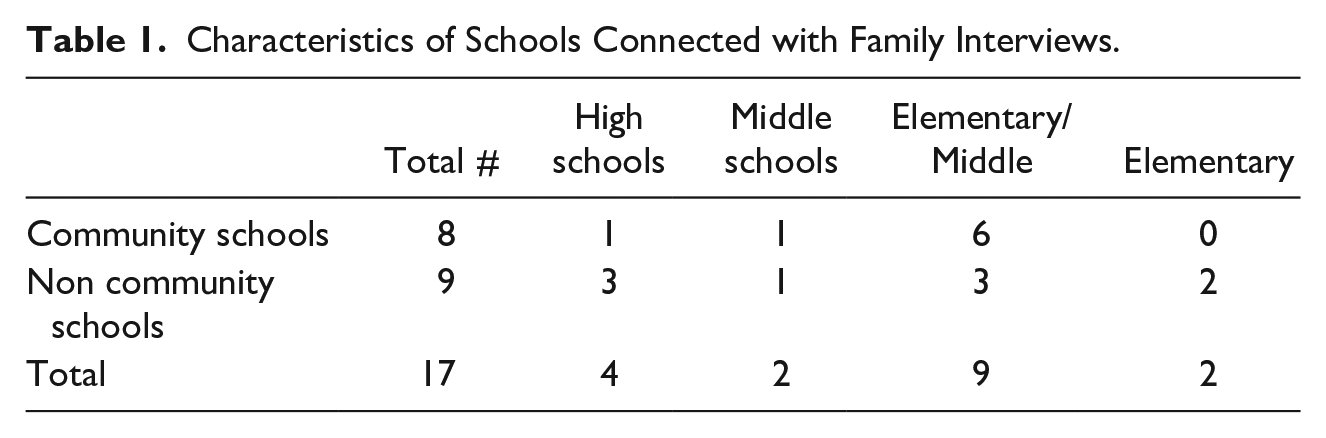
Of the total 659 interviews, we took a subset (192) that focused on parent engagement and schools, traditional and community school. Together, these interviews comprised the interview data for this study to inform us about the state of family engagement. The Teachers Democracy Project interviews go well beyond what the school district collects in its surveys. The results tell a story that constitutes a counter-narrative about how families felt about engagement in their schools. The open ended interviews allowed families to talk about experiences that they had at their schools, rather than just say whether they felt the school engaged with them or not. Interviews were conducted with family members connected with 17 different schools, roughly an equal number of community (8) and traditional schools (9). There was a mix of elementary, elementary/middle, middle, and high schools, located in a variety of neighborhoods across the city (see Table 1). The student population of the traditional schools in the study reflected the population of Baltimore schools in general. The population of African-American students in all Baltimore schools is 78.6%, and the population of African-American students in the traditional schools in which the interviews took place was 82%. However, the student population of African-American students in the community schools in the study was much lower at only 70%. The community schools had a high Latino population at 23% which is about double that of the city, which is 11.3% Latino (see Table 2).
Characteristics of Schools Connected with Family Interviews.
Student Demographics by School Type.
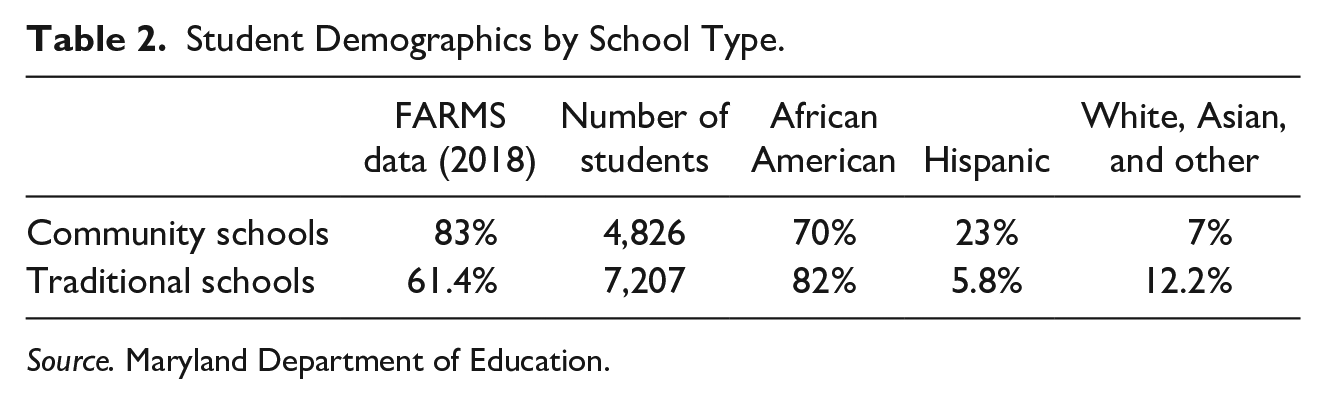
Source. Maryland Department of Education.
In Baltimore, the district has been providing free meals to all students since 2015, and no longer collects data on those entitled to free and reduced priced meals, but recent state education data shows that about 60% of all students are entitled to free and reduced priced meals, which was similar to the percentage of students connected with the schools with which interviewees were connected were entitled to free and reduced prices meals. However, there was a much higher percentage at the community schools, 83% of students were entitled to free and reduced prices meals at the schools with which interviewees were connected (see Table 2).
Data Analysis
We conducted a thematic analysis based on what emerged from all of the data sources. As in any interpretive study, data analysis was ongoing and iterative. We began by reviewing collected data from interviews. We developed a coding scheme through an “open coding process” (Emerson et al., 1995, p. 143). A set of themes emerged from the data that became codes during the analysis and in turn became the coding categories for the data. These codes were helpful in defining what exactly was important to parents about their schools. They were also helpful in defining how community school founders and lead agency representatives saw community schools and the role of family engagement. The coding process was then followed by a series of memos generating “grounded theory” (Glaser & Strauss, 1967). We shared these memos and also conducted discursive and analytic reviews of public documents available about community schools and family engagement to understand the connection between the themes and their corresponding evidence (Emerson et al., 1995).
Authors’ Positionality
The authors of this article are long time educators, and have worked with community schools. One of the authors of this article, Jessica Shiller, is an educator, researcher, and college professor. She has students working as interns under community school coordinator supervision. She is white and works at a predominantly white institution, just over the city line, which means that she and her students traverse a border that in the public imagination is a dividing line between Black poverty and violence and white middle class safety. This requires doing a lot of learning and reflection on structural racism and white privilege before, during, and after the time they spend in community schools. Jessica’s research and teaching supports the need for community schools, and has written about how effective community schools are in improving school attendance, for example. Through her networks and relationships, she also provides professional development training to community school coordinators.
The Teachers’ Democracy Project is an advocacy organization that has taken on the role of critical friend with the public schools in Baltimore. They are made up of parents, teachers, and community activists that have created a city-wide working group on the need for more teachers of color, pushed against school closures, and helped create culturally responsive curriculum for schools, for example. In terms of community schools, TDP pushed for a model that empowers parents rather one that serves clients, to push people to “shift school culture in the direction of inclusive decision-making” (TDP, 2018). Their goal is to have teachers and parents in authentic relationship to one another, and designed their research to help meet that goal.
Findings
In 2008, Baltimore’s schools launched an Office of Partnerships, Communications, and Community Engagement, an attempt by a previous superintendent to bring a series of siloed areas under one umbrella of community engagement. According to the director of this office in 2008, the goal was to re-frame how families felt about the schools and its students. He observed, “After a listening tour, families were actually face-to-face getting a sense that, ‘You know what? The school district actually desires to be in a relationship with us.’. . .For a lot of people it was the first time they’d encountered a superintendent” (Mapp & Noonan, 2015, p. 8). The district showed that they prioritized family engagement by initiating school-family councils at each school, a parent board that would inform school district decisions, and increasing funding for initiatives like community schools.
While a there was a lot of excitement around this set of strategies, and around the community schools, in particular, as engines of neighborhood improvement, the success of the community schools depended considerably on the “strength of infrastructure within the communities” (Mapp & Noonan, p. 21). Advocates observed that not every neighborhood had a viable community or neighborhood-based organization and that the capacity of families varied from neighborhood to neighborhood (Mapp & Noonan). This messy patchwork made few communities ready to advocate for shared power with their local schools, a key feature of Ishimaru’s notion of equitable collaboration (Ishimaru, 2019b). Families were just getting used to the idea of school-family councils by the time the current superintendent took the helm in 2016. While community schools remained a priority for the district, the findings show that family engagement remains a challenge and, therefore, limits the capacity of families to engage in “equitable collaboration” with community schools.
District Perspective on Family Engagement in Community Schools
After examining school board meeting minutes and public documents dedicated to community schools and family engagement, we found that indeed family engagement has been a priority for the school district since 2008. As we examined documents and asked questions about the family engagement approach related to the community schools in Baltimore, we learned a good deal about the approach. In a school board meeting, community schools were promoted as a strategy that would:
Promote student achievement, positive conditions for learning, and the well-being of families and communities
Build an integrated strategy that enhances academics and student well-being through enrichment, health and social supports, family engagement, youth and community development
Anchored by the work of a full-time site coordinator and expanded hours with out of school time programming
Provide a base for parent and community advocacy on behalf of their children
(Baltimore City School board meeting, 2016).
This approach, at a district level, proposed to have community schools become a launching pad for parents and communities or advocacy, while providing services to support their needs. In this same meeting, school board members articulated a desire to “partner with families, communities, and the public and private sectors to foster shared ownership of schools and to collectively create opportunities for student success” (School board meeting, September 2016). This seemed consistent with earlier iterations of the family engagement policy, and the desire for “shared ownership” conveys an aspiration for school-family connections.
Two years later, those hopes manifest slightly differently. In public documents, Baltimore’s school board articulated the community school primarily: As a place and a set of strategic partnerships among the school and other community resources that promote student achievement, positive conditions for learning and the well-being of families and communities; Maintains a core focus on children, while recognizing that children grow up in families, and that families are integral parts of communities; Builds an integrated strategy that enhances academics, enrichment, health and social supports, family engagement, youth and community development that improves student well-being; and is anchored by the role of a site coordinator and expanded hours (Baltimore City school board meeting, September 2018).
In this later iteration, the school board does not articulate the idea of community schools as a hub for parent advocacy and a place of equal partnership, but rather, community schools as places of support and engagement for parents and families, not exactly places that focus on power and/or shared decision-making. By removing that language of advocacy from the definition of community school, the emphasis changes from community schools that promote parent power to schools that provide services.
Looking at the school board’s deliberations on their family engagement policy from the same time shows that there was a restructuring of the family engagement strategy to focus on providing programming and interventions for families as well as an effort to build their capacity to help with academic engagement as the two main priorities (School board meeting minutes, February 13, 2018). Community schools were a central part of this strategy, and seen as a base for family engagement. However, there was a subtle shift in this more recent articulation of the role of family engagement. The focus for the district narrowed from the idea of advocacy in 2016 to participation in 2018. Two of the major goals advanced by the school board in 2018 were to ensure that at least 50% of school-family councils were fully functional and that there was an increase in volunteer opportunities for families at the schools, suggesting that the aim for families was simply going to be getting more of them into the school building. Warren et al. (2009) refers to kind of approach to families as involvement, rather than engagement because it is a limited type of participation in the school itself (Warren et al., 2009, p. 2238).
Community Partner Views on Family Engagement
While developing the capacity of parents as advocates was not a priority for the school district, one lead partner for community schools had a long history of parent organizing, Child First Authority. They encouraged and supported their community school coordinators to engage families, to see them as “equitable partners.” There are three tiers of family engagement that they communicate to coordinators:
Level 1 Engagement—Participation. Do they come?
Level 2 Engagement—Do they volunteer or give back?
Level 3 Engagement—Are they influencing decision making by sitting on committees, going to board meetings, going to Annapolis, etc. At what level are they influencing? In schools? Neighborhoods? City? Or state?
Though Child First has said they found only small numbers of schools working with parents at the third tier, they maintain this tiered system to encourage community organizing. They also see these tiers as a progression “Engagement is a prerequisite to deeper organizing. We need it all. It’s not an either/or” (Community school leader, personal communication, October 7, 2019). No other lead agency has a “tier three” equivalent to measure their family engagement.
In our interviews with representatives of other lead agencies and community school coordinators, we found that the biggest challenge to using community organizing tactics to engage families was the fact that there is a such a deep need among families for basic needs like food, housing, and employment. About one fifth of Baltimore residents live in poverty, the median family income is below the national average at $48, 840 (US Census Bureau, 2015). This need puts community schools in the position of constantly trying to address family needs. As one coordinator explained: Parent organizing is a full time job. I don’t have the capacity to do as much as is needed given all the other duties. After 3 years [of being a community school] we have more parent leadership than we did. But for a lot of parents it’s hard to focus on long term things when they are surviving and navigating things like electricity cut offs. Families don’t come with “How do I advocate for myself?” They want help with a need (Community school coordinator, personal communication, October 2019)
Another former community school coordinator, who now works for a lead agency, echoed this idea by describing a typical encounter that a coordinator has with families: A parent walks in the door and she is about to be evicted. If she has any kind of existing support from the Department of Social Services, she will be ineligible for a grant to help her keep her housing. If she has a husband and a daughter and a son, shelters don’t take families with multiple genders. The community school coordinator is left calling churches and alternative locations for the family to try to help (Personal communication, October 2019).
Because they interface so directly with parents each day, coordinators often end up trying to help them negotiate the labyrinthine social services that provide for low income families instead of organizing parents to advocate for themselves or collectively for a shared concern. Coordinators are stretched thin and talked about not having the bandwidth to do more than they are already doing. Organizing seems to be something that falls by the wayside, even if they believe it is important. What is more, because community schools are frequently held accountable for helping to improve attendance (an important indicator of school performance), coordinators get caught up working on ways that will improve attendance in the short term (i.e., finding a family stable housing), rather than organizing a group of families to advocate for better housing options across the city. While longer term, organizing could address the needs of Baltimore’s families, community schools were often in a position of addressing the immediate needs, preventing them from cultivating “relational power between parents, families, community members, and educators engaged together to influence institutions—not only to provide conditional access to resources, knowledge, and opportunities but also to transform them systemically” (Ishimaru, 2019a, p. 357). In the end, despite community schools’ interest in building relationships with families, the approach maintains what Warren et al call a service model of engagement, which “tends to emphasize family needs rather than family assets” (Warren et al., 2009, p. 2222). In doing so, the model maintains a deficit perspective of families; it positions families are always those in need, and schools as always the ones providing for that need.
How Families Experienced Engagement: The Welcoming School
One theme that arose in family interview data was the idea of the “welcoming school.” Ishimaru talks about the “welcoming school” as one that focuses on listening, respecting, and building relationships with families (Ishimaru, 2019b, p. 30). While certainly an improvement over a parent involvement model which focuses on getting parents volunteering at the school in traditional activities, like the Parent Teacher Association, this relational approach still does not address the power differentials between families and schools, and often maintains a “school-centric approach” where the school still determines the terms of engagement for families.
In our study, the welcoming school notion was pervasive, and about a third of all family members interviewed described their schools as welcoming, “family oriented” or “like a community.” This happened across community schools and traditional schools. One community-school parent described her relationship with her child’s school this way: They are a family oriented school. The school curriculum is very challenging, the staff members are pleasant. The school atmosphere is cordial and she loves how they blended the elementary and middle school together (Parent of a community school student, personal communication, July 2018)
This parent actually used the word family in her comments about the school, suggesting that there was a trusting relationship where school felt like network of people who cared for her and her children. Another community school parent explained, I don’t have any complaints about my daughter’s school. I am very impressed at the things the school has to offer: Coach class, keeping parents up to date with the events, student activities, PTO meetings, calling the parent not just when their child is misbehaving in class, but also when the child is doing good (Parent of a community school, student, July 2018)
This parent does not go as far as to say that the school was a family, but that because there was positive communication with her, she felt as though the school was a reliable place. Taken together, these community school parents felt as though the school “welcomed them.” In other words, the school treated the parents well by inviting them in, communicating positive feedback about their children, treated them respectfully, invited them to events and activities, and had functioning parent teacher organizations.
The idea of the welcoming school transcended type of school, and was not exclusive to community schools. As one parent at a traditional school said, there was kindness and love that emanated from the school: I have a son and daughter who attend this school and am very pleased with the education that her children have received. I wish all schools in the city could have the love and compassion, and kindness that the administration staff and teachers have towards the students and parents (Parent of a traditional school student, personal communication, July 2018).
This parent expressed a feeling of warmth that she and her child receive at school. While all schools should feel this way to parents and children, and certainly makes the parents and children feel welcomed, the relationship described is not a two-way engagement. The welcoming school is fertile ground for more relational engagement between schools and families, but in order for parent engagement to deepen and become equitable, Ishimaru suggests that the school needs to move beyond incremental changes to more powerful engagement that builds the power and capacity of families to lead and make decisions in the school and beyond.
There was one case, in which the school chose to use its resources and position in the neighborhood to engage non-dominant parents. This traditional school paid for food and childcare at evening meetings, allocated funds to pay teachers overtime, and hired additional staff to do parent outreach. Parents in this school described working in tandem with the school regarding a shared concern about the lack of a school crossing guard. One parent described it this way: The information was important and I will attend more meetings. We need security for our children walking and crossing guards, and we have to make it happen for them (Parent of a traditional school student, personal communication, July 2018).
This parent continues to be active in his school, and considers his work to be part of a larger collective effort for school safety. The school made this parent feel welcomed by providing food and childcare, and solicited his support for an issue of concern for the whole community. However, it was unclear whether parents could bring their own separate concerns and issues to the school, especially if those concerns were with the school staff.
Consequently, for a school to move beyond welcoming to a more equitable collaboration, it would need to begin cultivating bi-directional or reciprocal relationships between school and families (Ishimaru, 2019a). In this way, families would move from the role of clients or beneficiaries of schools to educational leaders who collaborate and shape the agenda for the school (Ishimaru, 2019b, p. 50). Most schools in our study were not engaged with families at this level, according to interview data. While there was evidence of relationships between the schools and families, the families in most cases came to the school, not the other way around. The schools did not solicit families’ ideas and feedback for making policy decisions at the school. Ishimaru uses the term “school-centric” to describe the kind of engagement where the school is the dominant partner in the relationship, where the school decides and the parents can jump on board or not (Ishimaru, 2019a). The findings from the interviews suggest that relationships with families were indeed school-centric where the parents were coming to the school, and not the other way around whether a school was a community school or a traditional school. This finding was surprising, as parent engagement is a central tenet of community schools, but reflects the district and lead agency views of family engagement which treats parents as clients or as stakeholders that the schools serve rather than full partners with whom to collaborate and share power.
Barriers to Engagement: The Unwelcoming School
Feeling unwelcome at schools was a much more pervasive theme across the interviewee responses. Unwelcomeness cut across community school and traditional school, and interview data showed that this presented serious barriers to engagement with families. Barriers to family engagement in schools, especially among low income parents of color, have long been recorded in the literature and include language and cultural barriers, lack of childcare, and bureaucratic school processes (Ishimaru, 2019b, p. 24). Taken together these barriers can add up and prevent parents from engaging with schools at all (Henderson et al., 2007). Although it is troubling, Ishimaru has found that these kinds of barriers are commonplace and normalized in schools, regardless of the school type.
Many schools, from families’ perspectives, seemed like unfriendly places with meetings held at times when parents could not be there and insensitive to the circumstances of poverty. Parents said things like they “had a hard time taking off work to come to the school for meetings.” that “meetings were always held at times they could not come,” and that schools seemed oblivious, sometimes, to the “special circumstances faced by homeless families” and families with language barriers “who feel judged by the school.” A third of all respondents spoke about barriers to involvement in schools,
Looking more closely into this issue as part of this current study, we observed that these barriers often related to a history of poor communication or misunderstanding between the parents and their child’s teacher leading to a sense of distrust, and a feeling of being unwelcome. Again, regardless of school type, parents who felt unwelcome often laid blame on the principal, teachers, and/or office staff. One parent explained that her interactions at the school were negative from the time she walked in the door: I would like to see more positive interactions between the office staff and parents. I think that the front office staff is very rude and need to limit out of school interaction with parents. The office staff instigates issues between parents and behave unprofessional in and out of the work environment. (Parent of a student at a community school, personal communication, July 2018).
This community school parent did not feel welcome by the office staff, often a parent’s first interaction with a school. While troubling, this is not an uncommon experience, especially among non-dominant parents. In another example, one parent was going to move her child to a different school because of the bad interactions she had with the school staff. She lamented: My chief concern is parent interaction with school staff. I have had too many negative interactions, and am transferring my child. . . (Parent of student at a community school, personal communication, July 2018).
These comments by parents are disturbing, especially from parents connected to community schools, but the research in family engagement has shown how common scenarios like this are in schools (Ishimaru, 2019b). Often nondominant parents feel disrespected or treated unfairly by school staff, which can not only make parents feel unwelcome, but can trigger memories that parents may have of their own negative school experiences. Olivos (2006) also points out that these negative interactions can reify existing power imbalances between school and low income families, families of color, or immigrant families, for example (Olivos, 2006).
Power asymmetry is very visible when parents do not speak English. A parent at a community school said, My voice isn’t heard because I do not speak English. The staff is uninterested and avoids interacting with me or hearing my concerns. I am very confused about how I reach out for assistance with my son (Parent of student at a community school, July 2018, personal communication).
This parent feels un-welcomed by school staff and is prevented by connecting with school staff because of the language barrier. Rather than try to connect with this parent, the staff avoids her, suggesting that the staff have a language deficit. Family engagement needs to be culturally competent (deRoyston & Madkins, 2019). This example demonstrates how little cultural competence school staff members may be willing to acquire which is especially surprising given this parent was connected with a community school. Moreover the example shows that schools can not only be unwelcoming places but have the power to actively resist parent engagement, alienating parents and maintaining the “fortress walls” of the school (Henderson et al., 2007).
Parent alienation was especially upsetting when issues of school safety came up. They expressed serious concerns about exposure to danger while in school, and while on the way to and from school. These concerns were even more prevalent in schools serving immigrant and refugee students, regardless of school type. The school by school data indicated that the level of concern was related as much to parents feeling that their serious worries were ignored or downplayed when they complained. As one parent described, I am very concerned about the many fights that happen on the bus. I tried having a conversation with the Bus Aide but nothing has changed. I am very worried that something very bad will happen. Kids have known they can do whatever they want on the bus and no consequences (Parent of an ESOL
2
student at a community school, personal communication, July 2018).
Another parent shared that she worried about the walk to and from school. She described a situation in which, A teenager pushed my son into a small creek on his way home. He could have died. Me and other parents requested a bus to keep our kids safe. No one cares about our concerns (Parent of an ESOL student at a traditional school, personal communication, July 2018).
These incidents demonstrate a blatant disregard for the families that the schools serve, suggesting that traditional and community schools in Baltimore may be described best as “fortress schools” (Henderson et al., 2007). Many of the parents interviewed not only feared for their children, but, even more significantly perhaps, felt that those schools did not care about the safety of those children. This is a particularly egregious example of how schools put up barriers with parents. This lack of care for parents, particularly immigrant and refugee parents, is unfortunately baked into the history of public education in the United States. Since their inception, public schools have been places of brutal alienation and exclusion including its foundational period in which Native American children were forced to separate from their parents to go to school and leave their language, cultures, and families behind (Ishimaru, 2019b; Spring, 2009).
Despite this history, families certainly want to have a partnership with and a role in schools, as one suggested: It’s important to communicate with parents, students, teachers, and staff. Kids are faced with trauma daily. And with the right communication we could identify problems with our children at first sight. And once detected we can work to solve them (Parent at a traditional school, personal communication, July 2018).
This parent, like many others, had a desire to connect with their child’s school and even expressed how it is a necessity, but clearly the aforementioned barriers need to be addressed in order to foster any kind of authentic engagement. Interestingly, parents still thought that there must be a way to bridge the differences between parents and schools, and perhaps community schools were a route to this collaboration, as one parent explained: Parents are afraid to engage with the schools. Community schools may play a key role in this culture shift. If schools can offer services that meet the needs of the parents, parents will be more susceptible to partner with the school (Community school parent, personal communication, July 2018).
This parent names the problem with parent engagement very clearly, describing the fear that prevents further engagement. As a parent of a community school student, she suggests that community schools are poised to change how parent engagement happens at schools, and identifies partnership as a vehicle through which further partnership may take place. It remains to be seen whether the community schools have the capacity to engage parents in “partnership” rather than only providing them services, and whether they can move beyond being welcoming places of equitable engagement (Ishimaru, 2019b).
Discussion
The findings from this study suggest that in terms of family engagement, while the school district prioritizes the engagement of families and there are welcoming schools, there is still much work to do to ensure more equitable collaborations between schools and families. As deRoyston and Madkins (2019) state, in order for community schools to building relationship, especially with African-American families, there needs to be a serious shift in school structures and practices. They write, “Instantiating anti-deficit notions into structures, relationships, and pedagogical practices must be enacted in schools and classrooms consistently and systematically” (deRoyston & Madkins, 2019, p. 247). To do this, community schools would have to continue to be spaces that try to meet the basic needs of students and families, while also upending attitudes and approaches that maintain deficit perspectives. Additionally, Ishimaru (2009b) urges schools to reach toward more equitable collaborations with families, which requires challenging the structures and practices that maintain powerlessness among non-dominant families, which would require that they work very consciously to with non-dominant families collaboratively in school problem solving.
Community schools have a special opportunity to pave the way for family organizing and leadership in the district by using their extra resources to both really listen to parent concerns, and then harness the energy generated by this listening process to bring parents into the school’s struggle, to engage them in school problem solving about an issue that has resonance throughout the school community. In some schools, this would mean dealing directly with a difficult transportation safety issue; in another it would mean tackling the lack of a crossing guard; in another it might involve collaborating around how to meet the school’s homework policy. At the very minimum, schools need to actively address concerns parent concerns about safety, ensure there is welcoming front office staff, communicate with parents and give positive feedback, send timely information about events and activities, and provide accommodations for parents at evening meetings including feeding the whole family and childcare. The very first step, however, would be to listen to families. If the results of this study yielded nothing else it would be that there is very clear information about how to engage with parents in a more relational way if schools listen to their perspectives.
In terms of policy, there are also ways for the district to be much more purposeful about parent engagement, which can set the stage for more equitable family engagement. After our review of public documents and interviews with community school leaders include, we can see that the district needs to put forward very specific policy statements and resources for training that articulate the goal for building the capacity of parents, working with them in equal partnership, and implementing shared decision-making practices. Families need to be seen as equal partners with schools in the process of educating their children. It is only then that they can begin to reimagine family engagement as equitable: reciprocal, relational, and communal (Ishimaru, 2019b).
Given that there were no dramatic differences around family engagement between traditional and community schools, we concluded that that it is tough to change the grammar of schooling (Tyack & Cuban, 1995). Even with the best of intentions in community schools, where coordinators reach out, develop relationships, provide services, and invite parents into the school building for events, it is challenging to break the gravitational pull toward conventional norms and practices of school which translate into structures that put schools at the center of the school-family relationships. The work is not easy, but necessary to see better outcomes in terms of family engagement in the long term.
Conclusion/Implications
We believe that the community schools have incredible potential to engage with families more collaboratively and to develop their leadership capacity, as we have seen in other cities around the country (Ferrara & Jacobson, 2019). We offer this loving critique in the hope that it is taken up by lead agencies, school district leaders, and community schools themselves. At the moment, we see three primary areas of focus: (1) Family engagement policy, (2) Family engagement practice, and (3) Addressing the most pressing needs of families. In order to shift the ground in these three areas, district leaders, community schools, lead agencies, parent organizers, and families could come together to re-strategize so that the community schools does more than provide services. Conversely, a shift may indeed provide the groundwork for empowering parents and community work to change the systemic forces that continue to disadvantage non-dominant communities, but without a shift in the model, the community schools may mediate the impact of poverty, but not work to change the overall structure that leaves poverty in place. The situation requires schools and parents to do advocacy work to change the underlying systemic problems while they are also struggling with basic needs. To make this happen, parents need the space to move beyond complaints and develop enough analysis of problems to be able to understand the root cause of them and then to pull the right levers to make change.
Advocacy at the local and the state level is needed as well. The Kirwan Commission, a body charged with reevaluating the school funding formula in Maryland, defined family engagement as including but not limited to “family and community engagement and supports including informing parents of academic course offerings, opportunities for children, and available social services as well as educating families on how to monitor a child’s learning” (Kirwan Commission, 2018, p. 108). This narrow definition of family engagement sets up parents as recipients of school knowledge, and maintains a “school-centric” way of engaging parents. Families tend to have a broader definition of engagement. They want to know what is going on in schools, to volunteer, to know what is going on with the budget, to be a part of school planning and decisions.
We hope that this study is the beginning of a shift to this broader conception of family engagement. We also recognize the need for more research since our data set was limited to understand the uneven patterns around the city of family and community engagement. Finally, we believe that in Baltimore there is also a need to wrestle with the reality that the need is so great for basic needs that it is hard for school staff to think about doing much more than address those needs. Perhaps a bolder city-wide strategy which engages more agencies to support Baltimore’s citizens is in order. Moving forward, we are committed, through this university-community partnership, to doing more research and strategizing to improve what has already begun to take hold in Baltimore, and hope that people involved with community schools will embrace this critique in the spirit with which it was intended, with love and hope for the future.
Footnotes
Declaration of Conflicting Interests
The author declared no potential conflicts of interest with respect to the research, authorship, and/or publication of this article.
Funding
The author received no financial support for the research, authorship, and/or publication of this article.
