




Abstract
Like many of the American Founders, Witherspoon was influential and successful in several different pursuits. We are right to remember him as an important Christian pastor, as an American patriot, and as Princeton's first great president. The question we must ask, then, is whether this man and his accomplishments are rendered suspect, or at least made moot, because of one issue: slavery. On the one hand there is much in what Witherspoon said and did that shows him to be an opponent of slavery. While a pastor in Scotland, he baptized a runaway slave belonging to one of the leading members of his church. Later at Princeton, Witherspoon gladly taught free Blacks. His stated opinions—in writing and in lectures—were uniformly against slavery. He voiced objections to mistreating slaves and urged masters to instruct their slaves and equip them for future freedom. On the other hand, Witherspoon owned slaves. For many, that's all we need to know to denounce Witherspoon as self-serving hypocrite. Yet, we should look more closely at the historical record. Until now, Witherspoon has been condemned as an enslaver on mainly one piece of paper: an inventory prepared after his death that listed among his property two slaves. Even this line has not been quoted in its entirety or considered alongside the other contemporaneous account of his possessions. The full record needs a fuller explanation. Despite his flaws, there is little doubt that Witherspoon was, on the whole, more enlightened on the issue of slavery than many of his generation, and less personally complicit in the evils of slavery than many of our country's most celebrated founders.
For now, the John Witherspoon statue stands in its prominent place outside Firestone Library at Princeton University. I say “for now” because some students—including 300 graduate students who signed a petition initiated by graduate students and a faculty member in the philosophy department—are adamant that the statue should be removed. 1 At one level, the debate is about public symbols and to what degree statues and names memorializing the past must meet all the moral standards of the present. Not surprisingly, some have insisted that Witherspoon has to go, arguing that Princeton's sixth president was a slave-owner who voted against the abolition of slavery. 2
The purpose of this article is not to address the question of Witherspoon's imposing statue, at least not directly. While I do think Witherspoon is deserving of commemoration, this article is about history not iconography. For starters, we need to understand why John Witherspoon has been memorialized in the first place, both as rescuer of a university that was floundering before he invigorated it during his quarter century as president and as an influential leader of the American Revolution. Second, we need to understand what Witherspoon believed, and what he did, about slavery.
The historical evidence, when examined in detail, tells a more balanced, and often more positive, story than what one hears from Witherspoon's detractors. It is true, for seven or eight years, Witherspoon owned one or two slaves. It is also true that Witherspoon did not advocate immediate emancipation. As I explain below, drawing in part on own archival research, these bare facts do not tell the whole story—not the whole story about Witherspoon the president and patriot, nor the whole story about how Witherspoon related to slaves and free Blacks, what he believed about slavery, and what he hoped America, as it related to slavery, would be like in the future.
A Brief Biography
John Witherspoon was born on February 5, 1723 in the Scottish village of Gifford, 25 miles east of Edinburgh. 3 In 1739, he defended his Latin dissertation “On the Immortality of the Mind” and graduated from the University of Edinburgh. Continuing at Edinburgh, he studied divinity, being instructed in the new Enlightenment ideas coming out of Europe and in traditional Presbyterian theology.
Witherspoon served two churches as a minister in the Scottish Kirk. His first church was in Beith, a small agricultural village in western Scotland. Witherspoon's twelve years in Beith (1745–57) were fruitful and eventful. In 1746, Witherspoon led a group of militia volunteers from Beith intent on fighting for King George II against the Jacobite uprising. Although Witherspoon was not engaged in any military conflict, he got too close to the Battle of Falkirk and was subsequently captured and imprisoned for a short time in Doune Castle near Stirling (interestingly, most of the castle scenes in Monty Python and the Holy Grail were filmed using the Doune Castle). In 1748, he married Elizabeth Montgomery, the daughter of Robert Montgomery of Craighouse, one of the prominent families in the parish. Together John and Elizabeth had ten children, seven of whom preceded them in death.
Witherspoon's second pastorate was in Paisley (1757–68), a growing manufacturing town on the outskirts of Glasgow. He was a popular preacher, and his church in Paisley had to be expanded to 1,300 seats to accommodate the growing congregation. During Witherspoon's ministry in Scotland, he was asked to preach at important venues, he published more than a dozen books on theological topics and ecclesiastical controversies, and he was awarded an honorary doctorate from the University of St. Andrews.
In 1766, representatives of the College of New Jersey (later “Princeton University”) urged the Paisley pastor to become its next president. Although Witherspoon initially declined (because of his wife's reticence to travel across the ocean and move to America), he later changed his mind and agreed to the college's second round of entreaties. Witherspoon and his family landed in Philadelphia on August 17, 1768. He was 45.
When Witherspoon arrived, it was not at all certain that Princeton—at that time a primitive backwater compared to Glasgow—would survive. After a string of presidents who died early in their tenures, the college was low on students, low on teachers, and low on money. As president, Witherspoon was responsible for recruiting students, disciplining them, and (sometimes) boarding them. He was also charged with raising funds, furnishing the library, doing private tutoring, and teaching regular courses on history, eloquence, divinity, and moral philosophy. Witherspoon earned a reputation as a man of great energy, a fine teacher, and a firm disciplinarian. His leadership ensured Princeton's survival and established it as one of the most important institutions in the new country.
Not long ago I was in Colorado Springs for a speaking event, when one evening I walked through downtown and found my way into a local bookstore. I went into the history section and found a beautiful used book entitled Princeton University: The First 250 Years. It's an impressive coffee table kind of book with lots of history, stories, pictures, and photographs. The book was only $9 so I eagerly bought it. Later that night, I saw in the front cover that the book was given as a gift to Mr. William K. Coors of Golden, Colorado, class of 1938, with a personal letter thanking him for “his thoughtful generosity” to the university. I’m not sure how much he appreciated the book since it ended up in a used bookstore, but I was glad to find it! The book has an entire chapter entitled “The Witherspoon Era.” That's how important the Scotsman was to the founding of Princeton. After going through five presidents in twenty-two years, it's no exaggeration to say that without Witherspoon, and his twenty-six years at the helm, the College of New Jersey likely would have closed its doors. The book records, “Witherspoon set the course for the future Princeton University to a remarkable degree. He was, by all accounts, Princeton's first great president.” 4
In the 1770s, Witherspoon turned his attention increasingly to political matters, with John Adams once referring to Princeton's president as “an animated son of liberty.” 5 On May 17, 1776, Witherspoon preached one of the most significant sermons in American history, a message based on Psalm 76:10 entitled “The Dominion of Providence over the Passions of Men.” As partly an exploration of the colonies’ right to revolt, the sermon is widely regarded as helping to prepare the way for the decisive move for independence later that summer. In July, Witherspoon etched his name in history as the only clergyman to sign the Declaration of Independence.
In the ensuing years, Witherspoon marshaled all of his energies and all the men and resources of Princeton to support the revolution. Witherspoon was so tied to the patriot cause that the Whig politician Horace Walpole famously remarked, “Cousin America has run off with a Presbyterian parson!” Likewise, in a 1779 letter, Adam Ferguson wrote to Alexander Caryle (both classmates of Witherspoon's at Edinburgh): “We have 1200 miles of Territory in Length occupied by about 3,000,000 People of which there are about 1,500,000 with Johnny Witherspoons at their head against us.” 6 A British officer in 1783 wrote that Witherspoon “perhaps had not a less share in the Revolution than Washington himself. He poisons the minds of his young students and through them the Continent.” 7
Witherspoon's support for independence did not come without significant cost. During the war, the college was shut down, students were dispersed, and Witherspoon had to flee Princeton for fear of British troops. Presbyterian ministers were particularly hated by the British for their outspoken defense of the revolution. At the Second Battle of Trenton, John Rosbrugh—a graduate of Princeton, an ordained Presbyterian minister, and the first ever casualty among US chaplains—was killed by Hessian troops under command of a British officer when they mistook Rosbrugh for Witherspoon. When Witherspoon returned to the college after the battle of Princeton, the president found that buildings had suffered extensive damage, library books had been used for kindling, and many of his personal belongings had been confiscated or destroyed. “Old Weatherspoon has not escaped their fury,” a congressman wrote to Thomas Jefferson. 8 Most painfully, Witherspoon's son, James, was killed on October 4, 1777 at the Battle of Germantown.
It is hard to overstate Witherspoon's influence as one of our most quintessential, if often forgotten, founders. He was well respected and often sought out for advice by George Washington, John Adams, Thomas Jefferson, Alexander Hamilton, and Benjamin Franklin. James Madison stayed on an extra year at Princeton to sit under Witherspoon's personal instruction. Besides the Declaration, Witherspoon also signed the Articles of Confederation, helped New Jersey ratify the Constitution, served in the state legislature, and participated in 126 committees during his six years in the Continental Congress. At various points, he served on the committee of finances, the committee to confer with George Washington on the military crisis and the procurement of supplies, the secret committee charged with executing the war effort, and on the all-important Board of War. Having learned French at a young age, Witherspoon also translated for French dignitaries visiting America. Furthermore, he personally taught a generation of educators, legislators, and statesmen in the new republic. A list of his Princeton students includes twelve members of the Continental Congress, five delegates to the Constitutional Convention, one US president (James Madison), one vice president (Aaron Burr), forty-nine representatives, twenty-eight senators, three Supreme Court justices, eight district judges, one secretary of state, three attorneys general, and two foreign ministers.
In the last decade of his life, Witherspoon turned over many of his duties at Princeton to his son-in-law, Samuel Stanhope Smith. Witherspoon continued to preach almost every Sunday to the congregation at Princeton, until his eyesight began to fail. After losing his first wife in 1789, Witherspoon married Anne Dill, a much younger widow, in 1791. They had two daughters together before Witherspoon died at his country home, Tusculum, on November 15, 1794, having served as Princeton's president for more than a quarter century.
Witherspoon's Views on Slavery
It is often said that Witherspoon’s relationship to slavery was complicated. I suppose that's true in so far as most human beings are complicated, especially as they relate to the contested moral issues of their age. At the same time, Witherspoon's views on slavery were fairly straightforward: he believed that bringing people into slavery was wrong (except as a punishment for crimes), that abolition should be sought after and prayed for, that slaves and Black people should be treated with decency and dignity, that immediate abolition (on a personal and national scale) would likely do more harm than good, and that slavery would soon disappear in America. In all these views, and in his personal practice, Witherspoon was typical of many educated men in Britain and in America, and more enlightened than several of our most famous founders.
The Case of James Montgomery
In spring of 1756, Robert Shedden of Scottish town Beith was caught up in a now-famous case involving a runaway slave known as James Montgomery. Years earlier Shedden had purchased Montgomery (who came to Scotland under the name Shanker) from Captain Joseph Hawkins in Virginia. After giving Montgomery an apprenticeship in Beith, Shedden was determined to sell his slave back to Hawkins, for the original sale price of £56 plus 1,000 pounds of tobacco (in light of Montgomery's apprenticeship). When Montgomery refused to go, Shedden forcibly brought him to the Port of Glasgow. Montgomery escaped but was soon captured in Edinburgh and imprisoned. Robert Gray, Procurator Fiscal of the Ballie Court of Edinburgh, took up the case in defense of Montgomery, arguing, in part, that Shedden's so-called slave “was instructed in the Christian Religion and was publicly Baptized in the presence of the Congregation in the parish Church of Beith and named James Montgomery Shedden, as is instructed by a certificate under the hand of John Witherspoon minister of the said parish.” 9 Sadly, Montgomery died in prison before the case could be heard before the Court of Session.
Given the nature of a court case, there are two ways to view Witherspoon's public act of baptism. Robert Shedden insisted that Witherspoon and the elders of the church informed Montgomery that even as a Christian he would still have the duty to obey his master. We have no record of Witherspoon accepting or denying this claim. On the other hand, Montgomery's legal counsel emphasized that as a baptized member of the church in Beith, Montgomery could no longer be a slave, because such bondage was inconsistent with his freedom in Christ. Given the fact that Witherspoon baptized Montgomery the day before he was to be taken to Glasgow, and that Witherspoon sent him off with a certificate verifying his good Christian conduct, it seems probable that Witherspoon knew he was helping Montgomery make his case for freedom. As Alexander Murdoch of the University of Edinburgh has pointed out, “Nothing in the certificate of baptism claimed its possessor was a free man, but Witherspoon's support was important.” 10
Although the Princeton and Slavery Project—which grew from a small undergraduate research seminar in 2013 into the launch of an impressive website in 2017, utilizing the work of fifty authors and fifteen research assistants—cites William Harrison Taylor's important volume Faith and Slavery in the Presbyterian Diaspora several times, the Project website paints a more negative picture of Witherspoon than Iain Whyte's relevant chapter in Taylor's volume does. 11 The Project's website suggests that Witherspoon only meant to free Montgomery from sin and had no interest in his physical freedom. Whyte, on the other hand, observes that “the court also heard that Witherspoon had given [Montgomery] a ‘certificate of Christian conduct,’ indicating an expectation that he might go free, and effectively providing him with a means of achieving this.” 12 At the very least, it is significant that Witherspoon was willing to instruct and baptize a slave in a dispute with one of his own church members. 13 In fact, some have speculated that the surname “Montgomery” was given to the enslaved man after the maiden name of Witherspoon's wife Elizabeth. This would be another indication of the closeness of Witherspoon's relationship to the enslaved man he baptized and welcomed into membership in his church.
Private Instruction
As president, Witherspoon taught free Black men and gained the reputation for Princeton as a place where Black men could receive personal instruction. In 1774, Bristol Yamma and John Quamime—African-born slaves who had purchased their freedom a year earlier—matriculated to Princeton to be special students of the president. They were not enrolled for degrees, but they had private lessons with Witherspoon.
Years later, John Chavis—a Revolutionary War veteran, property owner, and free Black man—sought out Witherspoon for similar instruction. In 1792, as an older “nontraditional” student, Chavis was admitted to Princeton using scholarship money from the Leslie Fund. In order to be admitted to Princeton, a student had to be tested in English grammar, orthography, punctuation, composition, geography, United States history, Latin grammar, Greek grammar, and mathematics. Chavis was well educated and a quick learner. While at Princeton, he received private tutoring from Witherspoon. In 1793 or 1794 Chavis left Princeton (likely because of Witherspoon's illness and death) and later finished his academic studies at Liberty Hall Academy (now Washington and Lee University) and was licensed to preach by the Lexington Presbytery in Virginia. 14
Published Works
Witherspoon did not often speak explicitly to the issue of slavery, but when he did, his views were similar to other leading men of the founding generation: forced slavery is wrong; slavery will soon die out in America; immediate abolition is, therefore, neither wise nor necessary. In his Lectures on Moral Philosophy—composed soon after arriving in America, but published only posthumously from student notes—Witherspoon argued that while men may become slaves by their consent or as a punishment, “it is certainly unlawful to make inroads upon others, unprovoked, and take away their liberty by no better right than superior power.” Later, Witherspoon insisted, “Some have pleaded for making slaves of the barbarous nations, that they are actually brought into a more eligible state, and have more of the comforts of life, than they would have in their own country. This argument may alleviate, but does not justify the practice. It cannot be called a more eligible state, if less agreeable to themselves.” In conclusion, Witherspoon allowed that it was not necessary to free men already in a state of slavery because this would “make them free to their own ruin.” Still, “it is very doubtful whether any original cause of servitude can be defended, but as legal punishment for the commission of crimes.” 15
To be sure, Witherspoon was not a radical abolitionist. In his Description of the State of New Jersey, he maintained that slaves were well fed and well clothed. He did not view the plight of the enslaved with urgency. Yet, he was glad to see that the Dutch “use their slaves and other servants with great humanity, often not scrupling white and black to eat together.” 16
It is sometimes said that Witherspoon taught and voted against abolition, but this is only true if we equate abolition with immediate emancipation. When Witherspoon, in 1790, chaired the committee considering the possibility of abolition in New Jersey, he did not vote against abolition. He argued that sufficient laws against slavery were already in place and that slavery would soon die out. According to Varnum Lansing Collins—Witherspoon's most comprehensive biographer, Witherspoon “offered the suggestions that New Jersey might enact a law that all slaves born after its passage should become free at a certain age, as for example 28,” even though Witherspoon thought the progress of universal liberty was such that there would no longer be any slaves in America in twenty-eight years. We can question the judgment of men like Witherspoon, but we should deal fairly with the reasons for their actions. Collins concludes that Witherspoon's opinions were “laudable but over-sanguine.” 17
The Presbyterian Church's Statement on Slavery
The best example of Witherspoon's thought on slavery and how to end it probably comes from the statement made by the Synod of New York and Philadelphia (i.e., the Presbyterian church) in 1787 and later reiterated in 1794. We should not forget just how revered Witherspoon was among his fellow Presbyterians. He was appointed to almost every important committee in the early years of the national Presbyterian church. He drew up many of the church's foundational documents and was given the honor of preaching the opening sermon at the first General Assembly in 1789. At that first Assembly, there were 188 ministers present, 97 of whom were from Princeton, 52 of those being Witherspoon's former pupils. Given his stature as senior statesman and as the personal mentor for over a quarter of the commissioners, the statement on slavery in 1787 undoubtedly reflected Witherspoon's own beliefs and may have been drafted by him.
Here, in full, is the statement on slavery adopted by the Presbyterian church in 1787: The Synod of New-York and Philadelphia do highly approve of the general principles, in favor of universal liberty, that prevail in America; and the interest which many of the states have taken in promoting the abolition of slavery. Yet, inasmuch as men introduced into a servile state, to a participation of all the privileges of civil society, without a proper education, and without previous habits of industry, may be, in many respects dangerous to the community. Therefore, they earnestly recommend it to all the members belonging to their communion, to give those persons, who are at present held in servitude, such good education as may prepare them for the better enjoyment of freedom. And they, moreover, recommend, that matters, wherever they find servants disposed to make a proper improvement of the privilege, would give them some share of property to being with; or grant them sufficient time, and sufficient means, of procuring, by industry, their own liberty, at a moderate rate: that they may thereby be brought into society, with those habits of industry, that may render them useful citizens. And, finally, they recommend it to all the people under their care, to use the most prudent measures, consistent with the interest and the state of civil society, in parts where they live, to procure, eventually, the final abolition of slavery in America.
18
(Emphasis in original)
This long statement may give us the fullest and clearest explanation of Witherspoon's views on slavery and abolition. He did not think men should be forced into slavery, but once already enslaved, he did not think immediate emancipation would be good for society or good for most slaves. He believed slaves should be educated and treated humanely. He favored abolition, but gradually and eventually. Toward that end, Witherspoon encouraged masters to give slaves a share of property, thus allowing them to be better prepared for freedom. It seems that Witherspoon likely practiced what he preached by making “Forton Weatherspoon” a householder of his own and giving him the opportunity to be fully emancipated, which he appears to have been shortly after Witherspoon's death.
Witherspoon, John Newton, and William Wilberforce
Before turning to the case against Witherspoon as a slave-owner, it is worth mentioning his connections to anti-slavery advocates John Newton and Wiliam Wilberforce.
Many Americans know of John Newton (1725–1807), or if they don’t know of Newton directly, they’ve heard his famous hymn “Amazing Grace” (1773). What many may not know is that Newton was, before his conversion to Christianity, a participant in the Atlantic Slave Trade, first serving on a slave ship in 1745 and continuing work on slave ships and investing in the slave trade for many years. Although Newton was “awakened” to God and his sin in 1748, he wrote in 1764 that he was not “a believer in the full sense of the word, till a considerable time afterwards.” In 1764, Newton began service as an Anglican clergyman. He moved to a church in London in 1780, eventually becoming one of the leading evangelical ministers of his day. In 1787, Newton published his Thoughts upon the African Slave-Trade (1787), in which he confessed his own complicity in the slave trade and called for its abolition.
Newton was one of the most important influences in the life of William Wilberforce (1759–1833), the acclaimed British leader who committed his life to the abolition of the slave trade. Following an evangelical conversion in 1785, the young Member of Parliament doubted that he should remain in politics. Wilberforce sought out Newton for counsel, who urged him to continue and “serve God where he was.”
While it would be too much to claim that Witherspoon was a pivotal in the lives of Newton and Wilberforce, it is worth noting that the three evangelicals were connected at various points. In 1791, the College of New Jersey, under Witherspoon's leadership, conferred an honorary degree upon Newton. 19 No doubt, the school sensed a spiritual connection with Newton, but the degree also suggests implicit support for Newton's role in opposing the slave trade. Both Newton and Wilberforce commended Witherspoon's theological writings, especially his Treatise on Regeneration (1764). Newton said it was the best book he had read on the subject, while Wilberforce, for his part, recommended the book often, gave it away to friends, and penned a complimentary essay in 1823 for a new edition of the work. If Witherspoon had been seen as a friend of slavery and an enemy of abolition in his own time, it is unlikely that Newton and Wilberforce would have thought of him so highly and praised his work so unreservedly.
But What about His Slaves?
We have seen thus far that there is much in what Witherspoon said and did that show him to be on the right side of the slavery question. While a pastor in Scotland, he baptized a runaway slave (belonging to one of the leading members of his church). Later at Princeton, Witherspoon gladly taught free Blacks. His stated opinions—in writing and in lectures—were uniformly against slavery. He voiced his objections to mistreating slaves and urged masters to instruct their slaves and equip them for future freedom. Witherspoon's views were similar to other leading Northern men of the founding generation (and even some Upper South slaveholders): slavery is wrong; it will soon die out in America; immediate abolition is not feasible, but final abolition should be sought after, and slaves should be prepared now for their eventual freedom. Not a heroic voice perhaps, but on the whole, much more good than bad.
Except, of course, that John Witherspoon owned slaves. The argument is often made that no matter what sentiments Witherspoon might have expressed against slavery, in practice he was another hypocritical, self-serving slave-owner. Moreover, in prosecuting the case against Witherspoon, the argument is often made (usually more rhetorically than strictly historically) that Witherspoon was complicit in the full weight of the slave system, and therefore to honor Witherspoon is to turn a blind eye to 400 years of oppression and white supremacy.
We might think of it as the “one slave rule”: to have owned even a single slave for any period of time, without a full renunciation and expiation, is to put one's character and accomplishments beyond the pale of respectability. While I understand the laudable desire to speak honestly about the evil of slavery—something historians have not always done—I question whether this approach is the best way to deal fairly with people from the past.
I especially question this approach when it comes to John Witherspoon and slavery. Until now, Witherspoon has been condemned as an enslaver on mainly one piece of paper: an inventory prepared after his death that listed among his property two slaves. Even this line has not been quoted in its entirety or considered alongside the other contemporaneous account of his possessions. In short, the full record needs a fuller explanation.
There are two direct pieces of evidence showing that Witherspoon owned slaves in at least some sense (I’ll say more about that phrase in a moment): the New Jersey tax ratables and the inventory of his possessions compiled shortly after his death. Each merits careful examination.
Tax Ratables
The New Jersey State Archives hold the tax ratables for colonial and early national New Jersey. These are records about property and other goods and the taxes levied on these possessions. Here's what we find for the Western Precinct of Somerset County (where Witherspoon's country estate, Tusculum, was located). 20 The first record of Witherspoon with a slave comes in 1780, which makes sense because he moved to Tusculum, a mile off campus at the time, in 1779. We don’t how this slave came to be listed under his ownership. We have no bill of sale. We don’t know if the college provided the slave. We don’t know if the slave was already connected to the property. The person was likely a household servant who helped in the home or on the land with the 500-acre estate, one of the largest landholdings in the precinct. Plainly, Witherspoon did not turn his sprawling estate into anything like a slave plantation.
The next tax ratable we find is from 1784. Now Witherspoon is listed with two slaves. In 1785, two slaves. In 1786, two slaves. The next tax ratable available is from 1788, and now there are no slaves mentioned in connection with Witherspoon's property (up to 556 acres by this time). For the remaining years of his life—1789, 1790, 1791, 1792, 1793, 1794—there are no slaves. In 1795, the estate is now listed under Ann Witherspoon. Again, no slaves are listed (see Table 1).
Tax Ratables 1780–1797
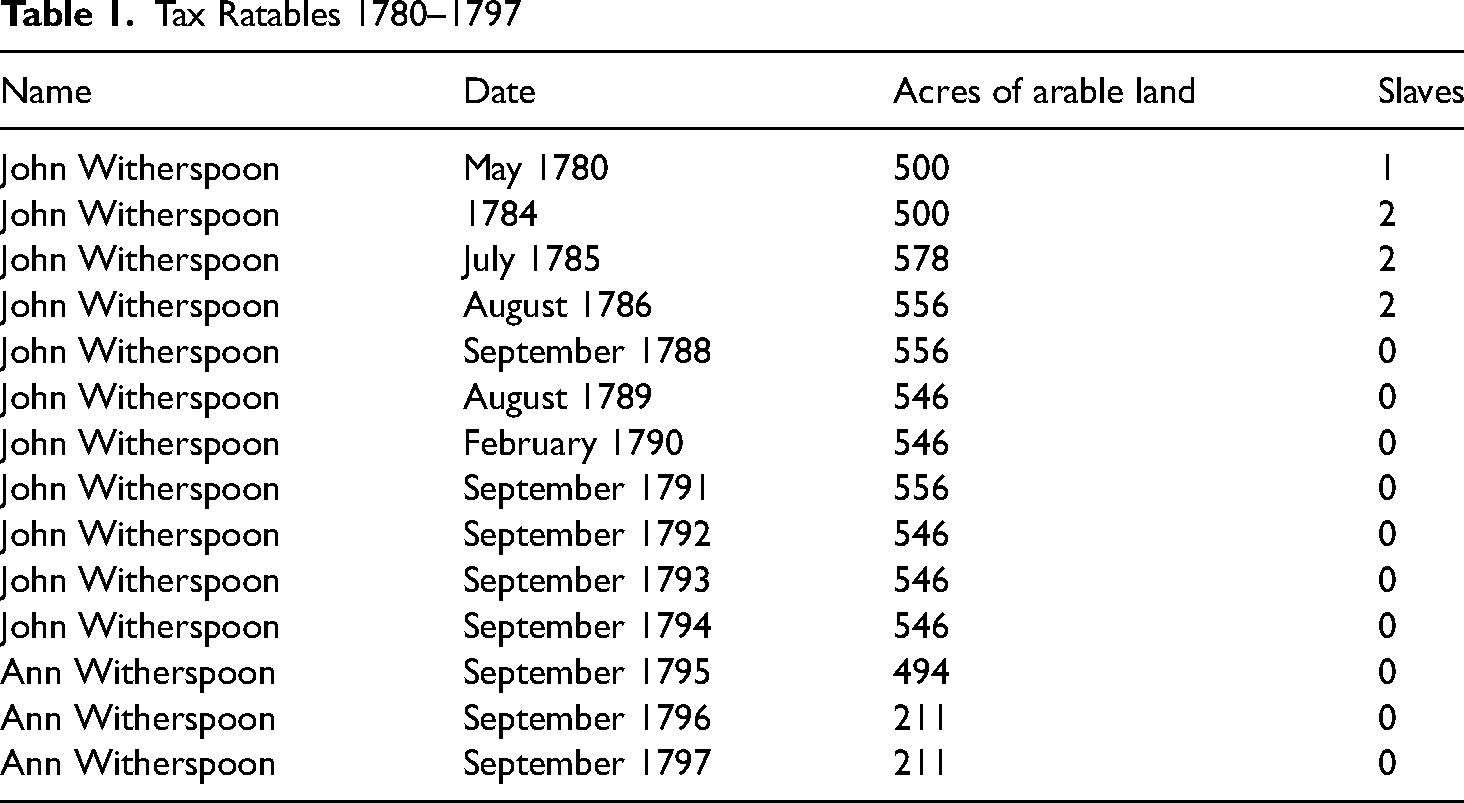
Where does this leave us? Assuming that from 1781 to 1783, years for which there are no surviving records, Witherspoon had slaves, he would have had one or two slaves for seven or eight years. If we don’t know how these slaves got there, we don’t know where they went either. Were they sold? Did they die? Did Witherspoon or the college set them free? We don’t know.
There is something else we need to look at in the tax ratables. In 1792, 1793, and 1794 there is listed for the first time another Witherspoon (spelled “Weatherspoon” as John's surname was also sometimes listed in the ratables), with the designation N (1792), then Ne (1793), then Neg (1794)—Neg being the designation for Negro. The persons marked “Neg” in the tax ratables always share a last name with a landowner. These were almost certainly servants or slaves who had been recently freed, or slaves who had been given property on their way to full emancipation. Indeed, this African-American Witherspoon—the first name is spelled differently each year, but it is something like Forton—is listed as a householder and as owning cattle. We’ll come back to Forton and his freedom status in a moment, but first we need to examine the other piece of evidence.
Last Will and Testament
Witherspoon's Last Will and Testament—drawn up on September 15, 1794 and modified on November 11—does not mention any slaves. Rather, the will only stipulated who was to receive what portions of his settled estate. Any statement to the effect that Witherspoon's will, prepared while he was alive, included slaves is false. None of his specific possessions were enumerated until thirteen days later on November 28, when two appraisers list his possessions and state a value for every item. The inventory listed two enslaved persons, but with an important proviso that is never mentioned in the indictment against Witherspoon. The final line of the appraisal lists at £200: “2 Slaves supposed to be worth until they are 28 years of age.” 21
We can’t be entirely certain how to reconcile the appraisers’ mentioning of two slaves at the time of Witherspoon's death with the listing of no slaves according to the tax ratables of the same year. Some facts are certain, and they point in only one direction. The key to connecting the dots is the precise wording from the appraisers, with its curious reference to 28 years of age. Why is this age marker written down?
In the summer of 1791, Witherspoon—whose first wife, Elizabeth, died in 1789—married Ann Dill, the widow of Dr. Armstrong Dill of York County, Pennsylvania. The Dills were one of the most prominent families in the county, and The History of York County (1886) indicates that the family owned slaves. 22 So why does Forton, the “Negro” Witherspoon, suddenly appear in the tax ratables of 1792? It would seem that two slaves came with Ann Dill in her marriage to John Witherspoon, that they were considered Witherspoon's assets by the appraisers executing his will, but that the slaves were, in another sense, free persons and listed as such in the tax record. This conclusion may not be absolutely foolproof, but it is the most reasonable way to square the otherwise conflicting document.
This is where the reference to “28 years of age” is also relevant. In 1790, Witherspoon delivered the report of a committee in the New Jersey legislature—a three-person committee appointed to consider a pair of abolition petitions. The report offered that the legislature “might pass” a law stating that “all slaves born after its passage should become free at a certain age, as for example 28.” No doubt, Witherspoon and his colleagues modeled this suggestion on Pennsylvania's famous 1780 “Act for the Gradual Abolition of Slavery”—the first act abolishing slavery ever adopted by a democratic people. That Act decreed that children born to enslaved mothers after March 1, 1780 would be born free and bound to indentured service until they reached 28 years of age, at which time they would be released from all service.
Let's try to put this all together. If two enslaved Black persons came to Witherspoon's household as a part of Ann's property, it seems they were treated as free Blacks with their own household, and at most were only to be kept in servitude until they were 28 years of age (in keeping with the 1780 Pennsylvania statute). As it turns out, there is no more record of the “Negro” Witherspoon after John's death in 1794. It seems that the enslaved persons who came with Ann, likely treated as free Blacks, were set entirely free after Witherspoon's death, whether or not they had reached the age of 28.
Conclusion
The historical evidence strongly cautions us against assuming the worst about Witherspoon's slave-ownership and imputing to him all the worst evils of the institution. In the light of the eighteenth-century context, the contradictory evidence raises question about what it even meant for Witherspoon to be listed as a slaveholder. It is possible that Witherspoon's slaves were more like indentured servants who were never considered bound—neither they nor their offspring—to perpetual subjugation. Maybe there is more damning evidence out there. We don’t know, for example, how Witherspoon came to have slaves at Tusculum in 1780 or where they went after 1786. By the same token, there is no record that he dealt in the buying and selling of slaves, including those listed as his property. There is no evidence that he treated his slaves poorly or that he had slaves for more than seven or eight years. As far as Somerset County was concerned, Witherspoon owned no slaves at the time of his death. More than that, it seems likely that Witherspoon practiced what he preached in the Presbyterian statement of 1787 by making “Forton Weatherspoon” a householder of his own and giving him the opportunity to be fully emancipated, which he appears to have been shortly after Witherspoon's death.
In all of this, we can still wish that Witherspoon had moved more quickly to free slaves in his own life or made the case for final abolition with more urgency. New Jersey would become the last northern state to abolish slavery, doing so only in 1866, a year after the Civil War ended. Considering the totality of his teaching and his personal example on the issue of slavery, we ought to question any assessment that makes Witherspoon out to be someone deeply enmeshed in slavery throughout his life or in favor of the indefinite perpetuation of slavery. There is little doubt that Witherspoon was, on the whole, more enlightened on the issue of slavery than many of his generation, and less personally complicit in the evils of slavery than men like Jefferson, Madison, Washington, Franklin, and many of our country's most celebrated founders.
Witherspoon was respected in his day as a great theologian, an exemplary college president, and an “animated son of liberty” whose leadership and sacrifice did much to advance the cause of the American Revolution and to establish the governing principles of the new republic. Even on the issue of slavery—though compromised by our standards—he showed himself to be moving in the right direction and called others to the same. With eyes wide open to his faults, Witherspoon's legacy deserves to be commemorated—by the Scottish, by Americans, by Presbyterians, and even by Princetonians too.
