



Abstract
Hosting income-generating installations and events in cathedrals remains controversial. This article examines three narratives suggesting that such activities are missional and supportive of Anglican ecclesiology. Then it explores new survey data gathered from people attending the 2024 pre-Christmas son et lumière in Liverpool Cathedral. Five statistics stand out within these data: while only 30% were churchgoers (attending at least six times a year), 91% felt welcomed and at home in the cathedral, 61% lit a votive candle, and 56% said they would attend more events like this. As a consequence of attending this installation, 28% said that they were more likely to attend a carol service in the cathedral, and 21% that they were more likely to attend a carol service in their local church.
Introduction
Increasingly cathedrals are being recognized as occupying a distinctive location within the changing religious landscape of England and Wales. There are two faces to this distinctive location. One face looks inwards to sustaining a Christian presence: while church attendance declines and church doors are locked, cathedral attendance seems to grow and cathedral doors remain open. The other face looks outwards to developing a business model rooted in tourism, heritage and leisure industries. This outward-looking face may be essential for keeping the roof watertight and keeping the lights switched on. The question, both sociological and theological, concerns whether these two faces reveal two conflicting identities or whether they are part of the same missional presence within a society that has largely lost touch with the Christian narrative.
Theoretical work, both sociological and theological, has begun to explore narratives that draw these two faces closer together. The first narrative draws on Edward Bailey’s sociological theory concerning implicit religion and explores the implications of this theory for illuminating the distinctive identity of cathedrals. 1 The theory of implicit religion draws attention to ways in which cathedrals seem to have capacity to soften boundaries between the sacred and the secular. Implicit religion was first drawn into the academic debate about cathedrals by Hammond 2 and has been developed more recently in a series of papers by McKenna, Francis and Stewart 3 and by McKenna, Francis, Village and Stewart. 4 According to this approach, by softening the boundaries between the sacred and the secular, cathedrals lower the threshold that people need to cross even to venture into sacred space. Those who may stand on the outside of the locked parish church may find themselves crossing the much lower threshold into cathedrals. Since it is often installations, events and exhibitions that first give such people permission to enter cathedrals, these very installations, events and exhibitions may be missional.
The second narrative draws on Judith Muskett’s literary theory concerning the power of metaphors both to describe and to explain the capacity of cathedrals to draw people in. 5 Specifically, Muskett profiles five major metaphors. Cathedrals are shop windows into the Church: this arouses curiosity and enhances footfall. Cathedrals are flagships for the Church: they indicate serious intention and effective leadership. Cathedrals are beacons for the gospel: they shine out in darkness, symbolize stability and offer a secure reference point. Cathedrals are magnets drawing people in: they generate tourism, bring economic prosperity and encourage people to stay. Cathedrals are sacred space and common ground. Like Bailey’s theory of implicit religion, this fifth metaphor illuminates ways in which sacred space and common ground collide within these inspiring and majestic buildings.
The third narrative draws on Gary Hall’s theological and ecclesiological theory concerning the distinctive purpose of Anglican cathedrals, published in Anglican Theological Review. 6 Hall’s answer to the question about ‘the purpose of cathedrals’ is that cathedrals derive their character and identity from hosting the bishop’s cathedra. His argument could be paraphrased to claim that cathedrals are called to do what bishops are called to be. As an Anglican, Hall then illuminates this call by a close analysis of the ordinal. Drawing on Hall’s analysis, Leslie Francis characterized Anglican cathedrals ‘as episcopal theological resource churches for nurturing growth and sustainability’. 7 It is here that Anglican ecclesiology becomes so important. If cathedrals really hold the capacity to serve as shop windows, flagships, beacons and magnets, and if cathedrals really hold the capacity to draw people across the threshold into sacred space, then this should hold capacity for impact across the area of episcopal jurisdiction and thus strengthen parish churches as well as grow the cathedral’s congregations.
While all three narratives are of themselves interesting and plausible, there has been a serious lack of empirical investigation to examine the effectiveness of installations, events and exhibitions as agencies for mission. A start to redress this lacuna has been made by Liverpool Cathedral as part of its strategy to be a research-informed and research-engaged ecclesial community. An initial study was reported by Kirby, Francis and Village conducted among 283 visitors to the Luxmuralis installation Space, the Universe and Everything during February 2022. 8 Subsequent studies were conducted among participants at the Luxmuralis pre-Christmas son et lumière in December 2022 by Village and Francis 9 and in December 2023 by Francis. 10 The most intriguing finding to emerge from the studies conducted among the visitors to the Luxmuralis installations in Liverpool Cathedral were reported by Francis. 11 Participants at the 2023 pre-Christmas son et lumière were specifically asked whether the experience made them more likely to want to attend a Christmas service in the cathedral. In response to this question, 39% said that they were more likely to attend a carol service in the cathedral and 18% said that they were more likely to attend a Christmas Eve or Christmas Day service. By coincidence, the 4,749 attendance at the Christmas Eve carol services was a 21% uplift on the pre-Covid 2019 attendance; the 1,232 attendance at Midnight Mass was a 73% uplift on the 2019 attendance; and the 910 attendance at the Christmas Day Choral Eucharist was a 26% uplift on the 2019 attendance. These two sets of figures cannot be causally linked, but the coincidence is worth noting.
Building on the earlier studies of participants at the 2022 and 2023 pre-Christmas Luxmuralis son et lumière, the present study concerns participants at the 2024 installation. All three years the installations were billed as ‘The light before Christmas’: in 2022 the theme was ‘The angels are coming’, in 2023 ‘The manger’, and in 2024 ‘Starlight’. For all three installations, the iconic space of Liverpool Cathedral was divided into three zones and participants were invited to navigate a journey of discovery as they progressed through the three zones. Participants entered zone one at the ‘west’ end of the cathedral and found themselves immersed in the huge ‘well’ amid the sights and sounds of the secular Christmas celebration. When they were ready, participants migrated east to enter zone two in the main space. Here they found themselves immersed in sights and sounds that had more resonance with the Christian narrative, including the melodies and words of familiar carols. The lighting drew their attention to the high altar and elaborate reredos.
Again, when they were ready, participants migrated into zone three, the ambulatories and walkways leading behind the high altar into the south transept, and then through the Rankin porch. Here, the pace slackened. Here, the lighting was subdued. Here, the music became more reflective. Here, participants were invited to reflect on classic depictions of the nativity. Emerging eventually from zone three back into the west end of the cathedral, participants were welcomed into a reflective space illuminated by flickering votive candles. They could light their own candle and reflect on accessible prayer cards and relevant literature. On leaving the cathedral, participants were greeted by a member of the cathedral clergy or lay volunteers, given a leaflet detailing the services on Christmas Eve and Christmas Day, and invited to return.
Research aims
Against this background, the present study addresses five research aims. The first aim is to map the demographic profile of those who booked tickets to attend the 2024 pre-Christmas son et lumière in Liverpool Cathedral, The Light before Christmas: Starlight, specifically in terms of sex, age, education and connection to the cathedral. The second aim is to map the religious profile of these participants, specifically in terms of religious affiliation, religious attendance, religious belief and self-assessed religiosity. The third aim is to profile their engagement with the cathedral, specifically in terms of the extent to which they encountered welcome within the cathedral and encountered God in that space, and in terms of their engagement with religious and spiritual practices in writing a prayer request or in lighting a votive candle. The fourth aim is to profile the perceived impact of the installation on those participants, specifically in terms of impacting their religious beliefs and their interest in attending services in the cathedral. The fifth aim is to profile the perceived impact of the installation extending beyond the cathedral to local churches.
Method
Procedure
When people booked to attend the son et lumière, they were invited to give assent to receiving a follow-up survey from the team at Liverpool Cathedral to assess their experience of the installation. All participants in this online survey were aged 18 or over and gave their formal consent by clicking a box that gave access to the rest of the survey. A total of 660 responses were received.
Instrument
The survey was hosted on the Qualtrics platform and comprised three sections. Section 1 explored demographic and background information. Section 2 presented measures of religiosity, psychological well-being and spiritual well-being. Section 3 presented a recognized measure of personality.
Results and discussion
Who participated in the survey?
The first step is to explore who took part in the survey in terms of their demographic profile.
Sex. A quarter of the participants were male (25%) and 74% were female, with 1% preferring not to say.
Age. Over half of the participants were in their fifties or sixties (54%), a quarter were aged under 40 (25%), 21% were aged 70 or over, and 1% preferred not to say.
Education. Over half of the participants were graduates, with 34% holding a bachelor degree, 15% a master’s degree, and 3% a doctorate. A further 34% held certificate- or diploma-level qualifications.
Connection with the cathedral. Nearly three-quarters of the participants identified as occasional visitors (73%), 13% as regular visitors, and 14% as visiting for the first time.
What is their connection with religion?
The second step is to explore the religious identity and engagement of those who took part in the survey. The survey included the standard question concerning religious affiliation as formulated for the national census conducted in England Wales in 2001. 12 A quarter of the participants identified as having no religious affiliation (24%), 73% as Christian, and 3% as affiliated with another world religion. These figures can, therefore, be set alongside the census data. In the 2011 census, 71% of the population of Liverpool identified as Christian, falling to 57% in the 2021 census, but remaining well above the national average of 46% for England and Wales considered together.
Table 1 presents attendance at acts of public worship, not including occasions such as weddings and funerals. The general threshold in social scientific studies for regarding someone as a churchgoer is at least six attendances a year. 13 On this criterion, the majority of participants would not count as churchgoers, with 41% never attending and a further 29% attending fewer than six times a year. Looked at from another perspective, 16% of participants reported attending weekly. These statistics confirm that the installation was attracting committed churchgoers as well as the unchurched.
Attend acts of public worship (apart from weddings/funerals).

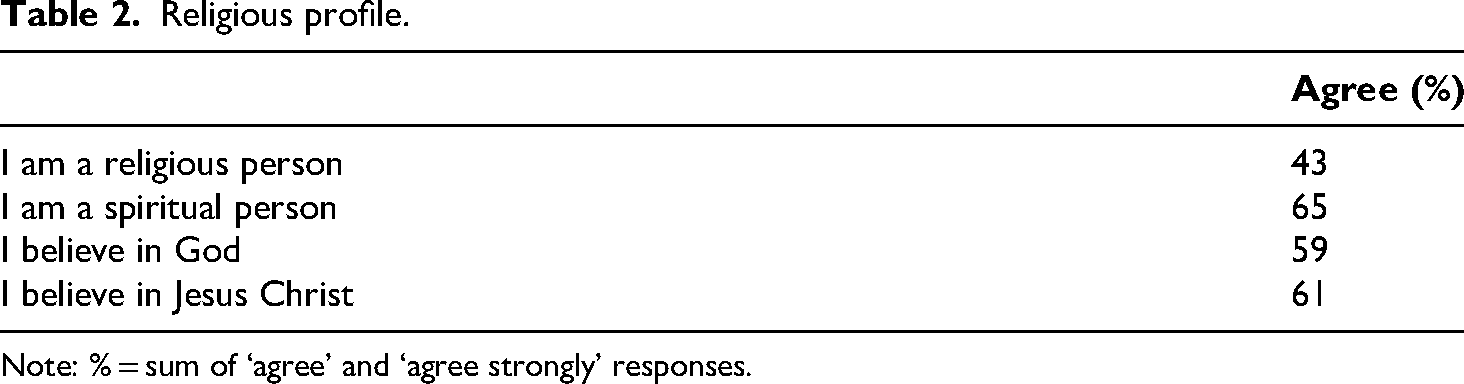
Table 2 turns our attention from religious practice to religious belief and self-assessed religiosity. Three-fifths of the participants expressed belief in God (59%) and belief in Jesus Christ (61%), a much higher proportion than those who expressed such belief through attendance at public acts of worship, an observation consistent with research more widely. For example, in their study of those attending the Christmas Eve carol services in Liverpool Cathedral, Francis et al. found that 63% expressed belief in God, compared with 38% who counted as churchgoers on the criterion of attending at least six times a year. 14 These findings demonstrate that two-fifths of those crossing the threshold of the cathedral to participate in the installation come without such theist belief.
Religious profile.
Note: % = sum of ‘agree’ and ‘agree strongly’ responses.
Building on Heelas and Woodhead’s now classic study of religion in the Lake District town of Kendall, The Spiritual Revolution, 15 interest has grown in exploring the religious landscape of England in terms of those describing themselves as ‘spiritual but not religious’. 16 In the present study, 65% of participants identified themselves as spiritual, half as many again as those who described themselves as religious (43%). The data provided by Francis et al. demonstrated that a similar proportion of those attending the Christmas Eve carol services described themselves as spiritual (68% compared with 65%). At the carol services a slightly higher proportion described themselves as religious (50% compared with 43%). 17
What is their engagement with the cathedral?
The third step is to explore the participants’ engagement with the cathedral. The data presented in Table 3 indicate that 93% felt welcome and at home in the cathedral, and that 28% found that the installation helped them to encounter God. These statistics resonate with the cathedral’s mission statement embedded on the website: Liverpool Cathedral is a place of encounter. You may be a visitor who will encounter a warm welcome inspired by our Christian beliefs. Or you may wish to encounter God in a deeper way.
Engagement with the cathedral.
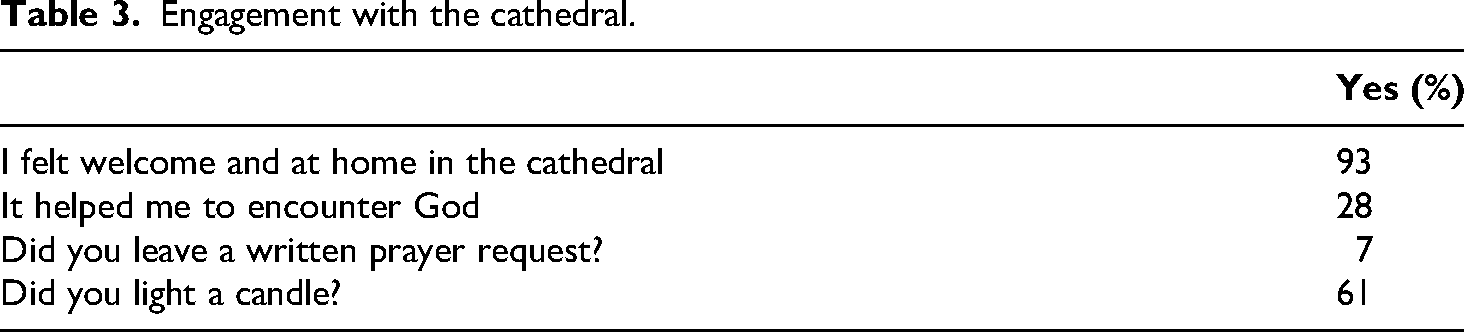
Throughout the installation, the cathedral offered two specific points of religious/spiritual engagement for participants: the opportunity to leave a written prayer request and the opportunity to light a votive candle. The data presented in Table 3 indicate that 7% left a written prayer request and 61% lit a candle. Research by Tania ap Siôn has noted the growing importance of these two significant practices among visitors to churches. 18
What impact did the participants experience?
The fourth step is to explore the perceived impact of the installation on the participants with specific reference to their personal faith, to their contact with the cathedral, and to their local churches. Table 4 covers these three themes. The survey invited participants to rate the impact of the visit on a five-point scale: much greater (5), greater (4), same (3), less (2) and much less (1). The data presented in Table 4 aggregate the ‘much greater’ and ‘greater’ responses.
Impact of the visit.

In terms of personal faith, 7% considered that their visit had increased their knowledge of the Christmas story, 7% considered that it had increased their belief in God, and 5% that it had increased their belief in Jesus.
In terms of contact with the cathedral, 56% considered that their visit had increased their interest in attending another event like this in the cathedral, and 25% that their visit had increased their interest in keeping in touch with the cathedral. The installation also had an impact on increasing overall interest in attending services in the cathedral (19%), and specifically in attending a carol service in the cathedral (28%) or in attending the cathedral on Christmas Eve or Christmas Day (11%).
In terms of contact with their local churches, around one in five of the participants considered that the installation had increased their interest in attending a Christmas service in their local church (19%) or in attending a carol service in their local church (21%)
Conclusion
The present study was designed to explore the missional capacity of cathedral installations and events. After exploring three narratives suggesting that cathedrals may hold unique capacity to bridge the divide between Anglican identity and contemporary society, the study drew on new data provided by 660 participants at the pre-Christmas son et lumière held in Liverpool Cathedral during December 2024 to address four specific research aims.
The first aim was to map the demographic profile of those who booked tickets to attend this installation. The key statistics from this section of the survey showed that the majority of the participants had previous contact with the cathedral either as occasional visitors (73%) or as regular visitors (13%). In other words, here is a group of people who may be developing a sense of connection with the cathedral.
The second aim was to map the religious profile of those who booked tickets to attend this installation. The key statistic from this section of the survey was that 70% of the participants were not churchgoers. In other words, this installation had the capacity to draw across the threshold a large number of people unfamiliar with entering or occupying sacred space.
The third research aim was to profile the engagement of those who booked tickets with the cathedral. The two key statistics from this section of the survey demonstrated that the majority of participants felt welcome and at home in the cathedral (93%) and that 61% had engaged in a spiritual practice by lighting a votive candle. In other words, the cathedral’s mission of encounter had been successful in ensuring that a diverse group of visitors had encountered a warm welcome and in enabling many of these visitors to make a successful transition from common ground into inhabiting a sacred space and into responding to that sacred space by engaging in a spiritual practice.
The fourth research aim was to profile the perceived impact of the installation on those participants, specifically in terms of impacting their interest in attending services in the cathedral. The two key statistics from this section of the survey are that 28% of the participants considered that the experience had increased their interest in attending a carol service in the cathedral and 11% considered that the experience had increased their interest in attending the cathedral on Christmas Eve or on Christmas Day. In other words, for some participants this encounter with the cathedral through an installation led to a greater interest in encountering the cathedral through engaging with an act of worship.
The fifth research aim was to profile the perceived wider impact of the installations on these participants, specifically in terms of potential engagement with their local churches. The two key statistics for this section of the survey are that one in five of the participants considered that the installation had increased their interest in attending a Christmas service in their local church (19%) or in attending a carol service in their local church (21%). In other words, for some participants, this encounter with the cathedral through an installation led to a greater interest in encountering Christian worship within their local churches. The episcopal ministry of the cathedral may be sharing missional intent further across the diocese.
There are clear limitations that caveat broad generalization from the present study: the data are limited to one location (Liverpool Cathedral), one event (a pre-Christmas son et lumière) and one group of participants (those who booked the tickets). These limitations could be addressed effectively by further replication and extension studies.
Footnotes

Ethical approval
This study received approval from the Research Ethics Committee for the School of Humanities, Religion and Philosophy at York St John University (approval code: HUM-RS-AV-05-22-01). All participants had to affirm that they were 18 or over and give their informed consent by clicking a box that gave access to the rest of the survey.
Funding
This research received no external funding.
Declaration of competing interests
No potential conflict of interest was reported by the authors.
Data availability
Data are available from the corresponding author upon reasonable request.