




Abstract
This study tests the thesis that innovative cathedral installations and events may soften the boundaries between common ground and sacred space, perhaps especially at Christmas. Over two-fifths of the participants surveyed at the 2023 son et lumière ‘The light before Christmas’ in Liverpool Cathedral said that their experience made them more likely to attend a carol service in the cathedral and one-fifth said they were more likely to attend a Christmas Eve or Christmas Day service. By coincidence, the 4,749 attendance at the Christmas Eve carol services was a 21 per cent uplift on the pre-Covid 2019 attendance; the 1,232 attendance at Midnight Mass was a 73 per cent uplift on the 2019 attendance.
Introduction
Several recent studies have drawn attention both to the proliferation of installations, events and exhibitions in cathedrals and to the controversy and debate these generate. 1 For some, the helter-skelter in Norwich Cathedral, the crazy golf bridges in Rochester Cathedral and, most recently, the 1990s silent disco in Canterbury Cathedral are causes célèbres and represent nothing less than the profanation of scared space. At one level, the development of cathedrals in this way may be nothing more than the economic outworking of the observation focused by the 1994 Archbishops’ Commission on Cathedrals that both acknowledged the dual identity of cathedrals as core places of worship and as major tourist attractions and began to analyse the complementary and conflictual nature of those two identities. Today, cathedrals continue to balance their responsibilities to serve the mission of their diocese and to pay the enormous bills presented to a national heritage site.
Against this background, scholarly attempts are being made to reflect on the rationale underpinning the diversity of installations, events and exhibitions currently colonizing cathedral space. Are these unashamed genuflections to commercialization, or are they strategic agents of ministry and mission? Recent approaches to think strategically and missionally about the role of installations, events and exhibitions in cathedrals have been rooted in two fields of enquiry: the analysis of cathedral metaphors initiated by Judith Muskett; and Edward Bailey’s notion of implicit religion. These two approaches share in common the assumption of secularization and an appreciation of the growing gulf between the Christian narrative and the dominant social context.
The power of metaphor
The power of metaphor for illuminating an understanding of cathedrals was introduced by Muskett in a programmatic paper, ‘Mobilising cathedral metaphors’, 2 and subsequently developed more fully by Muskett in a carefully documented book, Shop-Window, Flagship, Common Ground: metaphor in cathedral and congregation studies. 3 The five metaphors privileged for special attention in Muskett’s book all illustrate the capacity of cathedrals for engaging with diverse publics. Shop windows arouse curiosity and enhance footfall in the marketplace; flagships indicate the serious intention of their operators to be effective in their mission; beacons shine out in darkness, symbolize timeless stability and serve as a secure reference point; magnets draw people in, generate tourism and bring economic prosperity; sacred space and common ground finely capture ‘the vocation of cathedrals to be both a spiritual and community utility’. 4
Of these five metaphors, the notion of cathedrals as sacred space and common ground may prove to be the most powerful for exploring the capacity of cathedrals to engage the wider community in the sense of connecting the Christian presence with those who may be less inclined to engage with, or to cross the threshold into, parish churches. The first part of this compound metaphor was discussed by Carr.
5
Carr argued that ‘[c]athedrals are a specific and accessible example of “common ground”, an idea with many resonances of common land and common rights intended for a variety of different groups’.
6
The theme of common ground was developed further in respect of cathedrals by Lewis, who argued that: On common ground, grazing rights are difficult to define and it is undesirable that they should be too tightly constructed … Cathedrals are nothing if they are not accessible holy places in which all kinds of people feel that they belong.
7
Cathedrals are sacred spaces and common ground. Cathedrals stand as signs of God’s love and grace in the midst of a distracted world. They provide serious spaces and places for prayer and contemplation in a busy world.
8
The power of implicit religion
The power of Edward Bailey’s 11 concept of implicit religion for illuminating an understanding of cathedrals was introduced to cathedral studies by Hammond. 12
Subsequently, McKenna, Francis and Stewart focused on two specific insights from the theory of implicit religion for analysing the range of installations, events and exhibitions that their survey found promoted within Anglican cathedrals. 13 First, the notion of implicit religion softens the boundaries between the sacred and the secular and gives substance to the idea of cathedrals as ‘sacred space and common ground’. Within this perspective, they identified and discussed eight categories of events mentioned on cathedral websites and hosted within cathedrals that appeared to be softening the boundaries between the secular culture and the sacred space of the cathedral. These categories were scientific exhibitions, festivals, musical events, art exhibitions, theatre, markets, community events and installations. While few of the examples identified in the study rivalled the sensational appeal of the helter-skelter, the crazy golf bridges or the 1990s silent disco, many clearly held capacity to enhance footfall and to extend the reach of cathedrals into diverse publics.
Second, the notion of implicit religion draws attention to the themes and activities that generate meaning and purpose and that, by so doing, hold the capacity to direct and enhance human flourishing. Events, exhibitions and installations not only have the capacity to draw publics into the common ground, but, within the sacred space, they also have the capacity to offer experiences that may generate meaning and purpose and enhance human flourishing. Within this second perspective, McKenna, Francis and Stewart identified and discussed seven themes: social justice and social conscience; violence and reconciliation; remembrance; migration and sanctuary; Covid-19 and lockdowns; personal well-being; and nature and environment. 14 Themes like these hold the capacity to stir the human heart, to anchor the human mind, and to promote engaged human flourishing.
Listening to participants
The limitation with the analysis reported by McKenna, Francis and Stewart 15 is that, while it was able to chart the provision, it had no access to the responses of participants. Two other studies have tried to address that limitation. In the first of these two studies, Francis, Mansfield, McKenna and Jones reported on a survey conducted among participants attending the jazz festival in Brecon Cathedral. 16 This survey focused on the psychographic segmentation of cathedral visitors, employing psychological type theory. A series of earlier studies concerned with psychological profiling had shown that cathedral visitors were unrepresentative of the population as a whole, and that certain psychological types were less inclined to cross the threshold into cathedrals. This new survey attracted 196 responses and demonstrated that the jazz festival made a significant contribution to addressing this imbalance by drawing into Brecon Cathedral more intuitive types and more perceiving types. In other words, specific types of events may extend the reach of cathedrals.
In a second study, Kirby, Francis and Village reported on a survey conducted among participants attending the Luxmuralis son et lumière installation in Liverpool Cathedral, ‘Space, the Universe and Everything’. 17 This survey focused on exploring the religious background of the participants, on their attitude towards cathedrals hosting science-related installations, and on the impact of the experience on their spiritual well-being. The survey attracted 283 responses. Among these participants, 15 per cent were weekly churchgoers, 38 per cent never attended and 27 per cent attended fewer than six times a year, the threshold often taken by social scientists to qualify as a churchgoer. 18 These data demonstrated that 94 per cent of the participants agreed that a cathedral is an ideal place for this type of installation, and 73 per cent agreed that we need both science and religion in our lives.
The impact of the installation ‘Space, the Universe and Everything’ on spiritual well-being was assessed by John Fisher’s model that conceptualizes spiritual well-being as reflected in the quality of relationships that individuals have with the self (the personal domain), with other people (the communal domain), with the world around them (the environmental domain), and with a personal or impersonal transcendent other (the transcendental domain). 19 In response to the prompt ‘Spending time in Liverpool Cathedral has helped me to’, 69 per cent reported that it had helped them to feel less stressed about themselves (personal domain), 59 per cent reported that it had helped them to feel better about their relationships with other people (communal domain), 57 per cent reported that it had helped them to connect better with the natural world (environmental domain), and 36 per cent reported that it had helped them to connect better with God (transcendental domain).
Advent son et lumière
It is against this background that Liverpool Cathedral invested heavily in a pre-Christmas son et lumière in 2022 and 2023. On both occasions the installation was billed ‘The light before Christmas’; in 2022 the theme was ‘The angels are coming’, and in 2023 ‘The manger’. On both occasions the iconic space of Liverpool Cathedral was conceptualized into three zones and participants were invited to step into a journey of discovery as they progressed through these three zones. Entering from the ‘west’ end of the cathedral, participants were welcomed into the huge ‘well’ to immerse themselves within the festive joy of the secular Christmas celebration, vibrant in light and sound. Here, projected on the great west wall and window, were emblems of Christmas wrapping paper, Christmas presents, Christmas festivities and Santa’s sleigh speeding across the night sky.
From the ‘well’, participants were drawn into the ‘main space’, with a subtle change in temperament and tone as attention was drawn to the high altar and to images and sounds that began to resonate with the Christian narrative. Angels danced across the ceiling to the echo of familiar carols, and church bells called the faithful to worship. Finally, from the main space, participants were shepherded into the ambulatory and walkways leading behind the high altar into the south transept, and then through the Rankin Porch. Here, the lighting was subdued, and participants were invited to reflect on classic depictions of the nativity. Emerging eventually from the Rankin Porch back into the west end of the cathedral, participants were welcomed into a reflective space illuminated by flickering votive candles. Those so minded could light their own candle and reflect on accessible prayer cards and literatures. On leaving, participants were given a leaflet detailing the services on Christmas Eve and on Christmas Day.
Research question
The two theoretical frameworks rooted in the power of metaphor and rooted in the power of implicit religion each raise expectations about the effect of an advent son et lumière on the participants in relation to the explicit Christian mission and ministry of the cathedral. The metaphor of ‘common ground and scared space’ prompts the expectation that individuals who entered the common ground may have encountered the sacred space, and having encountered the sacred space may wish to return for a more explicit encounter with the Christian narrative. The theory of implicit religion that installations, events and exhibitions may soften the boundaries between the secular and the sacred also prompts the expectation that the encounter with implicit religion may prompt a more willing engagement with explicit religion.
The intention of the present study is to approach the research question from two directions. One direction invites a survey among those who attended the son et lumière to explore their self-assessment of the impact of the installation on their perception of the cathedral. The other direction invites an examination of the trajectory of attendance figures at the Christmas Eve and Christmas Day services located within the cathedral. We begin by looking at the attendance figures.
Counting Christmas Eve and Christmas Day attendance
Table 1 presents the attendance figures recorded for the carol service(s) held on Christmas Eve, the Midnight Christmas Mass, the early morning Christmas Day Communion Service, and the mid-morning Christmas Day Choral Eucharist between 2007 and 2023. For the two five-year periods, 2007–11 and 2012–16, averages have been presented to smooth annual fluctuations. No figures were recorded for the Covid year 2020. Two features of this table merit comment.
Attendance on Christmas Eve and Christmas Day.
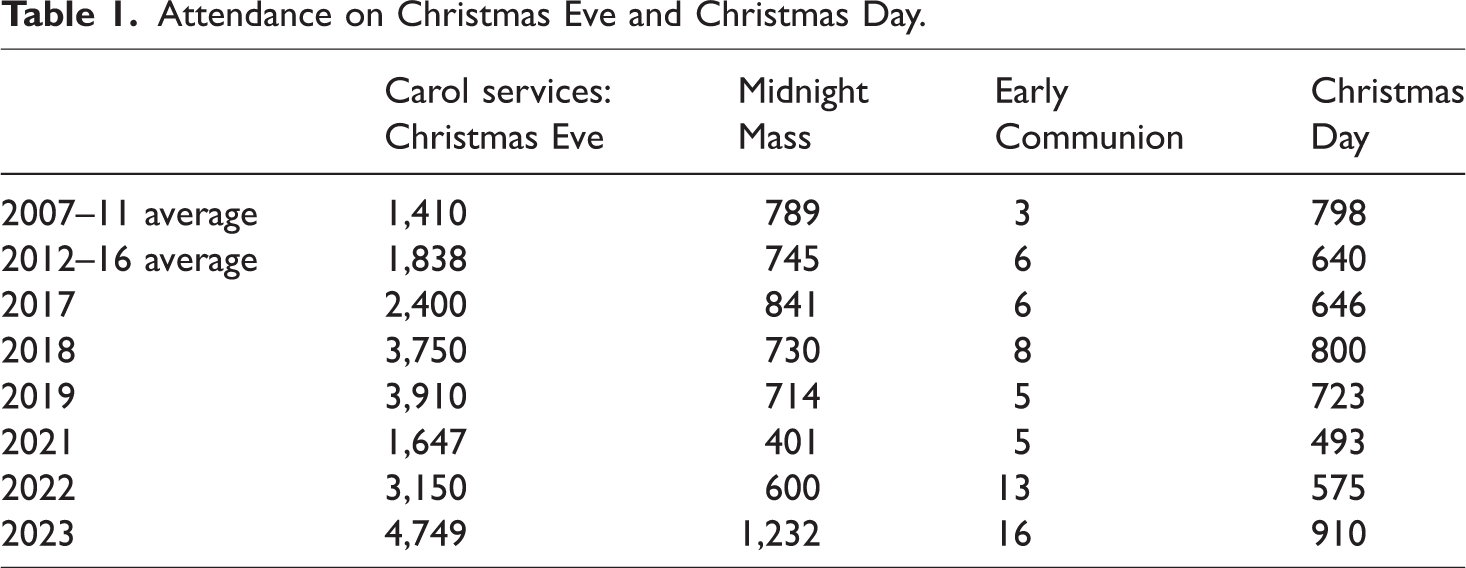
In terms of the Christmas Eve carol service, there was gradual growth from 2007 to 2016. In 2016 the attendance had risen to 2,200 and then in 2017 to 2,400. In 2018, the decision was made to provide two carol services at 2 p.m. and 4 p.m. in place of the one at 3 p.m. This additional provision was reflected by 56 per cent growth in attendance with a further increase the following year. The build back after Covid in 2021 was slow. In 2022, a third carol service was added at 11 a.m. and attendance was almost back to the 2019 figure. Then in 2023 there was a 21 per cent uplift on the 2019 pre-Covid figure.
In terms of the Midnight Mass and the Christmas Day Choral Eucharist, the uplift on the previous year is considerable. The Midnight Mass attendance was up by 100 per cent and the Christmas Day Choral Eucharist attendance by 58 per cent. The uplift on the 2019 pre-Covid figure was 73 per cent for the Midnight Mass and 26 per cent for the Christmas Day Choral Eucharist.
These increases in attendance cannot be causally attributed to the experience of the son et lumière, but the coincidence is certainly worth noting. We now turn attention to the survey among the participants attending the son et lumière.
Surveying participants at the son et lumière
Building on the initial survey conducted by Kirby, Francis and Village among the participants attending the Luxmuralis son et lumière installation ‘Space, the Universe and Everything’ in Liverpool Cathedral in February 2022, 20 further surveys were conducted among two pre-Christmas son et lumières also created by Luxmuralis, hosted in Liverpool Cathedral between 2 and 9 December 2022 (‘The angels are coming’) and between 1 and 8 December 2023 (‘The manger’). In 2022, 691 individuals responded to this part of the survey, of whom 81 per cent were female; 25 per cent were under 50, 27 per cent in their fifties, 32 per cent in their sixties, and 15 per cent aged 70 or above; 20 per cent identified as weekly churchgoers, with 33 per cent never attending and 30 per cent attending fewer than six times a year. In 2023, 464 individuals responded to this part of the survey, of whom 78 per cent were female; 24 per cent were under 50, 25 per cent in their fifties, 34 per cent in their sixties, and 17 per cent were aged 70 or above; 18 per cent identified as weekly churchgoers, with 40 per cent never attending and 28 per cent attending fewer than six times a year.
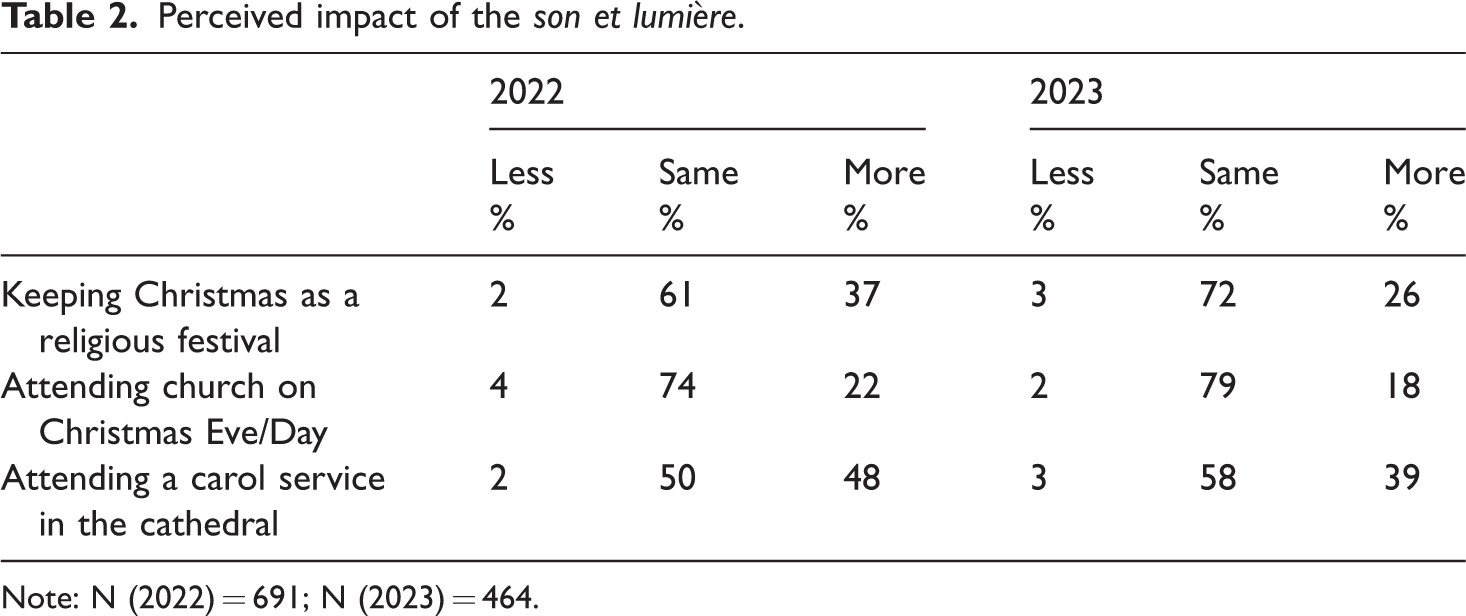
While the surveys conducted at these pre-Christmas son et lumières were designed to address a number of specific research questions, 21 the aspect of these surveys relevant for the present article concerns inviting the participants to assess the impact of the installation on their personal evaluation of the religious significance of Christmas. They were invited to rate a number of items on a five-point scale: much less (1), less (2), same (3), more (4) or much more (5). Three of these items are presented in Table 2 with less and much less collapsed into one category (less) and with more and much more collapsed into one category (more). These data demonstrate that, in 2022, 48 per cent of the participants considered that the experience of the son et lumière had increased their likelihood of attending a carol service in the Cathedral, and so did 39 per cent in 2023. In 2022, 22 per cent of the participants considered that the experience of the son et lumière had increased their likelihood of attending church on Christmas Eve/Day, and so did 18 per cent in 2023. The greater impact of the experience in 2022 may be traced to a more powerful experience orchestrated that year in the third zone of the installation within the ambulatory, walkways and Rankin Porch.
Perceived impact of the son et lumière.
Note: N (2022) = 691; N (2023) = 464.
These affirmations of increased intention to attend cannot be causally connected with the observed increases in attendance, but the coincidence is certainly worth noting.
Conclusion
The present study set out to test the thesis that innovative cathedral installations may soften the boundaries between common ground and sacred space, perhaps especially at Christmas time when residual memory of the Christian narrative may be easier to access. The installation at Liverpool Cathedral by Luxmuralis privileged the theme ‘The light before Christmas’ and skilfully took participants on an adventure, beginning with the secular celebration of Santa’s sleigh crossing the night sky and reaching the climax with classic images of the nativity and rank on rank of votive candles.
The thesis was tested by two pieces of data. On the one hand, a survey among participants at the son et lumière revealed that over two-fifths of the participants in the survey felt that the experience had increased their intention to attend a carol service in the cathedral, and one-fifth felt that the experience had increased their intention to attend a service on Christmas Eve or Christmas Day. On the other hand, comparison of attendance figures on Christmas Eve and Christmas Day in the cathedral recorded in 2023 with those recorded before Covid in 2019 revealed an uplift of 21 per cent attending carol services (from 3,910 to 4,749) and an uplift of 73 per cent attending Midnight Mass (from 714 to 1,232). The current research does not allow these two pieces of data to be causally linked, but the coincidence is worth noting.
There are three limitations with the present research that can be addressed by future research (funding permitting). First, the proportion of participants attending the son et lumière and captured by the survey was small; future research could extend this. Second, to complete the picture we would have needed a survey of those attending the Christmas Eve carol services, the Midnight Mass and the Christmas Day Choral Eucharist. Such a survey was conducted in 2019 among participants attending the Christmas Eve carol services, with 1,231 responses, and could be repeated. 22 Third, we need to be able to compare Christmas Eve/Day attendance trends in other cathedrals. The most recent report of Cathedral Statistics 2022 provides aggregated Christmas attendance from 2012 to 2022, 23 so it may still be some time before the national picture for Christmas 2023 becomes available.
There may also be some practical implications for resourcing ministry and mission in the Church of England arising from these research findings, and as a consequence the following questions may be worth pursuing:
What is the missional value of softening the boundaries between common ground and sacred space at Christmas time? Building on Bishop David Walker’s insights in God’s Belongers,
24
how missional is the capacity of cathedrals to draw people to God through place, events and people? What kind of resources would cathedrals need to fulfil their potentials as flagships, beacons and shop windows for the Church of England?