




Abstract
The rise of the monastic movement in the fourth century led many monks to settle in the Judaean desert. They described how they lived in an inhospitable environment. This gives fresh insights into the life of John the Baptist, including his diet. He would have foraged for food, including the melagria plant, widely eaten by desert dwellers. Later scribes, who were unfamiliar with the desert, changed this to meli agrion, or wild honey.
Introduction
It all began with a meeting in the desert between an itinerant preacher and the son of a carpenter. The writers of each of the four Gospels begin their account of Jesus’ ministry with the preaching of John the Baptist. As well as describing John’s message, they provide details about his lifestyle – how he lived in the desert, wore rough clothing made out of camel hair with a leather belt, and ate a diet of locusts and wild honey (2 Kings 1.8; Matt. 3.1–5; Mark 1.4–6).
A diet of locusts
At first sight his diet is surprising, especially the eating of locusts. But while locusts are not a familiar part of a Western diet, they are edible and have been used for food in many societies, including around the Mediterranean in the first century of the common era.
A locust or akris, with the plural form akrides, is a kind of grasshopper, which belongs to the Acrididae family of insects. There are many kinds, as the prophecy of Joel shows when he refers to the ‘swarming locust, the hopper, the destroyer and the cutter’ (Joel 2.25).
There is widespread evidence for their use as food. They could be served at a royal banquet, as is shown in a sculptural relief from the palace of the Assyrian king Ashurbanipal (669–631
John also, we are told, ate wild honey or meli agrion. This could have been honey made by bees, but the word can also refer to the sweet sap that comes from certain trees. Honey is a sign of the abundance of the land given by God, who ‘would feed you with the finest of wheat and with honey from the rock [that] would … satisfy you’ (Ps 81.16; cf. Deut. 32.13). Honey was well known in the region of Judaea. Josephus writes about date palms: ‘Of the date palms there are numerous varieties differing in flavour. When pressed underfoot they emit copious honey, not much inferior to that of bees, so that the region is abundant in honey.’ 4
So, it is possible that John the Baptist would have eaten grasshoppers, which he could have boiled or roasted as instructed by the Damascus document, and he could also have found honey either from bees or from the sweet sap of trees.
This account of the man of the desert relying on the simplest of foods has been accepted by commentaries and scholarship alike, with alternative possible foodstuffs dismissed as examples of an attempt to domesticate the strangeness of the story. 5 But although it is quite possible that John lived on grasshoppers and honey water, it is also highly improbable, because, although grasshoppers and honey – or honey water – are edible, it is hard to see how they could be found in sufficient quantities to form the diet of even an ascetic preacher. If he relied on honey as a source of carbohydrate, he would need to find 130 grams or two cups a day to provide an adequate level of carbohydrate for brain function. 6 This improbability suggests that we should look for alternatives.
This alternative approach is to look at the desert in which John lived and preached, and to see how those who dwelled in this desert found a way to maintain this lifestyle. While examples of locust and honey eating collected by scholars and commentators have been drawn from a wide variety of literary evidence, these studies have not – so far as I have been able to find out – considered the topography of the desert and have not referred to the accounts of those who lived there. This approach gives another and more probable account of John the Baptist’s life.
The desert of Judaea
Desert is a physical space, but it also has a spiritual dimension. Desert is where you go to meet with God. So, in Hosea, God speaks to his people: ‘I will bring her [Israel] into the desert and speak tenderly to her’ (Hos. 2.14). Empty spaces are places where the divine is encountered within many religious traditions.
John’s desert was the region of land stretching alongside the Jordan valley and Dead Sea. When he and his hearers went into the desert, they would have left the inhabited hilly country where both Jerusalem and Bethlehem are located and travelled east towards the Dead Sea and the Jordan valley. They would quickly have entered a dramatic and varied landscape.
The desert of Judaea can easily be crossed on foot in a day’s walking. Travellers going from Jerusalem to Jericho – as did the characters in the parable of the Good Samaritan – would start their journey in the fertile hills around Jerusalem at an altitude of 750 metres, where there is abundant rain (700 millimetres of precipitation a year) that waters the fertile agricultural land with its reddish Mediterranean soil, and where olives and grapes can be grown. Then they would leave this terrain and cross a plateau where layers of chalk and flint make a hilly landscape, similar to the Steppe of Asia, where annual precipitation is 150–250 millimetres. While agriculture is not possible here, there are wadis where water flows into the valley and where wild plants grow. The land is suited to the grazing of sheep and goats, especially in the winter and spring, when water is more plentiful. Then, as our travellers descend further to the Jordan valley, they cross a strip of land that is even more arid and dry, similar in soil type to an African desert. It is as though in a journey of 20 kilometres and a descent of 1,000 metres, they cross the landscape of three continents, each of which has different characteristics: from the fertile European or Mediterranean-type soil of the hills; through the sparse vegetation of the Asian steppe land; to the emptiness of the African desert (Figure 1).
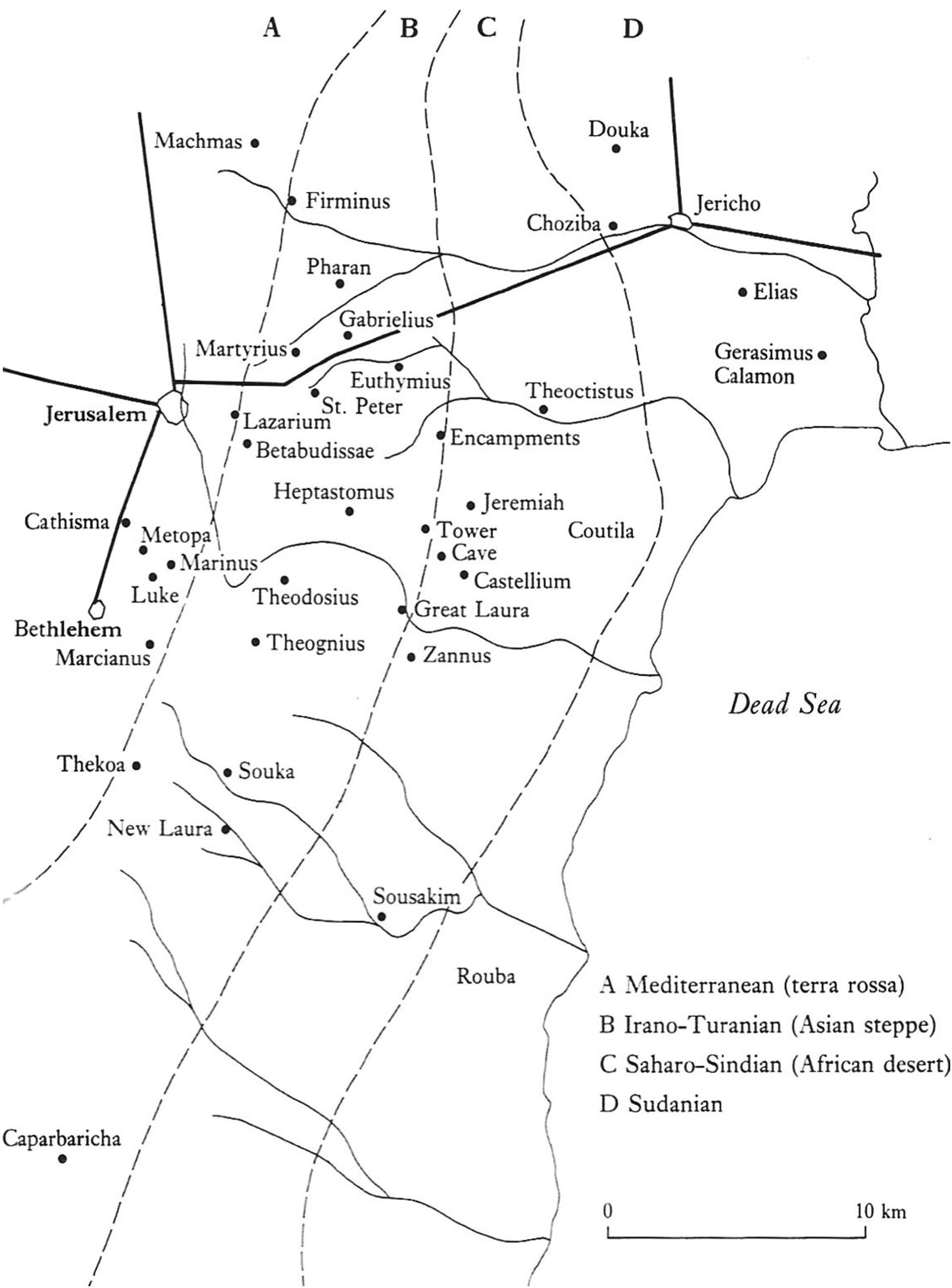
This plan shows the changing terrain, while the location of the desert monasteries shows the areas that are suited to habitation. Source: John Binns, Ascetics and Ambassadors of Christ: the monasteries of Palestine 314–631 (Oxford: Oxford University Press, 1994), p. 104.
John’s desert is small in size compared with the vastness of deserts in other parts of the world. It is easily accessible from the inhabited areas surrounding it, with a very varied terrain that allows for different ways of subsisting. Later, the Christian monks would spend the season of Lent in the more arid parts of the desert, which they called paneremos or extreme desert, as part of their ascetic discipline. 7
The desert of Judaea is a varied and spectacular environment with differing resources for the necessities of life – food, water and shelter.
The monks of the desert
This desert became home to the desert fathers and mothers after the Christian faith became tolerated during the reign of the Emperor Constantine. Monastic communities flourished in many areas, including in the desert of Judaea. While this happened three centuries after the life of John, the monks lived in the same places and learned how to survive in the same environment, finding the food and water that they needed.
Their lives are recounted by one of the most reliable chroniclers of early monasticism, Cyril of Scythopolis. He was born in 525 in the city of Scythopolis, the modern Beth Shean, at the southern end of the Sea of Galilee. 8 When he became an adult, he became a monk and wrote the lives of the founders of his monastery, Euthymius (377–473) and Sabas (439–532), and of five other leading monks of the Judaean desert. As a Palestinian by birth who lived all his adult life as a member of the communities of the desert, he knew the desert well and was a meticulous chronicler. He describes the desert location with knowledge and affection.
The diet of the desert
Cyril explains how the monks lived off the land. They developed techniques of agriculture which enabled them to grow a variety of vegetables and fruits in garden plots through careful conservation of the meagre rainfall. Rainwater was collected in large cisterns, providing water for crops in the dry months ahead. 9
They also knew about the plants that grew in the desert and that could be used as food. Cyril describes the foraging expeditions that went out into the desert to collect edible wild plants.
They collected a plant called mannouthion. 10 This was prickly and we are told how one monk cut his hands so that they bled. When collected it was often kept in the kitchen by the oven. This suggests that the mannouthion plant could also be used for fuel. Mannouthion has been identified as a type of thistle – the tumble thistle, with the botanical name Gundelia tournefortii. When this appears in February and March, all parts of the plant – leaves, roots, flowers and seeds – are edible, but as the year continues the leaves become yellow and spiky and can be used only for fuel.
Another plant that the monks valued and relied on during their wanderings in the desert was the melagria. This was collected especially by monks who set off into more remote areas during Lent. Here, Cyril tells us, ‘the melagria grow wild and is the food of the anchorites of the desert’. The monks took a small trowel with them on these expeditions to dig up the melagria. 11
Melagria has been identified as the desert asphodel or branched asphodel or Asphodelus microcarpus (Figure 2). This plant can grow up to a metre in height and produces white star-like flowers. It flourishes along the chalky hillsides of the desert. It is used for medical treatment, and, while the leaves are poisonous, the roots are edible when young. It flowers in late winter after the rains at the time when the monks would set out on their Lenten wanderings, and it is a valuable source of food. 12
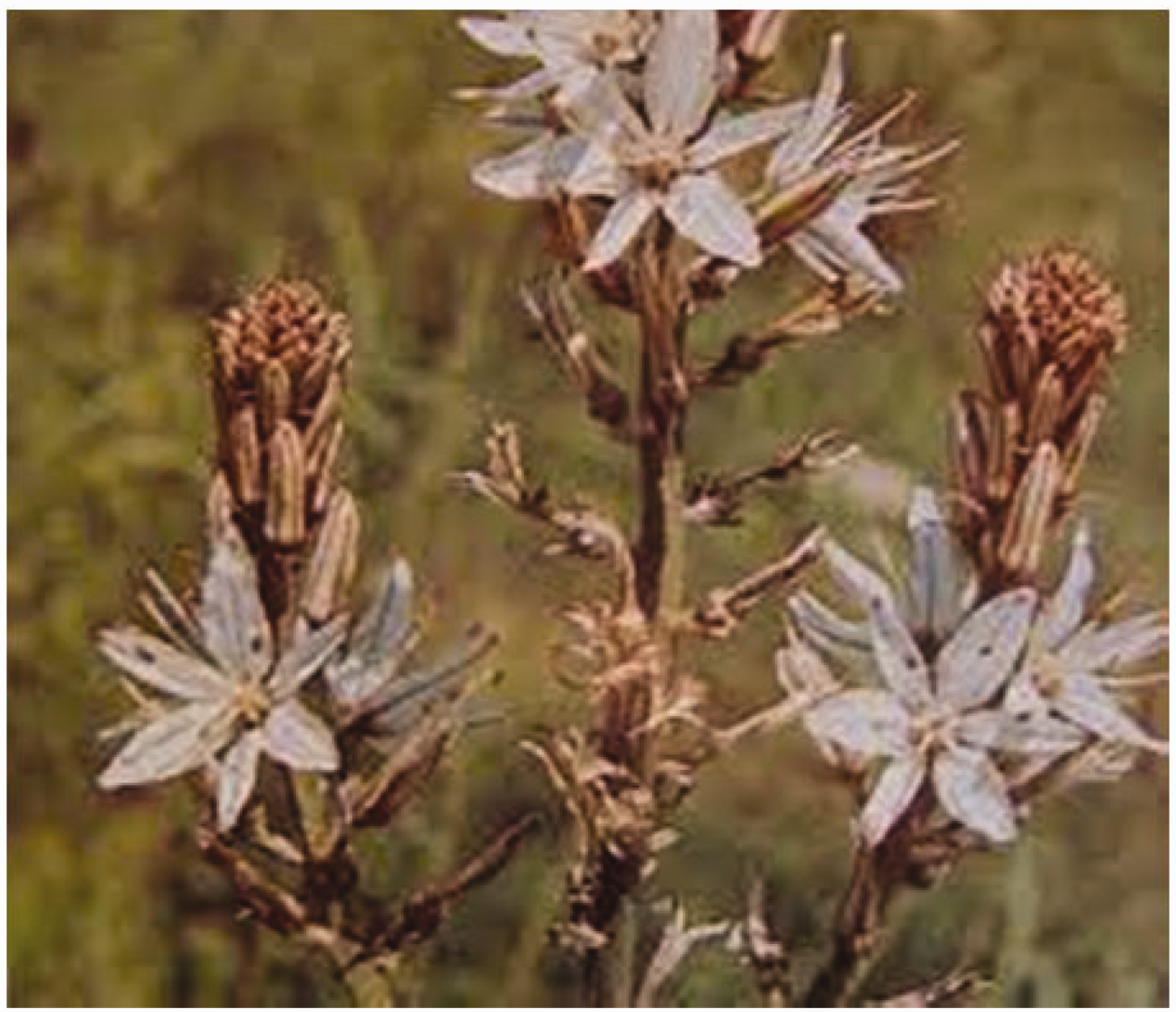
The desert asphodel.
There were other plants, too. There was the salt bush or maloah, known as mallow in the Bible, and the caper bush or Capparis spinosa, of which the seeds are suitable for food. But monks avoided the skillai or Urginea maritima; this has a toxic bulb and contains small, needle-like points. 13
Eating wild plants was a familiar practice in the desert of Palestine. It was a healthy and nutritious diet which led to a long life. Many of the monks whose lives are told by Cyril lived to an old age. Euthymius died at the age of 97; Sabas lived until he was 93; and another monk, Cyriac, was 107 when he died. The benefits of a plant-based diet are shown by the longevity of these vegetarian ascetics.
Ascetics who followed this way of life were called boskoi or grazers. They are familiar figures in the set of stories told by another of the chroniclers of the Judaean desert, John Moschos (c.550–619). 14 He tells us about ten of these grazers in colourful anecdotes. There is, for example, Abba Sophronios the Grazer, who, ‘for seventy years went naked eating wild plants and nothing else whatsoever’. 15 John is impressed by the demanding way of life but does not consider the ascetic path of the grazer to be bizarre or unusual.
But, once away from the desert environment, the boskos lifestyle was seen as strange and outlandish. The historian Evagrios Scholastikos, who also wrote in the sixth century, is shocked by the tales of the boskoi.
16
For him, the boskos was an animal-like character, whose ascetic feats are impressive but whose lifestyle is bizarre. He wrote: Another method [of ascetic life] transcends the capacity of all courage and endurance, for [these] setting themselves loose in the scorched desert and covering only the essentials of nature [with clothing] commit their bodies to extreme frosts and biting winds. And they completely cast off human sustenance and feed off the earth. They call them boskoi or grazers – and in time they come to resemble wild beasts.
17
These two writers demonstrate the differences between two environments – the desert east of Jerusalem and the sophisticated city of Antioch.
Meli agrion – or melagria?
The descriptions of desert life as told by Cyril enable us to imagine John the Baptist’s lifestyle in a fresh way as we come to understand the life and customs of the place where he lived.
When John went deeper into the desert, he would have followed the customs of those who had learned how to survive in these conditions. Melagria would have formed an essential part of his diet, as it did for the later monks, and this would have been remembered and would have become part of the traditions about his life.
But later the oral traditions took written form. The Gospels of Matthew and Mark could have been written in Antioch – the city where Evagrios Scholastikos was later to write his histories. Here, the desert was an unfamiliar landscape and the way of life of boskoi and desert dwellers was not understood.
While foraging for edible plants – and the name melagria – was familiar to the people in Judaea, the city dwellers of Antioch did not know what this melagria was. The very idea of living off wild plants was a source of confusion or embarrassment. In order to make this piece of the tradition clear and acceptable, the melagria or asphodel of the desert became meli agrion or the wild honey of the texts. Meli or honey was not only more familiar but also called to mind the biblical promise of a land flowing with milk and honey. With the addition of a single vowel – the iota – the text became clear and comprehensible to urban congregations who had never seen melagria in flower. This alteration becomes more understandable considering that there were no word divisions in ancient texts and so the addition of a single vowel is less obtrusive.
If, then, the meli agrion of the text should be identified with the melagria of the desert, then ‘wild honey’ was in fact a plant. And if this is a plant, then we should look again at the locust and see if this can also be identified as one of the plants of the desert.
A possible identification of the locust is that it is the carob tree or Ceratonia siliqua (Figure 3). This is an evergreen tree that is found across the Mediterranean and Middle East regions. The long dark seed pods can be harvested and ground down to make a sweet pulp. The carob tree has also been known as the locust tree, perhaps because its edible seed pods resemble insects hanging from its branches. In England it has been known as St John Bread because of its association with the Baptist.
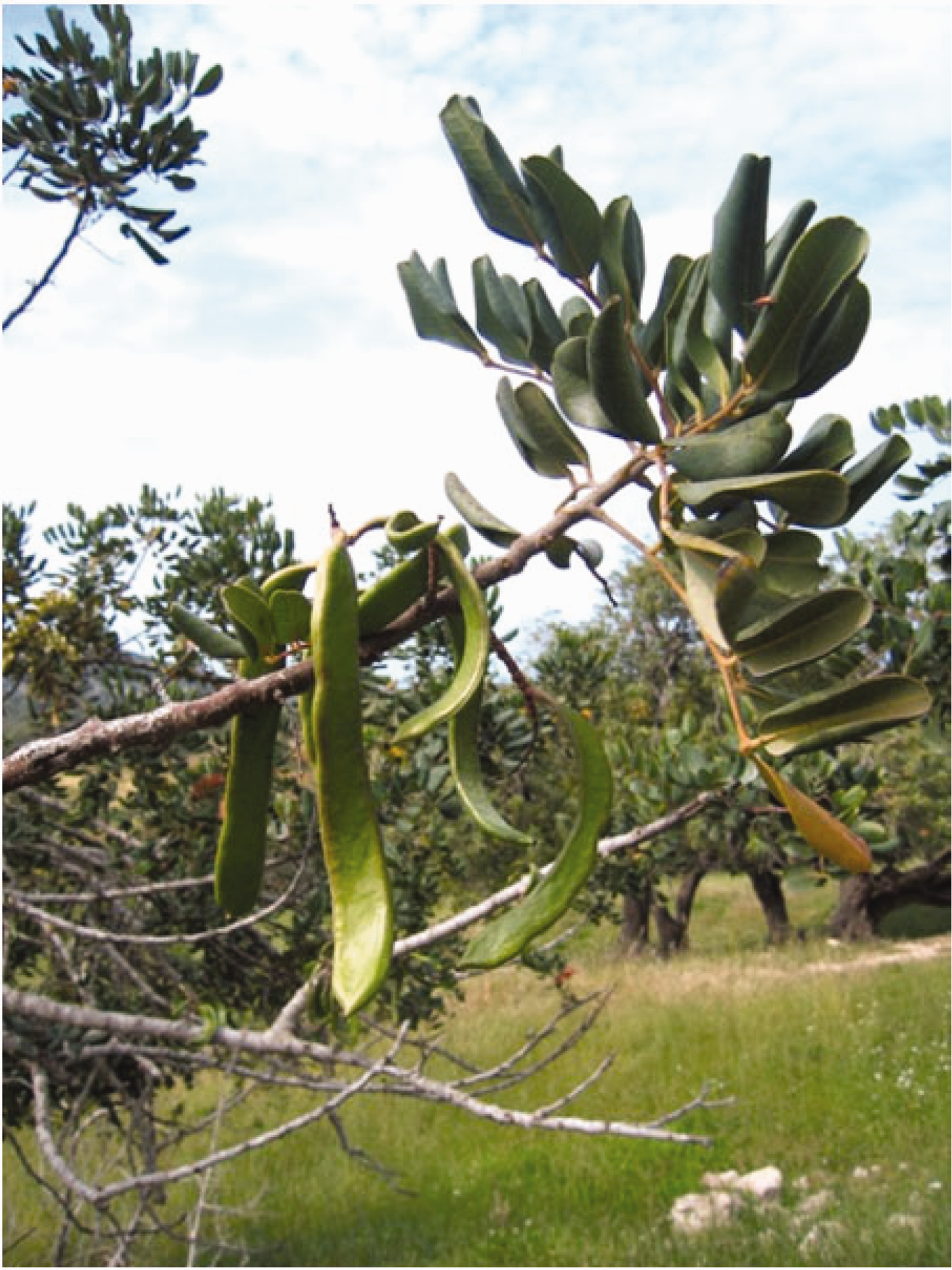
The fruits hanging from the branches of the carob tree. Source: Philip Oswald.
If the akrides or locusts are the seed pods of the carob and the meli agrion is the root of the asphodel, then this is simply the usual food of those who live in the desert margins. John collected the plants that grew around him for food. The plants mentioned are melagria – a root that is dug up from the ground – and the seed pods of the carob – a fruit that is picked from the branch of the tree. Instead of the Gospel texts stating that John’s food was ‘locusts and wild honey’, a better – if more long-winded – version of the earliest traditions would be ‘John’s food was provided by God, and he ate the fruits of the trees (like the carob) and the roots from the ground (like melagria)’.
But these plants would have been available only during the wetter winter months. They would not have supported life when the desert dried in the hotter summer months. So, if John lived off the edible desert plants, then in the summer he would have had to leave the more arid parts of the desert. His periods living in this extreme desert terrain demonstrate his ascetic lifestyle, at home in the place where God makes himself known. Like the later desert fathers, he would have set off into these remoter desert areas in the wetter months when food was easier to find. At other times of the year he would have settled in other areas. These would have been the Jordan river valley, where he baptized, or the towns of the hill country, perhaps attached to a community.
Conclusion
This gives us a context and background to the life and teaching of John the Baptist. He was a member of a community in one of the towns of the hill country or in the Jordan valley.
From here, he went into the desert places in the springtime, after the winter rains when the region was most fertile, and, during these periods of desert wandering, people came from the cities to listen to the preaching of the prophet.
These preaching journeys took him into the stretch of semi-arid grazing land that was not suited to agriculture but did produce various wild plants that could be eaten by shepherds and others who lived in these regions. He, like others before and since, foraged for edible plants. John followed the practice of those who live in desert margins and set an example of ascetic living that was to be followed by the monks who came after him.
He also spent some time alongside the Jordan river.
Jesus met with John during the desert preaching and baptizing missions. After his baptism, Jesus withdrew even deeper into the desert, into the area the monks sometimes called paneremos or total desert. Here, in this even more inhospitable environment, he was drawn into his struggle with his own thoughts and motivations, with the lures and temptations of the devil. Then he returned back to the higher, more fertile, spaces and went back to his home in Galilee to the north.
The landscape and way of life of the desert of Judaea was the place where the ministry of Jesus began.