




Abstract
Sixty years since its consecration, the architectural historian Henrik Schoenefeldt reflects on the theological questions underlying the plans for the post-war reconstruction of Coventry Cathedral. Covering the period from 1940 to 1962, this article explores the role of architecture in giving outward expression to the Cathedral Council’s discernment of a ministry reconciliation with a focus on Christian unity. At first this emerging identity articulated itself architecturally in symbolic acts and temporary interventions within the physical remains of the old cathedral. This was followed by proposals for the rebuilding, which culminated in Sir Basil Spence’s final design. However, his completed design reflects not only aspirations, but also the past ecclesiastical barriers towards ecumenicism. This suggests that its architecture did not represent a conclusion, but only an intermediate stage within a much longer, and still ongoing, process of discernment.
Introduction: emerging symbols of reconciliation
The Second World War had left behind ruins and scarred cities across Europe, and debates were held about whether these scars should be preserved as physical testimonies. In the context of the rebuilding of ecclesiastical buildings, the debates were concerned not only with issues of architectural preservation, but also with questions of their theological significance. In the context of the rebuilding of the Cathedral Church of Saint Michael, Coventry, the debate was concerned with the symbolic significance of the ruins, and this was inseparable from the discerning Christian response to the tragedy of war through a ministry of peace and reconciliation. In a sermon given in May 1962, the Archbishop of Canterbury, Michael Ramsey, described Coventry Cathedral as a house which spoke of peace, of reconciliation; nations which had been divided saw in it a sign that God could forgive, God could unite and God could make men and nations brothers. It was a prophecy, for, as a new cathedral rose from the ashes, so a new world of partnership, and brotherhood could, by God’s goodness, rise from the miseries of the past.
1
While this ministry was clearly a response to the experience of war, underlying it was also a call towards unity among Christians. This was grounded in the belief that the fractured relationships between the countries of Europe could be reconciled through unity among Christians of different denominations and nationalities. In a lecture given during a visit to Germany in 1961, Harold Williams, who in 1958 had succeeded Howard as provost, argued that it was to be achieved through the vehicle of ecumenicism. He said that ‘we shall establish firmly and honestly that the bond between Christians – merely because they are Christians – is sufficient to break down every other barrier’. 2
The objective of this article is to offer a reflection on these explorations over the period from 1940 to 1962 by investigating how the emerging identity of reconciliation articulated itself architecturally over three key phases. The first phase, covering the period from 1940 to 1948, was characterized by small, temporary interventions within the ruins, and the second phase, which lasted from 1942 to 1946, was concerned with the development of a first, yet unrealized, design for a new cathedral that was produced by the architect Giles Gilbert Scott (1880–1960). The third phase, which lasted from 1947 until 1962, was concerned with the procurement and implementation of a final design. From an architectural perspective, the completion of the cathedral could be considered the conclusion of this process of discernment, but this research has shown that the architecture also reflected historical divisions that prevented the ideal of reconciliation among Christians from being fulfilled.
Phase 1, 1940–48: a transitional cathedral: debris, a ruin and the forging of symbols of reconciliation
The original cathedral was destroyed by incendiary bombs on the night of 14 November 1940. The fact that it was hit by incendiaries was significant because it resulted in the damage being limited to the loss of combustible materials, such as timber ceilings and roof trusses, while most of its masonry structure withstood the fire. Despite displaying physical scars, the tower and external walls, including the intricate stone tracery of its gothic windows, were clearly recognizable and retained a strong presence within the ruined landscape of the city around it. Bishop Gorton noted that the ‘scarred walls still stand’ and ‘its spire is miraculously undamaged’. 3 These monumental ruins were not only preserved, but, between 1941 and 1948, they were transformed into a space for worship and prayer. The site also became enriched with symbols of an emerging ministry of peace and reconciliation. The beginning of this transformation was marked by small yet highly symbolic acts, as well as by the creation of liturgical objects from building fragments found inside the ruins, which were used in corporate worship and spaces for prayer. Among the fragments that survived the heat of the fire were pieces of fallen stonework and thousands of nails from the burned rafters. In his book Ruined and Rebuilt, published in 1962, Howard wrote that the debris contained ‘a few charred beams, twisted girders, bits of wire, and a great profusion of nails of all sizes lying everywhere, with every particle of wood burnt away from them’. 4
The earliest symbolic act was undertaken by the provost within days after the raids. With a piece of chalk, he added the words ‘Father Forgive’ on the wall of the ruined apse, which was covered in black soot. 5 In 1948, these ephemeral marks were memorialized by being replaced with carved letters. The words were taken from Jesus’ last sentence on the cross, added to the Gospel of Luke (23.34): ‘Father, forgive them, for they do not know what they are doing.’ This was the earliest physical expression of a call for reconciliation, which Howard also made the subject of a radio address given on Christmas Day of 1940. He asked all Christians to try hard ‘to banish all thoughts of revenge’, and while he saw the war as necessary to overcome the ‘tyranny and cruelty’ of the Nazi regime, he also made a plea for making ‘a kinder, simpler, a more Christ-like sort of world in the days beyond this strife’. 6
In January 1941, the provost continued the transformation of the chancel by commissioning a new altar. This was constructed from fallen stonework and surmounted by a large cross, which was made from two charred wooden rafters that had survived the fire. In November 1941, The Times wrote that ‘two charred beams have been fastened together to stand, pitiful and protesting, as a cross’. 7 These interventions were small and the majority of the space was left in its original state until 1948. Only a narrow path had been cleared in the centre of the former nave for processions, lined with large mounds of debris on both sides. According to Howard, the space felt ‘austere, desolate and uncomfortable’. 8 This space was used for the annual commemoration services and important Christian festivals, such as Good Friday and Easter, as well as for the enthronement of Bishop Gorton in February 1943. 9
Another symbolic act was the creation of iron crosses, using medieval nails from the burnt rafters, which were adopted as a new symbol for Coventry and its ministry of reconciliation. From 1941, a large nail cross, mounted on top of a pole, was carried by the crucifer during cathedral services. 10 Alongside their liturgical role in local worship, however, the crosses also became important in the development of the cathedral’s ministry of reconciliation. Throughout the 1940s, various nail crosses were shared with parishes in different countries. As early as January 1942, Howard described the cross of nails as a ‘token of the Christian bond that unites our people together, and of our common faith in the ever-living Christ to heal the wounds of the world’. 11 Through these acts, the cathedral began building an informal network of parishes sharing in a ministry of reconciliation, which provided the foundations for the formation of a more formal partnership, known as the Community of the Cross of Nails, in 1974.
In 1948, the rubble was cleared and the site transformed into a public space for prayer and large outdoor services. It was landscaped and the walls of the ruins were lined with eight prayer stations. This marked the end of interventions within the ruins, but between 1941 and 1951 the Cathedral Council and Diocesan Conference also discerned how the cathedral ought to be rebuilt. This was intimately intertwined with the question of how much of the ruins, including liturgical artefacts made from fragments, should be preserved for their symbolic significance and integrated into the design of a future cathedral.
Phase 2, 1942–47: a first architectural scheme
Despite uncertainty about the outcome of the war, the Cathedral Council began to consider plans within weeks of the raids. In November and December 1940, Howard publicly voiced his conviction to rebuild,
12
and in March 1941 the Cathedral Council resolved to rebuild ‘as soon as the circumstances allow, and as funds permit’. Following advice received from the Central Council for the Care of Churches, it also resolved that it should ‘be rebuilt on or near the site of the present ruin’.
13
The Central Council, which was a department within the Church of England (CofE) that provided technical advice on the conservation of churches, advocated the retention and repair of most of the surviving fabric. It argued that ‘outer walls can be repaired and should be retained’, that the ‘predominance of the spire should not be disturbed’,
14
and that the new parts of the construction ‘should not be in violent contrast’ with the existing structure. This emphasis on preservation imposed serious constraints on the design, and in spring 1942 the Cathedral Council appointed Giles Gilbert Scott as architect.
15
He was renowned for his experience in designing ecclesiastical buildings in the gothic style, including the design for a modern Anglican cathedral in Liverpool. His scheme for Coventry, first presented to the public in February 1944, retained most of the historic fabric and the exterior of the new cathedral was designed in a gothic style to blend seamlessly with the remains. Some parts of the scarred walls were incorporated into the new building, while others were retained as ruins. The new cathedral, which occupied the eastern half of the site, was turned by 90 degrees against the east–west axis of the ruined cathedral, and the new altar was placed at the point where the two axes intersected. In the western half, the tower and scarred walls were retained as ruins (Figure 1) and transformed into a courtyard leading towards the new west door.
Diagrammatic floor plan of Giles Gilbert Scott’s plan of 1944.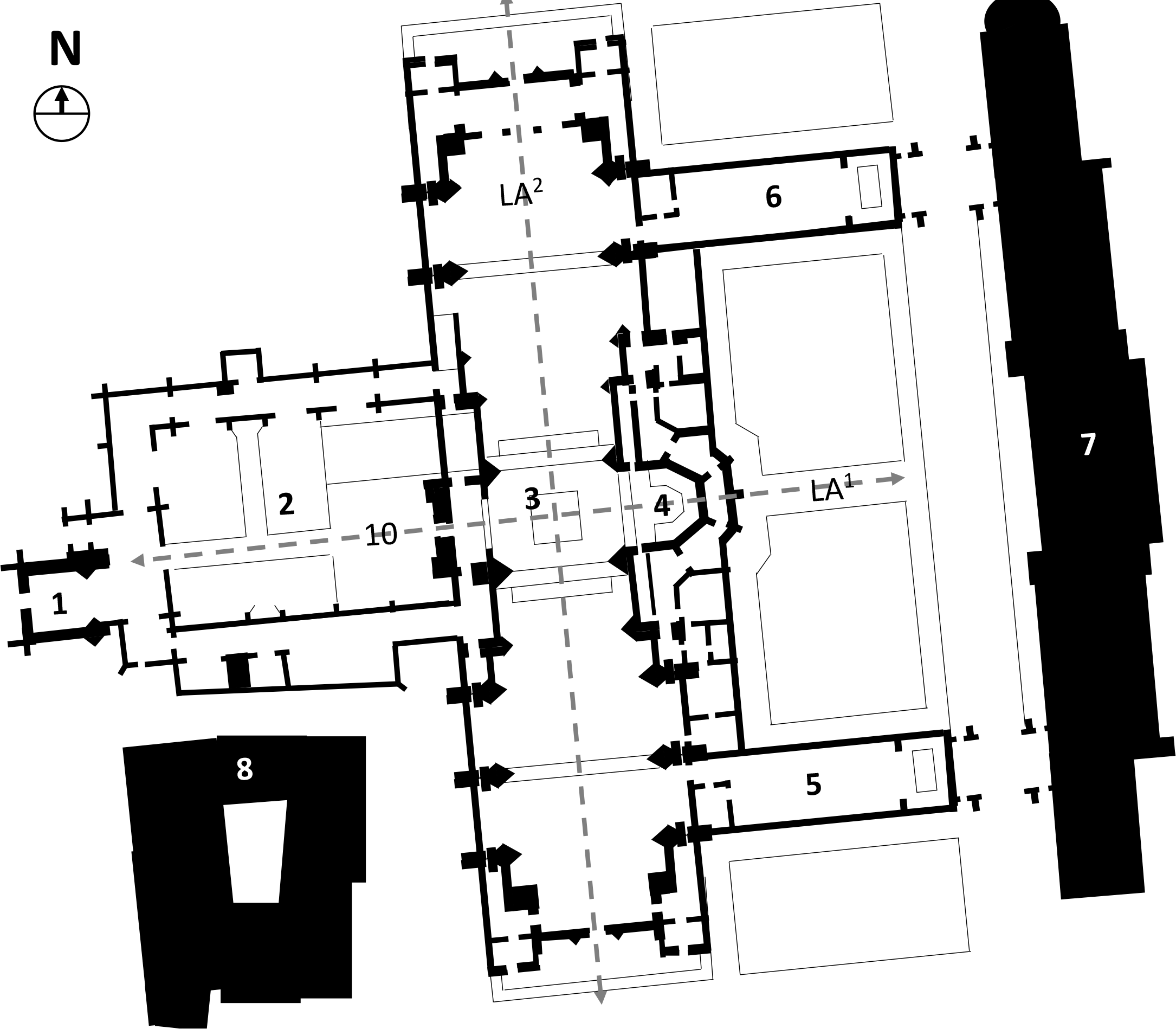
An important influence on the development of the plans was the installation of Neville Gorton as the new Bishop of Coventry in February 1943. He was instrumental in advocating the ministry of reconciliation and Christian unity as part of the vision for the new cathedral. During his first public address to the city of Coventry on 26 March 1943, he argued that the cathedral should become a space to be shared by Christians of different denominations. 16 The Church Times wrote that Gorton ‘felt strongly that the new cathedral must not be for one sect only. It must be a central thing, symbolic of the new life of the city, and not the preserve of any particular denomination.’ 17 In his view, greater interdenominational collaboration was necessary for Christian evangelism to become effective in an increasingly materialist society. It is unclear from this statement how far Gorton envisaged going with the idea of the cathedral becoming interdenominational, but it was radical at the time as it was not compatible with CofE ecclesiastical law. Up until the Sharing of Church Buildings Act of 1969, ecclesiastical law did not permit Anglicans to sign formal agreements with other churches for the joint use of church buildings, 18 and interdenominational worship, facilitated through local ecumenical partnerships, only began to be trialled in 1964. The question of how far the ideal of interdenominational collaboration could be realized in the context of the 1940s was explored over the next 12 months while the Cathedral Council and Diocesan Conference developed the brief for a new cathedral. By February 1944, the Council came to an agreement with the Free Church Federal Council to collaborate in the operation of future ecumenical facilities, which were to include a Christian service centre and Chapel of Unity. 19 Gorton, however, became more cautious about the idea of an ecumenical cathedral. In a public statement, given in February 1944, he emphasized that ecumenical mission was to become a separate entity. The ecumenical mission would be accommodated within a Christian service centre with its own chapel, but the CofE was to retain the ‘sole control’ of the services within the cathedral. He stressed that the worship would be centred on the eucharist and maintain the ‘Anglican liturgical traditions’. 20 William Temple, Archbishop of Canterbury, produced a written statement that endorsed the idea of an ecumenical centre, but also stressed that it was ‘essential’ that the cathedral remained ‘purely and definitely an Anglican church’. 21 This separation was also evident in Scott’s scheme, with the chapel and centre placed in separate buildings outside the body of the cathedral.
In early December 1944, the constitution was finalized for a separate governing body, known as the Joint Council of the Christian Service Centre. 22 This comprised ministers from the Anglican and non-conformist churches and was chaired by the Bishop of Coventry. 23 It was approved by the Diocesan Conference and Cathedral Council, and prior to his death in October 1944, it was also endorsed by Temple. 24 The first Joint Council was appointed by February 1945, and to enable it to commence its ministry prior to the completion of the new cathedral, the western crypt of the ruins was restored and adapted to function as a temporary Chapel of Unity. This was consecrated in November 1945, 25 but, although the constitution provided a legal framework for collaboration, it also illustrated its limitations by stating that ‘Holy Communion will not as yet be celebrated in this chapel’. 26
Phase 3, 1950–62: towards a new design, building on a revised brief
The constitution settled important questions at an institutional level, but the original architectural scheme was discarded after two years. In December 1946, following the advice of the Fine Arts Commission, the Cathedral Council abandoned the original scheme, and in January 1947, after Scott had formally resigned, the Council appointed a small commission to give advice on the procurement of a new design. 27 This was chaired by Lord Harlech, Director of the Ancient Monuments Board. Among its members was Sir Percy Thomas, an architect, and Sir Philip Norris, the vice-chancellor of Bristol University, but half the membership were clergy. These included two Anglicans, Lemprière Hammond (1881–1965), Bishop of Stafford, and Herbert Jones (1887–1969), Provost of Leicester, and the Methodist Ernest Benson Perkins (1881–1974), who was also the author of The Methodist Church Builds Again, a guide to the rebuilding of churches. 28
In July 1947, the Commission published its final report. Its advice was to procure the new design through an architectural competition, but it also gave advice on the treatment of the ruins. It recommended retaining only the tower, arguing that the outer walls were ‘unsafe to incorporate them in a new building’. 29 It also suggested that the cathedral should be built as close as possible to the original site and in a gothic style, 30 a detail that the Royal Institute of British Architects (RIBA) criticized for being far too constraining. Lord Harlech did not fundamentally oppose a modernist design, but was concerned that it would not harmonize with the original tower. In response to RIBA’s criticism, Harlech told the Cathedral Council that a modernist scheme would be acceptable if it was placed on a different site. This was significant, as it inadvertently outlined an approach to reconciling old and new that would become central in Spence’s later plans for a modernist design. The Council and Diocesan Conference approved these recommendations, but omitted the requirement for a building in a gothic style. 31
In 1948, the Cathedral Council appointed a reconstruction committee 32 to coordinate the project, and after three years held an architectural competition. In 1950, RIBA appointed a panel of assessors, which was composed of the architects Percy Thomas, Edward Maufe and Howard Robertson. In the brief for the competition, which the committee had developed in consultation with the cathedral and Joint Council, 33 the treatment of the ruins was revisited. 34 Adhering to the advice of the Commission, the brief only insisted that the tower was preserved ‘either separately or as part of the new cathedral’. It left the retention or removal of walls at the discretion of competitors, but requested that the crypt below the ruins were preserved and connected to the new cathedral. It also permitted competitors to place the new building in any location within an area marked on the site plan, which, alongside the ruins, constituted a large area on the north side of the original cathedral, which would become important for the realization of Spence’s final concept. The brief also contained specific requests for the particular artefacts to be preserved and given a prominent place within the new cathedral. It lists the ‘Altar of Rubble’, ‘Charred Cross’, ‘Cross of Nails’ and the ‘stones bearing the words “Father Forgive”’. This indicates that these artefacts had acquired high cultural significance. In the context of the brief, the architectural relationship between the cathedral and the Chapel of Unity was also revisited. In 1947, the Harlech Commission had noted that the CofE and Free Churches had agreed that the Chapel of Unity could not be placed inside the cathedral itself, and instead ‘decided to erect an independent building near the cathedral’ and suggested the graveyard to the north of the cathedral as a potential new site. 35 These recommendations, however, were not adopted in the competition brief. Instead, it expressed the desire for the chapel to be an integral part of the cathedral. This view was also expressed strongly in a written statement from the Joint Council, which was attached to the brief. In this, it stated that the chapel should not been ‘seen as a secondary entity to be treated architecturally as an adjunct’ and stressed that it was ‘essential in the thought as well as the structure of the cathedral itself. We attach a fundamental spiritual importance to the Chapel of Unity within the cathedral plan.’ 36 While the brief asked for the distinction of ownership only to be marked architecturally, through a ‘vertical boundary plane’, 37 it also gives evidence of the presence of a clear separation. It said that the connection between the cathedral and chapel should ‘be arranged so that worshippers in the chapel may, if so desired, feel themselves to be part of a service taking place in the cathedral’. These words illustrate that non-Anglicans were to be placed in a position where they could be only observers rather than full partakers in the worship of the cathedral.
A (un)settled position: Basil Spence’s final scheme
By the closing date of the competition on 20 July 1951, a total of 216 architectural schemes had been received. 38 The competition, which has been explored by the architectural historian Louise Campbell, cannot be discussed in detail in this article, but these schemes showed various approaches to relating new buildings to the ruins. 39 On 15 August 1951, the assessors announced that they had selected Spence’s entry. 40 His plans, refined and constructed over the following 11 years, expressed a clear position regarding the relationship between the new cathedral and the ruin on one side, and the Chapel of Unity on the other.
In a written statement, submitted as part of his competition entry, Spence highlights the importance of the ruins as an inseparable part of the new cathedral. He noted that it ‘should grow from the old and be incomplete without it’,
41
and, like Scott’s early scheme, Spence’s cathedral was perpendicular to the liturgical east–west axis of the ruins. In contrast to Scott’s scheme, however, he proposed a separate structure built outside the boundary of the historic site, separated from the ruins by a public avenue (Figure 2). This enabled the ruins to be preserved in their entirety and the artefacts to remain in their original locations.
42
Despite this physical separation, the old and new parts were unified spatially through the use of visual axes. The south elevation of the new cathedral, which fulfilled the liturgical role of the west door in traditional cathedrals, was completely transparent and a canopy extended the roof of the modern nave and went across the path to touch the north elevation of the ruins. This canopy marked the intersections between the main axes of the new and old cathedrals, offering a vantage point from which both the new high altar at the north end of the modern nave and the rubble altar of the old cathedral ruins could be seen. This shows that the old and new retained their distinct identities, yet were integrated through their spatial relationships. Spence also adopted a similar approach to establish a dialogue between the Anglican cathedral and the Joint Council’s Chapel of Unity.
Diagrammatic floor plan of Basil Spence’s plan of 1962.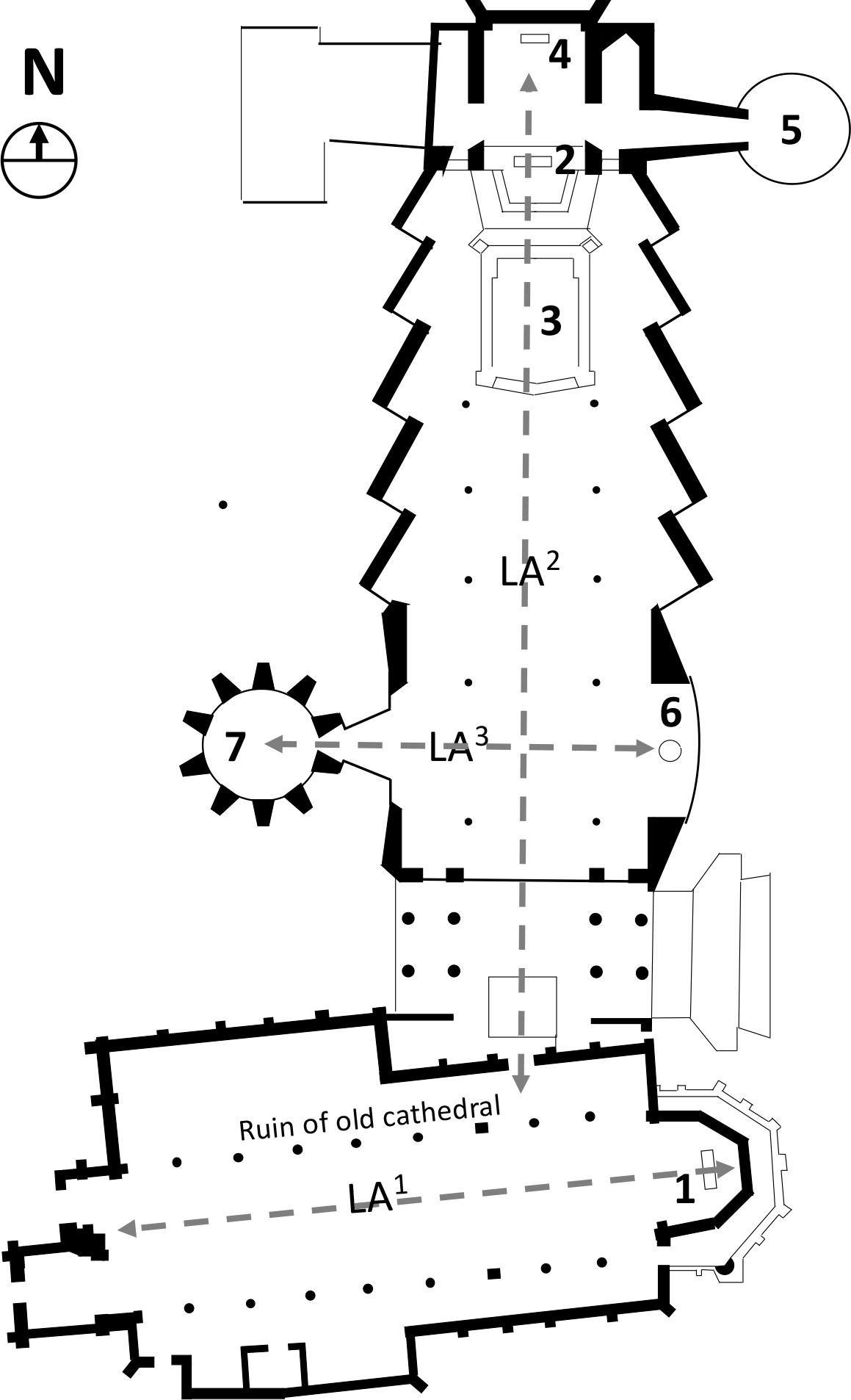
The latter was an independent and architecturally distinctive structure outside the main body of the cathedral. It was a prism that was perched outside the cathedral like a tent. Indeed, according to Spence, it was intended to symbolize a medieval crusader tent, as he saw the strive towards Christian unity as a modern crusade. Although it was external, the chapel was not spatially isolated from the nave. Both were linked through a short passage, and divisions were also rendered invisible through the introduction of a second liturgical axis. In addition to the main axis, which runs north–south and terminates in the high altar and Graham Sutherland’s tapestry, depicting Christ rising in glory, there is a secondary axis that runs east–west. Its ends are marked by the baptistery on the east and the chapel on the west side of the nave, occupying the place that in a traditional church would have been occupied by the high altar. Yet, at the time of its completion in 1962, the Chapel of Unity neither had an altar nor did the CofE permit shared eucharistic services with other denominations. While the Joint Council enabled practical collaborations, the chapel’s creation was not accompanied by reforms towards ecclesiastical or doctrinal unity. It could therefore be argued that the architecture did not represent the conclusion of the process of discernment that had begun in 1940. Instead, it could be interpreted as the physical expression of a transitional stage within an ongoing strive towards Christian unity. Now, 60 years later, we can raise the question of whether the architecture ought to be static or allowed to evolve as a living embodiment of progress in ecumenical relations.