



Abstract


Literacy is associated with long-term educational, employment, and health outcomes (e.g., Brasseur-Hock et al., 2011). Despite this, national data indicate that two-thirds of upper elementary students struggle with reading (National Center for Education Statistics, 2022), and this number is even greater among those with identified disabilities. Despite strong evidence to support the use of validated instructional practices and interventions to teach reading skills, there remains a significant number of students for whom these practices alone do not seem to be sufficient (Denton et al., 2013; Suggate, 2016). Therefore, it is imperative to identify effective methods for intensifying reading intervention for students with or at risk for reading disability (RD) in the elementary grades, before students face mounting challenges related to increasing text demands.
Students with persistent reading challenges often demonstrate decreased motivation related to reading tasks (Wolters et al., 2014). Research has shown that students who are unable to read fluently often become frustrated and resistant toward academic tasks, thereby negatively influencing their effort, persistence, and engagement in intervention (Margolis & McCabe, 2006; Multon et al., 1991), and there is growing evidence that motivation accounts for unique variance in predicting reading performance, with robust bidirectional relations (see Toste et al., 2020). Low levels of motivation are associated with less time spent reading, and this presents a serious risk to students’ long-term success (Chapman et al., 2000; Wigfield & Guthrie, 1997). Motivation theories seek to understand and explain what drives humans to work toward particular goals or outcomes. Underpinning a wide array of theories is the notion that motivation can influence an individual in their engagement with or avoidance of any task or behavior and are, thus, self-reinforcing in nature. Teaching students self-determination skills has the potential to enhance motivation—directly teaching students self-regulation skills, such as goal setting and planning for attainment, can enhance motivation and other outcomes. In this article, we describe how self-determination instruction focused on enabling students to learn and use skills associated with self-regulating goal setting and attainment can be integrated with supplemental reading interventions for elementary students with or at risk for RD. First, we provide a case for the importance of self-determination. Then, we describe a validated intervention—the self-determined learning model of instruction (SDLMI; Shogren et al., 2024a)—and the development of an elementary version that can be integrated with reading interventions, the SDLMI-reading (SDLMI-R). We provide detailed guidelines for supporting students as they move through the first phase of the SDLMI-R. Recommendations guide teachers to consider ways to engage students in self-directed goal setting in their elementary classrooms.
What Is Self-Determination?
Although the term “self-determination” has different definitions and associated theoretical frameworks in the education and psychological literature, the framework we adopt in this project is causal agency theory (Shogren et al., 2015). This theory integrates multiple theoretical orientations relevant to enhancing motivation, self-regulation, and goal setting and attainment. According to causal agency theory, self-determination is a “dispositional characteristic manifested as acting as the causal agent in one’s life” (Shogren et al., 2015, p. 258). Causal agency theory highlights how instruction, opportunities, and supports for the development of skills associated with self-determination (e.g., choice-making, decision-making, problem-solving, goal setting and attainment, self-regulation, self-advocacy, self-awareness, self-monitoring, and self-knowledge; Shogren & Raley, 2023) can be integrated into classroom practices to enhance student motivation and learning. There is strong evidence for teaching self-determination skills in secondary transition for students with disabilities (Hagiwara et al., 2017). Few studies have investigated teaching self-determination alongside academic skills for elementary students with disabilities, especially in reading (Didion et al., 2021). Researchers have found students who are involved in the process of setting their own goals are more motivated and engaged in achieving those goals (Wehmeyer & Shogren, 2017). Goal setting may support individuals to regulate their actions for task achievement (Elliott & Dweck, 1988; Quirk et al., 2009). When students evaluate their performance toward goals, they are more likely to persist at a task when challenged (Elliott & Dweck, 1988).
SDLMI
The SDLMI (Shogren et al., 2024a; Wehmeyer et al., 2000) was developed to support students with and without disabilities to self-direct the goal setting and attainment process—learning critical self-determination skills and enhancing their motivation. Grounded in causal agency theory, the SDLMI is not a specific curriculum per se but a model of instruction to facilitate student-directed, self-regulated goal setting and attainment across contexts. Most research on the SDLMI has focused on secondary contexts for students with disabilities, and the SDLMI has evidence of implementation in other contexts, including secondary English, mathematics, and science courses (Shogren et al., 2024b). The SDLMI is identified as an evidence-based practice for enhancing postschool outcomes in transition (National Technical Assistance Center on Transition: The Collaborative, 2022). There is a need to focus on how to integrate self-determination instruction for elementary students to build a strong foundation for self-determination across the life course (Didion et al., 2021; Shogren et al., 2022). Given the number of students who are struggling with reading and the role of motivation in enhancing engagement in instruction, reading instruction is critical context for implementing self-determination intervention. First, we describe the core components of the SDLMI (student questions, facilitator objectives, and educational supports). Then, we describe the development of the SDLMI-R to address the need of teaching self-determination skills within the context of reading instruction.
The SDLMI is a three-phase instructional cycle guided by a facilitator that is repeated over time and individualized for each student. Each of the three phases presents a problem to be solved by the student (Phase 1: What is my goal?; Phase 2: What is my plan?; Phase 3: What have I learned?). Educators teach students strategies to solve the problem by posing and answering a series of four student questions per phase that are constructed to direct the student through a problem-solving sequence, building self-regulation skills as they learn to use and apply the questions to reach self-selected goals. The solution in each phase leads to the problem-solving sequence in the next phase (e.g., “What is my goal?” in Phase 1 leads to “What is my plan?” in Phase 2). Each student question is linked to a set of facilitator objectives that provide a road map for educators to support students in solving the problem of the student question. For example, with the first student question (“What do I want to learn?”), the facilitator objectives are to enable the student to identify specific strengths and instructional needs; identify and communicate preferences, interests, and beliefs; and prioritize needs. These objectives are met by facilitators using specific strategies, or educational supports (i.e., goal setting and attainment instruction, self-advocacy instruction, problem-solving instruction).
SDLMI-R in Elementary Grades
Steps have been taken to address the need for a greater focus on instruction targeting self-determination skills in elementary education, particularly for students with reading difficulties, by developing the SDLMI-R (Toste, 2021–2026). The development of the SDLMI-R followed a rigorous process focused on adapting the secondary SDLMI materials to include instructional language, scaffolding, and supports to make them accessible for elementary-aged students (Toste et al., 2025). Specifically, the instruction is more directed, with supports in place to model and practice skills related to goal setting and attainment.
Although the adapted SDLMI framework holds promise for application across academic content areas, prior research has consistently demonstrated that specific modifications are necessary to align the model with different instructional contexts. The SDLMI-R addresses this need by embedding reading-focused prompts, examples, student samples, and case scenarios. These context-specific adaptations are particularly critical for students with RD, who often have extensive histories of failure in reading-related tasks. For these students, setting and pursuing goals in reading requires not only effective instructional strategies but also psychological support to reengage with an area where they have experienced repeated setbacks. By embedding supports that are explicitly focused on reading, the SDLMI-R creates a context that fosters psychological safety, thereby enabling students with RD to make themselves vulnerable enough to set meaningful reading goals and work toward achieving them “
The SDLMI-R iterative development process has led to a scripted, manualized program that can be integrated into intensive reading instruction. The program includes 40 lessons, delivered over an academic year, where trained facilitators (e.g., teachers, tutors) implement lessons to guide small groups of students (two to three) through the three phases of the SDLMI. Facilitators use the script to provide instruction, opportunities, and supports for students to learn the goal setting and attainment process.
Summary of the Self-determined learning model of instruction (and self-determined learning model of instruction-reading) phases and student questions

Note. Self-determined learning model of instruction content reprinted with permission from Kansas University Center on Disabilities (Shogren, Bruno, et al., 2024a).
Implementation of Phase 1
Through Phase 1 of the SDLMI-R, teachers support students as they begin to self-identify goals and self-direct the goal setting process during reading instruction. In this phase, students answer four questions that guide them in setting this goal. In the following sections, we describe each student question alongside an example of how Ms. Luna supports her student, Jaylen, in setting a goal.
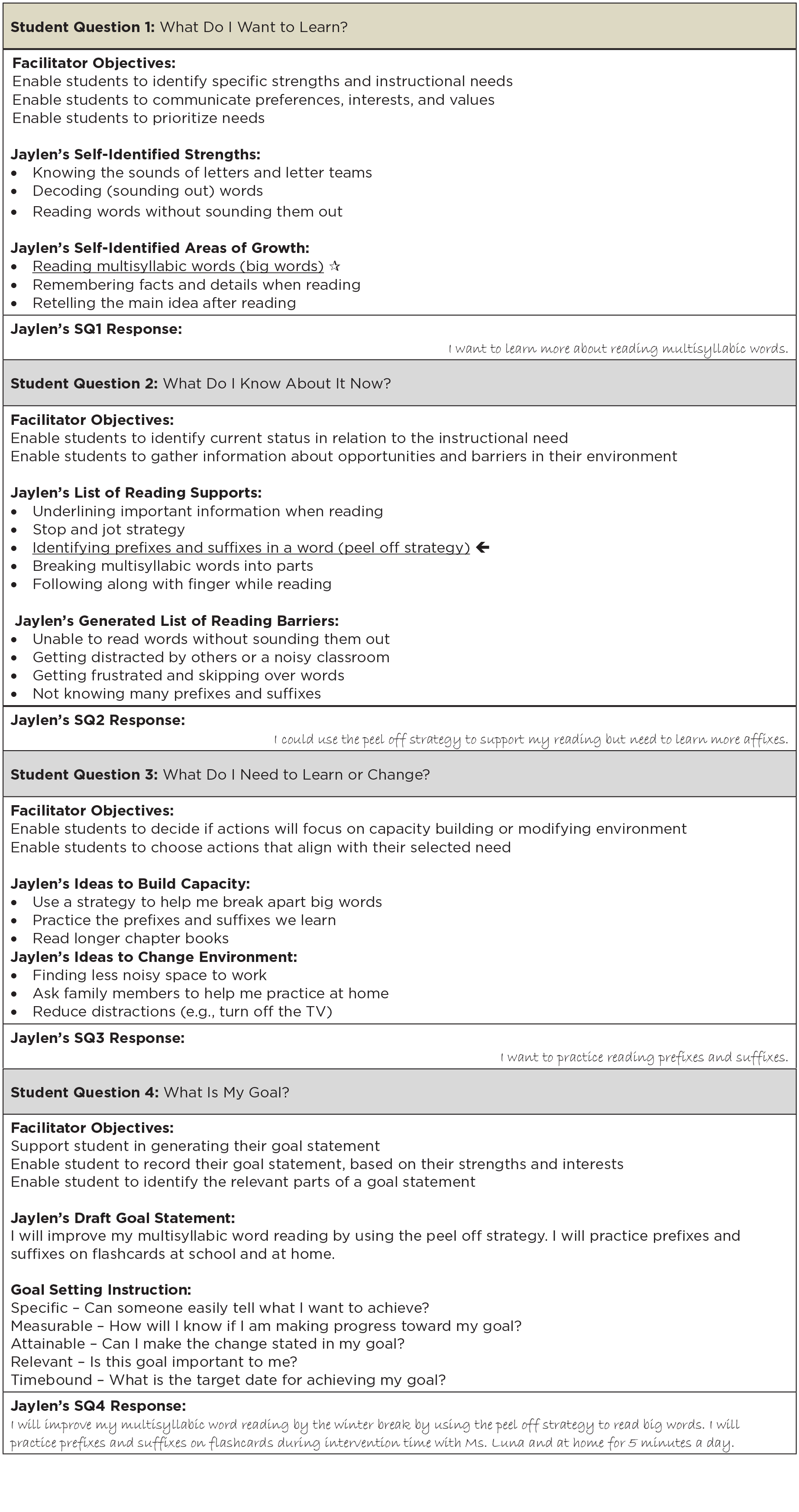
Summary of instructional focus and Jaylen’s response to Phase 1 student questions
Ms. Luna is the special education teacher at Avalon Elementary. Jaylen is one of the students that Ms. Luna works with for supplemental reading intervention. Jaylen is a fifth grader with an identified word-level RD (i.e., dyslexia), and she is receiving instruction focused on foundational word reading and decoding skills throughout her elementary school years. Like many students with dyslexia, Jaylen requires intensive and explicit reading intervention to support her ongoing development of proficient reading skills. This year, Ms. Luna focused on intervention that targets multisyllabic word reading skills for Jaylen.
Jaylen has become increasingly disengaged with reading lately, and Ms. Luna remembers a self-determination program, the SDLMI-R, she learned about at a local education conference last year. Ms. Luna contacts the presenter to get more information about the SDLMI-R. She thinks instruction in self-determination skills could empower Jaylen to better understand her own reading-related support needs and self-direct her learning goals and action plans. Although Ms. Luna has experience with creating goals for her students in reading, she is unsure what it would look like to explicitly teach self-directed goal setting. Also, in elementary school, most instruction is teacher-directed, and Ms. Luna is unsure of how to provide opportunities for student autonomy. After reviewing the materials and going through training, Ms. Luna begins Phase 1 of the SDLMI-R with Jaylen’s reading intervention group to see if this instruction has an influence on her students’ motivation and self-determination.
Student Question 1: What Do I Want to Learn?
In the first student question of Phase 1, facilitator objectives guide teachers to support students to identify both strengths and areas where they need to grow, communicate these strengths and needs, and prioritize them. SDLMI-R lessons guide teachers to meet these facilitator objectives. Teachers start by providing students with a list of reading skills aligned with what they know about students’ strengths and needs (e.g., knowing the sounds that most letters and teams make, understanding the meanings of words, or remembering facts and details from texts) to guide their thinking of and differentiating their strengths and areas of growth. Teachers can include skills they are targeting in their reading intervention lessons or programs in the list of reading skills for easy alignment. Strategically choosing skills for the student self-reflection supports the student to identify areas of strength that they can celebrate and areas of growth that align with skills taught during reading interventions. In doing so, teachers are providing educational supports related to self-assessment and communication of needs and priorities for learning. Supporting students to identify these areas is critical to enabling them to self-direct their learning and goal identification as they continue to move through Phase 1.

Self-assessment tool to identify strengths and areas of growth
To support Jaylen and her other students in responding to Student Question 1 of the SDLMI-R, Ms. Luna uses a self-assessment tool that guides them to identify their strengths and areas of growth in reading. She provides students with an activity page that presents “Buckets of Reading Skills” in three main areas: decoding, fluency, and comprehension. Ms. Luna is implementing a research-based multisyllabic word reading intervention, Word Connections (Toste et al., 2023), so she includes specific skills targeted in that program on the self-assessment tool along with other relevant foundational reading skills.
Ms. Luna guides Jaylen and other students in the group through the self-assessment tool during the first 5 minutes of their intervention time. She defines the three main buckets and the different skills listed for each to increase students’ understanding of the terminology. While Ms. Luna reads, she asks students to check off skills that are strengths. Next, students think about which skills are areas of growth by highlighting them on their activity pages. Jaylen self-identifies five strengths and three areas of growth. Ms. Luna supports students to decide which of their areas of growth is most important to improve. Jaylen decides to prioritize improving her multisyllabic word reading because it will help her when reading in class and enjoy books at home. Jaylen draws a star beside this skill on her activity page and shares her answer to Student Question 1—“I want to learn more about reading multisyllabic words.”
Student Question 2: What Do I Know About It Now?
The second student question guides teachers to enable students to identify what instructional needs they have related to their identified area of growth. Facilitator objectives focus on teachers supporting students to identify their current status, instructional needs, and barriers to and opportunities for growth in their environment. Educators use educational supports related to problem solving and decision making and supporting students to advocate to remove barriers. Instructional materials support educators to enable students to identify strategies for success and barriers that may interfere with their reading. To meet the facilitator objectives, teachers guide students to identify barriers and supports based on their individual knowledge of the student. Learning this process of identifying barriers and supports (and refining it through multiple SDLMI-R cycles) can guide students to be proactive in their thinking to ensure that they can successfully work toward their goal. Now that students have considered current supports and barriers to remove, they are ready to start thinking about the changes they need to make to improve on or learn more about their area of growth. This process guides their response to Student Question 2.
“
The next time Ms. Luna meets with Jaylen’s reading intervention group, they begin with instruction focused on Student Question 2 of the SDLMI-R. Ms. Luna guides students in thinking about supports and barriers in the context of reading. Through the discussion that Ms. Luna facilitates, Jaylen identifies strategies that support her reading of multisyllabic words (e.g., peel off strategy). She also identifies some of her main barriers in reading multisyllabic words—skipping over words, not knowing many prefixes and suffixes, and getting distracted at home. Jaylen decides that her answer to Student Question 2 is “I know the peel off strategy can support my reading but need to learn more affixes.” The ideas generated in this session serve as a foundation for the supports and barriers she will consider and refer back with Ms. Luna as they continue through the phases of the SDLMI-R.
Student Question 3: What Do I Need to Learn or Change?
The next SDLMI-R lesson focuses on students answering Student Question 3. In the lesson, teachers can introduce different types of changes (i.e., building capacity or changing the environment). This supports students to explore whether their priority is personal growth or changing the external factors. Personal growth might focus on learning a new reading strategy or increased time practicing new skills, or it could mean changing the environment by seeking out less noisy spaces or asking family members to support practice at home. In enabling students to think through these issues, teachers are meeting the facilitator objectives to support students to determine if they want to focus on building their capacity, changing the environment, or both and then allowing students to choose the best option. Teachers also focus on using educational supports related to building problem-solving, decision-making, and choice-making skills as they guide students through this lesson. This instruction gives students the opportunity to think about different areas they can focus on and then prioritize the change they think will be most effective.
“
In the week that follows, Ms. Luna moves on to Student Question 3. Each student in the group discusses what changes they can make. Ms. Luna explains that there are two types of actions we might take: making changes to abilities or our environment. Jayden is working on her multisyllabic word reading, so she thinks about some ways to help her build capacity and change the environment to help her improve in her area. One way that she can improve her abilities is by learning affixes so she can recognize prefixes and suffixes more quickly in big words. Then she thinks of ways to change something in her environment. She knows that she can get easily distracted at home when working on her reading, so she thinks that it will be important to turn off the TV while she is doing her work.
Ms. Luna supports Jaylen in prioritizing the change she wants to make. Jaylen thinks focusing on building capacity will be the most helpful for improving her multisyllabic word reading skills. This is because she knows that the peel off strategy helps read big words, and she wants to review and practice reading affixes (i.e., prefixes and suffixes) so that she can recognize them. Ms. Luna knows that she will be able to support Jaylen with this because she explicitly teaches affixes in the Word Connections reading intervention. Jaylen records her response to Student Question 3—“I want to practice reading prefixes and suffixes.”
Student Question 4: What Is My Goal?
Students complete Phase 1 of the SDLMI-R by setting their goal. During instruction for Student Question 4, students learn about the process of setting a goal and teachers use goal setting instruction as an educational supports. Throughout instruction, teachers guide students (meeting the facilitator objectives) to prioritize what they will focus on and write a specific, measurable, and observable goal. For example, if the student wants to improve their reading fluency and focus on building their capacity, the student can decide to practice repeated reading and write a specific goal for how often, at what duration, and for how long they will focus on repeated reading. Because goal setting instruction is essential to the SDLMI-R process, Student Question 4 can often span more than one session, although as students repeat the SDLMI-R process, they will continue to learn and build skills over time. The goal of SDLMI-R instruction is to learn the process. In the following sections, we provide an overview of how a teacher might scaffold their instruction and students’ work to complete Phase 1 and answer Student Question 4.
Draft goal statement
Students use their responses to Student Questions 1 through 3 to create an initial draft of their goal statement. The teacher supports them in identifying how they will make changes (Student Question 3) in relation to what they want to learn (Student Question 1) while thinking about how they might overcome barriers (Student Question 2). Students can highlight the key parts of their responses to integrate into their goal statement. Additionally, the teacher can provide a sentence stem (e.g., “I will . . . by . . . .”) to support students to add this content into the goal statement. Students generate an initial goal statement that addresses what they want to learn, what change they want to make, and what they can do to make the change happen.
Ms. Luna has delivered Phase 1 SDLMI-R instruction with her recent Word Connections lessons. Now she is ready to move on to Student Question 4 and support her students in setting their goal. Jaylen reviews the information she organized during her previous SDLMI-R lessons. She wants to improve her multisyllabic word reading skills (Student Question 1). She knows that using the peel off strategy can be a support, but she has not learned a lot of prefixes and suffixes, so that is a barrier (Student Question 2). Based on this knowledge, she wants to practice reading prefixes and suffixes (Student Question 3). Ms. Luna supports Jaylen in thinking about how she can make this change. They decide that they will make flashcards so that Jaylen can practice reviewing affixes at school and at home. Jaylen records a draft of her goal based on this information, and Ms. Luna tells her they will continue to work on it during next lesson.
Explicit goal setting instruction
After students have generated their initial goal statements, the teacher provides additional instruction to support goal setting. This should include explicit instruction on the components of a goal and ways to make goals specific, measurable, attainable, relevant, and timebound (SMART). Teacher-created SMART goals translate to improved student learning outcomes (Lawlor & Hornyak, 2012), and students can also be taught the components of SMART goals.
At the start of her next intervention session, Jaylen learns about SMART goals with Ms. Luna. Ms. Luna explains the five criteria for a SMART goal. Specific goals are clear, meaning you can easily know if it happened or not. Measurable means there is a way to keep track of progress to know when the goal is achieved. Achievable is a goal that can be met based on current supports and barriers. Relevant goals are personally important or align with long-term plans. Timebound means that there is a stated deadline for achieving the goal. Ms. Luna provides her students with an “ask yourself” question for each criterion so that they can reflect on whether their draft goal statement is SMART. Jaylen reviews each question and realizes that she could not answer “yes” to the questions about her goal being measurable or timebound. Ms. Luna tells her to make note of this so she can continue to refine her goal statement.
Review and refine goal statement
Finally, students are ready to finalize their goal statements and complete Phase 1 of the SDLMI-R. After students receive additional goal setting instruction, they determine whether they need to adjust their goal statement to ensure that it is SMART. It is essential that students’ goals are clear and comprehensive because this facilitates the creation of an action plan for achieving their goal in Phase 2.
“
In their final lesson for Phase 1, Ms. Luna asks her students to review their goal statements and refine or adjust the goal to meet the SMART criteria. Jaylen knows that she needs to add more detail to her goal to make it measurable and timebound. Her goal states that she wants to improve her multisyllabic word reading by using the peel off strategy and that she wants to practice reading prefixes and suffixes with flashcards. To make it measurable, she adds details about how often she will practice—she decides she will practice during each intervention session and for 5 minutes every day at home. She also thinks about how to make her goal timebound and decides she wants to try to achieve her goal before the winter break. With these new details, Ms. Luna supports Jaylen in responding to Student Question 4, setting her SDLMI-R goal:
I will improve my multisyllabic word reading by the winter break by using the peel off strategy to read big words. I will practice prefixes and suffixes on flashcards during intervention time with Ms. Luna and at home for 5 minutes a day.
Next Steps
After students have generated their goal statement in Phase 1 of the SDLMI-R, teachers continue to facilitate instruction as students develop an action plan for taking steps and monitoring progress on their goal (Phase 2), learn strategies to evaluate their progress, and decide if their action plan worked or if other goals or actions need to be considered to make progress (Phase 3). Then, students cycle through the SDLMI-R process again with a new goal or a new action plan and evaluate progress toward their goal. The SDLMI process is designed to be used repeatedly so students can grow in their goal-chasing abilities. Goal attainment is important, but learning the process of setting goals and planning for attainment is critical. The process may increase motivation and support students to learn when and how to make adjustments to their goals and the strategies to achieve them.
Conclusion
When students consistently set goals and create plans for attainment, they start to see a direct connection between their efforts and their success (Shogren et al., 2017). This process is cyclical—students try strategies, reflect on what worked, and adjust as needed. As they tackle challenging tasks and succeed, they realize their strategies and skills make a difference, which encourages them to take on similar challenges and use the strategy in the future (Ryan & Deci, 2017; Shogren et al., 2017). It is important that elementary teachers support students to lead the goal setting process even if their priorities differ or a goal seems challenging to achieve. When students observe that their strategies did not result in them reaching their goal, they can use their observations to revise the goal, reconsider the focus, or brainstorm alternative strategies, going through the SDLMI cycle again. Goal setting is an important first step in Phase 1 of the SDMLI-R, and the process of monitoring goals and evaluating progress is achieved in Phases 2 and 3.
To intensify reading instruction for students with persistent reading difficulties, it is important to address not only the academic needs but also psychosocial factors. The SDLMI-R provides an avenue to enhance self-determination skills within the context of intensive reading instruction. Although we describe the process of integrating the SDLMI within reading instruction for elementary-aged students, this self-determination framework can be adapted to any curriculum (e.g., mathematics, science, behavior). Essentially, any context in school where students can set goals provides an opportunity for systematic and explicit self-determination instruction, such as the steps in the SDLMI. Importantly, teachers across subjects, grades, and disciplines (general and special education) can collaborate to use shared language and strategies that support students’ goals and action plans. For example, if a student shares with their special education teacher a goal to practice affixes using flashcards, their general education teacher could encourage this practice or provide time during classroom transitions. The essential takeaway is that students require opportunities and support to set goals and build action plans that are important to them, and teachers should facilitate this learning.
Footnotes
Funding
The author(s) disclosed receipt of the following financial support for the research, authorship, and/or publication of this article: This research was supported by the U.S. Department of Education, Institute of Education Sciences, Grant No. R324A210204. Nothing in this article necessarily reflects the positions or policies of the agency, and no endorsement by it should be inferred.
