



Abstract


Despite evidence that reading interventions are effective for improving the reading skills of younger and older students (Gersten et al., 2020; Scammacca et al., 2015), there is evidence reading interventions that are effective for most students are not as effective as expected for some other students. It is estimated these generally effective interventions are inadequate for 2% to 7% of the general population and 25% to 50% of students with disabilities (D. Fuchs & Fuchs, 2015).
Intensive reading interventions are interventions with instruction specially designed to address the needs of these students. Intensive reading interventions can be created by starting with a generally effective and validated reading intervention. This intervention is then adjusted to increase the intensity of instruction. Usually, the first step in increasing intensity is to quantitatively intensify the intervention by increasing the dosage of the intervention (L. S. Fuchs et al., 2018). One way to increase dosage is to place students in smaller instructional groups. Another way to increase dosage is to increase the total time in intervention by adding more intervention sessions or by increasing the duration of each intervention session. However, the research on the effects of this approach is mixed, with no evidence that reading interventions that take place in smaller groups (e.g., one-on-one vs. groups of three) or for longer periods of times consistently result in better student learning (Donegan & Wanzek, 2021; Gersten et al., 2020; Wanzek et al., 2013). Therefore, other ways to intensify interventions are needed.
Alexis is a fifth-grade student with persistent difficulties in reading. She is identified with a language impairment and has been seeing the school’s speech language pathologist to work on her oral language comprehension and vocabulary. Alexis also struggles in multiple areas of reading and receives special education reading intervention. Her reading intervention consists of additional small-group reading instruction that she receives with three other students for 45 minutes every day. Her special education teacher, Ms. Carl, uses a multicomponent reading intervention program to teach Alexis’s small group. This intervention has been shown to be effective in improving reading outcomes for students with disabilities. The multicomponent intervention includes explicit instruction in phonics and word reading, fluency, vocabulary, and comprehension. Most of the students in Alexis’s group have made substantial progress in reading. Although Alexis has made some progress since beginning the intervention, she still has significant difficulties with reading and is performing far below grade-level expectations.
Intensifying Interventions Using Explicit Instruction
To explain other ways to intensify instruction, L. S. Fuchs et al. (2018) developed the Taxonomy of Intervention Intensity. This taxonomy details intervention dimensions, beyond dosage, that can be used to increase the intensity of interventions, including alignment, attention to transfer, behavioral support, and comprehensiveness. Alignment considers how well the intervention addresses the students’ difficulties, does not address already mastered skills, and allows for a focus on critical grade-level standards. Attention to transfer considers how well the intervention allows for the student to transfer skills taught to other contexts. Behavioral support considers if the intervention includes components to support positive, productive behavior; executive functioning; and self-regulation skills. Comprehensiveness is another dimension of the taxonomy and considers how well the intervention incorporates elements of explicit instruction (L. S. Fuchs et al., 2018).
Explicit instruction is a high-leverage practice for special education and is associated with improved learning for students with disabilities (Hughes et al., 2019). The high-leverage practices are 22 critical practices in special education that are effective for improving outcomes for a broad range of students with and at risk for disabilities (Hughes et al., 2019). Reading interventions that use explicit instruction are effective for improving both younger and older students’ reading skills (Flynn et al., 2012; Gersten et al., 2020; Herrera et al., 2016). Explicit instruction is an approach to teaching that is focused around a specific learning goal; to meet this goal, skills are clearly explained and demonstrated, and then students are guided through practice with support and feedback until they can perform the skill independently (Archer & Hughes, 2011). There are several defining features of explicit instruction, including segmenting complex skills into smaller manageable units of instruction, drawing students’ attention to important features of content through modeling, promoting successful student engagement with the skill by providing prompts and supports and systematically fading them until students can demonstrate the skill independently, providing many opportunities for students to respond and receive feedback, and creating purposeful practice opportunities to ensure students maintain and generalize skills (Hughes et al., 2017).
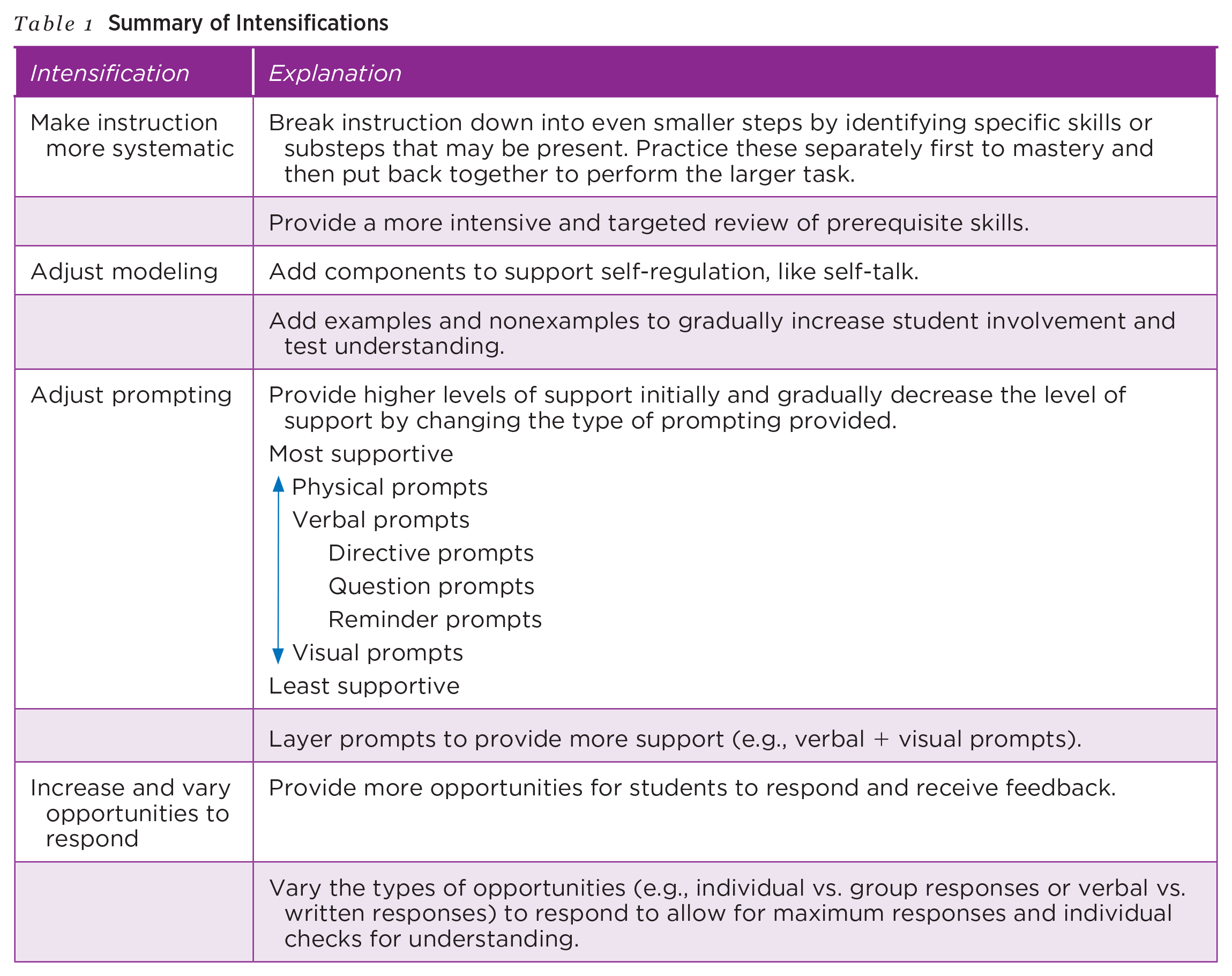
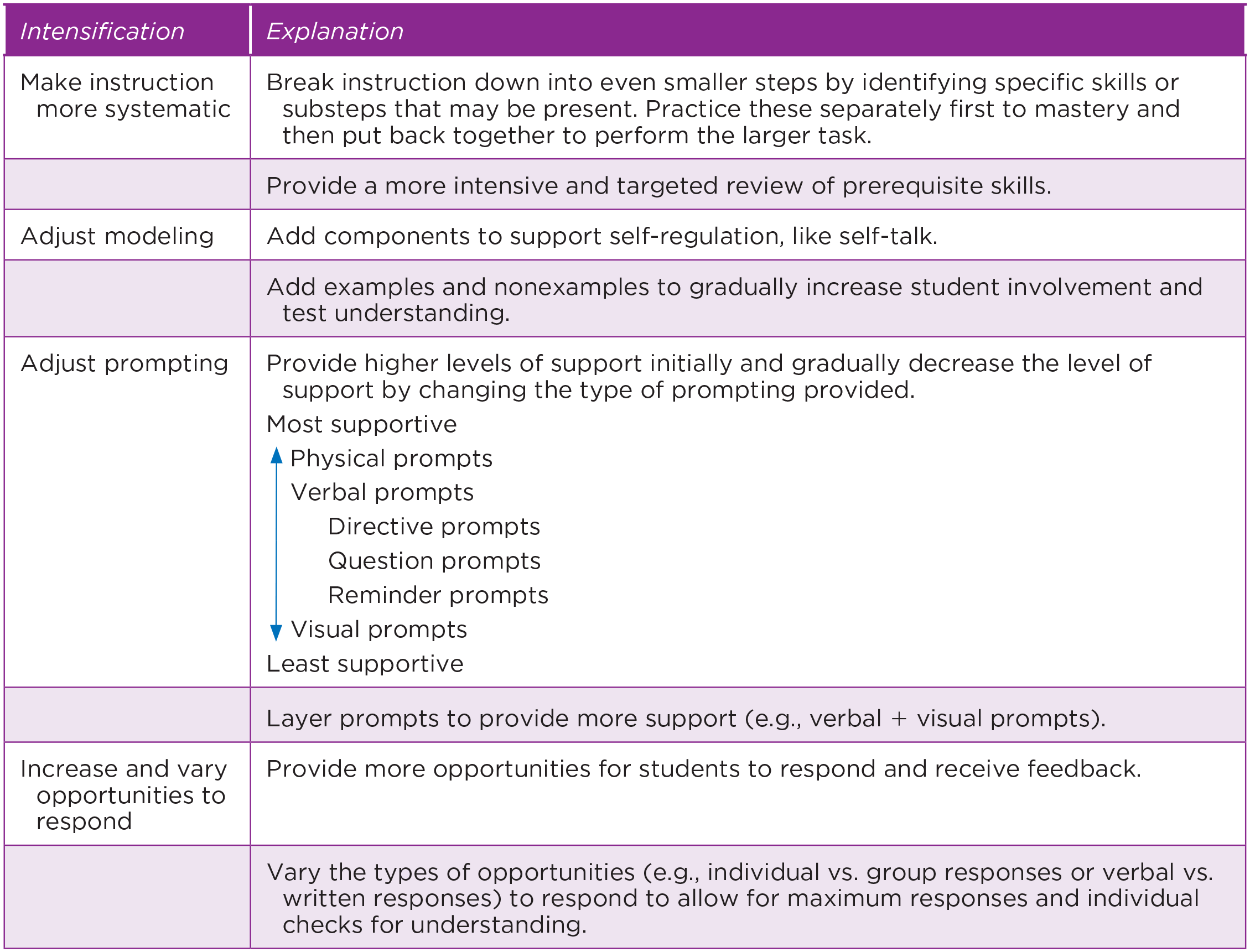
One way to intensify instruction is to make the instruction more explicit and systematic (L. S. Fuchs et al., 2018). This can be accomplished by adjusting how often the features of explicit instruction are present and also how intensively the features are delivered within an existing intervention. This approach to intensification fits within the larger system of data-based individualization (DBI). In DBI, teachers start with an evidence-based intervention targeted to student-specific needs and monitor student progress using validated progress monitoring measures; if students are not making progress, then teachers adapt the intervention to intensify it according to the specific needs of the student (Peterson et al., 2019). In the sections that follow, we explain four approaches to adapting and thus intensifying instruction by making it more explicit: adjusting the instruction to be more systematic, adjusting the modeling to include components to support cognitive processes and address student specific needs, adjusting the level of support provided by the prompting, and adjusting the opportunities for students to respond and receive feedback (see Table 1 for a summary of these approaches). We explain the details of each approach and provide examples of how Ms. Carl, a special education teacher, applies each one to adapt and intensify an existing reading intervention to make it more effective for Alexis, a fifth-grade student with intensive reading needs.
Summary of Intensifications
Although Alexis has made some progress since beginning reading intervention with Ms. Carl, her progress has been minimal, and she still has significant difficulties with many reading skills. She reads at a slower rate than most of her peers and frequently makes mistakes when reading words with more than one syllable. She also struggles to answer comprehension questions, particularly those that require her to synthesize and/or summarize information she has read. Alexis also sometimes becomes distracted during reading instruction and has difficulty applying strategies with multiple steps.
Ms. Carl monitors Alexis’s progress with her reading skills closely. Because Alexis’s intervention focuses on multiple areas of reading, Ms. Carl administers two types of progress monitoring probes weekly. To monitor Alexis’s silent reading fluency and comprehension, she administers a maze probe weekly. To monitor Alexis’s progress in word reading and decoding, she administers a nonsense word fluency probe weekly. Because Alexis’s reading skills are substantially below grade level, Ms. Carl administers third-grade-level probes to make sure the assessments will be sensitive to growth.
Ms. Carl examines Alexis’s progress monitoring graphs after the first 8 weeks of intervention. She remembers her school psychologist mentioning she can apply the four-point rule to quickly determine if Alexis is making adequate progress or if intensifications to intervention are needed. The four-point rule says if the four most recent data points are on or above the goal line, the student is making adequate progress and the intervention can be continued as planned; however, if the four most recent data points fall below the goal line, the intervention needs to be intensified to accelerate student progress (The Iris Center, 2015). Ms. Carl notes that Alexis’s progress for both of her progress monitoring measures is inadequate and her data points are falling below the goal line (see Figure 1) and knows she needs to make changes to Alexis’s intervention to help her make more progress.
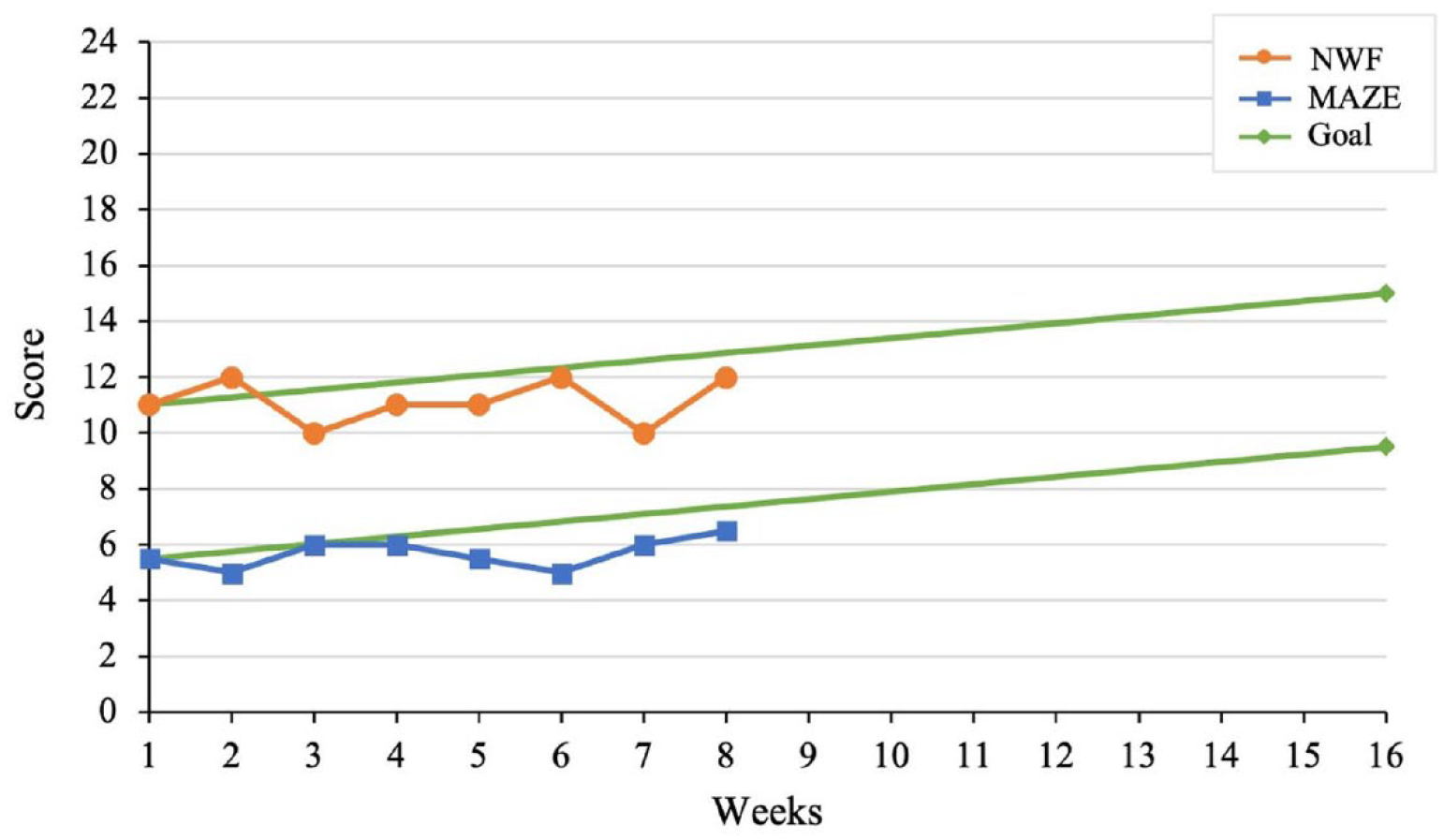
Alexis’s progress monitoring graph before intensifications
Ms. Carl recently learned about different ways to intensify her instruction for students with intensive reading needs. She knows one way she can intensify her instruction is by making it more explicit and systematic. The reading intervention she provides for Alexis is already delivered using explicit instruction; Ms. Carl is careful to model each new skill, provide supported practice, and error correct with immediate and specific feedback. However, Ms. Carl thinks Alexis would benefit from instruction that is even more explicit and systematic. Ms. Carl knows she needs to intensify Alexis’s reading instruction to help her make more progress. She also wants the adjustments she makes to match Alexis’s needs and plans to continue to monitor her progress to determine if the intensifications have made an impact on Alexis’s learning.
Making Instruction More Systematic
Explicit instruction should be systematic. This means large skills should be broken down into smaller skills, and each of these skills should be taught to mastery before the larger task is introduced. Difficulty of each of the skills should also be considered here. Easier skills should be taught before more difficult ones. In doing this, the teacher should consider prerequisite skills, or skills the student needs to know first before being able to perform the larger task. These prerequisite skills should be activated and reviewed. As a final step, the smaller skills that have been previously taught and mastered are put back together to accomplish the larger task.
Instruction can be intensified by making it more systematic (Vaughn et al., 2012). One way to do this is by breaking a task down into even smaller steps. In doing this, teachers would consider each step and identify specific skills or substeps that may be present. Then, they would break each larger step into these smaller parts, practicing each separately first until it is mastered. Then, once the individual parts of the step are mastered, teachers would put them back together to practice the step with the ultimate goal of putting all steps together to perform the larger task. Another way teachers can make instruction more systematic is to provide a more intensive and specifically targeted review of prerequisite skills according to the students’ area of difficulty. Ms. Carl integrates both of these approaches (breaking instruction down into even smaller steps and providing an intensive and targeted review of prerequisite skills) to make her instruction more intensive for Alexis.
Ms. Carl examines the comprehension instruction that she is providing in Alexis’s small group and decides that this component could be intensified to become more systematic. Ms. Carl has noticed Alexis is struggling to state the main idea after reading brief sections of a story. When asked to state the main idea after reading, instead of one brief sentence summarizing the most important parts of the story, Alexis retells everything she read, even small unimportant details. Ms. Carl thinks Alexis is having trouble identifying what should be included in a main idea statement, so she decides to break down her instruction into smaller steps: identifying the main who or what, identifying two to three important details about the main who or what, and then synthesizing those ideas in a succinct sentence summarizing the text. Over the course of a week of intervention, she focuses her instruction on one of the steps for identifying the main idea of a paragraph, identifying the main who or what. She models this step and provides many opportunities for supported practice until Alexis masters this step. Ms. Carl repeats this process with the other steps, isolating each skill and providing many opportunities for Alexis to practice before introducing the next step. After Alexis masters each step, Ms. Carl plans for multiple opportunities for Alexis to bring all the skills together again for the larger skill of identifying the main idea of a paragraph.
Ms. Carl also decides to intensify her instruction through a targeted review of prerequisite skills. She notices that Alexis has difficulties identifying main characters when specific character’s names are replaced with their respective pronouns. Ms. Carl knows this is an essential skill for creating main idea summary statements and decides to incorporate a targeted review of identifying pronouns in sample sentences. She first provides examples of pronouns to help Alexis remember words to be looking for in the sentences (e.g., “she,” “him,” “her,” “it,” “their,” “mine”). Ms. Carl then provides a few sample sentences to practice in identifying the pronoun and what or who it refers to in context. This targeted review at the beginning of instruction helps support Alexis in applying those skills when identifying the main who or what as a part of creating her main idea summary statement.
Adjusting the Modeling
Modeling is a key component of explicit instruction. Modeling includes both demonstrating the skill and also explaining what is being done (Archer & Hughes, 2011). The explanation should include a think-aloud where the teacher voices any critical internal thoughts, self-directions, or decisions that take place when completing the skill (Archer & Hughes, 2011). This should take place before students engage in practice with the skill to show how the skill can be performed successfully.
Modeling can be adjusted to make it more intensive. One way to do this is by adding components to support cognitive processes. Self-regulation is one such cognitive process. Self-regulation is the deliberate and conscious control of cognitive activities that allows students to carry out a task successfully, including planning the task, keeping track of progress throughout the task, and seeing the task to completion (Schunk & Zimmerman, 2012). Teaching strategies and applying with self-regulation processes has been shown to be effective for improving literacy skills (Graham et al., 2013; Sanders et al., 2019). Self-regulated strategy development (SRSD) is an instructional approach that uses direct teaching of self-regulation skills along with strategy instruction to improve academic performance (Graham et al., 2013). SRSD is effective for improving the writing (Graham et al., 2013) and reading comprehension skills of students with disabilities (Sanders et al., 2019).
One common tool in teaching self-regulation is the use of self-talk. Self-talk is the internal dialogue that occurs when carrying out a task. Teachers can add the use of strategic self-talk to support students’ individual needs and intensify modeling. For example, if a student is having trouble starting a task or remembering what comes next, self-talk can be added to modeling focused on how to begin a task and what to do first, second, and third. If a student is having trouble staying focused, teachers might add self-talk to modeling focused around managing competing thoughts and interests to stay engaged in the task. Finally, if a student is struggling with negative emotions associated with a task, teachers might add self-talk to modeling focused on staying motivated when feelings of discouragement or frustration occur. Ms. Carl decides to use this approach with Alexis to intensify her instruction.
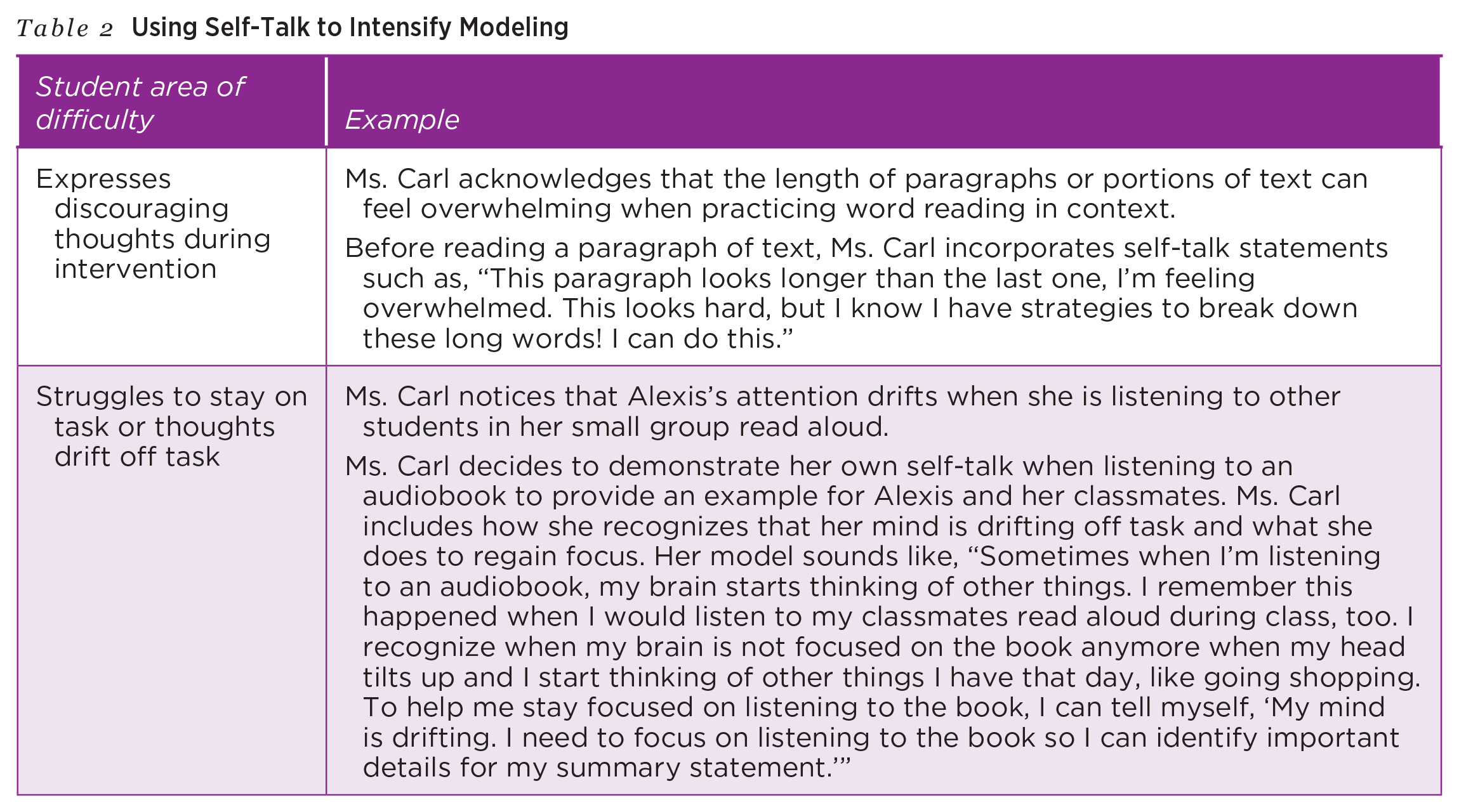
Ms. Carl thinks about the modeling she provides when identifying the main idea, and although she already provides a think-aloud, she decides to layer on modeling her own self-talk walking through the steps of compiling the important components for a main idea summary statement. She decides to incorporate phrases such as, “Now that I have read this paragraph, I need to go back and identify the main who or what of this paragraph. I can look for names of characters or frequent pronouns to help me.” These phrases serve as a reminder of the steps and keep a student focused on what he/she should be looking for in each step. Ms. Carl recognizes that Alexis struggles to remember the steps to create a main idea summary statement, and she guides Alexis in using self-talk as described. Table 2 provides other examples of self-talk that can be incorporated to intensify the intervention.
Using Self-Talk to Intensify Modeling
Another way teachers can adjust modeling to make it more intensive is to add examples and nonexamples to modeling where student involvement in the skill is gradually increased. Involving students during modeling can assist in keeping them engaged and also allows opportunities to test their understanding before they engage in practice. It should be noted that student involvement during modeling should not involve them practicing the skill; this should be done by the teacher. Rather, they can practice parts of the skills that they have already mastered as prerequisite skills or answer questions related to the steps the teacher is carrying out to perform the skill after the steps are explained. Ms. Carl applies this approach to intensify her modeling for Alexis.
Ms. Carl decides to incorporate student involvement into her explicit modeling along with her self-talk. She is careful to ensure that she is still the lead in the model. After she reads the paragraph aloud, she says, “Now that I have read this paragraph, the first step in identifying the main idea is to identify the main who or what. What is the first step?” This allows for Alexis and her peers to state the first step in the procedures for identifying the main idea. Ms. Carl continues on, “I know I can look for names of characters and pronouns like ‘he,’ ‘she,’ or ‘it’ to help me identify the main who or what. I see the name Dorothy here a few times in our paragraph. Point to the name ‘Dorothy’ in our text. Use your finger to find it in the next sentence.” This allows for active participation in recognizing the frequency of the character’s name in the text, building toward identifying the main who or what for a main idea summary statement.
Adjusting the Prompting
Guided practice is a stage in an explicit instruction lesson where the student practices the skill with teacher scaffolding (Archer & Hughes, 2011). The scaffolding ensures that the student is able to successfully perform the new skill and is gradually withdrawn until the student can perform the skill successfully on their own (Hughes et al., 2017). Many scaffolds in guided practice come in the form of prompts. There are three general types of prompts: physical prompts, verbal prompts, and visual prompts (Archer & Hughes, 2011). In physical prompts, teachers provide motor guidance in completing a task. In verbal prompts, teachers provide spoken explanations or directions to support task completion. Within verbal prompts, there are also different types of prompting: directives, where teachers tell the student what to do; questions, where teachers ask the student what to do; and reminders, where teachers remind students of what to do (Archer & Hughes, 2011). Finally, in visual prompts, written reminders or steps of a process are provided to support student practice.
These different kinds of prompts provide different levels of support (Archer & Hughes, 2011, Chapter 2). Physical and verbal prompts are more supportive than visual prompts. Within verbal prompts, directives are the most supportive and should be used when students are beginning to learn a task. Questions provide a moderate amount of support and can also be used to monitor student learning. Reminders provide the least amount of support and should be used once a student is close to being able to perform the skill independently.
Students with reading disabilities often struggle with short-term or working memory (Kudo et al., 2015), which can cause difficulties during the guided practice phase of the lesson. To support students with reading disabilities more effectively, teachers can intensify guided practice by adjusting the prompts provided during this phase of the lesson for students who are having difficulty practicing skills. This can be accomplished by adding additional prompting, for example, layering a visual prompt alongside verbal prompting. The level of support provided by the prompting can also be adjusted by changing the type of prompting provided. For example, if a student is having trouble remembering the steps to complete a task, guided practice can be started using directive verbal prompts where teachers tell students each step, one at a time, as they perform them. Another way to adjust guided practice is to adjust how the prompts are faded, fading them more gradually across a series of examples. For example, if fading from verbal to visual-only prompting is too sudden a reduction in support, verbal prompts could be gradually faded by moving from directive prompts to questions and finally to reminders before moving to visual prompts only. Ms. Carl demonstrates how this approach to intensify support can be applied in her reading comprehension instruction with Alexis.
Ms. Carl reflects on her previous instruction and thinks that the best support for Alexis would be to pair a visual support along with her verbal prompting. Ms. Carl decides to incorporate a graphic organizer to prompt and organize the components of identifying the main idea of a text. She not only models the use of the graphic organizer but also provides the opportunity for her students to practice using the graphic organizer with the next paragraph of the text. She incorporates verbal prompting to help students make the connection between the use of the graphic organizer and the steps of making a main idea summary statement. Ms. Carl is also intentional about her plan for fading the verbal support for the graphic organizer to incorporate a visual support that can scaffold Alexis’s self-regulation and move her towards independence in creating main idea summary statements. Figure 2 provides information on how prompting can be adjusted to increase support when students need more guidance in creating a main idea statement or decrease support to prepare students to perform tasks independently. The left side of the figure shows how Ms. Carl can provide high levels of support while Alexis completes the task (e.g., providing directive verbal prompts paired with the visual support of the graphic organizer). Following the arrows to the right shows how Ms. Carl can fade prompting and lessen support to move Alexis to independence. If Alexis starts to struggle when fading support, Ms. Carl can return to higher levels of support shown by following the arrows to the left.
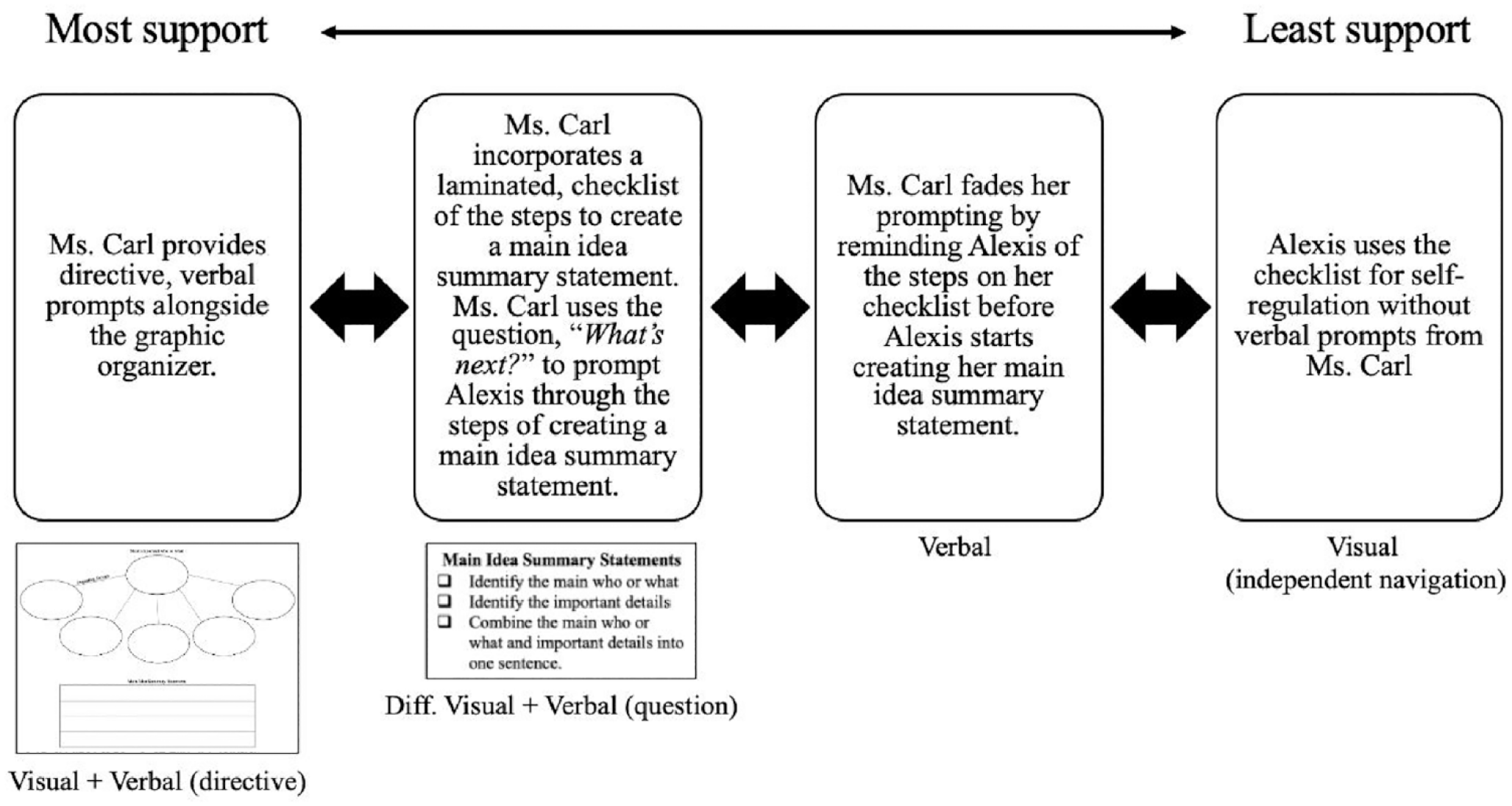
Intensifying intervention through adjustments to prompting
Provide More Opportunities to Respond and Receive Feedback
A critical component of explicit instruction is providing students many opportunities to respond and practice the skill while providing specific and timely feedback (Hughes et al., 2017). This is a critical component because student practice is necessary for learning. The practice should be provided with the appropriate amount of scaffolding to ensure it is successful. The practice can also include different modalities of responses (e.g., individual vs. group responses or oral vs. written responses). Providing multiple opportunities for students to respond also allows for teachers to gauge student understanding and make necessary adjustments, for example, adjusting the level of support provided by the prompting. Furthermore, ensuring frequent opportunities to respond during lessons encourages high student engagement in learning (Van Camp et al., 2020). Increasing opportunities to respond during reading instruction not only improves the quality of instruction but also is tied to improvements in students’ reading achievement (Fien et al., 2015).
Teachers’ feedback is also critical and should be immediate, specific, and provided appropriately for correct and incorrect responses (Archer & Hughes, 2011). “Immediate” means the feedback should be delivered instantly after the student responds. “Specific” means it should provide precise information about how the students’ response was correct or incorrect. Finally, “appropriately provided” means correct responses or correct parts of responses receive affirmative feedback, where the students receive information on what they did correctly, and incorrect responses receive corrective feedback, pointing out the error and guiding the student to the correct response.
Explicit instruction can be intensified by increasing the number of opportunities to respond while providing high-quality feedback. This approach of intensifying instruction is unique: It can increase how explicit the instruction is because providing multiple opportunities to respond is a critical feature of explicit instruction (Hughes et al., 2017). It can also intensify instruction by increasing the dosage of the intervention, similar to how increasing the length of each intervention session can provide students with more opportunities to practice the skill (L. S. Fuchs et al., 2018). Opportunities to respond can be provided in varying formats throughout the lesson. Ms. Carl intensifies her instruction with Alexis by providing more opportunities to respond and varying the type of response (individual and group responses; verbal and nonverbal responses) to increase practice for all students in her group, including Alexis, and also allows her opportunities to deliver individualized feedback.
Ms. Carl examines her instruction within the multisyllabic word reading portion of the reading intervention she uses with Alexis. She notices that although she was providing multiple opportunities for the students in her small group to respond, almost all of her opportunities were choral, verbal responses. Ms. Carl decides to plan for a mixture of verbal and nonverbal responses and also makes sure to balance individual and group responses. She incorporates individual, written responses when asking students to identify known prefixes during this portion of instruction. “Take your whiteboards and write down the prefix you see in this word. I will know you are ready when I see the back of your whiteboards.” This type of opportunity to respond adds variety to her instruction and allows for Ms. Carl to gauge individual student responses, which can provide her with the opportunity to provide more student-specific feedback. Ms. Carl also incorporates opportunities for students to talk to their partner while reviewing the known affixes as a warm-up for multisyllabic word reading. “Take turns reading our affixes for review in the box at the top here with your partner. Then, we will have a lightning round for everyone to respond. I’ll set my timer for our review.” This allows for more opportunities for students to practice the affixes they have learned within the intervention lesson.
Monitoring Student Progress
An important part of intensive intervention delivery is establishing and carrying out a progress monitoring plan. A progress monitoring plan should be established before beginning the intervention and continue to be carried out throughout intervention intensifications. Data should be graphed and evaluated throughout this process. Ms. Carl knows the importance of gathering data and objectively evaluating student progress, so she includes this as a step in evaluating Alexis’s intensified instruction.
Eight instructional weeks after implementing changes to the intervention, Ms. Carl examines Alexis’s graphed progress monitoring data to determine if the intensified intervention is effective. Ms. Carl compares Alexis’s data line to her goal line and evaluates her progress using the four-point rule. If Alexis’s four most recent data points are on or above her goal line, Ms. Carl will know the intervention is effective. If they are below the goal line, she will know additional adjustments need to be made to increase effectiveness and accelerate Alexis’s learning. Ms. Carl evaluates Alexis’s progress and notes the four most recent data points for both progress monitoring assessments (nonsense word fluency and maze) are above Alexis’s goal lines (see Figure 3). She is pleased to see Alexis’s progress and continues her intensified instruction and progress monitoring as planned to determine if more adaptations are needed in the future.
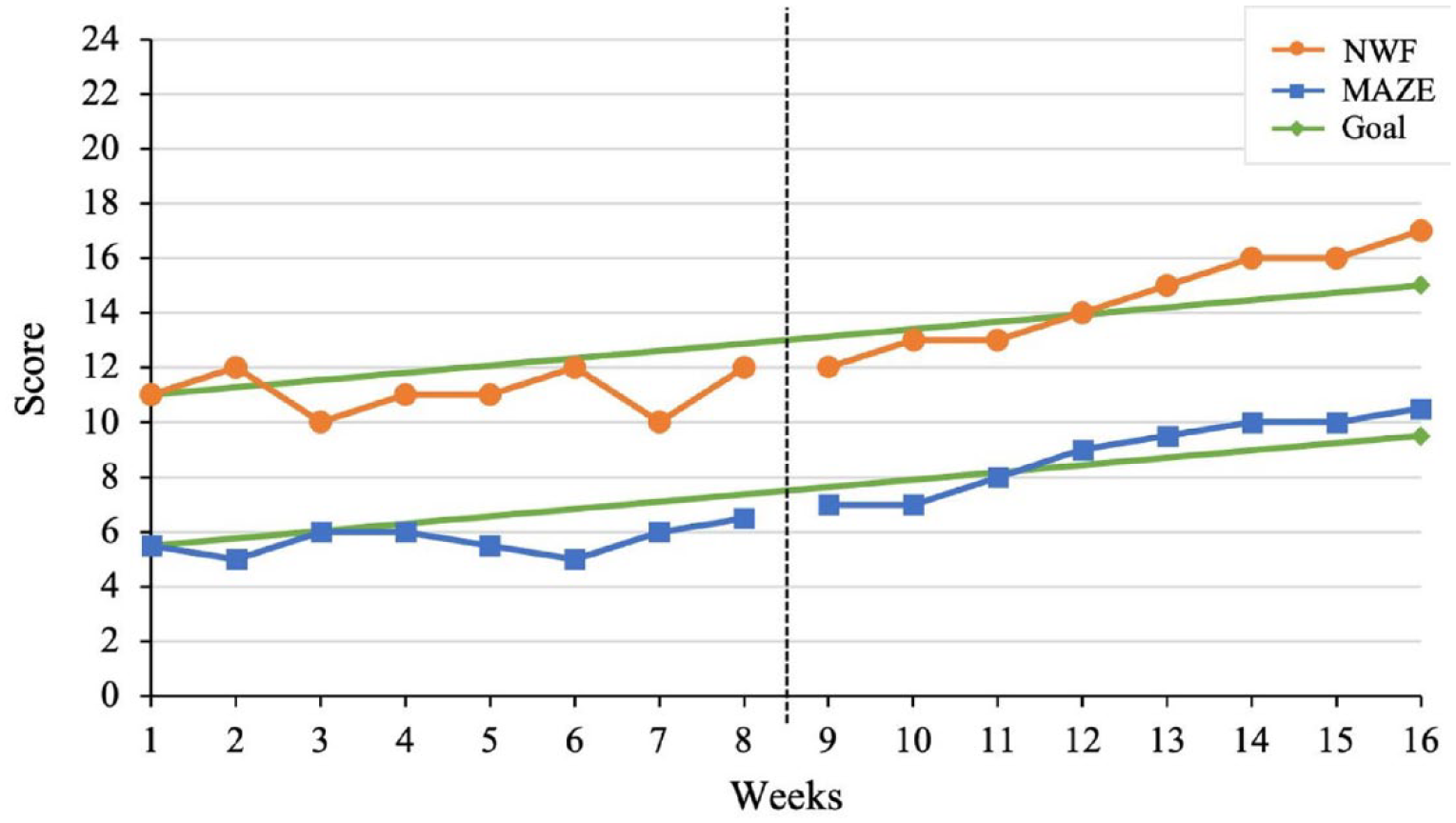
Alexis’s progress monitoring graph after intensifications.
Final Thoughts
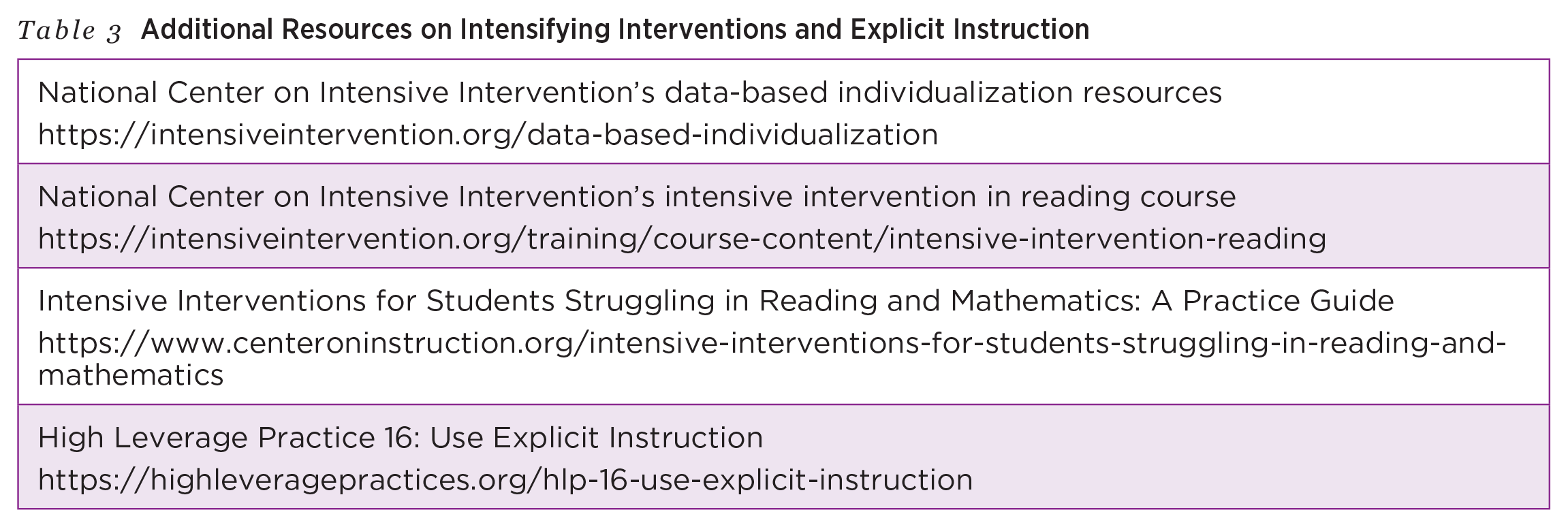
Teachers need additional ways (beyond dosage) to intensify instruction. Making instruction more explicit is one way to adapt instruction to make it more effective for students with intensive needs. In the taxonomy of intervention intensity, L. S. Fuchs et al. (2018) summarized four other ways to adapt instruction, including quantitative adjustments (i.e., dosage) and qualitative adjustments (i.e., alignment, attention to transfer, and behavioral support). We recommend their article and the resources available through the National Center on Intensive Intervention (https://intensiveintervention.org/training/course-content) for individuals who would like to learn more about different approaches to intensifying instruction.
Intervention adaptations, such as making instruction more explicit, are embedded within a larger system of DBI. DBI is a problem-solving process for intensifying interventions through the systematic use of data and intervention adaptations that has been shown effective for improving students outcomes across academic areas (Jung et al., 2018). We recommend the resources available through the National Center on Intensive Intervention for teachers who would like to learn more about DBI (https://intensiveintervention.org/data-based-individualization). This and other recommended resources on intensifying interventions and explicit instruction are listed in Table 3.
Additional Resources on Intensifying Interventions and Explicit Instruction
Footnotes
Declaration Of Conflicting Interests
The authors declared no potential conflicts of interest with respect to the research, authorship, and/or publication of this article.
Funding
The authors received no financial support for the research, authorship, and/or publication of this article.
