



Abstract
Solving mathematics word problems requires skills from multiple domains, including efficient word-decoding skills, text comprehension, problem solving, and arithmetic. Word problems can be especially difficult for students with dyslexia (i.e., word-level reading disability), causing frustration for students and teachers. This article discusses the complex process of solving word problems and outlines four strategies for supporting the co-development of skills in word-problem solving and reading for students with dyslexia: (a) adapt word problems for readability and support word reading; (b) teach students to recognize word-problem types; (c) explicitly teach word-problem specific vocabulary; and (d) integrate writing through student-generated word problems.

Ms. Worley is a second-grade teacher beginning a unit on mathematics word problems. Recently, several of her students were identified as having dyslexia. After distributing a set of word problems to her class, she sits next to one of these students, Edgar. Immediately, Edgar scans the word problem for numbers and begins adding. She asks him to pause and reminds him that before solving a word problem, you have to read it. At this point, she notices that the word problem has several multisyllabic words and various digraphs (e.g., /sh/ and /th/). Ms. Worley is confident in supporting her students with dyslexia during reading instruction but is less sure of how to support these students during math instruction. She knows that she could read the word problem to Edgar but would rather use word problems as an opportunity to support the codevelopment of reading and word-problem solving.
It is entirely reasonable to feel unsure of how to support students with dyslexia in solving mathematics word problems. Mathematics difficulties often co-occur with reading disabilities (Willcutt et al., 2013), and the nature of word problems can make them a particularly difficult challenge for students with dyslexia. Word problems require orchestrating multiple skills and knowledge sources in mathematics, reading, and linguistic comprehension. To better understand the complexity of solving word problems, consider the problem model strategy outlined by Mayer and Hegarty (1996).
In this model, students work through four processing phases (see Figure 1) in solving a word problem. The first phase is translation. Students read the word problem, processing it in increments. With each piece of information read, students formulate and adjust a mental representation of the word problem. The next phase is integration. Students focus on the object of the problem, determining what in the story is being manipulated. Then, students integrate the relevant information into a mathematical representation. Students might determine what operation is occurring in the problem or draw a visual illustrating how the numbers in the problem are related to one another. Students may cycle between the translation and integration phases, rereading the word problem or referring back to specific sentences several times before moving into the planning phase. In the planning phase, students construct an equation to solve for the unknown. In the execution phase, students solve the equation using the relevant operation.
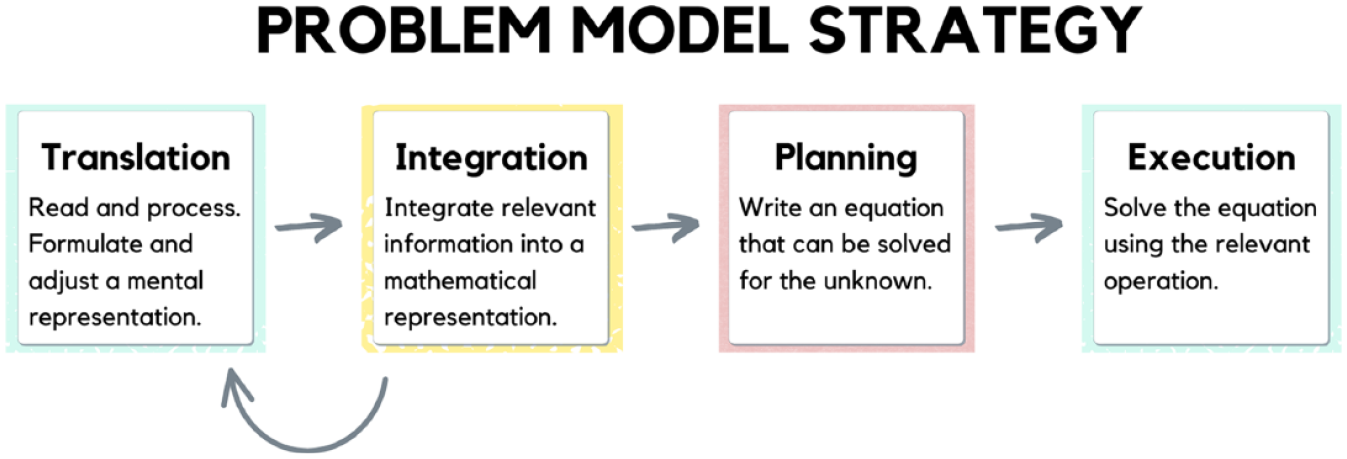
Problem model strategy (Mayer & Hegarty, 1996)
If you have ever felt frustrated with how word problems are progressing in your classroom, remember the complexity of the task at hand. Solving word problems is a multifaceted process for all students, and when students are expected to read word problems (as in most situations), students with dyslexia face an added challenge.
Deeper Dive Into the Demands of Word Problems
Upon being presented with a word problem, the first step is to comprehend the sentences of the problem. Accurate and efficient word reading is an essential skill that makes reading comprehension possible (Gough & Tunmer, 1986; Jenkins et al., 2003). Reading words accurately allows them to be connected to meanings. When students can read words with minimal effort (i.e., “automaticity”), their cognitive recourses can be dedicated to understanding the text and integrating the relevant information into a mathematical representation. Strong decoding skills contribute to improved comprehension, and improved comprehension contributes to word-problem proficiency (Vilenius-Tuohimaa et al., 2008).
In contrast, word meanings are not properly activated when word reading is inaccurate. When significant cognitive energy must be devoted to laboriously decoding words, reading comprehension may be significantly obstructed. Inaccuracy and inefficiency in reading words are hallmark characteristics of dyslexia (Lyon et al., 2003). Thus, considering Mayer and Hegarty’s (1996) model, many students with dyslexia may not successfully move past the translation phase if they cannot accurately read the words in the problem.
Even when reading word problems aloud to students, word problems require oral language comprehension skills (Fuchs et al., 2020). Understanding the sentences in word problems requires discernment of key ideas, inferencing, and vocabulary knowledge (Oakhill & Cain, 2017). Additionally, knowledge of word-problem-specific vocabulary has been found to mediate the effects of word-problem interventions (Chan & Kwan, 2021; Fuchs et al., 2020). These linguistic comprehension skills and knowledge sources are required whether students read the word problem or if the teacher reads them aloud.
In addition to comprehending the text of a word problem, students must integrate the relevant information into a mathematical representation and construct an accurate equation. Moreover, once students have written an equation that, when solved, will reveal the unknown value, they must have sufficient arithmetic skills to reach the answer. On the surface, it may seem that arithmetic is the most important factor related to solving word problems. However, research has shown that although necessary, instruction on arithmetic alone is insufficient (Powell et al., 2020). Thus, in addition to instruction in arithmetic, teachers should model how to understand word problems, transfigure them into mathematical representations (mentally or with visuals), and construct accurate equations (Fuchs, Bucka, et al., 2021). Next, we describe four strategies to support students with dyslexia in this process.
Strategy 1: Adapt Word Problems for Readability and Support Word Reading
Improvement in both reading proficiency and word-problem solving requires frequent practice and considerations of how to support skills in both domains. First and foremost, it is essential that students with dyslexia receive explicit phonics instruction. Explicit phonics instruction involves directly teaching and modeling how to segment and blend phonemes, associating printed letters and letter combinations with sounds, and using this information to read and spell words (Ehri, 2020). Effective reading instruction also involves extensive practice reading words and text with the support of a teacher who provides immediate affirmative and corrective feedback.
Reading word problems aloud while students follow along can be viewed as a support while their reading skills are developing. However, it is possible to support the codevelopment of students’ word-problem solving and word-reading skills. One way is to adapt word problems for readability by making them more decodable. Decodable texts contain a high proportion of words that are phonetically “regular” (i.e., words in which letters make their most common sounds) or words with features previously taught through phonics instruction (Cheatham & Allor, 2012). Decodable texts allow students to apply their emerging knowledge of spelling-sound correspondences to read more words accurately.
Word problems can be written using words that students are likely to be able to decode given their current stage of phonics instruction. Alternatively, existing word problems can be edited to swap out phonetically complex words with decodable alternatives (for an example, see Figure 2). It may not be practical to rewrite every word problem your students with dyslexia encounter, but when possible, this modification will likely benefit both students’ reading development and word-problem solving. You may focus on rewriting word problems that you model solving, making it possible to demonstrate and engage your students in sounding out words with particular spelling patterns. Or, you may focus on rewriting word problems that students are expected to solve independently, thus increasing their capacity to read the word problems themselves.
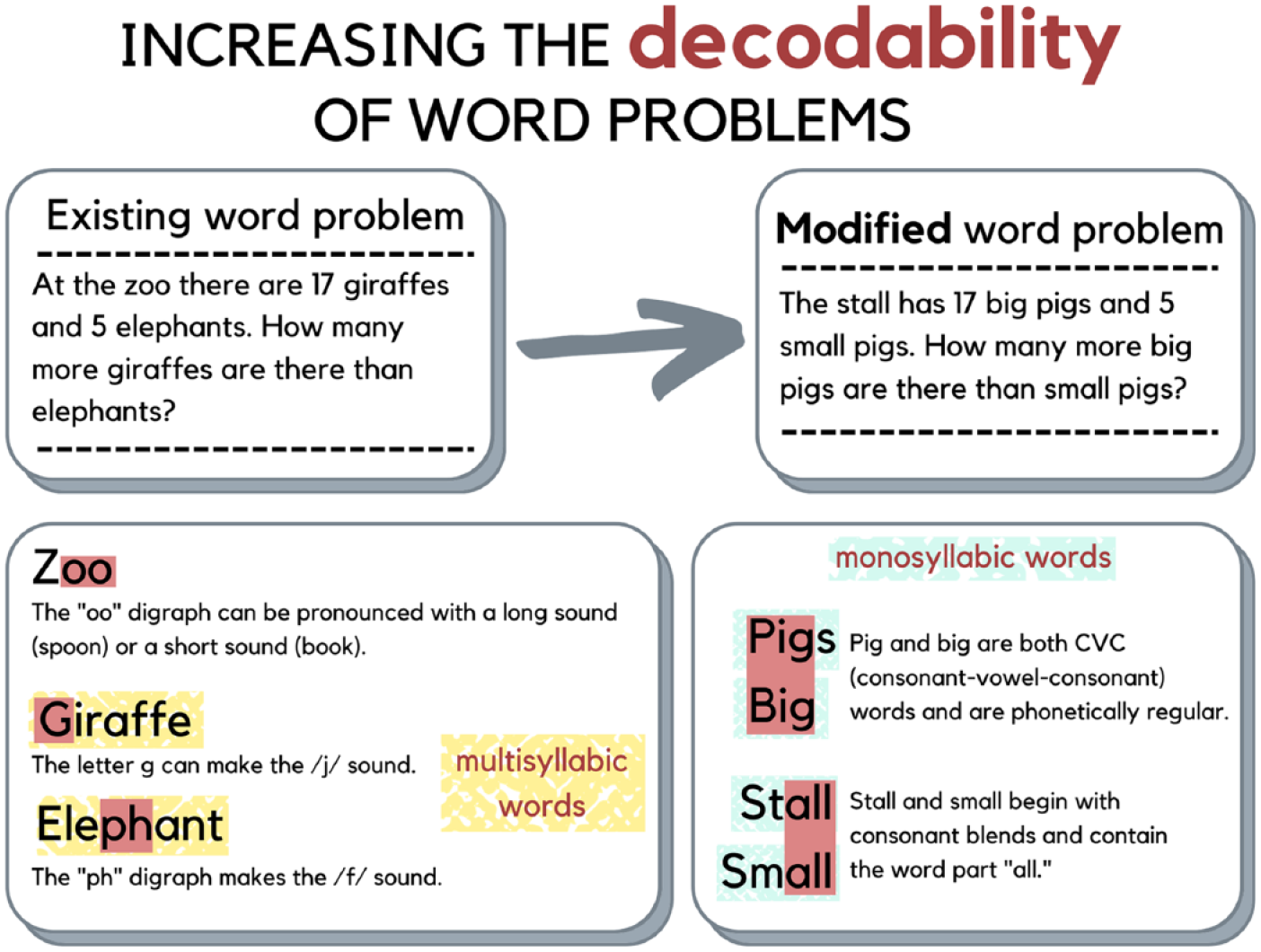
Example of adjusting an existing word problem to be more decodable
Later that week, Ms. Worley sat down with her teammates to lesson plan for the following week. During phonics time, their students will be learning about r-controlled vowels (e.g., st
When students can accurately decode the words of a word problem independently, they can devote more cognitive resources to comprehension. As previously mentioned, students often reread word problems, or parts of them, to fully comprehend the scenarios and formulate mathematical representations. In contrast, when students cannot independently decode many of the words, their ability to refer back to the word problem is limited, thus hindering comprehension and word-problem solving. Moreover, word problems that are mostly decodable can allow students with dyslexia to solve more word problems within a given timeframe (given that they will spend less time laboring over the words).
Ultimately, even if the text in word problems is made more accessible, students with dyslexia are still likely to make reading errors. Errors may include mispronunciations, skipped words, or words the student struggles to sound out. How teachers respond in these instances can help support the codevelopment of their reading and word-problem solving skills.
The first thing to remember is to correct reading errors as soon as they occur. Immediately correcting errors helps maintain cohesion in students’ comprehension and reinforces the importance of accurate reading. In the context of word problems, it may be most efficient for the teacher to provide a word that a student mispronounces, struggles to decode, or skips. Providing a challenging word is recommended when a word exceeds the student’s current decoding skills, given its length, complexity, or unfamiliar letter patterns.
Other times, it can be helpful to reinforce students’ decoding skills by prompting them to rely on their knowledge of letter-sound correspondence to “sound out” and blend words. These situations may be when the word is within the student’s skill range, meaning that it is a word they have seen before or they know the letter sounds contained in the word. Teachers can provide sounds to letters that students miss or model how to sound out the word and blend the sounds back together. Sometimes, the blended sounds in a word may not result in its correct pronunciation, in which case, the teacher can model adjusting the pronunciation to match a word in the student’s oral vocabulary.
Finally, in addition to correcting word reading errors, teachers of students with dyslexia should provide frequent affirmative feedback that recognizes when students read words correctly. Affirmative feedback helps bond word spellings to pronunciations in students’ memory, and it is especially important when students are unsure of their pronunciation or when they read a new or challenging word.
In summary, teachers can adapt word problems for readability and support students’ reading skills in the following ways:
• Correct reading errors as soon as they occur.
• When a word exceeds a student’s current decoding skills, you might provide the word.
• In other instances, you might prompt the student to sound out the word and blend the sounds together.
• If the blended sounds do not result in the correct pronunciation, model how to adjust the pronunciation.
• Provide frequent affirmative feedback when students read words correctly.
These efforts support students in accessing the text and comprehending the scenario in a word problem, which are the first steps in being able to solve it accurately. Moreover, prompting and modeling sounding out within mathematics instructional time can reinforce students’ generalization of decoding skills beyond reading intervention. Our recommendation to adapt the decodability of word problems is meant as a scaffold to be used when it is feasible. Ultimately, students with dyslexia will encounter word problems that are difficult to read independently. This underscores the importance of implementing explicit phonics instruction and intensifying this instruction through increased practice opportunities.
Strategy 2: Teach Students to Recognize Word-Problem Types
One-step word problems that require addition or subtraction are categorized into three problem types, also called “schemas”: total, change, or difference. In total problems, parts are combined into a total. In change problems, a starting amount increases or decreases to a new amount. In difference problems, a greater amount is compared with a lesser amount. At first glance, understanding schemas may only seem necessary for developing curricula, not information that should be transparent to students. However, students benefit from this explicit instruction (Jitendra et al., 2021; Peltier & Vannest, 2017). As illustrated in Figure 3, each schema is linked to a specific problem-solving strategy. Teaching students to recognize word problems by schema aids comprehension and improves problem-solving accuracy. Within Mayer and Hegarty’s (1996) model, schemas are equivocal with the mathematical representations that students must form to transition into the planning phase.
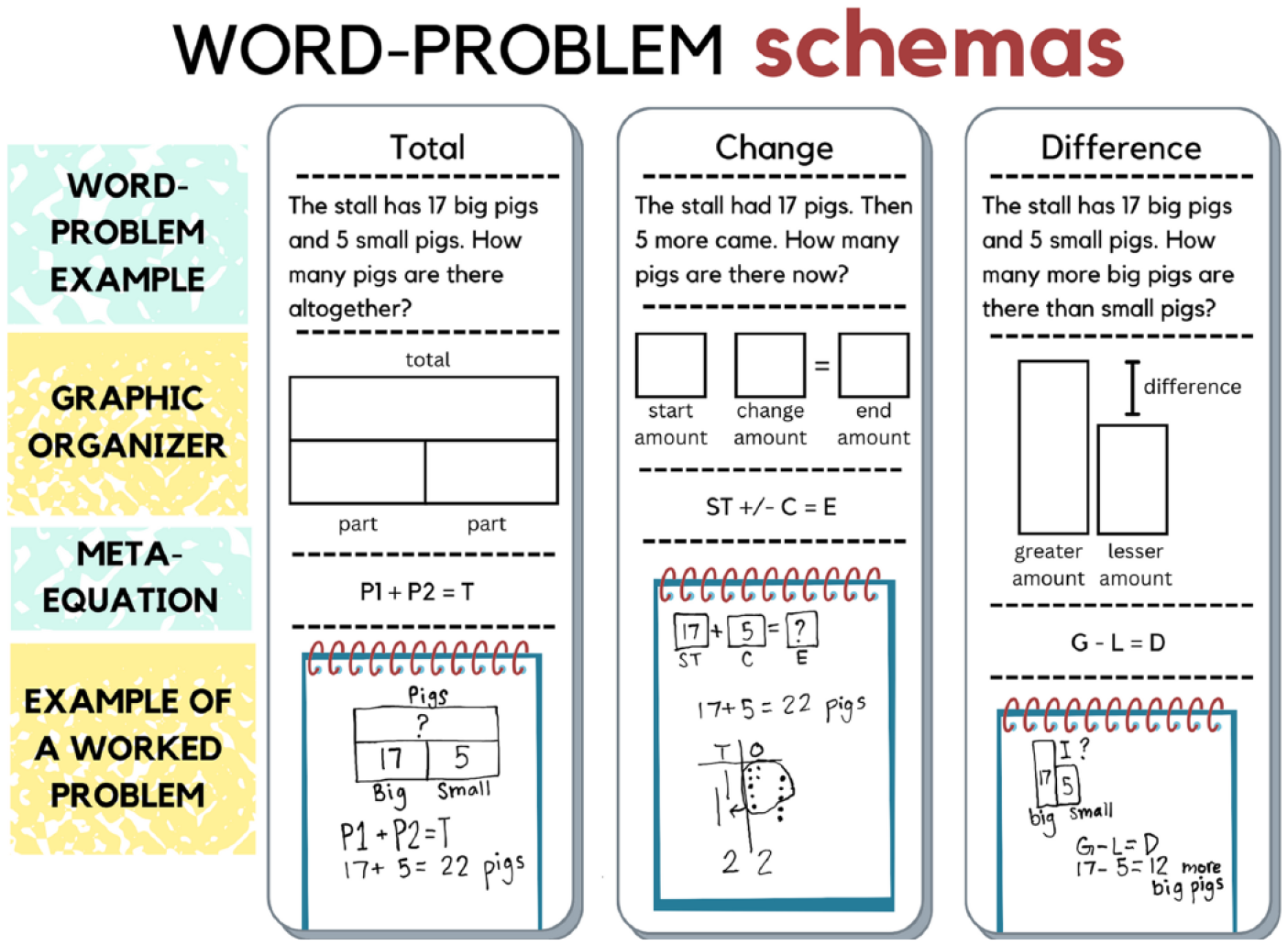
Schema examples, graphic organizers, and meta-equations
Students with dyslexia may particularly benefit from learning to identify word problems by their schema. Because not all word problems can be adapted for readability (e.g., word problems on standardized assessments), students may either ask word problems to be read aloud to them or spend a considerable amount of time decoding the words. In either scenario, students will have a limited ability to reread or go back to reference the sentences in the word problem. If students with dyslexia learn to identify the underlying structure (i.e., schema) of word problems, they can form mathematical representations more easily.
It is essential to introduce schemas sequentially and provide sufficient time to identify and solve problems of that type before introducing another (Powell, 2011). Typically, teachers model a single schema and practice that schema for several sessions before introducing another schema. Then, when introducing a second or third schema, actively practice discrimination between schemas with students (e.g., this is a total problem because . . . ; this is a change problem because . . . ).
Often, schema instruction is paired with an “attack strategy,” a heuristic that guides students through specific problem-solving steps. Word-problem attack strategies should always begin with reading the word problem and include a prompt for students to determine the schema. For example, you could teach students to RUN through the problem:
After drawing the appropriate graphic organizer, students carefully determine where to place the values from the word problem and draw a question mark (or other representation of an unknown) to represent the unknown value. You might teach graphic organizers in tandem with meta-equations, which help students transform mathematical representations of word problems into equations (Arsenault & Powell, 2022). Once students have completed the graphic organizer, they write the appropriate meta-equation (see Figure 3). Using both the graphic organizer and meta-equation as aids, students write an equation to solve for the unknown.
An added complexity of word problems is the position of the unknown (Arsenault & Powell, 2022). Consider this word problem: “There are 13 fish in the tank. 5 of them are guppies, and the rest are goldfish. How many goldfish are there?” This is a total problem because parts (guppies and goldfish) are combined into a total (the total fish in the tank). Students would draw the total graphic organizer, write the total number of fish as 18, and write that 5 of the fish are guppies. The meta-equation for total problems is P1 + P2 = T (Part 1 plus Part 2 equals the Total). Therefore, 5 + ? = 18. In this total problem, one of the parts is unknown.
In change problems, a starting amount increases or decreases to a new amount. Here is an example: “There were 12 birds in the tree. Some birds flew away. Now, there are 3 birds left in the tree. How many birds flew away?” For change problems, the meta-equation is ST ± C = E (the STarting amount, plus or minus the Change amount, equals the End amount). In this example, the birds in the tree decrease, and the change amount is unknown. Therefore, 12 – ? = 3.
Consider the word problem: “The store has 18 blue hats and 9 green hats. How many more blue hats are there than green hats?” This is a difference problem because a greater amount is being compared with a lesser amount. Students would draw the difference graphic organizer, writing 18 as the greater amount, 9 as the lesser amount, and a question mark to represent the difference. For difference problems, the meta-equation is G – L = D (the Greater amount minus the Lesser amount equals the Difference). Thus, G – L = D becomes 18 – 9 = ?
Next, Ms. Worley decides to map out the remaining 4 weeks of the unit on word problems. Having recently learned about schema instruction during professional development, she structures this unit differently than in the past. First, she will introduce total problems. For a week, students will practice solving total problems and determining whether the total or one of the parts is unknown. The next week, she will introduce change problems. Students will practice identifying and solving change problems, determining whether the amount in the story is increasing or decreasing and what value is unknown. Throughout the week, students will continue solving total problems and learn to differentiate between total and change problems. During the third week, Ms. Worley will introduce difference problems. Students will practice identifying and solving for the greater amount, the lesser amount, or the difference. Finally, the fourth week of the unit will include all three schemas, with an intensive focus on differentiating between them.
For additional information on teaching students to solve word problems using schemas, see the TEACHING Exceptional Children article by Powell and Fuchs (2018).
Strategy 3: Explicitly Teach Word-Problem Specific Vocabulary
Vocabulary knowledge plays an important role in the comprehension of word problems (Chan & Kwan, 2021; Fuchs et al., 2020). Although linguistic comprehension is often viewed as a relative strength for students with dyslexia compared to their decoding difficulties (Wagner et al., 2020), there will still be many students with dyslexia who lack familiarity with vocabulary terms and phrases used in academic subjects, like mathematics. Additionally, because reading is a major source of new vocabulary, students with dyslexia can have underdeveloped vocabulary knowledge.
First, it is crucial to differentiate vocabulary instruction from the problematic keywords strategy. In pursuit of helping students experience success with word problems, students are sometimes taught to look for “keywords” (i.e., words that mean to add or words that mean to subtract). This strategy may seem effective in the short term but should be avoided. When students are taught to look for keywords tied to specific operations (e.g., “in all” as a cue to add), they often avoid reading word problems in their entirety and do not form adequate mental representations. Moreover, this strategy is generally ineffective (Karp et al., 2019). Powell et al. (2022) determined that using the keywords strategy for one-step word problems is unsuccessful 50% of the time. For multistep word problems, the success rate drops to less than 10%. Teaching students to use keywords will not lead to long-term success with word problems.
Instead of teaching keywords, embed explicit vocabulary instruction within schema instruction (e.g., Fuchs, Seethaler, et al., 202l; Root & Browder, 2019; Stevens et al., 2023). Provide “student-friendly” definitions of terms and incorporate frequent opportunities for students to practice using them in context (Beck et al., 2013; Lin et al., 2021). First, you might prioritize teaching the meaning of terms and phrases related to general word-problem solving (e.g., word problem, schema, unknown; see Figure 4). When students understand the language related to word-problem solving, they will be better equipped to explain their thinking and engage in discussions about word problems. Next, teach the essential vocabulary associated with each schema (see Figure 4).
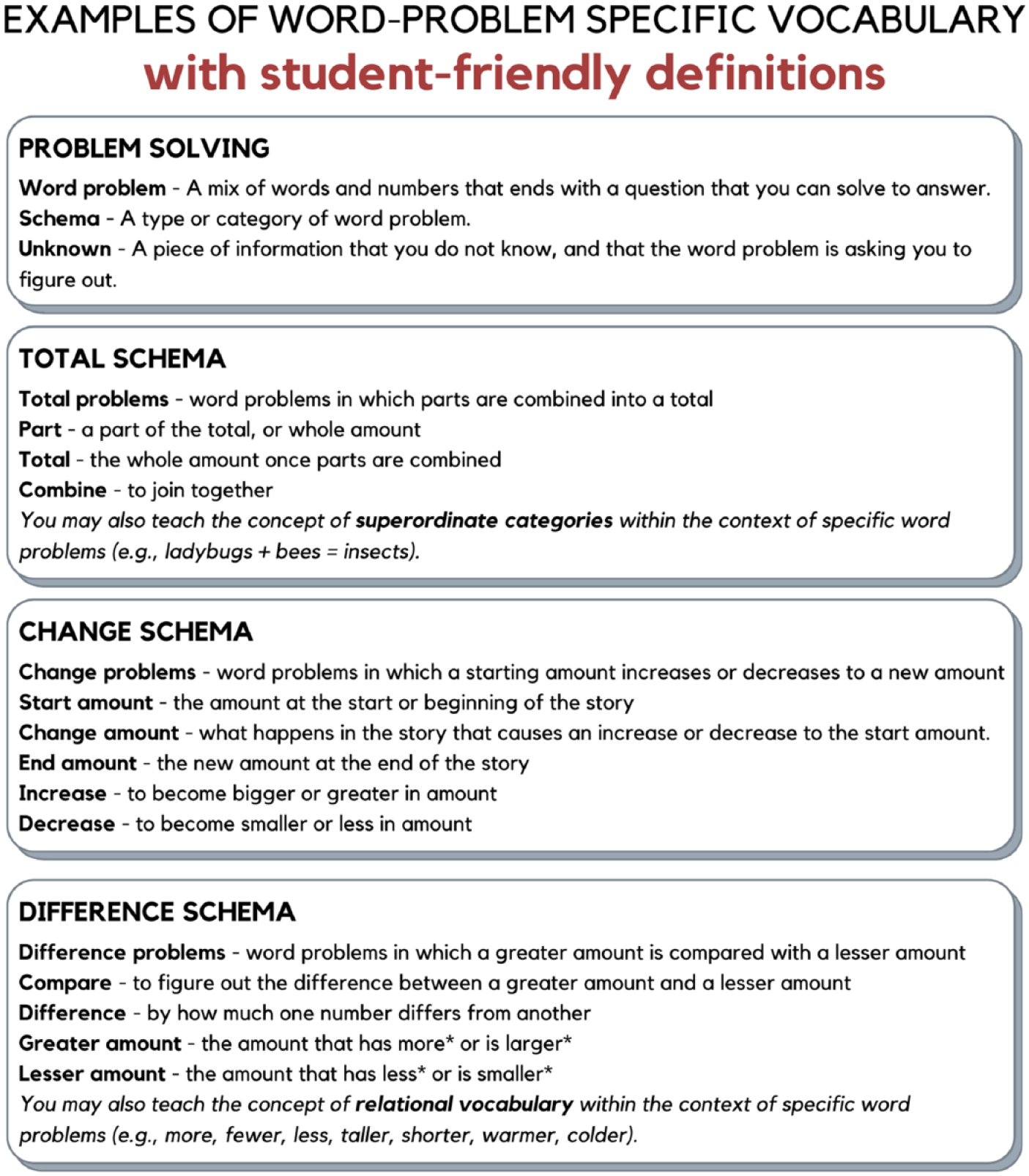
Examples of word-problem specific vocabulary with student-friendly definitions
When introducing total problems (i.e., word problems in which parts are combined into a total), prompt students to discuss total problems using the terms “part,” “combine,” and “total.” Consider the total problem: “The bakery has 35 muffins. 18 are blueberry muffins, and the rest are chocolate chip. How many chocolate chip muffins are there?” Students should be able to explain that there are 35 total muffins. Part of the muffins are blueberry muffins, and part of the muffins are chocolate chip muffins. In this word problem, one part is unknown. Moreover, when students are solving total problems, you may need to teach students to recognize superordinate categories (i.e., topics that can be broken into categories). For example, if a word problem states that there are “7 ladybugs and 4 bees” and then asks, “How many insects there are?” students will need to understand that “insects” means ladybugs and bees.
When introducing difference problems (i.e., word problems in which a greater amount is compared with a lesser amount), students must understand the terms “compare,” “difference,” “greater amount,” and “lesser amount.” Students must also understand relational vocabulary (i.e., “more,” “fewer,” “less,” and words such as “taller,” “shorter,” “warmer,” or “colder”). Consider the difference problem: “It was 78 degrees on Monday and 84 degrees on Tuesday. How much warmer was it on Tuesday?” Students need to recognize that in this context, the word “warmer” refers to the temperature difference between Monday and Tuesday. Therefore, the greater amount is the temperature on Tuesday, the lesser amount is the temperature on Monday, and the difference is what is unknown.
When introducing change problems (i.e., word problems in which a starting amount increases or decreases to a new amount), students must understand the terms “increase,” “decrease,” “start amount,” “change amount,” and “end amount.” Consider the change problem: “Ricky went to the mall. After buying a new football for $17, he had $3 left. How much money did he bring to the mall?” Students should be able to explain that the start amount is the money that Ricky brought to the mall. His money decreased after he bought the football. The change amount (i.e., how much he spent on the football) is $17, and the end amount is the $3 he had left. In this change problem, the start amount is unknown.
Depending on the linguistic complexity of the word problem at hand combined with the unique vocabulary knowledge of your students, word problems provide unique opportunities to enrich students’ vocabulary knowledge. During or after having a student read a word problem aloud, you might probe the student’s knowledge of a potentially unfamiliar term. When discussing terms, do not tie operations to them. Instead, provide simple definitions and additional contexts (e.g., “How many fewer?” is asking “How many less?” Let’s practice. How many fewer pencils do I have than pens?”). Research suggests that referring to word meanings as students read new words improves the vocabulary knowledge and word-reading skills of students with dyslexia (Austin et al., 2022). This underscores the value of frequently referring to the meaning of new words and how they are used in word-problem contexts.
During small-group time, Ms. Worley pulls Edgar and several other students to solve the following word problem: “Marcus picked 62 vegetables from his garden. 14 of them were peppers, and the rest were carrots. How many carrots did Marcus pick?” First, she has the students write down the attack strategy RUN (i.e., read the word problem, underline the question, and name the problem type; Fuchs et al., 2014). Next, she draws her students’ attention to several words with r-controlled vowels (i.e., Marcus, garden, peppers, and carrots). She leads her students through a choral reading of the word problem and models how to segment and blend the sounds of the word “vegetables.” Her students underline the label “carrots.” Now, the students need to “name the problem type.” Edgar shares that he thinks the problem is a total problem, and Ms. Worley encourages the group to explain their reasoning through questioning. “What makes this problem a total problem?”
“Are parts put together into a total?”
“Are peppers vegetables? What about carrots? So, peppers and carrots are combined into the total vegetables.”
“What is unknown in this word problem? The total or one of the parts? How do you know?”
Strategy 4: Integrate Writing Through Student-Generated Word Problems
Students with dyslexia often experience difficulties in writing (Hebert et al., 2018). Spelling difficulties, a hallmark of dyslexia, negatively affect the quantity and quality of students’ writing output. Reading experience also influences writing skills (Hayes, 1996) because students learn new background knowledge, vocabulary, syntax familiarity, sentence structures, and text organization through reading. Studies indicate that spelling and writing instruction can improve reading skills for developing readers and students with dyslexia (Graham & Hebert, 2010; Graham & Santangelo, 2014). Therefore, integrating writing through student-generated word problems is another way to support the codevelopment of reading and word-problem solving.
To further solidify students’ understanding of the different schemas, consider having students write their own total, change, and difference problems (Wang et al., 2022). Teach students to plan their word problems before they begin writing them, just as we encourage students to engage in prewriting activities before writing (Graham et al., 2012). For example, after introducing students to total problems and their accompanying graphic organizer, students can begin planning their own total problem. To begin, have students draw the total graphic organizer. This presents an additional opportunity to review the concept of superordinate categories (e.g., cats + dogs = pets). Prompt students to think of any topic that can be broken into categories. For example, students could choose ice cream (chocolate or vanilla), books (fiction or nonfiction), or toys (plushies or fidget spinners). Once these components have been chosen, students will label the total with the topic (e.g., ice cream) and the parts with the categories (e.g., chocolate and vanilla).
Once students have labeled their graphic organizer with the components of their word problem, they will generate appropriate numbers and decide which amount is to be unknown. From there, students write the word problem using the graphic organizer as a guide. For example, if a student wrote a “?” for the total ice cream, “6” for the chocolate ice cream, and “6” for the vanilla ice cream, they might write, “I have 6 scoops of chocolate ice cream and 6 scoops of vanilla ice cream. How many scoops of ice cream do I have?” (see Figure 5 for a visual example). In summary, students can follow these steps when writing their own word problems:
Draw the related graphic organizer.
Decide on a topic for your word problem and label the graphic organizer accordingly.
Generate appropriate numbers and mark what information will be unknown.
Write a word problem that matches your completed graphic organizer.
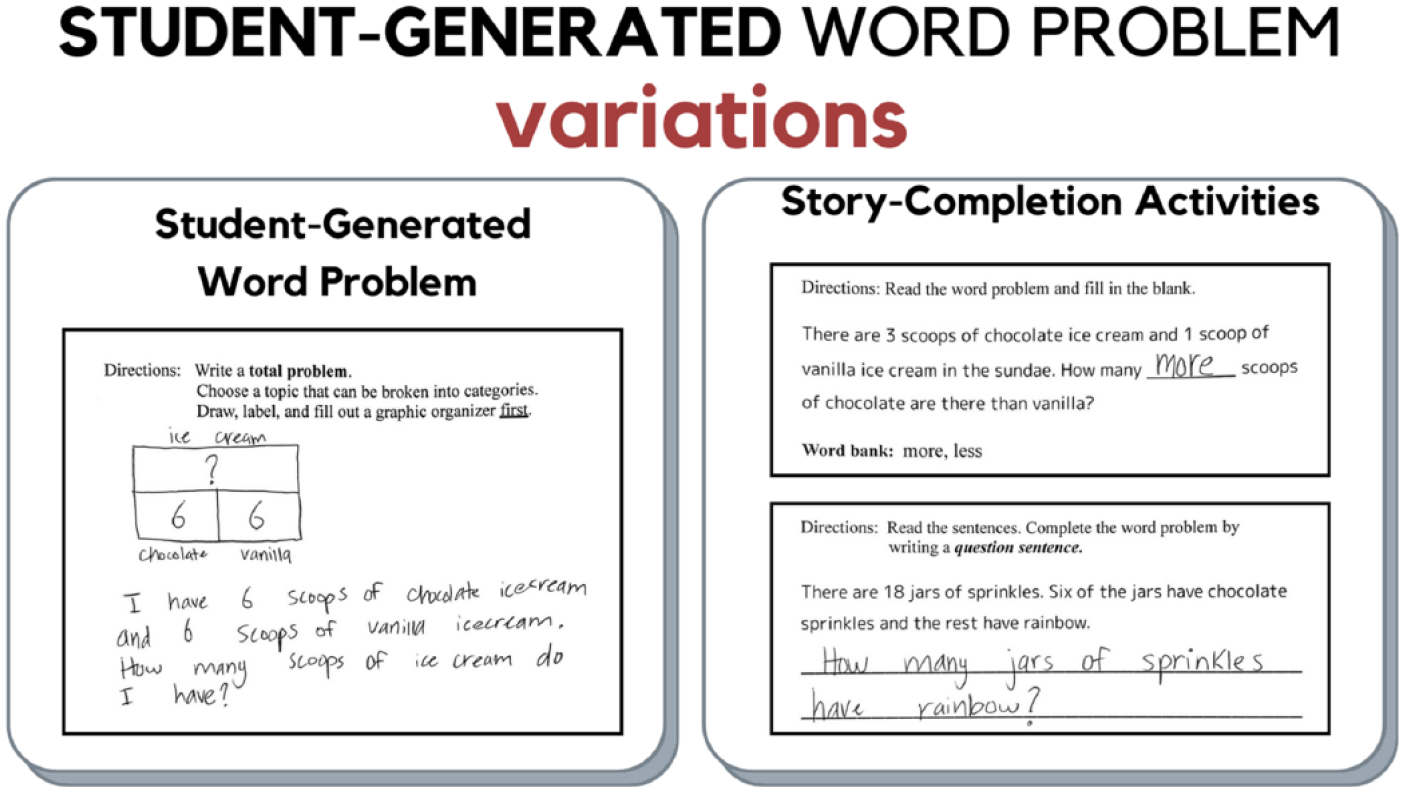
Student-generated word problem variations
When first introducing student-generated word problems, provide explicit instruction on each step of the process and model several examples from beginning to end. Next, provide guided practice opportunities in which students are given immediate feedback and have access to exemplars. Provide students with the appropriate level of scaffolding depending on their experience with generating word problems, comfortability with the selected schema, and writing proficiency. Support their spelling; encourage students to spell words based on their knowledge of letter sounds and spelling patterns, help students segment words orally to represent them with letters, and provide affirmative and corrective feedback. When an additional level of scaffolding is needed, provide students with sentence stems.
Another modification for student-generated word problems is story-completion activities. Story-completion activities can range from providing students with a partially complete word problem in which they fill in blanks (with or without a word bank) to word problems missing the question sentence (Arsenault & Powell, 2022; see Figure 5). This is another way to provide students with dyslexia additional opportunities to interact with word spellings. As students generate their own word problems, it is crucial to maintain a connection with solving word problems. Upon generating a word problem, students should be able to explain its schema and how to solve it.
After introducing difference problems, Ms. Worley noticed her students were having a difficult time differentiating between total and difference problems. To address this, she decided to implement a story-completion activity. First, Mrs. Worley displayed and read the following scenario aloud: “During lunch, 13 of Ms. Worley’s students drank chocolate milk, and 4 drank white milk.” Ms. Worley explained that depending on the question sentence, this could be either a total problem or a difference problem. To demonstrate a total problem, Ms. Worley wrote the question, “How many cartons of milk did Ms. Worley’s class drink?” And to demonstrate a difference problem, she wrote the question, “How many more students drank chocolate milk than white milk?” Following this modeling, Ms. Worley introduced a new scenario and had her students write their own question sentences.
Summary
Solving word problems is a complex task that requires interdisciplinary knowledge and skills and can be especially difficult for students with dyslexia. Simultaneously, by implementing the four strategies (see Figure 6), word problems can be a vehicle for supporting the codevelopment of reading and word-problem solving. When possible, adapt word problems for readability, thus providing additional opportunities for students with dyslexia to practice decoding and accurate word reading. Encourage students to try reading word problems themselves. Prompt and support students with sounding out and blending words together and, when necessary, adjusting the pronunciation to match known words. Teach students to identify word problems by their schema and solve them accordingly. Within schema instruction, explicitly teach word-problem-specific vocabulary without tying words directly to operations. Lastly, to further support the codevelopment of reading, writing, and word-problem solving, include activities in which students write their own word problems.
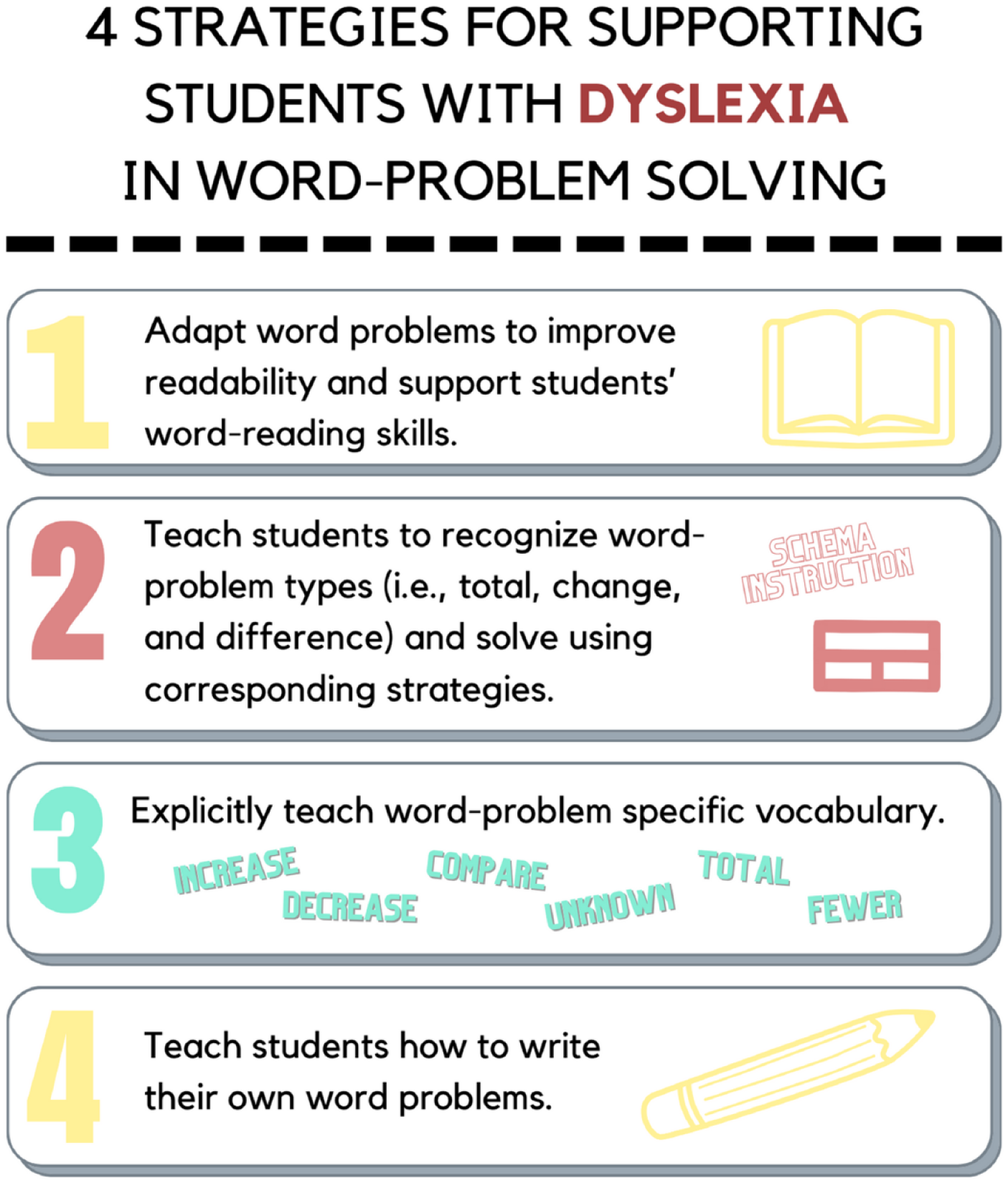
Four strategies for supporting students with dyslexia in solving word problems
Footnotes
Declaration of Conflicting Interests
The authors declared no potential conflicts of interest with respect to the research, authorship, and/or publication of this article.
Funding
This article was supported in part by grant R324A200209 from the National Center for Special Education Research in the Institute of Education Sciences. The content is solely the responsibility of the authors and does not necessarily represent the official views of the National Center for Special Education Research or the Institute of Education Sciences.
