




Abstract
Robust vocabulary instruction is an important part of comprehensive English language arts (ELA) instruction. Vocabulary instruction supports students in learning the meaning of words to build a receptive vocabulary that they can rely on to comprehend the words they read and hear. Many students with significant cognitive disabilities (SCD) and complex communication needs (CCN) struggle to read or understand grade-level words, concepts, and texts. Explicit vocabulary instruction can play an important role in addressing this area of need. Addressing the vocabulary needs of students with SCD and CCN in a comprehensive way calls for a greater investment of instructional time to build their receptive vocabulary and conceptual understandings of new vocabulary. It calls for leveraging the high frequency expressive vocabulary students are likely to have available on their augmentative and alternative communication (AAC) systems to make meaningful connections and demonstrate their understanding of new vocabulary. The aim is successful comprehension across ELA and other academic domains through a robust and expanding receptive vocabulary that extends beyond the words commonly programmed onto AAC systems. Finally, vocabulary instruction should be one part of a comprehensive approach to ELA instruction, with substantial time and effort also devoted to reading and writing instruction so that one day students with SCD and CCN can use spelling and writing to bridge the gap between the words they know and the words they have access to use expressively.

Vanessa is a hardworking fourth-grade student with significant cognitive disabilities and complex communication needs. She uses an augmentative and alternative communication (AAC) device that offers about 60 graphic symbols that represent high-frequency words (e.g., “different,” “look,” “some”) on the main page. Her device also includes additional personalized and topic-specific vocabulary that is represented graphically and organized by category (e.g., people, clothing, sports) across dozens of linked pages. Vanessa communicates with her teachers and peers using gestures, idiosyncratic signs, and primarily single words on her AAC device—occasionally she will link together two or three words. The words available on her device contribute to her ability to demonstrate what she knows about a topic and express what a topic makes her think about or how it relates to her life and personal experiences. Mr. Blythe, Vanessa’s English language arts (ELA) teacher, introduces and teaches his class new vocabulary words every week. Mr. Blythe recognizes how important it is to build new conceptual understandings through vocabulary instruction in order for his students to read with comprehension and make crucial connections during class activities and discussion. He worries about Vanessa benefiting from the vocabulary instruction given her current receptive and expressive language abilities and the limited repertoire of words she has available for expression on her AAC device. He is trying to identify ways to better support Vanessa to expand her receptive and expressive vocabulary and provide appropriate access to grade-level content in ELA alongside her peers.
Learning and using new vocabulary is an essential part of comprehensive ELA instruction. All students—including those, like Vanessa, who participate in an alternate assessment based on alternate achievement standards as a result of significant cognitive disabilities (SCD)—need to understand the meaning of essential words to successfully comprehend what they are reading and hearing (Beck et al., 2013; Erickson, 2017; Erickson & Koppenhaver, 2020; Wright & Cervetti, 2016). To learn new vocabulary, students with and without disabilities require direct vocabulary instruction aimed at teaching the (a) meanings of words in varied contexts, (b) relationship between new words and known words, and (c) spelling of words (Erickson & Koppenhaver, 2007; McKeown, 2019).
“Learning and using new vocabulary is an essential part of comprehensive ELA instruction.
According to the U.S. Department of Education, Office of Special Education and Rehabilitation Services (OSERS; 2015), students with SCD are a diverse group who receive special education services under a variety of eligibility categories (e.g., autism, intellectual disability, multiple disabilities) and require extensive, repeated, individualized instruction and support, substantially adapted materials, and targeted instruction to acquire, maintain, and transfer skills across settings. By definition, students with SCD are unable to achieve grade-level academic standards, even with appropriate instruction and accommodations (Thurlow et al., 2019); however, like for all students with disabilities, the Individuals With Disabilities Education Act (IDEA; 2004) and the current Elementary and Secondary Education Act (2015) require their involvement in and progress toward grade-level standards (OSERS, 2015).
With this understanding in mind, Vanessa’s team developed her individualized education program (IEP) to align with grade-level standards and included specific supports to make it possible for her to be involved in the full scope of the grade-level curriculum (e.g., direct and indirect speech-language services to build skills and support their application and use in the classroom). They also recognized that maximizing her opportunity to learn must involve instruction that extends well beyond the specific goals on her IEP (Taub et al., 2017).
Although vocabulary instruction is an important part of grade-level standards across content areas for all students, there is a clear and pressing need for receptive vocabulary instruction for students with SCD and complex communication needs (CCN), because fewer than half of this group of students can demonstrate understanding of basic phrases and sentences and very few can read or listen to extended text with comprehension (Erickson & Geist, 2016). Explicit receptive vocabulary instruction can support growth, yet it is often an undersupported area for students with SCD and CCN (Erickson & Koppenhaver, 2020). When vocabulary instruction is addressed, it is often with a narrow focus on learning specific words and identifying the associated graphic symbols for the purpose of expressive use on AAC systems (Beukelman & Light, 2020). Although expressive communication is absolutely important for students with SCD and CCN, success across academic domains requires an emphasis on receptive vocabulary (Beck et al., 2013; Erickson & Koppenhaver, 2020). The purpose of this article is to describe an approach to receptive vocabulary instruction for school-age students with SCD and CCN that involves both direct and indirect opportunities to learn new words. The approach is aimed at expanding students’ conceptual understandings related to new words through the use of evidence-based instruction (see Beck et al., 2013) and the high-frequency words (i.e., core vocabulary) that are generally available on AAC systems (Cross et al., in press; Erickson & Koppenhaver, 2020; Van Tatenhove, 2009; Witkowski & Baker, 2012).
“All students need to understand the meaning of essential words to successfully comprehend
what they are reading and hearing.
Receptive-Expressive Vocabulary Differences
The body of words students understand and draw upon in receptive tasks (i.e., listening and reading) is larger than that which they use for expressive tasks (i.e., speaking and writing; Owens, 2008), and this difference exists across the life span (Beck et al., 2013). By first grade, students without disabilities are estimated to have receptive vocabularies of 8,000 to 14,000 words and expressive vocabularies of approximately 2,600 words (Anglin et al., 1993); similarly, adults are estimated to understand twice as many words as they use (Brysbaert et al., 2016). There are known differences in the expressive and receptive vocabularies of children with various developmental disabilities (Davis et al., 2016), with smaller receptive-expressive discrepancies for some children (McDaniel et al., 2018) and all reports lending support for the importance of building receptive vocabulary.
Students who use natural speech to communicate have access to the full repertoire of words they know for possible expressive use. In contrast, students, like Vanessa, who use AAC are constrained by the words and associated symbols others have selected and made available on their AAC system (Beukelman & Light, 2020; King et al., 2015). The alphabet is the only symbol system that offers potential for AAC users to say anything in any given situation. There is no other symbol-based approach, including the most robust AAC systems available, that supports the range of utterances a student may wish to say (Erickson & Koppenhaver, 2020). For students who are not yet able to spell, teams often make extensive efforts to program new words on AAC systems to then encourage expressive use as words are taught (Erickson, 2017). However, it is estimated that children learn three new root words per day and 3,000 to 4,000 new words per year between first and fifth grades (Anglin et al., 1993; Nagy & Herman, 1987). It is impractical for a teacher like Mr. Blythe to configure access to vocabulary on an AAC system at a rate even remotely close to this. Likewise, adding a few hundred words per year risks burdening most AAC systems with overly complicated navigational requirements (Erickson & Koppenhaver, 2007). The alternative proposed herein involves (a) investing instructional time to build students’ receptive vocabulary; (b) leveraging the high-frequency, core vocabulary readily available on AAC systems to make connections and build new conceptual understandings to expand receptive vocabulary (Erickson, 2003; Van Tatenhove, 2009); and (c) teaching all students to spell and write so that one day, they will be able to use whatever words they wish (Erickson & Koppenhaver, 2020). As Yoder (2001) affirmed in reference to students like Vanessa, “There is no one who is too anything to learn to read and write” (p. 6). Students with significant disabilities who use AAC can learn to spell when provided instruction that is interactive, includes models, and focuses on functions rather than forms (Hanser & Erickson, 2007; Sturm, 2012).
“Developing deep understandings of words is an incremental process that occurs over multiple encounters.
Building Receptive Vocabulary and Word Knowledge
The breadth and depth of a student’s receptive vocabulary is strongly related to reading and listening comprehension (Beck & McKeown, 2007; Scarborough, 2001) and general academic achievement (Taylor et al., 2013). Developing deep understandings of words is an incremental process that occurs over multiple encounters and often involves learning multiple word meanings, understanding situations of use, and making associations between the new word and known words (Duff, 2019; McKeown, 2019). Direct vocabulary instruction, combined with indirect experiences within rich language environments, such as wide reading and experiences with text, is generally the most effective approach to vocabulary instruction (Marulis & Neuman, 2010) and forms the basis for students to develop their knowledge of words (McKeown, 2019).
Unfortunately, the literature regarding vocabulary instruction for students with significant disabilities regularly confounds concepts of word and symbol identification with meaning (Erickson et al., 2009; Erickson & Koppenhaver, 2020). The result is that students are taught to match printed words with pictures, identify small sets of printed words (Hua et al., 2013), or discriminate graphic symbols (Lorah et al., 2014). These methods help students learn to identify small sets of words, but they fail to help students develop the kind of generalized understanding and use that are required to support text comprehension and academic achievement (Browder et al., 2006).
“Getting students interested in and aware of words is essential to building a foundation for effective vocabulary instruction.
Building Interest and Making Connections
Getting students interested in and aware of words is essential to building a foundation for effective vocabulary instruction for students with (Erickson & Koppenhaver, 2020) and without disabilities (Beck et al., 2013). This involves helping students learn to recognize when they encounter unknown words, building interest in learning about those new words, and relating new words to known words. The connections students make between new words and known words will ultimately help them build the kinds of deep understandings that will make it possible for them to interpret the meaning of a word when it is encountered in a new context (Beck et al., 2013; Erickson & Koppenhaver, 2020).
There are many creative and effective ways to increase students’ awareness of and interest in learning new words. For example, students are more likely to be engaged and enthusiastic about learning new words when instruction is lively and interactive than when it is independent and rote (Beck et al., 2013). Lively and interactive activities may include (a) reading books together with interesting vocabulary, (b) taking time to note and explain new words as you read, (c) encouraging students to interact and talk about the book, and after reading, (d) discussing the contexts in which the words were used (Erickson & Koppenhaver, 2020). Students like Vanessa can successfully use their AAC systems to actively engage across activities like these by using the repertoire of vocabulary they have readily available. Although their talk using AAC is likely to be less complex compared with that of their naturally speaking peers, one-, two- and three-word utterances can be used to contribute to group discussions and demonstrate understanding of new vocabulary and associated concepts (Cross et al., in press; Erickson et al., 2021; Geist et al., 2014, 2020). A reliance on one- and two-word utterances is common for many students who use AAC (Beukelman & Light, 2020).
Selecting Words to Teach
One of the most important aspects of vocabulary instruction is choosing which words to teach (Beck et al., 2013, McKeown, 2019). With a sea of words to choose from, Beck and colleagues (2013) provide a helpful starting point by organizing words into three tiers based on words having different practical value in language. Tier 1 words (e.g., “go,” “more,” “cup”) are common words that the majority of children who use natural speech to communicate will learn through everyday interactions in meaningful contexts and without the need for explicit instruction, often before they enter school. For students with SCD and CCN, Tier 1 words are often explicitly taught as students begin learning to use the words and symbols on their AAC systems (Erickson et al., 2021). Tier 2 words (e.g., “perform,” “category,” “describe”) are common in written language and overlap with academic words that are useful across various domains (Beck et al., 2013). Tier 2 words are important targets for vocabulary instruction for students with SCD and CCN because understanding these words can help them across oral and written language tasks (Erickson & Koppenhaver, 2020; McKeown, 2019). Tier 3 words (e.g., “circumference,” “aorta,” “escarpment”) are domain specific and rare (Beck et al., 2013). Tier 3 words may be of perceived importance for a single academic lesson or unit, but they do not tend to be useful to students with SCD and CCN beyond those fleeting instructional lessons.
These tiers can help guide the focus of vocabulary instruction. However, the selection of the specific words to teach from week to week and lesson to lesson should also be guided by additional considerations, including the academic expectations for students and the specific topics and themes they are studying, reading about, discussing, and writing about. Teachers like Mr. Blythe can assess the value of teaching a word based on whether students are likely to (a) find it across texts and contexts, (b) use it to describe their own experiences through spoken or written forms, (c) relate it to known words, and (d) develop deep knowledge of it as one important dimension of the topic and theme being taught (Beck et al., 2013).
Mr. Blythe carefully reviews the vocabulary words used in the texts and topics he plans to cover in his weekly lessons and selects Tier 2 words to teach based on the perceived value for helping students build their understanding, make crucial connections, and ultimately, meet academic expectations.
Connecting New to Known Words in AAC
Planning effective vocabulary instruction for students with SCD and CCN requires identifying how the words students have available on their AAC systems relate conceptually to the new vocabulary they are learning and how students can use existing vocabulary to express understandings of the new words and associated concepts (Erickson & Koppenhaver, 2020; Van Tatenhove, 2009). In some cases, it is appropriate to add new words to a student’s AAC system, but before teams invest instructional time (both theirs and the student’s) in programming new words, they should unequivocally determine that the target word is likely to be highly useful for expressive communication purposes outside of the context of the lesson or unit. For example, Erickson (2003) described a student whose team diligently added new vocabulary words like “escarpment” to his AAC device week after week. The student learned to identify the words in response to definitions, but he rarely, if ever, used the words outside of quizzes and unit tests. As they shifted away from programming each new word on his AAC system, they found they could increase the number of words they targeted for explicit instruction. They also found that the student made more efforts to express a broader range of concepts as he learned to use the words already available on his AAC device to communicate about new words.
This process of linking known words to new words has been discussed in the AAC literature for many years. It has been described as a form of circumlocution (Erickson, 2003), as students who use AAC are taught to use available words or messages to convey the meaning of a word that is not available (Clarke & Schneider, 2014). The most systemized version of this approach is known as descriptive teaching (Van Tatenhove, 2009; Witkowski & Baker, 2012). In descriptive teaching, adults use the words targeted for receptive vocabulary instruction by saying them and teaching students how to use the core words on their AAC systems to describe the concepts behind those target words. Regardless of the specific approach, the emphasis is on helping students learn to think flexibly about words on a conceptual level while helping them communicate understandings of a broad range of receptive vocabulary even when they do not have access to the specific words on their AAC systems.
Mr. Blythe considers how he can make meaningful connections to the words Vanessa uses every day to support her in learning Tier 2 words. When he introduces the word “perform,” he describes its meaning using core-word combinations available to Vanessa, including “to do” and “to put on.” As he plans his vocabulary lessons, he takes a few minutes each week to jot down related high-frequency words so that he can be sure to make meaningful connections between the new words he is teaching and the words his students are likely to already know.
Delivering Effective Receptive Vocabulary Instruction to Students With SCD and CCN
Beck, McKeown, and their colleagues (Beck et al., 2013; Beck & McKeown, 2007; McKeown et al., 1985) provide an overview of features of effective, evidence-based approaches to vocabulary instruction. They recommend frequency intervals of approximately 10 words per week, with each word used at least 10 times across varied contexts. They also recommend the use of a robust set of activities that are focused on going beyond definitions to engage students in thinking about the meaning of words and making connections between new words and known words (see Beck et al., 2013, pp. 88–93). This body of work is adapted here to describe a weeklong instructional cycle aimed at helping teachers actively engage students with SCD and CCN using the words readily available on their AAC devices. The goals include dramatically increasing the rate at which students with SCD and CCN are introduced to new words, focusing on conceptual understanding of the words and emphasizing application and use.
A 5-Day Instructional Cycle
To help illustrate the proposed instructional cycle, the topic of community and associated theme of communities working together was selected in connection with the book The Birchbark House, by Louise Erdrich (1999), which is generally read in the upper-elementary grades (National Governors Association Center for Best Practices & Council of Chief State School Officers, 2010). In fact, The Birchbark House is read frequently enough that various adapted versions of it are available to make it more accessible to students with SCD and CCN. For example, chapter-by-chapter versions that feature the main events can be found on Tar Heel Reader (https://tarheelreader.org/), an open-source, online library that includes more than 77,000 books. The topic, theme, and book will each be referenced throughout the following example.
Introducing target vocabulary (Day 1)
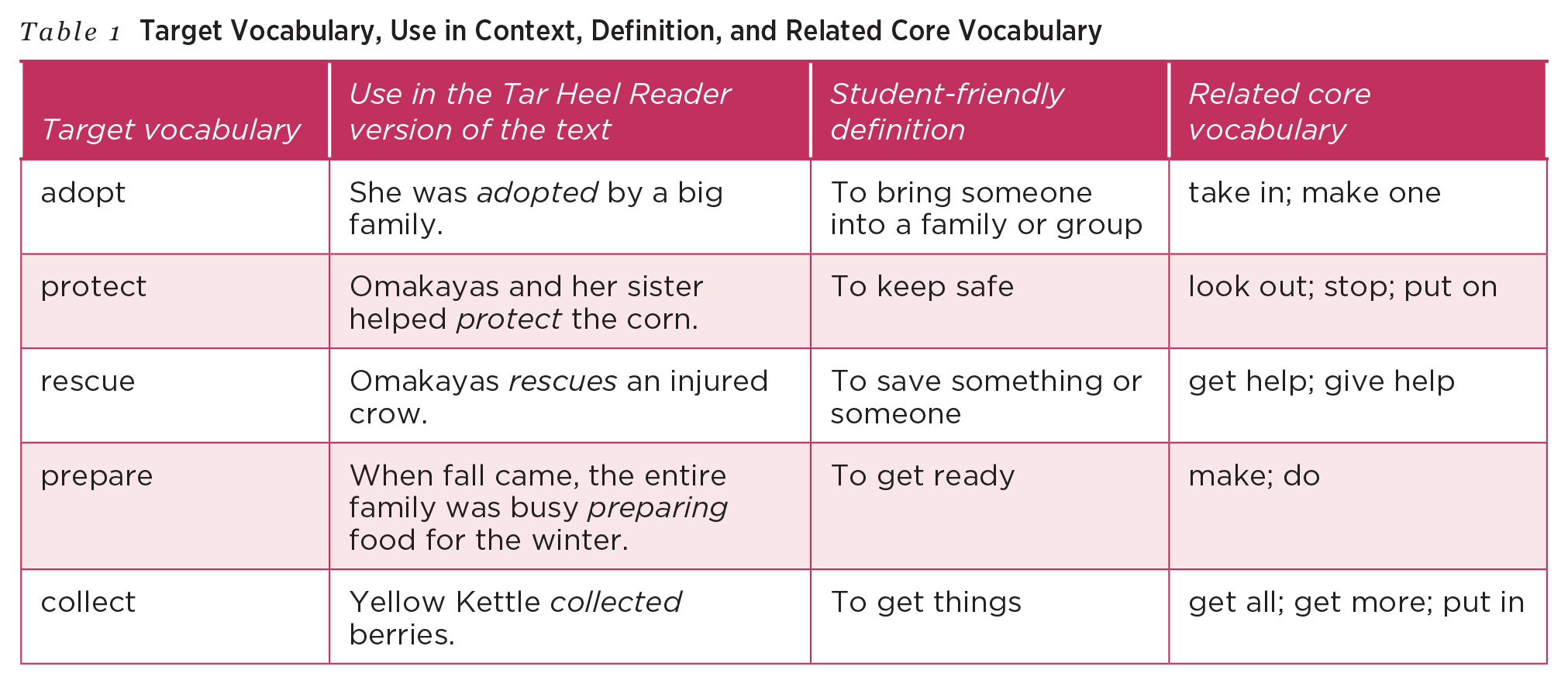
On the 1st day of instruction, provide clear explanations of the target words and discuss how the words are used in the text and other contexts. Write the words for the whole class to see, and support students as needed in adding the new words to a personal list they will keep (Beck et al., 2013). Table 1 provides an example of words that might be targeted for the theme of communities working together and The Birchbark House. The table also describes the context where the words appear in adapted versions of the text on Tar Heel Reader, student-friendly definitions of the meaning of each word, and example core words that commonly appear on AAC systems that may be used to talk about and demonstrate understanding of each target word.
Target Vocabulary, Use in Context, Definition, and Related Core Vocabulary
Meaningful opportunities to interact with the target words (Days 2–4)
After the vocabulary words have been introduced and talked about, maximize student opportunities to encounter and interact with the targeted words through a variety of direct and indirect instructional activities. The key is to offer repetition with variety so that students go beyond having narrow, definition-based understandings of the words and develop deep knowledge of their meaning and use (Erickson & Koppenhaver, 2020). Direct instruction is aimed at providing multiple exemplars, making meaningful connections to student background knowledge and experience with the concepts represented, and scaffolding instruction as student responses offer insights into their depth of understanding of new words. Activities involve students indicating relationships between known concepts and new words (e.g., a lost dog in relation to “rescue”) and using their personal experiences and familiar contexts from a story to describe relationships (e.g., talk about how “rescue” was used in the story). Table 2 provides examples of a range of instructional activities that could be used in combination to support students in developing knowledge of the meaning and use of new words.
Example Instructional Activities
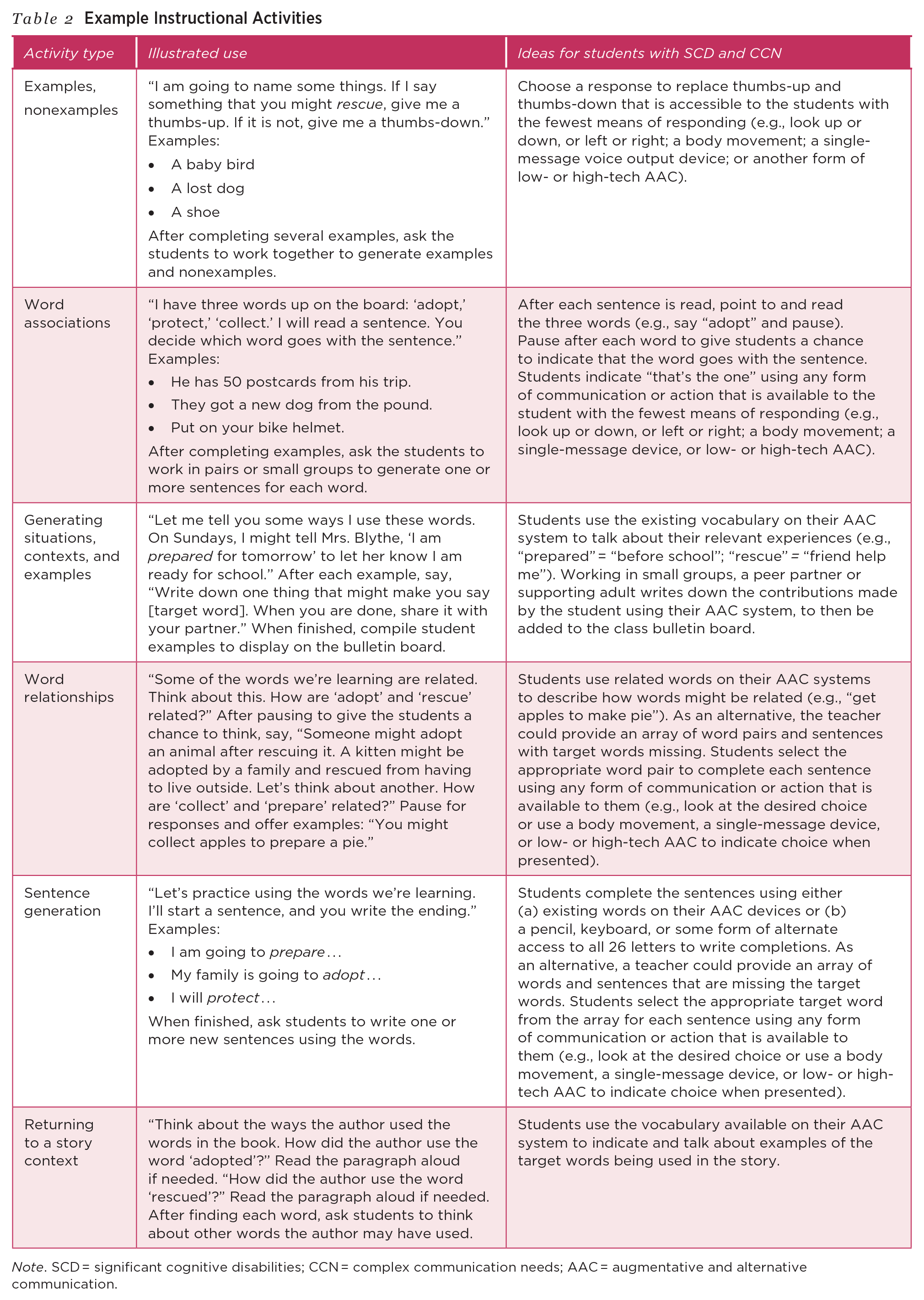
Note. SCD = significant cognitive disabilities; CCN = complex communication needs; AAC = augmentative and alternative communication.
Assessment (Day 5)
As a final step, assess student knowledge of the new words by asking them to describe and use the new words in ways that extend beyond those used in instruction. Students like Vanessa can use the known words on their AAC systems to demonstrate knowledge of the new words. For example, they can use their words to describe how an umbrella might protect them (e.g., “water off”) or to talk about something they might rescue (e.g., “need help”; “animal”).
This 5-day cycle is intended as an example of an instructional sequence that applies evidence-based practices in vocabulary instruction. This instructional sequence can be effectively adapted for students with SCD and CCN to help them build a robust receptive vocabulary and expand their conceptual understanding and use of the words available on their AAC systems. Figure 1 offers a checklist of recommended components. Depending on the theme and topic, the words being targeted, and the activities being applied, the number of days in the sequence can be adjusted as appropriate.
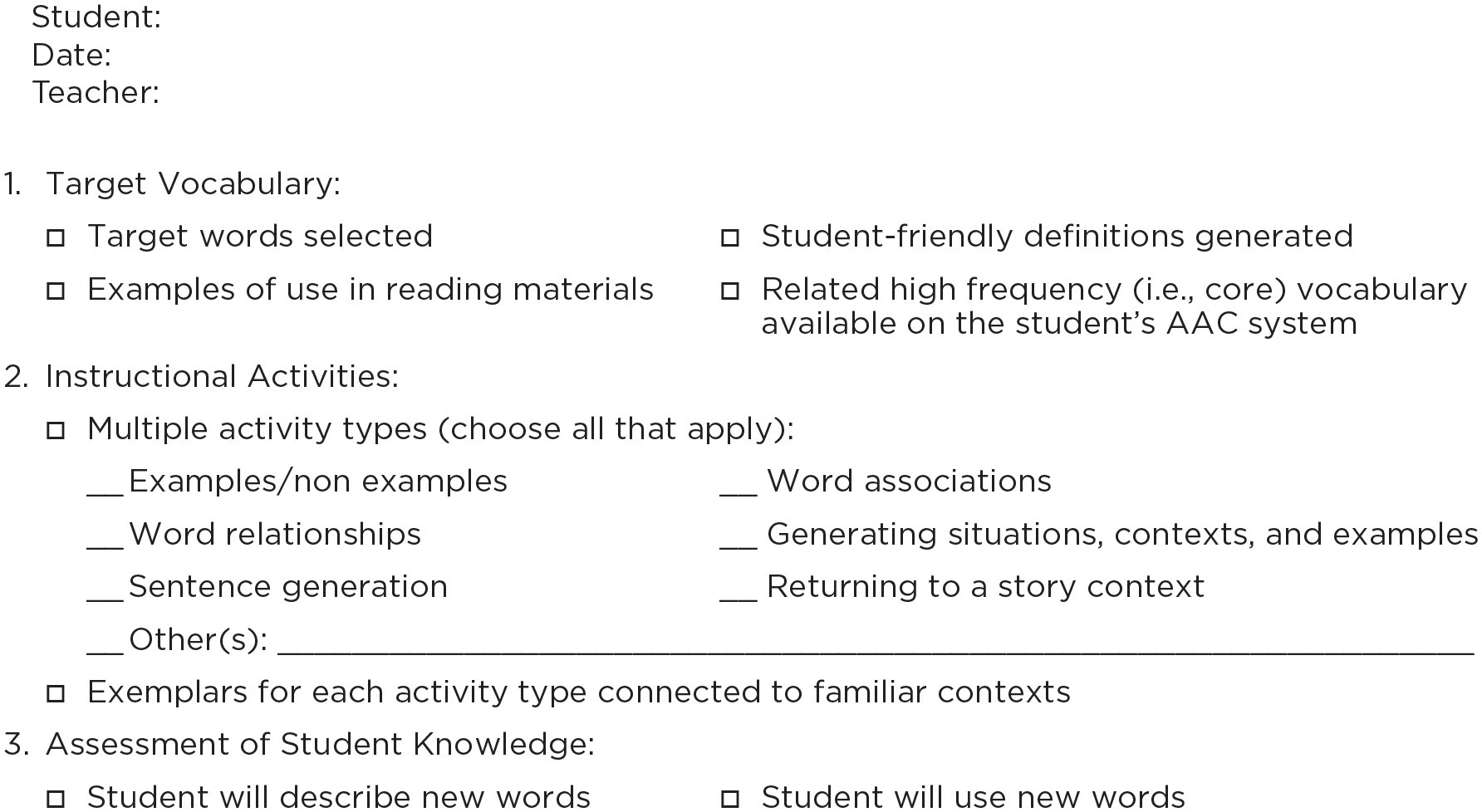
Checklist of components of vocabulary instruction for students who use augmentative and alternative communication
Summary
Robust vocabulary instruction is an important part of comprehensive ELA instruction. Robust receptive vocabulary knowledge helps students comprehend the words they read and hear. Most students with SCD and CCN struggle to understand grade-level words, concepts, and texts. Explicit vocabulary instruction can play an important role in addressing this area of need. This is especially true when instruction is aimed at expanding their conceptual understandings of new words through participation in language-rich instruction.
Addressing the receptive vocabulary needs of students with SCD and CCN calls for a greater investment of instructional time and an understanding of differences in expressive and receptive vocabulary. This requires an emphasis on building conceptual understandings of new words while leveraging the high-frequency words that are available on students’ AAC systems. In this way, students are explicitly taught to use known vocabulary to make meaningful connections and demonstrate their understanding of new vocabulary. The aim is successful comprehension in ELA and across other academic domains through a robust and expanding receptive vocabulary. Finally, vocabulary instruction should be one part of a comprehensive approach to ELA instruction, with substantial time and effort also devoted to reading and writing instruction so that one day students with SCD and CCN can use spelling and writing to bridge the gap between the words they know and the words they have access to use expressively.
Footnotes
Declaration of Conflicting Interests
The author(s) declared no potential conflicts of interest with respect to the research, authorship, and/or publication of this article.
Funding
The author(s) disclosed the following financial support for the research, authorship, and/or publication of this article: This document was produced in part under U.S. Department of Education, Office of Special Education Programs, Grant No. H327S190005. The views expressed herein do not necessarily represent the positions or policies of the Department of Education. No official endorsement by the U.S. Department of Education of any product, commodity, service, or enterprise mentioned in this publication is intended or should be inferred.
