




Abstract
The 1970 Missale Romanum provides three liturgical formularies for the unity of Christians which are an important source for understanding Catholic attitudes to ecumenism after the Second Vatican Council and for considering the role of liturgical prayer in forming ecumenical perspectives. This article analyzes the orations of these masses, showing how the texts draw on ancient patterns of prayer as well as the constitutions and decrees of Vatican II. Of the nine orations for the unity of Christians studied here, two are lightly adapted from pre-existing prayers, while the remaining seven are new compositions which draw to varying degrees on the Latin euchological tradition. The new compositions have a variety of thematic and textual sources, notably including several documents of the Second Vatican Council: the Decree on Ecumenism Unitatis redintegratio, the Constitution on the Liturgy Sacrosanctum concilium, and the Dogmatic Constitution on the Church Lumen gentium.
Introduction
Unitatis redintegratio, the Decree on Ecumenism promulgated in 1964 by the Second Vatican Council, declares that “change of heart and holiness of life, along with public and private prayer for the unity of Christians, should be regarded as the soul of the whole ecumenical movement, and merits the name ‘spiritual ecumenism.’” 1 Revised in the wake of the Council, the 1970 Missale Romanum provides several liturgical formularies for the unity of Christians which are an important source for analyzing Roman Catholic attitudes to ecumenism after the Second Vatican Council and their articulation within a liturgical context. 2 This article will analyze the Masses for the unity of Christians in the contemporary Roman Missal, showing how the orations draw on ancient patterns of prayer as well as the constitutions and decrees of Vatican II. 3
Despite their significance as a liturgical reception of Vatican II's teaching on ecumenism, previous scholarship on these prayers has been limited. In 1982, the German liturgist Emil Lengeling offered brief comments on the formularies for Christian unity in the Roman Missal. 4 In 2003, the Belgian philologist Bertrand Coppieters ‘t Wallant published an overview of the euchological sources of the post-conciliar Roman Missal that included a cursory treatment of the liturgical and conciliar sources for the prayers. 5 In an article published in Studia Liturgica in 2015, I analyzed the first of the three formularies, showing how it draws on a set of prayers for the taking away of schism promulgated by the Avignon Pope Clement VII (1342–1394) during the Western Schism. 6 In this article, I shall discuss the other prayers included in these formularies, identifying the conciliar, scriptural, and euchological sources utilized by the drafters of these prayers and demonstrating that the ecumenical perspective represented by the three formularies is deeply rooted in the language of several documents of the Second Vatican Council: the Decree on Ecumenism Unitatis redintegratio, the Constitution on the Liturgy Sacrosanctum concilium, and the Dogmatic Constitution on the Church Lumen gentium.
Coetus XIII and the Composition of New Mass Formularies
In place of a single votive mass “For the unity of the Church” (Pro unitate Ecclesiae) found in the 1962 Missale Romanum, 7 the 1970 Missale Romanum provides three formularies “For the unity of Christians” (Pro unitate Christianorum) in the section labeled Missae et orationes ad diversa. 8 Each formulary provides two collects (only one of which would be used in a particular celebration), one Prayer over the Offerings, and one Prayer after Communion. 9 In addition, the first formulary provides a proper preface which is likewise specified for use in the other two formularies. 10
Most of the orations in these formularies were composed in the 1960s by members of Coetus XIII (De Missis votivis) of the Consilium ad Exsequendam Constitutionem de Sacra Liturgia. 11 The group initially comprised Herman Schmidt, SJ (1912–1982) as relator, Dante Balboni (1917–2004) as secretary, and Burchard Neunheuser, OSB (1903–2003), Henry Ashworth, OSB (1914–1980), Ferdinando Dell’Oro, SDB (1924–2010), Joan Llopis i Sarrió (1932–2012), and René-Jean Hesbert, OSB (1899–1983) as members. In 1966, Aimon-Marie Roguet, OP (1906–1991) took over as relator and Jean-Baptiste Molin, FMC (1909–2000) became secretary.
A Coetus XIII schemata from September 1968 sheds light on the presence of multiple newly composed orations for the unity of Christians in the 1970 missal.
12
According to the authors of this document, with respect to masses for various needs, Quite often it is impossible to retain the orations which are found in the Roman Missal, or even to draw more suitable orations from the treasury of the more ancient euchology. Indeed, prayer ought to express the mentality of our age, particularly when treating of temporal needs such as Christian unity, peace, or famine.
13
After briefly discussing several examples of prayers deemed to be less fitting for contemporary worship, including the pre-conciliar collect for the unity of the Church, 14 the authors suggest that it would be expedient for multiple orations to be provided for ad libitum selection according to diverse circumstances. 15 The document concludes with a request for a decision from the Consilium Fathers: “Are these principles for revising or composing masses for diverse needs pleasing to the fathers?” 16 The multiple formularies and newly composed prayers for the unity of Christians in the 1970 missal suggest that the answer was positive.
Formulary A
The following sections shall explore the liturgical and theological sources of the revised and newly composed prayers for Christian unity provided in the 1970 Missale Romanum. In addition to the first Collect, the Prayer over the Offerings, and the Prayer after Communion of Formulary A, which are adapted (with varying levels of editorial intervention) from the 1962 formulary for the Unity of the Church, 17 Formulary A contains a second collect which was newly composed for the 1970 missal. 18
The collect begins with a motivating clause and address to God (line 1), then offers two petitions (lines 2 and 3), the second of which is followed by two purpose clauses (lines 4–5 and 6) (Table 1). 19
Text and Translation of Formulary A, Collect 2.
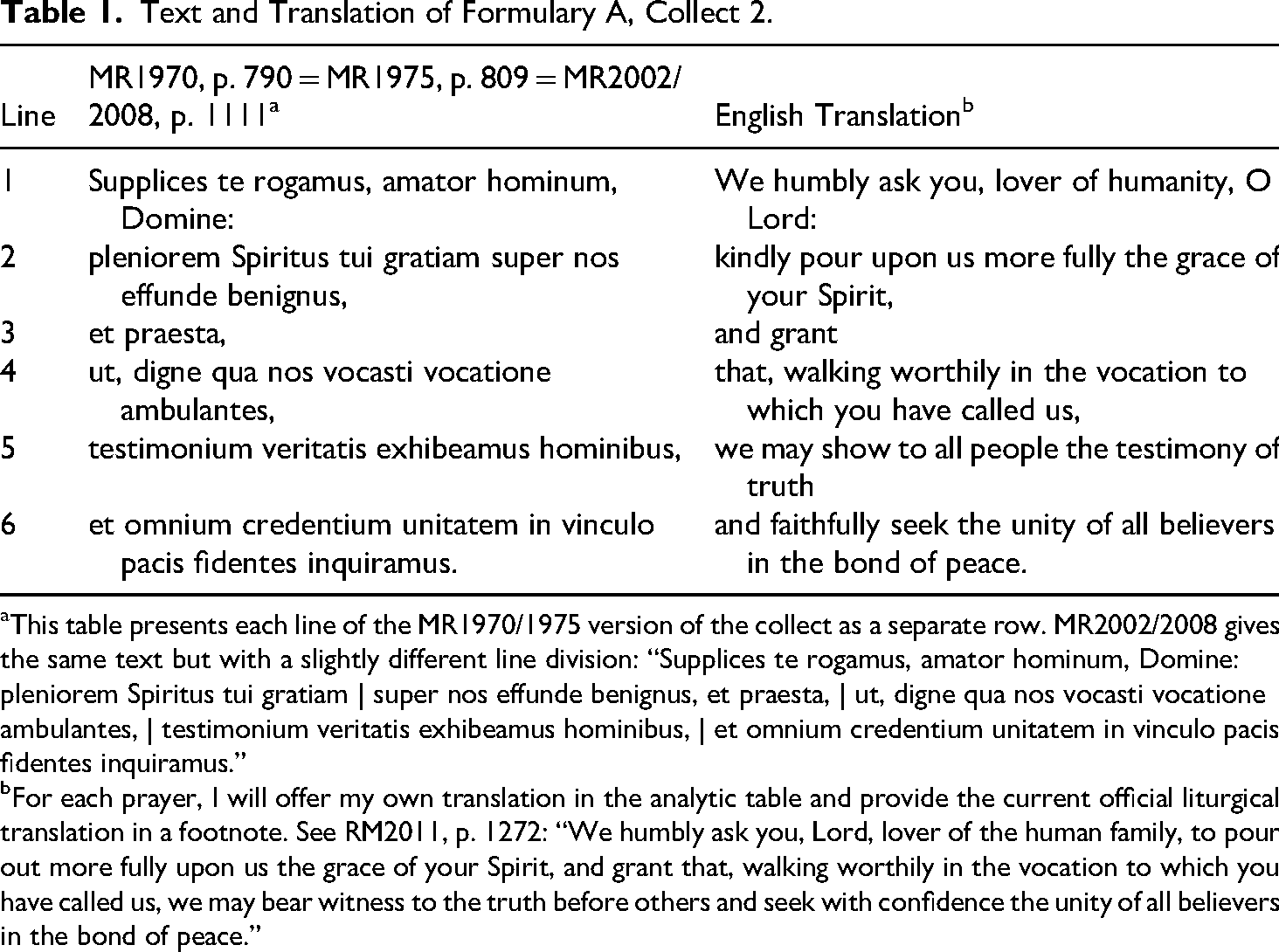
Text and Translation of Formulary A, Collect 2.
This table presents each line of the MR1970/1975 version of the collect as a separate row. MR2002/2008 gives the same text but with a slightly different line division: “Supplices te rogamus, amator hominum, Domine: pleniorem Spiritus tui gratiam | super nos effunde benignus, et praesta, | ut, digne qua nos vocasti vocatione ambulantes, | testimonium veritatis exhibeamus hominibus, | et omnium credentium unitatem in vinculo pacis fidentes inquiramus.”
For each prayer, I will offer my own translation in the analytic table and provide the current official liturgical translation in a footnote. See RM2011, p. 1272: “We humbly ask you, Lord, lover of the human family, to pour out more fully upon us the grace of your Spirit, and grant that, walking worthily in the vocation to which you have called us, we may bear witness to the truth before others and seek with confidence the unity of all believers in the bond of peace.”
The collect begins with the phrase “Supplices te rogamus” (We humbly ask you). Although this phrase is perhaps best known as the opening of a section of the Roman Canon, it is relatively common in Latin euchology, appearing 38 times in the Corpus Orationum (CO), including 18 instances where it forms the opening line of a prayer. 20 The opening lines continue with a motivating clause describing God as a “lover of humanity” and a brief address to God as “Lord” (Domine). The description of God as “amator hominum” is unusual within Latin euchology, but builds on a venerable tradition of Eastern liturgical prayer. 21 Although God is often described as a “lover” in Latin euchology (e.g., pacis … amator [CO 1110], castitatis amator [CO 1119], innocentiae … amator [CO 1260a]), the Latin phrase “amator hominum” does not appear in any of the sources indexed in the Corpus Orationum. In this case, the drafters of the prayer seem to have drawn on the Greek liturgical tradition, where the designation of God as philanthropos appears frequently in various liturgical texts, building on a usage already present in Clement of Alexandria and Origen. 22
After invoking God, the prayer makes two sets of requests. The first petition asks that God “kindly pour upon us more fully the grace of your Spirit” (line 2). Although not a direct quotation, the emphasis on grace in this phrase echoes the opening paragraph of Unitatis redintegratio (UR), in which the word “gratia” appears four times: But the Lord of the ages works out with patience and wisdom the plan of his grace (propositum gratiae) on our behalf, sinners though we are. In recent times more than ever before he has been rousing divided Christians to repentance over their divisions and to a longing for unity. Everywhere large numbers have felt the impulse of his grace (gratia); and among our separated brothers and sisters likewise, through the inspiration of the holy Spirit (Spiritus sancti fovente gratia), a movement has grown and developed, whose aim is the restoration of the unity of all Christians. … Moved by desire for the restoration of unity among all the followers of Christ, [this holy synod] wishes to set before all Catholics the resources, the ways and the means by which they can respond to this grace and divine vocation (divinae vocationi et gratiae respondere).
23
Read in the light of this paragraph, the first petition of the collect implicitly acknowledges that the desire for Christian unity is already a gift of grace and begs that the grace of the Holy Spirit may be given to us more abundantly. 24 The closing line of UR 1, which refers to desire and work for Christian unity as both a grace and a vocation, will take on further significance in the second half of the prayer.
The collect continues with a second petition followed by two purpose clauses (lines 3–6): “[3] grant [4] that, walking worthily in the vocation to which you have called us, [5] we may show to all people the testimony of truth [6] and faithfully seek the unity of all believers in the bond of peace.” In addition to recalling the language of vocation from UR 1, this section draws extensively on a range of scriptural sources (Table 2).
Scriptural Sources for Formulary A, Collect 2.
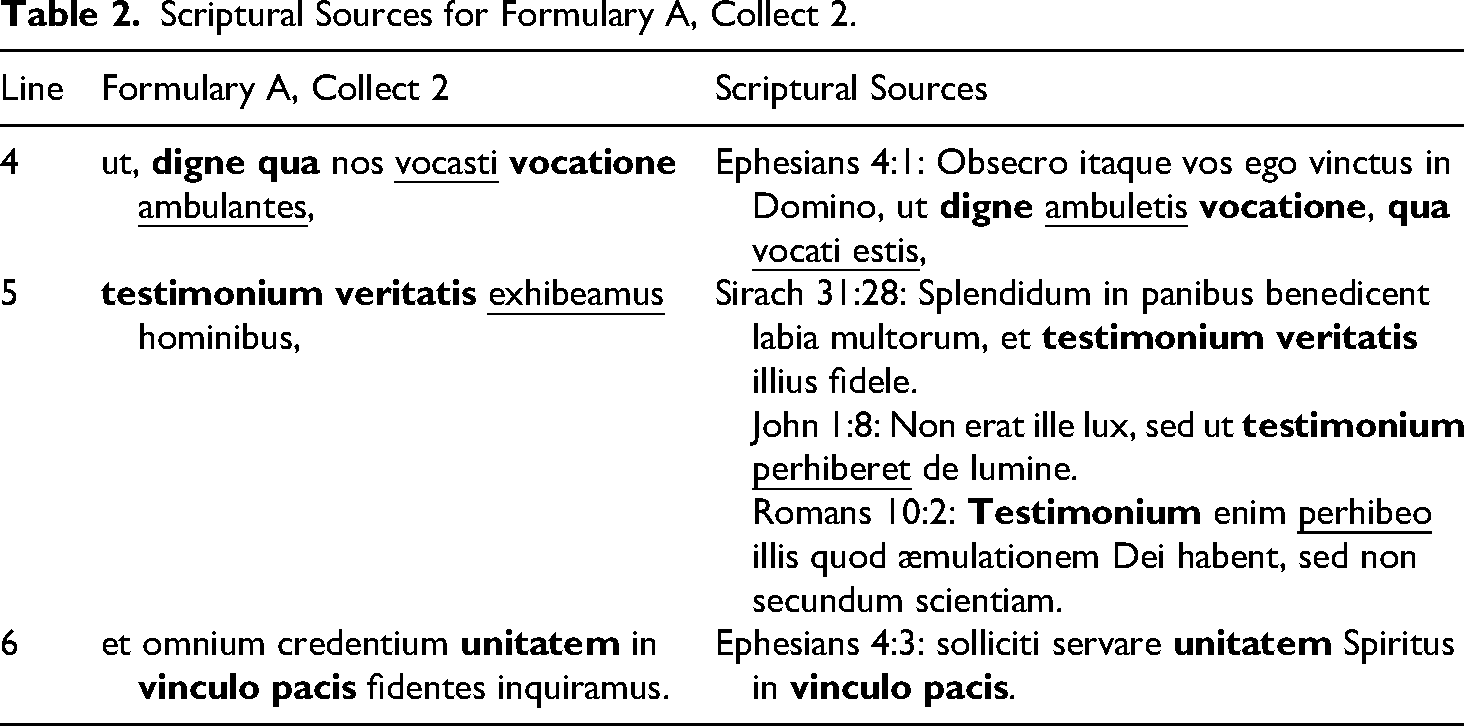
The opening words of line 4 are adapted from Ephesians 4:1 (“I … beseech you to walk worthily in the vocation to which you are called”), transforming Paul's command into a participle form that declares the Church's commitment to the ecumenical vocation. 25 Two specific requests are then made.
The first (line 5), to “show to all people the testimony of truth (testimonium veritatis),” echoes a phrase from Sirach 31:28 (testimonium veritatis) and has resonances with the theme of “bearing witness” which appears in passages such as John 1:8 (testimonium perhiberet) and Romans 10:2 (testimonium enim perhibeo). As hinted by Coppieters ‘t Wallant, this part of the prayer may also be echoing the call of UR 12 that all Christians should profess their faith in the Triune God “before the whole world” (coram omnibus gentibus) and should “bear witness to our hope” (testimonium reddant spei nostrae). 26
The second request (line 6), to “faithfully seek the unity of all believers in the bond of peace,” directly quotes Ephesians 4:3: “Careful to keep the unity of the Spirit in the bond of peace.” 27 Ephesians 4:1–3, which forms the basis of the participial phrase and the second request, is featured prominently in UR 7, where the Council Fathers link Paul's exhortation with the need to pray to the Holy Spirit for the grace to be genuinely self-denying, humble, and gentle so that we may experience the interior conversion necessary for authentic ecumenism. 28
In contrast to the other orations of Formulary A, which are adapted from a pre-existing formulary for the unity of the Church, the second collect of Formulary A is a new composition produced by Coetus XIII which draws on certain traditional phrases from Eastern and Western euchology while integrating both explicit and subtle references to a variety of scriptural passages and themes from the Decree on Ecumenism.
Formulary B presents two collects, the first lightly adapted from an earlier prayer and the second newly composed, as well as a newly composed Prayer over the Offerings and a Prayer after Communion lightly adapted from earlier sources.
Collect 1
The first collect of Formulary B emphasizes God's role in uniting diverse peoples in the Church and the ongoing need for God's intervention for this unity to be preserved. In contrast to the newly composed prayers in the unity formularies, this prayer is lightly adapted from an ancient collect. The prayer follows a classic structure, beginning with a short address to God followed by a motivating clause (lines 1–2), then concluding with a petition (line 3) and purpose clause (lines 4–5) (Table 3).
Text and Translation of Formulary B, Collect 1.
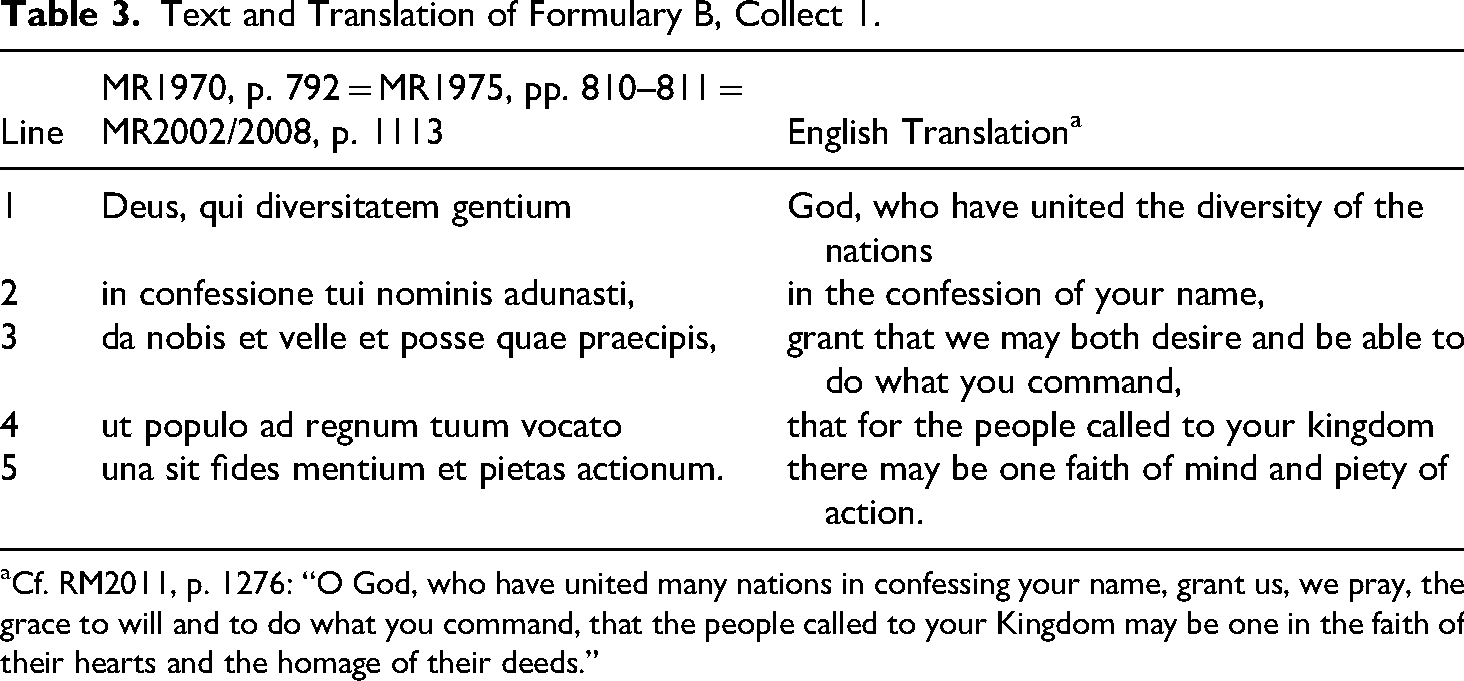
Text and Translation of Formulary B, Collect 1.
Cf. RM2011, p. 1276: “O God, who have united many nations in confessing your name, grant us, we pray, the grace to will and to do what you command, that the people called to your Kingdom may be one in the faith of their hearts and the homage of their deeds.”
This collect is lightly adapted from a prayer which appears in closely related forms in the Gelasian sacramentary for use at the Easter Vigil and in the Gregorian sacramentary for use during the Easter Octave. 29 Compared with the version in the 1962 missal, the only difference in the 1970 version of the prayer is the substitution of “your kingdom” (regnum tuum) for “eternity” (aeternitatem) (Table 4).
Sources of Formulary B, Collect 1.
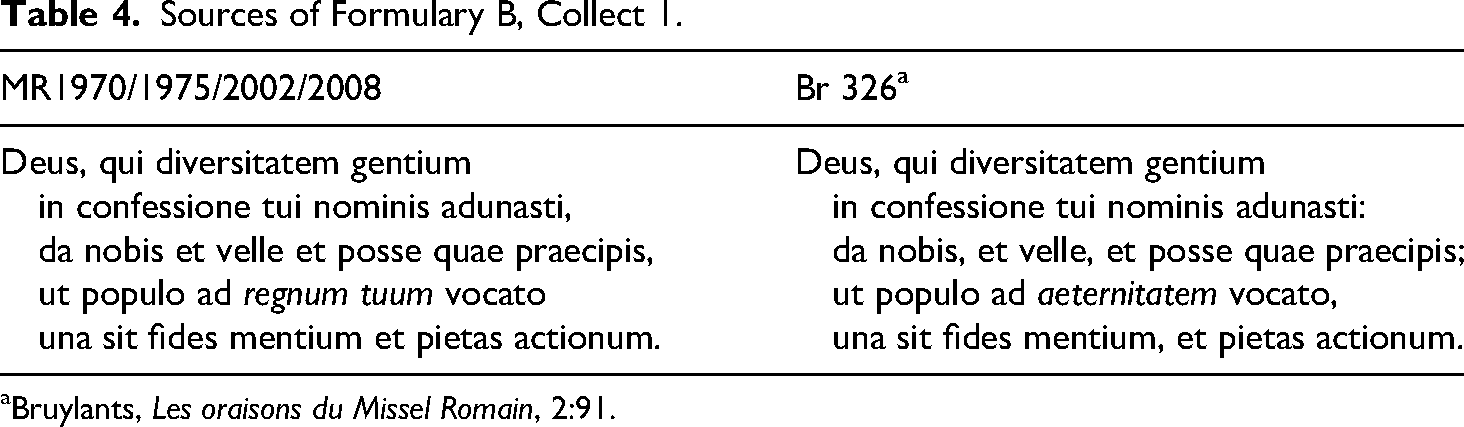
Bruylants, Les oraisons du Missel Romain, 2:91.
This collect has rich scriptural resonances connected with the theme of unity. The opening reference to uniting of the diversity of the nations in the confession of God's name recalls Psalm 116–117, which calls all the nations (omnes gentes) to praise the Lord, as well as Acts 2:3–11, where the gift of the Holy Spirit given at Pentecost enables the apostles to preach to devout Jews “from every nation under heaven” (Acts 2:5), reversing the confusion of languages established at Babel (Gen 11:1–9). The request that “we may both desire and be able to do what you command” is a direct echo of Philippians 2:13, where Paul declares that God works in us “both to desire and to accomplish, according to his good will.” 30 The reference to the “people called to your kingdom” (or “to eternity” in the source text) recalls 1 Peter 2:9, which refers to God's “people” who have been “called out of darkness into his marvelous light.” 31 The final line of the collect, which asks that “there may be one faith of mind and piety of action” for God's people, directly quotes the reference to “one faith” in Ephesians 4:5. 32
The closing words of the collect, “pietas actionum,” referring to unity in acts of love, has a fascinating reception history and is an excellent example of the longitudinal influence of liturgical texts on Christian theology and spirituality. The eighth-century missionary St. Boniface quotes the phrase in a letter to the Abbot of Montecassino written to establish a closer bond of fraternal prayer. 33 The eleventh-century canon Berengar of Tours quotes the prayer in the context of a theological and spiritual apologia, expressing his desire to maintain unity with the church despite being entangled in conflicts over eucharistic theology. 34 Likewise, Radulphus of Cambrai quotes the prayer in his late eleventh-century life of St. Lietbertus. 35 The twelth-century preacher Stephen of Tournai likewise quotes the prayer in a sermon on religious life. 36 The thirteenth-century Franciscan Thomas of Celano weaves the prayer into a description of the unity of the early followers of St. Francis of Assisi. 37 The fifteenth-century canon Thomas à Kempis cites the prayer in a meditation on the apostolic church. 38 Through its inclusion in Mass for the unity of Christians, the prayer is a forceful reminder that unity is a gift of God's grace, not merely the result of human efforts.
The second collect in Formulary B is a new composition which draws on expressions from the Roman euchological tradition as well as themes from the Decree on Ecumenism. 39 The prayer begins with a general petition combined with an address to God (line 1), followed by a more specific petition (lines 2–3) followed by a purpose clause (lines 4–6) (Table 5).
Text and Translation of Formulary B, Collect 2.
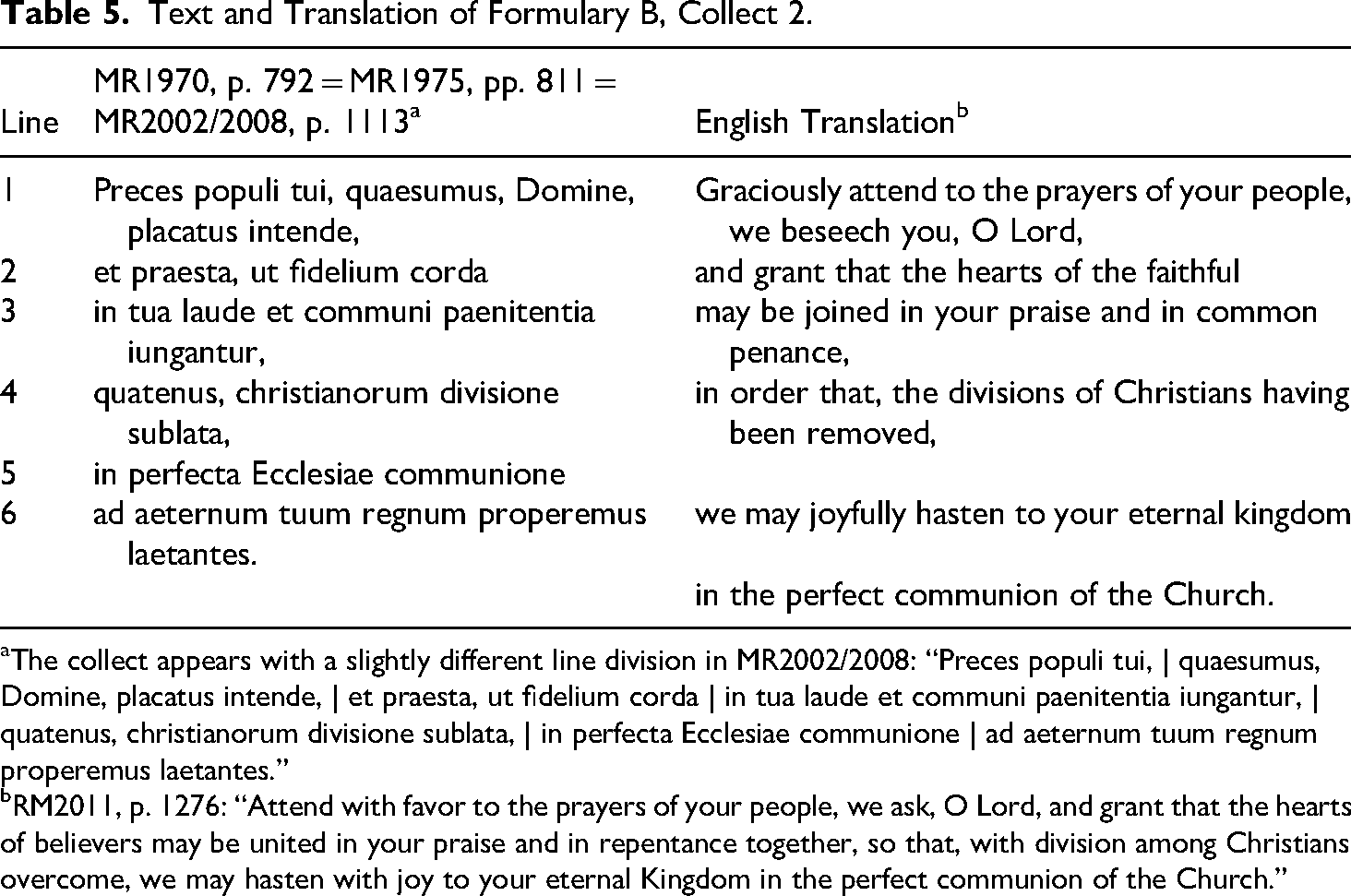
Text and Translation of Formulary B, Collect 2.
The collect appears with a slightly different line division in MR2002/2008: “Preces populi tui, | quaesumus, Domine, placatus intende, | et praesta, ut fidelium corda | in tua laude et communi paenitentia iungantur, | quatenus, christianorum divisione sublata, | in perfecta Ecclesiae communione | ad aeternum tuum regnum properemus laetantes.”
RM2011, p. 1276: “Attend with favor to the prayers of your people, we ask, O Lord, and grant that the hearts of believers may be united in your praise and in repentance together, so that, with division among Christians overcome, we may hasten with joy to your eternal Kingdom in the perfect communion of the Church.”
The opening lines of the prayer, requesting God's attention to the needs of his people, are drawn from other liturgical sources. The opening phrase “Preces populi tui, quaesumus, Domine” appears nine times in the Corpus Orationum, while the phrases “placatus intende” and “et praesta” appear in dozens of other prayers.
The rest of the prayer draws on various themes of Unitatis redintegratio. The main petition, “grant that the hearts of the faithful may be joined in your praise and in common penance,” links the actions of liturgical praise and communal penance with the building up of the unity of the faithful. The opening words, “hearts of the faithful” (fidelium corda), recall the emphasis of UR 2 that it is the Holy Spirit who brings about the “communion of the faithful” (communionem fidelium). 40 The linking of penance and praise recalls the emphasis of UR 8 that “change of heart and holiness of life, along with public and private prayer for the unity of Christians, should be regarded as the soul of the whole ecumenical movement.” 41 As the collect suggests, praising God together and undertaking common penance witnesses to the source of Christian unity as well as the need for personal and collective repentance.
The theme of penance in UR 8 builds on ideas expressed in the two preceding paragraphs, which emphasize the need for the Church to respond to Christ's summons to “continual reformation” (perennem reformationem) 42 and the need for individual Christians to undergo “interior conversion” (interiore conversione) and to grow in holiness and unity with God in order to grow in unity with other Christians. 43 As UR 8 goes on to emphasize, common prayer (communes … preces) is a witness to the unity which already exists among Christians, but the lack of full sacramental sharing (communicatio in sacris) shows the need for deeper unity to be brought about through God's grace. 44 While commending common prayer, the Decree on Ecumenism expresses caution about the indiscriminate use of communicatio in sacris as a means of restoring Christian unity. The Decree expresses a tentative approval of communicatio in sacris in the context of a discussion of the eastern churches 45 while pointedly avoiding it in the section on the separated churches and ecclesial communities in the west. 46
The divisions among Christians implicitly acknowledged by these distinctions are referred to in the following lines of the prayer. The collect continues with an ablative absolute clause (which itself expresses a prayer intention) followed by an expression of the intended result of the earlier petition: “in order that, the divisions of Christians having been removed, we may joyfully hasten to your eternal kingdom in the perfect communion of the Church.” The ablative absolute phrase “the divisions of Christians having been removed” (christianorum divisione sublata) has direct parallels with several paragraphs of UR. In UR 1, the Council Fathers use the word “divisio” in a stark articulation of the consequences of disunity: “Such division (divisio) is clearly contrary to Christ's will. It is a scandal to the world and damages the sacred cause of preaching the gospel to every creature. 47 The phrase “divisions among Christians” (divisiones christianorum) appears in paragraph 4. After acknowledging the many ways in which Catholics and other Christians share in a common tradition and in the means of grace, the Council Fathers state that “Nevertheless, the divisions among Christians (divisiones christianorum) prevent the church from realizing in practice the fullness of catholicity proper to her, in those of her sons and daughters who, though attached to her by baptism, are yet separated from full communion with her.” 48 Finally, UR 18 uses the word “sublato” in expressing the hope that “the barrier dividing the church between east and west will be removed (sublato), and that at last there may be but the one dwelling, firmly established on Christ Jesus, the cornerstone, who will make both one.” 49
By placing the request for the divisions of Christians to be lifted in the ablative absolute (christianorum divisione sublata) before making a further petition, the collect emphasizes that our prayer is not only for the “negative” intention of removing division, but is ultimately aimed at a “positive” intention, i.e., the restoration of “the perfect communion of the Church” which will help us to reach God's eternal kingdom. The phrase “perfect communion of the church” (perfecta Ecclesiae communione) is a direct adaptation of a phrase which appears in UR 4 in an expression of the Council's vision for the goal of the ecumenical movement: “when the obstacles to perfect ecclesiastical communion (perfectam communionem ecclesiasticam) have been gradually overcome, all Christians will at last, in a common celebration of the eucharist, be gathered into the unity of the one and only church.” 50 The eucharistic overtones of the reference to the perfect communion of the Church anticipate the liturgy of the Eucharist which will occur later in the Mass, implicitly acknowledging the—as yet unattained—hope for the common celebration of the Eucharist by all Christians.
In its use of the themes of liturgical praise and communal penance, the collect emphasizes the primacy of God's initiative in bringing about both praise and repentance in his faithful as well as in overcoming the divisions that persist among Christians. The emphasis on the unity of the hearts of the faithful in undertaking this praise and penance reminds us of the need for a true integrity of the inward and outward aspects of our lives: praise and penance is not meant to be merely performative, but to express the inward convictions of our hearts.
Formulary B provides a newly composed Prayer over the Offerings that is also provided for two other occasions in the 1970 missal: the August 28 memorial of St. Augustine and the Votive Mass of the Most Holy Eucharist. 51 In contrast to the collect just considered, which drew extensively on the Decree on Ecumenism, the Prayer over the Offerings instead draws on the Constitution on the Liturgy Sacrosanctum concilium, which in turn draws on an important text from St. Augustine which links the Eucharist with ecclesial unity. The prayer begins with a phrase contextualizing the prayer (line 1), then makes a petition together with an address to God (line 2), and concludes with a purpose clause (lines 3–4) (Table 6).
Text and Translation of Formulary B, Prayer over the Offerings.
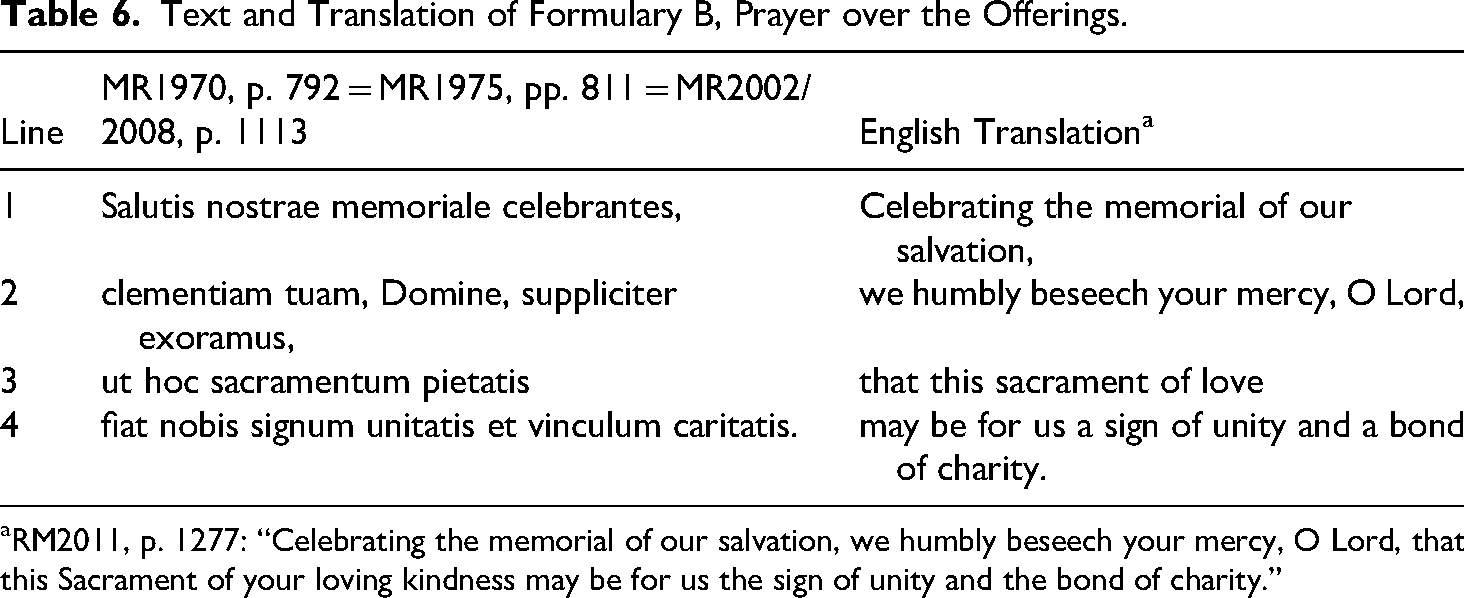
Text and Translation of Formulary B, Prayer over the Offerings.
RM2011, p. 1277: “Celebrating the memorial of our salvation, we humbly beseech your mercy, O Lord, that this Sacrament of your loving kindness may be for us the sign of unity and the bond of charity.”
This prayer draws extensively on Sacrosanctum concilium 47, the opening paragraph of the chapter on the holy mystery of the Eucharist (Table 7). 52
Latin Text and English Translation of SC 47.
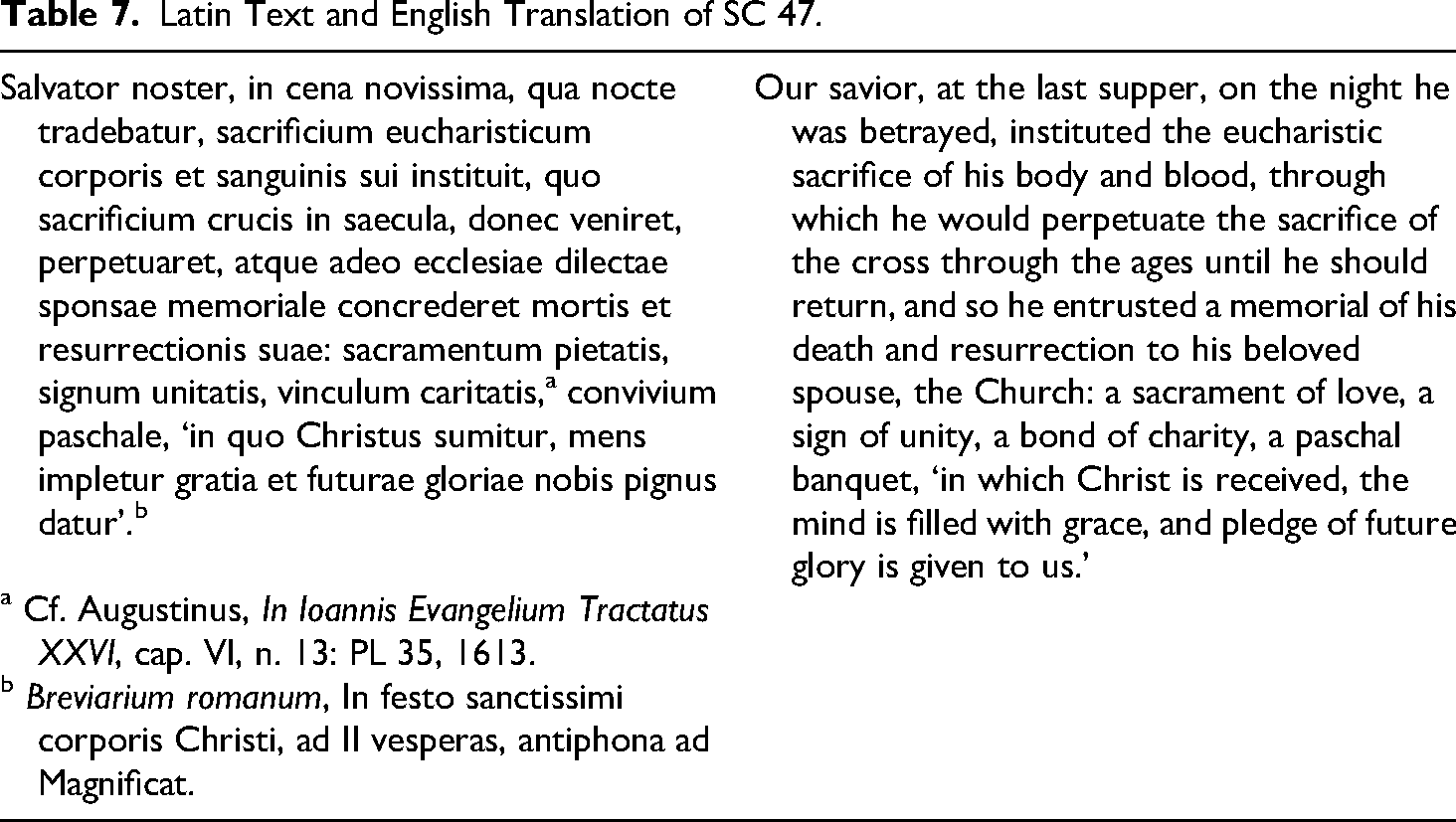
The prayer begins with a participial phrase that acknowledges the liturgical context and describes the event taking place as “Salutis nostrae memoriale” (a “memorial of our salvation”). The term “memoriale” recalls SC 47, which describes the Mass as both a “eucharistic sacrifice” and a “memorial … of [Christ's] death and resurrection.” 53 The next phrase, “clementiam tuam, Domine, suppliciter exoramus,” appears frequently in Latin euchology, and serves as a link to a petition adapting a passage from Augustine's Tractates on John which features prominently in SC 47. In Tractate 26, commenting on the John 6 Bread of Life discourse, Augustine gives a litany of titles for the Eucharist: “o sacramentum pietatis! o signum unitatis! o uinculum caritatis!” (“O sacrament of love! O sign of unity! O bond of charity!”) 54 In the Prayer over the Offerings, the context of the Augustinian exclamations is slightly modified. Rather than simply listing the three titles, the prayer first declares that the Eucharist is a “sacramentum pietatis,” and then uses the phrase “fiat nobis” to ask that the Eucharist might become for us a “signum unitatis” and “vinculum caritatis.” This adaptation responds to the genre of the Prayer over the Offerings, examples of which often express the desire for eucharistic transformation of the gifts which are offered. The petitionary transformation of the phrase implicitly acknowledges that the Eucharist is paradoxically a sign of disunity, insofar as the Catholic ecumenical goal of the “common celebration of the Eucharist” articulated in UR 4 is not yet considered possible by the Catholic Magisterium. In the liturgical context of a Mass for the unity of Christians, the prayer thus expresses the confident hope that this eucharistic celebration will contribute to building up the unity and charity of the Church, while also subtly pointing to the ongoing need for a full restoration of unity.
Like the first collect of Formulary B, the Prayer after Communion is lightly adapted from a preexisting postcommunion prayer. The prayer begins with a petition combined with an address to God (line 1), followed by a purpose clause (lines 2–3) (Table 8).
Text and Translation of Formulary B, Prayer after Communion.
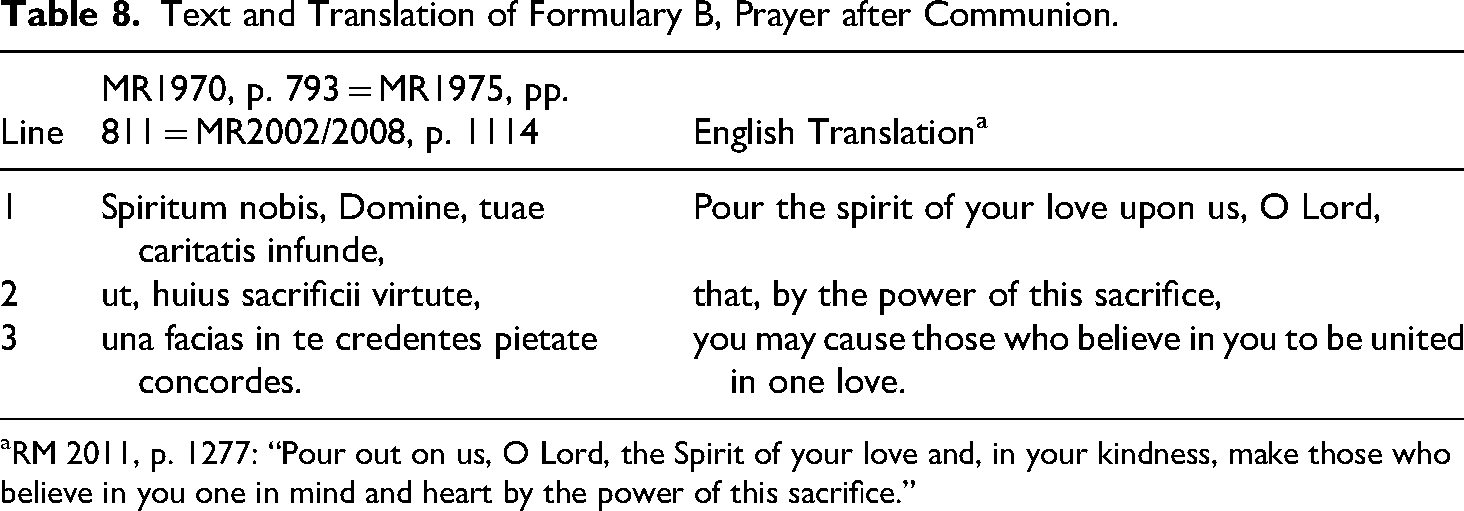
Text and Translation of Formulary B, Prayer after Communion.
RM 2011, p. 1277: “Pour out on us, O Lord, the Spirit of your love and, in your kindness, make those who believe in you one in mind and heart by the power of this sacrifice.”
The Prayer after Communion is lightly adapted from a preexisting prayer that appears in two closely related versions in the Corpus Orationum. CO 5521a appears already in the Veronense manuscript (sometimes referred to as the Leonine Sacramentary) for the Anniversary of a Bishop 55 and in later liturgical sources for a variety of occasions including weekdays after Quinquagesima or as part of a Votive Mass for Charity. 56 CO 5521b, which includes explicit references to the paschal sacraments, also has a prominent place in the Latin liturgical tradition, appearing in many sources for Holy Saturday and Easter Sunday. The later version is itself drawn on by the Constitution on the Liturgy, which cites the paschal version of the prayer (alongside another Easter collect) in the context of explaining the famous adage that the liturgy is the “summit and source” of the Church's life (Table 9). 57
Sources of Formulary B, Prayer after Communion.
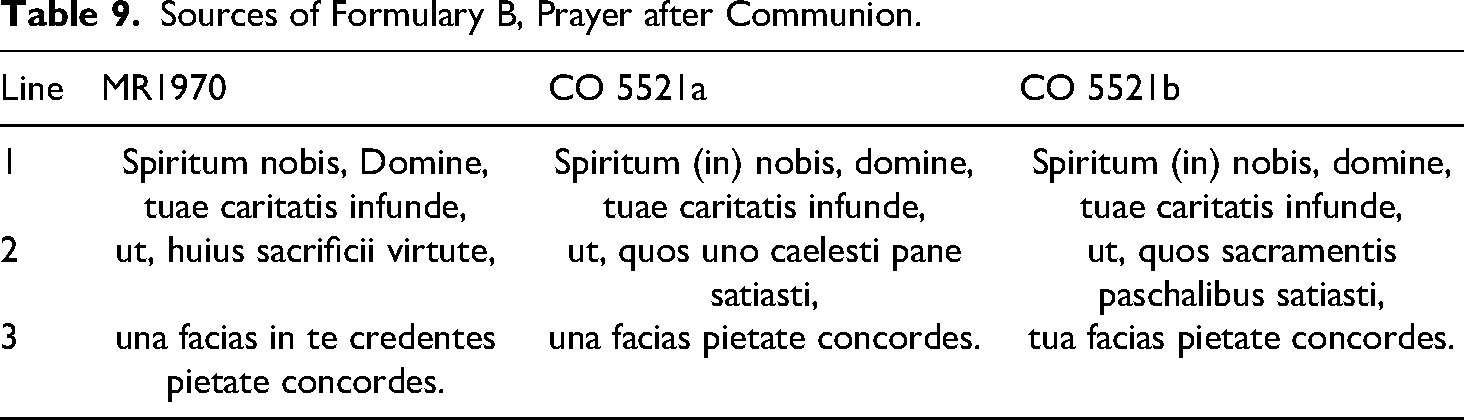
The 1970 prayer differs from its ancient sources by the substitution of the phrase “by the power of this sacrifice” (huius sacrificii virtute) 58 in line 2 for “whom you have satisfied with one heavenly bread” (quos uno caelesti pane satiasti) and by the addition of “those who believe in you” (in te credentes) in line 3. 59 The reason for the first substitution is not obvious, particularly as it removes the Pauline imagery of the “one bread” derived from 1 Corinthians 10:17 which is particularly apt for the context of praying for Christian unity. 60
On the other hand, the addition of the phrase “in te credentes” emphasizes the shared faith which already exists among Christians despite lacking the fullness of unity desired by Christ. 61 Considered together, the modifications to this prayer undertaken by the revisers have a somewhat ambiguous effect; while the addition of “in te credentes” helps specify the ecumenical context of the oration, the removal of the Pauline imagery of “one bread” weakens the symbolic power of the prayer, although it is possible that the phrase may have been removed to make the prayer inclusive to non-Catholic participants who have not been able to receive communion during the Mass. 62
Formulary C contains two collects, the first of which is crafted from a pre-existing prayer together with passages from the Decree on Ecumenism and the second of which is a new composition. The Prayer over the Offerings in the formulary is likewise a new composition, while the Prayer after Communion is adapted from a pre-existing prayer.
Collect 1
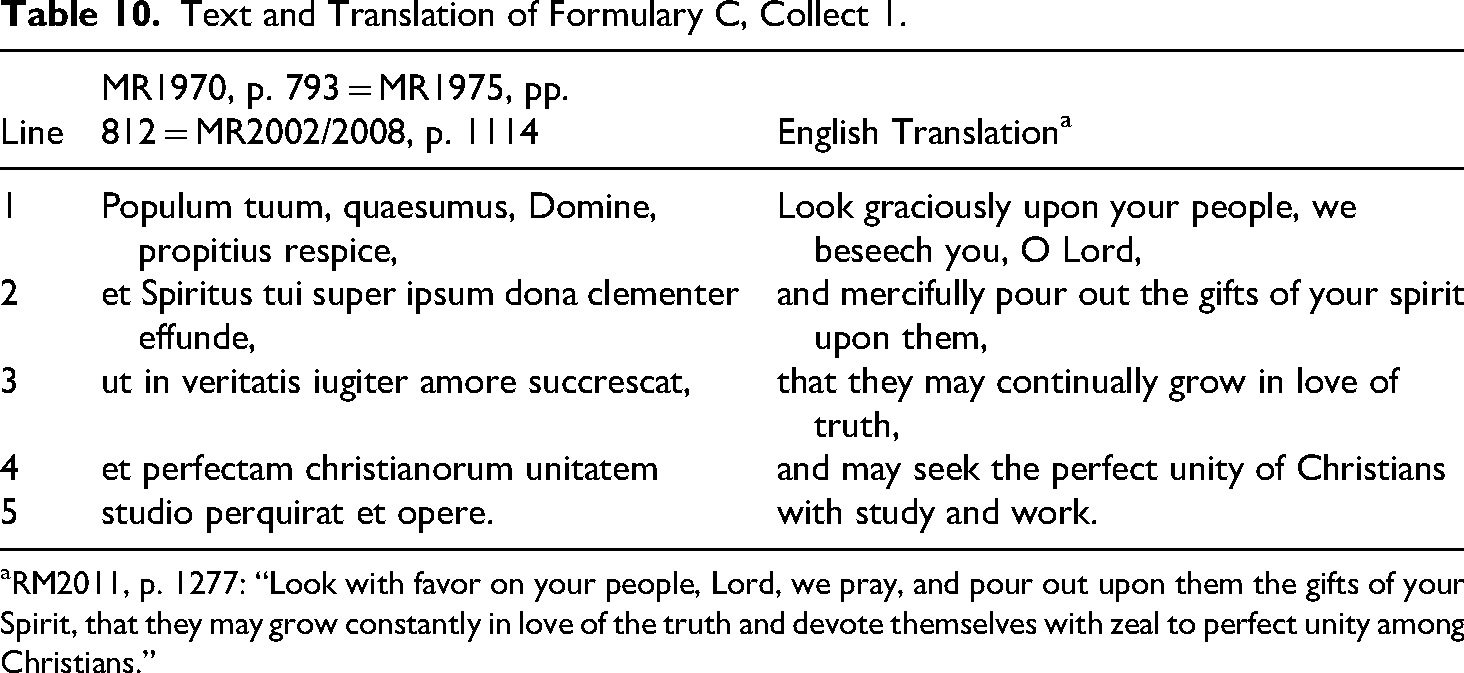
The first collect of Formulary C combines the opening line of a Lenten collect from the Gregorian sacramentary (CO 4294) with a set of petitions derived from various passages of Unitatis redintegratio. 63 The collect begins with a petition and address to God (line 1), then continues with a second petition (line 2) followed by a purpose clause expressing two desired results (lines 3–5) (Table 10).
Text and Translation of Formulary C, Collect 1.
Text and Translation of Formulary C, Collect 1.
RM2011, p. 1277: “Look with favor on your people, Lord, we pray, and pour out upon them the gifts of your Spirit, that they may grow constantly in love of the truth and devote themselves with zeal to perfect unity among Christians.”
The opening petition, “Populum tuum, quaesumus, Domine, propitius respice” (Look graciously upon your people, we beseech you, O Lord), is taken without modification from a Lenten collect (CO 4294) found frequently in liturgical sources from the Gregorian sacramentary through the 1962 Missale Romanum. The second petition requests the gifts of the Holy Spirit for the sake of two further intentions: growth in love of truth and further efforts for unity through study and work. In contrast to the second collect of Formulary A, which prayed for the grace of the Holy Spirit to be poured on us (pleniorem Spiritus tui gratiam super nos effunde benignus), this collect prays for the gifts of the Holy Spirit to be poured upon God's people (et Spiritus tui super ipsum dona clementer effunde). Just as UR 1 emphasizes the role of the Holy Spirit in distributing God's grace, UR 3 draws attention to the “gifts of the Holy Spirit” as being among the “significant elements and endowments” which “can exist outside the visible boundaries of the catholic church” and which impel towards unity. 64
The first result intention asks that God's people “may continually grow in love of truth.” The phrase “love of truth” (veritatis … amore) is taken directly from UR 11, which states that Catholic theologians engaged in ecumenical dialogue “must proceed with love for the truth (veritatis amore), with charity, and with humility.” 65 The second result intention asks that God's people “may seek the perfect unity of Christians with study and work.” Just as the reference to the gifts of the Holy Spirit in this collect paralleled the request for the grace of the Holy Spirit in the second collect of Formulary A, so too this request for the “perfect unity of Christians” parallels the request for the “perfect communion of the Church” in the second collect of Formulary B. The request in the present formulary has verbal parallels with two passages in the Decree on Ecumenism: UR 1 describes the ecumenical movement with the statement that “through the inspiration of the holy Spirit, a movement has grown and developed, whose aim is the restoration of the unity of all Christians (Christianorum unitatem restaurandam).” 66 Likewise, UR 5 uses the adjective “perfectam” in conjunction with “unitatem” in describing the efforts for “full and perfect unity” (plenam perfectamque unitatem) sought by the ecumenical movement. 67 The call to establish this perfect unity “with study and work” recalls the emphasis in UR 9 on the necessity of study in order for Catholics to truly understand “the outlook of our separated fellow Christians” 68 and of UR 4 on the need for “prayer, word, and work” (oratione, verbo et opere) in the field of ecumenism. 69 In this context, it is worth noting that sensitivity to the conciliar sources of this prayer is helpful for the work of translation. In the 2011 Roman Missal, the passage containing the reference to “study and work” is translated as “devote themselves with zeal to perfect unity among Christians.” While “with zeal” is a plausible translation of “studio,” and in fact most uses of “studio” in the Corpus Orationum could be appropriately translated in that way, 70 the emphasis on the importance of study in the Decree on Ecumenism suggests that “with study and work” would be more fitting in the context of this collect for the unity of Christians.
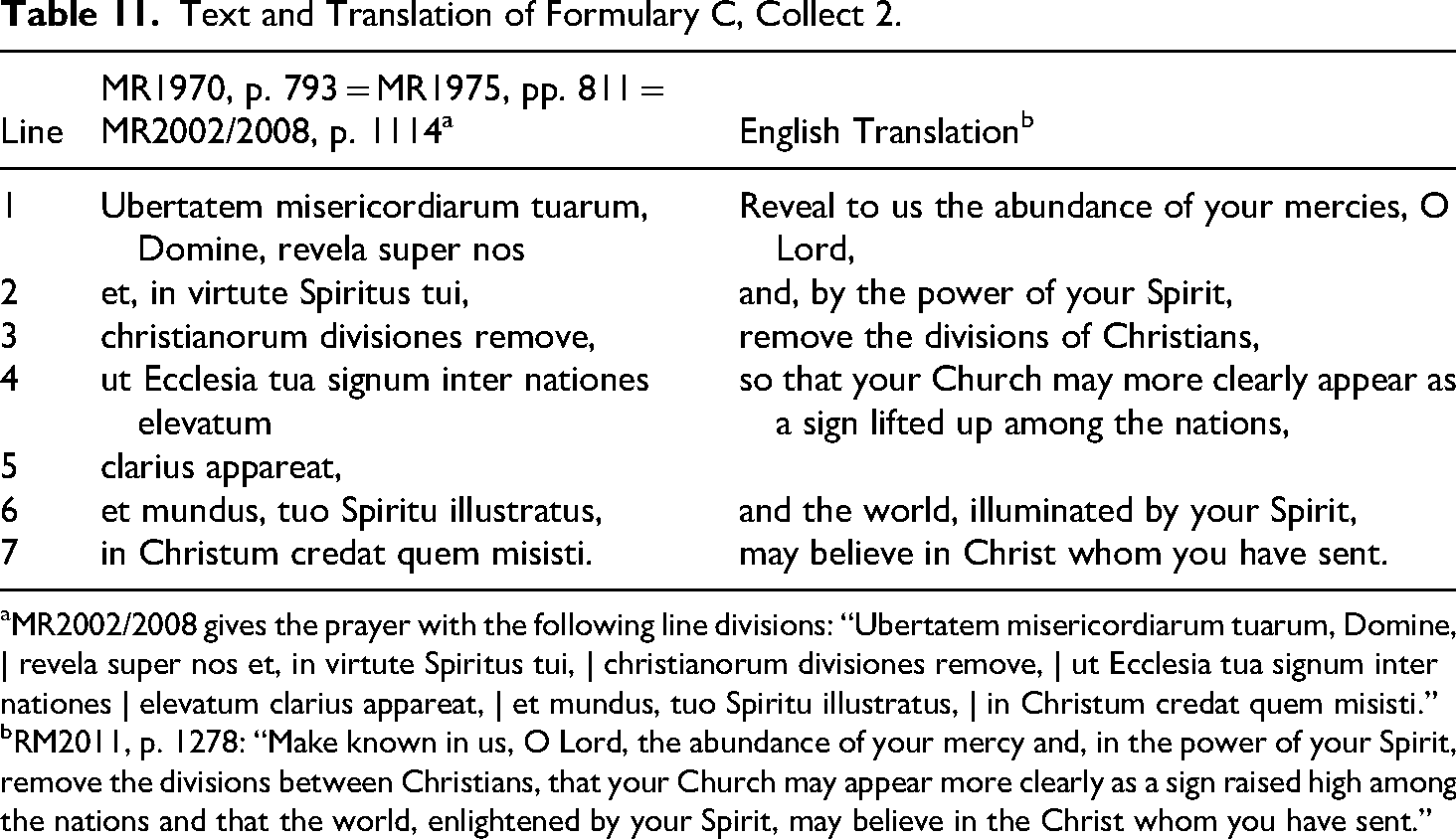
The second collect in Formulary C is an entirely new composition. Although Coppieters ‘t Wallant does not list any sources for the prayer in his indexes of the post-conciliar editions of the Missale Romanum, certain textual parallels may be discerned between this prayer and the Decree on Ecumenism. 71 The prayer begins with two petitions (lines 1–3), the first of which includes an address to God, and the second of which is followed by a purpose clause with two further requests (lines 4–7) (Table 11).
Text and Translation of Formulary C, Collect 2.
Text and Translation of Formulary C, Collect 2.
MR2002/2008 gives the prayer with the following line divisions: “Ubertatem misericordiarum tuarum, Domine, | revela super nos et, in virtute Spiritus tui, | christianorum divisiones remove, | ut Ecclesia tua signum inter nationes | elevatum clarius appareat, | et mundus, tuo Spiritu illustratus, | in Christum credat quem misisti.”
RM2011, p. 1278: “Make known in us, O Lord, the abundance of your mercy and, in the power of your Spirit, remove the divisions between Christians, that your Church may appear more clearly as a sign raised high among the nations and that the world, enlightened by your Spirit, may believe in the Christ whom you have sent.”
The first petition asks that God may “reveal to us the abundance of your mercies.” This is thematically linked to the rich scriptural theme of divine mercy, including the proclamation in Ephesians 2:4 that God is “rich in mercy” (dives est in misericordia). The link of “ubertas” or abundance with mercy is not directly scriptural, but similar expressions are found in the Hexameron of Ambrose of Milan and a letter by Peter Cellensis.
72
The second petition asks that “by the power of your Spirit” God may “remove the divisions of Christians.” The reference to the power of the Holy Spirit draws on the closing paragraph of the Decree on Ecumenism: The synod moreover professes its awareness that human powers and capacities cannot achieve this holy objective—the reconciling of all Christians in the unity of the one and only church of Christ. It is because of this that the synod grounds its hope deeply on Christ's prayer for the church, on the Father's love for us, and on the power of the holy Spirit (in virtute Spiritus). “And hope does not disappoint us, because God's love has been poured into our hearts through the holy Spirit, who has been given to us” (Rm 5, 5).
73
The reference to the “Christ's prayer for the Church” in this passage underscores the connection between the collect and the Decree on Ecumenism, given the allusion at the end of the collect to the High Priestly Prayer of John 17 which will be discussed below. The specific goal of what is to be achieved by the power of the Spirit is the removal of the “divisions of Christians” (christianorum divisiones). Just as in the second collect of Formulary B discussed above, this phrase is taken directly from UR 4, in which the Council Fathers lament that the “divisions among Christians (divisiones christianorum) prevent the church from realizing in practice the fullness of catholicity proper to her.” 74
The request for the removal of division is linked to two further petitions within a result clause. The first asks “that your Church may more clearly appear as a sign lifted up among the nations.” This image is derived from Isaiah 11:12, in which Isaiah proclaims that the Lord “shall set up a standard unto the nations, and shall assemble the fugitives of Israel, and shall gather together the dispersed of Juda from the four quarters of the earth.” 75 Already used at Vatican I as a description of the church, 76 this image is in turn taken up by UR 2: “The church, then, is God's only flock; it is like a standard lifted high for the nations to see it (signum levatum in nationes).” 77 In the liturgical context, the addition of the word “clarius” (more clearly) acknowledges that the Church is a sign for the nations, but that this does not always appear clearly, i.e., that the lack of perfect unity obscures the sign value of the Church. This acknowledgment leads to the final petition of the prayer, that “the world, illuminated by your Spirit, may believe in Christ whom you have sent.” This petition echoes John 17:21: “That they may all be one, as you, Father, are in me, and I in you; that they also may be one in us: that the world may believe that you have sent me.” This verse is directly quoted in UR 2, which links Christ's offering of this prayer for unity with his institution of the “wonderful sacrament of the eucharist, by which the unity of the church is both signified and brought about.” 78 The collect's link between the illumination of the Spirit and the world coming to believe in Christ being sent by the Father echoes the Trinitarian emphasis found frequently throughout UR (e.g., UR 1, UR 2, UR 24) and responds to the liturgical context of the collect, in which the prayer is directed to the Father through the Son in the unity of the Holy Spirit.
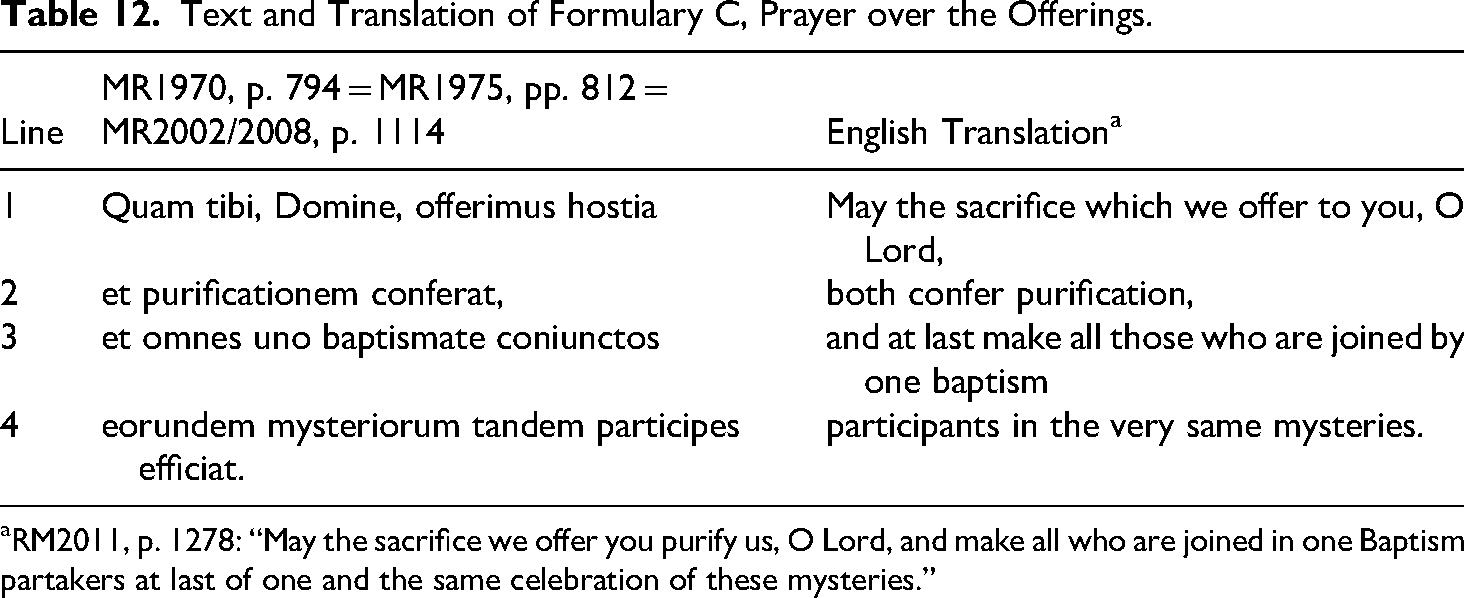
The Prayer over the Offerings for Formulary C is likewise a new composition which includes parallels to passages from the Decree on Ecumenism, although these are somewhat less explicit than the collect just considered. 79 The prayer opens with a reference to the liturgical context of the prayer combined with a divine address (line 1), and continues with two petitions (lines 2–4) (Table 12).
Text and Translation of Formulary C, Prayer over the Offerings.
Text and Translation of Formulary C, Prayer over the Offerings.
RM2011, p. 1278: “May the sacrifice we offer you purify us, O Lord, and make all who are joined in one Baptism partakers at last of one and the same celebration of these mysteries.”
The prayer begins by referring to the “sacrifice” (hostia) which is being offered to God in the Eucharist and makes two petitions. The first petition requests that the sacrifice may “confer purification,” a phrase that is borrowed from a postcommunion prayer dating back to the Old Gelasian Sacramentary and found in later sources for the 9th or 10th Sunday after Pentecost. 80 The emphasis on purification recalls the statement of Lumen gentium 15 regarding the connection of purification and the reestablishment of unity: after describing the links between all the baptized and the growing desire for Christ's disciples to be “peacefully united, in the way established by Christ, in one flock under one shepherd,” the Church “exhorts its children to purification (purificationem) and renewal so that the sign of Christ may shine more clearly over the face of the church.” 81 The second request is that the sacrifice may “at last (tandem) make all those who are joined by one baptism participants in the very same mysteries.” The use of the word “tandem” (at last) recognizes that the restoration of unity is an ongoing process subject to God's timing and not merely the result of human effort. The word appears in UR 18, at the end of the section on the Eastern Churches, in which the Council expresses the hope that “the barrier dividing the church between east and west will be removed, and that at last (tandem) there may be but the one dwelling, firmly established on Christ Jesus, the cornerstone, who will make both one.” 82 The recognition of the existing (but not perfect) unity conferred by baptism is rooted in principles expressed in UR 3 and UR 22, although in this case the parallel is thematic rather than verbal. 83 The expression of hope that those united by baptism will at last be able to participate together in the celebration of the eucharistic mysteries is likewise rooted in UR 22, which emphasizes the need for the sacramental bond of unity established by baptism to be completed in eucharistic communion, as well as underscoring the Council's recognition of the need for further dialogue with “ecclesial communities” which “have not retained the authentic and full reality of the eucharistic mystery.” 84 The petition for the common celebration of the Eucharist is likewise rooted in the passage of UR 4 discussed above, in which the Council expresses the goal of all Christians being united “in one celebration of the Eucharist” (in una Eucharistiae celebratione) as an integral aspect of the unity sought by the ecumenical movement. 85
The Prayer after Communion of Formulary C is adapted from a collect for the Vigil of Pentecost found in the Gelasian Sacramentary. In this case, the modern prayer takes the second half of the Pentecost collect, while crafting a new opening section that reflects the liturgical context of a postcommunion prayer and adding an Augustinian reference that helps specify the ecumenical context of the prayer. The prayer begins with a line acknowledging the liturgical context of the Prayer after Communion and addressing God, then makes two petitions (lines 2–3 and 4–5) (Table 13).
Text and Translation of Formulary C, Prayer after Communion.
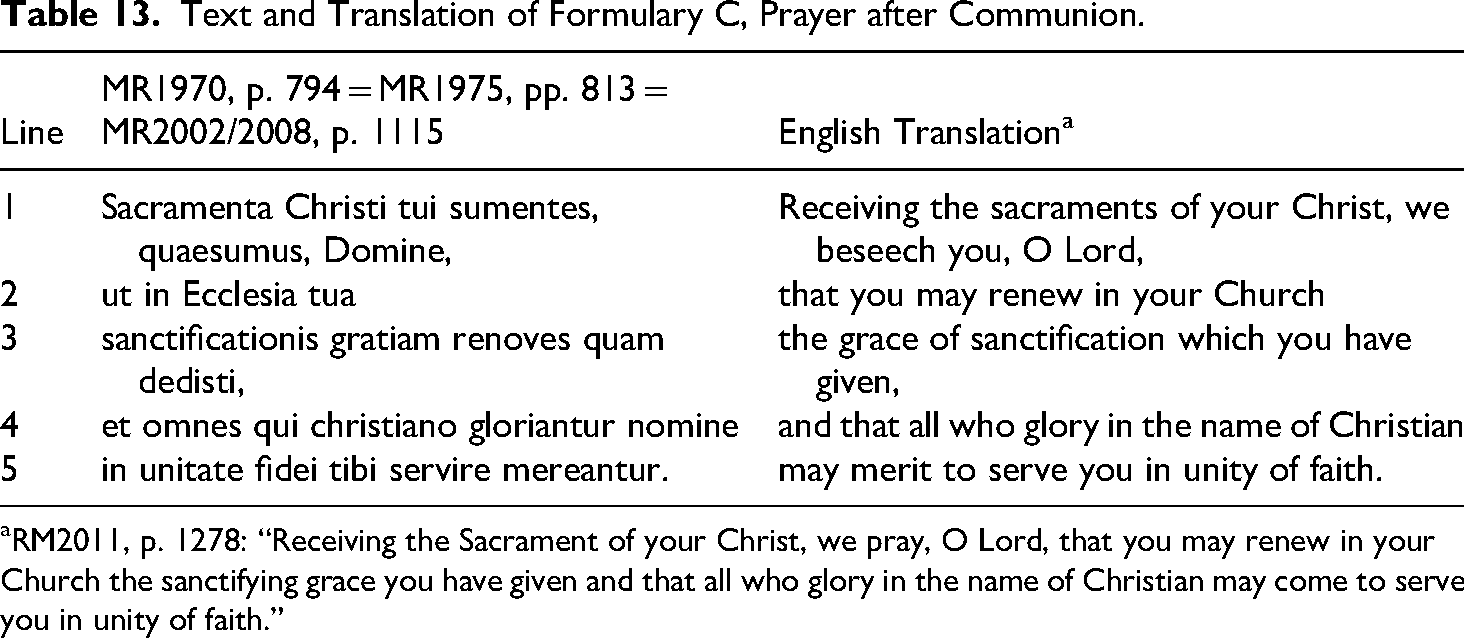
Text and Translation of Formulary C, Prayer after Communion.
RM2011, p. 1278: “Receiving the Sacrament of your Christ, we pray, O Lord, that you may renew in your Church the sanctifying grace you have given and that all who glory in the name of Christian may come to serve you in unity of faith.”
The opening phrase has parallels with other postcommunion prayers which include the phrase “sacramenta sumentes” 86 as well as other prayers which refer to “Christi tui,” although the phrase “sacramenta Christi tui” does not appear in other euchological sources. 87 The remaining part of the prayer is adapted from a Gelasian Pentecost Vigil collect (CO 1192), with various minor changes and additions (Table 14).
Sources of Formulary C, Prayer after Communion.
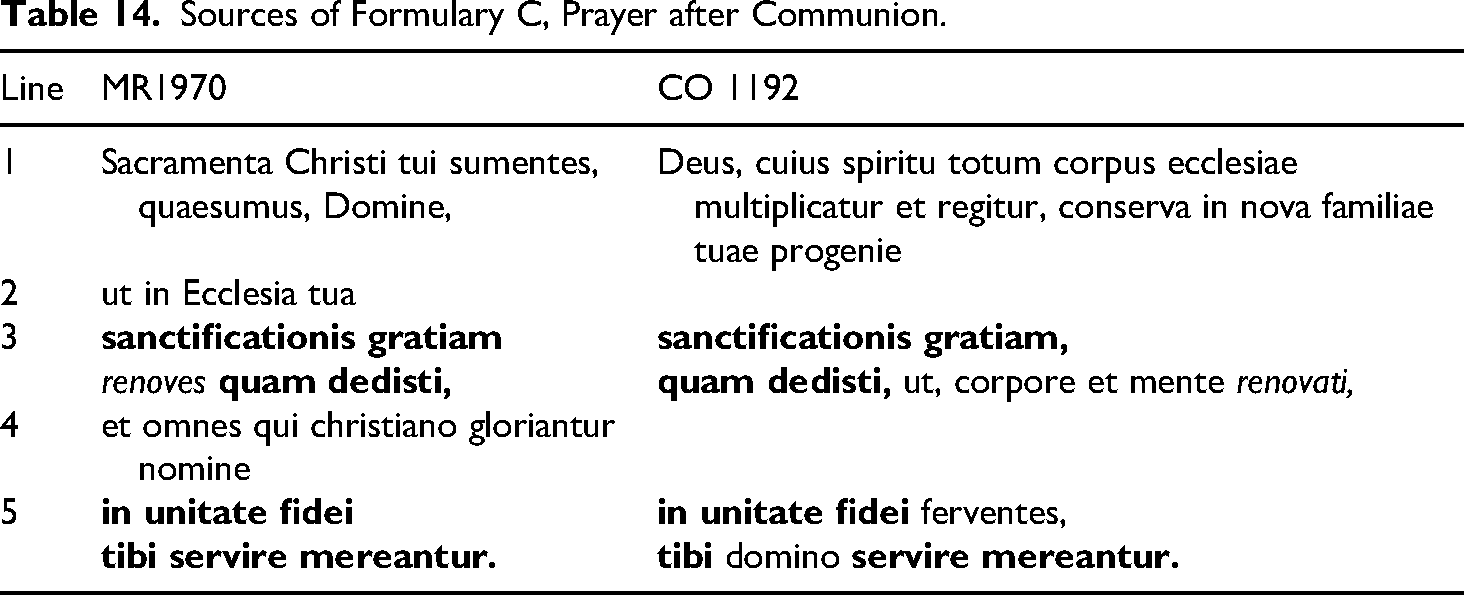
The original prayer asks for the conservation of the grace of sanctification which has been given, whereas the new prayer requests the renewal of the grace which has already been given. The new prayer seems to be referring especially to the baptismal grace of sanctification, requesting that this already existing source of unity may be renewed for the sake of a fuller embrace of the unity of faith. The new prayer adds a phrase not found in the Pentecost collect: “all who glory in the name of Christian” (omnes qui christiano gloriantur nomine). Variations on this phrase appear often in the works of St. Augustine (often with a negative sense of sinful pride), 88 and appear frequently in a positive sense in later writers, including in the conciliar decrees of Lyon II, Constance, and Florence. In the post-conciliar Missale Romanum, the phrase also appears in the collect for St. Patrick and one of the collects of the Common of Pastors. 89 In addition, a closely related phrase is used in UR 3, Lumen gentium 15, and Lumen gentium 69, in these cases speaking of those who are “adorned by the name of Christian.” 90 In the context of the postcommunion for the unity of Christians, this phrase serves to both honor the shared legacy of all Christians while also pointing to the need for a deeper unity that goes beyond names alone to the common service in “unity of faith” referred to at the end of the prayer.
Of the nine orations for the unity of Christians studied in this article, two are lightly adapted from pre-existing prayers while the remaining seven are new compositions which draw to varying degrees on the Latin euchological tradition. The new compositions have a variety of thematic and textual sources, but make extensive use of several documents of the Second Vatican Council: the Decree on Ecumenism Unitatis redintegratio, the Constitution on the Liturgy Sacrosanctum concilium, and the Dogmatic Constitution on the Church Lumen gentium.
These prayers celebrate the already existing unity of Christians brought about by the grace of baptism, but also underscore the need for a more perfect unity that will enable the fullness of sacramental communion between Christians. The liturgical genres of the individual prayers contribute to this differentiation: while the collects tend to be more “inclusive” in their articulation of the unity of those engaged in praying to God for a renewal of Christian unity, the Prayers over the Offerings and the Prayers after Communion explicitly or implicitly acknowledge the wounds to unity which prevent (according to the official Roman Catholic perspective) the united celebration of the Eucharist. 91 These prayers are not “triumphalistic” in this articulation, but nevertheless forthrightly acknowledge the ongoing state of imperfect communion between the Catholic Church and other churches and ecclesial communities. In this respect, they faithfully mirror the nuanced position articulated by Unitatis redintegratio, which signaled a major turning-point in the Catholic Church's engagement with the ecumenical movement while maintaining subtle distinctions between the degrees of unity already enjoyed between various churches and ecclesial communities and the need for a distinction between communes … preces (“common prayer”) for unity and communicatio in sacris or full sacramental sharing in the midst of ongoing divisions. 92
According to the closing paragraph of Unitatis redintegratio, human prayer and work to (re)establish Christian unity ultimately must be rooted in trust in Christ's prayer for us: The synod moreover professes its awareness that human powers and capacities cannot achieve this holy objective—the reconciling of all Christians in the unity of the one and only church of Christ. It is because of this that the synod grounds its hope deeply on Christ's prayer for the church, on the Father's love for us, and on the power of the holy Spirit (in virtute Spiritus).
93
In the Masses for the unity of Christians of the Roman Missal, the Church renews this prayer of Christ for the Church, offering it to our loving and merciful Father in the unity and power of the Holy Spirit.
Footnotes

Funding
The author received no financial support for the research, authorship, and/or publication of this article.
Declaration of Conflicting Interests
The author declared no potential conflicts of interest with respect to the research, authorship, and/or publication of this article.