



Abstract
Risk denotes uncertainty; something that cannot be controlled or planned for. Such uncertainties can be opportunities or threats that positively or negatively affect an intended outcome. Therefore, there is the question: what are the risks involved when identifying difference, and marking it as “diversity” for the purpose of promoting “unity”—ecumenically and in worship? This article intends to explore the risks of identifying difference(s) and/or acknowledging diversity when promoting unity (as well as inclusivity and equality) in liturgy, worship, and liturgical renewal. Furthermore, this article explores the terminology unity and diversity from the fields of liturgical studies and systematic theological ecclesiology with the aim of developing a deeper understanding of what is meant by “unity in diversity,” which includes understanding the concept of the visible and invisible church in relation to ecumenism and unity from a liturgical perspective, as well as the marks of the church.
Unity as a Utopia
In an ever-polarizing world, the church, much like society, is concerned with unity. Similar words that also affect and influence “being church” are often displayed in metaphorical neon-lights such as equality, inclusion, and solidarity. Each of these terms, or concerns, are not new but have become more complex than during the apostles’ early proclamations of the Gospel. This, at the time, drew opposition, rejection, and friction due to opposing opinions on the understanding of “being church.”
1
Van Wyk, in return, asks a question relevant to both the third millennium and the time of the apostles: Does ‘being church’ imply a choice for love, faith, and hope …, based on the inclusive example of Jesus …? Or does ‘being church’ mean a choice for institutionalized genealogy, which could either mean the church is the spiritual Israel, or the continuation of the biological Israel? In essence, when could one be considered to be part of the church and when not?
2
As an introduction to a discussion involving unity, the reality of unity itself is a utopia. Especially amid diversity as achieving unity would change the state of the diverse many to a combined entity—one. On the contrary, Van Wyk argues that “Being church in the world is not an invisible, future accomplishment.” In response, one can both agree and disagree. Yes, being church in the world is currently being accomplished, but no, it is yet to be accomplished. An abundance of examples can be used for either side of the argument.
This article, however, and the author's theological perspective in general, is more in line with Miroslav Volf's point of view; that one is Christian first and foremost, and subscribes to a culture, and other components of one's identity second. This is an extension of Volf’s explanation that: Much like Jews and Muslims, Christians can never be first of all Asians or Americans, Croatians, Russians, or Tutsis, and then Christians. At the very core of Christian identity lies an all-encompassing change of loyalty, from a given culture with its gods to the God of all cultures.
3
Thus, there is a tension created between the united one and the diverse many. As if there is a homogeneous Christian blanket covering the heterogeneity of the people loyal to the God of all cultures (and denominations). Within this tension is where the risk lies, which is what will be explored in this paper by asking the question: What are the risks involved when identifying difference, and marking it as ‘diversity’ for the purpose of promoting ‘unity’ 4 —ecumenically and in worship?
As a presupposition, and prelude, unity in the sense of “being church” (globally or locally)—and “unity in diversity”—is a utopia. In a binary sense, it is yet to happen as evidenced by disunity within the global, visible church regarding opposing opinions on matters of polarity and “us-versus-them” thinking. Ecumenically speaking, this lack of unity; or rather utopian future accomplishment, raises the idea that perhaps while “being church” in unity is still pending, solidarity is constantly achieved.
The word “solidarity” can be defined as “unity (as of a group or class) that produces or is based on community of interests, objectives, and standards” (Merriam-Webster Dictionary, 2021). Jürgen Moltmann 5 conveys the notion of solidarity by describing the suffering of Christ on the cross as also being the sufferings of the poor and weak; “which Jesus shares in [H]is own body and in [H]is own soul, in solidarity with them.” 6 Jamilia Osman 7 quotes Lilla Watson stating in 1971 that: “If you have come to help me, you are wasting your time. If you have come because your liberation is bound up with mine, then let us work together.”
The inference in Moltmann's description, Lilla Watson's popular quote, and the Merriam-Webster definition is that solidarity is signified by a sense of community and/or identifiable unity manifested by mutual experiences of suffering. De Beer and Koster, rather generally, define solidarity as “the positive bond between the fates of different people.” They also describe solidarity to mean “the well-being of one person or of one group is positively related to the well-being of another person or group.” 8 Social cohesion and unity are different to solidarity, 9 in that the latter suggests a cause underpinned by self-donation and/or self-giving, or as Volf expresses: “solidarity refers to ‘struggling on the side of,’ rather than simply to ‘suffering together with.’” 10
The understanding (and amalgamation) of the descriptions and definitions given above is that solidarity involves positive giving of oneself within a community struggling for the mutual well-being, interests, objectives, and/or standards of its members. Watson suggests that self-giving, in the sense of helping, is not an act of solidarity. However, the descriptions shared by Volf and Moltmann suggest differently—namely that self-giving, especially for the well-being of another, is indeed an act of solidarity.
It is on the understanding of self-giving that the idea of ecumenical solidarity arises and is underpinned by understanding that genuine Christian reflection on social issues “must be rooted in the self-giving love of the divine Trinity as manifested on the cross of Christ; all the central themes of such reflection will have to be thought through from the perspective of the self-giving love of God.” 11 As a prelude to Christ on the cross is the last supper and the lesson that came with Jesus washing the feet of the disciples: “Very truly I tell you, slaves are not greater than their master, nor are messengers greater than the one who sent them. If you know these things, you are blessed if you do them.” (John 13:16–17, NRSV). The words of Matthew 25:35–40 (NRSV) may also resonate with the notion of self-giving in solidarity through genuine Christian reflection: “… Truly I tell you, just as you did it to one of the least of these brothers and sisters of mine, you did it to me.”
Both verses convey a sense of humanity, with an undertone of equality with the reference to “brothers and sisters” and a reminder that: “slaves are not greater than their master, nor are messengers greater than the one who sent them.” Jaime Clark-Soles argues, under the reasonable assumption that Jesus performed a foot washing, that: “Jesus may have signified one or more themes that would have been available to a Galilean Jew of the first century, namely, friendship, sacrificial love and purification….” 12 Sacrificial love, which Clark-Soles 13 acknowledges is closely tied to friendship, in this occurrence can boldly reflect as the reversal of status; “a critique of hierarchy and embracing radical egalitarianism”—and humility. 14
Perhaps the unity sought through ecumenism is not the church becoming one, as the simplest understanding of unity but rather unity as in solidarity. In this way, diversity and multiplicity are maintained albeit as an ecumenical whole that struggles on the side of, and/or acts on the self-giving love of the divine Trinity. Whichever approach to unity is preferred, and a case will be made for solidarity at a later stage, diversity is still a determining factor in effectiveness. The terms difference and diversity should be understood first before exploring the research question.
Difference and Diversity
One experiences the other as tabula rasa: This response almost acknowledges the other as un-human because “they” are seen to have “no story, no selfhood, no history.” When encountering the other, one fails to understand the others’ stories, traditions, and cultures to the extent that they do not truly realize the selfhood of the people that are other to themselves. One experiences the other as a threat: Unfortunately, a catalogue of examples exist that assist in describing this response to difference. Examples include apartheid, the holocaust, genocide (in Rwanda) and ethnic cleansing (in Eastern Europe) as well as all racist, sexist, and homophobic attitudes. One experiences the other as some exotic, romantic being who is so different that they need not be taken seriously; or the other as some universal category of person that is undistinguishable from any other person in a classed group.
Immediately, there are at least three recognizable and real risks in identifying difference or as Ackermann puts it, the other. Before discussing the risks further, it is necessary to develop the understanding of difference more deeply and what it means for diversity.
When discussing identity, Volf refers to the “politics of difference” which, he writes, “rests on two basic persuasions.” The first is that “the identity of a person is inescapably marked by the particularities of the social setting in which he or she is born and develops.” 17 In other words, one identifies with (and acquires identity through), for example, parents, friends, classmates, teachers, clergy, and more, but also importantly their sharing of language, beliefs, customs, traditions, and ideologies. 18 Identity, thus, is shaped in part by recognition of and by those with whom “we” identify. The second basic persuasion of the politics of difference is that failure to recognize, and/or “misrecognize” can be harmful, oppressive, or imprison “someone in a false, distorted, and reduced mode of being.” 19
Similarly to Ackermann, Volf highlights some approaches to the problems of identity and otherness. The approaches Volf discusses, however, are remarkably different in execution from the responses discussed by Ackermann. These so-called solutions differ from Ackermann's responses in that each is focused more on social arrangements rather than inter- or intra- personal interactions between one person (or group) and another. Each of the options below is a proposal on how a society could be arranged to avoid exclusion and accommodates people living together amid diversity:
20
The “Universalist Option” involves controlling the “unchecked proliferations of difference” and the spread of universal values that ensure coexistence. Conversely, the acceptance of difference without these universal (religious) values will lead to “chaos and war.” The “Communitarian Option” involves the celebration of communal characteristics and the promotion of heterogeneity. This option envisages that the previous option, of promoting universal values, will lead to “oppression and boredom rather than peace and prosperity.” The “Postmodern Option” is a more radical approach to solving the problems of identity and otherness and involves turning away from universal values and the particularities of identity and seeking “refuge from oppression in the radical indeterminacy of individuals and social formations.” In this way, spaces should be created where individuals can constantly create and acquire new identities and lose the old ones.
For Volf, however, these social arrangements are not paramount. Instead, and here there are similarities to Ackermann, Volf is more concerned with how one needs to be to co-exist with others. Considering the concept of ecumenism, or the ecumenical church, perhaps Volf's suggestion here should be taken to heart—whether it be in unity or solidarity: “theologians should concentrate less on social arrangements and more on fostering the kind of social agents capable of envisioning and creating just, truthful, and peaceful societies, and on shaping a culture climate in which such agents will thrive.”
21
The suggestion being made here is that theologians, liturgical scholars, and those involved in designing and implementing liturgies should not set their focus on social arrangements. In other words, they should not choose one of the options listed above nor develop their own social arrangement. Instead, they should focus on cultivating an environment in which people can act as social agents that, in turn, stimulate unity in the midst of diversity. Thus, the focus is less on arranging a context in which different identities engage with one another in a specific format; and more on nurturing people on how to co-exist with other individuals from different contexts.
James K. A. Smith, a liturgical scholar, takes a different approach to understanding identity, or the formation of identity, and difference. 22 In discussing what a human person is, Smith first draws on philosophers Plato and Descartes and the notion of “I think, therefore I am.” His explanation, however, goes further in asserting that humans do not simply think their way through existence and perceive the environment around them; humans also feel. He adds that the fundamental way in which human beings intend the world is love. Thus, “ultimate love” is formative and constitutive of identity. “Ultimate love” is not the trivial love of a sport team or meal, nor is it the significant love of a family member or counterpart; it is “that to which we are fundamentally oriented, what ultimately governs our vision of the good life … what we desire above all else, the ultimate desire that shapes and positions and makes sense of all our penultimate desires and actions.” 23 Smith adds that this love or desire “is a structural feature of being human.” 24 If (ultimate) love is formative of identity, then what human beings love distinguishes one (individual or group) from another (individual or group). 25
Before considering the empirical data, it is necessary to develop an understanding of “church” for the purposes of the phrase “being church.” Church is more than the meeting place of the diverse and/or different individuals and their approaches to one another. Additionally, the concerns over unity and ecumenism are not limited to people alone but include the church (as a global institution) and churches (as the gathering places of local communities of Christians).
The Visible and Invisible Church
The idea(s) of the visible and invisible church is connected to the four marks of the church. These marks, from the Nicene Creed are: one, holy, catholic, and apostolic church. 26 “One,” “holy,” and “apostolic” are isolated, albeit integrated, adjectives or attributes. Importantly, these are made by faith and should be made in faith to avoid losing meaning as integrated components, which cannot be detached from their context, of the triune God. 27 Furthermore, Moltmann writes that “the acknowledgement of the ‘one, holy, catholic, and apostolic church’ is acknowledgement of the uniting, sanctifying, comprehensive, and commissioning lordship of Christ.” 28 Each of these components can be seen as statements of faith, hope, and action. 29 The table below summarizes how each mark of the church is a statement of (1) faith, (2) hope, and (3) action: 30
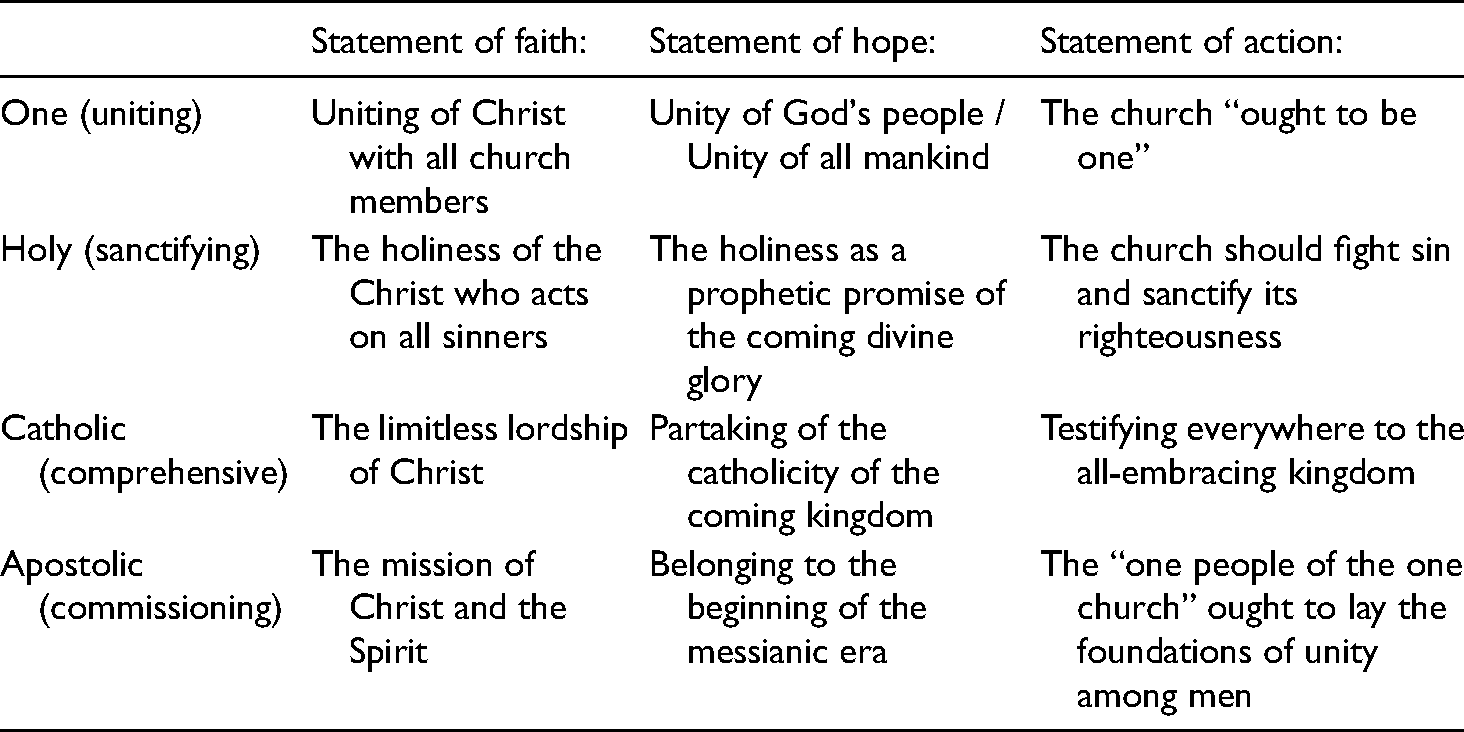
Considering the summary in the table above, the marks of the church are both indicative and imperative characteristics. The nature of the marks of the church as statements of faith indicated a church in acknowledgement of its existence because of Christ's actions. Thus, a church acknowledging the marks of the church as characteristics are, first and foremost, the activity of Christ. Second, the nature of the marks of the church as statements of hope suggests the church's existence being rooted in Christ's messianic mission. Therefore, the church's marks have messianic premise. Lastly, these marks as statements of action encourage a course of action in response to the marks of the church characterized as statements of faith and hope. Moltmann explains that their characteristics bear the essential nature, or essence, of the church; therefore faith, hope, and action “are the genesis of the form of the church visible to the world in unity, holiness, catholicity, and apostolicity.” 31 “In other words, the church lives dynamically, throughout historical form, in the ‘one, holy, catholic, and apostolic’ rule of Christ visible through faith, hope and action.” 32
From the perspective of reformed theology, Calvin's focus on the unity of the church is somewhat like the marks of the church described above. Calvin argued that the church is the object of faith and not simply the result of humankind's decision to join one another in worship; second, that the church is the mother of all believers which reiterates that there can be only one church; and third that “it is not for us to decide whether we will belong to the church, or not, or to which church we wish to belong to, or not, or—even worse and almost beyond imagination—whether we will allow believers in the church or exclude believers from the church.” 33
Keeping in mind these statements of faith, hope, and action, binary thinking suggests a visible and invisible church. On one hand, the “visible” church as the church as it presently appears to be. On the other hand, the “invisible” church refers to an understanding of the church already being united (or one) simply, conceptually because of the mutual belief in God. 34 The invisible church, or ecclesia invisibilis, refers to the one true church and/or truly one church. 35 However, there are several questions about this concept of the church in duality.
Without entering those conversations and the confusion surrounding the somewhat contradictory notion of the church in duality, the understanding here is that the visible church refers to church(es) as it is (and was), and the invisible church refers to what the church ought to be. In this regard the visible church is the church as it is, with all its diversity associated to “interpretation, formulation, confessions, order, the ministries, the forms of local worship, and much more.” 36 The invisible church, on the other hand, is the church in an ideal world where the earthly (visible) church becomes heavenly (invisible); the church already as one; a “hopeful ideal that is sought to be achieved”; the divine church in comparison to the visible, earthly, human version. 37
Visible or invisible, from an ecclesiological perspective, “church” is seen as the tangible community where Christians gather for the purposes of worship, prayer, sharing, learning, contemplation, and mission. 38 Additionally, “church” is seen as one social organization among many while also being viewed as a shared form of life, shaped by sincere and fervent theological self-understandings. 39 Moltmann explains that the church “stands for God to the world, and it stands for the world before God.” 40 Therefore, it ought to always present itself in the forums of both God and the world.
With an understanding of unity, difference, and diversity (and identity), as well as theoretical concepts of what church is, the empirical data detailed below can be analyzed. The key concepts above assist in gauging the risks involved with applications of unity.
The Risks Involved
This section begins with a pertinent question asked by Volf in his book Exclusion and Embrace: “Could it be, however, that the medicine itself is making the patient sick with a new form of the very illness it seeks to cure?” 41
This question is asked in response to the notion that society, in general, should persist with the modern idea of inclusion until the last evidence of exclusion is expunged. This immediately brings to the surface the concern that, among other risks, unity to the point of absolute inclusion is problematic. The language of “we”/“us” and “they”/“them” will be used in the proverbial sense from here on, in developing a few points of risk. Immediately from the above, one potential risk in “us” identifying “them” as different presents “them” with a choice: be inclusive with us or be ejected by “us” through exclusion. In other words, “they” ought to be in agreement with “us” and “our” “normal” views, values, beliefs, and morals or “we” will eject “them” for being “abnormal.” 42 Furthermore, when “we” identify “them” as different for the sake of inclusion, “we” have immediately excluded “them” because “they” are not “us.”
In the first part of this paper, two points were made on the phrase “unity in diversity.” The first point was that the very notion is utopian; while there is evidence of unity there is not—nor will there be—complete unity. The second point is part and parcel of the first point, the phrase “unity in diversity” is ironic because the term “unity” denotes one entity; while “diversity” is the term for many entities. Therefore, in pursuing unity to the nth degree, “we” or “they” (depending on where one situates oneself) are seeking “to level all the boundaries that divide and to neutralize all outside powers that form and shape the self.” 43
Below is an example of the medicine itself making the patient sick with a new form of the very illness it is trying to cure. At many South African churches, the leadership—usually made up of “us”—has this idea that “we” will be inclusive if “they” lead us in worship with “their” songs of praise. Many worshipers have observed what tends to happen in these scenarios. Drawing from one participatory observation ought to give sufficient account of the inclusive cure becoming a variant of the exclusive illness. 44
Beyond South Africa being the country of apartheid and a history of exclusion, it is also a place of racial, cultural, and linguistic diversity. South Africa boasts having twelve official languages. With all these languages in mind, the medicine of inclusivity can become an illness when worship becomes an act of inclusion. In a rather pluralistic church in South Africa, those planning the liturgy decided that the predominantly English-speaking congregation should be led by a choir exclusively worshiping in isiZulu, isiXhosa, and seSotho. That which was observed and recorded during that worship service showcases the risks of identifying difference and promoting unity (or inclusivity). It could have been a coincidence, although the chances of that are low, that those who planned this worship service decided on having an African choir lead worship on the Sunday preceding the South African national elections. This act of inclusion, and display of unity, presented evidence of the risks that Ackermann and Volf discuss.
As a point of departure, the language barrier posed a problem. The majority English-speaking congregation found it difficult to follow as they read new words for the first time, as they attempted to sing. Second, the choruses with which they were familiar, sung in English, were performed in a unique way by the choir. While this is a risk and potential disadvantage, it is also a benefit of inclusion. The benefit is that the African choir singing their version of a colonial English song of praise shows that it is now as much a song of “theirs” as it is “ours.” The disadvantage is that in attempting to be inclusive, this rendition excludes those that normally sing it differently. This was observed later in the service when the choir was singing another English hymn, albeit the African version of it. It was recorded that the (Caucasian) English-speaking members of the congregation were unable to follow; while those that knew this version were reveling in the experience and the opportunity to worship in a way more familiar to them.
Since the issue of unity and inclusivity is not limited to the worship service, and because it is important to draw on the lived experiences of people, another example of “the cure of inclusion becoming the disease itself” is explained by a group of South African, Black, professional cricket players. A qualitative study investigated the perceptions of players and key informants of the “effectiveness of a quota intervention in South African cricket.”
45
In this study, forty-three players and sixteen informants provided an important insight into acts of inclusion; the excerpt below is pertinent to the question asked in this paper: All participants believed that the changing character of the senior teams negatively impacted team cohesion and effectiveness. The majority of Black African players sensed they did not belong in the current senior team setups. They believed that this was, in the main, due to the [mindsets] of team leadership and to a lesser degree, their teammates. This sense of exclusion manifested in perceived discriminatory selection practices, decreased opportunities, limited playing time and a lack of integration into the team culture. Many of these exclusionary behaviors were less overt, for example language, music and food preferences of the dominant culture prevailing. These sentiments expressed by the Black African players were reinforced by most key informants … Some Black African players felt uncomfortable knowing that they may be selected only because of the quota policy and not their ability.
46
The majority of White, Colored, and Indian players were more positive about the team environments in which they played. Notwithstanding this, White and Colored players felt they were being unfairly treated because they were left out of teams for Black African players who were perceived to be less competent. It was apparent that the policy had created unnecessary rifts and that much of this could have been alleviated through more honest communications and team leadership.
48
These attempts at inclusion hardly look inclusive or uniting. Whether it is a worship service or professional cricket, some methods of inclusion do not achieve what is intended. From the above it seems that while there appears to be some form of unity, there is certainly also palpable disunity and/or exclusion. These risks, like the others mentioned here, are pertinent in understanding “unity in diversity” when considering any form of ecumenical church. Perhaps, before attempting to foster unity (or inclusion), “we” and “them” should consider what unity means in the context of its application and why it is applicable.
Conclusion
Ecumenically speaking, for the purposes of “unity in diversity,” and as a suggested theory for praxis, perhaps the church as a global community of Christians should take an approach similar to that which Volf argues for when suggesting that “Christians can never be first of all Asians or Americans, Croatians, Russians, or Tutsis, and then Christians.” In other words, the ecumenical church should not be first of all Anglican or Presbyterian, Catholic, Orthodox or Pentecostal and, then, Christian. There should be a shift, not so much in loyalty as Volf suggests but, in understanding from a given denomination with its doctrine to the church that struggles on the side of, and/or acts on the self-giving love of the divine Trinity as a Christian entity. Therefore, a visible and invisible church that displays unity in the form of solidarity without being swallowed into some homogeneous state with a lack of identity.
Theologians and church leaders alike ought to carefully think and rethink the idea, utopian or not, of unity and its application. The attempts concisely detailed above, whether in the worship service or in the lived experience of national sports teams, are indicative that there are risks to cultivating unity; and that not all attempts at unity are successful which further highlights Volf's approach that theologians and, by virtue, clergy and worship leaders should set their focus more on fostering social agents with the ability to envision and create “just, truthful, and peaceful societies” and shape a culture climate in which such agents can thrive. 49 Thus, if the church is a social organization shaped by sincere and fervent theological understanding, and the church stands for God to the world, and for the world before God, 50 in maintaining diversity the church can establish unity by “struggling on the side of.” This could be evident in liturgy as people come together and act on the self-giving love of the divine Trinity, in the visible church.
Footnotes
Declaration of Conflicting Interests
The author declared no potential conflicts of interest with respect to the research, authorship, and/or publication of this article.
Funding
The author received no financial support for the research, authorship, and/or publication of this article.
