



Abstract
Liturgical theology is a relatively new sub-discipline of theology. Despite many efforts, clarity is still lacking in both its purpose and methodology. In this study, the liturgical-theological method of luminary Kevin W. Irwin is dissected, diagrammed, and evaluated in direct response to recent calls in the academy for clarity in liturgical-theological method; the study also contributes to the ongoing conversation as to what liturgical theology is, why it matters, and how it is to be undertaken.
Keywords
Introduction: Liturgical Theology and the Pressing Need for Methodological Clarity
As liturgical scholar Teresa Berger has observed, “in the last half-century, the liturgy has (re-)emerged as a distinctive source for theological reflection.” 1 Early work in the domain focused on crafting dialectical definitions of liturgy and theology, often relying on the sixth-century axiom lex orandi, lex credendi. 2 Work in liturgical-theological method soon followed. Since this flowering of liturgical theology in the academy, scholars have produced an unparalleled number of works utilizing liturgy as the primary source. 3 Though fewer such theologians have ventured explicitly into the question of methodology, several crucial works have emerged 4 and the question of how to do liturgical theology remains a pressing and sometimes vexing question.
Pressing, also, is the question of why engaging in rigorous liturgical theology is essential or even urgent in the present day. The sacramental theologian and liturgical scholar David N. Power has argued convincingly, for example, that the decline in collective memory in “first-world” cultures is having a dire impact on the ability of collective worship to function effectively. 5 An important way, though one of many, for the academy to explore this problem is via liturgical theology.
Part of the challenge when it comes to method in liturgical theology is that the broader field of liturgical studies is an inherently and inescapably interdisciplinary endeavor. Insights from disciplines beyond theology must inform liturgical theology, for example, if one were to investigate Power's argument. Interdisciplinarity also means that scholars approach liturgical theology from different starting points. One might begin with musicology, while another may start with systematics, and yet another ritual/ethnographic research. As such, working towards the clarity Joris Geldhof argues for (and often provides), as well as clearly delineating and investigating extant and possible methods, are crucial tasks.
It is also true that liturgical theologians have an underlying methodological problem: how can they be sure to define the object of liturgical-theological reflection in a way that moves beyond just text, while at the same time recognizing text as a primary conveyer of meaning in human ritualizing? Though it is unquestionably true that all aspects of liturgical celebration constitute data for liturgical-theological reflection, it is still unclear how theologians are to consider this vast data set in a way that is both coherent and useful, and at the same time avoids the real threat of a methodological quagmire. 6 To say the path ahead is not entirely clear is an understatement.
A beginning to a solution can be found in liturgical scholar Joris Geldhof's (Katholieke Universiteit Leuven) call for “a great amount of daring” in the methods that liturgical theologians employ.
7
Experimentation is required that tests existing theological methods, as is the positing of new methodologies. This article is one step along this daring path, peering into the inner workings of a method and pointing forward to new routes on the liturgical-theological map. In many ways, the study is a reaction to Geldhof's 2020 work Liturgical Theology as a Research Program.
8
In this book, Geldhof lays out five questions to guide a “research program” in liturgical theology:
What is the proper place of liturgical theology? What past evolutions have there been and what tendencies are there currently in the field of liturgical theology? What contents should liturgical theologians focus on? How can liturgical theologians engage in research? How can liturgical theology appropriately respond to what happens in church and society? the scope of liturgy must not be separated from the one of fundamental theologies and philosophies of religion. Where else could God's Word be heard? Where else is it spoken? Where else is the Word of God embodied in concrete circumstances and received in one's community and one's life?
14
Geldhof's first and fourth questions are most relevant to this article. In terms of liturgical theology's “proper place,” it would greatly benefit the academy to pay closer attention to liturgical theology as a sub-discipline. It serves as a “bridge-builder or go-between,” Geldhof says, for sacramental theology and liturgical studies, as well for the historical and pastoral sides of liturgical studies.
9
Liturgical theology also has the potential to inform the broader discipline of theology in relation to ecumenism and truly contextual theology.
10
Even further, Geldhof suggests that in theology over the past century (at least) there has been a near universal Liturgievergessenheit (“the broad phenomenon of forgetting or neglecting liturgy within theology”
11
) in the global West
12
to the detriment of the discipline. While, of course, a liturgical theologian would be likely to argue for greater prominence of the discipline, Geldhof's argument that “Liturgy qua liturgy—i.e., not liturgy as a repertoire of textual illustrations but as a constitutive organic whole—has not been at the forefront of mainline theology … for centuries”
13
is quite convincing and opens systematic theology to an array of criticisms. To be sure,
In terms of Geldhof's fourth question about method, he states, “It is not clear which method, or methods, liturgical theology must preferentially adopt and why.”
15
He goes on to assert that, The basic methodological problem … concerns … access to liturgical reality, which seems … hardly reflected upon. I mean access in a quite literal sense: how can one access liturgy? How can one approach it, enter it, become part of it, observe it, in such a way that it allows one to develop theological insight about it, from it, into it, with it?
16
This article also aims, then, to respond to Geldhof's methodological question.
In what follows, the liturgical-theological method of Kevin W. Irwin—as put forward in his monumental works Context and Text: A Method for Liturgical Theology (2018) 17 and The Sacraments: Historical Foundations and Liturgical Theology (2016) 18 —will be examined in detail, providing a model for similar work related to other methods and bringing some clarity to what it means to do liturgical theology. 19 (It is worth noting that Geldhof calls Context and Text “probably the most important reflection about method in the field of liturgical theology.” 20 ) This article begins by exploring Irwin's work and influences, moves on to delineate the foundations of his method, then dissects and diagrams his method, including modes of utilizing the method. The article concludes with some critical engagement with Irwin's method as well as by noting some open questions about Irwin's liturgical-theological project and liturgical theology in general that point forward to future work that needs to be commenced by theologians. It must be said at the outset that Irwin is a Roman Catholic theologian and that his method focuses on the post-conciliar Latin rite. His method is ecumenically useful, nonetheless—as he asserts, as the method delineated below will make clear, and as the influences on his professional life make nearly impossible to refute.
The overarching aim of this article is not to put Irwin's method into conversation with other methods (even Geldhof's), but rather, first, to answer Geldhof's call in the liturgical academy to provide clarity surrounding method in liturgical theology, which might in turn spur liturgical theologians to more careful articulation of the why and how of liturgical theology. One could assert, notwithstanding many exceptions, that often liturgical theologians, me included, talk too much about liturgical theology and might make more of an impact if we were to focus more on accessing liturgical reality, as Geldhof puts it, from a theological point of view—in other words, doing liturgical theology. Such access requires method, and this article aims to delineate and clarify a specific method with an eye to encouraging its more frequent use in context, as Irwin might say.
A second part of the fundamental aim of this article is to encourage experimentation and creativity in the devising of new or cognate methods for doing liturgical theology, which Geldhof has flagged as essential to the future of the discipline. Discerning the inner workings of a particular method can aid in its critique as well as in constructive methodological work in parallel or alternative directions.
Irwin's method is not revolutionary in the sense that its aim is to upend how we think about liturgical reform and renewal, but, if taken seriously and put into practice, while of course noting this putting into practice requires the active collaboration of Church authorities (here, in the Roman Catholic context), the critical edge of Irwin's method would require much change in our current way of doing liturgy. The edge of Irwin's insight remains the principles of liturgical reform of the Second Vatican Council. While the academy is quite familiar with said principles, it is my (and perhaps Irwin's) assertion that the liturgical reform has barely begun, and its potential for transformation remains largely unearthed. 21 Liturgical theology, done well, has a critical role in the task ahead.
Work and Influences: Kevin Irwin's Liturgical-Theological Project
Irwin's Influence(s)
Kevin Irwin's influence within Catholic sacramental theology and liturgical studies is difficult to overstate. He is a prolific writer: more than twenty books, eighty-plus articles, over ninety reviews, and counting. Given the volume of his work, naturally, his interests span far beyond method in liturgical theology to areas such as liturgical spirituality and, perhaps most importantly, the environment. In this latter arena, his insights about the inseparability of creation and sacraments, grounded in the principle of sacramentality, have shed light on the “how” of Christian sacraments. He is not new to the fray and has recognized sacramental theology's potential to inform the debate about care for the environment since at least the early 1990s. The enduring nature of this concern is clear from his 2016 published commentary on Laudato Si’, Pope Francis’ encyclical on the environment.
Kevin Irwin’s account of those who have influenced his liturgical-theological work.
27
Kevin Irwin’s account of those who have influenced his liturgical-theological work. 27
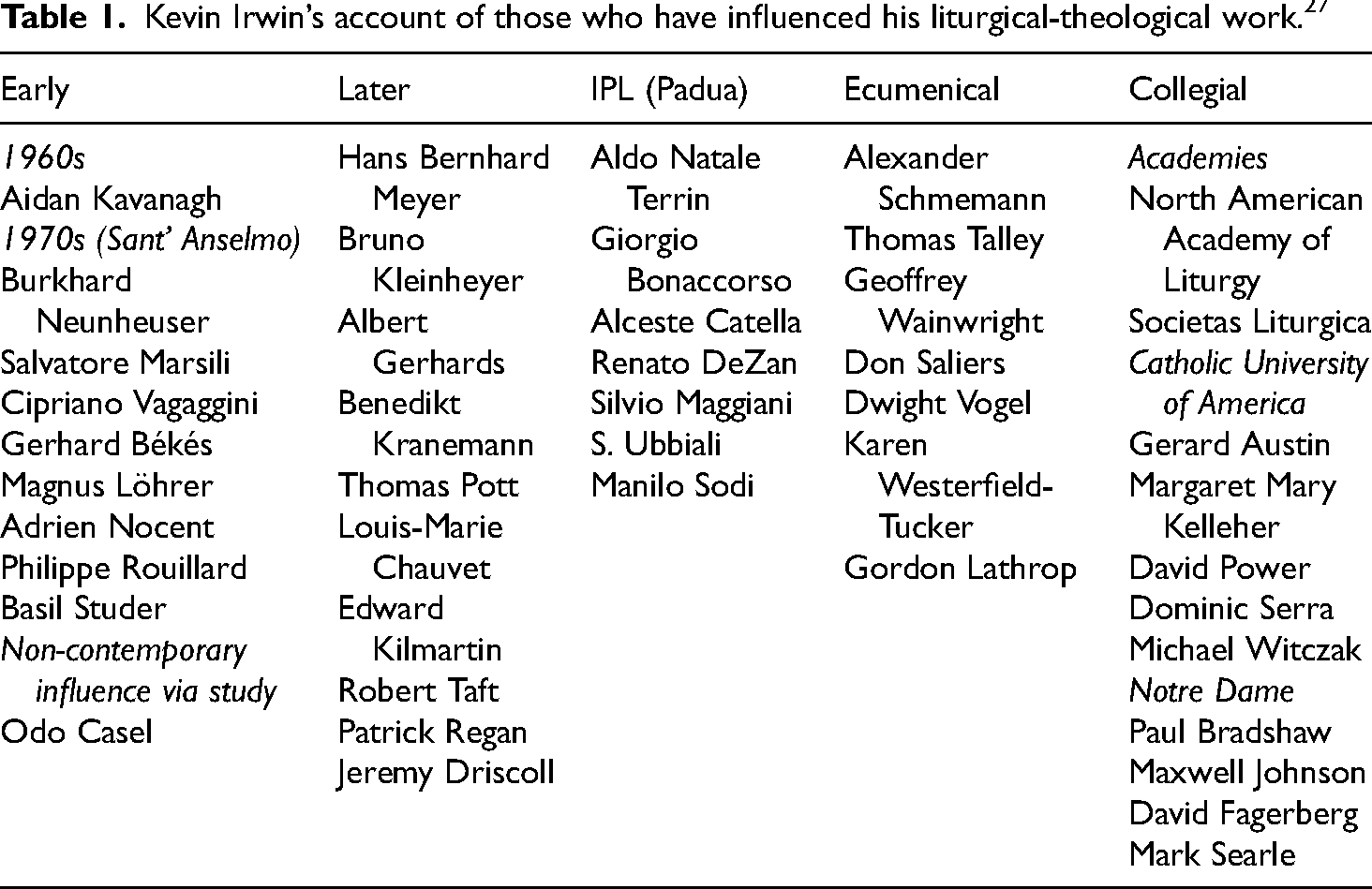
Theological method has been a focus of Irwin's work from the start, as his doctoral dissertation makes clear. 28 His first published work on method in liturgical theology (beyond his dissertation) appeared in 1989, 29 with his useful primer on the topic appearing in 1990. 30 Not long after, in 1994, the first edition of Irwin's magnum opus in liturgical theology was published: Context and Text: Method in Liturgical Theology. Since then, this book has endured as one of the primary works in liturgical-theological method. In 2018, the revised and expanded edition of this book appeared with its subtitle slightly adjusted: Context and Text: A Method for Liturgical Theology.
In the years between 1994 and today, Irwin continued his theological work in several arenas, including the theology of ordained ministry, liturgical reform, ecumenism, the environment, Pope Francis’ theology of liturgy, 31 and liturgy in time of pandemic. 32 The majority of his scholarly output, however, has remained within the spheres of sacramental and liturgical theology, with method always explicit and at the fore. Two crucial themes that emerge in Irwin's work prior to the publication of the revised edition of Context and Text are environmental theology and sacramentality. Indeed, the two are rightly intertwined in Irwin's thought and work. 33 He has written much on the topic, even renaming a chapter from “Symbol” to “Sacramentality” in the revised edition of Context and Text. 34
Kevin Irwin's Method for Liturgical Theology
Foundations
Irwin's writing on and in liturgical theology is vast. Here, two works are taken as summative of his thinking: The Sacraments: Historical Foundations and Liturgical Theology (2016) and Context and Text: A Method for Liturgical Theology (2018). While the latter is certainly Irwin's most fulsome articulation of his liturgical-theological method, the former is also relevant in that it shows how his ideas on method permeate his work in sacramental theology and in that it serves to (usefully) connect and dissolve boundaries between the theological subdisciplines of sacramental theology and liturgical theology. In addition, The Sacraments includes a sharp and concise delineation of method.
Irwin's way of viewing theology, and method, finds inspiration in patristic ways of speaking theologically about sacraments. He notes, “The authority of liturgy in the patristic era was not that of a simple deposit transmitted intact. The lex orandi both reflected a living theology and supported a response to liturgy in Christian living.” 35 Patristic theology of sacraments was primarily in the form of mystagogic catecheses, which by their nature reflect on liturgical events rather than liturgy as some meta-reality in Christian life. The theology of sacraments is not limited to a “uniform liturgical/sacramental theology,” and indeed it could not be. 36
The context in which we do theology today is a post-Vatican-II-liturgical-reform context, Irwin argues, in which fostering participation and comprehension are indispensable to liturgical celebration. 37 Diversity of liturgical expression, even within the same liturgical rite, is taken for granted. This reality requires theological reflection that can accommodate diversity of praxis. As such, a reappropriation of the patristic model is especially useful.
With this aptness of the patristic model comes a corollary that one can derive from Irwin's work: systematic theology of the sacraments as we usually think of it decreases in relevance and usefulness as a means of interpreting sacraments theologically, as its focus is coming to understand sacraments in some universal sense 38 in contrast to understanding sacraments celebrated in a particular time and place with a particular community. 39 Another implication in this shift is that the boundary between liturgical and sacramental theology blurs and even dissolves. Sacramental theology must be a liturgical theology of the sacraments, and liturgical theology is sacramental theology.
Liturgy for Irwin is a complexus of symbols, words, gestures, music, space, objects, vestments, vessels, and so on. It is this complexus that is the subject and source of liturgical theology. 40 The liturgical theologian recognizes that a full theology of a liturgical event considers all facets of said event, or at least that the “eventing” of liturgy must be at the foreground of a liturgical theology. Discreet interpretation forms part of the picture, but even this sort of interpretation fails if it does not take some account of the interrelatedness of the aspect under consideration to the whole. For this reason, for Irwin, both “theology of liturgy” and “theology drawn from the liturgy”—distinct but inseparable—are “liturgical theology.” 41
Theology of liturgy “describes what Christian liturgy is and what it does in terms of actualizing the reality of Christ's paschal mystery for the church, gathered and enlivened by power of the Holy Spirit.” 42 Three theological principles are inherent to liturgy and, thus, underpin a “theology of liturgy,” and mean that “the craft of theologizing on the act of liturgy necessarily focuses on how the church's central saving mysteries are uniquely experienced in and through the liturgy”: anamnesis, epiclesis, and ecclesiology. 43
Theology drawn from the liturgy concerns the use of liturgy as “a generative source for developing theology.” 44 This mode of doing theology in Irwin's thinking relates most obviously to systematics, wherein one could articulate a liturgical Christology or liturgical ecclesiology. A liturgical spirituality would also result from this sort of theologizing, as would a liturgical moral theology or ethics. 45 Indeed, by emphasizing the doxological nature of theology, Irwin asserts that not only is the symbiosis between lex orandi and lex credendi crucial to liturgical theology, but also that one must consider the implications of this symbiosis for living, that is, a lex vivendi is also implied in a liturgical theology. 46
Before delving specifically into the method put forward in Context and Text, it is important to note a few of Irwin's foundational assertions related to liturgical theology and the purpose of the book. One crucial claim of Irwin's work in liturgical-theological method—one that is firmly grounded in the vision of liturgy put forward by the Liturgical Movement and the liturgical reform—is that: each and every time we engage in the sacred liturgy is always a new event—a new event of salvation, redemption, and reconciliation with God and one another (among many other things), and a new event of our communal growth in holiness and of our communal self-transcendence.
47
what this book aims to do is to view the liturgy through a theological lens, to explore the multifaceted reality that the liturgy is and celebrates, and to offer both a critique of the reformed liturgy and suggestions for improved celebrations.
48
Crucial here is that liturgical theology as a discipline has at least a twofold purpose: to plumb the depth of meaning in liturgical events and to contribute to ongoing liturgical reform. Liturgical theology, thus, has a critical edge. 49
Finally, even though Irwin's critique in the book pertains exclusively to post-conciliar Roman Catholic liturgy, he sees Context and Text as “a contribution to ecumenical liturgical method and theology,” 50 which makes sense given that ecumenism is a major focus of his overall scholarly project.
Delineating and Diagramming Irwin's Method 1: His Meta-Method
Our concern throughout this book … is to articulate what it means to experience and appreciate “liturgy from the inside” in which every text, act, gesture, posture, and element from creation or manufactured by the work of human hands has a theological meaning, with many of them containing more than one meaning, because many of the components of liturgical action are inherently multivalent. These components are experienced together in the liturgical rite, the enactment of which influences how they are understood and interpreted. 51
In Context and Text, Irwin devotes the entirety of chapter 2 to method, of which most of the rest of the book presents a demonstration. Here, he puts forward a twofold thesis: context is text / text shapes context. While a clever play on words and a compressed, complicated assertion, Irwin unpacks the thesis as follows. First, context is text: “liturgical context is text, in the sense that context provides the source—text (again meaning ‘texts and rites’ as enacted)—for developing liturgical theology.” 52 Context as text allows and facilitates a theological interpretation of the “constitutive elements of the liturgy—sacramentality, Word, euchology, time, and arts,” which are the data for articulating a liturgical theology. 53 Context (which is the “text” for interpretation) includes three dimensions:
Historical evolution of a rite: Here liturgical history and tradition are investigated to reveal a rite's origins, its contents, and changes to the rite over time and from place to place, not only in terms of ritual content, but also in terms of how the rite and its component parts have been understood theologically. The historical investigation also allows one to discern between peripheral and essential ritual and theological aspects of a rite. 54
The current post-conciliar rite: Here the liturgical theologian investigates the reformed (post-Vatican II) rite to discern its “theological meanings,” focusing on the entirety of the liturgical complexus. Interpretation must account for the diverse parts and genres within a rite, and the interaction thereof. Proper celebration (that is, enacting the rite according to the rubrics of / as envisaged by the rite, with permissible options and flexibility taken into account) is assumed, and the influence of the “setting for liturgy” and “conducting of liturgy” is considered in terms of how they “facilitate and enhance the assembly's appropriation and understanding of the scriptural texts, prayers, symbols, and gestures.” 55 A hermeneutic within this dimension of context is the positive evaluation of the liturgical reform and the resulting rites, asserting their normativity and their “richness,” particularly in comparison to Tridentine rites. 56
The critical function of liturgical theology: Here, the liturgical theologian turns the focus to both (a) how the official rites might be revised, improved, 57 enhanced, or made better suited to culture(s) in subsequent editions of the rite, and (b) how a rite might be conducted more effectively, as the post-conciliar liturgy, with its flexibility and inherent demand for active participation requires careful and systematic preparation, formation, and the development and fostering of particular skills among members of the assembly. 58 The ongoing nature of liturgical reform and its indispensability are taken for granted, 59 which means that the “critical function” of liturgical theology is fundamental, as it must inform the ongoing reform and renewal of the liturgy within all of Christian society. This function also means one might add another subsidiary dimension to the lex orandi / lex credendi / lex vivendi nexus, that dimension being the lex agendi or law of effective liturgical enactment, which is clearly related to the idea of ars celebrandi. There are boundaries and guides to critique within this critical mode of liturgical theology, which relate to the prior two dimensions (history, current rites) as well as to scripture, doctrine, cultural norms, philosophical/confessional starting points, and so forth.
These three dimensions of context provide the liturgical theologian analytical access to the rites and facilitate the interpretation and analysis of the constitutive elements of liturgy, which include (according to Irwin's method) sacramentality, Word, euchology, time, and arts.
Irwin goes on to articulate the other half of his thesis, text shapes context: “the act of liturgy can influence the shape of theology, ecumenical dialogue, and living the moral, spiritual life.” 60 This methodological principle gets to the heart of things, exploring why participating in the liturgy matters in the first place. As Irwin says, “Methodologically … our concern is with the theological and spiritual implications of engaging in liturgy, that is, the constitutive implications that arise from the theological interpretation of the constitutive elements of liturgy.” 61 Liturgical theology, therefore, is a “way of redirecting theology as intrinsically oriented toward confession, thanksgiving, and praise of God.” 62 Thus, liturgical theology can serve as a corrective or methodological solution in instances when doing theology has become disconnected from conversion or from any real experience of the kerygma that emanates into life—the whole point of Christianity in the first place. Here the lex vivendi is clearly at play.
The two figures or diagrams of liturgical-theological method that follow depict, first, the overarching connections between the fundamental elements of liturgical theology, that is, lex orandi, lex credendi, and their corollaries lex vivendi and lex agendi. The second diagram sketches Irwin's “meta-method” or the broad method put forward in Context and Text (Figures 1 and 2).
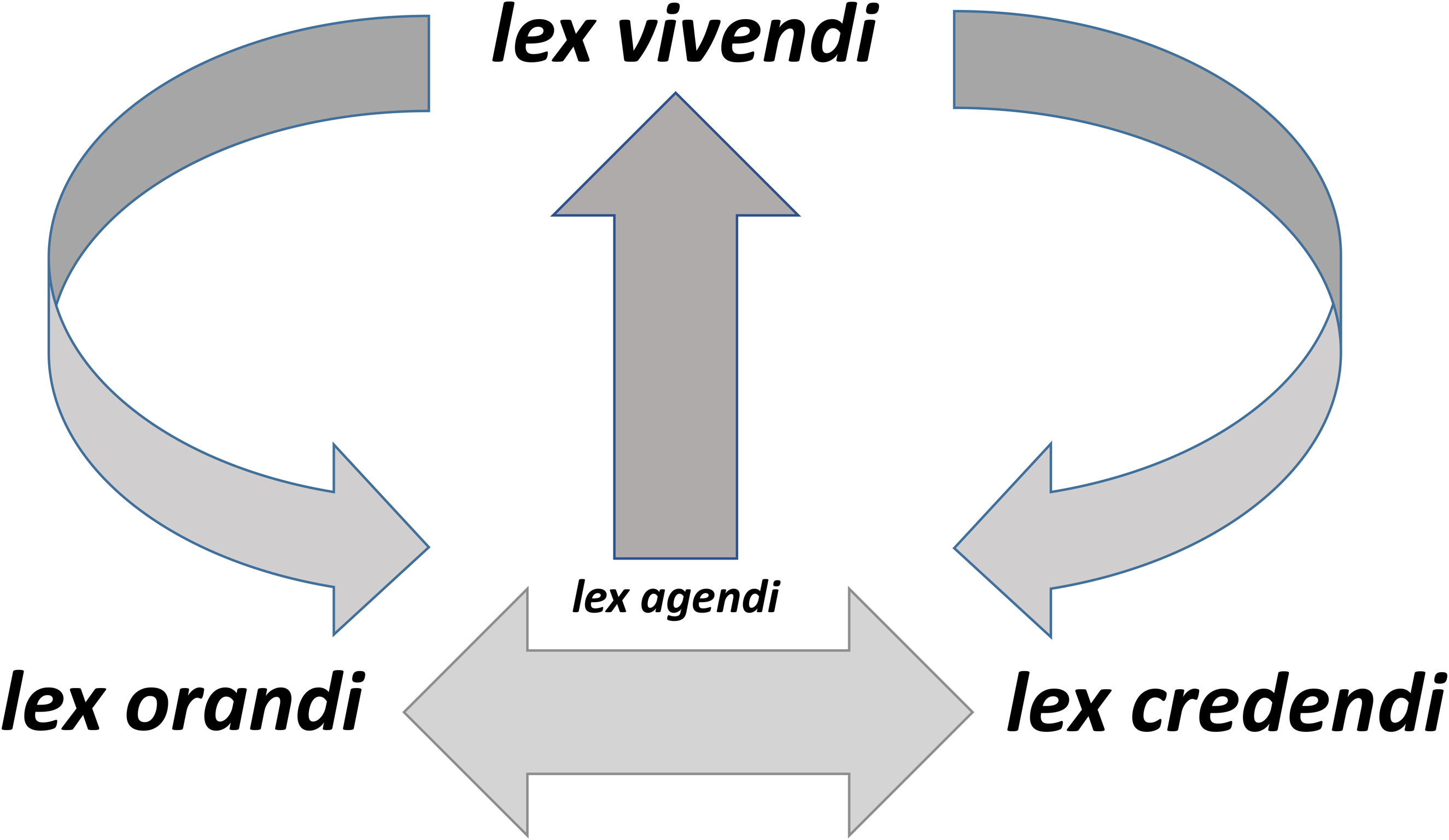
The relationship of fundamental components for liturgical theology.
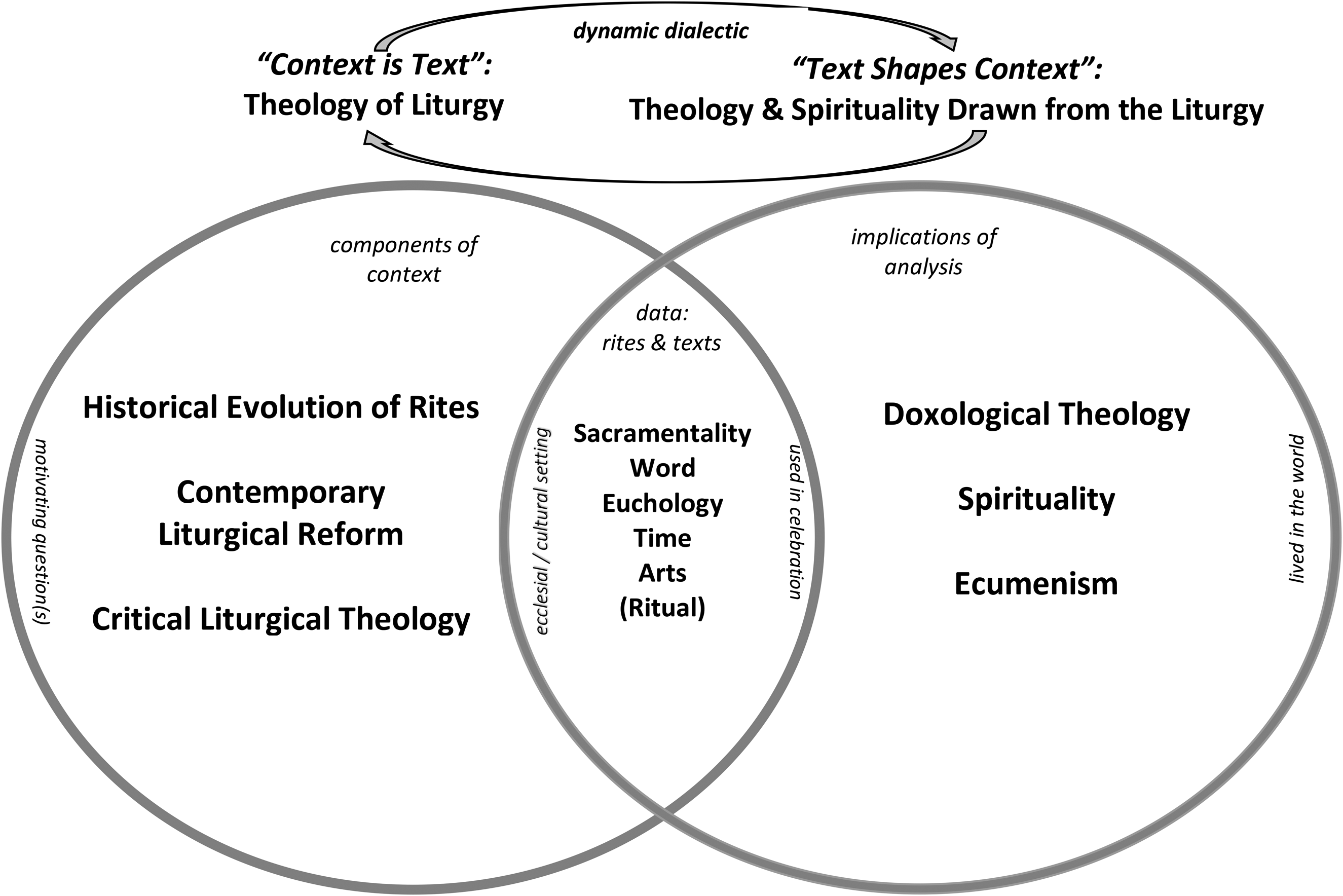
Diagramming Irwin's meta-method. (The closed circles do not indicate separate domains as in a Venn diagram, but aim to show, imperfectly, the aspects of Irwin's complexus).
Employing the term “meta-method,” even though not used by Irwin, intends to encompass Irwin's overarching methodological achievement for theological investigation of liturgical rites. It does not have a particular rite in mind and has broad potential for application in a variety of contexts.
63
In sum, “doing” liturgical theology according to Irwin's meta-method involves a motivating question that looks to characteristics of a liturgical event for an answer:
sacramentality Word euchology time arts. the historical evolution of the rite the current rite and relevant underlying principles of the liturgical reform critique of the rite (both the official ritual book and the rite as enacted). ecclesial/cultural setting actual celebration or event doxological theology (implications for the doing of theology in whatever mode) spirituality (the Christian life outside the context of liturgical worship) ecumenism (implications for ecclesial mutual-understanding).
These aspects comprise the interactive data for analysis, viewed through the interpretive lenses of
The data thus interpreted, as well as influenced by the
is brought to bear on constructing a “theology and spirituality drawn from the liturgy” in terms of
In his 2016 book The Sacraments, Irwin demonstrates an application of his meta-method to a more specific context, noting its implications to a specific realm of theology: Christian sacramental rites (baptism, Eucharist, etc.) and what liturgical-theological investigation of said rites reveals for sacramental theology. This application is here termed “infra-method” (again, not a term Irwin uses) as a way of distinguishing it from Irwin's meta-method in its particularity and specific focus. In this book Irwin articulates two fundamental methodological principles:
Each and every thing that we use [and do] in the liturgy … has a theological meaning, and sometimes more than one. Each and every act of liturgy is an immediate and direct experience of the saving mysteries of our salvation, mediated to us through the complexus of words, gestures, signs, and silences (among other things) that comprise the sacred liturgy.
64
These principles have serious implications for doing liturgical theology. First, all aspects of liturgical celebration are potentially (and even necessarily) the proper subjects of liturgical theology. Second, knowing what to pay attention to is key to the task of liturgical theology. Third, knowing how various aspects of liturgical celebration function and relate to one another is essential.
In The Sacraments, he also puts forward four sources for theology drawn from the liturgy [that] should be collected, studied, and prayed over for any inquiry into the theological meaning of sacraments in general, an individual sacrament, or any part of the rite of a sacrament. These four sources offer the data on which a liturgical theology of the sacraments can be based.
Scripture readings
Prayers of blessing, consecration, and absolution (e.g., eucharistic prayer, the blessing of water at baptism)
Other prayers of the liturgy (e.g., collects, solemn blessings, prayers over the people)
Sacramental signs, gestures, and postures. 65
The point here is to enable a theologian to interpret a “theology from the rites.” 66 The seeming limitation of context here has to do with how one understands liturgy. If it is the official, public worship of the church, the official dimension means that “the liturgical books that are presently used in the church's liturgy to celebrate the sacraments … should be regarded as the primary sources for sacramental theology.” 67
Still, Irwin recognizes the ever-present dialectic between what is contained in the liturgical books and actual practice (or liturgy as event, which takes us back to his meta-method of Context and Text). The boundaries in The Sacraments pertain specifically to a liturgical theology of sacraments because the goal is to discern the church's understanding of sacraments through its official rites. If, however, the goal is to understand, determine, and articulate theology expressed in and through a particular liturgical celebration, the field of data becomes broader. Perhaps what we see here is Irwin's distinction between sacramental theology per se and liturgical theology broadly understood. To be sure, there are likely other infra-methods one can derive from Irwin's meta-method.
On one hand, liturgy exists only in its celebration, and it is only in celebration that believers encounter the theology of the liturgy. On the other hand, the rites (official liturgical books) of the church provide boundaries to proper celebration and to a correct understanding of the theology of sacraments and other liturgical celebrations, drawing, as they do, on the authoritative sources of scripture and tradition. 68
What the rites put forward as normative is one thing, but it is another question altogether as to what theology is expressed in a particular liturgical celebration—relying as it does upon translating the contents of the ritual book (really just a collection of instructions and texts) into performance. Even more complex is the matter of how to discern the means and effectiveness of the appropriation of said “contents” by the ritualizing believer. Within specific contexts and communities, local expressions and understandings can and do flower that offer new insights into the theology of the liturgy, and that might, over time, even influence the development of the official rites (i.e., text shapes context).
Irwin approaches this critical issue in The Sacraments in his discussion of “actual celebrations of the liturgy.”
69
He notes church buildings and music as key variables, in addition to the variety intrinsic to the reformed liturgy.
70
The crux of the matter—and the reason doing liturgical theology is a much more varied and complex task than traditional systematic sacramental theology—is that, given the present structure of the reformed liturgy with its variety and flexibility, there is the issue of whether what is experienced at liturgy conforms to what the ritual books envision … In other words, there are variables in the way the liturgy is celebrated, and sometimes the description of a liturgical ritual is one thing, and what actually happens when the rite is celebrated is another. This requires being attentive to what is actually done in the celebration.
71
The methodological outcome of Irwin's The Sacraments is an infra-method that emanates from the insights of his meta-method but differs in terms of its specific data points and theological underpinnings. As such the book is an important resource for understanding the potential of Irwin's meta-method to be aimed at a wide array of liturgical/ritual data and events. The infra-method includes eight elements constitutive to doing a liturgical theology of the sacraments:
The way sacraments work:
1. Sacramentality 2. Humans and human work 3. Word enacted 4. Prayer events Experience of the Trinity Paschal memorial
Communio
“Already” and “not yet”
73
What happens in liturgy:
In his doing of liturgical theology in The Sacraments, the objects of analysis are liturgical texts (readings and prayers), including the text that comprises each, each text's place within the ritual, and the text's interconnectedness to other texts. All this together forms the context or subject for theological reflection. Of course, this is an obvious methodological turn when considering the proclamation of scripture or the utterance of a liturgical prayer, but Irwin also utilizes this “context” in his consideration of the first two aspects of how sacraments work (sacramentality, humans, and human work) and the four dimensions of what happens in liturgy (experience of the Trinity, paschal memorial, communio, “already” and “not yet”). All dimensions are exemplified through a skilled and insightful analysis of liturgical texts, introductions to official liturgical books, the Constitution on the Sacred Liturgy, and other ecclesiastical documents.
While Irwin is always careful to recognize and assert the influence the broader liturgical context has on the communication of theology within worshiping liturgical communities (indeed, this is a key assertion of his work), we do not actually encounter liturgical-theological reflection and analysis that takes other elements of the liturgy as their subject, except when this can be done in relation to liturgical texts. 74
Irwin's assertion of the broader context—the entirety of the liturgical event and its sources (liturgical books) as the subjects of liturgical theology—is clearly a fundamental priority in his method. He calls the conclusion to Sacraments “Sacramental Celebration Is Sacramental Theology,” and ends the book by encouraging the liturgically participatory believer/minister to “be prepared”, “participate” in the liturgy well, and “live out in life what we celebrate” (Figure 3). 75
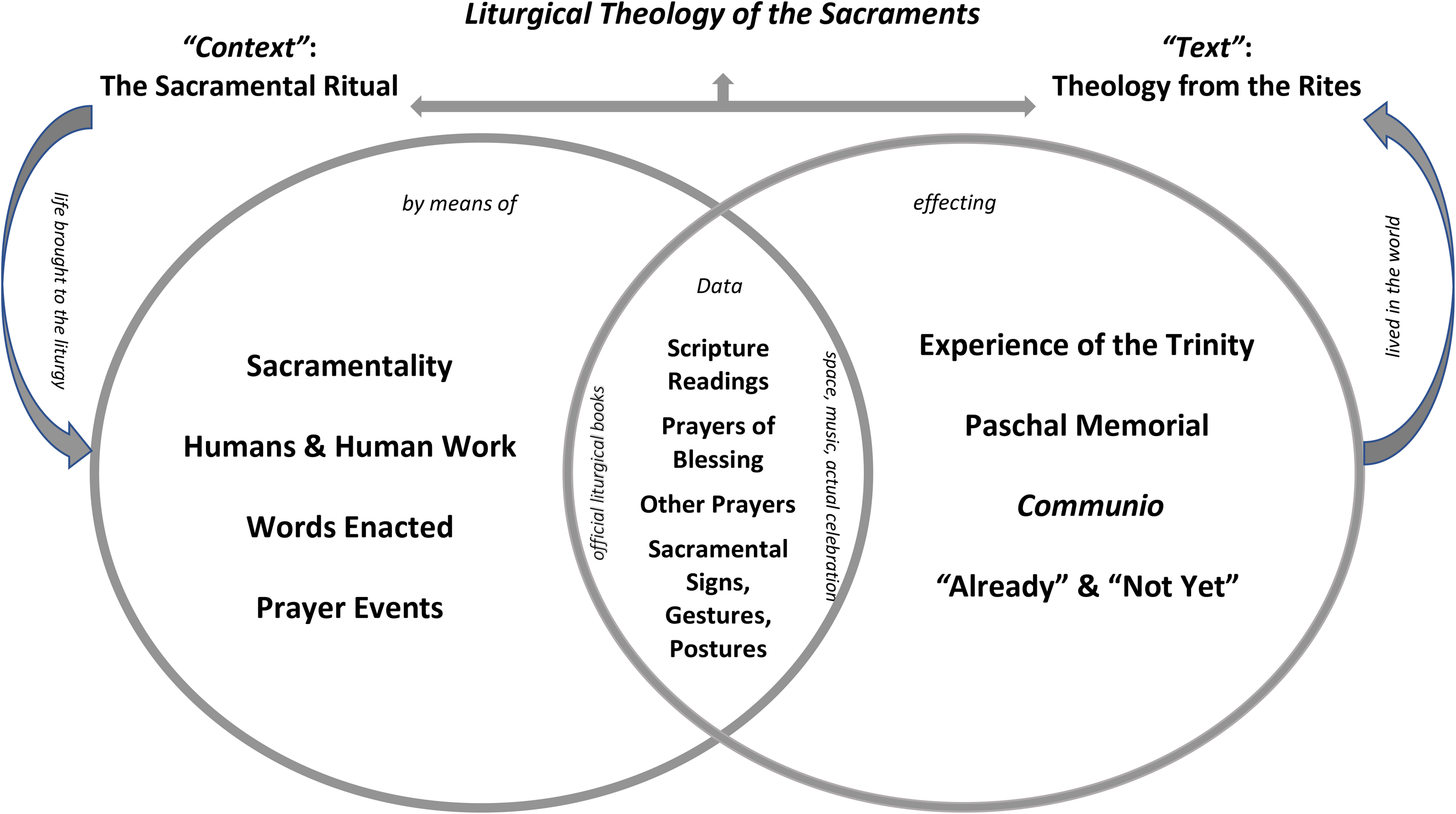
Diagramming Irwin's infra-method. Again, the overlapping circles do not represent separate domains as in a Venn diagram. Similarities to Irwin's meta-method are clear, as one would expect given the infra-method is in essence a more specific application of the meta-method.
In sum, the “doing” of liturgical theology according to Irwin's infra-method looks to a sacramental liturgy's
scripture readings prayers of blessing other prayers sacramental signs, gestures, postures sacramentality humans and human work Word enacted prayer events. liturgical space music of the liturgy actual celebration experience of the Trinity paschal memorial
communio
“already” and “not yet.”
which comprise the interactive data for analysis, and which are then viewed through the interpretive lenses of
The data thus interpreted, as well as influenced by the
is brought to bear on constructing a “theology from the rites” effected through the liturgy in terms of
In Irwin's method, the interplay of contexts and texts in liturgical celebration brings out—sometimes eye-opening, sometimes expected—theological themes expressed in the rite and (and one can hope) appropriated by the gathered assembly. The theological lenses Irwin utilizes (doxological theology/spirituality/ecumenism and experiences of the Trinity/paschal memorial/communio/“already” and “not yet”) let the theologian draw out useful details about the celebration and help in providing critique where the liturgy (at least from this patristic + post-Conciliar perspective) might have done better, be that in the actual celebration or in the ritual “script.”
Are emergent theological themes and revisions to official rituals adequate reason to undertake liturgical theology, however? Here, the question that seems most pertinent is “so what?” What is the use of this sort of liturgical-theological reflection? Certainly, it is interesting (at least to theologians and liturgical scholars) to plumb the depth of meaning manifested by Christian ritualizing. But Irwin would surely see this as an insufficient reason for doing liturgical theology. What matters is what flows from the experience of the liturgy for life and theology.
The insights of liturgical-theological analysis have serious, often practical, implications, and here is where Irwin's infra-method flows back into his meta-method. Looking into the “theology of liturgy” (“context is text” / lex orandi) must lead to “theology and spirituality derived from the liturgy” (“text shapes context” / lex credendi). This dialectic between context and text radiates insights to inform the life of the church, of a particular ritual tradition, of a local community, and of each baptized person (lex vivendi). Indeed, the format of The Sacraments makes it clear that such is Irwin's aim; each chapter ends with questions for discussion, denoting the book's formative thrust, and more than one chapter has a section called “Agenda in/for Life,”
76
clarifying the usefulness of the preceding liturgical-theological reflection for lived spirituality. Far from being simply an academic exercise, liturgical theology done the Irwin way has multiple edges that pry into life for the sake of its transformation and conversion—to become ever more Christ:
Conclusion: The Boundaries of Irwin's Method
In the final analysis, if undertaken from the broadest possible perspective, several key insights underly Context and Text. One might also call these insights aspects Irwin would see as essential to any liturgical-theological method, not just his own.
All aspects of liturgical celebration should be intrinsic to liturgical theological reflection. Knowing what to pay attention to is key. Knowing how various aspects function and relate to one another is essential. Method really depends on questions and goals
77
and, thus, Irwin's method is an appropriate starting point; whatever the method, a liturgical theologian must pay attention to context(s).
The choice of an appropriate method depends upon the question or context under consideration. If this is the case, then, what Irwin offers is a deeply astute response to the needs of liturgical theology. In short, Irwin places a map before the liturgical theologian: decide upon your questions, then (and only then) think about which method(s) would be most likely to give you useful answers to those questions. Finally, pay attention to questions and context, no matter the method in use.
In Context and Text, Irwin accomplishes liturgical theology in three dimensions.
First, the book as a whole is itself a work of liturgical theology presenting a theology of the liturgy through the lenses of history, present-day rites, and ongoing liturgical reform, with implications for Christian living. Second, he presents a method for doing liturgical theology—one that allows for liturgical-theological reflection upon any liturgical rite. By means of this method, one can take any liturgical rite as the object for analysis, focusing again on his variously expressed “lenses” or “contexts,” and drawing out implications for future practice and the ongoing interplay of lex orandi, lex credendi, and lex vivendi. A ritual as a unified complexus can be considered, as can a specific element of a ritual—but in either case the analysis is a kind of meta-analysis that reveals what officially promulgated rites put forward as the proper form of celebration, how these “rites and texts” theoretically work in practice, how they interact with tradition, history, and principles of liturgical celebration, and, finally, what all of this might reveal in terms of needs for ongoing liturgical reform. Third, ultimately Irwin's is indeed a method, but it is also a methodological framework as Joyce Ann Zimmerman suggests.
78
Within this framework, the liturgical theologian can take up additional supplementary methodologies based upon their motivating questions or the aspects of the ritual they wish to explore. If the goal is to explore the theology of various chants of the Mass, for example, musicological methodologies would be essential supplements to Irwin's method.
79
If the appropriated theology of an actual celebration of a liturgical rite at a particular time in a particular place with a particular group of people is the object of analysis, then supplemental methods are required (e.g., ethnography, participant-observer analysis, reader-response criticism), as Irwin's method does not allow for such analysis beyond critique of enactment in light of official requirements and principles. To be sure, this intermittent need for supplemental methods is not a weakness in Irwin's method. No method can accomplish all things, and, indeed, Irwin's vehement assertion that every dimension of liturgical celebration must be considered in the doing of liturgical theology seems to presume the need for (or at least the possibility of) additional if not innumerable methods. Indeed, if pressed to say whether Irwin's is a method or a framework, I might stray and call it rather a model.
80
The Bounds and Evolution of the Lex Orandi
Irwin says that: liturgy is primarily an act of theology through which we enter into the otherness of the infinite and transcendent God through the very human means of texts and rites, words and gestures, speech and symbolic action, all involving the body and the human senses.
81
The church's decisions about what words, rites, symbols, and gestures to use matter a great deal since they comprise the church's rule of faith, its lex orandi.
82
These two statements create a fruitful dialectic or tension, in that on the one hand we must avoid deviation from the official rites, and on the other hand if the official rites fail to let us “enter” then they need reform. One reason Irwin maintains the boundary between official and enacted liturgy is a concern for theological quality control (even orthodoxy), and a recognition that poorly celebrated liturgy can in a sense deform the official rite and make it communicate something unintended. Still, the only theology ever communicated within the liturgical assembly is the theology of the rite as enacted somewhere and sometime, which Irwin's method can only tangentially explore. 83 We can surely admit, however, the possibility and usefulness of theological reflection on liturgical sources outside of the context of an actual here-and-now “eventing” of the ritual. This is what Irwin calls the “theology of liturgy” and what could perhaps be called a “systematic liturgical theology,” which then leads to further reflection or “theology drawn from the liturgy.”
The key to understanding Irwin's method is understanding his starting point. Or, to put it another way, for Irwin, what is liturgical theology and how should liturgical theology be undertaken? The official “rites and texts” are and must be the subject of liturgical theology for Irwin. This stance circumscribes the possible data for liturgical-theological reflection. It also tells us about the should inherent in his method: the official “rites and texts” (as the present-day manifestation of the ancient liturgical tradition, as a complexus comprised of multiple and inter-related genres of texts/rituals/symbols/arts, as grounded in the principles of the Vatican II liturgical reform, as promulgated by the Holy See thus becoming official and normative, and as subject to ongoing reform based in the insights and critique resulting from properly executed liturgical-theological reflection) really have to be the subject because—for all the reasons above and from Irwin's coherent vision of liturgical theology—they constitute the living lex orandi of the Church.
Of course, one might take different starting points to the doing of liturgical theology. Irwin would probably think this diversity of methods a good and necessary thing and welcome supplementary methods that help to achieve the overall goals of his method or model. Still, at least for traditions with officially promulgated liturgical books, he would likely say the rites and texts therein comprise the most important and relevant data to the liturgical-theological endeavor. 84 The coherence and inherent circumscription of Irwin's method make it particularly useful, sound, and manageable; at the same time its starting point might make it less useful or even not of use for liturgical traditions with an improvisatory mode of corporate worship.
Future Directions and Open Questions
While each of the following open questions requires further explication beyond the limits of this article, Irwin's method raises many questions, which need to be addressed in future scholarship to continue Geldhof's “daring” and “clarity” that inspired this article in the first place.
In looking only to liturgical enactment in the abstract and privileging the official “rites and texts” in doing liturgical theology, is there a conflation of what constitutes the lex orandi and lex credendi? From a certain perspective, the liturgy could be viewed as simply another collection of texts that communicate doctrine. Is it the performative potential of the “rites and texts” that make them live outside the lex credendi? The lex orandi has authority insofar as it actually manifests in local liturgical celebrations. We could ask, does the orandi even exist outside of enactment? From another hyperbolic perspective, however, if we take the example of poorly performed liturgy that fails to communicate what the “rites and texts” intend and, thus, fails to activate the lex vivendi, can said local celebration be deemed as authentically constituting the lex orandi? What happens if we open up the development and interpretation of both lex orandi and lex credendi to the hyper-local interpretive context?
85
And, what is the most effective (and efficient) way to discern appropriated liturgical theology? That is, a liturgical theology produced through a multi-year participant-observer analysis can glean crucial insights, but not every work in local liturgical theology can take such time. How can liturgical theology's critical dimension or “edge,” as the methodological tool by which “rites and texts” are continually renewed and reformed, actually bear fruit? Liturgical reform: how does it happen, how is it meant to happen, what solutions might there be to the current quagmire in which the post-conciliar “rites and texts” seem to have become again immutable? Indeed, a liturgical theology of liturgical reform is urgently needed, not just in the academy but for the ongoing vitality of the liturgical life of the church.
86
Would a source-critical dimension add something to Irwin's method? For example, is the history of a prayer, its original sources, its evolution over time or history of revision relevant to a liturgical theology? Clearly, music comprises part of the official “rites and texts”—namely, chant—contained in official liturgical books. As such, it seems a liturgical-theological method needs to have a means of interpreting both melody and text. How? Can music qua music communicate a theology and shape the lex credendi?
87
Are official (often ancient) melodies as authoritative as official (often ancient) prayers? Irwin frequently uses the word “constitutive” to speak of the indispensable parts of a liturgical rite. The word implies that there are non-constitutive elements of liturgy and non-constitutive implications (or effects) of liturgical enactment. In the doing of liturgical theology this is an important distinction that probably must remain, but it is also potentially problematic: that some things matter more than others is clear, but who makes or has made the distinction and what voices are and have been censored out of the process of discerning what is constitutive?
88
If some parts are more important than others, does the same apply to persons?
89
Context is Key
Irwin's most important insight is that context is the “text” we read when “doing liturgical theology.” This context is in many ways universal, but at the same time and paradoxically only local. Irwin's method is rightly paradoxical, too, in that it is firmly situated in both the never-ending process of liturgical reform while, at the same time, in officially promulgated and (for a time at least) unchangeable rites. The method also achieves a dialectic between the universal and local. The living history of local Christian liturgical praxis shaped and shapes the lex credendi of the universal church, which in turn shepherds it within the bounds of orthodoxy.
While Irwin's method flows from his Roman Catholic context, and his own “doing” of liturgical theology is concerned with Roman Catholic liturgy, he is also clearly influenced by concern for ecumenism and the ecumenical thrust of liturgical studies, liturgical reform, and liturgical theology in general. His balancing of liturgy as event and liturgy as tradition makes his method complicated (i.e., it is quite difficult to outline the method step by step), but this complexity is honest and, without question, what liturgical theology grounded in the principles of the liturgical reform (with its aim of renewing tradition for present-day communities) requires.
The careful dissection and critique of Irwin's method presented here is one step along the way to future clarity regarding method in liturgical theology. Recalling Joris Geldhof's call for daring in this task can provide inspiration to those willing to undertake it, and looking to this analysis, we hope, can inspire other liturgical theologians to examine, delineate, and test a variety of existing and yet to be developed methods. Such work is crucial in this era in which normative modes of liturgical participation are inching toward the metaverse, and in which a sacramental world view is greatly diminished. As always, doing liturgical theology is and must be a creative task.
