




Abstract
This article examines the genre of Contemporary Worship Music (CWM) within worship contexts in terms of its formative and purposeful nature. In CWM settings, the worship leader plays a particular role in the selection and facilitation of CWM repertoire to be led by praise bands. Through the leader's consideration of the message of the CWM lyrics, and the relational nature of CWM practices, a worship leader's pedagogical decisions are integral to contributing to a space of dialogue for worship musicians. Drawing on previous literature addressing liturgical language in worship, I analyze the CWM context as a particular case where liturgical language shapes musicians’ spiritual formation. This examination of CWM practices includes an analysis of musicians’ engagement in relational musicking and meeting through I-Thou encounters. I therefore explore both the need for worship leaders to consider the multitudinous theological implications of their actions, as well as the way musicians are shaped and formed intimately through their musical engagement with CWM.
Introduction
Within Western Christianity's worship musical landscape, contemporary music trends have grown exponentially throughout the past several decades. 1 Starting in the early 1990s, contemporary worship—“a band-based, informality-driven, and relevance-seeking way of worship” 2 —increased in popularity among many evangelical Christian churches. 3 Along with contemporary worship trends, Contemporary Worship Music (CWM) developed and spread rapidly as a musical genre, “imitating” and shifting according to popular music characteristics. 4 Many contemporary evangelical worship services today continue to include CWM as their primary musical genre, replicating Western popular music sounds, lyrical expressions, and popular music song structures. 5
Along with the spread of CWM, a variety of musical and theological critiques have emerged that address CWM trends, many of which derived from the so-called “worship wars” of the 1990s. Churches experienced particular difficulty in reconciling between “sacred and social implications of traditional and contemporary sounds” in worship. 6 Some of these theological critiques, still prevalent today, involve the characteristics of CWM lyrics, which tend to be approachable, conversational with an informal nature, 7 and focused inward on the believer's personal worship experience. 8 In considering CWM lyrics, the worship leader—typically the lead vocalist or instrumentalist in contemporary worship settings—plays a particular role in the selection and facilitation of the CWM repertoire. 9 It often falls on the worship leader to help decipher the potential impact that CWM lyrics have on worship musicians and the greater congregation. Through the leader's consideration of the message of the CWM lyrics, and the formative, purposeful, devotional nature CWM plays in contemporary worship, the worship leader's role is integral to the creation of a space of meeting within the context of a particular praise band.
In previously conducted research, I examined praise bands situated in two different evangelical churches in London, Canada. 10 I specifically looked at how worship musicians acquire and develop their musical skills within the church as well as their musicking 11 processes in both rehearsals and worship services. As someone deeply connected and committed to the possibilities and potentials of the educative process, I was drawn to viewing this data from the lens of an educator's practices. Within both settings, worship leaders appeared to fulfill formal roles similar to the role teachers play in school contexts. These worship leaders indicated that they based repertoire decisions primarily on the nature of the song lyrics, selecting CWM repertoire with lyrics that created unity among musicians and the greater congregation. As evident in the worship leaders’ responses, they viewed CWM lyrics as fulfilling a spiritual function within a worship service.
These findings provided a direction for exploration in the current article, aiming in part to draw connections between the practices of the contemporary worship music leader and the practices of an educator. While worship leaders play an integral role in selecting CWM repertoire, there is a lack of scholarly research into the role of worship leadership pedagogy within contemporary worship settings. Nor is there a significant amount of research focused on the theological, philosophical, or theoretical elements of liturgical language in CWM contexts specifically and its effect on worshippers. 12 The study of liturgical language in worship has, however, been researched in religious contexts separate from CWM in terms of contextualization and semantics 13 and within scholarly reflections, such as changes within the language of the Catholic Mass after Vatican II. 14 This article, therefore, explores the study of liturgical language in worship, examining the CWM context as a particular case, from which implications for other worship contexts may also be drawn. I extend recent research on speech acts in corporate worship to the CWM environment, considering the role of the worship leader in facilitating musicians’ engagement in relational musicking and meeting through I-Thou encounters. 15 Thus, I argue that liturgical speech is enacted through musicking in CWM settings, forming and shaping worship musicians in terms of their spiritual formation. This article specifically focuses on relationships between worship musicians, such as musicians within a praise band, and the worship leader, such as the music pastor or lead musician at a church, rather than the congregation as a whole.
Throughout my examination of practices of liturgical speech in CWM settings, I affirm Christopher Small's definition of musicking, as worship musicians do not simply engage in music-making together, but enter into a space of relationship while doing so. Small's theory affirms that the meaning of musicking lies in the relationships created, not only between organized sound, but between people, society, and the supernatural 16 —which in this context is one's relationship with God.
Following a brief discussion of the particular role of worship music leadership, I shall suggest that worship musicians are impacted through their engagement in liturgical speech through CWM. In order to do so, I begin with a discussion of the pedagogical role of worship music leadership in accordance with an understanding of worship as a time of formation and re-orientation. This will be extended to the concept of liturgical speech acts in worship leading to encounter, as well as liturgical speech acts embedded in CWM and the role of the worship leader in facilitating these spaces. The article will conclude with possibilities for future exploration in church musical learning settings.
The Pedagogical Role of Worship Music Leadership
The practice of teaching, in connection with worship music leadership, will be viewed through the lens of Gert Biesta and Barbara Stengel. 17 Education as a practice, Biesta and Stengel explain, “is not just a practice with a purpose … [but] a practice constituted by its purposes.” 18 Biesta articulates the need for a purposeful shift in the focus of teaching towards bringing something new to students and their position in relation to the world. 19 To be taught is to be open to receive the gift of teaching which will involve interruptions in one's understanding of the world and life. 20 This process involves a notion of “transcendence” or revelation, which is described by Biesta as something “com[ing] from the outside and bring[ing] something radically new” 21 to the teaching and learning environment. Students are presented with “something that is neither derivable from nor validated by what [they] already know,” 22 “transcend[ing] the realm of the possible.” 23 While this process of encountering something “radically new” moves beyond the powers of the teacher, teachers have a responsibility to teach and help create these spaces and experiences of teaching and learning through engaging in a relationship with their students. Teachers bring something new to the encounter between the student and the world. We thus can view the role of the teacher, in accordance with Biesta, to be something essential, moving beyond the facilitation of learning environments, where students engage in a process of “being taught.”
In a religious context, then, the educational aim is also “to open up to new ‘existential possibilities’; that is, new and different ways of being in and of the world.” 24 Biesta's conceptual framework 25 may be extended to a praise band setting, where a worship leader similarly fulfills the role of an educator. Not only do worship leaders provide musical direction to the praise band within these spaces of teaching and learning, but in many evangelical settings they are also often expected to facilitate an experience of divine presence through music. 26 As Kevin Kurian recognizes, “Worship leaders must not only demonstrate musical expertise and emotional engagement, but significant spiritual leadership as well.” 27 Through a worship leader's intentional and purposeful creation of spaces of teaching and learning, musicians will ideally engage with something new that “transcend[s] the realm of the possible.” 28 Worship leaders are bringing something new to the encounter between the musician and the world musically. They can, therefore, use a space of teaching and learning such as a praise band to help facilitate musicians’ engagement in their worship of God.
The performative aspect of musicking in a CWM setting contributes to the creation of spaces of transformative worship. June Boyce-Tillman reflects on the complex process of engaging in church musicking, suggesting that singing in a worship context can be transformational. 29 CWM is not simply music written on a page, but rather it is embodied in performance. The worship leader, similar to Biesta's conception of the teacher, 30 uses the CWM song to help musicians realize a truth that enters their being from the outside. A worship leader provides spiritual leadership in this way, but also does not solely “occupy … a position of transcendence.” 31 Rather, worship leaders are creating spaces for musicians to engage in transcendence or revelation. Musicians, however, must also be open to receive the gift of teaching within religious contexts which will involve interruptions to their lives and understandings of the world. Furthermore, if engaging in CWM is understood to be a performative practice, worship leaders must consider that the embodied theological practice will affect each participant in a significant, intimate way. This requires worship leaders’ consideration of the multitudinous theological implications of the music they select. They must “take care to perform the theology that accurately reflects the beliefs of the church and in order to promote unity rather than division.” 32 When these factors are considered, the participatory nature of church musicking is capable of leading to worshippers’ sense of community between themselves and God, 33 which will be further explored in terms of the particular nature CWM lyrics play within a worship service.
Worship as Formation and Encounter
The term worship comprises a variety of definitions according to different cultures and religions across the world; therefore, it is necessary to begin with a clear definition of the term “worship” and its connection to “liturgy” within this particular focus of research. For the purposes of this article, Christian worship is described in terms of communal worship, such as within a congregation of Christian believers worshiping together in a weekly church service context. As defined by Nicholas Wolterstorff, Christian worship involves a “Godward acknowledgement of [His] unsurpassable greatness.” 34 Worship is specifically considered liturgical when it includes a sequence of act-types enacted according to a “scripted” text. 35 Scripted activity refers to the idea of types of activities that are shaped or enacted within prescriptions in force (for instance moral prescriptions, theological prescriptions, and linguistic prescriptions). 36 As Wolterstorff explains, liturgical scripts “prescribe verbal or gestural acts primarily not for their own sake but so that the participants can thereby perform certain ‘counted-as actions.’” 37 Liturgies, thus, are the dialogue and discourse present in congregational worship—the sequence or order of act-types (elements of worship) such as the confession of sins, intercessions, reading of scripture, or, in the context of this article, music as part of worship. These elements of worship are directed or shaped toward a particular end; they are rituals of desire for God, present for dialogue and engagement with God. 38
While worship varies according to personal context and culture, worship is commonly seen as a time of formation, where individuals’ identities and loves are repeatedly oriented toward God. The loves and desires of individuals, according to Smith, “are formed and aimed by their immersion in practices and cultural rituals.” 39 For James K. A. Smith, liturgy includes formative rituals that tell individuals who and whose they are. 40 Reflecting this description of liturgy, church musicking, thus, is a distinct form of liturgy, where musicians and the greater congregation come together as one and engage in a musical ritual directed towards their desire for God. Worshippers “perform scripted verbal, gestural, and auditory actions … for the purpose of engaging God directly in acts of learning and acknowledging [his] excellence … and to be engaged by God.” 41 Thus, regularly engaging in worship musically as a physical and spiritual ritualistic act is to continually re-order and re-orient their lives to God. Following this description of worship, then, the worship music leader has an integral role in helping facilitate this space of re-orientation and encounter for worship musicians.
Liturgical Speech Acts
The discourse of Christian worship in a congregational context has been described in terms of dialogue between a congregation and God, between God's self-revelation and the congregation's response. 42 If particular traditions “strongly address” God, they are engaging God “directly and explicitly” 43 and are expecting or hoping “for a certain reciprocity of orientation.” 44 Liturgy, therefore, can be seen to be enacted in order that relational address and listening may take place. 45 Particularly in Reformed and Evangelical traditions, God is seen to be both the audience and agent of worship, hence, within the liturgy, God is acting and worshippers are responding through the work of the Spirit. 46
The process of believers’ engagement in “liturgical lines and rituals,” or a sequence of act-types, connects to speech-act theory. 47 Emerging from J. L. Austin's writings on “performative speech,” 48 speech-act theory includes the phenomenon of one act counting as another. 49 As described by Austin, “to utter a sentence … is not to describe my doing of what I should be said in so uttering to be doing or to state that I am doing it: it is to do it.” 50 These performative acts can consist “of” doing something—the locutionary; “in” saying something—illocutionary; or “by” saying something—“perlocutionary.” 51 John R. Searle expanded Austin's speech-act theory to a discussion of linguistics and philosophy of language. 52 Renaming Austin's locutionary act as the “propositional act,” Searle emphasizes the notion that all speech is performative, where performing a propositional act is an illocutionary speech act. Illocutionary forces are combined with propositional content “toward an intended perlocutionary effect.” 53 For instance, when the lyrics of a CWM song selection are performed and sung, one is engaging in a performative act of re-orienting themselves toward an intended perlocutionary intent, which in a CWM environment would be spiritual formation.
Church music scholar David Calvert places particular emphasis on Searle's writings regarding the “constitutive rules” of speech-act theory when connecting the theory to liturgy and worship. 54 “Constitutive rules,” Searle writes, “create or define new forms of behaviour” 55 and they “constitute an activity the existence of which is logically dependent on the rules.” 56 Often with constitutive rules, something counts as something else in a particular context. Calvert applies constitutive rules to worship, asserting that speech acts within liturgy have the constitutive power to shape worshippers’ identity and spiritual formation. 57
Liturgical elements of worship are distinctly connected to Austin and Searle's writings on speech-act theory. Liturgical scripts in worship, including those present in CWM, prescribe verbal and gestural acts “primarily not for their own sake but so that the participants can thereby perform certain counted-as actions.” 58 David Hilborn addresses speech-act theory's connection to liturgical application through “its stress on language as a means to action; its sensitivity to performance, [and] ritual and local ‘rules’ as components of linguistic meaning.” 59 The emphasis of speech-act theory on performance and local “rules” as components of linguistic meaning connect to liturgy in worship, helping to describe “both linguistic and non-linguistic actions that constitute worship.” 60 Calvert explicitly explores the notion of liturgical speech acts in his theological research, asserting that liturgical speech acts in communal worship are “multiple, simultaneous, irreducible illocutionary forces directed toward the perlocutionary effect of spiritual formation.” 61 Within worship, locutionary speech acts coincide with illocutionary speech acts; worshippers perform the locutionary act of uttering words in worship with a certain meaning in mind and are therefore performing an illocutionary act. While liturgical speech acts indeed serve as a significant illocutionary force within worship, music, in particular, brings another level of illocutionary complexity to liturgical speech acts and has various implications for musicians’ meeting with others through listening and dialogue.
Musicking as Liturgical Speech Acts
Music is a significant element of congregational worship, and the musical experience of praise band musicians in particular is a useful example of the effect of illocutionary forces within worship. Thus, I explore how the relationships among musicians may be strengthened through their engagement in liturgical speech acts where they may be confessing with one another, remembering, rejoicing, or celebrating. While not specifically addressing praise bands, Boyce-Tillman describes the idea of relationship within musical experiences. Through the establishment of a relationship on the part of the musician with domains of the musical experience, Boyce-Tillman writes, a liminal space is reached. Musical experience is one of “encounter with infinity,” 62 and when musicians establish a relationship with all domains—expression, values, construction, and materials—the domains are likely to fuse, causing the musician to enter a spiritual or liminal space of transformation. Boyce-Tillman further mentions the notion of the bond that develops between individuals in liminal stages. As individuals engage in musicking together, specifically when entering spiritual or liminal spaces, feelings of unification and intimacy with others are likely to result, leading toward an I-Thou 63 encounter. 64
Within church musicking, too, praise band musicians enter into a space of encounter and engagement with God and others through liturgical speech acts, forming an I-Thou relationship. An I-Thou encounter involves taking an immediate stand in relation to another, involving one's whole presence. 65 All humans, according to Martin Buber, have a common yearning to meet the other and engage in the intimacy of an I-Thou encounter. 66 When one is approaching the other, accepting and relating to the other while maintaining one's own complete concreteness, an existential position is created. 67 This existential position is necessary for an encounter to take place, named by Buber as the “between,” 68 the space between the relating “I” and “Thou,” and “to whom the ‘I’ relates.” 69 In the “sphere of the between,” the “I” and the “Thou” are each completely present in a common event, 70 “experience[ing] … the other side,” 71 while maintaining one's own side of the relationship. The one who relates engages in an “extension of one's own concreteness … without forfeiting any thing of the felt reality of his activity.” 72 Buber describes the dialogical, I-Thou relation as a practice of “inclusion,” through which the experience is expanded. 73 As one is meeting the other in the “between” by and through inclusion, engaging in an act such as musicking may be seen as a means to which dialogical relation can occur.
While not writing in a religious context, Whale explores the concept of meeting as a particular attitude of musical engagement. Drawing from Buber's writings on the I-Thou encounter, Mark Whale views music as the sphere of the “between,” suggesting that each side of the meeting “must meet itself in its work to constitute the adequacy of its engagement with the other as it must meet with the other in its work to constitute the adequacy of its engagement with itself.” 74 Therefore, coming together involves the creation of critical thought—such as confession or self-examination in worship—as individuals share their lives together, consisting of mutual understanding, communication, and love. Whale asserts that musical meeting is not static and does not equal resolution of differing beliefs; rather, musical meeting occurs when conventions are challenged, re-evaluated, and re-articulated. Conventions and self-critical questioning are conceived in this article in connection with the practice of confession, where worshippers consider conventions in their daily lives and examine themselves before God according to their understanding of the truth of the Bible. “The meaning [of the meeting],” according to Whale, “is self-critical questioning,” 75 where an individual engages in self-critical attention to oneself in dialogue with their neighbor.
Praise band musicians engage in meeting, then, when they recognize music's meaning as worship and share in that belief, while becoming mindful of themselves at the same time. They engage in self-critical questioning such as confession and self-examination within this process of re-articulation in meeting, while also re-orienting themselves to God. Rather than searching for a final “answer,” meaning is found in the constant dialogue with God and one another. If CWM is seen as a form of the “between,” music's meeting with itself and God occurs through the musicians’ relationship to the musical encounter. As the performer “continually [recognizes] new ways that the music conceives of a particular musical relationship … we understand that music is constantly re-interpreting itself as the performer both recognizes and constitutes that re-interpretation.” 76 As Figure 1 shows, a triangle can visually represent this relationship between God, music, and the praise band musician. Both the musician and God are connected through their relationship, while music, furthermore, mediates the relation between the two. The musician addresses God, and God speaks to the musician, as mediated through music. Similarly, music is created and written in relationship to God, as mediated and performed by the musician.
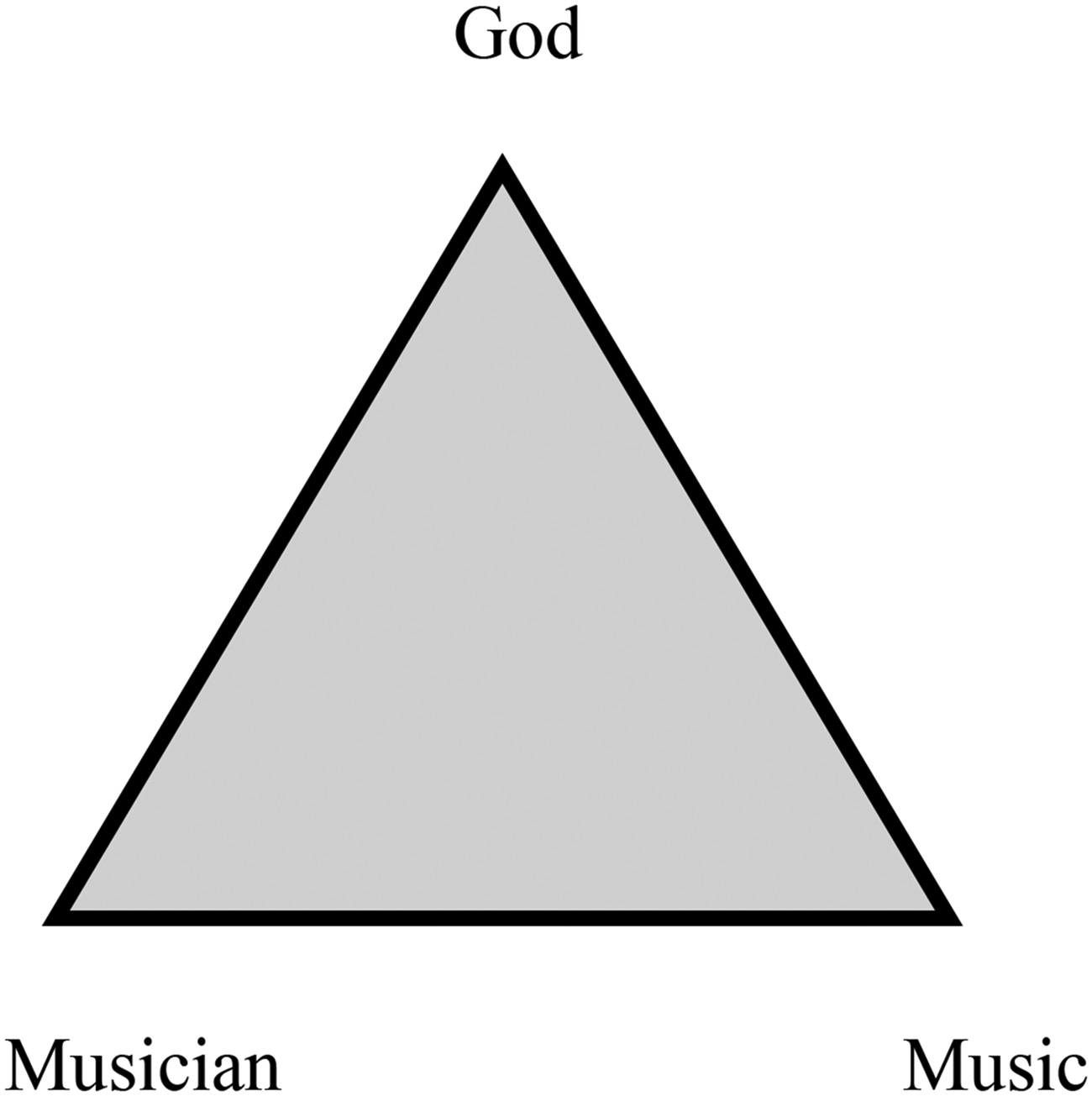
A visual representation of God, musician, and music in worship, drawing on Buber's (1947; 1958) theory of the “between”; the space between the relating “I” and the “Thou.” This triangle is adapted with permission from Garred’s (2001) visual diagram of the music-therapist-client interrelation in music therapy.
As individuals enter into a relational quality of the “between,” this state cannot be consistently maintained, since every I-Thou relationship returns into an I-It relationship. 77 Buber, therefore, describes the “creating [of] social conditions conducive to the individual member's meeting with the divine.” 78 Particular living centers or builders of community contribute to the generation of the “between” quality of relation, which lead to individuals’ encounters with the “eternal You.” 79 If CWM is understood to function as a particular form of the “between,” a worship leader may therefore be viewed as a builder of community. In accordance with Buber's theory, worship leaders have an ability to help establish social conditions that are “conducive to the individual member's meeting with the divine.” 80 Similar here to Biesta's description of transcendence in education where students are presented with something new that “transcends the realm of the possible, 81 members of a praise band may engage with something radically new in these contexts. A worship leader helps create and develop these environments, but ultimately the value is found in the meeting as individuals engage in self-critical attention and reflection with themselves and with the other. These environments can be particularly encouraged with the worship leader's consideration of the language of CWM lyrics, and their formative, purposeful, devotional nature in contemporary worship. With these considerations, then, CWM may help create spaces of meeting.
With the guidance of the worship leader as a “builder of community,” the musicians’ engagement in meeting and encounter will have an impact on them spiritually. As stated in Searle's writings, illocutionary acts often intend and result in perlocutionary response. Calvert indicates, “the ultimate perlocutionary effect of liturgical speech acts is the spiritual formation of the participant by way of capturing the imagination with the narrative-driven, Story-shaped, biblical language and practices of [congregational] worship.” 82 Participating in liturgical speech acts, with the added illocutionary force of music, thus has the potential for an even greater perlocutionary effect of spiritual formation on musicians. Worship, in this sense, is a response to God's self-revelation, or as Calvert states, “the perlocutionary effect of God's communicative action.” 83
As musicians enter into a relationship with the music, a process of performative listening occurs as well. CWM musicking practices involve one's engagement in listening toward relationship. Doyle Srader describes the illocutionary performative listening episode as involving three listening encounters: listening toward relationship, toward leadership, and toward fairness. 84 Listening toward relationship, Srader writes, involves an act of promise or commitment. Listening in this case could specifically be tied to Searle's commissive illocutionary speech act, where musicians re-commit themselves to God and celebrate promises made. Not only do musicians in this context engage in listening, but a state of relational encounter and dialogical musicking occurs when musicians enter the space of I-Thou awareness, imagination, and worship and leave behind their earthly state of pre-determined expectations. One's engagement in encounter within a praise band setting is one of understanding, where the individual is separated from the other but interacts with mutual understanding and respect. When sharing a spiritual experience and committing themselves to the truth of the Gospel together, musicians are likely to experience a close intimacy with one another. Thus, engaging in liturgical speech acts through music alone or through singing may lead to a strengthening of one's spirituality as well as a strengthening of human relationships.
Conclusion
In entering a space of the “between” and ultimately an I-Thou relationship through CWM, one might consider a process of sufficiently preparing to enter that space. This musical and spiritual preparation is individual, where praise band musicians prepare their hearts and minds spiritually for engagement in worship, while also rehearsing their musical technique and skills before a practice or worship service. They begin their preparation at an individual level, and from there they engage collectively with others in worship. It is necessary to emphasize that “excellence” in worship and engagement in adequate preparation does not refer to a level of technical excellence that must be reached in order to enter a space of engagement and dialogue with God. What is being emphasized here, rather, is the notion that Christians believe that their worship should glorify God, and many interpret that as preparing and playing to the best of their abilities. Some even may refer to praise and worship music as a “musical offering” to God. Yet, as musicians practice and rehearse “to the best of their abilities,” their musical technique will likely be impacted in the process. It would helpful, then, to further consider how worship leaders address this concept pedagogically within praise band practices, exploring how they may decipher who can and cannot be part of a praise band if all musicians are playing “to the best of their ability” for God. While a worship leader cannot necessarily determine this, some may still encourage the importance of critique and careful selection of musicians within a church worship setting.
Furthermore, it would be useful to explore how various churches conceptualize the process of music learning intertwined with worship leadership. Some may allow only professionals and “adequately trained musicians” to take part in praise bands. This may be based on an argument that initial music learning should occur outside of a church leadership setting, and once a certain level is reached, then one's musical “skillset” can be transferred to a praise band. Regardless of these various theological implications, however, it is critical to acknowledge the role of praise bands in musicians’ music learning processes and spiritual formation.
Worship is a time of formation and ritual, intentionally aligning musicians’ beliefs and understandings. Liturgies, an inherent element of worship, are often present in worship for the purposes of encounter and dialogue with God. 85 As praise band musicians continue to engage in liturgical speech through CWM, their musical learning and musicking practices are affected through this engagement. The formative and purposeful nature of CWM language may have perlocutionary effects, strengthening one's spiritual formation as well as human relationships. This process likely affects musicians today with whom educators and worship leaders come into contact on a daily basis. Concepts such as encounter, meeting in music, dialogical listening, and engaging in speech acts through music require further consideration and exploration for church praise band contexts. As suggested within this article, as musicians engage in liturgical speech acts through CWM, their musicking practices are particularly strengthened through dialogical listening and encounter. Worship leaders have a role in contributing to a space of musical meeting, in which musicians can enter into relational dialogue and re-commit themselves to their conception of the truth of God, becoming closer to one another throughout this process. Therefore, liturgical speech acts function as an illocutionary force enacted in CWM, with the constitutive power to shape musicians’ musical learning, musicking practices, and, ultimately, their spiritual formation.
Footnotes

1
Monique Ingalls, Singing the Congregation: How Contemporary Worship Music Forms Evangelical Community (New York: Oxford University Press, 2018); for a history of contemporary worship music see Swee Hong Lim and Lester Ruth, Lovin’ on Jesus: A Concise History of Contemporary Worship (Nashville, TN: Abingdon Press, 2017).
2
Lester Ruth, “Introduction: The Irony of a Missed Alliance,” in Flow: The Ancient Way to Do Contemporary Worship, ed. Lester Ruth (Nashville, TN: Abingdon Press, 2020).
3
Evangelical is defined by Ingalls as a broad, transnational, interdenominational religious Christian group within Protestant Christianity, currently numbering somewhere between 300 and 550 million Christians worldwide in 2018; for more information see Ingalls, Singing the Congregation, 12; Ruth, Flow, ix.
4
Monique Ingalls, “Introduction: Interconnection, Interface, and Identification in Pentecostal-Charismatic Music and Worship,” in The Spirit of Praise: Music and Worship in Global Pentecostal-Charismatic Christianity, ed. Monique Ingalls and Amos Yong (University Park, PA: Pennsylvania State University Press, 2015) 6.
5
Ingalls, Singing the Congregation, 5; Lim and Ruth, Lovin’ on Jesus, 5.
6
Deborah Justice, “Mainline Protestantism and Contemporary versus Traditional Worship Music,” in The Oxford Handbook of Music and World Christianities, ed. Jonathan Dueck and Suzel Ana Reily (New York: Oxford University Press, 2016) 491; see also Lim and Ruth, Lovin’ on Jesus for a greater discussion of the “worship wars.”
7
Lim and Ruth, Lovin’ on Jesus, 4–5; Lester Ruth, “How ‘Pop’ are the New Worship Songs? Investigating the Levels of Popular Cultural Influence on Contemporary Worship Music,” Global Forum on Arts and Christian Faith 3.1 (2015) 1–20.
8
Gordon Graham, “The Worship of God and the Quest of the Spirit: ‘Contemporary’ versus ‘Traditional’ Church Music,” in God's Song and Music's Meanings: Theology, Liturgy, and Musicology in Dialogue, ed. James Hawkey, Ben Quash, and Vernon White (London: Routledge, 2019) 89; Robert Woods and Brian Walrath, “Introduction,” in The Message in the Music: Studying Contemporary Praise and Worship, ed. Robert Woods and Brian Walrath (Nashville, TN: Abingdon Press, 2007) 16; see also Marva Dawn, Reaching Out without Dumbing Down: A Theology of Worship for This Urgent Time (Grand Rapids, MI: Eerdmans, 1995).
9
Ingalls, “Introduction,” 6.
10
Laura Benjamins, “Learning through Praise: How Christian Worship Band Musicians Learn,” Journal of Popular Music Education 3.3 (2019) 417–33.
11
Christopher Small, Musicking: The Meanings of Performing and Listening (Hanover, NH: University Press of New England, 1998); Christopher Small, Music, Society, Education (1977; repr. Hanover, NH: Wesleyan University Press, 1996). Throughout this article, I chose to use the term “musicking” to more accurately describe the relationships that are created when making music together. According to Small's theory, the meaning of music is found in actions, in what people do, rather than objects or musical works (see Small, Musicking, 8).
12
David Calvert, “Liturgical Speech Acts: How to Do Things with Words in Worship” (PhD dissertation, Southeastern Baptist Theological Seminary, North Carolina, 2018).
13
Ron Holt, “A Socio-Linguistic Approach to Religious Language,” Australian E-Journal of Theology 6 (2006) 1–14; Graham Hughes, Worship as Meaning: A Liturgical Theology for Late Modernity (Cambridge: Cambridge University Press, 2003); Richard Ingold, “God, the Devil, and You: A Systemic Functional Linguistic Analysis of the Language of Hillsong,” Literature & Aesthetics 24.1 (2014) 85–116.
14
Michael Bayldon, “Body-Language: Post Vatican II Liturgy,” New Blackfriars 86.1004 (2005) 450–53; David Maines and Michael McCallion, “Research Note: Evidence of and Speculations on Catholic De Facto Congregationalism,” Review of Religious Research 46.1 (2004) 92–101.
15
Martin Buber, I and Thou, trans. R. G. Smith (New York: Scribner, 1958).
16
Small, Musicking, 8.
17
Gert Biesta and Barbara Stengel, “Thinking Philosophically about Teaching,” in Handbook of Research on Teaching, ed. Drew Gitomer and Courtney Bell, 5th ed. (Washington, DC: American Educational Research Association, 2016) 7–67.
18
Ibid., 32, emphasis in original.
19
Gert Biesta, “Receiving the Gift of Teaching: From ‘Learning From’ to ‘Being Taught by’,” Studies in Philosophy and Education 32 (2013) 449–61; Gert Biesta, “Freeing Teaching from Learning: Opening up Existential Possibilities in Educational Relationships,” Studies in Philosophy and Education 34 (2014) 229–43; Patricia Hannam and Gert Biesta, “Religious Education, a Matter of Understanding? Reflections on the Final Report of the Commission on Religious Education,” Journal of Beliefs & Values 40 (2019) 1–9.
20
Biesta, “Receiving the Gift of Teaching,” 459.
21
Ibid., 456, emphasis in original.
22
Ibid., 455. See also Merold Westphal, Levinas and Kierkegaard in Dialogue (Bloomington and Indianapolis: Indiana University Press, 2008) 26.
23
Ibid., 456.
24
Gert Biesta and Patricia Hannam, “Religious Education and the Return of the Teacher,” Religious Education 111.3 (2016) 242.
25
Biesta, “Receiving the Gift of Teaching,” 449–61; Biesta, “Freeing Teaching from Learning,” 229–43; Hannam and Biesta, “Religious Education,” 1–9.
26
Ingalls, “Introduction,” 6.
27
Kevin Kurian, “The Person of the Worship Leader: A Qualitative Study of Communal Worship” (PhD dissertation, Fuller Theological Seminary, California, 2016).
28
Biesta, “Receiving the Gift of Teaching,” 456.
29
June Boyce-Tillman, “Tune Your Music to Your Heart: Reflections for Church Music Leaders,” in Christian Congregational Music: Performance, Identity and Experience, ed. Monique Ingalls, Carolyn Landau, and Tom Wagner (Surrey, UK: Ashgate, 2013) 53.
30
Biesta, “Receiving the Gift of Teaching,” 449–61.
31
Ibid., 459.
32
Boyce-Tillman, “Tune Your Music to Your Heart,” 53.
33
Ibid., 52–53.
34
Nicholas Wolterstorff, The God We Worship: An Exploration of Liturgical Theology (Grand Rapids, MI: Eerdmans, 2015) 26.
35
Nicholas Wolterstorff, Acting Liturgically: Philosophical Reflections on Religious Practice (Oxford: Oxford University Press, 2018) 19.
36
Ibid., 14.
37
Ibid., 26.
38
Ibid., 27.
39
James K. A. Smith, You Are What You Love: The Spiritual Power of Habit (Grand Rapids, MI: Brazos Press, 2016) 22.
40
Smith, You Are What You Love, 139.
41
Wolterstorff, Acting Liturgically, 29.
42
Calvert, “Liturgical Speech Acts,” 4.
43
Wolterstorff, Acting Liturgically, 27.
44
Wolterstorff, The God We Worship, 61.
45
Wolterstorff, Acting Liturgically, 29.
46
Ibid., 26–30.
47
Calvert, “Liturgical Speech Acts,” 30–31.
48
J. L. Austin, How to Do Things with Words (Oxford: Clarendon Press, 1962) 6.
49
Wolterstorff, Acting Liturgically, 23.
50
Austin, How to Do Things with Words, 6, emphasis in original.
51
Ibid., 94; 98–99.
52
Calvert, “Liturgical Speech Acts,” 13–14.
53
Ibid., 14.
54
Calvert, “Liturgical Speech Acts.”
55
John R. Searle, Speech Acts: An Essay in the Philosophy of Language (Cambridge: Cambridge University Press, 1969) 33.
56
Ibid., 34.
57
Calvert, “Liturgical Speech Acts,” 204.
58
Wolterstorff, Acting Liturgically, 26.
59
David Hilborn, “From Performativity to Pedagogy: Jean Ladriere and the Pragmatics of Reformed Worship Discourse,” in The Nature of Religious Language: A Colloquium, ed. S. E. Porter (Sheffield: Sheffield Academic Press, 1996) 173.
60
Calvert, “Liturgical Speech Acts,” 5.
61
Ibid., 8.
62
June Boyce-Tillman, “The Transformative Qualities of a Liminal Space Created by Musicking,” Philosophy of Music Education Review 17.2 (2009) 185.
63
Buber, I and Thou.
64
Elsewhere, I extend such themes of liminality and relationality in a music classroom setting through students’ musicking experiences (see Laura Benjamins, “Facilitating Relational Spaces of Musicking: A Music Educator’s Practice of Care,” in Authentic Connection: Music, Spirituality, and Wellbeing, ed. June Boyce-Tillman and Karin Hendricks (Oxford: Peter Lang, 2021) in press). I understand church worship, though, as a different form of relationality as one engages in dialogue with God and other believers.
65
Rudy Garred, “The Ontology of Music in Music Therapy—a Dialogical View,” Voices: A World Forum for Music Therapy 1.3 (2001).
66
Dan Avnon, “The ‘Living Center’ of Martin Buber's Political Theory,” Political Theory 21.1 (1993) 55–77.
67
Dvora Lederman-Daniely, “Creation of the ‘Sphere of the Between’ in Educational Dialogue,” Contemporary Education Dialogue 13.2 (2016) 202.
68
Martin Buber, “Elements of the Interhuman,” in The Knowledge of Man: A Philosophy of the Interhuman, ed. Maurice Stanley Friedman (New York: Harper & Row, 1965) 75.
69
Lederman-Daniely, “Creation of the ‘Sphere of the Between’,” 202.
70
Martin Buber, Between Man and Man, trans. R. G. Smith (1947; repr. New York: Routledge, 2002) 115. Citations refer to the 2002 edition.
71
Buber, Between Man and Man, 116.
72
Ibid., 115.
73
Ibid., 116.
74
Mark Whale, “Music as the Between: The Idea of Meeting in Existence, Music, and Education” (PhD dissertation, University of Toronto, 2009), ii.
75
Ibid., 3, emphasis in original.
76
Whale, “Music as the Between,” 239.
77
Buber, I and Thou, xiii.
78
Ibid., 57.
79
Ibid.
80
Avnon, “The ‘Living Center’,” 57.
81
Biesta, “Receiving the Gift of Teaching,” 456.
82
Calvert, “Liturgical Speech Acts,” 83, emphasis original.
83
Ibid., 214.
84
Doyle Srader, “Performative Listening,” International Journal of Listening 29.2 (2015) 95–102.
85
Wolterstorff, Acting Liturgically.