




Abstract
Although undergraduates from all class backgrounds work while attending college, little is known about how students approach finding work and the benefits they reap from different on-campus roles. Drawing on interviews with 110 undergraduates at Harvard University, we show that in the absence of clear institutional expectations surrounding on-campus work opportunities, students draw on class-based strategies to determine which jobs are “right for them.” Upper-income students pursued “life of the mind” jobs that permitted them access to institutional resources and networks. Alternatively, lower-income students pursued more transactional “work for pay” positions that yielded fewer institutional benefits and connections. The consequences of these differential strategies were amplified during COVID-19 campus closures as work-for-pay positions were eliminated while life of the mind continued remotely. Through documenting heterogeneity in work experiences, we reveal a class-segregated labor market on campus and extend previous analyses of how university practices exacerbate class differences and reproduce inequality.
Keywords
Undergraduates from all class backgrounds work while attending college (National Center for Education Statistics 2022), but not all jobs yield equal benefits. Extant research has focused on the relationship between hours worked and academic performance and engagement, consistently documenting the negative academic consequences of working long hours and working off campus (Bozick 2007; Choy and Berker 2003; Kuh, O’Donnell, and Reed 2013; Pascarella and Terenzini 2005; Umbach, Padgett, and Pascarella 2010). Scholars have also shown that first-generation and low-income college students are more likely to work off campus at non-university-sponsored or -connected jobs and at an intensity that undermines academic performance, retention, and engagement (Choi 2018; McCormick, Moore, and Kuh 2010).
However, some kinds of work, although less often afforded to first-generation and low-income students, can be beneficial. For instance, research shows that lower-income and first-generation college students benefit from “high-impact” positions, such as conducting research for faculty members on campus (Kilgo et al. 2019; Zilvinskis and McCormick 2019). In addition to increased academic performance, high-impact positions promote deep approaches to learning, student engagement, and cognitive development (An and Loes 2023; Nuñez and Sansone 2016). Left underexplored, however, are the social processes undergirding employment stratification on campus (see Smith 2007). Consequently, we know little of how social class shapes students’ employment trajectories in college and the differential access to institutional resources their jobs provide. By comparing the employment strategies of lower-income and upper-income undergraduates and the differential experiences and benefits these strategies yield, we examine how on-campus employment reproduces existing social class disparities.
We document heterogeneity in on-campus work, which is often portrayed as homogeneous and equally beneficial for all students. Unlike internship or career funnels (Binder, Davis, and Bloom 2015; Moss-Pech 2021), little institutional infrastructure exists to help undergraduates navigate the on-campus job application process. This laissez-faire approach to campus employment leads to “interpretative moments” (Calarco 2014) that students must make sense of and respond to (Swidler 1986). We draw on interviews with a purposefully stratified sample of 110 lower- and upper-income undergraduates at Harvard University to investigate how social class shapes students’ strategies for securing work. Harvard’s student body diversity, near-universal residential campus model, and myriad institutional resources make it an ideal site to study how students from different socioeconomic backgrounds who are immersed in the same resource-rich, cultural milieu experience stark differences navigating campus employment. Furthermore, by conducting this study in the wake of COVID-19 campus closures, we document how classed strategies for seeking employment lead to a segregated labor market and how this stratification creates uneven returns to paid campus labor.
When upper-income students in our sample worked, we found they were about twice as likely as lower-income students to seek and secure faculty-facing work (e.g., research or teaching assistantships) that dovetailed with their intellectual or career interests (see Cech 2021, Martin 2012). They felt comfortable reaching out to influential adults to find “life of the mind” positions on campus that provided direct access to institutional resources (An and Loes 2023) and often engendered relationships with faculty and administrators. Lower-income students, in contrast, prioritized earning money quickly to meet pressing financial needs. Moreover, they frequently reported discomfort engaging with authority figures, which shaped the jobs they pursued and their strategies for securing those positions. Ultimately, these students were drawn toward publicly advertised, easily accessible, familiar “work for pay” positions, such as barista and desk clerk, and they compartmentalized their academic and work experiences. A small proportion of lower-income students did secure faculty-facing life of the mind work. Students who attained such jobs reported either greater ease with authority figures due to their precollege experiences or direct recruitment by faculty. These alternative trajectories enabled some lower-income students to attain life of the mind roles, but the overall class-segregated pathway to those positions remained intact.
Differential college work strategies and experiences proved consequential during COVID-19 campus closures. Whereas students who worked life of the mind positions were able to continue working remotely, students in work for pay positions were laid off and had to seek other options during a period of limited opportunity. This disruption disproportionately hurt lower-income students, who were more likely to hold manual labor positions and to depend on their earned income to support themselves and their families.
These findings extend our understanding of how social class shapes how students navigate college (Armstrong and Hamilton 2013; Harrison, Hernandez, and Stevens 2022; Ivemark and Ambrose 2021; Jack 2019; Johnson 2022) by demonstrating how students’ job-seeking strategies reflect their class-based engagement strategies. Building on prior research examining how students’ ease with engaging authority figures functions as a form of cultural capital (Bassett 2021; Calarco 2018; Harrison et al. 2022; Jack 2016; Lareau 2015; Streib 2011; Yee 2016), we explore how this ease extends to accessing material, social, and institutional resources through paid work. Consequently, this analysis extends the research on employment in college beyond the focus on numbers of hours worked to document the social process of engagement and the disparate institutional and social advantages that result from different strategies (Lamont, Beljean, and Clair 2014). Understanding these dynamics provides insight into the reproduction of inequality in higher education, even as colleges adopt policies to ameliorate it.
Learning, Working, and Earning
Work is a central feature of the undergraduate experience (Goldrick-Rab 2016; Pascarella and Terenzini 2005). Approximately 40 percent of full-time college students work, and 25 percent of them work 20 or more hours a week (National Center for Education Statistics 2022). For the past 30 years, research on work in college has largely focused on the relationship between hours worked and student engagement and academic outcomes (Goldrick-Rab 2016; Pascarella and Terenzini 2005). Scholars have found mixed results, indicating that working benefits some students but impedes the success of others (Choy and Berker 2003; Kuh et al. 2013; Lundberg 2004; Zilvinskis and McCormick 2019)
This scholarship demonstrates that the type and intensity of work matters, consistently finding that working off campus for long hours undermines student learning and engagement (Choy and Berker 2003; Kuh et al. 2013). For example, Umbach et al. (2010) found that students who worked more than 20 hours off campus reported fewer meaningful interactions with faculty and less growth in critical thinking (see also Dundes and Marx 2006). Researchers posit that working long hours off campus limits positive and supportive interactions on campus and reduces the academic, social, and emotional benefits students gain from community membership (Armstrong and Hamilton 2013).
In addition to gaining fewer academic and social benefits from their campuses, students who work long hours off campus may experience increased challenges due to the inhospitable conditions of low-wage work. Students who work off campus and enter the low-wage workforce are most commonly employed in retail, food preparation, or service roles (Ross and Bateman 2019). These jobs are marked by low wages and scheduling instability (Gerstel and Clawson 2018; Schneider and Harknett 2019). Scheduling instability, even more so than low wages, is associated with psychological distress, poor sleep, and lower levels of happiness (Schneider and Harknett 2019), and it poses problems for college students who must maintain routine class schedules and meet strict assignment deadlines to remain in good academic standing and keep their financial aid. Low-wage retail and service workers are also vulnerable to job loss. During the pandemic, low-wage workers, especially those ages 16 to 24, faced the largest job losses and recorded the slowest recovery (Bateman and Ross 2021).
In contrast, researchers have found that working on-campus jobs can help students gain important benefits. Trolian and Rossman (2022) found that on-campus employment was positively associated with increased openness to diversity and challenge, in part due to increased interactions with diverse peers (Rossmann 2022). On-campus jobs can also serve as a bridging experience, helping students develop relationships with institutional agents (Lee and Maynard 2019; Stanton-Salazar 2011) and acquire dominant cultural and social capital. These benefits may be especially large for students who arrive on campus with lower volumes of dominant social and cultural capital (An and Loes 2023; Kilgo et al. 2019). For example, Nuñez and Sansone (2016) illustrate that on-campus work helped first-generation Latinx students forge connections with peers on campus and develop dominant cultural capital.
In this body of scholarship, on-campus work is generally presented as homogeneous and equally accessible by all students. But on-campus jobs range widely in terms of function, pay, status, flexibility, and access to institutional resources. Even at well-resourced universities, some students are paid to do janitorial work while others work as research assistants (Jack 2019). On-campus jobs also vary widely in terms of visibility and application process; many high-status and high-impact jobs, like research assistantships, are often not publicly advertised and are gated by faculty and administrators.
The minimal institutional infrastructure surrounding campus employment amplifies ambiguity about the spectrum of jobs and how to secure them. In contrast to the dedicated offices, proactive recruiting, and coaching that funnel students into high-status internships and careers on elite campuses (Binder et al. 2015; Rivera 2015), many universities adopt more technologically driven, laissez-faire approaches to campus employment. On-campus jobs are often disseminated through email, university websites, or platforms like Handshake. Many campuses also host once-a-semester, on-campus job fairs, but an implicit premium is placed on independence; students are expected to discover and navigate these spaces on their own. Despite this heterogeneity, little research interrogates students’ pathways to securing employment, leaving their job-seeking strategies and experiences securing employment unexamined.
We fill this gap in two ways. First, we identify and explore two distinct but ubiquitous types of on-campus work that provide differential access to institutional resources, including faculty support, recommendation letters, and skills-based training: life of the mind and work for pay. Life of the mind and work for pay are Weberian ideal types (Weber 1978); they are analytic concepts used to represent the overlooked heterogeneity in on-campus work opportunities. Life of the mind work is characterized by its emphasis on intellectual labor and proximity to faculty members or administrators. Students are hired to help faculty and staff advance their academic work and meet institutional goals. Example positions include research assistants, course assistants, translators, and grant writers. Work for pay jobs, in contrast, are characterized by their emphasis on physical labor. Students are more likely to be hired and supervised by staff or peers to help the campus run efficiently and provide services to peers. Roles often include groundskeeping, retail and food service, and building management; these jobs rarely grant access to institutional resources beyond pay. By examining students’ experiences in these roles before and during COVID-19 closures, we show how these two types of work provide students with differential institutional and financial resources. We document a segregated labor market on campus, one marked by social class.
Second, we show how social class shapes students’ strategies for securing on-campus employment and the meanings students attribute to the work they do. The ambiguity and inconsistent institutional expectations surrounding on-campus work create what Calarco (2014:186) terms “interpretative moments,” which she defines as “situations in which ambiguous expectations prompt conscious interpretation” (see also Calarco 2018; Swidler 1986). Calarco (2014, 2018) demonstrates that as early as elementary school, students draw on class-based logics to respond to ambiguous expectations in schools. Whereas middle-class students draw on a logic of “entitlement” to secure advantages and assistance, working-class students adopt a logic of “appeasement” to demonstrate respect and deference to authority (Lareau 2003; Streib 2011).
Research examining how social class shapes academic engagement posits that these inherited behaviors persist as youth transition to adulthood (Armstrong and Hamilton 2013; Lareau 2015) and that undergraduates continue to draw on class-based strategies for engaging faculty and the larger institution (Bassett 2023; Benson and Lee 2020; Harrison et al. 2022; Ivemark and Ambrose 2021; Jack 2014; Lee and Kramer 2013; Stuber 2011; Yee 2016). Students’ help-seeking strategies are a form of cultural capital (Bourdieu 1984); they are “micro-interactional processes whereby individuals’ strategic use of knowledge, skills, and competence comes into contact with institutionalized standards of evaluation” (Lareau and Weininger 2003:569). Different help-seeking strategies yield different access to institutional resources, or “profits,” that can aid students’ progress in college and mobility after graduation (Lareau and Weininger 2003; see also Hurst et al. 2023). For example, Yee (2016) showed that low-income students preferred to labor over assignments independently rather than ask for and receive assistance from professors or teaching assistants. Similarly, Bassett (2021) found that in times of crisis, low-income, first-generation students were reluctant to reach out to staff and faculty for help navigating the university unless they had developed trusting relationships with them (see Benson and Lee 2020). Jack (2016) revealed that although the majority of lower-income students avoided faculty, those who graduated from boarding and day schools had developed an ease with engaging authority figures through their prior experiences in elite environments and reported a greater sense of belonging and access to academic support (Ivemark and Ambrose 2021). Even when students are given clear communication on how to proceed, Harrison et al. (2022) show that middle-class students are more likely to advocate for their preferences if university recommendations contradict their desires.
Extant research demonstrates that students bring class-based strategies to college, but this work has primarily explored students’ interaction with faculty in their capacity as teacher and mentor. Yet faculty and administrators also serve as supervisors and managers. Left underexplored is how on-campus work operates as a site of social reproduction and how social class shapes students’ interactions with faculty in their role as employer in ways that produce uneven access to institutional resources. We argue that students’ job-seeking strategies are an extension of their larger engagement strategies. Examining differences in students’ comfort engaging institutional agents in this way deepens our understanding of how social class shapes students’ trajectories through college, and especially how their judgments about what types of jobs are “for them” or “not for them” (Jack and Black 2022) shape their strategies for finding work and result in unequal advantages.
Data and Methods
Place
Elite universities are ideal sites for studying how campus employment functions as a site of social reproduction. They have high levels of student body diversity (e.g., racial, socioeconomic), are almost exclusively residential, and provide a plethora of unpaid and paid job opportunities. Consequently, undergraduates are immersed in the same social milieu, have equal access to institutional resources, and are exposed to the same campus cultural norms (Binder et al. 2015). These dynamics fulfill the conditions of theoretical sampling (Willer 1967) and permit one to examine how social class shapes students’ strategies for navigating college (Armstrong and Hamilton 2013; Johnson 2019).
Harvard University is an elite, selective research university with extensive resources. Nearly one out of every eight enrolled students come from families that make more than $680,000 annually, but Harvard also operates a need-based, no-loan financial aid system. Students whose families earn less than $65,000 per year are awarded grants and scholarships that cover the entire cost of tuition and room and board. Approximately 20 percent of students fall into this category. However, even students who receive full financial aid are asked to contribute to the cost of their education. Harvard requires all students to “meet their estimated personal expenses” during the academic year through “term-time” work, but the university does not provide direction as to how to comply with such requirements.
On-campus employment at Harvard is portrayed as a “rewarding and fulfilling” way for students to explore their interests. As Harvard’s “Guide to Student Employment” explains, “Whatever your interests may be, there is likely a job available.” Given Harvard’s 12 graduate and professional schools, each filled with centers and institutes (Faculty of Arts and Sciences contains 45 centers alone), this statement is not far-fetched. Faculty across the university hire undergraduates as research assistants, course assistants, and tutors. Libraries, offices, departments, and centers hire students to provide operational and administrative assistance, staff events, welcome guests, and manage communications. Harvard promotes on-campus jobs as “varied and plentiful” and advertises them through three primary avenues: a jobs database, two annual in-person job fairs, and email solicitations. Many more positions, however, are transmitted through informal channels (e.g., during office hours).
Participants
Between January and October 2021, a team of five researchers (including the two authors) conducted in-depth, open-ended interviews with 110 Asian (A), Black (B), Latino (L), mixed (M), Native (N), and White (W) undergraduates at Harvard (see Table 1) as part of a larger project on the present-day experiences of undergraduates with Harvard and the Legacy of Slavery Initiative. 1 The initial focus of the project was to explore the experiences of Black students, who we oversampled, but we purposefully included Asian, mixed, Native, and White students to better understand the challenges students face today, with a diverse sample along class and racial lines. After securing student emails from the Office of Institutional Research, we first sorted students into racial/ethnic groups and then by amount of financial aid received (none, some, full). We assigned each student a random number, sorted our list numerically, and then extended invitations on a rolling basis. We also recruited undergraduates through snowball sampling and direct invites.
Analytic and Racial/Ethnic Classification of Undergraduates.
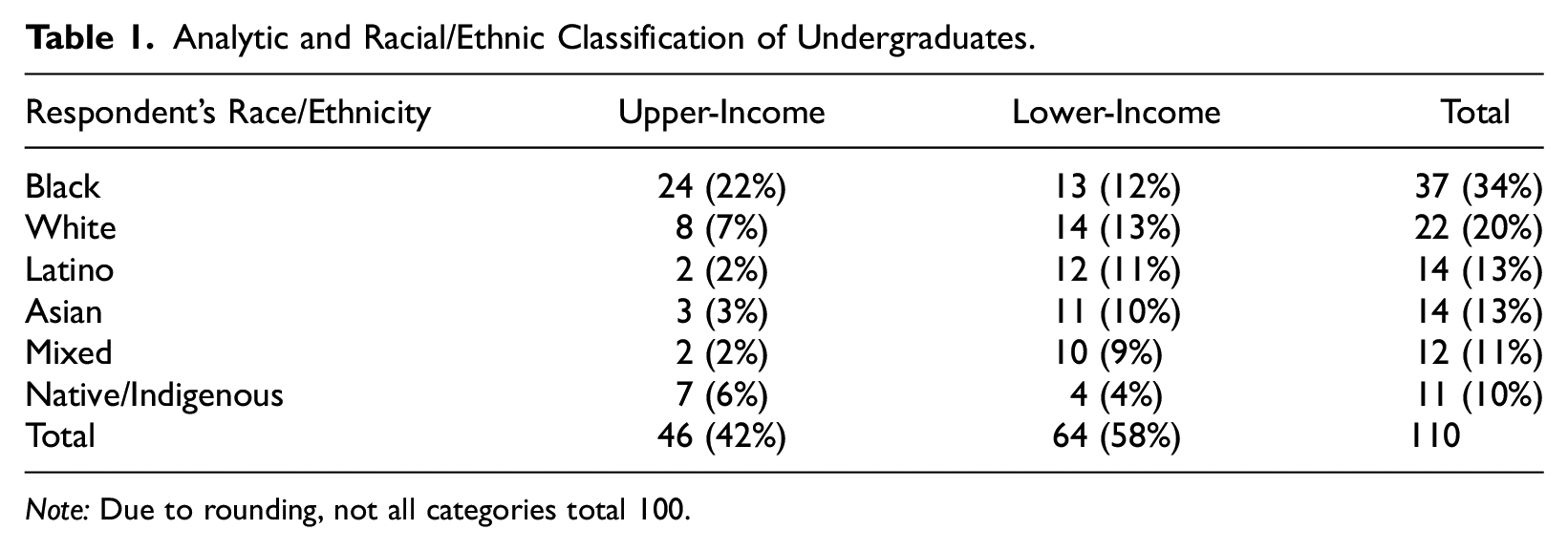
Note: Due to rounding, not all categories total 100.
For this analysis, we focus on differences between lower-income (LI; family earns less than $65,000; n = 64) and upper-income (UI; family earns more than $65,000; n = 46) students because we found the <$65,000 group to be most different from students who received some or no financial aid. 2 Participants whose families earned less than $65,000 not only qualified for full financial aid, but they were also more likely to report being first in their families to attend any college. Roughly 66 percent of lower-income students in our sample identify as first in their families to go to college (with neither parent earning a college degree in the United States), and 10 percent reported being the first in their families to graduate from high school. Lower-income students across racial lines talked about the need to support themselves and their families. In contrast, Upper-income students were not only exclusively continuing-generation college students, but they also frequently had parents with advanced degrees. They were also more likely to report being a “legacy” at Harvard, meaning their parents attended Harvard as an undergraduate or for their advanced degree.
Data collection and analysis
Interviews ranged from 1 to 7.5 hours and lasted, on average, 2.5 hours. Students were compensated $40 for each interview session. Forty students completed their interviews across two or three sittings. Three students agreed to do a second sitting to complete their interview, but we were unable to schedule a follow-up. When possible, we matched interviewers and participants by race, class, or both. Three researchers identified as Black (LI), one as White (UI), and one as Native (LI). All interviewers used a standard interview guide and asked students a range of questions about their families and neighborhoods, their high school experiences, their transition to Harvard, and COVID-19 interruptions. We also asked specific questions about employment before and during college, students’ motivation for working, and their approach to finding work.
Data for this analysis primarily came from answers to two prompts: “Tell me about working on campus” and “What did COVID-19 mean for working?” We also examined general reports about being employed while in college. We asked students about their experiences in this open-ended, discursive manner to allow them to outline their job-seeking strategies and to identify their most salient experiences working in college (see Hirsch and Jack 2012). Data were coded iteratively (Charmaz 2006) by first grouping discussions of work across transcripts and then comparing themes across groups (Deterding and Waters 2021). We read interview transcripts to summarize students’ work history, focusing on their motivation for work and strategies for securing employment at Harvard. Index codes related to working were reread and analyzed to assess patterns in motivations for work and strategies for securing work. As we examined differences between income groups, we did not observe any differences between racial groups in how students sought or accessed work on campus. We then focused on students’ work experiences after campus closures in March 2020 and what COVID-19 closures meant for students’ work and earning money.
Findings
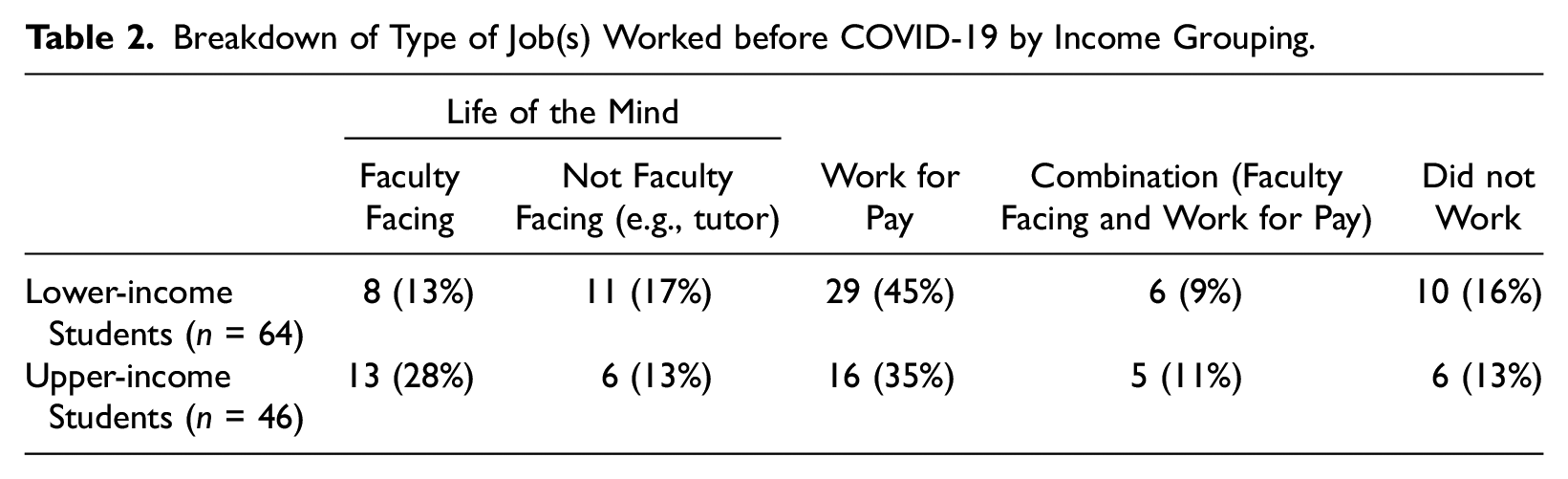
We first describe how ambiguity and inconsistency in Harvard’s on-campus work “marketplace” lead to “interpretative moments” (Calarco 2014) for undergraduates. We then describe how two aspects of social class—students’ level of financial need and their ease in engaging authority figures—yield different strategies and experiences with on-campus work before examining the consequences of campus closures due to the COVID-19 pandemic (see Table 2). Whereas Upper-income students worked to earn money for socializing or to build their résumés, lower-income students reported an urgent need to work to support themselves and their families. Upper-income students drew on strategies of “curation,” comfortably reaching out to adults to network and find work, especially positions that dovetailed with their academic, personal, and career interests. They often sought life of the mind jobs such as course, research, or teaching assistantships. In contrast, lower-income students reported discomfort engaging with college officials and a lack of familiarity securing such jobs. To resolve pressing and persistent financial demands, they drew on strategies of “compartmentalization,” drawing boundaries between the economic demands of life and the academic demands of Harvard. This strategy led them toward familiar, more transactional positions, such as barista and janitorial services, where contact and engagement with authority figures was minimal. Lower-income students who did secure teaching or research positions reported being either (1) directly solicited for the role or (2) aware of the process due to prior experiences at elite private schools. These differential strategies proved consequential during COVID-19 campus closures. Students in life of the mind positions, who were disproportionately upper-income, successfully transitioned to remote work, whereas students in work for pay roles, two-thirds of whom were lower-income disproportionately lost their jobs.
Breakdown of Type of Job(s) Worked before COVID-19 by Income Grouping.
On-Campus Work: Inconsistent and Opaque
Harvard reports that 78 percent of their undergraduates work a part-time job on or off campus during college, but this statistic masks great heterogeneity in the type of roles students work, how they find them, and the benefits they accrue. Students who visit Harvard’s Student Employment Office website are directed to an internal jobs database that contains both on- and off-campus opportunities. Recently listed jobs (9/28/23) included an off-campus job coaching high school students to get into elite colleges, a London-based machine learning internship, a “Faculty-Student Initiative Intern” in the Dean of Students office, an SAT tutor, a front-office assistant in the economics department, and a temporary household helper. Each role requires different application materials, involves different interview processes, has different starting and ending dates, and has different compensation structures. Each role also requires different engagement with authority figures and conveys different status signals to future employers.
The vast array of opportunities advertised on the jobs database shifts weekly, but other realms of on-campus work are more predictable. Campus libraries, eateries, and residence halls reliably hire undergraduates every year to shelve, clean, greet, and serve. These jobs are publicly and frequently advertised through flyers, via social media posts, and in the jobs database. Dorm crew, a well-known manual-labor position cleaning dorms, is advertised as a preorientation program to students before they arrive. These jobs involve clearly delineated, repetitive tasks, and they are typically supervised by staff or peers rather than Harvard faculty or administrators. Students view these jobs as easily securable. As Nicole 3 (LI, M) explained, dorm crew is one of the “jobs you automatically get just by applying.” We term this type of on-campus employment work for pay.
However, as Harvard’s Student Employment Office explains, at Harvard, “Many students pursue a research opportunity in place of a standard job” (emphasis added). Research positions are nonstandard in compensation, transparency, and application process. For example, Harvard’s Student Employment Office website directs students interested in research toward the jobs database but cautions, “Not all faculty members or departments use the SEO Jobs Database to post positions, so you may want to visit individual academic department websites to see if positions are there or contact a faculty member directly” (9/28/2023). This inconsistency generates confusion for students. Stephen (LI, L) wanted a research position but incorrectly believed there was only one application deadline: “I wanted to get a research position for this semester, but I wasn’t able to. I missed the deadline in the fall to sign up and to reach out. So, I don’t have one now.” Other students assumed you had to know a professor to get a research job. Jackie (LI, A) noted how research “felt much less accessible to me. I didn’t develop very personal connections with my professors freshman year. I didn’t even know how people found those research jobs or how they started it.”
The inconsistency and opacity of research roles is partly by design. Research is a high-stakes, labor-intensive endeavor, and faculty want autonomy in deciding who they hire, what tasks students will do, and for how long. Harvard faculty similarly value autonomy in selecting undergraduate “course assistants” (CAs), and they use public postings, direct outreach, and past student performance to recruit their CAs. Research and teaching are two of the most prominent faculty-facing roles on campus that rely on intellectual labor; other life of the mind jobs include editing the student newspaper, tutoring, and translating. On-campus job seekers have to make sense of this vast arena with variable pathways and formulate a strategy. In the following, we detail how upper-income and lower-income students’ differing strategies and financial needs result in different experiences and benefits.
Upper-Income Students: Connecting the Dots
Over half of the upper-income students worked a life of the mind job that advanced their academic and professional interests, and almost a third worked directly with faculty as a research or course assistant. They reported spending their earnings at restaurants, on buying clothes, and on “unnecessary leisure expenses.” When faced with Harvard’s ambiguous job marketplace, they drew on strategies of curation, proactively finding, creating, and securing positions that advanced their interests and career goals. Jack (UI, W) explained how he put his networking skills to use to find a job researching political polarization: “One of the things that I pride myself on as a skill is I’m pretty good at making connections. The research job I got through a professor, an old professor of mine that I knew was interested in that stuff. I emailed him and asked if he knew anybody.” Carmen (UI, B) identified as a Black biracial woman and valued the opportunity to explore these social identities in college. She was immediately drawn to the undergraduate pedagogy fellow at the Bok Center for Teaching and Learning: “I was like, this feels very important.” She was particularly excited to help “professors understand the identities of their students. . . . I speak to instructors, which can be museum staff, but mostly TFs [teaching fellows] and instructors, about structures of power and privilege in the classroom.” The job also permitted Carmen to be “definitely more frivolous” with online shopping and buy “just random things.”
Meredith (UI, W) constructed her schedule to expose her to chemical principles both inside and outside of class. After struggling in her first year, she made herself a fixture in office hours: “I realized that is the most effective way to get my work done; you know you’re getting the right answers.” After completing the initial chemistry sequence, she joined the organic chemistry teaching team. When asked how she secured this job, she explained, I actively sought them out. My friends were doing it. Not for the same classes, but for other classes. I was like, “Oh, that sounds fun.” I like teaching too. I was a teaching assistant for the EMT [emergency medical technician] class after I did it. So that’s why. I actively sought it out. No one was like “Hey, you want to do this?” I was like, “Please professor, I loved your class,” that kind of thing.
Meredith reprised her role of course assistant many times, twice teaching for the same chemistry professor. Repeated engagement with professors allowed her to not only deepen her understanding of the material, but it also gave her insight into becoming a life science consultant before starting medical school. She confidently noted, “I know the science; I don’t know about business.”
Naturally, not all upper-income students held life of the mind roles. Some did not work at all, and about a third of our sample chose work for pay jobs, such as tour guide or book shelver in the library, to have “some cash on hand.” Elizabeth (UI, N), who prided herself on being self-sufficient, did not want to “be asking my parents every second for money to do stuff.” She got a job as a student caller for donor relations: “I like to have my own money that I can use to do what I want to do with. That’s, literally, the sole reason. I didn’t need to have one . . . literally, just for shits and giggles.”
Lower-Income Students: At Arm’s Length
For lower-income students, work was not about extras or “shits and giggles”; it was about meeting basic needs. All lower-income students who worked reported doing so to support themselves in college and to not be a financial burden on their families. When Amanda (LI, A) saw that one of the “pre-orientation” programs at Harvard paid students to clean dorms, she immediately signed up: “I was like, ‘Oh, money, I could put it towards books or something.’ I just wanted to be independent from my parents, I didn’t really want to ask them to support me through college. I was like, any chance of employment I’ll take up.” Almost a quarter of lower-income students (23 percent) reported sending earnings home to help support their families. Melissa (LI, W) shared that “I worked all through college, all through high school” because it would “directly impact the ability of my family to pay for food and pay bills.” She opened a bank account and gave her mother access to it: “My mom just takes money when she needs to pay bills and stuff.” August (LI, L) felt similarly obligated to help: “My mom doesn’t have a retirement account. My mom doesn’t have siblings. I’m the savings account.”
Urgent financial needs—whether to buy books, send money home, or both—pushed lower-income students toward work that had clearly advertised pay, flexible hours, and immediate start dates. Mia (LI, L) shared that “I’ve been footing the bill for my family for a long time.” Coming to Harvard did not stop that. She took on two campus jobs and sought additional paid opportunities, prioritizing work that was “super flexible.” As she noted, “I’m making enough to not be in crisis mode most of the time.” Describing her work history, she said, I started being an usher, which was definitely a very inconsistent level of income, but they fed us since we would have to stay super late. But that wasn’t enough money. . . . I also took up a poster posting job. What else did I do? I would also take place in studies, whether it be at a business school, or any other school for that matter. They would offer quite a bit of money. I’m OK with being a guinea pig as long as I get paid.
Quick access to money was important for Mia, especially when usher shifts were periodically “kind of sparse.” Although her family made aspirational statements like “I don’t want you to worry about us,” Mia noted that they would also ask, “Can you please send $200 back home? We need it to survive.”
Unlike their upper-income peers who sought to connect academic endeavors with career pursuits, financial need coupled with familiarity and ease of application process influenced almost half of lower-income students to seek out work for pay jobs such as desk clerks, custodial, or delivering laundry. These jobs were posted publicly, had straightforward application processes, and outlined clear, recognizable tasks. Sasha (LI, B) recalled grabbing a flier about working in the library media department, “They were like ‘Apply to do this. This is what you’ll be doing for the year.’” The flier got lost, but she luckily found it just as she was running out of money and her mom warned her she could not help. Sasha applied, got the job, and worked until the pandemic. Nicole (LI, M) was similarly driven to earn money quickly and like Sasha, applied for the first jobs she found. In her first year, she worked as a bartender, babysitter, dog walker, and dorm cleaner. Later, she reflected, I had no idea that if you just work one job that pays pretty well and just take on more hours that it makes far more sense than holding so many different jobs. In my head, I was like, “Oh if I work more jobs like I’ll make more money.”
As lower-income students opted for work for pay positions to address urgent financial need, their lack of familiarity with life of the mind roles and discomfort engaging authority figures pushed them away from research assistant and course assistantship positions. For these jobs, and even some office positions, applying went beyond submitting applications. For many life of the mind positions, no formal application existed. Contact with gatekeepers—faculty and administrators who coordinated hires—mattered (see Smith 2007). Yet for many lower-income students, networking with authority figures was new, uncomfortable, or both. A lack of clarity surrounding the application process and nebulous evaluative standards, from how students should comport themselves to what skills professors were looking for in an applicant, exacerbated uncertainty for lower-income students. As Nicole (LI, M) angrily reflected, “I didn’t know what business casual was. I still don’t.” Laura (LI, A) saw certain positions on campus as out of her comfort zone and even her purview: I didn’t feel I was qualified. I don’t know. I didn’t really think about it, didn’t really know about it until late, I guess sophomore, junior year. I don’t even know if I have the skills. I guess it was also self-doubt and lack of confidence in my own skills.
Uncomfortable and stymied by self-doubt, Laura never submitted her name for consideration. Kevin (LI, W) called his inability to connect with faculty “the problem” that plagued his undergraduate career. “Nobody told me to do that; I had to figure it out later on. That’s the issue. It’s not that the professors themselves are inherently out of reach. Some of them are, but who cares about them? It’s very hard to know that you’re supposed to do that.”
Reluctance to go after such positions sometimes went deeper than unfamiliarity with button-down blazers. In line with previous research (Bassett 2021; Jack 2016; Yee 2016), lower-income students were more likely to report avoiding engaging college officials to resolve academic and personal challenges. As Charlotte (LI, L) said matter-of-factly, “I would avoid people. . . . I don’t know what it is, but I have a fear of people getting too involved in my personal or private life.” Working to support her family was a deeply personal matter to her. Charlotte never saw a formal search for a position through: “Every time I had to answer another question or talk to another person, it freaked me out. I would always chicken out at some point in the process.”
Students managed this uncertainty through a strategy of compartmentalization; they drew boundaries between meeting the academic demands of Harvard and the economic demands of life. As Xavier (LI, B) explained, “I feel like my perfect job is always going to lean towards the research side. Although, I want to separate research from work.” This was also true for Betty (LI, B). Like Mia, Betty flocked to campus websites to assemble varied jobs to support herself and free her mom from financial worry. Betty specifically sought “one-day jobs and stuff like that” where you find a job, show up, do the work, and leave. Her rationale for choosing such jobs was clear: “I’m pretty comfortable navigating that, but not exactly reaching out like, ‘Hey, I need a job.’” Contrasting her approach to peers like Meredith, who advocated for jobs, Betty noted, “That’s a little bit out of my comfort zone and something I’ve never done.” Similarly, Gertrude (LI, W) was not comfortable engaging with adults, and that went double for faculty: “I don’t ask for help very often or enough. . . . I like to be able to figure out stuff on my own.” Gertrude did attend a job fair, but she found it overwhelming and left within the first half hour.
Like Laura, who was shocked at “peers who have asked for a regrade” on tests and assignments, some lower-income students voiced concerns that peers “gamed the system” by blurring the line between academics and work (see Jack and Black 2022). Kevin (LI, W) had a dorm crew job, and he reflected on differences between him and his wealthier peers in approaches to work: My girlfriend, her jobs are interesting; she was doing research with a professor. She gets paid a lot more than I do. I have no idea how to even get into that job. She had known because a friend had done it. It’s an informal network that you feel like you’re not a part of. If you don’t know people that go here, you don’t have that sense of being here. I went for what was obvious, which is doing work for money. I didn’t know that you could research with the professor and make money while also advancing your own academic interests. I didn’t know you could combine all that stuff. When you’re trying to make money, you don’t have a lot of time to go career shopping.
Kevin reported “not having that perspective.” But it was also about lack of comfort. Kevin shared that his girlfriend was “movie theater in her house” wealthy. Her friends shared their best strategies to navigate Harvard that supplemented parental guidance. Kevin, in contrast, made connections elsewhere. Tellingly, he noted, “When I think about Harvard, honestly, the adults that I have the most connections with are dining hall workers. . . . We can relate on a lot more topics than the faculty members here. I’ve grown a deep relationship with most of the people that are here working.” The boundary Kevin drew between working and research was bright.
About a quarter of the lower-income students in our sample did secure faculty-facing roles, and their experiences reveal two ways class-based patterns were disrupted. First, lower-income students who excelled in a course were sometimes nominated by a TF or directly contacted by a professor to serve as a course assistant. Direct outreach dramatically simplified the application process and provided reassurance to lower-income students that they were “right” for the job. This informal, alternative application process was hidden to lower-income students until they were approached. Once students engaged with faculty, they felt more comfortable advocating for themselves in subsequent encounters. As Jackson (LI, W) explained, I was offered the job with Professor Mint. She just reached out to a couple students who were recommended by their TFs. That’s how I got that one. I reached out to Professor Brighton, who teaches stats. I asked if there were any open positions, I’d love to join the team. He got back to me and was like, “It’s yours if you want it.”
Jackson was surprised by the informal application process: “I thought there’d be a more extensive interview process. I got it by asking for it.”
Another exception to class-based patterns of on-campus employment was a group of lower-income undergraduates who had attended elite private schools, a group Jack (2019) calls “the privileged poor.” These lower-income students attended preparatory schools with similar social and cultural norms to Harvard and had been socialized to engage with authority figures to promote their success (Cox 2017). Rather than viewing faculty engagement as a hurdle or a problem, they saw it as a pathway to employment. Sam (LI, B) entered Harvard with a myriad of professional wet lab research experiences and was eager for more training: “I really want to do it more intensely, focus on it during college, especially to get ready to do a thesis my senior year.” This yearning was bolstered by his introductory chemistry professors who “are just two amazing professors and people who I learned a lot from, obviously academically, but also more about myself and what I want to learn.” Spurred by such positive experiences, Sam decided it was “time to get some experience and reach out.” He did what his high school trained him to do: He “looked for chemical physical biology labs. I reached out to the PI [principal investigator]. I was like, ‘I’m really interested in like, whatever. I really want to get some lab work, some lab experience.” His cold call paid off: “She’s like, ‘That sounds great. You can come by.’ Afterwards, I got hired, and I was working.”
And Then Came COVID-19
When COVID-19 closed campus, students who worked life of the mind positions were generally able to continue working while students who held work for pay jobs were laid off. This disruption disproportionately hurt lower-income students, who were more likely to hold work for pay positions and dedicate their income to supporting themselves and their families.
Life of the mind: continues remotely
Although saddened to leave campus and friends, Carmen (UI, B) received support from her supervisor, an administrator, alerting her that her work could continue. She explained, Because of where I worked . . . the Bok Center, part of our work was going over the COVID-19 website of what people are trying to say about classes restarting. Because of that, they were like, “We fought really hard for you guys to not be fired and be able to continue working. And we are trying as hard as we can to adapt this work remotely.”
Carmen’s position evolved with the pandemic. Moreover, she felt empowered. “The first presentation I ever gave for this job,” she shared, “was during the semester that we went home, about how COVID-19 exacerbates underlying issues that are identity-based but not identity-caused.” Her work was “very transferable” because “they worked very, very hard to make sure that it was able to be remote. . . . That’s part of the job anyway, to help professors, and other people on campus, move things over remotely.” Carmen even increased her hours, from 5 to 15 hours a week.
Angelica (UI, B) had built relationships with faculty before campus closed. She smiled remembering participating in “Classroom to Table, which is dinner with my professor.” She used some of those connections to secure a teaching position when so many students were losing theirs. “I just emailed him, and he was like, ‘Yeah, of course. Be a TF.’” She continued, TFs are grad students and there’s a lot of undergraduate students. I’m a junior. I don’t know if I’m qualified to be teaching a class of juniors and seniors what I learned last semester. COVID-19 had a lot to do with that; they didn’t really ask me for anything. I told him, “I got this grade in econometrics. I loved your class last year. I don’t have any teaching experience. Can I be a TF?” He was like, “Yes, let’s put you on board.”
Tellingly, and in contrast to Laura (LI, W), Angelica’s lack of experience did not stop her from going for the position she wanted.
Meredith (UI, N) was “course assisting for Orgo” at the time of campus closures. Discussing what closures meant for her, she called it “weird”: Fewer people went to my office hours. Before I’d have 15 or 20 people swarming me with questions. Then it was like one or two or no one. I’d be lucky if I had one person. That was something I thought was interesting. My friends were taking the class were reaching out to me to just ask questions, like private help. Which we get paid for, so I’m like, “OK, that’s fine with me.”
Meredith’s services were still needed, and her transition online “was fine. Nothing that bad.” Although she missed peers flooding her office hours, her position and pay continued.
Carmen’s (UI, B) and Meredith’s (UI, N) lower-income peers who held life of the mind positions similarly saw “no change” in hours, which provided critical relief as family members experienced pandemic layoffs. Isaiah (LI, M) worked alongside Carmen and received the same protections from his supervisor and additional hours. Michelle (LI, L) was holding down three jobs, including serving as a translator at the law school. Although her other positions ended, she was able to continue translating for 20 hours a week remotely. Her family had “recently lost a lot of money because we had to pay for a lot of medical expenses for my extended family,” and her parents’ landscaping business suffered as customers canceled their appointments. Michelle’s income provided a critical financial cushion for her family: “That’s why I continued working and trying to pursue other avenues of finances. My family has a goal of saving up a certain amount of money so that we’d be able to afford just living.”
The privileged poor also discussed how their jobs continued during closures. Speaking about his time working in the lab, Sam (LI, B) shared, “I do 15 hours a week. 15 to 20 . . . it’s not really much of a difference.” Maria (LI, L) felt similarly: “Fortunately, my job did continue online and that definitely does help alleviate some of that stress that I was feeling.” Her dad “wasn’t working the extra hours that he was working” at his side jobs, and because she was back at home, he had an unexpected mouth to feed in a house that was barely treading water.
Pink slips
Most work for pay jobs did not withstand closures due to COVID-19. Thomas (UI, W) had been working at the library until “the library sent an email to all of their staff, including myself, that was like, you no longer have a job.” However, the effects of this loss were minimal for him. Shrugging it off, he noted, “I’m not working to feed myself or support anyone. . . . I wasn’t spending nearly as much money because I wasn’t going anywhere, doing anything. It didn’t feel like a total loss.” Free from money worries, Thomas filled his free time volunteering at a children’s camp.
For lower-income students, closures meant more than a scramble to get off campus; it made their pursuit of security more challenging. Laura (LI, L) felt most comfortable working with people her own age and had cobbled together five jobs, including cooking at the Grille, working as a student mentor, and being a class scribe to support herself and her family. Closures threw her well-organized world into complete disarray: “It meant half of my jobs were being cut. And the jobs I still had, the hours were being cut. It definitely meant not making the threshold I had for myself and my family.” Laura did not know how to recoup those lost hours: “In terms of getting new jobs, that wasn’t going to happen.”
Closures forced Jackie (LI, A) to forfeit her hours. Transitioning online was not possible; her job was to “clean up around this office” and make name tags. She noted, “I just stopped working, wasn’t something that could be translated to online work. It was more physical.” When Kevin (LI, W), who took pride in manual labor, reflected on what COVID-19 meant for working and earning money, he simply stated, “For me, it just meant I couldn’t anymore.”
Like Jackie and Kevin, Gertrude (LI, W) received an email the week of closures announcing work stoppage. Her manager, who was a peer, advised her, “Focus on staying safe, staying healthy, getting home to your families. Don’t worry about cleaning any bathrooms this week.” But dorm crew was Gertrude’s only job, and her 12 hours a week went to zero. She explained, bitterly, “You can’t work from home cleaning bathrooms.”
For lower-income students who had to find work when campus closed, worries about bringing home more than a paycheck were constant. They again sought out service or retail roles, which now held terrifying health risks for themselves and their families. Gertrude returned to Starbucks. Looking deflated, she said, “My dad and I both continued our in-person jobs during the pandemic, especially aware that if we got sick and brought COVID-19 into our household, my grandpa’s life would be at stake.” Taking a moment to compose herself, she continued, “Gramps had so many underlying conditions; I had little doubt that if he got the coronavirus, it would’ve killed him. . . . I was so afraid that I would get COVID-19. That I would spread it to him. That I would cause his death.”
When the privileged poor lost work on campus, they comfortably activated their networks to secure high-status positions to make ends meet. Dima (LI, W), for example, worked in the library and lost hours when campus closed. Closures, he explained, “cut out any avenue of money that I can make; I could no longer work. . . . My mom lost her job shortly afterwards, too. At that point, we were parched for any avenue of money.” However, Dima reached out for support from Prep for Prep, an education nonprofit that places students in private schools, because he was an alum. Dima secured an analyst position at a major television network that supported him and his single mother until campus reopened more than a year later.
Discussion and Conclusions
Most undergraduates work during college, but students’ motivations for working, experiences on the job, and benefits secured from their roles are underexplored. By examining undergraduates’ on-campus work experiences, we uncover a class-segregated labor market. Upper-income students, freed from financial stress, pursued life of the mind positions, such as research and course assistantships, that advanced their academic and professional interests and expanded their networks. These positions also proved durable to campus closures. In contrast, the pressure lower-income students felt to quickly make money in college, uncertainty about life of the mind roles, and discomfort approaching authority figures pushed them toward work for pay positions. Roles such as barista and dorm crew helped them resolve financial need but did not facilitate long-term ambitions. COVID-19 revealed that these roles are vulnerable to exogenous shocks and offer limited access to institutional support.
This research expands our understanding of the social processes that reproduce inequality (Lamont et al. 2014) by revealing how on-campus employment amplifies existing class disparities. Whereas previous scholars have documented the relationship between hours worked and social and academic outcomes, we explore on-campus work as a site of social reproduction. Extending Calarco’s (2014) concept of “interpretive moments” from interactions in the classroom to institutional pathways, we demonstrate that ambiguity prompts classed logics and “strategies of action” (Swidler 1986). With little institutional guidance or intervention, lower-income students’ uneasiness with authority figures, weighty financial obligations, and pride in their work ethic propelled them toward familiar retail and service work. Lower-income students made sense of these choices by drawing bright lines between themselves and their higher-income peers and between academic and paid work (Jack and Black 2022). This strategy resolved urgent financial needs but yielded fewer noneconomic rewards than the strategies of upper-income students, who navigated on-campus work with ease and formed valuable connections with faculty and staff.
We observed two patterns that diverged from the classed strategies. First, when faculty and administrators directly contacted lower-income students about participating in life of the mind positions, they simplified the application process, reduced ambiguity, and reassured students they were well suited for the role. Exposure to this more informal, network-driven strategy of job seeking was eye-opening for lower-income students, who reported using it to secure further positions. Importantly, although this outreach aided individual students, it left an unequal system in place. Additionally, the privileged poor entered college less defensive and more at ease with engaging faculty and staff, underscoring that cultural endowments and strategies of action are not set. These students embraced the notion that campus employment could be aligned with academic interests and postgraduation plans, which made pursuing life of the mind positions feel more like a continuation of high school than a radical departure from their life before college.
These diverse experiences highlight two practical implications for colleges. First, when institutional actors send clear messages to students that their performance, work, or experiences make them a good fit for a life of the mind role, lower-income students are more likely to pursue that pathway. Faculty and staff should not assume that all qualified students will consider themselves to be worthy candidates, nominate themselves for life of the mind roles, or reach out to connect with faculty. Second, the privileged poor’s experiences reveal that ease and comfort is something that can be cultivated. Proactive, consistent programming that builds relational trust between lower-income and first-generation students and university staff can shift students’ help-seeking mindsets (Bassett 2021). Preterm immersion geared toward lower-income and first-generation college students can help students develop relationships with authority figures and gain localized knowledge about how on-campus employment works (Kisida, Greene, and Bowen 2014; Stuber 2011).
Alongside these interventions, college leaders should audit the existing structure of on-campus student employment opportunities to understand how it may exacerbate class segregation (Bassett 2020). Harvard is one of a limited number of research-rich undergraduate colleges situated within a robust network of research centers and graduate schools. Additionally, it has enough life of the mind roles for every undergraduate to hold one before graduation. Other research universities typically have larger undergraduate student bodies with fewer research assistant and teaching assistant positions available to undergraduates, leading to more work for pay than life of the mind roles. Given that higher-income undergraduates and their parents engage in “opportunity hoarding” (Hamilton, Roksa, and Nielsen 2018), a smaller number of lucrative opportunities will likely only exacerbate class segregation. Non-research-intensive universities will have more teaching rather than research life of the mind roles, but they could target low-income students for research training and mentorship through federal grant programs such as the TRIO McNair Scholars Program and the National Institute of Health’s BUILD program. However, regardless of institutional context, some dichotomy between life of the mind and work for pay will exist. For example, even at Berea College, where 96 percent of undergraduates receive Pell grants and all students are required to hold on-campus jobs, some students work as teaching assistants while others work as janitors.
Studying one elite, residential university limits our ability to generalize to other institutional types. However, we accept the trade-off between breadth and depth. Future studies should examine the relationship between social class, on-campus job marketplaces, and students’ experiences with on-campus work, especially as universities diversify their campuses along class lines. This study’s focus on how students engage with faculty and staff in their pursuit to find work is not meant to downplay how students use peers to navigate this process. As new research emerges investigating peers as arbiters of information and gatekeepers to institutional resources (Johnson 2019, 2022; McCabe 2016), future studies should investigate the role peers play in helping students secure work (Smith 2007).
Understanding students’ motivation for working on campus and the strategies they use to secure jobs can help universities more effectively address students’ financial needs. For example, in 2022, Williams College in Massachusetts became the first institution to remove loans and work requirements from students’ financial aid packages. This well-intentioned policy was designed to free low-income students to pursue their academic and social interests. However, it neither relieves students from familial obligations nor changes the role that social class plays in shaping students’ employment trajectories. This is a missed opportunity because access to institutional resources and accumulation of cultural and social capital shape mobility prospects after graduation. Working with faculty or administrators provides crucial benefits for low-income students that upper-income students can more easily attain through familial and social networks. If colleges are to be true engines of mobility, it is imperative to explore the pathways and barriers to securing lucrative positions on campus. This call grows greater in the wake of the Supreme Court’s decision in Students for Fair Admissions v. Harvard, as colleges turn toward class-based affirmative action policies to recruit more lower-income undergraduates and diversify their campuses.
Footnotes
Acknowledgements
We thank members of the research team who helped conduct the interviews: D’Wayne Bell, Shandra Jones, and Kemeyawi Wahpepah. We also thank Matthew Clair, Zoree Jones, Kemeyawi Wahpepah, and Jenna Maree Wong for their thoughtful comments.
Funding
The author(s) disclosed receipt of the following financial support for the research, authorship, and/or publication of this article: This research is supported by the Harvard & the Legacy of Slavery Initiative at Harvard University.

Research Ethics
This study was approved by the authors’ university Institutional Review Board Committee. All participants gave informed consent prior to participating in the study and selected their own pseudonyms.