




Abstract
Academic mismatch, the incompatibility between applicants’/students’ aptitude and their desired/current academic program, is considered a key predictor of degree attainment. Evaluations of this link tend to be cross-sectional, however, focusing on specific stages of the college pipeline and ignoring mismatch at prior or later stages and their potential outcomes. We developed and tested a longitudinal and multidimensional framework that classifies mismatches along the college pipeline by direction (match, overmatch, undermatch) and stage (application, admission, enrollment). We combined them into match pathways and evaluated how these configurations shape graduation outcomes. Analyses of administrative data on all applicants and students at universities in Israel between 1998 and 2003 demonstrate the added value of this framework. We show that academic mismatch is substantially more prevalent and complex than previously depicted, with only a third of all students fully matched at all stages. Mismatch at each stage affects graduation chances, but the effect is also path-dependent. Thus, it is important to study the entire match pathway to understand how academic mismatch shapes inequality in graduation outcomes. Our findings have important implications for policies designed to increase degree attainment and diversity.
Keywords
Incompatibility between college students’ aptitude and their academic program, often referred to as “academic mismatch,” is central to several research streams in higher education, including research on affirmative action, college choice, and retention (Alon 2015b; Alon and Tienda 2005; Bassis 1977; Bowen, Chingos, and McPherson 2009; Hoxby and Turner 2013; Marsh 1987; Shavit and Williams 1985). The interest in academic mismatch stems from the assumption that the fit between applicants’ or students’ academic capabilities and college requirements is important to eventual degree attainment and the prospects it brings. Mismatched applicants/students may be “upwardly matched” or “overmatched” when their academic profile is substantially below their desired program or their classmates or “downwardly matched” or “undermatched” when the reverse is true. Because the probability of academic mismatch is not randomly distributed, with higher rates among minority and low-income students, it is considered an important mechanism for inequality in degree attainment and is thus a key concern in policy discussions of equity, diversity, and inclusion (Black, Cortes, and Lincove 2015; Bowen and Bok 1998; Ciocca Eller and DiPrete 2018; Cook 2022; Dillon and Smith 2017; Griffith and Rothstein 2009).
Empirical and theoretical evaluations of academic mismatch tend to study it as a cross-sectional phenomenon, focusing on occurrences of academic mismatch at a specific stage of the college pipeline, such as application or enrollment. Moreover, only one direction of mismatch is typically considered: undermatch or overmatch. A prime example is the literature on the “mismatch hypothesis,” a prominent explanation of the potentially negative effects of academic overmatch on retention (Brief for American Educational Research Association 2012; Hawkins 2015; Supreme Court of the United States [SCOTUS] 2011). This hypothesis predicts that overmatched minority students at elite colleges will have difficulty catching up in their studies, eventually decreasing their chances of graduation. This hypothesis is central to the legal debate on affirmative action. In his concurring opinion with the 2012 SCOTUS decision on Fisher v. University of Texas, Justice Clarence Thomas posited: The University admits minorities who otherwise would have attended less selective colleges where they would have been more evenly matched. But, as a result of the mismatching, many blacks and Hispanics who likely would have excelled at less elite schools are placed in a position where underperformance is all but inevitable because they are less academically prepared than the white and Asian students with whom they must compete. Setting aside the damage wreaked upon the self-confidence of these overmatched students, there is no evidence that they learn more at the University than they would have learned at other schools for which they were better prepared. Indeed, they may learn less.
1
This claim was reiterated by Justice Antonin Scalia during oral arguments in the second round of the Fisher case (December 2015): There are those who contend that it does not benefit African Americans to get them into the University of Texas where they do not do well, as opposed to having them go to a less advanced school, . . . a slower track school where they do well.
Naturally, empirical evaluations of these predictions focus on students who are overmatched in enrollment. These studies largely refute the mismatch hypothesis, showing that overmatched students at elite colleges are more likely than their matched counterparts to graduate (Alon and Tienda 2005; Bowen and Bok 1998; Fischer and Massey 2007; Kurlaender and Grodsky 2013).
Another example of the cross-sectional focus on academic mismatch is evident in research on college choice, which centers on factors leading applicants to apply to colleges where their academic credentials are substantially above the admissions requirement (Black et al. 2015; Delaney and Devereux 2020; Hoxby and Avery 2013; Hoxby and Turner 2015; Mullen and Goyette 2019). These studies show that financial, informational, and geographic constraints increase the likelihood of minority and low-income students applying to “safe” colleges (Black et al. 2015; Bowen et al. 2009; Delaney and Devereux 2020; Hoxby and Avery 2013; Hoxby and Turner 2015). Studies have similarly found that students from advantaged backgrounds are more aware of the benefits of selective institutions and more likely to use their resources to “aim high” and apply to a “reach” college (e.g., Mullen and Goyette 2019).
Notwithstanding the important insights of these studies on the unequal distribution of academic mismatch and its effects on degree attainment, the focus on academic mismatch as a cross-sectional event essentially precludes consideration of how mismatch may vary along the college pipeline, whether mismatches at different stages enhance or suppress each other, or whether the configuration of mismatches along the college pipeline has a distinct effect on degree attainment. Reflecting on this issue, Cortes and Lincove (2019:99) note, “The general consensus in the student–college fit literature is that most observed academic ‘mismatch’ in college enrollment stems from the application behavior of students and not from admission decisions by universities.” This raises two issues about the mismatch scholarship. First, the current work targets two student–institution interactions, application or enrollment, largely ignoring the interaction at the admission stage. Second, it assumes mismatches at different stages entirely overlap.
From this vantage point, evaluations of the mismatch hypothesis do not account for the possibility of mismatch in prior stages of the college pipeline and its possible cumulative or distortive effects on student outcomes. Likewise, the scholarship on mismatch in applications ignores how it may shape students’ pathways later on, namely, their admission chances and enrollment match, or how later mismatches may enhance or cancel an application mismatch. Consequently, mismatch’s potentially cumulative and path-dependent effects on graduation chances have not been explored. We argue for the need to situate academic mismatch along the college pipeline and view it as a longitudinal phenomenon. Such a view can shed light on the intricate effect of academic mismatch on students’ experiences and outcomes.
In what follows, we develop a longitudinal perspective on the effect of mismatch on college graduation. Building on a well-established sociological understanding of the importance of educational aspirations and academic environment for student success, we classify academic mismatches by their direction and stage along the college pipeline. We focus on three student–institution interactions along this pathway: (1) the application stage, when students’ profiles may be mismatched with the admission requirements of their desired program; (2) the admission stage, when students’ admission outcomes may be misaligned with their first-choice preference; and (3) the enrollment stage, when students may enroll in programs in which their academic profiles are substantially above or below those of their classmates. Each stage can affect graduation chances, and this effect can be path-dependent so that mismatch in prior stages constrains or enhances the effect of subsequent stages. Our approach is longitudinal, linking mismatch at various stages and in various directions into “match pathways” that can independently shape graduation outcomes and the effect of each stage-specific match. In doing so, we ground the concept and consequences of academic mismatch in a broader understanding of the reciprocity between students’ aspirations and the environment.
We empirically tested this longitudinal framework with unique, high-quality administrative data on all applicants, admits, and students at four out of six comprehensive universities in Israel from 1998 to 2003. The data capture about 70 percent of all university applicants and 64 percent of university degree recipients in Israel during these years (over half of all students in the Israeli postsecondary education system during this time). Israeli universities follow an early specialization structure, offering various fields of study programs that differ in their admission requirements. Applications and admissions are program-specific, and the admission decision is based solely on academic aptitude. We leveraged this structure to focus on within-university stratification and track students from application to graduation. These high-resolution longitudinal data enabled us to accurately gauge all stages of student–institution interactions (application, admissions, enrollment), examine all states of mismatch at each stage (match, undermatch, overmatch), and create stage-state configurations, each denoting a unique match pathway. We then tested the effect of all match pathways on graduation and the variation in the effect of stage-state-specific matches on graduation when nested in different configurations.
Our results confirm that academic mismatch is substantially more prevalent and complex than previously depicted, with only a third of students fully matched along the path. We found large variations in the configuration of stage-state mismatches along the college pipeline, confirming there is no predetermined track of academic mismatch. These variations are critical because academic mismatch at each stage uniquely influences graduation (with the largest effect for mismatch in admission). The effect of stage-specific mismatch on attainment is also path-dependent and varies when nested in different configurations. Finally, the match pathway has a distinct effect on graduation. This longitudinal framework suggests the stratifying effects of academic mismatch are greater than the cross-sectional literature assumes because, as we show, minority and underprivileged groups are less likely than their counterparts to follow pathways leading to higher graduation rates. Together, these results underscore the contribution of the longitudinal framework and provide useful insights for designing evidence-based policies to boost college retention, diversity, and inclusion.
A Longitudinal Framework For Academic Mismatch
Student–Institution Interactions
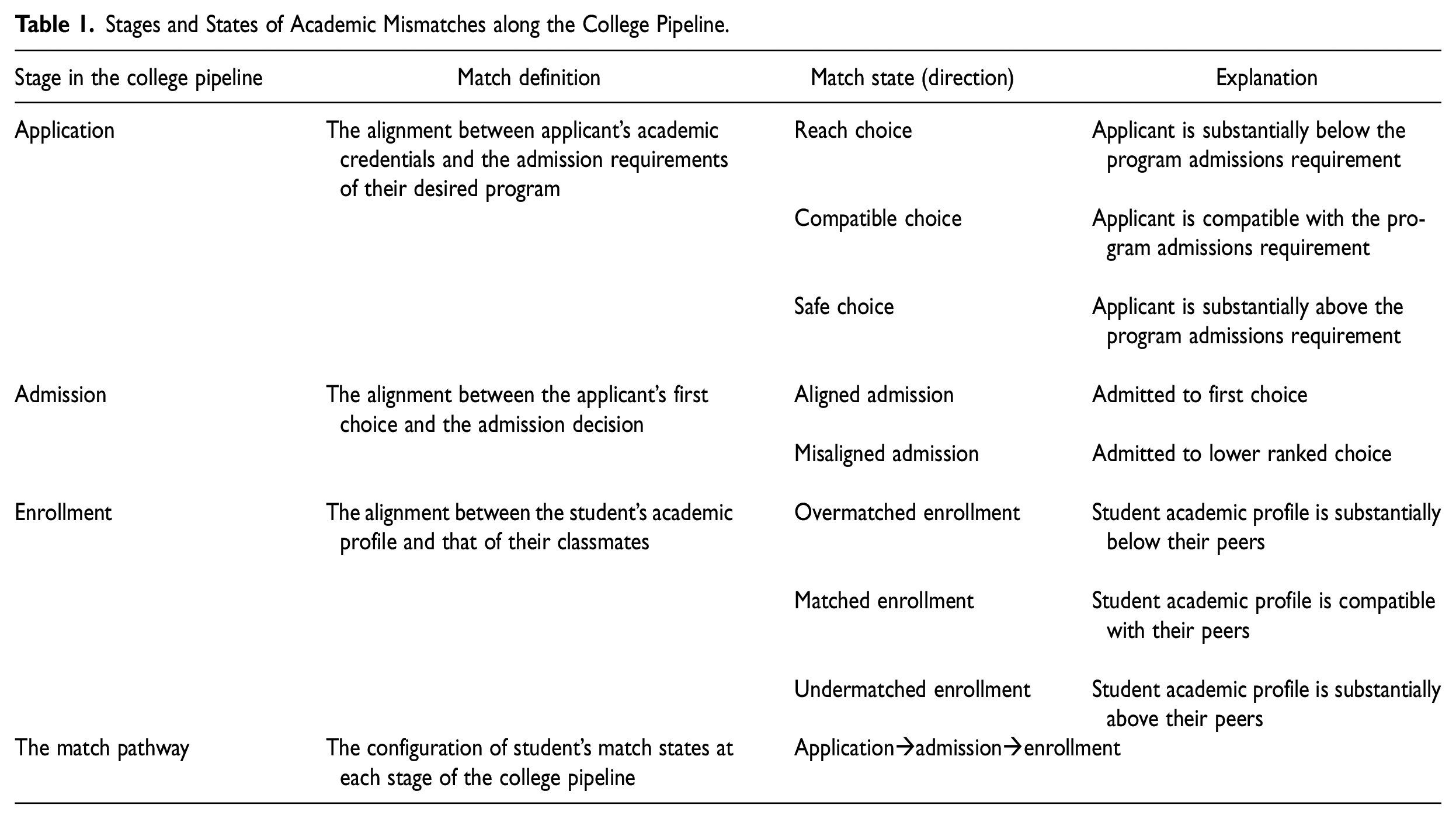
We conceptualize students’ match pathways as sequential interactions between students and institutions. An academic mismatch can occur at different stages of the match pathway, take different directions (states), and exert unique influences on retention outcomes. These influences can be path-dependent (the effect of the same event on graduation likelihood can vary by the overall configuration) and/or cumulative. The specific configuration of states during the application, admission, and enrollment stages—the match pathway—is assumed to be consequential for graduation outcomes. The following sections outline the components of our framework, starting with a breakdown of possible stages and states of mismatch and then assembling them into match pathways. Table 1 details the definitions of mismatches according to our longitudinal framework.
Stages and States of Academic Mismatches along the College Pipeline.
Application stage
The first student–institution interaction is at the application stage, when applicants identify suitable academic options, rank them, and send applications to a short list of programs that fit their aspirations and preferences (Niu and Tienda 2008). Indeed, a long tradition in the sociology of education and the status attainment literature in general shows educational aspirations are important predictors of attainment (Morgan 2005; Morgan, Gelbgiser, and Weeden 2013; Morgan et al. 2013b; Schneider and Stevenson 1999; Sewell, Haller, and Portes 1969). Mismatch at this stage is defined by the incompatibility between an applicant’s academic profile and the program to which they apply. Applicants may apply to academically “compatible,”“reach,” or “safe” programs in which their profiles are equal to, substantially below, or substantially above the admission requirements, respectively (Alon and DiPrete 2015; Hoxby and Avery 2013; Mullen and Goyette 2019). The ranking of applicants’ preferences is especially important because their most desired option best captures their aspirations. Yet accurate data on applicants’ revealed preferences and their rankings are rare.
Admission stage
The next student–institution interaction occurs at the admission stage. Academic programs review the pool of applications and offer admission to some depending on their academic profile, the program’s available resources, and the competition for slots in a particular year (Alon 2009; Gandil 2021; Schmidt 2018). 2 Mismatch at this stage is defined by contrasting the applicant’s preferences, revealed by a ranked choice set at the application stage, and the institution’s preferences, revealed by the admission decision. Admission to the first choice is aligned with the student’s preferences; admission to a lower-ranked choice is misaligned with the student’s revealed preferences. 3 Higher rates of misaligned admission are expected among applicants making reach first choices in their application, yet given that admission requirements temporally fluctuate (supply/demand, sensitivity to yield), some students will not be admitted to their compatible or safe first choice.
This individual–institution interface is typically absent from conceptualizations of mismatch (Cortes and Lincove 2019) and, more broadly, the scholarship on degree attainment either because of lack of data on revealed choices or conceptual lacuna (underestimating the role of motivation for attainment relative to academic match). Yet it is a key thread between stages of the college pipeline, simultaneously capturing applicants’ ranked preferences and enrollment options. Misalignment in admission can directly influence graduation because disappointment or shattered aspirations can lower motivation (Tessler 2022). It can also have an indirect effect by modifying the bearing of prior and later stages in the college pipeline on retention and perseverance. Thus, including this fundamental dimension of the college pipeline in a longitudinal perspective may shape what we know about the effect of academic mismatch on students’ outcomes.
Enrollment stage
The next student–institution interaction is enrollment. This mostly relates to the academic environment and its effect on student outcomes (Alon and Gelbgiser 2011; Gelbgiser 2021; Gelbgiser and Alon 2016). We define academic mismatch in enrollment as the distance between students’ academic profiles and those of their classmates. This mismatch best captures students’ compatibility with their academic environment. The academic profile of overmatched students is substantially lower than that of their peers, and the academic profile of undermatched students is substantially higher.
Match Pathways along the College Pipeline
The amalgam of the various states of mismatch in the various stages creates multiple possible “match pathways,” meaning the specific configuration of match states in the application, admission, and enrollment stages. This perspective allows the classification of a student’s entire match pathway, considering mismatch as a longitudinal and multidimensional experience. To illustrate the added value of this perspective, consider the match pathways of three hypothetical students, Rebecca, Imani, and Lucia: Rebecca: compatible choice → aligned admission → matched enrollment Imani: reach choice → misaligned admission → matched enrollment Lucia: compatible choice → aligned admission → overmatched enrollment
Imani and Rebecca are enrolled at College A and are academically matched with their classmates. Yet their match pathways have been very different. College A was Imani’s second choice, and she settled for it. Her top choice was another, more selective college, but she was denied admission. Once enrolled in College A, her academic aptitude matched her peers. College A was Rebecca’s first choice, and her academic aptitude was compatible with her peers at this college. Although both Imani and Rebecca are matched at College A, their graduation likelihood may differ given their precollege aspirations, the alignment between their preferences and the admission outcomes, and their eventual enrollment decisions. Imani may have had inaccurate or unrealistic information about college admission, leading her to apply to a more selective school. The misalignment between her preferences and admission outcomes may hamper her motivation to persist at College A. The scholarship on mismatch in enrollment would have missed this important distinction between the two classmates, ignoring the effect of Imani’s misaligned admission on her graduation chances.
Lucia, the third student, was admitted to her first choice, College B, and this college seemed compatible with her academic preparation. Yet because of the high volume of high-achieving applicants to this institution this year, Lucia realized upon enrolling that her academic profile was below her classmates. The mismatch hypothesis (and some SCOTUS justices) would predict that Lucia will have difficulty catching up with her classmates, leading to frustration and stigmatization that could hinder her persistence. Yet the scholarship on mismatch in application ignores this possible outcome. Lucia will go under the radar because her application choice is compatible with her destination.
These hypothetical examples suggest that mismatch at each stage of the college pipeline (application, admission, enrollment) and its direction (state) may uniquely influence students’ experiences and graduation chances. Mismatch in application and admission captures the misalignment between students’ aspirations and enrollment options. Overly ambitious or unambitious applications may reflect unrealistic educational plans or dispositions that will later hamper retention, regardless of the eventual college destination (see Holland and DeLuca 2016; Morgan et al. 2013a, 2013b). These misaligned aspirations may increase students’ risk of disappointment, affect their willingness to tackle academic challenges, or point to information gaps before college. Similarly, misalignment between students’ aspirations, reflected in their first-choice application, and their admission outcomes can lower motivation and commitment and reduce retention chances.
Enrollment mismatch best captures the effect of the college environment on student outcomes (e.g., academic challenge, peers, or organizational resources), regardless of aspirations. The “big fish in a little pond” literature, for example, suggests students evaluate their abilities relative to their classmates, so being at the bottom of the class (i.e., overmatched enrollment) can cause self-concept to plunge, affecting subsequent retention (Crosnoe 2009; Marsh 1987; Marsh and Hau 2003; Marsh et al. 2007). Alternatively, the literature on peer effects predicts a negative effect of undermatched enrollment on retention (Anelli and Peri 2019; Bowen et al. 2009; Cortes and Lincove 2019; Dillon and Smith 2020; Hoxby and Avery 2013; Ovink et al. 2018; Winston and Zimmerman 2004; Zimmerman 2003). Students may continue to adopt practices and learning habits and adjust their goals through interactions with their peers (Armstrong and Hamilton 2013; Binder, Davis, and Bloom 2016; Gelbgiser 2021; Lee and Kramer 2012). Undermatched students enroll with classmates who have inferior learning habits and heterogeneous goals; thus, they are at risk of adopting performance-depressing habits (Harding 2011). In contrast, overmatched students are exposed to peers with superior learning habits, which may boost their persistence (Alon 2009; Dillon and Smith 2020; Gelbgiser 2021).
These are predictions of the consequences of cross-sectional mismatch. Yet the effect of stage-specific mismatch may vary by the configuration within which it is nested. Consider Imani, for example. Had she gained admission to her first choice (reach), she may have reaped the benefits of her ambitious aspirations. However, in her current path, she is not pursuing her ambitious choice, which may offset the positive effect of high educational expectations. Thus, without situating mismatches in a broader pathway, we risk underestimating the effect of academic mismatch on college graduation and missing the reasons for its effect. By the same token, the potentially negative effects of low aspirations, manifest in applications to a “safe” college, may be enhanced by undermatch in enrollment, increasing students’ chances of seeking more challenging routes. In this case, the effect of low aspirations and undermatched enrollment can be cumulative or even multiplicative.
In summary, academic mismatch is potentially detrimental to student outcomes. Yet most of what we know about this phenomenon is stage-specific. This undermines our understanding of academic mismatch, which, we argue, is a longitudinal, complex, multidimensional, and path-dependent phenomenon. Therefore, it should be tracked from college application to degree attainment. The longitudinal framework we propose builds on and extends prior insights regarding the importance of academic match (e.g., Alon and Tienda 2005; Bowen et al. 2009; Cortes and Lincove 2019; Kurlaender and Grodsky 2013; Marsh et al. 2007; Ovink et al. 2018) but also acknowledges that students move through the academic pipeline in ways that are not predetermined or unified (Kizilcec et al. 2023), necessitating a broader and more flexible conceptualization of academic mismatch.
This framework postulates four testable tenets: (1) There is some level of correlation between stage-specific mismatches along the college pipeline but no predetermined track; (2) all stage-specific mismatches along the college pipeline are uniquely consequential for students’ graduation chances, even given the entire pathway; (3) the match pathway has a distinct effect on graduation; and (4) the effect of each stage-specific mismatch on graduation is path-dependent, varying when nested in different configurations. We now turn to an empirical examination of the tenets of the framework, contributing to a more nuanced and theoretically grounded understanding of the relationship between academic mismatch and graduation.
The Empirical Investigation
Data
The primary challenge in assessing the effect of mismatch configurations on graduation is the need for high-quality longitudinal data on both the individual and the program. This includes information on applicants’ revealed choices (administrative data with information on the programs to which prospective students have applied and their ranked preferences), the admission requirements of each program, the institutional admission decision for each option, enrollment status, the composition of students in a program, and retention outcomes in all programs attended. Although many commonly used surveys 4 collect information on students’ college applications and preferences, these data are self-reported and ask about either intentional applications (e.g., “To which schools/programs do you intend to apply?”) or post hoc applications (e.g., “Which colleges have you applied to?”), which are both subject to social desirability bias and post hoc rationalizations (Fisher 1993). 5 Furthermore, it is practically impossible to assess mismatch at the application, admission, and enrollment stages using survey data due to lack of accurate data on admission requirements or the entire composition of the student pool.
To overcome these hurdles, our empirical investigation exploited a unique database containing administrative data on all applicants, admits, and students from four leading comprehensive universities in Israel from 1998 to 2003. 6 The applicants and students in our data constitute about 70 percent of all university-bound applicants and 64 percent of all university bachelor’s degree graduates (Israel Central Bureau of Statistics 2019). We analyzed the academic careers of 75,152 first-time undergraduate students from application to graduation. 7
The Setting: Israel’s Higher Education System
During the investigation period, the Israeli higher education system consisted of 60 baccalaureate institutions divided into two main tiers. The first tier included six public research-oriented universities that grant all degree levels and enroll over half of all postsecondary students in Israel (Israel Central Bureau of Statistics 2019:Table 1). 8 The second tier included an open-admission university, specialized institutions like art or teacher training, and the relatively new “academic colleges,” which are the product of massive expansion of the Israeli higher education system that began in 1995. These academic colleges are characterized by a narrower academic scope (mostly undergraduate degrees in very few vocational fields that do not require research infrastructure, e.g., law, psychology, and management), less selective admission within each field (the majority are “open door”), and lower economic payoffs (Achdut et al. 2019; Caplan et al. 2009; Shwed and Shavit 2006).
Despite this expansion, competition for spots at research universities has intensified, and universities have become even more selective. Admission rates to research universities have dropped due to the increased demand by high-achieving students, and the test scores of admitted applicants have risen (Alon 2015b). 9 Given these disparities in academic scope, admissions requirements, and academic rigor, we focus on university students. These institutions resemble selective research universities around the world that are the sites of debates on affirmative action.
Several characteristics of Israel’s university system make it an ideal setting to study the effects of academic match on graduation. It is an early specialization system, in which all application and admission processes are major-specific within institutions. The institution-major-specific offerings range from 15 programs at the Technion to 38 at Tel-Aviv University, outlining a clear choice set. 10 Programs at each university vary in their admission requirements, ranging from more to less selective, but are identical in their geographic location (same institution) and costs (relatively low and government-controlled tuition). 11 This structure enabled us to focus on within-university variation in academic mismatch, which naturally mitigates the effect of often unobserved factors such as spatial preferences or pecuniary considerations, typically mentioned as reasons for mismatch (e.g., Black et al. 2015; Roderick, Coca, and Nagaoka 2011).
Admissions to each major program are mechanistic, based on an academic composite score (a combination of matriculation and standardized psychometric test scores) and the supply of slots. Information about admission thresholds from the previous admission cycle is readily available to all applicants on the institution’s application website (previously in packets), reducing uncertainty and information gaps about admission chances. This admission process allowed us to accurately define and measure academic mismatch at every stage, circumventing unobserved heterogeneity that typically plagues such assessments in holistic admission regimes (Karabel 2006; Warren 2013).
At each university, prospective students submit a ranked list of their chosen programs (up to four single or double majors). Applications to programs are considered sequentially according to ranked preferences: Admission to the program ranked first by the applicant is considered first, admission to the second program choice is considered only if the applicant is not admitted to the first-choice program, and so on. In this setting, ranking of preferences is clear and captured in our administrative records. These unique features allowed us to measure mismatch at the application, admission, and enrollment stages precisely and evaluate mismatch as a longitudinal multifaceted phenomenon.
Measures
Graduation status
Graduation status is a categorical variable coded 1 if students obtained a bachelor’s degree in the program they first enrolled in within five years of matriculation (>150 percent of the official duration) and 0 if they did not. 12 Fifty-nine percent of students graduated from their respective program within five years of matriculation. 13
Composite academic score
Admission to Israeli universities is based on applicants’ academic composite score, that is, their GPA in the national high school matriculation exams (“Bagrut”) and their score in the national standardized test (“psychometric exam”), similar to SATs and ACTs in the United States. There are slight differences in the scales and weights universities use to calculate composite scores; we thus converted applicants’ composite scores to their percentile rank relative to all applicants in the same academic year and institution, enabling comparison across majors, institutions, and time. The models also account for applicants’ raw Bagrut GPA and psychometric scores to net out variation in absolute scholastic ability.
Academic mismatch indicators
Application stage
Match states at this stage refer to the alignment between the applicant’s academic credentials and the admission requirements of their desired program, measured as the distance in academic composite score percentiles between an applicant’s score and the program’s admission threshold (set as the 25th percentile academic score of admitted applicants in the previous academic year). 14 This was calculated for applicants’ first program choice based on all applicants (including those not admitted or enrolled). 15 The distribution collapsed into quartiles: We categorized applications at the bottom quartile as reach choices, applicants in the middle two quartiles as compatible, and those in the top quartile as safe choices. 16
Table 2 reports the relative distribution of mismatch at the different stages among enrolled students: 14 percent of all enrolled students applied to a reach program that required composite scores that were, on average, 28 percentile points higher than their composite score percentile. The relative underrepresentation of reach applicants is expected, given that they are less likely to be admitted. More than half (55 percent) of the students applied to a compatible program, and an additional 31 percent applied to a safe program requiring a composite score 33 percentiles lower than theirs.
Academic Match in Application, Admission, and Enrollment for Students Enrolled in Four Universities in Israel, 1999 to 2003.
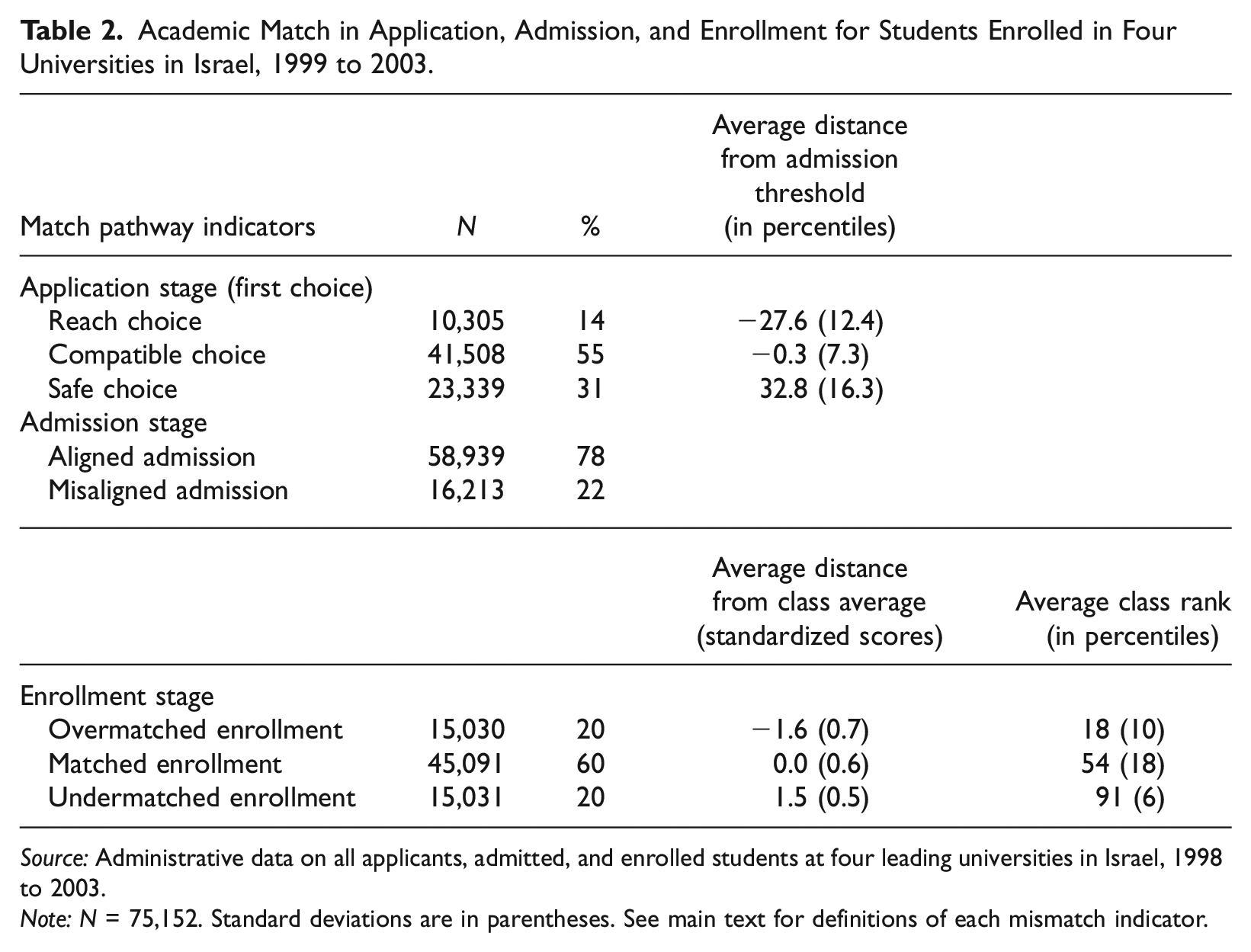
Source: Administrative data on all applicants, admitted, and enrolled students at four leading universities in Israel, 1998 to 2003.
Note: N = 75,152. Standard deviations are in parentheses. See main text for definitions of each mismatch indicator.
Admission stage
Match states at this stage refer to the alignment between the admission decision and an applicant’s first choice. Students admitted to their first-choice program were considered aligned admission, 17 and students admitted to a lower choice, ranked second to fourth in their application, were considered misaligned admission. Seventy-eight percent of enrolled students were admitted to their first choice. 18
Enrollment stage
Match states at this stage refer to the alignment between students’ academic credentials and those of their classmates. We considered two dimensions of academic compatibility: (1) students’ percentile class rank and (2) the standardized distance of students’ academic profile from the average profile in the class. 19 These dimensions merged in a factor analysis, yielding match scores for all enrolled students at each program-university-year cell. 20 We collapsed the distribution of match scores into quantiles: Overmatched enrollment includes students at the bottom quantile, and undermatched enrollment includes those at the top. 21 Overmatched students were ranked at the 18th percentile of their class, on average, and their academic profile was about 1.6 SD below the average class profile (Table 2). Undermatched students were ranked at the 91st percentile of their class, and their academic profile was 1.5 SD above the class average. Matched students were ranked, on average, at the 54th percentile, and their academic profiles were at the class average.
Our measurement for match in enrollment is consistent with prior measures focusing on the distance of students’ academic profiles from those of their class or college (e.g., Fischer and Massey 2007). However, it departs from several measures that define matching counterfactually, by whether students could potentially gain admission to a more selective college (e.g., Alon and Tienda 2005; Bowen et al. 2009). Yet in holistic admissions contexts (as in the United States), the counterfactual assumption that a student could have enrolled in a more selective college may be optimistic. It is equally plausible the student would not have gained admission to a more selective college due to unobserved factors, such as essay quality, motivation, or extracurricular activities (for a review of the conceptual and methodological problems of commonly used mismatch measurements, see Bastedo and Flaster 2014; Rodriguez 2015). Because we had information on all applicants and students enrolled at each program-university-year cell (in an admission setting that is completely formulaic), we could accurately measure the academic compatibility of students with their classmates—the core element in the construct of academic match.
Social and contextual adjustment factors
Our analyses include a standard set of sociodemographic factors known to stratify students’ educational pathways and outcomes, such as age, gender, ethnic origin/immigration, and the socioeconomic cluster of their locality. We also include indicators for institution and application year to account for variations in period and organizational context. Descriptive statistics for all adjustment variables are in Table A1 in the online supplemental material.
Analytic Strategy
The first tenet of the longitudinal framework is that match states along the college pipeline are correlated but there is no predetermined track. We evaluated this tenet by listing all possible match configurations and their prevalence (Table 3) and by fitting logit and multinomial logit models predicting mismatch at later stages (i.e., admission/ enrollment) by mismatch at earlier stages (i.e., application/ admission; Table 4). Together, these analyses allow us to trace the direction and strength of correlations between stage-specific matches.
Prevalence of Match Pathway Configurations among Students at Universities in Israel, 1998 to 2003.
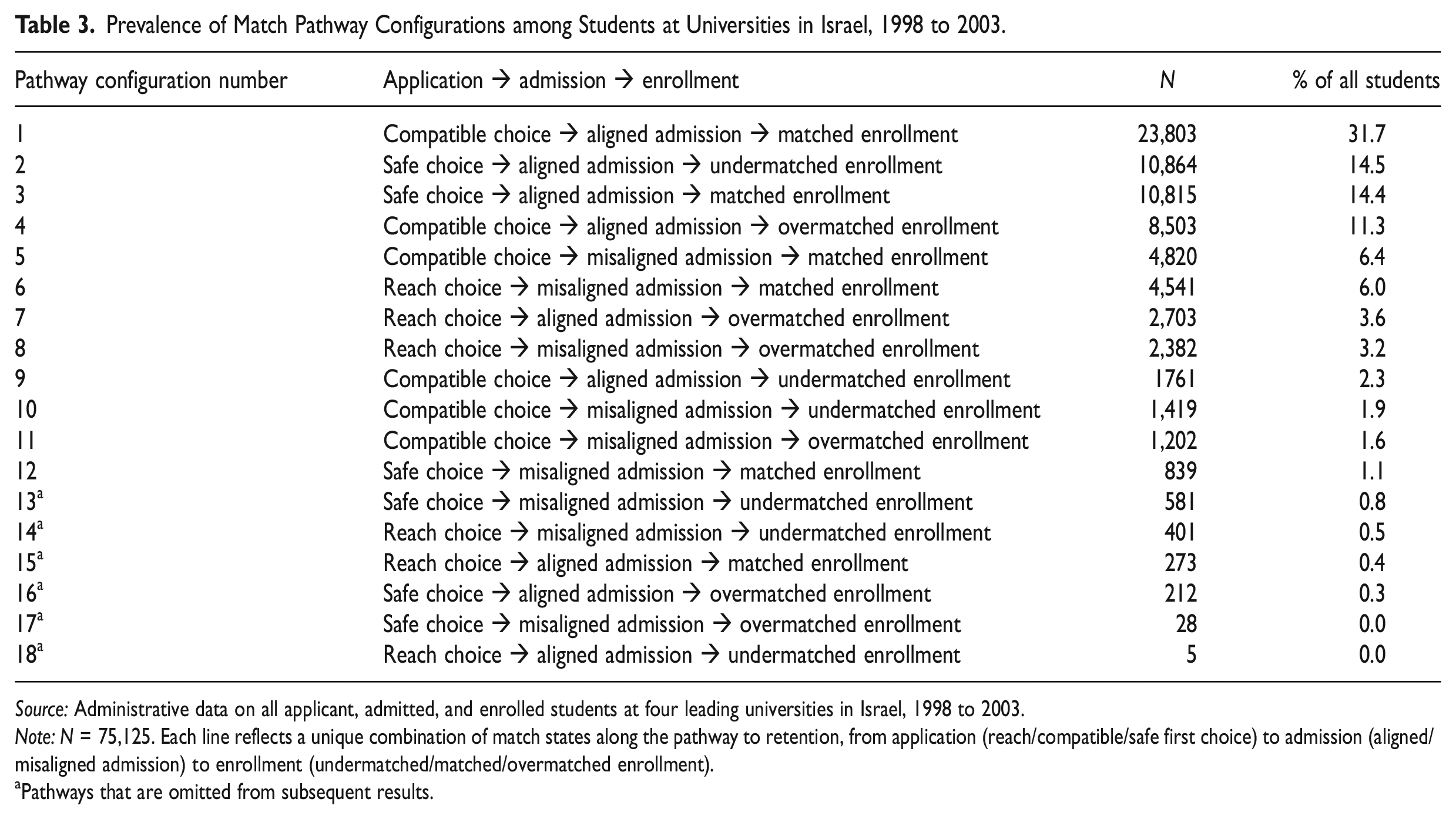
Source: Administrative data on all applicant, admitted, and enrolled students at four leading universities in Israel, 1998 to 2003.
Note: N = 75,125. Each line reflects a unique combination of match states along the pathway to retention, from application (reach/compatible/safe first choice) to admission (aligned/misaligned admission) to enrollment (undermatched/matched/overmatched enrollment).
Pathways that are omitted from subsequent results.
Coefficients from Models Predicting Match States at Later Stages by Match States in Prior Stages.
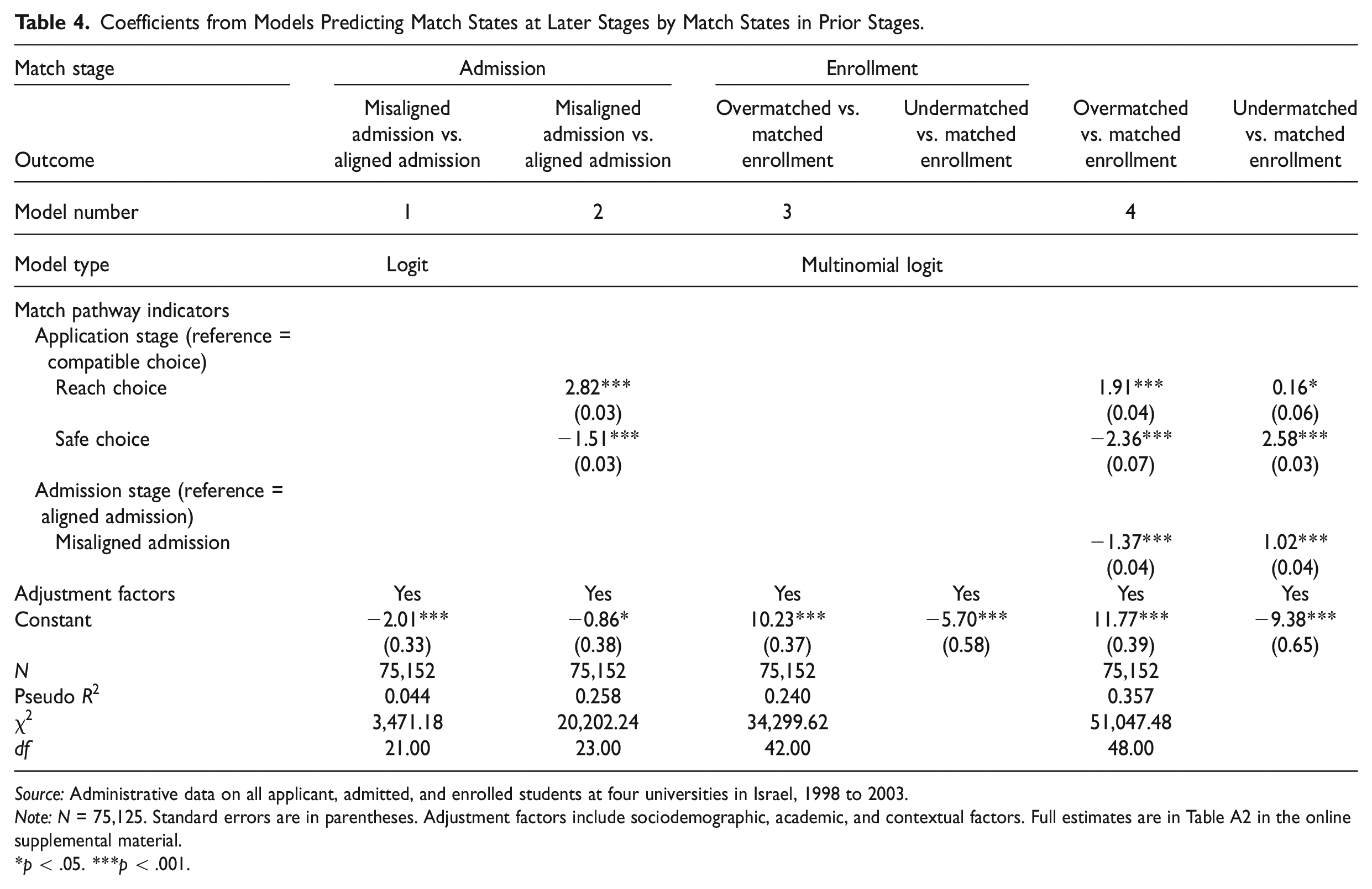
Source: Administrative data on all applicant, admitted, and enrolled students at four universities in Israel, 1998 to 2003.
Note: N = 75,125. Standard errors are in parentheses. Adjustment factors include sociodemographic, academic, and contextual factors. Full estimates are in Table A2 in the online supplemental material.
p < .05. ***p < .001.
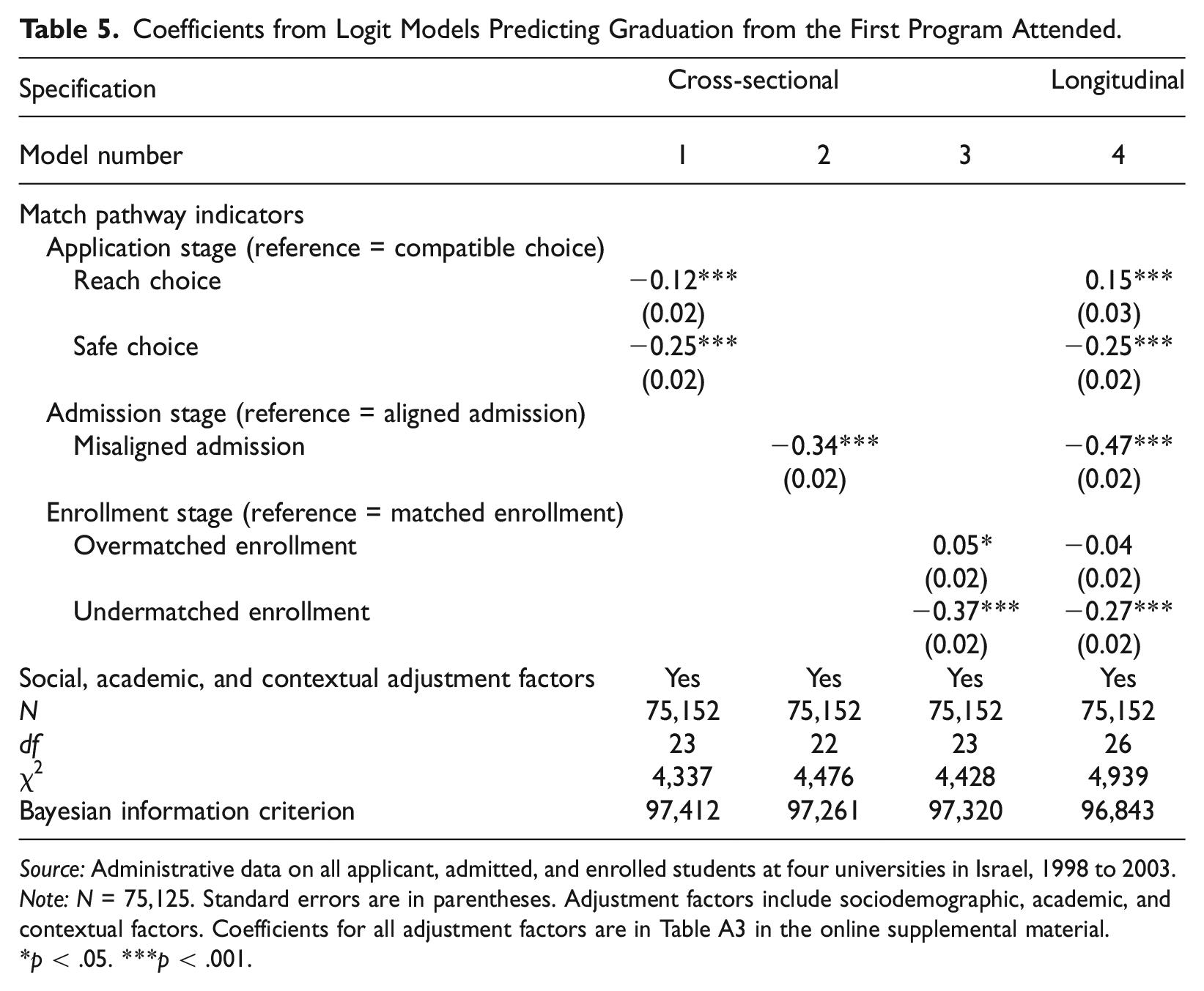
The second tenet of the longitudinal framework is that all stage-specific mismatches along the college pipeline are uniquely consequential for students’ graduation chances, even given the entire pathway. We evaluated the unique effect of each academic mismatch on graduation chances with a series of logit models (Table 5). As a baseline, the first specification fits a cross-sectional framework, assessing whether each stage-specific mismatch is consequential for graduation, net of social and contextual adjustment factors. This specification can be expressed as

where p is the probability for graduation,
Coefficients from Logit Models Predicting Graduation from the First Program Attended.
Source: Administrative data on all applicant, admitted, and enrolled students at four universities in Israel, 1998 to 2003.
Note: N = 75,125. Standard errors are in parentheses. Adjustment factors include sociodemographic, academic, and contextual factors. Coefficients for all adjustment factors are in Table A3 in the online supplemental material.
p < .05. ***p < .001.
The second specification in Table 5 fits the longitudinal framework and assesses its second tenet, that all mismatch along the college pipeline is uniquely consequential for students’ graduation, given the entire pathway. It includes indicators for all match states along the college pipeline and can be expressed as

The coefficients for match states in this model denote the association between stage-specific matches and graduation net of mismatches at other stages (and the adjustment variables). Significant net associations will bolster the longitudinal framework. Based on these estimates, Figure 1 depicts the predicted graduation probability associated with match states at each stage from this longitudinal model specification.
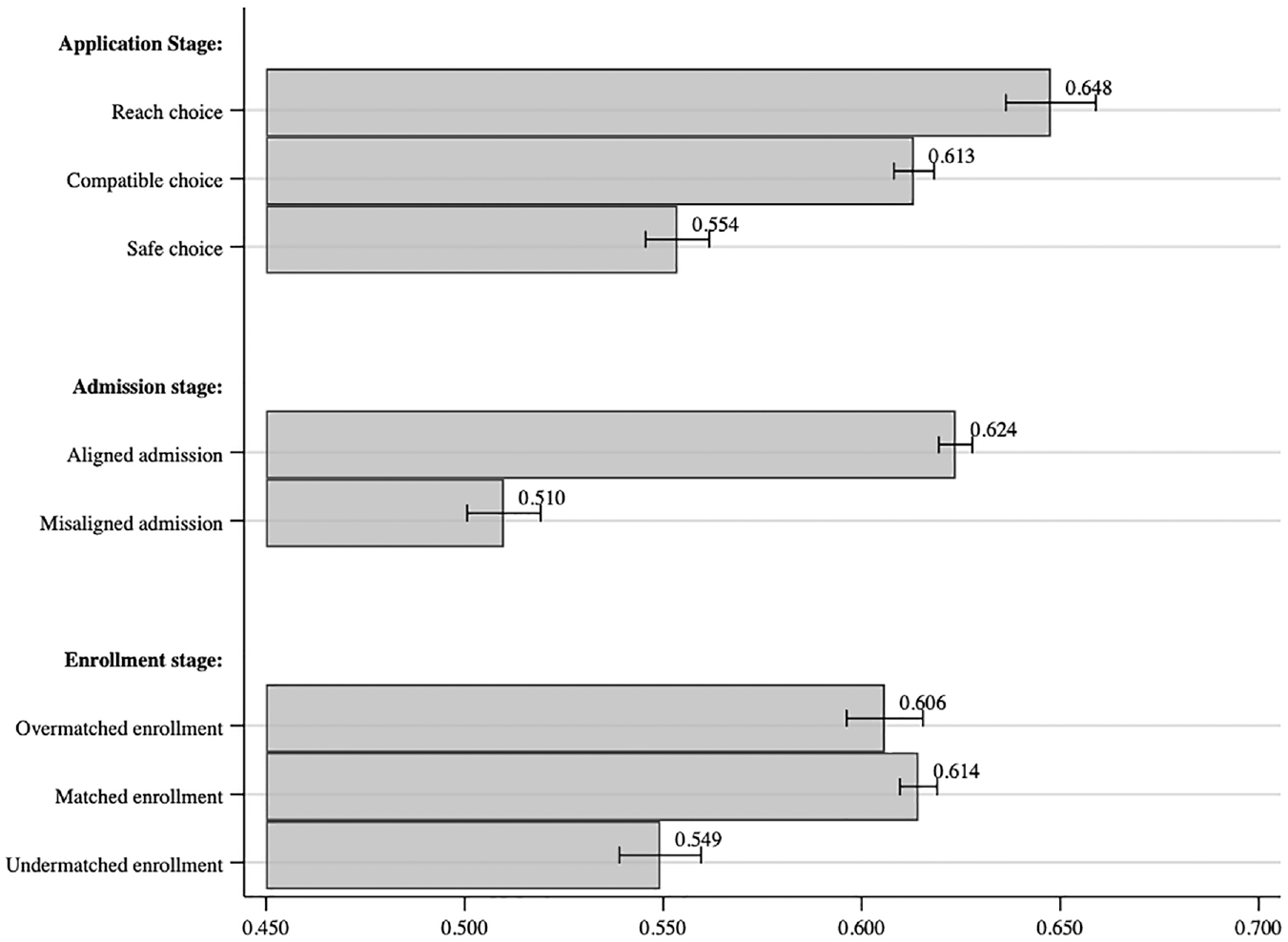
Predicted graduation rates (obtained from Model 4 in Table 5).
The third tenet of the longitudinal framework is that the entire match pathway has a distinct effect on graduation. The fourth tenet is that the effect of each stage-specific mismatch on graduation is path-dependent, varying when nested in different configurations. We assessed these conjectures by reestimating the longitudinal framework specification but this time classifying students’ entire pathway with a single indicator of pathway configurations. This classification captures the association of each unique pathway configuration with graduation, allowing for the effect of each stage-specific match to vary by the pathway within which it is nested. 22 Using these estimates, we calculated the predicted graduation outcomes of otherwise observationally similar students following different match pathways (Figure 2). This allows us to make comparisons showcasing the influence of the entire pathway and the variations in the effect of stage-specific matches when nested in different configurations.
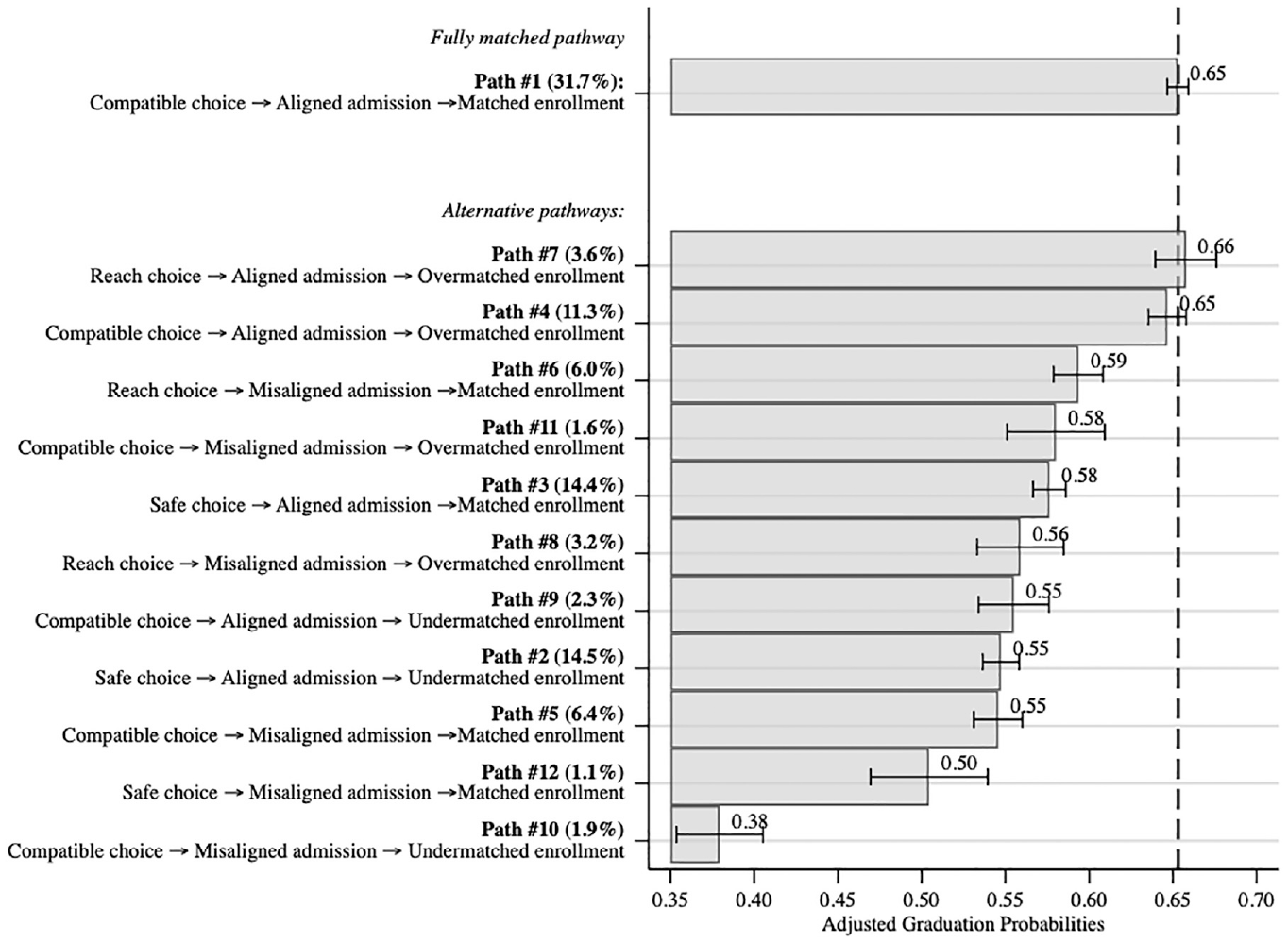
Predicted graduation rates for each match pathway configuration.
Results
Variations in Match States along the College Pipeline
What is the prevalence of academic mismatch along the college pipeline? When examined cross-sectionally, 45 percent of students are mismatched in application, 22 percent are mismatched in admission, and 40 percent are mismatched in enrollment (see Table 2). The longitudinal perspective, however, postulates that these rates underestimate the overall prevalence of academic mismatch and the complexity of match pathways. This prediction is supported in Table 3, which lists all possible match pathway configurations in our data and their prevalence. For ease, the configurations are ordered (and numbered) by their relative prevalence in the population.
In the “fully matched pathway” (Configuration 1 in Table 3), students like Rebecca are matched at the application, admission, and enrollment stages. This is the most prevalent single pathway (a third of all students). Yet the vast majority of students in our population experienced at least one stage-specific mismatch, confirming academic mismatch is more prevalent than can be captured by cross-sectional measures. The second and third most frequent pathways are applicants admitted to their first-choice safe programs (aligned admission) and either undermatched or matched with their classmates upon enrollment (each with 14 percent of students). The fourth pathway describes the configuration of students like Lucia (compatible choice → aligned admission → overmatched enrollment, 11 percent). Imani’s pathway is Configuration 6 (reach choice → misaligned admission → matched enrollment), representing 6 percent of students. The results also reveal several infrequent pathways, each capturing the experience of less than 1 percent of our population (Configurations 13–18). 23 For parsimony, we do not dwell on these unlikely scenarios. However, these students were included in all analyses; their effect on the estimated associations was minor, and omitting them yields similar results (see Table A3 in the online supplemental material).
The results in Table 3 support the need to evaluate academic matches from a longitudinal perspective. The difference in the prevalence of different pathways also suggests some degree of between-stage correlation in academic mismatch. We show these potential links in Table 4, which presents the logit and multinomial adjusted coefficients predicting later mismatches by earlier ones. We estimated two nested models for each outcome (admission and enrollment). First, in the base model, we only include the social, academic, and contextual factors (Models 1 and 3); in the second model, we add prior match states (Models 2 and 4).
As expected, early stage mismatches are significant predictors of later-stage mismatches (Models 2 and 4). Reach application increases the chances of misaligned admission (i.e., being admitted to the lower choice) and the risk of overmatched and undermatched enrollment. Although the former is anticipated, the latter (undermatched enrollment) is surprising, suggesting that ambitious students are less inclined to include academically compatible options in their choice set or that they ensure their admission odds by including a safe program in their lower-ranked options. Safe applications increase students’ likelihood of being admitted to their top choice but also increase the likelihood of undermatched enrollment. Misaligned admission significantly decreases the risk of overmatched enrollment but increases the risk of undermatched enrollment, even net of mismatch at application.
How strong are these links? A comparison of Model 1 (base model) and Model 2 (with match in application) suggests match in application accounts for about a fifth of the variance associated with mismatch in admission (the explained variance increases from 4.4 to 25.8). Similarly, a comparison of Model 3 (base model) and Model 4 (with match states in prior stages) suggests prior matches explain about 12 percent of the variance in enrollment mismatch (increasing from 24 to 36). Although substantial, it does not suggest that students’ pathways are predetermined. Instead, most of the variance is unexplained by match states in prior stages, providing a solid motivation to explore mismatch longitudinally. These results support the first tenet of the longitudinal framework: Students’ pathways are diverse. Focusing on mismatch at one stage fails to capture the potentially substantial variation in pathways that may be consequential for graduation outcomes.
Stage-Specific Academic Mismatch and Graduation
Table 5 presents the coefficients for stage-specific mismatches from logit models predicting graduation. Models 1, 2, and 3 capture a cross-sectional perspective. Matched students at each stage are set as the reference category, so the coefficients present the expected change in the (log) odds of mismatched students graduating relative to matched students, all else being equal. The results in Models 1, 2, and 3 suggest mismatch at each stage is significantly associated with graduation net of academic, social, and institutional variations. These results are consistent with the general mismatch literature, showing that the fit between students and the program they applied to or were enrolled in shapes their graduation outcomes regardless of their social and academic characteristics. Application to either safe or reach programs (Model 1), misaligned admission (Model 2), and being undermatched in enrollment (Model 3) are negatively associated with graduation likelihood. Being overmatched in enrollment (i.e., below the average profile of the class), in contrast, is positively associated with graduation (Model 3), a result consistent with prior findings refuting the mismatch hypothesis (e.g., Alon and Tienda 2005; Bowen and Bok 1998). Yet these cross-sectional results ignore the overall pathway of each student and previous mismatches that influence graduation chances.
Model 4 presents results from the longitudinal framework specification, which simultaneously accounts for all stage-specific mismatches and adjustment factors. The results confirm the second tenet of the longitudinal framework: All stage-specific mismatches along the college pipeline are uniquely consequential for a student’s graduation, given the entire pathway. Most stage-specific mismatch coefficients remain large (some are even larger) and statistically significant in the full specification. Furthermore, the model fit statistics indicate the full model better fits the data than do the partial models despite the additional degrees of freedom.
Most associations change their magnitude or direction between the cross-sectional and longitudinal models, thus demonstrating the added insights gained from a longitudinal path-dependent perspective. The association between reach application and graduation is particularly notable; it is negative in the cross-sectional model but positive in the full model. Given the large and negative association of misaligned admission with graduation, the negative effect of reach application on graduation in the cross-sectional model (Model 1) is likely driven by higher rates of admission misalignment among reach applicants (Table 4). Once the longitudinal specification accounts for mismatch states at the admission and enrollment stages, the underlying relationship between reach application and graduation is positive. Another notable result is the association between overmatch in enrollment and graduation: It is positive in the cross-sectional model but insignificant in the full model. This suggests the cross-sectional positive effect is driven by prior associations (e.g., reach applicants admitted to their first choice). Once these are netted out in the longitudinal specification, overmatching in enrollment has no additional bearing on graduation. Together, these results provide important insights into the potential misspecification of mismatch models that do not consider the full match pathway.
The net associations between stage-specific mismatch and graduation are captured in Figure 1, which plots students’ predicted graduation probabilities by their match status at each stage from the full longitudinal specification (Model 4 in Table 5). These predicted probabilities are fitted to the characteristics of the average student, so differences in graduation probabilities at each stage can be attributed to their match state. Students who apply to a reach program are more likely to graduate than their counterparts who apply to a compatible program (65 percent vs. 61 percent) net of all mismatch states at subsequent stages. Students who apply to a safe program have the lowest graduation likelihood (55 percent). The largest net differences in graduation are generated at the admission stage—a factor unobserved in most mismatch studies. Students with misaligned admission (i.e., admitted to their lower choice program) are substantially less likely to graduate than observationally similar students with aligned admission (i.e., those admitted to their first choice, 51 percent vs. 62 percent). These results call attention to the importance of aligned admission in shaping students’ motivation and degree attainment and support the inclusion of this stage in the match pathway.
Once prior mismatches are considered, overmatched enrollment—the quintessential indicator used in the “mismatch hypothesis” and one focus of the scholarly and legal debate on affirmative action in higher education—has no dire consequences on student outcomes: Overmatched students, the ones mentioned by Justice Thomas, and their matched counterparts are equally likely to graduate (61 percent for both groups). In contrast, undermatched students, who are substantially above their class average, are less likely to graduate than their matched counterparts (55 percent vs. 6 percent, respectively). These findings are consistent with prior studies and highlight the importance of a challenging and stimulating social and academic environment to promote the retention of high achievers (Hoxby and Turner 2013; Kang and García Torres 2019). They also reveal that match states in application and admission are more consequential for graduation than mismatched enrollment; the latter is important mainly for undermatched students. 24
Together, the results shown in Table 5 and Figure 1 support the second tenet of the longitudinal framework: All stage-specific mismatches along the college pipeline are uniquely consequential for students’ graduation, given the entire pathway. They also reveal a critical point: Cross-sectional (single-stage) models yield biased estimates of stage-specific match-graduation associations.
The Match Pathway and Graduation Likelihood
The third and fourth tenets posit that the match pathway has a distinct effect on graduation and that the effect of stage-specific matches on graduation is path-dependent, so it may vary when nested in different configurations. The value of the longitudinal perspective is clear in Figure 2. The figure plots the adjusted graduation probabilities of each unique pathway for the 12 most prevalent configurations outlined in Table 3. These predicted probabilities come from a model accounting for students’ specific match pathway configurations and are adjusted to the characteristics of the average student in our population. Thus, differences in the predicted graduation probabilities are driven by the mismatch pathway rather than by students’ academic and sociodemographic profiles. Pathways are ordered by their expected graduation probabilities, and the configuration numbers from Table 3 are retained for consistency.
The expected graduation probability of students who are on the fully matched pathway (Configuration 1) is 0.65. Interestingly, the graduation probabilities of students with reach applications, aligned admission, and overmatched enrollment (i.e., students admitted to their ambitious first-choice program who are substantially below the class average, Configuration 7) are similar (0.66). Although this configuration represents only 4 percent of all students, this is a remarkable finding given that this profile fits the prototype of affirmative action students. This pathway underlies most research on affirmative action policies, and our results corroborate prior findings that discard the mismatch hypothesis (e.g., Alon 2015b; Alon and Tienda 2005; Bowen and Bok 1998). Our results further explain these findings by showing the pathway is important: Students benefit from reaching high in applications and being admitted to their top-choice program; overmatched enrollment does not hurt their persistence. In comparison, students in Configuration 8 also applied to reach programs, but they were not admitted to their first-choice program; they are also overmatched upon enrollment but have much lower expected graduation probabilities (10 percentage points lower: 56 percent vs. 66 percent) because they are misaligned in admission. Thus, students reap the benefits of ambitious aspirations only if admitted to their desired program.
Juxtaposing the quintessential pathway for undermatching (being above the class average) in which students apply to a safe program, are aligned in admission, and are undermatched in enrollment (Configuration 2) to other pathways also reveals the value of a longitudinal path-dependent perspective. The expected graduation probability of students in this pathway is only 55 percent (10 percentage points lower than that of fully matched students). Importantly, this large disadvantage stems from the specific match pathway configuration. Take, for example, Configuration 3 (safe choice aligned admission matched enrollment). The graduation likelihood of students in this pathway is 58 percent—3 percentage points higher than Configuration 2 and 7 percentage points lower than the fully matched pathway. This comparison suggests aiming low in application (safe choice) is highly consequential for attainment even if students end up in a matched program upon enrollment. Had the effect of application and enrollment undermatch been similar regardless of the configuration, we would expect the graduation likelihood of students in Configuration 9 (compatible choice → aligned admission → undermatched enrollment) to be about 7 percentage points higher than that of students in Configuration 2. But this is not the case: The graduation probability of students in Configuration 9 is only 1 percentage point higher than in Configuration 2, suggesting the effect of the undermatched environment is even larger for students matched in their application. These comparisons confirm that the entire pathway is important for understanding students’ outcomes because the stage-specific associations vary by the configuration within which they are nested. Clearly, cross-sectional evaluations of undermatch may underestimate or overestimate the extent of undermatched students’ disadvantage in college and miss part of the reason for dropping out.
Finally, the expected graduation probabilities of observationally similar students who are on pathways that deliver the highest and lowest graduation outcomes are 28 percentage points apart (66 percent in Configuration 7 vs. 38 percent in Configuration 10). This is a huge gap, especially because the best outcomes are obtained by students whose academic profile is below their class average (overmatched enrollment). In contrast, the worst outcomes are obtained by students whose academic profile is above their class average (undermatched enrollment). This remarkable finding suggests we undervalue students’ motivations and preferences as determinants of their college outcomes. More broadly, it highlights the importance of embedding mismatch in a longitudinal framework. As the patterns reported here demonstrate, the relationship between academic mismatch and graduation is complex and nuanced; it is shaped by multiple interactions between students and their respective academic units as they progress through the college pipeline.
Discussion and Conclusions
Academic mismatch has been proposed as one of the obstacles to degree attainment and as such, a critical determinant of life chances. Consequently, it receives considerable attention in legal debates on affirmative action. In all recent legal cases deliberated by SCOTUS, overmatching in enrollment has been mentioned as causing depressed graduation rates of underrepresented minorities (Hawkins 2015). Academic mismatch is also at the center of scholarly and policy initiatives seeking to understand and possibly change the college application behavior of high-achieving, low-income, or minority applicants (Black et al. 2015; Kang and García Torres 2019; Smith, Pender, and Howell 2013). Viewing mismatch as a stage-specific, one-sided occurrence, this scholarship sets the stage for the current longitudinal and multidimensional framework.
The conceptualization we develop in this study perceives mismatch as a dynamic phenomenon based on a series of sequential student–institution interactions along the college pipeline. Critical interactions occur in the application, admission, and enrollment stages, yielding multiple potential configurations. The evidence marshaled here supports the four tenets of the longitudinal framework: Match pathway along the college pipeline is not a predetermined track, all stage-specific mismatches along the college pipeline are uniquely consequential for students’ graduation, and the match pathway has a unique and path-dependent effect on graduation so that the effect of stage-specific match states can vary when nested in different configurations. These results suggest cross-sectional evaluations of mismatch not only underestimate or overestimate the extent of mismatched students’ disadvantage in college but also miss part of the reason for dropping out. In sum, the big picture, the match pathway, is more important than any of its parts.
The evidence is based on administrative records on the academic careers of six cohorts of bachelor’s-level university students in Israel from application to graduation. These data and the structure of admission into Israeli universities enabled us to measure mismatch at each stage, study configurations of mismatch, and assess their association with graduation. Moreover, the focus on within-university variation naturally mitigates many exogenous (and often unobserved) factors, such as geographic location or costs, that can influence students’ pathways and their graduation outcomes, thereby providing an ideal setting to test core arguments in the literature on academic match. Indeed, academic mismatch emerges as a more complex and prevalent phenomenon than commonly thought, so a single mismatch measure cannot capture match pathways’ variability and explanatory value. Although the results reflect the experience and outcomes of students in Israel at a specific time, we are optimistic about the external validity of this longitudinal framework because the stage-specific results—the effect of overmatching and undermatching on graduation—resemble those reported previously in the United States. We hope future scholarship will enhance, expand, and refine the longitudinal and multidimensional perspective developed here regarding the relationship between match pathways and graduation.
The study of academic mismatch is anchored in the stratification and inequality scholarship, and this longitudinal perspective can be harnessed to broaden our understanding of the distribution of educational opportunities. In a supplementary analysis, we examined whether students from socially disadvantaged groups in Israel are less likely to follow more beneficial pathways (based on their expected graduation probabilities presented in Figure 2). We found that among observationally similar students, the odds of women, Arab, and low socioeconomic status students following high graduation pathways are 17 percent, 12 percent, and 8 percent lower than those of their more advantaged counterparts, respectively. 25 These significant disparities contribute to inequality in degree attainment between social groups. 26 Given the variability of the available pathways and the variation of match states within them, these differences could not have been captured by focusing on stage-specific or one-direction mismatch analysis. In fact, because some of these high graduation pathways include mismatch states at one or more stages along the college pipeline, a cross-sectional evaluation would have mistakenly considered these states as detrimental rather than beneficial. Together, these findings underscore the potential of the longitudinal framework to shed light on academic mismatch and its consequences for inequality.
This novel framework for academic mismatch extends existing understandings of the processes hindering degree attainment. Our study shows that degree attainment is a longitudinal and multidimensional process based on a series of student–institution interactions, and no stage along the college pipeline can give us accurate insights regarding students’ success. Another fundamental theoretic innovation of this perspective is the bridge it forms between theories regarding the role of the academic environment students encounter in college with sociological and social-psychological theories on the importance of aspirations and motivation for students’ success. Our findings call for greater theoretical attention to students’ aspirations and preferences when evaluating the consequences of academic mismatch (see Morgan 2005; Morgan et al. 2013b). Furthermore, they reveal the pivotal role of the match between students’ preferences and admission decisions in facilitating students’ ability to navigate challenging academic environments. Our focus on this dimension of application behavior, the ranking of students’ applications, is another key contribution of our study to the traditional conceptualizations of mismatch. Evaluations of student–college fit that do not consider pre-enrollment aspirations, preferences, and admission outcomes miss an important source of variation in degree attainment.
This study contributes to the theoretical foundation and robust evidence needed to guide the ongoing debate on admission policies in higher education. Set in the context of Israel’s higher education, our results add to this literature by showing that admitting ambitious students to elite programs can boost their graduation chances. Not only do students gain from the social and organizational resources available at elite colleges (Alon and Tienda 2005; Binder et al. 2016; Bowen and Bok 1998; Stevens, Armstrong, and Arum 2008), but they also gain from fulfilled aspirations and increased motivation. To increase retention rates, colleges must acknowledge the contribution of ambition and motivation to academic success. At the same time, our results suggest colleges should be wary of admitting applicants who aim too low and should instead consider steering them toward an environment that is sufficiently challenging and stimulating to boost their retention outcomes.
Research Ethics
This study is based on a secondary use of anonymous and de-identified data from universities’ administrative records and is exempt from ethics committee approval.
Supplemental Material
sj-docx-1-soe-10.1177_00380407241238726 – Supplemental material for Match Pathways and College Graduation
Supplemental material, sj-docx-1-soe-10.1177_00380407241238726 for Match Pathways and College Graduation by Dafna Gelbgiser and Sigal Alon in Sociology of Education
Footnotes
Acknowledgements
We are grateful to Shoval Merton for her excellent research assistance in this project.
Funding
The author(s) disclosed receipt of the following financial support for the research, authorship, and/or publication of this article: This research was supported by grants 200800120 and 200900169 from the Spencer Foundation, 7590 from the Yad Hanadiv Foundation, and 8461 from the Edmond de Rothschild Foundation. The content is solely the authors’ responsibility and does not necessarily represent the official views of the Foundations.

Supplemental Material
Supplemental material for this article is available online.
Notes
References
Supplementary Material
Please find the following supplemental material available below.
For Open Access articles published under a Creative Commons License, all supplemental material carries the same license as the article it is associated with.
For non-Open Access articles published, all supplemental material carries a non-exclusive license, and permission requests for re-use of supplemental material or any part of supplemental material shall be sent directly to the copyright owner as specified in the copyright notice associated with the article.
