




Abstract
‘Modern slavery’ not only fails to conceptualise the exploitation of migrant domestic workers from post-colonial nations, but also their affluent employers in post-imperial London. Existing evidence focuses on ‘victims’ or ‘survivors’, with sparse data on whom they work for. This study analyses 200 responses to a survey asking migrant domestic workers about the employers they accompanied to the UK, their post-‘rescue’ employers and the (lack of) support provided by the British state. Comparing the survey findings with visa schemes in place during the British Empire, and using contemporaneous social theory (Du Bois and Martineau), this study applies a historical lens to show how Britain was, and is, more concerned with protecting wealthy employers than migrant domestic workers. Since the 18th century, this has been justified using the moral binary of ‘British’ freedom and ‘foreign’ slavery.
Introduction
Rule Britannia, rule the waves; Britons never will be slaves. (Mallet and Thompson, 1740: 42)
When this patriotic affirmation of freedom was written, slavery was legal across Britain’s empire. These lyrics today are sung by flag-waving crowds at Last Night of the Proms, an event so ‘British’ that it features in the ‘Life in the UK Test’, which migrants must pass for citizenship (Stationery Office, 2013: 90–91). The test’s handbook focuses less on how Britain enslaved millions of people from Africa, and more on how the Royal Navy heroically ‘stopped slave ships from other countries, freed the slaves and punished the slave traders’ (Stationery Office, 2013: 42–43). By ignoring the enduring connections between colonial racism and capitalist wealth accumulation (Blackburn, 1988), such ‘strategic ignorance’ around Britain’s history (Crewe, 2025) epitomises the moral binary at the heart of this article – freedom, naturalised as a ‘British’ ideal, and slavery, portrayed as ‘foreign’. However, the extent to which ‘modern slavery’ can be compared to transatlantic slavery remains an active sociological debate (O’Connell Davidson, 2015, 2022; Schwarz and Nicholson, 2020).
This article contributes to this debate using the case of the c.20,000 migrant domestic workers who travel with their employers to the UK each year, typically women from the Philippines, India and Indonesia (Home Office, 2024a). According to existing qualitative (Mantouvalou, 2015) and journalistic evidence (Kelly and Grant, 2017), these workers are underpaid, overworked and abused in the affluent London neighbourhoods of Kensington, Knightsbridge and Mayfair – all within walking distance of the Royal Albert Hall where the Proms’ crowds sing ‘Rule Britannia’. The British government and charities formally identify many of these workers as ‘victims of modern slavery’ (Home Office, 2024b; Sharp, 2024) but scholars suggest this label reinforces an oversimplified, Orientalist perspective on exploitative labour practices (Anderson, 2014: 10; Blaydes, 2023; Parreñas, 2021: 149–151). This divergence may be due to a lack of data linking domestic workers to London’s wealthy neighbourhoods; existing quantitative data captured by non-governmental organisations (NGOs) and the British government focuses on ‘victims’/‘survivors’ aggregated to the national level, with almost no information on their employers (Home Office, 2024b; Sharp, 2024). Yet, to understand how the lived experience of contemporary migrant domestic workers’ conditions relates to historic forms of unfree labour, we must go beyond anecdotal evidence and identify the affluent neighbourhoods where this exploitation takes place (Reynolds, 2022: 413).
Accordingly, this article analyses 200 responses to an ‘Employer Mapping Survey’ in 2023, co-designed and distributed by members of the grassroots organisation, the Voice of Domestic Workers (VoDW). This asked migrant domestic workers about their treatment by the employers they accompanied to the UK (usually ‘foreign’), their ‘post-escape’ employers (usually ‘British’), where they live(d) specifically and the support (or lack thereof) received from the British state. Instead of relying on contemporary sociological understandings of ‘modern slavery’, this article looks at how ‘modern social theory’ is rooted in colonialism (Bhambra and Holmwood, 2021), putting the findings of the survey in dialogue with WEB Du Bois and Harriet Martineau, and comparing the Overseas Domestic Worker Visa with similar schemes in place during the British state Empire, rather than transatlantic slavery.
This article asks how a historical lens might aid with understanding the ‘slavery’ or ‘freedom’ of migrant domestic workers in the UK today, contributing to ongoing sociological debates through three key findings. First, I dispel the myth that slavery is ‘foreign’ to liberal democracies like Britain after they formally abolished slavery, mapping colonial and contemporary migrant domestic workers onto the same affluent neighbourhoods in London, and tying both to wealth accumulation via conquest. Second, I challenge the alleged ‘freedom’ granted to migrant domestic workers after escaping their first employers, as the British government re-traumatises migrant domestic workers fleeing exploitation, as it did to domestic workers in previous eras. Finally, having deconstructed this binary of ‘foreign’ slavery and ‘British’ freedom, I suggest that the difference between historical and contemporary forms of unfree labour is not legal, but temporal: instead of deciding if somebody ‘is’ a slave, the British state maintains colonial domination by deciding who ‘was’ a slave.
Domestic Work, ‘Modern Slavery’ and ‘Britishness’
For half a century, the ‘freedom’ of migrant domestic workers in Britain has fluctuated. After the ‘Windrush’ generation of Commonwealth migration was restricted in the 1960s, ‘cheap labour’ was sourced from other parts of the world, including Southeast and South Asian domestic workers travelling to Britain on an informal ‘concession’ system, which stamped their passports with the name of their employers (Anderson et al., 1993: 42–46). Because of the abuse this system facilitated, workers and their allies lobbied the government to introduce a specific Overseas Domestic Worker (ODW) Visa in 1998, giving workers the ability to change employer and renew their visa up to permanent settlement; in 2012, the government restricted the visa to six months and re-tied employees to specific employers, re-enabling employers’ abuse (Mantouvalou, 2015); then, after further campaigning by workers and their allies (Caruana et al., 2025: 527–529), the ‘Modern Slavery Act 2015’ included a clause (Section 53) recognising overseas domestic workers as vulnerable to ‘modern slavery’; only in 2016 did workers regain the right to change employer, and their leave to remain was extended from six months to two years if found to be ‘victims’ of ‘modern slavery’ (Sharp, 2024: 12–14). On paper, these provisions protect migrant domestic workers, but in practice employers continue to hold disproportionate power; workers cannot find work outside of private households, they struggle to find new employers within their short visa period, they have no access to public funds and no route to permanent settlement (Wieltsching, 2024: 21).
While the ‘Modern Slavery Act 2015’ inscribed the symbolic boundaries of a new legal category (Caruana et al., 2025), the actual categorisation of cases is done via the ‘National Referral Mechanism’ (NRM), which promises to identify ‘victims’ and refer them to ‘appropriate support’ (Home Office, 2024c). According to grassroots domestic workers’ organisations and their NGO allies, the NRM re-traumatises rather than helps survivors, and the legal category of ‘modern slavery’ fails to capture the nuances of exploitative work (Wieltsching, 2024).
Critical scholars similarly challenge the false binary of forced/voluntary movement (Martins and O’Connell-Davidson, 2022), but take a vital additional step – situating ‘modern slavery’ within enduring legacies of colonial conquest and transatlantic slavery. O’Connell Davidson (2015, 2022) contrasts this approach against the literature on ‘modern slavery’ pushed by ‘new abolitionists’ made up of well-funded, Global North-based NGOs, political elites and gradualist academics. Sometimes these agendas overlap, such as Schwarz and Nicholson (2020) who simultaneously recognise colonial legacies and challenge legally deterministic conceptions of slavery. Others shift perspectives over time: Anderson initially described how ‘slavery has been quietly re-established in Britain’ as part of a successful campaign for migrant domestic workers’ rights in the UK (Anderson et al., 1993: 11), but later acknowledged that the narrative of ‘foreign employers (mostly Arab) importing slavery’ reinforces the false moral superiority of ‘liberal’ (imperial) Britishness (Anderson, 2014: 10). This Orientalist discourse often criticises the exploitative nature of kafala (Parreñas, 2021: 149–151), an Arabic word meaning ‘legal guardian’, which refers to the sponsorship system used to regulate migration to the Arab Gulf (AlShehabi, 2021: 291). Anti-Arab stereotypes, however, are centuries old, with 18th-century texts decrying the ‘modern slavery’ of the Ottoman Empire across West Asia and North Africa (Hill, 1709: 259; Wallace, 1753: 207). Rather than focusing on legal amendments, like abolishing kafala, Parreñas (2021: 155) argues that ‘moral pressure’ on employers with ‘arbitrary authority’ may be more effective, accounting for the variety of employers’ treatment of workers. Similarly, an alliance of grassroots workers’ organisations and small NGOs in the UK critiques the lens of ‘modern slavery’ in favour of a ‘continuum of exploitation’ (Wieltsching, 2024). Despite this nuance, these smaller organisations’ focus on casework and lobbying leaves little time to acknowledge colonial legacies underpinning contemporary inequalities.
To bridge the gap between the narratives of colonial ‘afterlives’ and ‘modern slavery’ (O’Connell Davidson, 2022), sociologists must confront the entanglement between canonical social theory and the colonial foundations of ‘modern society’ (Bhambra and Holmwood, 2021). However, since the ‘international division of reproductive labor’ is both racialised and gendered (Parreñas, 2015 [2001]), some decolonial scholarship’s focus on racialisation in isolation renders it less useful for understanding the historical legacies of domestic work. Bhambra and Holmwood rightly welcome WEB Du Bois’ resurgent popularity within the discipline, citing his ethnographic study The Philadelphia Negro (Du Bois, 1996 [1889]), which found many African American women working in domestic service (Bhambra and Holmwood, 2021: 182), but they do not mention that this fieldwork with domestic workers was conducted by Eaton (1996 [1889]).
Another omission from Bhambra and Holmwood’s (2021) examination of modern social theory is Harriet Martineau, who highlighted the inconsistencies between the ‘morals’ of the US constitution and the ‘manners’ she ethnographically observed in 1830s America, of chattel slavery in the South, ‘free’ African Americans’ lack of rights in the North, employers’ mistreatment of domestic servants and the concentration of private wealth (Martineau, 1837). Unlike Marx, who simplistically terms servants ‘modern domestic slaves’ (1993 [1867]: 575), Martineau describes domestic service as a ‘compound’ of slavery and contract, with the ‘obedience and subjection’ of the former and the ‘uncertainty of maintenance’ of the latter (1838: 413). Despite the relevance of this to current debates about the ‘freedom’ of domestic work, there are only limited applications of Martineau’s theories to contemporary empirical research (Puri, 2021). This may be due to her divisive and contradictory politics, which mix radical abolitionism and feminism with conservative anti-unionism and imperialism (Dzelzainis and Kaplan, 2010). Using Martineau’s concepts to analyse the lives of female domestic workers from the Global South risks reinforcing colonial knowledge production (Freire, 1993 [1970]), but her theory can help understand the ideologies of wealthy employers based in the Global North, and ‘complicate western sociological foundations from within’ (Puri, 2021: 640).
‘Conquest’, Martineau believes, is a driving force between master–servant conflict in Britain, arguing that the working classes, descended from Saxons, hate serving the heirs of the Norman conquerors (1838: 414–416). Though this claim lacks evidence (despite recent analysis showing the persistent affluence of Norman surnames (Clark and Cummins, 2014)), Martineau (1838: 416–417) draws upon her ethnographic observation of Irish domestic servants for whom the ‘imposition of a conquering [British] aristocracy’ is ‘fresh in the minds of the native race’. This historical perspective highlights the folly of separating the purified categories of ‘race’, ‘class’ and ‘nationality’. As Du Bois (1996 [1889]: 386–387) prompts readers to remember, the English elite once ‘looked upon the ancestors of most Americans with far greater contempt than these Americans look upon Negroes’ and citizenship was extended to ‘the Celt and the Slav’ with a ‘shade of reluctance’. Du Bois (1996 [1889]: 136) also observes how African Americans ‘despised’ domestic service for its associations with chattel slavery but later reflected that this rejection feeds into the ‘“manure” theory of social organisation’, which categorises ‘services which no real human being ought to be compelled to do’ (Du Bois, 1920: 120). Both Du Bois and Martineau predicted the ‘international division of reproductive labor’, which overcame social divisions within nation states by outsourcing domestic work to migrants, typically female, racialised and from post-colonial nations (Parreñas, 2015 [2001]).
A historicising lens is vital for understanding the ‘freedom’ of migrant domestic workers in the UK. As Martins and O’Connell-Davidson (2022: 4) warn, however, comparing contemporary ‘trafficking’ with the transatlantic slave trade is an inaccurate way of describing how and why exploited workers travel. More insightful comparisons can be made with the historical migrant domestic worker visas issued during the British Empire. Passports for South Asian ayahs (nannies) accompanying British imperial families on their transcontinental journeys included their employers’ names, making them ‘analogous to modern work-visas’ (Datta, 2023: 154), while contemporary ayahs working in ‘Euro-American expatriate’ households in India echo these colonial dynamics (Chakraborty and Grover, 2022). There are also parallels between contemporary NGOs like Kalayaan and the humanitarian ‘Ayah’s Home’, which sheltered both ayahs and East/Southeast Asian amahs who were mistreated by their employers (Datta, 2023: 98–124).
Before its empire began to break apart in the 1940s, Britain accepted around 20,000 working-age Jewish women fleeing the Nazis on the condition they work as domestic servants, unlike the better-known and more altruistic rescue of children under Kindertransport (Craig-Norton, 2019). Decades later, in the 1990s, the narrative of ‘cruel Middle Eastern men’ and their ‘victimised’ domestic workers from the Philippines captured the public imagination, even though their post-‘rescue’ British employers often mistreated them further (Anderson, 2014: 10). Both cases highlight the hypocrisies of British liberalism, the ambivalence of ‘rescuing’ someone from ‘slavery’ and scholars’ lack of attention to what happens to these people once they become ‘free’ (Agarwal, 2024). Given the evidence provided by NGOs (Sharp, 2024), the abuse of domestic workers by West Asian employers should not be trivialised, yet qualitative and quantitative studies show that this is part of a broad spectrum of varied labour conditions (Blaydes, 2023; Parreñas, 2021). To challenge this Orientalist ‘folk devil’ narrative of ‘modern slavery’ (Broad and Gadd, 2023; Parreñas, 2021: 149–151), there is a need to produce rigorous data linking ‘foreign’ employers, the British state and its citizens, all of whom have profited from migrant domestic workers’ exploitation, both historically and today.
Methodology
Following work as a volunteer, VoDW asked me to update their ‘Employer Mapping Survey’: this questioned migrant domestic workers about who their employers were, in which specific neighbourhoods they lived, their employment conditions, any mistreatment or abuse they had faced and where they had sought support (VoDW, 2018). VoDW found the survey useful for responding to journalists, other NGOs and politicians, but they wanted more recent data and hoped that my social scientific training might help them improve the questionnaire. Rather than single-handedly redesign the survey and perpetuate colonial knowledge hierarchies (Freire, 1993 [1970]), I received a small ‘impact’ grant from my university to include workers in the development of a new survey. This involved two 90-minute workshops with 12 workers, each of whom were given refreshments, travel expenses and a payment of £50 for their time. The first workshop in July 2023 focused on design, covering the following topics: the purpose behind the survey; the intended sample and recruitment strategies; what they like and dislike about the 2018 survey; and potential new questions. Workers wrote their ideas on worksheets and I also captured notes from plenary discussions. There was a consensus on the political urgency of the survey (e.g. ‘expose the truth’ and ‘send to the government’), the importance of showing geographic maps of employers and a desire for the new survey to ask about both the employers they accompanied to the UK and their current employers (the 2018 questionnaire did not distinguish between the two). Workers also wanted more specific questions about the NRM process, their experience of it and current employers’ awareness of what this meant for the workers’ rights in the UK. Together with Marissa Begonia, director of VoDW and former migrant domestic worker, we created a new questionnaire that balanced the workers’ feedback in the workshop, accessibility and ethics, containing the following sections:
Survey background, including how the data were going to be used.
Informed consent and assurance of anonymity.
‘About you’ (nationality, year arrived in the UK).
First employer in the UK (postcode, their nationalit(ies), occupation(s), family size, work contract details, any mistreatment or abuse).
Organisations reached out to for support (e.g. Police, Kalayaan, VoDW, etc.).
Experience of the NRM process.
Current employer in UK (as ‘first employer’ above, and their awareness of the NRM).
Any other comments.
The survey questionnaire was created on Google Forms by VoDW and distributed by members via word-of-mouth and social media. Between 23 July and 20 September 2023, they received 200 valid responses (after removing six blank/duplicate responses). We identified three key ethical risks. First, a large university working with a small charity could be extractive; to avoid this, VoDW remained the data controller throughout the entire process, following their own internal policies for responsible data processing, and only sending me a copy of the data post-collection. Second, the survey risked identifying workers and/or employers; we mitigated this by not asking for names or contact details, and aggregating individual postcodes to the level of council wards. Finally, the questions on abuse risked re-traumatising workers; to minimise this, we made the few open questions optional and provided signposting to advice and support services.
For the second workshop with workers, focusing on analysis, I printed out basic descriptive tables of each question for annotation and discussion regarding what they thought were most important. Mirroring the first session, workers were interested in the tables regarding the NRM process and their current employers. However, through both the second workshop and the ‘any other comments’ section of the survey, workers criticised the length and complexity of the new questionnaire. The 2018 survey lacked precision, but it was also simple enough to be administered both online and in-person and received 539 responses as a result. Despite the new survey’s lower response rate of 200, the ability to longitudinally track workers across multiple employers provides a novel perspective. Because of the small non-random sample, I only provide descriptive statistics. However, to provide further context, I present the findings from the ‘Employer Mapping Survey’ alongside the limited quantitative data collected by others: Blaydes’ (2023) representative survey with domestic workers who had worked in the Arab Gulf; client details captured by the domestic worker charity Kalayaan (Sharp, 2024); and Home Office data on Overseas Domestic Worker visas issued (Home Office, 2024a).
Wealth and ‘Foreign’ Slavery
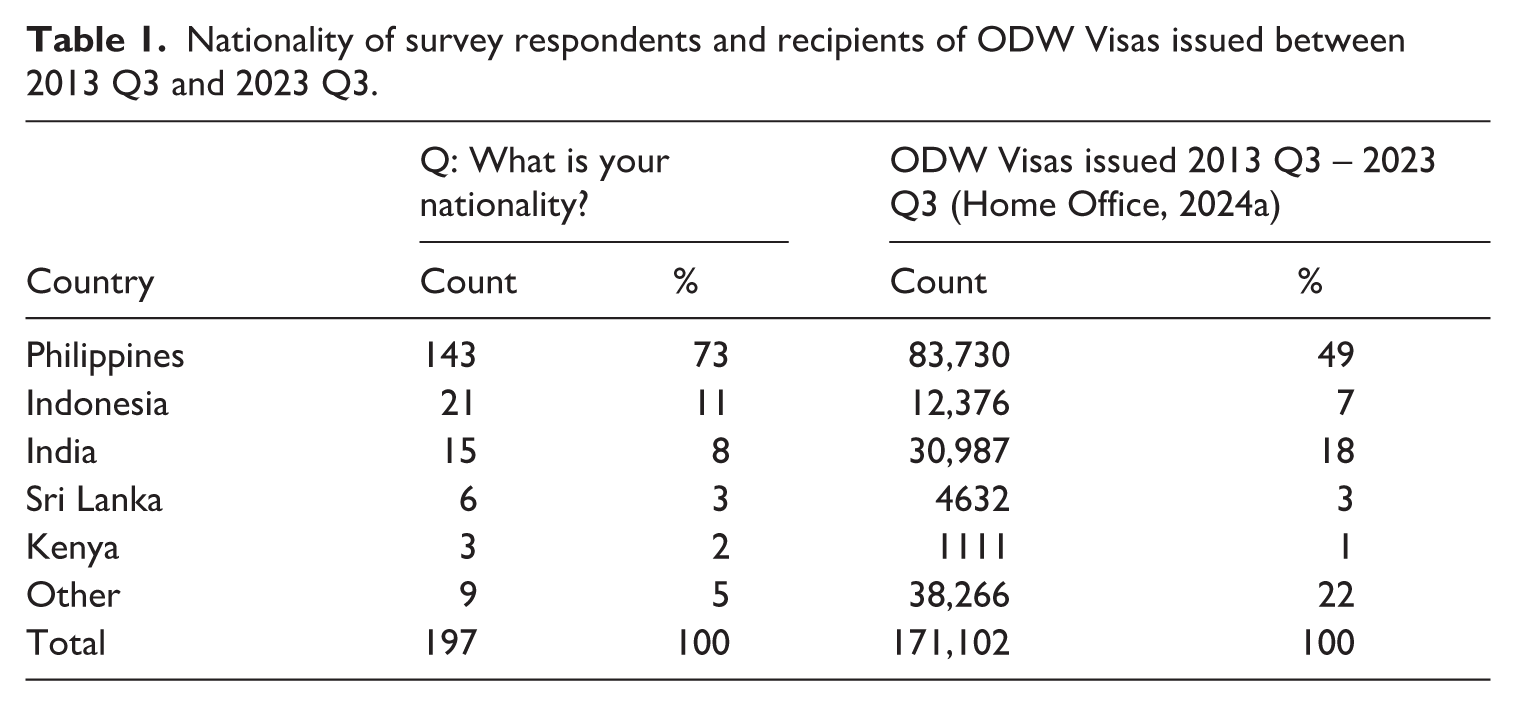
Slavery is discursively positioned as ‘foreign’ to the UK, but historicising the employment of migrant domestic workers highlights the longstanding complicity of Britain’s government and wealth elite in exploitative labour. Like the ayahs and amahs who served British imperial families 200 years before (Chakraborty and Grover, 2022; Datta, 2023), South and Southeast Asia still send the majority of ODW Visa holders to the UK (Home Office, 2024a), as is reflected in the survey’s sample (Table 1).
Nationality of survey respondents and recipients of ODW Visas issued between 2013 Q3 and 2023 Q3.
The employment and living conditions captured by our survey are abysmal (Table 2), with most survey respondents reporting economic abuse (on-call 24 hours a day, no days off and no rest/break periods), spatial abuse (not allowed out of the house unaccompanied, surveilled by employers, not given a room/bed of their own, denied food or drink), along with psychological/verbal and physical abuse. Though not a majority, 65 also reported sexual harassment and/or abuse.
Living and employment conditions of survey respondents’ first employers, by all employers, employers from the Arab States and British employers.
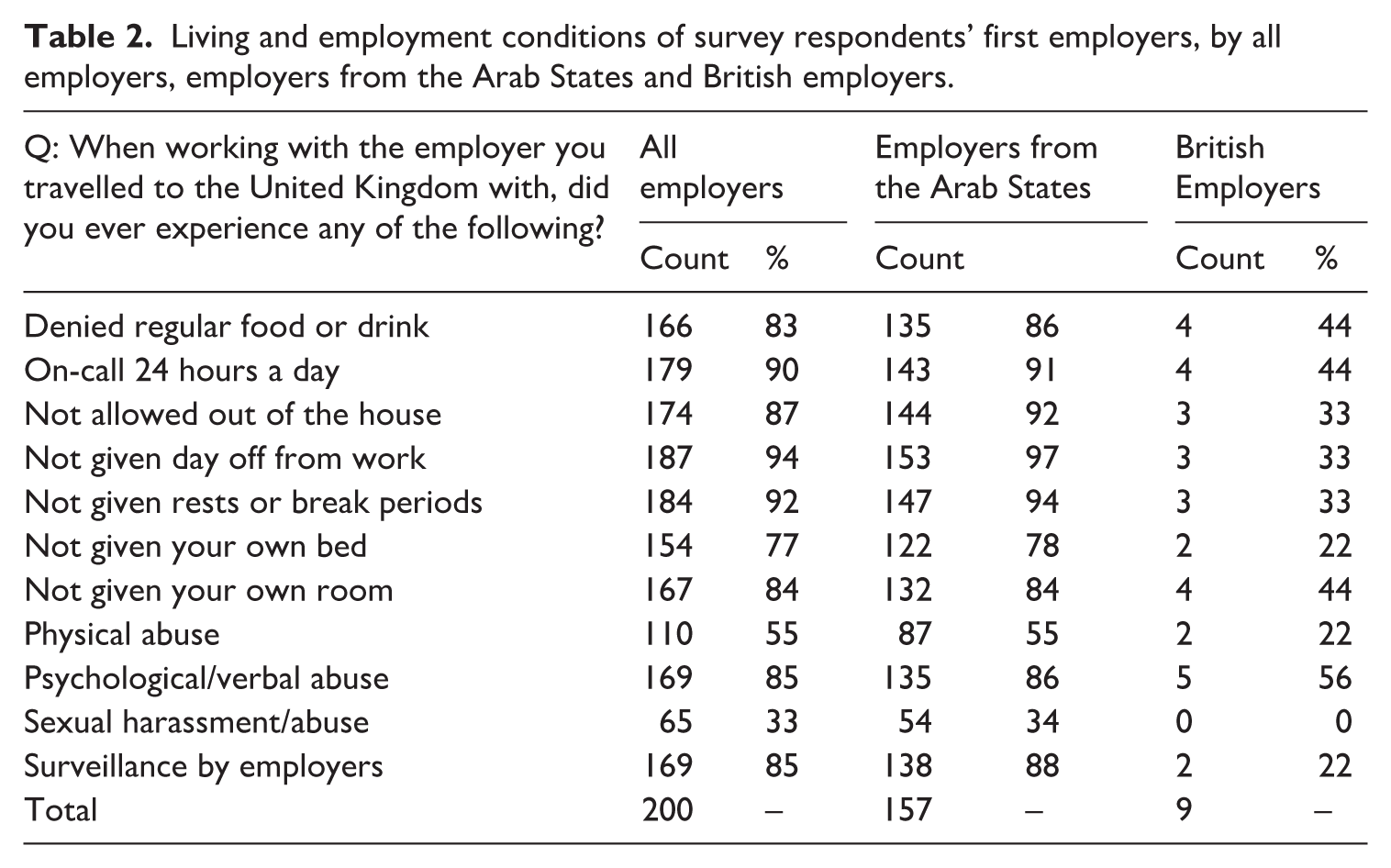
In a historical context, however, these findings are predictable since they echo both migrant domestic worker surveys in the UK before the introduction of the visa (Anderson et al., 1993: 67) and the colonial records of employers mistreating and abandoning ayahs (Chakraborty and Grover, 2022: 311–312; Datta, 2023: 98–124). From the perspective of campaigning, it would be tempting to take the percentages from Table 2 and infer them to the wider population of ODW Visa grantees in Table 1. Indeed, when British journalists describe how ‘thousands of foreign domestic workers remain enslaved’ (Kelly and Grant, 2017), the discursive power of this argument becomes clear. While recognising that any number of people mistreated is too many, it is also important to acknowledge evidence against both quantitative (‘thousands’) and qualitative (that their treatment constitutes ‘slavery’) descriptions of such claims. According to estimates by the International Labour Organisation (ILO, 2021: xviii), the Arab States dominate the employment of migrant domestic workers, and our survey similarly recorded 79% of employers from that region. Using existing survey panels in the Philippines and Indonesia, Blaydes (2023) was able to ask a representative sample of domestic workers in the Arab States about their living and working conditions. Counter to contemporary perceptions of Arab ‘slave traders’ (Anderson, 2014; Parreñas, 2021), and the historical Orientalism that underpins this (Hill, 1709: 259; Wallace, 1753: 207), Blaydes’ (2023: 737–739) latent class analysis paints a heterogenous picture: 71% of workers report 0–1 types of mistreatment by employers, 24% of workers report excessive hours and/or late payment, while 5% face confinement and/or emotional, physical or sexual abuse. This also mirrors the typology that Parreñas (2021: 23) developed from her ethnography of domestic workers in the Arab States: ‘moral employers’ (who try to relieve inequalities), ‘amoral employers’ (who ignore employees’ welfare) and ‘immoral employers’ (who worsen inequalities). As Table 2 indicates, most survey respondents’ employers would fall within Blaydes’ most abusive type of employer, and if we applied her 5% to the 171,102 ODW Visa grantees over the last 10 years (Table 1), we would find ‘thousands’ (8555) whom some would describe as ‘enslaved’. Again, however, it is impossible to test this with the current available data. Instead, the survey findings can help us understand more about who these employers are, and the structural foundations of their ‘immorality’.
After the 157 employers from the Arab States, the domestic workers in our sample reported nine employers from China (including former British colony Hong Kong), another nine from the UK and 23 from other nations, while two did not answer this question. The pool of employers perpetrating ‘modern slavery’ is thus more heterogenous than Orientalist accounts. Additionally, as Table 2 indicates, some British employers engage in the same forms of abuse and mistreatment. The differences between these two groups are not statistically significant, but the overlap does challenge the hard moral boundaries between ‘liberal’ democracies and the absolute monarchies whose human rights abuses they condemn.
The complicity between the British state and those they accuse of ‘modern slavery’ is further shown when looking at survey respondents’ migration experience. They are supposed to attend an interview at a Visa Application Centre (VAC), run by the international ‘commercial partners’ of UK Visas and Immigration (UKVI), where they are supposed to submit a UK-law compliant job contract they have signed (UKVI, 2021). Only 65 workers reported signing a contract, 19 of them understood this contract before signing it and four were given a copy of this contract to keep. Regardless of the contract’s accessibility, the respondents’ abuse and mistreatment shows what little value this contract has. Workers are also supposed to receive an information leaflet at the VAC interview setting out their ‘employment rights’ in the UK and ‘how to access support if these rights aren’t being met’ (UKVI, 2021), but again, only 10 out of the 65 workers who attended an interview reported receiving this document. An independent review of the ODW Visa commissioned by the British government flagged these issues and recommended greater monitoring of these ‘commercial partners’ running VACs overseas (Sharp, 2024: 20–21), but this has not yet happened. Taking a longer historical view, this is not an ‘overseas’ issue since many survey respondents’ employers were born within the British Empire; Arab Gulf nations like Qatar and the UAE were ‘British protectorates’ as late as 1971 and their kafala sponsorship system is not a traditional practice as Orientalist accounts portray but a ‘product of British colonial practices to control labour’ (AlShehabi, 2021: 309–310). The narrative of Britain’s ‘fight against modern slavery’ positions the mistreatment of domestic workers as exterior to the nation, but the wilful negligence of UKVI across its former empire shows the persistence of imperial domination.
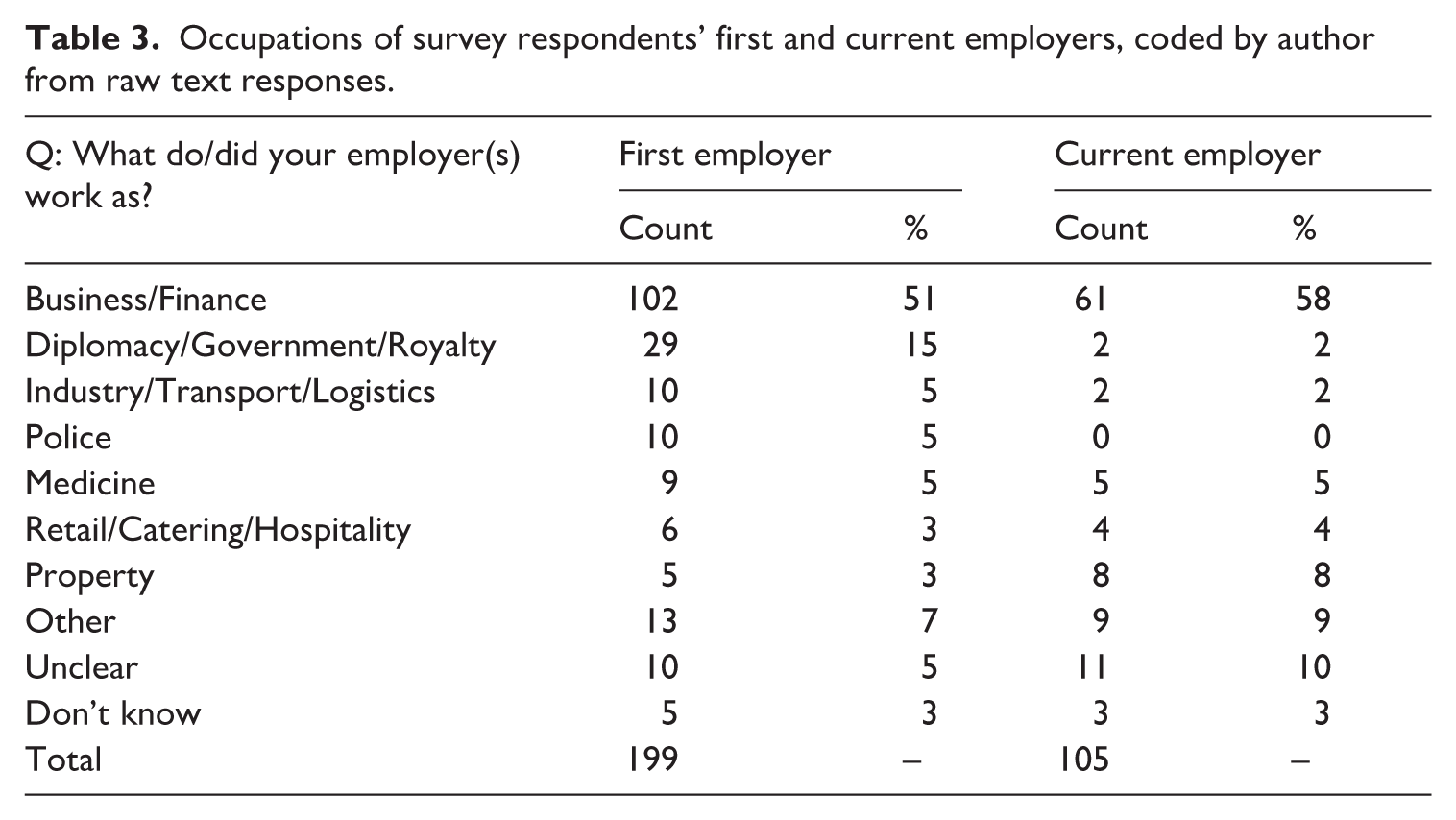
Since the legal category of ‘modern slavery’ was instigated by conservative, pro-business and anti-immigration actors (Caruana et al., 2025: 519–522), it is perhaps unsurprising that politicians and the media often portray it as ‘foreign’ (rather than British) and as ‘organised crime’ (rather than ‘legitimate’ employers) from Romanian ‘gangs’ (Caruana et al., 2025: 520) to Nigerian ‘Islamic extremists’ (Broad and Gadd, 2023: 92–93). Through interviewing the perpetrators of ‘modern slavery’, however, Broad and Gadd (2023) found little resemblance to the ‘folk devils’ that are presented to the public. Similarly, when we asked survey respondents about the occupations of the individuals they accompanied to the UK (Table 3) the most common role was variations on ‘businessman’ (102), a banal descriptor considering the abuse their employees accuse them of. More strikingly, the list of occupations also includes agents of the state, from royalty, diplomats and government employees (29) to policemen (10). When those mistreating and abusing workers are those making and enforcing the law, the unfeasibility of framing ‘modern slavery’ as ‘organised crime’ becomes clear. One worker’s response to the occupation question encapsulates another possible cause behind exploitation: ‘not sure (they own a big land and property)’. Recent politicians have not been as honest as Lord Reay in 1990 (‘if wealthy investors [. . .] were unable to be accompanied by their domestic staff they might not come here at all’ (cited in Anderson, 2014: 10)), but protecting the wealthy still appears to trump the rights of domestic workers.
Occupations of survey respondents’ first and current employers, coded by author from raw text responses.
Elites’ wealth is hard to measure by social scientists (Advani et al., 2022: 3–4), let alone by domestic workers whose employers withhold their job contracts. Nevertheless, geodemographic research of London’s richest neighbourhoods demonstrates that postcodes can predict residents’ wealth (Burrows et al., 2017). Out of the 200 respondents, 133 provided a full postcode and/or street address of where they stayed with their employer, while an additional 60 provided enough information to determine the neighbourhood (e.g. ‘Marble Arch’). Figure 1 shows the distribution of 139 employers within London at ward level. This shows that the wards with the greatest concentrations of employers, (e.g. ‘West End’ (15) and ‘Knightsbridge & Belgravia’ (14), etc.), are the same as those with the highest property values, and where ‘wealthy and ambitious high flyers liv[e] predominantly in the very best urban flats’ (Burrows et al., 2017: 191).
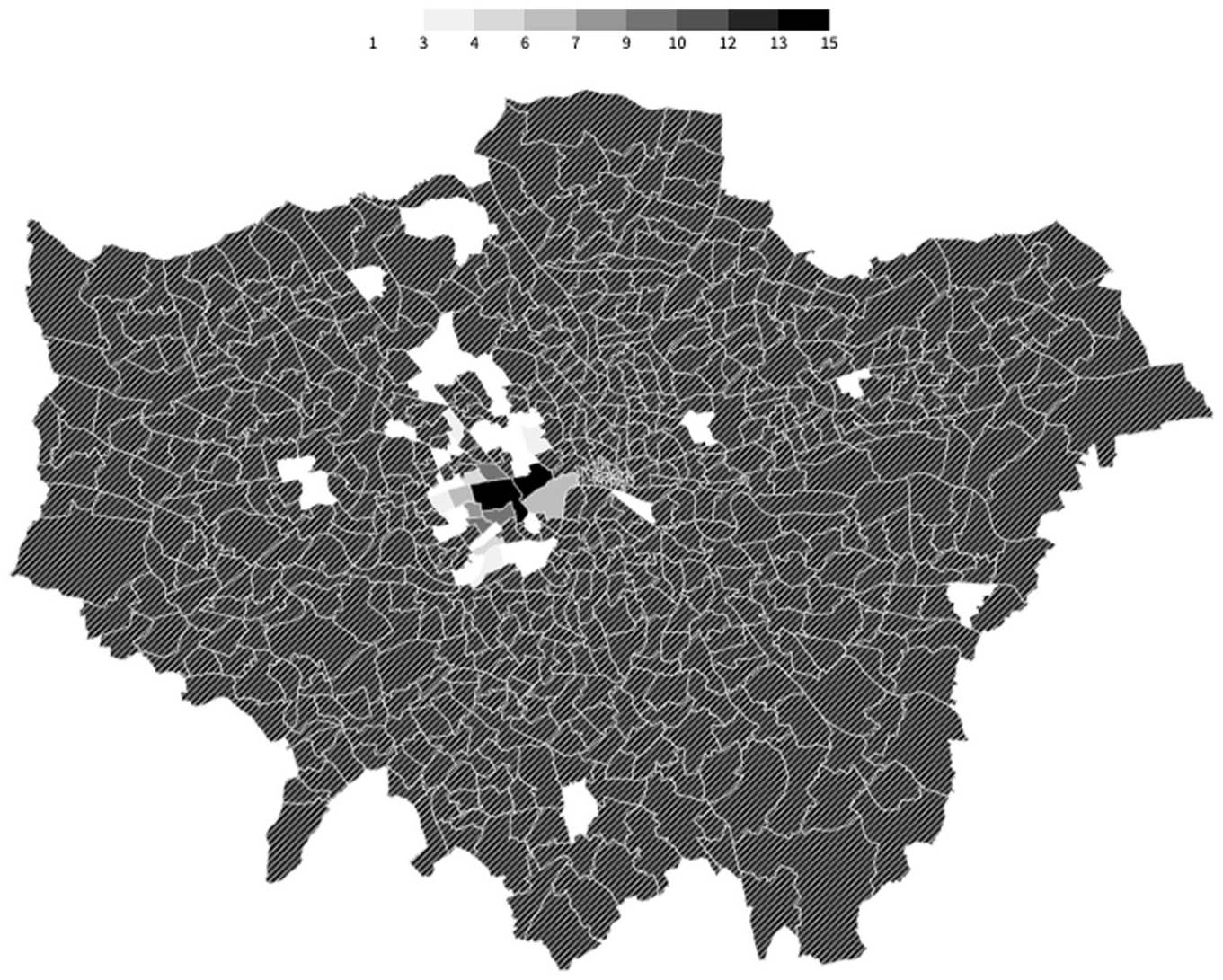
Distribution of 139 employers across Greater London whom survey respondents accompanied to the UK on an ODW Visa.
While supplementing nationality with occupation and wealth creates a richer picture of who these employers are, this still compounds the trope of ‘Middle Eastern oligarchs’, which geographical analysis of tax data shows are outnumbered by affluent business professionals from the Anglosphere, Western Europe and India (Advani et al., 2022: 18–28). To go beyond sensationalism, then, it is necessary to look at how these neighbourhoods’ attraction to employers builds upon previous waves of ‘conquest’, which, as Martineau (1838: 414–417) observes, shapes domestic service in later periods: much of the West End is still owned by the Howard de Walden estate, developed by those enriched by the East India Company like Governor Robert Adams who brought ‘black servants’ with him from India in 1730 (Richardson and Guillery, 2016: 134), a trend later formalised through the British Empire’s ‘ayah passport’ system (Datta, 2023); in Knightsbridge, the Cadogan Estate was one of many landowners funded by the labour of enslaved people from Africa on Caribbean plantations (Crewe, 2025: 19–23; UCL, 2024), some of whom were brought over as ‘servants’ and ‘status symbol[s] for the wealthy’ (Blackburn, 1988: 80); and finally, the Grosvenor Estate in Belgravia, as their French name suggests, traces its origins back to the knights of the Norman Conquest whose descendants remain disproportionately affluent (Clark and Cummins, 2014). Though the ‘races’ and nationalities of elite employers shift over time (Du Bois, 1996 [1889]: 386–387), the amassing of wealth from colonial-capitalist ‘conquest’ remains consistent (Martineau, 1838: 414–417). From the British Navy in the 19th century to the ‘Modern Slavery Act’ today, the British state claims to have ‘punished the slave traders’ (Stationery Office, 2013: 42–43). Yet, these past and present imperial connections show that protecting wealthy employers remains a higher priority than ‘freedom’ for enslaved people and domestic workers.
Work and ‘British’ Freedom
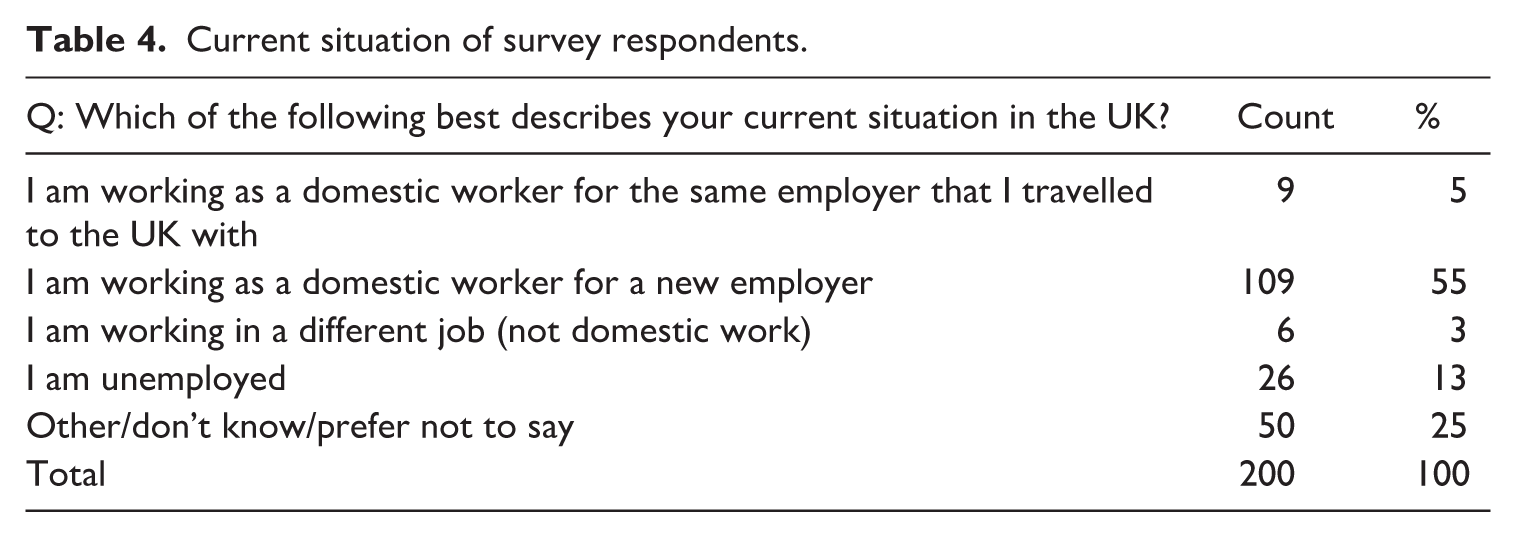
Freedom is held as an inherently ‘British’ value, but comparing contemporary and historical migrant domestic workers’ relationships with the British state undermines this liberal ideal. After a batch of questions about the employer they accompanied to the UK, our survey asked workers about their ‘current situation’. As Table 4 shows, only nine out of the 200 respondents reported that they were still working for this first employer. According to the narrative of ‘new abolitionists’, then, most of the workers in our survey have had their ‘fairy tale ending’ since they are now ‘free’ (O’Connell Davidson, 2015: 205–209). Yet, as per Agarwal’s (2024) ethnography of informal workers in India who were ‘rescued’ from ‘bonded labour’, these ‘rescues’ can be followed by extended periods of waiting. From Table 4 alone we can see that 26 workers are unemployed, and respondents (including the 50 who selected ‘other’) often added comments describing their precarious situations (e.g. ‘On and off job. It’s hard to find a permanent job.’).
Current situation of survey respondents.
These workers’ precarity is not simply due to capitalist labour market dynamics, but also the state-operated system that is supposed to provide ‘appropriate support’, the ‘National Referral Mechanism’ for ‘potential victims of modern slavery’ (Home Office, 2024c). Workers and their allies describe how this system can ‘re-traumatise survivors and often create vulnerabilities to exploitation and abuse’ (Wieltsching, 2024: 12), and this is also reflected by our survey respondents’ various routes through the NRM process. The first barrier is knowledge of the NRM itself; a total of 83 respondents state that they have not been referred to the NRM and the final open text question includes 20 requests for referral or more information about the process (e.g. ‘I want to know about NRM’). Of the 76 workers who have been referred, most (51) received a ‘positive reasonable grounds decision’, which means the Home Office ‘suspects but cannot prove’ that the worker is a ‘victim of modern slavery’ (Home Office, 2024b), four workers received a ‘negative reasonable grounds decision’, 13 are still waiting and eight either ‘don’t know’ or ‘prefer not to say’. The following comments from workers rejected at this stage highlight their deep frustration with what they see as an arbitrary process: I don’t know to what extent of severe abuse I have had to suffer in order to pass the NRM? Do employers must beat me and rape me so I pass this NRM, what is this, I don’t even understand? I was told that was the only way forward but I was told my case was weak which means not having pay is not abuse, not having a day off is not abuse, and being sick and still working is not abuse, then what is the definition of abuse? is it being beaten, being raped or dying?
Historically, as O’Connell Davidson (2015: 38–40) observes, the distinction between ‘slaves’ and ‘non-slaves’ was legal (de jure), while today the state identifies instances of de facto slaves hiding among broader social categories like ‘worker’. Schwarz and Nicholson (2020: 410), however, warn against the legal determinism of this binary, recognising ‘slavery as a condition as well as a status’. Reviewing the comments from workers rejected by the NRM shows that there are distinct differences between colonial and ‘modern’ definitions of slavery, but this difference is temporal rather than legal. While assigning legal status to an enslaved person was declarative in the present tense (i.e. ‘you are a slave’), the legal category of ‘modern slavery’, as determined by the British NRM, is interrogative in the past tense (i.e. ‘were you a slave?’). Though some workers reported many of the same forms of mistreatment as those who received ‘positive reasonable grounds’, the NRM process forces them to question whether their lived experience is a ‘weak case’. With no de jure slavery in Britain or its former empire today, the state can exploit domestic service’s liminal position between the ‘obedience and subjection’ of slavery and the ‘uncertainty of maintenance’ of the labour contract (Martineau, 1838: 413). As respondents highlight, this creates a perverse incentive to wait until they are ‘being beaten, being raped or dying’ before they are close enough to de facto slavery to have a ‘strong case’. Under colonialism, the ‘status of slavery translate[d] to a condition’ of exploitation (Schwarz and Nicholson, 2020: 410), but the NRM today has reversed this process, with an exploitative condition translating to the status of ‘slavery’. In both cases, despite their qualitative and quantitative differences, British law has decided who is, or was, a ‘slave’.
The next stage of the NRM is the ‘conclusive grounds decision’ at which point, ‘on the balance of probabilities, there is sufficient information to consider the individual is a victim of modern slavery’ (Home Office, 2024b). Out of the 51 workers who received ‘positive reasonable grounds’, most (39) are still waiting, one received negative conclusive grounds and 11 received positive conclusive grounds. Like Agarwal’s (2024) informal workers, the British state forces migrant domestic workers to wait for undefined periods, as reflected in their open text comments: Confusing cause there is no point of this process it will going to end up nothing and I will still stuck in my situation. Coz until now waiting for so long for the result and still don’t know what gonna happened next. How many years in NRM no update still.
Though our survey did not capture how long the respondents had been waiting, according to five years of client data from the charity Kalayaan, the waiting time between a reasonable grounds decision and a conclusive grounds decision has a median of 786 days and a mean of 941 days (Parliament, 2023). To survive in the UK this long, 109 of the survey respondents found domestic roles with a new employer (Table 4). The majority of these new employers are British (57), with several from India (10), Iran (10) and a range of other nations, while the Arab States’ combined (10) total is much lower than the workers’ initial employers (Table 2). Even if these new employers appear more heterogenous, their occupations are similar (Table 3), with variations on ‘businessman’ remaining the most common role (61), followed by those working in property (8) and medicine (5). These are the so-called ‘working rich’ who dominate the UK’s ‘economic elite’ (Advani et al., 2022) and, as Figure 2 shows, these employers still congregate around the affluent neighbourhoods identified through tax data and geodemographics, albeit in a more dispersed form than the employers whom they accompanied to the UK (Figure 1).
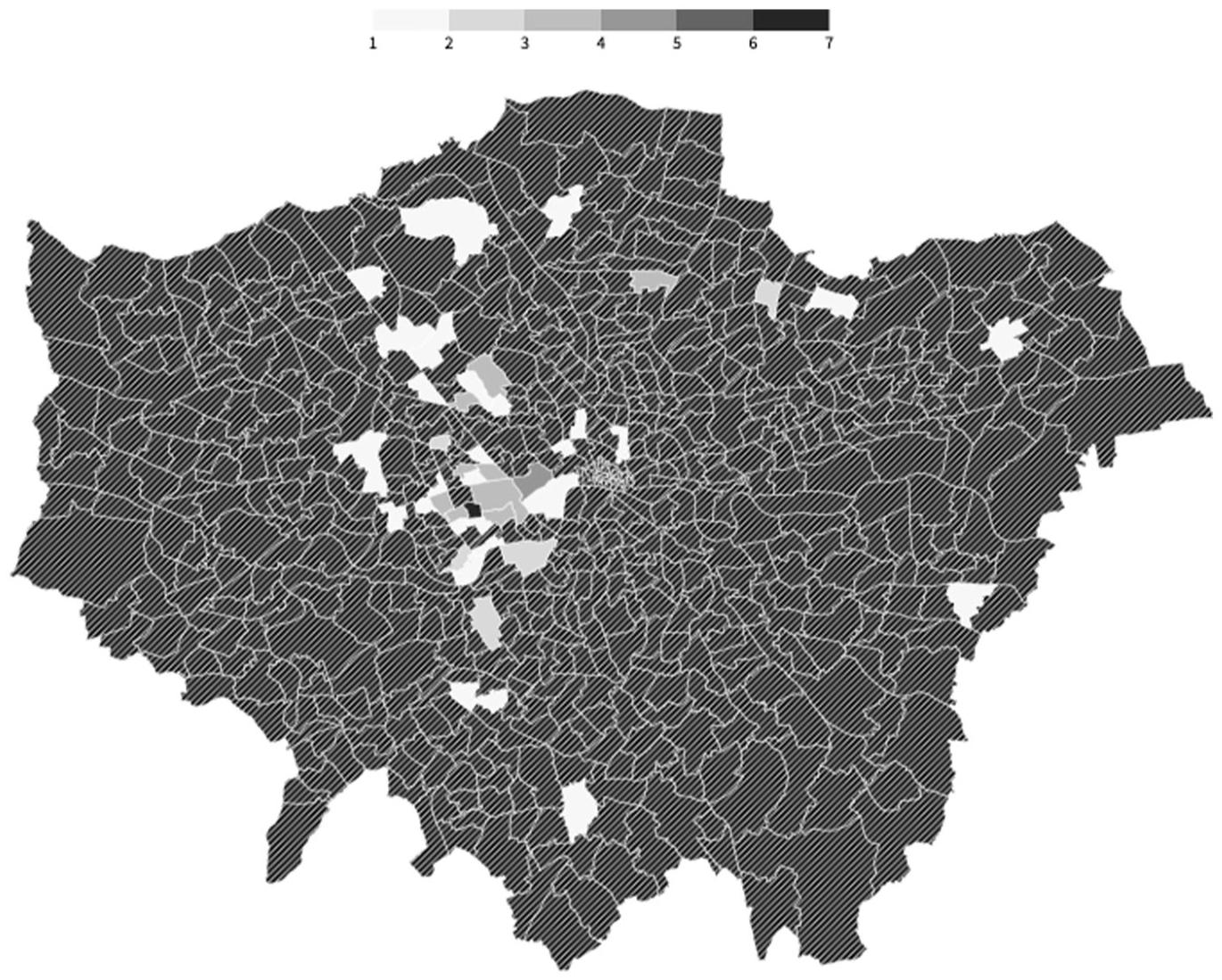
Distribution of 77 employers across Greater London whom respondents reported working for at the time of the survey.
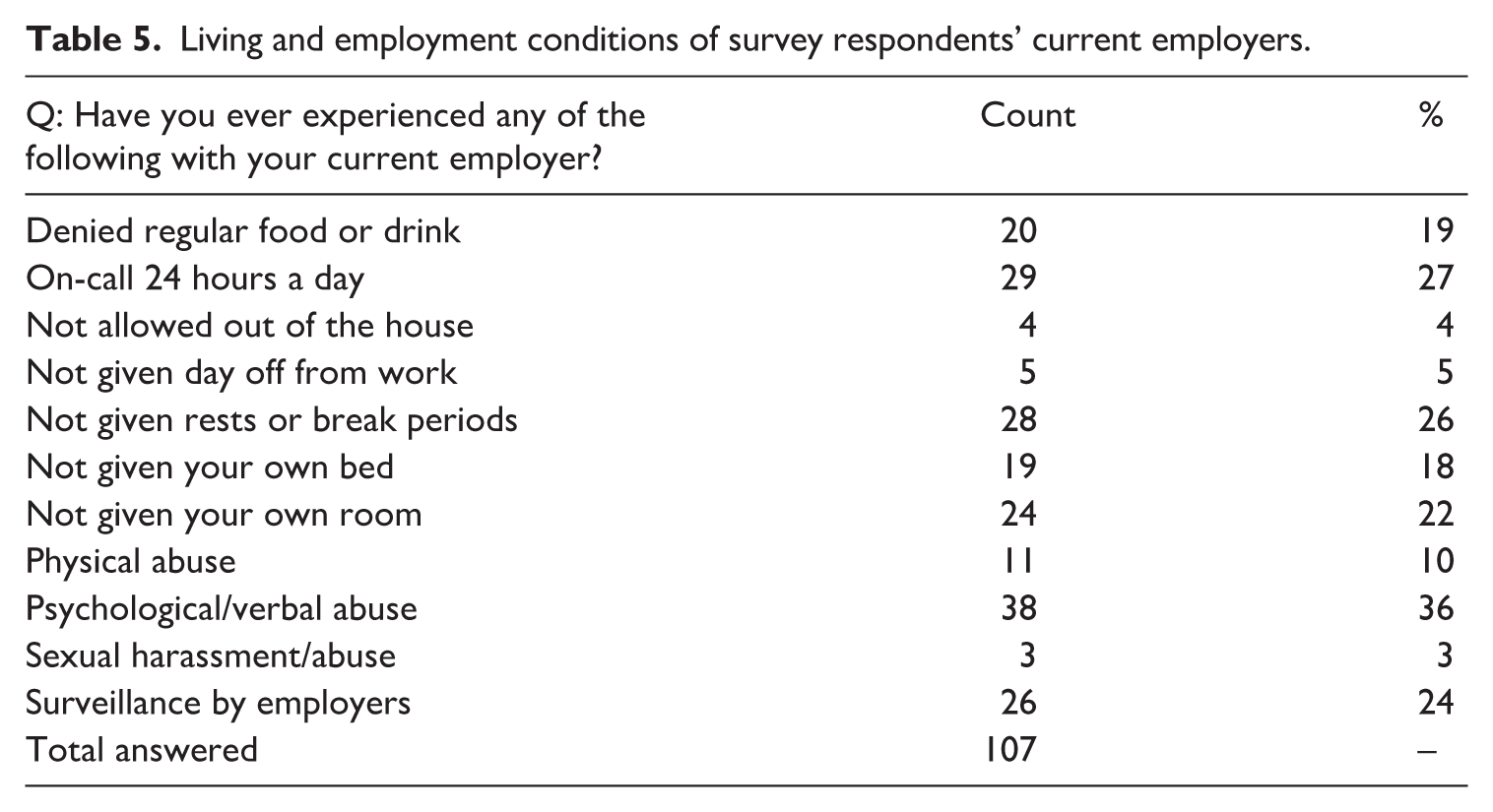
Restoring migrant domestic workers’ right to change employer in 2016 was intended to protect them from ‘modern slavery’ (Sharp, 2024). According to this logic, the responses to the survey questions asking about the workers’ current employers should show a marked decrease in exploitation. While there is a reduction in spatial confinement and physical/sexual abuse (Table 5), psychological/verbal abuse endures for over a third (38) and their median wage is £9.60, still below the National Minimum Wage of £10.42 in 2023. Additionally, only 19 have a written contract with their employer, with most (63) having a verbal agreement, while some (17) have no contract or agreement at all. Using Parreñas’ (2021: 23) typology, several of the workers ‘escaped’ from abusive ‘immoral employers’ only to end up with negligent ‘amoral employers’. This negligence also extends to employers’ awareness of their employees’ legal status, with most respondents (66) believing that their employers do not know about the NRM. Given the managerial responsibilities of these ‘professionals’, it is hard to believe these employers’ ignorance. Instead, it may be a similar case of denial as Anderson (2014: 10) observed among employers who believed they were providing ‘havens’ to domestic workers escaping ‘slavery’ in the 1990s but then proceeded to exploit them further, because ‘Britain is not the kind of place’ where anyone would ‘benefit from the labour of “slaves”’.
Living and employment conditions of survey respondents’ current employers.
This moral accounting, that British economic exploitation is justified in comparison to ‘foreign slavery’, parallels an earlier visa regime from the 1930s, when around 20,000 female Jewish refugees of ‘working age’ were admitted to Britain as domestic servants (Craig-Norton, 2019). The ‘need’ for migrant domestic workers at this time was due to the ‘unwillingness’ of (British) ‘working class girls’ to assume a role that left them at ‘the margins of labour and society’ (Craig-Norton, 2019: 299), as Martineau (1838) predicted a century earlier. Mirroring our contemporary survey responses, Craig-Norton’s (2019: 325) analysis of testimonies by Jewish refugees who worked in domestic service finds ‘alienation’ and ‘drudgery’, with faux-humanitarian British employers exploiting their flight from the Nazis by providing low pay and poor living conditions, which the refugees could avoid only by eventually leaving the profession to ‘become human again’. Their rejection of domestic service reinforces what Du Bois (1920: 120) calls the ‘manure’ idea of society, with ‘services which no real human being ought to be compelled to do’. However, this dynamic was, and is, reinforced by nation states’ colonial policies rather than marginalised individuals’ understandable avoidance of exploitative work. As Anderson (2024) observes, Britain granting migrants the ‘right to work’ is a form of ‘fantasy citizenship’ obscuring the state-enforced ‘duty to work’. Using the moral justification of being a ‘lesser evil’ compared to ‘modern slavery’, the British state makes our survey respondents work for their ‘freedom’, both through continuing to work for (mostly British) employers exploiting their precarious migration status, and through the long and re-traumatising process of providing a ‘strong case’ of vulnerability to the NRM. ‘Britons will never be slaves’, as the crowds at the Proms sing, but the historical and current exploitation of migrant domestic workers in the UK appears far from idealised British ‘freedom’.
Conclusion
This article has explored how a historical lens might aid understanding the ‘slavery’ or ‘freedom’ of migrant domestic workers in the UK today. Through analysing the 200 responses to an ‘Employer Mapping Survey’, co-designed with migrant domestic workers, comparing their condition to domestic workers from previous eras, and using the social theory of Du Bois and Martineau to ‘complicate western sociological foundations from within’ (Puri, 2021: 640), I have challenged the moral binary of ‘foreign’ slavery and ‘British’ freedom.
To reject the ‘foreignness’ of slavery, this article further challenges the ‘folk devil’ narratives of ‘modern slavery’ (Broad and Gadd, 2023) by going beyond the usual focus of data collection on the ‘victims’/‘survivors’ of ‘modern slavery’ and shifting instead to the employers who allegedly abuse them. By mapping the distribution of respondents’ employers across London (Figures 1 and 2), I have shown how the employers whom workers travel to the UK with, and their subsequent UK-based employers both congregate in the same London neighbourhoods of Belgravia, Knightsbridge and Mayfair tied to the ‘economic elite’ (Advani et al., 2022; Burrows et al., 2017). Since the former, mostly ‘foreign’, employers treat domestic workers abysmmally, and many of them come from the Arab states (Table 2), this might seem to corrobate the superiority of British liberalism over the exploitative kafala system. Applying a historical lens, however, I found that from the 18th century to today, ‘slavery’ is presented as both a ‘foreign’ deviation from liberal capitalism (Anderson, 2014; Hill, 1709; Parreñas, 2021; Wallace, 1753), and the moral antithesis of ‘Britishness’. Yet, as survey respondents reported, those who abuse and mistreat migrant domestic workers include both formal British citizens and those born in the British Empire. In these former ‘protectorates’, the British state’s outsourced ‘visa application centres’ continue to deceive domestic workers with false promises of employment rights, echoing the Indian ayahs abandoned by their colonial employers (Chakraborty and Grover, 2022; Datta, 2023). London’s wealthiest neighbourhoods, too, are built upon the profits from slavery and colonialism (Richardson and Guillery, 2016; UCL, 2024). Since many of our respondents’ employers are ‘businessmen’, law-makers, or law-enforcers (Table 3), the British state, historically and today, appears to be more interested in protecting wealthy employers than migrant domestic workers, regardless of whether this mistreatment constitutes ‘slavery’.
By challenging the ‘Britishness’ of freedom, this article has moved beyond the ‘mainstream trafficking discourse’ and its focus upon ‘rescue’ (Agarwal, 2024). By analysing migrant domestic workers’ situations after they escape from their first employer, I found that ‘freedom’ fails to describe migrant domestic workers’ precarity in the UK. In the name of providing ‘support’ to ‘victims’, the British state forces workers to wait years to decide whether their lived experiences are believable and severe enough to be ‘slavery’. British employers further exploit these workers through long hours, low pay and informal agreements, just as they did with Jewish refugee domestic workers (Craig-Norton, 2019). Using a historical lens, my analysis of the survey responses shows how both the state and employers reinforce domestic work’s ambiguous position between the ‘obedience’ of slavery and the ‘uncertainty’ of capitalism (Martineau, 1838: 413), along with the damaging idea that ‘no real human being ought to be compelled to do’ domestic work (Du Bois, 1920: 120).
Finally, viewing migrant domestic work through a historicised lens enables an alternative understanding of how ‘de jure’ transatlantic chattel slavery might relate to the ‘de facto’ form of ‘modern slavery’ (O’Connell Davidson, 2015: 38–40). These phenomena are qualitatively and quantitively distinct, but my analysis suggests this difference is temporal rather than legal. While the colonial system declared ‘you are legally a slave’ in the present tense, the British system today legally decides whether or not ‘you were a slave’. Schwarz and Nicholson (2020: 410) are right to acknowledge that ‘slavery’ can be ‘a condition as well as a [legal] status’, but my analysis of the adverse impact the NRM process has upon migrant domestic workers suggests that the relationship between the condition and status of ‘slavery’ is bidirectional, with the post-imperial British state retaining decision-making power. Colonial and contemporary domestic work share a common ancestor in conquest, and both remain obscured by the moral binary of the Britishness of ‘freedom’ and the foreignness of ‘slavery’. Instead, the UK might finally adopt the ILO’s (2021) convention for ‘decent work for domestic workers’, extending labour rights to migrants rather than ostensibly ‘protecting’ them from ‘modern slavery’.
Footnotes
Acknowledgements
I am indebted to the Voice of Domestic workers, particularly Marissa Begonia and the 12 members who spent time co-designing and analysing the survey, the 200 workers who responded and those who ran the original 2018 survey. I would also like to thank Rose Deller from LSE’s Knowledge Exchange and Impact team, the anonymous reviewers, the special issue editors and Helen Lewandowski for her invaluable support.
Funding
The author disclosed receipt of the following financial support for the research, authorship and/or publication of this article: research funded with ‘PhD Knowledge Exchange and Impact’ grant from London School of Economics and Political Science.
