




Abstract
This article addresses challenges of preparing sociology graduate students to apply academic knowledge practically and translate their sociological imagination into meaningful work after graduation. It introduces a model of community-engaged learning through community-based participatory research (CBPR) projects, bridging classroom learning with ‘real-world sociology’. The course seeks to empower students to transfer acquired skills to benefit communities and improve social conditions. Key pedagogical challenges include transitioning to ‘learning by doing’, establishing reciprocal partnerships and organizing the work within a semester. We present the framework developed for teaching a graduate course in CBPR for several previous semesters in a marginalized community in South Baltimore, MD, USA. Our analysis illustrates the benefits of CBPR as a teaching tool, combining research methodologies, community engagement and sharing findings with the community for empowerment. We also discuss feedback from students and community partners, challenges and best practices for international scholars.
Keywords
Introduction
One of the key challenges faced by sociology programs is how to prepare students to apply their academic knowledge in practice and to translate their sociological imagination into meaningful work after graduation. For graduate programs, this conundrum intersects at various levels of student engagement: converting research methodology skills learned in the classroom into actually doing research and going beyond describing and analyzing social conditions to changing them. For example, Pain (2009) observes that there is a gap between teaching students research methods and teaching them the practice of actually researching, a gap that we feel has important consequences for graduate students’ personal and professional development.
In this article we introduce a model of community-engaged learning via community-based participatory research (CBPR) projects that bridges that gap by empowering students to do what Quartaroli (2014: 83) calls practicing ‘real-world sociology’ to ‘change the world’. The social change aspect of teaching via CBPR projects aligns with applied and clinical sociology’s claims to not only understand the social world, but to improve those social conditions found to be in need of change. For instructors, that means leaving the classroom and conventional lectures in order to teach students how to do sociology hands-on in the field.
However, challenges of teaching community-engaged courses emerge when shifting the focus from practicing methodological strategies in the classroom to ‘learning by doing’ a research project in marginalized communities. Having graduate students leave the safe and predictable world of in-class instruction in order to get involved in the messy process of primary data collection often in very unfamiliar spaces, involves a certain amount of apprehension but will ultimately give them invaluable opportunities for personal and academic growth.
Applied sociologists often use social science methodologies to benefit underserved populations via funded, impact-oriented long-term projects. In the context of semester-based teaching, sustainability becomes complicated because clients in non-profit community organizations are not constrained by the semester rhythm. CBPR course projects also entail unconventional roles for both instructors and graduate students. Rather than assuming leadership in the research process, instructors become facilitators who observe, listen to local voices and suggest ways in which their research knowledge may be of use to the goals of the community under study. The student researchers’ skills become tools for community service as the main purpose is shifted from producing papers for academic audiences to disseminating findings to community members or organizational clients.
Our course model combines: (1) learning of research methodologies; (2) application of these tools in CBPR projects; (3) engagement with community partners and members in community volunteer work; and (4) sharing research findings and action plans with the community and beyond. If successful, this model can be invaluable for community revitalization efforts through long-term community–university partnerships, for students’ continued commitment to civic engagement and for students’ professional development based on real-life research experience.
Despite the increasing popularity of classroom-based CBPR, its educational dimensions remain largely absent or only briefly addressed in scholarly discourse (Molosi-France and Dipholo, 2022). In this contribution to the special issue, we present our pedagogical framework and analyze the lessons learned from several semesters with graduate students in two neighboring marginalized communities in the southernmost point of Baltimore City, USA – Brooklyn and Curtis Bay between 2015 and 2023 (see Adler et al., 2022, 2023). After reviewing relevant literature on CBPR and the pedagogy of teaching it, we introduce our course model for community-engaged sociology at the graduate level. We highlight key feedback from students, community members and partners, describe challenges and analyze course content, assessment and outcomes. Recommendations and best practices will be presented to guide scholars interested in this pedagogy.
Brooklyn and Curtis Bay: Two Marginalized Baltimore Communities
Baltimore has a long history of economic and race/ethnic inequality, intensified by racially segregating neighborhood grading practices in the 1930s – the so-called redlining. This color coding by banks providing housing loans reflects areas considered more or less ‘safe’ for white investment based on race/ethnic composition (Huang and Sehgal, 2022). The resulting ‘Black butterfly’ pattern (Brown, 2022) refers to the geographical shape formed by predominantly Black neighborhoods in the east and west of Baltimore City. It underscores how racial and economic segregation are remarkably stable over decades and how spatial dis/investment in Baltimore’s neighborhoods has remained uneven (see also Aufseeser and Mahmoudi, 2025; BNIA (Baltimore Neighborhood Indicators Alliance), 2023). Although there were originally five neighborhoods on the southern peninsula of Baltimore, only Brooklyn and Curtis Bay remain. Their physical separation by the Patapsco River contributed to decades of social, economic and environmental decline (King, 2014). Between 1900 and the 1950s, the area was zoned for industrial use, including chemical production and waste disposal (King, 2014), and low-income worker housing was created. Increased pollution has led to elevated rates of cancer, asthma and other health issues and the communities are ‘food deserts’ with limited access to healthy and affordable foods (Baltimore City Government, 2012). They are also characterized by high unemployment and child poverty rates, gun-related violence, low median household income, infrastructure deficits and environmental hazards (BNIA, 2023; see also Adler et al., 2023; Huang and Sehgal, 2022). Both neighborhoods are highly diverse, with a 2023 racial diversity index of 87.6 – well above Baltimore’s average of 62.7 (BNIA, 2023) but remain segregated. Within the north-west of Brooklyn, 18.7% of residents are African American/Black and 39.4% are white (the remainder being Hispanic or biracial), compared with 39.8% and 22.1%, respectively in the south-eastern tract (U.S. Census Bureau, 2023).
CBPR and the Pedagogy of Teaching It
CBPR
Two key principles of CBPR are treating the community of interest as a whole and researchers collaborating with key community members or partner organizations. Both parties share their knowledge and skills to develop research questions, design projects and solve problems identified by the community (Jagosh et al., 2015; Rosenthal et al., 2009). As such, co-learning is an important aspect of CBPR (Hacker, 2013). This approach encourages community partners to take an active role in the research process and may include community members in all stages of the research process (Rosenthal et al., 2009). This differs from traditional research where investigators are the main drivers of each phase of the process. Thus, research is not done on the community based on researcher goals, but with the community based on community needs.
Unlike other forms of research, CBPR involves a transformative framework that engages local communities at the center of the research process to produce meaningful benefits for their members (Jain et al., 2023). There is an action and social justice component to this work that is either incorporated into the research project itself, or the results of the research are intended to later inform some type of action to be carried out by or in favor of the community (Hacker, 2013). Hence, intricate knowledge of communities and their conditions fosters research results that can be effectively linked to advocacy, increase awareness of policy makers, improve infrastructure and direct local resources where needed. For example, Suarez-Balcazar et al. (2022) present a range of social-justice based CBPR case studies. The research for ‘Promoting economic justice among youth with disabilities in the US’ improved the opportunities of youth of color with disabilities to become small entrepreneurs by addressing employment challenges and lacking resources. The project helped the youths generate business plans and created opportunities to make decisions and develop their ideas. Similarly, Ferreira and Gendron (2011) demonstrate that CBPR can empower oppressed Indigenous and traditional populations across the Americas, and position scientists as active learners rather than mere observers. Focusing on Primary Health Care, Chanchien Parajón et al. (2021) illustrate how CBPR can move beyond the traditional individual patient focus by fostering collaboration among partners grounded in community priorities and strengths, thereby advancing health equity. The collection of successful case studies on community development, environmental issues, race–class–gender inequalities, health disparities, crime and violence reduction presented in Nyden et al. (2011) also illustrates the importance of CBPR for community well-being.
Undergraduate and graduate students in the social sciences are typically not trained in CBPR, yet calls for proposals increasingly involve ‘on-the-ground’ work that includes local context as well as local voice. Social work, community psychology and public health are at the forefront of engaging academics and students in hard-to-reach communities (e.g. immigrant women, LGBTQA+, people of color, populations with disabilities) to answer questions that cannot be answered via traditional methods. For example, students successfully engaged in planning a CBPR project and conducted a phone survey of homeless shelters and even published their final research report in a peer-reviewed journal (Lundahl, 2008).
CBPR courses can lead to small-scale improvements that provide the impetus for larger positive developments. For example, Fernández et al. (2020) implemented a CBPR course involving projects developed in collaboration with Mexican immigrant mothers, which revealed how their lived experiences within their communities were closely tied to social and economic inequalities. Based on the findings, resources for students with special needs, affordable housing and public safety could be identified. The authors found that through the student projects, ‘the Mexican immigrant madres demonstrated their leadership, agency, hope, and resilience in the face of increasing systemic inequities, and gained an increased ability to address long-standing issues in their community’ (Fernández et al., 2020: 181).
Pedagogy
Pedagogically, a course in CBPR is more challenging to teach than a traditional sociology methods course, in which the final project asks students to develop research proposals that they will never execute (Bach and Weinzimmer, 2011; Korsching and Peter, 2007; Taylor and Pettit, 2007). While this approach allows for practice in formulating research questions, designing methodology, choosing instruments and proposing analytic strategies, it does not prepare students for the ‘messy’ realities of conducting field research (Finkelstein, 2010; Gullion and Graybill Ellis, 2014). In contrast, CBPR courses require the application of knowledge and skills learned in the traditional classroom setting to research projects involving real people with real-world consequences (Breese, 2011; Gullion and Graybill Ellis, 2014; Huisman, 2010). These courses also typically offer opportunities for students to work autonomously and collaborate beyond the classroom (Finkelstein, 2010). Students engage in research projects in communities and are encouraged to discuss methodologies, research activities and decision-making processes related to these projects (Finkelstein, 2010; Sankaran et al., 2007). Thus, these courses involve aspects of critical pedagogy (Huisman, 2010) by de-centering the instructors’ role, making them facilitators in the teaching and learning process. For graduate curricula, Moore and Donaldson (2022: 418) contend that CBPR provides: many natural opportunities to connect practice to research, [. . .] and teaches students about power, structural racism, disparities, group process, interviewing, macro practice, ethical practice, diversity, cultural humility, and many other areas of knowledge, skills, and attitudes important for them to gain.
Current approaches to sociological pedagogy acknowledge that ‘doing sociology’ is crucial to learning sociology and is accomplished via collaborative learning (Huisman, 2010). This includes collaborative and critical pedagogies intended to use one’s sociological imagination, particularly as it pertains to marginalized groups in society (Braa and Callero, 2006; Fobes and Kaufman, 2008; Pedersen, 2010). A ‘sociology as pedagogy’ approach in course design is considered vital for examining and improving upon teaching and learning dynamics (Halasz and Kaufman, 2008) in a CBPR course: teaching and learning are happening inside and outside of the classroom, and at multiple levels. The course we are introducing here is based on a ‘reflexive pedagogy’ and a social justice lens. Hence, this course has been transformed based on teacher and student reflections and community input over many semesters.
Courses that direct their research objectives to addressing issues in local neighborhoods also help to carry out the public mission of US universities to engage in partnerships with communities in which they are embedded. In addition, CBPR involves respect for community members’ knowledge and experience, thereby privileging the voices of those who are not in power because the role of the researcher is de-centered. However, power imbalances can present a significant ethical challenge in CBPR (Wilson et al., 2018). We did encounter power hierarchies both within the community and the research partnership, which proved difficult to identify, articulate and address. Nevertheless, we concur with Wilson et al.’s (2018: 193) view that CBPR provides a valuable framework for a ‘reflective practice’, enabling the recognition and negotiation of such dynamics.
According to Bach and Weinzimmer (2011), CBPR courses provide the opportunity to gain proficiency in the entire research process, which in turn can enhance professional growth. Students receive useful skills, particularly when it comes to advancing research practice, professional and public presentation of results, learning to collaborate with others and producing results within strict deadlines (Bach and Weinzimmer, 2011). In terms of assessments, this also means that assignments incorporating components of the research project rather than exams are practical (Finkelstein, 2010). Students are also able to learn and retain more from this type of approach as concepts and theories learned in lectures are reinforced and help to contextualize their field work (Bach and Weinzimmer, 2011; Huisman, 2010). Similarly, student experiences outside of the classroom with public actors allow them to make sense of sociological theories and concepts related to power, inequality and various disparities (Moore and Donaldson, 2022).
Community-Engaged Learning
Recently there has been a shift in terminology from ‘service learning’ and ‘experiential education’ to ‘community-engaged learning’ (Brudney and Russell, 2016). The new concept captures the ideas of community-based learning by doing, being engaged in community service by using academic skills to advance community-led efforts and gaining experience working off campus. The literature generally assumes that community-engaged learning benefits students, universities and communities (Hammersley, 2013; Oldfield, 2008; Tyron and Stoecker, 2008). However, scholars writing about the benefits for students also highlight the relative lack of specific information available on student learning outcomes for these classes. Tolich et al. (2015) measured the outcomes of an undergraduate internship course and found that students were able to develop ‘identities as researchers’, were more adept at problem solving and more confident and motivated to do research. Others show that for traditional service-learning courses students benefit more from the experience than communities (Blouin and Perry, 2009; Stoecker et al., 2010).
In addition, studies of internship courses often focus on student reflections and learning rather than on the perceptions of and benefits to community members, or organizations’ experiences with service learners (Blouin and Perry, 2009; Brudney and Russell, 2016; Mobley, 2007; Tolich et al., 2015). While several studies have measured the outcomes of service learning for students (Chesler et al., 2006; Molee et al., 2010; Rondini, 2015; Yorio and Ye, 2012; Warren, 2012), few assess the perceived and actual benefits of service-learning experiences for participating community members and organizations and whether service-learning courses actually contribute to social change in communities (Blouin and Perry, 2009; Stoecker et al., 2010; Tyron and Stoecker, 2008). Hammersley (2013) points out that one of the key issues community organization members have with service learning is that research is mainly conducted with organization leaders as participants, rather than other community members. Recently Brudney and Russell (2016) developed a method to address the community perspective that quantifies the contributions of volunteers in terms of the value of time and skilled labor to community projects. Their accounting shows that student research projects in fact can make a very valuable contribution to communities by providing free skilled labor and time, which otherwise would be quite prohibitive in price.
A Graduate Course in CBPR
CBPR is an approach that respects and shares multiple forms of knowledge and includes multiple modes of discovery in order to be useful to community partners (Kozimor-King and Prince, 2018). Thus, a course in CBPR must be flexible in teaching and applying various methodologies, as needed for various projects. In addition, the design of a CBPR course involves high-impact pedagogical practices like team-based learning and co-learning with community partners. Ultimately, the course goal is not only to train students to be researchers, but to assist community partners in problem solving, to produce useful deliverables to them and, ultimately, to empower them to do and use research themselves.
In the graduate course presented here, students examine social issues affecting the well-being of an urban neighborhood in South Baltimore. We use an ‘instructor-anchored model’, in which ‘the instructor holds the partnership, prioritizing fostering enduring community–academic relationships’ across academic semesters, and shows a long-term, consistent commitment to working with the community partners (Rojo, 2025: 18). Based on previous connections the instructor has made, current students examine community well-being with special attention to access to green spaces, healthy food, opportunities, housing and a healthy environment. The instructor and their university have become a known factor in the community so that trust can be built.
Having a good relationship with trusted, visible and respected key residents in the community also serves a protective function in that we are privy to insider information and aware of safe spaces. Community residents are challenged by criminal and drug-related activities, which tend to be concentrated in various ‘hot spots’. The concern that students may feel unsafe in an unfamiliar community with a challenging environment was countered by repeated group visits in the community and friendly encounters with residents. Being in the field with students requires various precautions and measures to ameliorate potential risks. First, students receive instructions from the instructor and community partner on how to conduct themselves in their outsider role and which areas to avoid before entering the field. Student concerns about their safety are always taken seriously – especially considering that most have never been in this type of environment. During the initial walk-through with the community partner – and throughout the semester – students are wearing university logos/colors and their university ID, and are holding clipboards to record impressions in order to clearly signal their purpose in the community. When doing their projects in the field, they use a group app to stay in touch, have a known meeting/safe space, always walk at least in pairs, leaving the community before dark. Ethical behavior – respect, friendliness and cultural humility – guide all encounters with residents, and students are taught how to deflect aggressive or inappropriate behaviors. In order to protect residents’ identities, photos and film do not contain recognizable faces unless permission is given.
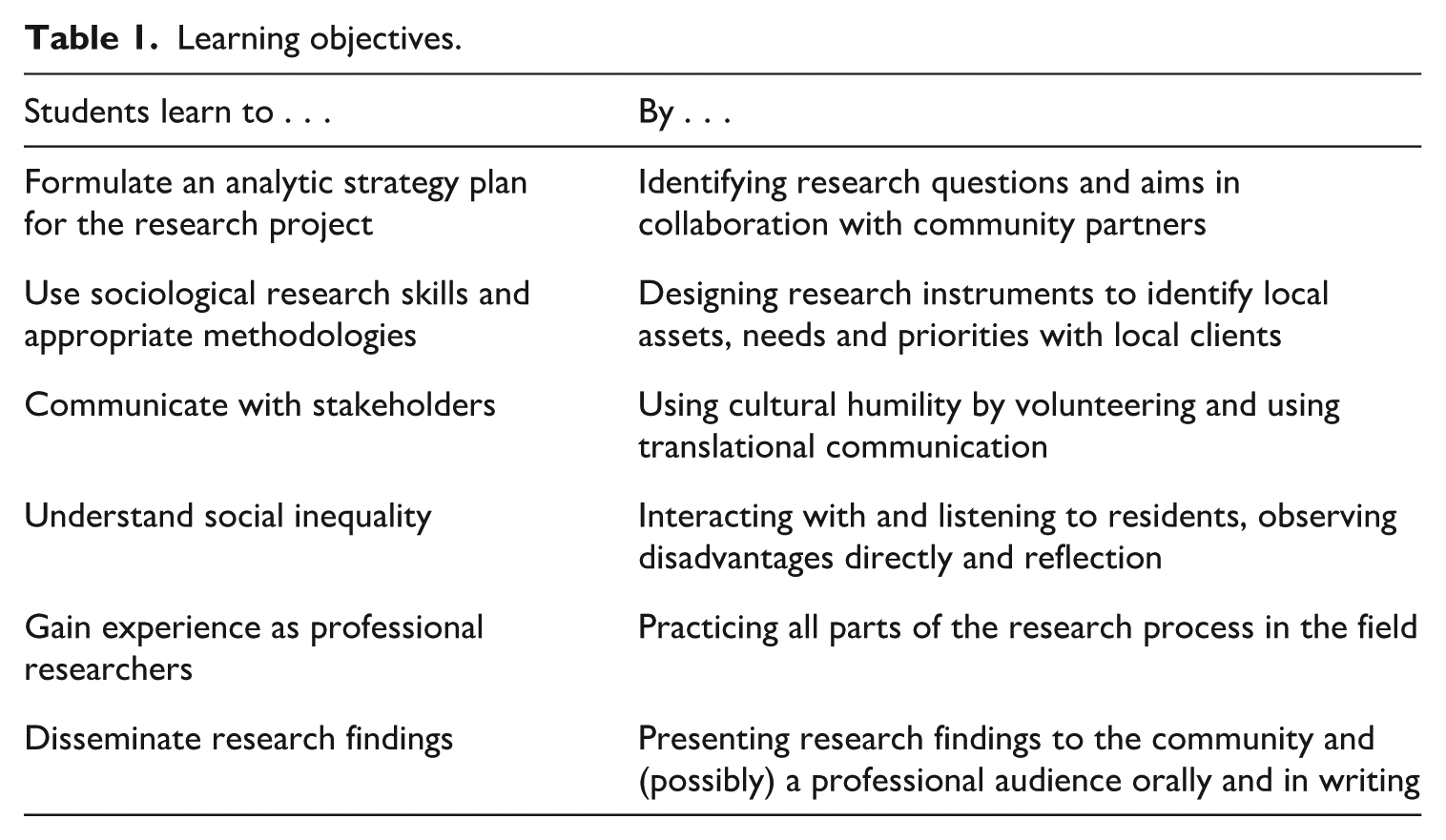
In coordination with community or partner priorities, students use an asset-based approach to develop relevant research foci, collect data through various methods, volunteer in the community and with organizations, document assets and needs, develop action plans and make recommendations for change. Students learn and use the necessary research methodologies in the field and communicate the research results in a professional manner to various audiences. Of major importance is the involvement of the key users of the research findings in the research design, and the usefulness of the research products for the community or partner organization under study. The general learning objectives of the course are presented in Table 1.
Learning objectives.
The projects are designed based on dialogue with community partners, who share their understanding of priorities and needs in terms of research. The instructor facilitates these discussions, negotiates potential research products and translates community requests into ‘doable’ projects in a semester framework. The graduate students use their sociological knowledge, methodological skills and access to university resources to perform the research and create an action plan based on findings. While the course has an overall theme and covers various methods each semester, student teams focus on specific partner organizations/topics in their projects. The projects receive Institutional Review Board (IRB) approval as part of the general course human subject’s clearance. This requires that all students be certified in terms of IRB training before they enter the field. Discussion of research ethics in dealing with local clients is strongly emphasized throughout the semester.
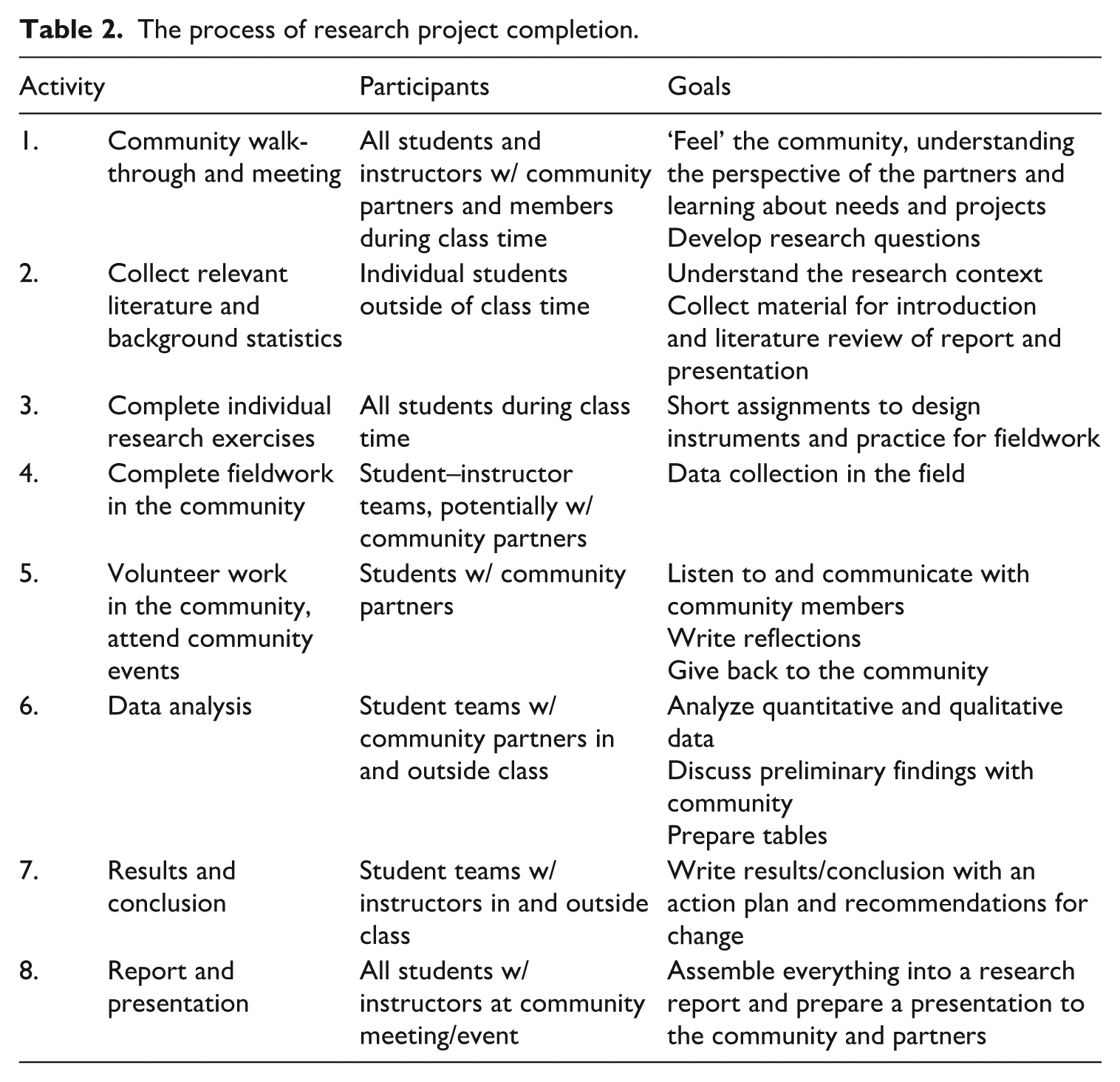
Assessment in this course is challenging because both individual skills and collaborative products are involved. The contributions to various research components leading up to the final presentation and research report earn points as assignments to generate the individual course grades. Thus, the research process is broken down into short individual assignments, which later are modified and combined into a collaborative product from each research team. All team assignments undergo a peer review process to refine and improve them. The process of project completion is shown in Table 2.
The process of research project completion.
Course Analysis: Aims, Research Findings and Lessons Learned
The Pilot Course and Subsequent Iterations
This course was first taught in Spring 2015 and the preparation involved five months of preliminary work by the instructor to select the community, make contacts with community leaders, get involved with the community association and understand needs and priorities. At that time the community garden became the research focus because the garden director was a key contact, who was well connected in the community. Guided by concepts, such as social trust, a sense of community, civic engagement and collective efficacy, research questions about the need for green spaces, the use of the garden by community members and the amount of order (safe spaces) and disorder (problematic spaces) in the community were developed. The methods used that semester included fielding a survey about residents’ perceptions about their community, interviewing key community members about community needs, conducting a windshield survey about order and disorder in public spaces (Harvey et al., 2013) and asset mapping.
During this pilot course, the students, the TA and the instructor were overwhelmed by the amount of work, the time constraints, and the fluidity of the tasks to be completed during the semester. Although the students did very good work, some struggled with key skills and/or lacked the time on weekends and after class to complete the required field time hours. According to blog entries and reflections in class discussions, students enjoyed listening to key informants who provided background about the community. Students also appreciated the asset-based approach rather than the usual deficit mitigation perspective (see archive of student Blog entries here: https://umbcappliedsociology.wordpress.com/2015/). Students’ personal growth was reflected in their shifting perspective about ‘defective’ communities to resilient spaces full of potential. Cultural humility in conversations with residents and ‘being in the spaces’ inspired them to think of solutions as though they lived there rather than from an ‘ivory tower’ position. They also thought learning new skills, such as mapping and interviewing ‘real people’, was exciting. While presenting their results off campus to a ‘real audience’ rather than fellow students was intimidating, they appreciated gaining experience with presenting to public audiences. The class suggested that the community should start a newsletter to share important information and a calendar of events. Right after the semester concluded, the TA and a resident, who also designed the newsletter logo, published the first community newsletter. This project continued until 2019 and involved additional residents.
Based on extensive feedback from students and community partners about the pilot, the course underwent major modifications over the next eight years. Having a TA who has taken the class before was advantageous because she already knew the community and had connections there. Depending on the number of students enrolled in the class, the number of research teams varied from one to three each semester. Over time, the methodologies used became more diverse and refined so that we could update surveys and maps. The research teams in the second course focused on food access, safe spaces and two community organizations. The methods covered were interviews, photo voice, focus groups, spatial analysis of food access and safe spaces, windshield surveys, logic modelling in two community organizations and an asset map update. The students saw the dearth of educational opportunities in the community and organized a field trip for the community youth to the university. This experience was transformational as the students became ‘temporary big brothers/sisters’ for the teens. As they engaged with the youths on campus, the students realized their own privileged position and several decided to meet, sponsor and tutor their young ‘partners’. It is advantageous to work with the students’ background knowledge in terms of topics and methods. For example, one student had an undergraduate degree in geography and was able to teach the class (and the instructor) more advanced spatial analysis skills (ArcGIS), another introduced their photo-voice experience and a third was able to arrange the youth visit through his work connections on campus.
In an effort to build on previous projects, in 2017 we focused on beautification efforts. The students designed a community survey for residents who had received a prize from the neighborhood’s ‘Yard of the Week’ contest. The students went door-to-door and collected 40 questionnaires. These conversations with people at their doors left strong impressions on the students – these human connections taught them about the pride people take in their yards and that they enjoy talking to students about their community. Rather than focusing on the neglect, crime and trash in the streets, the residents attempt to create a small personal retreat. Students also mapped the windshield survey results against the yard winner locations, showing ‘hot spots’ and ‘safe spots’ in the community. Based on those findings and growing concern over crime, in 2019, students walked the neighborhood to supplement official vacant housing data and mapped the complete list of unoccupied housing with 911 calls (emergency) and 311 calls (disturbance). The resulting heat maps were extremely useful to the community, as the correlation between ‘hot spots’ in crime, dumping and vacancies could be documented for police and policy makers to effect changes.
In the next semester, the students designed an online and in-person community survey as well as fielding interviews in English and Spanish to examine community needs and priorities, which was important considering the recent large influx of Spanish-speaking residents. This experience led to another research project, where Spanish-language online surveys demonstrated that during the COVID-19 pandemic, immigrants had very limited access to testing and care in Brooklyn, which resulted in Baltimore City funding for projects seeking to improve health care for Spanish speakers in the neighborhood. In 2022, the class conducted focus groups and interviews with young residents (age 18–23), produced logic models and a literature review for the grant applications of a community youth organization. In addition, the students created a manual on how to use and analyze open access data on crime and vacant properties.
The Most Recent Version of the Course
In 2023, the professor invited an international colleague (second author) to team-teach the course and our collaboration with the Brooklyn community continued. Building on previous semesters and on discussions with community partners, we decided to focus on aging in the community in terms of the living conditions of senior residents, and what challenges exist in Brooklyn that prevent senior citizens from utilizing assets and services. Building on previous semesters and on discussions with community partners, we decided to focus on aging in the community in terms of the living conditions of senior residents, the assets and services older adults use regularly and services that are missing or need improvement,
Together with students and our project partners, we applied a mixed method approach, including an analysis of U.S. Census data (American Community Survey 2017-2021) 5-Year Estimates, 2022), official data from the City of Baltimore, ArcGIS mapping, neighborhood observations and semi-structured qualitative interviews with senior residents. The face-to-face interviews conducted by the graduate students covered perceived living conditions and neighborhood safety, usage of community assets and mobility, reliance on social networks and changes the residents would like to see to make the community more age-friendly. We faced particular challenges in terms of access to potential participants because senior residents were difficult to contact and to involve in our study. Students were shocked to learn about the seniors’ fear of leaving the house, difficulty negotiating unsafe sidewalks, health and food access, and transportation issues. They attempted to engage with elders at community events, at stores, food pantries, the library and churches. This was especially challenging because only four students were enrolled this time. Thus, it was crucial that the two instructors assisted students in the field work. The disciplinary composition of the team – one student was trained in Geography, and the second instructor has a background in the sociology of housing – allowed us to include updated ArcGIS mapping techniques to analyze transportation access, areas respondents avoid due to crime and the distances to key services.
The final report contributes to the limited literature on aging in marginalized neighborhoods, outlines specific suggestions for action to the Brooklyn community partners and provides an outlook for future research (Adler et al., 2023). Our findings indicate that the neighborhood already has numerous assets, but they are underutilized by seniors. Older Brooklyn residents are largely disconnected from the services and events offered within the neighborhood. Reasons for this include a lack of knowledge of opportunities, limited transportation options and a general hesitation to get involved because of crime.
During the public presentation, students and residents discussed how increased awareness of community assets could encourage participation in improvements and even attract new residents. The results suggest that renewal efforts should focus not only on physical conditions and safety but also on increasing trust and social engagement among residents. We highlighted that greening projects could help the community leverage its own abilities to improve the neighborhood’s appearance and strengthen social ties. Following the semester, students learned that their research had tangible impacts: the report was utilized in grant applications by a community association, which subsequently received significant funding to enhance various aspects of community safety, beautification and transportation.
Lesson Learned and Recommendations
Teaching a CBPR course presents a range of logistical and pedagogical challenges, including the background of students, time management, fieldwork coordination and the dissemination of findings. With respect to teaching logistics, we recommend reducing the number of hours spent in the community to balance in-class discussion, preparatory work for data collection, data analysis and report writing. In addition, seasonal factors such as weather conditions and academic calendars should be considered when planning community-engagement activities. Offering the course in Spring semester was difficult because the often-inclement winter weather in Baltimore disrupts the initial community walk-through, attending outside community events and community observations. In addition, student research was limited by the time constraints of the semester. Once students design their projects, receive IRB approval and practice their methodology(ies), they have only a few weeks to collect and analyze data, and write up the findings (see also Fontaine, 2006). Visiting the community and organizations earlier in the semester and starting data collection sooner is beneficial. In-person class meetings can focus on conceptual and methodological learning, while online meetings could be dedicated to guest speakers, discussing progress on fieldwork and next steps for individual/group student projects. The courses were held in the evenings for 2.5 hours, once a week. Meeting twice a week for half the time or splitting credits, to allocate some to fieldwork in the community may be helpful.
Equally critical is the number of students enrolled in the course in terms of supervision capacity and the feasibility of conducting meaningful research. Having small teams of two to three students appears to work well, as does having narrower project options for team projects. Thus, the instructor has to negotiate a few projects with community members in advance. Overall, more instruction on fewer methods and small, synchronized assignments leading to a combined presentation work well once the students understand the process. The enrollment of students with different skill levels (i.e. first year and advanced MA students) can pose problems. The clear gap in experience can lead to conflicts and hinder the team building aspects of the course. We recommend offering this course to social science graduate students who have completed their core courses. However, having students with experience in different types of skills (methodologies) appears to be an advantage (see also Korsching and Peter, 2007).
Drawing on our experience, the following list – though not exhaustive – offers some insights for planning and highlights key skills students have gained:
Applying theoretical knowledge to real-world situations and community settings.
Engaging in action-oriented research, including the (co-)design, implementation and dissemination of research aimed at addressing concrete social issues.
Expanding competencies in research methods and fieldwork, including hands-on experience.
Adapting research processes to evolving conditions and the specific needs and capacities of community partners.
Developing time management skills in response to the constraints of a tightly structured academic semester.
Enhancing communication skills, tailored to different target groups.
Establishing and sustaining collaborations with communities from diverse social contexts.
Gaining new perspectives through direct community involvement, grounding abstract sociological concepts in lived experience.
Student feedback stated that the best part of the class was being in the community and gaining experience interacting with ‘real people’. It is also important for students to realize that they are learning not only research skills, but ‘soft skills’ such as empathy, cultural humility and a deeper understanding of life in places outside their own comfort zone. Students appreciated learning to work independently and in teams on a strict time schedule for this class. The sometimes rather sudden changes in scheduling due to new circumstances were cause of anxiety, so building as much structure into the course as possible is necessary. Course aspects that students mentioned as the most useful for their academic programs and for professional development were related to the various methods and analytic strategies they learned and had to apply to their research projects. The methods of data presentation (logic models, posters, maps, tables, etc.) were also noted as useful broadly applicable skills and techniques. While students noted the challenges and time involved in creating an academic research poster, they were happy to have this product and noted it as one of the most useful skills to have learned in the class.
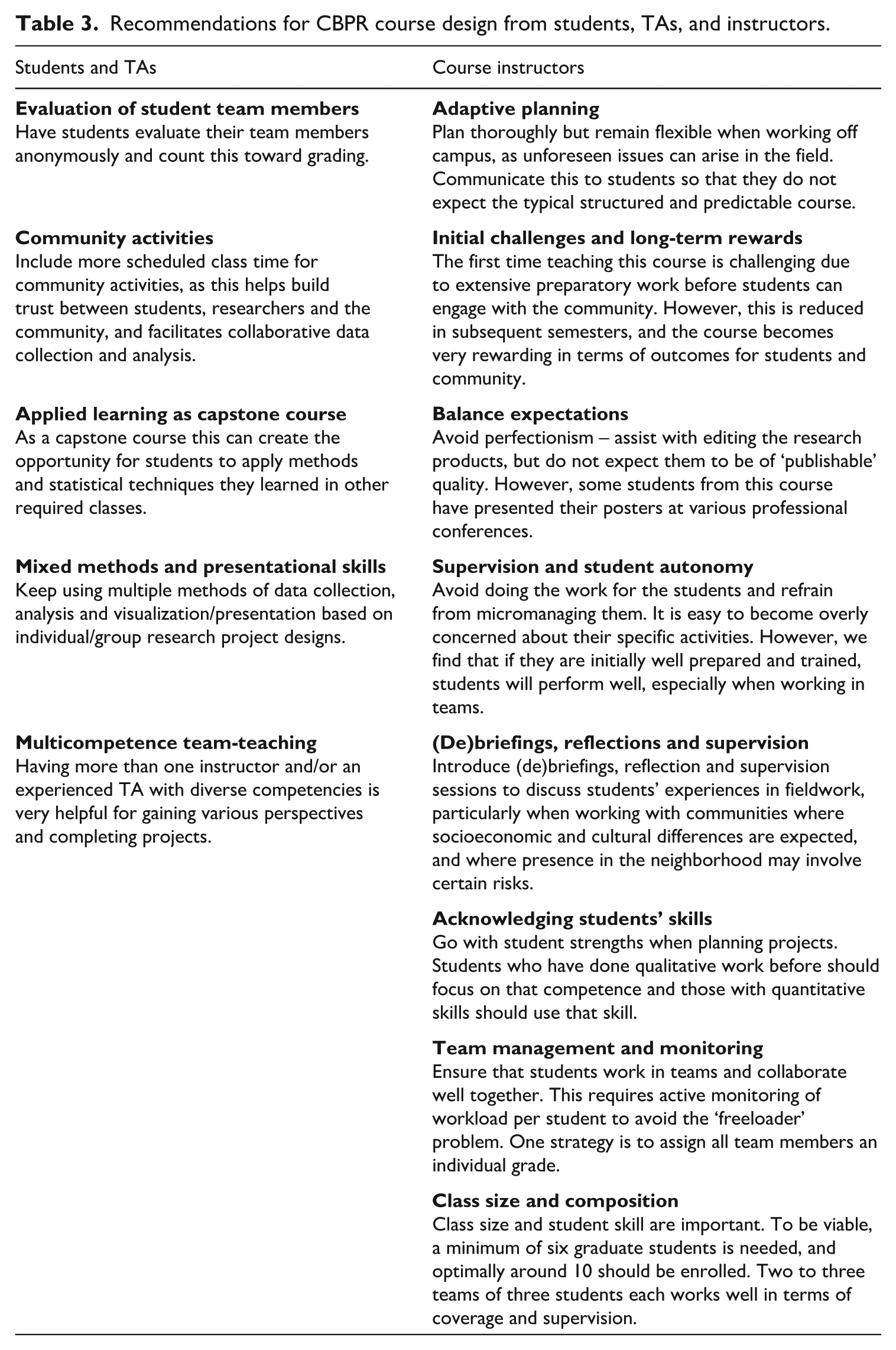
Joint reflections on the course experiences are essential for deepening learning and fostering critical engagement (Ciabattari et al., 2018) and should be an integral part of this type of course. During one semester students had to make blog entries, which was quite instructive, but in the end was draining on their already tight time schedule. As is the case with most team projects, some students are left with the burden of trying to engage and motivate their peers to contribute and finish their portion of the work. This dynamic is not always obvious to instructors, and it may be useful to have students formally evaluate each other and to make students aware that peer evaluations will be considered in assigning individual grades. Korsching and Peter (2007) asked students to assign letter grades to themselves and all other students anonymously at the end of the semester based on everyone’s contributions. Table 3 presents the recommendations by students, TAs and instructors.
Recommendations for CBPR course design from students, TAs, and instructors.
Conclusion
This article presented a model and pedagogy for a community-based participatory research (CBPR) course designed to equip sociology graduate students with the skills to apply academic knowledge in practical settings and translate their sociological imagination into meaningful work after graduation. Drawing on existing literature on sociological pedagogy and CBPR, we described the strategies used and modified in several iterations of teaching a graduate course in South Baltimore, MD. This course model requires extensive preparatory work, including sustained community engagement and the establishment of trust-based community connections to identify research priorities and to yield potential research participants. The fieldwork component demands a significantly higher time commitment for students compared with conventional graduate courses. Student evaluations highlighted the dual nature of the experience: intellectually demanding yet deeply rewarding. They underscored the value of working in the field with community members and gaining confidence in applying their research skills. Through direct interactions with community partners, students not only extended their research competencies but also developed a nuanced understanding of cultural humility and social inequality (Muhammad et al., 2015).
Community partners expressed strong appreciation for the students’ volunteering and researching in the community. The outputs of the course, such as the final reports, community newsletters and training manuals, served multiple functions: support community development initiatives including grant writing, strengthening community agency and improving communication networks, and empowering their own research capacities through freely accessible software and data. The course outcomes also expand students’ academic and professional skills by providing them with materials for conference presentations and primary data for analytic and thesis papers. The students’ personal growth during a CBPR course is difficult to measure; however, the reflections on their experiences in a marginalized community show that they have a deeper understanding of the meaning of inequality. Consequently, the CBPR course represents more than a pedagogical innovation – it is also a transformative space where academic learning intersects with civic engagement.
Footnotes
Acknowledgements
We thank the graduate students, community partners and residents, and especially Tess Hines, who competently assisted with the class and previous presentations about our teaching experiences.
Funding
The authors disclosed receipt of the following financial support for the research, authorship and/or publication of this article: Tino Schlinzig’s contribution to this research was supported by the Swiss National Science Foundation (SNSF) under Grant Number 215410.
Ethics Statement
The courses and their research projects discussed were approved by the IRB of UMBC.
