




Abstract
This research note critically examines the concept of ‘self-made’ wealth, drawing on data from the Forbes 400 rich list (2014–2023). The ‘self-made’ narrative, we argue, obscures structural factors that shape wealth accumulation and serves meritocratic discourses that justify wealth inequality. Our empirical analysis reveals that men are disproportionately labelled as self-made, while women are more frequently labelled as heirs. We argue that this reflects a persistent gender ideology that fails to recognize women’s contributions to wealth creation. We propose using new categories like ‘dynastic’ and ‘non-dynastic’ to shift the focus to family-based wealth dynamics; we also compare how men and women on the Forbes 400 rich list from 2023 would be labelled using those terms. Additionally, we highlight the usefulness of non-binary concepts like upward mobility or the big jump. Such reconceptualization, we argue, offers a more nuanced understanding of the formation of the wealth elite.
Introduction
There is a recent trend of quantitatively analysing large-scale public datasets related to elites, such as rich lists (Lu et al., 2021; Tisch and Ischinsky, 2023; Worth and Reeves, 2024). Such lists often provide information about the origin of fortunes and classify people as either heirs or self-made billionaires. The most common definitions of being self-made include being ‘the founders of their business’ (Scheuer and Slemrod, 2020: 191) or having ‘built it [the fortune] (more or less) from scratch’ (Korom et al., 2017: 81). Researchers have used these distinctions between self-made and heir to explore questions about wealth persistence, social mobility and elite reproduction (Baselgia and Martínez, 2024; Ischinsky and Tisch, 2023; Korom et al., 2017; Scheuer and Slemrod, 2020).
Using rich lists as data sources has many methodological advantages. It does not require active participation by elites, thus sidestepping ethical questions around control and the imbalance of power between researcher and participant that can characterize this kind of research (Ellersgaard et al., 2022; Lillie and Ayling, 2021). By relying on publicly available information, it also does not risk legal action against the researcher (see Gaztambide-Fernández, 2015). And with large sample sizes, it can unpack broader trends about wealth and the wealthy over time (Reeves and Friedman, 2024).
However, the datasets and their labels are also themselves of sociological significance. Goffman’s (1974) ‘frame analysis’, for instance, suggests that such labels act as frames that can shape both self-identity and public discourses. Those discourses, we argue in the following section, legitimize and even reinforce economic inequality. Moreover, as we also argue, the script of being ‘self-made’ reinforces the gendered nature of wealth inequality. Using these labels in sociological work, then, also implicates us researchers in those discourses.
This research note contributes to the literature on wealth in two ways. First, it connects the ‘self-made’ label to the sustainment of gendered inequalities of wealth, bringing a feminist lens to the discussion. Second, it calls for change. We put forward alternatives for conceptualizing and analysing wealth accumulation that take gendered dynamics into account. We hope that our proposals open a long-overdue conversation about academic practices in the study of wealth, their consequences and possibilities for their rupture.
Meritocracy, Gender and ‘Self-Made’ Wealth
In the US context, which the Forbes 400 list captures, meritocratic discourses of having ‘earned’ one’s wealth imply that an individual deserves that wealth (Gaztambide-Fernández, 2009; Ho, 2009; Khan, 2011). 1 In other words, it makes ‘differences in outcomes appear a product of who people are rather than a product of the conditions of their making’ (Khan, 2016: 185). This connects to the cultural narrative of the ‘American dream’, often referring to the attainment of success and upward social mobility through hard work and ambition. However, it has been shown that US Americans overestimate class mobility (Kraus and Tan, 2015). In fact, social class in the USA is rather immobile, being directly connected to one’s grandfather’s social position (Hertel and Groh-Samberg, 2014).
High earners in the USA seem somewhat aware that meritocracy is, indeed, a myth. Roth (2011: 182) found that 29% of the Wall Street workers in her study did not believe that their workplace was meritocratic. Still, meritocratic norms in the country lead the rich to weave stories around ‘earning’ their wealth, despite often having benefited from their parents’ wealth when making their own, because these stories are culturally preferred (Sherman, 2017).
The wealthy’s claims on meritocratic narratives can be theorized as claims on legitimacy. One part of that legitimacy is moral legitimacy – Sherman (2017), for example, shows that wealthy New Yorkers downplay their wealth in order to be seen as good people (see also Reeves and Friedman, 2024). Another part is legitimacy of economic inequality itself, because wealth is framed as being distributed according to hard work (Andersen et al., 2021; Son Hing et al., 2019). In fact, research has linked meritocratic ideologies to the normalization and even acceptance of economic inequality (Mijs, 2021; Otero and Mendoza, 2024). Meritocratic narratives thus shield the wealthy from social criticism, thereby protecting their position at the top of the economic hierarchy (see also Littler, 2018). Such narratives also appear to keep those at the bottom, at the bottom. Having strong meritocratic beliefs appears to negatively affect the life outcomes of those from low socio-economic backgrounds in Germany – arguably because they became discouraged by the structural barriers that prevented meritocratic-based futures (García-Sierra, 2023). In other words, meritocratic narratives can be clearly linked to the perpetuation of wealth inequality.
Meritocratic narratives’ legitimation of wealth and the wealthy also has a gendered dimension to it. Indeed, inheritance has been shown to be the primary path for women globally to become superrich (Ischinsky and Tisch, 2023; Keister et al., 2021). One reason is social gender norms. In heterosexual couples in the USA, for example, a husband’s career is likely to be prioritized over his wife’s, particularly when there are children involved (Sherman, 2017). 2 Another reason is gendered barriers to making big money in the USA. These include gender discrimination in recruitment processes to top corporate positions and in performance-based pay on Wall Street (Rivera and Tilcsik, 2016; Roth, 2011) and closed men’s networks of so-called angel investors (Brush et al., 2002).
There are (at least) two important consequences of the seemingly objective labels of ‘heir’ and ‘self-made’ being, in fact, gendered. The first relates to the notion that gender roles are learned. 3 As such, the labelling of men as ‘self-made’ and women as ‘heirs’ teaches individuals, often implicitly, that making money is something for men and inheriting it is something for women. This lesson has been directly connected to women’s employment rates and professional ambitions, which shape both the wage gap and the wealth gap within heterosexual couples (Fortin, 2005; Grabka et al., 2015). In other words, such labelling can become a self-fulfilling prophecy that keeps women dependent on men for economic wealth (Yavorsky et al., 2019).
The second consequence of the labels of ‘heir’ and ‘self-made’ being gendered is that such labelling offers a cultural legitimation of ‘men’s work’ (money-making), while denying this recognition to women who, through unpaid household labour, child care and activities like organizing social events and charity work, play a critical role in building and sustaining the fortunes of wealthy families. 4 Thus, women’s unpaid work not only can facilitate a partner’s ability to focus on their career but also may contribute to the durability and even growth of a fortune through managing the formal and informal education of children (heirs) and cultivating socially and economically valuable networks (Ostrander, 1984; Sherman, 2017). As a result, as Sherman (2017) discusses, women remain dependent on men not just for money but also for social legitimacy.
These issues come to the fore in the dissolution of a marriage. When dividing assets in a divorce, the unpaid labour of women in France and Germany goes unaccounted for by husbands, lawyers and the courts, leaving women economically worse off than men (Bessière and Gollac, 2023; Kapelle and Baxter, 2021). An American example here is the story of MacKenzie Scott and Jeff Bezos, explored in depth in the first chapter of The Gender of Capital (Bessière and Gollac, 2023). Despite jointly developing Amazon with Bezos and putting off her ambitions to be a writer (with a degree in English from Princeton University) to raise four children and support his career, Scott handed over control of 75% of the company’s stock plus voting control of her shares in their divorce.
The label of ‘self-made’ thus not only seems to serve the rich by justifying immense wealth and wealth inequality, but also appears to reinforce the gendered nature of that inequality. And yet, the media, which arguably both shapes and reflects the public consciousness, seems to like framing immense wealth as meritocratically ‘earned’. Looking into the social backgrounds of individuals in the top 20% of the British Sunday Times Rich List, for example, Schimpfössl and Monteath (2022) found that 81% of the Brits in their sample were born into nobility or dynastic business families, and/or educated at famous schools. This offers a rather different picture from the newspaper’s claim that 94% of the listed individuals were ‘self-made’.
Data and Methods
Our dataset is based on the Forbes 400, a yearly published list of the 400 wealthiest US Americans. To put this annual list together, Forbes ranks individuals according to their estimated assets, including company shares, art collections and real estate holdings. For the purposes of this article, we investigated individuals ranked on the list between 2014 and 2023. We start in 2014 because that is when Forbes introduced a scale from 1 to 10 to describe the extent to which someone on the list was ‘self-made’. 5
There are 633 6 individuals in our sample. Using information provided by Forbes, we identified each individual as female or male (female = 1, male = 0; no other gender categories were given by the magazine). We also identified birthyears and assigned them to one of three birth cohorts (born before 1940; born 1940–1960; born after 1960). Finally, and most significantly for this article, we indicated whether the individual was categorized by Forbes as ‘self-made’ or an ‘heir’. We used two measures. The first is a binary measure taking the value 1 if the person was classified as self-made and 0 otherwise. The second measure is a score between 1 and 10. According to the Forbes website, a score of 1–5 means an individual mostly inherited their wealth; 6–10 means they mostly built their own wealth. 7 Still, a score of 7, for example, indicates ‘self-made who got a head start from wealthy parents and moneyed background’ – a description that already highlights a major shortcoming in the meaning of the scale. For Forbes, coming from money does not exclude someone from also being categorized as ‘self-made’.
Who Is Labelled ‘Self-Made’?
Table 1 offers insights into Forbes’s self-made classification by gender and cohort. In our total of 633 individuals, there were 90 women and 543 men. Of the men, 77% were classified as self-made, compared with only 19% of the women. Examining the sample by birth cohort shows that younger cohorts are more often classified as self-made: 77% of those born after 1960 are ‘self-made’, whereas only 62% of those born before 1940 are. The increasing role of technology and finance in creating huge fortunes (Korom et al., 2017) may contribute to an increasing share of self-made labels among younger cohorts.
Descriptive statistics of the sample.
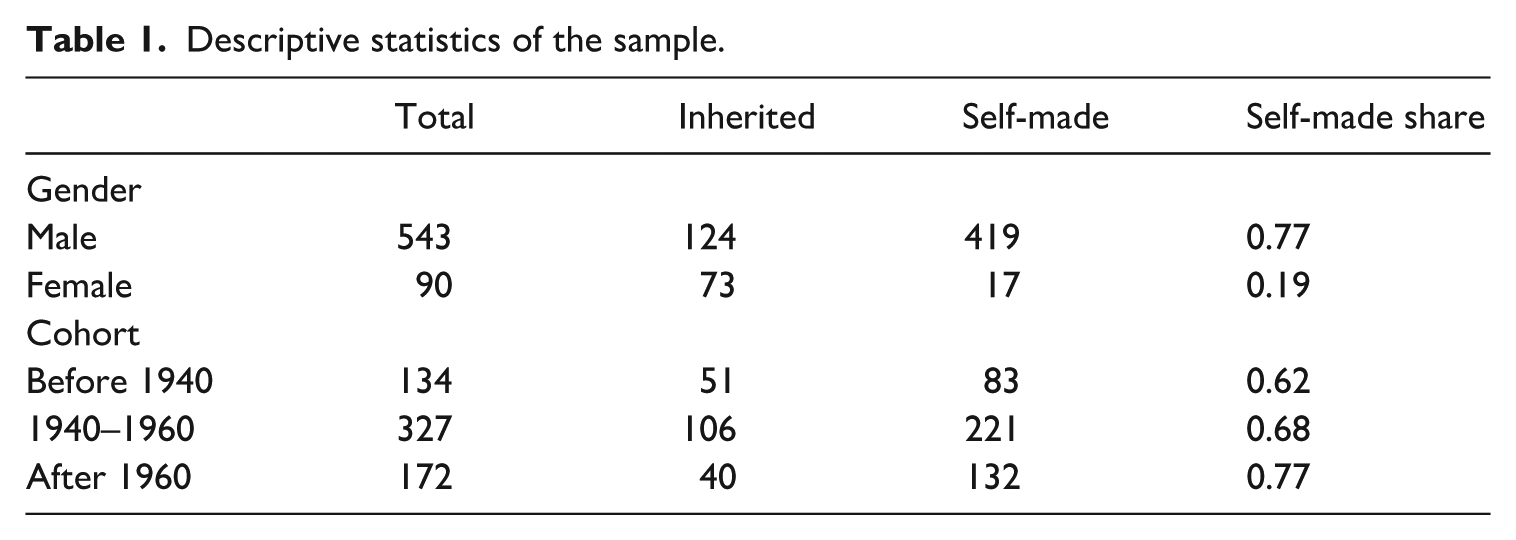
Figure 1 compares Forbes’s binary measure with its 10-rank measure of self-made status by gender. The figure shows that compared with the richest men, the richest women in the USA are more often labelled as heirs who are not working to increase their fortunes. In contrast, the highest self-made score (‘self-made, grew up poor, overcame obstacles’) seems almost exclusively applied to men.
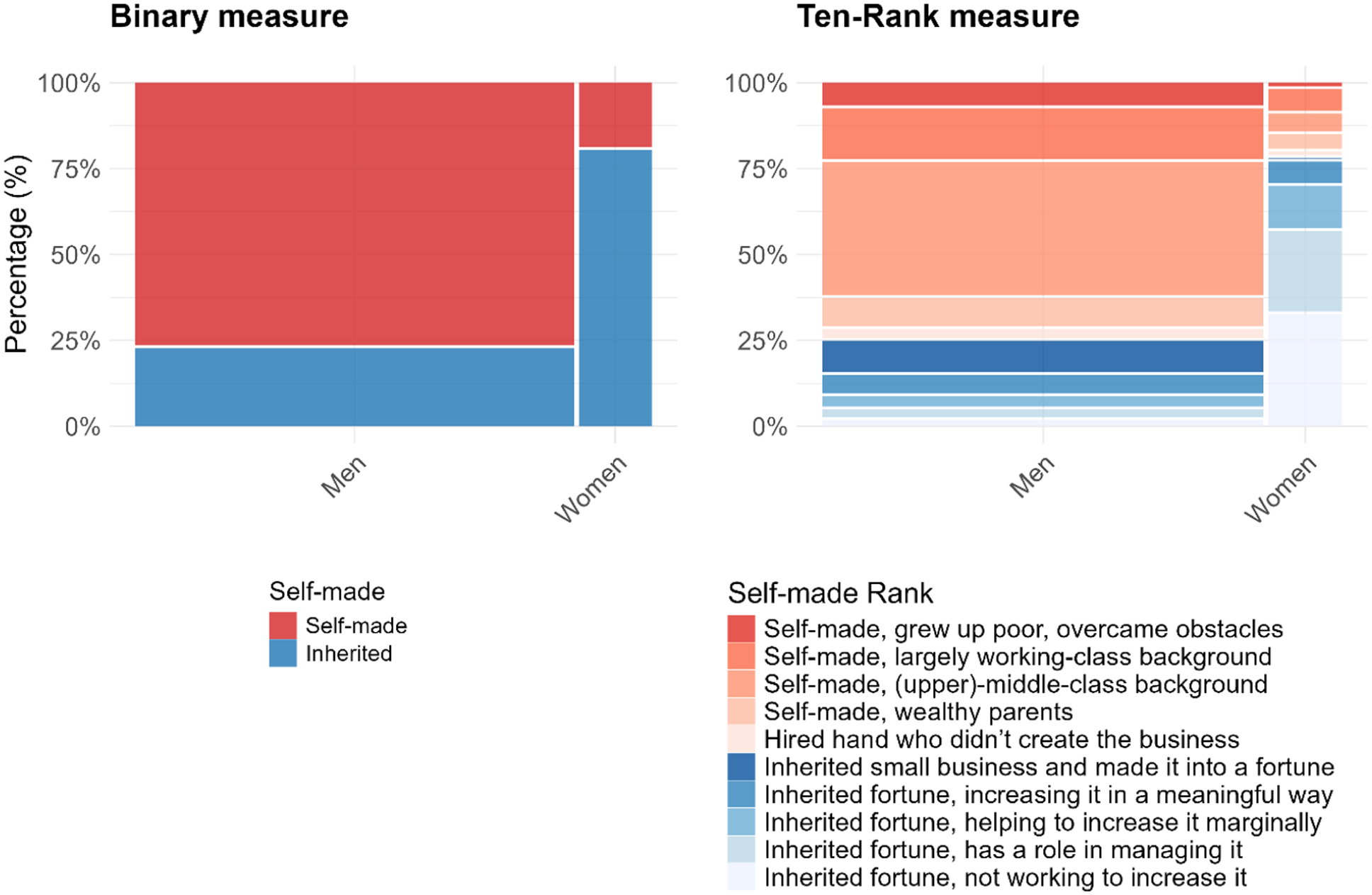
Different measures of self-made status and gender.
However, keeping in mind the gendered factors that influence wealth accumulation, discussed above, we should have expected two things: (1) fewer women judged to be inheritors who are not increasing their fortune; and (2) more women judged to be self-made by overcoming obstacles. Forbes’s current labelling scheme, then, clearly does not count unpaid labour such as planning family events, managing children’s education, supporting business operations, strategic planning or creating philanthropic ventures as contributing to growing wealth nor does it consider the numerous obstacles that high-earning women have overcome both in society and on the labour market, previously discussed.
That gendered structural advantages cannot be captured by labelling becomes even more apparent when scrutinizing the ‘self-made’ classification by birth cohort. Figure 2 shows that for men, the share of individuals labelled as self-made increases over time, while for women, this share decreases. The more detailed self-made score in Figure 3 further shows that consistently over time, more women’s scores than men’s scores have been in the lower thresholds of ‘self-made’ and ‘heir’, while more men’s scores than women’s scores have been in the higher thresholds. This means that Forbes has consistently attributed women’s accomplishments more to others than to themselves, and men’s accomplishments more to themselves than to others. In other words, the gendered dynamics of wealth creation have been oversimplified in the data.
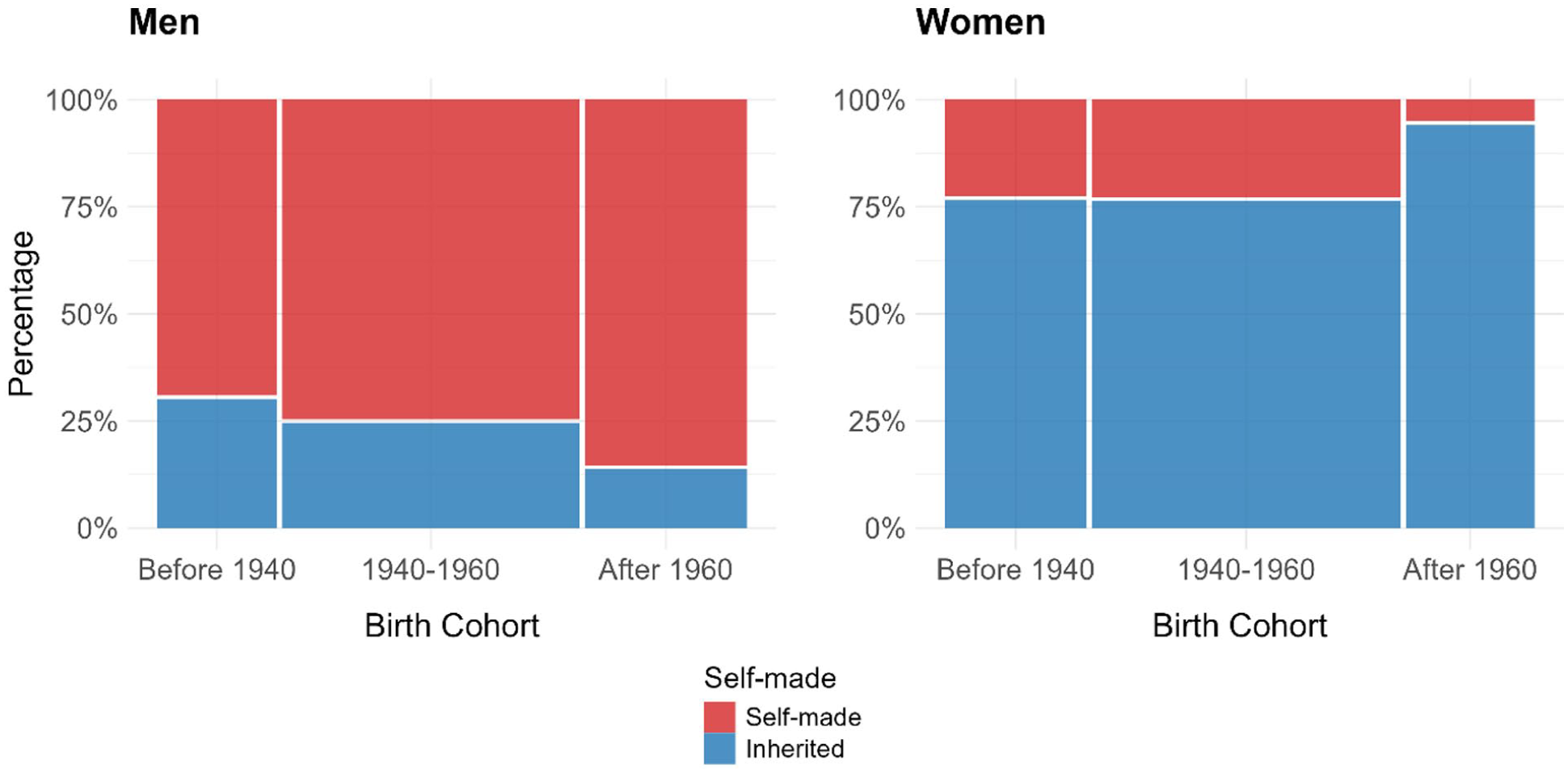
Binary self-made status, gender and birth cohort.
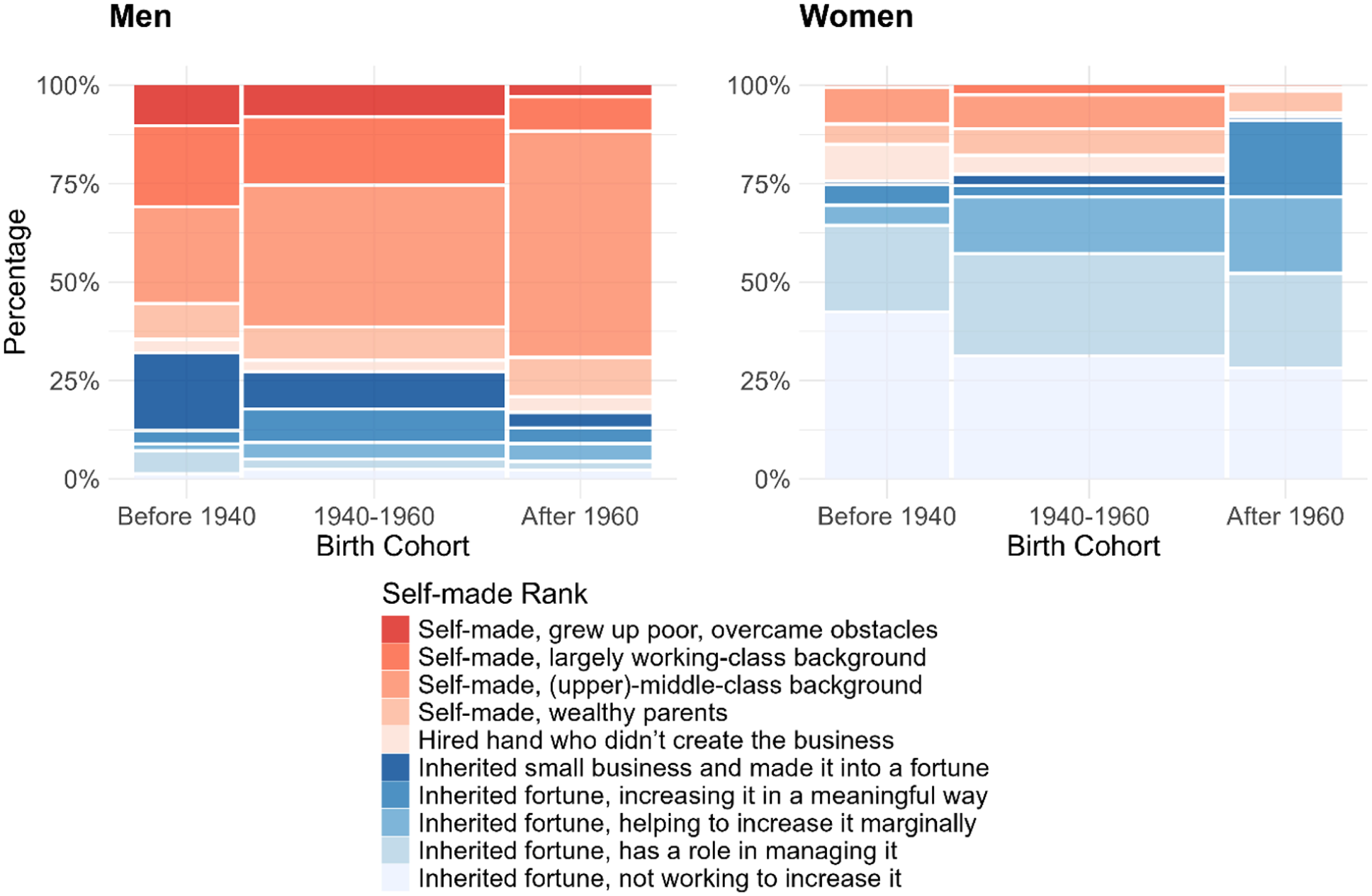
Ten-rank self-made status, gender and birth cohort.
Alternatives
This research note highlights the problematic nature of the self-made label, which may serve meritocratic discourses that legitimize wealth inequalities and, moreover, reinforce the gendered nature of those inequalities. Goffman’s (1974) ‘frame analysis’ suggests that such labels can shape not only self-identity but also public discourses, making them sociologically significant. As such, we strongly feel that we researchers need a new vocabulary and new concepts to delineate between different paths to extreme wealth.
In terms of vocabulary, we understand the value of having binary descriptors when it comes to doing quantitative analyses. Binary variables are often necessary in quantitative research to simplify complex social phenomena into analytically tractable categories, enabling clearer comparisons and statistical modelling. However, it is imperative that these binary descriptors are not merely reductive but instead thoughtfully constructed to capture underlying structural advantages, thereby facilitating a more nuanced and rigorous analysis of extreme wealth.
We propose the reframing of ‘heir’ and ‘self-made’ as ‘dynastic’ and ‘non-dynastic’. The spirit of the former set of labels captures a difference between old wealth that has been passed down and new wealth that has been created. Referring to wealth as ‘dynastic’ or ‘non-dynastic’ does the same, while shifting the unit of analysis from the individual to the family. It also recognizes the importance of accumulation processes over time for the superrich (Bourdieu, 1986; Savage and Nichols, 2018).
To evidence the usefulness of the dynastic/non-dynastic labelling, we generated a variable indicating if a fortune is dynastic based on the Forbes 400 list from 2023. We define fortunes as dynastic if at least one parent or another ancestor appeared on an earlier Forbes 400 list. To do this, we combined the Forbes 400 list from 2023 with earlier Forbes 400 lists (1982–2023). If an individual’s parents died before 1982, we manually checked if the person’s parents appeared on an earlier Forbes list. Figure 4 shows that among women, the proportion holding dynastic fortunes is smaller than the proportion of heirs. A similar pattern is observed for men, though the discrepancy is less pronounced resulting in smaller gender differences. Thus, how we operationalize the origin of a fortune (dynastic or ‘self-made’ versus heir) matters for the interpretation of the persistence of wealth.
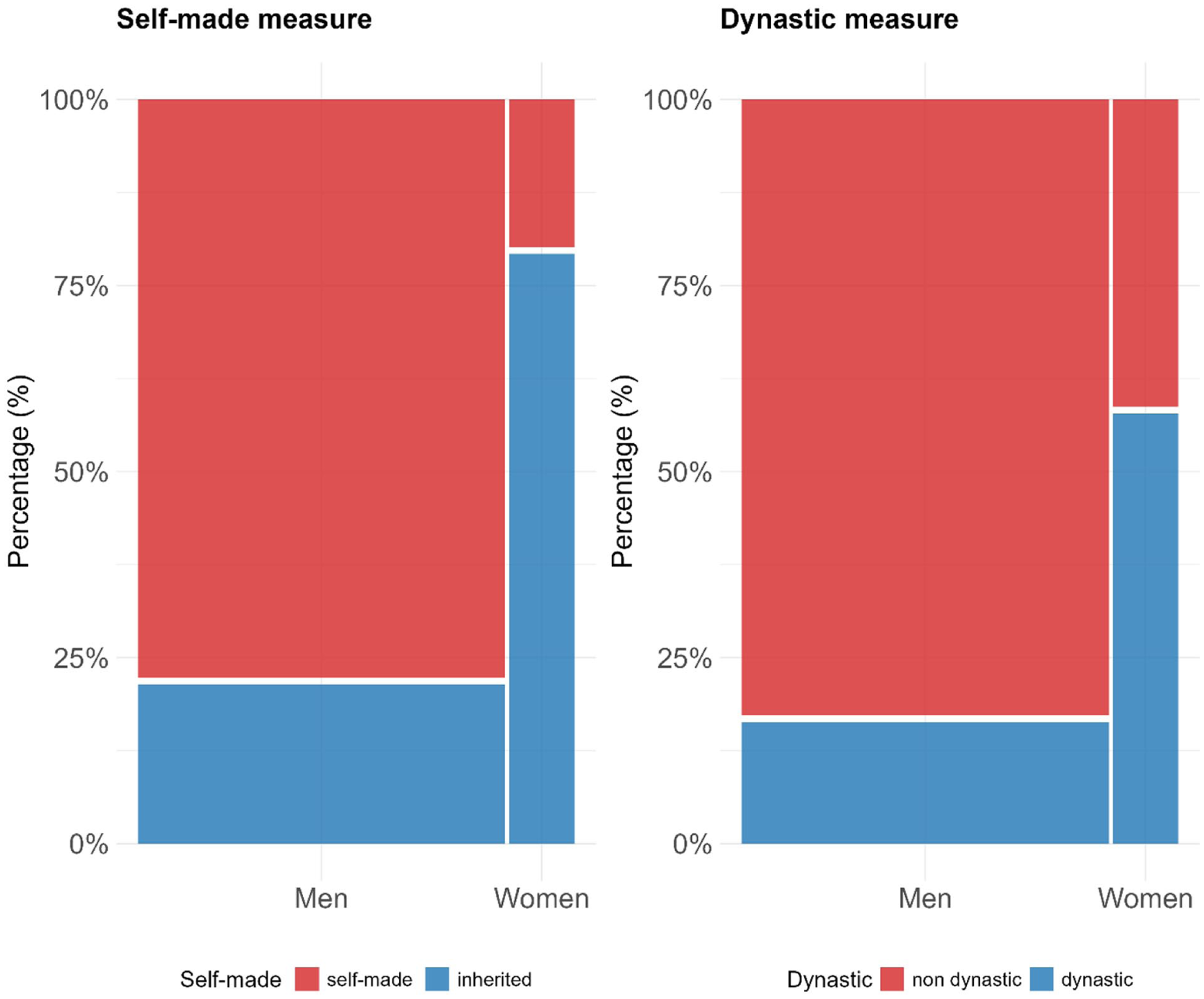
Comparison between self-made and dynastic measure, Forbes 400 from 2023.
We acknowledge that there are a few difficulties with this approach. One is the potential need to trace a family web to find dynastic origins of wealth (i.e. wealth that was moved from, say, an uncle to his nephew as a loan or direct investment in an entrepreneurial venture) and both the logistical difficulty with and time needed to successfully do that (see O’Brien, 2024). Another difficulty is that in the case of using rich lists like Forbes, one would need to re-code the labels of ‘heir’ and ‘self-made’. This adds an extra step to data preparation – and a time-consuming one at that, which is why we only did it for the 2023 list. However, given that researchers can publish data sets for others to reuse, as we have now done, the effort would be recognized and valued. 8
Another possibility is to back away from labels altogether and deploy concepts that more accurately capture the complexities of wealth accumulation. One example is upward mobility – which considers factors that play critical roles in facilitating wealth accumulation, such as educational credentials, family background and social networks (see Maxwell and Lillie, 2024). However, attribution of an upward trajectory would, as much as possible, have to be independently verified rather than rely on the ‘origin stories’ that might understate one’s privileged background (Friedman et al., 2021; Reeves and Friedman, 2024).
Another example is the big jump – significant inflection points when fortunes grow exponentially. This concept, discussed in C Wright Mills’s The Power Elite (1956), highlights the broader systems, policies and market dynamics that enable wealth accumulation (see Toft and Hansen, 2022). Focusing on ‘big jumps’ allows for sensitivity to the hidden advantages and structural conditions – such as favourable tax policies, inheritance laws and industry-specific booms – that disproportionately benefit certain groups, particularly men, while limiting access for others, such as women and minorities (Tisch and Schechtl, 2024).
A shift in focus from individual narratives of success to structural mechanisms of wealth accumulation is, we feel, overdue. Such a shift could provide a more comprehensive and useful framework for analysing the formation of the wealth elite, in its sensitivity not only to gender but also to other factors like race. This kind of shift might then help us challenge the meritocratic narratives that too-often obscure (gendered) sources of wealth and power. It might also be a more effective way to push for change among the rich themselves. As Sherman (2017) points out, moving the focus of critiques away from individuals and towards systems – or, as per our suggestions, towards family structures – makes it easier for those individuals to accept and consider that critique. In other words, such a shift in focus may also have a positive impact on broader social justice goals.
Footnotes
Acknowledgements
We would like to thank Charlotte de Alwis for her excellent work as a student assistant, helping to prepare the dataset. We would also like to thank Claire Maxwell, Isabell Stamm and our anonymous reviewers for their comments on our article.
Funding
The authors disclosed receipt of the following financial support for the research, authorship and/or publication of this article: funding support for this article was provided by the Deutsche Forschungsgemeinschaft (BE 2053/11-1).
