




Abstract
Based on interviews with waste management workers, this study focuses on changes in low-paid/low-status workers’ experiences of recognition during and after the pandemic. In this article, we explore these developments, drawing on the work of Honneth, Fraser, Neckel and Reckwitz. Our analysis challenges the rather romanticised treatment of recognition that persists in existing research on dirty work. In particular, though the pandemic heightened societal awareness of the value of essential services, we found that these emancipatory moments were short lived, as status hierarchies remained largely unchallenged. Instead, workers’ experiences during the pandemic suggest a growing sense of status fixity and polarisation which, following Neckel and Reckwitz, reflect a broader sharpening in economic and cultural inequality.
Introduction
The Covid-19 pandemic created a space for renewed thinking about our collective reliance on often ‘invisible’, low-status ‘key workers’ essential to societal functioning (Press, 2022). In this article, we report on research focusing on key workers involved in street cleaning, refuse collection and grounds maintenance in London and the South East. This ‘dirty’ work is carried out by groups who are often less well-regarded and whose identities are regularly devalued (Ashforth and Kreiner, 2014; Deery et al., 2019). However, during the 2020 Covid lockdowns, grassroots social media fuelled public displays of support for these and other lower-paid/lower-status workers, such as ‘clapping for key workers’, because they were seen as ‘bearing the brunt’ of the pandemic in order to keep ‘the country running’ (e.g. Younge, 2020). In highlighting our collective dependence on key workers, the pandemic era was said to challenge pre-existing negative status designation (De Vries et al., 2021). In this article, we were interested in the following research question: what effect, if any, did the pandemic have on the occupational status and recognition of those involved in essential services? In pursuing this question, we were also concerned with a broader issue: how the current ‘status order’ might play out in workers’ struggle for recognition.
Conceptually, crisis introduces opportunities for scholars to challenge the coordinates of existing debates (Dinerstein et al., 2014). Thus, the pandemic opened up ways for us to question established frameworks within which sociological debates on recognition had been conducted, and to reflect on whether current approaches and understanding maintain their relevance and emancipatory potential. Empirically, rapid societal-level changes associated with work and employment during the pandemic offered a rare chance to delve into the everyday reality, hardship, fears and hopes of those who, prior to the pandemic, found themselves sidelined and largely invisible to the public.
To examine how recognition could be awarded or refused, we draw on a debate between Fraser and Honneth (2003). Their divergent perspectives in the co-authored book Redistribution or Recognition?: A Political–Philosophical Exchange, exposed a need to give more thought to the shift from redistribution to recognition, and to examine ‘which of the theoretical languages linked to the respective terms is better suited to consistently reconstructing and normatively justifying present-day political demands within the framework of a critical theory of society’ (Fraser and Honneth, 2003: 112, 113).
For Honneth, the concept of recognition holds exclusive sway, it is a unified framework that simultaneously reflects and normatively justifies present-day political demands (Fraser and Honneth, 2003). Honneth’s central assumption is that humans need recognition to form intact identities. Thus, Honneth’s theory prioritises relations within the self, focusing on the emancipatory processes and conditions needed for self-realisation. In contrast, Fraser warns us against the dangers of this monistic treatment of recognition and proposes a differentiated account of recognition. With her focus on a status model, she stresses how the existing ‘status order’ might interfere with parity of participation and, consequently, different social groups’ chances for success in struggles for recognition. In referring to parity and disparity, Fraser considers the extent to which different groups have equal access to symbolic and economic resources. For instance, Fraser notes how attaining parity in the struggle for recognition can be weakened by poor or deteriorating economic and material conditions. Fraser’s sense of the parity also denotes the way that different groups are sociopolitically portrayed, such as when a negative rendering of a social or occupational group contributes to their relatively inferior social status. Parity could also be disrupted by a ‘misframing’ of ‘who is included and who is excluded from the circle of those entitled to a just distribution and reciprocal recognition’ (Fraser, 2007: 325).
Though the work of both Honneth and Fraser are directly relevant to our study, their analysis nevertheless failed to fully capture significant aspects of our respondents’ experience. In consequence, to broaden our theoretical analysis, we supplemented our reference to Honneth and Fraser through attention to the recent work of the German sociologists Neckel (2020) and Reckwitz (2021). Between them, these four scholars present differing interpretations of the feasibility of constructive change. For Honneth (2024), the existing social arrangements and associated normative objectives, although failing in many ways, still possess emancipatory potential. Fraser (2022) is more pessimistic, especially in relation to collective capacities for public action, though she entertains the thought that history is punctuated by moments in which people overcome these collective action problems. However, Reckwitz and Neckel cast doubt on any long-term emancipatory potential of the current era. From Neckel’s theoretical perspective, Fraser’s ‘status order’ amounts to ‘status fatalism’ because those in low-status positions can often feel that their destiny is ‘fixed’, with little chance of improvement (Neckel, 2020: 479). As Reckwitz (2021) also comments, this ‘status fixity’ leads to a growing sense of social division, accompanied by ‘disparate self-perceptions, life opportunities, and feelings toward life’ (p. 68).
In this article, we work across all four theoretical propositions in order to study key workers involved in waste management. These jobs are commonly described as economically undervalued (Hatton, 2017) and ‘invisible’ (Rabelo and Mahalingam, 2019). Many of those working in waste collection undergo multiple forms of devaluation and stigmatisation due to the physical proximity of their work to ‘dirt’ (Deery et al., 2019), the low level of competence and the absence of formal training (Hennekam et al., 2020), as well as limits on their upward mobility (Léné, 2019).
In addition, participants in our study were affected by the diminishing status of public sector workers (HoSang and Lowndes, 2016) and a growing ‘anti-public sector bias in the media’ (Willems, 2020: 807), mirrored in sociocultural norms that portray public sector workers as lacking in initiative and ambition, and less hardworking, efficient or competent than those in the private sector (HoSang and Lowndes, 2016). Together, these task-related, skill-related, class-related and sector-related forms of devaluation can be mutually reinforcing (Hatton, 2017), presenting a collective obstacle in struggles for recognition.
In what follows, we firstly outline Honneth’s argument that a sense of stigmatisation and marginalisation of those involved in dirty work may be at least partly offset by confirmations of their societal relevance. Yet drawing on Fraser, we question this argument because it is not easy for those involved in dirty work to dismantle existing status hierarchies. Finally, we develop our analysis by drawing on Neckel (2020) and Reckwitz’s (2021) emphasis on social status ‘fixity’ and ‘polarisation’, developments that may further impede participants’ chances in the struggle for recognition.
Recognition and Dirty Work
Recognition theory, especially that of Honneth, underscores the relational nature of dignity, respect and esteem at work (Hill, 2001) as ‘the reproduction of social life is governed by the imperative of social recognition’ (Honneth, 1995: 92). Honneth’s theorising commences with the assumption that the development of self-confidence, self-respect and self-esteem are mainly achieved intersubjectively through processes of mutual recognition. He maps the various forms of reciprocal recognition ‘onto different levels of practical relation-to-self’ (Honneth, 1995: 93). He later outlines three fundamental conditions, or patterns, for establishing recognition relationships. The first two are ‘love’ (leading to self-confidence) and ‘legal’ recognition (leading to self-respect). However, most pertinent to our discussion is Honneth’s third condition, which concerns the social esteem and ‘achievement recognition’ that people seek to gain through work.
Honneth’s achievement recognition has been predominantly drawn on in relation to emancipation through work (Groutsis et al., 2020), looking into the effect of recognition practices on worker motivation (Tweedie, 2020) or how the withdrawal of recognition might provoke subversion and resistance (Mahalingam and Selvaraj, 2022). In this manner, this literature departs ‘from the conventional wisdom of an economic focus . . . informed by a utilitarian logic, and . . . extends the non-economic lens by exploring the emancipatory motives of work experience’ (Groutsis et al., 2020: 865). Instead of a utilitarian logic, it draws attention to ‘the role that interpersonal recognition plays in activating worker identity and agency’ (Hill, 2001: 444) and the forms of emancipation and resistance that emerge from an individual’s search for meaningful work (Groutsis et al., 2020; Laaser and Karlsson, 2022).
Drawing on this and related arguments, ‘dirty work’ researchers frequently insist that gaining respect and satisfaction remains possible for those who are devalued (Deery et al., 2019). These studies point to the versatility of those carrying out this difficult and unpleasant work in deploying reframing mechanisms and esteem-enhancing strategies to gain a more positive meaning and a sense of oneself (Bailey et al., 2019; Laaser and Karlsson, 2022). For example, men involved in physical work might reinforce a positive identity by celebrating norms of working-class masculinity and the need for physical strength and endurance (Ashforth and Kreiner, 2014; Tracy and Scott, 2006). In sum, this research emphasises the appeal to identity-affirming norms, as expressed through a variety of worker responses (McCabe and Hamilton, 2015).
Yet there remains a need to interrogate the emancipatory emphasis that this literature adopts, with its relative neglect of the way that workers’ experience and interpretation is shaped by broader social relations that can be profoundly unequal in social status, value and prestige (Lara and Fine, 2007). From this perspective, Fraser’s critique of Honneth opens a useful space to move beyond a predominantly ‘psychocultural’ preoccupation and consider other factors contributing to status subordination and marginalisation.
Re-framing Recognition (Fraser and Honneth)
The conversation between Honneth and Fraser in Redistribution or Recognition?: A Political–Philosophical Exchange, encapsulates the desire of both scholars to rethink Critical Theory in relation to the changing nature of demands for justice. For Honneth, it implies a shift from mainly demands for economic equality to struggles for recognition of group identities. For Fraser, this shift to recognition is a cause for concern as it might lead to masking economic inequality and representational disparity.
Honneth’s focus points towards the subjective, psychological and cultural aspects of human interactions since these processes are seen as central to identity formation and self-realisation. ‘One can develop a practical relation-to-self’, notes Honneth, ‘only when one has learned to view oneself, from the normative perspective of one’s partners in interaction’ (Honneth, 1995: 92). When recognition is withdrawn, we suffer from misrecognition, fuelling our struggle for recognition.
Fraser, in contrast, is critical of the identity model of recognition because of its overreliance on a ‘moral – psychological’ theory of the person (McNay, 2008). For her, ‘social status’ (Fraser, 2001: 24) is equally fundamental to recognition struggle, where status denotes the relative standing of social actors, such that a higher social status tends to routinely enhance the credibility of any demand for recognition. In this context, Fraser refers to the ‘misrecognition or status subordination’ that occurs where some actors are commonly regarded as inferior, excluded or invisible (2001: 24). Misrecognition represents ‘the wrong in social relations, not in individual or interpersonal psychology’ (Fraser, 2001: 27, emphasis added). In other words, misrecognition results from the prevention of participation as an equal peer in social life because institutionalised patterns of cultural value portray one’s occupational, or social, group as comparatively undeserving of esteem. As importantly, ensuring this parity of participation requires attention to economic mechanisms, including pay and job security, as well as consideration of the bounds of justice, and whose interests count (Fraser, 2007).
Status Fixity and Polarisation (Neckel and Reckwitz)
For reasons of space, it is beyond the scope of the present article to offer an extensive analysis of Reckwitz and Neckel’s work. Instead, we wish to focus on an area where their arguments coalesce, namely their conclusion that the labour of post-industrial societies is becoming increasingly polarised. In particular, we will consider how this polarisation might interfere with struggles for recognition.
Both scholars agree that we are witnessing ‘polarized post-industrialism’ (Reckwitz, 2021: 85), characterised by an increasing disparity between the ‘winners’ of the post-industrial ‘knowledge economy’ (Reckwitz, 2021: 88) and those minimally qualified, who are likely to suffer socio-economic decline and cultural devaluation. As Reckwitz writes, though the ‘post-industrial economy’ is ‘highly heterogeneous’, there nevertheless remains a ‘clear tendency toward the working world becoming polarized between the knowledge-based and cultural labour of highly qualified people on the one hand and the routinized services performed by the so-called service class on the other’ (Reckwitz, 2021: 132). For Reckwitz, these processes of polarisation do not just signal an increasing disparity in income and wealth, but also reflect the culturalisation of inequality, as some groups’ lifestyles and viewpoints are culturally praised, such as highly qualified knowledge workers, while those of low-skill workers are seen as having limited social value. These experiences of devaluation, as Reckwitz notes, translate into pessimistic feelings among low-skill workers about the possibility of future life improvement or changes in perceived social status (Reckwitz, 2021).
In a similar vein, Neckel (2020) draws attention to the growing fixity of social status, especially in relation to the globally expanding low-skilled service sector. As Neckel puts it, these workers experience an ‘apparently unalterable social position’ (2020: 479). From Neckel’s perspective, though contemporary capitalism appears to offer ‘opportunity’ and the promise of ‘professional advancement’ (2020: 479) and status improvement, there are increasingly large areas of the labour market where this represents an illusion.
If we apply Reckwitz and Neckel to the existing debate about recognition processes, it suggests that the socioeconomic shift towards polarisation may undermine the likelihood of the culture of reciprocal social obligation desired by Honneth (a ‘society of equals’) as well as the conditions for parity of participation central to Fraser’s thinking.
Research Context and Participants
The pandemic presented an exceptional example of how cultural and symbolic meanings, and the status attached to certain essential jobs, appeared to have been, at least temporarily, rethought, as formerly ‘invisible’ workers became ‘seen’ and judged ‘essential’ to societal functioning. To explore this unique context further, we set out to revisit sites in London that had been researched in a previous, pre-pandemic study (Slutskaya et al., 2023). The pre-pandemic, ethnographic study combined participant observation and in situ interviews with 53 refuse collectors, road sweepers, litter pickers and graffiti removers to explore the juncture of the material and the symbolic in dirty workers’ experiences. Consideration of the Fraser–Honneth debate was sparked by emergent findings relating to workers’ accounts of social bracketing and withdrawal of recognition. These ideas partially informed the framing of the current project and led us to revisit some previous sites with the aim of investigating how the pandemic affected the recognition and experience of key workers involved in waste management.
Revisiting previous sites is increasingly deployed in qualitative research as it can facilitate building trust (Fujii, 2017) and exploring changes over time (Saldaña, 2003). For instance, we were interested in how public initiatives to recognise key workers (e.g. ‘public clapping’) during the pandemic, which were unknown pre-pandemic, might have influenced experiences of recognition during and after the pandemic. In addition, revisiting previous sites can enable researchers to explore connections between the ‘micro’ and ‘macro’ (Neal and Flowerdew, 2003), including individuals’ experiences within a rapidly changing sociopolitical context (Vincent, 2013) as characterised pandemic era society.
The present study took place between the first and the second lockdown (2020) and after the end of the second lockdown (2021). The London councils we accessed in the original study were again contacted via phone and e-mail to ensure managers’ consent to carry out the study. However, it was not possible to revisit all the original research sites because of risk assessment guidelines during the pandemic lockdowns. Overall, 42 interviews (24 in London and 18 in southeast England) were conducted across the two previous sites in London, and two new sites located in southeast England. London and the South East share similarities regarding wealth distribution, with the highest paying jobs concentrated in these areas (Xu, 2023), and the highest level of insecure and low-paid work in both locations (Creagh, 2023).
All sites had a similar demographic profile and occupational coverage to the original study. Purposive sampling also ensured that all participants had sufficient experience of working in their current (or similar) roles pre-pandemic. Participants had worked for their respective council authorities for between five and 40 years. Reflecting the predominant composition of this workforce, all participants were male and 96% were White. In the UK, 97.4% of people working within on-street refuse and salvage are men (Office for National Statistics, 2018) and the majority are White (95.4%) (Office for National Statistics, 2018).
Data Collection and Analysis
Qualitative interviews were used as an optimal method for understanding the perceptions of disadvantaged groups (Trappmann et al., 2023), their experiences of inequality (Andersen et al., 2021) and societal injustices (Fine, 2013), as well as offering participants an opportunity to present narratives in their own terms (Philipps and Mrowczynski, 2021).
Men involved in waste collection are unaccustomed to self-disclosure (Skeggs, 2004), so it was important to foster trust (Oliffe and Bottorff, 2007) and address any reservations associated with perceived researcher–participant social differences. The researchers (wherever possible) therefore conducted interviews outside and alongside participants as they worked, or during their breaks. Besides being necessary to mitigate Covid risks, our aim was to de-emphasise academic–participant power relations, facilitating more open responses because we were ‘on the beat’ in the familiar work environment of our participants, inhabiting their everyday ‘dirty work’ routines. This research approach reflected the sense of research settings as other than just a ‘neutral backdrop’ (Tyler, 2011). In other words, the notion of ‘place’ may elicit different responses depending on an individual’s relationship to their physical surroundings (Bjørvik et al., 2023), influencing the self they present (Sin, 2003) and constituting an arena in which power relations may be reinforced or downplayed (Elwood and Martin, 2000).
Before interviewing, participants were informed about the research purpose, that participation was voluntary, and that data would be anonymised. Interviews followed a conversational approach (Kvale and Brinkmann, 2009), using open-ended questions and eliciting stories designed to allow participants to explore in their own terms their experience during the pandemic. We asked participants to reflect on and compare past experiences (e.g. ‘before the pandemic, what were your interactions like with the public while you are working?’), present experiences during the pandemic (e.g. ‘have you noticed any changes in your interactions with the public since the pandemic began?’) and their thoughts on a post-pandemic future (e.g. ‘do you think the pandemic will impact your future interactions with the public?’). Our ‘working alongside’ approach to data collection potentially truncated the time available for interviews since participants’ work necessitated changing activities/locations frequently. Nevertheless, interviews typically lasted 25–30 minutes, which was sufficient to obtain accounts and reflections across these areas. All interviews were recorded with consent.
Analysis was iterative throughout data collection, assessing changes in recognition processes during and after the pandemic, and participant perceptions of the implications of change. We used thematic analysis to code the interviews (Braun and Clarke, 2014). Initial codes were generated independently by the researchers and, through discussion and multiple readings of the transcripts, consensus on broader first-order categories and a final subset of second-order, over-arching themes was derived (Figure 1). Coding was partly theoretically informed (deductive). For example, initial codes such as ‘Clapping and thank you cards (from the public) enhancing the self-esteem of workers’ and ‘Increased positive social interactions between public and workers’ (Figure 1) aligned broadly with Honneth’s position on the possibility of improving relations of recognition. Further codes, including ‘Persistent negative cultural evaluation of public sector workers, e.g. not so clever, less competent’ and ‘Rising cost of living and low pay undermining ability to achieve self-esteem and confidence’, were suggestive of Fraser’s concern about parity of participation.
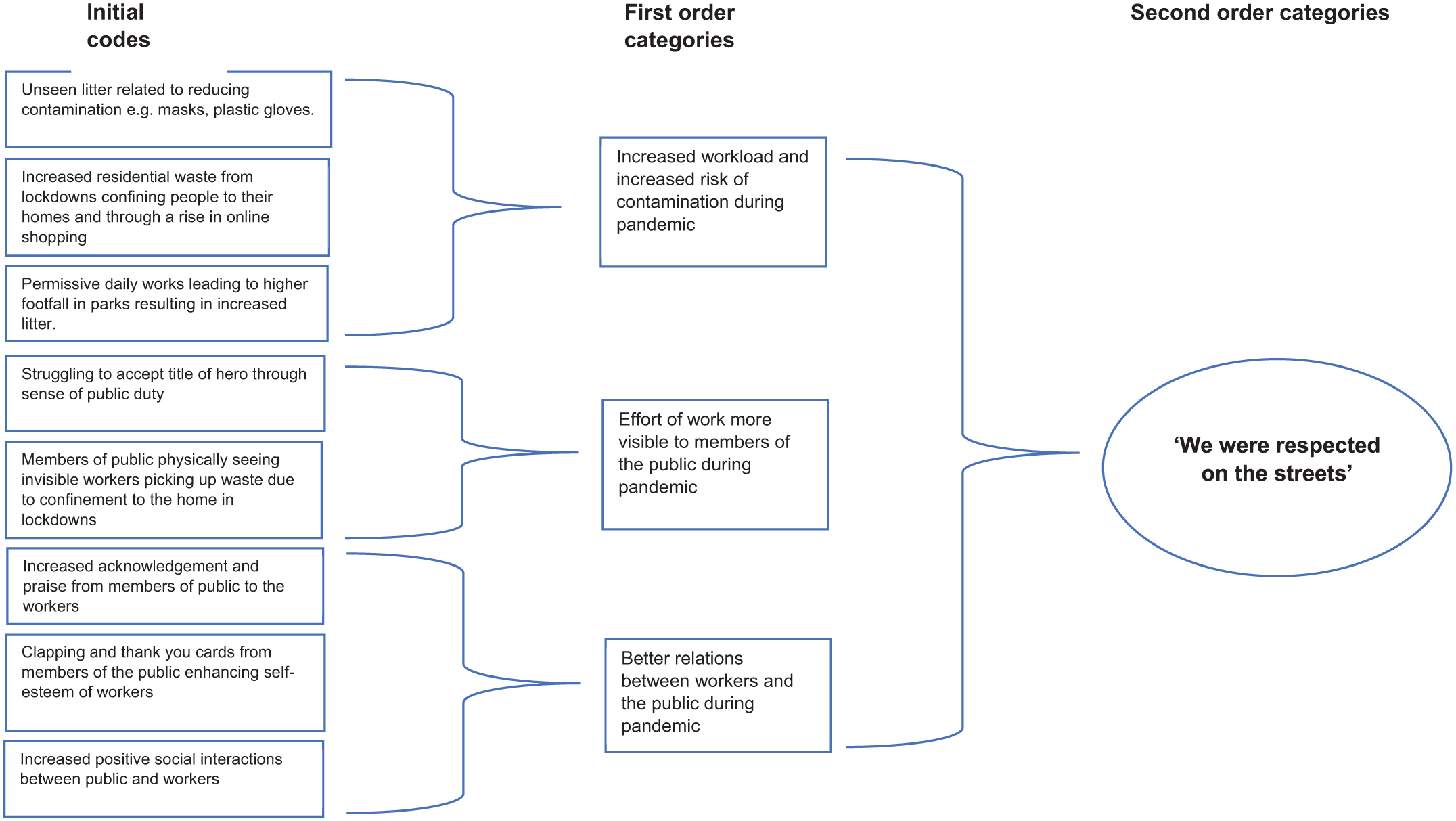
Thematic coding example.
Other themes resulted from an inductive approach to interpreting important emergent findings not captured by a Honneth–Fraser framework; for example, ‘Gap between social groups reinforced through the pandemic of those going out to work (low-status key workers) and those staying home’ and ‘Social group division highlighting lack of desire to understand how the other half lives’. Such themes drew us to Reckwitz’s and Neckel’s work to support further interpretation of the data and an expansion of our theoretical framework to include notions of polarisation and status fixity.
Lastly, consistent with a relationally reflective approach, emerging themes were also discussed among the researchers as interviews progressed to identify how certain normative pressures might have played out. For example, we considered how the respondents’ gender might have influenced responses because the almost exclusively male composition of the waste management workers, coupled with the researchers being female, might have invoked gendered responses as participants attempted to reinforce their working-class male identity.
Findings
Analysis identified four overarching themes: (1) We were respected out on the streets; (2) Looked down on, again; (3) How can we feel on a par with others?; and (4) Two worlds, even further apart. Each is elaborated below with illustrative extracts from the interviews. Most themes were not specific to occupational subgroups. In general, participants’ accounts were remarkably consistent, although those who interacted directly with the public tended to report stronger experiences of recognition, as well as subsequent disillusionment.
We Were Respected Out on the Streets
Unlike many other occupations, those involved in waste management during the pandemic were classified as essential workers and expected to continue doing their jobs. Most participants took this in their stride and got on with their daily tasks. Workers repeatedly appealed to their sense of public duty in averting the health risks of waste piling up, saying, for example: ‘It’s one of those services that you can’t just walk away from, it’s paramount that it’s done. I mean, one of the issues with refuse is that it does become a health issue after time.’ Concurrently, they stressed that ‘it was a job as normal’, refusing to accept the designation of ‘hero’ that had appeared in the media: ‘Oh, for me, I didn’t think, well, we were doing anything special, well, I’m doing a job that I get paid for’ (loader).
For participants, the value of their service was enhanced by the harshening conditions they experienced during the pandemic, namely an upsurge in workloads due to previously unseen forms of litter (e.g. face masks and plastic gloves) and greater waste from increased online shopping and DIY. In addition, as the number of visitors to parks, green spaces and footpaths soared, so did the amount of rubbish: We did find in the pandemic, that because people weren’t working the refuse went up because everybody . . . cleared out their garages, their sheds (loader). Motorbikes coming into the parks delivering pizzas to people that are sat in the park and then that pizza box stays there; the litter I believe, it almost trebled, within a matter of two weeks . . . (street cleaner)
The rise in the volume of litter led to the intensification of workers’ schedules, extended routes, longer rounds and six-day working weeks: We were short of drivers because we lost a lot of staff through different illnesses and for shielding and bits and pieces. So yeah, I think for me, I did six days a week . . . (dustcart driver)
Yet, workers in our study continuously emphasised the importance of doing a good job, priding themselves on their physical stamina and on the contribution of their labour to the community.
Alongside the challenges, new positive elements of the jobs also emerged. Cleaning jobs are expected to be invisible insofar as the goal of this work is to make cleanness appear natural, rather than achieved through hard physical work (Rabelo and Mahalingam, 2019). However, as people were staying at home during the lockdowns, the effort of those collecting the waste and maintaining the parks became more noticeable: And there was a lot more people in the parks, and at home, we didn’t see normally because they would have been going to work, we were seeing them and then they were realising, so ah these are the people that actually do the work. (dustcart driver)
Despite some awkwardness workers experienced in the face of gestures of recognition, they confessed to the positive feelings evoked from being on the receiving end of acknowledgment and respect, even as they felt self-conscious and diffident about being labelled heroes: I felt embarrassed when they were clapping, I did. I mean, what do you do? I’m going bright red, I’m going, what do you do, do you just go like that, ‘Thank you very much’, you’re waving back, like you’re a, like you’re a superhero or something like that, you’re a celebrity. I’m not, I’m just a normal dustman, but it was good . . . the country showing their appreciation. (litter picker)
Getting respect and recognition was described by participants as ‘motivating’, ‘heartening’, ‘cheerful’ and ‘really nice’. Workers were moved by expressions of gratitude, as one commented: ‘She actually said: “Where would we all be if it weren’t for you lot”. And I was quite choked up by it, really it did choke me up.’ And another participant summed it up as: ‘. . . we were respected out on the streets. People were giving us respect and as a group . . . ‘(dustcart driver).
This aspect of participants’ accounts closely resonates with Honneth’s ideas of work as a source of self-esteem (1995, 2012), as exampled by workers’ responses to affirmative social gestures like clapping, ‘thank you’ cards, drawings and personal notes. As importantly, and in Honneth’s theory of recognition, not only did these gestures of appreciation signal a potential for more respect, but they also suggested the strengthening of the social bond between the workers and the public, a new form of mutual acknowledgement: We’re part of it, yes . . . it’s kind of like the police, the fire brigade, the ambulance, the hospitals, it’s part of the services of a community, working to keep the community functioning, and what we do is part of that . . . (dustcart team leader and driver)
Overall, the pandemic had a moral significance for participants insofar as it produced a potential moment in which their effort temporarily merited respect, recognition and regard for them as equal (equally important) fellow subjects. It offered an example of an opportunity for accentuation of the relations of recognition (Honneth, 2012) by generating a sense of workers’ indispensability for societal functioning.
Looked Down On, Again
From Honneth’s perspective, a sense of marginalisation may be at least in part reduced by a promise of mutual dependence, and an understanding of ‘each other’s function in the social lifeworld’ (Honneth, 2012: 63). Drawing on Honneth (2001), the increase in key workers’ perceived importance and public visibility during the pandemic might therefore be expected to increase this mutual understanding, and, thereby, challenge the devaluation of these workers, and call into question or challenge their pre-existing status. In contrast, however, most respondents did not think that the new forms of recognition prompted by the pandemic would produce a long-lasting effect on their status, as reflected in a general scepticism and comments such as: ‘as soon as the pandemic sort of eases off, it (recognition) will disappear, it all be back to normal’ or ‘people have got short memories’: In the pandemic they were clapping us right, now they treat you like dirt again, . . . you get abuse, you get threatened, we did the bulky bins around the corner, we had silly little notes in the bins threatening us, calling us lazy bastards, we’ve heard it all . . . (dustcart driver)
In response to the question about what constituted ‘the normal’, workers expressed their concerns about the deteriorating status of public services and the increasingly negative perceptions of those carrying out physical work. The majority felt that their growing experiences of disrespect and misrecognition went beyond ‘simply being looked down on’ or ‘being shouted at’. Participants’ views seemed to reflect social values presenting public services as inconvenient and inefficient social burdens (Hutton and Paddison, 2014). They referred to such comments from the public as ‘we are paying your wages and you’re sitting around smoking or something . . .’ or ‘clearing rubbish is basic work, you should be grateful you have a job’. Thus, workers’ apprehension about their status echoed Fraser’s concern about the ‘status injuries’ (Fraser, 1998: 2) resulting from such negative attributions as being ‘lazy’, ‘not very clever’, or overpaid and underworked: the concept of it all is that, because you work for the Council, you don’t work hard; they see council workers as shirkers . . . once a stigma is attached to a certain job, it’s very, very difficult to clear that stigma . . . (litter picker)
Fraser argues that ‘the economy is always already permeated with cultural interpretations and norms’ (1998: 44). Similarly, workers in our study commented on how continuous cultural downgrading of public services was taking place alongside austerity-driven economic cuts to council budgets that, in turn, led to downsizing, intensification and precaritisation. These organisational changes were experienced as eroding the status and the working conditions of those involved in waste collection. Since the sites were already inadequately resourced, coping with the pandemic was not helped by the operational difficulties resulting from pre-pandemic budget cuts: I think it’s basically got worse here because the austerity and the cutbacks. I mean, there’s only so much you can cut off the cloth. You can’t cut no more. (dustcart driver) Now employment is based on zero hours, part-time work, extremely low pay . . . people who say, you’re lucky to have a job, that is wrong, that is man’s or a person’s given right to have labour . . . (litter picker)
Taken together, our participants remained doubtful that they might be successful in gaining more social recognition. In particular, the pandemic did not result in a revisiting of the status order that relegates those in waste management jobs to the bottom of the status hierarchy, through such negative sociocultural attributes as being lazy, unintelligent, uneducated, or lacking the ambition, skills or abilities to perform any other tasks. Indeed, answers to questions about the long-term effect of the pandemic generally suggested disillusionment and resignation: for example, ‘Long-term? No, because they ain’t going to appreciate, they don’t appreciate what you do for a living, don’t be silly.’
In sum, participants’ comments lent further support to Fraser’s argument about the need to challenge the ‘institutionally anchored and systematically subordinating’ cultural socio-economic patterns that devalue the contribution of many service workers (Zurn, 2003: 522). In this way, our findings highlight the ‘injustices of status’ (Fraser and Honneth, 2003: 54) consequent upon four decades of neoliberal, socio-economic ‘re-ordering’ (Law, 1994), with its weakening of the economic and cultural positioning of public service institutions, and those employed by them (Libal and Kashwan, 2020). In this manner, our study supports Fraser’s (2001) suggestion that a pre-existing low social status undermines the credibility of one’s demands for recognition.
How Can We Feel on a Par with Others?
Participants also questioned what it meant to be ‘truly recognised’ and ‘feel on a par with other fellow subjects’ when the pandemic failed to delegitimise the prevailing recognition order. In particular, many expressed frustration, and sometimes anger, over their low pay and job precarity: one of the loaders printed how much he earns a year and posted it . . ., it went from that . . . people need to realise what we actually earn . . ., oh, nobody in this day and age should be getting paid so little and . . . (loader)
For Fraser (2007), participatory parity goes beyond avoidance of disrespect since it implies a just distribution of material resources, reflected in access to secure work, housing, leisure time and social activities. Yet our participants repeatedly referred to their constant anxiety about money and job security. Feeling ‘more esteemed’ was undermined by the challenges of ‘living on very little’. Unaffordable house prices, high rent and cuts in housing benefits led to increases in pressing bills, and exacerbated the frustration about pay: Nothing has changed since the pandemic. Well, when I pay for my rent and that it’s basically near enough all my wages, it’s straightaway gone . . . (litter picker) I think to, if you want my honest opinion, I think that our jobs here don’t get paid enough to live on if you want to be blunt, it will never change . . . (litter picker)
The erosion of communities and the separation of families were also experienced by workers as an additional form of exclusion: The more that the rents are going up is making it extremely hard for normal working-class people to live there, with the government cut backs on housing benefit they’re literally forcing people out, . . . where the rents are cheaper, which I think is wrong because it breaks families up because they have to move . . . (litter picker)
Participants commented on how not having enough money circumscribed their participation in social life and community activities. Owing to falling incomes and mounting costs, workers struggled to get involved in such social activities as visiting families who lived away, or relatives in hospital, as well as birthday celebrations or taking holidays: I can’t remember how long when I last had a holiday . . . all the kids have gone away at different times and I’ve got my girls, ‘dad, are we gonna go on holiday?’, you know, all the other kids coming back showing off their tans and stuff, and that’s a big thing for my eldest daughter, you know, all the other kids are brown and I’m like ‘no, no, we’ll go next year’ and it’s ‘you say that every year dad’. (cage vehicle driver)
These experiences support Fraser’s argument that workers’ sense of being on a par with their fellow citizens is closely linked to the distribution of material resources. In particular, gross disparities in access to work and housing, income or leisure time meant that our participants could not truly interact with others as ‘peers’ (Fraser, 2007). In this sense, the downplaying of economic factors in dominant accounts of recognition does appear as a ‘tragic loss’ (Fraser, 2007: 338) since it distorts our understanding of recognition struggles (Zurn, 2005).
Two Worlds, Even Further Apart
Yet the experience of the pandemic suggests that we need to look beyond Fraser’s sense of status parity to fully understand the processes that may interfere with recognition struggles. Many in this study felt that the pandemic showed that they had no choice but to accept the fact that their low status might never change, reflected in such caustic comments as, ‘now things are easing off we’re the arseholes of the planet again . . .’. In this sense, what gets recognised is not simply a function of social contribution, but it tends to reflect ‘the social structures . . . that depend on the rank he or she occupies in a status system’ (Neckel, 2020: 480): I think that because the way that society is nowadays, if you’ve got a job with money, you’re elite and people look up to that . . . they look at people like road cleaners . . . and they think you’ve got nothing . . . we’re not important to them. It’s like their man servant sometimes, you know . . . it’s like, big fish and the little fish. When the pandemic is over it will be the same. (litter picker)
As importantly, workers in our study felt that any possibility of coming together through understanding ‘each other’s function in the social lifeworld’ (Honneth, 2012: 63) was severely undermined by the unequal consequences of the pandemic among disparate groups. In Reckwitz and Neckel’s terms, the pandemic exposed the polarisation of people’s experiences: some people took more risks, some less, some had choice, some did not, some thrived, some suffered, some died.
Participants commented on the difference in social groups’ capacity to distance themselves from the unpleasant and the contagious: They are at home, comfortable. We get nothing. No, nothing. Not even, ‘Oh, we’ll give you a couple of days, like a couple of days extra as your holiday so you can recover and that’, nothing. (litter picker)
In answer to the questions about these challenges of ‘banding together’, waste collectors commented on how the pandemic was another illustration of manifold (and growing) societal divisions. Workers listed such things as second homes where those in white-collar jobs could escape to avoid Covid-19, especially as some of the council management had moved outside of the city for safety. In contrast, those on agency contracts ‘didn’t even get the option’, as one refuse collector put it. Participants also observed that ‘getting no option’ was also true about nurses, carers, bus and subway drivers, those working at supermarket checkouts and all those who lived in overcrowded housing.
Many were convinced that those wearing the uniform and performing ordinary, repetitive, low-paying and low-skilled tasks were increasingly perceived as servants in a society that is chiefly devoted to the promise of individual achievement and financial success: Well, some people, once they are educated, they get a suit and tie on . . . they think they’re the bee’s knees, you know, . . . They believe we’re just there, almost like a servant, you know, and, and that changes as you go through the borough though, so you’ll probably get that attitude more at the . . . end of the borough, more affluent people there and the more middle-class type people. (litter picker)
Workers talked about what Reckwitz (2021) refers to as an intensified socio-structural dualism and an increasing distance between cultural subgroups: I don’t like this, you know, and it’s, the Borough’s completely divided but it’s divided on every single line – you have the rich people that, you know, have their property and their way of life and the way they do things and they, oh, they don’t see us . . . nobody mixes is the vision across the whole Borough with every single thing that you do. (cage vehicle driver)
The quotes above resonate with Reckwitz’s and Neckel’s stress on polarised post-industrialism characterised by ‘polarization of incommensurable social positions and segmentation of social statuses’ (Neckel, 2020: 477, emphasis added). In sum, for our participants, the pandemic made the divisions of lifestyle, life opportunity and social position yet more tangible.
Discussion and Conclusion
The pandemic offered us a rare chance to examine the way that social change might affect processes of recognition among a group of, at least temporarily appreciated, key workers. Our findings are nuanced, supporting aspects of both Honneth’s and Fraser’s propositions. The findings concur with some of Honneth’s thinking on the significance of labour participation for identity formation. Similar to other studies of physically tainted occupations (see Deery et al., 2019 as an example), our project suggests that an individual’s work role remains important to social identity, even for those involved in ‘the most thankless’ tasks (Honneth, 2012). In particular, the pandemic provided opportunities for accentuation of the relations of recognition (Honneth, 2012) by highlighting our reliance on low-paid workers for societal functioning, and increasing the visibility of their contribution to the common good. Yet, simultaneously, our analysis calls into question an overly romanticised treatment of recognition in dirty work literature with its focus on the emancipatory power of work (e.g. Groutsis et al., 2020). In this study, the emancipatory moments of the pandemic experience were short lived because the existent status hierarchies remained unchallenged. Similarly, the dominance of a market rationality portraying public services as ‘social burdens through distortional taxation’ (Afonso and Gaspar, 2006: 4) and as ‘lame and inefficient’ (Mazzucato, 2018: 3) diminished participants’ chances in achieving warranted recognition, and, overall, the pandemic failed to improve reciprocal trust and respect. Instead, our respondents reported that their day-to-day exchanges with the public reverted to experiences of ‘being treated like dirt again’ or conceived as lazy and less competent. In this way, our findings support Fraser’s status model by highlighting ‘injustices of status’ (Fraser and Honneth, 2003: 54) and the obstacles those involved in ‘dirty’ occupations confront in their attempts to contest them.
As importantly, our findings call attention to the way that participants’ experience of being able to interact on a par with others is weakened by the decline in secure employment, deterioration in compensation schemes and limited access to housing and benefits. In addition, workers felt they lacked resources to engage in many forms of social life, particularly workers with families and children. From our participants’ point of view, the pandemic did not bring about any significant improvement in their working lives. These findings echo Fraser’s argument that gross disparities in access to work and housing, income or leisure time may deny certain occupational groups a sense of interacting with others as equals (Fraser, 2007).
Finally, in support of Neckel (2020) and Reckwitz (2021), the pandemic became a source of disillusionment for our participants as it seemed to confirm the fixity of their status, where many felt that their social positions appeared unalterable. These status disparities also severely constrain ‘group-mixing’ experiences, and thereby hinder the possibility of societal sharing in a common life. In consequence, it becomes very difficult to achieve the mutual dependence and consanguinity desired by Honneth where we can acknowledge ‘each other’s function in the social lifeworld’ (2012: 63) and appreciate our interrelatedness despite our differences and separateness.
In sum, our study supports Neckel and Reckwitz’s sense of a growing polarisation reflecting sharpening economic and cultural inequalities. Such observations not only place further doubt around Honneth’s desire for emancipation through recognition, but also question the likelihood of Fraser’s sense of parity. Instead, our research suggests that existing divisions may become yet further entrenched.
Footnotes
Funding
The authors received no financial support for the research, authorship, and/or publication of this article.
