




Abstract
This article addresses a key question in the sociology of social inequality: how the class-privileged come to monopolise formerly open social fields through processes of social closure. We focus on ‘informal social closure’, the less studied form of closure in the literature; our empirical case is youth cross-country skiing in Norway, which historically has recruited across the class spectrum. Based on interviews with ski parents and inspired by Bourdieu’s notion of ‘illusio’ (players’ belief in the game’s importance), we distinguish between three groups of resourceful families who play various roles in exacerbating monopolisation: ‘genuine’, ‘compliant’ and ‘unwilling’ players. Our analysis furthers the understanding of how illusio fuels informal closure processes; compliant players – those with a weaker illusio – play a key role. To understand compliant players’ role, the analysis should scrutinise both how they legitimate the exclusionary code pushed by genuine players and their moral commitments beyond the particular game.
Keywords
Introduction
How social fields become closed is a key issue in the sociology of social inequality and the focus of this article. According to Manza (1992: 275), ‘closure’ refers to ‘the process by which one group of actors denies others access to rewards and opportunities’. Weber (1978), who was the first to highlight how social groups vary in their exclusiveness and by what criteria people are included and excluded, also described social closure as a gradual process that can take many forms. Contemporary closure theorists have pointed to formal and informal modes of closure as key forms (Manza, 1992; Murphy, 1988). While ‘formal social closure’ captures how access to scarce positions and privileges can be restricted by (for example) state-sanctioned rules, such as with modern professions, ‘informal closure practices’ refer to ‘hidden, unorganized, perhaps even unconscious’ forms of social action (Manza, 1992: 286) that nevertheless create effective boundaries to other social groups and ensure control over a field’s resources, both material and symbolic.
This article contributes to the literature on the latter mode of social closure – the type that hinges on what Murphy (1988: 2) refers to as ‘backstage exclusionary practices’. Guided by Bourdieusian field theory, we focus on an understudied aspect of informal social closure processes: how different groups of ‘players’ within formally open social fields operate and implicate each other in developing and maintaining an exclusionary social practice.
We use the empirical case of Norwegian youth sport to achieve insights on informal social closure processes. In Norway, youth sport represents a particularly salient field for studying how those involved come to ‘enforce closure codes’ (Manza, 1992: 286). Youth sport is formally open to all who want to participate, but access is becoming increasingly difficult for the less privileged, a situation that contrasts with the sport-for-all ideology that underpins national sport policy and that legitimates Norway’s massive public funding of the sector. As is happening in many places, however, youth sport is changing in ways that may work against the goal of equal access. Studies describe an increasingly professionalised, commercialised arena that is infused by elite-sport dynamics (Sandvik and Solstad, 2023; Seippel, 2019; Taylor and Garratt, 2010). Youth cross-country skiing, the specific sport we focus on, is no exception. The use of professional coaches is on the rise in cross-country skiing, at least for older youths. We have also seen an influx of private agents in the field (although it belongs to the volunteer sector), such as schools offering specialised ski programmes and gear manufacturers awarding individual sponsorship deals to promising skiers. These changes, combined with technical advances in the sport and more extensive race programmes, are signs that the sport is becoming more demanding for young skiers and their parents alike to manage.
Recent research from Norway also shows that youth sport is becoming more class-based in terms of participation rates (Strandbu et al., 2017). The question of why class-privileged youths increasingly outnumber the less privileged in youth sport has received surprisingly little attention from researchers, although some have pointed to rising costs and time demands on parents as contributing factors (Andersen and Bakken, 2019; Strandbu et al., 2017). Little is therefore known about the role of the real ‘players’ in the youth sport field, namely the parents. Over the years, parents have become much more involved in their children’s sport activities (Stefansen et al., 2018; Wheeler and Green, 2019) and, as shown by Eriksen et al. (2024) particularly in the upper-middle classes parents often continue their support longer than is strictly necessary. A question that has yet to be studied is why the ‘game’ (in the Bourdieusian sense) becomes meaningful for parents and the types of ‘players’ they become when engaging in a field where the balance between egalitarianism and elitism is already clearly shifting towards the latter.
Our empirical data come from a qualitative study comprising interviews with ski parents from clubs in different parts of Norway and field observations at youth ski races. To understand which internal field dynamics are exacerbating the ongoing process of social closure in our field, we use as thinking tools Bourdieu’s notions of ‘illusio’, or how people can be ‘taken in and of the game’ of a particular field, and ‘social gravity’, or the pull of the game once people have invested in it (Bourdieu and Wacquant, 1992). As we study parents as ‘players’ on behalf of their children we also draw on insights from newer theorisations of the moralities of class-privileged parenting in the tradition form Lareau (2003).
By approaching youth cross-country skiing as a case that can be particularly illuminating for the understanding of informal social closure processes, our article makes two main theoretical contributions. First, while illusio is a key driver in such processes, the analysis must be attentive to illusio as a varied phenomenon that comes in different degrees and forms. Second, the analysis must look beyond the stakes of the particular game to understand how a weaker illusio does not preclude practices that contribute to upholding the game – and thus fuel monopolisation. We flesh out how we arrive at these suggestions in the empirical analysis, which focuses on (1) the characteristics of the field that draw class-privileged parents into the game, (2) the different ways parents read and operate in the field and (3) the relations among the different groups of players who make up the field.
Field, Illusio and Social Gravity
We approach youth cross-country skiing as a social field in Bourdieu’s (1998) meaning: as a semi-autonomous field characterised by specific rules and actions that is simultaneously adaptable to change. While most fields have admission requirements, some are more exclusive than others. Economic factors play a role in social closure, but such closure is also linked to incorporated knowledge about how to conduct oneself within the field, as exemplified in Bourdieu’s description of the upper-class monopolisation of ‘the most distinctive sports’: [N]o less than the economic obstacles, it is the hidden entry requirements, such as family tradition and early training, and also the obligatory clothing, bearing and techniques of sociability which keep these sports closed to the working classes and to individuals rising from the lower-middle and even upper-middle classes. (Bourdieu, 1978: 838)
In Bourdieu’s thinking, social closure happens through processes that those who are involved are more or less unaware of. His notion of ‘illusio’ is particularly useful to understand such processes, as the concept foregrounds how people through their engagement in the field become ‘taken in and by the game’ (Bourdieu and Wacquant, 1992: 116) and acquire an ‘enchanted relation’ (Bourdieu, 1998: 77) to the game’s value and how its rewards (status, prestige, authority, etc.) can be obtained. Illusio then is: [T]he fact of being invested, of investing in the stakes existing in a certain game, through the effect of competition, and which only exist for people who, being caught up in the game and possessing the dispositions to recognize the stakes at play, are ready to die for the stakes. (Bourdieu, 1998: 77)
This dynamic also holds for involvement in sport, as shown in a study of young professional footballers who, despite their meagre chances of success in the long run, invested their whole lives in the sport (McGillivray et al., 2005). The significance of illusio for social practice also applies to the involvement in play and games more generally, as outlined in Huizinga’s (1955) book Homo Ludens, which Bourdieu (1998: 76) built on in his elaboration of the concept.
Generally, for a field to operate, it must engage agents with the right type of habitus; that is, a set of dispositions that makes them both eager to and capable of competing for its rewards (Bourdieu and Wacquant, 1992). The question of which types of habitus draw people to different fields, however, gets little attention in Bourdieu’s work (Swartz, 1997). In our case of social closure, we have seen how class-privileged parents share a set of dispositions that allows them to buy into the game and understand and master its rules. For them, skiing is a worthwhile practice that their children will benefit from mastering. While some parents recognise the value of the game and have the practical knowledge of how to play it from the outset, others will enter the field less ‘enchanted’ and knowledgeable and will gradually learn about the game and how to be a competent player, in essence becoming more or less captured by illusio.
What Bourdieu calls the ‘gravity’ of fields (Bourdieu and Wacquant, 1992: 17) provides an inroad into understanding how illusio is acquired and maintained through practice. Hage’s (2011) and Threadgold’s (2018a) interpretations of Bourdieu’s concept are helpful here. They discuss the ‘social gravity’ of a field as that which keeps players in the game. Social gravity is important to our analysis, as it refers both to how the game people are invested in gains deeper purpose as time passes and to the pull of the game on those involved, since the loss of commitment or the use of incorrect strategies comes with ‘an array of consequences’ (Threadgold, 2018a: 39). Importantly, for ski parents, such consequences affect not only them but also their children.
Both illusio and the social gravity of a field are ‘expressed in the very strategies and struggles that take place in a field’ (Threadgold, 2018b: 162). Key to our analysis is also the notion that people’s commitment to the field might vary, which will manifest in how much ‘time, effort and emotion’ (Threadgold, 2018a: 42) they are willing to spend. Hence, we focus on the strategies and struggles of both those who are totally caught up in the game and those who are somewhat less engaged – to understand the role of illusio in informal social closure processes.
Parenting, Class and Morality
As we study parents as players on behalf of their children, we also draw on the evolving theorisation of parenting in class-privileged groups, particularly Lareau’s (2003) seminal study Unequal Childhoods, where she developed the concept of ‘concerted cultivation’ to capture the logic of child-rearing among those with high levels of economic, cultural and social capital. The concept points to a labour-intensive type of parenting that involves close monitoring and extensive scaffolding of children’s development and drive that resonates with institutional demands. Enrichment activities play a large part in this type of parenting, as described by Lareau. Such activities are seen as important to boost both physical and social skills, as well as cognitive development (Vincent and Ball, 2007), and they provide the possibility for parents to bond with their children by engaging wholeheartedly in something that matters to them (Stefansen and Aarseth, 2011).
Although within-class variations exist in how ambitious and hands-on class-privileged parents are (Irwin and Elley, 2011), this type of parenting may be considered an outflow of middle-class culture, with its ‘imperative of expansion – of opportunity and of selfhood’ (Sherman, 2017: 28; emphasis in original), in a context where parents more generally have become ‘responsibilised’ (Vincent and Maxwell, 2016). To understand parents’ illusio in the skiing field, our analysis also considers how parents – as social agents more generally – may be simultaneously committed to different moral spheres (Halvorsen and Ljunggren, 2021). The ski parents we have studied are deeply committed to scaffolding their children’s engagement in a prestigious field, but they are also citizens, with political sentiments that may be more or less egalitarian and that may conflict with providing optimal conditions for their own children (Reay, 2008). We therefore focus not only on the practices of concerted cultivation in the context of skiing, but also on how parents feel about the game they are invested in. A key argument of the article is that focusing on how ‘class is lived internally’ (Perrier, 2013: 659) can further the understanding of how social-closure processes unfold.
We draw inspiration from previous studies that have shown how class-privileged parents can display feelings of ambivalence and sometimes even guilt when using their various capital types to provide advantages for their children, for instance in school (Reay, 2008), and as captured in Sherman’s (2017) concept of ‘conflicted cultivation’. Such parents may deploy ‘strategies of constraint’ (Sherman, 2017) to temper their children’s ‘sense of entitlement’ (Lareau, 2003) or, as described by Perrier (2013), construct their high level of investment as being reasonable compared with those who either do too little (in her case: working-class mothers) or too much (‘pushy’ and strategic middle-class mothers).
The Study
Our analysis is based on interviews with parents from 22 families with children above the age of 12 who were or recently had been active in youth cross-country skiing conducted as part of a larger study on costs in youth sport more generally (n = 51). We also attended national and club-level races for youths to get a sense of the skiing field and its ‘players’. Ethical approval was given by SIKT (Norwegian Agency for Shared Services in Education and Research) and all participants gave their informed consent to be interviewed.
The parents we interviewed were recruited from 10 skiing clubs in different parts of Norway, primarily located in large and midsize cities. We initially corresponded with a contact person and communicated that we wanted to talk to various types of skiing parents. Once we acquired an interviewee, we used ‘snowballing’ to gain more potential interviewees. The sample we obtained was largely upper-middle class, although some had lower-class positions. Almost all parents were of majority Norwegian origin and worked full time in skilled jobs that brought privileges such as high salaries, professional freedom and work-time flexibility. The parents worked as engineers, researchers, doctors, economists, dentists, civil servants and IT consultants, among other jobs. They were in their 40s and 50s, and many had reached top-level positions in their line of work. Although we cannot know for sure, our sense is that the sample is fairly reflective of the current class composition of the competitive part of the youth skiing field, at least in urban areas.
Our approach to the possible participants was open and flexible. We contacted one parent in the family, and if they had a partner, we let them decide if they wanted him or her to join in the interview – which some did. Our sample therefore includes 22 families and 28 parents (16 mothers and 12 fathers). All two-parent families (n = 19) were heterosexual, and all single parents (n = 3) had previously lived with a partner of a different gender.
We interviewed the parents in their homes or at their or our workplace. 1 In a flexible manner, we used an interview guide that was organised around the following themes, in addition to including background information about the parents (sports, education and work life): their children’s sports trajectories; the parents’ roles in youth cross-country skiing; the family’s routines and practices related to skiing; what sport meant for the child and the family; and the costs involved. The interviews lasted from one to two hours and were transcribed verbatim by a research assistant.
While our analysis focuses on the interviews, our observations during the initial field visits were what sparked our interest in ski parents’ role in transforming skiing from something open to all to a playing ground primarily for the privileged few.
Based on the field observations and initial interviews, our sense of the field was that the parents were more or less of the same kind, a class-privileged group who strategically deployed their resources to give their children a ‘leg up’ in the skiing game. As we interviewed more parents, we came to understand that a lot more was going on. While all parents discussed a sport that had changed in many aspects, they navigated this new terrain in different ways; some expressed very ambivalent feelings about their own level of investment. In this phase, the authors of this article met several times and discussed how we could make sense of the parents’ narratives, and especially what puzzled us the most: that parents who were critical of what the sport was becoming (too serious, demanding and excluding) seemed to ‘do’ ski parenting in ways very similar to those who voiced less uneasiness about their own massive investments. When we then conducted a more systematic analysis by coding all the interviews, we saw that some parents did not fit into either of these two groups, whom we came to label the ‘genuine’ and ‘compliant’ players. Rather, this third group of parents positioned themselves as more ‘unwilling’ players, in the sense that they were more restrained in their investments, for example by opting out of the most prestigious races. In our material, this third group was smaller than the first two, and very few parents did not conform to any of these profiles.
Groups of Players in a Transforming Field
While we found some variation within the three groups, our description below focuses on what defined them as distinctive groups. As illustrated in Table 1, the groups diverged along three interlinked dimensions: the level of identification with the field, how parents saw their role as ski parents and the level of investment they made in skiing.
Group profiles.
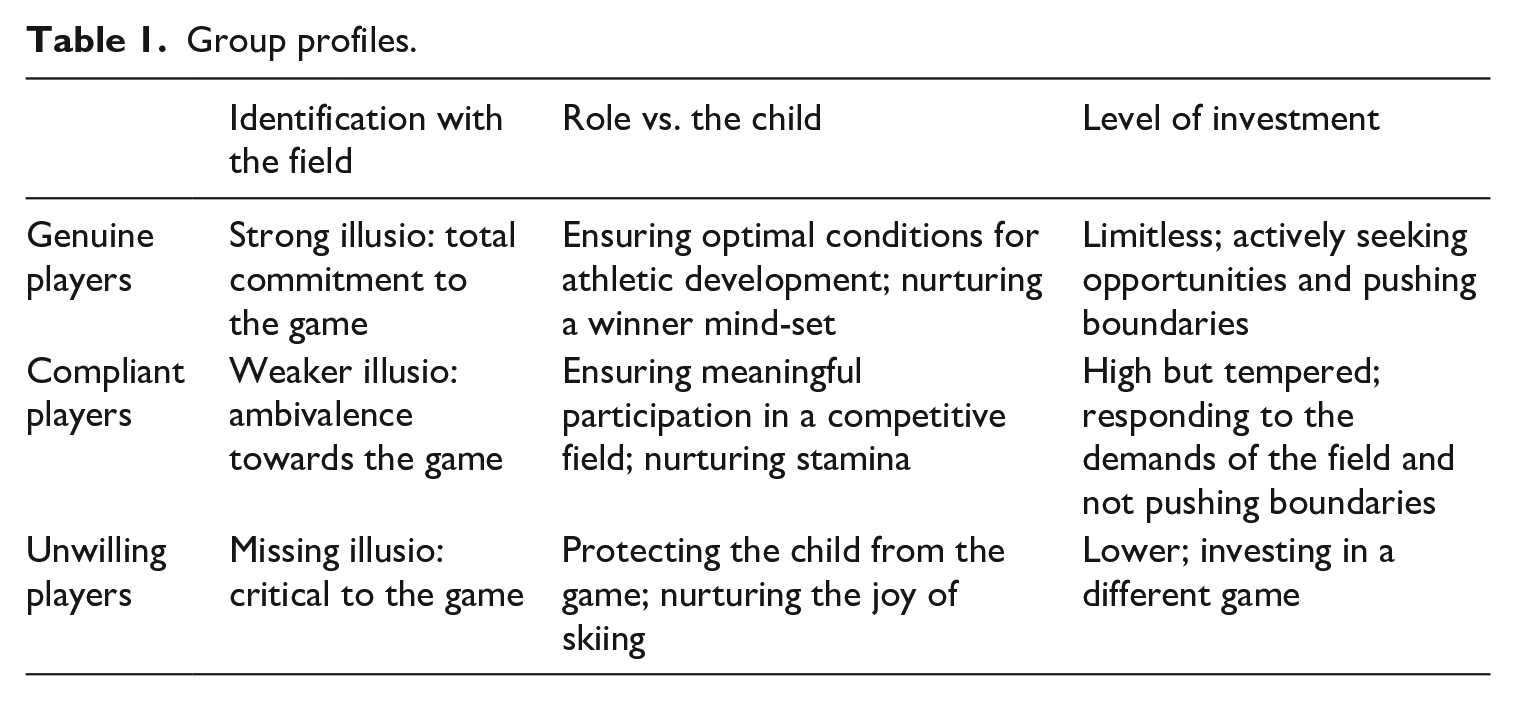
Below we further unpack how the three groups understood and navigated the skiing field and their contribution to the emergent closure of the field. To illustrate key analytical points, we use a mixture of retelling and shorter and longer quotations. All quotations were translated from Norwegian to English by the authors and have been lightly edited for clarity and, in some cases, to secure the anonymity of the participants and their children. For transparency, the quotations are marked with F for father and M for mother, followed by an interview number. M1 thus stands for Mother, interview 1.
Genuine Players: Reinforcing the Rules of the Game
The genuine players were primarily characterised by their willingness to invest in everything they deemed necessary for their children to develop as athletes and succeed at races. These parents did not see their massive investment as a sacrifice; rather, it was profoundly meaningful, ‘a privilege’ (F20), in this period of life. They got to spend time with their children and see them thrive. The genuine players also conveyed a strong sense of belonging to the skiing field. They were part of what some referred to as the ‘ski family’: those who both contributed to the local club (by coaching, sitting on the board and helping out at races) and scaffolded their children: It’s a group of very enthusiastic people. If you’re willing to be part of it, to travel around to races and things like that, then it’s a very inclusive world. But you have to be engaged. And if people are engaged, I think it’s very easy to become included. (F32)
The willingness of the parents in this group to go ‘all in’ – their illusio, in Bourdieu’s sense – came through in how they invested in top-level gear for both classic and skate skiing and the time and effort they dedicated to making sure their children’s skis were in prime condition for races. Racing was what the sport was about, and the parents treated skis as a matter of great importance, especially as their children grew older, illustrating Bourdieu’s point about the ‘gravity’ of social fields. The genuine players generally spent significantly more money on skis than other parents did.
Ski waxing was also a serious matter, and the parents invested in all the necessary equipment and wax types. The fathers would often spend hours working on the skis the day before a race. Ensuring their children had perfect skis was not optional for parents, but a duty that required a specific competence, since ‘it’s very demanding if you want to provide good skis for your child so they can have a good experience – you need to know quite a lot’ (F32).
Everyday family life essentially revolved around skiing in these families, a life that was more hurried than among the ‘compliant’ and ‘unwilling’ players: I’ll spend hours during a lot of Fridays and Saturdays prepping skis (. . .). [The kids] have many races on the weekends, and we drive and prepare [the skis] and follow up. Skiing also involves a lot of volunteer work, to the extreme. But then, the kids love it, so we give them our all. (F7)
The children generally participated in extensive training programmes. The parents planned and organised everything and often drove their children to and from practice. Summer holidays could be organised to provide opportunities to prepare for the forthcoming ski season; during the winter, most weekends were dedicated to races.
Some parents sought out better conditions than those generally provided by their local clubs. They could ask if their children could be placed in a group for older children, or advocate for professional coaches rather than parent coaches, or for a more differentiated training regimen. One family changed to a better club, while others chose to enrol their children in private, sport-dedicated secondary schools, offering that their children really wanted and benefitted from such programmes, since ‘They support you and they push you to be bold in your goals’ (M22).
The parents were often aware that the training load could be onerous for ambitious children, and that they were balancing on a knife’s edge between allowing their children to push hard enough for optimal development and risking injury or illness. The parents’ commitment to finding this balance was another testament to their illusio, since such commitment lies at the core of the elite-sport logic.
The commitment to the game also came through in how the parents scaffolded their children at races. Much like the support team for professional athletes, the parents often had designated roles. One would do a walk-through of the trail before the race and would usually also coach their children about ‘things like “In this part, you’ll need to watch out”, or “At this point, you’ll be tired, and it’s important that you use the last of your strength to increase your speed before you head into that hill”’ (F33). The fathers would often do the final waxing and ski testing at the skiing arena, while the mothers ensured that their children had eaten, were in the right frame of mind and had warmed up before the start. Both parents would then run out to different places on the trail, where they could film their children and cheer them on; some would offer technical advice. Afterwards, they could ‘discuss [the race]: the technique, speed and those kinds of things’ (F33).
What also seemed to fuel these parents’ illusio was that they saw their children as particularly talented and driven. A 12-year-old was described as a potential world champion, while other children were described as ‘serious’ and ‘athletic’ (M22) or even ‘top athlete children’ (F25). The parents’ views were often confirmed by good results at races, which could then lead to individual sponsorship deals with ski and gear producers, thus drawing the parents ever deeper into the logic of the field.
Some could see that the sport had become dominated by parents from the top tiers of society, ‘the type with nice cabins in the mountains and two dogs on a leash and two successful parents who’ll do everything for their children’ (M22). One defensive strategy was to present their own level of investments as moderate, or at least not as extreme as some: ‘We don’t come to races with a whole ski rack with six or eight pairs of skis, like some do; we’ve found . . . not a modest level, but a medium level [of investment]’ (M22). Another defensive strategy was to underline how they were not only focused on their own child, but supported other children, for instance with waxing their skis or cheering for everyone at the races.
The parents also conveyed that they had broader goals than athletic development. They could discuss skiing as a good investment to foster grit, stamina and social skills in their children: ‘things you can benefit from in work life at some point or another’ (F37). But the amount of energy they put into the game – which from the outside looked like massive investments – suggests at the same time that their main concern was the game itself. The few signs of moral unease that some conveyed came through more as an afterthought.
Compliant Players: Following the Rules of the Game
The compliant players were also highly involved in their children’s skiing, and they possessed much the same capital types as the first group. They shared with the first group a genuine love of skiing, both as a sport and an outdoor activity. They were geared towards supporting athletic development but not towards optimising at all costs and were generally more tempered in their approach. They wanted their children to have a good experience and to participate on an equal footing in a sport that they, too, recognised as technically demanding.
These parents therefore essentially complied with the rules of the game by buying good skis, investing in the ‘waxing game’ and generally monitoring and following up their children – who also participated in quite a few races. Their illusio was weaker, however, which came through in their ambivalence about their own investment levels as well as their critique of other parents’ lack of self-control, for instance by using fluoride wax (which is now prohibited) to maximise glide at races: ‘[Then you can] easily spend between 500 and 1000 krones [€45–90] for one race. One race! It’s completely bonkers. And then you have a 12-year-old stumbling around with not-so-good technique [on very good skis].’ Still, this father also described himself as having become quite ‘the expert in waxing and prep’, and hence he also followed the rules of the game by making sure his child had good skis. Another father described how he had used fluoride on his 12-year-old’s skis at a race to prevent her from falling too far behind on the results list, illustrating that what may seem like overinvestment can have little to do with optimising a child’s chances of winning.
Although the compliant players valued and prioritised skiing, some discussed what they were missing out on because of the huge time demands, for instance going skiing themselves on the weekends or investing in their careers. A few had made compromises with their own political ideals, such as by allowing their children to enrol in a dedicated sport-based high school, even though they did not support private schools in general: ‘We think they’re expensive, and in principle we have the public school system, and it’s important to support that’ (M34).
The compliant players’ investment levels were not low by any standards, but they generally spent less money on gear than the genuine players did and did not push for special treatment, or for their children to practise more or differently to become better, although some were positive about dedicated sport-based high schools and were happy when their children got private sponsorship deals. Most felt included in the skiing milieu, but not all. They also did a lot of volunteer work for the club, and many socialised with other ski parents.
Some were surprised by the investment level required in skiing. Still, once immersed in the logic of the field, they found themselves complying with its implicit demands: ‘I knew so little about it from before. (. . .) I didn’t know what types of races there were and the types of gear. And I thought, “Two pairs of skis is enough”, but then it’s not’ (M9). While many practised different forms of moderation and felt they had ‘solved things with gear in an okay way, compared with many’ (F13), a temptation to invest more could also come through in their narratives. A mother (M52) explained how her daughter, a talented skier, had owned only two pairs of skis to use at races until she had obtained an individual sponsorship deal, but she also added that her skis were ‘really good’ and how she always made sure they were waxed properly for races. While this mother never provided technical advice or filmed her daughter at races, she still felt that she sometimes was too invested: ‘I can be too engaged. (. . .) I’m really concerned about the performance (. . .) It’s something about my joy, my own joy of seeing that [my child] performs well. I feel a bit shameful about that, really’. Hence, although the compliant parents were critical of the field’s ‘doxa’: that skiing is about preparing for and excelling at races, rather than learning to enjoy the activity and being in nature, they could be captivated by the field’s illusio in the moment, when their children did well at a race or when they felt part of something bigger.
While most people in this group also prioritised the races, not all did: ‘You don’t have to participate in all the races. You assess which races are worth it. Travel for long distances to ski for five minutes? [Laughs]’ (M9). This and similar statements illustrate how these parents had a less ‘enchanted’ relationship to the game than the first group. Rather, they more often saw through the illusio of the field that drove the genuine players to more frantically pursue optimal conditions for development. Hence, for some, being in the field was emotionally taxing.
Some addressed their moral unease by projecting the ‘elite’ logic onto clubs other than their own, for instance to clubs in the Oslo area, where ‘They start with roller skis from age 8 (. . .) and where there’s talk about high-altitude training and [where you see] (. . .) the negative, commercialised culture among parents’ (M34). Others pointed to the mixed messages their own clubs sent: ‘I feel it’s less explicit in our club, but in practice it’s precisely like that here also; they’re just better at hiding it. You have to have the best gear and the best wax’ (F13).
Although the compliant players who were most critical of the spiralling investment demands of the sport (which effectively kept the less privileged out) were ambivalent about what skiing had become, scaling down was difficult, since doing so would make it harder, if not impossible, for their children to meaningfully partake in skiing. They would let their children down and could risk sliding into the group of parents who did not understand skiing, the ‘tail-light’ parent group – those with no stakes in the game who simply dropped their children off at practice and then left. By following the script, they also fulfilled the moral ethos of middle-class parenthood of treating a child’s leisure activities as serious projects and not mere children’s stuff: This year, it’s crazy because [the club] expects that they’ll be elite athletes. So now it’s four weekends with races in the national cup during the winter, which means races Friday, Saturday and Sunday and then you have to go there on the [preceding] Thursdays as well. And we’ve almost dropped [races] or let our daughter decide for herself. We don’t protest. We’ll only do the Saturday races when they’re somewhere nearby. (. . .) To go to [a distant city] to be number 200, to take time off school for that . . . But many will do it even if they’ll be number 100. (. . .) I think it’s ridiculous. (F13)
Across this group, the parents generally did not refer to their children as top athletes, nor did they treat them as such. Our impression was that most had children who did not perform at the top level or have the highest ambitions. Treating a youth leisure activity as seriously as a professional sport, which the genuine players did, was also more ambiguous for these parents for this reason.
Unwilling Players: Questioning the Rules of the Game
The unwilling players were a mixed group, united by not being captured by illusio. A few had been in the field and tried to participate in the game as best they could but had become discouraged over time as the demands escalated. These parents conveyed a feeling of being pushed out, essentially that the field was not for people like them: You almost need to have a parent with a degree in waxing and everything [to succeed]. It’s a lot of pressure on having the right gear. And the older [our daughter] got, the worse it became to not have everything. (M24)
Others opted for a different version of the sport once they realised that the real game was rigged for someone else’s success, such as the father of two boys who had been an active skier himself growing up and felt he was familiar with skiing. He was now both a coach for a training group and highly committed to running the local club. A turning point occurred when he accompanied one of his sons to a national ski race. As a coach, he had followed the ski federation’s guidelines for gradual progression in training. Before the race, they had prepared well, hoping for a good performance – as they could do in local races. But at this race, they met the national elite: top-trained youths who were at much higher technical levels. For the son, the whole setting was intimidating. The trail was hard, and he finished among the last on the results list. The father conveyed his shock at realising the difference between their local approach and that of the ambitious big clubs: [At the big races], you find the best skiers in the area, people who’ve had a completely different regimen starting from age 7 and 8, with a lot of races during the winter and parents who spend enormous amounts of time on technical drills and training sessions (. . .), and then they compete on a totally different level compared with those who’ve followed the guidelines. And the races are serious: starting from age 11, it’s just the stopwatch and the results list [that count].
After returning home, he discussed the experience with other parents, and they agreed that they would not put their skiers through such torments again but rather focus on the local races where the competition was less fierce.
Illustrating the same point of partially refraining from following the rules of the game, one mother discussed how skiing had become a totally different sport from when she had competed at a high level when younger. In her narrative, between the time she left and when her child became active, the collective and low-key aspect of the sport had vanished. In her view, parents had a leading role in upholding the ‘carousel’, which we take to refer to the spiralling demands of the sport that change its purpose; she referred to the situation as akin to ‘mass hypnosis’, noting that ‘you’re drawn into’ it. The mass hypnosis – or illusio – was related to the enormous gear demands that other parents took for granted, but particularly to the waxing game that most parents were deeply invested in: ‘[Everything] just exploded; it became even worse [as time went on].’ She had chosen to opt out of this key element of the game: ‘But we (. . .) saw the madness in it, and we tried different [types of] prep (. . .) to make it cheaper.’ Illustrating the doxa of the field, the mother’s efforts to change the club’s approach to waxing had been futile. Despite her credibility as a former elite skier, she was unable to convince the other parents to take a more modest approach.
The unwilling players could be successful in implementing changes locally, however. One mother (M30) described her role in instigating change in her children’s club. Unlike other clubs, this club now also had training groups for those who did not want to compete – which was where her children participated. The club also had a strict policy of not allowing children to switch to older training groups when their parents requested it. This profile was not without dilemmas in a skiing culture geared towards talent development: if the trainings became too inclusive or lax, then they might run the risk that the most talented skiers would enrol in other clubs. As we read her narrative, this situation would affect the motivation of those ‘left behind’ to stay on, even if they were not there to compete.
Discussion
The present article contributes to the sociology of social inequality by examining how ‘illusio’ fuels ‘backstage exclusionary practices’ (Murphy, 1988: 2) in fields that are formally open for all. Our empirical case was youth cross-country skiing in Norway, where youth sport receives massive public support due to its promise of social inclusion. The development we describe – a propelling, exclusionary dynamic that effectively pushes families from less privileged backgrounds to the periphery or out of the field – is likely also taking place in other youth sports, but perhaps not to the same degree as we have seen in cross-country skiing. If this is so, then youth cross-country skiing could be seen as an extreme case of a more general development, but that is an empirical question.
In contrast to more formalised forms of social closure, our analysis exemplifies how informal modes of social closure can have little to do with agents’ conscious efforts to block access for those less privileged in order to control the game. As we have shown, the families involved in youth cross-country skiing were not actively working towards social closure. Such an ambition would contrast sharply with the longstanding cultural status of skiing as Norway’s national sport, its aura of naturalness and authenticity, and its historical legacy of offering opportunities for those from humble backgrounds to rise to international success and become national heroes. Rather, our analysis suggests that the ongoing closure process has resulted from the ‘enchanted relationship’ that the privileged parents who now dominate the field have developed towards the game.
As a group, they shared characteristics that made them easily excited when entering this field. Most of the parents we interviewed had been active in youth sports themselves, many in skiing. They saw skiing as a worthwhile investment. For most of them, skiing was also a good fit with their current active and outdoorsy lifestyles, which in winter often included skiing. In addition to mastering an activity that would give them lifelong joy, they saw enrolling their children in skiing as an investment in their health and character, since they would learn to enjoy pushing themselves and working towards a goal. As parents, they were also committed to the logic of ‘concerted cultivation’ (Lareau, 2003), which entails close monitoring of a child’s development and a deeply felt responsibility to follow up, especially when children have an interest that can enrich them (Stefansen and Aarseth, 2011).
What they encounter is a field rigged for serious and limitless parental engagement. The gear is complicated, the race programme extensive and there are travels to be arranged and private offers to consider. Hence, parents who are attuned both to the sport and an intensive parenting style are entering an already-structured field, which their practices contribute to uphold. For most parents, the field’s demands are only partially visible from the outset. A gradual process of immersion follows as their children grow into the sport and the parents become involved in the club and socialise with other ski parents who share the same dispositions. The field’s dynamic thus presents itself over time as it slides from the play of children’s skiing to something more serious.
Importantly, parents played various roles in the sport’s ongoing social closure. The genuine players, those most captured by the illusio of the field, set the tone. They skilfully manoeuvred the field to scaffold their children’s ambitions. They invested in and deployed a field-specific cultural capital, gained know-how related to skis, waxing, training regimens and race preparation, and acquired expert positions in the field. They pushed the field further towards professionalism by acting similarly to the support teams surrounding professional adult skiers, thus escalating the field’s hidden entry requirements. A further prompt to becoming excited to this degree was how their children responded, how they developed into skiers. The parents’ illusio was fuelled when their children displayed a competitive mind-set, were highly motivated towards self-improvement and (as most did) performed well in races. The genuine players’ willingness to overinvest, or the ‘taste for excess’ that they embodied, was thus linked both to their habitus and to their ski-parent trajectory.
The compliant players also played a vital role in upholding the field’s exclusivity: not by going ‘all in’ and pushing the boundaries, but by doing what was necessary for their children to benefit from the sport and have a positive experience, as any good parent would do. Thus, they bought the good skis, took the preparation and waxing seriously, and organised their lives around the race programme. They also had the required resources and the same inclinations as the genuine players to acquire the necessary skills. Although their illusio was weaker than that of the genuine players, they nevertheless played the game as if they condoned its rules – that the game is about developing according to one’s potential and doing one’s very best at races. Their dilemma was that doing what most of them considered to be morally right to keep the field more open, to scale back on investments, would not only make the sport harder for their children but would also communicate that they did not really take their interest seriously as something more than a leisure activity. The reduced temptation of the compliant players to overinvest may also be linked to the response from their children. Although some children were top-level skiers, most were not, according to their parents. Still, these parents’ ‘distaste for excess’ only translated to a slightly more moderate level of investment compared with the genuine players.
The social gravity of the field drew also them into the game. By engaging in the field and supporting their children over time, they became ski parents, people with ties to other ski parents and the club (which often relied on them), and they acquired the know-how and expertise required to be seen as ‘one of us’. Thus, choosing the wrong strategies, by investing less, would also have consequences for their position in the field and their sense of belonging. Because their moral struggle was internal and seldom voiced, they were seemingly of the same kind as the genuine players, the ‘group of very enthusiastic parents’ – those who matter in the ski family. For the genuine players then, the support from the compliant players had a role in reinforcing the belief that everyone was involved in the same game, illustrating Bourdieu’s (1990: 68) point that the ‘countless acts of recognition’ that compliance represents are both a precondition and a product of the field.
The unwilling players contributed little to the increasing exclusivity of the field. Confronted by the demands of the game, some of them opted out, feeling that the game was not for people like them. Others tried to frame the sport as something different from what it was, an arena for inclusion and community or fun and physical activity. They engaged in a struggle over the field as such, and over what its purpose should be. Because they were few in number, their efforts did little to change the sport, but they contributed to skiing’s overall legitimacy as a healthy and inclusive youth sport by their efforts (and sometimes successes) to provide sheltered spaces where a more inclusive version of the sport could be played.
Conclusion
Building on Bourdieu’s thinking, we have explored how illusio contributes to informal modes of social closure. The role of illusio is more complex than one might think. Two theoretical points may be drawn from our analysis. First, players presumably of the same ‘type’ habitus-wise can become ignited by the game of a particular field to a different degree and serve different roles in closure processes. While players with a strong illusio orchestrate exclusionary codes of practice, those with a somewhat weaker illusio (contrary to common logic) also play a key part in closing the field for the less privileged. The compliers’ importance lies both in how they legitimate the excesses of the genuine players and (at least in our case) in their de facto presence in the field. There are simply not enough of the hard-core players to maintain the field. Second, the investment practices of the players with a weaker illusio can only partially be explained by what Bourdieu called the ‘gravity’ of the field, or the ways the field draws players in over time. Moral commitments to other spheres of life can also contribute to drawing players ever deeper into a game’s logic. The source and the content of such commitments are not the main argument here; our general point is that the analysis of social closure should look beyond the logic of the game in question to capture why players who are more ambivalent come to invest heavily in a game and thus support the exclusionary code pushed by its genuine players.
In conclusion, the question of both what drives compliant players and the relationship between them and the genuine players deserves specific attention in studies of informal modes of social closure.
Footnotes
Acknowledgements
We want to express our gratitude to both the two anonymous reviewers and Jørn Ljunggren for their insightful and constructive comments.
Funding
The authors disclosed receipt of the following financial support for the research, authorship and/or publication of this article: this work was supported by the Research Council of Norway, Lifechances, project number 334443.
