




Abstract
The moments during which people come to believe in conspiracy theories have been described as ‘awakenings’. Current research offers individualised and narrative explanations of awakenings. Yet the social qualities of these experiences have received little attention. Accordingly, this article offers a sociological view of resonant awakenings to explain the processual interactions through which belief in and commitment to conspiracy theories builds. Informed by theories of resonance and ethnographic data, we explain how experiences of emotional resonance initiate awakenings in response to perceived failures of epistemic authorities. Awakenings continue through epistemic resonance, where conspiracy theories are interpreted in groups, leading to collective identification with these contentious forms of knowledge. Finally, activist resonance involves collective participation, which can culminate in the mobilisation of conspiracy movements that challenge state and social institutions. The practical and theoretical contributions of these findings extend sociological theories of conspiracy movements and resonance.
People who believe in conspiracy theories often recall the moment that they woke up or saw the light (Harambam, 2020). Academic studies also describe how entry into the world of conspiracy theories follows ‘awakenings’, abrupt moments of insight that transform how people see themselves and the world around them (Barkun, 2013; Butter and Knight, 2015). A growing body of psychological research explains awakenings at an individual level, such that interest in conspiracy theories is considered to result from irrational thinking (Brotherton and French, 2014), personality traits (Goreis and Voracek, 2019) or as a reaction to personal feelings of anger and anxiety (van Prooijen and Douglas, 2018; Whitson et al., 2015). In so doing, however, conspiracy theorists are often portrayed as isolated outsiders and keyboard warriors on the margins of society (Harambam, 2020; Polipo and Willemsen, 2023).
In contrast, sociological investigations have contextualised conspiracy theories, such that awakenings are seen to occur during ‘periods of cultural distortion and grave personal stress, when we lose faith in the . . . viability of our institutions, and the authority of our leaders’ (McLoughlin, 1978: 2). In other words, beyond individualised explanations, awakenings can be catalysed by broader social conditions. Recent research, for example, shows how conspiracy theories represent narrative resources that enable people to make sense of complex and problematic events such as the COVID-19 pandemic, climate change, and geopolitical conflicts (Boltanski, 2014; Harambam, 2020; Melley, 2022). Furthermore, sociological research has begun to detail the effects of an increasing incidence of awakenings. In particular, conspiracy theories concerning 5G technology and COVID-19, 15-minute cities, low-traffic neighbourhoods and ‘climate lockdown’ are motivating activism against various targets including telecommunication infrastructures, vaccination centres, highway networks and political processes (Chao-Fong, 2021; Jolley and Paterson, 2020).
Indeed, as forms of contentious knowledge 1 (Tan, 2021), conspiracy theories not only claim to reveal the nefarious influences of powerful groups; they can also incite believers to question and initiate action against social and state institutions (Birchall and Knight, 2022; Halford, 2023). Such instances challenge a long-held view that conspiracy theorists are too leaderless, diverse, irrational or disinterested in activism to qualify them for movement status (Fenster, 2008; Knight, 2000). Indeed, with social movement studies theorising diverse leaderless movements (Castells, 2015; Hill et al., 2018) that unite through narrative resources (Davis, 2002; Martin, 2024), it is appropriate that conceptions of conspiracy movements have recently been proposed to account for the social lives of people who are interested in conspiracy theories, and to describe mobilisations based on narratives that claim to expose the actions of alleged conspirators (Bertuzzi, 2021; Halford, 2023).
However, while the existence of conspiracy movements is acknowledged, sociological research has stopped short of explaining the processes by which such outcomes might transpire (Butter and Knight, 2020). This article answers calls for qualitative and ethnographic research to better understand awakenings (Bertuzzi, 2021; Halford, 2023). Specifically, we ask what are the social processes by which awakenings occur, and how do these mobilise conspiracy movements? To answer these questions, we analyse ethnographic data through theories of resonance (McDonnell et al., 2017; Rosa, 2019). Our findings enable us to conceptualise resonant awakenings, a transformative process involving emotional, epistemic and activist interactions that together mobilise participation in conspiracy movements. In so doing, we contribute a view of awakenings as extended social processes. We also contribute to sociological research on conspiracy movements by highlighting how conspiracy theories are resources created and developed by diverse and leaderless groups in order to challenge expert authority of social and state institutions. Finally, we extend theories of resonance by demonstrating how qualities of resources and social interactions stimulate ongoing resonance, and sustained commitment to activism.
Resonance Theory and Awakenings
To explain the social features of awakenings, we draw on resonance theory (McDonnell et al., 2017; Rosa, 2019). The concept of resonance is apt to explain how certain narrative, material or symbolic resources are experienced in ways that make them more or less popular. More specifically, resonance describes how certain resources chime with people when they offer a feeling of discovery, or solutions to problems (McDonnell et al., 2017; Rosa, 2019). In this way, resonance theory enables us to continue reaching beyond psychological accounts of awakenings, by analysing how conspiracy theories are experienced in context.
These contextual considerations will often include broadscale social milieu that prime how certain ideas, narratives, media, objects and so on can afford solutions to problems that people are experiencing (McDonnell, 2023). For instance, political speeches or the toppling of contentious statues can resonate by offering solutions to widespread feelings of injustice (Abrams and Gardner, 2023; Lamont et al., 2017). Moreover, as this example suggests, contextual considerations may also involve group processes. For instance, McDonnell et al. (2017) explain that when people encounter useful resources together, they can experience shared emotions that further enhance their experiences of resonance.
Consider the opportunities for participatory interpretations to reveal novel insights in book and film clubs, for example (Long, 1992). In such instances, narrative resources stimulate collective feelings of discovery, interpretations and elaboration that make resonance a social event (McDonnell et al., 2017). Furthermore, Ketelaars (2016) explains resonance may motivate people to act in ways that conform with resources such as narratives or protest frames, potentially initiating participation in the ongoing reproduction of popularised resources. These insights are important considerations in understanding awakenings, particularly in light of recent studies that show how the narrative and epistemic qualities of conspiracy theories invite people to contribute to their development and reproduction (Marwick and Partin, 2024; Overwijk and de Zeeuw, 2023).
The possibility for resonance to stimulate collective interpretations, in manners that build participation means that we are also motivated to analyse awakenings over extended time frames rather than bounded moments (McDonnell et al., 2017; Rosa, 2019). By observing how resonance is experienced over time, we wish to account for instances where commitment builds beyond casual interest and towards collective action. Moreover, in taking a processual approach to these problems, we aim to address calls to ‘identify the conditions under which the experience of resonance is sustained’ (McDonnell et al., 2017: 10).
In short, resonance theory enables us to analyse group interactions that stem from and enhance how conspiracy theories become accepted and motivate people to act on their transformed beliefs. At this juncture, however, Masquelier (2020: 860) suggests that although resonance theory explains how narrative and symbolic resources can reinforce new ways of seeing the world that prompt action, it is not clear how collective action such as social movements and protests are ‘guided by resonance and directed at large-scale social change’. Hence, further to our goal of understanding the social processes by which awakenings occur within social contexts, we also seek to understand the processes by which narrative resources such as conspiracy theories resonate in ways that mobilise conspiracy movements.
Method
To examine the social features of awakenings, our research draws on five years of multi-sited ethnographic fieldwork (Marcus, 1995) among conspiracy theorists. Our research took place in two stages. During the first stage of data collection (2017–2018), a gatekeeper introduced us to a community interested in a variety of conspiracy theories. These included anti-5G narratives, flat-earth ideas, alternative health and vaccine hesitancy, as well as New Age spirituality. Owing to established social conventions around visibility and participation, we disclosed our position as researchers (Barkun, 2013). Although initially suspicious of our presence, our interest in community members’ views led to us being granted access to closed groups in online social networks such as Discord and Telegram.
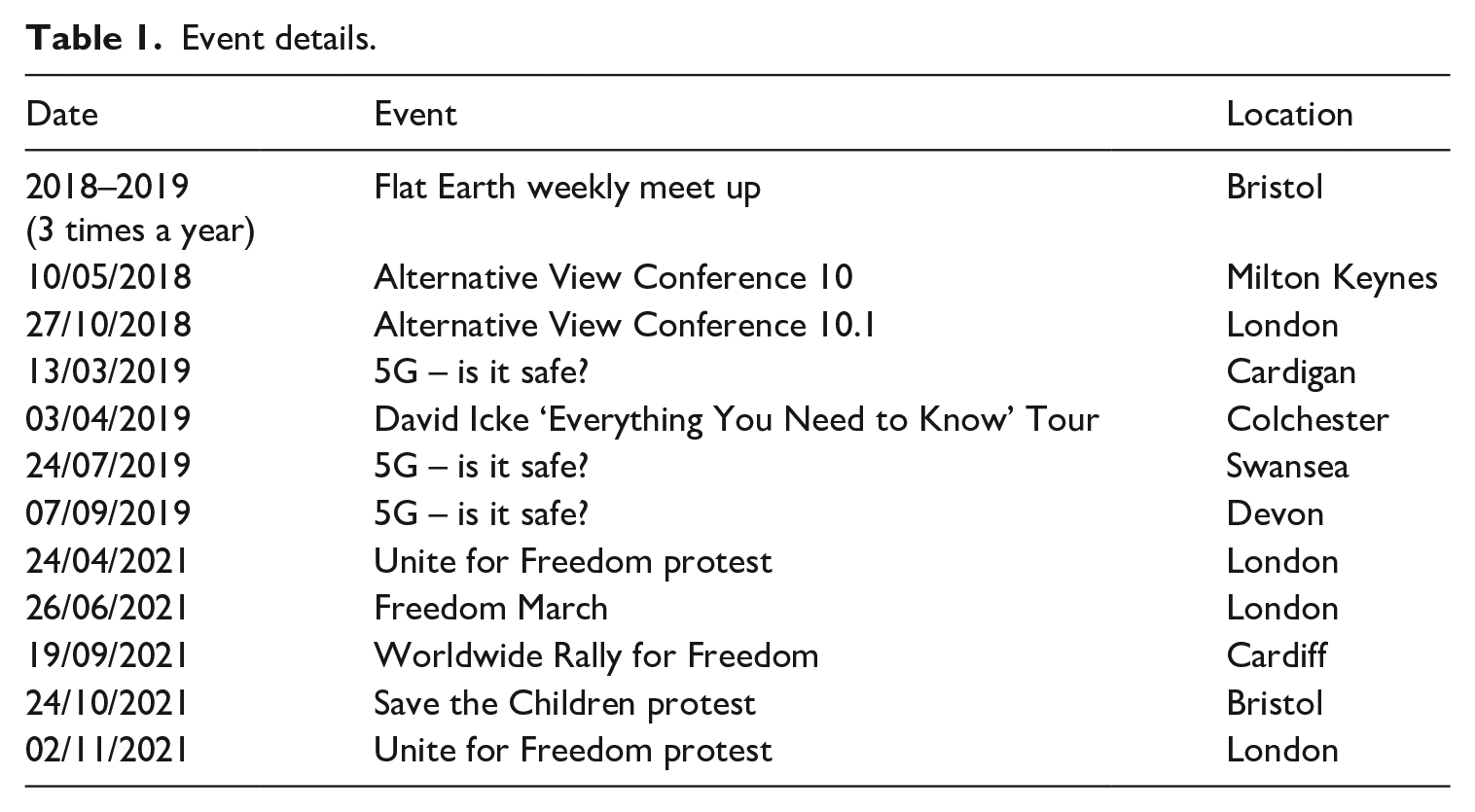
During the second stage of data collection (2018–2022), we immersed ourselves in various events organised by conspiracy theorists, attending public meetings, conferences and protests across various sites (see Table 1). Authors one and two became participant observers at events where activists worked to convince audiences of the importance of their causes (Halford, 2023; McCarthy and Zald, 1977). Our priorities were theoretically informed, aiming to observe the contextual conditions in which conspiracy theories resonated, and to understand how these led to participation in conspiracy movements. We were initially apprehensive about approaching groups often depicted as delusional, dangerous and angry (Harambam, 2020). However, these feelings were assuaged at events where people were welcoming and enthusiastic. This social quality of these contexts became key to our findings.
Event details.
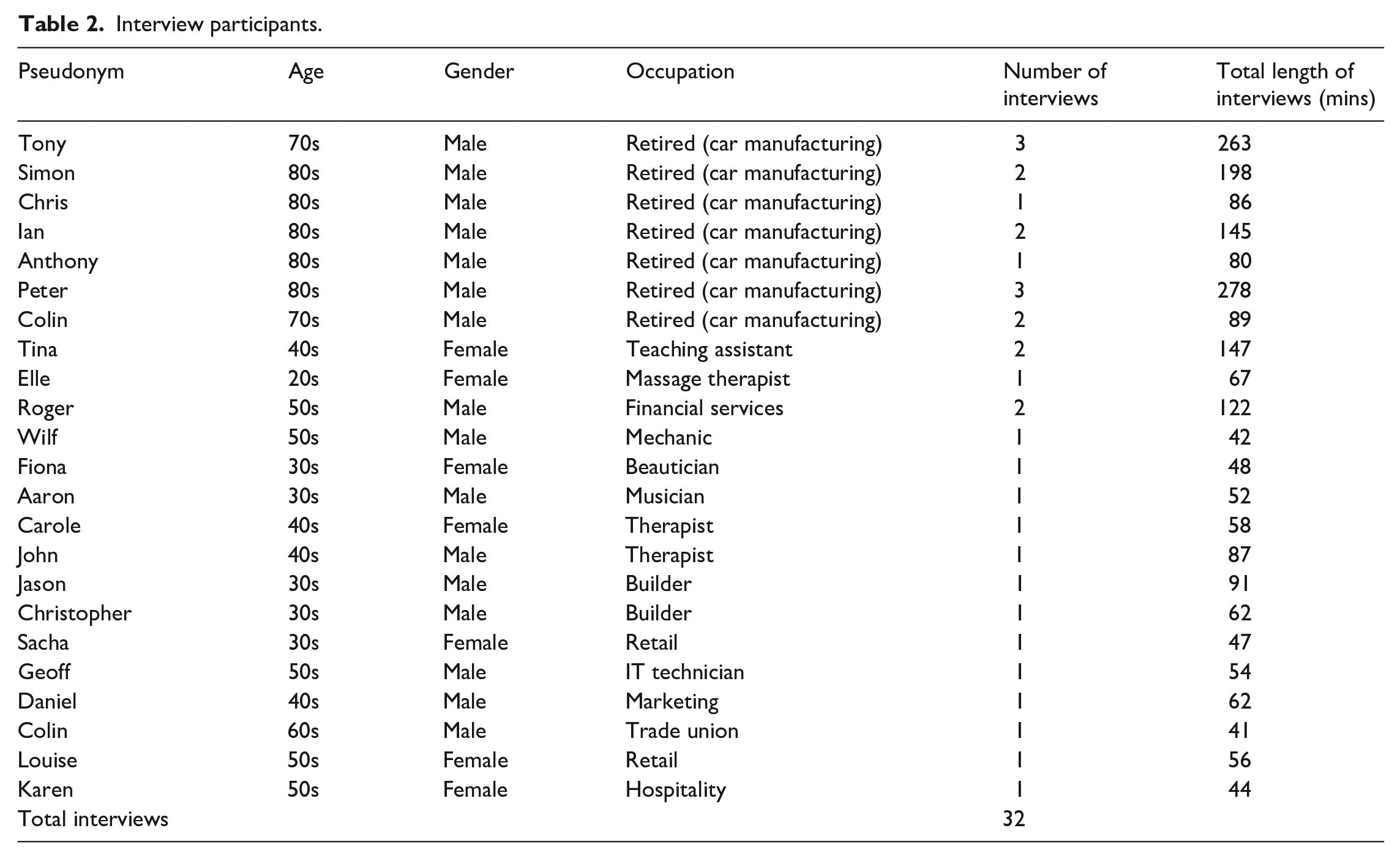
Participant observation allowed us to invite participation in semi-structured interviews (see Table 2). Interviews were conducted in-person, audio recorded and transcribed. Interviews sought autobiographical accounts to uncover significant experiences in explaining participants’ rejection of epistemic authorities (Szczepanik and Siebert, 2016). Often, interviewees spoke about their awakenings without being prompted. We probed interviewees for processual details asking how their awakening unfolded, with whom and what transpired afterwards. Ultimately, our data collection generated 32 interviews with 23 participants, 362 pages of participant observation fieldnotes and 105 photographs.
Interview participants.
Data analysis was informed by resonance theory (McDonnell et al., 2017; Rosa, 2019). Authors one and two coded the data together. Our first round of coding identified three varieties of resonance (Park et al., 2021), which revealed experiences where people grew suspicious towards epistemic authorities; where conspiracy theories resonated; and where they became committed to protest as part of conspiracy movements. We labelled these as emotional, epistemic and activist resonance. Author three triangulated coding and interpretations, and key participants were contacted to member-check final interpretations (Tracy, 2010).
Findings
Our findings explain how awakenings unfold during sequential experiences of resonance. We start by explaining how awakenings often begin with experiences of emotional resonance where the perceived failures of epistemic authorities trigger suspicion and anger. Following this, we explain how awakenings continue through epistemic resonance, where people identify with others through shared use of conspiracy theories to explain the failures of epistemic authorities and point blame at particular targets. Finally, we show how activist resonance engenders ongoing participation in conspiracy movements that challenge the expert authority of social and government authorities.
Emotional Resonance
Awakenings often begin as experiences of emotional resonance, where feelings of shock, anger and distrust towards epistemic authorities motivate people to search for explanations. Many of our participants recall such interactions with epistemic authorities including state and medical bodies. For instance, Chris (80s, male, retired) explained how his awakening began during automotive industry job losses in which he witnessed ‘little in the way of government help and support despite their promises. . . We were stranded, ordinary people and we were left stranded. I was in shock; I had to wake up.’
Peter (80s, male, retired) too described a similar trigger to his awakening when he lost trust in the epistemic authority of the health service. He explained how the unexpected death of a family member prompted initial feelings of sadness, and anger towards medical staff, but that this gradually turned to suspicion towards the broader medical system:
One thing that brought things home, really started to get me questioning things, was an experience that showed the medical system cannot be trusted. I have no problems with the people who work in the NHS. [. . .] But having loved ones, someone in my family, pass on because of some Consultant’s poor decision, which left us heartbroken. We were sad and angry, and it made me lose faith in the medical system. They cannot be trusted. [. . .] We rely on these people to look after us, but they get things wrong. That’s when I began questioning things and started doing my own research.
Peter describes how his feelings of anger and suspicion initiated a quest for knowledge (DeGloma, 2014). Indeed, he went on to discuss feeling that ‘something about it did not feel right at all. I had to start searching for real answers, to properly study what went wrong.’ Chris’ and Peter’s descriptions confirm how awakenings are primed by contextual conditions (Harambam, 2020; Melley, 2022). In this case, the declining British automative industry, plus a health service under increasing pressure, provided contextual conditions for failures that primed their suspicions. Unlike depictions of sudden, religious conversions (James, 1902), however, the ‘truth’ concerning such events does not come to our participants ex nihilo. Rather, Chris describes actively ‘having to wake up’, and Peter recalls feeling compelled to go searching for answers.
It follows that participants described being motivated to embark on a quest for knowledge (DeGloma, 2014), what Peter – like many conspiracy theorists – describes as ‘doing his own research’. Across a variety of contexts, a suspicion of epistemic authorities drives the pursuit for the truth by finding and sharing alternative explanations and sources. Elle (20s, female, massage therapist) for instance, discussed how her distrust of medical authorities resulted in an emotionally driven search for answers:
As I began to deal with the fact that those in power cannot be trusted, and that the truth is being concealed . . .. I started a long, hard struggle with reality. Once you feel that break with what you are told, you cannot ignore it, but you must wrestle with it and discover the truth. . . I developed my own medical understanding, of discovering what worked for me. . . I read a lot about the pharmaceutical industry, about medical discoveries being hidden away. It took time to make sense of things, but that emotional wake-up call was the starting point.
In contrast to explanations that treat awakenings as bounded moments (Barkun, 2013; Butter and Knight, 2015), our findings show how awakenings unfold stepwise. In this case, emotional resonance motivates action. Chris for instance recalled how his emotions of distrust were energising, and he described the ‘freedom that came with coming to terms with what I felt, that I could no longer trust anyone or anything. I embraced that search for answers knowing I was on the search for the real truth’. Chris’ response recalls how narrative resources are more likely to resonate when they explain or help solve personal and emotional experiences (McDonnell, 2023; Rosa, 2019). In the next section, therefore, we describe how the answers provided by conspiracy theories trigger epistemic resonance, where individuals’ emotional experiences are shared and validated.
Epistemic Resonance
Awakenings continue through epistemic resonance, where conspiracy theories validate suspicions towards epistemic authorities. Recalling how resonance is an experience of discovery that transpires when narrative or material resources offer answers to problems (McDonnell et al., 2017; Rosa, 2019), Peter describes how anti-5G conspiracy theories offered clarity around his fears and suspicions as to the damaging effects of these radio frequencies. He describes conspiracy theories as enabling him to ‘truly access the way the world really works. You can see for the first time who is really behind everything that happens. . . It was as if a light was switched on in my head and I could see things clearly.’
Personal experiences of discovery become social through narrative and material resources that are designed to be shared. Films like Plandemic (2020), for example, bring conspiracy theories to life with slick production techniques, and good-versus-evil narratives that lend them the feel of documentary films (Boltanski, 2014; Melley, 2022). Like Peter, Elle uses enlightenment metaphors (DeGloma, 2014) to describe how the film led her to believe that COVID-19 was deliberately coordinated by powerful groups of ‘deep state’ actors: ‘My friends and I, we see the world now through a new set of eyes. The pandemic made us see the light, to see the truth. It was like a revelation.’ Experiences of resonance often occur when narrative or material resources explain and offer answers to problems (McDonnell et al., 2017; Rosa, 2019), and in Peter’s and Elle’s cases, conspiracy theories resonate by explaining novel and problematic events such as lockdowns.
In contrast to the public image of conspiracy theorists being isolated ‘keyboard warriors’ (Polipo and Willemsen, 2023), epistemic resonance occurs among groups where interpretations are discussed and emotions intensified (McDonnell et al., 2017). Although little in the way of formal organisational hierarchies and roles exist in conspiracy theory movements, some enthusiastic participants draw on their ‘social and information capital’ (Hill et al., 2018: 704) to establish social platforms for conspiracy movements, administering social media pages, establishing agendas and encouraging participation. These ‘soft’ leaders (Hill et al., 2018; Turner and Millward, 2024) also bridge offline and online domains, disseminating flyers to gather people at face-to-face social events (see Figure 1). The following fieldnotes taken at an anti-5G event, for instance, reveal how personal testimonies allow people to ‘recognise the connected nature of their personal experience’ (Sowards and Renegar, 2004: 542):
The church hall was buzzing. As people enter the room, they grab fact sheets about the dangers of 5G. . . . After a rousing applause, the campaigner opens with a story about a family member who was diagnosed with a brain tumour. ‘It was devastating. But that was why I started doing my own research and that’s how I found out about the dangers of 5G.’ He invites the audience to share their stories. We hear of ongoing headaches undiagnosed by doctors. One by one, attendees stand up to tell others about unexplained ailments, and how they feel ignored by the medical profession. After 30 minutes of people discussing their circumstances, the campaigner offers his thoughts. He presents his evidence – a supposed scientific paper, redacted technical documents, and a popular YouTube video made by an American scientist – about how governments and global telecom companies suppress the truth about the known dangers of 5G. ‘Can you believe it? It’s shocking! I had no idea it was this dangerous’, an audience member whispers after the campaigner explains the risk to children, pregnant women, and elderly. (Author one, Fieldnote)
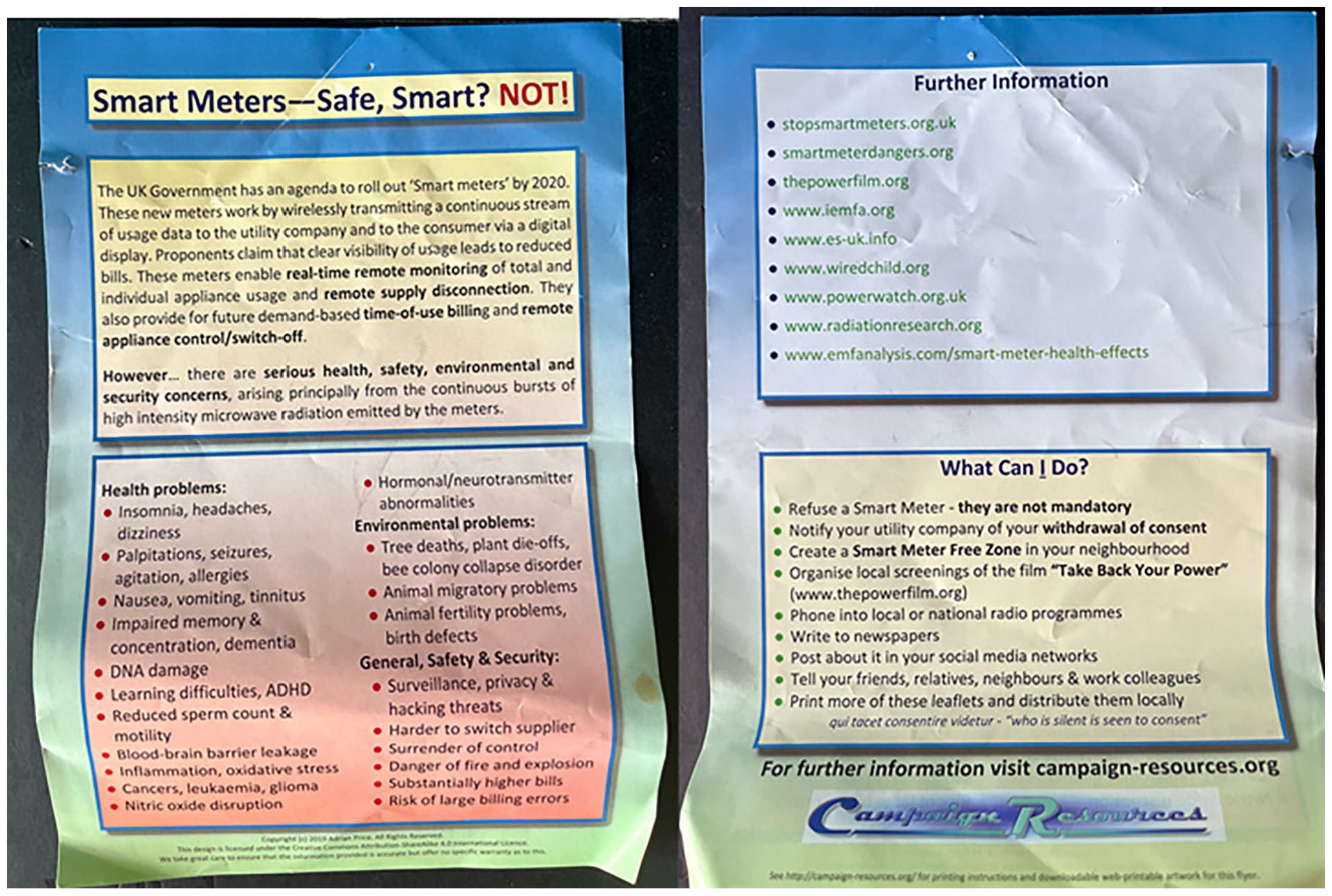
Flyers distributed at Swansea anti-5G event – 24 July 2019.
Resonance can be enhanced in group settings, where collective interpretations and elaboration take place (McDonnell et al., 2017). The anti-5G event (see Figure 2) is a particularly good example of how group settings can enhance resonance when people experience shared emotions (McDonnell et al., 2017). In this case, shared suspicions about 5G technology causing ailments gave rise to an intensifying level of excitement and anger towards the epistemic authorities held up for blame. In this way, people become ‘emotionally entrained’ (Collins, 2004: 87), feeding off each other’s emotional responses, sharing embodied rhythms as they clap and vocalise together. Moreover, interactions like these create a sense of atmosphere and solidarity (Collins, 2004); indeed, our fieldnotes describe how the ‘energy in the room is positive at the end of the presentation, as if they have been provided a clear, definite answer for once’ (see Figure 2).
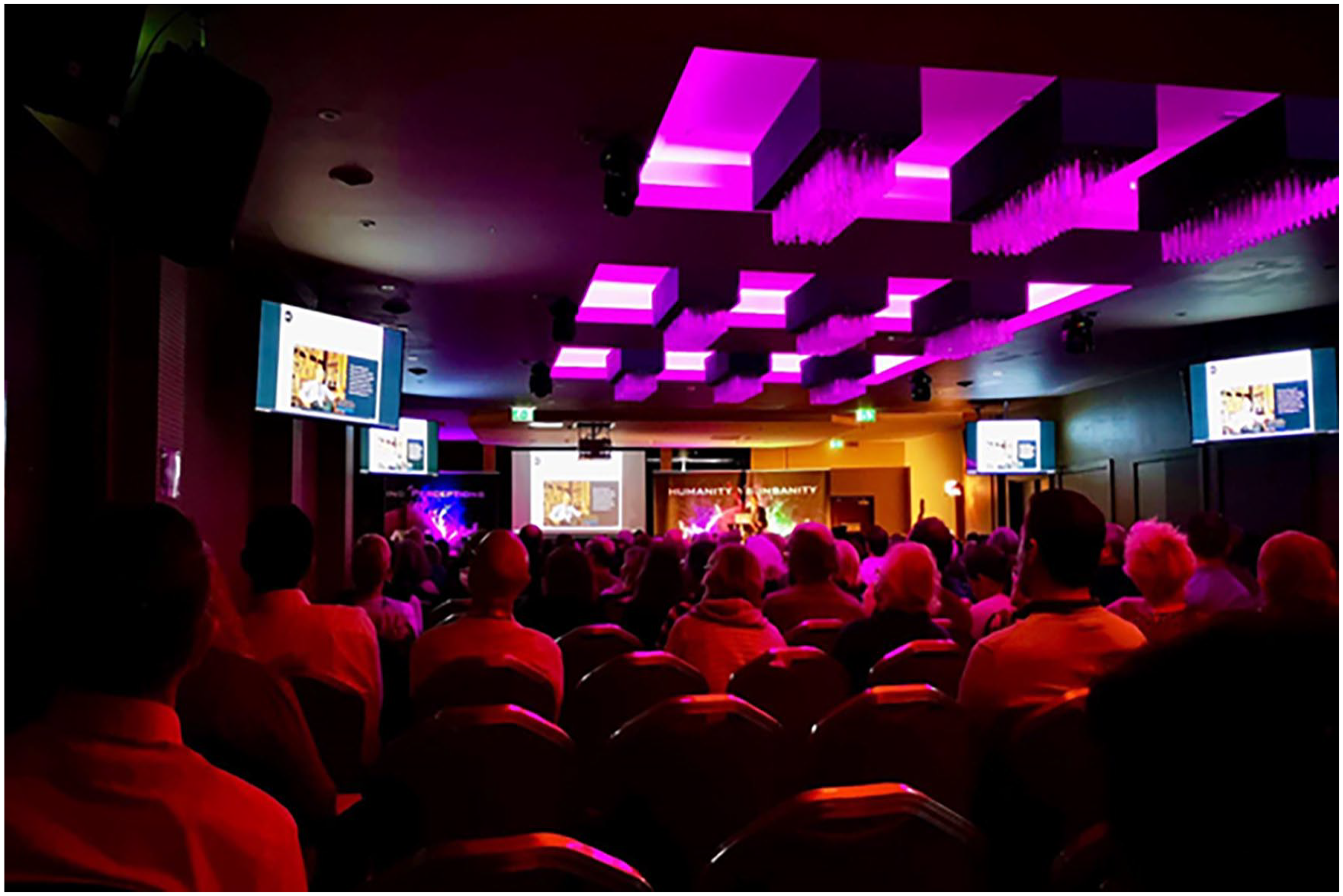
The audience at Alternative View 10.1 – 27 October 2018.
Beyond face-to-face contexts, epistemic resonance also occurs in online social networks. Facebook, Discord and Telegram are popular platforms where conspiracy theories are shared and discussed (Butter and Knight, 2020). Here, similar group processes intensify interpretations and shared emotions when people watch conspiracy theories together. Elle, for instance, details how she ‘woke up with her friends’ when they watched the film Plandemic (2020):
When it was released on Facebook, my friends and I shared it immediately. We watched it on the same night, to make it a shared event. I put it on the TV and my housemates and I watched it while I was messaging friends. Lots of shock face emojis and devil emojis [. . .] We are always sharing our thoughts with each other, sending links to interesting ideas. Most times we send things that others have already seen, because we’re involved in the same scene, same communities. [. . .] We were reacting to the bits of the film that chimed with our thinking, like about the potential origins of this, about the whole animal origin story being a lie, and the pandemic is a controlled event to sell vaccines to countries.
For Elle, Plandemic (2020) validates shared suspicions towards governments and health authorities during COVID-19. Moreover, by watching the film together, Elle and her friends actively interpret the narrative offered, drawing connections between the film’s claims and their own experiences, thus boosting their experience of resonance (Harambam, 2020; McDonnell et al., 2017). By sharing memes and emojis, participants can establish ‘emotional entrainment’ in online environments (Collins, 2004: 87; DiMaggio et al., 2017). Energised by the shared belief they have uncovered a ‘hidden truth’ suppressed by epistemic authorities, people begin to see themselves as engaged citizens (Barkun, 2013).
For example, having experienced the clarity of epistemic resonance, participants like Jason (30s, male, builder) described how he felt ‘energised to discover more, to join the dots, to do my own research and, ultimately, do something about it’. Epistemic resonance plays an important role in mobilising support for conspiracy movements since conspiracy theories frame alleged conspirators as targets, which is often an important aspect of mobilisation (Benford and Snow, 2000; Halford, 2023). In the next section therefore, we explain how experiences of activist resonance further involve people in the development and production of conspiracy theories as well as in forms of protest.
Activist Resonance
During activist resonance, people commit to collective action intended to challenge the epistemic authorities and institutions targeted for blame. For many, this begins with what conspiracy theorists call ‘doing their own research’. Here, claims made by conspiracy theories are compared and confirmed with online sources (Birchall and Knight, 2022). Tina (40s, female, teaching assistant) for example, described how she rejected mainstream media after ‘waking up’ to claims that 5G technology is a weapon for depopulation:
I did my own research. To confirm, to check, to do due diligence. And straight away, Agenda 21 and depopulation: UN’s agenda to depopulate the world. 5G is part of that plan, it’s all part of their strategy! And the warning signs in the video were all true. There is all this scientific material out there, if people just woke up and stopped listening to the media, they’d see how 5G isn’t harmless – it isn’t a simple technology. . . . Non-ionising radiation, electromagnetic fields: it was banned in Brussels!
By accessing technical reports and engaging with primary data, ‘doing your own research’ enables Tina and others to reach beyond official or accepted explanations and understandings of events (Collins and Evans, 2019). Yet given how resonance motivates people to act in ways that conform with the worldviews offered by narratives (McDonnell, 2023), it is unsurprising that such practices are generally limited to accessing sources that confirm conspiracy theories (Dentith, 2018). Indeed, rather than following principles of falsification that guide scientific research (Collins and Evans, 2019; Popper, 2015), the online groups that we observed most often favoured sources that confirmed beliefs about the dangers of 5G and how this technology is furthering the political agendas of powerful groups.
This task is facilitated by online ‘infoglut’ environments (Andrejevic, 2013), in which heterodox scientific research 2 and ‘conspiracy influencer’ media sources are freely available for people to ‘verify’ claims made by conspiracy theories. For instance, during the COVID-19 pandemic, a conspiracy theory that 5G ‘triggered the virus’ resonated with some audiences (Birchall and Knight, 2022) who then sought information to support and extend this explanation for the novel problems and failures of public policy that accompanied the pandemic. In so doing, moreover, people are afforded opportunities to assume the identity of ‘heroic figures’ (Boltanski, 2014: 126) and experience the thrill of ‘revealing what is really happening, as part of a proper community’ as Geoff (50s, male, IT technician) explains.
It follows that activist resonance can extend beyond merely sharing and confirming existing conspiracy theories. Rather, conspiracy theorists add to pre-existing narratives by exploiting what Fiske (1989) calls narrative ‘gaps’. These leave space for people to explore personal topics of interest, address unfolding events and propose solutions to unsolved problems (Barkun, 2013; Boltanski, 2014). Take Anthony (80s, male, retired) for example: following his experience of epistemic resonance through which he had come to believe that global affairs are determined by the Bilderberg Group, he began writing his own contrarian histories. Specifically, by drawing on his personal interest in the automotive industry, he produced novel ideas and information that add further details within the overall narrative of a more general conspiracy theory:
Sitting at his computer desk, Anthony explains how a documentary about the Bilderberg Group made him ‘see the light’. As he talks through the consequences of this transition, he hands us images that he has printed out, containing jottings and Post-it notes. ‘It’s all there. You need to do your own research.’ This research is personal. It speaks to his fascination with mysteries in the car industry, such as the unsolved death of the diesel engine’s creator, Rudolf Diesel, who he claims was ‘killed by a group of powerful men who decide the course of history’. He explains how he is putting together more evidence to demonstrate ‘he was too much of a threat, so he needed to go’. [. . .] His plan is to send a draft of a blogpost to a friend, before then recording a self-narrated video to post on YouTube. (Author two, Fieldnote)
In lending themselves to popular production (Jenkins, 2006), conspiracy theories afford further opportunities for the kinds of group activities that enhance the epistemic resonance we described above. In particular, activist resonance establishes a situation in which the more ‘research’ people do, the more real their worldviews become, and the more shared participation is made possible, all of which strengthens beliefs that a conspiracy has taken place (Luhrmann, 2020; McDonnell, 2023). As part of local and online communities, Christopher (30s, male, builder), praises those who participate in providing new information and ideas, as well as the level of support he receives as he shares his own information:
There’s a community of us. I was never big into Telegram but there’s so much good stuff on there, lots of good people doing excellent research, keeping discussion going. [. . .] We send links to one another, saying ‘have you seen this yet?’. And videos will get shared to others [. . .] There’s a lot of support out there for people who are doing their own research. It’s a group of us, there is always someone wanting to hear more, building on the work of others, giving each other support. There’s a real buzz in this community.
Recalling how experiences of resonance are energising, Christopher’s description of this ‘buzz’ confirms how group settings can intensify shared emotions and group identity, as people interact in a mutually supportive manner (Collins, 2004; McDonnell et al., 2017). Moreover, such group resonance can motivate people to take actions that are inspired by these novel ways of seeing the world (McDonnell et al., 2017). Particularly when conspiracy theories point the finger of blame towards alleged conspirators, they also provide possible answers for what is to be done in response (Melley, 2022).
For instance, Roger (50s, male, financial services) explained that his epistemic awakening left him with a ‘realisation that conventional politics is a circus, a media spectacle. Real change happens inside [points to his chest] but also in protest, on the streets.’ Recalling the most general goals of social movements to challenge and transform structures of power through protest (Martin, 2024), activist resonance sees people who have experienced a transformation in worldview – which Roger calls an ‘internal change’ – seeking to participate in direct action to subvert alleged conspirators (Halford, 2023).
Just as social media is used to share and develop conspiracy theories, it also offers spaces where collective action is organised (Castells, 2015). Like other social movement organisations, protests are arranged by ‘soft’ leaders of semi-formalised groups (Halford, 2023; Hill et al., 2018). These groups afford coordinated action and the sharing of information about potential protest opportunities (Lee, 2015). Indeed, having experienced emotional and epistemic awakenings, these groups comprise sympathetic audiences (Jasper, 2014) already convinced that a conspiracy has taken place, as these fieldnotes demonstrate:
The message came over self-described ‘pro-civil rights’ group Stand Up X’s Telegram channel for people to assemble at 9am this Saturday on a vacant car dealership forecourt due to its proximity to a planned vaccination centre. The yellow placards used at previous protests would be available, but group members encouraged people to bring their own. . . It is a motley crew of protestors – there are the familiar faces, the yoga teachers, dance instructors, tattoo artists and YouTubers who have brought cameras and drones to live stream and record the protest, around 50 people in total. Over a loudspeaker, Gary directs everyone to group up and line the road, where we are to initiate conversation with shoppers and those stuck in traffic about the ‘pandemic being a hoax to strike fear into people’, that ‘vaccines are dangerous and untested’. But there is little message discipline. People’s own pet theories take precedence over Gary’s suggestions. One trio attribute the pandemic to 5G, but they are met with confusion as passers-by are not aware of what 5G is. Despite some being nonplussed, protestors remain in good spirits. . . On the Telegram channel later, people declare the protest a success: ‘we definitely woke a few people up this morning!’ (Author one, Fieldnotes)
Protests such as these recall the risks of self-mobilising movements (Lee, 2015) where social media facilitates the coordination of collective action among engaged activists: the more diverse the mobilisation, the harder it is to coordinate and align its statements (Jasper, 2014). While the protest is composed of diverse individuals, among whom frame alignment is problematic, participants are nevertheless united through a shared desire to expose and subvert alleged conspirators (Halford, 2023). As such, rather than diminishing the efficacy of protest, the diversity of concerns incorporated by conspiracy theories were able to mobilise widespread support for disruptive protests against COVID-19 restrictions.
Moreover, by offering a clarity of vision that motivates action, awakenings become sustained experiences of resonance that do not fizzle out (McDonnell et al., 2017). Indeed, for some, this willingness to engage in disruptive protest is sustained at the expense of long-term relationships with family and friends (DeGloma, 2014). Roger explained that ‘difficult conversations have been had with my wife and my kids, about the questions I’ve asked’. Confirming his level of commitment to conspiracy theories and activism connected to these, Roger ultimately became estranged from his family and received a criminal conviction following his involvement in anti-lockdown protests.
Discussion
Current research describes the importance of awakenings as moments during which people start believing in conspiracy theories (Butter and Knight, 2015; Harambam, 2020). However, sociological studies have stopped short of explaining the social features of awakenings and how awakenings can mobilise conspiracy movements. By heeding calls to study conspiracy theories ‘in the wild’ (Butter and Knight, 2015: 27) and to generate empirical insight into the ‘lived realities of people for whom conspiracy theories make sense’ (Harambam, 2020: 21), this study offers an ethnographic account of how conspiracy theories resonate, engendering popularity, participation and protest (Halford, 2023). Specifically, we show that conspiracy theories resonate during emotional, epistemic and activist interactions that together comprise resonant awakenings. We now develop and explain our conceptualisation of resonant awakenings, and discuss implications for social scientific understandings of how people become conspiracy theorists. We then explain how resonant awakenings provide novel insight into how conspiracy movements mobilise (Halford, 2023). Finally, we discuss how our findings extend sociological theories of resonance (McDonnell et al., 2017; Rosa, 2019).
Resonant Awakenings
Prior research describes waking up and seeing the light (Harambam, 2020) as sudden epiphanies that transform people’s worldviews (Barkun, 2013; Butter and Knight, 2015; DeGloma, 2014; Harambam, 2020). In so doing, awakenings are represented as ‘elevator-like’ experiences involving an ‘expedited ascent to a new higher level of consciousness’ (DeGloma, 2010: 530). In contrast, we view awakenings as more ladder-like, occurring over extended periods and in a variety of social contexts. For many, the first step on this ladder is an experience of emotional resonance where the perceived failures of epistemic authorities trigger feelings of shock, anger, distrust and suspicion. Recalling how resonance is an energising experience (McDonnell, 2023; Rosa, 2019), emotional resonance can result in feelings of purpose and interest in explaining the problems that people have encountered.
Further to this, the emotional charge resulting from emotional resonance often motivates action along new directions (McDonnell et al., 2017). For some, this involves experiences of epistemic resonance, where people begin doing their own research. Here a search for explanations to the problems and crises that stimulated emotional resonance is fulfilled by contentious knowledge that explains problematic events as conspiracies led by powerful groups (Tan, 2021). In these instances, conspiracy theories resonate because they offer ways of thinking about intractable, often complex problems (McDonnell et al., 2017). Importantly, our research shows how conspiracy theories are often encountered in groups where collective interpretations and discussions take place. As people puzzle through problems and discover explanations together, epistemic resonance is enhanced (McDonnell et al., 2017; Rosa, 2019), and feelings of group identity are generated as thoughts, emotions and actions become aligned (Collins, 2004; DiMaggio et al., 2017).
This sense of shared identity can stimulate activist resonance that fosters ongoing participation in conspiracy movements (Halford, 2023). Experiences of resonance encourage people to act in ways that are guided by these novel ways of seeing the world (McDonnell, 2023). This can range from sharing sources and producing new conspiracy theories, to organising events and taking part in protests. Importantly, activist awakenings may enhance the perceived reality of conspiracy theory worldviews, strengthen beliefs and potentially build commitment from casual interest towards participation and protest. Contrary to the view that depicts conspiracy theorists as isolated outsiders whose communications are rife with disagreement (De Wildt and Aupers, 2024), or stereotypes of a ‘bunch of delusional and angry minds’ (Harambam, 2020: 19), our findings illustrate a thriving and supportive social scene in which people come to feel that they are better informed about the workings of the world and are ready to take action. This being the case, our conceptualisation of activist resonance helps to explain how collective action and protests are ‘guided by resonance and directed at large-scale social change’ (Masquelier, 2020: 860).
Participatory Resources and Transformation
By taking a processual approach to awakenings, we also address opportunities to extend theories of resonance. McDonnell et al. (2017: 10) argue that ‘we need to better understand how resonance leads to transformation, reproduces the status quo or fizzles out’. Addressing this call is important when considering how many resources resonate without resulting in lasting transformation. For instance, studies show how compelling animal advocacy documentaries regularly resonate with audiences, and yet still do not result in people adopting these resource’s solutions, that is a plant-based diet (Hartwell et al., 2022).
Our findings explain that while epistemic resonance can provide an initial experience of lucidity where people see the world anew (McDonnell et al., 2017; Rosa, 2019), resonance is sustained through ongoing actions. In particular, the participatory qualities of conspiracy theories shape lines of action people subsequently pursue (Jenkins, 2006). Because conspiracy theories are typically encountered in digital contexts, our findings show that people are afforded many opportunities to take part in the ongoing production of further information and ideas that reproduce conspiracy theories. Moreover, in the absence of genuine expertise, assessing data, refuting claims and distinguishing trustworthy from untrustworthy sources is a difficult task (Levy, 2022), such that epistemic resonance is often self-confirming.
In short, our research shows conspiracy theories are not only narrative resources that enable people to make sense of complex and uncertain social events (Boltanski, 2014; Harambam, 2020; Melley, 2022). Rather, their participatory quality allows people to continue to question the official, dominant version of events produced by a range of epistemic authorities. Furthermore, the additive social activities that conspiracy theorists enjoy reinforce the perceived reality of these worldviews, giving rise to a community of believers who become committed to subverting alleged conspiracies. In this way, our research extends theories of resonance by showing personal transformation relies less on what a resource represents (Boltanski, 2014; Harambam, 2020) and more on how resources make certain kinds of action and interaction possible. In terms of these possibilities, we now discuss how resonance can stimulate conspiracy movements.
Awakenings and Conspiracy Movements
Our conception of resonant awakenings not only helps to explain how ‘people transition from an unknowing citizen to a conspiracy theorist’ (Harambam, 2020: 137), but the potential for increasing commitment, such as involvement in activism (Halford, 2023). A problem with viewing conspiracy theorists as isolated outsiders is that this perspective glosses over the possibility for group action based on mutual beliefs in conspiracy theories (Fenster, 2008; Knight, 2000). However, confirming recent perspectives on ‘conspiracy movements’ (Bertuzzi, 2021; Halford, 2023), we find conspiracy theorists taking part in disruptive protests intended to expose and subvert alleged conspirators. Our research extends this line of research by answering questions as to how conspiracy movements mobilise.
We explain how conspiracy theories can mobilise movements through resonant narratives that offer novel ways of experiencing and relating to ‘the world, towards people and things, events and the future’ (Rosa, 2019: 180). Specifically, the emotional, epistemic and activist components of resonant awakenings make mobilising conspiracy movements possible. By triggering anger and outrage, emotional resonance offers the kind of affective motivation to take part in protest action (Castells, 2015). Moreover, epistemic resonance plays an important role in mobilising support for conspiracy movements since they identify those who are to blame, a common move in movement mobilisation (Halford, 2023; Jasper, 2014). Activist resonance illustrates how the participatory qualities of conspiracy theories enhance commitment to these worldviews, catalysing the possibility to organise protests.
In this respect however, we found little active recruitment of sympathetic audiences (Jasper, 2014). Resonant awakenings create a pathway to mobilisation akin to what has been theorised as ‘self-mobilisation’ (Lee, 2015), where participants in the movement act as ‘soft-leaders’ tying together small pre-existing organisations and interest groups at events where people are able to share their testimonies and experiences (Halford, 2023; Hill et al., 2018). In extending a view of conspiracy movements as motivated by resonant awakenings, our research also extends insight into the cultural and narrative features of social movements.
In contrast to the more rational perspectives familiar to resource mobilisation (McCarthy and Zald, 1977) and framing perspectives (Benford and Snow, 2000), social movement studies have begun to emphasise the narrative resources that motivate engagement in protest politics (Martin, 2024). Specifically, resonance theory points to how narrative, material and symbolic resources stimulate attention and motivate action (Abrams and Gardener, 2023; Davis, 2002). More particular to our case, conspiracy theories represent an often-irrational set of narrative resources capable of engaging a diversity of political outsiders. In other words, unlike social movements that engage members in political processes (Jasper, 2014), conspiracy movements benefit from narratives that establish a ‘big tent’ under which a variety of worldviews can coexist.
Accordingly, in contrast to canonical models of social movement progress, where frame alignment and disagreements can thwart progress (Benford and Snow, 2000), these cultural resources offer an immersive quality capable of bringing together diverse activists (Halford, 2023). The immersive quality of QAnon, for instance, brings together yogi-mama Instragrammers with doomsday preppers (Bloom and Moskalemko, 2021; Overwijk and de Zeeuw, 2023). Likewise, our findings describe how 5G conspiracy theories mobilised ‘wellness’ entrepreneurs with libertarians. Halford (2023) explains that conspiracy movement activists share the belief that a conspiracy has occurred, and it must be exposed but also have varying interpretations of exactly how or why the conspiracy took place. In other words, conspiracy movements are less concerned with rigorous logic, and more with blame and action.
Finally, our conceptualisation of resonant awakenings may stimulate further research to explain other kinds of personal transformation and group participation that mobilise forms of activism and protest politics. To be sure, allegations of conspiracies and collusion are not always false (Boltanski, 2014), and to this end, our perspective may enhance research that investigates personal and social responses to apparent collusion in industrial, political and cultural life (Butter and Knight, 2020). While some such instances, such as the recent Horizon IT scandal resonate with publics, leading to widespread outrage, protest and legal responses, other crises of institutions and leadership fail to sustain attention or provoke action. Exploring further processes of resonance in other instances of social movement organisation may shed light on the conditions under which resistance and activism are likely to transpire.
Conclusion
This study explains how conspiracy theories are experienced and put to use by groups of people. Belief in and commitment to conspiracy theories builds through extended social processes that we conceptualise as resonant awakenings. For many, these processes begin with experiences of emotional resonance that raise questions over the perceived failures of epistemic authorities. Conspiracy theories resonate by answering such questions, yet beyond pragmatic accounts that emphasise conspiracy theories as problem-solving resources (Boltanski, 2014; Harambam, 2020; Melley, 2022), we show how epistemic resonance involves behavioural and emotional entrainment that builds collective identification and a sense of community among conspiracy theorists. This social side of conspiracy theories is enhanced by the participatory affordances of these narrative resources and the media platforms on which they are shared. These features of the social contexts in which conspiracy theories are experienced also encourage activist resonance, where the production of novel ideas engenders a self-reinforcing cycle of action and belief. In contrast to studies suggesting conspiracy movements are too leaderless, diverse or disinterested in activism (Fenster, 2008; Knight, 2000), activist resonance can culminate in the mobilisation of conspiracy movements that challenge state and social institutions through forms of protest and direct action.
Footnotes
Funding
The authors received no financial support for the research, authorship and/or publication of this article.
