




Abstract
Building on research establishing social class origin pay gaps within higher managerial and professional occupations, using a national survey of 3336 higher managerial and professional workers in the United Kingdom, this article documents social class origin gaps in an index of non-pay aspects of job quality. This study finds that those from lower social class origins have a greater propensity to cluster within those higher managerial and professional occupations that generally have higher job quality but are lower paying. However, they have lower job quality than their higher social class origin counterparts through occupying lower quality jobs within occupations. None of the penalty associated with lower social class origins can be accounted for by a rich set of observed factors. Given the centrality of job quality to health and wellbeing, we conclude job quality must factor into research and debates concerning the long shadow of socio-economic background on life chances.
Keywords
Introduction
Social class (often measured by occupation) has traditionally been viewed as the backbone of the social stratification system in sociology (Grusky and Ku, 2008). Social classes represent enduring positions of socio-economic advantage and disadvantage, often transmitted between generations within families. For at least 125 years, studies have been statistically documenting the uneven propensities of entering different occupational positions depending on the occupational position of one’s parent(s) (Heath and Li, 2024: ch. 2). Intergenerational social class mobility is not just an indicator of the extent to which socio-economic advantage and disadvantage is transferred between generations, but also one of how socially open or closed a society is. Across a number of countries, a more recent development has been documenting the pay penalty faced by those from lower social class origins (defined in terms of parental occupation) within the most advantaged occupations (Bernardi and Gil-Hernández, 2021; Hällsten, 2013; Laurison and Friedman, 2024; Mastekaasa, 2011). This strand can be viewed as extending the intergenerational social class mobility literature to better understanding how socially open or closed the top or most senior levels within the most advantaged social class are to those from different social class origins.
Findings from the UK reveal substantial pay gaps according to social class origin within higher managerial and professional occupations (e.g. doctors, solicitors, accountants). Those from lower social class origins who had attained such occupations were observed to earn 17% less on average than those from higher managerial and professional family backgrounds (Laurison and Friedman, 2016). These are important findings because they suggest those from lower social class origins are not progressing to the top or most senior positions within their occupations as frequently as their already privileged counterparts. In this article, we extend this literature on the social class origin pay gaps within higher managerial and professional occupations by exploring gaps in non-pay aspects of job quality.
Our focus on non-pay job quality is a justified extension to this literature for at least three reasons. First, focusing on a single aspect of job quality such as pay, as important as it is, provides an incomplete picture of the mechanisms by which jobs are known to shape life chances. This is especially the case when it comes to health and wellbeing life chances. For instance, research reveals non-pay aspects of job quality such as work–life balance opportunities and job design are more consequential than the financial rewards from work for chronic stress-related biomarkers as well as life satisfaction (Chandola and Zhang, 2018; Chandola et al., 2019; Clark et al., 2018; Green et al., 2024). Second, non-pay job quality is now a policy issue of national importance in its own right, at least within the UK. The Office for National Statistics (ONS) now publishes official statistics on the issue (Baeck and Uzzell, 2022) following a governmental review declaring such non-pay aspects of job quality regulation to be in the purview of government (BEIS, 2017). Nonetheless, while research has illustrated non-pay job quality is highly stratified by occupation, gender and ethnicity (Gallie, 2015; Lindley, 2015; Williams et al., 2024), to our knowledge, it has rarely, if ever, explored disparities according to social class origin, when some of the mechanisms behind class origin gaps in pay imply similar disparities in other important non-pay aspects of job quality too. Third, research shows that although other aspects of job quality correlate with pay, the correlations are generally modest, and sometimes reversed. For instance, job insecurity is relatively even across the pay distribution, while excessive job demands increase with levels of pay (Green et al., 2015). Therefore, social class origin gaps in job quality cannot simply be inferred from what is known about pay gaps, hence the need for a study specifically on non-pay aspects of job quality.
In this article, we explore social class origin gaps in job quality drawing upon 3336 responses by higher managerial and professional workers sampled in the Chartered Institute of Personnel and Development’s (CIPD) UK Working Lives Survey (UKWLS) 2021 to 2023, an annual survey into job quality in the UK. Building on social class origin pay gaps research, we explore the extent to which any observed disparities in job quality between those from different class origins might be accounted for by differences in demographics, human capital, job and workplace factors, and the extent to which disparities are left unexplained. In brief, we find that, although those from lower social class origins have a greater propensity to cluster into higher managerial and professional occupations that generally have higher job quality (albeit lower paying), within these occupations they have lower job quality overall. The magnitudes of social class origin gaps we observe with respect to job quality are somewhere between graduates and non-graduates, on the one hand, and the ethnic majority and minorities on the other, so are of a substantively important magnitude. None of the seemingly superior job quality of those from privileged origins can be accounted for by a rich set of demographic, human capital, job and workplace controls. Our findings provide initial evidence that the social class origin gaps in pay can be extended to non-pay job quality, but the mechanisms are likely more complex and multifaceted. We conclude that job quality must also factor into research and debates concerning the long shadow of socio-economic background on life chances, even within relatively privileged occupational positions.
Social Class Origin and Pay
A longstanding finding in the literature on intergenerational social class mobility is the highly unequal chances of entry into higher managerial and professional occupations by parental class, or social class origin. For instance, in the UK, the odds of those from the highest social class origins attaining such a social class position relative to the lowest social class are 12 times greater than the same odds for those from the lowest social class origins (Heath and Li, 2024). In more recent years, a related research stream has explored the relationship between the ‘long shadow’ of social class origin and various socio-economic outcomes other than social class attainment among adults, sometimes referred to as the direct effect of social origin literature (Bernardi and Gil-Hernández, 2021). Relevant to the present study are the several studies documenting pay gaps by socio-economic background, covering a range of countries including Norway, Spain, Sweden and the United States (Bernardi and Gil-Hernández, 2021; Hällsten, 2013; Laurison and Friedman, 2024; Mastekaasa, 2011).
In the UK, an influential study by Laurison and Friedman (2016) revealed that those from lower class origins within higher managerial and professional occupations earned substantially less than those from higher managerial and professional backgrounds – about 17% less. About half this gap could be explained by various demographic, human capital and job characteristics. This research found that educational qualifications alone explained about a quarter of the gap. This reflects patterns of occupational attainment more broadly. Those from more advantaged backgrounds generally receive greater schooling through parental investment in more expensive residences in catchment areas of better schools, private education and tutors, and are more likely to have parents with higher educational qualifications themselves (Bukodi and Goldthorpe, 2018).These qualifications in turn are used to screen out potential recruits by employers, especially in higher managerial and professional occupations. Laurison and Friedman (2016) also found that those from working-class origins were more likely to work in lower-paying higher managerial and professional occupations such as engineering, the civil service and IT, while those from middle-class origins were more likely to work in higher-paying ones such as law, finance and medicine. These occupational employment patterns also contributed to the pay gaps. Additionally, those from higher managerial and professional backgrounds were more likely to work in larger workplaces and in London, where pay is higher.
Why half the pay gap was left ‘unexplained’ was likely due to a range of factors not typically being included in surveys, and possibly also some being difficult or too numerous to measure in surveys. One factor could be discrimination or bias in recruitment and selection and/or pay awards by employers. As social class origin is not an easily visible characteristic (only a tiny proportion of organisations collect data on it), it is difficult to gauge whether, and to what extent, discrimination or bias may be important for understanding the unexplained component. Some socio-cultural and interpersonal characteristics observable by employers in recruitment and selection, such as interests outside work on CVs (e.g. darts, skiing) and regional accents in interviews, which may plausibly be correlated with social class origin (although the strength of any associations is uncertain), have been shown in the little systematic research on employers to play no meaningful role in employer decisions (Jackson, 2009; Watt et al., 2019).
Socio-cultural and interpersonal characteristics may play a role in career choices and progression, through feelings of ‘cultural fit’ or confidence on the part of the worker, as Bourdieu’s (1990) theory of habitus would predict. Indeed, some qualitative evidence suggests that those from lower class backgrounds are likely to struggle navigating careers in higher managerial and professional occupations due to lower social and cultural capital (Ashley, 2022; Friedman and Laurison, 2019). While as of yet it has been difficult for quantitative studies to fully grasp the reasons behind class origin pay gaps, the two revealing findings from the Laurison and Friedman (2016) study for the present study are, first, the sheer size of the gap they identify, namely double the gender pay gap and treble the differences between the ethnic majority and ethnic minorities. Second, that half of the gap could not be explained by a rich set of factors known to determine pay. The present study aims to establish whether the same two findings hold true for the important concept of job quality.
Social Class Origin and Job Quality
The study of job quality has a long history in sociology, although common usage of the term only emerged relatively more recently, not least because differences in working conditions provide the basis to delineating social classes within the ‘Weberian’ tradition of social class analysis. This approach defines social classes as occupational groupings sharing similar life chances through sharing similar employment relations (Breen, 2005), giving rise to differences in pay levels, job security and prospects for advancement across classes (Goldthorpe, 2007). Industrial sociology additionally focused on the nature of work itself, sometimes known as intrinsic job quality, such as job design and job complexity, often in relation to worker attitudes such as alienation (Blauner, 1964; Kohn, 1976), inspired in part by Marx and Marxian theory. With the emergence of the field of ‘job quality’, different dimensions of working conditions from a range of different fields and disciplines are now commonly studied together. Indeed, job quality is now considered an umbrella term for a family of concepts (Warhurst et al., 2022). We elaborate on these in the section that follows.
A key argument in the job quality literature is that job quality comprises of job attributes that affect health and wellbeing (Felstead et al., 2019), implying that just focusing on socio-economic aspects of work (e.g. pay) would provide an incomplete picture of understanding how work relates to the psycho-social life chances. Indeed, research shows certain non-pay aspects of job quality such as job control are associated with health biomarkers even when income is taken into account (Chandola and Zhang, 2018; Chandola et al., 2019), while life satisfaction research has shown that non-pay job quality is the second most important predictor of it, behind only physical health, and far ahead of household income (Clark et al., 2018; Green et al., 2024).
Given the strong health and wellbeing basis to job quality, some research views job quality on a continuum from low to high quality using an ‘overall’ index (Green et al., 2024; Williams et al., 2020), while other research maintains different aspects of job quality are best studied as distinct domains (Felstead et al., 2019). In the current study, we adopt an index approach to provide the first descriptive overview of social class origin gaps in (non-pay) job quality, although we do provide a brief analysis of the separate components we study.
Our focus is on five non-pay job quality domains common to several national and regional governmental job quality frameworks, such as the UK government’s ‘Good Work’ definition and Scotland’s ‘Fair Work’, and those developed by Eurofound and the Organisation for Economic Cooperation and Development (OECD) internationally. First, job security. As mentioned, influential models of social class make propositions not only about levels of pay but also about stability of income and likelihood of job loss (Goldthorpe, 2007). Second, and closely related are prospective opportunities such as career ladders and career development opportunities, also highlighted in these models of social class. Third, the degree to which one’s job allows opportunities for work–life balance. This is included in job quality definitions because having control over when, how much and from where one works has been shown to improve health and wellbeing in and of itself (Chandola et al., 2019; Felstead and Henseke, 2017). Fourth, is job design, which is a basis for interesting and fulfilling work, and further influences career progression through the development of human capital. While there are many aspects of job design, two influential attributes in Karasek’s (1979) ‘job strain’ model are job demands and job control. Another component of job design highlighted by Blauner (1964), Kohn (1976) and others on early studies of alienation, is that of job complexity. This stream of research highlighted the deleterious effects of the fragmentation and routinisation of work. Fifth, we consider workplace relations. It is well known that workplace relations are important for understanding job satisfaction for instance, with relations with managers being particularly important (Haile, 2023).
The extent to which there are social class origin gaps in non-pay job quality within higher managerial and professional occupations is unknown. Given the critical role job quality plays in understanding health and wellbeing chances, and the policy interest it attracts, we argue understanding how social class origin relates to it is of substantive sociological importance. As with the research of social class origin disparities in pay, our expectation is that those from lower class origins will be disadvantaged relative to those from higher managerial and professional backgrounds, for much of the same reasons posited earlier, even within the relatively advantaged higher managerial and professional occupations (Gallie, 2015; Williams et al., 2020).
One potentially critical mechanism, as with the class origin pay gaps, is through specific occupations and their characteristics. Research has shown that class destination is becoming a stronger predictor of a range of job quality domains over the last few decades in the UK, not just pay (Williams, 2017), but also learning requirements, job complexity, job control, job demands and work–life balance (Gallie, 2015; Williams et al., 2020). Thus, the differential properties of those from different social class origins to be channelled across different occupations within the higher managerial and professional occupations is another possible mechanism. There are also socio-cultural and interpersonal explanations for being channelled into certain higher managerial and professional occupations and certain jobs within them over others. For instance, one of the few studies to explore social class origin and job quality (in the United States context) made the argument that those from higher social class origins prefer higher autonomy jobs, while those from lower social class origins would prefer those with a greater public service orientation (Fang and Tilcsik, 2022). In the UK, public sector higher managerial and professional occupations are relatively more intense, have lower autonomy and poorer work–life balance than most other occupations (Blackaby et al., 2015; Williams et al., 2022). As we follow a quantitative approach, we recognise we cannot speak so much to socio-cultural and interpersonal explanations. Given our goal is to identify disparities, ascertain their magnitudes and further, to apportion them to factors that we can observe, our study can inform areas for future research to delineate these explanations.
Data and Analytical Strategy
Data
The data comes from pooling the 2021, 2022 and 2023 UKWLS. It is designed and funded by the CIPD, the professional body for the human resources management profession in the UK. It is an online survey field by YouGov, with respondents drawn from their panel of UK adults who were working at the time of survey invitation. Panel members were randomly invited within quotas derived from ONS data according to gender, full/part-time status, organisation size, sector and industry. Respondents received small financial incentives for taking part. To minimise response bias, we apply weights, calculated by YouGov based on response rates in relation to the above characteristics (CIPD, 2020). We restrict our analysis to 3336 respondents allocated to the higher managerial and professional class in the ONS’s National Statistics Socio-Economic Classification (NS-SEC) (ONS, 2020b) based on their four-digit SOC2020 occupation (ONS, 2020a) and other ancillary information, having employee status, and with complete information on all the variables of interest.
Measuring Social Class Origin
Social class origin is derived from survey questions on the highest earning parent’s job when the respondent was 14 years of age. Parental jobs were classified to four-digit SOC2020 codes, which, along with parental employment status, were then used to classify parental jobs to one of the classes in the NS-SEC. NS-SEC draws upon the Weberian approach to class analysis (Breen, 2005), in which class positions are defined in terms of sharing similar life chances, operationalised in NS-SEC as sharing similar employment relations (Rose and Pevalin, 2003; Rose et al., 2005). Parental NS-SEC is widely used in research as an indicator of social class origin.
As shown in Table 1, NS-SEC delineates eight classes that we collapse to four, following prior research (Breen and In, 2024; Brook et al., 2023; Bukodi and Goldthorpe, 2018; Buscha et al., 2021). This approach groups together NS-SEC 3–5 and NS-SEC 6–8 as intergenerational mobility between NS-SEC categories within these two groupings is generally considered to be horizontal rather than vertical (Heath and Li, 2024). In practice though, the qualitative findings are unaffected if we use the more detailed eight NS-SEC categories (results available on request).
Social class and the National Statistics Socio-Economic Classification (NS-SEC).

Notes: largest three origin and destination occupation occupational unit groups (SOC2020 four digits) within each social class come from the UKWLS 2021 to 2023.
Compared with the nationally representative Understanding Society Survey (USS) (University of Essex and Institute for Social and Economic Research, 2023), the UKWLS under-samples those from lower social class origins (NS-SEC 6–8) (Table SA1 in the Supplementary Appendix). However, a key strength of the UKWLS is that, as well as including social class origin, it is the most comprehensive job quality survey in terms of breadth and depth in the UK, and perhaps the world, making it an ideal dataset for this article’s research aims.
Measuring Job Quality
Non-pay job quality is captured through 10 indicators. First, job security is captured by an item asking ‘How likely do you think it is that you could lose your job in the next 12 months?’ with responses on a five-point response scale ranging from 1 ‘very likely’ to 5 ‘very unlikely’. Second, prospective opportunities is gauged by two separate items for promotion and development opportunities respectively. These are captured by the level of agreement on the same five-point scale ranging from 1 ‘strongly disagree’ to 5 ‘strongly agree’ to the items ‘My job offers good prospects for career advancement’ and ‘My job offers good opportunities to develop my skills’, respectively. Third, work–life balance opportunities is captured by an item asking, ‘How easy or difficult would you say it is for you to arrange to take an hour or two off during working hours to take care of personal or family matters?’, with the possible responses ranging from 1 ‘very difficult’ to 5 ‘very easy’, and another item asking ‘How much influence do you have over the time you start or finish your working day?’, with the possible responses ranging from 1 ‘none’ to 4 ‘a lot’. Fourth, job design is captured by, first, a job complexity indicator derived from a set of items asking ‘In general, how often does your main job involve the following?’, ‘solving unforeseen problems on your own’, ‘monotonous tasks’ (reverse coded), ‘complex tasks’, ‘learning new things’ and ‘interesting tasks’, with possible responses ranging from 1 ‘never’ to 5 ‘always’ (Cronbach’s alpha of 0.72). Second, a job control indicator derived from a set of three items asking ‘How much influence do you have over the following?’, ‘the tasks you do in your job’, ‘the pace at which you work’ and ‘how you do your work’, with possible responses ranging from 1 ‘none’ to 4 ‘a lot’. Responses were averaged to form a job control index (Cronbach’s alpha of 0.82). Third, a job demands indicator with responses ranging from 1 ‘strongly agree’ to 5 ‘strongly disagree’ in relation to the item ‘I usually have enough time to get my work done within my allocated hours’. Finally, workplace relations are captured in terms of relations with managers and colleagues. The former is captured by responses ranging from 1 ‘very poor’ to 5 ‘very good’ to the item ‘How would you describe your relationship(s) at work with the following?’ ‘Your line manager or supervisor’. The latter is captured using the same scale but is an average of responses from the two items ‘Colleagues in your team’ and ‘Other colleagues at your workplace’ (Cronbach’s alpha of 0.78).
Following previous research on overall job quality, these 10 indicators are combined into a single index by taking the first principal component to form a job quality index (Green et al., 2024). To validate this index, we allocated respondents to job quality quintiles and observed group averages across four different wellbeing indicators (Figure SA1 in the Online Supplementary Appendix). Even among higher managers and professionals, there is a steep gradient in wellbeing across job quality quintiles, even though this group is relatively advantaged nationally. For instance, the difference in average job satisfaction between the bottom job quality quintile and the top one is being ‘dissatisfied’ and ‘very satisfied’ (the top category) with their job. Similar patterns are found for the extent to which respondents found their jobs meaningful, life satisfaction and mental health.
Analytical Strategy
The analysis proceeds in three steps. First, we give a descriptive overview. Second, we explore the extent to which observed compositional differences between different origin classes can account for disparities in job quality with a series of regression models that progressively introduce more variables, an approach like previous quantitative research on social class origin pay gaps (Laurison and Friedman, 2016). The first model includes no controls (only year dummies), and represents the gross class origin gap in job quality. Second, we introduce demographic and human controls (age, sex, ethnicity, parental status, educational qualifications, tenure and region of residence) as these could be potential mediators. In the third model we add important job and workplace controls (part-time, temporary contract, workplace size and industry), also potential mediators. In the fourth and final model, we introduce specific dummies for 10 occupational groups to control for occupational segregation. As an extension to the regression analysis, we present decompositions on the extent these different blocks of variables can account for disparities in job quality between different social class origins, explained in more detail later. In the final analytical step, we rerun the regression analysis on the specific occupations and demographic groups subsamples to explore heterogeneity.
Note that our analysis does not directly include pay as a potential mediator because pay was not collected consistently in the UKWLS. However, in the first step of the analysis, we draw upon published estimates of occupation-level pay to aid in interpreting class origin and occupational employment patterns.
Results
Descriptive Analyses
The results begin with a descriptive overview of overall job quality by class origin in Figure 1. Those from lower social class origins are less likely to have jobs in the top two job quality quintiles and more likely to have jobs in the bottom two quintiles. Turning to the 10 constituent components of the job quality index in Table SA2 in the Online Supplementary Appendix, a similar pattern of modest social class origin differentials is found. While modest, as Figure SA1 and other research makes clear (Chandola and Zhang, 2018; Chandola et al., 2019; Clark et al., 2018; Green et al., 2024), seemingly small differences in job quality can have disproportionately and substantively large effects on health and wellbeing indicators such as allostatic load and life satisfaction.
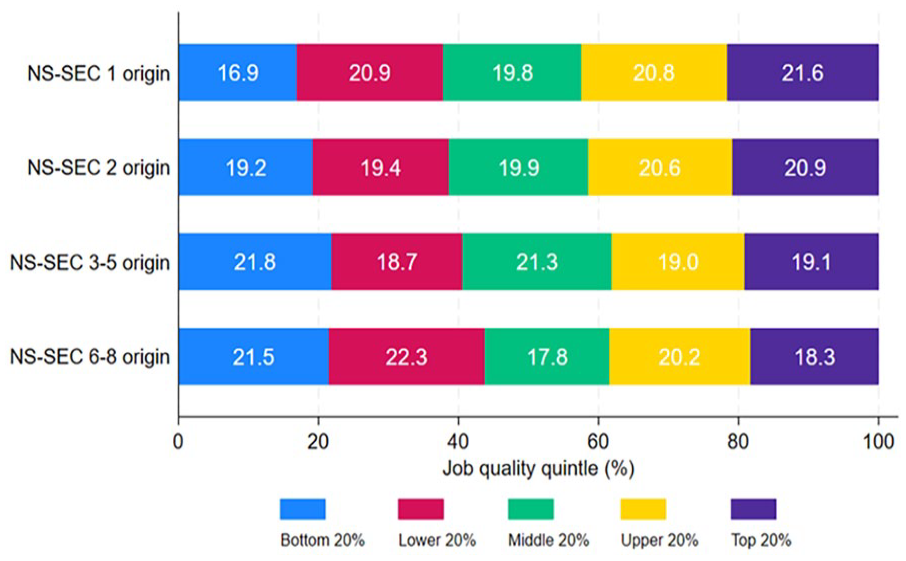
Job quality quintile by social class origin among higher managerial and professional workers.
In foreshadowing the regression analysis, it is helpful to explore descriptives of independent variables (Table SA2 in the Online Supplementary Appendix). Those from lower social class origins (NS-SEC 3–8) are more likely to be older, female, less likely to reside in London and less likely to work in the real estate, finance and professional services sectors than those from higher social class origins (NS-SEC 1–2). In terms of occupational employment patterns, Figure 2 illustrates that occupations with a higher share of those from the lowest social class origins (NS-SEC 6–8) score more highly in terms of job quality on average (Panel a). On the other hand, occupations with a higher share of NS-SEC 6–8 origin workers also have lower average pay (Panel b). In other words, we find occupational segregation that in some respects favours those from lower social class origins in terms of job quality. This implies that the class origin gap in job quality chiefly stems from inequalities within occupations. This finding also underscores the need to study job quality separately from pay as higher pay does not necessarily coincide with higher (non-pay) job quality. We would stress, however, that this is a relatively tentative finding because small sample sizes mean we have had to aggregate occupational unit groups to relatively coarse categories. For instance, medical practitioners are merged with other health professionals such as clinical psychologists, but also a diverse set of other public service occupations such as senior public sector managers, civil servants and head teachers, which are collectively merged into a general ‘public service professionals’ group. Detailed information on the construction of the specific occupational groupings can be found in Table SA3 in the Online Supplementary Appendix.
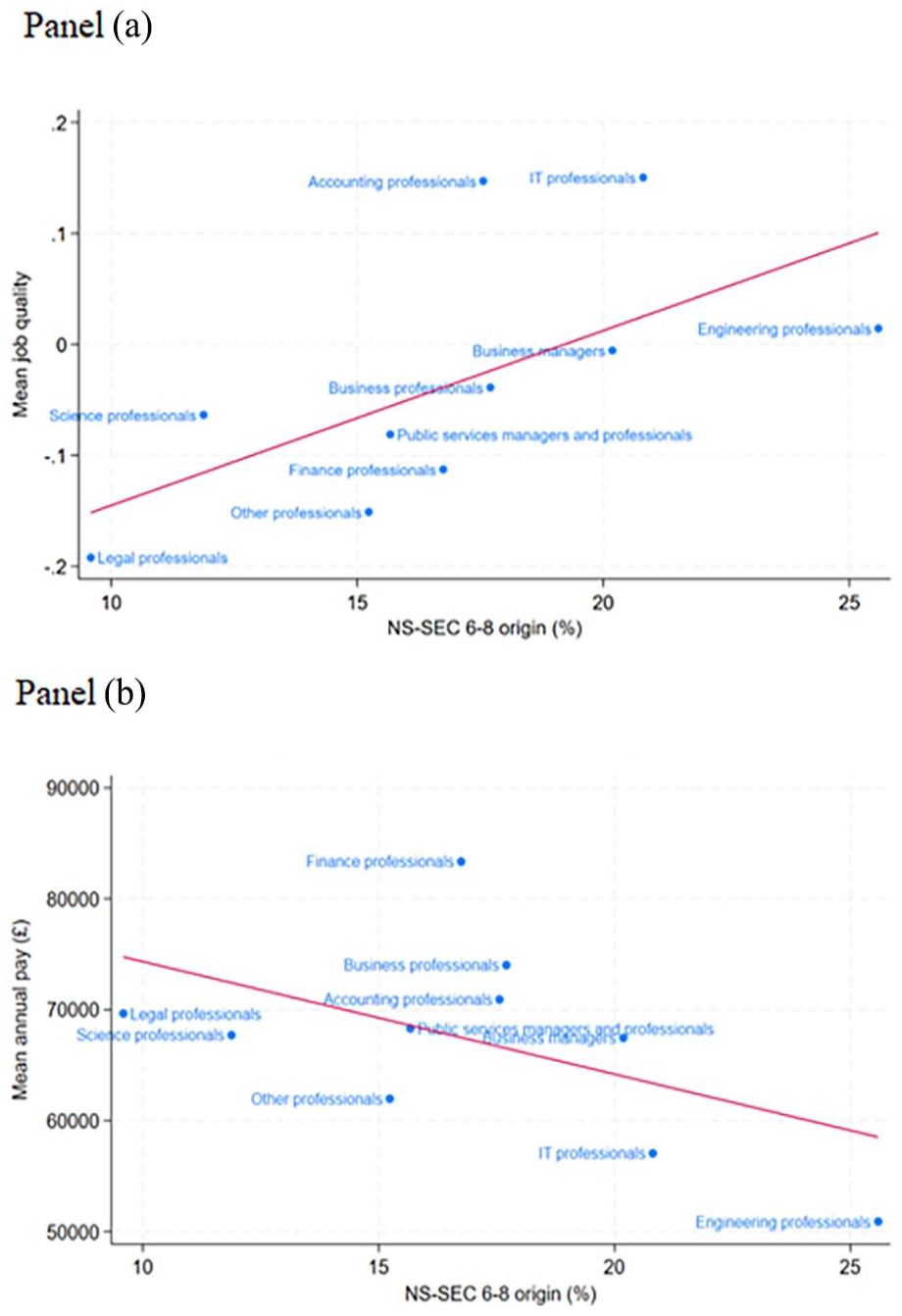
Social class origin composition and job quality within specific higher managerial and professional occupations. (a) Average job quality and share from NS-SEC 6–8 origins within NS-SEC 1 occupations. (b) Average pay and share from NS-SEC 6–8 origins within specific NS-SEC 1 occupations.
Regression Results
Turning to the regression results (Table 2), Model 1 includes social class origin and year dummies as the only independent variables and provides a baseline model. Given the job quality index is the first principal component, it is a z-score by design (i.e. it has a mean of zero and a standard deviation of one), coefficients therefore have a meaningful interpretation – standard deviations from the mean for higher managerial and professional occupations. Apart from those from NS-SEC 2 origins, those from lower social class origins have inferior job quality relative to those from higher managerial and professional backgrounds (NS-SEC 1 origins). The gaps are in the order of one-sixth of a standard deviation in the case of those from NS-SEC 3–5 origins and one-fifth in the case of those from NS-SEC 6–8 origins. Introducing demographic and human capital controls such as age, sex, region and education in Model 2 only slightly attenuates the social class origin gaps. Adding in job and workplace controls such as part-time status and workplace size in Model 3 attenuates the social class origin gaps somewhat. Introducing specific occupations increases the associations in Model 4. Overall, while these coefficients may appear somewhat modest, especially with respect to previous research on class origin pay gaps, they are still of a relatively substantively important size, being comparable to somewhere between the job quality differentials according to graduate status and ethnicity, and similar to sex.
Regression analysis of social class origin gaps in job quality.
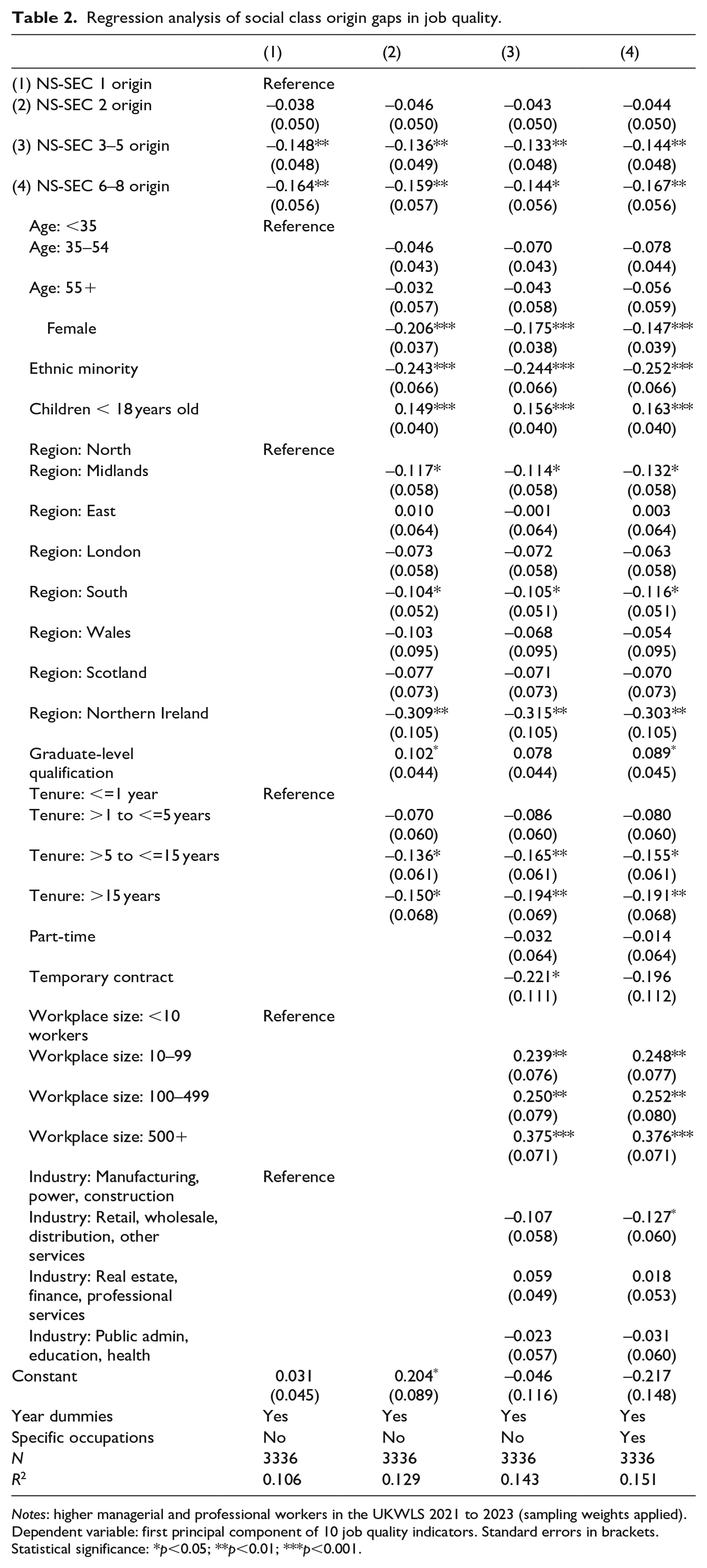
Notes: higher managerial and professional workers in the UKWLS 2021 to 2023 (sampling weights applied). Dependent variable: first principal component of 10 job quality indicators. Standard errors in brackets. Statistical significance: *p<0.05; **p<0.01; ***p<0.001.
To help understand these regression results further, we proceed with decomposing our findings using the Kitagawa–Blinder–Oaxaca decomposition (Blinder, 1973; Kitagawa, 1955; Oaxaca, 1973). This exercise allows us to quantitatively apportion how much of the gaps in job quality between different classes of origin can be explained by differences in observable characteristics such as demographics and occupational employment patterns. In doing so, we follow the same approach in the literature on social class origin pay gaps and our motivation is to make our analysis comparable to this body of work. Following Laurison and Friedman (2016), we group those from NS-SEC 3–8 origins, and those from NS-SEC 1 origins to form another group. These findings are reported in Table 3. The findings are similar to the regression analysis reported above in that a modest job quality differential is observed (about one-sixth of a standard deviation). Unlike with the class origin pay gap research, where almost half of the observed differentials were explained by explanatory factors similar to the ones we employ in this article, the results for job quality demonstrate that the job quality gap we observe between those from more privileged and less privileged origins is entirely unexplained by such factors.
Kitagawa–Blinder–Oaxaca decomposition analysis of social class origin gaps in job quality.
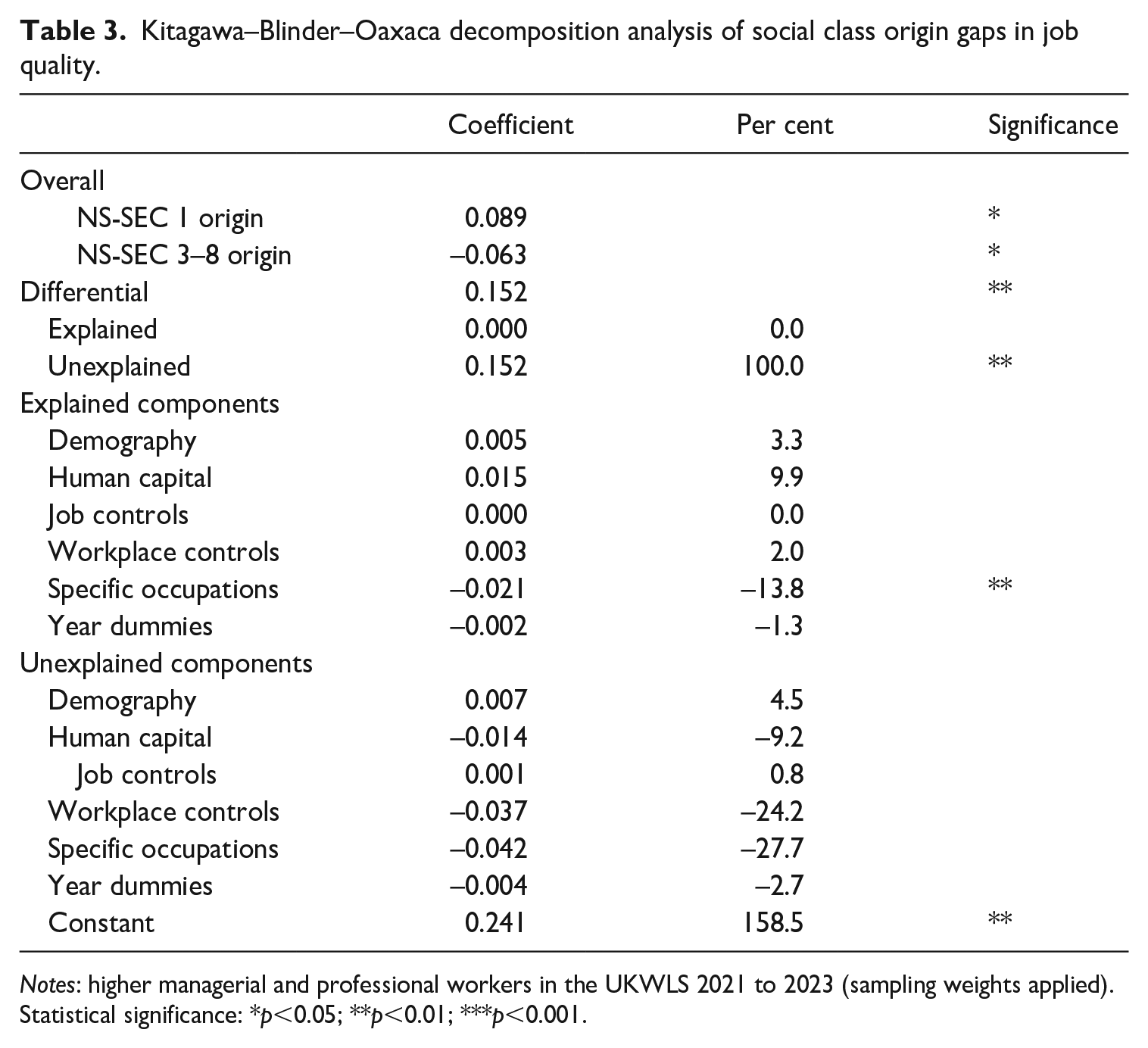
Notes: higher managerial and professional workers in the UKWLS 2021 to 2023 (sampling weights applied). Statistical significance: *p<0.05; **p<0.01; ***p<0.001.
As was shown in Figure 2, the occupational profiles of those from lower social class origins suggest that they should have higher job quality than what is observed. As well as having lower job quality for a given occupation, as evidenced by the negative unexplained component attributable to occupations, those from NS-SEC 3–8 origins appear to suffer a large unexplained social class origin penalty, as evidenced by the large coefficient for the constant. Further analysis demonstrates this finding holds for each of the 10 job quality items when considered separately (see Table SA4 in the Online Supplementary Appendix). Clearly, better understanding the determinants of job quality and why it appears that social class origin is directly important for explaining it is something in need of further research.
Heterogeneity Analysis
We next move on to explore whether the main finding presented thus far of worse job quality for those from lower social class origins in higher managerial and professional occupations holds in various subgroups through regression analysis on different subsamples. The findings are presented in Figure 3. Beginning with specific occupations, the regression results confirm the earlier findings that insofar as occupations are concerned for understanding inequalities in job quality by social class origin, it is largely through the inequality within them rather than between them.
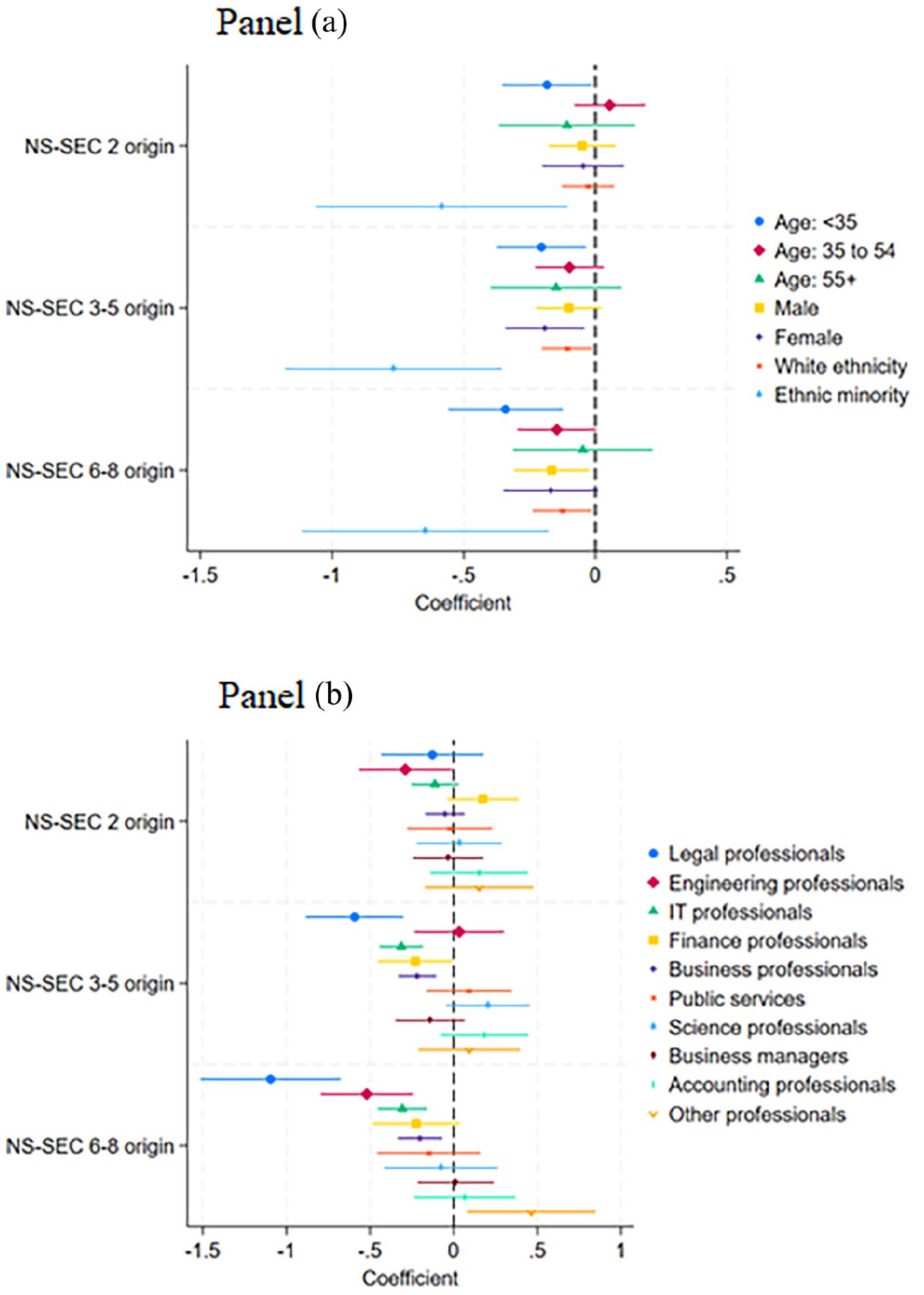
Social class origin gaps in job quality by subgroups. (a) Demographic groups. (b) Specific occupations.
Turning to demographics, beginning with age, no disadvantage is found among older workers (55+) from lower class origins, only for younger workers (<35). This reflects previous research on socio-economic status, which finds that those from lower social class background who had poorer work experiences at the beginning of their careers were able to catch up with their higher social class origin peers later (Jacob and Klein, 2019). Turning to sex, we find that the differences between men and women are similar. With respect to ethnicity, however, we find very large and concerning gaps. The poorer job quality of ethnic minorities is relatively well documented, reflecting in part, a migrant penalty, as half of ethnic minorities are foreign-born (Williams et al., 2024; Zwysen and Demireva, 2020). Our findings suggest a very large relative disadvantage of those from lower social class origins among ethnic minorities, mirroring findings with respect to pay and socio-economic status (Khattab, 2016; Zuccotti, 2015).
Discussion
Building on studies demonstrating pay gaps according to social class origin among higher managers and professionals, this article explored whether similar gaps in non-pay aspects of job quality. The central finding is that those from lower social class origins have worse job quality. Unlike pay gaps, however, compositional differences cannot account for the job quality disparities we observe. If anything, our findings suggest those from lower social class origins could be expected to have better job quality than those from higher social class origins given their occupational profiles.
Our findings call for attention to why these gaps emerge and the related question of why they are seemingly so poorly captured by the rich set of variables. One explanation might be that the determinants of job quality are more complex and multifaceted than pay given their multidimensional nature. The mechanisms relating social class origin to a specific job quality dimension may depend on the dimension in question and the gaps in the composite index we employ obscure these varied mechanisms. For example, job insecurity might be largely determined by industry, with those from lower class origins being more likely to work in the more insecure sectors of manufacturing and retail. On the other hand, job complexity might depend more on the specific higher managerial and professional occupation in question, and those from lower social class origin are less likely to work in traditional professions such as law. However, as mentioned earlier, observable factors are more or less equally poor in accounting for disparities by class origin across all 10 job quality indicators (Online Supplementary Appendix Table SA4).
Another reason still might be that, unlike pay, job quality in its entirety is not known prior to entering a job – it only emerges over time. This points to differential treatment by managers within industries and occupations – as managers are an important mediator of job quality. Relatedly, higher and lower quality workplaces may be segregated along social class origin lines, as workplaces are also an important mediator for understanding job quality (Williams, 2009). For instance, it may be more difficult for those from lower social class origins to access the highest quality jobs if they are in organisations with relatively few workers from such origins. Or perhaps those from lower social class origins are simply less likely to know the organisations in which such jobs are located given the unobservable nature of most domains of job quality.
Before concluding, we briefly reflect on the limitations of this study and draw out their implications for future research. First, we note the UKWLS is not based on a probability sample. Its advantage, though, is the breadth of job quality captured. An extension of this study could explore class origin gaps in a more limited range of job quality indicators but with a more representative sample. Second, even though the UKWLS is the most detailed job quality survey in the UK and perhaps the world, there are always other domains of job quality it does not consider. For instance, voice or physical working conditions, or indeed pay. Third, the UKWLS lacks an indicator for foreign-born. Disentangling national origin from social class origin is something for future research, especially given the large social class origin gaps among ethnic minorities. Fourth, while we predicated our focus on non-pay job quality on the implications for health and wellbeing, we did not directly explore inequalities in work-related health and wellbeing, and this is another area for future research to explore.
Conclusions
To conclude, this article builds on prior evidence that individuals from lower socio-economic backgrounds are not only less likely to attain higher-level jobs, but are likely to face ongoing disadvantages within these jobs. We thus add weight to the argument that ambitions for greater equality should not be limited to what occupations people have, but also consider other facets of their jobs. More specifically, we believe our findings justify the issue of job quality factoring into research and debates concerning the long shadow of socio-economic background on life chances, even within relatively privileged occupational positions. Job quality is of great consequence for health and wellbeing. It cannot be simply read off from pay levels. One practical implication of our study in the UK is for the Social Mobility Commission, a statutory body tasked with reporting on the state of socio-economic background inequality, to publish on non-pay job quality, alongside their current narrower focus on pay and occupational attainment (SMC, 2024). One further practical implication of this study for organisations is that they may want to collect and analyse data on their employees’ socio-economic backgrounds as a small but growing number of UK employers now commendably do (SMF, 2024) with data on job quality, given the well-developed and validated inventories for these (Felstead et al., 2019).
Supplemental Material
sj-docx-1-soc-10.1177_00380385251339592 – Supplemental material for Social Class Origin and Job Quality among Higher Managerial and Professional Occupations in the United Kingdom
Supplemental material, sj-docx-1-soc-10.1177_00380385251339592 for Social Class Origin and Job Quality among Higher Managerial and Professional Occupations in the United Kingdom by Mark Williams, Jonny Gifford and Maria Koumenta in Sociology
Footnotes
Acknowledgements
The authors thank the CIPD for including parental occupation in the UK Working Lives Survey on behalf of the first author, and for providing access to the data. The authors also thank the editor and reviewers for their constructive comments.
Funding
The authors received no financial support for the research, authorship and/or publication of this article.

Supplemental material
Supplemental material for this article is available online.
References
Supplementary Material
Please find the following supplemental material available below.
For Open Access articles published under a Creative Commons License, all supplemental material carries the same license as the article it is associated with.
For non-Open Access articles published, all supplemental material carries a non-exclusive license, and permission requests for re-use of supplemental material or any part of supplemental material shall be sent directly to the copyright owner as specified in the copyright notice associated with the article.
