




Abstract
Solo self-employment (SSE) is a heterogeneous category that requires further contextual analysis across different occupations and professions. Drawing on a multiple methods study, this article reveals the corrosive impact of a specific type of SSE, that of the self-employed personal trainer (SEPT) in the UK fitness industry. SEPTs pay rent in cash and in kind and carry out (unpaid) tasks that would otherwise be undertaken by contracted employees leading to a corrosive impact on employment. Despite a dramatic increase in gym membership in the UK between 2006 and 2021, Office for National Statistics data reveal a decrease in employment in both proximal fitness industry functions and for personal trainers, alongside an increase in self-employed fitness instructors of more than 400%. Our study shows that the nature of the work of this growing SEPT workforce has a direct and negative (corrosive) impact on those undertaking the work.
Introduction
This article focuses on the future of work as it connects with core and emerging themes in the sociology of work and employment. Many readers of this journal will be familiar with digital platform mediated, gig work (Newlands, 2022; Tubaro, 2021; Wood and Lehdonvirta, 2023; Wood et al., 2019a, 2019b), which has attracted considerable attention of late. Much of that attention has focused on work that is dependent on a single employer and mediated by a digital platform. The present article explores the consequences of a form of gig work that has gained less attention, that is, dependent contractors whose work is neither digitally mediated or at the behest of a single employer. While dependent workers and dependent contractors are both part of the broad classification of solo self-employed workers, Kuhn and Maleki (2017) distinguish dependent contractors from dependent workers as the former are not reliant upon a single organization for an income (as is the dependent worker) but are instead reliant upon an organization to mediate the transactions between individual clients and the contractor. Dependent contractors have been labelled colloquially ‘insta-serfs’ – a term that is effective in conveying an image of exploitation, recalling the indentured labour of the medieval serf. While insta-serfdom has not been fully elaborated, neo-villeiny (Harvey et al., 2017), on the other hand, has been documented according to four core characteristics: the absence of guaranteed income, rent, bondage and work-for-labour.
Surplus labour and necessary labour are impossible to delineate in other forms of work within capitalism (Burawoy, 1979; Edwards, 1986); however, as we show, the surplus labour and necessary labour of the neo-villein are distinct. It is directly as a consequence of this that the work of the self-employed personal trainer (SEPT) in the UK fitness industry has a corrosive impact on both those undertaking the work and those in proximal employment.
Analysis of primary and secondary data in this article illustrates the detrimental or corrosive impact of the work of SEPTs. The qualitative impact of the work on SEPTs themselves is manifest in work intensity, working conditions and negative outcomes on mental and physical health. The quantitative impact of the work is evidenced in the number of employment opportunities available for personal trainers and others in proximal functions in the fitness industry. In what follows, the corrosive impact of neo-villeiny is revealed both on employment opportunities for those in proximal functions and on the nature of the work itself in terms of working time and the health of those performing the work.
Solo-Self Employment
The European Union defines solo self-employment (SSE) as the status of ‘a person who does not have an employment contract or who is not in an employment relationship, and who relies primarily on his or her own personal labour for the provision of the services concerned’ 1 (see also Holloway and Pimlott-Wilson, 2021; Jansen, 2020; Murgia and Pulignano, 2021). This category of worker encompasses a large proportion of the workforce in most Organization for Economic Co-operation and Development (OECD) countries (Boeri et al., 2020: 179; see also Murgia and Pulignano, 2021). For instance, there are around 4.1 2 million solo self-employed workers in the UK representing 93% of those self-employed and 13% of the total workforce. 3 SSE has been advanced as ‘a key accelerant for economic development that stimulates innovation, efficiency, structural economic transformation and job growth’ (Holloway and Pimlott-Wilson, 2021: 1548). While SSE has been presented in a positive light as an alternative to unemployment (Al-Dajani et al., 2015; Rindova et al., 2009) and there is the potential at least for the solo self-employed to create jobs for others, research indicates that this transition (from SSE to employer) is unlikely. Only around 4% of solo self-employed men and 2% of women become employers after two years (see Cowling and Wooden, 2021; see also Henley, 2019) and so it is far more likely that solo self-employed workers remain as such, creating only work for themselves (see Astebro and Tag, 2017; Malchow-Møller et al., 2011).
Questions have also been raised about the nature of the work undertaken by those in SSE (Litwin and Phan, 2013) with research into the qualitative outcomes of SSE revealing that benefits in the form of increased autonomy are offset by vulnerability and insecurity (see Gallie et al., 2017; Tammelin, 2019, for example). The solo self-employed tend to earn less than employees performing the same function (Giupponi and Xu, 2020) and while the mental wellbeing of self-employed workers is positively influenced by autonomy (Nikolaev et al., 2023), it is detrimentally impacted by stress and long hours (Nikolova, 2019). Studies have shown that wellbeing among the solo self-employed is higher than it is for employees in terms of satisfaction with leisure time (Van der Zwan and Hessels, 2019) and in terms of job satisfaction (Binder and Coad, 2016; Giupponi and Xu, 2020). However, the wellbeing of solo self-employed workers is more detrimentally affected in instances of financial distress than it is for employees (Berrill et al., 2021).
Crucially, there is considerable heterogeneity amongst SSE workers (Blanchflower, 2000; Bögenhold, 2019; Holloway and Pimlott-Wilson, 2021; Jansen, 2020; Van Stel and de Vries, 2015) – a group that encompasses those whose work is defined as genuine self-employment and also bogus self-employment (Kirk, 2020), false self-employment (Behling and Harvey, 2015) or dependent work (see Moore and Newsome, 2018) where solo self-employed workers are hired in order to avoid labour costs associated with employees (Kalleberg, 2000, 2009). It is important to note that this group is comprised of dependent workers (who usually rely on a single organization for their income) and dependent contractors who are reliant upon a platform to mediate the relationship between themselves and multiple individual clients, such as Uber drivers (Kuhn and Maleki, 2017). There is considerable value in research that examines a specific type of SSE because it helps us better understand different quantitative and qualitative impacts of the work (see, for example, Murgia and Pulignano, 2021). The quantitative impact of work is illustrated in this article with reference to the number of employment opportunities available, while the qualitative impact is documented in terms of the demands of the work and their physical and mental impacts. The article gives attention to the experience of SEPTs in the UK fitness industry.
The SEPT, Neo-Villeiny and Corrosive SSE
Previous research on SEPTs in the UK has compared the relationship between the SEPT and the gym in the contemporary capitalist context with the feudal relationship between the serf or villein and the Lord of the land; hence the term neo-villeiny. The characteristics of neo-villeiny have been documented elsewhere (see Harvey et al., 2017); however, as these are key to the analysis in this article it is important to reiterate them here. First, there is no guaranteed income: SEPTs are not paid by the gym. Instead, they must solicit clients from within the gym membership in order to generate an income. To do so, SEPTs engage in a good deal of unpaid work (discussed later). Second, SEPTs must pay a fee to the gym in cash and/or in kind so that they can operate therein thereby accessing expensive equipment and more importantly a potential client base. Third, the SEPT is bonded to the gym because of the difficulty in generating clients if operating outside a gym. Operating within a gym provides the SEPT with a large potential client base made up of gym members. Finally, there is considerable work-for-labour (see Standing, 2011) whereby the SEPT engages in unpaid labour that is not remunerated but is both necessary in order for the SEPT to generate an income. In this paper we refer to the surplus labour of the SEPT because while work-for-labour is labour that is unpaid but required in order to complete an activity that is remunerated, the upaid labour of the SEPT is both necessary in this regard and also valuable to the gym in which the SEPT operates.
Of critical import to this article is the rent paid in cash and in kind by the SEPT. Rent is a ‘defining characteristic of feudal relations of production’ with serfs ‘compelled to render a rent in kind, money, labor services or, more commonly, in some combination of these’ (Burawoy, 1979: 21). There is a clear distinction between the necessary and surplus labour of the serf whereby the serf works ‘on the lord’s land for so many days each week, and during the remaining days they cultivate their “own” land for the means of survival. The former is fixed and surplus labor; the latter is “necessary labor’ (Burawoy, 1979: 21). Within capitalism the necessary and surplus elements ‘are not empirically distinct’ because while the surplus labour that ‘peasants perform for their lords is plainly visible, the capitalist’s surplus is not directly observable’ (Edwards, 1986: 46).
Critically, it is possible to distinguish between the necessary and surplus labour of the SEPT through rent in cash and in kind. Just as the serf leased land from the Lord and worked the Lord’s land (surplus labour) for the opportunity to cultivate their leased lot for sustenance (necessary labour), the SEPT pays a rent to and performs work for the gym (surplus labour) for the opportunity to solicit clients and generate an income (necessary labour). In effect, neo-villeins must ‘fend for themselves in the time remaining for their own production’ (Burawoy, 1979: 26). The SEPTs’ surplus labour includes work otherwise undertaken by paid employees, for example, conducting formal fitness classes, customer service, cleaning and maintenance. In so doing, the SEPTs’ surplus labour serves as a substitute for paid customer service staff and thereby poses a direct threat to opportunities for paid employment and necessarily entails a corrosive quantitative impact because of the rent in cash and in kind that incentivizes the gym to maximize the number of SEPTs operating therein.
The number of serfs on the Lord’s land was ultimately constrained by the size of land owned by the Lord and the fertility of that land. In theory, so too should the characteristics of the gym serve as a constraint on the number of SEPTs operating therein. The size of the gym (represented by the space, the range of equipment and the number of members) and its ‘fertility’ (represented by the affluence of the members) should constrain the number of SEPTs because these factors determine how many SEPTs can generate an income in each gym. The affluence of gym members is critical because of the significant, additional and often deemed unnecessary cost of personal training. The cost of personal training is substantial as it can increase expenditure on fitness for an individual by more than 200%. At the observation site in this study – a low-cost gym – a single one-hour session with a SEPT was £30, almost doubling the monthly cost of membership (at £18). One might argue that it is unnecessary because gym members will understand at a rudimentary level, at least, how to exercise. This lack of necessity is an important distinction between the SEPT and occupations such as hair stylists, for example (see Harvey et al., 2017). Whereas the size of the membership base is important so that the SEPT has access to a greater number of prospective clients, the affluence of the members will influence their likelihood of soliciting the services of the SEPT.
The financial value of SEPT surplus labour means that it is in the rational economic interests of a gym owner to maximize the number of SEPTs working therein. It is possible for gyms to have a large number of SEPTs because the low barriers to entry into this type of work with SEPTs occasionally operating alongside up to 20 others (see Harvey et al., 2023). Consequently, gyms have access to what Marx refers to as a vast industrial reserve army of workers (see Harvey, 2014: 79) who will be more tolerant of less fertile sites as a consequence of competition and their need to operate within a gym to generate an income. To operate as a SEPT in the UK one must have a Level 3 Diploma in Fitness Instructing and Personal Training or a Level 3 Diploma in Personal Training – a qualification that can be earned within several weeks. As numbers of SEPTs increase so too does the negative impact (qualitative) of the work as SEPTs compete for a finite resource, that is, the members of the gym who they must attract as clients in order to generate an income. Many gym members do not seek the service of the SEPT because that service is perceived to be too costly, nnecesary or both. If a gym member solicits the service of a SEPT, then they are likely to solicit only one SEPT at any given time.
To be successful in attracting clients, the SEPT must first be visible and accessible. It follows that competition for clients will intensify presenteeism in terms of both as spending long hours at the workplace (Simpson, 1998) and attending work while ill (Johns, 2010; Karanika-Murray and Biron, 2020). Moreover, as the SEPTs’ skills are standardized and so in the context of high competition (and little differentiation in the service offered) it is natural for competitors to pursue a cost leadership strategy (Block et al., 2015). Therefore, competition between SEPTs will drive down the tariff for service thereby exacerbating income insecurity (Standing, 1997) and precaritization of the work (Alberti et al., 2018; Gallie et al., 2017).
Data Collection and Analysis
Primary data were collected as part of a multiple method study undertaken over a 10-month period from December 2017 to October 2018. Questionnaire survey data along with observation data taken at a single gym in South Wales (UK) are used to demonstrate the corrosive impact of the work on those performing it (i.e. the qualitative impact). The quantitative impact of the work is evaluated with reference to UK Office for National Statistics (ONS) data that are analysed to illustrate changes to employment in the UK fitness industry over a 15-year period (2006–2021).
Qualitative data were collected from participant observation carried out in one gym in South Wales, UK. Around 40 hours of participant observation were conducted over a 10-week period between April and October 2018. Participant observation involved observing SEPTs at the gym and included multiple informal interviews conducted as conversations (see Sassatelli, 1999; Sparkes, 2009; Van Maanen, 2011). The exact number and duration of these conversations were not recorded, but there was at least one conversation during the majority of observation sessions and occasionally there were conversations with more than one SEPT during a single session. The observation period was formally arranged via agreement with gym management and with the knowledge of the SEPTs operating at the gym. Participant observation involves integrating into the environment by participating in the activities common therein (Aktinson and Hammersley, 1998). In this case, the member of the research team who carried out the observations performed exercise, making notes regularly during observation sessions. The observation data revealed the frequency that a SEPT attended the gym and the range of activities they carried out in the gym for which they were not paid. Qualitative data were also collected from six 4 in-depth interviews. Whereas one interview was conducted in December 2017, qualitative data collection largely took place between April and October 2018 to supplement the observational data and results from the questionnaire (see Jick, 1979; see also Hussein, 2009, for a discussion of the value in combining qualitative and quantitative research methods).
Data were collected from a questionnaire survey sent directly to 462 personal trainers operating in 40 cities across the UK (with at least 10 personal trainers contacted in each city). Respondents were identified using a Google search for SEPTs in each city. The sampling frame was personal trainers with their own business in each of the 40 cities and the top 10–15 Google search results were selected. While the sample is small, the population itself is not large with ONS data indicating that there were fewer than 17,000 full-time self-employed fitness instructors (itself a broader category that includes personal trainers) in total at the time in the UK, and around 40,000 self-employed fitness instructors in total. The purpose of the survey was exploratory and the value in the survey data is in providing evidence of the qualitative impact of the work on those surveyed. The survey was primarily used to explore the ways in which the surplus labour of those surveyed experienced work and how this work corrodes employment opportunities for those in proximal employment.
The questionnaire survey included questions that dealt with a range of issues including: total hours worked; hours spent in the gym with clients; hours that the respondent spent exercising themselves; and views on the role of exercise in the work of the SEPT (for health and/or aesthetic purposes). Respondents were also asked whether they paid rent and whether they carried out any work to reduce their rent, and to identify from a range of activities that they carried out without payment from the gym. Finally, a section of the survey was dedicated to the impact of the work on the SEPT’s personal health. This included whether the work impacted them physically or psychologically, along with a series of questions about their mental health such as the frequency at which they felt sad, lonely, depressed, bored, anxious, ‘that everything is too much’, rested, calm and peaceful, tired and/or restless. At multiple points in the survey respondents were given the opportunity to elaborate on their answers and many respondents included free-form comments. These qualitative data are analysed in the findings section.
Those in the sample of 462 personal trainers were contacted initially with a request to participate in the questionnaire survey and provided with the link to the online survey (hosted by onlinesurveys.ac.uk, formerly Bristol Online Surveys) in April–May 2018. A follow-up email was sent to recipients in July 2018 irrespective of whether or not they had participated. Participation in the survey was encouraged by the possibility of winning one of five gift vouchers ranging in value from £10 to £50. A total of 97 responses were received (i.e. 21% response rate). The sample was comprised of 52% female respondents and 47% male, with 1% who chose not to disclose. ONS data for the proportion of fitness instructors according to gender was 41% male and 59% female in 2018. The sample was predominantly white British (87%). Around 37% of the sample had dependent children and 3% were professional athletes. More than 57% were full-time personal trainers and 4% saw the job as a hobby. The sample included SEPTs and personal trainers employed by the gym. The majority of respondents (76%) were self-employed. In 2018, 58% of fitness instructors in the UK were self-employed and 42% were employed. However, as we point out below, the category of fitness instructor is not an ideal proxy for personal trainers and so the sample may well be more representative than these data suggest.
The response rate to this survey is some way below the average response rate for online surveys (Daikeler et al., 2022), however, it is still above the 20% threshold used as an indicator of the reliability of surveys with a sample size of fewer than 500 (Wu et al., 2022). The response rate to this survey was doubtlessly hampered by the use of a problematic password: including both a zero ‘0’ and a capital letter ‘O’). The survey was password-protected in order to reduce the possibility that ‘uninvited participants’ would complete the survey thereby distorting the survey results (see Sue and Ritter, 2012: 78). Problems accessing the survey were identified during both the interviews and conversations 5 with several SEPTs at the observation site – two of those SEPTs complained that they had tried but failed to access the survey because they were unable to input the correct password. This article draws on data from 74 respondents who declared themselves as self-employed. These data are at points contrasted with the responses of 13 personal trainers who stated that they were employed by a gym. Analysis of the quantitative data was conducted using the Online Survey software and is rudimentary for the purposes of transparency (for a justification of rudimentary statistical analysis see Murphy, 2021; Tay et al., 2016).
It is important to acknowledge the interpretative nature of qualitative data analysis (see Halfpenny, 1979). However, the use of multiple methods of data collection and different forms of data as explained above served as a means of triangulating our analyses and reducing the impact of author bias or over-reliance on particular narratives/accounts. Secondary source data (the value of which are discussed by Johnston, 2014) were drawn from the ONS database in order to assess the quantitative impact of SEPT work. Data were analysed from a 15-year period (between 2006 and 2021) to demonstrate changes in the number of ‘sports and leisure assistants’ and also the proportion of employed versus self-employed fitness instructors. The COVID-19 pandemic negatively affected some industries more than others with fitness among the most severely affected and so the analysis primarily focuses on changes between 2006 and 2019 in order to rule out the impact of the pandemic.
Findings
Quantitative Corrosiveness
The quantitative corrosive effect of SEPT work is illustrated by the change in the number and proportion of self-employed fitness instructors in the UK fitness industry between 2006 and 2021 (with 2019 used as a pre-pandemic reference point). Data from the online survey are presented in the first instance to explain why the surplus labour of the SEPT has such a detrimental quantitative impact on employment opportunities in the fitness industry. Fewer than half of the SEPT respondents (43%) paid a cash rent to the gym at which they operated. Where rent was paid the sum ranged from £100 per calendar month (four respondents) to more than £400 per month paid by 15 respondents. The surplus labour carried out by SEPTs is illustrated in Figure 1, where the left column for each category represents the survey responses of SEPTs who undertook various activities as rent in cash or in kind. The right column for each category presents the responses of personal trainers employed by the gym. Evidently and importantly, many of the self-employed respondents engaged in activities that would otherwise be the responsibility of paid employees. As one respondent put it: ‘I’M SELF EMPLOYED BUT HAVE TO WORK 15 HOURS A WEEK FOR THE GYM WHERE I WORK OUT OF FOR FREE AS A WAY TO PAY RENT TO DO MY BUSINESS AT THEIR PROPERTY’ (Male, Birmingham, capitals in original).
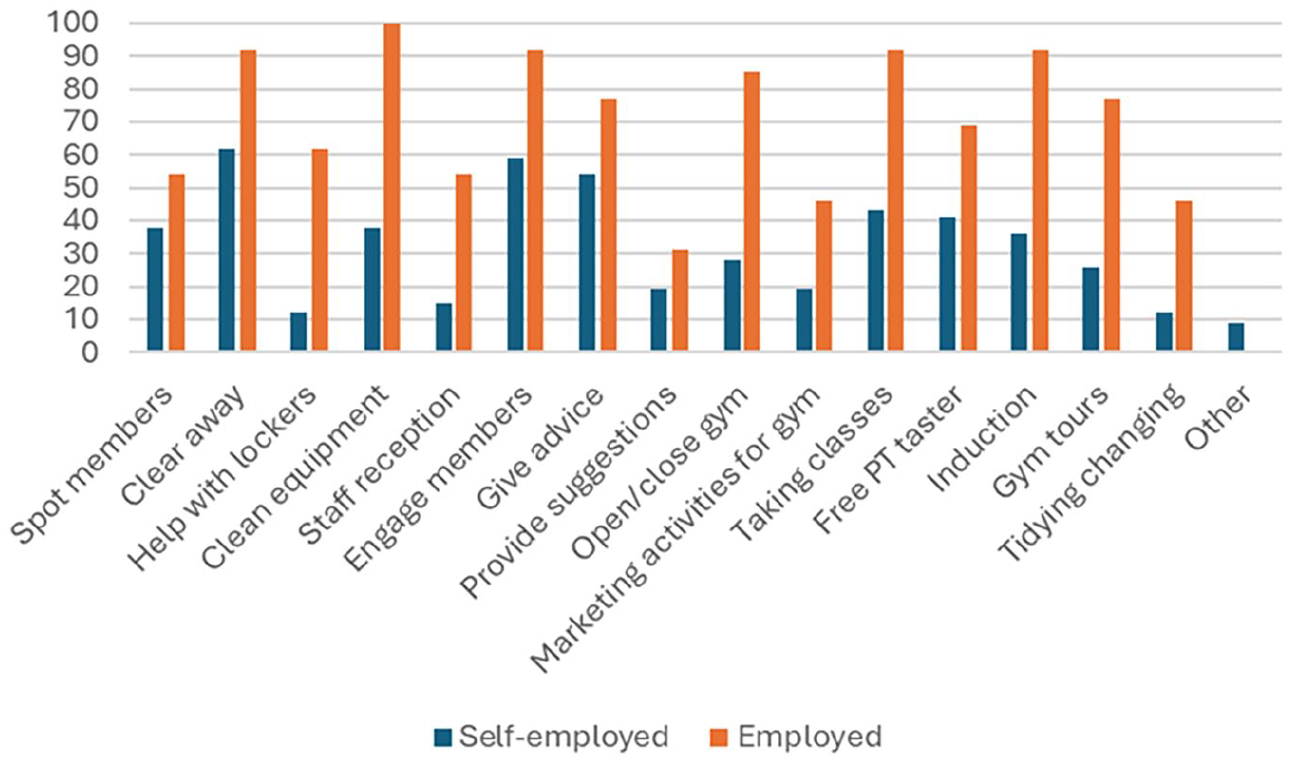
Activities regularly undertaken by SEPTs and employed PTs.
Others provided a list of unpaid activities they carried out for the gym:
…alarm testing, gym inductions, tidying and maintenance, gym floor classes, member engagement, training programmes. (Male, Hull) Classes, cleaning, run gym, first aid. (Male, Central London)
While several respondents referred to maintenance, running the gym and cleaning, another identified the marketing role played by SEPTs in bringing new members to the gym. This is both potentially valuable for the SEPT who thereby increases their prospective client base, but certainly valuable to the gym that increases the number of paying members: ‘I do a considerable amount of volunteer work to help bring business in’ (Female, Wales).
Around 60% of SEPT respondents stated that they regularly engaged members in conversation, more than half provided unpaid advice to members and around 40% assisted members during their workouts. These activities substitute for paid customer service staff. A large majority of respondents stated that they regularly cleared away equipment left out by members after use, almost 40% stating that they cleaned equipment – here the surplus labour diminishes the need for cleaning staff. Each of these functions is critical to the health and safety of members within the gym with equipment left out posing a tripping or safety hazard for members. Cleaning of equipment, on the other hand, is vital to avoid the spread of disease (this has become critical following the emergence of COVID-19). These data illustrate the value of SEPT surplus labour (in cash and in kind) to the gym and demonstrate the encroachment of SEPT activity into other jobs thereby diminishing or negatively affecting the need for employees.
Whereas it is difficult to accurately measure the impact of the work of the SEPT on paid employment more generally in gyms, data from the ONS were used to explore changes in employment and self-employment in the industry. The ONS occupational signifier of ‘sports and leisure assistant’ is used as a proxy for generic work in gyms. This group includes workers from a variety of occupations, including but not limited to those employed in customer service and maintenance functions within gyms. This occupational signifier is not ideal because the category encompasses workers outside of the gym and so these data are more likely to belie rather than amplify the corrosive effect of SEPT work on employment in gyms. The ONS data reveals that the number of staff working as sports and leisure assistants has increased over the 15 years between 2006 and 2021 with a significant reduction in 2021 (see Table 1) – a change that is attributable to the pandemic – this increase is significantly lower than the increase in gym membership over this period.
Numbers of employed sports and leisure assistants.

The number of employed sports and leisure assistants increased by around 12% from 53,800 (of whom 30,200 were part-time employees) in 2012 to 60,100 in 2019 (of whom 34,000 were in part-time employment). The increase in employment overall is largely attributable to growth in part-time employment. Moreover, employment has not kept pace with a large increase in the number of gym members in the UK. According to Statista.com, 6 UK gym membership increased by 56% (from 4.5 million to 7 million) between 2011 and 2019. Whereas these data do not categorically demonstrate the quantitative corrosive impact of the work of the SEPT on employment in proximal functions, they indicate a moderate increase in employment within an industry experiencing significant growth.
These data are more informative when considered along with data that show the decline in employment among ‘fitness instructors’ in the UK on the one hand, and the growth of self-employment among fitness instructors on the other. Whereas the ONS occupational group ‘fitness instructors’ 7 is not ideal because it encompasses other fitness industry roles aside from personal trainers, it is nonetheless the most suitable proxy indicator available. These data tell us something about the scale of growth of self-employment in the sector and allow comparison with the growth of employed fitness instructors in the same timeframe. In 2021, almost 80% of fitness instructors were self-employed (with 70% self-employed in 2019) compared with 32% in 2006 (see Table 2). The impact of the pandemic was catastrophic for many fitness industry operators and certainly led to a decrease in employment opportunities. However, the data reveal the numbers of self-employed fitness instructors increased from 9000 to more than 47,000 between 2006 and 2019, while the numbers of employed fitness instructors increased by only 2000 in the same period (see Table 2).
Numbers of employed and self-employed fitness instructors.

As a consequence of the pandemic, many gyms were unable to continue operating with the State of the Fitness Industry Report (2022) revealing that 631 gyms closed following the outbreak of the pandemic (see Marcellin, 2022). The impact of the pandemic on employment for fitness instructors has been more severe. ONS data for 2021 reveal that while the number of employed fitness instructors dropped by around 41% from the previous year, the number of self-employed fitness instructors increased by around 20%.
Qualitative Corrosiveness
The qualitative corrosive effects of SEPT work are a result of the competition between SEPTs for clients at a specific gym. As it is in the financial interest of the gym to increase the number of SEPTs operating therein (due to the appropriation of their surplus labour in cash and in kind), then SEPTs commonly find themselves alongside many counterparts each of whom are competing for clients from the same membership base. The survey data indicate that one SEPT was competing with more than 20 others and although such a retinue of SEPTs is uncommon, more than a quarter of respondents reported that they worked alongside (and in direct competition with) between 10 and 20 counterparts. The problems created by competition were expressed in this way:
It’s becoming a race to the bottom. Newly qualified, inexperienced PT’s undercharging, resulting in them never being able to earn and sustain a living and hence the churn of PT’s that we currently see. This eventually dilutes the service and prevents highly skilled, qualified and experienced PT’s from being able to charge and earn what they are worth. (Undisclosed gender, Central London) . . . they are all out for them selfs [sic] and we all have different programs and training options and all offer different things and have very different training we have undertaken so some think they are worth more than others. (Male, Belfast) . . . because they are generally of the ‘everyone for themselves’ mentality. (Female, Swansea)
Competition certainly contributes to the belief among SEPTs that they are required to be on site (or on the gym floor) for long hours in order to be successful (Harvey et al., 2017). The survey data show that around 40% of SEPT respondents who operate on a full-time basis spend more than 31 hours per week in the gym, with three respondents being present for more than 51 hours. It is important to point out that there is more to the work than being present at the gym with many other aspects of the SEPTs’ work taking place outside of the gym. Indeed 29% of full-time SEPT respondents dedicated 51 hours or more to their work (with 11% working for more than 61 hours). Many hours each week are dedicated to marketing and promotion of their business, preparation of exercise and dietary plans, responding to queries and so on. The working week for the SEPT is far longer than the time spent on-site. As one of the survey respondents put it: ‘[SEPTs] take on more than 15 clients a week to be able to get a steady income but then there is about 30 hours worth of support, programming and admin on top of all that which increases with each client’ (Female, Blackpool). Alternatively, an interviewee expressed the arduous nature of the work in this way:
I work long hours. I was working 7 days a week previously. Now I work 6 days. And I work hard – you have to. It’s very hard and tiring. I usually start between 7 and 8 [a.m.] and finish about 9 [p.m.]. (Interview notes, April 2018)
The participant observation was conducted on every day of the week at different times of the day. It was nonetheless rare not to see the majority of SEPTs who operated in the gym on the gym floor on each visit irrespective of the day or time of day. Informal discussions with SEPTs operating at the observation site reveal that a six-day work week was common, with some on site seven days a week. The corrosive impact on the qualitative aspects of work are then manifest in work intensity and working time. Qualitative corrosiveness is also manifest in an impact on the health of SEPTs. One might argue that for workers whose physical health and aesthetic is an essential part of one’s work (see Harvey et al., 2014) physical injury is to be expected as a job hazard. After all, physical exercise takes its toll on the body. However, respondents also identified a negative impact of the work on their mental health.
8
For instance, many pointed to the negative impact of long working hours that they perceived to be necessary in order to be successful:
Tiredness due to 0515 alarm for early training sessions everyday. (Male, no location given) Early starts and late finishes at work not being able to sleep enough hours. (Male, Dulwich) Constantly feel exhausted. Not getting in until late. I’m shattered. No social life. It’s difficult to fit in exercise. Knackered. It’s not sustainable. (Interview notes, April 2018) Unsociable and irregular working hours lead to lack of or disturbed sleep. (Male, London) Tired!! long hours, lots demand and constant interaction with clients can be tiring and mentally exhausting. The club I work at has no natural light or air on the gym floor and 13 hour days soon add up in that space!! (Female, Oxford)
Stress, fatigue and sleeping problems were reported by more than 40% of SEPTs in the study with around one-third also reporting anxiety. The corrosive effect of the work on the mental health of SEPTs is an issue that featured in several responses, for instance:
[the job] has regularly ran me down. People expect your life to be on show on social media constantly. And expect instant 24 hour replies and support. Even when on holiday. I also have a medical condition that being that active physically and mentally when doing research and programmes it takes a lot of time and can be stressful and causes me to have flare ups. Many trainers are similar but not as extreme. (Female, Blackpool) I stopped training regularly and gained weight. I also got fed up, which again triggered me to eat when my finances were not great. (Male, Midlands) The unsociable hours and fatigue make it hard to exercise (busman’s holiday). The shifts mean sleeping and eating patterns are inconsistent leading to poor emotional health. (Male, Worcester)
Of note, one respondent neatly summarizes how the impact of competition between SEPTs specifically impacts wellbeing negatively:
Made me very ill over the years and experience high levels of stress and anxiety. Wanting to do the best job for my clients and working long hours in and out of the gym. But having other trainers in the area constantly undercutting each other, overstepping professional scope. (Female, Pulton-le-Fylde)
Discussion and Conclusion
This article has explored the quantitative and qualitative corrosive impact of the work of a distinctive group of dependent contractors. This group, SEPTs, have been defined as neo-villeins because of core characteristics of the work they undertake that reflect the medieval relationship between the landlord and the villein. We theorize that the surplus labour of the SEPT in the form of rent in cash and in kind both intensifies the work of the SEPT (qualitative corrosiveness) and poses a direct threat to employment opportunities for personal trainers and for others in proximal occupations in the fitness industry (quantitative corrosiveness).
The qualitative corrosive impact of the work has been documented above through the voices of interviewees and data from a questionnaire survey of SEPTs operating throughout the UK. It is clear from these data that the nature of the work impacts on the lived experiences of SEPTs who undertake the work. The research reports a shared experience of insecurity, the intensification of working time and a detrimental impact on their wellbeing. As for the quantitative impact, data from the questionnaire survey show the extent of SEPT surplus labour as SEPTs undertake activities that would have otherwise required paid staff such as leisure assistants. Consequently, the surplus labour of the SEPT reduces the need for employees, thus extending the corrosive effects in the labour market. Secondary source data from the UK ONS illustrate the way in which employment of sports and leisure assistants has not kept pace with the dramatic increase in gym members. Meanwhile, the number of fitness instructors who are employed has likewise increased slightly alongside a dramatic increase in the number of self-employed fitness instructors.
The implications of the research go far beyond the specific issues faced by SEPTs, speaking as well to more general changes in patterns of work and employment. Self-employment has been proposed as a policy response to unemployment, but this study of dependent contractors clearly demonstrates the flaw in assuming that self-employment is fundamentally positive in reducing unemployment. While our focus in this study is a distinctive group, the characteristics that mark the relationship between the SEPT and the gym (i.e. neo-villeiny) are applicable to a range of service sector occupations in a tertiary sector that is growing as a consequence of the opportunities created by the digital economy. New forms of work in the digital economy appear to be marked by precarity as documented by recent contributions to this journal (e.g. Newlands, 2022; Wood and Lehdonvirta, 2023). It has been noted previously that neo-villeiny is applicable beyond the fitness industry and the implications of our analysis suggest there is scope for this relationship of production to emerge elsewhere. Advocating self-employment as a policy response to unemployment is reckless as this form of corrosive SSE clearly shows. Firms in the UK and elsewhere are currently recovering from the impact of the pandemic, face interest rate rises and are responding to the problems created by Brexit, the ongoing Russian invasion of Ukraine, conflict in the Middle East and a potential trade war with the US. ‘Innovations’ in the nature of work are to be expected, however, SSE of the kind documented in this article will exacerbate rather than alleviate the problem of unemployment.
Footnotes
Acknowledgements
We are grateful to Paul Edwards, Ed Heery, Paul Jones, Kim Shuey, Melanie Simms and Geoff Wood for their contribution to the development of this article.
Funding
The authors received no financial support for the research, authorship and/or publication of this article.
