



Abstract
Despite evidence of extensive and growing concern about climate change, citizens remain relatively unlikely to discuss it in everyday conversation, presenting a puzzle to commentators and researchers. Different explanations of climate silence have been suggested, most notably from social psychology and from political economy perspectives, which posit forms of cultural control. However, there is limited evidence about the relational contexts of everyday climate talk and the meanings that people themselves attach to it. In this article, we analyse data from new qualitative research and explore how climate talk is patterned, forms of self-silencing and the meanings attached to climate talk, with reference to its interactional and relational contexts. We argue that social interactional contexts, relational work and mundane forms of practical constraint play an under-investigated yet crucial role in limiting climate talk.
Introduction
Although citizens express extensive concern about climate change in surveys they are relatively unlikely to discuss climate change in any depth in everyday conversations (Marshall, 2014; Norgaard, 2011; Sparkmann et al., 2022). Campaigning organisations and climate communications researchers often advocate mainstreaming ‘climate talk’ in everyday conversation and encourage climate conversations (Fine, 2022; Greenpeace, 2021; Webster and Marshall, 2019) to help break ‘the climate spiral of silence’ (Ettinger et al., 2023). However, attempts to normalise climate talk involve relatively limited conceptual engagement with the social and cultural shaping of everyday climate discourses and silences. Indeed, climate silences seem to present a puzzle to commentators and researchers who expect more obvious public engagement with the epochal significance of the climate crisis. Different explanations of limited everyday engagement with climate change have been suggested by social psychologists and by social science theorists who argue that cultural and ideological forces underpin climate silences and limit our imaginations, constraining what is normal to talk about, think and feel in relation to climate change (Norgaard, 2011; Stoddard et al., 2021).
A small but growing body of literature has explored the nature of climate talk and how it can be discouraged or closed down by social contextual factors despite increasing public concern about climate change. Social psychological approaches understand self-silencing to arise from people’s concerns about impression management and self-presentation in contexts where they misjudge other people’s levels of climate concern (e.g. Geiger and Swim, 2016; Sparkmann et al., 2022). This is seen to drive the ‘spiral of silence’ (see also Gurney et al., 2022), which acts as a brake on political change. Other writers offer a more political reading of silence, exploring how broader cultural and ideological forces shape our ‘social imaginaries’ (Stoddard et al., 2021; see also Norgaard, 2011) and delimit what is normal to talk about. In such approaches silences are understood not simply as ‘not talking’ but as ideological displacement, which serves to reproduce status quo arrangements and limit transitional change. In these literatures on everyday climate talk and its absences, the analytic framing has been on individual outlooks, social psychological contexts and political and cultural ideological drivers, which undermine climate talk or lead people to (after Norgaard, 2011) ‘look away’.
Despite evidence on growing climate concern over the past decade, there is relatively little research into the everyday social and relational contexts in which people choose when and with whom to discuss climate change issues and the meanings they bring to this (Fine, 2022; Howard, 2023). There is some relevant evidence that we review including research into how both political and climate activists downplay these important aspects of their identity in some of their interactions (Ekström, 2016; Howard, 2023) and further evidence on how social and relational dynamics frame political discussion in everyday contexts (Davies, 2022). We build on existing research by exploring new data on the social relational contexts in which people discuss climate issues, or not, and the motivations and meanings they associate with everyday climate talk.
Drawing on qualitative data from a new study of public perceptions of climate change in the north of England in 2021, we interrogate lay accounts of climate talk and explore how it is shaped and delimited by social and relational contexts and conversation norms. First, we show a clustering of climate talk linked to participants’ expressed concerns about climate change but which varies across friendship and interactional contexts, with even the most climate concerned participants in our research, including activists, speaking about frequent self-silencing as a way to maintain positive social interactions with friends and others. Second, we show evidence of reflexivity and relational work in how participants describe climate talk with friends and family, and how such talk is often closed down in day-to-day interactions. Third, we examine the content of everyday climate talk as described by those most likely to engage others, noting that they frequently described encouraging small behavioural or attitudinal changes in their everyday interactions. At first sight this might support the argument that people consent to dominant cultural drivers that trivialise or individualise climate change causes and consequences (e.g. Webb, 2012). However, this tendency was evident even among those who held political and collective understandings of climate change and climate action. We argue that the limited extent and content of climate talk can be explained with reference to social interactional contexts, relationship work and mundane forms of practical constraint. Our evidence helps explain why climate talk in everyday contexts under-reaches growing public concern.
Climate Talk and Climate Silences
There is relatively limited quantitative research on the extent of everyday climate relevant conversations. An influential long-running American study (Marlon et al., 2023) found that, in 2023, 36% of US respondents discuss climate change at least occasionally while 64% rarely or never talk about it. In the UK, a 2015 survey carried out after severe flooding events in 2013–2014 found that 39% of respondents stated they discussed climate change ‘at least sometimes’ while 44% rarely, hardly ever or never discussed it (Capstick et al., 2015: 21). This was despite 68% of the respondents being ‘fairly’ or ‘very’ concerned about climate change. In response to the 2021 YouGov survey question ‘How many times in the past week, if at all, have you had a conversation (in person or remotely) with someone about climate change, the environment or green issues?’, 57% of respondents stated at least ‘once or twice’, and 40% ‘not at all’ (YouGov, 2021). This survey ran shortly before the 26th United Nations Climate Change Conference of the Parties (COP26) was held in Glasgow amid considerable UK media coverage. The same question asked a year later in 2022 saw 42% saying at least ‘once or twice’ and 54% ‘not at all’ (YouGov, 2022), which is rather closer to Capstick et al.’s findings and suggests that everyday climate talk ebbs and flows with media coverage. Meanwhile, levels of concern about climate change are growing in the UK, with 85% reporting being very or fairly concerned in 2021 (BEIS, 2022), so it is evident that climate talk under-reaches general levels of concern.
There is some evidence of a direct individual-level association between degrees of concern and engagement in climate talk, with a recent US survey showing that 66% of citizens who described global warming as extremely important to them also reported talking about it in the prior month, compared with 13% of those who described global warming as not too, or not at all, important to them personally (Latkin et al., 2024). Recent research has explored how climate talk unfolds on social media; for example Hautea et al. (2021: 12) examine young people’s use of TikTok to engage with climate change in diverse ways, using the platform to ‘express their concerns, frustrations and personal stake in what they perceive to be salient issues of their time’. However, our article focuses primarily on in-person climate talk, which is what our participants talked about when we asked them about when, how and with whom they talked about climate change.
Calls for more extensive public discussion about climate change aim to increase citizens’ engagement with climate issues. Climate talk is widely seen as an effective way to raise awareness of climate change, encourage climate friendly behaviours and build a sense of common purpose (Beery et al., 2021; Goldberg et al., 2019; Kelly et al., 2020). Conversations about climate change are widely promoted; for example the Scottish Government’s ‘Climate Conversations’ initiative encourages talking about climate change as ‘a simple and free way you can help combat the climate emergency’ (Scottish Government, n.d.: para. 1). Greenpeace (2021: para. 2) suggests that ‘having an open, respectful climate conversation is one of the most powerful things you can do’, while for campaigning organisation Climate Outreach, climate conversations ‘are important not just in themselves, but because they are a part of all of us engaging with the challenge of climate change, and driving the wider social and political response’ (Webster and Marshall, 2019: 4). Climate talk is seen to help educate and inform citizens, influence normative changes and help to drive low carbon transitions, either by shifting individual behaviour or by building consensus and placing pressure on governments to enact pro-climate policies (Frantz, 2022; Geiger and Swim, 2016; Sparkmann et al., 2022; Webster and Marshall, 2019).
It is important to complicate these arguments with reference to how people experience and negotiate the topic of climate change with friends, family and others, including how and when they avoid talking about it, and when it can cause friction. We must also examine a tradition of critical analysis, which holds that advocating more climate talk is naive in the context of social, cultural and political forces that influence and delimit everyday discourse. Accordingly, we turn now to literatures that ask why people do not discuss the issues as much as theorists expect given the epoch defining challenges presented by climate change.
In the USA, research has suggested that people are discouraged from talking about climate change due to their misperception that climate concern is a minority view, a phenomenon described as ‘pluralistic ignorance’ (Sparkmann et al., 2022: 1). They avoid climate change talk, fearing negative judgement from raising a topic that does not interest or concern others (Geiger and Swim, 2016). This self-silencing is understood to contribute to the so-called ‘spiral of silence’ (Taylor, 1982, cited in Geiger and Swim, 2016: 80), which helps to undermine discussion and stall policy/actions to tackle climate change. In social psychological explanations, self-silencing is explained with reference to individual volition, impression management and the desire to be perceived as competent, framed with reference to wider social sanctions and expectations. Other research has examined how institutional norms and practices place boundaries around acceptable ways of discussing climate issues, and how people self-silence due to concerns about their professional reputations (Willis, 2018; Wright et al., 2012).
In her research, Norgaard (2011) explains everyday climate silences among citizens through an account of ‘norms of inattention’ shaped by cultural and political economy drivers. Drawing on Zerubavel, Norgaard (2011: 5) argues that ‘notions of what to pay attention to and what to ignore are socially constructed’, in part through conversational norms that govern the social acceptability of discussion topics. She explored how social interactions and conversational conventions discouraged talking about climate as a potentially upsetting issue over which people felt they had no agency. Across different settings, climate change was commonly mentioned but rarely became a topic of sustained or serious discussion. In these ways climate talk was closed down, reproducing collective modes of climate denial or silence. Others also suggest that capitalist political economy and cultural drivers influence ‘what receives attention, what seems rational and what seems possible in response to climate change’ (Gunderson et al., 2019: 58; see also Norgaard, 2011), setting boundaries on what is normal to talk about and delimiting our social imaginaries (Stoddard et al., 2021). For Norgaard (2011: 98), conversational norms help to produce these cultural silences and reveal ‘the contours of social structure in private life and the links between political economy and interpersonal interaction’ so that the political and moral implications of climate change are elided (see also Heald, 2017). Norgaard draws on Gramsci’s concept of hegemony, a form of control that ‘gerrymanders the boundary of perception’ (Eliasoph, 1988, cited Norgaard, 2011: 133) producing inattention and consent to the status quo. We see Norgaard’s analysis as powerful and compelling, but question its sufficiency as a general explanation in contexts of significant diversity in citizens’ concern and engagement with climate change.
Norgaard’s work foregrounds the import of relational contexts and conversation norms as key vectors of climate silence. Other social scientific research into everyday political talk provides insight into how contested, contentious or ‘difficult’ topics are managed; for example Ekström (2016) explores the importance of the social relational contexts in which political discussion is initiated, managed or foreclosed. Drawing on Goffman’s work on interaction rules and everyday encounters, Ekström (2016) analyses everyday political talk among young adults in Sweden, suggesting it occurs only in particular settings, for example where familial norms or particular friendship contexts sanction and encourage political talk. A perceived lack of common ground, or even common interest, works to inhibit such discussions (Ekström, 2016) and is linked to the ways young people manage their identities and social selves. Such concerns also shaped their participants’ very cautious approach to sharing personal views on social media due to fears about how others would respond (Ekström, 2016).
Also drawing on Goffman, Howard (2023) explores how interaction norms and identity management affect whether and how climate activists talk about climate issues with non-activist family members and friends. Describing a UK cultural context that negatively stereotypes environmental activists, Howard found that her participants commonly distanced themselves from their activist identity when they interacted with close, non-activist, others. Drawing on Ahmed’s (2010) ideas about ‘feminist killjoys’ she argues that people ‘tone down’ their approach or their language to avoid seeming overly negative. Concerns about conversational awkwardness and the desire for positive interactions meant that for Howard’s activist participants climate-related issues were avoided or raised cautiously, a tendency echoed across the wider cross-section of citizens involved in our own study.
The work of Ekström and Howard focuses particularly on questions of identity management and the interactional contexts that lead to reflexivity in discussions about politics and climate. We also take such contexts as a key focus, considering people’s experiences of interactional and conversation norms and further interrogating the question of relationship work and its effect on climate talk. Relevant to our concern with relational work is Davies’ (2022) study of Brexit-related conversations in everyday family contexts in the UK, where family members’ views diverged on this highly polarised and divisive issue. Davies draws on Goffman and is also influenced by Mason’s (2004) work on relational thinking and her argument that we need to see relationships as the appropriate focus of analysis, rather than individuals (Mason, 2004; see also Crossley, 2015). In her study, Davies explored how people navigated Brexit-related conversations with family members, and the profound importance of relational contexts in shaping what was and was not said. For Davies (2022: 98), ‘it is not possible to understand how and why people approach political discussion without understanding their relationships’. In summary, the evidence about political and climate talk highlights the role of interactional and conversational norms in shaping or limiting everyday climate talk, but also hints at the importance of relational work, an area that is under-explored in accounts of climate talk and that we take up in our study.
Research Design and Methods
We draw on qualitative data from a two-stage exploratory research project carried out in 2020 and 2021. The first stage involved an online survey (n = 1676) distributed to people who lived, worked and/or studied in the city of Leeds in the north of England. We distributed the survey via diverse networks of local authority, third sector, community and educational organisations in the city. Survey respondents provided contact details if they were willing to be involved in follow-up interviews, which we ran with 42 participants. In our survey we asked a question used in the Business, Energy & Industrial Strategy (BEIS) Public Attitudes Tracker survey question: ‘How concerned, if at all, are you about climate change?’ with the response categories, ‘very concerned’, ‘fairly concerned’, ‘not very concerned’ and ‘not at all concerned’. In our sampling for the qualitative research we ensured our sample profile quite closely reflected UK-wide patterns of climate concern (BEIS, 2022), and additionally sampled with reference to diversity within the concern groupings by gender, age, parenting status, education level and political leaning. Interviews were conducted online and lasted around one hour. In the interviews, we explored a number of topics aiming to engage with participants’ perceptions and understandings of climate change and related issues, including the meanings that climate change had for participants, the extent to which they thought about it or tried to address their own carbon emissions, their ideas about personal responsibility, the role of individual action and ideas about fairness. We also asked people whether and to what extent they discussed climate change and with whom, and their perceptions and experiences of negotiating differences of opinion about climate change in different contexts. The data are drawn primarily from responses to direct questioning about whether or not participants discussed climate change issues with others in everyday interactions. We developed a thematic analysis through coding transcripts based on close reading, coding inductively and in relation to concepts emerging from our critical reading of literature to draw out key analytic themes. In the analysis presented below we examine participants’ accounts of:
Who, if anyone, they discuss climate issues with, the contexts in which they do so and how this varied across the sample.
How talk about climate change is contextual and closely linked to relationship work.
What they discuss and the meanings they bring to such talk and if, and how, they think it matters.
Who Talks about Climate Issues in Everyday Conversation?
Existing evidence suggests that concern about climate change is linked to the likelihood of talking about it in everyday conversation (e.g. Latkin et al., 2024) but there is quite limited evidence on this relationship. To briefly contextualise the qualitative analysis of this section, we note that there was a strong association in our survey data between people’s expressed climate concern and the extent to which they reported talking about climate change (see Figure 1).
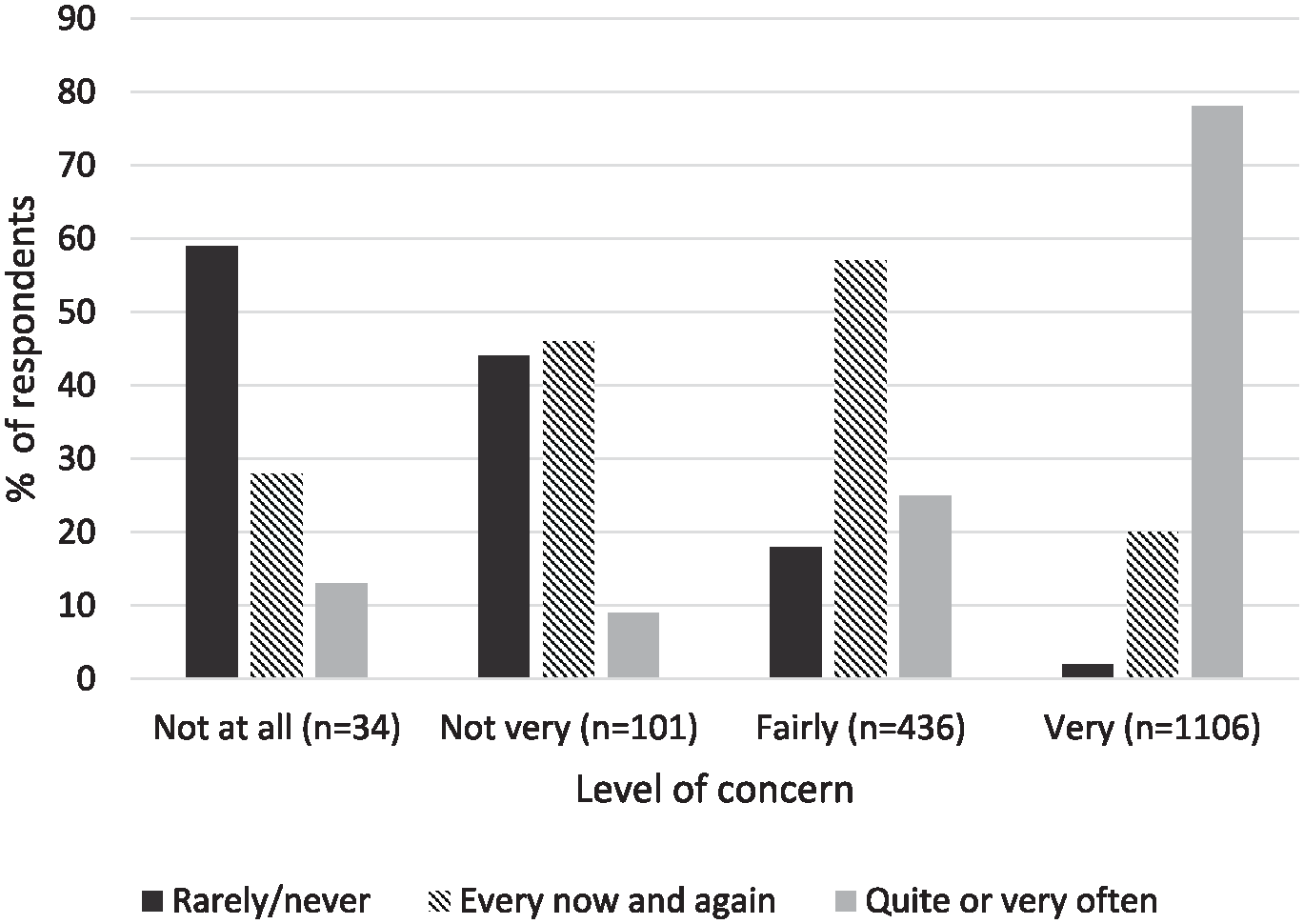
Frequency of climate change discussion by level of concern.
In the interviews, we explored with participants whether, how and with whom they discussed climate change, whether they ever stopped themselves from talking about it, to what extent their views differed from friends, family and others and whether this was important to them. In the qualitative data that are the focus of our analysis, talk about climate issues was tightly patterned and was closely associated with the degree of climate concern expressed by participants. Those who identified themselves as being ‘very concerned’ about climate change said that they routinely talked about climate issues in certain contexts. For this group, climate change was part of their everyday conversation and was often pro-actively introduced as a topic of discussion. For example, for Jess, 1 ‘in a lot of circles I’m in, it’s frequently talked about . . . It’s. . .it’s become much more the norm.’ Asked how often he discussed climate change issues with family, friends and other people Mike said: ‘Very regularly because that’s what I’m interested in.’ For Marcus, who was very involved in climate activism, climate was an everyday conversational focus: ‘I would say that, say, 30 to 50% of my conversations with friends would be about topics related to climate change or climate justice.’
In contrast, among participants who had described themselves as ‘fairly concerned’ climate change talk was more contingent and tended to be prompted by something specific like unusual weather:
Q: Are there any other people that you would discuss climate change with? A: Well, it’s probably just [with] a few . . . friends that we just go out with. We caravan a lot, so we go away and we’re sitting outside in the warm sunshine . . . And that can trigger the conversation about the weather. You know, it’s definitely changing is the weather. (Joe)
Kathleen said she discussed the issue with her grandson when prompted by something relevant in his schoolwork:
I’ll tell you who I talk to it more about, my eight-year-old grandson! They are learning so much at school about it that he will come home and he’ll be doing a project, and I can sit [with him] for ages and that really brings it home to me.
For some who were ‘not especially concerned’ about climate change, climate was not a topic they spoke about to friends or family. For example, Karen said: ‘I just don’t think it’s a topic that ever comes up.’ Others in this group suggested that they might sometimes talk about climate issues, but in ways that were limited, largely reactive and tended to prompt no further reflection or discussion. For example, Tina (not especially concerned) stated:
[my son will] start talking about something and it’ll show that he’s been taught something about, you know, rising sea levels . . .. But it is just not, within our home, . . . something we’d discuss. We’d listen to him and what he’s saying, that probably would be the end of the conversation really.
These illustrative examples suggest that people’s inclinations to discuss climate change issues vary in relation to their expressed degrees of concern with the very concerned more likely to routinely discuss climate change with like-minded friends than the fairly concerned who were more likely to discuss it contingently and less extensively. It is unsurprising that climate talk clusters in relation to expressions of climate concern (see also Latkin et al., 2024) but the evidence provides useful context for our analysis below in which we focus primarily on those who are concerned and most likely to discuss climate change with family, friends and others. We show that, even among those who are most concerned and inclined to talk about climate change, where there is any variation in perceived interest across friends there are profound limits on what gets discussed, if anything.
Climate Talk, Self-Silencing and Relational Work
While accounts of the spiral of silence and qualitative research into activist identities foreground identity management in conversational interactions, our evidence underlines the importance of social relational dynamics for understanding limits on climate talk. We show that, even among the most concerned, climate talk is contingent on context and often closed down in consequence of the relational work that people undertake in their interactions with others. We identify three aspects of this pattern. First, an ethic of nurturing good relationships with others meant self-silencing if there were perceived differences of interest. Second, in some accounts, we saw that a related desire to respect others’ rights to their own beliefs and avoid imposing their own beliefs led to self-silencing. Third, particularly in familial contexts, participants sought to avoid the risk of being negative or fuelling anxieties.
While ‘very concerned’ participants were pro-active and open in talking about climate change with like-minded others, they were reflexive about other people’s views and self-silenced when they felt others might have differing degrees of concern or interest. For example Mike, who talked regularly with close friends, adapted his conversation to suit other people’s views: ‘But I know full well that some people don’t wanna talk about those things at all. And I’ve gotten better over the years at realising and refraining from discussing these things.’ Good relationships could be strained by raising or pursuing a topic that might prove uninteresting, and participants highlighted the importance of focusing on common ground, as exemplified by the next two participants:
every once in a while I talk about [climate issues] with my friends but not very often because I think like it’s not that they’re not interested but I think I’m probably a lot more interested [laughs] than they are so [laughs] . . . yeah. (Betsy) Do we talk to our friends about it? . . . Not often . . . as an example, there’s a group of four of us that have been friends for a long time, [and two of them] they’re not bothered, that’s it. Oh, it’s boring, you know, and the other one would rather talk about her new shoes [laughs] . . .. I’m thinking I wouldn’t have reached her, and I thought I’d rather keep her as a friend and shut up about these things. (Wendy)
Climate concerned participants were circumspect about who they talked with about climate change and when they did so. This echoes Howard’s (2023) activist participants, who described taking care in how they talk about climate issues to avoid straining personal and social relationships, and complements Davies’ (2022) findings in which participants used their knowledge of others’ views to judge when or whether to talk about Brexit. Our own evidence highlights the ways in which efforts to nurture friendships led to participants avoiding discussion of climate if they felt others did not quite closely share their climate interests and concerns.
Participants also described their concerns about how others would react if they did not take account of mismatches in climate change concern or interest. Several climate concerned participants said they were careful not to be seen as ‘going on’ or ‘too preachy’ about climate change, or as ‘a bore’. Asked if he talked about climate change with friends or family, James said:
certain friends, I pick and choose. I don’t wanna be one of those people who’s too preachy. I think, yeah, I can see people’s eyes rolling sometimes but if I’m surrounded with people I know are quite keen on it we have a good little natter.
Wendy, reflecting on the care she took to avoid ‘lecturing’ people, described her hope to ‘gently influence’ them through raising awareness while nurturing her friendships:
I’ve had to realise that if I want to keep some people around me, I’ve got to accept that they might have a different view and that maybe it’s better to keep them close and gently influence than just alienate somebody and just be that nutter that just pisses everyone off, you know [laughs].
The evidence suggests that concerns about presentation of self may be important in climate silences. However, hitherto the literature has understated the importance of people’s concern to nurture and maintain positive relationships meaning that, in contexts where views and interests vary, climate concerned citizens often avoid climate talk.
We turn to a second, related, aspect of relationship work closing down climate talk. In some responses the desire to nurture common ground with friends and others overlapped with a perceived risk of appearing judgemental or being seen to push one’s own views too forcefully. For Nathan:
depending on who you’re talking to – it can come across maybe as, as a personal attack if . . . if someone kind of has a lifestyle that is maybe more kind of carbon hungry than you . . . And I wouldn’t want to kind of jeopardise those friendships to kind of try and . . . win what feels like a losing battle.
Nancy foregrounded her view that individuals have the right to live their lives as they wish, and not have others’ views imposed upon them: ‘I don’t like it when people try and force their values on someone, so I will never say, oh you shouldn’t be using that, you should be vegan, . . . you have to live your life how you want to.’ These examples accord with arguments that people silence themselves as a form of impression management (Bashir et al., 2013; Geiger and Swim, 2016), but we suggest that they also illustrate another kind of relationship work, nurturing positive relationships by being wary of overstepping a line of imposing one’s beliefs on others.
The third aspect of relationship work negating climate talk appears in participants’ concern that they might project their own anxieties and concerns onto others, potentially disrupting or straining otherwise positive interactions (see also Howard, 2023). For example, for Lindsay:
I would say that generally, I would imagine most of my friends are coming from the same sort of area that I am. . . . They do make small changes, I’m sure, but maybe they don’t suffer from the angst that I have. So I try not to drag the conversation down.
Others also described self-silencing to avoid dampening the mood, for example during celebrations or leisure activities, ‘when I know everybody just wants to have a nice time’ (Mike). Such concerns with ‘bringing down’ conversations reflects a sense that climate talk would be deemed depressing or negative. Several participants wanted to avoid causing emotional distress when interacting with people they were close to, especially family members. Lindsay said she had stopped herself from talking about climate change in front of her son because ‘he doesn’t need doom and gloom’. For Kathleen, ‘[my partner] and I might stop and say, “oh let’s talk about something that’s less distressing”, because it is very . . . it is distressing’. These accounts link to evidence that climate change can produce emotional responses in part due to ‘causing feelings of uncertainty, unpredictability and uncontrollability’ (Pihkala, 2020: 1). They suggest that some participants are sensitive to the potential for others to experience climate- or eco-anxiety, making them cautious about their capacity to upset others, or themselves, by talking about climate issues.
The evidence reveals the relational embeddedness of climate talk and illustrates ways in which people carefully negotiate climate talk within the context of different relationships. While this is partly with reference to others’ anticipated judgements (Geiger and Swim, 2016) it is more centrally about seeking to maintain positive interactions, nurturing good relationships and being attentive to others’ experiences and feelings. This appears to have a dampening, or even deadening, effect on everyday climate conversations across many contexts. We have also shown how some participants self-silenced as a way of protecting those close to them, including family members, from anxiety and negative emotions. Social interactional contexts and forms of relational work help to explain limits on climate talk even among those most concerned about climate change. In the following section, we explore what participants said they talked about when they talked about climate, and the meanings climate talk had for them.
The Content and Meaning of Everyday Climate Talk
For Heald (2017: 9) ‘Climate silence requires a broader definition of silence than the obvious instance of not talking about climate change at all’ meaning that we need to understand what is spoken about, and what is not, as well as understanding how literal silences are produced. This involves exploring how the social, moral and political implications of climate change are obscured even when it is raised in conversation (Heald, 2017; Norgaard, 2011; Stoddard et al., 2021). Many writers have documented prevailing discourses and contexts in which the causes and consequences of climate change are depoliticised and individualised (Koslov, 2017; Lamb et al., 2020; Norgaard, 2018; Stoddard et al., 2021). In this section, we show that discussing and encouraging small behavioural and attitudinal changes was a recurring theme even among the most climate concerned participants in our research. At first sight, this might appear to reflect a wider discourse that frames climate action in terms of individual-level changes while wider power relationships and social structural processes are hidden from view (see also Norgaard, 2018; Stoddard et al., 2021; Webb, 2012). However, while climate conversations were often narrow in scope for our more climate concerned participants they were only one form of practical engagement with climate change. We therefore question whether cultural control effectively accounts for these everyday climate silences.
At first sight the accounts of climate talk amongst our more concerned participants seem rather surprising, given that they commonly recounted encouraging small behavioural and attitudinal changes, implying an individualised and apolitical view. Encouraging individual-level changes was quite common, for example through sharing suggestions about how to reduce carbon emissions or using climate friendly products. Lisa spoke about ‘all sorts of little things that people share’ among her friendship group, such as the merits of switching from regular shampoo to a shampoo bar:
Yeah, generally we talk . . . about different things about climate, like friends . . . they might be promoting ideas as to what they might’ve come across, something like, I don’t know. . . like them shampoo bars, saying ‘Oh, well I don’t buy shampoo anymore, I buy these bars because it’s better for the environment and for the climate.’
Others provided examples of sharing tips on avoiding food waste, advising on where to get product refills or encouraging a switch to more environmentally friendly products, for example:
I had a success with my sister because I get that Who Gives a Crap toilet paper . . . And they sent me a thing saying if you recommend somebody, you can get a £5 voucher and they can get £5, so I sent it to my sister, ’cause she’s always admired the packaging that they come in. (Frances)
These accounts of raising awareness by focusing on relatively trivial consumer choices and changes could appear to point towards a very muted and depoliticised engagement with climate change, or imply that people are reproducing a dominant neoliberal ideology of individualised and consumer responses to climate change (Norgaard, 2018; Stoddard et al., 2021). However, many of our very climate concerned participants, and some of the fairly concerned ones, held clear political and moral stances on climate change and were active in demanding wider collective change, whether through local or national bodies or activist organisations. For example, Lisa, who talked about shampoo bars, was also involved in campaigning in her local community and lobbying the local authority. Frances, who talked with her sister about toilet paper, was involved in a national environmental campaigning organisation. Many climate concerned participants were highly cognisant of the limitations of individual consumer choice and quite commonly advocated for systemic structural change. We therefore interpret the frequent focus on relatively trivial changes as a response to practical constraint (see Irwin and Wright, 2024), with participants’ accounts illustrating restricted possibilities for action and influence in their day-to-day lives, also reflected in how they sought to engage others. Further, given participants’ desire to avoid upsetting or overly forcefully challenging others’ behaviour, as described above, it might also be that such minor changes are seen as more palatable and less threatening.
The desire to engage others with climate issues was a strand that ran through participants’ responses, although while they hoped to exert a degree of influence they were very conscious of the difficulties of so doing, particularly with those who were less interested in the topic. For some climate concerned participants, talking about climate change was an opportunity to educate others and encourage them to be more engaged. This was often distinguished from changing people’s minds, which was seen to be unlikely – or very difficult – in the context of informal interactions. For Valerie, a student: ‘it’s very difficult to, to try to change minds. I mean I don’t intend to change anyone’s minds or anyone’s ideas but I . . . maybe I try to educate people around me.’ When asked whether he felt he had been successful in changing his friends’ minds or offering different perspectives, James responded:
I think some people will sort of agree they’ll wanna make changes, but they won’t be aware of how to do that . . . I don’t know how much I’ve done in terms of changing people’s minds. I think it’s more making them aware of things they can do . . . sort of, changing their perspective from not being bothered to being bothered, if that makes sense?
Some participants felt that conversations about climate change could contribute to wider incremental and potentially cumulative shifts in attitudes and perceptions. For example, Mike said:
I’ve got groups of friends who are less interested but some who are now coming round to this, these ways of thinking. And I’ve seen some close friends who previously were all about cars and consumerism. Like making conscious decisions to, to eat less meat or no fish and things like that. Like brought about by films like Cowspiracy and Seaspiracy . . . And then plus the stuff that I’ve been sharing with them throughout the years, it just builds up an argument.
The very climate concerned participants therefore saw climate conversations with friends as potentially helping raise awareness and encourage greater engagement, while being acutely aware of the limits on doing so and focusing on areas where people feel able to assert some agency such as in their consumption choices and everyday behaviours.
Only occasionally did participants describe political talk as routine. More generally they did not feel they could change minds or readily speak across felt-as-different degrees of understanding, interest or concern. Our participants often spoke about sharing ‘little things’ with fairly like-minded people and about small changes they had persuaded family and friends to make. Such issues are trivial in respect of effecting meaningful change and might be interpreted as a kind of responsibilisation, devoid as they often were of political content. However, they were also seen as a way to help others to become more knowledgeable about, and engaged with, climate issues. This itself can be seen as a political act consistent with political readings of climate change and necessary responses to it, characteristic of the wider accounts of many of our very concerned participants. Within the limited scope of their everyday climate talk (see also Stoddard et al., 2021, Norgaard, 2018), participants were acting within the contextual contours of everyday practical constraint in which what they do maps onto what they perceive they can do. Our evidence suggests that everyday climate silences and limited climate talk need to be understood with reference to social relational contexts and mundane forms of practical constraint, which help explain why everyday climate talk under-reaches growing public climate concern.
Conclusion
Many climate campaigners and writers advocate for climate conversations with friends and family as a way of raising awareness, improving understanding and encouraging behavioural and normative changes. We have argued that pre-existing relationships do not necessarily offer opportunities for talking about climate change or for directly engaging with its political and moral implications. The caution with which participants broached climate issues in everyday talk across differences of opinion raises questions about how informal climate conversations can build consensus or effect change as advocated by climate communications organisations and campaigners. For many researchers and commentators, citizens’ everyday climate change talk is puzzlingly limited given the epochal significance of climate change impacts and this has prompted differing explanations of climate silences. Much research in this area has examined conversational and interactional norms with some arguing that citizens under-estimate levels of concern and interest among other people, leading to self-silencing as a means of impression management (Geiger and Swim, 2016; Sparkmann et al., 2022). Others have foregrounded ideological limits in lay discourse whereby cultural processes work through conversational and interactional norms, effectively ‘producing’ climate silences so that climate change is not discussed at all or is discussed in limited and depoliticised ways (Heald, 2017; Howard, 2023; Norgaard, 2011; Stoddard et al., 2021).
Our own research findings suggest that many people touch on climate change in their everyday conversations as might be expected given the growth in media coverage, policy debate and general public awareness. In our study it was only the small number of participants who were not especially concerned for whom climate is a topic that ‘just doesn’t come up’. Our evidence partly echoes that of Howard’s (2023) work on climate activists’ interactions with (non-activist) family and friends as well as wider evidence on how political talk is commonly absent from social encounters (Ekström, 2016). These authors focused on citizens who were managing their political or activist identity in everyday interactions. Our own analysis focused on a broader demographic of participants describing their encounters, the ways they sought to ensure positive relationships and how climate talk played out within this. Our data show climate conversations to be clustered, most markedly among those who were very concerned about climate change. It also shows that very concerned participants routinely discussed climate issues with like-minded others but also commonly self-silenced, explicitly avoiding the topic with others they perceived to hold differing views or simply as less interested. Differing degrees of perceived concern or interest were enough for people to avoid or quickly move on from climate talk and accounts here foregrounded the relational work involved in nurturing positive conversational interactions and sociality. Within family contexts, or with friends who held very similar climate views, participants sometimes reined in climate talk in order to protect themselves and others from stress and negative emotions given its potential to cause upset and anxiety. Our research adds to a small body of work on the importance of conversation and interactional norms by additionally evidencing the ways in which managing close social relationships often delimits everyday climate talk, helping to explain why it under-reaches expressions of climate concern.
Having explored how participants often self-silenced we examined the question of what they discuss when they do alight on climate issues, as well as the meanings that participants accorded to such conversations. Here the evidence points to the limited scope of climate talk, a limit described in the literature as a form of political and moral silence (e.g. Gunderson et al., 2019; Norgaard, 2018; 2011; Stoddard et al., 2021). Our participants described the ways in which they shared information with friends and sought often to encourage minor kinds of behavioural or attitudinal change. However, we cautioned against interpreting this as a general silencing since for many concerned participants it was framed as encouraging greater engagement with climate issues, reflecting a sense of realism in what they could do in their everyday interactions. Holding back in everyday conversation and encouraging individual-level responses was also compatible with political understandings of the drivers of, and necessary responses to, climate change. We argue that extensive climate silences within everyday discourse, and what is elided, can be explained with reference to social interactional contexts, relational work and mundane forms of practical constraint in which people act. Climate talk in everyday contexts necessarily under-reaches growing public climate concern.
We acknowledge Norgaard’s (2018: 173) compelling argument that: ‘individual understandings, values, risk assessments, actions, choices and so forth are critically constrained by their cultural, economic and political contexts’. Public discourse and political debate is rife with misinformation, vested and powerful fossil fuel interests promote discourses of delay (e.g. Lamb et al., 2020) and governments use rhetoric exactly in line with such discourses. Media coverage is, at best, uneven and power threads through policy agendas and through dominant neoliberal economic paradigms (e.g. Stoddard et al., 2021). However, we also argue that accounts of cultural control over-generalise as an explanation of everyday climate silences and risk understating the extensive concern and appetite for profound change evidenced across significant sections of the population.
Footnotes
Funding
The authors received no financial support for the research, authorship and/or publication of this article.
A Note on Ethical Clearance
The interviews were conducted by the authors and Dr Katy Roelich. The research received ethical approval from Research Ethics, University of Leeds, ref: LTSSP058, May 2021.
