




Abstract
This research draws upon qualitative data to empirically examine a theorisation of the temporal dimensions of social practices, and how anti-consumption destabilises and is destabilised by five dimensions: duration, tempo, sequence, synchronisation and periodicity. Our analytical themes highlight the emergence of what we term dissonant intervals, that is, temporal glitches that manifest in these temporal dimensions of social practices that are unsettled by anti-consumption. Where the social coordination of temporalities becomes challenging or even impossible due to the accrual of these dissonant intervals, this generates a micro-level asymmetric (i.e. uneven, unsettled) socio-temporal rhythm in daily life. We contribute the novel concepts of dissonant interval and asymmetric socio-temporal rhythm to sociological research on the temporalities of social practices. The significance of these concepts lies in their expansion of existing temporality vocabularies and imaginaries, their generative potential for future research and their implications for the promotion of environmentally sustainable practices.
Keywords
Introduction
This research empirically examines Southerton’s (2006, 2020) theorisation of the temporal dimensions of social practices and how anti-consumption destabilises such dimensions. Societies have long deliberated on how and how much we consume (Newholm et al., 2015). Scholarly examples include Adam Smith’s (1776/2010) concerns with extravagance and wastefulness, Thorstein Veblen’s (1899) critique of conspicuous consumption and Henry David Thoreau’s Calvinist material morality of efficiency, thrift and self-responsibility, which propelled the voluntary simplicity movement of the 19th century (Rudmin and Kilbourne, 1996).
More recently, sociology and consumer culture scholars have acknowledged the amplification of consumerism as a socio-cultural phenomenon, manifested through the expansion of market logics under neoliberal capitalism (Kravets et al., 2018). Consumer culture has positive societal benefits, but also problematic individualisation (Eckhardt et al., 2018), time pressures that are detrimental to well-being (Southerton, 2020), materially intensive lifestyles sustained by cultures of credit and debt (Evans and Gregson, 2023) and challenges to environmental sustainability that highlight the need to consume less (Evans et al., 2017).
Such ethical, political and environmental concerns are among the reasons why some people who can afford to engage in consumerism nevertheless choose to consume less. Initially understood as individuals’ actions against consumption (Lee et al., 2009), anti-consumption is now defined as ‘intentionally and meaningfully excluding or cutting goods from one’s routine or reusing once-acquired goods with the goal of avoiding consumption’ (Makri et al., 2020: 178). Anti-consumption can manifest across many practices and involves rejection (i.e. doing without), reduction (i.e. consuming less), reusage (i.e. using as many times as possible) and/or reclaiming (i.e. rethinking the use of) specific products (e.g. garments, food, packaging) to circumvent consumption (Lee et al., 2011; Makri et al., 2020). Thus, anti-consumption can take place during pre-acquisition, acquisition, use and disposal of products (Rudmin and Kilbourne, 1996).
Yet, the anti-consumption literature is primarily psychology oriented. It foregrounds individuals’ attitudes, intention and choice, and largely neglects the social practices of which they are a part. For example, it is argued that anti-consumption is voluntary rather than a consequence of financial constraints (Ozanne and Ballantine, 2010); that it can help individuals to communicate their beliefs and values in less materialistic ways (Sekhon and Armstrong Soule, 2020); and that it requires significant attention and effort (Makri et al., 2020). Further, where one key aspect of anti-consumption, namely temporality, is discussed in this literature, it is addressed mainly as a psychological factor, in the form of individuals’ lasting or temporary adoption of anti-consumption behaviours (Strandvik et al., 2013).
Instead, our research takes a sociological perspective, focusing on anti-consumption as a social practice and examining how it destabilises other practices’ temporal dimensions. Diverse practice theories exist. For example, Warde (2005) speaks of understandings, procedures and engagements, while Shove et al. (2012) address meanings, competences and materials. Nevertheless, they share common ideas, including that practices are an interconnected nexus of activities involving doings and sayings (Schatzki, 1996); that practices are socio-culturally understood, organised and performed in everyday lives according to norms and performance standards (Reckwitz, 2002; Schatzki, 1996; Warde, 2005); and that practices involve affective intensities and emotions (Spotswood et al., 2024). Specifically, we follow Leipämaa-Leskinen et al. (2016) in seeing anti-consumption as a dispersed practice, that is, one that occurs across other, integrative social practices. An integrative practice is a complex practice ‘found in and constitutive of [a] particular domain of social life’ (Schatzki, 1996: 98). In contrast, a dispersed practice is a set of actions ‘appearing in several domains of life and requiring mainly understanding’ about what to say and how to act (Moraes et al., 2020: 73; Schatzki, 1996; Warde, 2005). By taking this perspective, we reinvigorate anti-consumption research by moving beyond psychology-oriented approaches and re-embedding anti-consumption within the social practices through which it disperses. Thus, we foreground and further theorise how anti-consumption shapes, and is shaped by, the temporal dimensions of other (integrative) social practices.
A social practices perspective on the interconnections between time and society enables a deeper understanding of how daily life is experienced and temporally organised (Southerton, 2006), including the consumption modes that take place within it. Consumption mediates social practices (Warde, 2005), and is inseparable from temporal dimensions because of social conventions about when, how frequently and at what pace it should take place (Southerton, 2020). Thus, we advance these important theoretical conversations by addressing the following research question: what happens to the temporal dimensions of practices when people engage in anti-consumption, and how does this affect the temporal rhythms of such practices in everyday lives?
We examine the temporalities of anti-consumption and of the practices it intersects through qualitative research. Our findings illuminate how temporal dimensions are destabilised by the challenges of anti-consumption. This temporal destabilisation enables us to theorise the existence of what we term a dissonant interval, that is, a temporal glitch that emerges when a dispersed practice such as anti-consumption disrupts the ‘normal’ temporal dimensions of the integrative practices it intersects. Further, as dissonant intervals accrue, thus unsettling practices’ temporal dimensions further and making the social coordination of everyday practices more challenging, what we term an asymmetric socio-temporal rhythm is manifested. This is a micro-level rhythm that is asymmetric in the sense of not mirroring or matching the ‘normal’ – linear and circular (Southerton, 2020) – rhythms of practices in society, or itself being uneven as well as tentative, fragile and unsettled, which complicates everyday anti-consumption and the social practices it traverses.
We make two main contributions to sociological research and to the anti-consumption literature. First, in following practice scholars (Southerton, 2020; Warde, 2005), and re-embedding anti-consumption within social practices, we establish that dispersed practices can destabilise integrative practices’ temporal dimensions and everyday rhythms. Second, we theorise the existence of both the dissonant interval, a disruptive, destabilising temporal glitch, and the asymmetric socio-temporal rhythm, an uneven micro-level temporal rhythm that emerges as dissonant intervals accrue, making the social coordination of everyday practices difficult. These contributions are significant, as they advance sociological theorisations on how dispersed practices can interact with, affect, and be affected by, integrative practices. They are also important in highlighting the richness and multiplicities of temporal dimensions, including the micro-level socio-temporal rhythms that manifest through the coordination of everyday social practices, and the temporal misalignment and fragility of environmentally sustainable practices that go against dominant social logics and structures.
Conceptualising the Temporalities and Rhythms of Practices Involving Anti-Consumption
Much of the existing research has addressed time objectively, including studies that treat it as a resource (Glucksmann, 1998). In the anti-consumption literature, such perspectives include the idea of freeing up time from consumption-related activities (Alexander and Ussher, 2012). Time is also treated objectively when decisions to eschew consumption in the present are expected to achieve positive environmental results in the future.
However, time perceptions can go beyond chronological clock time (Adam, 1990), and conceptualisations of temporal dimensions can facilitate more pluralistic understandings of time (Fine, 1990), including in relation to anti-consumption. There is an extensive body of literature on time and temporalities across several disciplines. Nevertheless, our perspective aligns with the view that temporalities are socio-culturally constructed, subjective, time-related perceptions of social phenomena (Southerton, 2020; Usunier and Valette-Florence, 2007). Temporalities involve diverse time perceptions and experiences (Carlson et al., 2019), emerging as possible time structurings (Glucksmann, 1998), and manifesting through consumption-mediated social practices (Shove et al., 2013; Southerton, 2013; Woermann and Rokka, 2015). Accordingly, social structures and processes (including the social practices through which anti-consumption disperses) shape, and are shaped by, the use and perceptions of time in everyday lives (Woermann and Rokka, 2015).
As subjective, dynamic and socially entrenched time perceptions and experiences (Hoy, 2009), temporalities have multiple dimensions. Here, we follow Lauer (1973) and Southerton (2006, 2020), who build on Zerubavel’s (1979, 1981) works, in foregrounding practices’ temporal dimensions, specifically duration (how long an activity lasts), tempo (whether an activity is fast or slow, accelerated or decelerated), sequence (the order in which activities occur), synchronisation (whether diverse activities co-occur) and periodicity (the frequency and repetition of an activity). These interrelated temporal dimensions are useful for explaining and recognising diverse time functions and experiences, but also for systematically analysing practices’ temporalities (Southerton, 2006), including how practices are formed, organised, reproduced and habituated (Southerton, 2013). Together, practices, their temporalities and their social coordination form co-existing, overlapping and diversely scaled socio-temporal rhythms in society (Shove et al., 2013; Southerton, 2020), rhythms that are characterised by circular (i.e. recurrent) and linear (sequenced) patterns occurring at micro- to macro-level scales (Southerton, 2020).
Shove et al. (2013), Southerton (2020) and Warde (2005) make a crucial point regarding the indivisibility of consumption from social practices and their temporalities, which we argue is significant for unpacking the temporalities of practices where anti-consumption disperses. Consumption plays an essential role in enabling social practices (Warde, 2005), and cannot be severed from temporalities due to social conventions and expectations about when, how quickly and how frequently consumption within a particular practice should happen (Southerton, 2020). Consequently, we argue that in social practices involving the dispersed practice of anti-consumption, anti-consumption will destabilise, and be destabilised by, such practices’ temporal dimensions, complicating and disrupting taken-for-granted, materially intensive social conventions and their assumed temporalities. Thus, we problematise how anti-consumption affects, shapes and is shaped by, the effective performance of well-established social practices, including their temporal dimensions and rhythms.
We apply and build on three aspects of Southerton’s (2020) temporalities theorisation, given their significance to practices involving anti-consumption. First, as a dispersed practice (Warde, 2005), anti-consumption happens in and through the temporal performances and organisation of integrative social practices. Thus, we suggest that anti-consumption attempts to reject, reduce, reuse, repurpose and/or reclaim the material aspects of integrative practices demand the ongoing reconfiguration of such practices. This reconfiguration, in turn, challenges social conventions about the temporal aspects of those integrative practices, impacting their meaningful and competent performance and the performance of anti-consumption itself.
Second, as the temporal dimensions within integrative practices become destabilised given the challenges that anti-consumption poses to their materials, meanings and competences, this destabilisation creates what we term dissonant intervals. We define a dissonant interval as the temporal glitch that occurs when a dispersed practice like anti-consumption disrupts, and is disrupted by, the temporal dimensions (i.e. tempos, durations, sequences, synchronisation and periodicities) of the integrative practices it intersects.
Third, as dissonant intervals accrue and further destabilise the social coordination and performance of shared daily practices featuring anti-consumption, they can generate what we term a micro-level, asymmetric socio-temporal rhythm in everyday life. This rhythm is asymmetric in that it does not reflect the ‘typical’ socio-temporal rhythm of practices or is itself uneven, having the potential to further destabilise and complicate patterns of everyday anti-consumption and of the integrative social practices it traverses. Thus, we build on ideas of circular and linear socio-temporal rhythms (Southerton, 2020), suggesting that the dispersed practice of anti-consumption can unsettle, destabilise and complicate – and be unsettled, destabilised and complicated by – integrative practices’ temporal dimensions and their social coordination. This destabilisation, in turn, creates micro-level asymmetric socio-temporal rhythms in practitioners’ everyday lives.
Methods
Our interpretive analysis draws upon facet methodology, where the research question comprises constellations of interconnected facets (Mason, 2018a, 2018b; Muir, 2022). Like metaphorical gemstone facets of diverse shapes, sizes and reflective intensities, our research facets cast light and shadows on anti-consumption temporalities in strategically illuminating ways (Mason, 2011; May, 2023). The method reveals original dimensions to our theoretical concerns, and questions existing temporal assumptions and categories (Mason, 2018a). Facet methodology can provide ‘flashes of insight’ and diverse ways of seeing (Mason, 2011: 80; Woodward and Mayr, 2024) into how anti-consumption destabilises integrative practices’ temporalities and vice versa. Within this approach, rigour entails insightfulness when crafting facets that can genuinely, meaningfully and incisively illuminate specific aspects of the temporal gemstone at hand (Mason, 2011).
We used qualitative research because all qualitative data are expressions of social action and reflect participants’ socio-cultural resources, discourses and practices (Leipämaa-Leskinen et al., 2016). We conducted 14 in-depth interviews, and our choice of method is based on the perspective that individuals ‘know of and are familiar with the rules cited in their practices, the general understandings that imbue proceedings, and the ends, projects, actions, and emotions that are acceptable or prescribed there’ (Schatzki, 2019: 33).
We recruited participants who self-identified as engaging in anti-consumption voluntarily. Calls for participation in the research were disseminated through social media and one of our universities’ online community boards. The calls ‘cased’ anti-consumption by drawing upon published anti-consumption definitions and giving examples of the associated understandings and actions across diverse practices. We also specified that eschewing consumption because of financial or legal constraints is not considered anti-consumption. Other criteria required participants to be aged 18 or over and employed either part- or full-time.
Ten participants were interviewed face-to-face and four online. Their ages, employment statuses and how they practised anti-consumption varied widely (Table 1). We attempted to balance consistency with variety in the sample. As all participants were engaging in anti-consumption, there is consistency. Yet, the different ways that participants practised anti-consumption, and their diverse characteristics, contribute to the diversity of perspectives in this study, allowing insights into different aspects of anti-consumption, its temporalities and the practices it intersects.
Participants’ profiles.
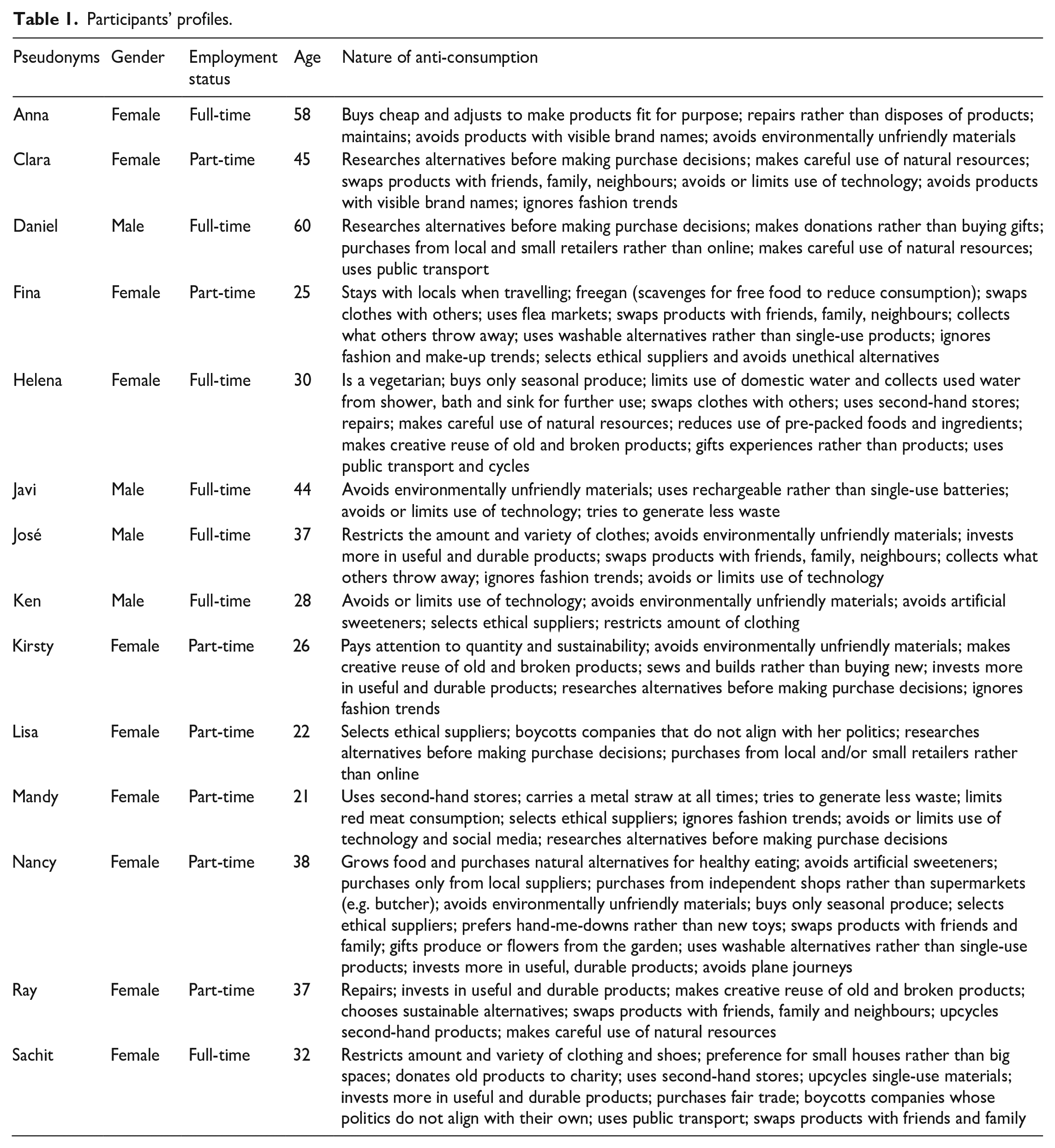
We asked participants to bring images of what anti-consumption means to them and these images functioned as starting points for the interview conversations. The discussion guide included questions about participants’ backgrounds, how they define anti-consumption, the practices where anti-consumption might feature and their temporal perceptions. Interviews took place between May 2019 and March 2020; each lasted 45–60 minutes. Verbatim transcriptions generated 100,889 words and were analysed using NVivo 12.
The interviews generated rich data as participants exemplified how they practise anti-consumption, how this is organised across different practices, what this means to them and how it affects the temporal aspects of other practices. Thus, our data reflect participants’ anti-consumption meanings and doings, and our probing of relevant temporal aspects as they emerged during the interviews. Further, as our own experiences, values and positionalities inevitably shape our understandings and analysis of social practices, the research team engaged in self-reflexivity about their own attempts at anti-consumption. This is because reflexivity can enable us to account for our own biases and, thus, improve research practice (Kleinman and Copp, 1993).
Our analytical process evolved from coding the data thematically using a template analysis approach (King and Brooks, 2018), to building facets based on our theoretical concerns and the emerging data. We developed a flexible, a priori coding template based on our theoretical interests plus a small subset of the data. Informed by the template approach, this initial coding remained tentative. As data analysis progressed, we changed and refined the coding template until further data analysis yielded no additional insights (King and Brooks, 2018). Thus, facets were shaped progressively, and iteratively as new insights emerged (Mason, 2011). This process involved contextual flexibility and sensitivity (Brooks et al., 2015). It illuminated the novel temporal facets of the data, while questioning existing temporal assumptions and categories (Mason, 2018a). In this way, the later stages of analysis focused on unpacking the three most insightful and theoretically relevant facets that emerged from the data, their inter-relations and what their illuminating capacities are regarding anti-consumption temporalities.
The Temporal Facets of Anti-Consumption
Our data show empirical support for Southerton’s (2006, 2020) theorisation of social practices’ temporal dimensions, but also for how such dimensions become destabilised when anti-consumption traverses such practices. The temporal dimensions become evident in facet one, and then they systematically reappear in facets two and three. Thus, the first facet highlights how the five temporal dimensions (i.e. durations, tempos, sequences, synchronisations and periodicities) manifest through our participants’ anti-consumption practices. The second leverages these foundational temporal dimensions by demonstrating that, when anti-consumption disperses across integrative practices, it destabilises such practices’ temporal dimensions. This destabilisation, in turn, creates glitches (i.e. dissonant intervals) in these dimensions. Delving further into, and building upon, these two facets, the third facet shows that, as these temporal glitches accrue, practice patterns are destabilised, and the social coordination of practices becomes more difficult. These challenges to practice coordination then generate micro-level asymmetric socio-temporal rhythms in everyday life. Figure 1 sets out the three emerging facets.
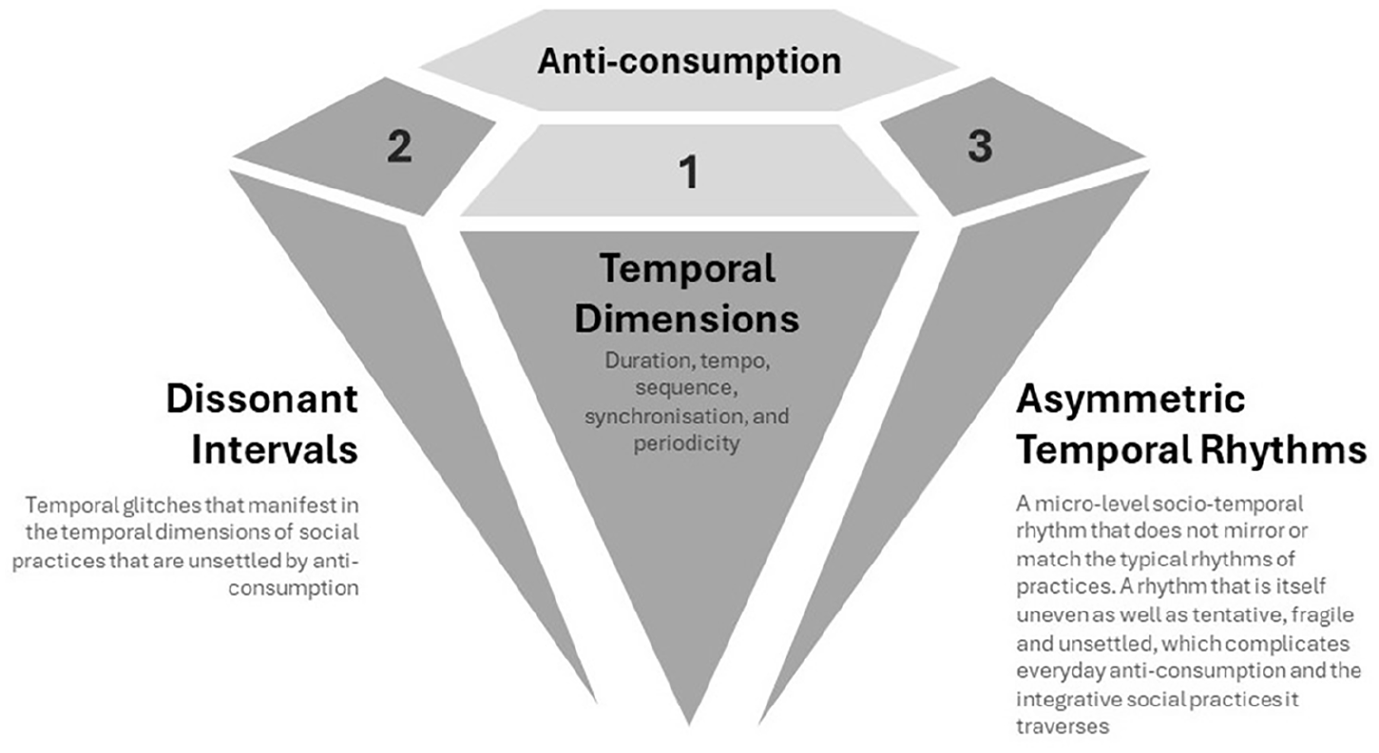
The temporal facets of anti-consumption.
Across these interrelated facets emerges a deficit perspective among the most reflexive participants, who at times express negative evaluations of, and discomfort with, the temporal destabilisation and disruptions they experience when performing anti-consumption.
The Intense Facet: The Temporal Dimensions of Anti-Consumption
As a dispersed practice (Warde, 2005), anti-consumption permeates the temporal performance and organisation of the integrative social practices in which it features. Our data show that it involves actions such as not shopping for new fashion items, consuming less or no meat and not using a car to commute. As Anna (female, 58) suggests, anti-consumption manifests through sets of actions that are configured to resist ‘buying too much, being obsessed with buying things’, ‘being manipulated into thinking that this is worth it’ and ‘the whole philosophy of . . . things which don’t last’.
For many participants, anti-consumption accompanies a sense of mindfulness that evolves over time, with reflexive discourses and actions that are organised to achieve a balance among material wants, necessary consumption and the freeing up of time. As Fina (female, 25) suggests, ‘I like not wearing make-up so much anymore; it’s just very practical, and it’s also, like, less time-consuming.’ Consistent with the well-established anti-consumption ethos of reducing, reusing, recycling and resisting consumption (Lee, 2022; Makri et al., 2020), our participants’ sayings and doings reflect respect and care for the materials that constitute the objects of everyday consumption. For example, Anna ‘treats it [clothing] with respect’. She cares for garments and white goods within fashion and laundry practices, respectively, so that products last longer, and this counteracts manufacturers’ planned obsolescence. Here, Fina and Anna reflect on an objective measure of time (Adam, 1990), but the temporal tapestries of anti-consumption emerge in other ways, too. Participants perceive temporalities subjectively (Carlson et al., 2019), according to their own psychological make-up, personalities and moods (Hornik, 1984). Participants carry the temporal dimensions of anti-consumption within the various integrative practices they perform, in turn co-constructing multifarious structurings of time (Glucksmann, 1998) in everyday life. For example, anti-consumption makes the duration of cooking longer due to reduced consumption of processed and pre-packaged ingredients: ‘With the food, it’s a lot of planning, cooking; you have to dedicate the time to cooking [from scratch], you have to do the planning’ (Helena, female, 30).
Here, Helena exemplifies how anti-consumption practice can make the consumption process involved in another practice (i.e. cooking) last longer than what she perceives to be the more common versions of this other practice, which typically involve the consumption of processed foods. This, in turn, impacts on the duration of the anti-consumption practice itself. This is because of its demand for more planning (about how, where and when to shop, which ingredients to buy, how and how much to cook, and how to avoid food waste), as well as for prolonged food preparation.
Tempo emerged through participants’ understandings of how certain practices become fast or slow, accelerated or decelerated, when they include anti-consumption. For example, for some participants, anti-consumption creates perceptions of acceleration because of its increased demand for planning and organising. For others, anti-consumption helps them slow down when their lives are busy, by enabling them to spend time in activities that enhance their well-being without consumption. Anti-consumption can also mean being creative about how to engage with material objects, and such creativity is perceived to be a slow process. For instance, participants know that if they make something (e.g. sew their own clothes or build a rack for their bedroom), the process will enable a sense of slowing down compared with the accelerated process of shopping, as Clara (female, 45) explains: ‘I’m building my own cupboard, so this is very slow work because I’m not a professional, but you know, I’m trying to [make] my shelves and not buy.’
Further, temporal sequence was mainly understood in relation to arranging different practices, their elements and their performances sequentially. Consuming or not consuming were central to daily practices’ sequential organisation, given the importance of anti-consumption in participants’ lives: ‘To go [food] shopping, I go on my way to work, or on my way back from work, so I’ve reorganised my day’ (Daniel, male, 60).
Daniel reorganises his day so that food shopping that cannot be avoided can be done around his work commute, as ‘a [part of his] daily routine, not as a special journey’. Although this ordering of practices might equally apply for people who do not engage in anti-consumption, Daniel explains its meaning in terms of reducing transportation-related carbon emissions. For carriers of anti-consumption practice, shopping itself requires more active organising and sequencing than it might for other people, as the performance of these daily practices is modified such that consumption is minimised. When shopping is needed, anti-consumption often demands a resequencing of other practices, their elements and their temporalities.
Further, synchronisation is important for anti-consumption given its dispersed nature, but how synchronisation is enacted depends on understandings of time as a resource. That is, for some participants, anti-consumption is time-consuming, as, for instance, ‘it takes more time to go to a vintage store [than] just going to the high street’ (Mandy, female, 21). Therefore, these participants try to synchronise anti-consumption with periods of time when they are less busy, for example when they are on holiday: This was actually travelling in Portugal, and I stayed with the locals, so this is also great for me to avoid consumption . . . this way I had no cost, but it’s not really about the cost, also about the consum[ption] that you definitely make lower. (Fina, female, 25)
Fina takes time to plan her ‘stay with the locals’ and safeguards her holidays against what she perceives as normalised but unnecessary holiday consumption (e.g. hotel rooms, restaurant meals); in this context, anti-consumption is synchronised with tourism practices.
Conversely, participants who understand anti-consumption as a practice that frees up time synchronise anti-consumption with spending time meaningfully, as time can then be spent on activities other than consumption (e.g. sharing a meal with family and/or friends).
There is also a periodicity to anti-consumption, given that it involves reduced shopping frequency and that it is not performed evenly or continuously across time. While some resistance to shopping becomes habituated, there is also a regulation of shopping periodicity by, say, going without when fruits and vegetables are not in season, food shopping only on weekends or replacing (rather than buying more) clothes only when extremely worn-out items can no longer be used: I have about four dresses, but they are different, like, warmer dresses and those that I wear in summer and at a point where I can see that the colour is changing, or [. . .] the piece is losing its shape, I . . . That’s where I start my research [to replace the item]. (Kirsty, female, 26)
A further aspect of the periodicity of anti-consumption concerns resistance to cyclic consumption, for instance resistance to seasonal fashions, and to the consumerism typifying holidays such as Christmas. Participants find strategies each year to resist the materialism of Christmas by using old newspapers for gift wrapping, donating to charities rather than buying gifts, giving experiences rather than material objects or finding ‘other ways to, you know, show my love to others instead of giving gifts’ (Clara, female, 45). An annual marker of anti-consumption is Buy Nothing Day, in November, when people are asked not to shop for 24 hours (Persson and Klintman, 2022). This represents a very short-lived instance of anti-consumption practice, but more widely anti-consumption can manifest in short-lived cycles, largely because it misaligns with market-mediated consumption norms and structures. For example, Kirsty’s partner engages only briefly in anti-consumption: I suggested to my partner not to buy anything during that week . . . Monday, Tuesday, Wednesday [laughs]. But then he went, like, oh I want to make pasta. [. . .] We didn’t have all the ingredients and he went to the grocery shop and bought everything for the pasta. (Kirsty, female, 26)
In sum, this facet shows that anti-consumption requires specific understandings about how to act (Schatzki, 1996; Warde, 2005), for the temporal organisation of rejecting, reducing, reusing, repurposing and/or reclaiming the material elements of the practices that anti-consumption intersects. As anti-consumption manifests its own durations, tempos, sequences, synchronisations and periodicities, it disrupts the temporal dimensions of the practices it traverses.
Shining a Light on the Facet of Dissonant Intervals
As the previous facet started to show, the temporal qualities of anti-consumption can destabilise the effective performance of otherwise well-established integrative practices, disrupting the temporal dimensions of practices that usually conform to mainstream consumption logics. It is these temporal disruptions that we term dissonant intervals, which are the temporal glitches and destabilisations that occur in the integrative practices that anti-consumption traverses, and which also evoke challenging affective intensities (Spotswood et al., 2024) for the carriers of such practices.
Dissonant intervals are reflected, among other things, in a sense a discomfort. For example, when evaluating the longer practice durations of anti-consumption in the previous section, specifically in relation to the planning and cooking of meals, Helena (female, 30) went on to say:
‘I think that’s probably why a lot of people don’t do it because it’s not necessarily comfortable.’
Helena highlights the discomfort involved in performing a practice (cooking from scratch without processed ingredients) that goes against the logic of consumer culture (the consumption of processed foods). Consistent with the growing literature acknowledging that sustainable consumption can be inconvenient (Diddi et al., 2019), requiring more time and extra energy (Mukendi et al., 2020), our findings show that the temporal dimensions that participants perceive as ‘not normal’ can create temporal glitches that are uncomfortable, that disrupt and destabilise the temporal dimensions of practices: We don’t have any cling film in the house, so we don’t even have it for emergencies; it’s just not in the house, and sometimes you have these moments where you’re, like, I really need cling film [laughs], so you have to find a solution. (Nancy, female, 38)
Thus, Nancy reflects on the additional chores caused by avoiding convenient but unsustainable products, and the temporal implications and routine disruptions involved in this food practice.
Tempo glitches were also highlighted, particularly regarding the slow and often inconvenient pace of commuting to work or shopping without a car: If I were to take a car to work, it would take about 15 minutes [to get there], but since I walk, or take the bus, it takes half an hour, so that’s an extra half an hour a day that I pay with my time. [. . .] It’s effort and it’s time and I think a lot of people couldn’t put that in shopping. Using the bus, I’m not on my own schedule. There is definitely more work because of it. (Helena, female, 30)
Here, Helena foregrounds the tempo implications of commuting to work by public transport rather than by car. But she also evaluates, from a deficit perspective, the tempo disruptions, effort and discomfort involved in slow commuting, as she is not on her ‘own schedule’. Similarly, growing vegetables to avoid shopping takes considerable time, effort, patience and respect for the slow tempo of seasonality and the uncertainties related to the amount and quality of the crop. It can also disrupt and destabilise other practices’ temporalities by leading to their acceleration, deceleration or even disruption (e.g. working fewer days) so that food growing can be performed according to the practice rules and standards of anti-consumption: I work four days a week and Monica [wife] is currently working four days a week and is going down to three days a week and on those spare days we are going to be doing things like spending time in the garden doing vegetables, so actually you make a choice. (Nancy, female, 38)
Further, disrupted sequencing emerges through the destabilisation of participants’ organising of integrative practices according to anti-consumption principles and rules: I needed to buy boots, which meant that I needed to find time to go do that and that time is not planned in my week or in my month – it’s not there – so I have to rearrange my time and it’s hard [laughs] to find a moment in which I will go to a store and it [. . .] feels like pain for me, oh, I have to go buy something. (Ken, male, 28)
Here, Ken discusses sequencing in relation to having to shop, as, for him, shopping is an extraordinary rather than a habituated activity. Thus, other practices must be re-sequenced for shopping to occur, creating sequencing disruptions and misalignments. Like Helena, Ken foregrounds the negative aspects related to the destabilisation that anti-consumption temporalities create for other practices. This evidences how the temporal dimensions of anti-consumption can misalign with, and disrupt, those of other practices, impacting on the organisation of everyday life.
Participants experience further temporal unsettledness when trying to synchronise their anti-consumption with the performance of other social practices, such as visiting friends or having a party: On a daily basis it is really easy to recycle. One day you [throw] a party at home. Then they help you to clean up and they place all kinds of waste together. You think about it and say, what a nuisance! Even when it is one day, I am generating more waste. But this involves people that are helping you, so you may say, today I will make an exception, but it feels bad. (Javi, male, 44)
The synchronising of a social gathering with the need to manage waste according to anti-consumption rules disrupts habituated anti-consumption practices, ‘even when it is [just for] one day’, leading to negative feelings and stress for Javi. Here, it is the party that disrupts and creates an interval or glitch in anti-consumption rather than the other way around, showing how the temporalities of other practices can also affect those of anti-consumption.
Dissonant intervals also emerge through periodicities that misalign. For example, Daniel reflects on the periodicity of Christmas, including what he sees as the normalised material intensity of the season’s gift-giving practice, and how he disrupts the seasonal gift-giving through anti-consumption: One or two Christmas presents that I’ve bought for people . . . basically they are done [as] a little email saying that I’ve spent some money planting trees in Africa . . . So, for me this was an element whereby it’s not really boycotting Christmas, but it’s about boycotting the consumption or extra or over-consumption that takes place at certain times of the year. (Daniel, male, 60)
Daniel considers how not giving a ‘normal’ gift for Christmas acquires the meaning of an intentional disruption or, to use his word, a ‘boycotting’ of what he perceives as the overconsumption that occurs each Christmas. Other annual events such as this can also be unsettling for Daniel: Christmas is [. . .] a period of time where we consume a lot . . . We need to buy presents because otherwise we’ll feel bad, or the other person will feel bad . . . There’s a great amount of pressure put on us to provide nice presents. I mean Christmas is one example, but there’s other times of year as well. (Daniel, male, 60)
Daniel’s quote illustrates the periodicity of consumption-intensive, recurring social events, but also the negative evaluations and emotions that such events can engender given the disruption they cause to anti-consumption and its temporalities.
This facet, thus, unpacks the temporal glitches or dissonant intervals that anti-consumption creates. It illuminates how the temporalities of anti-consumption destabilise, and are destabilised by, integrative practices’ meanings, materials and the competences needed for their effective performance.
The Smallest but Shiniest Facet: Asymmetric Temporal Rhythms
This facet expands the preceding ones by highlighting that, as dissonant intervals accrue, they create uneven patterns in practices, making their shared coordination more challenging. This, in turn, results in a micro-level asymmetric socio-temporal rhythm, that is, an uneven rhythm that is also tentative and fragile, which does not mirror the ‘typical’ socio-temporal rhythm of practices, and which emerges through the intersection of anti-consumption and integrative practices.
For example, duration glitches (practice durations that are understood, discussed and enacted as shorter or longer than ‘normal’) can accrue because of the inconvenience of an anti-consumption practice: We have other things that we can use [rather than cling film], but I suppose there’s little moments and I guess they probably do add up over a week, over a year, that you are spending time doing these things. (Nancy, female, 38)
Here, Nancy reflects on the dissonant intervals that emerge and accrue through a refusal to use cling film. Moreover, as dissonant intervals accrue, they disrupt the possibility of socially coordinating other practice performances or ‘times when [. . .] shared social practices are performed’ (Southerton, 2020: 20). Indeed, participants discuss the accrual of duration glitches in diverse ways, for instance when persistently longer food practices involving anti-consumption ‘crowd out’ the shared coordination of other practices: If I weren’t cooking and worrying so much about making use of the food in my house, I think I would save a lot of time because that’s a couple of hours on the weekends, normally, so I could be doing more outside, at the beach, doing other things, or spending time with my boyfriend. (Helena, female, 30)
Here, Helena shows how the long duration of her cooking practice repeatedly impinges upon other social practices, creating worry and temporal glitches that accrue and persistently unsettle shared coordination of practices with her boyfriend.
José highlights the periodicity of fast fashion and how it is disrupted by his anti-consumption practice, hence generating an asymmetric fashion rhythm in his own practice: A lot of people say yes, those clothes (from Primark or Zara), they last you two years. No, that’s not true. I have clothes from those places that are, like, more than eight years [old]. They are not in fashion anymore [. . .] but I don’t care. (José, male, 37)
José circumvents fast fashion cycles by extending the periodicity of his garment usage repeatedly, even if his clothes ‘are not in fashion anymore’. An asymmetric fashion rhythm emerges as periodicity glitches accrue, and this uneven rhythm does not align with what ‘a lot of people say’ or with their cycles of fashion that ‘last you two years’. It is also asymmetric because not all his clothes will last ‘more than eight years’. Thus, the rhythm of fashion practice in José’s life misaligns (is not symmetric with) with the circularity (recurrent fashion consumption cycles) and linearity (fast replacement of fashion items ordered sequentially according to fast fashion production and advertising cycles and seasons) of the usual fashion cycles in his social circles.
Conversely, for Ken, the asymmetric temporal rhythm of anti-consumption is an instantiation of the uneven rhythms within his own life, rhythms that accrue and extend over the life course, reflecting the temporal intersection between the self and the externally structured conditions in society that demand materially intensive lifestyles: I think my anti-consumerism is a reflection, it’s a manifestation of my state of mind, umm, so [. . .] in the moments in which I am more truly myself, I happen to consume less and in the moments in which I am in the middle of a turmoil of western life, then I happen to consume more. (Ken, male, 28)
As Ken illustrates, this micro-level anti-consumption rhythm is neither linear nor circular. Rather, it is uneven (asymmetric) because it fluctuates and is always tentative, creating its own temporal patterns. Relatedly, Fina suggests: I try to be as vegan as possible, but sometimes, especially when I travel [. . .], I don’t want to put my own ideology above culture or experience or travelling. For example, I was invited by this family, and they said, ah you are our guest and it’s so great to have you; we have cooked the best chicken, [. . .] whatever. Then I won’t say no because I’m vegan. (Fina, female, 25)
For Fina, experiencing a new culture and adhering to local, familial social conventions means having to suspend or pause anti-consumption for some time and this happens repeatedly and unevenly when Fina travels. Fina exemplifies an experience many participants share, namely the ‘reverse accrual’ of dissonant intervals in anti-consumption because of another practice (i.e. travelling). This accumulation of dissonant intervals then creates difficulties in coordinating anti-consumption with other cultures’ dominant food practices, generating a micro-level asymmetric temporal rhythm in Fina’s everyday anti-consumption practice.
Similarly, coordinating work and social life can also produce an uneven anti-consumption rhythm, given that dissonant intervals accrue over time, especially when ‘life is very busy, [as] I will probably not spend as much time [anti-consuming] as during the holidays’ (Daniel, male, 60). Ken also explains that, when coordinating ‘going out’ with people who do not engage in anti-consumption, dissonant intervals accrue in his anti-consumption temporalities but are repaired eventually: When I go out with friends who buy stuff it may happen that my passive anti-consumerism vanishes a little bit, but then if I go, like, backpacking or I go to meditation or I do, like, a more self-conscious and outside-of-western-society moment of my life, then it gets stronger. (Ken, male, 28)
Likewise, other participants highlight how temporal glitches accumulate when trying to socially coordinate anti-consumption with going out with friends, for example when anti-consumption intersects caring practices. Nancy, a mother of a 10-month-old baby, describes her attempts at synchronising the use of nappies with going out with friends for the day: We’ve got the washable ones [nappies], but we do also buy the [disposable] ones and then if we’re going out, we sometimes use those because actually it’s impractical to take washable nappies with you when you are going out for the day. (Nancy, female, 38)
Nancy exemplifies the ongoing temporal glitches that can accrue with the use of washable nappies. Specifically, they make coordinating anti-consumption with socialising temporalities ‘impractical’. This, in turn, impacts anti-consumption rhythms, making them asymmetric (uneven).
Overall, this facet highlights that dissonant intervals accrue, destabilising practices’ temporal patterns and challenging attempts at shared coordination of the ‘times when’ social practices can be performed in everyday lives. Much reconfiguration of meaning, competence and material consumption is required to change how the integrative practices that anti-consumption traverses are temporally organised and performed. Perhaps unsurprisingly, this is usually only partially accomplished. Indeed, accrued dissonant intervals make the shared coordination of social practices difficult and tentative, generating fragile and uneven rhythms. These micro-level asymmetric socio-temporal rhythms co-exist with, and chip away at, the circularity (recurrence) and linearity (sequence) of the temporal patterns (Southerton, 2020) of the practices that anti-consumption intersects and of anti-consumption itself.
Conclusion
In this work, we examine Southerton’s (2020) theorisation of temporalities empirically and establish how anti-consumption destabilises, and is destabilised by, integrative social practices’ temporal dimensions and rhythms. We use a facet methodology approach and qualitative interviews to strategically illuminate a set of temporal facets within practices where anti-consumption features. Our facets offer flashes of insight into destabilised practice durations, tempos, sequences, synchronisations and periodicities.
Where integrative practices’ temporal dimensions are disrupted given the challenges that anti-consumption poses, this destabilisation casts light on what we term dissonant intervals. Dissonant intervals are different from tempo (i.e. acceleration or deceleration) because they are temporal glitches that occur when a dispersed practice like anti-consumption destabilises and disrupts (and is destabilised and disrupted by) the ‘normal’ temporal dimensions (i.e. tempo, duration, sequence, synchronisation and periodicity) of the integrative practices it traverses. Dissonant intervals are, thus, not another temporal dimension. Instead, they are temporal disruptions that occur across and destabilise those five dimensions, evoking challenging affective intensities (Spotswood et al., 2024) for practice carriers.
As these dissonant intervals accrue, they destabilise practice patterns and make the shared coordination of social practices difficult, creating unsettled, micro-level asymmetric socio-temporal rhythms up to the point when the need arises to somehow align anti-consumption with integrative practices. In part, this can be seen as a temporal repair mechanism that pulls towards the ‘usual consumption’ involved in socially dominant, unsustainable, integrative practices. However, this ‘pull’ then destabilises and disrupts the temporal dimensions of anti-consumption itself, creating asymmetric (uneven) socio-temporal rhythms within anti-consumption.
Therefore, we demonstrate how anti-consumption temporalities destabilise, and are destabilised by, the temporalities of the integrative practices they intersect, manifesting tentative rhythms that we conceptualise as asymmetric. An asymmetric socio-temporal rhythm emerges as dissonant intervals accrue. It challenges the shared coordination of social practices and is itself uneven as well as tentative and fragile. It also unsettles the evenness of circular (recurrent) and linear (sequenced) socio-temporal rhythms in everyday life (Southerton, 2020).
We make two main contributions to the sociological and consumer culture research on the temporalities of social practices. First, by re-embedding anti-consumption within social practices and foregrounding the temporal dimensions that shape, and that are shaped by, anti-consumption, we establish that anti-consumption destabilises integrative practices’ temporal dimensions and, thus, everyday rhythms. This contribution is significant, as it advances anti-consumption research beyond its psychology-oriented focus (Lee, 2022; Makri et al., 2020). It shifts the locus of analysis to examining anti-consumption as a dispersed practice, a practice that happens through the organisation and performance of other social practices, and which configures and is configured by the temporal dimensions of daily life.
This reorientation of anti-consumption research enables a second contribution, namely two original concepts: that of a dissonant interval, a disruptive kind of temporal glitch; and that of an asymmetric socio-temporal rhythm, a micro-level rhythm that emerges through the accrual of dissonant intervals. We thereby advance theorisations on the richness and multiplicities of temporal dimensions (Shove et al., 2013; Southerton, 2006, 2013, 2020), and on the micro-level socio-temporal rhythms that manifest as integrative and dispersed practices intersect, challenging the shared coordination of social practices.
These concepts are important, as they expand existing temporality dimensions, rhythms, vocabularies and imaginaries, including how we understand temporal manifestations in the configuration of practice elements. They are also significant in that they open new avenues for research seeking to advance less materially intensive lifestyles. For example, future research can examine how dissonant intervals and asymmetric socio-temporal temporal rhythms can create opportunities for the introduction of new socio-material interventions that seek to enable environmentally sustainable practices, or can examine how such temporal disruptions and asymmetries might impact people’s stability and sense of well-being. It can also employ longitudinal methods to understand how the temporal disruptions related to anti-consumption might lead to new socio-temporal rhythms at a macro, societal scale over time.
Finally, our findings exemplify how frustrating it can be to try to find ‘biographical solutions to systemic contradictions’ (Beck, 2007: 685). Thus, our research can benefit organisations and public policymakers interested in encouraging environmentally sustainable lifestyles in ways that go beyond assigning responsibility for systemic issues to individuals. For example, time poverty (Warren, 2003) can be addressed through policies that promote work–life balance, telecommuting and flexible working arrangements, as our participants’ quotes highlight that time pressures contribute to unsustainable consumption within social practices. Also, local communities can be supported to engage in (anti-)consumption in ways that allow communities to coordinate their temporalities collectively and with fewer asymmetries. Improvements in public transport and community ridesharing schemes can be helpful starting points. Policymakers and community activists could also promote opportunities for community-based initiatives, including community gardens, which are sustainable, relational and collective endeavours, or community repair cafes, where people can learn how to mend and, thus, collectively extend the duration of their material possessions.
Footnotes
Acknowledgements
The authors would like to thank Dr Jill Timms, the editorial team and the anonymous reviewers for their constructive feedback throughout the review process.
Funding
The authors received no financial support for the research, authorship and/or publication of this article.
