




Abstract
Empirical sociology’s focus on ‘things’ follows an Aristotelian legacy that prioritises discreteness and concrete singularities – that which are perceived to exist. In turn, such convention is predicated on an ontology of being and a natural focus on presence – the ubiquitous assumption that reality is ultimately atomistic and substantial. This metaphysical outlook has produced outstanding scholarly results. However, it also overlooks the significance of an alternative absence, a persistent but undetected ‘otherness’ that can affect social outcomes. The study shows how absences shape actionable imperatives in social settings and identifies requisite mechanisms through which social arrangements are enacted. Thus, it joins the burgeoning sociology of nothing, absence and loss and stresses the enactive consequentiality of what is missing through a sensemaking lens.
Introduction
Sociology regularly considers ‘no-things’ and their role in social settings. This is evident in works that explicitly tackle the topic and pick up steam such as loss (Jakoby, 2015), stillness (Stanley et al., 2020), silence (Zerubavel, 2010), death (Walter, 2008) or nothing and absence (McLanahan et al., 2013; Nordqvist, 2021; Scott, 2020) but also in streams that draw attention to absences as possibilities. For example, probabilistic approaches cater for absences such as in the case of networks that prevent activism, impede action and nurture non-becoming (Crossley and Ibrahim, 2012). Similarly, ‘space possibilities’ in Bourdieu’s (1984) work – a corpus central to what a society is – implicitly signpost absences in social settings. While recent studies caution about appropriating past spaces at face value, Bourdieu’s spatial representation enables sociologists to account for absences linked to, for example, lifestyle preferences or occupations (Glevarec, 2023). Lastly, sociological scholarship is the field where the discourse on poverty, deprivation and lack of certain things (social ties, equality, etc.) has excelled (Barwick, 2017; Davidson, 2023). Therefore, sociology’s theoretical apparatus includes several references to aspects of absence.
However, empirical sociological scholarship often privileges the tangible, the observable, the material and, thus, the immediately felt (Holmes and Ehgartner, 2021; Stanley et al., 2020). This is expected given that ‘[s]ociology is conventionally defined as the study of social things’ and the disciplinary oeuvre is about what social actors ‘do’ or ‘are’ (Scott, 2018: 3, emphasis in original). Consequently, that which is invisible and ineffable is given short shrift in making sense of reality; negatively defined ‘no-things’ have not equally captured sociologists’ empirical attention. Rather, they are treated as an implied contrast to the foreground ordinariness and prevalence of those social ‘things’ or, at times, portrayed as a quasi-exotic, less important deviance for social inquiry (see Croissant, 2014; Mueller, 2018; Scott, 2020 for a requisite critique). Yet, the burgeoning sociology of absence emphasises that social actors do some-thing with this otherness; absences are not ‘nothing’. Instead, they are variably experienced and subject to social appropriation (Mueller, 2018; Scott, 2020). Despite their omnipresence though, ‘no-things’ constitute ‘a sociologically neglected terrain’ (Scott, 2018: 3) and empirical investigations into absent manifestations, ironically, ‘remains largely absent’ in sociological literature (Holmes and Ehgartner, 2021: 253).
This asymmetric privileging of presence over absence reveals a paradox: Whenever we take the existence of something for granted, we must sceptically entertain the possibility of it not existing; otherwise, we would not posit it ‘as’ something (Heidegger, 1962; Sartre, 2018). Thus, absence is not an ontological epiphenomenon, a situational deviance or contextual anomaly that does not warrant empirical attention. Rather, it is a necessary condition for entities to appear as such, to be. Aspects of it (e.g. mortality) imply universal, inescapable conditions, which engender a far-reaching affinity, entrenched memories or profound emotions (Holmes and Ehgartner, 2021; Scott, 2020; Stanley et al., 2020).
Social actors often accept such conditions and view absences as source of meaning (Gilliam, 2013; Nelson, 2013). As Scott (2018: 4) notes, ‘[d]espite being negatively defined by lack or absence, [social forms such as non-presence] are constructed as meaningful by the reflexive social actors who manage them’. This centrality of meaning links absences with an effort to enact sense out of the interruption, ambiguity or confusion that, for example, death, loss, gaps signify. Meaning-making is a core concept in sensemaking accounts (Cerulo, 2018; Fiss and Hirsch, 2005), the main idea of which is that ‘reality is an ongoing accomplishment that emerges from efforts to create order and make retrospective sense of what occurs’ (Weick, 1993 cited in Fiss and Hirsch, 2005: 31).
This study contends that constructing plausibility of a disturbing experience to restore order may emerge out of absence – not as creatio ex nihilo but because what is missing is sense-rich and consequential (Jakoby, 2015; Scott, 2020). An absence enables actors to reassemble their experiences into a new order of meaning; to shape their agency because of what is ‘not’, too. Thus, acknowledging absences as something that ‘continually escapes our perception, is continuously deferred, yet which can disrupt sense at any moment’ (Introna, 2019: 761) may elucidate social outcomes beyond ‘tangible’ and ‘visible’ commitments. Then, this study is guided by two questions: how do absences implicate with sensemaking? What (non-)actionable consequences does their nexus induce in social settings? To shed light, absences are framed as means of appropriating sense, thus problematising extant sensemaking studies, which adopt a presence-laden focus. In doing so, I articulate three ways through which social actors may engage with absences, thus responding to calls to illuminate the (in)action potential associated with ‘no-things’ in sociological inquiry (Croissant, 2014; Scott, 2020). By extension, through their enactive consequentiality, I also highlight how absences explain outcomes of change, reproduction and decline in social settings.
Then, first, the study conceptualises absences to set the scene for their consequentiality and, drawing from the sensemaking literature, the preponderance of the assumption of presence is demonstrated as the dominant form of thought therein. The study goes on to show how such an orientation may be deficient in that it surreptitiously overlooks non-present but meaningful cues that undermine scholarly reflection on social life. Then, following three types of sense appropriation, a consequential model that explains social outcomes is put forward. The study concludes with discussion and contribution.
Conceptualising Absence
Not all absences are similarly effectual. For example, loss of a community leader (e.g. a pioneering activist) can be highly impactful, leading to collapse of a communal effort for social change. Contrarily, imagining a fictional non-existent (e.g. a superhero) that is not ‘here’ is less relevant to sociology. Moreover, absence of communication with peers for a day may be insignificant but missing social ties for a prolonged period following family relocation to another neighbourhood may denote marginalisation and social exclusion (Barwick, 2017). Namely, we neither have the same expectations nor do we attach the same importance to missing objects or instances (Sartre, 2018). Therefore, absences and their magnitude or scope are conditioned by, for example, our memory, imagination, felt deprivation, expectations or social status creating a panspermia of requisite types, which are mainly elucidated in philosophy (see, for example, Barton, 2020; Bernstein, 2021; Farennikova, 2013 on perceptual, topological or metacognitive perspectives).
For example, deconstructionism explains how absence is a supplement to presence that continually disrupts or questions the seeming stability and continuity of ‘being’. Absences reconfigure reality as we tend to perceive it while enabling its reconstruction on grounds that account for both what ‘is’ and what ‘is not’ (Derrida, 1998). Existentialism showed how missing instances imperceptibly serve as the backdrop canvas against which presence is allowed to stand out and, subsequently, how such absences privilege and imbue ‘visible’ entities with meaning (Sartre, 2018). Phenomenology stresses the gradual marginalisation and withdrawal of presence that unearths sentiments of, for example, anguish, dread or humility; that is, affective stances set against the calculative cognition normally associated with present ‘things’ (Heidegger, 1962).
I do not pretend to capture this intriguing metaphysical pluralism, which includes fictional non-existents, non-being, immaterial objects, nothingness, theological aporias, ontological (im)possibilities and so on (Bernstein, 2021; Erhard, 2020). Instead, I draw upon the sociology of nothing (Scott, 2018), absence (Holmes and Ehgartner, 2021) and loss (Jakoby, 2015) and define absence as the consequential lack of a prefigured structural entity. Understanding absence as predicated on an infrastructure of ‘some-thing’ implies a detectable difference; a comparison between our projections and expectations of what constitutes ‘presence’ and, its contradictory manifestations, that is, the ‘otherness’ that we, in fact, experience. Therefore, absence is the result of a ‘recognize-and-distinguish’ ability: an enduring representation of ‘some-thing’ in one’s mind (e.g. an object registered in memory) and a perceptual environmental input, which alerts us that this ‘some-thing’ is missing (Barton, 2020: 3833; Farennikova, 2013; Tiehen, 2015).
While this phenomenology is linked to incongruities that translate into something ‘drastic’ (e.g. agony or frustration), there are also non-actionable circumstances that generate no effects (Farennikova, 2013; Tiehen, 2015). Given their relevance to sociology, I am interested only in ‘drastic’ absences. Namely, a tokened mismatch between expectation and experience is of interest if the difference between the object-template and its absence is conducive to appropriation by, for example, adopted children, employees or class members as typical empirical foci of sociological analysis. Then, an absence may be ontologically dependent and actively extracted from what we visualise or circumscribe as ‘that which exists’ (a Sartrean figure or idealised Platonic form). However, for sociological theorising, entitisation of absences as mere deviance between one’s expectations and perceptual stimuli has little value. Instead, absences become relevant when past perishabilities, missing actualities or future potentialities map onto and implicate with our lived experiences as social beings. Thus, I recognise a functional role to absences, that is, social actors must be able to ‘do’ something about/with them; not only observe them as incongruities (Barton, 2020; Tiehen, 2015).
Sensemaking
Sensemaking has gained traction in general sociology (Cerulo, 2018; Fiss and Hirsch, 2005) but, predominantly, features in the sociology of health and illness (Iversen, 2021; Rhodes et al., 2016) and the sociology of organisations (Introna, 2019; Maitlis and Christianson, 2014). Despite the voluminous work though, there is ‘no single [agreed-on] definition of “sensemaking”’ (Brown et al., 2015: 266). Given lack of consensus, I adopt the definition in the most cited integrative review, which defines sensemaking as ‘a process, prompted by violated expectations, that involves attending to and bracketing cues in the environment, creating intersubjective meaning through cycles of interpretation and action, and thereby enacting a more ordered environment from which further cues can be drawn’ (Maitlis and Christianson, 2014: 67).
The definition affords certain questions: what violates expectations and triggers sensemaking in social settings? What informs interpretation, meaning-making and action? Is order always attained or could it also be lost and diluted? To shed light, it is noted that sensemaking is occurrence-laden; an effort ‘to create order and make retrospective sense of what occurs’ (Weick, 1995). As such, there is always some-thing, an event or episode that triggers, shapes and concludes sensemaking such as, for example, consuming pornography (Daskalopoulou and Zanette, 2020), a safety episode in a primary care setting (Rhodes et al., 2016) or rowing the Amazon (De Rond et al., 2019). In turn, these material instances call sensemakers to enact sense until their reality re-appears as more ordered through, for example, rejection of shame and empowerment (Fiss and Hirsch, 2005; Keeley et al., 2009).
Then, sensemaking cues appear to be salient and observable and await one’s attunement and detecting abilities for their appropriation. As such, occurrences that enable sensemaking are ‘talked into existence’ and have already happened (Weick et al., 2005: 409). They are rarely unarticulated, ineffable or absent. Observability and materiality of events seem to be the sine qua non infrastructure of sensemaking. However, why should ‘tangibles’ be the only cues that violate expectations? Why cannot counter-entitative instantiations act as sensemaking stimuli? Does this inattention to non-salient cues reflect what happens in social settings?
Indeed, ‘tangibles’ provide a basis to make sense of reality (e.g. intense experiences as means to embodied sensemaking; De Rond et al., 2019). However, so do aspects such as non-participation (Scott, 2018), loss (Holmes and Ehgartner, 2021), non-movement (Stanley et al., 2020) or non-knowledge (Mueller, 2018). For example, absences explain a non-inclusive environment and a disintegrating ethos therein as manifestation of sense loss. Thus, visibility of social reality is not equal to understanding it (Weick, 2020). To attain the latter, scholarly focus should not be only on those ‘visible’ cues. Rather, it should be on the story we try to make sense of; in an effort ‘to clarify what is going on’ (Maitlis and Christianson, 2014: 58).
For example, consider structural change initiatives, planned events that routinely feature as triggers of sensemaking (e.g. a major organisational restructuring). Sensemaking starts with such initiatives since the disruptive ambiguity they entail calls social actors (e.g. employees) to “theorizing” their world and the relationships within it in a hope to provide order and enhance plausibility of the issue at hand (Fiss and Hirsch, 2005: 31). However, temporal bracketing of this sort deprives sensemaking accounts of the generative background that necessitated the event per se; an infertile absence within the group (e.g. lack of cohesive ethos) that galvanised organisational leaders to, well, consider change. Pre-sense has already been made about this ‘infertility’, and the change initiative is its visible enactment – the absence became fecund.
Therefore, making sense of ‘what is going on’ is often contingent on a consequential absence. For example, visible symbolic markers of class such as cars are important for children’s perception of class identity (Vandebroeck, 2021). However, their absence is the underbelly that creates frustration and disorder and ignites children’s identity construction in tandem with surrounding stimuli. Absences are profound, often implicit and ‘ghostly’ but largely unrecognised (Lambert, 2020; Scott, 2020). If scholars ignore them, they may offer a belated, contrived representation of where sense originally resides and where change or decline are incubated. In turn, social actors appear as observers who reflect on tangible ‘things’ to construct their identity but, equally, as ones who miss the ‘no-things’ of social reality – the pauses, the gaps, the non-movement that may, for example, pinpoint the need for change and reidentification (Mueller, 2018; Stanley et al., 2020). Hence, scholars risk portraying social actors as mere troubleshooters (e.g. political leaders) or as simply ‘going on’ with their lives (e.g. class-ridden youth), whereas they may be prudent visualisers who sought to pre-empt a problematic escalation or propelled to imagine a possible, better future. By not being attuned to absences then, we may not grasp that social actors encounter absence-induced ambiguity and do something with/about it (Holmes and Ehgartner, 2021; Vandebroeck, 2021).
Consequently, sensemaking may emerge out of confusion (Mair et al., 2012), ambiguity (Czarniawska, 2005) or disruption (Martindale and Fisher, 2019). But what could be more confusing, ambiguous or disruptive than, for example, loss or oblivion? What else calls for more ‘explanation’ and ‘meaning-making’? 1 Appreciating absences then accords with a sociological mantra – reality engrosses an immanent fragility and vulnerability (Gimlin, 2006; Kalleberg, 2009). Namely, social ‘things’ as present were once non-actual and may become so again (e.g. death as anticipated absence; Broom et al., 2020). Inversely, experiencing absences at present (e.g. industrial loss, Strangleman, 2017; lack of shared identity, Grundy and Jamieson, 2007) reminds us that once entities ‘were’ or may ‘become’. Thus, understanding reality as the presence of contemporaneous entities alone, we under-theorise how visualised, ‘would-be’ possibilities or remembered, perished events implicate with meaning-making.
An important point then is that expectations are violated (and sensemaking occurs) because of and through lack of something, too (e.g. an absent government in a crisis; Franceschelli, 2020). Thus, to clarify ‘what is going on’, we may need to consider ‘what is not’, or else, not accounting for ‘absent’ instances implies an undue disconnect with pressing imperatives in social settings. Yet, while sense often resides in the absent and the ineffable, ‘it is surprising how little attention the sensemaking scholars give to such constitutive absences’ (Introna, 2019: 761).
The Nexus between Absence and Sensemaking
Digital sociology exemplifies the nexus between absences and sensemaking. In digital societies, meaning is often generated from non-tangible artefacts; mediated via persons or things that are not present but experienced virtually. This absence of tangibility does not mean that digital societies are not ‘real’ nor that meaning should be found only in adjacent beings. Social actors routinely craft their experiences via digital means and the absence of bodily proximities does not preclude them from making sense of unfolding realities. In fact, the absence of such proximities enacts new forms of socialising. For example, bodily absence in digital media facilitates novel socialisation modes related to, for example, negotiating, controlling, dating, exchanging goods or ideas. Therefore, digital communication makes others who are absent, not only reachable but also participants in doing ‘some-thing’ together (e.g. taking a mutual decision over a virtual call).
Therefore, naked senses are not the sole meaning-making medium; an exclusivity bias that is premised on the causal closure of the material world. After all, ‘[t]he job of the senses is not just to provide a record of “what is where”, but to report, promptly and efficiently, about what is not where’ (Farennikova, 2013: 452). Absences then may be often treated ‘as mind-dependent, non-physical, imperceptible, and causally irrelevant’ instances (Kukso, 2006: 28) but, as shown, their variable (e.g. digital) manifestations affect social outcomes. This so-called Eleatic principle (in Plato’s Sophist) denotes that an entity is real, basic and irreducible as long as it makes a causal difference (Armstrong, 1997; Tiehen, 2015). Indeed, as digital examples denote, absences are causally explanatory rendering unilateral presence-laden assumptions an unhelpful bias. I further elaborate ‘how’ building on three sensemaking moves ‘related to noticing or perceiving cues, creating interpretations, and taking action’ (Maitlis and Christianson, 2014: 59).
Stage 1: Absence Is Revealed, and Sense Is Created
Sensemaking unfolds from the ostensive nature of spectacular breakdowns that interrupt the ongoing, mundane flow of events (Holt and Cornelissen, 2014). Absences ignite such breakdowns demonstrating that things no longer work, pinpoint malfunctions or mistakes and act as indicative of, for example, poor organising (Western and Rosenfeld, 2011) or weak social ties (Yakubovich, 2005). Absences become noticed because something critical is missing that stubbornly blocks reflection and action. At such a liminal moment of ambivalence, we begin rationalising our confusing, ambiguous experience with absences drastically moving us away from our comfort zones, making us revisit our entrenched assumptions and prompting initial sense creation (Nettleton, 2006).
Confusion or ambiguity then violates expectations and induces sensemaking (Czarniawska, 2005; Mair et al., 2012). This entails certain possibilities: absences may trigger passivity (since implications lie beyond our agentic capacity; Martin, 2009), conservatism (to prevent unwelcome change; King et al., 2009) or engagement (to restore balance or re-establish order; Goodwin, 2007). A caveat though is noted: absences may be ubiquitous, but not prescient (Rassin, 2014). They must be made available to our experience, with sense creation being contingent on cultivating the skill to recognise absences. Yet, given our negative predisposition, we often lack a practical sensitivity to detect them (e.g. through curiosity; Poulis and Poulis, 2016). Namely, absences are not inevitably apprehended, and many may ignore them, thus nullifying their consequentiality. Only by following this agency of ours can absences become relevant and determine whether expectations are violated. Without attunement, an absence may never be brought to our attention; awareness cues may remain dormant. This inattention is amplified by an inclination to divert attention to positively infused events (or recast them as such), thus, marginalising or negating events such as loss or death (see positive asymmetry bias; Cerulo, 2008). Thus, absences must be objectified and presentified first – be made relevant for sense creation. As soon as they violate expectations, we ask: ‘What is going on?’ (the archetypical sensemaking question) with answers emerging ‘from awareness of what is absent or concealed as much as what is present or revealed’ (Holt and Cornelissen, 2014: 533).
Stage 2: Absence Signifies, and Sense Is Interpreted
This initial sense creation though is rather coarse; a sort of spontaneity that is akin to a knee-jerk reaction (Heiskala, 2011). Namely, a mismatch between expectation and perceptual sense, may be too generic and lack the functionality or actionable potential that is of interest for sociology. For example, absence of a leader (e.g. following formation of a social collective) may induce ambiguity. However, it may also denote that things are merely ‘different’ (Farennikova, 2013). Therefore, absences as experiential discrepancies are not actionably lucid instances by default; they may be interpreted as threatening or simply indifferent; merely discomforting or fundamentally risky and so forth (let alone being unnoticeable altogether). Only interpretation of this initial sense allows an absence to orient action and, thus, become sociologically relevant. Namely, interpretation opens up possibilities and may transform a non-typified sense creation into a projected chance (Pula, 2020; Strand and Lizardo, 2022).
Then, how should initial passivity, conservatism or engagement be interpreted? Interpretation is a nebulous task with no readily available template on which to draw. Absences, unlike, for example, institutions, are too amorphous; they may not directly indicate what they mean. Cognitive clarity is suboptimal, affective apprehension is ambivalent and, to compensate, counterfactual thinking may be required, one based not only on concrete cues but also on imagination, passion and emotional energy (Kellogg, 2014). Thus, interpretations are dependent on our ability and readiness not only to detect (stage 1) but also to decode absences. Should we, for example, perceive them as a threat or as something we can boldly surpass?
Three types of interpretation seem relevant. The first denotes fatalism when interpreting an overwhelming absence and, thus, merely accepting it (Keeley et al., 2009). Sensemaking then collapses and never concludes affirmatively or leads to no-sense. We stand in awe of the horror vaccui associated with overwhelming absences. Awe becomes fear; fear becomes paralysis; and sense may be censored, hidden, neglected or avoided (see Maitlis and Christianson, 2014; Whittle et al., 2016) leading to loss of parental rights (Elliott and Reid, 2019) or professional interests (Kellogg, 2014). Thus, sense may not be enacted positively and lead to non-becoming and decline.
Second, absences entail creative energy; they may be fecund, not overwhelming. This does not imply anything mystical but understands absences as incubator of action; as the springboard for engaged living and a stimulus eliciting boldness in social acts (Piven, 2008; Silva, 2012). As it is not something that simply happens, sensemakers may see absences as endemic to the human condition and ingrained in their psyche, a shadow they must engage with and address; it just awaits its own spark to reveal its consequentiality (Lambert, 2020). Thus, absences may be interpreted as fecund leading to bold engagement. Certainly, experiencing absence (e.g. death) is still an interruption. Yet, it also reveals its potentiality, a force that pushes and pulls us (Sartre, 2018; Webber, 2019). Then, absence is interpreted with a creative spin. How does it implicate our lived experience? How can we actively combat it?
Such interpretation is conditioned by expectations. What we wish to become or maintain shapes the value we attach to absence (Richmond, 2007). When it is revealed though, it reminds us of our fragility, namely the misalignment with those expectations. This is when absences urge us to restore an imbalance (Kalleberg, 2009) or resettle troublesome affairs (Næss, 2019). By pondering them then, we do not simply conceive what is ontically missing but reflect on absences as meaningful (Nelson, 2013). At that point, absences act as a calling to, for example, strengthen our societal status, identity or role. Interpreting them then reveals a metaphysical need; it is not just a missing presence. For example, in collectives such as social movements or corporations, such interpretation may transform actors into more agile activists or more resilient employees. Overall, a fecund absence leads social actors to address disruption and resolve ambiguity in affirmative terms.
This engagement entails a recognition. Loss, mortality and so on are profound events that challenge the continuity of our presence (e.g. parental loss; McLanahan et al., 2013). So, absences may substantially influence interpretation. As soon as they reveal themselves, we feel suspended and undecided. The immediate propensity following this suspension of judgement is ‘to repress this feeling, to expunge it, to confront it busily trying to alleviate the impress of vacancy by making sense’. However, at the same, ‘we might steward it as a source of possible but unknowable transformation’ (Holt and Cornelissen, 2014: 532–533). Thus, following initial reticence or bewilderment, we interpret what absence means. An absence ‘vibrates, or shimmers, or bristles, with concealed possibilities’ (Holt and Cornelissen, 2014: 532) while even leading to therapeutic outcomes (Silva, 2012).
Thus, by conceiving absences as troubling negation (e.g. exclusion from social networks), we miss the potential to re-connect with the world of presence (e.g. accessing other networks; Lim and Putnam, 2010). Through such re-connection, we disengage from mundane elements that would otherwise (i.e. without absence) absorb and consume us (see, for example, reproduction of racial stratification in organisations; Ray, 2019). Thus, absences may fertilise renewed possibilities; they boldly ‘perform’ as soon as we conceive their consequentiality. This boldness implies that the ambiguity associated with initial sense creation can be transformed into ‘an ethic of affirmation’ (Gilliam, 2013: 259), that is, an opportunity to boldly overcome detrimental consequences (e.g. reducing inequality by addressing recognition gaps; Lamont, 2018).
Certainly, absences may disorient, lead to apraxia or inability to confront challenges (e.g. remain addicted to hate; Simi et al., 2017). As such, interpretation does not imply only affirmative embracement. Thus, third, absences may be interpreted as threatening along with a need to conserve existing structures or identities through, for example, social anchoring (Grzymala-Kazlowska, 2016). Such consolidation accords with our instinctive approach towards lack and oblivion. Being embedded in a metaphysics of presence, this is what we feel comfortable with, and are accustomed to. Absences are readily abhorred because they intensify our ontological insecurity; they divert attention to what should or might be but is effectively not. We instinctively value abundance, immediacy and presence, not lack (Rassin, 2014). Colloquialisms such as ‘better than nothing’ are characteristic of such negative connotations. In our collective psyche, absences are an anathema, a stagnant state to avoid. We stand in awe and feel unable to transform them into self-efficacy or affirmative action; our visceral jolts prioritise anxiety, not energetic boldness.
Thus, absences may also consolidate our stance. They may not overwhelm and lead to inaction, but may sustain a lugubrious repetition of the known, the culturally matched and the familiar as means to mitigate risks (Rivera, 2012). We retreat to what provides us with existential shelter and refuse to affirmatively engage with an absence (e.g. of identity). Instead, we strive to maintain an authentic self against a changing world and dismiss what threatens the nucleus we protect (Staines, 2023). This often leads actors to un-become and recalibrate their identity, for example, by removing old mentalities, stickiness to social norms or redundant skills. Therefore, threatening absences represent an introvert, albeit still actionable, interpretation; they underscore one’s disinclination to engage with what is missing. Instead, we cautiously reproduce what is already in place, even if this requires un-doing or changing ourselves (Steidl, 2013). In this case, sensemaking is not an ongoing accomplishment but reflects the value of an accomplished structure, the core of which is worthy of further insulation.
Stage 3: Absence Induces, and Sense Is Enacted
Preoccupation with absence ‘is not so much a concern with emptiness as an awareness that things can always be otherwise, or not be at all’ (Holt and Cornelissen, 2014: 531). When experiencing ‘otherness’, we remain undecided; this is where ambivalence and reticence come in. As noted, this does not necessarily translate into fatalistic inaction through, for example, sense-censoring or sense-hiding (Whittle et al., 2016); it also opens a plenum of actionable possibilities: either we will do something so that ‘things can be otherwise’ (e.g. striving for social change; Andrews and Caren, 2010) or we accept that things ‘cannot be different’ (e.g. accepting inequality as morally permissible; Osberg and Smeeding, 2006). We may respond or retreat to a shelter that protects us from decline (e.g. through network embeddedness; Tubaro, 2014). In terms of actionable sensemaking then, two possibilities open up: either we enable emergence of novelty through rupture with prior arrangements (Davidson, 2023; Pickersgill, 2021) or seek ontic maintenance to insulate ourselves from further deterioration (Hwang and Sampson, 2014; Ray, 2019).
Emergence of novelty reflects ‘a pause that powers up new receptivity to create’ and entails possibilities of enactment through sensegiving or sense-demanding (Holt and Cornelissen, 2014: 536; Maitlis and Christianson, 2014). Novelty becomes the creative means to address absence-as-interruption. On the contrary, ontic maintenance reflects an anguish to, for example, preserve our status and reproduce our identity because of ‘a social context of ambiguity that is inherently associated with an uncertain process of “becoming”’ (Poulis and Poulis, 2016: 510). Absence consolidates, and we strive to protect what matters through, for example, sense-emphasising, or sense-specification. Both possibilities aim at safeguarding one’s social identity, status or role, albeit by employing different means (novelty vs. reproduction).
Following sense interpretation then, absences expose us ‘to an open, unknowable awareness of future possibility’ (Holt and Cornelissen, 2014: 533). On the one hand, we reproduce ‘what there is’, with ambiguity fostering conservative agency. Ontic maintenance is a mechanism of preserving what matters to sensemakers (e.g. past achievements; Foster et al., 2015). On the other hand, if an absence is interpreted as an opportunity to improve our status, to reconsider our place in the world or forge a new self, we boldly act towards emergence of novelty such as, for example, new social movements or new cultural offerings. In both cases, there is an aspired destination: a more ordered, plausible social reality (Weick et al., 2005).
A Model
Table 1 exemplifies the nexus between absences and sensemaking. Following absences as actualities or possibilities, social actors do something with/about overwhelming, threatening or fecund absences. Examples in cells echo sensemaking acts in extant literature 2 (Fiss and Hirsch, 2005; Maitlis and Christianson, 2014; Monin et al., 2013; Whittle et al., 2016) and are qualitatively distinct archetypes that epitomise the enactive consequentiality of absences.
Sensemaking acts and absences.
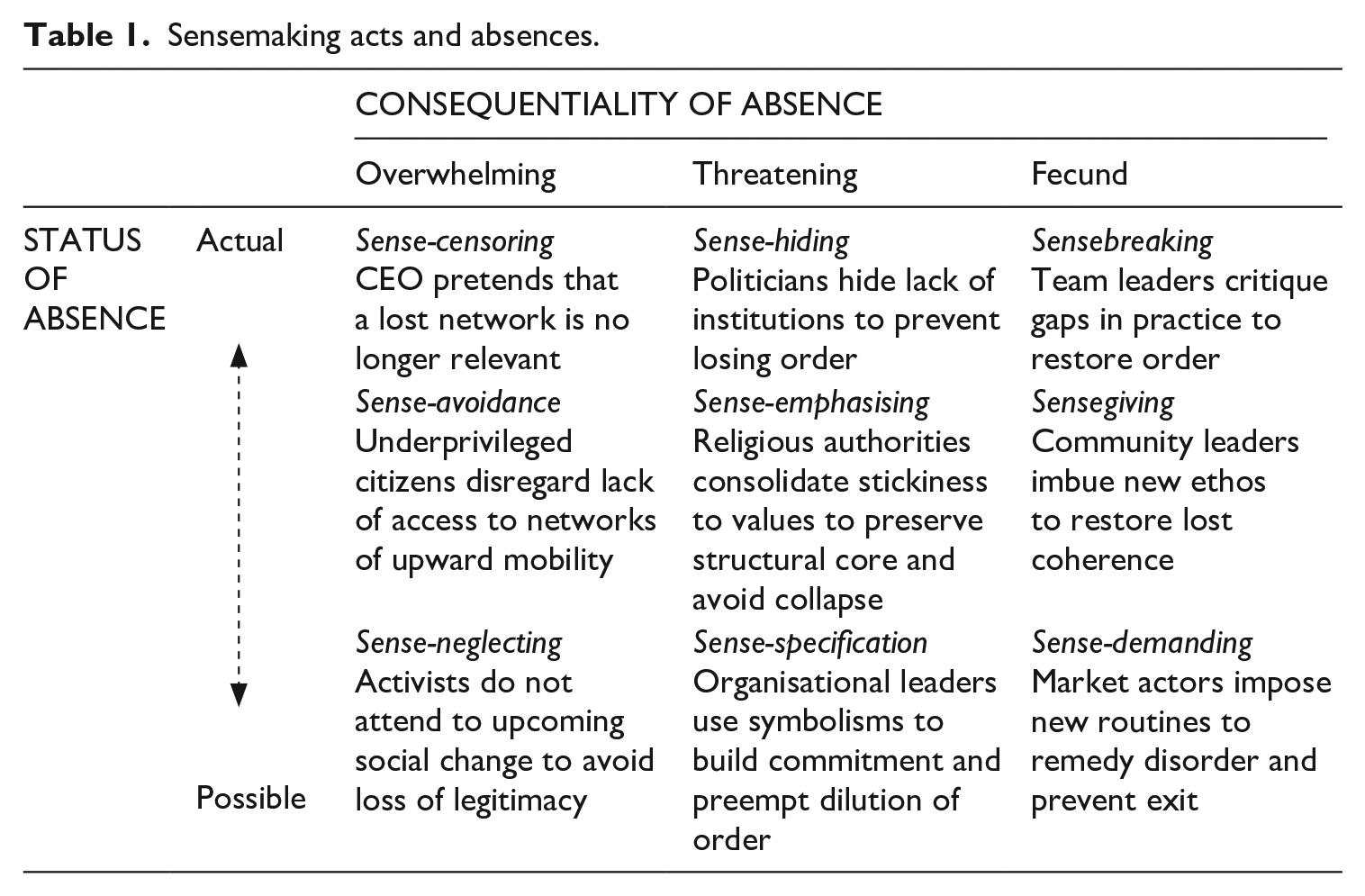
Figure 1 depicts how these sensemaking acts emerge: actors create sense of absences, which violate their expectations and trigger passivity, conservatism or active engagement. This leads sensemakers to attach an axiological label to overwhelming, threatening and fecund absences with associated fatalism, consolidation or boldness dictating a (non-)actionable appropriation of it. Thus, interpreted sense may be enacted into:
sense loss and dilution of order via inaction;
preservation of sense and defence of existing order through ontic maintenance;
refining sense and restoring order through emergence of novelty.
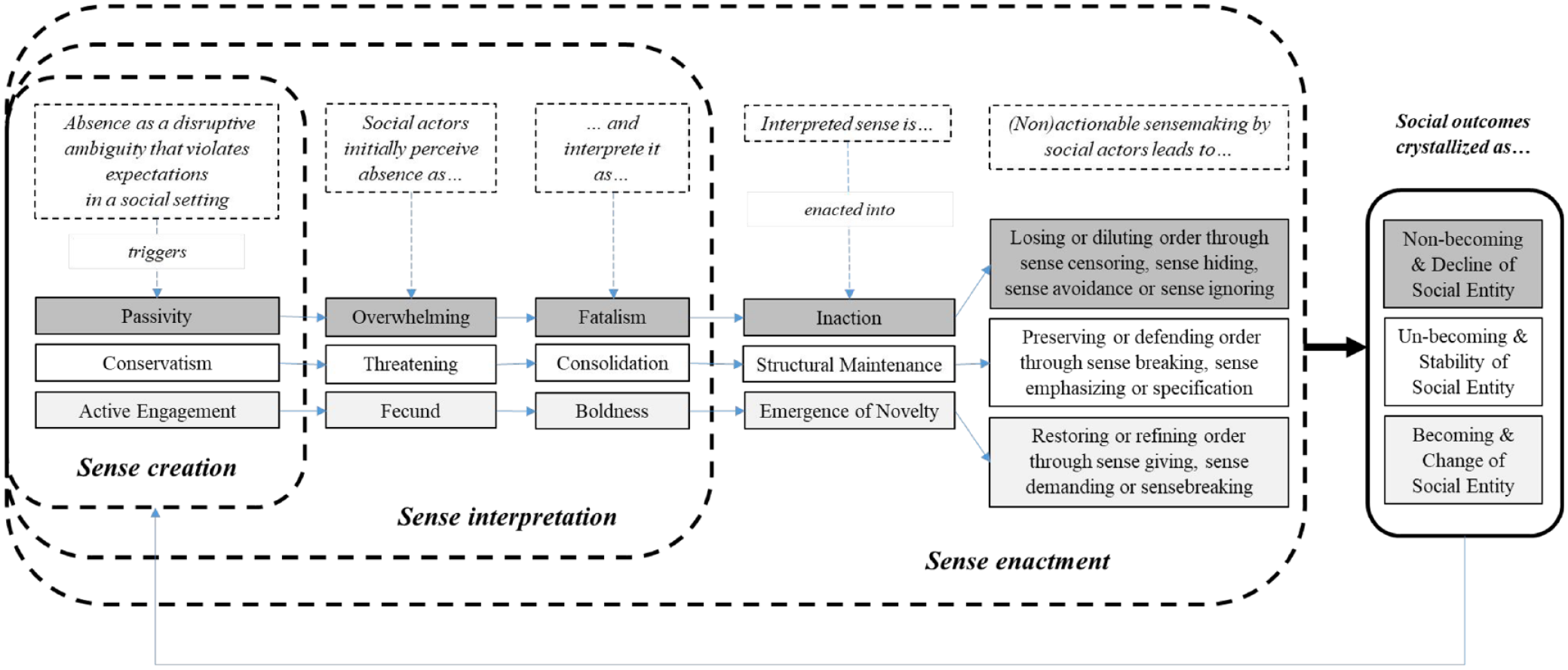
The consequentiality of absences in social settings: A sensemaking perspective.
In terms of social outcomes then, respective possibilities include:
non-becoming and decline following the passivity of social actors;
un-becoming and search for reproduction and stability;
novel becoming and change enacted by bold agents.
Thus, absences are not a negative instance. Rather, through their perception as a disruptive and unsettling feature, sensemakers may affirmatively overcome, introvertly avoid or fatalistically accept their confusing or ambiguous nature. As examples in Table 1 imply, an absence may reside in the past as a lasting memory; be a myth woven into symbolisms; be left in oblivion and re-emerge temporarily; or projected into the future as likely extinction. Absences are palpable and real, and when interpreted as meaningful, they may induce social change, reproduce existing arrangements from within or perpetuate passive inaction. Of course, consistent with social dynamicity, enacting sense may lead to further iterations (hence, the loop in Figure 1) until ambiguity and confusion are settled. 3
Discussion
The empirical lacuna around absences is an oxymoron, given the focus of sensemaking studies on ambiguity, and a paradox, given the plasticity of sociological traditions to elucidate collective outcomes (e.g. pragmatist or phenomenological accounts). This is important since privileging ‘presences’ impedes our ability to illuminate how social actors make sense of their experiences. Namely, an episodic treatment of reality may obfuscate; it engenders biases that may not enable us to ‘see’ real but non-visible forces at play. As such, it also determines aspects of the social fabric that we can(not) access and elucidate.
Thus, a presence-laden vernacular may dominate empirical inquiry but sensemakers are not only actants; they are reflective thinkers, too. They keep ‘authoring’ and ‘constructing the very situations they attempt to comprehend’ (Maitlis and Christianson, 2014: 58) while aiming to create ‘images of a wider reality, in part to rationalise what they are doing’ (Weick, 2020: 1425). This ‘wider reality’ is not always tactile. It entails visualised, felt or remembered realities (e.g. abhorrent situations), which may be no more or not yet, but are pre- or re-experienced during sensemaking. Then, ‘what is going on’ and the sensemaking stories we ‘read into’ (Weick, 2020: 1425) naturally entail non-tangibles, too; the underbelly that makes observable cues stand out and appear as such. If sensemakers neglect or underappreciate them, they may ‘belie experience [and] find their sense of experience going awry’ (Holt and Cornelissen, 2014: 526).
Therefore, scholars’ inattention to absences ignores cues that intermingle with one’s reflection; we limit social actors’ enactive potential to what the material world gives them ready at hand (Introna, 2019). However, this is not how actors feel, act and think. Rather, ‘people generate what they interpret’ and author the experiences they try to make sense of (Brown et al., 2015; Weick, 1995: 13). Social enactment follows interpretation; invention follows discovery (Hwang and Sampson, 2014; Rivera, 2012). In this iterative sequence, meaning-making may aggravate the fragility that accompanies absences or urge actors to overcome it.
Meaning is a foundation of sociological theory and a presupposition for sociological action, with its communication being a milestone in humanity’s evolution (Luckmann, 1989; Luhmann, 1995). Many species convey information but the ability to codify and discursively disseminate meaning (e.g. religious meaning; Luhmann, 1985) equips social actors with the tools to make sense of their experiences. It provides inspiration and guidance to construct plausibility of even mundane instances. For example, shared meaning in a brotherhood or activist group orients and enables; discourages and avoids. As such, it enacts social order or catalyses disorder via selective retention and rearrangement of, for example, rules, facts and processes.
Barad’s (2007) mattering is a case in point; it pinpoints intra-actions that iteratively reconstitute the social spaces we inhabit. This entanglement of matter and meaning denotes a possibility; potential states of being that await our choices to be realised. Our course of action streamlines indeterminate possibilities into actualities; our own becoming, which engenders a profound performativity: it reconstitutes social space by opening ever-new nesting possibilities (Barad, 2007). Thus, social settings signpost a plenum of options. Ultimately, social actants enact reality by drawing decisively idiosyncratic distinctions; necessarily contingent paths shaped via meaning-finding (e.g. quest for social belonging; Heiskala, 2011; Luhmann, 1985).
This article emphasises that absences are central in this mattering and hence, in the construction of social spaces. For example, when we re-encounter a traumatic absence that we habitually strive to forget (e.g. death), our dispositions protrude and are re-lived in the present; our future orientations, intentions and purposes are pre-lived as imagined possibilities. Temporalities reassemble and may induce bolder action compared with the original collapse when we first confronted loss. Why? Because mortality, loss and so on are profoundly and differentially impactful. They challenge our ontological continuity and re-shape meaning. Hence, absences are important for sociological inquiry not only as the ubiquitous underbelly of present spaces; they also implicate and shape our lived experiences as the meaning-finding sensemakers that we are.
Conclusion
We act in trailblazing, preserving or preventive ways with sensemaking providing the scaffolding for such orientations. Yet, without absences, such sensemaking may lead to a ‘naked’ reflection on reality. The nexus between absence and sensemaking then may help us understand how social actors appropriate their confusing or ambiguous experiences to understand ‘what is going on’ and restore order. Contrarily, neglecting absences is a suboptimal portrayal of how they find meaning (Cerulo, 2018), construct plausible accounts (Gilman, 2022), enact change (Andrews and Caren, 2010), preserve sense (Steidl, 2013) or restore order and equity in social relationships. Absences are not merely omnipresent; they are consequential, and their enactive agency can be more meticulously reflected in scholarly choices.
Thus, the study joins works that suggest a background for reflection other than salient stimuli (Holmes and Ehgartner, 2021; Jakoby, 2015; Scott, 2020). Whereas empirical literature privileges tangible cues to make sense of reality, this study contends that social phenomena can be re-invented through absences. In turn, their (non-)actionable appropriation can enact new, maintain existing or dilute social arrangements and order (see Mamali and Stevens, 2020; Strhan and Shillitoe, 2019). Thus, the study fills a gap. Namely, while the ‘symbolic social objects that comprise this shadowy domain’ have been sketched as accomplishments by reflexive actors (e.g. silence, inactivity, non-identity; Scott, 2018: 15; Stanley et al., 2020) and research shows how absences are socially constructed (Mueller, 2018), there is still dearth on their consequentiality. Hopefully, this study helps to explain how absences enact social structures.
Footnotes
Funding
The author received no financial support for the research, authorship and/or publication of this article.
