




Abstract
Microsociology has been criticised for universalising ‘the’ interaction order as it occurs among the North American middle classes. A way of addressing this issue lies in historicising interaction: showing how each component of the interaction order has been historically moulded. The present article illustrates this argument with the case of blushing, from the late 18th century through to the early 21st century, in the USA, Australia and France. The examination of newspaper articles, novels, publications in medicine, psychology and criminology, and other sources, makes it possible to retrace the shifting meanings and practices of blushing over time. Several processes have been identified, such as the racialisation of blushing at the end of the 18th century, its progressive masculinisation and medicalisation from the mid-19th to the mid-20th century and later its psychologisation and re-figuration in digital technologies. The conclusion calls for a historical sociology of the interaction order, or historical microsociology.
Introduction
‘I’d blush if I could.’ This is what Siri, Apple’s virtual assistant, originally answered when called a ‘slut’, or a ‘bitch’, in 2011. It was not long before this answer attracted media attention (Specia, 2019): why would a robotic interface enact such a strikingly embodied version of traditional femininity? As if driving the point home, a 2019 UNESCO report turned the automatic response into a symbol of the digital gender gap (West et al., 2019). The report was named: I’d blush if I could.
In the meantime, Siri’s code has been rectified. But the actual issue does not lie here. The reason why Siri’s answer, albeit seemingly trivial, sounded offensive, and triggered reactions whose scope went beyond artificial intelligence, is precisely because blushing is far from anecdotal. Blushing vehiculates long-ingrained images of femininity, submission, modesty and shame. As historical sociologists and historians have showed, the expression and meaning of emotions echo historical processes that deeply imprint our minds and our bodies, decade after decade, century after century (Elias, 1987, 2000[1939]; Rosenwein and Cristiani, 2017). Hence the mere fact of one’s face reddening, in this physiological reaction, in the sudden colouring of our skin – in what appears as an interactional feature – brings to the surface some durably embodied aspects of social life that cannot be wiped out by the editing of a few lines of code. Every blush carries a piece of history.
The present article takes the history of blushing, from the late 18th century until today, in the USA, Australia and France, as an illustration that interactional features – here a mundane manifestation of embarrassment (Goffman, 1956) – take shape and acquire meanings throughout historical processes. It advances that the identification of these processes constitutes one productive way of overcoming the enduring critique that has surrounded microsociological analysis, from symbolic interactionism to Goffmanian dramaturgy, according to which focusing on interactions would amount to universalising ‘the’ interaction order as it occurs among the North American middle classes. Rather, interactional occurrences that we may perceive as spontaneous or situational are formed through intertwined long-term processes, such as, in the case of blushing, its racialisation at the end of the 18th century, its progressive masculinisation, medicalisation and ‘casualisation’ from the mid-19th to the mid-20th century, and its psychologisation, decreasing significance and re-figuration in digital technologies at the turn of the 21st century.
Detailing these processes, as well as the groups and institutions involved in their production, will pave the way for a historical sociology of the interaction order, or historical microsociology.
Historicising the Interaction Order
However widely used in sociology and cognate disciplines, Goffman’s scholarship, here taken as the main representative of microsociology, has been attacked for presenting interactions as relatively independent from political contexts (Tyler, 2018) and social structures (Bourdieu, 1989: 17–20; Hacking, 2004: 288). While Goffman sprinkled his writings with scattered acknowledgements that some elements of the interaction order are culturally and socially variable (e.g. Goffman, 1956: 265, 1963: 128, 1983: 9–10), these acknowledgements remained meagre tangents to his core line of argumentation, arguably, identifying the ‘pure interactional man’ (Schudson, 1984: 640), one that transcends times and continents (Jameson, 1976). Such de-contextualisation of social life (Jacobsen, 2020) has been called the ‘interactionist fallacy’ (Gleeson, 1999: 21) or the ‘astructural bias’ (Musolf, 2016).
This problem takes on a singular resonance today as our academic legacies are being re-evaluated thought the lens of gender and colonialism, challenging the intellectual entitlement of making universal claims out of specific settings. It has already been addressed in several publications. Some outline historical changes affecting how people interact (Diehl and McFarland, 2010; Misztal, 2001; Scott, 2010), especially new communication technologies (Cetina, 2009; Schneider, 2017; Thompson, 2020). Others point to cultural differences, for instance regarding the experience and practices of stigma in different populations (Kusow, 2004; Riessman, 2000) and social classes (Gonos, 1980: 136; Gouldner, 1970: 382). Recent works called to ‘politicise’ the interaction order, introducing elements of context and theories of power in the study of micro-encounters (Athens, 2013; Duck and Rawls, 2020; Jacobsen, 2020; Meghji, 2018; Ruiz-Junco, 2016; Tyler, 2018).
To summarise, these interventions are of two kinds, each raising specific issues. Synchronic approaches relativise the notion of one interaction order, underscoring differences between cultures or populations. They are exemplified by Kusow (2004) on cultural differences in stigma, or at its extreme, Duck and Rawls’ (2020) differentiation between a ‘black interaction order’ and a ‘white interaction order’; and come with the risk of essentialising the inequalities under study. Diachronic approaches historicise how interactions are produced through time. They often oppose a ‘before’ and an ‘after’ – before and after the internet (Thompson, 2020), or ‘pre-modern’, ‘modern’ and ‘post-modern’ societies (Diehl and McFarland, 2010) – resorting to an excessively linear vision of history. Herein I suggest combining the diachronic approach (identifying a set of intertwining historical processes rather than an overall movement towards modernity) and the synchronic one (acknowledging the contingency of social divides throughout history).
This requires enriching microsociology with a more historically grounded perspective, closer to the sociology of Elias (1987, 2000[1939]) and his followers (Wouters and Dunning, 2019). Although such connection has already been outlined theoretically (Freund, 2015; Scheff, 2017), the present article proposes to go further: using the Goffmanian toolbox not as a set of concepts that would apply to all interactions with some cultural variations, but as situated points in history. Indeed, notions such as impression management, embarrassment, frontstage or backstage, can be reframed as the results and productive components of long-term social processes through which interaction orders take shape. In other words, the research programme sketched here, historical microsociology, does not only consist of situating interaction in context – this is now common in sociological research – but uses microsociological concepts as tools for historicising social life.
The Quest of Blushes Past
Most research in medicine and psychology premises upon the invariability of blushing through history and cultures, considering that research designs discover new insights into the human condition (Crozier, 2006). However, one must not exclude another option: that the meaning and occurrence of blushing vary depending on contexts, substantially evolving throughout history. This implies that new research does not only update a given state of knowledge on blushing, but also records its historical transformations; and that documents describing situations in which people blush, or express opinions about blushing, are archives documenting such transformations.
On this basis, the findings presented in this article are the result of an abductive process (Timmermans and Tavory, 2014) drawing on the triangulation of several types of data.
At first, my research assistants and I gathered a set of newspaper articles. In comparison with other available data, such as etiquette textbooks or medical publications, newspapers represent the most diverse and ‘mundane’ source of information, in the sense that, throughout the studied period, they include an unequalled quantity and variety of detailed accounts of blushing. These accounts can be descriptive (portrayal of interactions where one protagonist blushes), fictional (stories featuring blushing characters), prescriptive (opinion pieces assessing motives for blushing), analytical (reflections on the mechanisms of the blush) and poetic (texts using the symbolism of blushes). Moreover, the recent digitalisation of newspapers in several countries enables the large-scale collection of relevant data. Thus, using the keywords blush* (which includes ‘blush’, ‘blushes’, ‘blushed’ and ‘blushing’) and roug* (the French equivalent: ‘rougir’, ‘rougis’, ‘rougi’, etc.) in the databases Gallica (France), Trove (Australia) and Illinois Digital Newspaper Collections (as we could not access any federal database in the USA), we retrieved more than 3500 articles from France, more than 33,000 in Illinois and more than 50,000 in Australia. These three countries were selected because, as parts of the ‘West’, they are ‘comparable’ while presenting significant differences of language, culture, political and economic system conducive to productive comparisons.
Faced with such an amount of data, three reasons ruled out quantitative analysis. First, some articles retrieved using the keywords blush* and roug* were not relevant, containing expressions such as ‘at first blush’ or ‘Maiden’s blush’ (a variety of apples). Second, digitalisation mistakes are common, thus some texts with the words ‘brush’ or ‘bush’ found their way into the collection. Third, other words can designate blushing in both languages (crimsoning, scarlet cheeks, etc.) and were de facto not captured by this sampling method.
Therefore, our challenge was to analyse such abundant data qualitatively. We resorted to the following procedure. Twenty newspaper articles were randomly selected per decade and per country, constituting a ‘database’ of approximately 380 items for Australia, 380 for the USA and 440 for France. Some members of the team independently coded: the social properties of people who are depicted blushing (gender, age, etc.); the reasons that supposedly make them blush (flirtatious attitude, self-awareness, etc.); the emotions attached to reddening (shame, anger, etc.); the situations in which blushing occurred (private encounters, official events, etc.); the expertise deemed relevant to interpret blushes (medicine, theology, etc.); and the difference between actual blushing and metaphorical blushing, that is, cases when blushing is only mentioned as a symbol (‘you should blush at x’). We mixed chronological reasoning – how descriptions of blushing changed through time – and comparative reasoning – how these descriptions differ from one country to another – to generate hypotheses.
We then sought to ‘validate’ these hypotheses. To do so, we examined additional samples of newspaper articles to ensure that the generated hypotheses were not only the product of randomness in the initial sample. Simultaneously, we collected other sources of data to corroborate these potential findings. When newspaper articles suggested that some professional bodies claimed expertise over blushing, we conducted targeted studies of specialised literature: medicine, politics, psychology, criminology, theology and the make-up industry. Furthermore, we examined novels that feature blushing characters; some of which, like Jane Austen’s, have greatly contributed to popularising certain representations of the blush (Halsey, 2006; O’Farrell, 1997). When relevant, we used Google Ngram – a search engine that charts the frequencies of words in printed sources published between 1500 and 2019 – to inquire into vocabulary trends. Finally, the inclusion of additional sources from the UK, such as Darwin’s (1897[1872]) influential writings on emotions, became necessary as this country long represented a global centre of influence. The study of these additional data generated new hypotheses to be validated, and so forth.
In sum, following the widespread consensus, among historians and historical sociologists, that triangulation yields the most credible results (Childress et al., 2020), the conclusions presented in the following pages draw on the evolving combination of several sources: newspapers; specialised literatures; novels; and Google Ngram.
One question remains. What does this methodology enable us to demonstrate? It certainly contributes to a history of blushing taken as a cultural representation. However, as historians of emotions have showed, the study of archives – written traces of past emotional manifestations – also enables drawing inferences about emotions themselves, that is, how emotions were actually felt and expressed in different contexts, at different times in history (Rosenwein, 2010). Indeed, it would be reductive to claim that the recurrent observation of similar trends in several social fields (via the triangulation of sources) is merely a representational artefact due to archival production, without relation to the ‘reality’ of blushing. The main unknown is the intensity and the modalities of such relation between reality and representations, which, in the frame of this article, we can only leave open to question.
The Politicisation of Blushing at the Turn of the 19th Century
In the late 18th century, emotions shifted from being minimally presented as instinctive reactions to social situations, to being elaborated upon in multiple ways (Hewitt, 2017; Reddy, 2000). At the same period, the association of pale skin with civilisation rampantly strengthened in early modern Europe (Lafont, 2017), in light of ‘increased contact with foreign populations in the context of colonialism and a gradual shift in the perceived bodily role of blood from humoral substance to index of pedigree’ (McCann, 2015: 86). Race-mingling anxieties were made explicit by the fashionable use, among the higher classes, of cosmetics highlighting whiteness (Poitevin, 2011) and through the wider interest in – pale – skin in medicine and arts (Koslofsky, 2014; Lafont, 2017). Hence pre-existing racial distinctions radicalised in the late 18th century taking the form of an aestheticisation and intellectualisation of skin colour differences. Along with the development of racial anthropology, being pale progressively amounted to being civilised, in opposition to blackness/savagery: these associations became formalised at the turn of the 19th century.
It is in this context that ‘blushing in the 1790s had become a subject of political analysis’ (Lawson-Peebles, 2002: 95), and that whiteness came to be further associated with the ability to blush. This trend was epitomised in the writings of prominent authors, such as Thomas Jefferson. While Jefferson pushed for the abolition of slavery, he believed that Black people and whites were not equal, and that the former should not have the same rights as the latter, in particular, the right to vote. In Notes on the State of Virginia, written in 1782, published in 1832, Jefferson (1832: 144) justified this opinion by the ‘observation’ that Black people did not have as much expressive ability as white people; they could not blush: Are not the fine mixtures of red and white, the expressions of every passion by greater or less suffusions of colour in the one, preferable to that eternal monotony, which reigns in the countenances, that immovable veil of black which covers all the emotions of the other race?
Several prominent European authors of his time shared similar ‘observations’, such as naturalist Von Humboldt (1907[1807]: 483). A nuance is crucial: these authors did not want to theorise racial distinctions; they seemed genuinely unable to see non-white people blushing – a case for cognitive sociology (Zerubavel, 1999). Relatedly, newspapers almost only referred to white people blushing (people of colour were generally under-represented). Later, throughout the 19th century, the prevailing opinion became that non-whites can blush but blush less as they are accustomed to seeing more cruelty. For instance, a US newspaper noted: ‘Other mutilations were performed that would make even a North American savage blush to look at.’ 1
Blushing had also been a gendered attribute from the Middle Ages at least (Allen, 2005). But, again, the 18th century was a time of formalisation. Heated debates took place in the UK and the USA between intellectuals who interpreted blushing as a sign of modesty, desirable in women, and those who associated it with feminine debauchery (Lawson-Peebles, 2002: 95). Such opposition was thought of in relation to national mores; for many commenters France represented a singular danger, civilised to a point of degeneration, fearing that women, ‘with unblushing front, had adopted the sentiments and the manners of the impious amazons of republican France’ (Cobbett, 1800: 1). Perceptions of blushing contributed to the ordering of genders as a marker of ‘true’, modest womanhood.
Let us not forget class distinctions. While aristocrats and the rising bourgeoisie could ‘afford’ paleness, staying out of the sun, this was not a luxury available to most of the then outdoor-working class – nor could they buy cosmetics to control their degree of paleness (Martin, 2009). In France, to this social gradient should be added the habit, among the elite of the Old Regime, to paint oneself with fard and rouge (red make-up), and wear masks in public. Whereas cosmetics and masks would help form a conception of social life as artifice, or artifice as refinement, the Revolution shook this mode of self-presentation, imposing an ideal of ‘natural’ beauty that had slowly emerged in the 18th century. Thus, make-up advertising, which began in the 1750s, drifted away from the celebration of artifice to promote transparency in self-presentation, staging an ideal of republican honesty (Martin, 2009). Paleness remained a feature of class distinction, but not for the same reasons.
Seduction, Shame and Status in the Early 19th Century
While newspapers thrived in 18th-century France, it was not until the early 19th century that a similar trend could be observed in Australia and the USA. In these data, a primary separation can be made between ‘actual blushes’ – when someone’s face flushes – and metaphorical expressions of shame, disappointment, guilt or anger. Such distinction further articulates gender and class divides. In Australian and US newspapers, metaphorical blushing was widely used to convey the unease of men forced to assume responsibility for their actions, often political or military, their guilt in the case of a legal offence, their indignation over the affairs of nations, and under the eyes of God. Men blushed symbolically, as a staged stance towards the values of the world – ‘We will put the public journalists to the blush, if they can blush.’ 2
‘Actual’ blushes were relatively less frequent, and more feminine. Towards the 1830s, the figure of a (young) woman’s cheeks colouring developed as a charming attribute displaying innocence. Women were portrayed blushing when receiving attention from a man, whether this attention took the shape of a flirtatious encounter or a marriage proposal. They may have then blushed out of modesty, timidity and, while no desire was mentioned, one can imagine the reddening also expressed the unsaid – ‘young women hung their heads and blushed as we approached them’. 3 This pattern was abundantly associated with a cliche, tirelessly exploited in Australian newspapers: girls blushed like a rose.
A budding young rose, and he wished her his bride; She blush’d when she heard him his passion declare.
4
In the early 19th century, national differences separated how blushing was depicted in the three countries under study. In the USA and Australia, flushed cheeks mainly expressed ‘moral’ matters, judging good and bad behaviour. Political questions were raised in the USA, making people blush, while Australian newspapers focused more on everyday morality; this can be attributed to the political status of both areas, Australia being a colony and the USA, a parliamentary republic. But France presents the most striking contrast. In 1820s and 1830s French newspapers, ‘actual’ blushing tended to refer to issues of pudor, nakedness and indecency, as well as to social status: individuals of all genders who were embarrassed by their situation in the social hierarchy. They blushed, both literally and metaphorically, because they thought they did not have sufficient money, education, manners or prestige. Such reactions took place more often in ‘highbrow’ settings, as with this man of modest extraction invited in the castle of an aristocratic family: ‘I started to blush and then became crimson in hearing my name being repeated by the various domestics in uniform in charge of announcing my visit.’ 5 This specificity can be interpreted in the light of the social and political situation of France, which, following Napoleon’s reign, lived under the Restauration (1814–1830) and July Monarchy (1830–1848), whose goals were to reinstall pre-revolutionary hierarchies.
Let us conclude this section with a curious discovery. Whereas in Australia and the USA, blushes started on the cheeks, before eventually spreading to other areas of the body, the French were depicted reddening on the forehead first – ‘Get in, get in, nice pilgrim women. What! Your forehead blushes out of pudor!’ 6 These depictions could be only formulaic. However, Darwin (1897[1872]) made similar observations in the late 1860s, preparing The Expression of the Emotions in Man and Animals. Asking his fellow doctors to collect detailed examples of blushing in several European medical institutions, his French counterpart, Dr Moreau, reported that in his patients, blushes emerged on the forehead (Darwin, 1897[1872]: 311–312). Can the features of historical contexts be so embodied that even the reddening parts of the body can change? After all, many bodily manifestations, such as diseases, vary depending on the context. Another hypothesis would be that perceptions of the blush lead people to see it in different areas, similarly to the aforementioned intellectuals who could not see non-white people blushing.
The Rise of the Blushing Bride, and Other Turning Points
While the previous sections emphasised long-term processes that diffusely pervaded the march of generations, a few notable turns spanned the first half of the 19th century. The English expression ‘eloquent blood’ gradually appeared in the 1800s, to peak in the 1830s before slowly vanishing in the 1860s (Figure 1). In addition, three ‘turning points’ helped steer perceptions of the blush, at least in literature, medicine and journalism: the novels of Jane Austen and their noticeable use of reddened faces in character construction; the first medical publication dedicated to blushing in 1839; and the uniformisation of newspaper articles around ‘romantic’ blushes and the figure of the blushing bride in the 1840s.
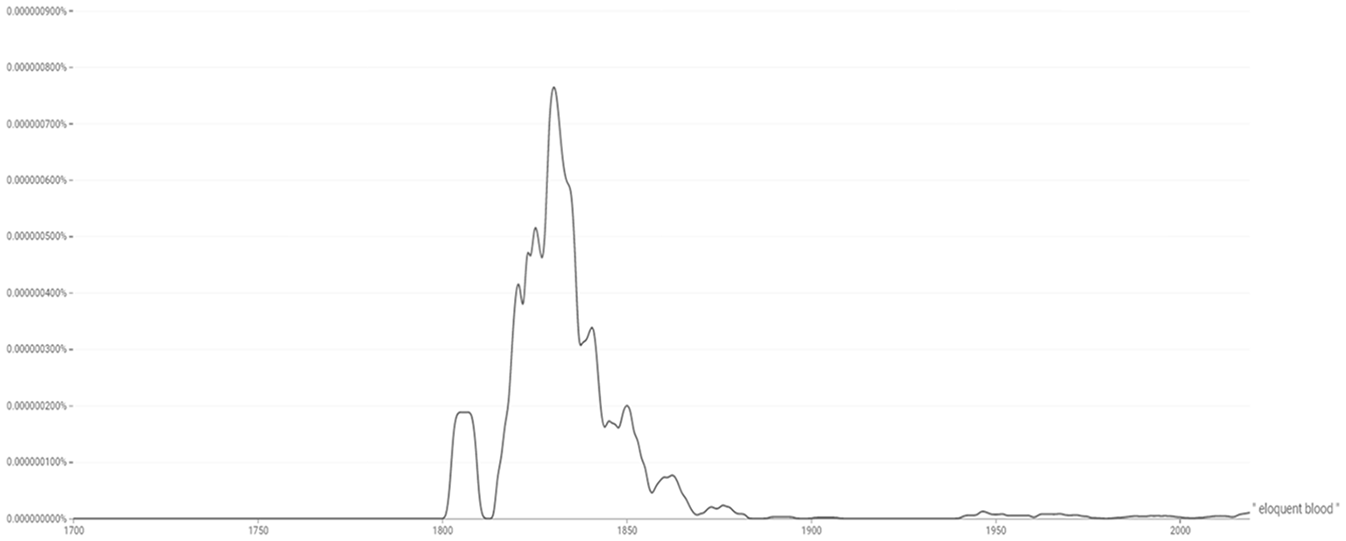
‘Eloquent blood’ in Google Ngram database (1700–2020).
Although blushing was already used in literature as a form of ‘bodily lapsus’ (Peterson, 2009: 33) – abundantly employed in The Princess of Cleves (Chang, 2012) – the work of Jane Austen stands out for its intense approach to blushing in character construction. Several literary scholars (Halsey, 2006; O’Farrell, 1997) point to the quantitative presence of blushing faces in Austen’s novels (115 occurrences of ‘blush’) and the qualitative complexity of the reasons for which their characters redden, entangling hidden desires, mixed feelings and multifaceted relations. Sometimes, Austen (1814) builds a relationship with her reader: in Mansfield Park, Sir Thomas sees his niece’s face turning ‘like scarlet’ after rejecting one of her suitors, and deduces that she is not in love yet; in fact, her feelings are for someone else, and what Sir Thomas believes to be a blush of innocence is a blush of guilt, as the reader knows. These layered levels of reading contributed to Austen’s influence in global literature (Halsey, 2019), as much as her noticed use of the blush that leads O’Farrell (1997: 8) to claim, maybe with exaggeration, that the ‘history of the blush in the nineteenth-century English novel is also a history of the novel’s response to the legacy of Austenian manners’; and maybe this influence went beyond literature.
These decades also witnessed the publication of the first dedicated medical book, The Physiology or Mechanism of Blushing, in 1839. Thomas Burgess, a medical doctor from England, hoped to contribute to the then-nascent understanding of the circulatory system. This is why he analysed blushing in relation to types of personality, themselves attached to types of blood circulation. Still, his reflection went further, combining moral philosophy, anthropology and physiology: under Burgess’ pen, blushing is a ‘window to the soul’. In humans, but also in animals and plants, blushing signals sensitivity to the extent that, Burgess (1839: 9) assumes, if plants can blush, they must also possess ‘something analogous to the scattered elements of a nervous system’. However, one must differentiate between true sensitivity that ‘draws a distinction between right and wrong’ (1839: 20) and false sensitivity, ‘excited by the slightest efforts of the imagination’ (1839: 21); the latter being ‘one of the greatest vices of civilisation’, causing madness and various ailments (1839: 183). Blushing is thereby embedded within the movement of civilisation in which cultivation is led to preside over instinct; civilised humans, including people of dark complexion, go red out of guilt – for only ‘idiots cannot blush’ (1839: 73).
Whereas significant national differences could previously be identified between Australian, US and French newspaper articles, a movement of internationalisation occurred in the 1840s. Differences faded as newspapers of all three countries put emphasis on blushes arising from romantic situations. Women were portrayed blushing when confronted with men’s seduction, sexual innuendos or marriage proposals, thus associating the reddening of their complexion with beauty, attractiveness, youth and innocence. This shift was supported by the rising figure of the ‘blushing bride’, which became a recurrent expression in English – as verified in Google Ngram (Figure 2). Not only does this observation signal a process of internationalisation – the acceleration of printing and postal services might have fostered mutual influence among writers worldwide, including famous novels such as Jane Austen’s and Walter Scott’s – but it also challenged the distinction between actual and metaphorical blushing. Indeed, as in the following 1841 poem, one cannot differentiate depictions from figures of style, which hints at the routinised use of blushing in mid-19th-century western cultures.
My heart is as light as the lark’s in the skies, And the rhyme of my song bids me own it, For the sweet blushing girl has confess’d to my sighs
7
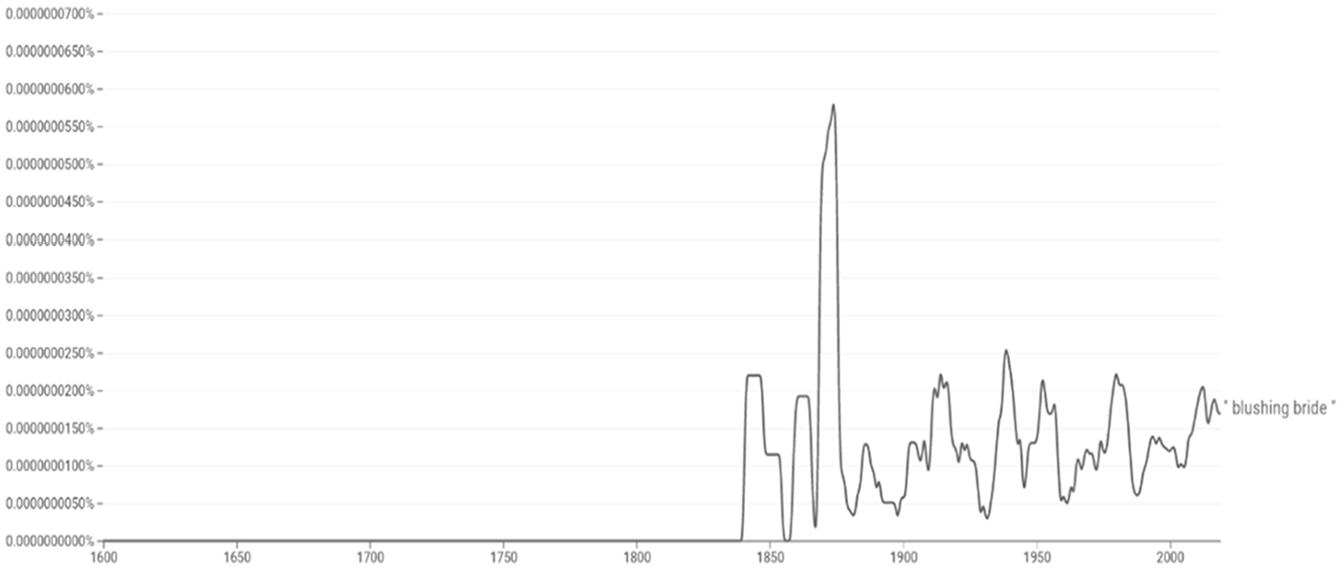
‘Blushing bride’ in Google Ngram database (1700–2020).
Agentic Blushes: The Second Half of the Long 19th Century
Towards the end of the 19th century, some fundamental transformations affected the ways in which blushing was socially perceived and ‘practised’. While reflections on social class and race faded away, the medicalisation, masculinisation and what I will call ‘casualisation’ of blushing could be observed, which underlie the expanding desire to turn blushes into agentic reactions.
In the third edition of Criminal Man, published in 1884, criminology pioneer Lombroso (2006[1884]: 206–211) intended to test the common-sense hypothesis that ‘criminals’ are inclined to crime due to insensitivity. Lombroso considered blushing to be an objective sign of guilt, therefore measurable. Out of the 59 male criminals surveyed, 61% reportedly blushed when reminded of their offence; against 19% for the 211 females interviewed, while most of them reddened when asked about menstruations (2006[1884]: 210). To Lombroso, this proved a connection between crime and a lack of sensitivity, however this association did not hold up in further criminological practice. In the early 20th century, the progressive development of lie detectors was sometimes presented as a remedy against law enforcement using trivial clues such as blushes (Inbau, 1935). With some exceptions, such as the Tom Sawyer case, wrongfully accused of murder in 1986, in Florida, after blushing in custody (Meissner and Kassin, 2002), the criminalisation of blushing – or of not blushing – did not happen.
However, its medicalisation did. French, US and Australian newspapers increasingly featured articles written by medical doctors on the physiological mechanisms at the origin of blushing (blood flowing in facial vessels). This overall interest was nurtured by the publication, in 1872, of Darwin’s The Expression of the Emotions in Man and Animals. The book includes a whole chapter on blushing (1897[1872]: 309–346), ‘the most human of all expressions’ (1897[1872]: 309). Although Darwin’s understanding of flushed cheeks generally corroborates that of Burgess, its originality resides in his evolutionist framework, in which self-attention (1897[1872]: 325) translates into the tonic contraction of certain parts of the body, whose ‘frequent reiteration during numberless generations . . . have become so habitual, in association with the belief that others are thinking of us, that even a suspicion of their depreciation suffices to relax the capillaries’ (1897[1872]: 337). Widely discussed, Darwin’s theory likely promoted blushing to the level of a legitimate object of medical attention, or medicalisation (Conrad, 2007). At the same moment more and more doctors tried to devise new treatments for their patients to master their complexion – not blushing too much. In 1889, the first sympathectomies were performed, originally with epileptic patients (Vannucci and Araújo, 2017): sectioning the nerves that causes the facial blood vessels to dilate, between the second and third rib, reduces blushing but also sweating. More commonly, the proposed treatments consisted of dermatological interventions and lifestyle advice. The apparition of these techniques begged the question: when is blushing ‘pathological’? Newspapers of the time often featured reflections of this kind, such as in this 1896 Australian article, asserting that ‘blushing is generally the characteristic of the young and artless. But there is rarely anything pathologically serious about a blush, except such fear of it as may be engendered by quacks who profess to undertake its cure.’ 8
Around the 1880s a second process manifested itself in newspapers and, to a lesser extent, in literature – especially James’ (2012[1881]) novels, for instance The Portrait of a Lady: what I will call the casualisation of blushing. While in previous times, most studied cases of blushing left few doubts as to why the interactants became flushed (seduction, shame or pudor), late 19th-century writings introduced both a diversification of emotions potentially expressed (desire, anger, joy, etc.), and some confusion regarding the motives of the blusher. They did not always point to a clear tension, a single feeling to be interpreted in regard to a single intention; or even to something worth being understood. A new layer of ambivalence came to surround blushes, as if to tease readers that they would never grasp the full picture. An 1889 article from the USA illustrates this. It recounts the story of a man who, trying a camera without any success, is told by a younger man that he has left the cover on the aperture. ‘I thanked the young man with a subdued ferocity that must have alarmed him, for he blushed and walked away. Perhaps he knew how to use a camera.’ 9 In comparison with prior decades, this narrative (among others) stands out as blushing creates several possible interpretations, intimated by ‘must’ and ‘perhaps’ – is this young man regretful, upset, frustrated? Maybe all of these. This blush precisely adds a touch of mystery.
The third process is the masculinisation of blushing. While the main occurrences of blush* in newspapers long remained women blushing in ‘romantic’ situations (especially in Australian sources), more and more men were portrayed blushing. Moreover, reddening faces were not solely those of ‘girlish’ men, as some commented in earlier decades. Men could blush ‘like men’, and not metaphorically; an action sometimes supported by expressions such as ‘furious blush’, whose use appeared in the 1860s (as confirmed by Google Ngram searches). In addition, masculine blushes became more ‘casual’, contrasting with early 19th-century noticeable blushes. For example, French magazine Mame published a fictional story where a character is mysteriously brought a letter. ‘As he was reading, the young man’s forehead successively became pale and blushed. Finally, he raised his head, and with bright eyes he asked the beggar: “Who gave you this letter?”’ 10 Blushes add emotional realism but go almost unnoticed.
Such masculinisation relates to the changing connotation of blushing for women. At the turn of the 20th century, while feminine blushing was less and less associated with the thrill of marriage proposals and more and more with ordinary seduction, and sexual attraction, it became presented as a ‘lost art’, somewhat of a generational fashion that regularly resurfaced. In 1898, Australian newspaper National Advocate commented on the opening of a school in Paris reportedly teaching women: the classic grace and simplicity of the early years of the century, with their accompanying downcast eyes and simpers, are now in vogue again, and the maidens who have forgotten how to blush are going to school to learn that primitive art.
11
That blushing was interpreted as a fashion probably explains why it was increasingly perceived, also, as something that could be mastered, especially in women: a ‘secret weapon’ that could disarm the most powerful men. Some techniques popped up to control when one blushed. The above-mentioned Paris school was said to suggest its feminine clientele discreetly refrain from breathing for 70 seconds. Another technique reported in the same period is that of the ‘blushing bonnets’: the cotton strings meant to tie these bonnets under the chin could be doubled by a metal string enabling its wearer to discreetly cut the circulation of their jugular vein, sparkling a blush in a few seconds. 12 In a nutshell, blushing became imbued with agency.
Anxious and Fashionable throughout the 20th Century
The 20th century underwent several significant processes: while the masculinisation of blushing continued, its medicalisation turned into psychiatrisation. It was also further appropriated by the make-up industry, while the attempt by some far-right groups to reinstate a racial understanding of it failed. Later, the development of digital technologies reconfigured the modes of expression and meanings of blushing.
By the Second World War, even fewer differences separated how men and women were depicted blushing in newspapers. Tellingly, the expression ‘blushing groom’ timidly emerged in English (Figure 3). Although masculine blushing was still pejoratively framed on occasion, it sometimes carried positive connotations. In 1940s and 1950s French and US newspapers, a significant number of blushes concerned soldiers, men in prominent positions – public officials, professors or football players – or indulging in certain hobbies: from ‘blushing golf enthusiasts’ to fathers playing with train sets.
13
Australian newspapers remained more conservative in this respect, episodically regretting this ‘lost art’ of womanhood. In fact, in all the studied countries, blushing acquired a connotation of outdated sociability, a remnant of the past: Grandpa: I never see a girl blush any more. It was certainly different in my day. Grandson: Good gracious, Grandpa! What on earth did you say to them?
14
Twentieth-century newspapers increasingly associated blushing with ‘blush-pink’ make-up. Industrialists came to market both make-up and dermatological treatments (e.g. ‘permanent face tinting’ simulating blushes for 20 years) 15 through the promise of a controllable, lasting blush. The mid-20th century marked a turning point in this history with the mass production of blusher make-up. ‘Blush-pink’ became a colour. It now has the hexadecimal code #FE828C. For some years, the use of this colour constituted a dominant trend in fashion, for instance in 1954 when ‘the blushing look’ was expected to be ‘the make-up look this Spring’. 16 Because of such appropriation of blushing (through its simulation) by the make-up industry, in the post-war era, many occurrences of blush* in newspapers related to the technical vocabulary of fashion.
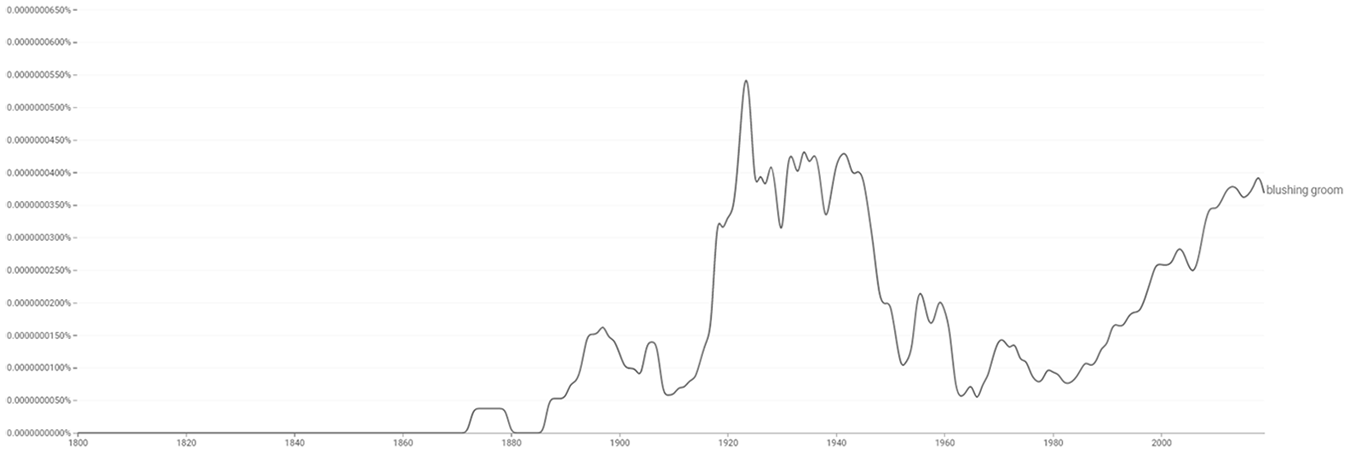
‘Blushing groom’ in Google Ngram database (1800–2020).
Overall, these occurrences dramatically diminished in quantity, to the extent that in the 1980s and 1990s very few articles contained this word. Perhaps, the massification of other media, such as radio and television, led newspapers to publish less in-depth descriptions of interactions and reflections on topics such as blushing. In Australia, France and the USA, this quantitative decrease was accompanied by two qualitative changes. First, blushing often occurred in religious settings, about topics pertaining to religion and traditions (especially in France), or situations taking place in past times, which strengthens its image of a lost art. Second, in Australia and the USA blushing sanctioned sex-related provocations, alluding to the changing mores of the sexual revolution (e.g. ‘America’s queen slut Madonna is now a blushing mother’). 17
Still, other processes were at play in the same period. Although they have been pushed to the margins, racial interpretations sporadically persisted. The idea that non-whites cannot blush re-emerged, in the USA, with the media exposure of the Klu Klux Klan and associate groups who wished to resuscitate the ‘pre-Adamite hypothesis’. 18 According to this hypothesis, only white people descend from Adam, which would be evidenced by some excerpts of the Bible. In fact, this point largely depends on the different translations of the book of Jeremiah, for instance 8:12 (but also 6:15), where in some versions Adam and Eve are portrayed not able to blush (American Standard Version), and in others no longer able ‘to feel humiliation’ (Holman Christian Standard Bible).
In the same decades, the psychiatrisation of blushing partly took over its medicalisation, in the sense that media and academic publications focused less on physiological mechanisms, in favour of psychological processes. This movement started in the early 20th century with the development of psychoanalysis, according to which blushing reveals unconscious desires (Feldmann, 1928), slowly replaced by behavioural perspectives of blushing as a conditioned expression of anxiety. In this field, blushing was primarily approached as a source of anxiety – the fear of blushing, or ‘erythrophobia’ – before being understood also as a symptom of anxiety. This double attribute of blushing stabilised in the 1990s (e.g. Leary et al., 1992) and appeared in major classifications of mental illnesses. In 1999, the International Classification of Diseases-10 (World Health Organisation (WHO), 1999: F40.1) labelled ‘social phobia’ as a fear of scrutiny resulting in blushing. While the third edition of the Diagnostic and Statistical Manual of Mental Disorders (American Psychiatric Association (APA), 1980) mentioned ‘flushing’ as a sign of ‘delirium’, ‘alcohol intoxication’, ‘caffeine intoxication’ and ‘Generalized Anxiety disorder’, in the DSM-IV, the fear of blushing as well as blushing itself were included as symptoms of Social Anxiety Disorder (APA, 1994). This trend strengthened in the DSM-V for which ‘blushing is a hallmark physical response of social anxiety disorder’ (APA, 2013). By the 1990s blushing had become a fully fledged object of psychiatric research and practice, as a core symptom of anxiety-related disorders; this interest extended to psychology (Leary et al., 1992).
The present article started with Siri’s answer to insults: ‘I’d blush if I could.’ This was only one repercussion of the multiple reconfigurations of blushing through digital technology. In fact, when digital communication came into existence, several attempts were made to integrate blushes to ‘humanise’ computer-assisted interactions. Most social media and software today offer the possibility of displaying a flushed face, including Word:  , written with :">. This feature, created in Japan in 2000 and published in 2010, exists in most programming languages – 😳 in HTML, U+1F633 in Unicode. Some engineers already started designing algorithmic models of blushing for virtual humans, such as video game characters, as most studies show that blushes make avatars express emotions more convincingly (De Melo and Gratch, 2009).
Conclusion
Among all the gestures and signs that compose the interaction order, blushing, this socially contingent mark of embarrassment (Scott, 2012), has varied in meaning and in practice throughout times and places. It has been variably racialised and gendered, has conveyed changing class divides, has been differently mobilised in political debates, used for seduction, turned into fashionable make-up, medicalised but not criminalised, digitalised and conceived as a lost art and as something that can be controlled; establishing deep connections between blushes and some of the most highly regarded values – a token of femininity, masculinity, civilisation, whiteness, appropriateness or modesty. These processes partly result from the involvement of certain individuals, groups and institutions, from some prominent members of the medical apparatus to ambitious make-up industrialists, from visionary writers to far-right activists.
Through the example of blushing, the present article aims at paving the way for historical microsociology. This research programme builds upon three simple assertions, critically connected with Goffman’s (1983) notion of interaction order:
(1) The components of the interaction order are the products of overlapping historical processes.
(2) These components carry meanings that reflect long-term structural, cultural and institutional phenomena.
(3) These meanings can be variably enacted, acted upon and embodied in interaction.
This programme aims to reflect on what is captured by microsociology (interactional features) in light of how the expressive options interactants rely on, often viscerally, have been ‘historically worked out’ (long-term processes). This approach can contribute to bolster the ‘critical and cultural’ dimension of interactionism (Jacobsen, 2020: 1), and its ‘most radical promises’ (Fine and Tavory, 2019: 457), including the production of insights into social organisation (Smith, 1999) and the theorisation of oppression and privilege (Fine and Tavory, 2019). For instance, the case of blushing showed how social inequalities can be embodied in the long run not only through the unequal distribution of material and symbolic resources, but also at a different level, through long-ingrained interactional practices and representations. It illustrated how, through which processes and under what influences, an expressive feature by which interactants can express embarrassment (among other things) varies over time and cultures, changeably associated with certain social positions. Thus, the multiplication of studies in historical microsociology would further move interactionism forward to become a fully fledged conceptual and methodological matrix in the study of history and social change.
Footnotes
Acknowledgements
Nayantara Ranganatha, Xya Romilio, Poojaa Srinivasan and Casper Wallen have contributed to this project as research assistants. They were involved in data collection and preliminary analyses.
Funding
The author received no financial support for the research, authorship and/or publication of this article.
