




Abstract
This article explains entrepreneurial activity patterns in the United Kingdom labour market using theories of racial capitalism and intersectional feminism. Using UK Office for National Statistics Labour Force Survey data 2018–2019 and employing probit modelling techniques on employment modes, self-employment types and work arrangements among differing groups, we investigate inequality in self-employment within and between socio-structural groupings of race, class and gender. We find that those belonging to non-dominant gender, race and socio-economic class groupings experience an intersecting set of entrepreneurial penalties, enhancing understanding of the ways multiple social hierarchies interact in self-employment patterns. This robust quantitative evidence challenges contemporary debates, policy and practice regarding the potential for entrepreneurship to offer viable income generation opportunities by those on the socio-economic margins.
Keywords
Introduction
The contemporary discourse on entrepreneurship invokes the notion that anyone, regardless of background, can use self-employment to attain socio-economic success. However, a critique of this meritocratic conception is emerging suggesting that challenges arising from disadvantaged social positionality constrain opportunities and returns (Essers et al., 2017; Villares-Varela, 2018). This primarily sociological critique emphasises that entrepreneurial activity is a process constrained and enabled by enduring social structures, normative roles and hierarchies of gender, race, class and so on, which shape access to networks of resources and perceptions of credibility (Carter et al., 2017; Duffy et al., 2015). As such, social and economic inequality affects entrepreneurial returns (Xavier-Oliveira et al., 2015).
This article contributes to sociological debates on entrepreneurship and inequality by empirically exploring how self-employment outcomes are stratified by intersectional positionality. Racial capitalism (Bhattacharyya, 2018; Robinson, 2000) is an emerging area of Marxist grand theory (Vidal et al., 2015) that explains persistent racial socio-economic stratification. Adopting this approach in combination with intersectional feminism (Anthias, 2013; Collins, 2019), we theorise how entrepreneurship and self-employment reproduce capital concentrations across intersecting gender, racial and class hierarchies. Our quantitative analysis of UK labour market data reveals nationally representative patterns of unequal self-employment outcomes enduringly shaped by these intersecting social structures (Else-Quest and Hyde, 2016; Martinez Dy and Agwunobi, 2019).
Within the labour market, we consider entrepreneurship to be a career choice (Hytti, 2010) that seems ever-growing in desirability. A valorisation of entrepreneurialism was fundamental to the evolution to neoliberal capitalism in the latter part of the 20th century, characterised by market deregulation, hyper-competition and social individualisation (Du Gay, 2004; Hanlon, 2018; Harvey, 2007). Under the auspices of globalisation, trade barriers were lowered, capitalist relations expanded (Boussebaa, 2020) and the visibility of entrepreneurship in popular culture and state policy increased (Kantola and Kuusela, 2019). The self-employed are thus engaging in a mode of entrepreneurial activity (Lippmann et al., 2005), which, due to generally lower barriers to entry, is more easily accessible, so we use the terms interchangeably. 1 Self-employment exists on a spectrum: sole trading at one end, and founding, owning and managing high growth, high value businesses at the other (Martinez Dy, 2022). We adopt a realist social ontology of labour markets, in which they are not independent entities outside of social structures, but rather coterminous with, and constituted completely by, social structures themselves (Fleetwood, 2006, 2011). Consequently, they are inescapably and profoundly raced, gendered and classed. To the theoretical framework of racial capitalism, we bring a feminist understanding of intersectional positionality (Anthias, 2013; Collins, 1990, 2019) in which dominant or non-dominant gender, race and socio-economic class positionality is relevant to entrepreneurial conditions and outcomes. Our primary research objective is to ascertain how the basic positionality of actors within such social structures – whether they are women or men, White or Black, Asian and Minority Ethnic (BME), and working or middle class – corresponds to self-employment inequalities. This objective informs our research question: how do intersecting social structures of race, gender and class manifest in within- and between-group differences in entrepreneurial outcomes?
Using UK Office for National Statistics (ONS) Labour Force Survey (LFS) data from 2018–2019, we examine a cross-sectional picture of UK self-employment, analysing a range of variables related to the heterogeneity of entrepreneurial activity, including firm size, firm survival, working arrangements and reliance on state benefits. We find that intersectional positionalities shape self-employment patterns, such that being a member of one or more non-dominant groups increases the chances of experiencing entrepreneurial penalties. Our results offer robust empirical evidence for the persistent marginality of non-dominant groups in entrepreneurial activity (Carter et al., 2015), which we explain in a novel way using racial capitalism and intersectional feminism. In so doing, we counter deficit models (Ahl and Marlow, 2012) assuming women, BME and working-class individuals are somehow less entrepreneurially able. Our study instead illuminates how social structures of privilege and disadvantage are evident in self-employment, intersecting to shape entrepreneurial outcomes.
The article proceeds as follows: we commence by reviewing the related literature. We then present the data and our empirical analyses. Finally, we discuss key findings in relation to existing theory and draw conclusions.
Theoretical Framing
Racial Capitalism and Entrepreneurship
The presence of a causal relationship between entrepreneurship and capitalism has long been theorised (Elliott, 1980; Schumpeter, 2010). Schumpeter’s (1912) seminal work posits that entrepreneurship enables the process of creative destruction powering capitalistic development. Less often explicated is how entrepreneurial activity is informed by and contributes to the process of capital accumulation, explored predominantly by Marxian scholars (Cox, 2013; Federici, 2004; Vidal et al., 2015). Although Schumpeterian and Marxian theory on capitalism was once explicitly conversant, this dialogue is poorly remembered today, but is being subtly reinvigorated by renewed attention to the notion of racial capitalism. Building primarily on the work of Robinson (2000), a contemporary strand of literature is now re-examining linkages between racialisation, racism and capital accumulation (Alagraa, 2018; Bhattacharyya, 2018; Go, 2021).
Racial capitalism theory posits race as a central organising structure of society and of capitalism itself, but one that is under-theorised in both historical and contemporary analyses of capitalism (Alagraa, 2018; Robinson, 2000). The composition of the proletariat, for Robinson, is more complex than Marx’s original formulation – what is understood as the ‘working class’ is internally stratified, through capitalistic processes, into historically and contextually contingent racial hierarchies, producing what Bhattacharyya (2018: 106) calls ‘a range of proleterianisations’. This is reflected in well-known patterns of labour market disadvantage experienced by racially minoritised working-class people: higher levels of un- and under-employment, concentrations in lower margin sectors, industries and less desirable forms of work, high engagement in self-employment and gig economy work, high rates of workplace discrimination and harassment, and higher vulnerability to job loss (Bhattacharyya, 2018: 107–109). These fundamental operational logics, Bhattacharyya (2018: x) argues, suggest that capitalism as a system of economic organisation ‘cannot be “fixed” or “adapted” in a way that allows us all to be equal’. Notably, this includes entrepreneurial activity as a form of economic engagement.
Yet, many portrayals of self-employment suggest that disadvantage stemming from such racialised class-based differences can be overcome by creativity and hard work, an assumption inherent in early entrepreneurship literature discounting the importance of race (see Van Fleet and Van Fleet, 1985). This directly contradicts evidence suggesting that those most likely to attain considerable returns from their venturing tend to have high levels of human capital, personal credibility and access to complex and effective networks (Anderson and Miller, 2003; Estrin et al., 2016; Marvel et al., 2016), transferring legitimacy upon the venture and enabling access to entrepreneurial resources. In the United Kingdom, our empirical setting, recent studies on entrepreneurship and diversity note that the most successful entrepreneurs are White, male and living outside London (British Business Bank, 2020), and that external investments in women and BME-led initiatives are miniscule in comparison with investments in White men’s ventures (Brodnock, 2020). That the large-scale capital consolidation and accumulation processes resulting from entrepreneurship continue to benefit dominant groups is clear; nevertheless, these dramatic differentials continue to be under-theorised. As such, racial capitalism theory offers important insights into why equal-opportunity entrepreneurship is a practical impossibility. We now turn to the intersectional feminist notion of social positionality to introduce how entrepreneurial activity, as a mode of capitalist reproduction, is not only raced and classed, but also gendered.
Intersectionality and Entrepreneurial Conditions of Difference
Black American feminists theorised how social structures of race, gender, sexuality and social class interlocked and operated simultaneously, reproducing society through a ‘matrix of oppression’ (Collins, 1990) that generated complex experiences of privilege and disadvantage (Crenshaw, 1989; hooks, 1981), a phenomenon now known as ‘intersectionality’. Such insights formed the basis of intersectional feminism, a critical social theory and umbrella term for interconnected feminist approaches to understanding difference (Collins, 2019; Davis, 2008; McCall, 2005) that has fomented vibrant debate (Nash, 2008; Puar, 2011; Walby et al., 2012). Intersectionality is now a popular shorthand for highlighting the presence, interaction and co-constitution of social structures in the lives of individuals and groups (Christoffersen and Emejulu, 2023), and challenging assumptions of within-group homogeneity (Carbado et al., 2013; Collins, 2019). Yet, intersectional analyses are still relatively infrequent within entrepreneurship studies, while holding much generative potential (Abbas et al., 2019).
Overall, we are interested in the relationship of diverse social positionalities, or the locations that individuals and groups occupy in multiple social hierarchies of interest (Anthias, 2008), to experiences of entrepreneurship. In most national contexts, women are less likely than men to become entrepreneurs (GEM, 2023), and since the 1990s, this persistent gender gap has prompted neoliberal governments to view women as a reservoir of ‘untapped’ entrepreneurial potential (Ahl and Marlow, 2021). Women are tirelessly encouraged by policy, government-funded reports, and news media outlets to engage in self-employment, claiming individual benefits and economic development (see Rafi, 2020; Rose, 2019). However, acknowledgement that returns from self-employment are, for many – particularly those at the social and economic margins – poor and uncertain, with high failure rates despite long working hours, is absent in such evangelical representations (Jayawarna et al., 2021; Jurik, 2020; Marks, 2022). Nonetheless, women’s share of self-employment in the UK increased between 2009 and 2019, while levels of waged employment remained stable (Martinez Dy and Jayawarna, 2020). Further, UK BME women appear to be contributing significantly to these increases (Martinez Dy and Jayawarna, 2020) but due to compounding structural oppressions may experience high levels of entrepreneurial disadvantage. We draw upon racial capitalism theory, from an intersectional feminist perspective, to develop an empirical critique that illustrates how social positionality informs entrepreneurial outcomes, undermining arguments for the existence of an entrepreneurial meritocracy.
Methodology
Combining a realist ontology with a social constructionist epistemology (Elder-Vass, 2012), we evaluate cross-sectional data from the UK ONS LFS at two points in time, producing a large data set of the UK self-employed population. The LFS focuses upon employment circumstances, including labour market patterns in self-employment and wage employment. It is the largest household study using a representative sample of the UK population, and since 1992 has provided the official statistics for the UK labour market. It follows a panel design and operates on a calendar quarterly basis, whereby households remain in the sample for five consecutive quarters with a fifth of the sample replaced quarterly. While this design supports longitudinal data for panel analysis, due to high attrition rates and shorter time span (changes within 18 months) the cross-sectional data are more useful than the longitudinal data in identifying labour market trends. For sampling, we took the working age population and used multiple indicators (economic activity, employment status, self-employment categories, etc.) to accurately determine the self-employed population. To increase sample size, self-employed cohorts from Q4 (October–December) of 2018 and Q4 2019 were combined after assessing and removing cases that participated in both surveys to avoid double counting. 2 Our final effective sample size is 12,854. This large sample size enables us to ensure meaningful estimates after sub-dividing the study population into groups defined by gender, race and class, as per our theoretical framing.
Measures
We looked at four dimensions (three binary and one continuous dependent variables) of entrepreneurial arrangements that we suggest constitute relevant conditions of difference for self-employment activity: 3 scale of operation (1 = operating a business with employees), income inequality (1 = receive state benefits), longevity (time in self-employment), working hours (1 = part-time work). Race, gender and social class are key explanatory variables, which are understood to intersect and interact (Martinez Dy et al., 2014; McCall, 2005). Following Hall (2017), race and ethnicity are socially constructed categories emergent from historical processes of hierarchisation and valorisation, precipitating present-day material effects; we distinguish race from ethnicity while noting that the two are often conflated. Social class is a multi-dimensional construct that encompasses social, cultural and economic facets, producing ‘enduring and systematic differences in access to and control over resources for provisioning and survival’ (Acker, 2006: 444). While our realist perspective conceives of gender as a spectral social construction emergent from human sexual dimorphism (Van Ingen et al., 2020), hegemonic gender classifications are still binary, which is reflected in the survey groupings of female and male.
Ontologically, we understand these classifications to be socially produced, complex and processual rather than biologically determined, binary and fixed. However, for the purposes of our quantitative empirical exploration we are obliged to analytically distinguish between broad groups, categorising them into women and men, BME and White, and working and middle (managerial and professional) class, an analytical distinction supported by our realist philosophical approach (Elder-Vass, 2007; Herepath, 2014). Although our theoretical framing suggests that the former group in each of these pairings is more likely to experience entrepreneurial disadvantage, in keeping with a realist approach, we seek not to predict, but examine and explain (Al-Amoudi and O’Mahoney, 2015) within- and between-group differences, correlated with privileged or disadvantaged positionalities. We assume the most challenging conditions for UK self-employment are those ventures that operate part time, without employees, wherein the self-employed person is in receipt of state benefits.
We operationalised race as a binary indicator variable derived from the participants’ self-identified racio-ethnic origins where 1 = BME and 0 = White British. We combined four categories (Asian, Chinese, African Caribbean and Other) in the original LFS ethnicity variable to create a dummy variable (BME) to populate the multi-tiered intersectional model. Within our sample, 88.77% of self-employed are classified as White British, and 6.17% Asian, 2.16% African Caribbean and 2.9% other ethnic groups. According to 2011 UK census data, this is a reasonable reflection of the UK population distribution. Although this categorisation offered a simplified model with an adequate sample for each category we tested, we lost the potential to produce a more detailed elaboration of the experiences of each individually grouped race, so what we are instead exploring is the effect of racial minoritisation. Gender is also a binary indicator variable, with ‘1’ indicating female (self-identified, 36.7% of the sample). While social class is a dynamic and relational category based upon wealth and income distribution, indicated by cultural as well as socio-economic markers (Bradley, 2014), for this cross-sectional analysis our class variable was derived from several items, including direct questions about class background plus inferences based on occupation. Following the National Statistics Socio-Economic Classification (NS-SEC), the official UK measure of social class, we first collapsed class into three categories: Managerial and Professional (NS-SEC 1 and 2), intermediate (NS-SEC 3, 4 and 5) and routine or semi-routine (6 and 7). For ease of analysis and presentation, we simplified this categorisation to only two groups: ‘Middle Class’ – NS-SEC 1 and 2, and ‘Working Class’ – NS-SEC 3–7, creating a binary indicator variable 4 (1 = Middle Class; 0 = Working Class).
Our regression analysis also included individual- and firm-level control variables. At the individual level, we controlled for age (a categorical variable, age < 30 years, 31–50 years and >50 years), a binary indicator variable representing health considerations (1 = health limits work), a binary measure indicating if the household includes children under the age of two years (1 = yes) and education (two categorical dummy variables, ‘secondary education’ and ‘little or no education’ with ‘degree or above level’ education as a reference category). At the firm level, control variables were chosen based on their potential to influence inequality of experience for the self-employed. Business type is a categorical variable with three categories (business owner – reference category; work for self, and freelance, subcontracting and other forms of employment). There is likely to be considerable variation in experiences based on the form of self-employment undertaken. Such differences complicate assessments of the patterns and outcomes of self-employment, especially in conditions of austerity, insofar as some are typically more precarious. Therefore, we controlled for the relationship between the dimensions of labour market inequality as defined by the various modes of self-employment. We also included industry dummies in all models.
Analytical Approach
To examine the effect of gender, race and class characteristics, we applied the categorical model for quantitative analysis of intersectionality proposed by McCall (2005). We used the three existing categorical dummy variables – gender, race and class – and made three possible distinctions: Male vs. Female; White British vs. BME; Middle Class (MC) vs. Working Class (WC), identifying eight subsets in total (Figure 1).
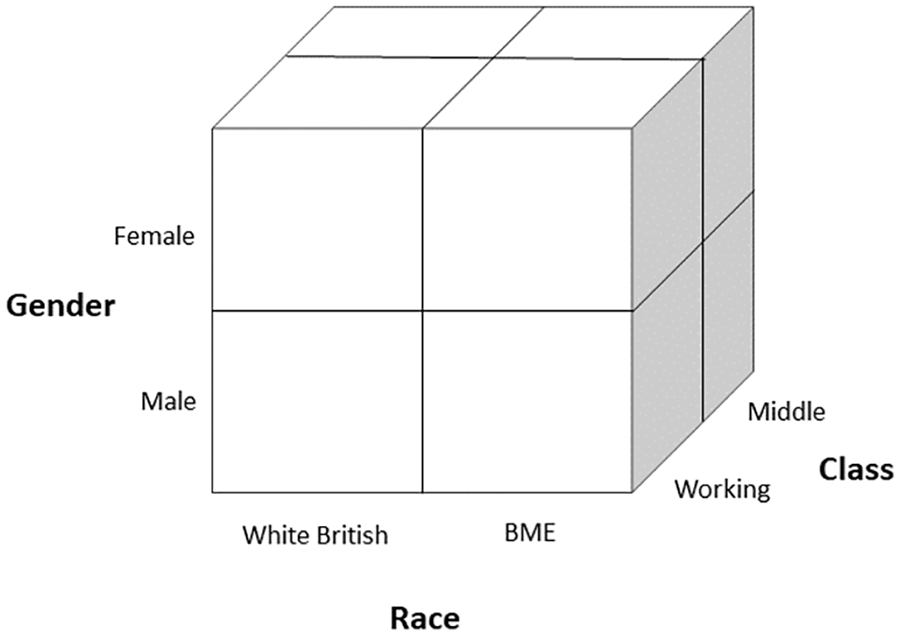
Intersectional demographic groupings.
Between-group analysis (comparison of the two broad groups under the heading of each of the three social categories) was studied using both bi-variate and multi-variate (logit) analysis. Given the intersectional nature of gender, race and class, we also assessed possible racial and class-based inequalities within the broader groupings of women and men, in light of the self-employment related variables that represent relevant conditions of difference: (1) tenure of operation; (2) receipt of state benefits; (3) size of operation; and (4) part-time or full-time arrangements. All multiplicative relationships between the characteristics of social positionality were used to examine differences across the eight possible demographic subsets of the sample. This between- and within-group analysis enabled us to study how intersections of gender, race and social class shape the likelihood of the self-employed experiencing less favourable entrepreneurial conditions.
Findings
Sample Profile
Table 1 presents descriptive statistics for each of our main variables. Our final sample consisted of 12,854 self-employed individuals, of whom 63% were male, 88% were White British and around 55% were designated working class. Some groups are more heavily represented; for example, White Male MC and White Male WC jointly comprise over 50% of the sample population, while 200 members represent the smallest group – BME Female WC.
Sample profile.
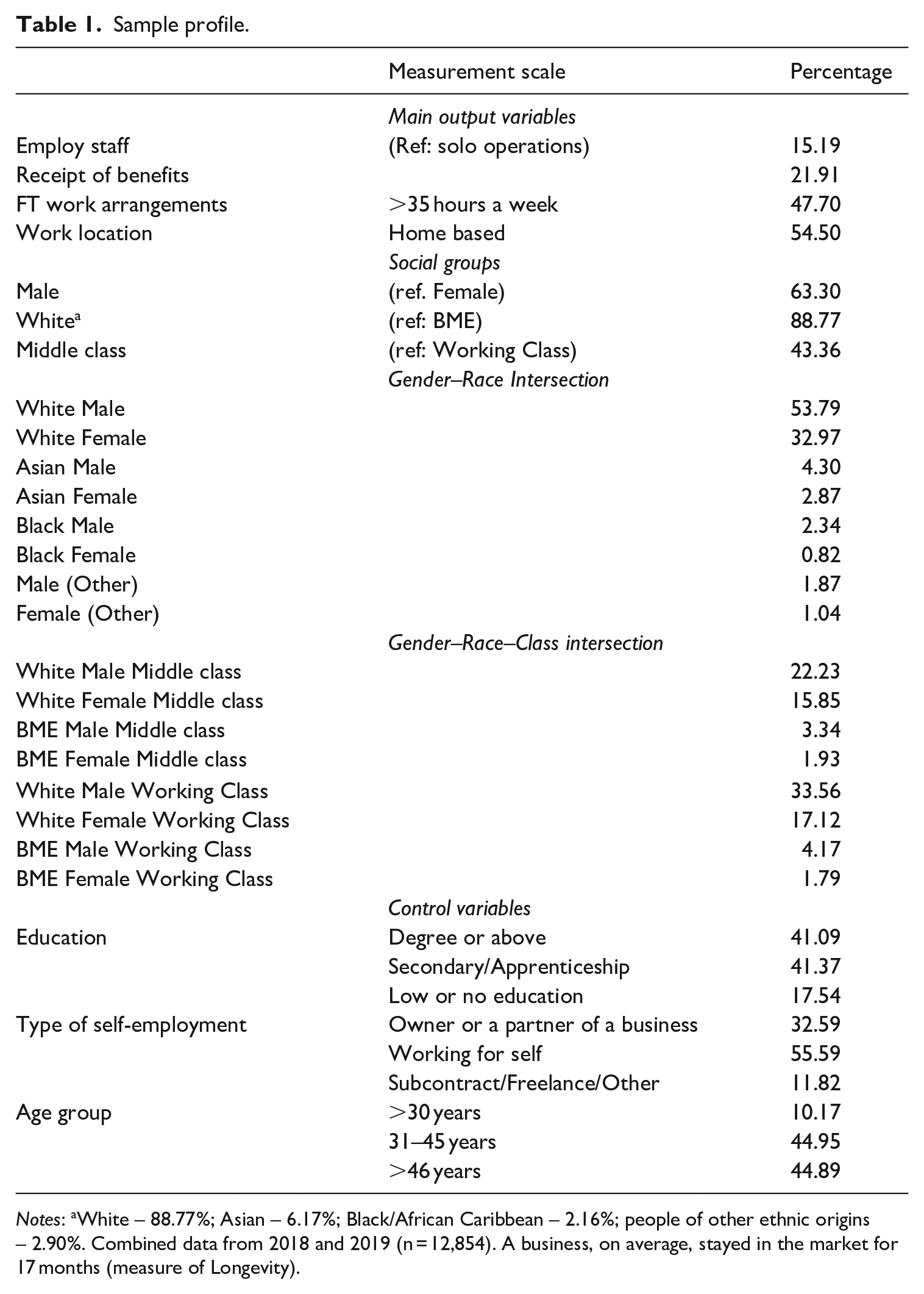
Notes: aWhite – 88.77%; Asian – 6.17%; Black/African Caribbean – 2.16%; people of other ethnic origins – 2.90%. Combined data from 2018 and 2019 (n = 12,854). A business, on average, stayed in the market for 17 months (measure of Longevity).
Self-Employment within and across Social Groups
Much current literature glosses over the range of returns experienced to self-employment, and in particular the propensity for low returns (Carter, 2011; Jayawarna et al., 2014). Here we study the pattern of a wider range of self-employment outcomes, between and within groups of individuals, exploring in particular groupings and intersections of gender, class and race.
Between-Group Differences
First, we conducted a bi-variate analysis to study variation in entrepreneurial arrangements between groups by gender, race and class (Figure 1), measured in relation to the four output dimensions. Table 2 highlights statistically significant between-group differences for the four output measures, offering strong support for our central claim that non-dominant (female, BME and WC) positionalities correlate to conditions of disadvantage in self-employment. Regarding gender, the main highlights are: 35% of self-employed women are in receipt of benefits, and 66% operate part-time, as compared with 14% and 30% of men, respectively. Regarding race, a higher proportion of BME self-employed receive state benefits (28% compared with 21% White British), although BME groups more frequently employ staff (19% compared with 14% White British).
Between-group differences – bi-variate analysis.
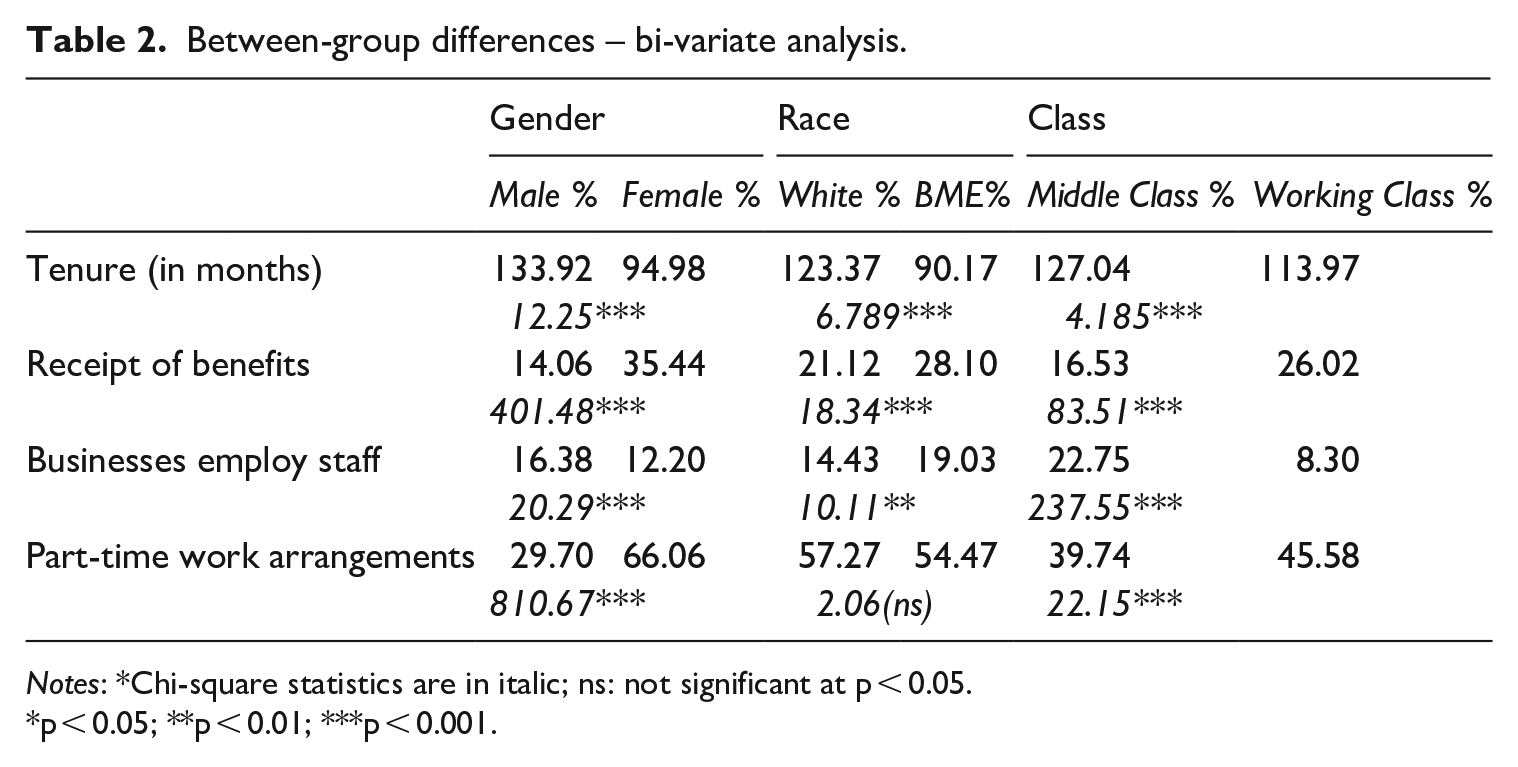
Notes: *Chi-square statistics are in italic; ns: not significant at p < 0.05.
p < 0.05; **p < 0.01; ***p < 0.001.
Significant differences reported within each social group in Table 2 illustrate that self-employment is likely to be less advantageous for certain groups. To further elaborate upon this and account for unexplained heterogeneity, we specify a number of regression models to fit each dependent variable, after introducing a number of individual- and firm-level controls.
The regression results in Table 3 reveal that, even after incorporating a broad array of controls, varying degrees of potential entrepreneurial disadvantage exist for those in different social groups. In particular, female, BME and working-class self-employed people are more strongly penalised than their socially advantaged counterparts (male, white, MC), in terms of employing staff and business tenure, albeit the latter to a lesser degree; they also are more likely to claim benefits. Furthermore, examining the strengths of the relationships presents a nuanced picture of how disadvantage is shaped by different positionality dimensions. For example, the most strongly significant determinant of employing staff was social class, while gender was the strongest determinant of tenure, benefit receipt and part-time work; notably, the only dimension in which race was not a significant factor was that of part-time work.
Between-group differences – multi-variate analysis.
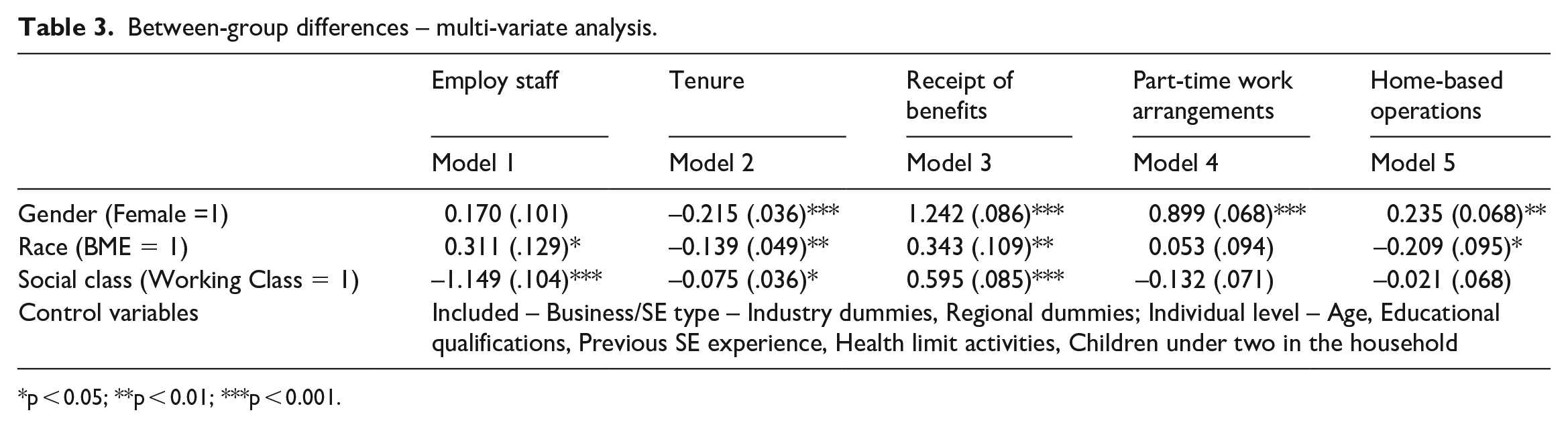
p < 0.05; **p < 0.01; ***p < 0.001.
Within-Group Differences
Within groupings of women and men, we conducted two analyses. Assuming minoritised positionalities present structural barriers to self-employment, in the first analysis (Table 4) we examine the combined effect of gender, race and class by taking the sums of barriers. For this analysis (Table 5), two sets of measures were employed: (1) no barriers (reference: White MC male) – three barriers (BME WC female); (2) male with no barriers (reference: White MC male) – female with two barriers (BME WC female). Figure 2 offers a graphical presentation of these results. Overall, they suggest that the coefficients for all outcome measures offer a strictly increasing pattern, from the lowest sum of barriers to the highest. Again, the group with all three barriers (BME WC women) experienced the largest disadvantage. The subsequent groups show a linear trend of progressively better outcomes. This pattern is particularly noticeable in the second set of measures, where gender intersects with race and social class. The effect progressively increases, leaving women disadvantaged by both race and class facing the most challenging conditions.
Number of barriers and likelihood of entrepreneurial penalty.
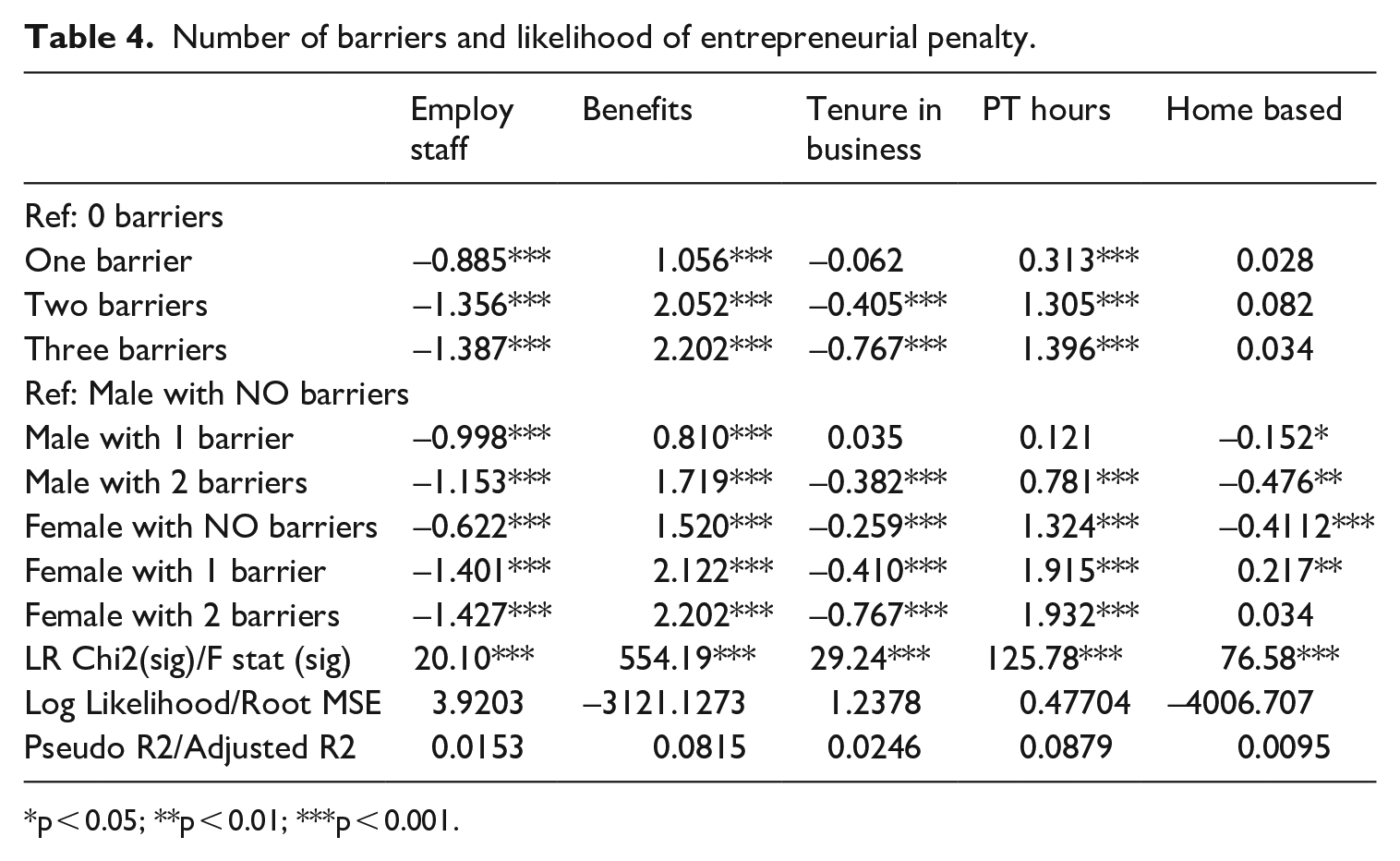
p < 0.05; **p < 0.01; ***p < 0.001.
Within-group analysis and conditions of difference.
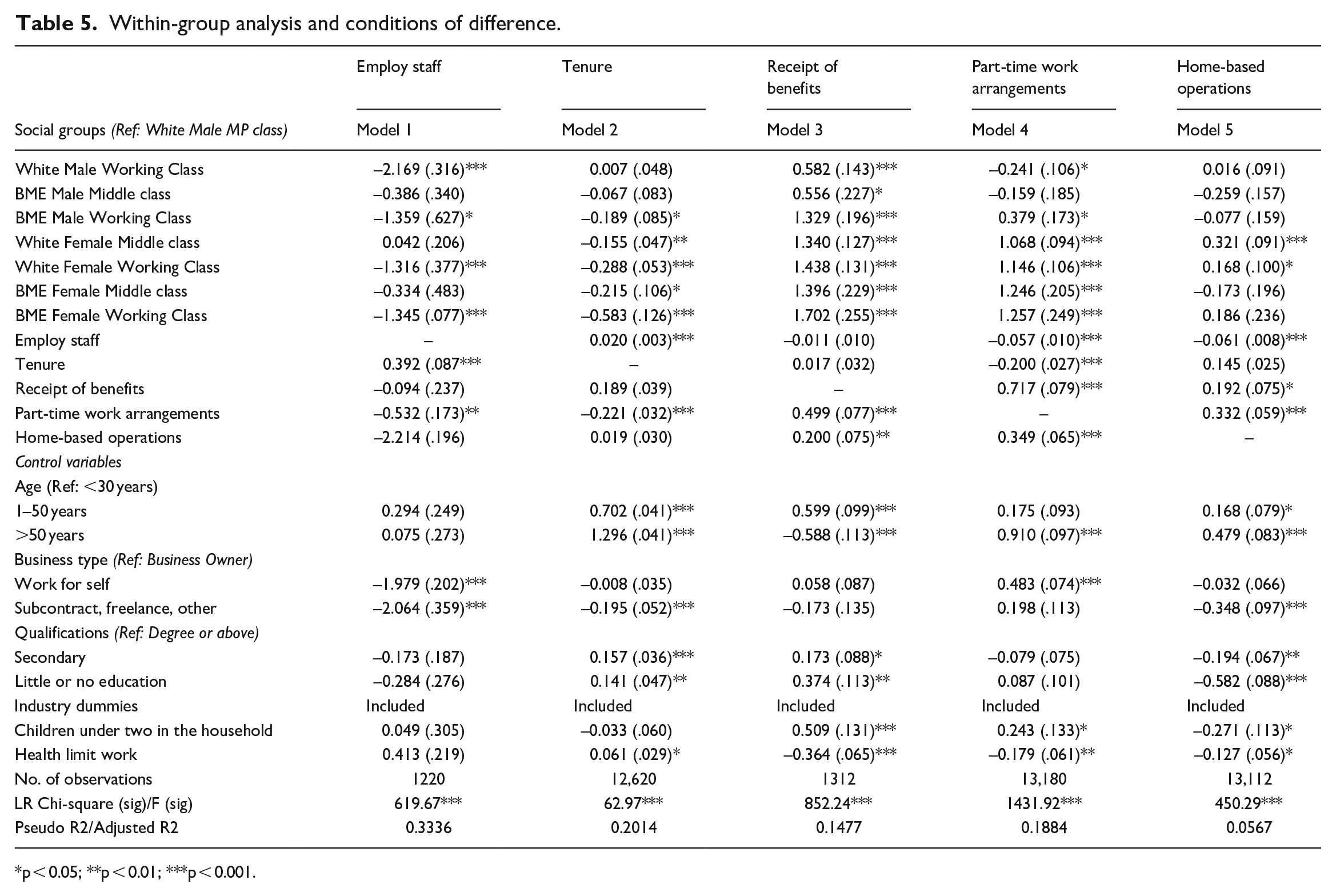
p < 0.05; **p < 0.01; ***p < 0.001.
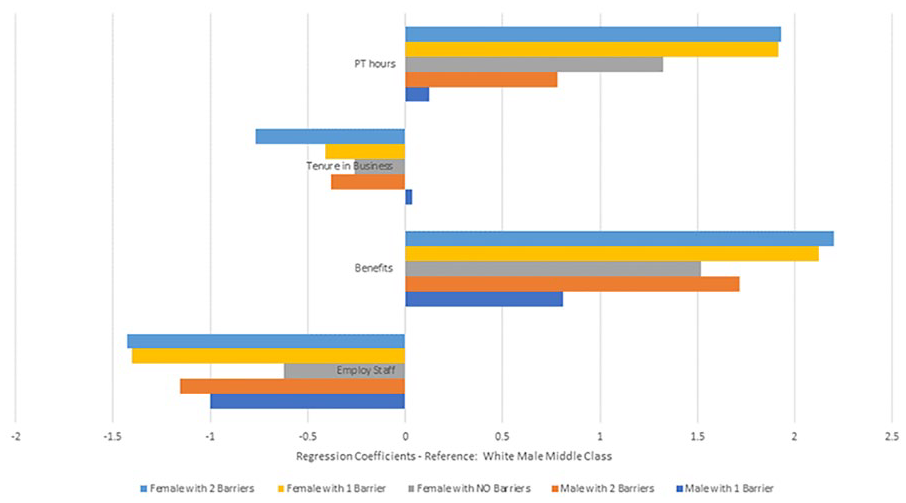
Positional indicators of entrepreneurial disadvantage.
The model of multiple disadvantages we present, while illustrative of increasing penalties for additional dimensions of social disadvantage, should not be interpreted as additive (Bowleg, 2008). What we instead perceive is an interactive effect of being a member of two or all three disadvantaged categories, which requires analysis across multiple facets of entrepreneurial activity to fully appreciate, as our study demonstrates. For example, White MC women are slightly more likely than men with one barrier to employ staff; however, these men tend to have the longest business tenure of all the disadvantaged groups. Notably, the likelihood of employing staff and therefore, managing a larger, scalable enterprise is largely concentrated within the middle class, indicating a clear class-based impediment to more lucrative self-employment.
Discussion
Intersectional feminist scholars emphasise the value of a quantitative approach, yet quantitative intersectional studies are still rare (Dubrow, 2008; Else-Quest and Hyde, 2016). Our findings address this gap and provide evidence of a profound intersectional penalty for entrepreneurship by multiply marginalised actors. Well-rehearsed challenges experienced by women entrepreneurs are found to be compounded for racially minoritised women, especially within the working class (Forson, 2009; Knight, 2016); BME WC women are the subset of the population most likely to face the most challenging entrepreneurial conditions – low-income and part-time, with negative implications for business survival. Such findings may be interpreted superficially via the ‘deficit model’, wherein BME WC women entrepreneurs are seen as less capable compared with White MC men. Yet, this simplistic reading neglects prevailing social and structural conditions and overemphasises agency (Ahl and Marlow, 2012; Villares-Varela et al., 2022). Highlighting the racist, sexist and classist assumptions of the deficit model and working instead with the realist methodological goal of explanation over prediction, we offer an alternative explanation based in robust theories of racial capitalism from an intersectional feminist perspective.
Enduring patterns of discrimination, resource constraint and unequal access to influential social networks are understood to characterise entrepreneurship by marginalised and disadvantaged groups (Carter et al., 2015; Fairlie, 2005). Since self-employment is but one mode of economic engagement within the labour market, it is perhaps unsurprising that the income penalties experienced by women and BME people in employment, otherwise termed gender and racial/ethnic pay gaps (Brynin, 2012; Hegewisch and Hartmann, 2014) are similarly reproduced in self-employment. This phenomenon is explained by our realist perspective in which labour markets are not distinct from, but wholly constituted by, social structures (Fleetwood, 2006, 2011). We find that positional disadvantage is linked to entrepreneurial penalties in a complex and interactive rather than generic way. Significant differences are shown to exist in not only income (through the proxy of benefits), but also in hours of work per week, tenure and employment of staff. While our results reveal a prevalent dimension of disadvantage shaping outcomes for each of these conditions (e.g. social class and employing staff, or gender and benefits), they nonetheless highlight how the other dimensions of disadvantage should not be ignored in explanations of entrepreneurial penalties. This finer-grained analysis of how different aspects of entrepreneurship are affected by various facets of positional disadvantage is a key contribution of our study, emphasising the importance of carefully attending to heterogeneity among the self-employed population.
Marxian feminist economist Federici (2019) argues that in periods of macroeconomic transition, it is women who suffer most. Indeed, since the 2008 financial crisis, UK women’s self-employment has continually increased, particularly part-time (Watson and Pearson, 2015). Rabindrakumar (2014) reports that 18% of single parents, mostly women, were self-employed post-crisis, 32% of whom were new entrants since 2012. We suggest this trend is related to extensive recent changes in welfare benefit provisions, which reduced incomes and eligibility and pushed more single mothers, as well as women near retirement, to seek work, including via self-employment (Thurley et al., 2021, Watson and Pearson, 2015). Notably, BME women appear to be the group in which entrepreneurial activity is rising most rapidly, while UK White women’s self-employment decreased between 2009 and 2019 (Martinez Dy and Jayawarna, 2020). Correspondingly, the activities of self-employed BME women are gaining attention from academics, practitioners and funding bodies; yet, this is not reflected in greater attributions of competency, signalled by key indicators such as external investment (Brodnock, 2020). It is therefore, concerning that the expansion in self-employment, which in 2015 was the only growth sector in the UK labour market (Watson and Pearson, 2015), appears to be in predominantly precarious economic activity, led by those with greater vulnerability, more likely to experience disadvantageous conditions and poorer outcomes. While our study focuses upon the UK, the insights it offers into the way in which socio-structural inequalities manifest in entrepreneurial outcomes may be resonant across a range of economic contexts, and particularly pertinent in larger economies where inequalities are even more pronounced (Ehlers and Main, 1998).
Our theoretical framing in racial capitalism and intersectional feminism enables a contribution to debates regarding increased participation of disadvantaged actors in potentially marginalised self-employment. Although the siren’s call of entrepreneurship may be a feature of contemporary neoliberal culture in general, it is increasingly targeted at marginalised groups. A series of policy efforts has encouraged women, and more recently, BME people, into entrepreneurship (Ahl and Marlow, 2021; Rose, 2019). Yet, the impact of racial marginalisation on entrepreneurial activity is only now beginning to be theorised (Bruton et al., 2023). Racial capitalism theory suggests that as capitalism expands to include ‘diverse economic activity into the logic of accumulation’, emergent processes serve to not only disadvantage women, but also differentiate populations along racial lines (Bhattacharyya, 2018: 37), drawing them towards specific kinds of economic activity. As Bhattacharyya (2018: ix) argues: Racial capitalism operates both through the exercise of coercive power and through the mobilisation of desire. People are not only ‘forced’ to participate in economic arrangements that cast them to the social margins; they also rush to be included in this way.
This is borne out in Villares-Varela et al.’s (2022) study of UK migrant enterprise, in which structural barriers to appropriate employment both encourage migrants’ entrepreneurial aspirations and place significant constraints on their agency. In the decade after the 2008 crisis, the unequal distribution of the benefits of entrepreneurial activity, while long-standing, became drastically exacerbated. White MC men were still able to accumulate and consolidate capital through business ownership, while self-employed women, BME people, and BME women in particular, were detrimentally affected by the extended austerity period (Rabindrakumar, 2014; Watson and Pearson, 2015). Feminist entrepreneurship literature has established how gendered differences in caring responsibilities and unpaid domestic work detrimentally affect women’s self-employment, inhibiting the realisation of promised flexibility (Bari et al., 2021). We extend such debates with our investigation of how race and class simultaneously shape this picture.
This study’s evidence can potentially inform understanding of similar issues in the period following the COVID-19 pandemic. In the UK this was characterised by a series of lockdowns from 2020 to 2021, which Torres et al. (2021a, 2021b) found to exacerbate pre-pandemic gender and racial gaps in employment, with complex effects on self-employment by gender, ethnicity and class. Overall self-employment fell from 4.4m at the start of 2019 to 3.8m in April 2021, concentrated heavily in service, hospitality and care sectors strongly affected by pandemic restrictions (Torres et al., 2021a). However, Torres et al. (2021a: 17) stress that intersectional positionality is highly relevant to the conditions and outcomes experienced: ‘Who is self-employed and the risks that they faced during the pandemic are not random but highly dependent on gender, ethnicity and how these intersect.’ To illustrate, White British women’s self-employment decreased very little during the period affected by COVID-19 (Torres et al., 2021a); White British women and men’s unemployment figures peaked earlier, in Q3 2020, while BME unemployment continued to rise until the end of the year (Torres et al., 2021b). While overall, men experienced the highest fall in formal employment, redundancies and self-employment, BME self-employment rates fell most sharply (Torres et al., 2021a, 2021b). Such insights speak to the need for closer attention to the intersectional way in which the self-employment landscape is stratified.
This also raises the question of the extent to which the expansion of capitalism to socially disadvantaged entrepreneurial actors, for example, through targeted self-employment support programmes, is in fact possible. Bhattacharya (2018: 96–97) notes: antipoverty initiatives have tended to focus on versions of economic inclusion that assume the model of equality between economic actors. Therefore, we see initiatives that seek to remove barriers to work, introduce local markets and encourage education as a route to waged work.
She argues that such initiatives cannot help but fail due to their flawed underpinning assumption of equality between actors. What is clear, however, is that our findings suggest that contemporary self-employment, rather than being a meritocratic and accessible mode of engagement in economic activity, is simply another means by which racial capitalism is reproduced.
Limitations and Future Research
The limitations to our analysis present potential opportunities for fruitful future research. First, while our study focuses on the period 2018–2019, the context of COVID-19 and its impacts on the labour market in general, and self-employment in particular, will constitute a necessary part of future analyses. Second, our empirical model is inherently static. Cross-sectional surveys are not well suited to exploring the temporal dynamics of self-employment. While we cannot establish the dynamics of work arrangement changes over time, or reject the possibility of endogeneity between concepts, our confidence in the causal order is increased when further analysis was undertaken using panel data available over five waves of the LFS. One obvious and important direction for future research is for scholars to better align the timing of measurement with the temporal nature of predictions using panel data collected over a longer time span. Third, our study assumes a binary choice between wage and self-employment; as such, it does not address the population of self-employed who also engage in wage employment. Although we use self-employment as the basic unit in our analysis, we nevertheless found important variations within self-employment such as the distinction between business ownership, working for self and freelance work. Thus, using self-employment as a multi-dimensional construct might offer other important insights.
Fourth, the category of ‘race’ is itself imperfect; the census categories that the LFS mirrors problematically tend to conflate skin colour, ethnicity and nationality (Mayblin and Soteri-Proctor, 2011). As such, socially constructed racial groupings encompass a range of ethnicities, between which socio-economic patterns may differ greatly due to divergent histories and persistent inequalities. Economic outcomes tend to be better for Indian and Black African groups, in contrast to Pakistani, Bangladeshi, Black Caribbean and Chinese groups (Carter et al., 2015; Modood, 2006); this variation by ethnicity is also evident in light of the COVID-19 pandemic, where all BME groups had much steeper increases in unemployment than White British people, which were worst for Pakistani and mixed-race groups (Torres et al., 2021b). White migrants may, or may not, be grouped under the BME heading, and can also experience discrimination despite potentially being racialised as White. Furthermore, generational differences can be expected between the economic activities of recent BME immigrants and British-born BME people. Fifth, socio-economic class is a challenging factor to explore – while we addressed it in a particular way in this study, more work needs to be undertaken to understand the impact of class upon self-employment. Finally, the findings around our control variables such as health conditions, age and type of self-employment highlighted several opportunities for future research on the increasingly important topic of part-time self-employment, and provide a strong platform for advancing such research.
Conclusions
This article contributes to sociological debates on entrepreneurship and inequality in two key ways. First, we have developed an interdisciplinary theoretical critique of entrepreneurial meritocracy drawing on racial capitalism and intersectional feminism. Second, we explored our arguments empirically through quantitatively analysing nationally representative self-employment data. The theoretical framing has enabled us to articulate and explain how intersections of gender, race and class positionality correlate with different types of entrepreneurial privilege and disadvantage in the UK. The findings resonate with work highlighting the prevalence of precarious self-employment, and the associated entrepreneurial penalty it precipitates, as a key feature of the contemporary labour market landscape (Watson and Pearson, 2015), especially for those who are subject to multiple structural disadvantages.
Recognising such diversity within the self-employed population further reveals the risks borne by BME entrepreneurs, especially BME working-class women, in this regard. Increased cultural promotion of racially diverse women’s entrepreneurship should be realistic, not evangelical – while laudable in terms of equalising representation, there are obvious limitations on the capacity of a plethora of fragile businesses to sustainably generate economic development at either the individual or societal levels. Furthermore, how these trends relate to periods of crisis, including recession, inflation and the differential access to stable and attractive employment opportunities as recovery efforts emerge, continue to require care and attention.
Footnotes
Acknowledgements
The authors would like to thank the anonymous referees for Sociology, editor Jill Timms, previous referees and attendees at the 2020 Academy of Management and 2022 Institute for Small Business and Entrepreneurship Conferences for their constructive comments on previous versions of this article. Any errors are our own.
Funding
The authors received no financial support for the research, authorship and/or publication of this article.
Ethics Statement
This study is based on publicly available secondary data. The authors report no conflict of interest for this study.
Notes
 .
.