




Abstract
Institutional theories of ‘local area effects’ hypothesise that local area differences in organisational resources are an important feature of inequality in individuals’ residential environments. However, while the organisational dimension of local areas has been identified as an important research priority within urban sociology, empirical work remains limited, with charitable organisations particularly under-researched. Therefore, a key question remains unanswered: why do charities in more deprived local areas have higher dissolution rates, reinforcing a lower prevalence of charities compared with less deprived areas? This article focuses on this research problem. It shows that volunteer leadership succession is less prominent in more deprived local areas, and that this more limited leadership succession helps explain why charities in more deprived areas experience higher dissolution rates. The results promote understanding of a mechanism underlying local area differences in organisational dynamics that lead to persistent differences in institutional resources between more and less deprived local areas.
Keywords
Introduction
This article addresses a key question unanswered in existing sociological work: why are charities 1 in more deprived local areas less likely to survive over time, reinforcing a lower prevalence of charities in more deprived compared with less deprived local areas? For the first time, we test the hypothesis that in more deprived local areas, where the pipeline of supply of new charitable board members may be more limited, the difficulty involved in ensuring leadership succession over time may be one reason why charities in more deprived areas experience higher rates of dissolution. We make use of unique longitudinal data that follow through time the population of charitable board members in England, linked to the registration and dissolution history of each associated charity. Our results make an important contribution to the literature on ‘local area effects’ within urban sociology by promoting understanding of a mechanism underlying the high charitable dissolution rates in deprived areas that lead to persistent differences in institutional resources according to the level of local area deprivation.
The Institutional Resources Perspective on ‘Local Area Effects’ within Urban Sociology
Spatially concentrated deprivation is an enduring feature of social stratification, central to the study of social inequality (Sampson, 2012). From an empirical perspective, patterns of spatially documented deprivation are well documented (Rae, 2012). Indeed, a variety of processes – related to residential sorting, the distribution and characteristics of housing, and local labour markets – serve to concentrate deprivation in particular local areas (North and Syrett, 2008), and patterns of local area deprivation may persist for considerable lengths of time (McCulloch et al., 2012). The reason why spatially concentrated deprivation is seen as a problem – and a reason why it has attracted much policy interest – is often linked to discussions about the importance of ‘local area effects’, whereby areas of spatially concentrated deprivation ‘are seen adversely to affect life chances above and beyond individual characteristics’ (Rae, 2012: 1184; Sampson, 2011).
However, within urban sociology a key challenge is to identify processes through which spatially concentrated deprivation is mediated: why does local area deprivation matter for people’s lives? Salient theory argues that, if ‘local area effects’ exist – whereby the level of area deprivation has an independent effect on individual well-being – presumably they stem from ‘processes that involve collective aspects of community’ – in other words, from ‘emergent properties’ of local areas (Sampson, 2012: 47, emphasis added). Indeed, according to one important perspective, there may be differences in institutional resources between more and less deprived local areas (Galster, 2012). Here, a pertinent ‘emergent’ area property is organisational density: in more deprived areas, community organisations may be less sustainable and therefore less prevalent (Wilson, 1987). However, providing empirical evidence to test this institutional resources perspective has proved a challenge. Indeed, there is recognition that the organisational dimension of local areas is a research priority within urban sociology (Sampson, 2011, 2012; Sharkey and Faber, 2014; Small, 2014), with charitable organisations (see note 1) particularly under-researched (Sampson, 2011).
The relative lack of empirical research on charitable organisations within urban sociology is a significant omission given longstanding concern about the potential for unevenness in the distribution of charities according to the level of area deprivation. The influential Wolfenden Report, a key inquiry into the UK voluntary sector, gave voice to this concern when it argued that some local areas ‘seem to provide a much more fertile soil for voluntary action than others’ (Wolfenden, 1978: 58). Importantly, differences in the density of charitable organisations according to local area deprivation may have implications for individual well-being. First, given that charities play an important role in the ‘mixed economy of welfare’ through their involvement in a diverse range of activities conducive to the welfare and well-being of individuals (Alcock, 2008), differences in the density of charities may translate into differential access to charitable services and amenities (Clifford, 2012). Second, given the organisational embeddedness of individuals’ social capital, differences in the density of charities may translate into differences in the size and quality of people’s social networks through affecting individuals’ ability to ‘form and sustain [social] ties’ (Small, 2009: 196).
There is growing awareness that the importance of local area deprivation is best understood longitudinally. Here, the interest centres on the extent to which the ‘emergent properties’ of areas ‘endure’ over time. For example, from an institutional resources perspective, McDonnell et al. (2020) extend Clifford’s (2012) cross-sectional analysis of differences in the density of charities according to local area deprivation by demonstrating the enduring nature of this relationship: in each of the census years 1971, 1981, 1991, 2001 and 2011, more deprived local authorities 2 in England and Wales have a lower density of charities than less deprived local authorities. Similarly, Clifford (2018) shows that the disparity in the density of charities according to local area deprivation remains consistent over time: despite sizeable turnover in the population of charities, less deprived areas have an enduring organisational advantage compared with more deprived areas, with a higher density of charities per capita. These results underscore the importance of empirically examining underlying organisational dynamics of formation and dissolution, a key concern of the organisational ecology literature (Hannan and Freeman, 1989). Thus, there is evidence that the enduring patterns in charitable density are the result of two reinforcing processes: first, relative to less deprived areas, in more deprived areas fewer charities are founded per capita; second, relative to less deprived areas, in more deprived areas charities experience a lower rate of survival (Clifford, 2018).
Empirical Research Problem: Why Do Charities in More Deprived Local Areas Experience Higher Rates of Dissolution?
Differences in the foundation rates of charities according to deprivation may reflect differences in available human resources (to facilitate strategic decision making and administration as organisational aims, structure and governance are formalised) and financial resources (to raise any preliminary capital costs). However, the mechanisms underlying the higher rate of charitable dissolution in more deprived areas are not well understood. Therefore, a key question remains: why is it that – even after foundation – charities in more deprived areas are less likely to survive, with a higher rate of dissolution? This article focuses on this empirical research problem. While multiple factors may be important to explain the higher rate of charitable dissolution in more deprived areas, this article focuses on examining a specific and as yet untested hypothesis in the literature: that ‘one important factor . . . may be related to [leadership] succession: in more deprived areas, when volunteers important to the governance . . . of the organisation choose to step down or are unable to continue, there may be difficulty in finding other individuals . . . to replace them’ (Clifford, 2018: 1586) – increasing the risk of dissolution.
There is a particular substantive basis for this article’s empirical focus on volunteer leaders. As Baggetta et al. (2013: 547) explain, ‘leadership differs from rank-and-file [voluntary] participation because leaders take responsibility for achieving organisational outcomes in ways the rank-and-file do not’. Indeed, charitable organisations, in the absence of formal owners (Hansmann, 1996), rely on volunteer board members (‘trustees’) 3 to provide a leadership role by overseeing an appropriate alignment between a charity’s activities and its mission. Board members also take responsibility for securing appropriate resources; for embodying the focus of organisational accountability; and for providing the connection between the charity and its various stakeholders (Harris, 2001). Moreover, since most charities employ no staff and report few volunteers outside of the board (Lee et al., 2017), board members often play both a governance and an executive role: in an estimated 80% of charities, in the absence of staff and other volunteers, board members rely predominantly on themselves to deliver the charity’s activities (Lee et al., 2017).
Importantly, in order to survive and to be governed effectively over time, charities rely not only on their present body of volunteer 4 leaders but also on a continuing pipeline of new volunteer leaders on an ongoing basis as existing board members leave their roles 5 (Doherty et al., 2014; Lee et al., 2017). Indeed, volunteer leaders are a fundamental non-financial resource for charitable organisations (Kendall et al., 2018) and, since charities rely on volunteer leadership, they ‘must both develop the capacity of current leadership and develop new leadership on an ongoing basis’ (Andrews et al., 2010: 1197). However, there is evidence that, across the charitable sector as a whole, charities are facing significant challenges in board member recruitment (Lee et al., 2017). According to recent estimates, three-quarters of charities report difficulty in recruiting board members and more than half report having at least one board vacancy (Getting on Board, 2017). A survey that asked charities to name their most significant challenge concluded that the most highlighted issue, ahead of any financial or funding difficulties, was board member recruitment (Kendall et al., 2018). Therefore, the Charity Commission (2016), the regulator of charities in England and Wales, emphasises that ‘the pipeline of supply of new trustees’ is a critical issue, with ‘many charities, particularly small and medium sized organisations’, reporting that ‘they struggle to recruit trustees at all’. Indeed, charities that do not ensure leadership succession through the regular appointment of new board members – those charities that are unable to pass on the ‘leadership baton’ to new volunteer leaders – may be more vulnerable to dissolution.
Therefore, this article conceptualises leadership succession as a mediator of the relationship between deprivation and charitable dissolution (Figure 1). It assesses whether leadership succession is less prominent in more deprived areas compared with less deprived areas (represented through the arrow A in Figure 1); whether charities where leadership succession is less prominent have higher rates of dissolution (represented through the arrow B); and whether local area differences in leadership succession (represented by the indirect pathway through A and B) help to explain the relationship between local area deprivation and charitable dissolution. Methodologically, the article’s longitudinal approach responds to the call to probe the processes underlying cross-sectional patterns within the literature in urban sociology (Sampson, 2012). Empirically, the article makes three novel empirical contributions. First, it shows that volunteer leadership succession – in terms of the refreshment of charities’ boards with new board members – is less prominent in more deprived local areas compared with less deprived local areas. Second, it shows that charities where leadership succession is less prominent – where the leadership ‘baton’ is less regularly passed on to new board members – have higher rates of dissolution. Third, it shows that the more limited leadership succession in more deprived areas helps to explain why charities in more deprived areas experience higher rates of dissolution.
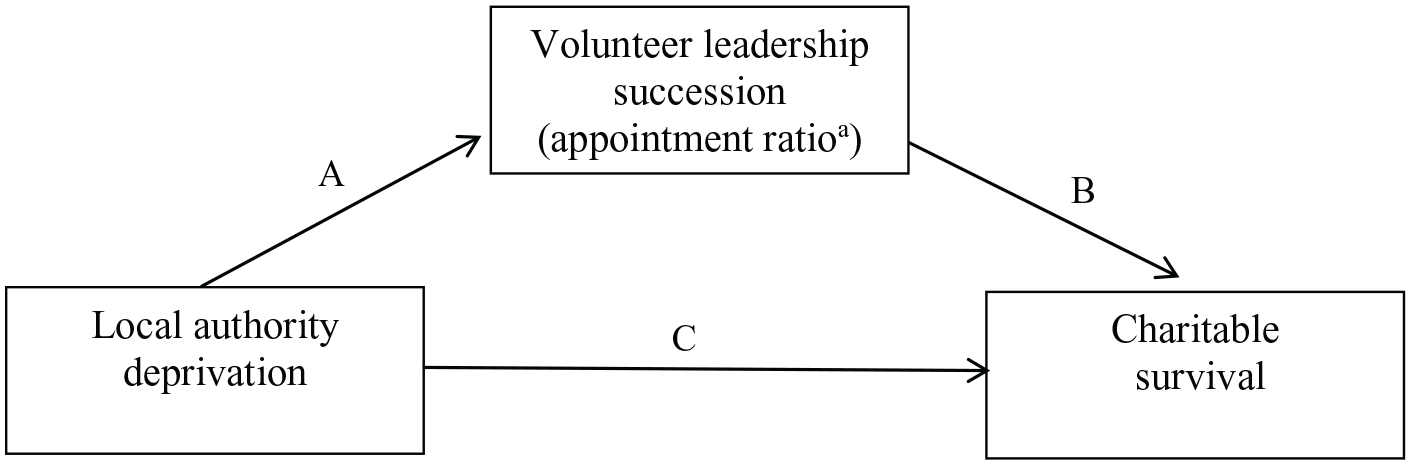
We conceptualise volunteer leadership succession as a mediator between local authority deprivation and the survival of charitable organisations.
Theory: Mechanisms Linking Local Area Deprivation with Volunteering
We outline compositional and contextual theoretical mechanisms linking local area deprivation with volunteering. While compositional properties of areas are derived from the aggregation of individuals’ characteristics, contextual factors describe salient dimensions of areas beyond these compositional characteristics (Sampson, 2012; Sharkey and Faber, 2014). Both compositional and contextual mechanisms predict lower rates of volunteering in more deprived areas – informing this article’s overarching thesis that differences according to deprivation in the supply of volunteer leaders may mediate the relationship between local area deprivation and charitable dissolution (Figure 1).
Compositional: Differences in the ‘Enabling Resources’ for Volunteering
Empirical evidence suggests higher rates of volunteering in less deprived areas (McCulloch et al., 2012; Mohan and Bennett, 2019). The most important mechanism linking local area deprivation and volunteering may be compositional: rates of volunteering may ‘vary directly with the supply of likely volunteers in the area’ (Mohan and Bennett, 2019; Rotolo and Wilson, 2012: 454). Indeed, while we might expect the demand for volunteering to be higher in more deprived local areas given that much volunteering is directed to those in need (Musick and Wilson, 2008), theory about the local distribution of voluntary activity emphasises not only the demand for services and goods but also the supply of resources conducive for volunteering (Rotolo and Wilson, 2012). The salience of the supply-side perspective is apparent when we recognise that volunteering is unpaid work: it ‘involves the provision of a service to others or the production of goods for the consumption of others’ (Taylor, 2004: 38). Through recognising this productive aspect of volunteering, we understand that – just like other work – volunteer work consumes certain resources (Musick and Wilson, 2008).
In particular, educational level is a consistent correlate of volunteering (Wilson, 2000): those with higher levels of education tend to be more well informed relating to social issues; are more likely to have developed certain ‘civic skills’ valuable for participation; and tend to have more wide-ranging social networks, which increases the chance of an individual being approached to volunteer (Verba et al., 1995). Occupational status is also important. Higher-status jobs help to develop ‘civic skills’ valuable for voluntary participation, including the organisation of meetings; preparing and delivering presentations; letter writing; and making strategic decisions (Wilson, 2000). Thus, compared with lower-level occupations, high-status employment tends to provide more volunteer-enhancing activities. High-status occupations may also provide a higher measure of control over one’s work schedule, facilitating a flexibility in time use that is conducive to volunteering, especially where this volunteer work entails long-term commitment (Musick and Wilson, 2008). In terms of financial resources, low-income individuals can be discouraged from volunteering by any incidental costs that accompany participation. In terms of health, functional impairments, chronic illness and mental health problems can pose a barrier to volunteering.
In general, it is clear that volunteer work is constrained and enabled by a range of resources (Verba et al., 1995) and that these resources are unevenly distributed in the population. This provides a theoretical basis for expecting volunteering to vary according to local area deprivation: compared with more deprived local areas, less deprived local areas may have higher levels of volunteering since a higher proportion of the population have the ‘enabling resources’ for volunteering in terms of education, financial resources, good health and civic skills (Musick and Wilson, 2008; Verba et al., 1995). Therefore, less deprived areas are ‘comprised of more of the kind of people who typically volunteer’ (Musick and Wilson, 2008: 341).
Contextual: Area Characteristics That Inhibit Volunteering
The second theoretical mechanism linking local area deprivation and volunteering is contextual: beyond any compositional differences in the ‘enabling resources’ for volunteering, there may be aspects of the local social and physical environment of deprived areas that serve to inhibit volunteering. Existing theory suggests that, compared with less deprived areas, rates of volunteering may be lower in more deprived areas because these areas may:
have higher rates of crime and disorder: as Musick and Wilson (2008: 325) explain, ‘when the social environment is risky or treacherous to navigate, one’s sense of social responsibility is unlikely to extend beyond one’s own family or circle of friends’. High rates of crime and disorder may undermine generalised trust and, since generalised trust is associated with volunteering (Uslaner, 2002), this may reduce voluntary participation. High rates of crime and disorder may also undermine institutionalised trust and therefore reduce engagement with local charitable organisations (Clifford, 2018; Uslaner, 2002);
lack access to community services and facilities. Community facilities may be less viable in more deprived areas (Logan and Molotch, 1987; Wilson, 1987, 1996). Indeed, more deprived communities may be less able to ‘sustain the infrastructure that makes associational life possible’, including ‘buildings in which to meet’ (Musick and Wilson, 2008: 324), which may serve to reduce opportunities to volunteer. Indeed, Coulthard et al. (2002) find that those who are unengaged in community life are more likely to report living in an area with few facilities. There may also be differences according to deprivation in the quality and responsiveness of local authority administration that affect not only the availability of public facilities for charities but also the quality of relationships between local authorities and the charitable sector that serve to foster or inhibit a context conducive to volunteering;
have a poor-quality living environment, such that individuals feel less attached to their community. Community attachment describes whether people feel committed to their local area. This may vary with the extent of ‘problems’ perceived to be characteristic of their area (poor-quality housing; pollution; traffic congestion, etc.). As Musick and Wilson (2008: 325) explain, ‘people who have negative feelings about their community are less likely to feel responsible for taking care of it’. Conversely, people may be more likely to volunteer if they feel attached to their area and rate it a good place to live (Smith, 1998).
Aligning Measure of Local Area Deprivation with Theory
The measure that we use to describe local area deprivation in our analysis is aligned with the two theoretical mechanisms – compositional and contextual – that link deprivation and volunteering. Our key covariate of interest is the Index of Multiple Deprivation (IMD; Department for Communities and Local Government (DCLG), 2016). This is a multidimensional measure of local area deprivation, based on seven domains encompassing a broad range of aspects of people’s living conditions. In terms of the compositional theoretical mechanism linking local area deprivation and volunteering, four of the IMD’s seven domains relate to deprivation in the ‘enabling resources’ conducive for volunteering: income; employment; education, skills and training; and health and disability. In terms of the contextual theoretical mechanism linking local area deprivation and volunteering, three of the IMD’s seven domains relate to deprivation in the local and social and physical environment that may serve to inhibit volunteering: crime; barriers to housing and services (as an indicator of lack of access to community services and facilities); and living environment deprivation.
Hypotheses
We hypothesise that, in keeping with the theoretical mechanisms linking local area deprivation and volunteering, charities in more deprived local areas rely on a smaller number of volunteer leaders. We expect these differences in volunteer leadership according to deprivation to be manifest cross-sectionally and longitudinally:
Hypothesis 1. From a cross-sectional perspective, charities in less deprived areas on average have a higher number of board members than charities in more deprived areas.
Hypothesis 2. From a longitudinal perspective, for charities in less deprived local areas, leadership succession is prominent as volunteer leaders are regularly replaced by new leaders; in contrast, for charities in more deprived local areas, leadership succession is more limited over time.
We also consider whether the difficulty involved in ensuring leadership succession in more deprived areas, where the pipeline of supply of new board members may be more limited, may be one reason why charities in more deprived areas experience higher rates of dissolution:
Hypothesis 3. Differences in leadership succession between local authorities (see note 2) – with leadership succession less prominent in more deprived local authorities compared with less deprived local authorities – help to explain why charities in more deprived local authorities experience higher rates of dissolution.
Data and Method
We construct a unique longitudinal dataset of charitable board members that follows through time every individual to have served as a board member for a charity in England between 2011 and 2022. To construct this dataset, we use information from the Charity Commission’s Register of Charities (RoC), which includes a list of the name of every current board member of every currently registered charity. We obtain 12 historical annual cross-sectional snapshots of the RoC for each of the years 2011–2022. We append each of these lists of charity board members and match common names for the same charity across years (see Online Appendix (1.1) for details). The resulting dataset provides, for every board member for every charity, their years of service between 2011 and 2022. We use this dataset to identify the number of board members, and the number of appointments and resignations 6 from the board, for every charity over this 11-year period.
We use information from the RoC that indicates each charity’s ‘area of operation’ – the local authority (see note 2) ‘where the charity does its work or provides its benefit’. We use this information to link each charity to our measure of deprivation – the IMD measured at the local authority level (DCLG, 2016) – and to local authority-level measures of urbanicity, ethnic diversity and proportion of owner-occupied dwellings (see Online Appendix (1.2) for details). In our analysis, we consider the 60% of charitable organisations that report that they operate exclusively within one local authority. Therefore, we use the area of operation information to exclude organisations that operate across a variety of different areas – regionally, nationally or internationally (see note 1). Our final dataset includes 1.31m board members (with 641,480 appointments and 715,102 resignations), contributing 5.17m years of board membership between 2011 and 2022. These 1.31m board members are linked to 91,712 charities, representing 856,789 charity years between 2011 and 2022, with 21,056 dissolutions.
Measures
We use longitudinal data on board members’ years of service between 2011 and 2022 to create organisational measures of the extent to which the same volunteer leadership roles for the same charity are undertaken by different people over time. We calculate the appointment ratio as

where
Similarly, we define the resignation ratio as

where
Models
We begin by examining differences in the average size of the board by local authority deprivation. We use a linear regression model

where our outcome
We then examine local authority differences in leadership succession. We use two linear regression models as in (3): in the first our outcome y is the appointment ratio; in the second our outcome is the resignation ratio. In both models, our covariate of interest is local authority deprivation.
We then examine the survival of charitable organisations. We consider a discrete time proportional hazards survival model of the form

where
In our analysis, we consider three survival models. In the first, we consider the relationship between leadership succession, and specifically the appointment ratio, and charitable dissolution. In the second, we consider the relationship between local authority deprivation and charitable dissolution. In the third, we consider how the relationship between local authority deprivation and charitable dissolution changes after taking into account local authority differences in leadership succession. Indeed, we conceptualise leadership succession as a mediator of the relationship between deprivation and charitable dissolution (Figure 1). Therefore, we conduct a formal mediation analysis to assess the significance of the indirect pathway, represented through the arrows A and B in Figure 1, that links local authority deprivation and charitable dissolution through leadership succession. We adopt the counterfactual framework, using potential outcomes notation, for assessing mediation (see Imai et al., 2010; the Online Appendix (section 4) provides methodological details).
Results
The results show sizeable differences in the average size of the trustee board by local authority deprivation (Figure 2; Table A2, Model 1). In less deprived local authorities, at the 95th percentile of the local authority deprivation distribution, the average board size is 6.15 board members (95% Confidence Interval (CI) 6.05–6.24). In more deprived local authorities, at the 5th percentile of the local authority deprivation distribution, 7 the average board size is 5.66 board members (95% CI 5.52–5.80). Therefore, and consistent with Hypothesis 1, the average board size is 1.09 times or 9% higher (95% CI 1.05–1.13) in less deprived local authorities compared with more deprived local authorities.
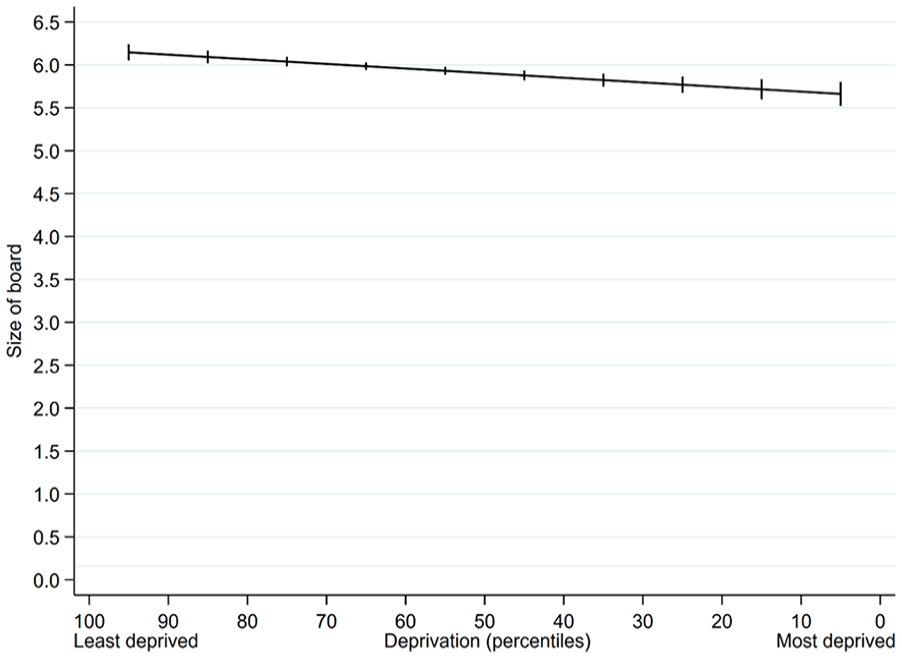
Local authority deprivation and the average size of the trustee board.
The results also show sizeable differences by deprivation in the extent to which boards are regularly refreshed by new members (Figure 3, left panel; Table A3, Model 2). In less deprived local authorities, the appointment ratio is 0.130 (95% CI 0.126–0.133): for every 100 years of board member service, there are 13.0 appointments. In more deprived local authorities, the appointment ratio is 0.099 (95% CI 0.091–0.106): for every 100 years of board member service, there are 9.9 appointments. Therefore, the appointment ratio is 1.31 times or 31% higher (95% CI 1.19–1.44) higher in less deprived compared with more deprived local authorities. There are corresponding differences by deprivation in the extent to which boards experience board members leaving their roles (Figure 3, right panel; Table A3, Model 3): in less deprived local authorities, the resignation ratio is 0.141 (95% CI 0.138–0.145), compared with 0.116 (95% CI 0.108–0.123) in more deprived local authorities. Therefore, the resignation ratio is 1.22 times or 22% higher (95% CI 1.12–1.32) in less deprived local authorities. Overall, it is clear that – consistent with Hypothesis 2 – compared with charities in more deprived local authorities, charities in less deprived local authorities experience a higher level of board member turnover, with boards being more regularly refreshed by new members and experiencing more regularly board members leaving their roles. Thus, volunteer leadership succession is more prominent in less deprived local authorities.
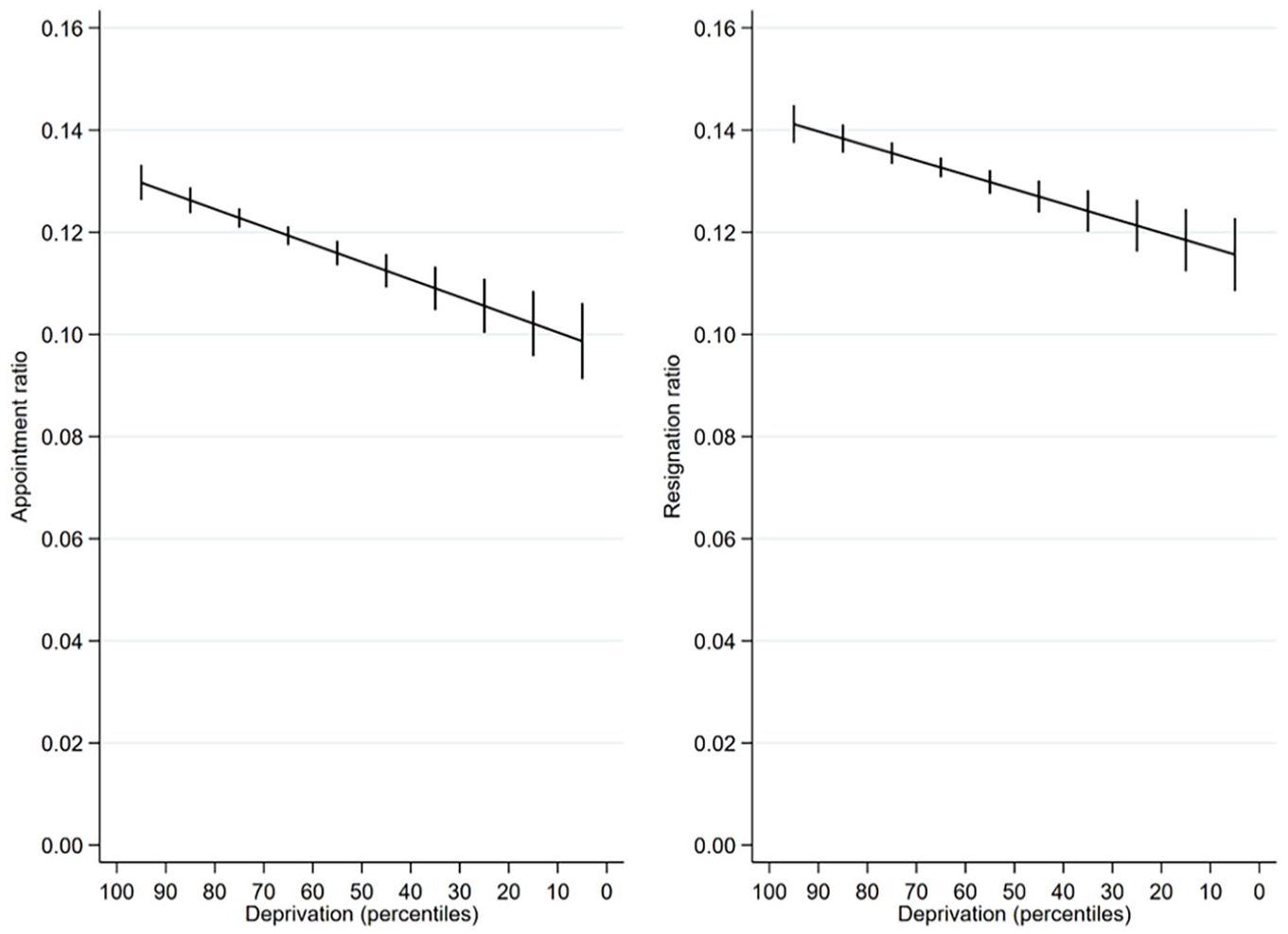
Local authority deprivation and leadership succession: appointment ratio (left panel) and resignation ratio (right panel).
The survival analysis shows that charities where leadership succession is prominent, with high values for the appointment ratio showing their board is regularly refreshed by new members, have low rates of dissolution (Figure 4; Table A4, Model 4). In contrast, charities where leadership succession is limited, with low values for the appointment ratio, show high rates of dissolution. For charities with an appointment ratio of 0.192 (at the 80th percentile of the distribution), there are 1.3 charity dissolutions per 100 charity years. For charities with an appointment ratio of 0.041 (at the 20th percentile of the distribution), there are 3.5 charity dissolutions per 100 charity years. Therefore, the rate of dissolution is 2.7 times higher (95% CI 2.6–2.8) for charities where leadership succession is more limited. Note that there is a similar gradient in charitable dissolution when considering the resignation, rather than appointment, ratio: charities with low values experience high rates of dissolution.
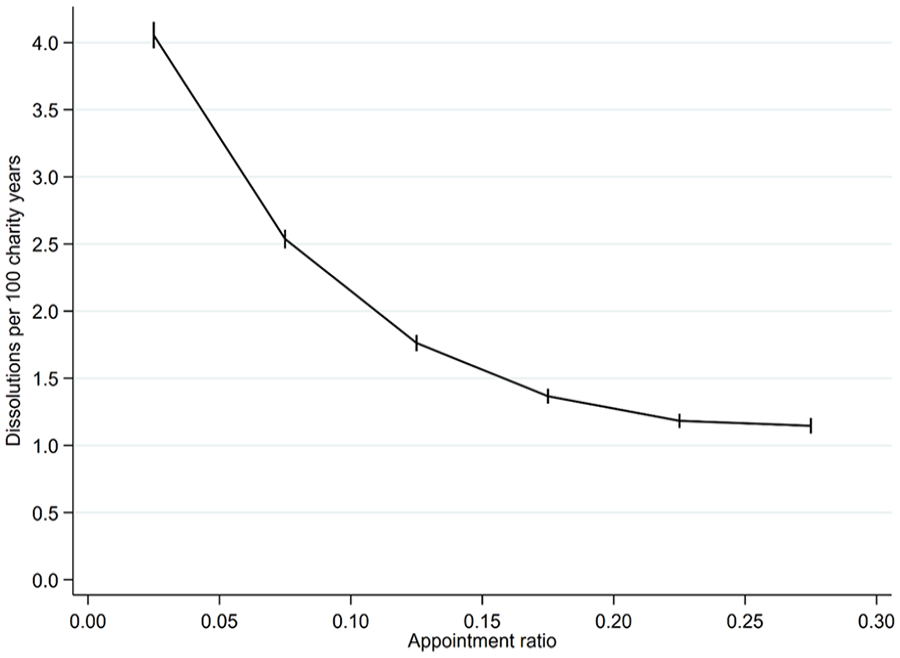
Leadership succession, as measured by the appointment ratio, and charitable dissolution.
The results show sizeable differences in the survival of charities according to local authority deprivation (Table A4, Model 5). In more deprived local authorities, at the 5th percentile of the deprivation distribution, there are 3.1 charity dissolutions per 100 charity years (95% CI 2.8–3.3). In less deprived local authorities, at the 95th percentile of the deprivation distribution, there are 2.2 charity dissolutions per 100 charity years (95% CI 2.1–2.3) (Figure 5). Therefore, the rate of charitable dissolution is 1.42 times or 42% higher (95% CI 1.25–1.59) in more deprived compared with less deprived local authorities.
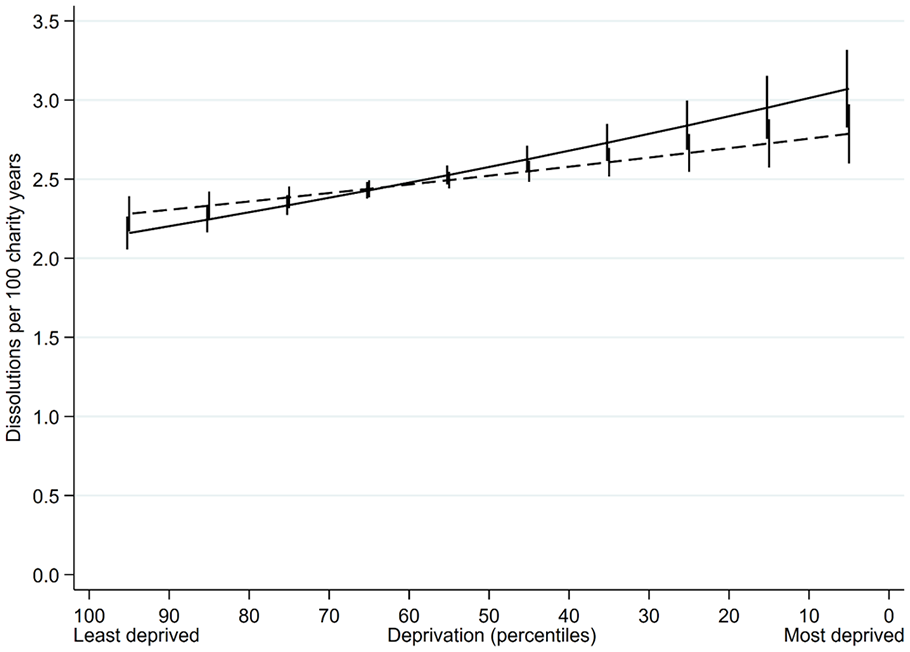
Local authority deprivation and charitable dissolution, before (solid) and after (dashed) controlling for differences in leadership succession as measured by the appointment ratio.
To what extent do differences in leadership succession, as measured by the appointment ratio, mediate the relationship between local authority deprivation and charitable dissolution? Importantly, when controlling for differences in leadership succession between local authorities (Table A4, Model 6), we observe a reduction in the size of the gradient in charitable dissolution according to local authority deprivation (Figure 5). When holding the appointment ratio constant, the rate of charitable dissolution is 1.22 times or 22% higher (95% CI 1.09–1.35) in more deprived local authorities compared with less deprived local authorities – rather than 42% higher when local authority differences in leadership succession are not taken into account. We conduct a formal mediation analysis to assess the significance of the indirect pathway, represented through the arrows A and B in Figure 1, that links local authority deprivation and charitable dissolution through leadership succession (see Online Appendix (section 4)). The simulation results from the mediation analysis provide an estimate of the average causal mediation effect (ACME): the population average of the indirect effect of local authority deprivation on the log-odds of charitable dissolution, which acts through the mediating variable leadership succession. The estimated ACME is −0.014 and is significantly different from zero (95% CI −0.015 to −0.012). The simulation results also provide an estimate of the average direct effect (ADE), the population average of the direct effect of local authority deprivation on the log-odds of charitable dissolution, which is not transmitted by the mediator variable leadership succession (represented by arrow C in Figure 1). The estimated ADE is −0.008 (95% CI −0.01 to −0.005). Therefore, the estimated ACME is larger in magnitude to the estimated ADE. These results provide evidence that is consistent with Hypothesis 3, which emphasises the importance of leadership succession to an understanding of the relationship between local authority deprivation and charitable dissolution.
Discussion
This article illustrates sizeable cross-sectional and longitudinal differences according to deprivation in the volunteer leadership of charities: compared with charities in less deprived local authorities, charities in more deprived local authorities have a lower number of board members and experience more limited leadership succession over time. We show that these differences according to deprivation do not simply reflect differences in urbanicity, ethnic heterogeneity and the proportion of owner-occupied dwellings. Therefore, the dual cross-sectional and longitudinal differences are consistent with compositional theory emphasising that, compared with more deprived areas, in less deprived local areas a higher proportion of the population are likely to have the ‘enabling resources’ conducive for a volunteer leadership role (Musick and Wilson, 2008; Verba et al., 1995); and consistent with contextual theory emphasising that, in more deprived local areas, aspects of the local social and physical environment may serve to inhibit volunteering (Coulthard et al., 2002; Musick and Wilson, 2008; Smith, 1998). 8 Importantly, this article’s results are consistent with the idea that – over and above the challenges in board member recruitment experienced across the sector as a whole (Getting on Board, 2017; Kendall et al., 2018; Lee et al., 2017) – board member recruitment is a particular challenge for charities in more deprived local authorities. We suggest that the lower resignation ratio in more deprived local authorities should be understood within this context: board members of charities in more deprived local authorities may leave their roles less readily because of the greater difficulty in finding other individuals to replace them. 9
This article also shows that charities where leadership succession is prominent – where the leadership ‘baton’ is regularly passed on to new volunteer board members – have lower rates of dissolution. In contrast, charities where leadership succession is limited, with the board less regularly refreshed through the appointment of new board members, have higher rates of dissolution. These results are in keeping with qualitative accounts that describe charities ceasing to operate because they have failed to recruit sufficient volunteers to fill board member positions: when existing board members seek to leave their roles, a charity cannot continue if there are no new leaders to replace them (Cope, 2018). 10 The results – which are consistent with the importance of volunteer succession as a key element of organisational capacity (Doherty et al., 2014) – therefore highlight the potential vulnerability of organisations reliant on the same individuals for their volunteer leadership for extended periods of time. Indeed, Rochester (2003: 117–118) warns about voluntary organisations that become ‘heavily dependent on the work and commitment of a small number of key individuals’. He describes individual leaders who maintain ‘high levels of personal commitment over a number of years’. However, when an organisation becomes dependent on these key individuals their loss can have ‘far-reaching consequences’. Indeed, since any individuals’ level of commitment cannot be sustained ‘indefinitely’, when they eventually step down this can ‘create an organisational crisis’ that may lead to charitable dissolution.
The importance of leaders becomes clear through appreciation of their wide-ranging role in organisational life. The vast majority of charities are small: 40% have an annual income under £10k; 80% have an annual income under £100k (Table A1). In most charities, board members play an executive as well as a governance role, such that they rely predominantly on themselves to deliver the charity’s activities (Lee et al., 2017). This helps to explain the risk of dissolution where leadership succession is limited and existing board members are not able to pass their leadership responsibilities to new volunteers when they seek to leave their roles.
Importantly, this article’s results suggest that the difference in leadership succession between local authorities – with leadership succession less prominent in more deprived compared with less deprived local authorities – helps to explain why charities in more deprived local authorities experience higher rates of dissolution. We propose that in more deprived local authorities, when existing volunteer leaders leave their roles, there may be particular difficulty in finding other individuals to replace them – increasing the risk of dissolution. The results represent an important step in the process of understanding the mechanisms underlying the higher rates of dissolution of charities in more deprived areas (Clifford, 2018). In turn, this provides insight into why differences by deprivation in the density of charitable organisations may persist over time: despite continual turnover in the organisational population, less deprived areas have an enduring organisational advantage – not only because of lower rates of charitable foundation in more deprived areas, but also because of higher rates of dissolution. The results therefore have key relevance to institutional resources theories of ‘local area effects’, within the literature in urban sociology, which propose that local area differences in organisational resources are an important feature of inequality in individuals’ residential environments (Clifford, 2018; Galster, 2012) – and therefore one means through which local area deprivation becomes salient in individuals’ lives.
The analysis in this article has limitations. First, the structured information that charities provide about their ‘area of operation’ is provided at the local authority level rather than at a finer spatial scale. There may be important spatial differences in volunteer leadership and charitable survival within local authorities that are not considered using the ‘area of operation’ data. Second, while we control for a range of relevant organisational-level and area-level covariates, there remains the possibility – as with observational research more generally (Lieberson, 1987) – that there is unmeasured confounding of the relationships between the ‘treatment’ and ‘outcome’ (local authority deprivation and charitable dissolution), or between the ‘mediator’ and ‘outcome’ (leadership succession and charitable dissolution). In particular, we note that we are unable to control for individual-level factors, including the socio-economic background of volunteer leaders, that may affect both leadership succession and charitable dissolution. However, we do not expect this to affect the nature of our conclusions: indeed, since on average volunteers with higher levels of income and higher levels of education tend to volunteer for longer spells (Locke et al., 2003; Musick and Wilson, 2008), and since organisations with more highly educated volunteer leaders have higher rates of survival (Wollebaek, 2009), other things equal, we might expect high socio-economic background at the individual level to be associated with both more limited leadership succession and lower rates of charitable dissolution – in other words, to drive an association in the opposite direction to that which we observe. Therefore, it is possible that the failure to control for the socio-economic background of volunteer leaders may in fact lead to an under-estimation of the strength of the relationship between prominent leadership succession and lower rates of charitable dissolution. Third, while we propose an explanation for the lower resignation ratio in more deprived local authorities – that board members may leave their roles less readily because of the greater difficulty in finding individuals to replace them (see note 9) – other explanations are possible too: a lower resignation ratio may, for example, suggest a more positive volunteering experience in more deprived areas. Therefore, the interpretation of this article’s quantitative longitudinal results would be further strengthened by complementary qualitative longitudinal research that follows a focused sample of charities through time – including through changes in board membership – and is able to probe why volunteer leadership succession is more prominent in less deprived local areas.
Conclusion
Institutional resources theories of ‘local area effects’ hypothesise that local area differences in organisational resources are an important feature of inequality in individuals’ residential environments. Therefore, empirical work examining the organisational characteristics of local areas has been identified as a key research priority within urban sociology, with charitable organisations particularly under-researched. Importantly, local areas are dynamic: as time progresses, they will experience a turnover of organisations as some are founded and others dissolve. Therefore, the specific nature of the empirical challenge is longitudinal: to explain why differences in the density of charitable organisations according to deprivation should persist over time even as local areas experiences organisational turnover. However – until now – a key question on this theme has remained unanswered: why do charities in more deprived local areas have higher dissolution rates, reinforcing a lower prevalence of charities compared with less deprived areas? For the first time – using a unique longitudinal dataset that follows through time the population of charitable board members in England, linked to the registration and dissolution history of each associated charity – this article shows that volunteer leadership succession is less prominent in more deprived local areas, and that this more limited leadership succession helps to explain why charities in more deprived areas experience higher dissolution rates. The analysis serves to illustrate the importance of examining mechanisms of continuity amid continual change (Sampson, 2012) – and specifically of interrogating the mechanisms that underly differences in organisational dynamics by deprivation and which lead to persistent differences in institutional resources between more and less deprived local areas.
Supplemental Material
sj-docx-1-soc-10.1177_00380385231221440 – Supplemental material for Passing or Dropping the Baton? Local Area Deprivation, Volunteer Leadership Succession and the Survival of Charitable Organisations
Supplemental material, sj-docx-1-soc-10.1177_00380385231221440 for Passing or Dropping the Baton? Local Area Deprivation, Volunteer Leadership Succession and the Survival of Charitable Organisations by David Clifford in Sociology
Footnotes
Acknowledgements
The author is grateful for the continued support of Professor John Mohan, director of the Third Sector Research Centre, University of Birmingham. The Charity Commission data contain public sector information licensed under the Open Government Licence v3.0 ( ). Many thanks to the Charity Commission for providing access to data from the Register of Charities. Many thanks to the reviewers and editors for their thoughtful and constructive comments and suggestions.
Funding
The author received no financial support for the research, authorship and/or publication of this article.
Supplemental material
Supplemental material for this article is available online.
Notes
References
Supplementary Material
Please find the following supplemental material available below.
For Open Access articles published under a Creative Commons License, all supplemental material carries the same license as the article it is associated with.
For non-Open Access articles published, all supplemental material carries a non-exclusive license, and permission requests for re-use of supplemental material or any part of supplemental material shall be sent directly to the copyright owner as specified in the copyright notice associated with the article.
