




Abstract
In this article, based on ethnographic research conducted in Perth, Western Australia and Madrid, Spain, we consider how community is understood and enacted for Russian-speaking migrants and its role in cultural (re)production. Studies often overlook the important role of struggle, contestation and power relations in everyday practices of community making. Drawing on Bourdieu’s field theory, we describe the Russian-speaking migrant community as a structured social space in which community leaders and migrant institutions compete for the right to represent the community. As a result of power differentials, contested ideas about what Russian-speaking culture is and how it should be transmitted, maintained and produced are established, (re)produced and revised. The community is perceived by its own members as disunited and/or consisting of members with whom migrants do not want to identify, forming a ‘community of unbelonging’.
Keywords
Introduction
Russian speakers abroad have been part of Russian nationalist projects for decades. Most recently they have been recruited in calls to unite for or against the Russian invasion of Ukraine. But, to what extent are these people a ‘community’, with a shared identity and orientation towards a home-region and to each other? This article considers how ‘community’ is constructed among this migrant population, and explores the role of community leaders and migrant institutions in processes of contestation for control over cultural production (Bourdieu, 1993b). These struggles result in ongoing conflict about what constitutes legitimate culture and who gets to define it. The resulting fragmentation is best characterised as a ‘community of unbelonging’, where the appearance of community clearly exists, evident in the existing structures and activities, but where a sense of shared feeling or idea of community is missing. Drawing on case studies from Perth, the capital of Western Australia (WA), and Madrid, Spain, we explore how and why this is the case.
The study was conducted in 2015–2020, with a focus on Russian speakers. These are small, diverse populations of migrants and their offspring who mostly hail from countries of the former Soviet Union (.id, n.d.; Australian Bureau of Statistics, n.d.; National Statistics Institute, n.d.). 1 According to the 2021 Census, 3835 people living in WA spoke Russian at home, representing only 0.1% of the state’s population of around 2.7 million. Further, 7215 residents indicated Russian ancestry (0.3%) and 2083 were Russian-born (0.1%). In Madrid in 2020, there were 7680 inhabitants who were born in Russia, which is also approximately 0.1% of the total population of around 6.8 million. It is difficult to exactly confirm the size based on statistical resources, since these populations include people from different countries of the post-Soviet space, of different ethnicities, speaking different languages at home. However, the numbers are very small in comparison with the large communities of Russian speakers in other countries such as Germany and the USA. 2 This smallness might be expected to create a strong sense of community, with a limited number of well-subscribed organisations and activities. Instead, in Perth and Madrid, we found the opposite.
Community and Migrants’ Culture
The term ‘community’ is one of the most contested concepts in the social sciences. Traditionally, it defines a group of people who share a physical space, a set of values, beliefs and behaviours who interact with each other and see themselves as a collective (Bell and Newby, 2022). Modern approaches extend these ideas, theorising communities in more processual ways, including acknowledging their potential to exist beyond a specific place, in the context of transnational communication, globalisation and migration (Delanty, 2018; Studdert and Walkerdine, 2016). It is suggested that rather than attempting to identify its static common attributes, it is important to emphasise ongoing actions of communing and doing and performing community, redefining it as practice, public doings or ‘being in common’ (Blokland, 2017; Neal et al., 2019). In various efforts to rethink the concept, it has been shown that community may provide sociability and support, with members who are - or believe they are - connected through commonality, a sense of belonging, identity or shared attachments, acquiring mutual experiences and sociality (Delanty, 2018; Grundmann and Osterloh, 2020; Gruzd et al., 2016; Hunter, 2018; Somerville, 2016).
In migration studies, there remains a popular view that migrant communities are often built through informal and formal organisations, that aim to fulfil their members’ needs, including preserving their ‘true’ or ‘original’ culture and heritage, promoting common goals and interests or contributing to developing social trust and support (Babis, 2016; Fennema, 2004; Halm and Sezgin, 2013; Jardim and Da Silva, 2019; Marzana et al., 2020). Community members are commonly perceived as being linked through horizontal connections, such as those formed through participation in organisational activities and extended through intergroup membership and contacts. For example, in studies of online migrant groups, community is typically referred to as social support networks, indicating the existence of mutual help and ‘the emergence of various degrees of solidarity’ (Andrianimanana and Roca-Cuberes, 2021; Guma et al., 2023; Nancheva, 2022: 3235).
Using the example of Russian-speaking migrants and defining a migrant community as a field of cultural production (Bourdieu, 1985, 1993a, 1993b), we show that theorising around community, as outlined above, is limited by two assumptions. First, it is unclear whether horizontal connectedness exists. Applying Bourdieu’s field theory to our empirical evidence, we find a system of ties defined not by horizontal bonds of connection and community, but rather by relations of competition and struggle for resources to achieve cultural legitimacy. The resultant system of interconnection between organisations and community representatives may lead to developing trust and mutual aid among participants, but it may also result in the opposite: distrust and conflict between community members. Second, we critique the assumption that the goals and interests of community organisations align with a common focus shared by all members in seeking to maintain (or sharing consistent views about) the ‘home culture’, as well as satisfying their main and pressing demands. We demonstrate that the way community goals and interests are formulated at any given point reflects the views of those who take leadership positions in this field, and whose ability to represent the community is based on a set of ideas that is constantly disputed (Bourdieu, 1993b; Brubaker, 2004b). This finding is supported by other critical scholarship which highlight how migrant organisation leadership is often poorly equipped to represent the diversity of community members, including women or newcomers (Bottomley, 1992; Kaşlı, 2016). We also emphasise how their activities and interests are created and redefined through contestation, with new organisations emerging and developing within the existing system of relations. In Bourdieu’s perspective, this is a competition for the discursive and practical construction of the ‘needs’ of the community, and the players in this game compete for leadership of it.
Thus, just as Brubaker (2004a, 2004b: 116) asked ‘What does it mean to speak “in the name of the nation”?’, we ask: what does it mean to speak ‘in the name of the migrant community?’ Brubaker states that nationalists and other ethnic entrepreneurs aim to change people’s perceptions of their group affiliation and identity. He considers nationhood not as an ethnocultural phenomenon but as a political claim, used not to describe the existing reality, but to construct it, mobilise people and form a sense of solidarity. Nationalism is thus a political language that nationalists use to induce people to identify with a particular nation. The same logic can be applied to the study of the language used by migrant community leaders. In this sense, culture, heritage and cultural values (Russian-ness) are not reflective of a certain reality, but rather a set of ideas and beliefs that community leaders (re)produce and construct, which can vary greatly between leaders.
To assist with the task of analysing the complex and contested processes of cultural (re)production in a migrant community by its leaders, we focus on efforts to realise or substantiate what Russian-speaking culture is, and how to produce and represent it. Finally, we demonstrate how those individuals who participate in the institutions and activities involved in the presumed community often do not share a sense of belonging to it; leading us to define it as a community of unbelonging.
Methodology
The article draws on findings from a broader study focusing on small Russian-speaking migrant communities in Australia and Spain. The fieldwork was undertaken by the first author in Perth from late 2018 to late 2020, and in Madrid in 2015, 2017 and 2019. This included participant observation, online data collection from Russian-speaking Facebook groups, 37 interviews in Perth and 85 interviews in Madrid, plus many more informal conversations in both places. A range of Russian-speaking organisations and events (including concerts, markets, church, national celebrations and workshops) were attended, and respondents were met at their homes or other venues (parks, cafes, etc.). In addition, since February 2019, the first author was a member of a Perth-based Russian-speaking performance group for about 10 months, which helped to facilitate access to this community and provided opportunities for participant observation.
The grounded theory approach (Glaser and Strauss, 2017) as a methodological strategy determined the collection, analysis and interpretation of data at all stages of the study. Following this strategy, analysing data began from the very first stages of fieldwork. Coding, which includes initial line-by-line coding and focused coding (Charmaz, 2006), was implemented for the first part of the collected data. The interview, observation and social media text data were coded into groups and then into subgroups, based on the topics related to the research aims. The initial analysis made it possible to identify recurring ideas and patterns, then identify themes and subsequently determine what additional types of data required.
Consequently, from the earliest stages of the research, numerous tensions and contestations that characterised both informal and formal relations between representatives of different migrant groups, organisations and their supporters were identified. These tensions permeated people’s relationships within these social networks in both Perth and Madrid, even to the extent of affecting people’s desire to attend events and interact with others. In addition, the communities were characterised by a large number of migrant institutions and by ongoing fractures, formations and re-formations associated with previous conflicts. In order to understand these processes better, the research sample was expanded, and more organisers, community school teachers and other active network members were interviewed. As a result of the ongoing collection and analysis of data and the identification of similarities between the Perth and Madrid cases, Bourdieu’s (1985, 1993a, 1993b) field theory was chosen as the optimal interpretative framework, as discussed in the next section. Owing to space limitations, in this paper we focus primarily on the Australian case.
The Russian-Speaking Community as a Field of Cultural Production
At a meeting of Russian-speaking ‘Organisation 1’ in Perth I met Nina
3
, a migrant from Armenia and a member of this organisation. Anna, another respondent who had worked with Nina’s husband in Russia, introduced us. Anna is a volunteer in two other Russian-speaking organisations in Perth. In addition, she was a co-organiser of the Perth celebration of a ‘national holiday X’, celebrated in some of the former republics of the USSR, aimed at Russian-speaking migrants from these countries. Some weeks later, I met Nina and a few other active members of her organisation at a picnic in honour of the ‘Russian holiday Y’ and a concert, held with the support of pro-Russian ‘Organisation A’ [Australian Council of Compatriots of Russia (ACCR)]. At these events, there were a variety of people I had met at other events or through organisations for Russian-speaking migrants, such as Anna, the participants and clerics of two Russian-speaking churches (Orthodox and Baptist), and a member of a performance group, which I joined as part of my participant observation. At this event of ‘Organisation 1’, I was also introduced to one of its oldest members, Dina, and her husband. They invited me to have dinner with their son, Mark, a second-generation migrant who does not speak Russian, and his wife, Olya, a first-generation migrant from Kazakhstan. It turned out that Olya had a close relationship with an active member of another ‘pro-Russian Organisation B’ [Russian Australian Representative Council (RARC)], which also supports many different events for Russian speakers in Perth, including an alternative celebration of the ‘Russian holiday Y’ at which my group performed. The ‘Organisation B’ was created in opposition to ‘Organisation A’ mentioned above.
The above description, adapted from the first author’s fieldnotes, contains many references to different Russian-speaking migrants, institutions and events. Based only on the information described above, their system of relationships is depicted in Figure 1. Attendance at an event or organisation, membership in an organisation and personal acquaintances are shown in the chart as connections. For example, Nina is a member of Organisation 1 (‘Org 1’ in the chart), attending the celebration of ‘holiday Y’, supported by the pro-Russian ‘Organisation A’. The pro-Russian Organisations ‘A’ (ACCR) and ‘B’ (RARC) include representatives from various organisations in the city.
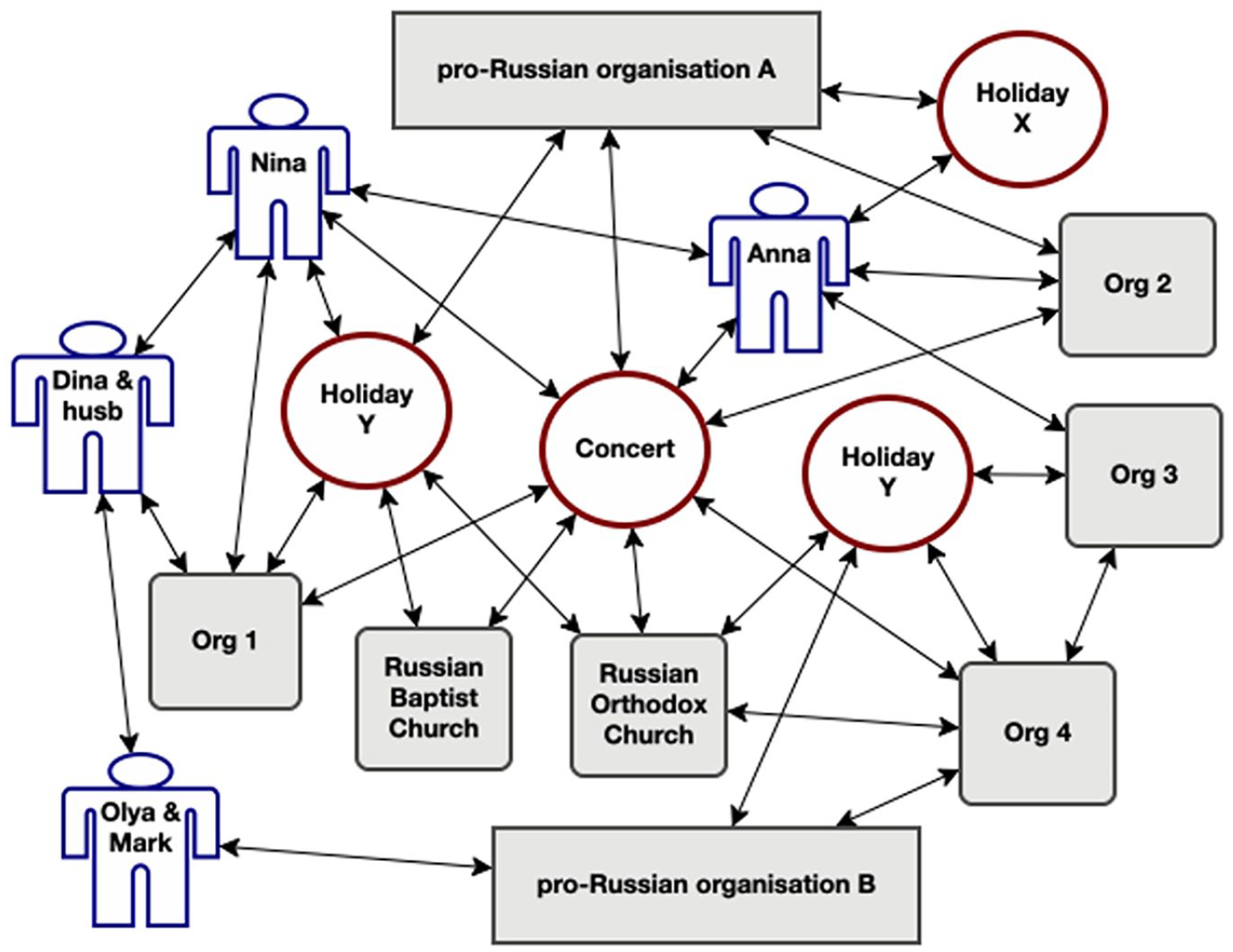
Visualisation of a fragment of the Russian-speaking community in Perth.
This example is a sketch of what constitutes a fragment of the Russian-speaking community of Perth and illustrates a number of features identified during the study in both cities. Russian-speaking migrants differ from each other in terms of various social characteristics. They belong to different generations of migrants, who were either born in different countries of the post-Soviet space or in Spain or Australia. They are religious to varying degrees and are members of different denominations. They come from Russian-speaking and mixed families, as well as from families in which the native language is from one of the countries of the post-Soviet space. They also speak the language of the country of residence, English or Spanish, with varying degrees of proficiency and occupy different social positions with regard to education and employment. Despite these differences, Russian-speaking migrants in each city are connected through a network of relationships, membership in various migrant institutions and consumption/attendance of various resources/activities for Russian speakers. They can thus, in some sense, be seen as constituting a community of migrants.
The ‘community’ in these cities has several important characteristics. First, it has a complex structure comprising multiple and overlapping institutions, particularly given the small number of Russian-speaking migrants, with several active and competing organisations providing recourses and activities. Second, tensions and contestations are a feature of the relationship between representatives of different organisations. Third, most of those involved in existing migrant institutions know of each other, have had contact with each other and the activity of some influences the activity of others, even if there are no direct interactions between them. For example, conducting two events targeted at the Russian-speaking audience on the same day, as happens, may affect attendance, given the size of the population.
Analysing the migrant community as a field of cultural production (Bourdieu, 1985, 1993b) helps to explain these empirically identified characteristics. The field is a relatively autonomous structured space constituted by social relations between cultural producers and their institutions that are in a situation of permanent competition for specific stakes. They compete for the entitlement to speak on behalf of the community, and to produce legitimate cultural products (such as holidays, meetings, concerts, mass media resources). While, for example, in the literary field, such agents and institutions include writers, publishers, literary agents, literary prizes and so on, in the Russian-speaking ‘field’ they include migrant institutions (community schools, online groups, associations, shops, churches, etc.) and cultural producers (community leaders, community school teachers, dancers, singers, etc.) who conduct activities or engage in the creation of cultural products, oriented mainly towards their consumption by Russian-speaking migrants living in these cities. Owing to the small numbers, the roles of producers and consumers regularly overlap. For example, the dance and vocal groups find new members among their audience and spectators; and producers themselves regularly become consumers of products from other producers.
The analysis also highlighted the differences between the Perth and Spanish cases. For instance, there was a more significant presence of Russian speakers from Ukraine playing the role of cultural producers or other participants in the Madrid community. Another difference is that the Perth community was more interconnected with the pro-Russian organisations (such as RARC and ACCR) than the Madrid community. One reason for this difference relates to the history of migration and ‘age’ of the communities. The migration of Russian speakers to Spain is a relatively new phenomenon, and the first migrant institutions appeared there only recently. The Russian government’s efforts to establish pro-Russian organisations in Australia have been more successful because they have been able to recruit several well-known pre-existing community institutions created, as well as a group of old-wave migrants who possess a high volume of symbolic capital and are regarded as legitimate leaders by various agents (Akifeva, 2022). These ‘old’ organisations and groups, which, as a result of a history of the settlement of different Russian-speaking migrant groups across Australia were not predominantly from WA, have conferred legitimacy upon the nationwide pro-Russian organisations in Australia and elevated their status as “legitimising institutions” (Bourdieu, 1985) throughout the country. As shown below, the community leaders in Perth lack recognised marks of distinction compared with their opponents, and have a limited range of strategies to achieve legitimacy in their struggle, and cooperation with these pro-Russian organisations and official Russian structures allowed some of them to acquire additional resources. 4 While the recognition of differences between the cases enhances our understanding that each community, as a field, has its unique characteristics, the focus of this article is on the identified similarities that informed the development of the Bourdieuan framework to explain how Russian-speaking migrants perceive and experience their communities.
To explore this, we consider the features of the Perth Russian-speaking community through the description of its agents and institutions, struggles for monopoly, cultural production processes and the fragmentation of the community at the symbolic level. We analyse these features applying Bourdieu’s field theory, arguing that this is a migrant community fractured by internal divisions, competition for resources, the right to represent authentic culture and ambivalence in terms of perceptions about what is an authentic community.
Agents, Institutions and Cultural Products
Our analysis revealed that the field of cultural production is a dynamic social space where institutions continually emerge and disappear, offering new products or alternatives to existing ones. The Perth Russian-speaking community comprises diverse, often interlinked, voluntary and commercial institutions providing online and in-person resources and activities. During the observation period, these organisations included three community schools, two main online groups, a library, a theatre for children, a music club for adults, several dance and other performance groups, various businesses and other establishments. Thus, we found a complex structure of multiple and overlapping institutions and considerable activity devoted to cultural (re)production.
For heuristic purposes, it is useful to draw an analogy between the Russian-speaking community in Perth and Spain and the literary field of cultural production (as already noted above) (Bourdieu, 1985, 1993a, 1993b; Sapiro, 2003). In the literary field, in order to take risks and engage in an activity that may not generate any profit, agents must be able to manage without significant material rewards: for example, they need to combine this activity with another job or have a different source of income. Similarly, in the Russian-speaking community, most cultural producers are not materially dependent on their cultural production activity. While a small number of people have built professional careers and earn a stable income by selling resources and products only or primarily to Russian-speaking consumers (including hairdressers, manicure specialists, people cooking dishes for individual orders and private language teachers), it is extremely difficult to make a living solely from cultural (re)production activities, particularly given the population size. There are few commercial Russian-speaking community-based enterprises. The single Russian grocery store, at the time of the fieldwork, only opened by prior arrangement (customers had to book a visit), and the only cafe set up by Russian-speaking owners, despite having Russian dishes on the menu and being known by some members of the Russian-speaking community as Russian, targeted a much broader customer market: it had an ethnically neutral name and interior, an English-language menu and looked more like a globalised coffee house.
There is a synergistic relationship between this entrepreneurial and social activity. Research on the migrant enclave economy shows how small businesses contribute to the formation of non-commercial local ethnic social structures and thus to the creation of social spaces in which people form social ties, positively affecting the functioning of the local communities (Zhou and Cho, 2010). Among the Russian-speaking community in Perth, businesses are more viable when entrepreneurs are involved in the life of the community as active non-profit participants. Some cultural producers hold volunteer positions in various organisations, and also have businesses or conduct commercial events. Clients are often recruited through these non-profit networks of relationships. However, business development by itself does not determine the growth of social structures or vice versa: entrepreneurial activity is usually most effective when it is simultaneously linked with non-commercial activity; thus, these two modes of activity encourage each other, contributing to the formation of a space called a community. For example, one Russian-speaking entrepreneur is the organiser and administrator of one of the most popular online groups for Russian speakers in Perth, and is also a participant and co-organiser of many community events.
Cultural producers may be interested in accumulating symbolic resources and obtaining symbolic profit such as recognition, status and prestige, and the activities can have their own symbolic benefits. In the migration context, this is particularly relevant for people whose migration path has been accompanied by downward social mobility. Such a social trajectory is typical for many Russian-speaking female marriage migrants, who have higher educational qualifications and held professional positions prior to migration. In Australia, owing to their lack of English proficiency or the time it takes to have their overseas qualification assessed, they may be out of work for some time. For example, a representative of a community Russian-language school describes who is employed by the school and why they work there as teachers: Basically, it is based on enthusiasm. Teachers who have no children, they are the ones who have recently arrived. They don’t have any Australian experience; they really need to take the first steps. Then there are teachers [with children], and they are the ones whose children attend [these activities], they are interested in teaching their own children.
Engaging in such teaching activities enables migrants to take ‘the first steps’ in Australia with regard to building social capital and allows them to accumulate other resources (e.g. expanding their network of acquaintances and acquiring knowledge about available opportunities), which can subsequently be converted into economic ones. In addition, for parents, participation can have the added benefit of improving their own children’s language skills.
The rewards from such non-material profit can vary greatly. The community also acts as a space where people can professionalise their own hobbies. People engaged in any activity, even at an amateur level, have a unique opportunity to convert these skills into increased status. This enables inexperienced artists, teachers and organisers to occupy positions that would often require a higher level of competence in other fields. There are almost no teachers of the Russian language with language qualifications in community schools, and the participants in dance groups, singers and other musicians do not need to have any special training or experience to start performing at public community events or to represent the community at multicultural events. For example, the first author was invited to teach Russian in one school, and to participate in public performances. Groups can perform with an international repertoire, for example, either oriental or ballroom dancing, or performances may be stylised in a naive or inexpert way as being related to Russian-speaking culture. The exclusivity of some producers is not in the type or quality of product they produce, but more that they can produce it in Russian. Thus, the cultural products are limited by the resources and characteristics of cultural producers: if, for example, there is an artist in the community, art classes may be offered, and so on.
In this way, the people who are ready to act as cultural producers may be well educated and occupy high social positions, but they commonly lack formal qualifications in ‘high culture’ products associated with Russian-speaking heritage, such as opera, theatre, ballet and literature. Most importantly they do not possess recognised marks of distinction compared with their competitors. Agents and institutions are included in the struggle for a monopoly on cultural production, but there are few differences between producers in terms of the volume of different capitals they possess: social, educational, cultural, symbolic, as well as the quality, content and criteria for the value of produced products. The cultural products are limited by the agents’ characteristics, dispositions, taste and skills. As a result, agents generate a wide range of products of variable quality. Their positions are unstable and always disputed: representatives of different groups accuse opponents of unprofessionalism, poor taste and misinterpretation of the essence of Russian culture.
Thus, cultural products in the community (including activities, concerts, gatherings, competitions, mass media resources, lessons provided by organisations) depend on two elements: first, community members’ characteristics, such as dispositions, tastes and the resources they possess; and second, the processes developed during the struggle and relationships with other agents and institutions as demonstrated in the next section.
The Struggle for a Monopoly of the Legitimate Mode of Cultural Production
The community, like any field, is a competitive social space where agents and institutions engage in a struggle for power and domination. Among the Russian-speaking community of Perth many new organisations and collectives arose as a result of conflicts over what elements of culture are worth reproducing, and who has the power to lead and participate in this reproduction. These have occurred at different levels, both within organisations, between individuals and at the level of opposing coalitions, the composition of which can shift and change. The following quote from an interview with a community leader reflects that this struggle, a ‘tug of war’, is seen as an important feature characterising relationships in the field: This is some kind of power, isn’t this? The dominance of one kind of grouping over another, let’s say. They claim to be . . . I do not know what. Well, but what is there to share here? We have such a little knot of people here, in fact, living here. And there is some kind of an incomprehensible tug of war, instead of uniting and making a common cause. For example, doing these concerts, but together. Yes? Well, in general, there is some kind of struggle for the audience, some struggle for some heads. It is impossible to understand what [it is].
It is in this struggle that questions arise regarding what Russian-language culture is, how to (re)produce it and how the revision of what is produced takes place. The following example of a popular event, the Russian Resurrection Film Festival, illustrates this contestation. Natalia Ehrenfeld, head of the Multicultural Talent Academy and project coordinator of ACCR, expressed her concern about the ways in which Russian culture is represented by the organisers at the opening of the festival (Aurunews, 2019): My firm conviction is that the goal of the festivals is to enhance the image of Russia, its culture, its traditions, and pride in our wonderful country. When I came to the opening of the festival [in Perth], I saw something completely different: the American hero, Batman, standing alone in the corner, oriental belly dance, but non-Russian one, the half-empty auditorium, and, of course, the choice of the movie – a comedy ‘Night Shift’ . . . The opening of the festival became a get-together for its own people, a private, low turnout ‘family’ party, in which someone’s personal interests were more appreciated than the interests of the community and the image of Russia.
She criticises the opening event organised by representatives of several other migrant organisations, including the competing pro-Russian organisation, RARC, for displaying elements not only of ‘non-Russian’ culture, such as the oriental belly dance, but also of ‘inappropriate’ Russian culture, such as the Russian comedy ‘Night Shift’. However, Nicholas Maksymow, a founder and director of the Festival, saw the choice of the comedy as entirely appropriate, expressing a different opinion about how Russian culture should be transmitted and reproduced (Kornits, 2018): The comedy, Night Shift, is one of the strongest comedies we’ve had in the past 15 years. The Soviet Union used to make great comedies, but in the period from the late ’90s to the present day, comedies are something Russia has struggled with, but this one really hits the mark.
This example reflects one of the many competitive relationships between representatives of different organisations, demonstrating how ideas about what Russian-speaking culture is and how it should be transmitted, maintained and produced, are established, reproduced and revised.
The struggle for a monopoly on the legitimate mode of cultural production takes the form of confrontation. Each agent imposes on others the boundaries of the field, conditions of belonging to it and points of view that should be considered legitimate within it. The declaration, by those challenging the current power brokers, of the desire to return to the authentic cultural source, is seen as an effective tool against dominant agents (Bourdieu, 1993b). We saw, for example, representatives of one group accuse others of self-interest by conducting cultural events for money, for narrowly understanding culture as a ‘marketplace’ culture, for representing the culture through specific forms of dance and dress (e.g. kokoshniks, Russian folk headdresses for women) or through specific ethnic dishes put up for sale. They claim it is necessary to understand the culture differently, from the standpoint of spirituality and a specific Russian soul. The opposite side may comment on opponents’ particular personal characteristics, unpleasant values or indicate the other group’s lack of professionalism and outdated approach. Here is how a cultural producer describes why they left the previous organisation to start their own, providing a similar type of Russian-speaking resources: We left because, in general, we didn’t agree on methodologies . . . That is, they wanted something in the old-fashioned way, and we wanted a kind of [description of the other activities], wanted more [than they did]. . . . They have different values, they, for example, do not create such a positive atmosphere there.
Agents engaged in the struggle assert recognition of their differences from other cultural producers and develop subversive and defensive strategies, along with corresponding discourses (Bourdieu, 1993a), within which what is constructed as Russian-speaking culture is (re)produced. The cultural production process thus includes not only creation of a cultural product, but also reflection on how to produce it, in accordance with their knowledge, skills and other resources, while also defending it through competition, reaction to criticism or by taking into account the alignment of forces in the field. Thus, community, understood as a field of cultural production, is a field of struggle, not solidarity. Cultural producers, in the process of the struggle, fragment the community and contribute to a feeling of disunity, and of not belonging.
A Community of Unbelonging: Migrant Perceptions of the Russian-Speaking Community
Through the course of the fieldwork, it became apparent that many Russian-speaking migrants do not want to interact with other such migrants, or at least they say they do not. Participants often stated this outright and felt their lack of interaction meant they were not appropriate subjects for the research. For example, Elena was concerned that her experiences would not be useful to the research as she was not involved in the Russian-speaking community. However, during the interview, she talked about several Russian-speaking friends with whom she maintains relationships, how she sent her children to Russian-speaking language schools and participated in the online groups’ discussions. She also attended Russian-speaking events with her Russian-speaking friends.
This feature of not perceiving themselves as part of a community was striking. People tended to see themselves as very dissimilar to those who, in their opinion, are more heavily involved in various activities or networks of Russian-speaking migrants and who consume more Russian-speaking services or produce them. The migrants themselves consider this network of cultural producers as being a community but often do not identify themselves with it. One respondent, a producer of Russian-speaking culture, works in an area in which she encounters a large number of Russian-speaking migrants. She believes that most of these people are not included in the community and that they try to stay away from it. When asked if the people she works with are part of the community, she replied: Only two out of all, and while one is directly involved, the second is simply, for example, her son [attends Russian-speaking activities]. There are several guys, one whose wife worked in a Russian-language school, but he himself was not included. There are several girls and boys who do not associate with Russian society at all, and by the way, there are a lot of them [in this professional sphere]. I know a lot of other Russians from other companies, they have never been seen in the Russian community . . . They do not go to the events . . . We meet with them, we speak Russian perfectly, but they in no way come close to the Russian society, they stew in their own juice and do not want to get into any quarrels, because many hear about internal conflicts and simply do not want to be associated with this crowd. They have some friends of their own, some of their own interests and they do not get involved with the Russian society in any way.
Here, inclusion in Russian-speaking networks is directly associated with participation in some public events, and with the consumption of products created by cultural producers. A person can have Russian-speaking friends, his or her family members can play an active role in the community or be regular consumers of some Russian-speaking services, but they themselves may not be perceived as a member of these networks.
Moreover, even being an active member in one of the organisations is not necessarily considered as signifying full membership of the community. For example, the same respondent mentioned a woman who is a member of one Russian-speaking organisation: She never participated in the life of the Russian-speaking society, never at all. . . . She was forcibly dragged along and is only there [in the organisation] due to her friend because she has a great relationship with her, and she is not friends with anyone else.
From a normative perspective, the community is always something ‘over there’, as Silverman (2006: 300) would say ‘the phenomenon always escapes’, but rather than using the term community unproblematically, the participants see it as something elusive, an ideal type that they themselves generally do not ‘belong’ to. Thus, people do not want to identify as Russian-speaking community members. Also, some do not wish to participate in conflicts or be seen as part of this conflicted community. The woman from the last example, according to the respondent, also does not wish to participate in other events because of the ‘low quality of the [cultural] product that is provided’. These reasons are combined with other reasons, such as a perception that some community members are people with whom they do not want to communicate, or that the community reproduces various negative cultural traits or politics.
The struggles among cultural producers can underlie the community fragmentation and how the boundaries between close-knit groups of Russian-speaking migrants are perceived. For instance, a parent whose child started attending a community school shared her view on the divisions within the community and mechanisms facilitating friendship ties: [Parents] are faithful to their school; they won’t go to another school. And for example, they can find fault with this school and sort of praise another. . . . Those [whose children] regularly and constantly [attend the school], . . . spend time together, for example, on weekends, go to camps. . . . I, for example, heard such cases that if you moved to another school, they generally stopped sort of accepting you here, for example, and they don’t greet you, you know, like that.
Thus, even when migrants form some friendship and acquaintance circles based on Russian-speaking community networks and are actively engaged as cultural producers and consumers, they do not articulate a sense of belonging as community members. The community of Russian speakers is “imagined” (Anderson, 1983) as a community whose members do not like and do not want to communicate with each other. People participate in the reproduction of this structured field of social relations without forming a sense of belonging, but nonetheless appear to identify through a shared sense of unbelonging.
Discussion: Cultural Reproduction in Community
In our attempt to understand cohesion and cultural construction in a small migrant community, this article has explored what community is for Russian-speaking migrants in Perth and Madrid and its role in cultural (re)production. Previous studies have paid insufficient attention to the struggles and power relations in the community and the role of leaders and institutions in creating cultural products. Bourdieu’s (1985, 1993a, 1993b, 1996) field theory makes it possible to explore and explain community, not as horizontal networks of trust between members whose leaders represent their interests and needs, but as a space of competition, where Russian-speaking culture and the ways it is reproduced, transmitted and maintained are contested and negotiated.
In these struggles we see in practice how, ‘what is at stake is the power to impose the dominant definition’ (Bourdieu, 1993b: 42) of Russian-speaking culture and how it should be reproduced, delimiting the cultural producers entitled to define the culture. The notion of field explains the existing conflicts as a struggle for stakes specific to the field. Criticism of some community leaders by others, and the latter’s reactions, are examples of offensive and defensive discourses (Bourdieu, 1993a), in which leaders defend their version of what is shared culture of Russian speakers and how it should be (re)produced. It is through this competitive process that questions of ‘proper’ culture are reviewed and substantiated, including the issues such as which films should be shown at Russian festivals, which dances are considered native, how and whether to celebrate certain holidays, how to teach the Russian language in community schools and so on.
Migrant institutions play an essential role in the formation of communities. They offer social spaces that contribute to forming social ties between different small groups of migrants who may perceive themselves to be isolated from the community they ‘imagine’. In studies of migrant organisations, profit and non-profit organisations are often seen as distinct (Babis, 2016; Guma et al., 2023; Halm and Sezgin, 2013; Marzana et al., 2020; Moya, 2005). The latter are often considered to have been created to defend the interests of migrants and to maintain homeland identity and culture. This study demonstrates that different types of migrant institutions are also involved in a struggle for power, and what can be represented as the needs of migrants and migrant heritage depends on who succeeds in claiming the role of cultural producers in the community. The leadership, and content of the cultural production, are ideological, and constantly disputed.
The transnational and deterritorialisation turns in migration research shifted scholarly study of migrant networks towards examining transnational processes that extend across national borders (Appadurai, 1996; Glick Schiller et al., 1992; Greschke and Ott, 2020; Levitt and Glick Schiller, 2004). But Bourdieu’s works also show that the boundaries of cultural fields are not predetermined and are not only confined within the nation-state but can also extend across transnational contexts. Defining the relevant perimeters of a field therefore presents a research challenge (Sapiro, 2018; Tabar, 2020). This research demonstrates that understanding the experience of Russian-speaking migrants, particularly in places where their numbers are relatively small, requires examining local dimensions of engagement and boundary construction, while also recognising the ongoing influence of the country of origin. The communities’ boundaries in both cities are defined by the power struggle among local agents and institutions competing to represent the community and provide resources and activities for the Russian speakers living there. Investigating these local settlement processes can therefore be crucial for understanding how the community works and how migrant networks are formed.
Conclusion
We have demonstrated how Russian-speaking migrants in Perth and Madrid imagine their fragmented ties as a community of unbelonging. This is consistent with the results of studies of Russian migrants elsewhere: ‘we are confronted with the lack of “communal consciousness” and widespread indifference or even antagonism towards fellow citizens among the Russians’ (Kopnina, 2005: 95; see also Markowitz, 1992). It is unclear whether this is a peculiarity of the Russian-speaking migrants, or whether it is indeed a wider phenomenon that requires further study. Despite this lack of perception of community membership, there is evidence of a common structured social space of networks among them, which we argue represents a community of unbelonging.
In many studies, a sense of belonging and the formation of attachments at a symbolic level, and trust in each other, is seen as a community’s fundamental basis (Anderson, 1983; Cohen, 1985; Delanty, 2018; Gruzd et al., 2016). This study shows how a community can exist as a structured social space of relationships, actively develop and institutionalise itself and at the same time be perceived as disunited, in conflict and consisting of members who do not, or do not wish to, identify with each other. They are aware of each other, may have virtual or face-to-face contact, meet at various Russian-speaking events, send their children to community activities, read Russian-speaking online groups’ resources or post there, and achieve other goals through Russian-speaking networks. They apparently enact community, while not necessarily feeling it. Thus, the community of Russian-speaking migrants is not accurately described by the imagined community metaphor (Anderson, 1983), primarily because people tend not to share a sense of communion. They perceive that there is a Russian-speaking migrant community to which they do not belong. Community leaders, contesting the right to represent and transmit Russian-speaking culture in a competitive struggle, draw boundaries between ‘proper’ Russian speakers and Others, and contribute to the process of community fragmentation and this sense of unbelonging. However, because any field is always a field of struggle, this process itself is the basis of the formation, institutionalisation and development of the Russian-speaking migrant community as a common social space, albeit characterised by unbelonging.
Footnotes
Acknowledgements
We are grateful to all the institutions and individuals who provided support for this research at different stages. We also thank all the research participants for their time and various kinds of generous assistance. Additionally, we appreciate the valuable feedback of the anonymous reviewers.
Funding
The authors disclosed receipt of the following financial support for the research, authorship and/or publication of this article: this research received support from an Australian Government Research Training Program (RTP) Scholarship. The Center for German and European Studies (St Petersburg State University – Bielefeld University) and the UWA PSA Fieldwork Award provided further support for the fieldwork conducted in this research.
