




Abstract
Self-tracking enables people to quantify and measure lifestyle and fitness activities and experiences. Our study focuses on the role of self-tracking in young people’s relationship with their body and their lived, ‘fleshy’ experiences in the social world. We draw on 23 in-depth interviews with young people using a life story approach. Our findings show that self-tracking affords young people to engage in different types of ‘body work’, to care for and transform their body that is in constant flux by treating it as either a ‘private’ or ‘shared’ project. We contribute to ongoing debates about the role of self-tracking in young people’s lives by offering a holistic approach that considers the individual and social circumstances that render self-tracking an ongoing, iterative, cumulative and embodied process of discovery, learning and lived and ‘fleshy’ experience.
Keywords
Introduction
Self-tracking allows young people to quantify and measure their activities and/or experiences (e.g. physical exercise, calories, sleep, etc.) in real-time to improve their lives and get to know oneself, while also often sharing the data with their peers (Bergroth, 2019; Lyall and Robards, 2018; Rooksby et al., 2014). Ruckenstein (2014: 69) defines self-tracking as ‘a practice that seeks to make known something that is typically not a subject of reflection, with the aim of converting previously undetected bodily reactions and behavioural clues into traceable and perceptible information’.
Sociological literature highlights that self-tracking affords greater self-knowledge and allows greater control of individuals’ lives, and achievement of better bodily outcomes (Lupton, 2020; Ruckenstein, 2014). However, self-tracking also means that young people are ‘deemed responsible’ for their self-knowledge and sense-making of the data they generate, as well as for their decisions and behaviours, which often take place in complex and uncertain contexts in their personal and social lives (Bergroth, 2019; Lupton, 2014a; Ruckenstein, 2014).
Current literature lacks an in-depth understanding of the role of self-tracking on young people’s relationship with their body and their lived, ‘fleshy’ experiences in the social world (Ameen et al., 2021; Lupton, 2017, 2020; Pink and Fors, 2017). To address this gap, we combine theories of the body in personal life (Holmes, 2019) with affordance theory (Gibson, 1979) in order to explore how self-tracking technologies and the metrics/data generated through them, shape young people’s bodily outcomes. Affordance theory (Gibson, 1979) is adopted as a lens in our research because it enables us to study the relationships between users and (self-tracking) technologies (Neves and Mead, 2021). We also draw from theories of the body (Holmes, 2019) in order to delve into young people’s ‘fleshy’, lived experiences of self-tracking. We conducted 23 in-depth interviews using a life story approach, drawing on young people’s reflections from the moment they became aware of these technologies (usually around 12 years old) up until their current use. Our findings show how self-tracking affords young people to engage in different types of ‘body work’ (Holmes, 2019). We find that new knowledges emerge as young people interact with the technologies and metrics/data in an ongoing, iterative, cumulative and embodied process of discovery, learning and lived and ‘fleshy’ experience (Heft, 1989; Holmes, 2019). As such, we argue that self-tracking enables young people to care for and transform their body that is in constant flux (Mol and Law, 2004) by treating it as either a ‘private’ or a ‘shared’ project.
Self-Tracking Practices
Sociological literature highlights the importance of understanding quantification in everyday lives and experiences (Berman and Hirschman, 2018; Espeland and Stevens, 2008; Lupton, 2016). Specifically, an extensive body of work focuses on the nature and implications of the quantified self (Feng et al., 2021; Gutierrez, 2016; Lupton, 2016), and on the modes of self-tracking, such as private self-tracking (to achieve self-knowledge and improve), pushed (encouraged by others in order to belong), imposed (used in schools and workplaces) and communal (part of a broader community or movement) (Lupton, 2014a).
Other scholars stress the challenges of assessing oneself through technologies that produce symbols/numbers, with Pantzar and Ruckenstein (2017) arguing that self-tracking reflects a ‘mechanical way’ of capturing daily life. Self-tracking allows for daily activities and routines to be captured and visually represented and labelled, which makes them both actionable and negotiable, provoking discussions of value and meaning of data rather than providing answers to the individual and, as such, telling a partial story of a larger life project (Ruckenstein, 2014). Such practices also appear to create anxieties and discomfort as making sense of data and integrating them into everyday life is a mentally and bodily laboured activity (Lupton, 2020), with people often being consciously alerted to their performance limitations (Lupton, 2012, 2014a; Ruckenstein, 2014). Finally, scholars stress the need for future studies to explore not only the knowledge acquired by self-tracking but also the tensions produced by digital and metric culture (Bergroth, 2019). This is because when activities and practices, such as self-tracking, are translated into numbers, lived experiences and bodily outcomes become narrow representations of such phenomena (Lupton, 2014b).
Technology Affordances and the ‘Body as a Project’
In order to make sense of self-tracking, we consider young people’s lived experiences, interactions and bodily outcomes through the theoretical lens of affordances (Gibson, 1979; Heft, 1989). Gibson (1979) introduced the neologism ‘affordances’ to describe ‘action possibilities’ (Bloomfield et al., 2010), that is, the actions that are possible in a given environment and the consequences that emerge from those actions. According to Gibson (1979: 129), ‘an affordance is neither an objective property nor a subjective property; or it is both if you like . . . [It] points both ways, to the environment and to the observer.’ As such, the affordances of an object, such as a self-tracking app or a smartwatch, cannot be reduced to its material constitution; they are what it offers, what it provides or furnishes to the individual that engages with it (Gibson, 1979). Heft (1989: 3) provides a description of the relational character of affordances: A seat is a feature of the environment specifiable in terms of properties of the object (i.e., it has a particular mass, height, and width); but its parameters as an affordance are delimited with reference to a specific individual of a particular weight, leg length, and girth. As a result, what constitutes a seat (or affords sitting-on) will vary among individuals with significantly different body scaling.
Understood in this way, affordances have synergetic properties, they are not immutable attributes ‘possessed’ by objects (Hutchby, 2001a, 2001b), they are a function of the relationship between people, objects and the social world.
Heft’s (1989) description also highlights the role of an individual’s bodily characteristics; the interactions between objects and bodies allow for a repertoire of different experiences. This is also particularly relevant in how people interact with technological artefacts. An embeddedness in the body connotes that an object or ‘a technological artefact does not exist “in itself”, with a certain ease or utility inscribed into it, but is defined in relation to its user and her capacities’ (Neves and Mead, 2021: 892). Looking into how technological artefacts are designed and developed, prior research broadly categorises the affordances that shape users’ experiences into abstract (high-level) and concrete (low-level) affordances (Bucher and Helmond, 2017). More specifically, high-level affordances refer to the persistence, replicability, scalability and searchability of different technologies (boyd, 2010), whereas low-level affordances refer to the materiality and the technical features of the technology (Bucher and Helmond, 2017). We also adopt this holistic understanding of affordances that recognises affordances as enabling or constraining depending on the outcome of the interplay between the materiality of a technological artefact (e.g. its technical features) and an individual’s capability to have a seamless interaction with it (Hutchby, 2003; Shamayleh and Arsel, 2022). Under this theoretical perspective, a number of studies argue that people with different bodily capabilities have different experiences with technology use (Bloomfield et al., 2010). For example, Neves and Mead (2021) explored the adoption of digital technologies in later life and showed how being frail (e.g. due to motor impairments) impacted older people’s use of a communication app. Similarly, Kristensen et al. (2021) conducted an ethnographic research on gym culture in Denmark to understand how different arrangements of actors and objects were mobilised in order to make self-tracking technologies ‘work’ for individuals with specific needs and thus to afford ‘care’ and protect them from bodily and emotional distress. In our study, we also focus on the role of the body in order to understand young people’s fleshy, lived experiences of self-tracking. To do so, we bring theories of the body in personal life (Holmes, 2019) into dialogue with affordance theory (Gibson, 1979; Heft, 1989; Hutchby, 2001a, 2001b, 2003).
According to Holmes (2019: 117), ‘the body is, undoubtedly, the most intimate of personal sites’. Our relationship and understanding of our body is both socially constructed and materially experienced through different types of ‘body work’. The ‘body as a project’ is, therefore, an ongoing site of negotiation where individuals engage in a constant process of maintenance and repair (Giddens, 1992). For example, in our context, self-tracking technologies afford young people to engage in ‘body work’ in order to control their body (e.g. manage weight by documenting daily calorie intake). Similarly, Lloyd’s (1996) research on aerobics showed how women adopted this form of exercise in order to discipline and transform their bodies in line with idealised feminine beauty standards. In this sense, the body is not a stable or fixed entity; it is always in flux because individuals strive to create a coherent body in perpetuity (Mol and Law, 2004). These processes of body care, maintenance and repair are informed by both societal norms around what an acceptable body should look like (Zanette and Brito, 2019; Zanette and Scaraboto, 2019) and also by the materiality of the body and its ‘fleshy’ and ‘leaky’ boundaries that need to be contained or transformed (Grosz, 1994). As such, we believe that technological artefacts and objects (i.e. wearables and mobile apps) that enable individuals to care for and discipline their bodies are of particular theoretical interest and worthy of further exploration.
Methodology
We adopted an interpretivist approach (Denzin and Lincoln, 2005) and conducted in-depth interviews as their ‘interactive, flexible but focused nature makes them the most trustworthy and effective source of data’ (Arsel, 2017: 939). A life story approach with its underpinning biographical standpoint was essential for investigating how young people make sense of events and experiences that happen to them in relation to social and cultural discourses (Asplund and Pérez Prieto, 2019; Miller, 2000). In addition, the lead researcher utilised a wearable device and self-tracking apps (e.g. smartwatch, sleep tracking, fitness tracker) for an extended period to gain empathetic knowledge (Pink and Fors, 2017). Using these enabled her to develop a deeper understanding about our informants’ engagement with the self-tracking apps and devices and to attune to their experiences. Ethical approval was gained from the second author’s university.
Participants were recruited using both purposeful and snowball sampling (Patton, 2002). We recruited informants online through the researchers’ professional networks. A screening questionnaire was used, ensuring that potential participants fitted the key criteria (i.e. age group, using a wearable device and/or a self-tracking mobile app). Potential participants were invited via email for an interview and received an ‘information sheet’ and a ‘consent form’ to sign.
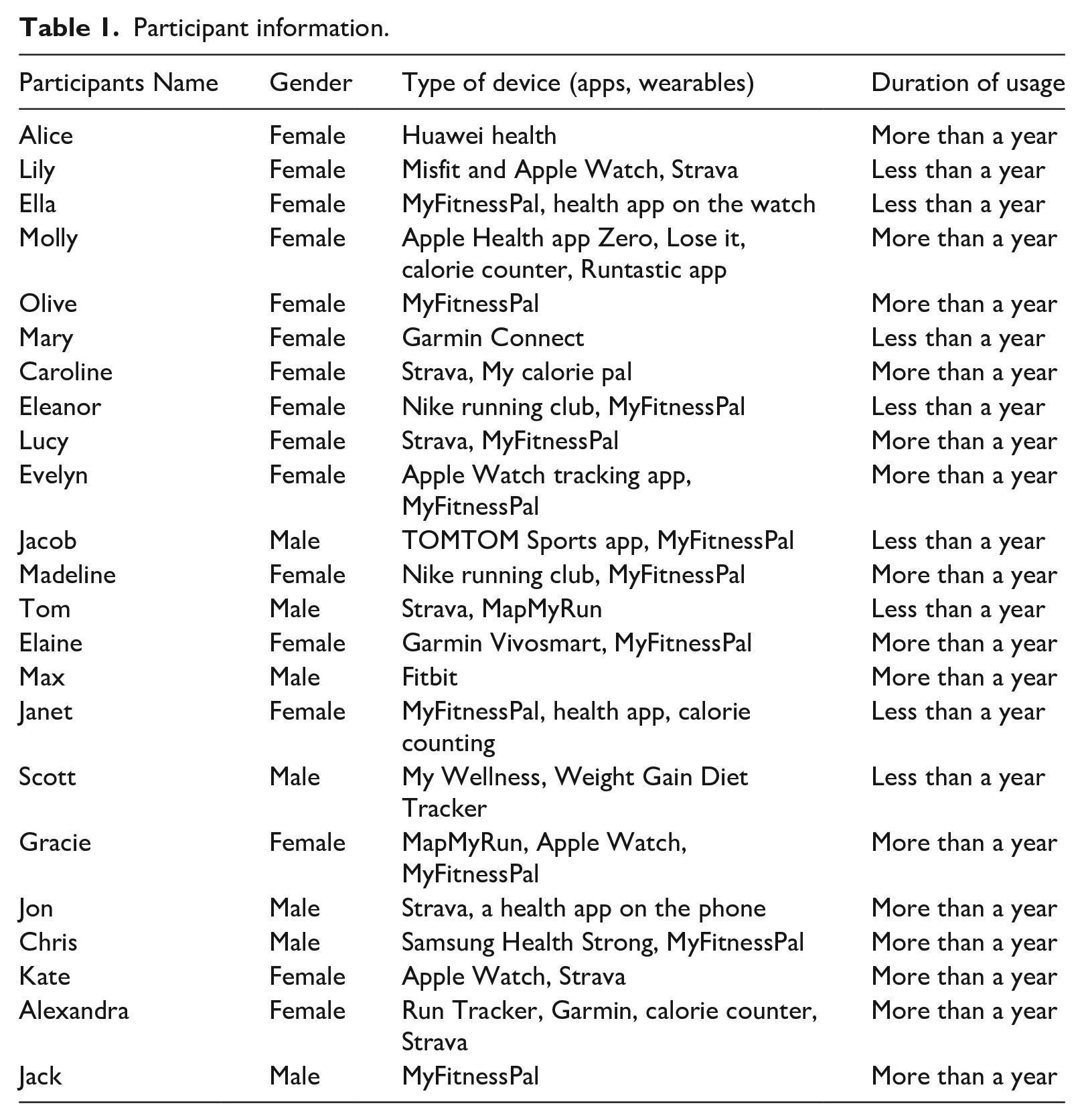
In total, 23 participants were interviewed online. We did not follow any precise criteria for sample size selection, in line with other qualitative inquiries (Braun and Clarke, 2022; Patton, 2002). Our decision to interview this number of participants was iterative, and context-dependent (Sim et al., 2018). We stopped collecting additional data when our sample demonstrated sufficient information power and when we addressed the key research question of our study (Braun and Clarke, 2021, 2022; Malterud et al., 2016). The interviews lasted 50–70 minutes (average interview 55 minutes) and were audio recorded, transcribed and anonymised. Pseudonyms were used to protect our informants’ anonymity. Our participants reported that they identify as female (16 participants) and as male (seven participants), were between 18 to 24 years old, white (20 participants), black (one participant) and Asian (two participants), and all were British and predominantly middle class (see Table 1 for our informants’ demographic information, brands of wearables and apps used and adoption time).
Participant information.
We followed a reflexive approach, which means being mindful of the intersubjective nature of the interview encounter, the balance of power between the interviewer and interviewees and the interviewer’s own preconceptions (Arsel, 2017). During the interview, the interviewer assisted participants to convey their meanings by sharing the story of what has happened, which calls for an informal, flexible approach eliciting open-ended responses and allowing the interviewer to ‘step back and observe the process as it is occurring’, and ‘see which direction it might best go in and know what question to ask next, all before it happens’ (Atkinson, 1998: 40). As such, an interview protocol was used as a flexible guide rather than a rigid one (Arsel, 2017) with some interview questions prompting participants to share their stories from different periods in their lives. For example, we started the interview by asking a few descriptive questions such as ‘how would you describe your first encounter with wearable devices?’, along with more structural questions such as ‘how did you use the device/application?’. We also asked our participants ‘how do your current self-tracking practices differ from your earlier ones?’ in order to start understanding how their use has evolved (Atkinson, 1998).
The interviews were analysed in a reflective, evolving and iterative process following Braun and Clarke’s (2022: 35) six-phases reflexive thematic analysis. In the first phase, ‘data set familiarisation’, the lead author (and interviewer) immersed herself in the data set immediately after the end of the first interview by listening to the audio files, reading the transcripts and notes, and producing notes about ideas and the data set. In the second phase, ‘coding’, the lead author worked through the data set on a systematic and evolving manner identifying interesting segments and allocating meaningful descriptions (codes). Following this process, in the third phase the lead author ‘actively generated initial (candidate) themes’ across the data set, capturing patterned meaning. According to Braun and Clarke (2022), data analysis by a single coder is normal practice but multiple coders can help develop richer and more complex insights about the data. As such, in the fourth phase, ‘developing and reviewing themes’, the entire research team assessed the ‘fit’ of the initial themes with the wider research context, which then led to ‘refining, defining and naming themes’ where the analysis was fine-tuned for the final phase of ‘writing up’.
Findings
We followed a life story approach in order to enable our informants to elaborate on how they feel (and felt) about specific life events and also, we gave them the space to explain their individual viewpoint on the ‘life being lived’ (Atkinson, 1998: 59). Our four themes capture our participants’ complex and evolving relationship with self-tracking. We show through our thematic analysis that our participants’ relationship with self-tracking was not situated solely on a specific time but was rather a part of their life story (Rosenthal, 1993). Our first theme, ‘the self-tracking learning process’, captures the learning process from early stages (teenage years) to young adulthood. Similarly, the following three themes, ‘body work and self-tracking’, ‘the body as a “private’ project” and ‘the body as a “shared project”’, encapsulate the complexity of the relationship and its effect on their body as an ongoing, iterative, cumulative and embodied process of discovery, learning and lived and ‘fleshy’ experience.
The Self-Tracking Learning Process
The first theme encapsulates the iterative processes through which our informants learn and discover self-tracking, as well as the role of affordances in developing new knowledge about self-tracking. Our findings show a multifaceted ongoing learning process (Heft, 1989), commencing before acquiring a device and encompassing a web of learning resources and practices that shape the relationship between the user, object and practice in the longer term.
This stage of learning about the material ‘object’ was quite straightforward for most of our informants as they were confident with the functional aspects of the technology; as Lily mentioned, ‘they tend to be quite simple to figure out’, which echoes Max’s experience: ‘yeah, it’s quite simple really’. Most agreed that digital learning happens outside the classroom, which supports past studies indicating that young generations take ownership of their digital learning (Szymkowiak et al., 2021). Reflecting on the learning process, we observed that our participants’ experiences were predominantly shaped by the social elements of self-tracking rather than its materiality. Participants recalled being gifted a wearable device during their teenage or late childhood years. Most participants used a positive tone to express their emotions when they were gifted a wearable device (with a few participants never having asked for one). As Jack mentioned: I got given it as a present for Christmas, but it was like . . . my parents or my whole family had. They would have competitions together and stuff on it and I was always the one without it. So I think that’s why they bought it for me really so I could join in. (Jack)
Jack was gifted a device so he would not feel ‘left out’. This reflects the communal and entertaining aspect of self-tracking among families and friendship groups (Spotswood et al., 2020). Learning about the ‘objects’ along with being part of virtual interactions with friends and family resulted in a pleasant initial relationship with self-tracking technologies (i.e. a ‘honeymoon-like’ phase) for our informants. For some, this phase was short-lived while for others it laid out the foundations for current self-tracking practices. To explain, a few participants acknowledged that learning about wearables goes beyond mastering technical features and involves education within the family environment about the meaning of self-tracking as a practice and its effects on their emotional, social, mental and physical development. Madeline recalled being gifted a self-tracking device when she was younger by her family, which later contributed to her anxiety and her body image concerns: I think they probably just thought that’s the latest thing that everyone has and it would be nice for me to have it and to like keep up with the new technology but, yeah, I don’t think they would understand like the negative impacts it could have. (Madeline)
Madeline’s narrative further highlights a gap in the learning process at home as both the gift-giver and receiver may lack the education and/or awareness around negative consequences. Recent studies with young people have warned of the importance of educating family members about the potentially negative effects of self-tracking practices (Freeman and Curtis, 2022). Our study further stresses the importance of social learning because learning can also involve imitating family members’ behaviour. Tom and Janet explain: Another part was obviously seeing my mum wear one and I kind of just obviously wanted to copy my mom and do something similar. (Tom) Yeah, and then my mum, my mum’s always had an eating disorder problems [. . .] and so, you know, when she uses this Fitbit and constantly measures it, and we’ll always be talking about food intake, and what food she can and can’t have, and then unconsciously passes on to me. (Janet)
Both quotations show that the process of learning about self-tracking is largely based on extracting behavioural cues from the familial environment (e.g. their school, families, friends). In some instances, as in Janet’s case, our participants acknowledged that they have been influenced by their families’ problematic behaviours, which affected their relationship with self-tracking.
As previously noted, participants claimed ownership of their education and digital learning, which often happens in a rather intuitive and unguided manner (Szymkowiak et al., 2021). As such, participants admitted to conducting Google searches, looking into and following social media influencers and experimenting with random numbers in order to understand self-tracking. As Jacob admits: Just a quick Google search really just type like a good running time for 17-year-old, there are lots of things there like websites that kind of like pinpoint and median time for like your age and weight and things like that. (Jacob)
Whereas Lucy attributed her motivation for using MyFitnessPal to not having a clear understanding about weight management when she was younger ‘I had a really quite childish understanding of how losing weight worked.’ Only a few of our participants consulted government webpages on healthy lifestyles and the UK National Health Service (NHS) pages such as Chris ‘I think what I did was like I looked up on the NHS how much protein you need? Things like that and then try to get my values on the app to meet those goals.’ Indeed, our analysis shows that our participants’ learning about self-tracking was based, albeit initially, on information gathered anecdotally and through unverified sources (i.e. the internet, social media) and through social learning by observing family and friends (Goodyear et al., 2019; Radovic et al., 2018). In many cases, this was quite concerning because in those early life stages, most of our informants had a limited understanding about what it entails to maintain a healthy body.
Body Work and Self-Tracking
This theme encapsulates the ‘transition’ from focusing on the object per se and its materiality to focusing on the practice of self-tracking as a form of ‘body work’ that enables our informants to achieve certain objectives once self-tracking becomes embedded in their daily life. We also show how engaging in self-tracking during their teenage years foreshadowed our informants’ current practices.
Our participants highlighted that self-tracking enabled them to engage in different forms of ‘body work’, which they considered motivational. Jon and Lily recall: The main driving factor is fitness. But that’s the main reason I do it, but then it’s also lots of satisfaction at the end of the week, and that’s a good feeling to have. (Jon) I think it pushes me because I want to do as many [steps] as I can every day and like walk more and like just, I think it just motivates me to like keep fit because it’s kind of challenges myself. (Lily)
Our participants’ quotations show that the satisfaction they extract from completing specific tasks motivated them to keep pursuing a healthier lifestyle, thus feeling more control over their bodies (Freeman and Curtis, 2022). Tom refers to what can be considered a high-level affordance (boyd, 2010; Bucher and Helmond, 2017); the ability to plan and schedule future tasks depending on his current progress. For Lily, knowing how she performs motivates her to continue to work on her body (Mol and Law, 2004) by completing more steps every day. Along the same vein, Tom engages in corrective behaviour when he does not reach the desired targets.
Sometimes when I’m feeling tired, I can check to see how much [sleep] you’ve had the last few days and I’ll notice that my average is only like six and a half hours. And I’m like okay maybe I need to lay tomorrow and get a bit more sleep just to sort of help recover. And the same with like the hydration. (Tom)
Being aware of underperforming, whether it is being dehydrated or lazy, self-tracking can prompt you to engage in body work as Caroline points out: ‘You don’t actually realise how active or how lazy you are in a day. And that just sort of kind of kicks you in the right direction if you if you are being lazy.’ Mary explains how this process unfolds via behavioural nudging features: it [the wearable] also vibrates telling me move on with, I don’t know why, but with this simple word “move”. Every time I look at, in my mind, it created like “mooooooveeee” (laughs). (Mary)
The device as a motivational agent seems to encourage Mary to be more active and engage in physical activity (Goodyear et al., 2019). Textual and visual motivation nudges were mentioned by the majority of our participants without consensus in terms of a specific course of action (Lyall and Robards, 2018).
The Body as a ‘Private’ Project
This theme offers an overview of our participants’ key milestones in their relationship with self-tracking that depicts a challenging, controlling and predominately ‘private’ nature. The language used by some of our participants such as ‘toxic relationship’, ‘controlling’, ‘addictive’, ‘obsessive’, ‘sad’, ‘unhealthy’, ‘badly affecting mental health’, ‘eating disorder’, ‘dysmorphia’, ‘it is personal’ when describing their experiences with self-tracking (especially when they were younger), denotes their individual struggles. These examples show the problematic facets of self-tracking (Freeman and Curtis, 2022; Freeman and Neff, 2023).
Our participants seem to differentiate between what data should be shared and what data should be kept private (with some going to great lengths to keep their self-tracking practices a secret). Janet explains why she does not share weight management data: [It’s] more personal, I don’t really need people knowing my weight, and how much I eat and stuff, especially because at the beginning, I put myself on quite severe calorific deficit, and I didn’t want people to become worried and stuff. (Janet)
Janet’s quote highlights the subjective nature of self-tracking (Lyall and Robards, 2018). Her body work (i.e. dieting) is stigmatised and remains ‘private’. Most participants seem to agree that the ‘body’ becomes a ‘private project’ when self-tracking involves body work around weight management and eating decisions. This was particularly evident for our female participants who faced additional pressures to conform to idealised feminine beauty standards (Lloyd, 1996) and further acknowledged the stigmatised effect of weight tracking (Depper and Howe, 2017). This is also witnessed in Lucy’s narrative highlighting the ‘secretive’ nature of this type of body work: [I]t just triggered a conversation between me and a few friends that we’ve all been through phases of using MyFitnessPal quite obsessively to track our calories [. . .] So the fact that we were all using these apps to track our food would kind of, it’s almost like the swan analogy, like it all looks very calm on the surface. But underneath everyone was thrashing about . . . just really hungry . . . and that’s bad [. . .] but yeah, it was unnerving to find out that everybody was secretive about the same app. (Lucy)
Lucy’s quotation reveals how hard it is for her and her peers to communicate with each other about how they are using self-tracking and the impact it has on their physical and mental health. Apart from their peers, our informants noted how they managed to hide the effects of self-tracking from their families. A few participants reflected on how they managed to keep their eating routines and struggles with weight management applications secret from their mothers. As Lucy and Madeline recall: Mum trusted me as I was eating meals at home. So like dinner and stuff mum didn’t have any reason to kind of suspect that I wasn’t eating at school. Didn’t want my mum to find out. (Lucy) I would say that I had quite a toxic relationship. Um probably, which started when I was about 12 with applications like MyFitnessPal [. . .] And then I’ll go through phases of realising like how badly it was affecting my mental health and so I’d maybe stop using it for a few weeks. But then I would feel stressed that I was putting on loads of weight, then I’ll go back to it again. (Madeline)
In Madeline’s narrative it is evident that she developed a somewhat toxic relationship (in her own words) with the weight management app she was using, which has affected her current use of self-tracking. A similar past experience was mentioned by Elaine and Olive as both participants recalled being obsessive and pushing their bodies: Basically, you have to lose weight, you have to be in a calorie deficit [. . .] So, I was just trying to make sure every day that I was doing that, and it worked, I lost quite a lot of weight quite quickly. (Elaine) I think it was probably unhealthy for me, like going down to the weight that I was at. And then I was always tired and couldn’t really do anything and had no energy. (Olive)
These narratives illustrate how self-tracking enabled these women to perform different types of body work in order to control and conform their bodies to achieve specific goals that were more about aesthetics and less about well-being (Gurrieri et al., 2013). Our participants also mentioned the pressure from social media and the idealised images presented online: ‘I would say Instagram or YouTube. Um, it was at the time it was more about like your weight and being skinny rather than actually being healthy and fit and strong’ (Madeline). This view was shared by many participants who reported having followed a lot of social media pages for weight loss and exercise at a young age.
Comparisons with influencers and social media celebrities have been known to affect young people’s body image dissatisfaction (Ho et al., 2016), and indeed only a few of our participants were able to distinguish between weight management practices shared on social media and reality as what influencers and peers choose to share online does not capture the entire process of what it entails to maintain a healthy body, which may be distorted leading to unhealthy social comparisons (Kleemans et al., 2018). As Madeline points out: We were scared of getting fat. We didn’t want to eat the wrong foods and it just seemed like at that time that’s what everyone was so obsessed with and that’s what the most important thing was. I think a lot of it came from social media. (Madeline)
Madeline reveals how ingrained notions of what an acceptable body should look like are in social media posts (Ho et al., 2016; Zanette and Brito, 2019; Zanette and Scaraboto, 2019). During their teenage years, our participants like Madeline, internalised these pressures and reported becoming ‘scared of getting fat’ and as such adhered to specific health norms (Gurrieri et al., 2013) by punishing their body. Self-tracking then fed those obsessions by affording them to experiment with data inputs and outputs that allowed them to lose weight and thus transform their unruly young bodies in line with idealised beauty standards (Grosz, 1994) and narrow interpretations of health (Goodyear et al., 2019).
The Body as a ‘Shared’ Project
This theme captures the social aspects of sharing self-tracking practices with participants adopting a more relaxed approach to self-regulation and self-surveillance and being keener to share their data and experiences with their communities. For these participants sharing their body work is part of their motivation and offers a sense of achievement. We observed that the most commonly used phrases and words were ‘I am competitive’, ‘motivates me’, ‘helps me’ indicating that self-tracking plays a mixture of roles in our participants’ lives (Lyall and Robards, 2018). A number of participants were keen on sharing their data in online platforms or with their social groups such as Tom: The only way I can connect with people is via Strava. So I’ll be able to see when other people went on a run or how far they cycled. So that’d be the sort of the . . . if we had to compare. And I think just saw my inner competitiveness, kind of seeing someone sort of cycle this far, I want to cycle further, or I want to run quicker. They’ll never know I am thinking that (laughs). (Tom)
For Tom, sharing his data on Strava afforded him to compare his performance with his peers, and that motivated him to push himself further. Tom was quite keen on improving his performance and used his peers’ data outputs as a benchmark for his performance. Sharing results and comparing performances with social groups can be a motivation for adopting self-tracking but also a validation of the personal effort (Hardey, 2022). Similarly, Jacob discussed the importance of competition in online communities: ‘I just wanted to see how I was doing compared to other people by age. I’m quite competitive.’
Our analysis shows that our participants were rewarded, which was an additional motivation for striving for better performances as Alexandra and Lily remember: So, if those times were faster than the time that we ran before, then they would come up, just compliment us and encourage us to run better next time. (Alexandra) And to like try and run faster and better and like [. . .] you know, you want you just want to impress people don’t you? Like you want to be the fastest. (Lily)
Strava afforded Alexandra and Lily to compare their running times with their peers and afforded community engagement and validation of their body work. We echo past studies (Freeman and Neff, 2023) highlighting the playful and communal side of such technologies attracting interest as they can be used both for self-evaluation and as a communicative ritual (Lomborg and Frandsen, 2016; Lupton, 2016).
In addition, Kate recalls being at secondary school and competing with her father: ‘It was just like a little competition between like, whether my dad did more steps than I did at school and stuff like that!’ The communicative value of self-tracking is evident in Kate’s quote, which opens up conversations about health and fitness among family members (Hardey, 2022). Sharing the body work was perceived as purposeful and entertaining. A sense of ‘ontological security’ (Giddens, 1992) and a sense of accomplishment is encapsulated in these shared routines. In Kate’s quote it can be seen that self-tracking technologies legitimise her body work affording her to communicate how she is achieving her targets.
Discussion
Our aim was to understand young people’s lived experiences with self-tracking and how they interpret and understand their interactions and data. Our life story approach (Asplund and Pérez Prieto, 2019; Miller, 2000) allowed for insightful narratives and reflections on the complex, contextual and evolving relationship between users and objects. We captured our participants’ reflections on the key aspects of their relationship with self-tracking dating back to its initial stages to their current practices and, as such, allowed for a more holistic view of the relationship between individuals, objects and the practice.
With the relational backbone of affordance theory (Gibson, 1979) we unpacked how our participants are introduced to, learn about and develop a relationship with self-tracking. We focused on the individual and the object and evidenced how self-tracking is a personal, social, contextual, complex and evolving practice. We found that self-tracking afforded our participants to engage in different forms of ‘body work’ (Giddens, 1992) that can be both positive (e.g. motivational) and negative (e.g. push the body beyond healthy limits) for self-trackers. As a result, self-tracking results in two forms of bodily outcomes; the body becomes a ‘private’ or ‘shared’ project, but nevertheless, the body is in constant flux (Mol and Law, 2004). When the body is treated as a ‘private’ project, body work involves crafting, modifying, disciplining and even punishing the body for not adhering to idealised norms of health and beauty (Zanette and Brito, 2019; Zanette and Scaraboto, 2019). When the body is treated as a ‘shared’ project, body work is shared and transforms into a more playful and communal process that allows self-trackers to receive external validation, feedback and motivation (Hardey, 2022).
We contribute to sociological research on self-tracking in three ways. First, we extend prior research focusing on the modes and types of self-tracking (Berman and Hirschman, 2018; Espeland and Stevens, 2008; Lupton, 2014a, 2016, 2021) by identifying which elements of ‘body work’ (Holmes, 2019) are deemed appropriate for sharing and which are kept private. Prior research shows the importance of family/friends in the uptake of self-tracking (Bergroth, 2019; Hardey, 2022; Lyall and Robards, 2018; Rooksby et al., 2014; Spotswood et al., 2020) and while we echo these findings, we further reveal the instances in which our participants conceal both their ‘body work’ and data outputs from the people close to them. Our study also expands knowledge about the challenges and tensions associated with self-tracking (Bergroth, 2019), an inherently mentally and bodily laboured activity (Lupton, 2020). We do so by illustrating that although self-tracking is offering the tools to care for and transform the young body that is in constant flux (Mol and Law, 2004), our participants also found themselves negotiating and contemplating their data inputs/outputs. Our study shows that this process can often render individuals in a position of being under control of self-tracking instead of being in control of a process that affords them to actualise their wellness journey and bodily outcomes (Ruckenstein, 2014).
Finally, we contribute to self-tracking literature that highlights the relational character of the practice (e.g. Espeland and Stevens, 2008; Hardey, 2022; Ho et al., 2016; Kristensen et al., 2021). Importantly, our findings show that learning about self-tracking is social, it transpires by observing family and friends, as well as experimenting with these technologies. Yet, the learning process initially seems to focus more on the object (wearables/apps) and its materiality, denoting the impact of low-level affordances (Bucher and Helmond, 2017) rather than on conscious acknowledgement of its scalability (boyd, 2010) and bodily outcomes. This dichotomy is regulated predominately during young adulthood rather than early childhood and teenage years when self-tracking begins. We found that very often our participants are gifted wearables as they enable them to socialise (Spotswood et al., 2020) but with limited to no education. In other words, overemphasising the merits of self-tracking while neglecting its challenges is quite worrying as it has a key impact on young people’s lived experiences and bodily outcomes, that is, their sense making of the data they produce and what it means for them. In particular, we highlight the importance of educating young people (Freeman and Curtis, 2022), their families and relevant institutions on the use and gifting of wearables. The wide range of relationships with self-tracking technologies and how these evolve through a person’s lifecycle further points to the ‘relational and dynamic character of technology’ (Neves and Mead, 2021: 902) allowing users to negotiate and re-negotiate their relationship with technology throughout their lives. Yet, our participants reflected on their fragility in these negotiations during their teenage years further highlighting what past studies (Freeman and Neff, 2023) have drawn attention to, which is the inappropriate approach to the design and implementation of such technologies under a ‘one size fits all’ approach. Finally, our insights are derived from a rather homogenous and predominantly white sample. We encourage future research to explore further the impact of particular body narratives, and modes of surveillance and control on how diverse bodies are perceived and engaged with as both a ‘private’ and ‘shared’ project.
To conclude, we believe that understanding the context of self-tracking requires acknowledging the complex negotiations that young people make, and how these are affected by multiple personal, contextual, technical and social factors. Gaining a holistic, sociological understanding remains vital in creating appropriate support mechanisms for young people and we believe that our study reflects a worthwhile contribution towards this direction.
Footnotes
Funding
The authors disclosed receipt of the following financial support for the research, authorship and/or publication of this article: BA/Leverhulme Small Research Grants (SRG1920\101599).
