




Abstract
Intoxicated sexual assault is the most common type of sexual assault but is rarely unpacked as a social phenomenon. Our analysis represents a novel approach to opening the broad category of intoxicated sexual assaults for further theorisation and identifies some of the social mechanisms that underlie victims’ sensemaking in the aftermath of such assaults. Drawing on qualitative interviews with female victims, we present a typology of four experientially different assault situations: ‘manipulative assault’, ‘opportunistic exploitation’, ‘sexually violent effervescence’ and ‘scripted compliance’ – each with a different lead-up and interactional pattern. Across these often messy and disorienting situations, socio-sexual status dynamics affected the victims’ understanding of what had happened: violations by low-status assailants were more clear-cut and easier to define as serious, while narrations involving high-status assailants were more ambiguous.
Keywords
Introduction
The present study investigates the most common form of non-consensual sexual interactions: sexual assaults that happen when young people attend parties and other forms of nightlife to drink and socialise, and perhaps hook up with someone. Young women are more exposed than young men to such assaults (Stefansen et al., 2021), and their experiences are the focus of our analysis.
While quantitative studies have been important in documenting the scope of intoxicated sexual assaults in different populations, as well as individual risk factors and consequences (Lorenz and Ullman, 2016; O’Callaghan and Ullman, 2022; Pape, 2014), the unfolding of such assaults has not received much attention in this research. What the victims have experienced, beyond non-consensual sex involving an excessive intake of alcohol or other intoxicating substances, is therefore often unclear (Pape, 2014). Our study suggests a way forward in opening the general phenomenon of intoxicated sexual assault for further theorisation. Drawing on qualitative data, we examine how victims of such assaults work to establish a sense of surety of what happened to them in the messy and disorienting situation they found themselves in: what Pemberton et al. (2019: 404) refer to as taking ‘narrative ownership’ to the victimisation experience.
We build on the emerging sociological scholarship on the diversity of sexual assault situations (Hirsch and Khan, 2020; Stefansen et al., 2021; Tutenges et al., 2020), which has been helpful in shifting the perspective from individual pathology to the social dynamics of sexual violence. While these studies have described different types of intoxicated sexual assaults, they have not systematically analysed what exactly sets different assault situations apart from each other. Collins’s (2009) micro-sociological approach to violence provides helpful guidance for this type of analysis. To understand the interactional dynamics of violence, he argues, the focus should be on ‘the contours of situations, which shape the emotions and acts of individuals who step inside them’ (2009: 1). Following this line of thinking and using a broad sample of victim narratives on intoxicated sexual assaults, our analysis focuses on how victims portray (1) the lead-up to their assault and (2) the socio-sexual status dynamics of the situation. The latter is important, since the assailant in intoxicated sexual assaults most often is an acquaintance, someone who is part of the victim’s social circle (Lorenz and Ullman, 2016). By highlighting this aspect of intoxicated sexual assaults, our study contributes to ongoing explorations of the intersections of sex and power disparities that have expanded in the aftermath of the #MeToo movement (see Gill and Orgad, 2018). More generally, we see this research as a contribution to the sociological study of sexual violence, which remains sparse (Armstrong et al., 2018).
Alcohol and Sexual Risk
Previous research has primarily linked the association between alcohol and assault risk to individual, cognitive mechanisms (Lorenz and Ullman, 2016). One such mechanism is related to ‘alcohol myopia’, a pharmacological effect that makes constraining cues, such as the fear of sexual assault, less striking, and compelling cues, typically related to the level of interest in sexual activity or relationships, more dominant (Lorenz and Ullman, 2016). ‘Alcohol expectancies’ may also play a role in creating sexual risk. The term refers to pre-existing cultural beliefs that certain cognitive, social, behavioural or emotional outcomes will occur from drinking and drive individuals’ behaviour (De Visser and Smith, 2006). Alcohol expectancies may include mood alterations, loss of control (Smit et al., 2018) and ‘the idea that drinking will have a positive effect on potential sexual encounters’ (Hunt et al., 2023: 85). While such research has shed important light on sexual risk in intoxicated settings, it has paid little or no attention to the socio-relational dynamics involved in the production of risk (Bogren et al., 2023).
Our study is further informed by a strand of literature that highlights how the social processes of intoxication contribute to producing sexual risk. Parties are valued social arenas and one of the few settings today where young people can socialise unsupervised by adults. Social drinking is also complexly intertwined with peer status hierarchies. Drinking alcohol can contribute to social capital (Demant and Järvinen, 2011) and signify group belonging (Buvik et al., 2022). Subsequently, many young people are eager to participate, despite being well aware of the sexual risks involved – particularly for girls (Tokle et al., 2023). Parties are also attractive, according to Measham (2002: 345), because they offer the possibility for a ‘controlled loss of control’, for instance to engage in casual hook-ups (Bogren et al., 2023). Such normative allowances can be especially important for women, given the sexual double standards that prevail also in sexually liberal cultures (Fjaer et al., 2015). As Tutenges et al. (2020) have noted, social drinking situations are laden with a sexual atmosphere that triggers behaviours that can flip a sexual interaction from something desirable to the ‘grey area’ (Gavey, 2005) between consensual sex and sexual assault. Hence, when unpacking intoxicated sexual assault as a social phenomenon, it is crucial to attend to ‘the pivotal moments when encounters change from being sex to being assault’ (Hirsch and Khan, 2020: xxxiii). The present analysis is attentive to how victims understand such situational shifts in settings that may be chaotic and non-ideal due to alcohol intoxication and power differences between the involved persons.
Sexual Ethics, Sexual Projects and Power Disparities
We rely on Kukla’s (2021: 271) understanding of consensual sex as: agential self-determining activity in which everyone involved understands that everyone else is acting in this agential, self-determining way, and in which everyone involved can and would stop the activity as soon as it ceased to be agential and self-determining in this way.
This definition accords with the view of sexual assaults as representing situations ‘where one person is inattentive to the other person’s right to sexual self-determination’ (Hirsch and Khan, 2020: 19). We are inspired particularly by Cahill’s (2016) approach to sexual wrongdoing, as it allows for theorising situations with varying degrees of sexual inattentiveness to the other. Building on Gavey’s (2005) notion of ‘just sex’ (i.e. sex that is within the realm of the legitimate), Cahill sees both partial and total sexual inattentiveness as instances of ‘unjust sex’. Rape in her thinking is a special case of unjust sex, since it is characterised by the total disregard of the other’s will.
Our analysis is sensitive to how inattentiveness or a lack of ‘care for the other’ (Bindesbøl et al., 2020: 14) may happen at various points in an interaction and with varying degrees of intensity. Research to date has shed some light on this issue, and we build from two recent studies that highlight the various ways intoxicated contexts represent ‘autonomy-compromising conditions’ (Kukla, 2021: 271). Tutenges et al. (2020) have shown how intoxicated assaults may unfold through a dynamic of ‘sexually violent effervescence’. The concept refers to chaotic sexual interactions that are spurred on by the sexualised atmosphere of social drinking situations and evolve into an assault as one person overpowers the other. Stefansen et al. (2021) have similarly described ambiguous sexual interactions that bordered on assault, where both parties initially were caught up in the effervescence of the situation. They also described two other interactional dynamics: one type was characterised by one person from the outset or more clearly taking the lead in moving things along towards what becomes an assault, the other was characterised by one person totally disregarding the other person’s will, for instance by deliberately causing intoxication or by forcing themselves on the victim.
None of these studies have focused on how ideas of the suitability of sexual partners play into intoxicated sexual assault experiences. Young people generally want to have sex with those who can confirm or lift their status in the peer group: those who are socially desirable (Hirsch and Khan, 2020). In this sense, ‘sexual projects’ – what sex is for – are often also status projects (Hirsch and Khan, 2020: 181). This applies especially to women, who, more so than men, risk stigma if they choose to have drunken sex, and particularly if the person they have sex with is seen as someone less interesting as a potential sexual partner (Hunt et al., 2022). Status dynamics must therefore be included in analyses of intoxicated sexual assault experiences – as they can affect both the lead-up to an assault and how the violation is interpreted in the aftermath. We use the concept socio-sexual status to illuminate these mechanisms. By this we mean the assessments victims make of the social desirability of the assailant and themselves in situ and after the assault – based on a combination of perceived physical attractiveness and social standing in the local peer hierarchy. Much as Hirsch and Khan (2020: 107) have done, in the present study we understand social desirability broadly; as pertaining to the popularity both of a person and of his or her social circle and as something that can intertwine with other sources of privilege such as gender, age, class, race and sexuality. Our analysis extends that of Hirsch and Khan (2020) on this point by systematically attending to how assault situations and socio-sexual status dynamics are linked.
The Study
The present study was set in Norway, which is characterised by liberal sexual norms, and where partying and binge-drinking is deeply rooted in youth culture (Pedersen and Von Soest, 2013). As part of the study, 40 women aged 22–44 were interviewed about their experiences of sexual violence during youth and early adulthood. The women came from a variety of socio-economic segments, all had majority Norwegian background and described assaults involving men or boys.
Prior to data collection, the project plan was evaluated and recommended by the Norwegian Centre for Research Data. Most of the participants were self-recruited via Facebook announcements, while a few were recruited via already interviewed women and a counselling service for rape victims. The interview topic was described to possible participants as experiences with unwanted sex or sexual violations across different contexts and social relationships.
Three female researchers conducted the interviews, 1 either face-to-face or via phone. Most interviews lasted about one-and-a-half hours. The face-to-face interviews were conducted either at the university premises or in the participants’ homes. We used a biographical approach to the interviews. We first covered the participants’ childhood, youth and family background and then approached the core topic of the interview, locating their assault experiences in time and place. The last part of the interviews covered their current life situations and thoughts about the future.
Our way of interviewing was inspired by the ‘teller-focused interview’ method, which was developed for studies of experiences that are ‘complex, sensitive, and difficult to bring up’ (Hydén, 2014: 810) such as sexual violence. The method involves active listening and a conscious effort from the interviewer to follow the participant’s initiative during the interview, rather than delivering a defined set of questions. When necessary, we supported the participants with questions that would facilitate their storytelling, for instance about the setting of the incident, the people present and the assailant’s behaviour. These efforts yielded detailed narratives that not only described what had happened but also fleshed out what the women had felt, both as the situations were unfolding and later on.
All interviews were conducted in Norwegian and transcribed verbatim. Direct quotations were translated from Norwegian to English by the authors and have been lightly edited for clarity.
Analytic Strategy
The analysis is based on 24 interviews, comprising a total of 34 narratives of intoxicated sexual assault. We built on and extended a prior, descriptive analysis of such assaults using the same data (Stefansen and Solstad, 2021). The analysis for the present article was conducted in two steps. In the first step, we read and reread the interviews and wrote memos for each incident detailing how the narrative was shaped in terms of two questions that seemed paramount for the victims to answer in order to acquire a sense of surety of what had happened: (1) the victims’ degree of interest in their assailants and the social situations of the assaults; and (2) their degree of participation both in the sexual situations and in their lead-up. These questions formed the underlying dimensions in the typology we then constructed to conceptualise intoxicated assault situations.
During the second step of the analysis, we read through all the narratives again, this time focusing on socio-sexual status dynamics. Mentions of status difference appeared in 25 of the 34 narratives, suggesting that status valuation plays a key part in victims’ sensemaking efforts in the aftermath of an assault. We then looked at how socio-sexual status valuations played out in and across the different scenarios.
Four Types of Intoxicated Sexual Assault
As illustrated in Figure 1, our analysis points towards four main types of intoxicated assault situations: ‘manipulative assault’, ‘opportunistic exploitation, ‘sexually violent effervescence’ and ‘scripted compliance’.
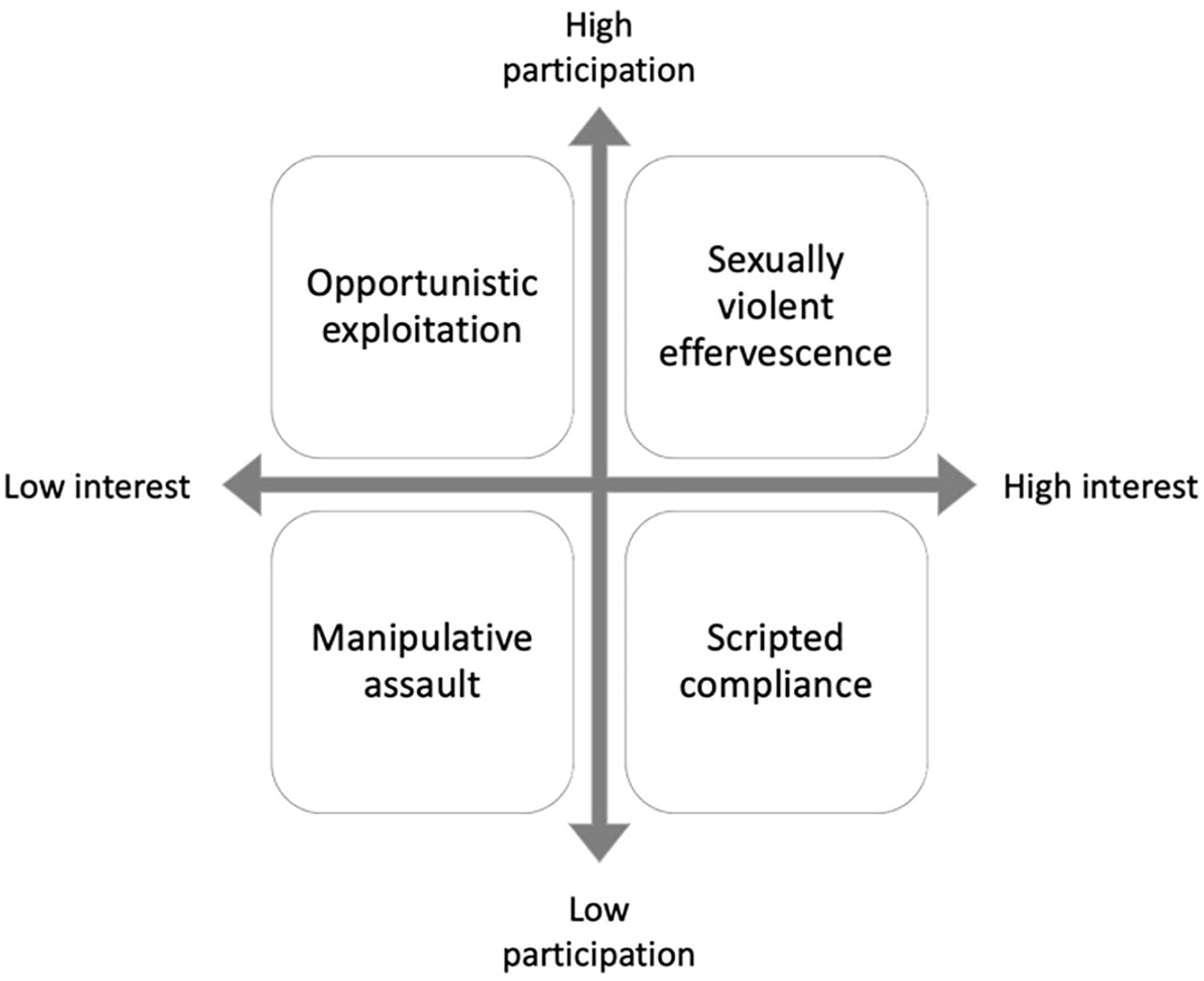
Types of intoxicated sexual assault.
In the analysis that follows, the four types are presented as ideal types in the Weberian sense: as tools for thinking about the defining features of different sexual assault situations and how they intertwine with socio-sexual status dynamics. In the presentation of the different types, and following Eldh et al.’s (2020) recommendation, we use direct quotations from the interviews to illustrate key analytical points. We draw quotations from across the narratives that illuminate each assault situation. The elements included from the more ‘unstable’ or less coherent narratives convey the fluidity that may characterise victims’ sensemaking efforts in the aftermath of an assault.
Manipulative Assault: Producing Vulnerability
The manipulative assault stories were distinct in that there was little room for doubt as to what had occurred: a sexual assault, a rape, where the assailant had contributed to the victim’s vulnerability by deliberately overpouring or drugging her. The narratives, which shared a sense of passivity in the sexual interaction and a lack of interest in the assailant, mirrored the stereotypical ‘sociopath model’ of sexual assaults (Hirsch and Khan, 2020).
The victims’ unresponsiveness in the assault situation is clearly illustrated in Marie’s narrative. She explained how, throughout the evening in question, her assailant, whom she had met via friends, had bought her numerous drinks at the hotel bar, rendering her so drunk that she could hardly walk and was ‘hanging in his arms like some cadaver’. The assailant then carried her into an elevator and took her to his room. Marie had only faint memories from being there, and of him having intercourse with her: I remember that he pulled up my dress and pulled down my panties and then I think I blacked out a bit after that. And then I was pinned down, my hands were pinned down. And then I think I zoned out because I understood that I did not have much to say, I was not able to resist.
Lisa described an incident at a house party that happened in her early youth. Finding her drunk to the point of incapacitation, one boy had raped her, while his friend filmed the assault with his phone. She described how she was sure that the boys at the party, who were a few years older than her, had spiked her beer: ‘I was drugged, because I wasn’t “there” at all.’ Siri described a similar experience, where she had been targeted on a night out with friends: ‘I was drugged at a nightclub . . . followed back home and raped in my own apartment.’ Other women described being targeted and then raped after voluntarily drinking to incapacitation.
The other distinct feature of the manipulative assault narratives, the lack of interest in the assailant, was especially clear in Marie’s story. She did not know the assailant, but her friend did. She described herself as already drunk when he started buying her drinks. In her story he was keen on her, and quite insistent. She painted him as a desperate and rather ridiculous character. She had absolutely no interest in him and made a point to mention having a boyfriend at home who, in contrast to the assailant, was ‘very handsome and very cool’. Mia described an incident with a similar lack of interest. She was raped at an after-party by a colleague who was 15 years older than her, whom she really disliked and previously had rejected on several occasions. In her own words, she had ‘always been, not just a little dismissive towards him, but extremely dismissive’.
In the manipulative assault narratives, the sex was portrayed as exclusively the assailant’s ‘project’, as illustrated by the previous quote. Any mentions of status dynamics that came up in these narratives to make sense of the assault were connected to the ‘interest’ dimension. The ‘participation’ dimension did not need any additional qualification, as the women had been raped when passed out and unresponsive. Most of the assailants were cast as low status in these narratives. He was someone the victim had no interest in, someone below her. His low status worked to confirm that the sex was involuntary. The fact that the assailant had needed to manipulate someone in order to have sex testified to his low status. Marie, with the handsome new boyfriend at home, was particularly explicit about the status dynamics of the situation. She was 17 at the time and placed herself at the top of the socio-sexual hierarchy at her school. It simply ‘made no sense’ that she could have desired someone like the assailant and voluntarily have had sex with him: ‘I was cute and petite and slim and pretty, and he was a 23-year-old fatty. There’s no logic to me wanting that.’ In other narratives of manipulative assault, labels such as ‘strange’, ‘old’ and ‘disgusting’ did the same rhetorical job of ruling out any sexual interest in the assailant, and thus in establishing the incident as an assault. One particularly clear example was Mia, who described her much older colleague as ‘incredibly creepy’ and ‘a rat’ to underline that sex with him could not have been anything other than rape.
Opportunistic Exploitation: Already Incapacitated
As described by Hirsch and Khan (2020), sexual assaults are seldom planned. More often, the assailants take advantage of someone who is asleep or otherwise incapacitated due to voluntary intoxication. In what we call ‘opportunistic exploitation’, the victim is passive throughout the assault, although a form of interest in the assailant may have existed prior to the incident, or a social pull in the situation: a desire to be included among peers and the in-crowd.
Eline, for instance, got ‘massively drunk’ at a house party at age 16 and was sleeping heavily when the assailant, a slightly older boy, found her in the bedroom she had retreated to upon getting too drunk. She woke up to him having sex with her. She recalled him saying, ‘Open your eyes, open your eyes’, as if to turn the situation into something more reciprocal, but she could not do it. Eline’s lack of participation was undeniable to her: she was ‘not in on it’. Eva described a similar lack of participation. She had blacked out at a birthday party at a private house. She remembered that she had been throwing up and recalled glimpses of the assailant, a man she had known from before and who was 10 years older, getting into bed with her and having sex with her, violently and painfully. Anne as well described herself as ‘almost unconscious’ during the assault, which happened on a hiking trip where she drank alcohol for the first time.
A recurring element in the opportunistic exploitation narratives was the victim’s attraction to the social group the assailant was part of, and the chance to be included and partake in their coolness. Eline, for instance, who was raped at the house party, talked about the assailant as someone she had liked as a person, if not romantically. He was ‘the nice one’ among his group of friends and was highly regarded in the local community. He was also the one who had invited her to the party, to which Eline had brought one of her girlfriends. Prior to the incident, the two girls were relishing in partying with the slightly older, popular boys.
Some narratives also included mentions of a sexual spark between the victim and the assailant prior to the assault, as was the case for Elisabeth who was raped in her 20s by her ‘old love’, whom she had not seen for years. They had met accidentally at a bar, where they flirted and talked about ‘what could have been’ between them. When he raped her at her friend’s flat later that night, she was in a state of sleep where sex was completely out of the question, heavily drunk and passed out on the living room sofa.
In the opportunistic exploitation narratives, as with manipulative assaults, the assailant’s low status and unattractiveness worked as a confirmation of the involuntariness of what had happened. Eva, for instance, alluded to aspects of her assailant’s past behaviour to confirm her impression of him as someone capable of committing sexual assault; she said she had ‘always had such creepy vibes from him’, so she was ‘actually not surprised that he would do such a thing’. For both Eva and other women, their assailants’ low socio-sexual status was part of the violation itself, as illustrated by Tanja: ‘Some of the boys came from bad families or they were looked down at, sort of. [Perhaps] that had something to do with me being embarrassed or extra embarrassed about what had happened?’ Inga described her massive relief at learning from a friend that she had not played an active part in the lead-up to the assault: My friend told me what had happened, that I had gone to bed and that she had sent the assailant to wake me up so that I could go out with her on the town. [. . .] And then I was so happy, I was so happy when I understood that at least I hadn’t invited him into the bedroom.
As she did not like the assailant, the idea of having had voluntary sex with him was disgusting.
An assailant in opportunistic exploitation narratives could also have high socio-sexual status. He was then referred to as someone likeable, attractive and popular in the youth milieu. These elements, which were particularly prominent in Eline’s story, worked to smooth over the gravity of the assault. Her friends viewed the episode as ‘not a big deal’ and insinuated that she was ‘probably a bit keen on him’, signalling that sexual contact with the assailant was not something to be distressed about. The example aptly illustrates what Hirsch and Khan (2020: 231) refer to as ‘the power of the group’ within interpretative processes involving sexual assault. Eline explained that everybody knew the assailant as a kind and considerate guy, which made it difficult for her to ‘make him into a monster’ – echoing culturally dominant ideas of men who rape as deviant and ‘other’ (Holmström et al., 2020). She narrated the assault as almost like an accident, where it ‘just happened’, without her assailant realising the violation. Besides, he later apologised: another confirmation that he was a nice guy. The ambivalence Eline expressed as to what she had experienced is tied to the fact that this person whom everyone liked could commit rape. A similar ‘embodied contradiction’ (Bindesbøl Holm Johansen et al., 2020) was present in other opportunistic assault narratives, where both the victim’s own and her friends’ trivialising reactions made labelling the incident an ‘assault’ difficult.
Sexually Violent Effervescence: Escalating Intensity and Loss of Control
The concept of sexually violent effervescence denotes situations characterised by the presence of both interest and participation. These elements appeared intertwined in the victims’ narratives, where the victim described being carried away to a certain degree by the initial mutual attraction or thrill of the situation; it was ‘just sex’ progressing to ‘unjust sex’ (Cahill, 2016) as the assailant became increasingly self-absorbed, and in overlooking how the victim’s interest was dissipating (Hirsch and Khan, 2020: 156) ended up comprising her autonomy (Kukla, 2021).
Silje’s narrative is a good illustration. She was 17 and heartbroken from a recent break-up with her ‘first love’. After attending a house party with her friends and the cooler boys in their social circle, she ended up being aggressively groped under her clothes by two boys as the three of them lay in a bed together, kissing and fondling. At the party, Silje had deliberately flirted with several boys in front of her ex-boyfriend to make him jealous. This type of explicit sexual project was also part of Sarah’s narrative. She was at a hotel the night of the rape, celebrating the end of the concert season with her choir. Aged 18, her intention was to use this occasion to finally lose her virginity to avoid the shame of not having had sex. She talked about the assailant as a likely candidate for fulfilling her sexual project, since they had made out at parties before and she perhaps found him ‘a bit handsome’.
Both Silje and Sarah described situations in which they were agentic and participated willingly at first. Silje, who was sad about her break-up, communicated a satisfying feeling of being in control, until she lost it: It was when they started groping a bit too excessively that it became a bit ‘too much of a good thing’. I’m not quite sure when it shifted, but it went from, ‘Ha ha ha, now we’re going to have [fun]; ha ha, now I’m on top of the world and my ex can only wonder where I disappeared to!’ to ‘Shit, now I’m no longer a hundred percent in control.’
The situation flipped from playful to dangerous as the boys carried on with their project without much care for Silje’s response. With Bindesbøl et al. (2020) we can understand Silje’s feeling of being violated as a consequence of the boys ‘pushing’ further without simultaneously ‘sensing’ her change of mind and the increasing lack of mutuality in the interaction.
Holmström et al.’s (2020) study highlights how communicating a change of will is perceived as difficult when sex is assumed or ongoing, which was illuminated in Silje’s narrative. She described that she suddenly lost control and remembered pushing the boys away at some point, physically signalling her unwillingness to go further. She offered that she did not verbally say no, as she worried about what the boys might think of her later, given that she ‘had been flirtatious all night’. She alluded to her desire to be included in their social circle as part of what had made it difficult to act on her feelings of discomfort when things went too far.
Unlike the other effervescence narratives, Sarah’s assault experience from the celebratory weekend with her choir involved violence. At the time of the assault, she described that she had been ‘into violence, physical violence’. She liked Quentin Tarantino movies and sometimes hit or pushed people for fun at parties. Prior to the assault, she had initiated a form of playfully violent interaction with the assailant in the hallway of the hotel by hitting him. He responded by hitting back – hard – and then called her ‘a bitch’ when she resisted his sexual advances and started to undress her in public: And then he started to like undress me in the hallway, which I found really disgusting and horrible that he did, but he did a lot, and there was a lot going on in the hallway and then I just said ‘Okay, let us just go to my room then.’
At this point she had lost all interest in going further but felt she had treated him badly, and eventually they had sex in her room – where her friend was already sleeping. Sarah was passive during sex, merely letting it happen. Her passivity did not affect the assailant, however, who continued with the sex regardless. The whole thing was ‘embarrassing and humiliating’.
All the effervescence narratives included situations or assailants the victim was initially drawn to. The assailants were cast as socially or sexually desirable, not below the victims, or someone the victim could use for their own sexual project. Capturing the affective side of effervescence, Ida emphasised the escalating ‘group mentality’ that had suddenly set in among the boys who assaulted her. From being thrillingly swept up and included in the crowd, she experienced a sudden shift where ‘all of them, at the same time . . . came on to me, and it became more and more aggressive’. Her emphasis was on the rapidly intensifying and chaotic dynamics of the situation – while the boys were rendered blameless.
These situations seemed to balance on a knife edge between girls engaging in a controlled loss of control (Measham, 2002) and being in real danger. Silje, who was out to make her ex jealous, was particularly explicit about her project to seek sexual affirmation from boys with a higher socio-sexual status than herself. A prominent feature of her story was that the boys involved in the event were at the top of the peer social hierarchy. She wanted to be liked by them and was flattered by their attention, which signalled that she too was desirable and cool. Silje took a chance that backfired. Her story attests to how high socio-sexual status can be central to effervescent sexual dynamics, impelling sexual interactions to go further than intended. For the victims, the experiences are therefore difficult to label as assaults although what happened was felt as intrusive, as was clearly conveyed by Mona: ‘The word “rape”, you associate that with something else . . . [but] it’s not the right word. “Assault” is perhaps the most fitting. But that’s not quite right, either.’
Scripted Compliance: No Desire, Mechanical Involvement
The notion of sexual scripts (Gagnon and Simon, 1973) points to culturally shared ideas of when and how sex should happen. In the narratives of scripted compliance, the victims described having participated physically in the sexual situation, without any interest in sex or in the assailant. A sense of being trapped in the situation and unable to refuse the assailant’s sexual advances was characteristic of these narratives. During the sexual interaction, the victims described going through the motions by undressing, getting into bed with the assailant and letting the assailant have sex with them, all while being more or less disengaged mentally.
Camilla’s narrative is an apt illustration. When she first saw her assailant, he was dancing alone in a bar. They left together after a while, but she had no interest in hooking up with him. She mentioned in the interview that she was a virgin at the time, an indication that sex with a stranger was not on her horizon for that night. Still, once she was in his flat, she felt incapable of saying ‘no’. She described a feeling of being trapped both physically and psychologically. In her drunken state, she did not know where she was, nor how to get out. More importantly, she felt obliged to comply with the underlying sexual script of the situation she found herself in: ‘There was nothing else to do: sex was what was going to happen.’ During the assault, she was so drunk that she ‘barely noticed the actual act’. Celine shared a similar feeling of being obligated to have sex with a man she had met outside a bar and who had escorted her home, despite her attempts to politely reject his company: And then we lay down in my bed. Suddenly he was on top of me, all naked. And just . . . apparently, sex was what was going to happen. And I thought, ‘Right, this is what’s going to happen, and I guess I have to go along with it.’
Celine saw what had happened as being connected to her lack of sexual boundaries. She explained that she often did not know what she wanted in sexual situations, and generally felt obliged to have sex if someone showed her sexual interest. Victoria similarly described a sense of being unable to articulate what she wanted (and did not want): I had the opportunity to resist, but I guess it was the expectation [that we were to have sex] that maybe . . . I don’t know if I would have found it that troubling had the sex itself not been so disgusting.
Prior to the assault, she had been throwing up from over-drinking and was feeling unwell. During the assault, she felt like ‘a doll with holes’ that her classmate used as he wanted: ‘Everything was about him, and it was really disgusting. In a very pornographic way. I felt it as humiliating and gross. Very male chauvinist, pornographic behaviour.’
The scripted compliance narratives included assailants of both high and low status. Camilla’s unflattering description of her assailant as unattractive, old and ‘strange’ spoke to her lack of sexual interest in him, and the unlikeliness of having willingly gone along with his sexual advances. In her story, his low socio-sexual status supported a version of events where she must have been coerced, or at least tricked into a coercive situation. Her narrative was infused with suspicions that the assailant had harboured ill intentions all along. For instance, she remembered that he had laughed at her for being so wasted and that she had felt humiliated. Celine articulated similar suspicions by referring to the stereotype of manipulative men who stalk the area outside night clubs late at night in search of drunk and vulnerable girls to take home and have sex with.
Still, emphasising their own physical participation in what had happened, both Camilla and Celine entertained the possibility that the assailant had falsely believed the sex to be voluntary and reciprocal. Celine, evidently quite astonished, described how the man who had assaulted her even asked for her phone number the following morning – which she then gave him. Camilla described having oscillated between different interpretations. Shortly after the incident, she thought about it as an embarrassing one-night stand that happened to have been her ‘first time’. Later, she regarded the incident as sexual assault, emphasising that the assailant had taken advantage of her being more drunk than him, thus echoing indications from a recent study that differences in intoxication levels tend to blur the line between sex and assault more than in situations with intoxication parity (Hunt et al., 2022).
In two of the stories characterised by scripted compliance, the victims described their assailants in rather positive terms – as sexually appealing, charming and popular. Their high socio-sexual status seemed to open the way for even greater doubt about the victim’s role in the assault. Could she have wanted it after all? Was she in on it for real? Because the assailants did not fit the standard image of sexual predators, the women directed critical scrutiny towards themselves. Marianne described being in a coercive situation where she performed oral sex on a man to avoid being raped; oral sex was the lesser of two evils. She talked about how her own doubts about what had happened were reinforced by her friends’ reactions: misconstruing her actions as signalling willingness, they did not read the situation as an assault. Besides, the assailant was a friend of her friends and, to them, a decent, likable person. For Victoria who was subjected to degrading sexual acts, the assailant’s high socio-sexual status was an important part of why she had found herself at an after-party alone with him in the first place. She had been flattered by his unexpected attention. He was ‘the popular guy in my grade who suddenly took an interest in me’.
Conclusion
Assaults that happen in intoxicated settings are often difficult to talk about for victims. They may not remember everything that happened, and their experience may not resemble available cultural images of what such assaults look like. Telling their story to a researcher, as the participants in our study did, is an opportunity to piece together the sequence of events that ended in an assault and possibly gain some clarity as to what they had experienced – other than a violation of some kind. These stories are still messy, as they are made up of blurry memories and afterthoughts and affected by social reactions from other people. Our analysis nevertheless shows that there are some distinguishing features to such narratives, that point to experientially different intoxicated assault situations. One contribution from our study is identifying these situations and their inherent social dynamics.
The typology we have constructed can thus be understood as one way of opening the broad category of intoxicated sexual assault for further theorisation. The approach we chose was to attend to what matters to victims when they seek to establish ‘narrative ownership’ of their experiences. The two most prominent concerns in our participants’ narratives were their own participation in the sexual interactions (and their lead-up) and their interest in the assailant or the social setting he was part of. These concerns were then treated as separate analytical dimensions that stories could be placed along in the construction of the typology – to untangle the various situational scenarios of intoxicated sexual assaults that previous research has only partially theorised (Hirsch and Khan, 2020; Stefansen et al., 2021; Tutenges et al., 2020).
The combination of the two analytical dimensions points to four experientially different situations that we conceptualised as ‘manipulative assault’, ‘opportunistic exploitation’, ‘sexually violent effervescence’ and ‘scripted compliance’ – each with a different lead-up and interactional pattern. Across the different narratives it was apparent that the sexual interaction that had taken place had fallen short of the definition of sexual consent as suggested by Kukla (2021) – the victim had either not been able to consent or partake in a meaningful way because of heavy intoxication, or she had felt that she could not opt out as things progressed. For those who had experienced manipulative assaults, the violation they had felt was unquestionable and they could narrate their experience through evoking the stereotypical image of an assaulter as someone with bad intentions, a predator. Our analysis offers important clues both to how other types of assaults happen and to why the victims of such assaults more often experience what Bindesbøl et al. (2020) has termed ‘embodied contradictions’ – a mismatch between the experience of being intruded upon and available discourses of what sexual assault is, that results in feelings of ambivalence. These feelings seem to arise when the situation entails either some form of participation, interest or both.
A second contribution from our analysis relates to what we have referred to as socio-sexual status dynamics – which has been highlighted in previous research as important for both interactional dynamics leading to assaults and sensemaking in the aftermath (Hirsch and Khan, 2020), but not connected to specific situational scenarios. In our study, a general dynamic was notable across the four types of intoxicated sexual assaults in terms of how status valuations affected victims’ understandings of what had happened. Drawing on Cahill’s (2016) thinking on degrees of violations of sexual integrity we saw how low-status assailants pulled experiences away from ambivalence and towards ‘unjust sex’ and rape, while the opposite was the case for high-status assailants. These experiences were drawn towards ‘just sex’ despite the felt violation. Hirsch and Khan (2020: 189) observed a similar pattern, noting that ‘high status provides men with some protection against allegations of sexual assault, because it is harder for others to imagine that sex with such men could be unwanted’. The opposite was the case for low-status men, since ‘sexual contact with men who are seen as less desirable is more likely to be perceived and labelled as “unwanted”’ (Hirsch and Khan, 2020: 236). Our study points in the same direction: local status hierarchies play a key role in ‘the social organization of sexual assault’ (Khan et al., 2020: 139).
What is novel from our study is the attention to how the general status dynamic plays out in the different assault situations. In manipulative assault, the assailant was generally cast as someone pathetic, a loser who needs to manipulate girls to have sex. His behaviour confirms his low socio-sexual status compared with the victim. It makes little or no difference for the interpretation if the assailant is above the victim on objective status markers, such as age or position. The effervescence narratives make a contrasting case. Here the assailant is always someone of high status whom the victim has an initial interest in. In narratives of such assaults the victim is portrayed as active, willing and enjoying the attention from someone who can confirm or lift her status – until the situation flips as the assailant pushes the situation further without recognising a budding reluctance in the victim. It is this situational shift from something possibly mutual to something one-sided that marks the interaction as non-consensual in Kukla’s (2021) meaning.
In opportunistic assault and scripted compliance, in contrast, the assailant could be cast as either low or high status. As in manipulative assault, animating the assailants’ low status appeared as a narrative tool that enabled victims to eradicate any doubt they may have had as to what had happened: it was unwilling, a rape, ‘at least’ an assault. Situations involving high-status assailants worked against such clear interpretations. While in manipulative assault the act of exploitation ruled out high status, this was not the case in these situations – illustrating how acts and status valuations are complexly intertwined in victim narratives. Put simply: in manipulative assault, the act trumps status, while in opportunistic assault and scripted compliance, status trumps the act, leading to ambiguity and not surety as to what had happened. These incidents therefore seemed to become trapped in an undecided space between an assault and something else.
Similar to both Hirsch and Khan (2020) and Jensen and Hunt (2020) our analysis points to the role of friends as co-interpreters of what a drunken sexual encounter represents, and how friends’ reactions in many cases contribute to a degrading of a potential sexual assault to possibly consensual sex. Our analysis thus confirms the importance of attending to consent also as something that is socially negotiated in peer groups, as captured in Jensen and Hunt’s (2020) concept of ‘social consent’ when aiming to understand victims’ possibilities for interpreting felt violations in intoxicated contexts as assault.
Our study was based on narratives from women who had experienced assaults from men. To fully understand the social dynamics and negotiations of intoxicated sexual assault, future analyses must incorporate other groups of victims. The conceptual framework we have suggested to distinguish between different situational scenarios may work as a starting point for such analyses and may also inform studies on the scope and risk factors of intoxicated sexual assaults in different populations.
Footnotes
Acknowledgements
The authors would like to thank Willy Pedersen, Jørn Ljunggren and the two anonymous reviewers for valuable comments to earlier drafts of the article.
Funding
The authors disclosed receipt of the following financial support for the research, authorship and/or publication of this article: the article is part of a research project funded by the Norwegian Ministry of Justice and Public Security through the Domestic Violence Research Programme.
