




Abstract
This article studies the life-stories and identity narratives of Turks of Western Thrace (Greece) focusing on the role of the Turkish–Greek border and its changing permeability. It suggests that people who have strong attachments to both sides of a national border experience spatial liminality and the border is a place of passage between not only territories, but also lived identities. For young Turks of Western Thrace, travelling to Turkey to work or study is an established strategy that is intertwined with major life events. Drawing on ride-along interviews and focusing on five participants, who travelled to Turkey during the Cyprus crisis, the article identifies the disciplinary power of bordering on identities and life-stories. By examining how different individuals dealt with this power, and how their circumstances affected the outcomes, it explores the tensions between agency and structure, state power and resistance, and categorisation and liminality during life-planning and identity construction.
Introduction
Identity construction – how people come to make sense of themselves in relation to various others – is a complex process that is quintessentially personal, entirely social and intensely political. It involves finding ways in, out and through categories and narratives of who one is, and becomes. Becoming, furthermore, often entails reflexivity, planning one’s life, risk-taking and achieving life plans, all of which have become individual responsibilities in modernity (Beck, 1992 [1986]; Giddens, 1991).
While a central premise of modernity, in which such responsibilities are grounded, involves breaking away from rigid structures of the past, young people continue to ‘make their own history’ (Marx, 1998 [1852]), build their lives and identities under circumstances that are not of their own choosing, those that are ‘existing already, given and transmitted from the past’ (Marx, 1998 [1852]). Instead of remaining in the past, rigid structures have evolved into fluid composites of ‘individualized social inequality’ with weaker class ties (Beck, 1992 [1986]: 88), regressive gender roles through which ‘the feudal inner structure of industrial society’ (Beck, 1992 [1986]: 106) implodes into private lives and societal risks that affect people in uneven and probabilistic ways. Structures also remain as habitus, ensuing predispositions that are ‘history made into nature’ (Bourdieu, 1979 [1972]: 78). Habitus entails both ‘cognitive and motivating structures’ (Bourdieu, 1979 [1972]: 76) and improvisations of established practices. It is fuzzy in the sense that it is not reproduced monotonously but adjusted to the ‘objective potentialities in the situation’ (Bourdieu, 1979 [1972]: 78). Furthermore, the power imposed by modern governmentalities upon becoming, works unnoticeably by administering the conduct of conduct (Foucault, 1991 [1975]) or social fields (Bourdieu, 2014 [1991]). It is often hard to tell apart the impacts of such fuzzy and fluid composites from personal achievements and failures. Hence, dealing with them becomes a dispersed, if not individual, problem (Beck, 1992 [1986]) that young people often face alone.
Places and movement are both a dimension and embodiment of these dynamics (Lefebvre, 1991 [1974]). They are both structured and structuring (Bourdieu, 1962 [1958]). By moving from one place to another, people can prioritise some belongings over others, access resources and opportunities for their life plans and perform different identities. Yet, young people often travel under circumstances that they did not choose. Border permeability – how easy and affordable it is to cross a border – offers tangible examples of structuration. Beyond lines on a map, national borders are manifestations of national categories (Anderson, 1991 [1983]) and through permitting ‘us’ but not some ‘others’, they solidify such categories. Border permeability often increases with the availability of new travel infrastructure, and decreases with policies and disciplinary technologies (Foucault, 1991 [1975]) that are selective between national and demographic groups, condition border-crossing on visas with lengthy, costly and risky applications, and perform bordering as a stressful or intimidating experience. In response, the disciplinary power of borders can invoke shared practices of adapting and discourses of resistance. Through this axis of discipline and adaptive response, experiences of major border-crossings are woven into lives and life-stories.
In this article, we study the life-stories and identity narratives of Turks of Western Thrace (Greece), a community that has been comparatively neglected. Turks of Western Thrace have strong attachments to places in both Greece and Turkey. Their identities readily fit neither the abstract boundaries of nations (Anderson, 1991 [1983]; Lewis, 2005), nor the actual border between the two countries. By studying their experiences, we advance theoretical understandings of identity construction from a spatial angle and introduce two concepts: spatial liminality and places of passage. Spatial liminality is a state of being between ‘here’ and ‘there’, belonging to both territories, or to significant places within, while feeling fully accepted in neither. While the existing literature on liminality highlights its temporal dimension with references to rites of passage (Bourdieu, 1979 [1972]; Van Gennep, 1960 [1909]) through which people shift between identity states (see also rites of institution in Bourdieu, 2014 [1991]), for spatially liminal communities, there are places of passage between their lived identities. The border is such a place. Unlike rites of passage that tend to offer a temporal trail in one direction, the border attracts repeated movement back and forth, connecting different sides of the self and linking people to places.
Border-crossing journeys can be very important for spatially liminal communities and the places they connect. Bourdieu points out that families have ‘a tendency to perpetuate their social being’ (Bourdieu, 1998 [1994]: 19) with matrimonial, economic and educational strategies. These strategies often differ for sons and daughters, reproducing ‘the division of labour between the sexes’ as well as ‘the division of sexual labour’ (Bourdieu, 1990 [1980]: 71). For Turks of Western Thrace, travelling to Turkey at a young age, often alone, to study or work is a common life-planning and identity-building strategy with gendered implications. During political crises, this journey is constrained and problematised. However, political tensions also reinforce the importance of building both social and economic capital in Turkey as precautionary strategies. Hence, political crises may ironically strengthen the need for cross-border connections. Redclift and Rajina (2019) conceptualise such practices as ‘protective transnationalism’, born out of the need to protect one’s future security in the face of discrimination.
As we will show in the following sections, spatial liminality across territories is different from the liminality of immigrants (Lewis, 2005; Zamindar, 2007). People experiencing spatial liminality do not always recognise a clear distinction between home and host countries. Instead, they face the border, its disciplinary functions and the passage between different national social spaces as they build their own lives at places that they feel they belong. Bourdieu explains the national social space, “as a space of spaces, a field of fields” “that the state constructs as it constructs itself”. This is “a process of establishing a unified and homogeneous space” that is “accompanied by the birth of a central power” (Bourdieu, 2014: 223). An important symbolic power of the nation-state in this process is producing categories. As we learn to forget about the emergence of such categories but understand the social world through them, the state “confers upon the cultural arbitrary all the appearances of the natural (Bourdieu, 1998: 38). This construction and categorisation process can bring extraordinary changes in the logic of places. Bourdieu, thus, argues that a “seesaw between two forms of belonging, belonging to a lineage group and belonging to a place” exists in many societies (Bourdieu, 2014: 224).
The concepts we introduce in this article facilitate better understandings of Bourdieu’s seesaw and identities that are situated on both sides of a national border – from Bangladeshi Hindus and Indian Muslims who live close to the India/Bangladesh border (Hussain, 2013; van Schendel, 2005), to the Yunnanese Chinese of the Chinese/Burmese border (Chang, 2015), or Russian-speaking populations living in post-Soviet republics (Heleniak, 2004; Laitlin, 1998) among many others. In the sections that follow, we will examine how different individuals dealt with bordering and ordering and how their circumstances affected the outcomes. Through these analyses, we will shed light on the interplay of structure and agency, state power and resistance, and categories and liminalities in the context of border-crossing.
Two Sides of a River: The Turkish–Greek Border in Broader Context
The Greek–Turkish border is part of the supranational borders of the EU. Its permeability shifts according to the politics of the time with important impacts upon vulnerable people on the global migration routes. At a more local level, the border cuts through the region of Thrace. Although its peripheries have gone through transformations, Thrace has existed as a geographical entity for three millennia, well known during most of this time as a vivid area of interactions between the ‘East’ and the ‘West’. This character of the region changed in the 20th century with wars, new borders and political conflicts. Although the metaphors of the ‘gate’ (for Greece and Thessaloniki) and ‘bridge’ (for Turkey and Istanbul) between East and West are still used, the mobility across the border is low. The Friendship Express, the only train service between Istanbul and Thessaloniki, for example, was terminated in 2011 as an austerity measure during the financial crisis in Greece.
The land border between Greece and Turkey follows the river Evros/Meriç. It was set with the Treaty of Lausanne in 1923, which defined Turkey’s borders. The treaty followed the convention on the large-scale and traumatic population exchange that was also signed in Lausanne. Accordingly, about 1.5 million people – the Turkish nationals of the Greek Orthodox religion (except those who were living in Istanbul and the islands of Imvros/Gökçeada and Tenedos/Bozcaada) and the Greek nationals of the Muslim religion (including Turks, except those living in Western Thrace) – were forcibly moved (Hirschon, 2003). Although Turks of Western Thrace remained in Greece, their experiences are woven into this relatively neglected case of population exchange.
Greek–Turkish relations are typically thought of as a longstanding rivalry. This general depiction, however, can be improved by taking three aspects into consideration. First, the two countries have had sustained periods of good relations: most notably, between the 1930s and 1950s when, despite the recent traumas of war and population exchange, the relations were normalised. The political discourse during this time even included themes of a shared identity (Heraclides, 2011; Rumelili, 2004). Heraclides (2011), hence, argues that the persisting feud between Greece and Turkey is retrospective rather than historical. Second, broader contexts such as the cold war and the EU process co-existed with major shifts in Turkish–Greek relations. Third, the political distance between the two countries has more significant impacts on people with spatial liminalities such as the Turkish minority in Greece and the Greek minority in Turkey.
In the 1950s, the cold war was shaping mobility and Turkey signed many bilateral visa exemption agreements with US allies including Greece (Aygül, 2013). Yet, the 1950s were also when the Cyprus issue, more specifically the ethnic dispute between the Greek and Turkish Cypriots, started to influence politics. When both countries applied for the European Economic Community at the end of the 1950s, Greek–Turkish relations were tense (Rumelili, 2004). Although the Cyprus crisis began as an issue conflict (where conflict communication is limited to a particular issue), it escalated into an identity conflict (where parties explicitly articulate existential threats) in the 1960s with outbreaks of intercommunal violence in Cyprus (1963, 1967) and discourses loaded with nationalist symbols and selective histories (Diez et al., 2006; Rumelili, 2004). When the military junta in Greece organised a coup in Cyprus in 1974, Turkey invaded the northern third of the island (Diez et al., 2006; Rumelili, 2004) creating new borders and forced movement.
The impact of the crisis was felt most strongly by minorities. During the Istanbul ‘riots’ of 1955, Greeks were attacked, and their properties were looted. The impact was also felt, as we will show in the following sections, through legal frameworks such as Article 19 of the Greek Nationality Code is 1955 that allowed for the denationalisation of minority members who left the country ‘with no intent to return’. Lack of intent was presumed by a national committee advising the Interior Minister based on issues such as whether or not the whole family was travelling abroad and if they sold their property in Greece. Between 1955 and 1998, 60,000 people, most of whom were of Turkish ethnicity, lost their Greek citizenship (Anagnostou, 2005; Human Rights Watch, 1990; Sitaropoulos, 2004). The article was revoked in 1998, but not retroactively; those who were denationalised did not necessarily re-acquire their citizenship.
The Cyprus crisis affected mobility between Turkey and Greece. Visa-free travel was suspended in 1964 until Turkey unilaterally granted visa-free travel to Greek citizens in 1984 (Aygül, 2013). In the 2000s, the Europeanisation of both Greek and Turkish foreign policies put the focus on peaceful relations (Diez et al., 2006). Disputed issues such as territorial waters and airspace over the Aegean Sea have remained less salient than issues of low politics such as cultural exchanges and economic cooperation (Heraclides, 2011).
Cross-Border Ride-Along Interviews
This study involved semi-structured, mobile interviews about travelling between Greece and Turkey. Despite having a longer history in anthropology and human geography, mobile interviews have become more widely used in the social sciences in the last two decades, in line with the growing body of research on mobilities (Büscher and Urry, 2009; Mackay et al., 2018; Wiederhold, 2015).
As a mobile method that involves travelling with participants, the ride-along interview offers the potential of re-establishing the connection between participants and places (Finlay and Bowman, 2017). Furthermore, long journeys can provide access to participants who are more likely to have time. The act of travelling together can also adjust the participant–researcher roles and enable building rapport (Finlay and Bowman, 2017; Wiederhold, 2015). Mobile interviews have some practical limitations as well. The interview setting on public transport is unlikely to provide privacy that participants may need. For researchers, making observations and conducting multiple interviews during a long journey, or frequent journeys, can be physically demanding.
We adopted ride-along interviews because our research motivation was better understanding the anomaly of low level of mobility and travel opportunities between the alleged ‘gate’ (Greece) and ‘bridge’ (Turkey) between East and West. Ride-along interviews enabled us to access key informants, who have direct experiences of crossing the border. The 10-hour (about 600 km) bus journey between Istanbul and Thessaloniki (see Figure 1) passes through towns in Western Thrace (including Alexandroupoli, Komotini and Xanthi) that Turks were allowed to remain in after the population exchange. Despite not being short, the bus route is a reasonable, low-cost alternative to flights and travelling by car. While the night buses on Fridays and Sundays were full of budget conscious travellers, daytime buses in weekdays were only half-full between Istanbul and Xanthi and almost empty between Xanthi and Thessaloniki.
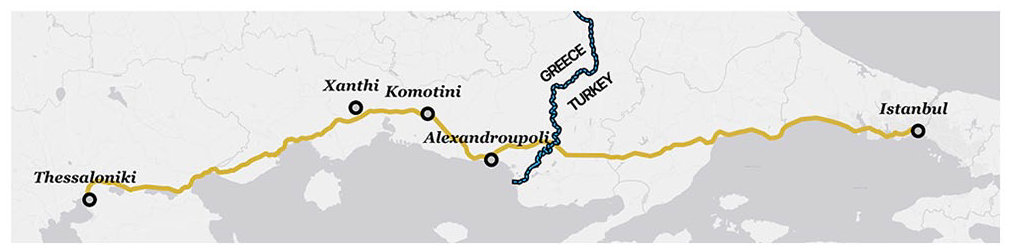
Map of the Turkish–Greek border and the bus route.
We planned a mixed set of journeys in order to achieve a diverse sample. We conducted our interviews through six (four daytime and two overnight) journeys, spread among spring, summer and autumn 2013. Then, a combination of convenience and maximum-variation sampling strategies was used. Participants were selected based on who were available and different from previous participants in terms of relatively more visible characteristics such as age and gender. We interviewed two tourist guides who frequently travelled on this route in Istanbul, and 24 Turkish-speaking passengers, two drivers and two stewards on the bus journey between Istanbul (Turkey) and Thessaloniki (Greece). Among our participants 16 were men and 14 were women. Passengers in our sample included young people travelling for EU-funded projects, businesspeople, tourists and people who were visiting their families or hometowns including Turks of Western Thrace.
As Wiederhold (2015) highlights, researchers are often both insiders and outsiders in terms of their connections to their participants. The first author of this study is Turkish, an immigrant in the UK and familiar with the lack of travel opportunities at Turkey’s borders with the EU. She was also aware, at a general level at the time, of the struggles of Turks in Greece and Greeks in Turkey. However, she is an outsider to the region of Thrace. The second author is an outsider to this field-site – whose interest in this study stems from her work on the Partition of Indian Subcontinent and the long-term impact of historical displacement and population exchange.
Although our sampling strategy and interview questions did not focus on ethnic identity, the fact that Turks of Western Thrace travelled frequently on this route was mentioned in both of our interviews with tourist guides (one of whom also identified as a Turk of Western Thrace) at the beginning of our study. Interviewing members of minoritised communities can raise specific ethical issues. First, interviews could raise potentially sensitive topics. Second, even though the study took place at a time when Greek–Turkish relations in general and border controls in particular were ‘normalised’, crossing the border during data collection entailed some risks. The researcher’s belongings including the data and fieldnotes could be searched and/or confiscated at the border. These possibilities posed risks at three levels. Participants could be identified against their choice, this risk could cause participants stress and fear, and they could refrain from taking part in the study or covering topics that they found important.
Hence, the research design was adapted with some precautions. First, no follow-up questions were asked to participants about potentially sensitive topics. Although participants were reminded that they did not have to answer interview questions, this additional precaution was used to give them more control, without encouraging them to share more than they felt comfortable with. Second, participant–researcher roles were adjusted in relation to personal information. Participants were not asked their names or detailed demographic information, but they were provided with a research information sheet with the researcher’s name, supervisor, work address and contact information. Pseudonyms were added during data analysis. The participants were only asked their age and their occupation. While recording this information, the researcher added or subtracted a few years to the participants’ age, and their occupation was noted as a broader occupational category. As such, anonymisation was done in front of the participant. Informed consent of participants was taken verbally at the beginning of interviews and audio recorded if the participant gave consent to audio recording. In total 27 of the 30 interviews were recorded. Among the five participants that we focus on in this article, all except Gülay agreed to audio recording.
During our interviews, we initiated conversations with open-ended questions such as: ‘what does Istanbul (or Komotini, Xanthi, Thessaloniki) mean to you?’, ‘do you think crossing the border is easy?’, ‘do you have any memories of your journeys on this route?’. We analysed all data initially by open-coding, identifying units of meaning and shared themes emerging from participants’ responses. We compared responses of different groups emerging from the data with each other and with the existing literature. About half of our participants described themselves as Turks of Western Thrace, and their responses stood out in terms of deep and significant meanings assigned to places on the bus route and narratives informing us on the impact of bordering. The ‘journey’ at a young age was a common theme in these narratives. Despite this commonality, there were also stark contrasts in the way the journey was experienced in the past and more recently. In order to provide a detailed analysis of this rich data, in the current study, we focused on five participants who experienced the journey during the Cyprus crisis. Other participants who identified as Turks of Western Thrace were either much older (one participant), or much younger (10 participants). This selection enabled us to study a specific period of intense impermeability from multiple perspectives, covering a long durée of interrelated events.
The main limitation of our study was that due to language constraints, only Turkish-speaking participants were interviewed. In this respect, our findings depict only one side of spatial liminality across the Turkish–Greek border. However, in this study, having a Greek-speaking researcher would not necessarily offset this limitation. Our participants explained that Turkish citizens of Greek origin tend to travel on a different route (between Istanbul and Athens). Furthermore, the fact that the interviewer did not speak Greek might have helped establishing participants’ trust by indicating that the study was unlikely to be conducted for Greek authorities or political organisations. A few participants tested whether the interviewer spoke Greek by switching to Greek at different points during the journey and checking her response.
Life-Planning, Identities and Spatial Liminality
This section presents and discusses the narratives of five participants. While participants touch upon a broad range of issues, border impermeability in the 1970s emerges as a common theme. The permeability of the border matters because the border is a place of passage between different facets of the self, places of attachment and opportunities.
In Pursuit of an Education in Istanbul
Hülya (54) is a Greek citizen of Turkish ethnicity, who grew up in Greece and is living in Komotini (Greece). Her first journey to Turkey was when she was 12. Like her older sister, she was going to study in Istanbul.
She remembers that first journey as traumatic both because she travelled without her parents for the first time and because Istanbul as a big city had a different logic of space (Bourdieu, 1962 [1958]; Lefebvre, 1991 [1974]). Her parents arranged a taxi and an elderly Greek neighbour accompanied her. Hülya started crying at Komotini and did not stop crying the whole journey. Their neighbour tried his best to comfort her, but nothing worked. ‘At the end’, Hülya says ‘I was worried that something was going to happen to him. I tried not to cry.’ By then, they were already approaching Istanbul. She had never seen a big city and her first impressions were overwhelming: ‘Where am I? I thought. I am lost. I felt myself like the smallest piece of dust (showing with her fingers) in this big city.’ Hülya highlights her first border-crossing experience as a significant event in her life course; a passage in both spatial and temporal terms. The visual contrast between Komotini and Istanbul marks the shift in habitus (Bourdieu, 1962 [1958]) embodied in places. It did not help that when Hülya first arrived in Istanbul, she did not have a place to stay. Her older sister was to sneak her into her own student accommodation. Hülya remembers trying to look taller and older in order not to be caught in the few months it took her parents to arrange a family home where she could stay.
Hülya’s narrative also depicts how the disciplinary function of the border affects everyday life and invokes new strategies of resistance (Foucault, 1991 [1975]). She explains that since the amount of money cross-border travellers could carry was strictly restricted and their belongings were searched at the border, students like Hülya, who would spend months away from their family, used to carry as much food as possible and bring items that were popular in Istanbul such as cups and blankets to sell. In this regard, like the journey itself, these shared solutions to the state’s disciplinary power are emerging practices of spatial liminality: I remember the bridge (the border). The Greek bus would stop at one side and the Turkish bus would wait at the other side. We had to walk that bridge with all our belongings. At the age of 13, your mother put lots of meals, jams and whatnot with you. My arms were getting longer while carrying them along that bridge. They wouldn’t let us bring money, I tell you, this route has experienced that a lot.
For the rest of her childhood, Hülya stayed away from her parents, seeing them only in term holidays. The irregularity of her initial travel arrangements indicates the importance of her studies in Turkey for her parents, and the risks she was expected to take at an early age. Other participants, such as Dilek (29) who worked as a tourist guide along this route, discussed the continuing practices of purchasing property and sending young people to study in Turkey ‘no matter what’. In her view, these are, most of all, precautions for the possibility of a war between the two countries.
Hülya’s narrative also conveys the role of helpful others – the Greek neighbour, the family she stayed with and possibly the staff at her sister’s student accommodation – in keeping her risky venture on course. This indicates that alongside the trauma and separation, there can be life-changing support for spatially liminal people at both sides of the border.
Hülya’s studies in Istanbul helped her establish a successful career in performing arts. On the other hand, as she points out from the bus window to the bridge and tells her story, memories of the long walk and heavy loads still seem fresh. For Hülya, the border is a place of passage between different facets of her identity, and different phases of its construction.
Resolving Complicated Identities
Murat (55) is a Turkish citizen living in Istanbul. He was born and grew up in a village near Xanthi (Greece). From early on, Istanbul had a strong attraction for Murat as an imagined place: Even at the age of 9–10, and long before even seeing it, I was in love with Istanbul . . . I didn’t listen to my parents, or anybody. When I was 16, I came to Istanbul to study. I was very happy for finally reaching my Istanbul. I was in peace, I still am.
Then, at the age of 20, he found himself at a crossroads in terms of his liminal identity: It didn’t make sense to enter Turkey with a passport each time. So I said to myself, either martyr or veteran (Turkish saying), there is no turning back. I left Greek citizenship and acquired Turkish one. I am now Turk – son of a Turk and I will die like this.
Murat’s permanent move to Istanbul corresponds with what Twigger-Ross and Uzzell (1996) call a conscious discontinuity, a move that marks a new stage in life. For him, losing his Greek citizenship was both a contingency that came with his new life in Turkey and a step towards simplifying his identity. Acquiring Turkish citizenship meant becoming ‘Turk – son of Turk’, a national identity that does not call for further queries or explanations. This clarity gave Murat peace, even though he remembers that the passage between places and identities was not easy: There was very high inflation back then in Turkey. And you have no support; you have no money, no assets, no relatives, no one. The only relative you have is God. It was hard. Then, you get married, you start a family, an order, it gets better.
In those difficult years, Murat had left all the support he could receive from his family back in Greece. His narrative, however, refers to personal boundaries instead of the national border. In his view, ‘one has to know his boundaries (haddini bilmek in Turkish) in life’. Knowing one’s boundaries, in this context, is not asking more than what you have, or are given. ‘If, despite difficulties, you can be happy with what you’ve got and be cheerful, people reward that cheerfulness’, he explains.
Despite being deeply attached to his Istanbul, Murat also explains that he is no longer able to sleep there due to the crowds, noise and pollution. The village he grew up in is, thus, a frequent getaway for him and his family. They still own the family house and travel as often as they can. ‘Air is clean’, Murat says ‘and neighbours always welcome you with vegetables they grow.’
Murat’s border narrative does not link impermeability to the actual border-crossing experience as Hülya’s story does, but instead highlights the risk of not being able to return (being ‘either a martyr or a veteran’). Whereas in the past he accepted leaving his village behind as a condition of life, more recently with more permeable borders, he has re-established his connections. As Case (1996) points out, the meaning of home can crystallise through the journey away from it. For Murat, this is an ongoing process as he oscillates between two places. His views of the little village near Xanthi and Istanbul are in complete contrast. Still, Murat feels home in both. ‘Xanthi is where I was born, Istanbul is where I grew’, he says, ‘both are my home (vatanım in Turkish). I cannot forgo either (ikisine de kıyamıyorum in Turkish).’ As such, he has found himself with more complicated place identities than he might have assumed in the past.
Statelessness and Political Exclusion
İsmet (58) is a Greek citizen with Turkish ethnicity. He works in Eastern Thrace (Turkey) as an academic and travels frequently across the border. He grew up in a town in Western Thrace wondering what Turkey was like. As he grew older, he felt alienated in Greece. This led him to ‘search his own identity’. Like many of his peers, İsmet first travelled to Turkey alone, as a young person to study.
He remembers that the first thing he noticed after crossing the border was the poverty and underdevelopment in Turkey. As Hyams (2002) argues, border-crossings can highlight differences between nations. ‘In those days,’ İsmet explains ‘the gap was much more visible.’ His early accounts of Turkey were also shaped by a familiar feeling of alienation that he explains through the lack of respect for heritage on both sides of the border: When I first saw the houses around the historical (Byzantine, perceived as Greek heritage) walls in Istanbul, I thought this was disrespectful to history and culture. I knew this feeling from Thessaloniki. We once went to movies with friends. Later, I learned that movie theatre was previously a (Ottoman, perceived as Turkish heritage) mosque.
Like Hülya, İsmet remembers selling cups, blankets and, in his case, jeans, for pocket money during his studies. After graduating, he stayed in Turkey for a few years. He, then, decided to return to Greece and travelled by ferry. He learned from the border officer that he had lost his Greek citizenship due to Article 19 (see previous section). ‘There is nothing you can do about it’, the officer said. He refrained from confiscating İsmet’s passport so that he could return to Turkey. He also recommended İsmet not to tell the Turkish officers that he had become stateless. Otherwise, he could be denied entry to Turkey as well and be stranded on the ferry, or at the border. ‘Because’, says İsmet, ‘Turkey was trying not to make it easy for Greece to denationalise Turks.’
Thus, İsmet was left on a ferry on the Aegean Sea between Greece and Turkey, like an embodiment of his spatial liminality, trying to find a way out with his now invalid passport. At the end, it was Greek friends and lawyers who helped him to go back to Greece. Following their advice, İsmet managed to enter the country flying from a European city using his invalid but unconfiscated passport. Once in Greece, he resisted deportation, repeating what his lawyers advised to numerous police officers who paid visits to his home. He eventually won his legal battle to regain his citizenship.
İsmet and Murat travelled to Turkey under similar conditions both of them wanting to resolve their identity. While Murat associates his journey with a deep attraction to Istanbul, alienation drove İsmet away from Greece. İsmet’s long-lasting legal fight contrasts with Murat’s motto of knowing one’s boundaries. While Murat longed to build his life coherently on the other side, İsmet was looking for a place where both sides of his identity were accepted. He did not find that place through movement. On the contrary, for a short period, he was stateless; excluded in perhaps the most fundamental sense (Redclift, 2013). His irregular arrival into Greece with the support of helpful others subverts (Doevenspeck, 2011) the nation-state in the case of Article 19, but it also extends its disciplinary bordering elsewhere in the territory, as exemplified with repeated police visits to his home.
On Places and People Who Are Left Behind
Selma (61) is a Turkish citizen living in Istanbul. She was born and grew up in Xanthi as a Greek citizen and member of the Turkish community. Like İsmet, she talks about feeling alienated in Greece in her youth and like Murat, she feels strongly connected to Turkey. As the bus travels through Western Thrace, she points outside and says: ‘In these lands, no matter what, there is a feeling of alienation. Our country (Turkey) is something else, something truly else.’
When Selma married a Turkish citizen and moved to Turkey, she knew this would mean losing her Greek citizenship due to Article 19. For her, losing her citizenship was neither an imposition (as in İsmet’s case), nor a decision (as in Murat’s case), but a compromise. Unlike Murat, who experienced being all alone in Istanbul while he was trying to build his life, Selma was happily married. The couple lived in small towns in the Marmara region (north-west Turkey) keeping a shop to earn their living.
The major effect of losing her Greek citizenship on Selma’s life was not being able to go back to Greece for over two decades. Detachment of bodies from significant places can provoke strong social and psychological responses precisely because it entails a ‘loss of self’ (Dixon and Durrheim, 2004: 458). Place identity, in this regard, can be an implicit structure, the significance of which can be overlooked until the bond between the person and the place is threatened (Chow and Healey, 2008). For Selma, the physical landscape, and the family she left behind were the two layers of her detachment. Just as alienation was what she remembers most about growing up in Greece, missing Xanthi became a major part of her new life in Turkey. ‘I missed the places where I was born and grew’, she says. ‘I was always seeing those places in my dreams . . . When I went there after 22 years, I felt a relief, a big relief (sighing) . . . My mother is old now, you see. But it is much easier now.’
Selma’s children grew up not knowing Western Thrace and their family members including their grandmother in Greece in person. Unlike Murat’s children, who are younger and frequently travel with him to Greece, her children are now adults. They live further away from Greece and a Greek consulate. Their current travel opportunities, therefore, are more limited. Selma and her husband were visiting Greece for the second time in the year, trying to make the most of their visa before it expires. One of their daughters visited Xanthi to see where Selma was from. ‘She called me while they were there and said “mother, it is beautiful here”. “Yes, of course it is my child”, I replied.’
The impermeability of the border led to weaker personal ties and more distinct identities for the two sides of Selma’s family. Travelling across the border helps her relieve the burden of self-loss, which was part of her life for so many years. The border, in this regard, constitutes a passage between different family connections and place attachments: of where she feels welcome in Turkey, and of where she was born and grew in Greece. It also constitutes a passage between different stages of her life: as a mother and a daughter.
Gender, Liminality and the Border
Gülay (57) is a Greek citizen, living in a border town in Turkey taking care of her unwell mother, who is a Turkish citizen. She grew up in a village near Komotini with her two brothers. The family decided to migrate to Turkey in the 1970s when Gülay was a teenager. In time, the whole family, except Gülay, acquired Turkish citizenship.
Gülay remembers the Turkish community she grew up with in Greece as a close-knit, hardworking and generous one. Her fondest memories of Western Thrace include playing with other children in the village, moving freely between houses and gardens and always being welcomed with the frequent offering of snacks. At the same time, Gülay also mentions that the community was closed to non-Turks. Thus, despite living in Greece, she never learned Greek until later years of schooling. It was one of her teachers who encouraged her and taught her Greek, which she now greatly appreciates.
The memory of her teacher’s encouragement remains important for Gülay because she thinks education can shape one’s life. While her brothers continued their education, went to university and established successful careers, Gülay was not given the same opportunity. Her parents believed that her future depended on making a good marriage. For Gülay, this was a crossroad in her life, depriving her from reaching her potential: ‘I wish I could get education too. Your life (referring to the researcher) is starting now. Mine is, well . . ., blocked (tıkanmış in Turkish).’
While aiming for a good marriage for Gülay, her family looked for similar roots and traditions. She, thus, married a Turkish man from Eastern Thrace, believing he was ‘a person of our region’, but he turned out to be ‘very different’. The couple divorced after several years of alcohol abuse and domestic violence. While explaining her misfortune first to a fellow passenger, whom she knows from her childhood, and then to the interviewer, Gülay repeatedly referred to her ex-husband’s origin on the other side of the border, Eastern instead of Western Thrace.
For Gülay, the places people are from continue to be important. She uses a similar reasoning when explaining how one of her brothers turned against them under the influence of his Eastern (Anatolian) wife. When their father passed away, he tried to sell their family house, even though Gülay and her mother had nowhere to go. With the support of her other brother and investigating legal options, she obtained a court order stopping the sale of the house as long as their mother is alive: ‘“You turned out to be a hard nut (çetin ceviz in Turkish)” my brother and his wife said to me . . . They thought I couldn’t do all that because I am not educated, but I did. I don’t care what happens to me after my mother passes away’, Gülay says, ‘I will find a way.’
Gülay’s plans for surviving on her own include possibilities in both countries. While trying to buy a house from a municipality scheme in Turkey, she is also very careful about holding on to her Greek citizenship. Although Article 19 is suspended, Gülay is still alert. ‘They don’t like it when you don’t make entries for longer than six months’, she says. Not taking any chance of losing her citizenship, she leaves her mum to neighbours once every six months and travels to Komotini, where she stays with old friends. These regular journeys, albeit in the opposite direction, are the enactment of a precautionary strategy, and once again they depend on the generous support of helpful others at both sides of the border.
Gülay’s narrative entails multiple conflicts. She is strongly connected to Western Thrace, which she still calls ‘our region’, and holds on to her Greek citizenship with all her might. As the sole carer of her mother, who could not move to Greece with her, she is preparing for an uncertain future, in which she may herself become homeless. The border is now a regular place of passage between her old friends, fondest memories and possible future in Greece and her current realities and family life in Turkey. Again, it represents both spatial transitions and temporal ones in that it is a key site of her next life phase.
Conclusions
In this article, we extend ride-along interviews to border-crossing journeys and examine how a national border and its filtering functions impact upon young people’s life-planning and identity construction. Focusing on a community that has not been adequately studied and their border-crossing during a political crisis in the 1970s, we examine the long-term and multifarious effects of intense bordering and relatedly, the categorical ordering of people through citizenship and denationalisation.
Bordering and ordering are elements of the construction of nation-states with territories that are cohesive within and separate from outside. In reality, however, complete cohesion and separation are impossible. As the geographies of states, nations, economies, ethnic and cultural groups are not isomorphic, national borders often cut through diverse forms of connections. Although we normalise state-made categories, diverse experiences of liminality, both mundane and profound, are reminders of their arbitrariness. Our findings enable us to extend theoretical understandings of identity, bordering and categorical ordering through the concepts of spatial liminality and places of passage. These concepts offer more nuanced understandings of the spatial dimension of social reality and advance analytical resources for studying identity construction. They provide a lens to better understand how young people build their lives taking the border into consideration and construct their identities with and against state power.
The border, in this context, entails and exemplifies folded layers of structure and agency. It is a concrete structure, obscured only by the heterogeneity of its impact on different nationalities and demographic groups. As our findings indicate, border-crossing provides access to precautionary capital and structural opportunities in educational and economic fields, and so the border is also an object of ongoing strategic calculation and agency. Through intersections between choice and constraint, established practices and improvisations, great risks are taken to mitigate other risks – young people travel alone, or risk denationalisation to avoid economic inactivity, or purchase property in preparation for war or conflict.
Our participants’ experiences also provide insights into the impacts of more elusive boundaries and structures. From idyllic settings of closely knit but closed communities to alienation in cosmopolitan settings, participants describe different inclusions and exclusions that affected their identity construction in Greece. The extent to which they resolved their issues by exploring more fitting lives in Turkey also varied. Gender had an important role in this variation. The narratives of Gülay, Selma and Hülya are marked in the first place by access to education and happy versus unhappy marriages, as well as broader familial attachments and detachments. İsmet’s narrative diverges from Murat’s, on a more individual and reflexive domain of action. While Murat found strength in accepting boundaries, İsmet remained in-between categories, fighting against the power of the state to define where he belonged.
Finally, our findings indicate that while state actions, from mundane practices of searching young travellers for pocket money to profound uses of power in denationalisations, can structure liminal identities, this is not a frictionless process. What all of our five participants had in common was the way the border was linked to major life-course events, big decisions and sacrifices. Since significant places and identity categories help with making sense of the self, as a corollary, deprivation from them corresponds to self-loss. Furthermore, the place attachment of spatially liminal people has two sides: they are attached to significant places, and attach these places together through their movement, families and belongings. When disciplinary bordering puts heavy pressures on spatially liminal people, many feel they have to part with some connections. While individuals deal with self-loss in different ways, their detachments may also be significant for places, providing an explanation for low mobility across the Greek–Turkish border and the impoverishment of the borderland region. In this respect, our participants’ narratives deepen our understanding of disciplinary power of bordering on identities and life-stories, and changing logic of places in the creation of the nation-state.
Footnotes
Acknowledgements
We would like to thank the editors and anonymous reviewers who provided thorough and thoughtful comments and feedback. We would also like to thank Dr J Riley Snyder for providing the map we used in  . Finally, we would like to express our gratitude for participants of this study who shared their life-stories with us.
Funding
The authors disclosed receipt of the following financial support for the research, authorship and/or publication of this article: this study is partially funded by the British Academy’s Balkan Futures project hosted at British Institute at Ankara and British School at Athens.