




Abstract
This article examines the relationship between knowledge hierarchies and gender stratification in research funding. Through a mixed-methods study combining data on 5460 funded and unfunded social science applications submitted to a research council in Western Europe, and nine interviews with current and former council members, we explore how applicants’ disciplinary, thematic and methodological orientations intersect with gender to shape funding opportunities. Descriptive analysis indicates that women’s proposals are underfunded, with a relative gender difference of around 20%. Using computational text analysis and mediation analysis, we approximate that around one-third of this disparity may be attributed to gender differences in disciplinary focus, thematic specialisations and methodologies. The interviews with council members allow us to make sense of these disparities and expose the disciplinary hierarchies and power struggles at play in the council, sometimes resulting in a devaluation of qualitative methods and, more broadly, interpretive, descriptive and exploratory approaches in proposal assessments.
Introduction
A surprisingly neglected topic in the scholarship on gender stratification in science concerns the formation of knowledge hierarchies. An extensive literature documents the structural, organisational and cultural conditions that constrain women’s academic career opportunities (Llorens et al., 2021; Orupabo and Mangset, 2022; Van den Brink and Benschop, 2014). However, we know much less about how processes of gender stratification relate to the formation of knowledge hierarchies that ascribe value and prestige to certain research topics and methods while marginalising others (Go, 2017; Key and Sumner, 2019; Lamont, 2009).
In this study, we explore the relationship between knowledge hierarchies and gender stratification in the social sciences. Specifically, we use data from a national funding agency situated in a Western European country (henceforth, the National Research Council) to analyse how decision-makers’ valuation and prioritisation of certain types of research at the expense of others, may indirectly reproduce gender disparities in funding outcomes.
Our conception of knowledge hierarchies builds on Bourdieu’s (1975) field theory in that we understand the distribution of scientific rewards and resources as an outcome of continuous struggles (within and across disciplines) over the validity and relevance of theoretical frameworks, methodological approaches and thematic interests. Owing to differences in scientists’ status and influence, such struggles will over time lead to hierarchies, where some ways of doing and evaluating science are regarded as more important, relevant and prestigious than others.
Understanding the link between knowledge hierarchies and gender stratification is important given the persistent horizontal stratification observed within and across scientific fields. Extant research underlines gender variations in thematic specialisations within and across the social science disciplines (Key and Sumner, 2019; Leahey, 2006; Nielsen and Börjeson, 2019). Studies also identify gender differences in preferred research methodologies, with women being overrepresented in qualitative and interpretive areas and underrepresented in quantitative and positivist areas (Evans and Bucy, 2010; Grant and Ward, 1991; Nielsen and Börjeson, 2019).
Some authors speculate that such variations may reproduce gender disparities in academic career outcomes (Key and Sumner, 2019; Lamont, 2009; Light, 2013). For instance, if decision-makers in appointment and funding committees in the social sciences are inclined towards research of a quantitative and positivist bent, and women are more prone to employ qualitative and interpretive approaches, this may lead to gender imbalances in the outcomes of selection processes (Lamont, 2009). This conjecture has not been explored empirically because it necessitates relevant data on unsuccessful funding applications, which are generally considered confidential by funding bodies.
Previous research on gender disparities in funding is inconclusive. Results tend to vary depending on research design, scientific field, national context and differences in the criteria used to assess funding proposals. While some studies indicate a slight female funding advantage, others point to a consistent male advantage, or no discernible gender difference (for overviews of the literature, see Cruz-Castro et al., 2022; Sato et al., 2021). Previous research identifies several potential drivers of gender disparities in funding, including the strong emphasis on applicants’ past achievements in proposal assessments (Witteman et al., 2019), the gender of peer-evaluators (Arceo-Gomez and Campos-Vazquez, 2022) and individual bias in reviewer ratings (Witteman et al., 2019). What is still lacking in this literature is a conception of how the valuation of scientific content itself, be it defined in terms of disciplines, research topics or methods, influences women’s and men’s advancement opportunities differently.
Combining data on 5460 funded and unfunded research applications submitted to the National Research Council, and nine interviews with current and former council members, we explore how applicants’ disciplinary, thematic and methodological orientations intersect with gender to influence funding opportunities. Our study addresses three main questions concerning the assessment of funding proposals: (1) what types of research are valued and devalued in the council; (2) on what grounds are judgements made; and (3) what are the potential (indirect) gender consequences of the dominant thematic and methodological preferences present in the council?
Our findings demonstrate how knowledge hierarchies may perpetuate gender disparities in social science funding by indirectly shaping the resources channelled into male- and female-dominated research areas. Disciplinary struggles within the council appear to play a role in how research proposals are evaluated, sometimes resulting in a devaluation of qualitative methods and, more broadly, interpretive, descriptive and exploratory approaches. This, in turn, appears to reinforce gender disparities in funding attainment due to the horizontal stratification of women and men applicants across disciplinary, methodological and thematic boundaries.
Background
In this study, we adopt a conflictual view of science, seeing researchers as engaged in ongoing struggles over status, resources and the monopoly of scientific authority and competence (Bourdieu, 1975; Elias et al., 1982; Fuchs, 1993). As Bourdieu (1975: 19) puts it, ‘science is a social field like any other, with its distributions of power and its monopolies, its struggles and strategies, interests and profits’. In this field, influential scientists deploy conservation strategies to preserve the established scientific order, and thus their own access to material resources (e.g. grants, jobs and infrastructure) and symbolic resources (e.g. citations, prizes and journal space). Such conservation strategies may materialise through the training of new generations, and the censorship of editorial boards and funding committees, where new scientific ideas are encouraged or discouraged, accepted or rejected. Conversely, less influential scientists may attempt to subvert and redefine the dominant evaluative logics of the field to promote their own positions, agendas and research interests (Bourdieu, 1975: 30).
This conflictual view does not imply that academics primarily act as calculating strategists and that self-interests prevail in scientific judgements. Scientists distinguish themselves from others through theoretical, thematic and methodological position takings, but also derive their preferences and reference systems (tastes and distastes) from said positions (Emirbayer and Johnson, 2008). For this reason, scientific judgements can never be fully detached from the competitive dynamics of the broader field (Chong, 2013). Evaluative judgements always find their principle in scientists’ socially constituted dispositions and their location in a larger professional universe of values, preferences and conscious and unconscious presuppositions (Bourdieu, 2003). Like decision-makers in other fields, scientific evaluators may attempt to preserve or advance their own (or colleagues’) positions by favouring prospects that resemble them in terms of values and characteristics (Kanter, 1977). Such processes of ‘homophily selection’ may also be shaped by the evaluators’ thematic and methodological tastes, known as cognitive homophily (Lamont, 2009; Travis and Collins, 1991).
Traditionally, feminist science scholars have used ideas about homophily to illuminate how inequalities are perpetuated through practices of ‘homosociality’ and ‘male-closeness’ (Cohen et al., 2021). In academic recruitments, homophily may operate through subtle, gender-related network practices affecting who is invited to apply for research positions, whose reputations are built and whose visibility is promoted through recommendations (Van den Brink and Benschop, 2014). Here we extend on this literature by focusing on the indirect gender implications of cognitive homophily, starting from the theoretical conception that funding applicants’ chances of obtaining funding may not only be determined by the merits of their work, but also by how closely their research mirrors the thematic and methodological tastes of peer-evaluators.
In interdisciplinary settings such as research councils, decision-makers’ capacity to impose evaluative logics and value definitions depends on the symbolic and material status of their discipline. Economics takes on a dominant position within the social sciences with respect to intellectual authority, resource accumulation and political influence (Fourcade et al., 2015; Lebaron, 2001). The discipline is largely autonomous from the rest of the social sciences (i.e. other social scientists’ influence on the control systems and conceptions of quality and relevance in economics is very low), socially integrated and unified in terms of concepts, theories and methodological frameworks. In comparison, sociology (and related fields like education, communication or organisation studies) is characterised by lower levels of social integration, autonomy, intellectual and public influence, and a greater diversity of methodological and theoretical orientations. Such differences between disciplines determine the hierarchical structure of the social science field and are likely reflected in the negotiations between council members on which projects to support.
Data and Methods
Funding Data
The dataset consists of 5460 funding applications submitted and reviewed between 2010 and 2020. As part of the submission process, all applicants were asked to assign a disciplinary code (Organisation for Economic Co-operation and Development (OECD) classification) to their proposals. All the proposals classify as social science according to the OECD classification.
To gain a better understanding of the most prestigious and economically important funding schemes, we decided to restrict our focus to applications for postdoc stipends and research projects, while excluding proposals concerning PhD stipends, international stays abroad, centres, instruments, data acquisition, book publishing, conferences, research networks, journals and guest professorships. This leaves us with a sample of 4729 postdoc and project applications (see flowchart in online Supplementary Figure A1). The dataset includes information on the submission year, primary discipline (OECD classification), targeted project type (postdoc stipends and various types of research projects) and the outcome of each proposal (rejection or acceptance). Moreover, we have consistent information on the applicants’ gender and age at the time of submission and a project title and abstract for most of the projects. Seven hundred and fifty projects (16%) did not contain an abstract. Fifteen applications did not contain information on applicant age. For these, we have imputed the average applicant age (42 years).
Other relevant variables that might play a role in funding outcomes such as institutional and departmental affiliations and position types and ranks, were either not available or reported inconsistently over the 10-year span of the dataset. The need to protect the anonymity of the applicants thus proved to be a constraint for this research, as the National Research Council was reluctant to disclose information that would compromise it.
Interviews
To illuminate the council’s evaluative practices and procedures, we conducted nine semi-structured interviews with current and former members of the council’s Social Science section. This section covers research in economics, sociology, political science, law and related cross-disciplinary themes. It thus assesses most social science applications submitted to the National Research Council (specifically 2922 of the 4729 postdoctoral and research project applications in our dataset). Council members are associate and full professors (or senior researchers) from national scientific institutions. They are generally nominated on four- to six-year mandates. In our recruitment, we sought to obtain maximum variation in terms of gender, discipline and affiliation: four interviewees were women and five were men; interviewees were economists, sociologists, political scientists and legal scholars.
To circumvent problems of social-desirability bias (where interviewees merely express the official position of the council), our interviews focused on descriptions of specific evaluative tasks and processes (Orupabo and Mangset, 2022: 321). We used an open-ended approach, mixing structured questions and guided conversation. The interview guide covered the following topics: the role of the research council in the national field of social science; the structure and composition of the Social Science section’s working groups; the evaluation criteria that members used to assess funding applications; and the content of their discussions during council meetings. In the last part of each interview, we also made use of documents and data drawn from the quantitative analysis to elicit comments and reactions regarding disciplinary, thematic and gender-related disparities identified in the data material. This allowed us to analyse how reviewers made sense of the observed disparities while also verifying that our understanding of the section’s internal structure was correct. The interviews were held in English and took place in May–June 2021. They lasted 45 to 80 minutes and were recorded and transcribed verbatim.
Content Analysis of Proposals
We used the OECD disciplinary codes and a lexicometric analysis (specifically descending hierarchical classification) to classify the disciplinary focus and thematic content of each application. The descending hierarchical classification was performed with the Alceste method developed by sociolinguist Reinert (1990) (for further specifications, see the Online Appendix).
We also conducted a manual coding of the abstracts to determine their primary methodological approaches (for further specifications, see the Online Appendix). This manual coding allowed us to infer the primary methodology for 2076 abstracts. Given that almost half of the proposal abstracts did not describe methods and data, this part of the analysis can only be viewed as suggestive. Moreover, our focus on methodological approaches is associated with some uncertainty, since the methods descriptions available in abstracts may not be fully representative of the methodological frameworks described in the full proposals.
As described below, we use information on research themes and methods to determine how applicant gender and intellectual position taking (in terms of primary discipline, research topic and methodological imprint) intersect to influence social scientists’ funding success. Here, we understand position takings as the specific ways that grant applicants orient themselves within the space of available disciplinary, thematic and methodological positions (Bourdieu and Wacquant, 1992). An applicant’s grant proposal is thus always situated in a broader field of possible positions, and will through the assessment process be evaluated up against competing proposals by scientists occupying different positions.
Mediation Analysis
We conducted a mediation analysis to approximate the indirect effect of discipline, inferred research topic and method on the association between applicant gender and funding success. We used a linear probability model (LPM) and the Karlson–Holm–Breen (KHB) method to decompose the total effect into a direct effect (the effect of gender on funding success, controlling for research topic and discipline) and an indirect effect (the effect of gender on funding success, mediated through research topic and discipline) (Karlson et al., 2012).
We used the Variance Inflation Factor (VIF) to check for multi-collinearity in all models. Our main predictor, gender, had low VIF values across models (VIF < 3). VIF values for the covariates and mediators were low to moderate with a maximum VIF score of 7.9.
Table 1 shows descriptive statistics for all variables included in the mediation analyses. Our outcome is a binary measure of whether an application obtained funding or not. Our primary predictor, gender, is also computed as a dummy variable. Our mediating variables consist of 18 dummy variables that specify the primary research discipline, topic cluster and methodology assigned to each application. All analyses adjust for applicant age (count variable), submission year (dummy variables), council/programmes (dummy variables), whether the project proposal is a new submission or a resubmission of a previously rejected proposal (dummy variable), whether the project is for a postdoc project or not (dummy) and whether the proposal is related to one of the council’s affirmative action programmes (dummy variable). The 4729 applications were assessed under seven different programmes: Social Science (N = 2922), Humanities (N = 1325), Natural science (N = 4), Health (N = 28), Technology (N = 22), Thematic programmes (N = 371) and Other programmes (N = 57). In our analysis, we included the councils as separate dummies. We identified reapplications (i.e. previously rejected projects) by comparing abstracts and titles across proposals. Proposals that had titles and abstracts that overlapped with preceding submissions were coded as 1, and original proposals were coded as 0.
Descriptive statistics: Means, standard deviations and available cases.
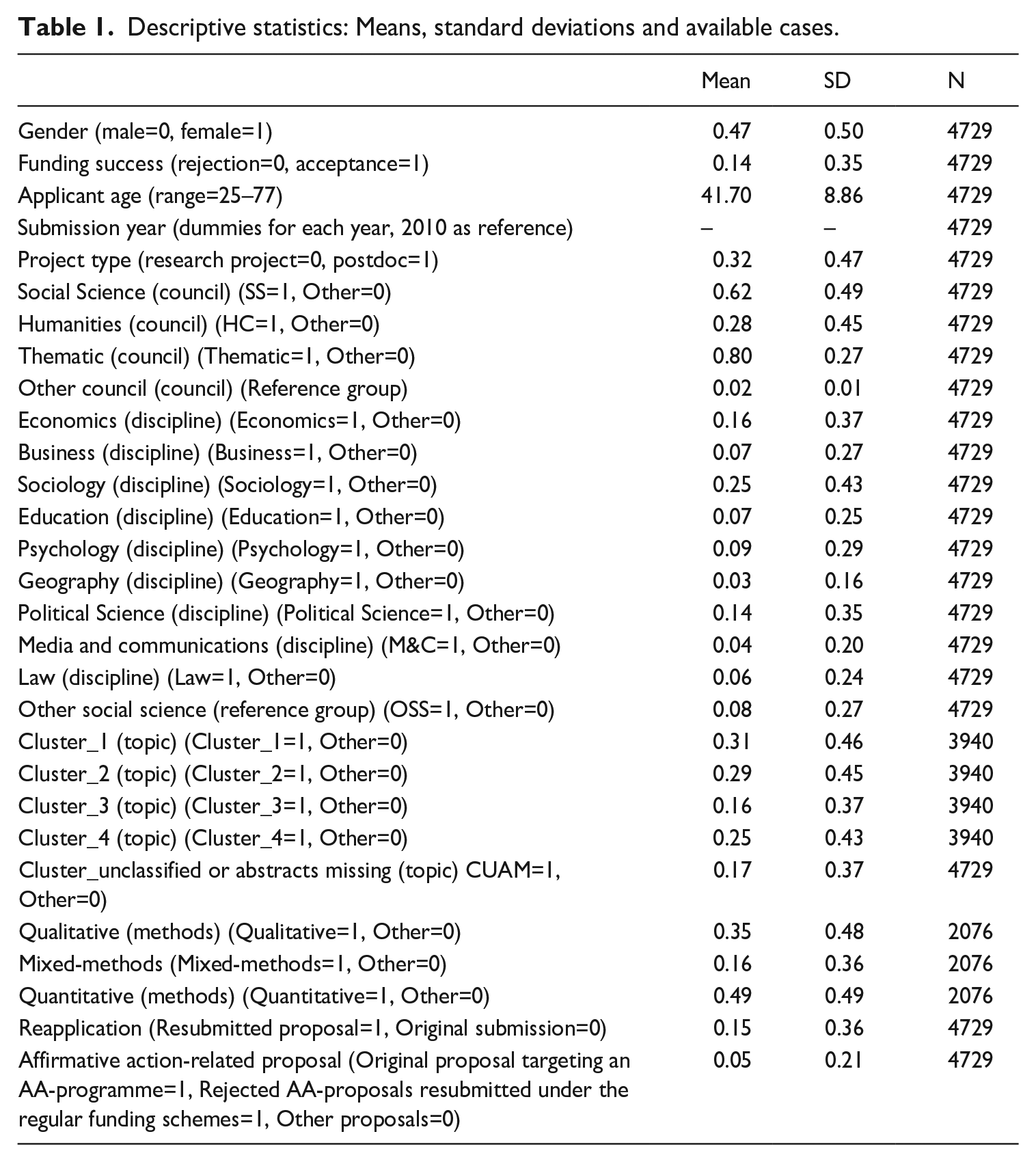
During the past 10 years, the National Research Council has initiated a few specific funding programmes aimed at increasing the number of female grant recipients. These programmes, which relied on moderate affirmative action (i.e. favouring female applicants in cases of equally rated male and female proposals), had very low success rates due to an unusually high number of female applicants. In the regression and mediation analysis, we have excluded these applications from the sample.
Results
The Thematic Space of the Social Sciences
We begin our analysis by exploring the thematic characteristics of the funding proposals. As shown in the factorial correspondence analysis (Figure 1), the projects are categorised into four main clusters. Cluster 1 (in red) features keywords such as ‘culture’, ‘medium’, ‘practice’, ‘ethnographic’. Proposals in this cluster primarily come from sociology (33%), education (15%) and media/communication (11%). Cluster 2 (in green) features keywords such as ‘market’, ‘model’, ‘decision’, ‘firm’ and ‘price’, and proposals primarily belong to economics (43%), business (17%) and political science (11%). Cluster 3 (in blue) covers key terms such as ‘child’, ‘cognitive’, ‘treatment’, ‘mental’ and ‘disorder’, and the dominant disciplines are psychology (33%) sociology (19%) and economics (17%). Finally, Cluster 4 (in purple) is organised around legal and political questions with distinctive key terms such as ‘political’, ‘state’, EU’, ‘law’ or ‘security’. The primary disciplines covered by this cluster are sociology (35%), political science (27%) and law (16%) (online Supplementary Table A1).
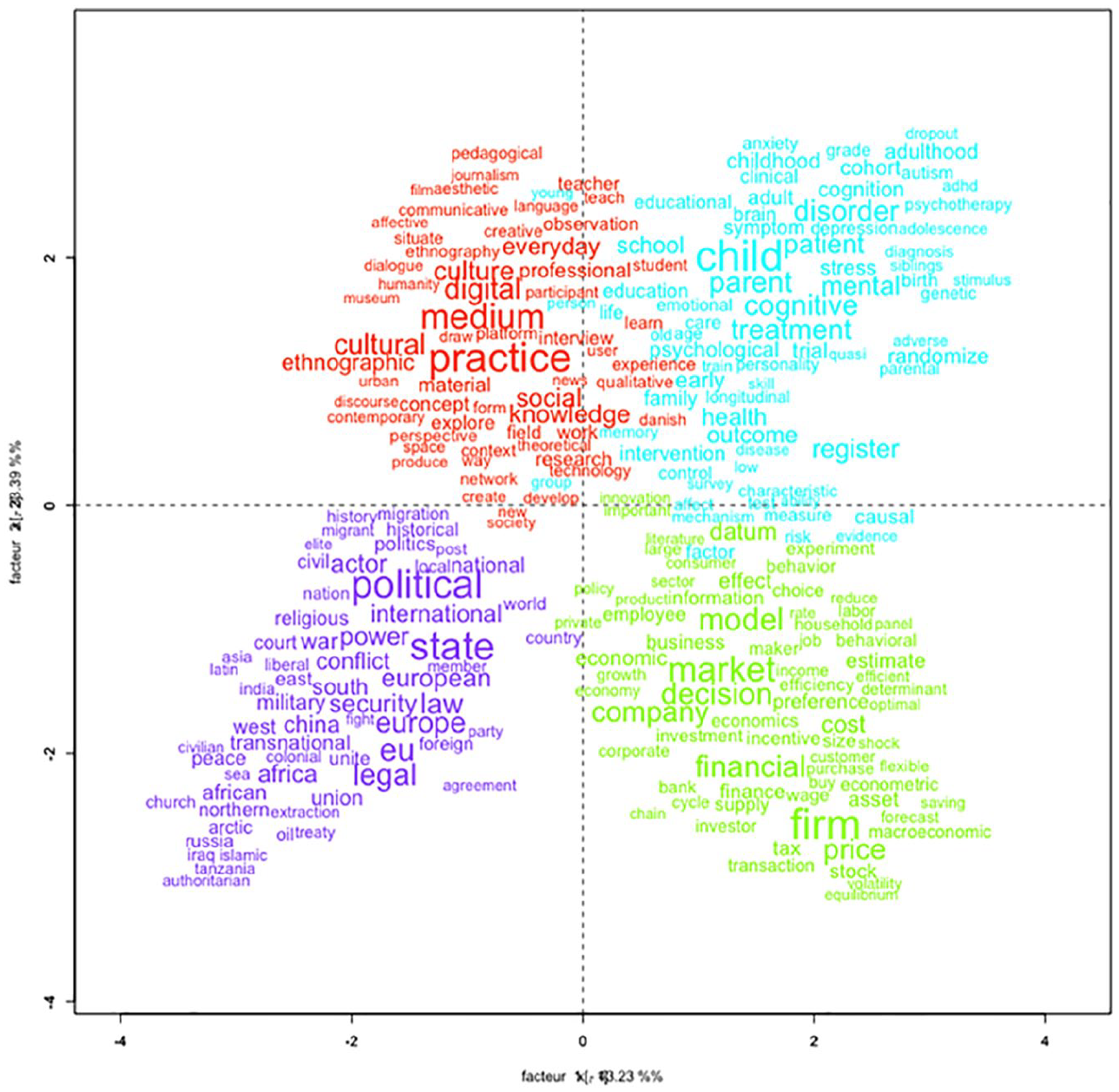
Factorial correspondence analysis of the application abstracts.
The upper part of the correspondence analysis features topics such as children and youth, education and health, the bottom portion focuses on economics, industry, law, war and international politics. This opposition is reminiscent of Bourdieu’s (1993) distinction between the two hands of the state: while the right hand is occupied with controlling budgets, securing territories and prosecuting citizens, the left hand is entrusted with compensating the social ills of the state (Kropp, 2013). Extended to the scientific field, the left hand (Clusters 1 and 3 – North) is the territory of sociologists, psychologists and education scholars, while the right hand (Clusters 2 and 4 – South) belongs to economists, legal scholars and political scientists.
On the horizontal axis, the right part of the correspondence analysis is characterised by quantitative methods (‘register’, ‘randomise’, ‘model’, ‘econometric’, ‘longitudinal’), while the left portion is predominantly qualitative (‘ethnographic’, ‘interview’, ‘context’). This pattern is also reproduced in the manual coding of proposal abstracts (see online Supplementary Table A2).
Importantly, this topological structure has a gendered dimension. Figure 2 presents the distribution of applicants by gender and topic cluster. Women applicants are overrepresented in Cluster 1, while men dominate in Clusters 2 and 4. Below, we examine how disciplinary, thematic and methodological orientations intersect with gender to shape funding opportunities in the council.
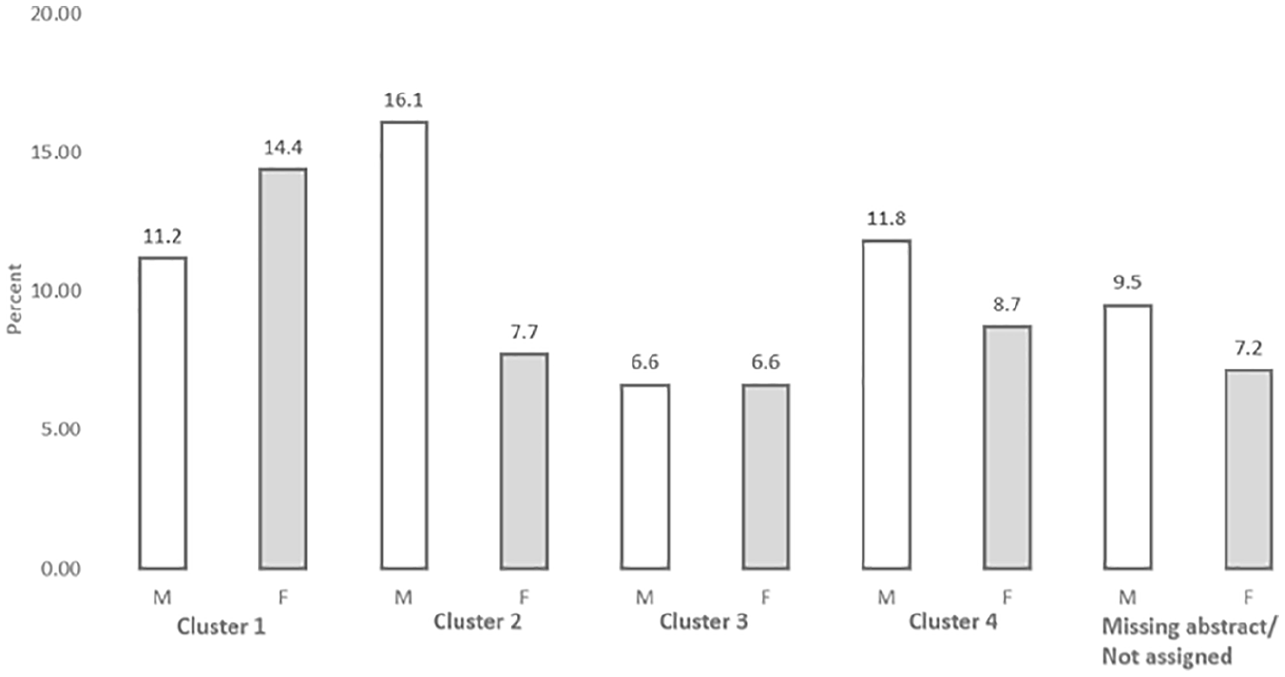
Distribution of applicants by gender and topic cluster (all councils).
Gender Disparities in Funding Rates
Simple bivariate comparisons show slight disparities in the average funding rates of men and women applicants in the full sample of social science projects (Women = 0.126, SD = 0.332; Men = 0.154, SD = 0.361; X2(1, N = 4727) = 7.44, p = 0.006) and in the sub-sample of projects submitted to the Social Science section (Women = 0.138, SD = 0.345; Men = 0.166, SD = 0.372; X2(1, N = 2922) = 3.98, p = 0.046). While these disparities may seem negligible, they correspond to relative gender differences of 22.2% ([0.154–0.126]/0.126) in the full sample, and of 20.2% ([0.166–0.138]/0.138) in the Social Science sample. Back-of-the-envelope calculations based on percentage point differences between men’s and women’s funding rates suggest that if women had had the same success rates as men, there would have been 59 additionally funded projects led by women in the full sample (0.028 * 2113 [female-led applications]), and 32 additionally funded projects led by women in the Social Science section (0.028 * 1142 [female-led applications]). These estimations correspond to the combined number of female-led social science projects funded in 2019 and 2020 (in total 60 female-led projects), and the combined number of female-led projects funded in the Social Science section in the years 2017–2019 (in total 32 female-led projects).
In linear probability models that restrict the focus to non-AA-related applications and adjust for applicant age, funding year, council, project type and reapplications, these estimated differences are slightly reduced (online Supplementary Tables A3 and A4). Compared with men, women applicants have a −2.4 percentage points (95% CI: −4.4 percentage points to −0.3 percentage points) lower probability of obtaining funding in the full sample (women’s probability = 13.0%, men’s probability = 15.4%), and a −2.7 percentage points (95% CI: −5.5 to 0.08) lower probability of obtaining funding in the Social Science sample (women’s probability = 14.0%, men’s probability = 16.7%). This corresponds to relative gender differences of 18% in the full sample and 19% in the Social Science sample. However, these estimates are associated with larger uncertainties. As indicated by the 95% confidence intervals, differences ranging from −4.4 to −0.3 percentage points in the full sample, and from −5.5 percentage points to +0.08 percentage points in the Social Science sample are also reasonably compatible with our data.
Indirect Effects of Knowledge Hierarchies on Associations between Gender and Funding
Table 2 summarises the mediation analysis (full sample) in a linear probability model (restricted to non-AA proposals) that adjusts for applicant age, funding year, council, project type and reapplications. Note here that the sample size in this analysis is further restricted to project proposals that include abstracts. Compared with men, women applicants have a −3.0 percentage points (95% CI: −5.1 to −0.8) lower probability of obtaining funding in this sample. Accounting for research topic and discipline reduces the estimated effect of gender on funding success to −1.9 percentage points (95% CI: −4.1 to 0.3) (direct effect), leaving an indirect effect of −1.03 percentage points (−1.6% to −0.5 percentage points). The total effect is 1.54 times larger than the direct effect (i.e. the confounding ratio), and 34.93% of the total effect is mediated through disciplines and research topics (i.e. the confounding percentage). A complementary mediation analysis with a logistic regression indicates similar results (online Supplementary Table A5).
Direct and indirect effect of applicant gender and mediators on funding success.
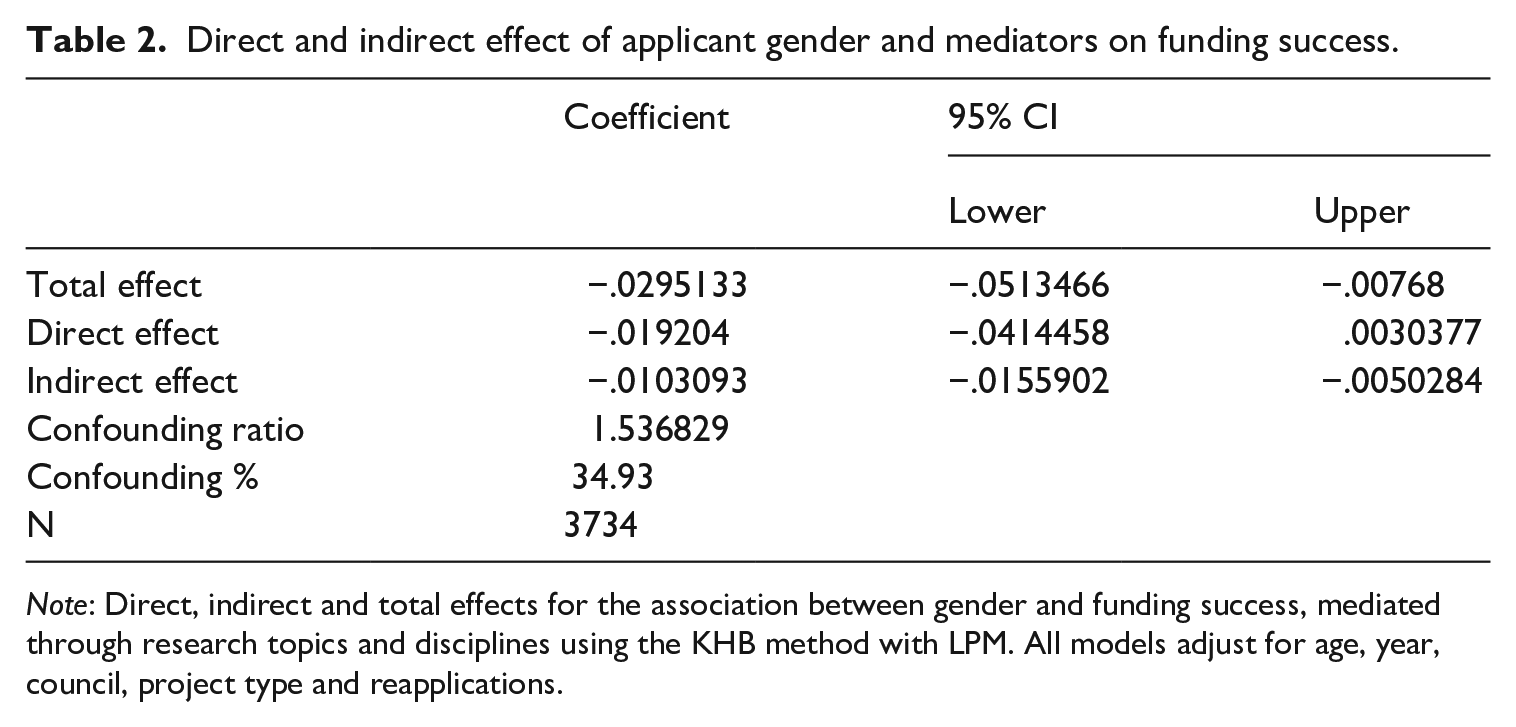
Note: Direct, indirect and total effects for the association between gender and funding success, mediated through research topics and disciplines using the KHB method with LPM. All models adjust for age, year, council, project type and reapplications.
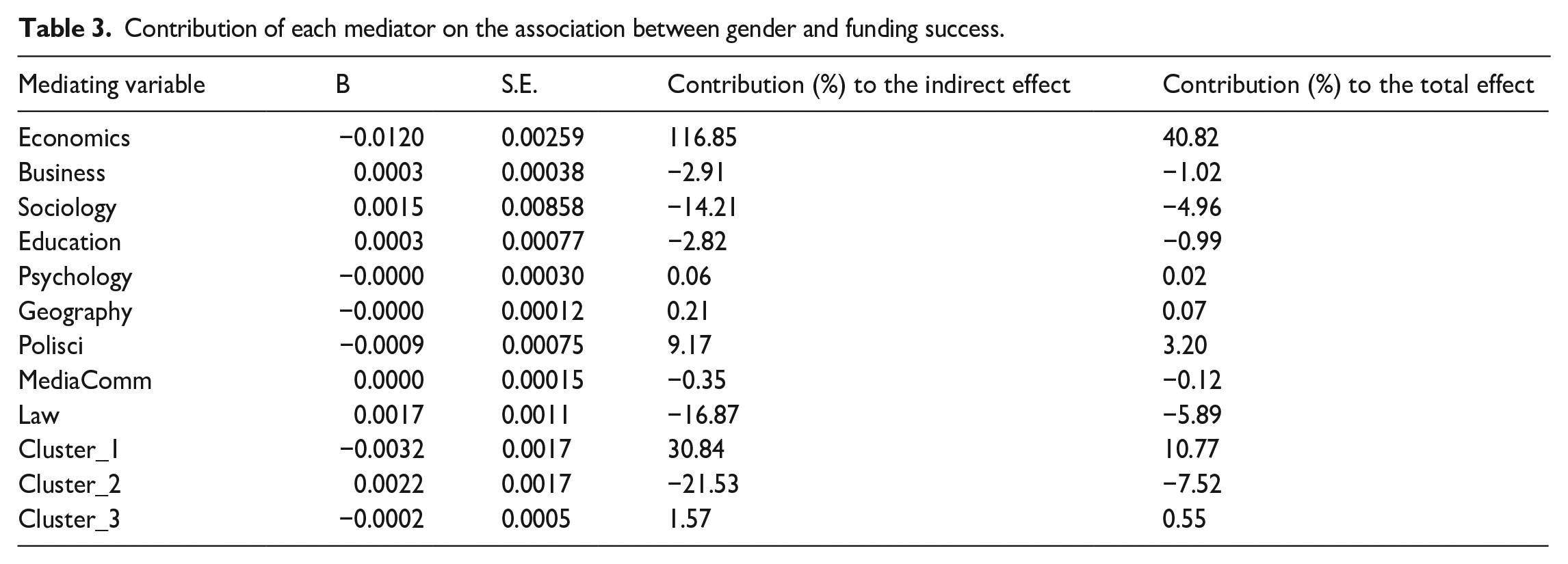
Table 3 specifies the contribution of each mediator to the indirect effect (left column) and the total effect (right column), and shows that most of the indirect effect of gender on funding is mediated through Economics and Cluster 1 (keywords: ‘culture’, ‘medium’, ‘practice’, ‘ethnographic’). A closer look at the descriptive distributions (online Supplementary Figures A2 and A3) enables a clearer interpretation of these estimates. Applicants within economics comprise 16.0% of all applicants but obtain 27.8% of all grants. In contrast, applicants within Cluster 1 comprise 25.6% of all applicants and obtain 16.6% of all grants. Since male applicants are well represented in economics (men in economics comprise 11.6% of all applicants, while women in economics comprise 4.4% of all applicants) (online Supplementary Figure A4) and women applicants are well represented in Cluster 1 (men in Cluster 1 comprise 11.2% of all applicants, women in Cluster 1 comprise 14.4% of all applicants) (online Supplementary Figure A5), these epistemic imbalances put women applicants at a disadvantage. In addition, descriptive analysis indicates notable imbalances in the success rates of male and female applicants in economics (Male = 26.2% vs. Female = 20.2%) (online Supplementary Figure A6). This may also contribute to the indirect effect decomposed in Tables 2 and 3 (online Supplementary Figure A7 displays success rates by gender and topic).
Contribution of each mediator on the association between gender and funding success.
We ran a separate mediation analysis to estimate the indirect effect of research methods (qualitative, mixed-methods or quantitative) on the association between gender and funding (online Supplementary Tables A6 and A7). In this case, we restricted the sample to the 1982 non-AA-related proposals, where we were able to infer the primary research methodology from abstracts. In a linear probability model adjusting for the same factors as in Table 2, the indirect effect attributable to methods was −0.79 percentage points (95% CI: −1.4 to −0.02) corresponding to 26.17% of the total effect (i.e. the confounding percentage). While our data make it difficult to fully disentangle the indirect effects of discipline, topics and methods due to covariance, these findings suggests that all three factors may play a role in explaining the slight gender disparities in funding outcomes.
A mediation analysis that restricts the sample to funding applications directed towards the Social Science section (online Supplementary Tables A8–A11) shows similar results to the ones presented in Tables 2 and 3, although with a slightly larger confounding percentage (40.79% of the total effect). In the following section, we explore the practices and procedures that may lead to epistemic and gender-related disparities in funding outcomes.
Scientific Merit at Play: A Closer Look at the Social Science Section
According to Lamont (2009: 9), ‘when scholars are called on to act as judges, they are encouraged to step out of their normal milieus to assess quality as defined through absolute and decontextualized standards’. During the interviews, council members regularly expressed that they did not represent their own disciplines or research areas in assessments, but rather put their expertise at the service of the common good.
These expressions align with the council members’ formal mandate and the cross-cutting assessment criteria that guide their work. In the 2021 call, the main criterion was scientific quality, followed by the applicant’s qualifications, feasibility and publishing and dissemination of results. In the assessment of scientific quality, the interviewees stressed three crucial elements, the big ones: research question, theory and methods: ‘Is the research question clear? Is state of the art clear? Is the methodological background described sufficiently well? Theoretical background?’ As we expand on below, the emphasis on detailed methodological considerations seemed particularly crucial, and qualitative and exploratory proposals were sometimes devalued with reference to this criterion.
Contextualising Scientific Standards
According to several interviewees, the absolute, decontextualised standards presented above became re-contextualised during the review process: research questions, theory and methods did not mean much without a discipline-specific reference. Thus, an important part of the council members’ work was to render the discipline-specific references intelligible to the rest of the council, and as emphasised later in this section, this sometimes proved challenging for the qualitative proposals. One council member described:
So it is a kind of a translation, and it needs to be. It needs to be a translation process, because it . . . I mean many of these applications are on a very high level. So you cannot expect people from other disciplines to necessarily get it, if they don’t work in that tradition, so you need to translate into . . . into something comprehensible for the entire council.
To understand the review process, it is necessary to account for the formal procedures that guide the examination of grant proposals. The Social Science section is divided into subsections that represent the main disciplinary areas of social science in the council’s country. Each of these subsections comprise four members (it used to be five) representing different specialisation areas. For instance, the sociology section usually consists of a qualitative sociologist, a quantitative sociologist, a general/theoretical sociologist and a more marginal member with ties to political science and/or economics.
Research projects are first evaluated in the disciplinary subsections before being discussed by the entire council at a later stage. This preliminary step is crucial in many respects. First, the distribution of the submitted applications across the three sections may greatly impact the outcome. As noted by some council members, proposals that did not fit neatly into one of the represented disciplines risked getting poor reviews. The more interdisciplinary proposals may thus face specific challenges during this phase of the evaluation.
Second, this is the step where applications are screened and the most promising proposals (according to the council members) will be brought up for discussion and defended in front of the entire Social Science section. Members reported grading the proposals as A’s, B’s or C’s according to their quality.
Third, this preliminary step is important, because it allows reviewers to anticipate the questions and criticisms that members from the other sections might raise during the joint discussions. As one council member noted ‘you become very skilled at thinking “so they will point to this, so I will be extremely prepared to explain why that is not a problem”’.
When projects are discussed by all council members, a lot of screening and preparation has already been done. Some projects will be fervently defended, while others are barely mentioned at all. However, the expert judgements articulated in the confined space of the disciplinary sections run the risk of being attacked and overthrown in the joint assessments. Two council members even compared the joint meetings to battle grounds:
If you were lucky you had all your applications finished by that day . . . and that was a mixture of sections fighting for their good applications; I think in most cases the sociologists felt they lost many battles. So I remember it as always feeling a little bit like ‘oh now we are going to battle’, when we were going to the big meetings, basically.
These descriptions of the joint assessments as ‘fights’ or ‘battle grounds’ allude to the disciplinary struggles at play during the joint assessments. Indeed, one council member with a qualitative methodological background emphasised the importance of being tough and standing up for one’s opinion in the joint assessment: ‘You need to be strong (. . .) Otherwise you will get no money to your field.’ In the following section, we analyse how these struggles relate to the symbolic and material status of the council members’ respective disciplines.
Disciplinary Struggles over Value Definitions
Descriptive statistics (online Supplementary Table A12) show clear variations in average funding rates across the social science disciplines. Economics has the highest funding rate (around 25% of applicants in economics receive funding), followed by political science (around 19% of proposals in political science receive funding) and law (around 16% of proposals in law receive funding). Sociology, conversely, is the less appreciated of the main disciplines represented in the council: only 12% of the sociology proposals reviewed by the Social Science section receive grants.
How are these numerical patterns reflected in the negotiations between council members? According to some interviewees, evaluative logics and value definitions imposed by economists and political scientists sometimes prevailed in the joint meetings. Such field struggles were particularly salient in the assessment of qualitative projects. While the council members generally declared that they endeavoured to respect the integrity of different epistemic cultures, three council members with a qualitative research specialisation mentioned instances where economists and political scientists would simply devalue non-quantitative approaches as less rigorous. One council member described it thus:
So one of the other times I presented one of our . . . we thought really good applications, which was based on interview data, which was very sensible in the context of what the . . . what the project was about. I remember very clearly one of the economists saying, and that was after having been in the council for a couple of years, one of the economists saying, and this is nearly almost a quote, because I thought it was so horrifying ‘oh but [interviewee’s name], you cannot be serious about the method here. Just talking to people, that’s not a method!’ [. . .] And that sometimes presented an obstacle to some of the sociology applications, even though they were really good, you would see the economists’ and the political scientists’ sections kind of gang up together, because they have a much bigger kind of brotherhood or community around methods.
As indicated here, the devaluation of qualitative methods and, more broadly, interpretive, descriptive and exploratory social scientific approaches by council members from economics and (quantitative) political science, is one possible explanation for the disciplinary and gender-related disparities in funding outcomes.
Some council members from economics and (quantitative) political science also described the qualitative proposals submitted to the council as less developed and transparent. One of them noted:
I think one challenge for a lot of the qualitative studies is that they [. . .] do not describe what they actually do. They say ‘I am going to collect this data’ [. . .] or they say ‘that is just it . . . that is the method’. And that is probably right, but for someone trained both in law, political science and economics . . . that was hard to accept [. . .]. I mean what was sort of strange was that projects that were very precise on, you know ‘we collect this data, then we are going to do this, we are going to create a typology’ whatever it is they do. Then you could follow the methods. It is the same in economics, you say ‘okay, I am just going to collect this data’ and you do not say anything about what statistical model you will use, then you will just be out the door. And I think we try to say that this was something that would be good to communicate to the qualitative researchers, if this is how they think they should write an application, the problem is they get thrown out every time. And I do not think we were super successful at that.
The disagreements in joint meetings concerning the specificity and quality of the qualitative proposals are also reflected in the funding data. According to our manual coding of proposal abstracts submitted to the Social Science section (N = 1265), 19.1% of quantitative proposals received funding, 11.3% of mixed-methods proposals received funding and 11.5% of qualitative projects received funding.
Not all council members seemed too concerned about the broader implications of such disparities. When asked to reflect on the thematic and gender-related imbalances identified in our quantitative analysis, two members noted:
I mean, it’s very difficult to do something about hierarchies of topics, and then, if women unfortunately happen to prefer less prestigious topics, it’s very difficult to do something about, except for talking about it and making sure that, that you [. . .] don’t have too many prejudices, and it’s very difficult to do something about [. . .]. So if we discussed whether we should balance the funding across groups or fields or something like that, the conclusion would always be that we would have to fund the best proposals and . . . rather than balancing and putting quotas and stuff like that. Because we would not want to fund a specific field if the quality did not live up to the assessment criteria to the same extent as applications from other fields . . . So there could be some fields that rarely got funding, but then our opinion was that those people within those fields they would . . . invest some effort, they would have to invest some effort in . . . looking at the assessment criteria and writing a better proposal.
As indicated by these statements, assessment processes were generally framed as meritocratic during the interviews. A few council members recognised the importance of minimising epistemic and gender-related imbalances and maintaining some level of disciplinary diversity in the portfolio of funded projects. However, the interviewees were first and foremost focused on funding the best proposals, irrespective of gender, topic or research discipline. As one interviewee told us ‘I would also be a bad representative of the research council if there was no correlation between quality and funding.’ These findings align with previous research on scientific evaluation processes, by demonstrating how evaluators often resort to narratives of excellence and meritocracy when making sense of inequality (see, for example, Van den Brink and Benschop, 2012).
Cumulative Advantages for Departments and Disciplines
To be sure, some council members seemed aware of the historical and structural conditions that might have disadvantaged certain disciplines or scholarly communities in the competition for funding. Yet, such disadvantages were seemingly not factored into the assessments. Generally, economists and political scientists appeared to be benefitting from the types of cumulative advantages that come with higher funding rates: building research capacity and obtaining funding-related know-how. Two council members noted:
In the [National Research Council] system, it is the council that does the assessments itself. That comes with some strengths and it comes with some [pause] deficiencies. The strength is that the research council would know something about all of the environments and know where the strong environments are [. . .]. So the strong thing is that if you are in the council, you know, well this is an application from a very strong environment [. . .], we can expect to have high demands on the applications, but we also know that it will be implemented in a strong environment. In this respect it’s kind of a massive effect in research that if you have you will get more, if you do not have, you will lose [. . .] Some institutions tend to produce better applications. And I think there are pretty good reasons for that. Sometimes because . . . At some departments at least, we have a very elaborate procedure, where you go through internal review and you have . . . It might be a big department with others that have been successful that give very good tips and tricks, and that just matters a lot for the quality of their applications, and that is going to be reflected in the success rates, so I think that is a big part of the explanation.
As suggested here, the reputation of an applicant’s environment may function as a signal of feasibility to council members: demanding projects will be more likely to succeed in strong environments. Further, applicants in well-funded environments may benefit from having access to important know-how on how to craft convincing and fundable proposals. Indeed, since council members are usually recruited from the best performing research environments, this form of insider knowledge is more likely to benefit applicants from the already successful departments. Practices like these may, over time, put applications from already successful environments (in terms of funding) at a slight advantage, possibly reinforcing funding disparities across disciplines and departments and potentially also along gender lines.
Concluding Discussion
Our study demonstrates a link between horizontal and vertical gender stratification in social science funding. Descriptive analysis indicates that women’s proposals are slightly underfunded in the council, with a relative difference of around 20%. Our mediation analysis suggests that around one-third of the observed disparity may be attributable to gender-related differences in disciplinary focus, thematic specialisations and methodologies. Specifically, we find that proposals in economics, where women are markedly underrepresented have unusually high funding rates, while practice and culture-oriented proposals, where women are well represented, obtain markedly lower rates of funding. Similarly, we observe a possible indirect effect of methods: proposals based on quantitative methods, where men applicants are overrepresented, have almost twice the funding rates of proposals based on qualitative and mixed-methods approaches, where women are better represented.
The correlational nature of our data makes it difficult to determine if certain disciplines, topics and methods are under-prioritised due to a high female representation, or if women are under-funded because they are active in under-prioritised areas. Both interpretations would be compatible with our results. Further, we do not have access to the actual content of the submitted proposals, nor the CVs of the applicants. For these reasons, we cannot determine if the observed gender disparities in funding rates are in fact due to differential treatment, or due to differences in the past performance of male and female applicants or the quality of their submitted proposals. Similarly, we cannot account for possible selection into the applicant pool. One council member noted that given women’s lower application rates, we would expect the women that actually do apply for funding to be more competitive, on average, than men applicants. Yet, overall gender differences may also be driven by women selecting into more competitive project-related funding schemes (that we cannot fully adjust for in our analysis) with lower success rates, on average.
Despite these limitations, our study demonstrates the importance of understanding funding-related gender disparities in the context of the knowledge hierarchies that ascribe value and prestige to certain disciplines, research topics and methods while marginalising others. Yet, we do not suggest discarding these findings as mere examples of Simpson’s paradox that can be ‘explained away’ by differences in the level of competition in male- and female-dominated disciplines. Note here that the vast majority of social science applications are reviewed in an interdisciplinary Social Science section, and while discipline-specific subsections identify the most promising applications within their disciplines, the final funding decisions are made in joint interdisciplinary meetings. Further, as indicated in online Supplementary Figures A2 and A7, the proportions of applicants and funding recipients differ substantially within and across disciplines and research topics. Proposals in male-dominated disciplines like economics and political science are ‘over-funded’ (given the disciplines’ total shares of proposals), while proposals in the female-dominated Cluster 1 (practice, culture, education, etc.) are ‘under-funded’ (given the cluster’s total share of proposals).
Importantly, the interviews with council members helped us to make sense of these inequalities and exposed the disciplinary struggles at play in the research council. According to some council members in more qualitative focused areas, the evaluative logics and value definitions imposed by economists and quantitative political scientists prevailed in the joint assessments, sometimes resulting in a devaluation of qualitative methods and, more broadly, interpretive, descriptive and exploratory social scientific approaches. Indeed, some interviewees even described the joint meetings as disciplinary battles. Such perspectives were, however, less prevalent among council members in economics, possibly due to their dominant position in the council. The capacity of some council members (primarily in economics and political science) to impose their reference systems and evaluative logics in the joint assessments reflects the relative stability of disciplinary hierarchies – even in elite settings, where influential gatekeepers of different disciplinary backgrounds come together to assess scientific proposals. This finding stands in contrast with past research suggesting that peer reviewers tend to place far more emphasis on pragmatic involvement in collective problem solving through compromises than on maximising their own positions through competitive logic (Lamont, 2009: 20). Contrary to this perspective, we show that competition between disciplines and sub-fields materialise through the interactions between members of the Social Science section.
Our interviews also suggest that the symbolic and material status-inequalities between disciplines and departments may be reinforced over time through cumulative advantages. As noted in the interviews, the reputation of an applicant’s environment may function as a signal of feasibility to council members, and applicants in well-funded environments may also benefit from having better access to important know-how on how to craft fundable proposals. Advantages like these may accumulate over time and put certain environments at a structural disadvantage, possibly reinforcing funding disparities across disciplines and departments, and potentially also along gender lines. Our quantitative data do not include information about applicants’ institutional affiliations, which makes it difficult for us to empirically approximate developments in funding disparities at the department level. However, future research should examine the potential role of such disparities in perpetuating epistemic and gender-related imbalances in funding rates.
In the mediation analysis, we observed a substantial gender difference in funding rates that could not be attributed to variations in methods, topics and disciplines. This remaining difference is likely an outcome of interrelated marginalisation processes, including women’s higher (average) teaching and administrative loads (Eagly, 2020), lower likelihood of being credited as authors in collaborative work (Ross et al., 2022), longer (average) leave periods (Mason et al., 2013), lower access to social capital (Belle et al., 2014) and ultimately lower average publication outputs. In conjunction, such marginalisation processes may put women applicants at a slight disadvantage in funding competitions, due to the strong emphasis on applicants’ achievements in proposal assessments.
In turn, women’s slightly lower funding rates may reinforce marginalisation processes by amplifying differences in teaching and administrative loads, available time for research, collaboration networks and ultimately publication outputs and advancement opportunities. As such, knowledge hierarchies only represent one of several possible mechanisms through which gender disparities in funding are perpetuated and further research is needed to fully decompose the sources of these disparities.
In summary, our findings demonstrate the importance of seeing gender as a social structure or system of inequality that goes far beyond individual traits and identities (Risman, 2018). In our case, this implies understanding knowledge hierarchies, epistemic imbalances and horizontal gender stratification (in terms of disciplines, topics and methods) as reflections of the macro-cultural logics that underpin persistent gender disparities (Risman, 2018). Or put differently, knowledge hierarchies and epistemic imbalances are an integral part of what makes up the gendered system of inequality in the social sciences, and should be interpreted as such. Thus, social scientists should not merely ‘control away’ disciplinary and epistemic differences to get closer to the ‘true’ effect of gender on science funding. Instead, such differences should be highlighted and interrogated as possible mechanisms through which inequalities are reproduced.
Supplemental Material
sj-pdf-1-soc-10.1177_00380385231163071 – Supplemental material for Knowledge Hierarchies and Gender Disparities in Social Science Funding
Supplemental material, sj-pdf-1-soc-10.1177_00380385231163071 for Knowledge Hierarchies and Gender Disparities in Social Science Funding by Julien Larregue and Mathias Wullum Nielsen in Sociology
Footnotes
Acknowledgements
We are very grateful to Janus Lauritsen and Isabelle Lecuelle for their research assistance.
Data and Code

Funding
The authors disclosed receipt of the following financial support for the research, authorship and/or publication of this article: this project was funded by the Danish Independent Research Council: Project no. 9130-00029B.
Supplemental material
Supplemental material for this article is available online.
References
Supplementary Material
Please find the following supplemental material available below.
For Open Access articles published under a Creative Commons License, all supplemental material carries the same license as the article it is associated with.
For non-Open Access articles published, all supplemental material carries a non-exclusive license, and permission requests for re-use of supplemental material or any part of supplemental material shall be sent directly to the copyright owner as specified in the copyright notice associated with the article.
