




Abstract
Contemporary academia features managerialism and neoliberal thinking, consequent of an increasingly dominant market logic. This article draws on interviews with disabled academics, line managers, human resources professionals, estates staff, health and safety staff, and trade union representatives, alongside university policy documents, to discuss the impact of this logic on the experiences of disabled academics. Understandings of disability across professional groups were divorced from institutional rhetoric of Equality, Diversity and Inclusion, aligning more clearly with market logic, manifest in performance management and idealised notions of academic work. Unlike students, disabled academics are required to navigate hostile policies and procedures. Their diagnoses are used in points of dispute relating to performance, or as an obstruction to dismissal tolerated out of legal obligation. This article illustrates the need for a change in university institutional logics to undo the damaging limitations of following market models of education.
Introduction
There are ongoing concerns about the marketisation of higher education (HE) in the UK, which have been linked to continued inequalities such as the lack of women in senior positions (Sang, 2018). However, there is notably little research on the experiences and management of disabled academics within universities. The current article responds to this lack of research into how disability is managed in UK academic settings and expands on notions of institutional logics in HE contexts (i.e. universities) by positing that there are intersecting logics of exclusion present and impacting on the working lives of disabled academics.
The article addresses three specific research questions: (1) How do institutional logics within UK universities frame disability and disability-related staff needs? (2) How does this differ from how students are constructed? And (3) How does a diagnosis/confirmation of disability disrupt or impact institutional logics in the university workplace?
We draw on the institutional logics and professional discourses present in contemporary university workplaces to explore the continued and problematic exclusion of disabled colleagues. We adhere to contemporary notions of institutional logics, recognising that there are seven ‘ideal’ types of institutional logics: the state, the market, the family, religion, the profession, community and the corporation (Ocasio et al., 2017). We focus specifically on the profession logic and market logic, as the two conflicting logics that manifest in HE institutions (Cai and Mountford, 2022). We explore their impact on university practices in relation to employee disability.
We present three complementary sets of data in the article, including university policy documents that are used in the management of disabled colleagues (n = 84), interview data collected from disabled academic employees (n = 75), plus interview data from other workplace stakeholders, including university management, human resources professionals and estates staff, professional services staff who support research activities and trade union representatives (n = 35). Importantly, we demonstrate that professional rationales and institutional logics within UK universities, even when in conflict, represent key reasons for the continued exclusion of disabled academics. The article illustrates how dominant logics and discourses in universities generate obstacles to disabled colleagues in all aspects of their management, including policy documents drawn on by managers, the construction of students-as-consumers and undermining of staff support in workplace disputes relating to disability. The article concludes by making recommendations and suggestions for how these alterations could be introduced and reflect the wider benefits they could bring to all university employees.
University Logics
The use of institutional logics as a lens for analysis in HE studies is a relatively new phenomenon (Cai and Mountford, 2022). Institutional logics refer to the seven normative orders of social practices and processes that (re)create the ‘rules of the game’ (Thornton and Ocasio, 2008: 112); a game based on the competing logics of the profession, the market, the family, community, religion, the state and the corporation (Ocasio et al., 2017). These logics are durable and enduring features of social life (Giddens, 1984). They specify which issues should be prioritised, what outcomes to pursue, what methods to employ and which measures to use to define success (Smets et al., 2015). They are socially constructed historical patterns of values, beliefs, assumptions, rules and material practices by which individual actors and organisations can organise space, time and activities, providing cognitive and practical templates for organisations regarding how and why to perform specific tasks (Thornton and Ocasio, 1999), and rationalise their legitimacy and necessity (Meyer and Rowan, 1977).
Using institutional logics is helpful in exploring organisational practices in HE research because universities offer ‘arenas long noted for the dominance of professionals’ (Dacin et al., 2002: 49). Logics-focused research in HE institutions has increasingly emphasised that HE can house multiple logics that can coexist despite sometimes being discordant (Cai and Mountford, 2022). Universities are highly rationalised institutions with professional logics historically rooted in academic autonomy and associated academic professional structure, the search for universal knowledge and high standards of excellence (Frank and Meyer, 2007; Krücken and Meier, 2006). The central asset of the university is the technical and specific knowledge of the workers (Alvesson, 2004), as illustrated in the institutional durability and coherence of university organisations internationally, albeit in conjunction with varying social, cultural and economic contexts (Ramirez, 2010).
Collini (2012: 8) argued that this tension is the realisation of the ‘instrumental discourse of modern market democracies . . . becoming impatient with the traditions of open-ended enquiry’, which had been their distinguishing feature. Collini’s argument reflects the changes seen in the way public policies manage public services more widely in the UK. New Public Management introduced new policy discourse that reorganised public organisations, such as universities, to operate as pseudo-private, profit-making organisations (Brunsson and Sahlin-Andersson, 2000; Ferlie et al., 2008).
The Neoliberal University
In this article, we consider neoliberalism to be a ‘useful term to describe the current phase of capitalism’ (Gray et al., 2018: 471), in that it is ‘a theory of political economic practices that proposes that human wellbeing can best be advanced by liberating individual entrepreneurial freedoms and skills within an institutional framework characterized [sic] by strong private property rights, free markets, and free trade’ (Harvey, 2005: 2). The neoliberalisation of HE is manifest in a continuing programme of marketisation, commercialisation and privatisation. These changes fulfil the new dominant purpose of universities: to contribute to the economic productivity of the country by reproducing neoliberal capitalist relations of production, apparent in the introduction of student fees and withdrawal of state funding (Kulz, 2021; Maisuria and Cole, 2017), the rise of managerialism and proletarianisation, of academics (Hill et al., 2015).
The move to marketised education in the university sector has not been without resistance. Responses from university staff have been more complicated than isomorphic compliance (Ashworth et al., 2009). Increasingly, neoliberalised university cultures represent a risk to key elements of academic culture and traditional logics relating to the pursuit of knowledge, and the autonomy of academics (Enders et al., 2013). Instead, the neoliberal academy requires the generation of capital, increasingly sought via high workloads, long working hours, a progressively metric-driven culture (Gruber, 2014; Sang, 2018) and an increase in fixed short-term employment contracts (Collinson, 2004). At the same time, in national university assessment exercises such as the Research Excellence Framework (REF) in the UK in 2021, universities have generally failed to provide more specific information on disabled staff impacts, supports or efforts to improve low reporting rates (REF 2021 Research Excellence Framework, 2022).
This environment has been shown to have had a detrimental impact on academics’ working lives (Addison, 2016) and identities (Collinson, 2004), particularly for women academics and those with a regional accent associated with being working class (Loveday, 2016). It is likely to have additional implications for disabled academics who already engage in additional work to organise their own support (Merchant et al., 2020). Little is known about how the ‘greedy institution’ of academia’s demands affects those academics who are disabled or have chronic health conditions (Williams and Mavin, 2015).
Disabled Academics
The authors of this article use the Social Model of Disability to conceptualise disability. This model identifies that it is ‘the disadvantage and restriction of activity caused by a contemporary social organisation which takes no or little account of people who have physical impairments and thus excludes them from participation in the mainstream of social activities’ (Barnes, 2012: 474).
Disabled academics are under-represented in the academic workforce, with fewer than 5% declaring disability in the UK (HESA, 2020), a figure far lower than the 19% level of disability apparent in the wider working population (DWP, 2020). Disabled academics are less likely to be found in leadership positions (Emira et al., 2018), are less likely to be submitted for research assessment processes (Leathwood, 2017) and are ‘othered’ within the competitive environment of the academy (Merchant et al., 2020). Academic institutions are failing to address the unique access needs of academic staff (Smith and Andrews, 2015).
In UK universities, the central piece of legislation that informs organisational Equality, Diversity and Inclusion (EDI) policies is the Equality Act (2010) (the Act), a piece of legislation providing workplace protections for disabled people. The Act has faced criticism for placing too much onus on the individual to enact their rights, being inadequately enforced, lacking clarity (Lawson, 2011; William, 2016) and utilising an individualised model of disability (Foster and Fosh, 2010) that sets low standards for employers only seeking to meet minimum legal requirements (Harwood, 2016).
This article builds on sociological discussions of institutional logics by extending our understanding of how key logics manifest within the practices of specific organisations, and by positing a logic of exclusion that is sustained within both the professional and market logics that conflict in higher education institutions (HEIs). An empirical contribution of the article is to illustrate how policy is informed by institutional logics and its subsequent impact on the management of disabled academics.
Methods
The data presented in this article were generated from an iterative process of analysing empirical interview data alongside selected human resources (HR) policies from all Scottish universities. Scottish universities represent a range of university ‘types’ including research-intensive universities and teaching-led institutions that have been established for a range of under 30 through to over 600 years. HE in Scotland is devolved from Westminster governance, though Scottish universities are still subject to UK-wide employment law (namely the Equality Act, 2010) and are experiencing the same neoliberal shift as universities across England, Wales and Northern Ireland.
Disabled Academics
Seventy-five academics, who self-identify as disabled or as experiencing long-term ill-health conditions, were recruited using convenience sampling from social media, contact via disability services in the UK and circulation of calls for participants by universities’ heads of schools. To accommodate interviewees’ needs, interviews took one of two forms: synchronous telephone or online interviews (n = 22) or electronic interviews via email or (online) shared documents to accommodate their impairments (n = 53).
Interviewees worked in a variety of disciplines including science, technology, engineering, mathematics and medicine (STEMM) as well as the social sciences and humanities, occupying a range of research and teaching roles. They held a variety of hourly paid, unpaid, independent, fixed-term and open-ended contracts. Participants had visible and hidden impairments, as well as acquired and/or lifelong health conditions, including: neurodivergence (autism spectrum disorders, dyslexia, dyspraxia), mental health conditions, mobility impairments, progressive neurological conditions, gynaecological conditions, traumatic brain injury (TBI), coordination disorders and muscular conditions. Table 1 supplies a summary of synchronous interview participants’ characteristics. Information regarding asynchronous interview participants can be made available if requested from authors but is not fully anonymised and too extensive to present in the article.
List of synchronous interview participants.
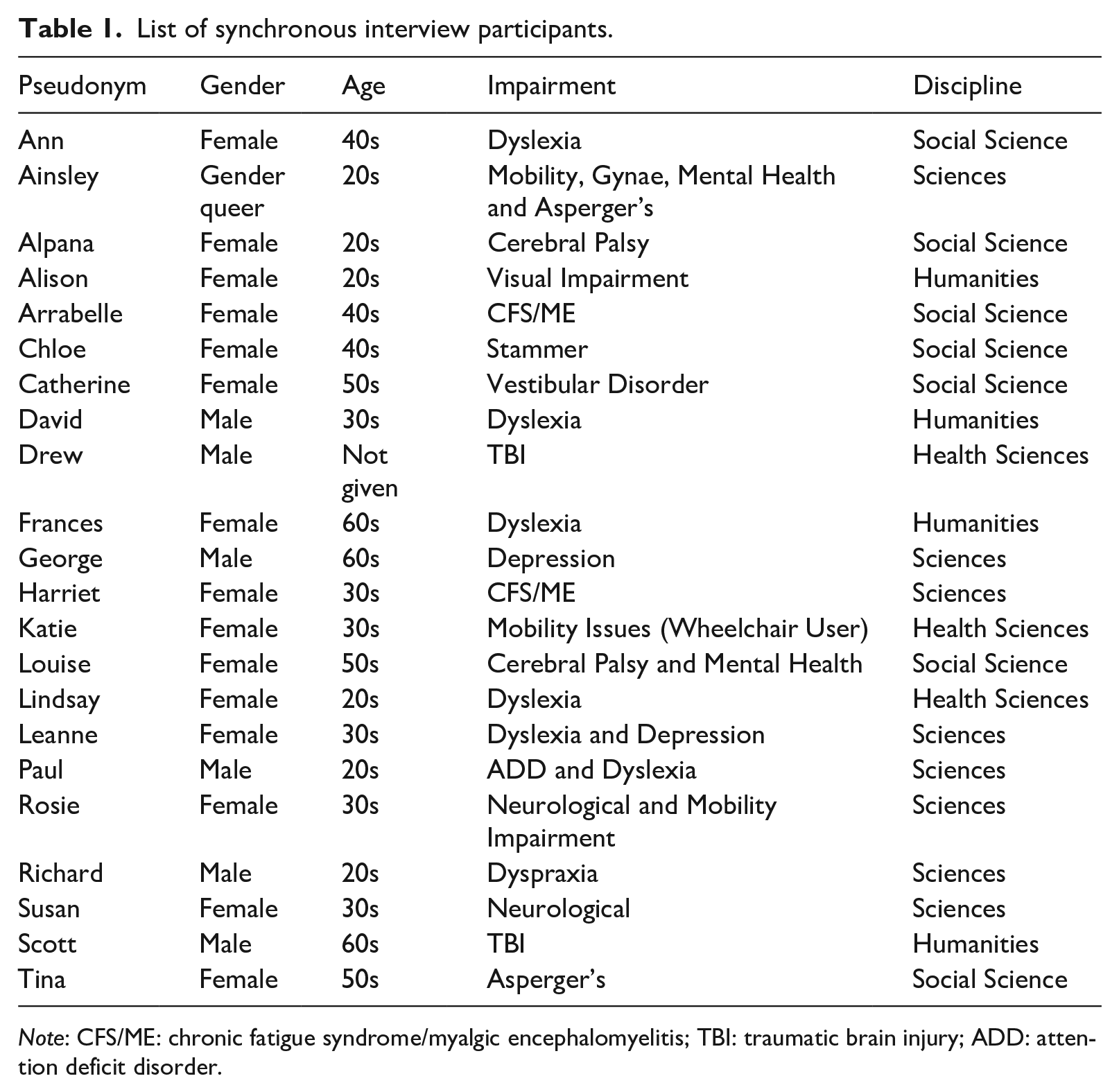
Note: CFS/ME: chronic fatigue syndrome/myalgic encephalomyelitis; TBI: traumatic brain injury; ADD: attention deficit disorder.
Workplace Stakeholders
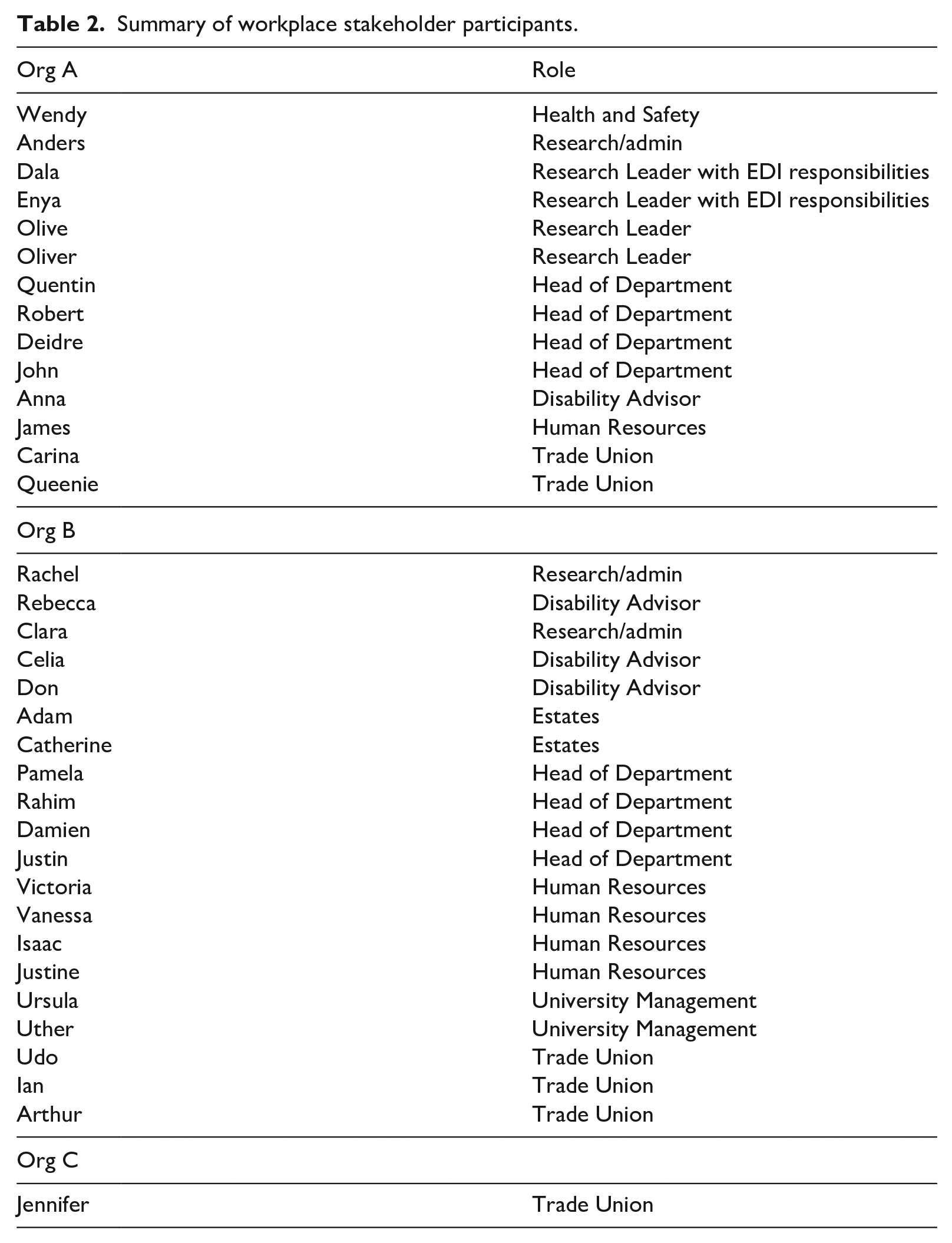
Thirty-five interviewees from three universities in Scotland were identified and recruited as university staff with a role in supporting or managing disabled employees. Interviewees were trade union representatives or held line management roles, including members of university management, heads of departments and/or research centres, HR professionals, estates, health and safety and research administration staff. Four interviewees held disability-specific roles supporting staff and students. The participants had varied experiences supporting or managing disabled colleagues. Interviewee information is summarised in Table 2. Interviewees were recruited via email invitations from the first author. Workplace stakeholders were identified via professional networks and publicly available job titles and recruited via targeted emails.
Summary of workplace stakeholder participants.
All synchronous interviews from both participant groups were semi-structured. Disabled academics were asked about their career histories, ‘impairment’ history and their experiences of academic work in relation to their impairment or disability, therefore providing insight into the impacts that institutional assumptions in both policy and practice had on their professional lives. Workplace stakeholder participants were asked about their roles and experiences in supporting or managing disabled staff and to provide examples of this management or support, addressing directly the logics and rationales that guided their decision making. Synchronous interviews lasted between 30 and 90 minutes. All project interviews were conducted in line with ethics and data management codes of good practice; for example, transcribed using data protection compliant professional transcription services, anonymisation (directly and indirectly) and saved on secure university servers.
This research was overseen and ethically approved by the social sciences research ethics committee of the university of the second author of the article, who also directed the projects. To minimise and avoid ethical issues, an effort was made to prioritise flexibility with synchronous/asynchronous semi-structured interviews and we anonymised interviewees’ identifiable data where possible for confidentiality. Disability can be considered a sensitive topic, and disabled people are sometimes viewed as a vulnerable group (Trevisan and Reilly, 2012). The research team sought to avoid patronising or ableist language when engaging with participants. Participation was voluntary. Gatekeepers were not used as part of the recruitment process for either disabled or non-disabled participants.
University Policies
Eighty-four university policies and associated documents from all 15 Scottish universities were analysed as part of this study. We analysed documents used by those in university leadership positions and HR professionals specifically in the management of disabled staff. The authors made the discretional judgement to remove health and safety policies from the analysis due to their limited content (signposting to other policies for the management of disability and ill-health) and include in the analysis where possible guidance documents on policy use or related to the support of disabled staff, as well as condition-specific policies and procedures. Policies and associated documents were sourced from public-facing university websites and email requests (including freedom of information [FOI] requests) to HR departments in other institutions during 2019.
The above information is summarised in Table 3. Where possible, the date policies were authored and the most recent, or next suggested review date are included. It was not clear in all the documents whether the dates listed related to reviews or updates. Some universities have updated their policies since data collection/analysis and submission. Where possible, this is also noted in Table 3.
Information on policy and associated documents analysed.
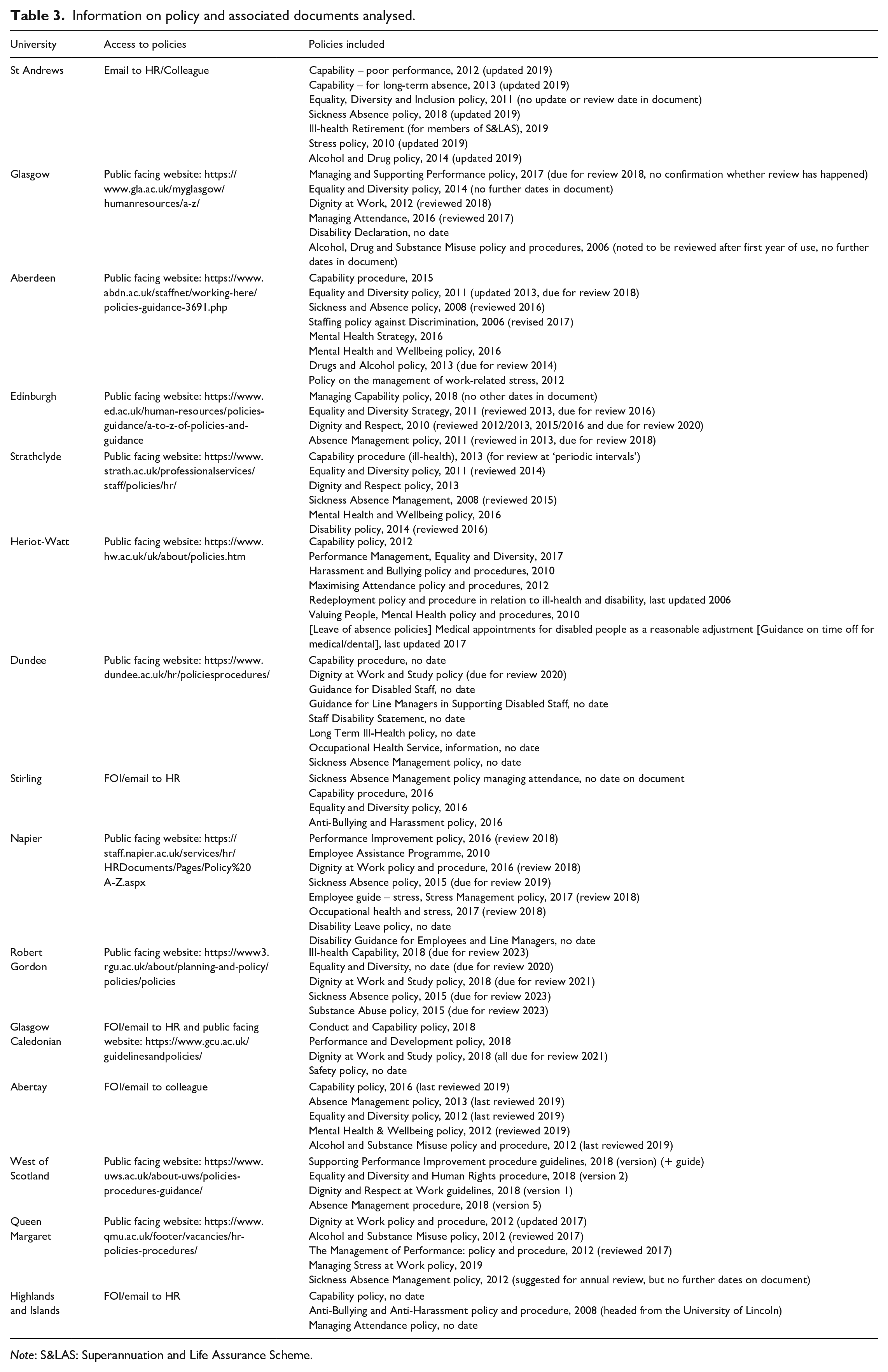
Note: S&LAS: Superannuation and Life Assurance Scheme.
Analysis
Data were organised in NVivo 12. Transcripts and policies were read, re-read, compared and discussed among the authors to develop a coding structure. The analytical process was iterative, with set research questions developed a priori focusing on the content, interpretation and enactment of organisational policy. However, we remained open to unanticipated themes and concepts generated during project interviews. As such, the analytical protocol involved a combination of inductive and deductive thematic analysis, which is a tested method for exploring policy documents alongside other qualitative data (see Fereday and Muir-Cochrane, 2006). The interview aims were deliberately broad to draw out all widest possible experiences of managing disability in university workplaces. The research team sought to use data analysis to identify where dominant institutional logics informed processes and assumptions in universities.
The use of recurring concepts, phrases and assumptions to identify the influence of institutional logics and their impact on disabled people in the workforce was noted as part of the analysis. This analytical protocol established three key findings: (1) that the dominant logics and rationales in the universities relating to the management of disabled colleagues were divorced from EDI rhetoric and instead situated them as ‘other’; (2) that the experiences and testimonies of disabled staff are valued less than those of students; and (3) that a diagnosis is operationalised in workplace disputes and concerns about meeting legal requirements but outside of disability as an issue of diversity.
Findings
Data generated as part of this study supported previous work arguing that the dominant logics in UK universities are the profession and market logic. Broadly, data from academic staff drew on the diminishing professional logic, and data from other workplace stakeholders, particularly HR professionals and many senior management staff, were informed by market logic. Despite the variety of occupations across the participant group, and presence of two conflicting logics, it was apparent that the contemporary market logic is particularly damaging for disabled academics’ careers. Disabled academics discussed potentially withdrawing from the sector and feeling as though they could not match up to the requirements made of them as academics, particularly so in a competitive market setting.
The ‘Unproductive’ Academic
University policies were influenced predominantly by market logic, their substantive content related to maximising staff presence and performance, as well as meeting legal requirements regarding workplace law. Reported communications from university leaders requiring academic staff return to work from the office for a minimum number of days per week suggests that maximising staff presence continues to be a priority ‘post-Covid’ (Bena, 2023). The policies inhibited some of the historical autonomy and freedom associated with the academic profession, specifically by limiting flexible working opportunities and the utilisation of staff performance reviews and other performance-related metrics. The importance of performance and presence in university policy had implications for disabled academics who were categorised in terms of what they cannot do, rather than an asset within the workforce. Managers identified that the policies they used to support disabled academics were sickness absence management policies and policies relating to performance and capability. Interaction with policy, then, for disabled staff, was to be categorised as an unproductive, or absent subject. The primary concerns of HR professionals, as outlined in their interviews, were to ensure workforce efficiency, enforce attendance, streamline departures from the workplace of unproductive subjects and meet legal requirements for dismissal. Their professional rationales reflected priorities aligned with market logic and the corporate university. Regarding interactions with disabled colleagues the ‘starting point [for HR] is the reason for the absence, as opposed to is there a disability’ (Victoria, HR, Org B), which was reflected in the experiences of disabled academics who found themselves ‘queried about [their] performance’ when they disclosed impairment effects (Donald, disabled academic).
The categorisation as ‘unproductive’ aligns with the market logics present in the neoliberal university. Disabled academics are subject to managerialist policies that position them as detrimental to the performance of the institution, rather than as organisational actors whose distinct experiences may enhance the work of a university: teaching and research. Being categorised as unproductive had material implications for the career development of disabled academics. Scott explained how his professional development meetings changed tone after he acquired his impairment. He commented on how he was no longer expected to progress or praised for his accomplishments but was instead informed that he was doing well for ‘coping’ with his disability.
Scott’s experience was mirrored in interviews with line managers and HR professionals who were unable to explain how university EDI aspirations would be applied to standard occupational processes such as recruitment and promotion. One manager said that he did not know how he would accommodate specific conditions into the recruitment interview process despite knowing that he ought to. This concern was repeated in an interview with Sylvia, a senior HR professional, discussing how to incorporate EDI agendas into the promotion process:
I don’t know to be honest . . . I don’t know if in reality when people are sitting around assessing somebody’s application, whether they would look at what someone had achieved. We are looking at reviewing our academic promotions policy and specifically putting something in there that says, you know, allowances should be made for breaks in service and things like that. But practically, how that would work, I don’t know. (Sylvia, HR, Org A)
The inability to apply inclusivity to university practices extended beyond individual career progression. One manager, Robert, led a large Science department in a university. When responding to questions regarding the inclusion of disabled colleagues Robert said it should be a strategic focus within universities. However, he did not incorporate inclusion into the strategic departmental and university leadership meetings that he led or chaired:
sounds like a callous thing to say, but it’s just the truth. I don’t think it [disability inclusion] does [get discussed in meetings]. I think for strategy meetings, at least in my [department], we tend to focus on either things that are big and wide and strategic and in effect, typically . . . typically income, or affect somehow our academic strategy. (Robert, Head of Department, Org A)
Disability is not discussed or accommodated within university processes such as promotion, or departmental-level strategies. Disability does not align with the market logic increasingly defining university practices, as it is positioned by key and influential university stakeholders in opposition to maximised productivity and minimised cost.
Students as Consumers
Both interview and policy data showed that the support available for disabled staff was poorer than the provision of support for students, demonstrating that students were constructed as consumers by HEIs, and subsequently their needs were placed at a higher priority than those of the creators and disseminators of the knowledge being consumed. This prioritisation of students could be due to universities’ legal responsibility in the UK to anticipate the needs of disabled ‘users’ (students), with no such comparable legal responsibility towards staff. Whereas student disability should be pre-empted, accessing support for staff required that individuals evidence their condition and prove that it is ‘genuine’: ‘the university provides, quite rightly actually, provides zero support unless you’re diagnosed’ (Olive, Research Leader, Org A).
Data illustrated an institutional reluctance to provide disabled academics with workplace accommodations, the provision of which was subject to scrutiny and surveillance:
The University is aware that sickness absence may result from a disability. At each stage of the sickness absence procedure (set out in paragraph 1.8 of this policy) particular consideration will be given to whether there are reasonable adjustments that could be made to the requirements of the job or other aspects of working arrangements that will provide support at work and/or assist a return to work. (Abertay University Absence Management policy)
University policy required the provision of medical expertise in the form of doctors’ certificates and occupational health support, with little to no mention of the individual staff member’s expertise in how their health or impairment interacted with their job roles and how specific accommodations might support them.
In one example, the power imbalance between students and disabled staff was particularly stark. Claire (disabled academic) explained how her department received a student complaint about her relating to her impairment and which included ableist language. There was no attempt to support or protect the employee, which meant misinformation spread throughout Claire’s department. The data evidenced the consumerist notion of the customer being right, whereby students’ own ableism towards staff was systematically supported, in sharp contrast to study participants’ experiences of former students who recalled that the visibility of disabled academics was a key reason that they had chosen to pursue a career in academia themselves. Unfortunately, a repeated pattern in these data was that in progressing from student to staff member, participants noticed a sharp decline in the support they received – even when they had received inadequate support as students.
Some disabled academics were actively discredited or had their concerns related to teaching belittled by their managers, who were more focused on organising teaching workloads. One participant, though not from the UK, offered an illustrative account that was reflective of those from UK-based academics. She explained that she could not teach in a particular lecture hall due to her impairment. She confirmed this again with a new manager when she saw that she had been put down to work in that lecture hall the following semester. She described her manager’s response:
the reply I got from the new person was, ‘yes, I heard you don’t like teaching in there. I’ll see what I can do’, and I thought, you know, that’s not okay. It’s not a preference . . . she did make the switch, but it was, I think, telling to me that it was treated as a ‘here’s this professor being difficult about where she teaches’. (Colleen, disabled academic)
Colleen’s quotation demonstrates local reluctance to provide simple workplace adjustments, despite there being an obvious benefit to students. Colleen’s wider interview showed that her manager did not engage with her any further and did not work to ensure Colleen was included, beyond the minimum requirement of changing the teaching room. Indeed, Colleen’s line manager would change her teaching load at the last minute without warning and she was teaching four modules each semester. Ultimately Colleen reported her management made her feel ‘insubordinate’ for requesting an accommodation, and this combined with her teaching load led her to change employers. This phenomenon of employees being made to feel as though they were being difficult, and the situating of their needs in opposition of the needs of students, was repeated throughout the datasets and reflected in interviews with managers. Disabled academics explained they were concerned that their managers thought they were ‘making a fuss’ over things they should ‘just be putting up with’ (Alex, disabled academic) and running the risk of developing a negative ‘reputation’ (Ian, Trade Union representative, Org B).
Operationalising Diagnosis
A feature of the data was the failure of EDI strategies, policies and legislation to challenge the dominant market logic present in UK universities. Instead, these strategies represented an obstacle to managers who viewed disability as an absence or performance issue and focused on their legal requirements not the meaningful implementation of workplace adjustments to create more inclusive working environments. Justin, a senior manager, described his experience managing an employee who was expected to be dismissed:
I have an academic who was in performance management who would have been dismissed, but it turns out he’d had cancer and it turns out we’ll not be dismissing . . . you’re almost at the end of the process and this [diagnosis] pops up. (Justin, Head of Department, Org B)
Justin described this introduction of a diagnosis to proceedings as undermining the process of performance management up until that point. This view was replicated across the data from trade union representatives who described using member diagnoses to conclude performance management procedures. Ian, a trade union representative, explained how when supporting one member he was handed a confirmation of diagnosis just before attending a formal dismissal meeting. Ian explained they were able to leave the meeting, employee contract intact, because of managerial concerns about liability, not any apparent desire to retain the specialist knowledge of a highly qualified and specialist professional. As such an individual’s diagnosis is used by the trade union representative as a shield to protect that particular worker, while the collective issue of accessibility remains unchanged.
These concerns were present in all employment stages. Justin’s case was particularly illustrative of this. When asked how he would respond to a workplace disclosure of disability and whether he felt prepared Justin responded:
You’re never ready. They would say ‘this is who you could talk to in terms of understanding legislative constraints’, and you could very easily make a mistake, either to the detriment of the individual, or to the institution which you have a responsibility to, because you’re unaware of those things. (Justin, Head of Department, Org B)
Justin identified, as did many other participants, that these concerns further contributed to institutional reluctance to employ and support disabled people. Numerous participants commented on managers not feeling comfortable discussing disability and disabled participants described not disclosing their conditions or impairments until after recruitment interviews, or only after they were experiencing difficulties to avoid their concerns being ‘presented straight back to [them] as [their] personal issue[s]’ (Daniel, disabled academic). The result of this was that issues faced by disabled employees ‘could have gone on for quite some time and by the time the member contacts [their trade union] it’s usually quite a serious performance issue’ (Arthur, Trade Union representative, Org B). Disability became operationalised for negotiation, putting unnecessary pressure on the individual to accommodate the failings of the university, rather than presented as an argument to reintroduce some of the professional autonomy central to the diminishing professional logic present in HE.
Discussion
This article has highlighted how disabled academics are under-represented in the organisation of academic life. Unrecognised in policy and undermined by the increasingly dominant market institutional logic in HE, it is not surprising that the clear majority of disabled academics refuse to declare a disability compared with the percentage of disabled people in the wider UK working age population (HESA, 2020). Disabled academics are constructed within HEIs as obstacles to service provision to students and/or performance concerns to their immediate managers. We also highlight how disabled colleagues experience their diagnoses being (unintentionally) used for local and national industrial disputes. Figure 1 outlines the thematic contribution of the article in relation to the research questions and data.
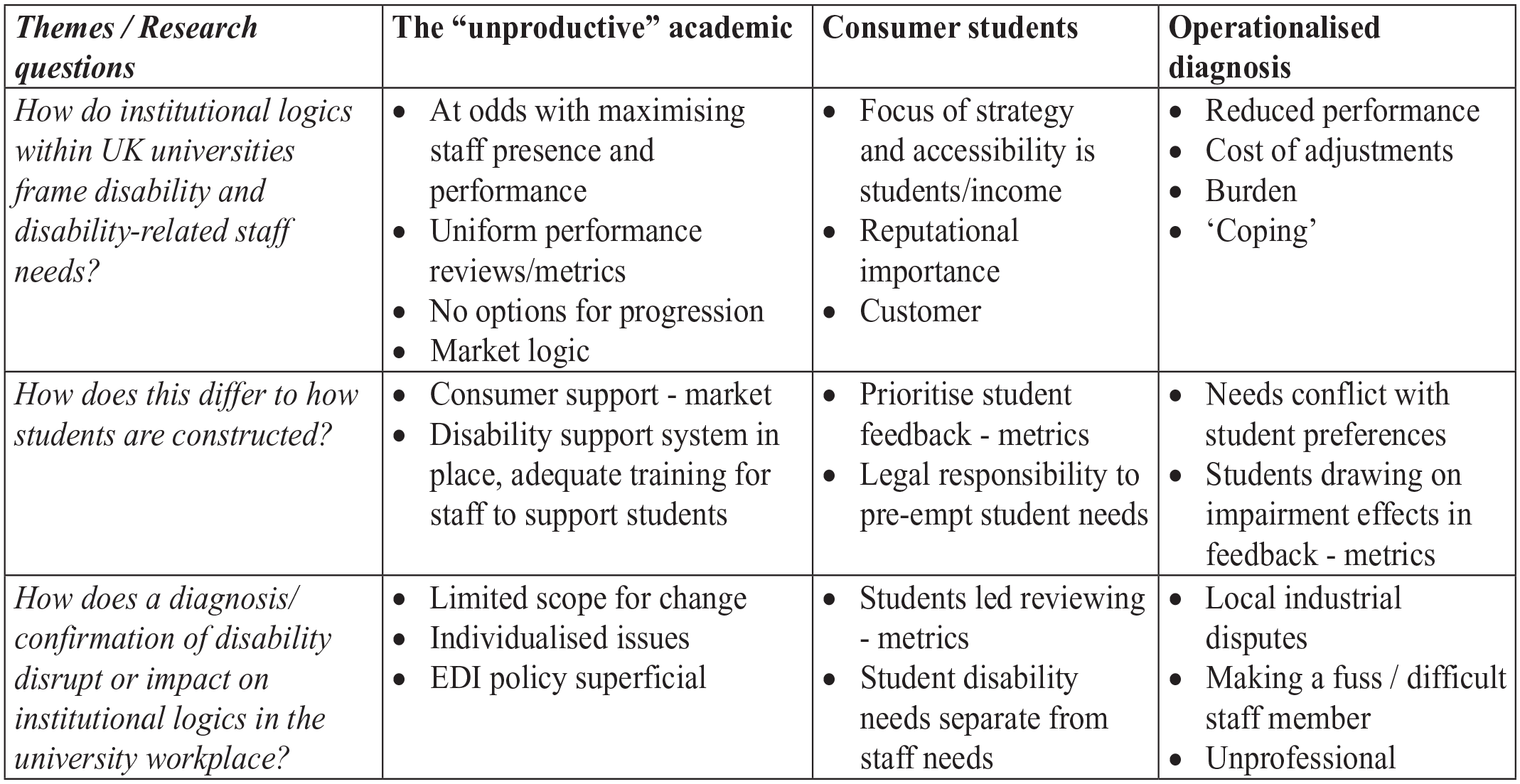
Summary of themes from data and research questions.
Disability does not feature in the organisation of UK universities – and as such the contemporary ‘rules of the game’ (Thornton and Ocasio, 2008: 112) are exclusive and create additional labour for disabled colleagues. The practices of university managers and the policies they draw on hint at cultivating, but evidently do not cultivate, inclusivity and diversity and support the continued under-representation of disabled people, people of colour, women and other disadvantaged groups within a working context increasingly defined by targets and metrics. This article supports research that has found the neoliberalisation of UK HE to foster sexism (Phipps and Young, 2015). This article illustrates how at a micro level, logics in universities preclude the inclusion of disabled colleagues from being a meaningful priority, or a measure by which to define success – key elements to the manifestation of institutional logics (Thornton and Ocasio, 1999).
The social construction of disability, rules and material practice by which university managers organise space, time and activities in university settings replicate wider issues of ableism and are divorced from the rhetoric of EDI policies. EDI policy in this context can be seen as, at best, unhelpful, and at worst, associated with a managerially driven agenda aligned with market logic (Noon, 2007). Irrespective, the purpose of EDI documentation with regard to supporting disadvantaged staff is shown to be persistently trumped by the adoption of consumerist practices for students, and not absorbed into the professional practices or narratives of most university staff. This suggests that diversity discourse has been developed predominantly as a branding opportunity to attract talent and/or custom (Edgley et al., 2016). This undermines the ability of EDI policy to challenge institutional inertia, as HEIs fail to acknowledge inequalities and do not prioritise addressing them (Pilkington, 2020).
Data presented in this article suggest that the exclusion of disabled academics is a feature of institutional market logic. This exclusion is a durable and enduring feature of social life (Giddens, 1984) for disabled colleagues, ‘woven into the fabric of regulatory structures, organisational forms, and social norms’ (Smets et al., 2015: 934) in the universities sampled from, despite the existence of EDI policies.
University policies and procedures do not recognise staff disability, thus limiting access to leadership positions (Emira et al., 2018), submission to research assessment processes (Leathwood, 2017) and promotion. We argue that there is an under explored exclusionary element to institutional logics in UK HEIs, that precedes the introduction of neoliberalism to university practice, but which is exacerbated by the productivity focus of market logics (Edgley et al., 2016).
As a sector, we could revisit Collini’s (2012) question ‘What are universities for?’ and find that the answer might not be to contribute to the economic productivity of the country by reproducing neoliberal capitalist relations of production, student fees and withdrawal of state funding (Kulz, 2021; Maisuria and Cole, 2017). Until academic institutions adopt logics of diversity and inclusion, they will continue to fail to address the unique access needs of academic staff (Smith and Andrews, 2015) and impairment effects will continue to act as a career boundary for disabled colleagues (Williams and Mavin, 2015). Inclusivity could be found in the incorporation of social justice approaches prioritised by some organisations in the voluntary, third and charitable sector (Tomlinson and Schwabenland, 2010). HEIs, with their institutional rhetoric of creating inclusive campuses for staff, students and faculty, represent a key work environment for championing disability and altering employment practice (Evans et al., 2017).
This change might also be incorporated into the practices of associated trade unions the representatives of which in this study showed resistance to the increasing dominance of market logics in relation to wider industrial disputes and individual case support in the workplace. In these disputes, trade union members sought to defend their work as teachers and researchers against the onslaught of managerialism, marketisation and metrics. Disabled academics, further disadvantaged by the adoption of market logic than non-disabled colleagues, have been used as a moral cause to defend traditional, autonomous and flexible academic working practices. However, in practice, individual casework relating to disability represented the use of diagnoses to support colleagues in performance-related disciplinary procedures.
This article presents new insights into the exclusion of disabled academics in HEIs, by drawing on Thornton and Ocasio’s (1999) concept of institutional logics. A further contribution is made in terms of how the findings have the potential to help enact important, strategic and long overdue change to disability human resource practices for academic workers. International data collection can further contribute to this conversation by exploring nuances in the intensity and impact of market and EDI logics across nation states and geographical regions, deepening our understanding of institutional tensions and changes in HE sectors. We can also speculate that the self-image within the sector as liberal and progressive might breed complacency when this conflicts with market demands, which may not be reflective of other sectors.
Footnotes
Acknowledgements
The authors would like to thank their participants for providing their time and insight.
Funding
The authors disclosed receipt of the following financial support for the research, authorship and/or publication of this article: this research was funded by an EPSRC Inclusion Matters Project, Disability Inclusive Science Careers, Grant reference EP/S012117, led by the second author at Heriot-Watt University.
