




Abstract
Electronic drug markets enable calculative, impersonal trade between faceless strangers, but also intimate interaction between pseudonymous users. In this space, do people treat banned drugs as ordinary consumer products that can be purchased from anyone? Or do drug-takers frame their consumption as a counter-cultural activity? To answer these questions, I use qualitative and computational research methods to analyse 3788 electronically published consumer reports of cannabis and psychedelic drugs from the period 2011–2017. I find that report writers emphasise product quality, customer service and transaction value, and devote less attention to the social and political sides of drug-taking. Discussions about legality, morality and counter-cultural ideas are completely absent from the texts, even in psychedelic reports, which detail profound effects. These findings suggest that drug e-commerce is primarily a normalising force, and that widening access to banned drugs is unlikely to disseminate counter-cultural perspectives.
Introduction
Markets provide institutional structures for commerce; exchange is made predictable and conflicts resolvable. This ‘stable world’, on which trade is contingent, is reproduced by routine interactions between actors in well-defined positions (Beckert, 2009; Fligstein and Calder, 2015). A salient part of what market actors do to maintain this order is to negotiate and determine the normative definitions of their exchanges (Almeling, 2011; Healy, 2010; Zelizer, 1978). All buyers and sellers base their consumer choices at least in part on cultural frames and moral judgements, as they have a sense of what is right and wrong for people like them (Wherry, 2012). These considerations are imperative in illicit markets, where goods and services are seen through contesting frames (Parker et al., 2002).
I examine the framing of drug consumption on darknet websites, where actors are protected by cryptography, masked by pseudonyms and can talk openly about illegal activities. Concretely, I analyse consumer reports of cannabis and psychedelic drugs that people have mail-ordered from sophisticated e-commerce platforms for direct trade between buyers and sellers, henceforth called cryptomarkets (Martin, 2014). Cryptomarkets first emerged in 2011. In recent years, sociologists have studied how cryptomarkets are vibrant social spaces in which people negotiate ideas of morality, share knowledge and build community (Masson and Bancroft, 2018), which helps users overcome police crackdowns (Ladegaard, 2019), and partially explains why trade often remains ‘overembedded’ (Duxbury and Haynie, 2021). Little attention has been devoted to how digital backspaces such as cryptomarkets enable a public presentation of profane consumption, and it remains unclear how unprecedented means for openly secret communication about shadowy matters shape the meaning of drug-taking for its users. When report authors share their accounts of drug-taking with the larger mass of cryptomarket users – of which there are at least hundreds of thousands (Department of Justice, 2017) – their perspectives influence normative understandings of what is considered a good or bad purchase, and in turn, what drug consumption is supposed to offer. As Becker (1953) famously noted, drug-taking is a socially constructed practice that depends on shared definitions and interpretations of physiological and psychological drug effects. Without any guidance or experience to rely upon, drug-induced changes in arousal and comfort can have multiple meanings that can both discourage or encourage further consumption. In our time, the framing of drug-taking warrants attention because the popular and political push for drug law reform continues to build momentum, and particular drugs might become more mainstream (Bromwich, 2020). I inquire whether publicly available and widely disseminated consumer reports frame drug-taking as a vehicle for ordinary pleasures, or as a pathway to counter-cultural thinking and living.
People frame their legal transgressions in various ways. Sykes and Matza (1957) argued that because lawbreakers often wrestle with inner moral obligations to abide by social and legal norms, they experience painful cognitive dissonance. This discomfort is neutralised by refashioning their decisions and behaviours. Sykes and Matza help us understand how people can under certain circumstances commit horrendous acts (I’m not a violent person, but that man hurt my child. . .), but their work is less helpful for making sense of deviant acts that are unlikely to generate strong feelings of guilt or shame. Sometimes, banned acts are considered socially acceptable (Svensson and Larsson, 2012), or even attractive and desirable (Katz, 1988; Topalli, 2006; Young, 2003). In such cases, framing analysis is an alternative. While neutralisation techniques examine subjective decision making, framing analysis examines collective representations of meaning. I study (1) how people frame their illegal consumption, and (2) how such consumption appears to newcomers and outsiders looking in. By analysing how consumer frames are presented and disseminated, I hope to identify some of the normalising processes for goods and activities that are inconsistently defined by legal and social norms, such as recreational consumption of drugs, which is at the centre of public and political debates about harm reduction and legal reform (Bromwich, 2020; Open Society Foundations, 2011).
I define frames as semantic contexts that project particular interpretations or associations of a given phenomenon. The clarity of Goffman’s writing is helpful here. In Framing Analysis (Goffman, 1974), he explained that social frameworks – made up of interpretations of a given situation’s context and interactions – provide meaning and help us determine what is relevant and irrelevant when we consider certain observations or thoughts, for instance when we evaluate a scruffily dressed man on the subway, feel the effects of newly imposed austerity policies or walk through the chaotic aftermath of a natural disaster. In the case of consumption, framing is often hidden in plain sight. The supermarket clerk and customer who exchange milk, butter and toilet paper for money will not need to convince each other or anyone else that their economic activities are morally acceptable. But in other cases, framing is contested. For example, whether people are willing to place securitised bets on life expectancy, or donate blood, organs and reproductive material, depends in part on how compensation is framed (Almeling, 2011; Healy, 2010; Zelizer, 1978). Framing, then, solves definition problems. When market actors accept or reject definitions, they negotiate and contribute to a collective understanding of the economic activities in question, what they mean and how they should be conducted.
Illegal activities are framed as profane by the institutions that control and report on them, such as the police, the courts and mass media (Hall et al., 2013). Their accounts delegitimise alternative perspectives, such as that drug-taking has recreational and medicinal value. Although such frames are sometimes promoted by pop culture, progressive politicians and activists, direct trade that disregards the banned status of drugs has been confined to the shadows (Beckert and Wehinger, 2013). But this is changing. People can now buy and sell banned products on openly available websites, where they can also discuss, negotiate and disseminate their own consumer frames. Perhaps the most salient feature of such cryptomarkets is that buyers and sellers can operate publicly, with pseudonyms that are both secure and verifiable. This kind of ‘open secrecy’ (Ladegaard, 2020) enables public conversations about all things related to drug trade, and several studies have found that market actors are heavily involved in such communities (e.g. Munksgaard and Demant, 2016). When drug-takers can express themselves freely, how do they frame their consumption? Do they adopt a conventional consumer logic, and/or do they frame their drug use as a counter-cultural activity?
Controversial frames will at times branch out of their local milieus and connect with a mainstream audience. Drug-takers’ newfound ability to talk openly about their consumer choices and experiences might influence public opinion, which is increasingly supportive of drug decriminalisation (Bromwich, 2020). At the very least, drug-consumption frames will shape how cryptomarket users and curious outsiders think and feel about drug-taking, and possibly how they experience it, as drug effects require interpretation (Becker, 1953). If people are told – directly and indirectly – that drug-taking is a pathway to alternative ways of being and thinking about the social order, as research on ‘cannabis culture’ suggests (Sandberg, 2012, 2013), it follows that widening access to drugs and public conversations about drug use might also kindle critiques of the status quo. But if people frame drug-taking as a mere recreational addition to contemporary mainstream life, then drug-taking will instead expand the prevailing consumer culture and reproduce the status quo (Marcuse, 2013). To document which frames dominate in cryptomarkets, I study how buyers detail their consumption of cannabis and psychedelics. The former drug is associated with counter-cultures and is particularly relevant due to its central place in legalisation and decriminalisation trends, while drugs in the latter category have a prominent place in the history of alternative lifestyles (Glausser, 2011).
Contested Frames of Consumption in Legal and Illegal Markets
All market actors affirm and negotiate the moral worth of their exchanges. Elaborate performances are redundant when people trade standard commodities and services, but at times, there is work to do. One example is the art business. While art dealers are capitalist actors, they often strive to preserve art’s sacredness by downplaying commercial aspects of their trade. They eschew direct talk about money, foreground their personal love of art, refuse to sell to investors and seclude payment devices and business negotiations to the gallery backroom, away from the art displays (Velthuis, 2013). Zelizer’s classic case is the life insurance market, which initially failed because people viewed insurance policies as grotesque and profane encroachments of human life. It did not take off until marketers convinced customers that purchasing a protection policy on a human life is a way to safeguard the family against potentially ruinous misfortunes (Zelizer, 1978). In markets for human blood and organs, in which organisations are dependent on donors, procurement is carefully framed as meaningful gifts (Healy, 2010), much like how egg donations are solicited, but notably unlike sperm banks, which use and highlight economic incentives, which are believed to match masculine ideas of worth (Almeling, 2011).
Consumers of banned drugs reject state-sanctioned frames, which often exclusively portray drugs as harmful and dangerous. In conventional drug markets, many consumers frame their consumption as normal. They might claim that drug-taking is ‘no big deal’ (e.g. Hathaway et al., 2018; Parker et al., 2002), or frame drug-taking as a form of risky but socially acceptable recreational consumption that is about personal choice, like tobacco and activities such as hang gliding (Parker et al., 1998). Others frame drug use as a way to manage everyday challenges, for instance ‘to induce relaxation, reduce stress, and mediate sleep patterns’ (Parker et al., 1998: 132). With these frames, consumers contest the boundary between legal and illegal drug-taking. They dispute rigid definitions coming out of the medical sector and criminal justice system, and claim that drug consumption is a normal part of human life.
Drug-takers also frame their consumption in opposition to normality (Collison, 1996; Hathaway et al., 2018; Lyng, 1990; Measham, 2004; Mohamed and Fritsvold, 2006; Sandberg, 2012, 2013). An insight that can be traced back to Durkheim is that cultural norms are constituted in part by what is excluded, rejected, scorned, despised and ridiculed, because ‘negation is affirmation’ of what is distinct about your group or community (Appiah, 2010: 138). Drug-taking has been framed as a rejection of both mainstream consumer culture and legal norms. For example, drug consumption has been framed as a means to script and idealise alternative and criminal identities (Collison, 1996; Mohamed and Fritsvold, 2006), and some cannabis consumers frame their drug-taking as counter-cultural acts that express anti-commercial, ecological and communal values (Hathaway et al., 2018; Sandberg, 2012, 2013). ‘Drug dealing’ is often not about maximising gains, but rather amounts to ‘social supply’ or ‘minimally commercial supply’, where exchange partners are friends and acquaintances who ‘share’ (Coomber and Turnbull, 2007; Hathaway et al., 2018). Some see their drug-taking as a ‘revolt against the mundane’, and transgress rules because they are there (Young, 2003: 391). In the words of one drug consumer: ‘if it was forbidden, we’d do it’ (Sandberg, 2012: 1133). Drug-taking has also been framed as a form of edgework, deliberate risk-taking that goes beyond the ordinary and pushes the boundary between order and disorder (Lyng, 1990). By giving in to the chaos of the moment and embracing a controlled loss of control, drug-takers escape the dull routine of ‘straight’ society and rebel against ‘the surveillance, regulation, and risk management of consumer society’ (Measham, 2004: 343–344).
The framing of drug use might be affected by the structural conditions of illegal trade, which are changing. We know that most contemporary drug market actors keep commerce within closed, personal networks (Coomber and Turnbull, 2007; May and Hough, 2004; Parker et al., 2002), in part to avoid the risks of open markets, but cryptomarkets enable impersonal trade. By connecting individual buyers and sellers in online mail-ordering platforms that look and work much like conventional e-commerce websites, people can trade without ever meeting face-to-face. Although global law enforcement agencies shut down the markets they can, trade continues as actors maintain communication, reorganise and resurface on new servers and domains, often in a more sophisticated form (Ladegaard, 2020). In this realm, where drug-takers can trade impersonally but also talk openly about their activities, how do they frame their consumption? Do they adopt a conventional consumer logic, as the novel markets work, look and feel much like legal e-commerce, and/or do they use their newfound means for openly secret trade and communication to frame drug-taking as a counter-cultural activity?
It has been argued that a dealer’s cultural background has greater impact on their business than economic rationality (Bucerius, 2007), and drawing on this logic, it is possible that cryptomarket actors are, due to drug trade’s long-standing dependence on social networks, and the counter-cultural associations of cannabis and psychedelics, unwilling to embrace the calculative logic of rational and impersonal market trade. In support of this thesis, research has found that early adopters liked cryptomarkets because they offered personal freedoms based upon cyber-libertarian philosophy (Maddox et al., 2016), and critiqued the criminal justice system for restricting human agency (Ladegaard, 2019; Munksgaard and Demant, 2016). Based on these findings, I expect that drug consumer reports include or at least acknowledge counter-cultural sentiments. However, drug-takers might also welcome their newfound capacity to engage in calculated, impersonal trade and adopt conventional consumer logics, and focus on price, quality and convenience. Actors may believe, or want to believe, that drug use is similar to other kinds of recreational consumption to neutralise the cognitive dissonance that sometimes results from lawbreaking (Sykes and Matza, 1957). It is also possible that market actors do both: invoke counter-cultural logics, but also draw on conventional market language in their framing.
Research Methods
To understand how cryptomarket users frame their consumption, I analyse consumer reports of cannabis and psychedelic products from several cryptomarket forums. The reports, which had a mean word count of 460, typically assess the ordering process and consumer experience. No guidelines are available in the markets and authors are free to discuss whatever issues, experiences and quality markers they want. As the reports review products that are directly available to readers, they differ from ‘trip reports’ on harm-reduction websites and are more akin to restaurant and experience reviews.
Interviews with market actors would likely yield different and perhaps more nuanced information about what people value in their transactions. Moreover, as report authors operate in a pseudonymous space, it is also possible that my data are flawed in particular ways, for instance if vendors covertly write some of their own reviews. Despite these limitations and concerns, the reports offer unique insights into how market actors frame their drug-taking, and in turn, how this consumption is presented to outsiders. The data are by no means a perfect and democratic representation of ‘authentic’ thought or speech in this underworld, but they are unobtrusively collected, directly from the original source, and offer an indigenous perspective on criminal matters that are difficult to study.
I collected consumer reports from seven dominant cryptomarket forums in the period 2011–2017 using python and wget. To compensate for potentially missing data, I included data from extensive website backups made by Branwen (2016). I located consumer reports in the forum data by searching for thread titles that contained common product denominators such as ‘cannabis’ and ‘LSD’, common slang terms such as ‘weed’ and ‘acid’ and variations of the words ‘review’ and ‘report’. With the help of a research assistant, I manually reviewed the resulting ~6000 posts and excluded 2200 of them. I focused on cannabis and psychedelics for several reasons. Cannabis is associated with counter-cultural consumption and is at the centre of a global legalisation and decriminalisation trend (Bromwich, 2020), which suggests that both counter-cultural and normalisation frames could be relevant. Psychedelics have historically been associated with alternative lifestyles (Glausser, 2011), and have powerful and potentially life-altering effects (Griffiths et al., 2006), which might mean that consumers have things to say, and perhaps for the first time, a platform on which to speak to a larger audience.
The analysis had a qualitative and computational component. For the qualitative analysis, I analysed 200 reports in sequential steps of open and focused coding (Emerson et al., 2011). I first read through the reports quickly, with an open mind. I captured an excess of ideas and themes related to the subject matter, and wrote down potential codes (e.g. ‘shipping’, ‘communication’) for more detailed analyses. I frequently returned to sections of particular interest to compare my initial codes and to test them against the data. My research assistant and I then discussed the data and our preliminary findings, jointly coded several reviews and then systematically coded the 200 reports (total word count was 77,800). Data saturation was reached after reading about 40 posts from each drug category. Through this process, we identified five salient topics: product quality, customer service, market value, drug effect and social setting.
For the computational analysis, I used Inductive-Deductive Topic Modelling (Ladegaard and Rieger, 2023). I first compiled terms associated with the five topics, drawing from our qualitative analysis. I then built a machine learning model 1 that converted the larger corpus of 3788 drug reports (from which the 200 reports were drawn from) into a vector space, where the location of each word is based on its semantic distance to others. This enables inductive word discovery. For example, I knew from the qualitative analysis that authors talk about drug effects using terms such as ‘euphoria’ and ‘calming’. By searching for words located near these two and other related terms in the vector space, I learned that actors also describe drug effects with terms such as ‘couch_lock’. I compiled a list of 500 suggested terms for each topic, included salient ones in each topic dictionary and repeated the process. To avoid false positives, I reviewed ambiguous and highly frequent terms. To avoid false negatives, I counted the occurrence of words that were not in my dictionaries, and reviewed all words that appeared at least 100 times in the data. After finalising topic dictionaries, I counted all words in each topic across the dataset.
The qualitative hand coding and computational analysis yielded broadly similar results, which suggests that my findings are valid. Below, I first present the computational results, and then discuss insights from the qualitative analysis.
Framing of Drug Consumption
Report writers were primarily concerned with five topics (Figure 1). I measured product quality by counting terms associated with ingestion, potency, taste and smell. As many psychedelics are odour-free and flavourless, unlike most cannabis products, terms associated with quality were more common in cannabis reports. However, the scant attention given to drug effects in cannabis reports (more on this below) suggest that the emphasis on quality is not merely due to an abundance of indicators (e.g. measures of product freshness), but also because other topics were sidelined. Customer service, measured by terms associated with communication, shipping, stealth and professionalism, was the most prominent topic in the cannabis reports, and the second most prominent topic in psychedelics reports. The topic dimensions (Figure 2) suggest that the focus on customer service is not solely due to practical considerations. That is, although it makes intuitive sense that cannabis consumers pay particular attention to a seller’s ability to hide smelly products (stealth) to evade detection, this does not explain why cannabis consumers seem to care more about professionalism, communication and shipping speed than psychedelic users. Product value, measured by estimations of appropriate price, quality and quantity, garnered surprisingly little attention in both categories. Still, there is a clear difference between cannabis and psychedelics – reports in the latter category downplay the topic, possibly because psychedelic consumers have fewer vendors and products to choose from. Drug effects are given much more attention in psychedelic reports, and the same is true for descriptions of the setting (consumption, social context, and place and activities). I expected this, as psychedelics can occasion powerful experiences (Griffiths et al., 2006; Schmid and Liechti, 2018), but cannabis effects also require interpretation and learning (Becker, 1953), and it is notable that cannabis reports devote little attention to drug effects and setting. Below, I discuss the five topics in detail.
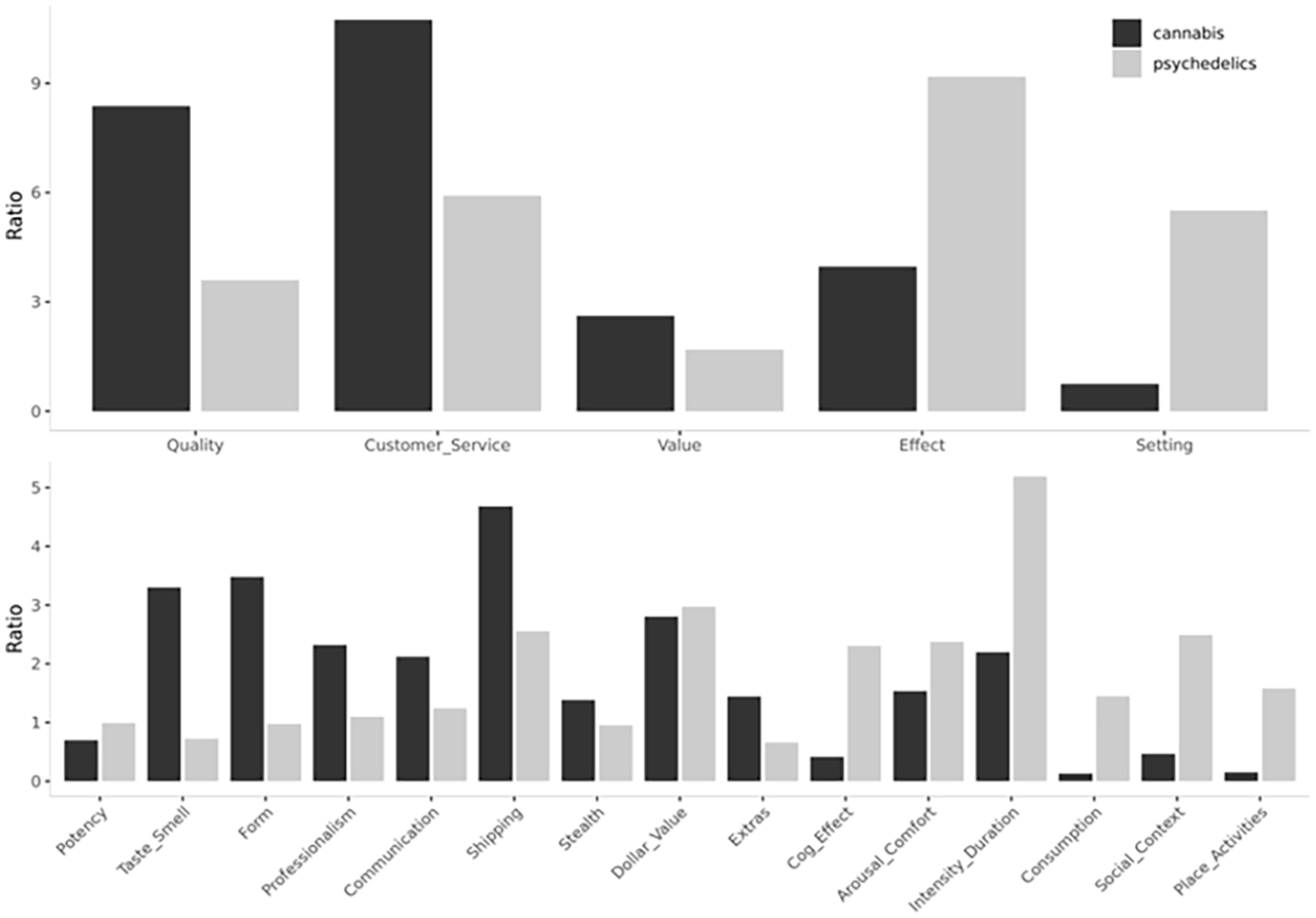
Topic keywords per consumer report (top). Each of the five topics has multiple dimensions (bottom).
Drug Effects
Psychedelic reviews devote considerable attention to drug effects. Often, the reports detail profound experiences that are sometimes framed as ‘journeys’. Below, in an excerpt from a much longer report, the author describes her first experience with LSD: I felt myself journey through countless lifetimes and watch the birth of endless beings on this earth. I watched the entire creation. [I was] filled with extreme euphoria . . . I was lying on my floor . . . totally blissed out . . . I wanted to surrender everything to this beautiful Infinite Consciousness. I was so full of gratitude it was hard to express it all . . . I was also filled with energy. I wanted to laugh and smile and dance and create. Now I’m not typically a creative person (damn science brain!) but I began writing, drawing and strumming my guitar, holy shit it was like an orgasm . . . when I strummed notes I was sent into a dimension of pure vibrational love. It was so beautiful . . . I stared at my face in the mirror as my expressions changed so rapidly without me actually moving anything . . . I was also able to really reflect on me as an individual and come to some interesting conclusions/ideas . . . Thank you. You have opened up another human’s heart to a powerful fuller dimension of being.
The author’s experience was audio-visually intense, emotionally powerful, introspective and existential. She detailed the drug’s effect, and went far beyond calculative assessments, framing LSD-consumption as a gateway to deeply meaningful experiences. She experienced perceptual changes; sounds, sights and thoughts became ecstatic vibrations, mesmerising visions and spiritual encounters. Reflections on the self generated novel insights, and the reviewer’s default tendency to think logically and rationally was overwhelmed by an impetus to create art. She thanked the vendor for facilitating a life-changing experience.
The report above and others like it suggests that drug-taking can be a gateway to deeply meaningful experiences, which has been documented by scholars (Griffiths et al., 2006; Schmid and Liechti, 2018) and ‘trip reports’ that have been published online since the 1990s (e.g. Erowid Experience Vaults, 2020). What’s new here is that someone who reads the report can order the exact same product and will likely have particular expectations for her drug-taking event, which is, as Becker (1953) has argued, likely to shape the experience. Cryptomarkets narrow the gap between the imagined drug and the real deal that can be purchased and consumed.
Cannabis reports devote less attention to drug-effect descriptions and instead appraise product quality and customer service, often in direct and business-like language. A review of a cannabis product of the ‘Bubble Gum’ strain describes its physiological and psychological effects: Nice hybrid that leans on the sativa side of things. Fairly energetic while also a great stay at home smoke. If you are familiar with the Cherry Kush it isn’t nearly as ‘stoney’ as that . . . the Cherry Kush packs a bit more of a punch in the indica department. The taste is very floral and delicious.
The author enjoyed the tasteful drug’s uplifting and calming effects, which were more balanced than she has experienced from other strains. The author is a cannabis connoisseur and assumes that her audience is familiar with the sedating and energising effects of various cannabis types. Such assumptions are common across the cannabis reports, more so than in psychedelic reports.
Presumptions of familiarity might explain why cannabis reports devote little attention to drug effects, but cannabis also offers a complex range of cognitive and emotional experiences. Drug consumers need to learn how to recognise and interpret physiological and psychological effects (Becker, 1953), and the cannabis reports I have analysed do not, for the most part, offer such guidance, neither implicitly nor explicitly. Cannabis products are rather framed as conventional consumer products that generate predictable effects.
Customer Service
Customer service measures dominate reports in both drug categories. Report writers typically highlight shipping (delivery speed and related issues), ‘stealth’ (product obfuscation) and communication (response time). In one report on LSD blotters, a customer spent about half of her 350-word review on customer service dimensions: Order was confirmed the same day and marked as shipped the next day. Order arrived in the northeast USA [after] 20 calendar days . . . Stealth: The package blends in very well with ordinary junk mail. [The Seller] says ‘You can open it and touch it but you won’t even know what’s inside the package.’ The package is smooth and flat and I cannot see the blotters when I hold it against my lamp . . . It is technically ‘hidden’ . . . but if someone else opens my mail they would probably find it . . . Communication: [the seller] answers my questions within 24 hours.
The author is mostly satisfied. Delivery speed was acceptable, packaging was adequate and the seller was responsive to inquiries. To this consumer, customer service is an important facet of illegal e-commerce. Psychedelics can change mood, foster positive behavioural changes, improve life satisfaction and affect attitudes about life and self (Schmid and Liechti, 2018), or induce terrible trips (Johnstad, 2021), but in reports like this one, most of the attention is devoted to practical issues. Cannabis reports are even more focused on customer service. In the review below, the author primarily assesses the seller’s customer service skills and the quality of her product, rather than its experiential value: Vacuum Sealed: YES. Decoy: YES. Handwriting: NO . . . Communication: 10+/10. Best communication I’ve had from any vendor period. Told me exactly what I needed to know, kept me updated and replied to my questions very quickly. Stealth: 10++/10. Best stealth I’ve seen from any vendor. Multiple decoys, well-layered MBB [moisture-barrier bags], product was well persevered and didn’t seem affected by transit at all . . . Shipping time: 10/10. Ordered Monday night arrived Friday . . . It’s great to see new concentrate vendors let alone someone with professionalism and a solid product . . . I would not hesitate to order again.
The positive review, which is organised as if following a template even though no formal review guidelines exist, highlights impeccable shipping, product obfuscation and communication. The author is particularly impressed with the stealth, as the vendor used a machine-written address label, several decoys and placed the product inside moisture-barrier plastic bags, steps that are believed to reduce the risk of detection by sniffer dogs and postal workers. In an uncertain market, good stealth also signals thoughtfulness – as a customer said in another report: ‘without stealth . . . you have nothing so it all starts there . . . thanks for caring!’
Quality and Value
Two other prominent assessment criteria are product value (pricing), and quality (potency, purity and freshness). Below, a consumer reviews the ‘the best acid I’ve had’: I’ve been [buying from] Tessellated since the first [cryptomarket] . . . There is no reason to go to another vendor. Period . . . Product 7/5: Don’t even get me started . . . the potency and clarity of this acid [is notable] . . . if it’s not good [and] extremely clean acid then there’s a huge chance of there being problems during the trip (bad trip, black out, etc.). I have personally taken 1200 µg of this acid and was able to talk to my friend while peaking. Not many other tabs can achieve such clarity at high levels.
The author is ecstatic about the high-quality product, which exceeds the one-to-five scale many people use in their reviews. The purity and potency helped her experience an intense and stable trip, which is, she claims, impossible to accomplish with poorly synthesised LSD. The quality of the product steered her away from problems during the trip, and enabled her to intensify the desired effects without losing control, by upping the dose. Notably, what she experienced at the peak is left unsaid.
Below, a consumer reviews a cannabis product (‘10 g Amnesia Haze’). After assessing customer service, as most authors do, she appraises the product’s quality and value: Product 9/10. Vacuum compressed but very well grown and well treated buds . . . potent citrus smell (have to be careful carrying this one around) and lovely taste, no real harshness . . . Covered in cream coloured trichomes . . . you can tell that it has been grown to the right maturity. Stems snap easily but the bud does not crumble to dust . . . has the right stink about it and grinds very appealingly. A 0.1 g bowl gave me a nice sativa lifting high for a good 2.5 hrs. I smoke around five days a week but this was still impressive for me. Value 12/10. 10 g was approx. £48 with delivery. OUTSTANDING VALUE . . . about half street price depending on where you live in the UK.
The author, another experienced cannabis consumer, writes that the product was potent and of high quality. This is inferred by the duration of the high, and the product’s smell, taste and consistency. The product is also seen as a bargain.
Appraisals of drug quality and value reminds us that market actors operate with incomplete information. They have modest expectations and are happy when they find quality and value. Coomber (1997) found that drug market actors often suspect that sellers adulterate their products, and similar suspicions in cryptomarkets suggest that consumers do not fully trust the feedback system and seller profiles, but I found little evidence of drug quality appraisals being about health risks. Instead report authors are primarily concerned with getting bang for their buck.
Setting
Report authors occasionally detail whether they consumed the drug solitarily or in the company of peers, and note how they engaged with their setting.
Most of the reported psychedelic consumption took place in the company of others. In a review of ‘three hits of LSD’, the author first assesses customer service and communication, and then describes the relational context of her consumption: I took out all three [blotters]. I hung out with a few of my close friends [who] had a lot of energy radiating off of them like I could physically see this energy as it was being emitted by them we sat there and talked about . . . the universe and determinism to philosophy and if free will exists and a broad range of many other topics of what we are going to do this summer and all our plans. We decided to go for a walk outside and I looked up at the stars and the moon. It had not occurred to me before this point but I realised how beautiful the stars and universe is and then I realised that it is all alive and in motion . . . Overall what these tabs provided me with was a nice clean LSD with some good friends and another great experience to remember . . . Thanks [vendor].
The ‘clean’ LSD blotters gave the author observational powers. She viewed nature as beautiful and full of life, and abstractions such as social energy became tangible and visible. In animated conversation, she and her peers discussed philosophical and existential concerns, and hashed out plans for the future. The vendor is thanked for facilitating a memorable social experience.
Cannabis consumers rarely detail the relational context of their consumption, even though scholars have argued that cannabis-consumption is distinguished by sharing (Sandberg, 2012, 2013). Sometimes the consumption is solitary, and most often, the reviews exclude data about the setting. In the two excerpts below, report authors mention the presence of friends or partners, but do not go into detail: I have a REALLY high tolerance to cannabis [but a] few hits off the bong and I’m baked . . . all of my friends have been rather impressed with it. The smell alone makes me want to drool. [The seller] is def offering some really good price vs quality on his buds . . . Def will be going back to them for more! *** The first one I tried had such a skunky smell like that of a skunk’s fresh wet spray. Tight dense dank little nugs. It must be high in THC percent. A half [joint] between two of us kept me laid back for about four hours. You can feel a good buzz from just one hit of this stuff . . . I’d recommend this vendor to the world.
The two authors identify smell and perceived potency as indicators of quality, and neglect to detail the effect beyond that the drugs made them ‘baked’ and instilled a ‘good buzz’ from a few hits. Like most cannabis report authors, they merely acknowledged that the drugs were consumed in the presence of others, unlike psychedelics consumers, who often highlight interpersonal connection as a central part of their consumption.
Sparse details on relational contexts does not mean that drug-taking happens in a vacuum. However, the reports’ individualised focus suggests that consumption of cryptomarket-sourced psychedelics and cannabis is not embedded in subcultures that emphasise community and interpersonal relationships. It is possible that drug-takers ascribe to such cultures in their lives, but their reports downplay social relations and foreground more practical and conventional concerns about customer service and product quality. This is the framing that greets other report writers and outsiders, who are unlikely to infer from the reports that drug-taking is a social activity.
The discrepancy between the individual focus in the reports and scholarly evidence of drug-taking’s social character might be due to organisational change. As noted, conventional illegal markets are highly dependent on networks (Beckert and Wehinger, 2013) and most drugs are sourced from friends, acquaintances and vouched-for individuals (Coomber and Turnbull, 2007; Hathaway et al., 2018; Parker et al., 1998, 2002). Becker’s (1953) participants learned that marijuana smoking is a social act, preferably done in the company of like-minded peers, which are also the most likely source of supply. Cryptomarket users, however, not only have the means to purchase drugs without ever interacting with a seller, they also learn, from reports, that drug consumption is primarily about getting quality goods at fair prices, from reliable and responsive vendors.
Discussion
I have two central findings. First, the primary focus of most cannabis reports is appraisals of customer service and product quality. Psychedelic reports also devote considerable attention to these topics. This is to some degree expected. Customers are understandably concerned with the trustworthiness of vendors and examine their conduct, and evaluate conventional reliability issues (such as shipment speed). It is nonetheless striking that many report writers, particularly in cannabis reports, sideline how drugs make them feel, what the drug-taking experience is like and the social context of their consumption. Moreover, report writers do not espouse stories, symbols and rituals associated with anti-capitalist sentiments, rebellion and community for alternative, free-thinking individuals (Sandberg, 2012, 2013). Studies have provided compelling evidence of such counter-cultural themes in early cryptomarkets (Ladegaard, 2019; Maddox et al., 2016; Munksgaard and Demant, 2016), and I expected the consumer reports to include language that distinguishes drug-taking from conventional consumption. But report writers largely adopt mainstream market frames. Even when reports detail powerful effects, which are common in the psychedelic reports, authors do not invoke counter-cultural frames. The tone and content of the consumer reports suggest to readers that drug-taking is, notwithstanding practical concerns, best understood as recreational consumption, in line with research on drug normalisation (Hathaway et al., 2018; Parker et al., 1998, 2002).
Becker (1953: 235), again, observed that drug-taking is ‘a sequence of social experiences during which the person acquires a conception of the meaning of the behaviour, and perceptions and judgments of objects and situations, all of which make the activity possible and desirable’. Per his view, both novice and experienced drug-takers need to examine ‘succeeding experiences closely, looking for new effects, making sure the old ones are still there. Out of this there grows a stable set of categories for experiencing the drug’s effects’ (1953: 239). Most of the reports I reviewed exclude talk about interpretive frameworks, suggesting that consumers will have to go elsewhere for this socialisation. The absence of drug-effect interpretations could reduce their importance, shape market norms and influence the consumer experience, in particular for new and solitary drug-takers, and perhaps even resocialise some experienced drug-takers. That is, rather than expecting and actively seeking alternative experiences of living and being, they might limit themselves to dominant effects such as ‘euphoria’ and ‘chill’, and focus their assessments on objective markers of quality, product value and customer service.
My second central finding is that report writers say little about the banned status of their consumption. The explicit moral negotiating that is often necessary in unconventional markets (Almeling, 2011; Healy, 2010; Velthuis, 2013; Zelizer, 1978) is absent from the reports. This is striking, because prominent researchers have suggested that people who break the law but are otherwise included in mainstream culture either (1) emphatically reject legal definitions of their behaviour (Sykes and Matza, 1957), or (2) break the law not despite but because it restricts human agency (Lyng, 1990; Measham, 2004; Young, 2003). Previous studies have found that cryptomarket actors fit both categories, such as when they denounce the criminal justice system and appeal to mainstream libertarian ideology (Munksgaard and Demant, 2016) and frame their digital markets as revolutionary forces against excessive policing of human behaviour (Ladegaard, 2019). Those two studies respectively captured sentiments in early cryptomarkets and in discussions of a police crackdown. The consumer reports I analysed completely disregard law enforcement. That is, drug-takers do not frame their consumption as acts that are particularly meaningful because they are in opposition to the law, as in cannabis culture (Sandberg, 2012, 2013). Instead, the reports suggest that these consumers only care about the law when they are forced to deal with it, such as after a police intervention.
The analysed reports do not capture motivation for drug-taking, or thoughts about drug use, but they show how drug-takers intentionally and unintentionally frame their consumption. The reports might thus influence whether curious outsiders, new market actors and experienced peers see their own consumption (if any) as recreational leisure or a counter-cultural act. My findings suggest that the public framing of drug-taking primarily adds to normalisation trends (Hathaway et al., 2018; Parker et al., 1998, 2002).
One possible explanation of the absence of counter-cultural justifications is that my study does not include interview data. Although this is a potential limitation, as interview data can elucidate actor attitudes, as seen in the reviewed literature, interviews often fail to capture what people actually do in their environment (e.g. in drug markets) (Jerolmack and Khan, 2014). That is to say, it is possible that drug users who are encouraged to explain their drug market participation to researchers may invoke counter-cultural frames to resolve the dissonance they may feel as study subjects, in line with Sykes and Matza’s (1957) original thesis. However, one reason to believe that my evidence of normalisation is not due to methodological differences from the extant literature is that early cryptomarket studies, which focused on salient moments in the economy’s formation, found counter-cultural sentiments in both interview data (Maddox et al., 2016) and forum data (Ladegaard, 2019; Munksgaard and Demant, 2016).
Concluding Thoughts
I have analysed consumer reports to document and explain how drug-takers frame their consumption. My central findings – that report writers emphasise customer service and objective measures of quality and drug effects over experiential accounts, and that they are disinterested in legal norms and definitions – suggest that digital frames of drug consumption accelerate normalisation rather than elevate counter-cultural logics. The ability to disseminate consumer frames in large, publicly available markets might in time add weight to the broader cultural shift towards normalisation and decriminalisation of drugs.
Consumer frames are undoubtedly shaped by the medium in which they are produced and presented. For example, cryptomarket actors omit identifying information from their reports, and such details are often central to any kind of personalised storytelling. This in turn suggests that people may employ objective language and metrics in their reports not only because subjective accounts are less valued, or because they embrace normality, but also out of safety concerns. For the same reason, report writers may feel obliged to devote considerable attention to issues such as product packaging at the expense of other topics and issues. If so, counter-cultural frames may return in legal drug markets. It is also possible that impersonal e-commerce merely disembeds drug trade from counter-cultures. When drugs are sourced from closed, personal networks, where buyers and sellers know each other, the line between market exchanges and subcultural environments is blurry, but online, consumers can place their orders without even thinking about counter-cultural themes and still engage with alternative lifestyles in their offline world. The purchase of a death metal album is not a counter-cultural act, but consumers may nonetheless be deeply embedded in alternative lifestyles at home, in their private milieu. It is also possible that self-aware report authors frame their consumption in a normalising manner because they see this as the most appropriate framing in a public space. That is, report writers might feel responsible for communicating a particular image to the world. Notwithstanding these nuances and potential limitations, I have a clear finding. The consumer reports communicate to experienced peers, market newcomers and curious outsiders that drug-taking is normal.
One potential avenue for further research is whether normalisation and digital trade in particular separates people from communities and cultures that have been shaped by external threats. The impersonal characteristics of e-commerce may individualise drug-taking experiences and their framing, as consumers are less dependent on networks. Is this kind of individual-level normalisation a precursor to group-level normalisation? These dynamics warrant research. Another option is to explore counterfactuals to my findings: under which circumstances will openly secret activities promote counter-cultural ideas?
Footnotes
Funding
The author disclosed receipt of the following financial support for the research, authorship and/or publication of this article: this research was supported by National Science Foundation, grant #1702919.
