




Abstract
Are women from the one-child generation in China gender egalitarians? Despite extensive studies on gender role attitudes from structural and cultural perspectives, limited research has explored the significance of gender role attitudes in Global South contexts, like China, which have unique demographic and cultural characteristics. This study focuses on the talent-and-virtue gender ideal – a classic set of patriarchal gender norms in which men are judged by their talent but women by virtues. Using 82 individual interviews with siblingless women, this study argues that women’s accumulation of socio-economic, geographical and financial (dis)advantages through the life course, particularly in relation to their husbands, drives their divergent gender role attitudes. Findings reveal the limitations of structural and cultural perspectives in explaining divergence and conversions of gender attitudes. A life-course accumulation and relational positionality lens offers an opportunity for scholars to assess the complexity of gender attitudes in Global South contexts and to analyse persistent gender inequalities in patriarchal cultures.
Keywords
Introduction
Gender attitudinal changes are highly complex, fluid and multi-dimensional (Knight and Brinton, 2017; Scarborough et al., 2019). Prior scholarship proposes explanations for the complexity of gender role attitudes from cultural and structural perspectives (Goldin, 2021; Risman, 2004). The former highlights the important role of cultural beliefs, rules and schemas in enacting gender, acknowledging that formal employment and tertiary education of women has risen while culture sustains inegalitarian gender role attitudes (Blair-Loy, 2001). Structural perspectives not only locate multi-dimensional and intersectional effects on producing and sustaining gender inequalities (Risman, 2004) but also identify areas for contesting these inequalities (Iversen and Rosenbluth, 2011). Cohort effects also show more progressive and egalitarian gender role attitudes regarding caregiving and breadwinning among younger cohorts such as the Generation-Zers and Generation-Xers than older cohorts (Risman, 2018; Scarborough et al., 2019).
Research on gender role attitudes generally has not used an intergenerational and life-course accumulative lens, which assesses (dis)advantages accrued in changes (or continuities) of one’s socio-economic and geographical status throughout key life-course transitions including education, work and family. Prior research on adolescents identifies the important role of parents’ gender attitudes and gendered behaviour in the formation of children’s gender role attitudes (Cano and Hofmeister, 2022; Kim and Fong, 2014). Thus, questions remain about parents’ influence in adulthood. The role of natal families is often reduced to the measure of socio-economic origin. This obscures the complex roles of natal families in shaping gender role attitudes, from early childhood, to family investment in education, to intergenerational reproduction of cultural and financial capital. Prior scholarship that assesses gender role attitudes and division of domestic labour between spouses shows a pattern of attitudinal alignment between couples (Schober and Scott, 2012). While valuable, this approach does not address the social context in which gender (in)equality is deeply rooted. It ignores positional and relational socio-economic, cultural and status (in)equality between couples.
This article uses life-course accumulation and relational positionality (the comparison of socio-economic and professional characteristics between couples) to research gender role attitudes using 82 individual interviews with highly educated women from the one-child generation in China. The article asks: (1) What are the precursors of gender egalitarianism or conformism among these women? (2) How are their positional and social characteristics accumulated during life-course transitions in relation to their husbands? (3) How do their relational socio-economic and status (dis)advantages compared with their husbands affect their gender role attitudes? I find both progressive gender egalitarians who prioritise their careers and traditional gender conformists who prioritise female virtues. I further find that the accumulation of socio-economic, geographical and financial (dis)advantages through the life-course trajectories, particularly in relation to their husbands, largely explains this divergence.
These findings suggest new ways of understanding gender role attitudes in Global South contexts like China. They show that the focus of past research on education and employment is insufficient to understand complex gender role attitudes even within a single cohort. The omission of life-course accumulation and relational positionality from widely applied structural and cultural perspectives has obscured women’s bargaining with different forms of patriarchal power. Women’s progressive, traditional or ambivalent gender attitudes are closely related to their positional and relational situations during various life-course transitions. This dual approach therefore offers an opportunity for scholars to assess the complexity of gender role attitudes in Global South contexts and to analyse persistent gender inequalities in patriarchal cultures.
Theoretical Framework of Gender Role Attitudes in Patriarchal Culture
This article attempts to centre a life-course perspective in understanding situational, positional and relational conditions that shape gender role attitudes. My theoretical framework draws on Haslanger’s (2012) epistemological approach to patriarchy and de Beauvoir’s (2011) life-course relational understanding of becoming women, which links women’s individual agency to their socio-economic origin and to the impact of their social origin on their life-course transitions in their journey towards an ‘assigned destiny’ inferior to men. I also build on gender theorists and political scientists who interrogate the interactional and relational complexity that consolidates patriarchy and sustains gender inequalities through individual agency, cultural schemas and structure (Cassino and Besen-Cassino, 2021; Iversen and Rosenbluth, 2011; Risman, 2004).
Structural Perspectives and Cultural Schemas
Gender scholars such as Risman (2004) propose that multi-dimensional structural perspectives explain persistent gender inequality and the process of gender equalitarianism. Risman (2004) links individual-level gendered situations to the relational and interactional gender roles and norms in the social structure and to institutional arrangements of power and resources that privilege men but does not deal with how gender relations and attitudes evolve over the life course. Goldin’s (2021) empirical research on five cohorts of women with university degrees and their quest for equality in 20th-century USA illustrates Risman’s theory. Goldin (2021) demonstrates that wide socio-economic and political changes, including expanding educational opportunities, post-war economic structural shifts and labour market changes shaped the choices of five generations of women about family and career. Goldin finds both growing equality and persistent barriers due to structural constraints. Her research focuses on changing gender attitudes and relations over time between different cohorts but does not address life-course changes within cohorts.
While structural perspectives focus on market forces, institutions and structures, culture regulates gender relations and individuals’ ability to seek gender egalitarianism (Swidler, 1986). Research on cultural systems and schemas of gender ideals interrogates how cultural systems regulate gender relations and how individuals internalise cultural ideals (Blair-Loy, 2001; Bolak, 1997; Neely, 2022). Extending Swidler’s (1986) theory of culture as a toolkit for researching patriarchal relations, Kandiyoti (1988) investigated enacting culture and doing gender as two sides of the same patriarchal system in some Global South contexts. While male and age hierarchies regulated complex gender and intergenerational relations and buttressed Confucian patriarchy, Kandiyoti (1988) found older Chinese women strategised through age hierarchies, which allowed them to maximise old-age security while regulating the behaviours of their daughters-in-law.
Patriarchy as a System of Oppression
Both structural and cultural perspectives help to uncover the opportunities and the constraints women face in patriarchal structures in different contexts, which affect gender role attitudes. However, questions about women’s bargains with patriarchy, that is, strategies utilising one’s positionality to maximise one’s life opportunities constrained by the system of male dominance (Kandiyoti, 1988); and progress towards gender equality or lack thereof remain. Why do women’s bargains fail to achieve gender equality and weaken the foundation of patriarchy? Haslanger (2012: 41) describes patriarchy as based in ‘relations of domination’, a ‘form of oppression’ of women (2012: 6) that ‘mark[s]’ and ‘naturalise[s]’ women’s ‘subordination’ (2012: 6) as well as dictating gender roles and norms.
To further convert Haslanger’s philosophical terms to sociological language, I shall use Swidler’s (1986) distinction between ‘settled and unsettled times’. In settled patriarchy, at least in theory, gender roles assign men to dominant social roles and women to subordinate roles in both public and private spheres across economic, social, political, religious and family and kinship domains. Gender norms of masculinity and femininity are more or less in sync with these roles. Masculinity and femininity are ‘standards’ by which ‘individuals are judged to be good’ and ‘virtuous appropriate to the gender’ (Haslanger, 2012: 42). Gender theorists echo these perspectives, describing moral ‘accountability’ that compels men and women to perform masculinity and femininity in allotted social roles – to ‘do gender’ (West and Zimmerman, 1987: 136, 134).
In unsettled patriarchy, gender roles and norms are out of sync. Gender norms of masculinity and femininity remain rigid but the gendered division of social roles in public and private spheres might change. Research on cultural schemas of gender ideals particularly illustrates this. Blair-Loy’s (2001) cross-cohort research shows how the cultural schema of devotion to work affected highly achieving women who broke into the men’s world of finance. Social roles changed for women, but devotion to work functions as a default masculine standard that required women to suppress feminine desires and make private sacrifices. Haslanger’s theorisation of patriarchy is not an optimistic one. She argues that women maintain the patriarchy by conforming to gender ideals and norms, and that the sanctions and censures they face sustain male domination. Both scenarios mark and naturalise women’s subordination, which explains the persistent lack of progress towards meaningful gender equalitarianism.
Bargaining with Patriarchy
Using structural and the cultural schemas perspectives to identify systematically the areas where gender inequalities are produced, maintained and contested, I focus on the aspects of structure, culture and gender relations Haslanger, Risman and others do not address: a life-course accumulation and relational positionality perspective. I argue that women’s ‘gendered situation’ – their socio-economic status, partnership and parenthood – is accumulated through life-course transitions to adulthood, marriage and motherhood and should be assessed in relation to positional and relational (dis)advantages to their male counterparts and their interaction with different holders of patriarchal power including their fathers, husbands and in-laws. I argue that we cannot fully understand the persistence of gender inequalities and oppression of women by aligning women’s individual circumstances with structural forces or by analysing their internalisation of cultural schemas. I contend that we need to take a dual approach, first to assess the life-course transitions from birth to education, work and family formation and the (dis)advantages women accumulate during these transitions, and second, to evaluate their positional and relational situations to bargain with patriarchal power. These positional situations change over time because of how women’s socio-economic (and geographical) status evolved during the life-course transitions. The evolved positionality they experience is further examined through a relational lens. It not only allows us to measure the ‘travel’ between their socio-economic (and geographical) origin and present ‘destination’; as well, the (dis)advantages accumulated during this travel in socio-economic (and geographical) structures.
Furthermore, the relational approach helps us to systematically assess accumulative (dis)advantages to their husbands and their families. The relational approach complements and strengthens the life course approach in several respects. It allows us to question the life-course approach as a coherent and organic process. By embedding the relational comparison between couples in the life-course approach, it permits us to assess life-course accumulation as either a disruptive or a consolidating force for gendered norms and roles. Thus, by taking this dual approach, we can better understand the complexity of individual agency and positionality in ‘doing gender’ and ‘enacting culture’ from a life-course perspective. More importantly, this dual approach will help us to comprehend how accumulative and relational advantages help to achieve effective bargains with patriarchy and how accumulative and relational disadvantages sustain patriarchal relations.
The Virtue–Talent Binary and the Women of the One-Child Generation
The virtue–talent binary is a classic patriarchal gender ideal in the Chinese context. Tradition says, ‘A man with virtue is a man of talent, a woman without talent is a woman of virtue’ thereby naturalising female subordination and maintaining patriarchal familial and social order (Lee, 2009). Talent here means abilities, skills and capabilities; one way to demonstrate these is to pass competitive civil service examinations. The female virtues, according to Ban Zhao’s popular Three Obediences and Four Virtues (Lee, 2009), consisted of womanly morals, womanly (lack of) articulation, womanly appearance and womanly (domestic) work. These were systematically woven into patriarchal subordination over the life course. Virtue and a lack of talent was a powerful cultural construct to ‘define the parameters of respectable womanhood’ in Imperial China (Judge, 2001: 768). This gender ideal does not simply justify the division of labour across both private and public spheres by confining women in reproductive roles and entitling men to pursue productive roles. More importantly, it enforces and regulates the core patriarchal social relations – male domination and female subordination. The historical contexts and social and legal structures that upheld strict three-stage patriarchal subordination might no longer exist in contemporary society. Yet, patriarchal culture still seems to dictate gender relations in that men continue to dominate women. Prior scholarship has interrogated how patriarchal social relations are sustained, for instance, through enforcing gender norms such as ‘men attending outside and women domestic’ (Cao and Hu, 2007: 1540), reifying masculine ideals as human ideals in the context of neoliberal discourses of meritocracy, productivity and efficiency (Liu, 2023) and misrecognising and even sanctioning women for stepping out of allotted gender roles, for example by delaying marriage (Gui, 2020).
I use siblingless women from the one-child generation as a case to assess the relevance of this gender ideal binary of virtue and talent through their life-course transitions and interactions with patriarchal power – their fathers’, husbands’, in-laws’ – in the contemporary context. This particular generation of women provides some attractive attributes for this study. In addition to being siblingless, they have experienced the Reform and Opening up in 1978, the massive expansion of education opportunities in the 1990s and, as they experienced life-course transitions to education, the labour force and family formation, China’s further integration into globalisation since the 2000s. This cohort has been at the forefront of massive change. The widening of educational opportunities alone upset traditional gender roles significantly (Fong, 2004). Without siblings, these women have become the sole beneficiaries of family investments (Fong, 2004; Kim et al., 2018). The 2009 Beijing College Students Panel Survey (BCSPS) showed that siblingless students counted for more than two-thirds of the total surveyed population (BCSPS, 2009, cited in Zhao, 2021: 121). My study on women’s representation in higher education between the pre-one-child generation and the one-child generation found women represented 41% of students in higher education when the 1980–1982 cohort matriculated, 44% for the 1985–1987 cohort and nearly 50% for the 1990–1992 cohort (Liu, 2017). Because men outnumber women in this generation due to sex-selective abortion (Cai and Feng, 2021), a larger portion of siblingless daughters go to university than siblingless sons. Indeed, 56% of surveyed students in the BCSPS (2009, cited in Zhao, 2021) were female.
Qualitative studies confirm these gender equalising trends in educational attainment (Fong, 2004; Kim and Fong, 2014). Fong’s (2002) pioneering work on one-child families found that urban parents mobilised all their resources to invest in education for their only children regardless of gender. My qualitative research with university students showed siblingless female students are more strategic than their male counterparts in minimising their social disadvantages and in maximising their labour market prospects (Liu, 2017). Similarly, Kim et al.’s (2018) interviews with siblingless adolescents showed that girls adopted more flexible survival strategies than their male counterparts in order to meet the challenges of rapid economic restructuring and changing opportunity structures.
Despite the dramatic shift in the landscape of gendered roles in education towards an egalitarian pattern, prior scholarship on work–family conflicts highlights persistent gendered norms and roles that not only burden women disproportionally with care responsibilities but also confine women within a patriarchal gendered division of labour across private and public spheres (Dong and An, 2015; Liu, 2023; Zhang and Hannum, 2015). Drawing upon data from the 2008 Time Use Survey, Dong and An’s (2015) analysis shows a gendered picture of roles and norms of work and care among all working-age cohorts. They found men on average spent 11.3 more hours on paid work than women per week while working women spent 27.3 hours on unpaid care work, nearly three times more than men. Jia and Dong’s (2013) study shows that disproportional care burden undermines women’s income potential using longitudinal datasets from the China Health and Nutrition Survey between 1990 and 2005. Motherhood carries a persistent earning penalty, around 20% in hourly wages and around 22% in annual income (Jia and Dong, 2013). This article addresses the factors contributing to such realities, employing a new conceptual framework to assess the patriarchal gender ideal of talent and virtue during life-course transitions among siblingless women from the one-child generation in China.
Data and Methods
The Sample
Data for this article consist of 82 in-depth, semi-structured interviews conducted in 2017–2018 with siblingless women born in 1980–1987 who were living in Beijing, Shanghai or Nanjing. Participants were at the prime age of employment, and many were married by the start date of this study in February 2017. Table 1 details the socio-economic backgrounds and geographical origin of all the respondents. Fifty-three (out of 82) respondents are from professional families, while the other 29 are from working-class backgrounds. None are from agricultural families, which is unsurprising because I focused on siblingless daughters. Agricultural families with daughters might have taken advantage of the exemption clause under the one-child policy, which allowed sonless farming families to have additional children. Instead of providing detailed regional specifications, I used the categories of metropolitan (born in Beijing, Shanghai or Nanjing) and non-metropolitan origin (born in eastern, central and western provinces) to summarise the regional backgrounds of the participants in this study. China’s notorious Household Registration System creates two-tiered citizenships in which people born in metropolitan urban households have metropolitan urban hukou, which confers many advantages over those with rural, county and non-metropolitan urban hukou (Lui, 2016).
A summary of interviewees’ socio-economic and demographic details (N = 82).
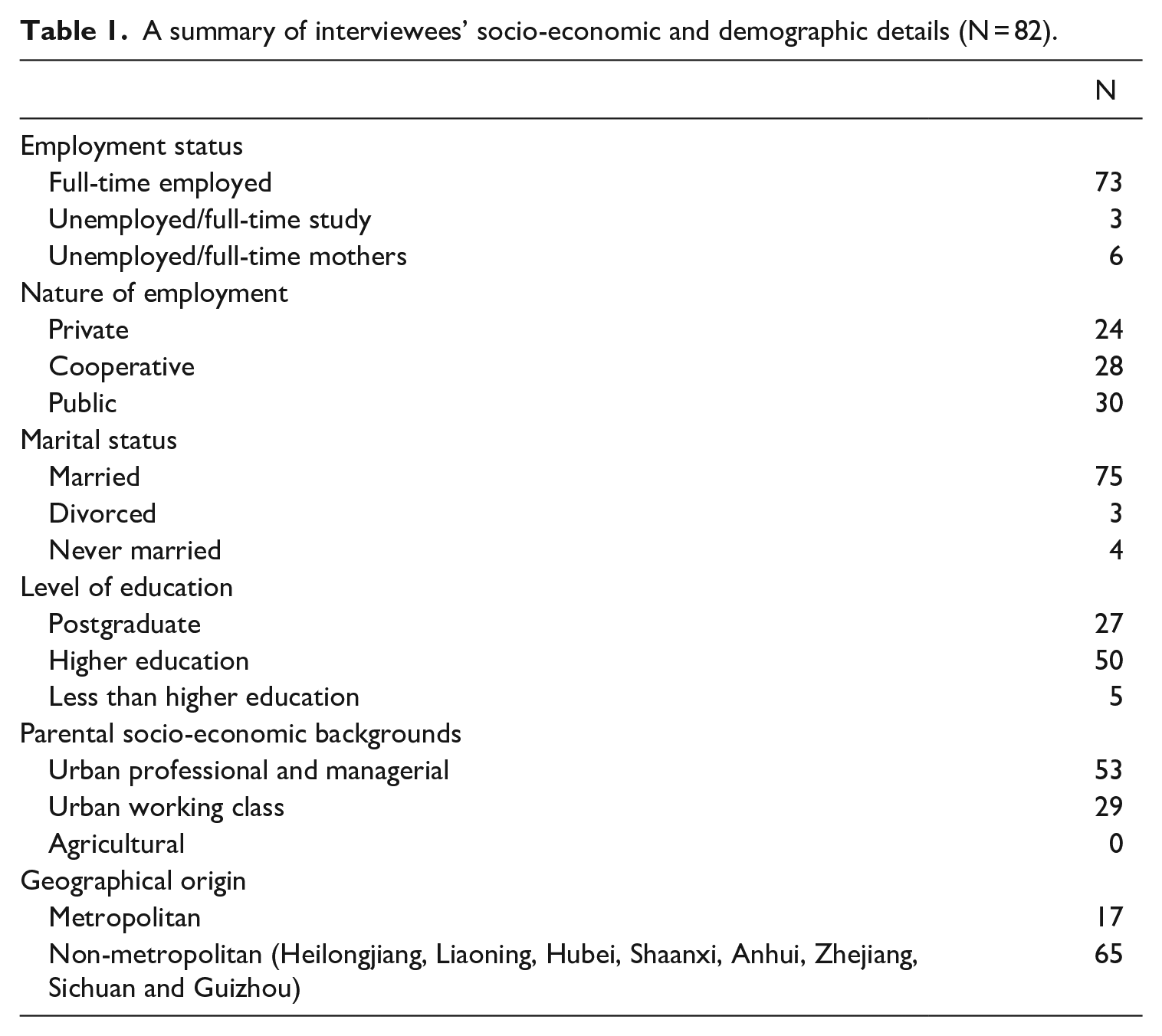
My sample represents a profile of women from relatively privileged backgrounds, in ways that go beyond the absence of women with rural agricultural backgrounds. But many saw their backgrounds as ‘middle’ in that their families were not as well-off as the wealthiest metropolitan natives. ‘Middle’ or no, those whose families had urban hukou were unquestionably more privileged than their rural counterparts. Likewise, the widely applied conceptualisations and measures of socio-economic status and/or class origin in sociological research in China (Chen and Yu, 2020; Dong and An, 2015) are insufficient in explaining the complexity of my respondents’ positionality. This is because their siblingless status not only intersects with gender, socio-economic and geographical/hukou hierarchies, it also disrupts intergenerational transactions of assets based on gender hierarchies. This complex positionality will be further unpacked through the lens of life-course accumulation and relational (dis)advantages in relation to their husbands.
I recruited my respondents mainly through two channels. First, I used social media websites and applications such as WeChat to search for the eligible research population. I posted a research recruitment advertisement on WeChat on 8 March 2017. The phrasing was purposefully broad to avoid priming the participants to think about patriarchy. Second, I rented temporary accommodation in the three cities and visited department stores, nail salons and restaurants to search for potential interviewees. The first approach was more effective than recruiting in person, and it prompted more offers to participate than I could accept. The recruitment message was at first circulated within a small number of private chat groups of university alumni in Beijing through my own contacts. It was then circulated by women who were networked into various chat groups organised by mums, neighbours, friends, schoolmates, colleagues and so on. For ethical reasons I did not recruit anyone I know personally or professionally. The reflections of my own positionality in this research were ongoing as I collected and analysed the data. Being a siblingless child and being close in age to my respondents helped me to gain their trust. Beginning the conversation by sharing my own experiences of coming of age in Anhui, a central province in China, encouraged interviewees to respond with their own stories. Most interviewees showed great interest in this project, and some even offered to waive anonymity. One informant thanked me for doing this project, saying ‘it is about time to take some notice of us’, describing the one-child generation as ‘the experiment generation’.
Methods
Interviews were semi-structured and lasted approximately 2.5 hours each. All but four were conducted in person at a public place the interviewees chose. All interviewees provided informed consent to be digitally recorded and all recordings were transcribed in Chinese. This study was conducted in full compliance with research ethics codes and practices established in my university’s Research Ethics Policy. Personal identifiable characteristics were removed, and the data were anonymised through pseudonyms and number codes. Three stages of coding were used in this study. First, open coding was applied to identify the trends in the interview transcripts by closely following the words and phrases the interviewees used. I focused on identifying the life-course transitions, from home to college, from work to marriage, as respondents themselves described them. It should be emphasised that these retrospective life history interviews only captured their life transitions into their late 30s. The second round of coding identified patterns of bargaining with patriarchy through conformity to or challenges of patriarchal gender norms and roles. In the third round of coding, I assessed the markers of egalitarianism and conformism patterns and linked these contrasting patterns to individual women’s situation in terms of socio-economic status, property ownership, cultural capital and geographical origin in relation to their husbands. I further analysed how positional and relational (dis)advantages emerged from different situations maintain, contest or shift patriarchal power over women.
Findings
Conformity or Conversion to the Virtues
I shall examine the way participants discuss female dispositions, reflect on filial piety and ascribe meanings to virtues and talent by locating their life-course points and their interaction with patriarchal power. First of all, being virtuous means compliance with filial piety, in particular, through performing ‘obedience’ (tinghua) to their parents. Among this group of dutiful daughters, many described having followed their fathers’ advice in switching from pursuing certain careers in favour of a more feminine job or a less risky occupation. They described being obedient and taking their fathers’ advice as the key to being a virtuous daughter. Zijia Zhong, a 37-year-old mother of one, abandoned her dream job – ‘a project manager in an international company’ to become a teacher. As she explained, ‘teaching is secure and suitable for women with a family’. The feminine norms of tinghua (obedience) and risk aversion immensely limit the scope of ‘appropriate’ roles in career choices, and fathers were major setters of standards for virtuous daughters. Instead of challenging their fathers, these women chose to suppress their ‘talents’ and ambitions instead of pursuing competitive careers and working in risky sectors. One respondent said, ‘my father always has my best interest at heart’; another said she ‘did not want to upset’ her father, in light of her parents’ huge investment in her. This finding resonates with prior scholarship on the internalisation of filial piety among young generations, particularly those from the one-child generation (Kim and Fong, 2014). While prior scholars investigate filial piety as important aspects of self and identity formation, I find that women specifically performed filial piety by being obedient, feminine, risk averse and focused on family.
Respondents who emphasised they were ‘family-oriented’, and that they were embracing ‘women’s responsibilities’ subordinated their career ambitions to family responsibilities, including housework, childcare, parental care and cognitive and emotional labour. Some prioritised their husbands’ careers by sacrificing their own. Mizi Hu, a 37-year-old mother of two, met her husband at university; they were both studying architecture. Mizi and her husband had both received job offers from a large private property development company upon graduation from the university, which was prestigious, and both accepted, but their careers subsequently took very different turns. Mizi explained: ‘Our job involved travelling. My boss preferred male employees like my husband. He had gained more business cases and got promoted to the management team. I never had his opportunities.’
Mizi did not want to give up her job at first because of her ‘hard-earned’ degree but, she said, she gradually came to terms with the ‘reality’ that ‘a woman’s place is in the family’. She described the job she transferred to in the public sector as ‘boring’ but ‘compatible with her family life’. She said she had taken it to ensure she could ‘focus on being a good wife and mother’ and achieve ‘family harmony’. Her parents welcomed her sacrifice of career ambitions and conformity to female virtues and her in-laws paid her respect. Mizi’s story illustrates Risman’s (2004) theory of multi-dimensional structural constraints on women’s life chances. The first ‘reality’ Mizi came to terms with is a man’s world of architecture business, in which masculine roles and norms dominate, forming a ‘fraternity club’ closed to women. Mizi’s experience of the lack of women-friendly policies is not unique in the profession of architecture. Neely’s (2022) ethnographic research on US hedge funds documents how elite white masculinity became a standard industry measure of performance and normalised working long hours and building networked fraternity clubs, which effectively blocked women and people of colour from competition.
Egalitarians’ Embracing Talent
Another group of women chose to embrace their ‘talent’ and pursue career ambitions, generally with their parents’ support. These respondents felt their parents wanted them to be successful more than they wanted them to be obedient. Gang Qian, a 35-year-old senior accountant in a national cooperative bank, described how her parents’ investment in a prestigious private boarding school and a study abroad opportunity in Canada allowed her talent to flourish. Paraphrasing the Chinese saying that knowledge changes one’s destiny, Gang said that it was her parents’ investment in her education that changed her destiny so that she ‘became professionally successful’. By embracing ‘talent’ and pursuing their education and career endeavours, those women reinvented codes for virtuous daughters. They faced expectations that they would succeed professionally. This finding supports prior scholarship on the aspirations of the children from the one-child generation (Kim et al., 2018). Moving beyond strictly following the traditional values of financial and care responsibility towards their parents, siblingless children aspired to achieve upward social mobility to reward parental investments (Kim et al., 2018).
Nonetheless, even those who felt that they were gender-progressive in education and the workplace expressed ambivalent attitudes about egalitarianism when discussing their roles as mothers, wives and daughters-in-law. They emphasised that they are career-oriented and distanced themselves from the role of a ‘virtuous wife and mother’. However, they were not apparently seeking equality in marriage or parenthood. These women’s ambivalent attitudes about gender roles in the private sphere echo research elsewhere about the ‘lag’ of gender egalitarianism in the public and private sphere (Knight and Brinton, 2017; Scarborough et al., 2019). While prior research conceptualises ambivalence of gender egalitarianism in Global North contexts (Scarborough et al., 2019), the respondents in my study strategised to achieve equality in the private lives. They prioritised their careers through various strategies of negotiation with patriarchal power, achieving what I call latent equality. These strategies often involve streamlining domestic responsibilities either by outsourcing domestic help or by relying on kin support.
Yuanhan Zhang, a 37-year-old mother of one, is an entrepreneur with a business portfolio that ranges from digital platforms to partnership in an insurance company to shares of a franchised kindergarten. Her financial resources allowed her to outsource most of her domestic duties to a full-time live-in nanny and a regular cleaner. She said that her in-laws were ‘bitter’ about her success and complained about her ‘lacking female virtues’. She purchased a luxurious flat for them in their hometown in Jiangxi to, in her words, ‘shut them up’. Zifei Liang lacked Yuanhan’s abundant financial resources, but kin support also allowed her to succeed. A 37-year-old of mother of one, Zifei is a senior code-programmer and deputy head in the department of technology and innovation in a large state-owned enterprise (SOE). After her daughter’s birth, she sought her parents’ support so she could pursue a competitive career. By her account, her parents took early retirement and relocated to Beijing to take care of ‘all the childcare and domestic chores’. Her parents’ sacrifices for their only daughter allowed her to maintain a competitive career after motherhood.
These strategies are hardly novel or exclusive to this cohort of women in China. Research on China and elsewhere shows that outsourcing domestic care is an important aspect of keeping up with competitive careers for professional women (Ballakrishnen, 2021; Bolak, 1997). Bolak’s (1997) research showed working-class women in Istanbul who negotiated with their husbands to let them work outside the home generally had kin support. It remains highly contested whether this strategy hurts feminism or undermines social justice (Ballakrishnen, 2021). But past research has not addressed, as I unpack below, how women utilise their positional and relational advantages accumulated during their life-course transitions to bargain effectively with patriarchal power in the private sphere and excel in their careers.
Virtue and Talent through Situational and Relational (Dis)Advantages
The previous group of women and their stories highlight a pattern of conforming to gender norms such as tinghua (obedience), risk aversion and family-orientation by subordinating their talents to gender roles appropriate to their femininity. This process of substituting their talent with virtues reflects submission to different holders of patriarchal power, from their fathers to their husbands and in-laws. Conformists discussed the complexities of positional and relational disadvantages accumulated during life-course transitions. Most conformists came from lower/middle professional or working-class families in non-metropolitan areas. Despite being much more privileged than those from rural areas, they are still inferior to those ‘above’-professional metropolitan natives. These socio-economic and/or geographical status disadvantages were not mitigated by their accomplishments in education and work. For instance, they had achieved university degrees and had professional jobs or good income in metropolitan areas where they currently reside. They considered themselves as ‘outsiders’ compared with ‘metropolitan natives’. This referenced more than status disadvantages in the hukou structure. Rather, they were conscious that they had not accumulated ‘metropolitan capital’: financial, cultural and/or social capital built on metropolitan hukou status. The want of metropolitan capital inherited from their parental generations left these women at a disadvantage when compared with their metropolitan counterparts. This relational disadvantage drew these women further to the virtue line. This allowed them to articulate their identities and worth through moral values such as being obedient daughters and daughters-in-law, virtuous wives and good mothers. This finding aligns with prior scholarship showing that underprivileged social groups frequently reference morals to achieve a sense of self-worth (Lamont, 2000).
Mizi exemplifies how women without metropolitan capital tend to embrace the womanly virtues. From a professional family in Jiangxi, Mizi’s parents had solid middle-class social status as her mother was a school teacher and her father was a civil servant. Both earned reliable income, but they had no significant wealth. Her husband, who is also a siblingless child, is from a similar family background, but, as she said, his family has ‘more financial assets’. Despite achieving upward social mobility as a professional in Shanghai, she was conscious of those ‘above’ her – university peers and friends from the mummy groups who are Shanghai natives and who possess metropolitan capital. Tracking their WeChat updates, she observed that many had ‘inherited apartments from their Shanghai parents’ and owned ‘big-wheeled 4x4s’ and took ‘foreign holidays’. By contrast, she sees her own decision to prioritise ‘happiness’ and ‘harmony’ over material goods as a moral one. Nevertheless, her relative financial disadvantage compared with her husband ‘nudged’ her to make the decision to ‘sacrifice’ her career in architecture where sexism is rampant. In the case of Mizi, by affirming her desire to be a virtuous wife and good mother, she employed the language of morals so that she did not feel inferior to ‘Shanghai natives’ and to have garnered the respect of her husband’s family.
Pengzhen Qin, a 35-year-old head of human resources in an SOE and a mother of two, also experienced relational disadvantages in comparison with her husband. Her academic accomplishments and early markers of success have been dismantled by her possession of less familial capital than her husband although, like Mizi, she was from a professional middle-class family. Pengzhen describes herself as having been an ‘academic genius’. She studied at an elite university in China and then pursued a postgraduate degree in the UK where she met her husband and got engaged: When we got married, his family paid for the deposit for our apartment. When I was pregnant with my first child, I missed a promotion. As a mother, I need to sacrifice for my child. But my husband got a promotion and a pay-raise. When I gave birth to my second child, my husband got a job offer in the senior management team in one of the largest banks. I felt more and more like a loser.
Pengzhen called her husband and his parents a ‘patriarchal gang’ who conspired to suppress her ambitions by enforcing patriarchal codes of male superiority and female virtues. She shared how her in-laws ‘persuaded’ her to have another child in addition to her son so that she would have a more ‘dynamic and harmonious’ family. Her in-laws immediately moved into her home after the birth of her daughter, and she said her husband took the opportunity to ‘outsourc[e] all care responsibilities to his parents’. Her husband’s pursuit of his high-powered career and complete absence from childcare was not only entitled as a masculine norm but also justified by his parents’ pressure. Pengzhen said that her in-laws ‘constantly nagged me about the importance of my husband’s career. Because they paid for the apartment and my parents did not have enough money to contribute, they felt I was at their mercy.’ Because her parents could not match her in-laws’ contribution, her ambitions to pursue a competitive career and to reap the benefits of her early striving was compromised.
Pengzhen became an ‘unwilling convert’ to ‘female virtues’. She turned to self-help literature to ‘develop positive energy’ and to ‘appreciate what I got [i.e. a boy and a girl]’. Her ‘conversion course’ to good womanhood ranged from flower arranging classes to Pilates to a culinary art course. Pengzhen’s case aligns with de Beauvoir’s (2011) description of ‘becoming women’ through ‘turning her kitchen [in]to her kingdom’. This finding also confirms prior scholarship about women who choose to prioritise family over career (Goldin, 2021; Stone, 2007). The professional women in Stone’s and Goldin’s US samples either were ‘pushed out’ of a competitive workplace incompatible with a family life (Stone, 2007) or made choices to prioritise motherhood (or not to have children at all) because of a lack of childcare infrastructures at the policy and structural level (Goldin, 2021). These macro-structural and the micro-workplace arrangements are moulded by masculine norms and roles, thus sustaining male advantages over women. However, Pengzhen’s case illustrates an additional layer of complexity – positional and relational disadvantages to their husbands. The competition of career ambitions between husbands and wives may hinge on the competition of familial financial resources even among those with essentially similar socio-economic status and professional backgrounds. Pengzhen lost this competition. To put it in a different light, the ‘patriarchal gang’ achieved domination of her through their possession of greater financial resources than Pengzhen’s family.
Pengzhen’s case is in a stark contrast to the second category of women in my sample, who embraced talent. These participants contested rigid patriarchal female virtues in their conjugal families through financial and/or geographical-hukou status advantages over their husbands and their husbands’ families. Zian Wang, a 31-year-old mother of one and a Nanjing native, works in the research and innovation department of the local government in Jiangsu and is in charge of cutting-edge research projects in several science parks. She was angry about the government’s announcement of the two-child policy in late 2015 and rejected her parents-in-law’s demand for a ‘grandson’. Zian shared her ‘traumatising’ experiences of being penalised at work for her first pregnancy. After learning she was pregnant, her male boss ordered her to transfer all her research projects to a ‘mediocre’ male colleague due to her ‘diminished capacities’ – although her capacities were not diminished. Zian’s case strongly resonates with research on fertility decisions among highly educated Japanese and South Korean women (Brinton and Oh, 2019). Such research shows women’s competitive advantages accumulated through advanced education degrees and professional career experiences did not protect them from discrimination. The claim that Zian had ‘diminished capacities’ recalls Correll et al.’s (2007) experiments on ‘perceptions of competency’ of working parents, in that working mothers, but not working fathers, were perceived less capable and competent than childless workers.
Now at the peak time of her career, Zian refused her in-laws’ ‘baby demand’. Her refusal to succumb to patriarchal fertility pressure is supported by her superior hukou status and socio-economic advantages over her husband. Zian is a Nanjing native with abundant social capital and has financial assets from her parents. By contrast, her husband is from a small county in Anhui. While his family has urban hukou, their status is inferior to her family’s status. Her family connections helped her husband with his career. Empowered by substantial social and financial capital from her natal family, Zian has an upper hand in negotiating with patriarchal fertility pressure. This finding is in line with previous research on the hukou hierarchies in intermarriages between rural and urban residents, which complicate masculine and feminine norms in marriage patterns (Lui, 2016; Qian and Qian, 2017). Prior scholarship shows urban hukou can compensate for women’s gender disadvantages (Lui, 2016). However, Zian’s case further illustrates the complexity of how hukou hierarchies intersect gendered norms and roles. Zian’s Nanjing hukou is superior to her husband’s Anhui hukou. The public benefits and citizen entitlements associated with superior Nanjing hukou, of which Zian’s husband was deprived at birth, were solid foundations for Zian’s bargain with patriarchal pressure at home.
Relational property ownership and financial assets superior to their husbands’ are another crucial basis for women’s bargaining power in their conjugal families. A total of 21 respondents reported that their parents contributed the majority of the money for their home purchase or that they owned more real estate than their husbands. This finding confirms prior research on gender and property ownership in China (Chen and Yu, 2020). Chen and Yu’s (2020) research using the China General Social Surveys shows that across age cohorts women without brothers are much more likely to own property than women with brothers. When asked about the implications of the advantages of property ownership, Huijie Xu, a 35-year-old mother of one, credited her parents’ early investment in an apartment – ‘having my name on the deeds’, with giving her a powerful voice in her marriage. Jokingly describing her husband as ‘chi ruanfan’ (a man relying on his wife), Huijie said she was able to ‘do what I want’, for instance, pursuing a postgraduate degree without ‘much protests’ from her husband and in-laws. While prior research confirms women’s negotiating power in the household increases with the level of education and wage income (Zhang and Hannum, 2015), my finding shows that intergenerational transactions of assets that uniquely benefitted siblingless daughters are crucial for negotiating boundaries of virtues and at the same time for maintaining their ambitions and ‘talent’.
Discussion and Conclusions
The present study systematically examines gender role attitudes of women from the one-child generation as these siblingless daughters live as wives, mothers and professionals. Using the lens of the talent-and-virtue gender ideal, I analysed 82 in-depth individual interviews with siblingless women about their gender role attitudes over their life-course trajectories and interactions with different sources of patriarchal power. Findings identify progressive gender egalitarians who embrace talent, traditional gender conformists who prioritise female virtues and some who have converted from egalitarians to traditionalists. I argue macro-level structural constraints and different internalisations of cultural codes of virtues and talent shape these two divergent tendencies. As well, the accumulation of socio-economic, geographical, hukou and financial (dis)advantages through the life-course trajectories, particularly in relation to their husbands, plays a crucial role of achieving an (in)effective bargain with patriarchy.
These findings have important implications for researching the one-child generation and gender role attitudes more broadly. In particular, they underscore the need to include the dual approach, a life-course accumulation and relational positionality, to assess the formations of egalitarian, traditional and ambivalent gender role attitudes in addition to the structural and cultural perspectives. Failure to do so could miss the opportunity to interrogate how socio-economic inequalities intersect with gender in different locations of life-course points and how these accumulative intersections might reproduce or mediate gender hierarchies. The omission of the dual approach might also limit our understanding of the complexity of women’s internalisation of gender cultural schemas, which evolves during their life-course transitions and interacts with different holders of patriarchal power at these life-course points.
Full understanding of gender role attitudes in the persistent patriarchal structure is an incomplete research endeavour. My findings on conformity and conversions to virtues strongly resonate with prior scholarship using multi-dimensional structural perspectives to examine how structural and institutional arrangements sustain gender hierarchies (Goldin, 2021; Risman, 2004). In some cases, structural constraints limited women’s space for embracing their talent, pushing them into traditional feminine roles, which became their sole source of self-worth. My findings on embracing talent confirm prior research about the ‘lag’ between private and public gender role attitudes (Knight and Brinton, 2017; Scarborough et al., 2019). That is, even those who embraced ‘talent’ in their jobs were ambivalent about equality in a marriage. These findings further confirm the validity of Kandiyoti’s concept of enacting culture and doing gender in a patriarchy in the contemporary Chinese context. The gender egalitarians, conformists and the converts (from egalitarians to traditionalists) illustrate the variety of and fluidity of internalisations of gender cultural schema during various life-course points. My findings on conversions to virtues particularly resonate with Haslanger’s description of patriarchy as a system of oppression, in which patriarchal power in the workplace and at home is coordinated in such a way as to naturalise women’s subordination, such as for Mizi and Pengzhen.
However, my research also reveals the limitations of structural perspectives, cultural schemas and patriarchal oppression on these siblingless women. The patriarchal oppression perspective is particularly useful to understand persistent pushback against women’s progress in the public sphere. Multi-dimensional structural perspectives and cultural schemas help us to understand that significant gender egalitarian progress in education and the labour force does not necessarily result in a corresponding egalitarian pattern in domestic division of labour and gender norms in the private sphere. Likewise, gendered oppression in the workplace persists. Yet, these theoretical perspectives do not explain divergent patterns of progressive gender egalitarians and traditional gender conformists identified in my sample who otherwise share similar characteristics in siblingless status, education achievement and professional status. My research suggests an explanation for this divergence – a life-course accumulation and relational positionality lens. My research addresses the problems with the current research landscape that focuses on present antagonism between male domination and female subordination without interrogating life-course transitions and accumulative impact on positionality, a strategy poorly suited for understanding the root of the ‘lag’ of gender role attitudes between the public and private spheres.
My research, inspired by de Beauvoir’s projects and conceptualisation of becoming a woman, proposes a dual life-course accumulation and relational positionality approach. This dual approach unpacks the complexity of how the gender ideal of virtues and talent not only informs, inspires and constrains these siblingless women in terms of conforming to or rearranging gender codes but also interacts with different forms of patriarchal power. This dual approach is particularly helpful to address the weaknesses of the static use of conceptualisation and measures of socio-economic status in prior gender research. By using this dual approach, I was able to assess siblingless status intersected with socio-economic and geographical/hukou hierarchies during participants’ life-course transitions and complicated intergenerational transactions of assets based on gender hierarchies. I was also able to show that women’s socio-economic, cultural, geographical and financial situation becomes relational during their life-course transition into marriage and parenthood, which creates different levels of advantages and disadvantages in terms of negotiating boundaries with patriarchal power held by their husbands and in-laws. This multi-relational and multi-positional situation is crucial to understand how they rearrange the priorities of virtue and talent to their own advantage.
Building on the insights of the current study, future scholarship on gender (in)egalitarianism in the Chinese context should take up several additional questions. To what extent can the patterns of gender egalitarian and conformist attitudes identified here be generalised to different cohorts of the one-child generation such as those born in the 1990s and the 2000s? Distinguishing cohort variations will increase our understanding of the effects of different historical and socio-political contexts on life chances and on gender role attitudes. The present study did not interview respondents’ husbands to develop a comparative analysis of gender roles and attitudes within individual households. Future research could investigate gender (in)egalitarian attitudes among men born during the one-child policy either through individual in-depth interviews or through couples interviews. The one-child generation remains a population of great interest for studying the effects of being siblingless in a patriarchal society and the impacts of recent large-scale change.
Footnotes
Acknowledgements
I would like to thank the editor Professor Rachel Brooks for her helpful guidance for my work. My deepest gratitude goes to anonymous reviewers who provided incredibly detailed and thoughtful comments. Without the reviewers’ generous help, I could not have improved the conceptualisations and the coherence of the overall analysis. I would also like to thank Kate Epstein for her interest in ‘brotherless daughters’ and for providing constant support with my writing. I am deeply indebted to the 82 women who trusted me to share their life stories of ‘virtues and talent’. It is my humble wish that this article will do some justice to their voices.
Funding
The author disclosed receipt of the following financial support for the research, authorship and/or publication of this article: this research was supported by the Department of International Development Research Grant, King’s College London, UK.
