




Abstract
Across Europe, children of low-educated migrants are entering high-status occupations. While the research literature has accounted for the determinants of this social mobility, few studies have explored how social mobility affects the lives of second-generation immigrant men and women in different ways. Drawing on in-depth interviews with 62 descendants of migrants in high-status occupations in Norway, this article asks how second-generation women and men experience their gendered opportunities and constraints after achieving upward social mobility. The analyses show how social mobility brings the second generation into social milieus where their majority Norwegian colleagues become their most relevant references for how to do work and family. Both the second-generation women and men share a strong dedication to work, however, while this requires the women to challenge gender-complementary expectations, the men largely rely on gender-complementary arrangements. The analyses thus suggest that social mobility changes the lives of women more than those of men.
Keywords
Introduction
Substantial numbers of children of labour migrants in Europe experience steep upward social mobility and enter the top of the labour market hierarchy, despite growing up with parents with little education and low-skilled occupations. The social mobility of second-generation immigrants, henceforth referred to as the second generation, has received significant attention over the past years (e.g. Alba and Barbosa, 2016; Midtbøen and Nadim, 2021; Schneider et al., 2014). However, a somewhat overlooked aspect of the social mobility of the second generation is that women, not men, are the strongest social climbers (e.g. Fleischmann et al., 2014). Second-generation women surpass their male peers in educational achievement, even in groups where the parents have migrated from countries dominated by traditional gender norms and practices (Alba and Foner, 2015; Feliciano and Rumbaut, 2005; Park et al., 2015). Despite the ‘female revolution’ it entails, remarkably little attention has been directed at exploring whether and how the striking social mobility of the second generation affects the lives and opportunities of women and men in different ways.
In this article, we focus on second-generation social climbers who have reached the top of the labour market hierarchy in Norway and entered high-status, high-income occupations, such as medicine, law and business and finance. Gaining access to such occupations means entering a labour market characterised by high demands in terms of performance, dedication and time commitment, with an intensified tension between demands, ambitions and devotions in the work and family sphere, in particular for women (Blair-Loy, 2003). However, these tensions may be particularly prominent for descendants of migrants in Norway. They live in a national context that stands out internationally for its strong gender-equality ideology, high female employment rates and generous family policies supporting the employment of mothers of young children (Ellingsæter and Leira, 2006), offering cultural and institutional support for women to maintain their attachment to work after becoming mothers. At the same time, the largest second-generation groups in Norway originate from countries characterised by complementary gender norms and practices, where men and women are allocated different, but complementary, roles and responsibilities in the spheres of paid work and the family (e.g. Inglehart et al., 2003). 1 Indeed, the migrant parents of the largest second-generation groups have largely maintained a clear gender-complementary division of labour, suggesting that second-generation immigrants in Norway encounter different and sometimes contradictory understandings of gender, work and what constitutes a worthwhile life in the context of the family, the workplace and society at large (e.g. Kavli, 2015; Nadim, 2014).
The overarching question we address in this article is what consequences steep social mobility can have for second-generation women and men. More specifically, we use their reflections and considerations around work and care as a prism to ask: how do second-generation women and men understand their gendered opportunities and constraints after achieving upward social mobility? In exploring this question, we draw on in-depth interviews with 62 second-generation individuals who work as lawyers, medical doctors and business professionals in Norway. The research participants are the children of labour migrants who arrived in Norway in the early 1970s from Pakistan, Turkey and Morocco. They grew up in families with fathers who typically had low-income working-class jobs and mothers who either were homemakers or had a weak attachment to the labour market. The second-generation participants, being professionals in high-status occupations, have thus experienced significant social mobility compared with their parents. Moreover, most of the second-generation women have additionally experienced a significant generational change in the gender roles they enact compared with their mothers. We analyse how the second-generation professionals position themselves within the competing norms and practices they encounter in different contexts and examine how they experience their cultural and structural contexts of opportunity to be who they aspire to be as women, men, parents and professionals.
This article advances the literature on the social mobility of the second generation in several ways. It does so empirically by demonstrating how second-generation social mobility has different consequences for men and women. While a few studies have focused on the gender differences in second-generation social mobility (Feliciano and Rumbaut, 2005; Fleischmann et al., 2014; Holland and de Valk, 2017; Park et al., 2015; Soehl et al., 2012), to our knowledge, no previous study has explored the consequences of this social mobility from a gender perspective. Theoretically, the article brings the literature on second-generation social mobility into conversation with the literature on work–family negotiations (e.g. Blair-Loy, 2003; Duncan et al., 2003; Halrynjo and Lyng, 2009), which has shown how work and family choices are shaped and constrained by structural and cultural factors. As many children of migrants experience social mobility and enter high-status and demanding parts of the labour market, studying the gendered consequences of social mobility for second-generation men and women provides an important glimpse into an overlooked aspect of long-term integration processes.
Social Mobility and Gender Relations in the Second Generation
Social mobility is a key concept in sociology and refers to a movement in class position, which can lead to profound changes in life opportunities, experiences and identities (e.g. Blau and Duncan, 1967). Many second-generation individuals have experienced substantial social mobility in this traditional sociological sense, achieving university degrees and securing middle- or higher-class jobs despite coming from low-income families with limited education (e.g. Alba and Barbosa, 2016). As children of migrants, they have typically experienced another type of generational mobility as well: they have grown up in a very different cultural and institutional setting than their parents, offering them vastly different opportunities, but also new challenges in negotiating competing norms and expectations in the family, ethnic community and the mainstream society (Feliciano and Rumbaut, 2005). Still, we have limited knowledge about the how social mobility changes the lives and preferences of second-generation women and men.
Indeed, the literature on second-generation incorporation has primarily been concerned with the determinants of social mobility. The educational achievements and accompanying social mobility of the second generation have been understood as reflecting a migrant-specific ‘optimism’, ‘drive’ or ‘advantage’ (e.g. Suárez-Orozco et al., 2009). Researchers have pointed to factors such as high aspirations, family support and pressure and collective mobilisation in ethnic communities to explain the social mobility of the second generation (e.g. Portes et al., 2009; Shah et al., 2010). By contrast, there has been little attention paid to the consequences of such processes of intergenerational upward social mobility for the lives and opportunities of second-generation men and women. While a few contributions have examined how processes of social mobility can shape various aspects of identity formation among the second generation (Schneider and Lang, 2014; Schneider et al., 2014), there is a striking lack of attention to the gendered implications of social mobility.
Although the gendered consequences of social mobility have not been explicitly addressed in the research literature on the second generation, some contributions shed light on the broader relationship between gender and social mobility. Second-generation women achieve more upward social mobility than men, at least in terms of educational attainments. Girls have higher educational expectations than boys, and second-generation women surpass their male peers in educational achievement (Alba and Foner, 2015; Fleischmann et al., 2014). Furthermore, several studies imply that second-generation women frequently challenge the gender norms and practices they associate with their parents (Heath and Demireva, 2014; Kitterød and Nadim, 2020; Nadim, 2014, 2016; Soehl et al., 2012). Nadim (2017) suggests that changing gender relations in the second generation might partly reflect unintended consequences of the families’ social mobility aspirations.
However, other contributions emphasise that second-generation women’s high educational ambitions and achievements do not necessarily reflect a shift towards more egalitarian gender roles. In a US context, Zhou and Bankston (2001) have argued that Vietnamese parents’ educational aspirations for their daughters are not a rejection of traditional gender roles but rather a response to the opportunities and necessities of education in their new country of residence. Moreover, several researchers have suggested that traditional gender norms can in fact contribute favourably to the educational achievements of girls compared with boys. As families with traditional gender norms tend to exercise strong control over their daughters, they also create better conditions for their daughters than their sons to focus on school (e.g. Farris and de Jong, 2014; Zhou and Bankston, 2001). Previous research has also demonstrated that women from gender-traditional families might be encouraged to pursue a high-status education, while at the same time being expected to prioritise family obligations over paid work once they have secured their credentials (Read and Oselin, 2008).
Whether second-generation women’s educational achievements translate into employment and a more gender-equal division of work varies strongly between different national contexts. Comparative research from Europe shows substantial national differences in the labour market participation of second-generation women, and researchers see these differences as largely reflecting national institutional contexts for work and care (Holland and de Valk, 2017; Soehl et al., 2012). The labour market participation of second-generation women is particularly high in the Nordic countries. The Norwegian welfare state context provides institutional opportunities to combine motherhood with paid work through its work–family policies, including a generous parental leave scheme, a ‘use or lose’ father’s quota and state-sponsored childcare services. Furthermore, it is a national context characterised by a strong ideological emphasis on gender equality, which also permeates gender expectations in work and family life (Ellingsæter and Leira, 2006). Thus, the Norwegian context provides institutional and ideological support for women and mothers’ employment, and the comparative research literature suggests that a shift away from strict gender-complementary roles is more likely in such ‘women-friendly’ contexts (Holland and de Valk, 2017).
Work and Family at the Top of the Labour Market
In the work–family literature, increasing attention has been paid to how work and family choices are socially and culturally shaped, reproduced and constrained (e.g. Blair-Loy, 2003; Duncan et al., 2003; Halrynjo and Lyng, 2009). Such research shows that work and family aspirations and choices are rooted in people’s understandings of themselves as gendered subjects and about what makes life meaningful (e.g. Blair-Loy, 2003; Crompton and Harris, 1999). Working in high-status occupations, such as business and finance, medicine and law, means entering a part of the labour market that requires high performance, a strong dedication to work and significant time commitments. Blair-Loy (2003) describes how women in demanding elite careers face two competing schemas of devotion, which are shared cultural models that we use to define and organise our thoughts, assumptions and emotions. On the one hand, the work devotion schema presents work as an important source of meaning, belonging and purpose and demands a strong time and emotional commitment to one’s firm or career. The family devotion schema, on the other hand, presents caring for the home and family as a source of meaning and fulfilment and calls for a time-intensive and emotionally absorbing form of childcare. These schemas of devotion imply different understandings of what it entails to be a professional and a mother and, ultimately, what it means to be a woman.
Scholars additionally emphasise how women’s career aspirations and choices are shaped by their perceived and experienced opportunities and constraints. These opportunities and constraints are shaped by, among other things, the institutional context (e.g. family policies), the work context (e.g. work culture, demands, company work–family policies), the family context (e.g. caregiving demands and expectations) and the larger cultural context in terms of available cultural understandings of gender roles, good childcare and what makes a meaningful life (e.g. Halrynjo and Lyng, 2009; Nadim, 2014). Living and working in a national context with strong institutional and ideological support for gender equality suggests that high-achieving second-generation women in Norway experience less barriers to their career aspirations and choices than elsewhere.
Both for the second-generation women and men in this study, entering the high-status occupations they now inhabit has entailed a steep social climb compared with the social position of their parents. The literature on class and social mobility has been concerned with how social mobility can challenge and alter one’s ‘way of being’ as it entails moving between different worlds, exposing the individual to new experiences, beliefs and practices (e.g. Bourdieu, 1984; Lee and Kramer, 2013). This change can happen without conscious effort or knowledge (Lee and Kramer, 2013), but it does not mean that the personal beliefs, preconceptions and ways of being, shaped by one’s upbringing, become fully replaced (Horvat and Davis, 2011). At the same time, scholars have emphasised that socially mobile individuals might actually feel more at home and more familiar in their new class setting than in their old, and that their unease in their original class setting might be an important drive for their social mobility (Reay et al., 2009).
For women, social mobility might also be driven by a wish to be liberated from traditional gender norms. For instance, a study of socially mobile women in Sweden finds that the women wanted not only to improve their class conditions, but also their gendered class conditions, seeking to escape what they considered as limiting gender norms in the working class (Wennerström, 2008). Indeed, a host of evidence suggests that women use their increased status and earnings to shape their relationships in a more gender-equal direction (Gerson, 2010). Social mobility in many cases entails being exposed to milieus with new gender ideals and expectations, and milieus that provide new gendered opportunities – especially for children of migrants who have grown up with more gender-traditional roles. As new class experiences become internalised, the socially mobile second generation – both women and men – might experience changing gender preferences and expectations.
Methods and Data
This study builds on 62 in-depth interviews with second-generation individuals who hold advanced degrees in medicine, law and business and finance. All participants are children of labour migrants who arrived in Norway in the early 1970s and are either born in Norway or immigrated before school age. More than two-thirds of the participants originate from Pakistan, the by far largest group among this wave of labour migration, while the remaining participants have parents who migrated from Morocco, India or Turkey. As the sample is dominated by one origin group, it not well suited for systematic comparisons according to parents’ country of origin. An overview of the participants, separated by field of work, gender and ethnic origin is displayed in Table 1.
Overview of the participants, by field of work, gender and parents’ country of origin.
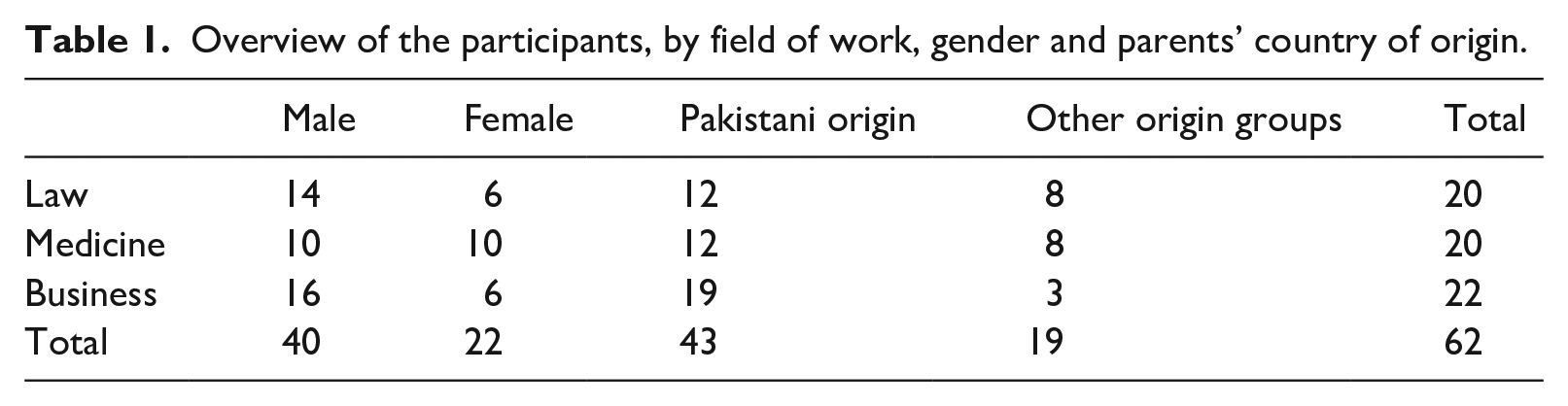
The sample consists of 40 men and 22 women. We aimed at a gender-balanced sample, but only succeeded in this ambition in medicine, where the share of women is also much higher than in the other two fields. The men in the sample are older (mean = 32 years) than the women (mean = 27.6 years), and while only two of the women have children, nearly half of the men are fathers. The reason for this imbalance is that having children was not originally a recruitment criterion. However, this means that while we could ask detailed questions about the actual work–family balance in the household of many male participants, interviews with the female participants mainly concentrated on their ambitions and expectations regarding family life.
Although the participants’ family backgrounds differ, their parents typically had low levels of education from their country of origin and entered low-skilled, low-income work in Norway. The participants’ families come from countries where gender-traditional norms and practices are prevalent, and the participants predominantly grew up in families with a gender-complementary organisation, where the fathers were responsible for economic provision and the mothers were either homemakers or had a weak attachment to the labour market. Consequently, having achieved a high-status education and secured a relevant job represented – for all participants – a story of steep upward social mobility. For the female participants, however, this journey in addition represented a pronounced break with the gender roles they had grown up with.
The interviews were conducted in 2016–2017 after the study was approved by the Norwegian Centre for Research Data. We used several channels for recruiting participants: we relied on snowball sampling, using our extended networks to recruit participants, who in turn identified more individuals who met our sampling criteria. We also went through student organisations and professional networks aimed specifically at young individuals of migrant origin. Last, we identified individuals who met our sampling criteria by searching company websites and LinkedIn, a social media platform where professionals present their resumes. The interviews were conducted face-to-face, except for a few that were conducted by telephone. Most interviews took place at the respondents’ workplaces or at a quiet cafe, while a few were held at our research institute. The face-to-face interviews lasted between one and one-and-a-half hours, while the telephone interviews were slightly shorter. All interviews were conducted in Norwegian, and the quotes used in the article were translated by the authors.
The interviews were semi-structured, building on an interview guide with questions aimed at mapping the participants’ life trajectories from their family upbringing through the educational system and into their current positions in the labour market. Detailed questions were asked about their current family situation and their reflections around combining demanding work with family obligations, now and in the future. The interviews were tape recorded, transcribed verbatim and coded using HyperResearch, a code-and-retrieve data program for qualitative analysis. In the systematic coding and analysis of the data, we traced how the participants described their work aspirations and achievements, as well as their reflections on the balance between work and care and more general gender ideals. We conducted both within-case analyses, tracing the individual stories and potential contradictions and inconsistencies within them, and between-case analyses tracing patterns of relevant themes across cases. We use the participants’ work–care considerations as a prism through which to analyse how they understand their gendered contexts of opportunity and constraint. Accordingly, the primary analytical comparison is between the women and men in the sample.
In the following analysis, we examine the gendered consequences of social mobility and first examine how the second-generation women and men respectively experience their gendered opportunities and constraints to be who they aspire to be as women, men, professionals and parents. Then we outline how they orient themselves in their high-status occupational fields, using their majority Norwegian colleagues as a frame of reference for how to do work and family.
Second-Generation Women: Threatened Professional Selves
The second-generation women in this study are professionals working in high-status occupations, as lawyers, doctors or business professionals, and they express a strong commitment to their work. In the words of Blair-Loy (2003), they draw heavily on a work devotion schema, viewing themselves as professionals and emphasising work as an important source of meaning, belonging and purpose. The women hold that they do not wish to compromise on their professional identity should they become mothers, and all state that they do not plan to retract from work or significantly reduce their investments in work. A female lawyer articulates this common sentiment, emphasising that her career and professional identity are as central to her as a mothering role will be:
It’s very important to me to not identify myself as only a mother. I’m not. First, I am [name], then I am a lawyer, in parallel with being a mother and spouse, and there is not one role that should be more prominent than the other. And it’s kind of, I think you move a step backwards if you are suddenly: ‘Now I’m only going to be at home with the children, and I’m only going to walk the stroller, and the husband is just going to be at work’ [ironic tone]. Why can’t he be at home with the children instead, and I go to work? (Lawyer 5)
The participant insists that she should be able to combine motherhood with her career as a lawyer. She describes retracting to a mothering role as moving backwards, almost mocking the idea of ‘only’ staying at home. She further challenges the idea of a traditional gender division of work, by asking why the roles cannot be reversed.
While the second-generation women in our study express a strong commitment to work, it differs how much they in addition draw on a family devotion schema when describing their ambitions for how to balance work and motherhood in the future. Some of the women emphasise that they wish to prioritise children and family when the time comes. However, their understanding of what this entails seem to be shaped by their vantage point from a highly demanding and work-intensive job. For instance, one of the female lawyers explains that she does not imagine that she will continue as a defence attorney in the long run, because: ‘I’m thinking family and children eventually, that I rather want to prioritise that part.’ But this does not mean retracting from work: ‘I want to work full-time [after having children]. I want to continue working 100%, just not that demanding work life. That I don’t have to take the work home with me. I don’t want to work less’ (Lawyer 14). Although the participant emphasises that she wants to prioritise family and children when the time comes, this means avoiding the most work-intensive parts of the business, retracting to a standard (full-time) working hours. Working in demanding high-status occupations, many of the women express a concern about whether their current work life is compatible with motherhood. They envision that they might have to modify how they work, but in a way that allows them to continue to pursue a career within their field.
In insisting on combining paid work and motherhood and dismissing a homemaking role, the second-generation women in our study challenge the gender-complementary roles most of them grew up with. Instead, the women want a gender-equal division of work, as this female lawyer states: ‘For me, it’s important that you [wife and husband] are two individuals, and you should be able to do what you want to do. If I must adjust, then the other person needs to adjust as well’ (Lawyer 7). The participant argues that she and her spouse should have equal opportunities to do what they want and implies that it would not be fair if only she must adjust her ambitions in the face of parenthood. By using the gender-neutral term ‘individuals’ about herself and her husband, she emphasises their similarities and contests gendered understandings of how they should adapt to parenthood.
While the second-generation women see a gender-equal division of responsibilities as key, many experience traditional gender expectations as a threat to their ambitions and professional identities. A female business professional, pregnant with her second child at the time of the interview, describes in detail how she and her husband balance two demanding careers with childcare, and explains that such gender-equal roles cannot be taken for granted:
So, the balance between family and work I think depends a lot on the understanding that you have with your partner. For very many, it is out of the question that the wife works full-time because ‘Hello, what about dinner?’ (Business professional 7)
She emphasises how the partner is essential in defining women’s opportunities and suggests that there is a great risk of meeting a man who expects his wife to stay at home.
For the second-generation women it seems to become essential to shield themselves from traditional gender expectations, most notably from their (future) partner, who, in the second-generation groups we study, tend to be of the same ethnic background (Wiik et al., 2021). One of the most striking examples is a female participant in business and finance. She explains that she has deliberatively postponed marriage until she has become more self-assured:
I’m working with myself now, more actively and consciously than before. [. . .] I focus a lot on exercise and kind of making myself both physically and mentally stronger. Now I’m preparing because I’m thinking that when you meet someone, and a new family and a new man comes into your life, and you’re going to start a life with someone, I don’t want to be in the phase where I’m insecure about myself. (Business professional 3)
The participant explains how she is working on herself and will not marry until she is sure that she will be able to stand up for her ambitions and negotiate work and care responsibilities with a future husband. While the other women are not as consciously preparing to negotiate their future gender roles, many detail how they are prepared to fight for the opportunity to pursue a career and avoid excessive care responsibilities. This can for instance involve trying to define the terms of the relationship from the onset and making clear their work ambitions and expectations of gender-equal roles.
To sum up, the second-generation women in the study express a strong devotion and commitment to work. They see themselves as professionals, wish for gender-equal relations and do not wish to move to a full-time mothering role when they have children. However, as the majority of the women do not have children, they might not envisage the relevance of a family devotion schema yet. The women hold that it is possible to combine motherhood with a career in their field, but consider gender-traditional expectations accompanying motherhood as a threat to their professional identities. Such gender-traditional expectations, which reduce the women to mothers and restrict their investments in work, can be understood as cultural constraints on their aspirations and professional identities.
Second-Generation Men: Relying on Gender Complementarity?
Like the women, the second-generation men in our study display a strong commitment to work and to a work devotion schema. However, while the second-generation women are concerned about cultural constraints in terms of traditional gender expectations and devise strategies to shield themselves from excessive care responsibilities, the second-generation men do not appear to see fatherhood as a significant barrier to work. In contrast to the women in our study, most of the men already have children.
The majority of the fathers (two-thirds of the fathers in the sample) have some degree of gender-complementary organisation of work and care, where care responsibilities are largely allocated to their spouses. Several of the fathers have a full-time homemaker spouse, while others have a spouse who works part-time or otherwise has a less demanding job, enabling her to take the main care responsibility. Similarly, several of the men without children expect that their (future) wife will take the main childcare responsibility. Thus, both the fathers and the men without children appear, at least to some extent, to rely on rather than challenge gender-complementary practices and ideals.
Interestingly, however, the men with clear gender-complementary arrangements appear to feel a need to downplay or legitimise the extent of gender complementarity, and they were often very vague about their family arrangements until asked for more details. A business professional with a demanding managerial position is explicit about his uneasiness with their gender-complementary arrangements:
I am so . . . I call it privileged . . . that I have the opportunity to have a wife who doesn’t work, and I find that quite uncomfortable. But it’s something we’ve agreed on. I’ve told her several times that if you want to pursue a career, you have to tell me, so I can adjust. (Business professional 15)
The participant acknowledges that he is privileged in that he can focus on his career but expresses that he is not comfortable with the situation. He does not appear to take their arrangements for granted and indicates that he is ready to adjust at any moment. While not all the men are equally ‘uncomfortable’ with gender-complementary arrangements, they do not take a gender-complementary arrangement as unproblematic or standard. In other words, the second-generation men appear to wish to distance themselves from a traditional male breadwinner role, without necessarily challenging gender-complementary roles.
However, some men in the study have a relatively gender-equal family model where they play a substantial role in family care work or have significantly adjusted their work investments to accommodate care responsibilities. Several men – both fathers and men without children – emphasise gender-equality ideals. For instance, a childless male business professional of Pakistani background says:
I have a very clear concept of family, which typically breaks a bit with the cultural norm. I feel that gender equality is very important, that both parties should work and equal division of work and all of that. (Business professional 2)
The participant expresses an explicit support for a gender-equal division of work and portrays such ideals as a ‘break’ with his cultural background.
Although some of the men express support for a gender-equal division of work, and expect to – or have already – adjusted their career ambitions in light of parenthood, they do not see parenthood as a threat to their careers, ambitions and sense of self in the same way the women do. It is simply not viable to them that they should have to retract from work because of care responsibilities.
In short, both the women and men in our study share a strong dedication to their work and careers and express an unwillingness to considerably reduce their investments in work to prioritise care responsibilities. However, while the women are concerned about the cultural constraints that accompany motherhood and actively try to shield themselves from traditional gender-complementary expectations, the men do not experience fatherhood (or the eventuality of it) as a threat in the same way. Furthermore, while the women overwhelmingly embrace and expect gender-equal arrangements and oppose the gender-complementary roles they grew up with, the men to some extent rely on (or expect to rely on) gender-complementary arrangements, where their spouses shield them from the most intrusive care responsibilities.
Majority Norwegian Colleagues as Frame of Reference
The second-generation women and men in this study have undergone steep upward mobility to reach their current positions in high-status occupations at the top of the labour market hierarchy. They have typically entered jobs with high demands in terms of performance, dedication and time commitment. The women and men alike emphasise how Norwegian working life, even at the elite levels, facilitates work–care reconciliation, particularly through the generous family policies of the Norwegian welfare state, such as state-sponsored childcare and comprehensive parental leave schemes. They display what Ellingsæter and Pedersen (2016) have described as a strong institutional trust in Norwegian family policies. Thus, although there are great gender differences in how the participants perceive cultural constraints on their work ambitions and understandings of self, the second-generation women and men alike appear not to see significant structural and institutional constraints.
A key component in the second-generation women and men’s faith in their possibilities is their observations of how their colleagues and peers manage work and family. References to colleagues and their work–family practices, both concrete and more general, are numerous in our interviews. As our participants work in fields with few ethnic minorities, the second-generation professionals’ frame of reference consists mainly of majority Norwegians. This statement from a female hospital doctor illustrates a typical general reference to how others do work and family: ‘At the hospital, I’ve heard that it’s a bit difficult to combine [work and parenthood], but many people do it, so I’m thinking it’s not impossible’ (Doctor 7). As exemplified in this quote, the second-generation professionals’ take their colleagues’ work–family practices as proof that it is possible, also for themselves, to combine a career in their profession with childcare responsibilities.
Still, many of the second-generation women are concerned with how they can manoeuvre to reconcile their demanding work situations with childcare responsibilities, while the men offer fewer reflections around such strategies. The lawyers and business professionals tend to highlight the opportunities their flexible jobs offer. A female lawyer at a multinational consulting firm explains:
You work a lot, no doubt about it. But the case is that in a law firm like [firm], which I can speak on behalf of, work–care balance is very organised. All parents go home around 3.30 to 4.00 p.m. to pick up their children at day care, but the thing is that people work in the evenings. (Lawyer 7)
The participant refers to how her colleagues with children take advantage of the company’s flexible work policies and perceives that her employer provides good and ‘organised’ possibilities for parents to combine demanding work and care responsibilities.
Another female lawyer in her late 20s explains that ‘nobody [in my firm] even thinks about having children before they are 30’. She implies that a common strategy for managing work and care is to postpone having children until you have become established in your career and describes this as an unspoken understanding in her company. Particularly the participants in law and business describe a career trajectory that requires heavy investment in the initial working years, but where it is possible to scale down as one advances to more senior positions. Accordingly, some of the female participants describe the importance of timing family and children strategically so it does not interfere unnecessarily with their careers.
Both women and men in our study refer to transferring to a more ‘family-friendly’ job as a potential strategy for reconciling work and care. What this entails differs between professions, but as indicated above, it primarily means opting out of the most work-intensive jobs in their occupation rather than opting out of a career or changing fields. For instance, one of the two mothers in our study is a lone mother and doctor and explains that she moved from a prestigious specialisation at the hospital to work at a nursing home because it is less demanding and gives her the flexibility to prioritise her care responsibilities. At the same time, she emphasises that this type of adaptation is common: ‘You see it with very many women. The ones who have small children, they change from internal medicine to nursing homes the years they’re having children, because it is kind of easy to combine with family’ (Doctor 15). Again, we see how colleagues and peers in the occupation act as a central frame of reference for how to do work and family. In this case, the reference to colleagues can act both as an example of possible work–family strategies, and as a way of emphasising similarities with her majority Norwegian peers.
The second-generation women and men in our study rely heavily on their colleagues as implicit and explicit frames of reference for how to do work and family. At the top of the labour market hierarchy, the most available references are majority Norwegian peers. In contrast, their families and ethnic communities are strikingly absent as frames of reference, other than representing a family model the women distance themselves from. In using colleagues as references for how to do work and family, majority Norwegian peers become powerful models for how the second-generation professionals consider their structural and institutional possibilities, how to manoeuvre their work contexts and for how they consider what is desirable, meaningful and valuable.
Discussion and Conclusion
This article addresses the overarching question of how the social mobility of the second generation can have gendered consequences – a topic that has largely been overlooked in the otherwise booming literature on intergenerational mobility in Europe’s migrant-origin populations. We have used the work–care considerations of second-generation women and men as a prism through which to analyse how they understand their gendered opportunities and constraints after achieving social mobility and becoming established in high-status occupational fields.
When second-generation social climbers move into high-status professions, they become immersed in a work logic where work achievements are an important source of status, value and purpose. In the words of Blair-Loy (2003), they become exposed to a work devotion schema in which work and career are framed as a central source of meaning. In the Norwegian context, the social climb also means moving into social milieus where the dual-earner model and gender-equality ideals are near hegemonic. With few ethnic minority role models available, it is their majority Norwegian colleagues, who operate within the same work environment, who become the most relevant and available role models, providing templates for how to do work and family as professionals.
Previous research has demonstrated that second-generation women’s educational achievements do not necessarily reflect, nor lead to, more equal gender roles (Farris and de Jong, 2014; Read and Oselin, 2008; Zhou and Bankston, 2001). However, this article is concerned with second-generation women and men who experience upward social mobility not only in terms of significantly higher educational attainment than their parents but also in terms of their work achievements. We find that both second-generation women and men express a strong dedication to their work and careers in line with the work logic of their professions. The second-generation women insist that they will not significantly reduce their investment in work to prioritise care responsibilities should they become mothers, and both the women and men detail how others are able to manoeuvre their work context to reconcile work and care responsibilities. In other words, the second-generation women in our study clearly expect to use their education in the labour market and insist on gender-equal roles, although this might change as they become mothers and are exposed to a family devotion schema. The second-generation professionals’ understandings of their gendered opportunities and constraints thus appear to be shaped by their position at the top of the labour market hierarchy and the demands, ideals and understandings of how one does work and family found there.
Of course, the characteristics of high-status professions described above confront all professionals in such occupations, regardless of social origins and migrant background. However, for second-generation social climbers the contrast between the social milieu for work and their family context can be particularly striking, exposing them to new experiences, beliefs and practices – because entering top of the labour market hierarchy means both entering a majority Norwegian context and entering a new class context.
Importantly, our study suggests that the experience of having moved between worlds is more profound for second-generation women than for second-generation men. In adopting a strong commitment to work and expecting gender-equal roles in the advent of becoming mothers, the women explicitly challenge the complementary gender roles most of them grew up with. Rather than being concerned about the implications of motherhood in itself, the women experience the main threat to their ambitions and professional selves from cultural constraints posed by complementary gender expectations from their family and partners, whom they experience as having conflicting conceptions of gender, work and care to those they encounter in their work contexts.
Whereas the second-generation women explicitly challenge a gender-complementary model, and experience a lurking threat to their professional selves, most of the men rely on – or expect to be able to rely on – more gender-complementary arrangements, where their spouses take the main care responsibility, enabling them to invest in their careers. At the same time, the men appear to feel a need to distance themselves from traditional gender roles and downplay the extent of gender complementarity in their family arrangements. This uneasiness about their family arrangements might reflect the exposure they have to strong gender-equality norms both in their work context and in Norwegian society in general, which can shape their understandings of legitimate gender relations. Although a substantial minority of the men emphasise a more gender-equal organisation of work and care, there are significant differences between the second-generation women and men in their understandings of their gendered opportunities and constraints after achieving social mobility.
There is a risk that the parenthood imbalance in our sample, where we have a substantial number of fathers represented but only a few mothers, can contribute to a skewed picture where the second-generation men’s work–care practices are implicitly compared with the second-generation women’s ideals and ambitions. While the women’s ambitions and ideals might change should they become mothers, there are clear gender differences in the cultural constraints the women and men in our study experience and anticipate. At the same time, both the women and men in our study express a general conviction that despite working in demanding jobs, the structural and institutional constraints are manageable. As Ellingsæter and Pedersen (2016) found for majority Norwegians, the second-generation professionals in our study trust and take for granted that the Norwegian family policy system will enable a good work–care balance.
In sum, our study suggests that upward social mobility changes the lives of women more than the lives of men. Fulfilling the social mobility project by pursuing a career requires women to challenge gender-complementary expectations, especially as they become mothers. For men, however, the continuity of the gender-complementary arrangement they grew up with provides advantageous conditions for pursuing a demanding career and achieving social mobility. Although they do not take the continuity of gender-complementary roles for granted in the Norwegian gender-equality context, the second-generation men have the advantage of largely being shielded from care responsibilities.
The gendered consequences of social mobility point to a potential conflict among second-generation immigrant men and women. As the children of labour migrants tend to find spouses of a similar background to themselves (Wiik et al., 2021), the different strategies that second-generation women and men in elite occupations rely on and aspire to may become powerful sources of tension in second-generation couples. This highlights the importance of understanding not only the determinants of second-generation social mobility but also its gendered consequences.
Footnotes
Acknowledgements
We thank the members of the research group Equality, Integration and Migration at the Institute for Social Research, as well as Anne Lise Ellingsæter, Jon Horgen Friberg and the journal’s anonymous reviewers for valuable comments to previous versions of the manuscript.
Funding
The authors disclosed receipt of the following financial support for the research, authorship and/or publication of this article: this article is part of the research project Pathways to Integration: The Second Generation in Education and Work in Norway (PATHWAYS), funded by The Research Council of Norway (grant number 247724), which is linked to the comparative project ELITES: Pathways to Success, headed by Maurice Crul. The article received additional funding from CORE – Centre for Research on Gender Equality.
