




Abstract
Recent decades have witnessed a renewed interest in stigma and its effects on life-course trajectories of disabled people. However, sociological narratives largely adopt monolithic understandings of disability, neglecting contextual meanings of different impairments and conditions and their intersections with other ascriptive inequalities, which may be consequential for exposure to stigma. Our article provides an intersectional analysis of disabled young people’s lived experiences of stigma in mainstream school settings. Drawing on semi-structured interviews with 35 autistic, dyslexic and/or physically disabled students, we show that stigmatisation is contingent on social class background, which affects students’ location within the school. We also find substantial variation in experiences of stigma between and within sub-categories of conditions/impairments, as a consequence of the perceived distance from normative ideals of skills and behaviour attached to individuals in school settings. Our findings highlight the importance of intersectional analyses of stigma, challenging universalised views about stigmatised disabled people.
Introduction
The association of childhood disability with socio-economic disadvantage is well documented: disabled children and young people are more likely to come from disadvantaged backgrounds (Spencer et al., 2015), and to lag behind in educational and occupational attainment in adulthood (Chatzitheochari and Platt, 2019; Chatzitheochari et al., 2022; Janus, 2009). Despite theoretical shifts towards sociological models of disability, the formation of these inequalities remains largely overlooked within mainstream empirical sociology and life-course research (Chatzitheochari and Platt, 2019). This article focuses on stigma, which has been previously argued to have a dramatic bearing on the life chances of disabled people by compromising future orientations and self-efficacy (Link and Phelan, 2001; Powell, 2003; Reeve, 2014; Thomas, 1999). Lived experiences of stigma among disabled children and young people remain understudied (McLaughlin, 2017), with the majority of sociological studies focusing on parental perspectives instead (Gray, 2002; Thomas, 2021).
We focus on disabled young people’s experiences of stigma in the school context, given its central role for socialisation and subsequent socio-economic attainment (Powell, 2003). Acknowledging the importance of intersectional perspectives in educational research on disability (Bešić, 2020), we specifically focus on the interaction of disability status and parental social class for the reproduction of (dis)advantage and its implications for exposure to stigma. We also pay particular attention to the contextual specificities of different impairments and conditions, exploring the extent to which they are subject to distinctive forms of stigma in the classroom and in peer relationships. We thus move beyond binary understandings of disability, recognising the vast heterogeneity within constructed and shifting disability boundaries (Powell, 2003).
Our study draws on data from the first wave of the Educational Pathways and Work Outcomes of Disabled Young People in England qualitative longitudinal study, which explores the association of childhood disability with socio-economic disadvantage. We analyse semi-structured interviews with 35 autistic, dyslexic and/or physically disabled mainstream school students from different social class backgrounds, who were in the final year of compulsory secondary school education at the time of interview. This sample allows us to move beyond single-axis analyses dominating the broader field of disability research, which has predominantly centred on the experiences of middle-class disabled people (Ben-Moshe and Magaña, 2014; Frederick and Shifrer, 2019). By examining different social markers in tandem, we challenge universalised views about stigmatised disabled people, highlighting the importance of intersectional analyses in the study of disability and life-course research.
Disability, Social Class and Stigma in School Settings
Stigma is ‘a social process that is characterised by exclusion, rejection, blame or devaluation that results from experience, perception, or reasonable anticipation of an adverse social judgment about a person or a group’ (Scambler, 2009: 441). Originally employed by Goffman (1963), the concept is still widely used to describe processes of labelling and social exclusion of individuals with ‘undesirable’ characteristics. Following earlier criticisms surrounding its individualistic undertones, theoretical reworkings have sought to locate processes of stigmatisation within unequal power relations in society. Perhaps the most influential reconceptualisation is that of Link and Phelan (2001: 377) who retained the focus on the co-occurrence of processes of ‘labelling, stereotyping, separation, status loss, and discrimination’, while emphasising stigma’s contingency on social, political and economic power. In a subsequent contribution, Link and Phelan (2014) distinguished between different avenues through which stigmatisation is achieved: structural discrimination through social policy, institutional practices and negative attitudinal contexts, as well as interactional discrimination occurring in interactions with individuals who carry a stigmatised status, subsequently leading to lower status assignment and exclusion. A third avenue is through stigmatised individuals’ behavioural and psychological responses to stereotype threats in daily encounters, known as stigma consciousness (Link and Phelan, 2014; Pinel, 1999). This refers to an internalised sense of shame in anticipation of stigma, frequently accompanied by withdrawal as a means of ‘concealing’ stigmatised identities (Reeve, 2014; Scambler, 2009). Stigmatisation has wide-ranging negative effects on domains such as educational and labour market attainment, psychological dispositions, health and well-being (Link and Phelan, 2001; Pescosolido and Martin, 2015).
Stigma is pertinent for debates surrounding the education of disabled students, a heterogeneous group of children and young people with a wide range of mind–body characteristics that fall outside societal norms of learning and development (Holt et al., 2012; Powell, 2003). In England, disabled children and young people are usually educated alongside their non-disabled peers in mainstream schools, often receiving Special Educational Needs and Disabilities (SEND) support alongside the main curriculum to enable learning. However, while the ideal of inclusive education is one of equal opportunities and social justice through the creation of a system suitable for all learners (UNESCO, 2009), structural discrimination towards disabled students remains the norm: mainstream schools are accessible only to students who are not seen as disruptive to the learning of the non-disabled majority (Armstrong et al., 2011; Runswick-Cole, 2011), while in-school learning support for those admitted often focuses on processes of normalisation (Holt et al., 2012) and is insufficient. In England, this was especially aggravated by the recent neoliberal turn of SEND policy (Lehane, 2017), which has resulted in a further reduction in resources, infrastructure and funding for specialist teaching and support staff (Done and Andrews, 2020).
Existing literature has explored disabled students’ stigmatisation, highlighting structural and interactional processes of segregation and ‘othering’ in learning spaces as well as peer relationships, commonly manifested as bullying (Chatzitheochari et al., 2016; Holt et al., 2012; Humphrey and Symes, 2010; Norwich and Kelly, 2004). In contrast to parental and teacher perspectives that are frequently relied upon in empirical research in the field (Butler-Rees and Chatzitheochari, 2022), lived experiences of disabled students can shed light onto school processes of social reproduction, elucidating the interrelationship of stigma consciousness, structural and interactional discrimination. However, these remain understudied, primarily due to the longstanding sidelining of disabled children and young people’s perspectives in social research (Watson, 2012).
Researchers commonly analyse disabled identities in isolation, with little consideration of their intersections with other ascriptive identities (Frederick and Shifrer, 2019; Shifrer and Frederick, 2019). Such approaches make implicit assumptions about disability carrying master status, disregarding that the convergence of different identities may produce varying risks and vulnerabilities with regards to stigmatising experiences (Turan et al., 2019). Adopting an intersectional lens (Crenshaw, 1990), our article aims to capture discrete structural locations and power differentials among disabled students within the school system. To this end, we argue that disabled students’ exposure to stigma is contingent on their social class background, which directly affects their socio-spatial location in the school system.
Sociologists have long highlighted the different avenues through which economic, cultural and social capitals are translated into school advantage, primarily focusing on non-disabled students (Ball, 2017; Bourdieu and Passeron, 1990; Calarco, 2018; Lareau, 2011). Research suggests that class-based privileges are equally important in the case of disabled students, with middle-class parents more readily able to navigate the educational system, secure disability diagnoses and provision of in-school support, exert more power in school choices and support learning outside of school (Holt et al., 2019). As a consequence, disabled students from more privileged backgrounds may experience more inclusive mainstream school environments and less interactional discrimination within the classroom and in peer relationships, which may mitigate stigma consciousness. Class-based differentials in attainment (Erikson et al., 2005) is another factor that inevitably diversifies school experiences, increasing stigma vulnerability among students from disadvantaged backgrounds whose lower performance may be stereotyped as an inevitable consequence of their impairments and/or conditions rather than an outcome of multiple marginalised identities (Woodcock and Hitches, 2017). To our knowledge, there are no existing studies surrounding the classed aspects of experiences of disability-related stigma in school settings. Instead, the majority of literature captures experiences of students from middle-class backgrounds, a common occurrence in the broader field of disability studies (Frederick and Shifrer, 2019), which may be partly attributed to the difficulty in accessing populations with intersecting marginalised identities for research purposes (Purdie-Vaughns and Eibach, 2008).
An intersectional lens also requires a move beyond binary understandings of disability in order to scrutinise how contextual specificities of different conditions and impairments are associated with stigma and disadvantage. Disability scholars have argued that there are varying structural and cultural ‘ableisms’ affecting individuals experiencing different conditions and impairments (Campbell, 2009; Holt et al., 2012). Stigma theories also suggest that students’ experiences may vary by visibility and perceived disruptiveness of their impairments/conditions, societal attitudes towards these and level of teachers’ specialist knowledge (Goffman, 1963; Jones, 1984; Link and Phelan, 2001). Furthermore, we may sensibly expect that the above-mentioned structural lack of resources, infrastructure and staffing will disproportionately impede the inclusion of students with higher-level support needs given complexity of required provision, creating higher risks for stigmatisation. There is some evidence of differential locations of disadvantage according to type of condition/impairment, which aligns with the above-mentioned theoretical propositions: dyslexia, a neurodivergent condition that is associated with different processing styles and is easily accommodated in the school context, is less frequently stigmatised than autism and physical disabilities, which are associated with a wider range of socio-communicative/motor difficulties as well as higher support needs, and may be more visible and disruptive within the classroom (Dixon et al., 2021; Egilson and Traustadottir, 2009; Humphrey and Symes, 2010; Riddick, 2000). However, to date, there is a dearth of studies that simultaneously explore within-group differences of varying forms of disability-related stigma in school settings.
Our article aims to rectify omissions in existing literature by providing an intersectional analysis of lived experiences of stigma in mainstream school settings. We move beyond previous approaches that interrogate disability as a monolithic and binary construct, highlighting the ways through which different axes of inequality interact to reproduce (dis)advantage. Our contribution is both substantive and empirical: we provide novel insights into a potential avenue through which disability-related social disadvantage is reproduced, while demonstrating the importance of intersectional analyses of stigmatisation in disability studies.
Methods
We draw on data from the first wave of the Educational Pathways and Work Outcomes of Disabled Young People in England qualitative longitudinal study, which aims to delineate mechanisms behind the association of childhood disability with educational and occupational disadvantage in adulthood. The study started in March 2021, following ethical approval from the Humanities & Social Sciences Research Ethics Committee of the University of Warwick. We recruited a sample of 35 students in the final year of compulsory secondary schooling (Year 11, 15–16 years old) from mainstream English schools. We focused on autism, dyslexia and physical disability, which correspond to the three broad groups of Special Educational Needs (communication and interaction, cognition and learning, sensory and/or physical difficulties), as defined by the Department of Education. Although we relied on self-identification of disability, the vast majority of our sample (n = 34) had official disability diagnoses. Recruitment was particularly challenging due to strict inclusion criteria, as well as the COVID-19 pandemic, which exacerbated longstanding barriers implicated in research with disabled people, especially those with multiple marginalised identities (Butler-Rees and Chatzitheochari, 2022; Purdie-Vaughns and Eibach, 2008). This necessitated the use of several recruitment avenues, consisting of schools, disabled people’s organisations, charities, local authorities and social media (Butler-Rees and Chatzitheochari, 2022). In order to recruit a socio-economically diverse sample, we also liaised with food banks and organisations working with marginalised youth. Furthermore, participants received a £20 voucher for their contribution. Despite these efforts, our final sample included notably fewer participants with physical disabilities, and from ethnic minority and low social class backgrounds 1 (see Table 1).
Sample descriptives.
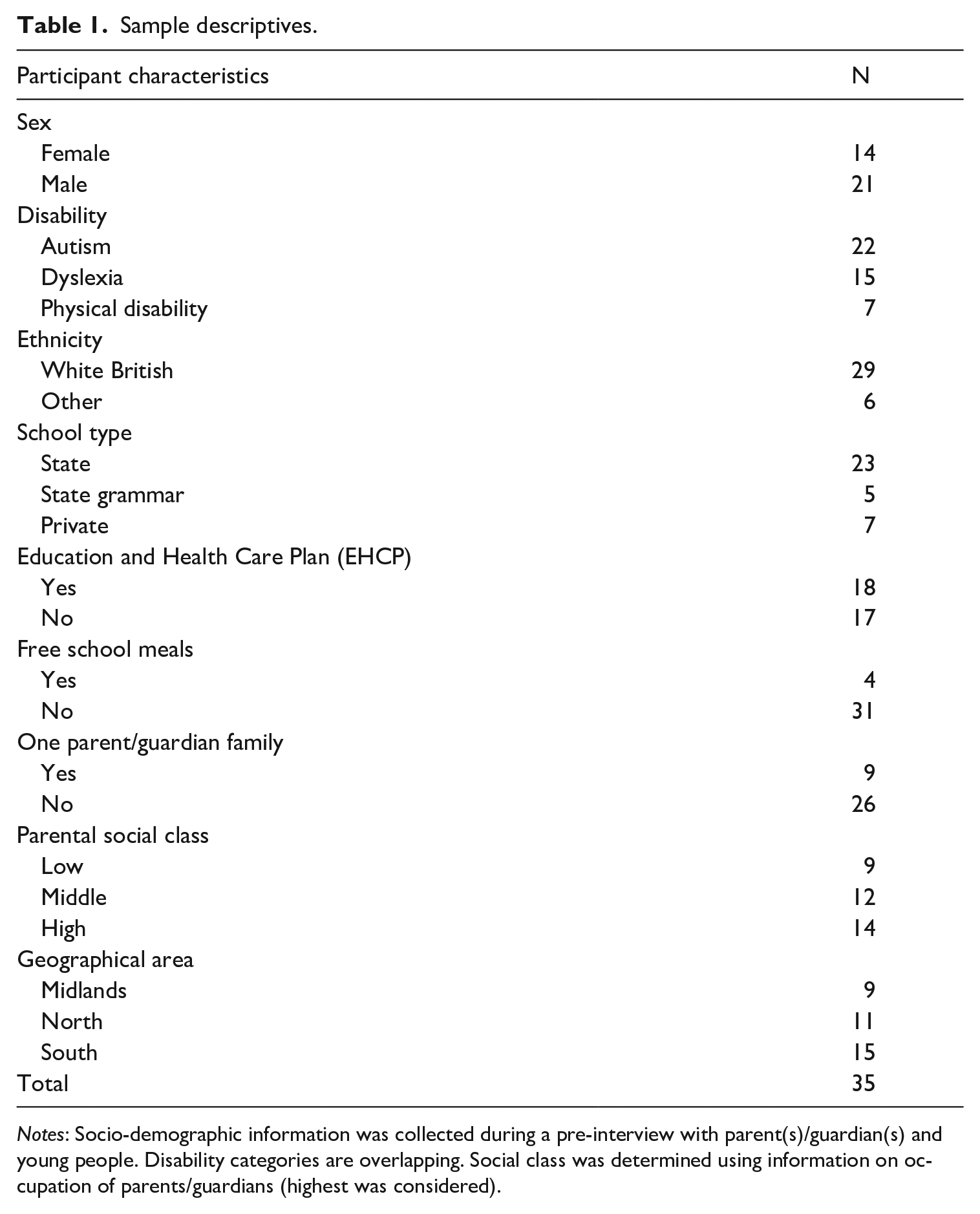
Notes: Socio-demographic information was collected during a pre-interview with parent(s)/guardian(s) and young people. Disability categories are overlapping. Social class was determined using information on occupation of parents/guardians (highest was considered).
Semi-structured online and phone interviews ranging from 45 to 90 minutes were conducted by a female interviewer with prior experience of research with disabled people. A person-centred approach was adopted, consisting of a pre-interview meeting with both the young person and their parent(s) to ensure accessibility and establish rapport. Parental presence during the interview was optional, and the majority of study members (n = 23) participated independently. Following the interview, participants were provided with the opportunity to edit their verbatim transcripts if they so wished.
Questions focused on disability, school and learning experiences, family life and future expectations. We sought to avoid reconstructing disability stereotypes by allowing young people to articulate their understandings and experiences of disability with minimal prompting (Christensen and Jensen, 2012). The first part of the interview was loosely biographical, with participants freely narrating their disability and school histories, noting times, events and people of significance (Butler-Rees and Chatzitheochari, 2022). Social class themes were covered indirectly through explorations of school and family life.
Our overarching aim was to document and explain commonalities and differences in experiences of stigma across intersecting axes of (dis)advantage, with a particular focus on social class and disability. Situational analysis was used to identify key elements, actors, relations and social structures that influence young people’s experiences of education and stigma, enabling ‘provocative yet provisional grounded theorising’ (Clarke, 2003: 559). We paid particular attention to earlier processes implicated in young people’s social location and lived experiences in the present. Data analysis was conducted by both authors, including the interviewer.
We assigned study members to the three broad social class groups of the National Statistics Socio-Economic Classification 2 (Rose and Pevalin, 2003), which captures differences in employment relations and occupational conditions. Notwithstanding possible heterogeneity of parental resources within these three occupational classes, it is important to note that these groupings closely align with other domains of socio-economic (dis)advantage experienced by study members (e.g. family structure, receipt of free school meals, parental educational attainment).
The majority of study members (n = 23) reported overlapping conditions/impairments. These members were assigned to a disability group (autistic, dyslexic, physically disabled) based on their self-reported primary disability, which refers to the condition/impairment with the greatest impact on their daily life (see Table A1 in the Online Supplement for individual-level information on participants’ characteristics). Our analysis therefore provides a discrete analysis of experiences of stigma among dyslexic, autistic and physically disabled young people, while simultaneously considering the substantial intra-group variation in level of support needs. In line with existing stigma theories (Goffman, 1963; Jones, 1984; Link and Phelan, 2001), we also explore the ways relational attributes like situational visibility and perceived disruptiveness of impairments and conditions are associated with differentiated stigmatisation experiences across the three disability categories of interest.
Findings
Social Class and In-School Support in Mainstream School Settings
At the time of interview, half of the participants appeared satisfied with the support in place at their current school, while the other half reported ongoing problems that significantly impacted on their educational experience. Such problems varied from inadequate exam provisions and Learning Support Assistants (LSAs) who did not fully address student support needs to lack of appropriate spaces and exclusionary practices. For example, Sophia, an autistic student from a high social class background spoke of frequently coming home from school and experiencing meltdowns due to sensory overload, a result of the school’s failure to provide her with a quiet space for respite during the day. Similarly, Zoe, a physically disabled student from a low social class background who has been experiencing seizures regularly since the age of 13, reported being frequently put in isolation, as her teachers considered her disruptive to other students’ learning.
Class emerged as a key factor for this observed inequality: participants from a low social class background were more likely to report receipt of inadequate in-school support compared with high- or middle-class participants, irrespective of their level of support needs and type of disability. Interviews revealed that those from high- and middle-class backgrounds had benefitted from distinctive parental advantages in navigating disability diagnoses and educational establishments in the past. This resulted in stark class differences in students’ current locations within the school system, with direct implications for exposure to institutional discrimination, that is, lack of appropriate in-school support and differentiated learning experiences.
Interviews with young people suggested that gaining entry to a mainstream school with exemplary SEND provision was a crucial parental strategy to ensure an inclusive school environment. Indeed, high- and middle-class participants who appeared satisfied with their in-school learning support frequently mentioned their school’s specialist resource base and prior experience with their impairments/conditions. It was not uncommon for these participants to mention disability and SEND provision as deciding factors for their secondary school choice. In contrast, while accounts of students from low social class backgrounds often highlighted parental concerns about school SEND provision, they also revealed an overall difficulty in successfully navigating the system and securing entry into a well-equipped school. For example, when discussing his secondary school choice, Rahul, an autistic student with high-level support needs mentions:
What happened was that despite being told yes, I could come, at the last minute they basically looked at my EHCP
3
and again they realised that my issues were too complex which is why they had to say no . . . so then my parents had to find a new school for me at the last minute, which we were lucky enough to find.
This last-minute change resulted in Rahul attending a secondary school with low GCSE attainment rates and poor SEND provision, which was consequential for his educational trajectory and experiences of interactional discrimination, an issue discussed in the next section. In contrast, not only were high- and middle-class parents able to achieve entry into their secondary school of choice, there were also cases of transfers to a private or independent school mid-way through the academic year, following instances of inadequate support, bullying and/or discrimination. Extreme cases of discrimination were also dealt with through periods of home educating. Ryan, an autistic middle-class participant discusses a period of home education following several instances of abuse in the form of seclusion and restraint in his primary school:
Immediately after that [traumatic incident] my mum pulled me straight out of school. And this is when I began to be home educated . . . However, because it was classed as home educating by choice, it took a big financial toll on my parents because my parents had to fund it all. And I’m just very thankful that I was in a situation where I could have done it.
Aside from access to inclusive school environments, high- and middle-class parents’ economic capital was pivotal for securing prompt disability diagnoses, ensuring appropriate advocacy of young people’s rights to education, financing private assessments and tuition, as well as in-school support to rectify existing issues with lack of school resources. These avenues contributed to more inclusive school experiences and minimised exposure to instances of institutional discrimination encountered by middle- and high-class young people during their school journeys. Take the example of Jonathan, a physically disabled participant from a high social class background. Jonathan was prevented by his headteacher from attending lessons following the onset of seizures associated with his physical disability. His parents sought the assistance of a legal team to make a discrimination case against the school. Jonathan’s exclusion from the classroom lasted for a total of three months. During this period, he was provided with learning materials to catch up with missed learning. In contrast, Zoe, a physically disabled student from a low social class background, experienced two entire years of missed learning as a result of her seizures and received no support or learning materials to enable her to catch up upon her return to the classroom, resulting in a compromised educational experience.
Unlike students from high- and middle-class backgrounds who saw learning support increase and improve as they went through school, low social class participants frequently experienced increased barriers to learning and inclusion over time. Their narratives often revealed a sense of helplessness with regards to in-school support due to their parents’ numerous unsuccessful attempts at securing what was needed for them. Abigail, an autistic participant from a low social class background who experiences mental health difficulties, explains how her school refused to provide her with the required support, despite her mother’s best efforts:
So, my school is not good with mental health. They were very uneducated, and they declined help from every service. It’s kind of like a stab in the back almost . . . When they kind of declined the help, my mum kind of expected it already because she’s lost so much trust in the school.
Similarly, Daniel an autistic participant from a low social class background notes how his learning support dropped off as he went through school, with the LSA who supported him being removed from his lessons, despite his mother’s attempts to get this reinstated:
Year 7 and 8 I got the support I needed, and then Year 9 is when it started dropping off. As it went on, I got no support. I had a Teaching Assistant for three years and she knew me well and then they just put her somewhere else . . . in Maths I went from top set to third set, ’cos when the support stopped, they just put me down . . . I feel very let down since I was doing so well with my support and then when it all stopped, everything just collapsed. [Mum] was trying to get back all the support, but the school was just not listening.
These narratives shift our attention beyond the importance of economic capital, echoing existing findings surrounding classed differences in the power to navigate and challenge institutional authority (Calarco, 2018; Lareau, 2011). Although impossible to infer from participants’ accounts, comparisons allude to the importance of high- and middle-class parents’ use of cultural capital, that is, skills, knowledge and competences, in yielding advantages within school settings (Holt et al., 2019; Lareau, 2011). This is also supported by two reported instances of successful advocacy from parents of low social class students, which were facilitated by their involvement in the disability charity sector.
Interactional Discrimination in Learning Spaces and Stigmatised Conditions
There were participants who had not experienced any stigmatising encounters with teaching staff, while others described pervasive negative attitudes and behaviours throughout their school journeys. Interactional discrimination was closely related to structural discrimination, with those who were not in inclusive school environments and had not secured appropriate in-school support more vulnerable to stigmatising encounters. However, interactional discrimination also cut across social class lines, with several instances of autistic and physically disabled students from high- and middle-class backgrounds consistently experiencing stigmatising encounters. These patterns direct attention to the varying stigmas attached to different conditions and impairments in school settings, and the relational attributes that are implicated in interactional discrimination.
There were no reports of interactional stigmatisation among dyslexic participants who did not report other disabilities. In contrast to autistic and physically disabled students, dyslexic students were more likely to have their support needs easily accommodated within learning spaces (e.g. through use of a reading pen or laptop, or provision of handouts on coloured paper), remaining otherwise invisible and ‘undisruptive’ during classes. At the same time, the vast majority came from high- and middle-class backgrounds and were high attaining, disproving stereotypes of low attainment among students with learning difficulties. Overall, dyslexic students’ accounts did not suggest substantial differences with non-disabled students nor deviations from normative ideals of skills and behaviour, which appeared to minimise their exposure to processes of stigmatisation in learning spaces.
In contrast, autistic participants described some of the most poignant stigmatising encounters with teaching staff. For example, Rahul, whose complex support needs were not being met by his secondary school, described teachers’ stereotyping of his behaviour, which often resulted in exclusions from the main classroom:
I was going to be excluded because they were thinking oh, I’m doing all of these things because I’m just being naughty or I’m just a problem child, a nuisance or a troublemaker . . . for the teachers, it was much easier for them to call me a troublemaker and a problem child, and to just throw me into detention. It just made their life easier rather than to work with me and understand why I’m doing what I’m doing.
Rahul’s experience was very similar to that of David, an autistic participant from a high-class background who faced ongoing challenges with in-school support despite his parents’ efforts:
It was very obvious from Year 1 and reception that the teachers didn’t really understand me, and the teachers just thought I was a troublesome child and just thought I was a pain . . . They just said ‘right, [David’s] just being an absolute pain, let’s completely and utterly separate him from all the other kids. Let’s put him in a room by himself all day every day’ . . . In Year 8 I had 76 referrals for bad behaviour and was it like six or seven exclusions? And it was not a good year, just the stress of being excluded all the time . . . I felt like I was doing the same things as the other kids, but I always got sent out for it.
At first glance, these accounts confirm existing research on the higher stigmatisation risks experienced by autistic students in mainstream settings (Humphrey and Symes, 2010). However, data analysis shows that such experiences were only common for a segment of autistic participants, shifting our focus to the relational attributes behind processes of interactional discrimination.
Unlike other autistic participants, students like Rahul and David were characterised by a ‘perceived typicality’, a term proposed by Monk (2022) to describe individuals who are tuned in to stereotypical perceptions about stigmatised categories. Their perceived disruptiveness in the classroom placed them at a considerable distance from normative ideals of behaviour upheld in mainstream school settings. Combined with being male, itself a key component of dominant societal representations of autism (Moore et al., 2022), these often-intersecting relational attributes triggered processes of labelling, stereotyping, segregation and status loss in learning spaces (Link and Phelan, 2001), as shown by the quotes above.
In contrast, autistic girls did not experience interactional stigmatisation in their encounters with teaching staff and did not present the same relational attributes as boys, appearing more ‘adjusted’ to the norms of mainstream schooling through more ‘disciplined’ behaviour. However, normative academic and behavioural conduct was often achieved through masking, a practice of concealment of aspects of one’s identity in order to ‘fit in’, arising from a high degree of awareness of stereotypes about a stigmatised status (Pearson and Rose, 2021). As explained by Scarlett, an autistic student from a middle-class background:
[Autism] doesn’t really affect my social skills, ’cos I grew up very well at masking obviously. I have never acted . . . ’cos people have a very rigid view of what autism looks like in their head. So, to them, I’ve never acted autistic, I don’t seem autistic.
It is important to note, while successful at reducing stigmatising encounters, masking is associated with a range of negative mental health outcomes for autistic people (Miller et al., 2021).
While physically disabled students were also subject to interactional stigma, their experiences differed greatly to those of autistic participants. The main source of differentiation was the immediate visibility of their impairments, which heralded unwanted attention and immediate negative reactions by some teachers, irrespective of their classroom behaviour and academic attainment. Matthew, a physically disabled student from a middle social class recounts a traumatic reaction of one of his teachers: ‘The first day when I went into the classroom, I was wheeled in by [LSA] and the teacher went like “oh, God!”, it haunted me for weeks.’
Such encounters were common among several physically disabled participants, mirroring findings of existing research surrounding visibly disabled bodies as objects of scrutiny that receive unwanted visual curiosity and negative reactions from others (Calder-Dawe et al., 2020). In addition to this, there were instances of segregation and exclusion, as a result of being perceived as disruptive for others’ learning (e.g. due to seizures), while it was not uncommon for physically disabled students to be stereotyped as incompetent and relegated to a lower status within mainstream classrooms. This is vividly illustrated by Matthew’s recounting of his learning experiences:
So [the teacher] would come up to me within one foot away and then dart away, what was that about? . . . I was in that class, and he wanted to ask me something, and so instead of asking me he asked the Teaching Assistant, like I was you know some mute, unable to talk baby.
We thus see that there are varying stigmas attached to different conditions and impairments, as well as different processes through which stigmatisation comes into play within mainstream classrooms, resulting in differentiated learning experiences and barriers faced by disabled students.
Interactional Stigma and Stigma Consciousness in Peer Relationships
The majority of participants had good relationships with fellow peers, acknowledging the importance of friendships for their overall school well-being. Many friendship groups reportedly included several disabled students, rendering disability differences less salient for processes of group socialisation. However, there were also reports of experiences of interactional stigma, mainly in the form of bullying and exclusion from friendship groups. At the same time, several young people appeared keenly aware of the need to conceal stigmatised identities in order to gain acceptance from their peers.
Patterns of interactional stigma mirrored those observed in classroom settings: while autistic and physically disabled young people frequently reported experiences of bullying, dyslexic students did not report any difficult peer interactions, providing further evidence of the inconspicuous nature of dyslexia outside learning processes (Riddick, 2000). Already subject to interactional discrimination within the classroom, autistic boys with high support needs appeared particularly vulnerable to bullying. For example, David, whom we previously discussed for his experiences of stigma within the classroom, mentions: ‘A couple of kids, they used to pick on me, they used to call me names a lot . . . They used to call me dickhead, or retard and so I just used to walk away.’
Andrew, a middle-class participant who is autistic with high-level support needs, speaks of experiencing bullying throughout his school journey, with students often making fun of him and provoking him through making noises which they knew he would find triggering:
They had exploited me and bullied me for years . . . it’s a whole group and some of them have been expelled . . . Saying it or making the sound just set me off, triggered me literally . . . It went on for years! Non-stop, day after day!
Similar experiences were reported by physically disabled participants. For example, Matthew was subjected to severe bullying throughout secondary school, with some of his peers going to great extents to exclude him from social activities, for example, spending break time at the top of a steep hill and sitting on high stools at lunchtime that he could not access.
Aside from revealing a new domain of stigmatisation for this segment of already disadvantaged students, interviews also showed that several disabled people displayed high levels of stigma consciousness with regards to peer relationships. Perhaps not surprisingly, stigma consciousness was particularly prevalent among those with no experiences of structural and interactional discrimination in the classroom. These participants were very conscious about ‘spoiling’ their school identity, frequently referring to their wish to ‘appear as normal as possible’, which was facilitated by the relatively low level of learning support they received, rendering them less visible than other disabled peers. Interviews highlighted these young people’s keen awareness of media and popular cultural representations of disability, while several also admitted they had experienced incidences of othering and stereotyping in previous school settings. For example, Sarah, an autistic participant from a high social class reports previous experiences of rejection after revealing her diagnosis to others:
People learn about [your diagnosis] and then they’re like ‘I can’t be associated with an autistic person, that’s just weird.’ And then they just distance themselves from you . . . It was kind of horrible to be honest . . . you feel so alone and like people just leaving you because of who you are and you’re never going to change that.
In a similar manner, Scarlett discusses negative reactions when her autistic identity became known to others:
I tend to tell people and then their attitude to me immediately changes as if suddenly there’s new information and I’m a completely new person . . . they start babying me a bit more or they’re just a bit more on edge about what they say.
Participants with heightened stigma consciousness like Sarah and Scarlett engaged in laborious masking, which was emotionally and physically exhausting. We thus see that, even in the absence of instances of structural and interactional discrimination, disabled young people in mainstream schools may still experience internalised forms of stigmatisation, with potentially negative implications for their life trajectories (Link and Phelan, 2014; Reeve, 2014).
Discussion and Conclusions
Despite recent calls for intersectional analyses in disability studies (Ben-Moshe and Magaña, 2014; Frederick and Shifrer, 2019; Shifrer and Frederick, 2019), the vast majority of research continues to employ monolithic understandings of disability, offering little insight on the convergence of stigmatised ascriptive identities (Turan et al., 2019). Focusing on disabled young people’s school experiences, our article provided a novel intersectional analysis of different manifestations of stigma, which has been identified as a potential mechanism behind the reproduction of disability-related inequalities (Powell, 2003; Reeve, 2014). We drew on semi-structured interviews with disabled young people in order to document different manifestations of stigma occurring at the structural, interactional and interpersonal level. A key strength of our study is its reliance on young people’s perspectives, which provided insight into lived experiences of stigma and disability, not achieved by studies that rely solely on parental accounts (Butler-Rees and Chatzitheochari, 2022; Watson, 2012).
Despite sociology’s enduring fascination with the impact of social class on educational experiences and outcomes, the intersection of social class with disability status has been almost entirely neglected. To a certain extent, this can be attributed to medical understandings of disability that view negative educational outcomes as natural consequences of varying long-term conditions and impairments, disregarding the influence of different systems of ascription and power in (re)producing disadvantage (Chatzitheochari and Platt, 2019). Our study sought to rectify this omission by exploring the classed dimensions of disabled young people’s stigmatising experiences within English mainstream schools. Findings reveal the consequential role of social class for disabled young people’s exposure to structural discrimination and consequent location within the educational system. Inequalities in material resources and cultural capital result in differences in child investments, school quality and experience, as well as power to navigate and challenge institutional authorities. These advantages allow high- and middle-class parents to overcome ableist barriers and practices frequently encountered in mainstream school settings in England, securing a more inclusive school environment and appropriate learning support for their children. In contrast, we find that disabled young people from low social class backgrounds accumulate a wide range of disadvantages during their school journey, as a result of the micro-level consequences of structural discrimination in school settings. These findings mirror those of literature focusing on non-disabled children (Bourdieu and Passeron, 1990; Calarco, 2018; Lareau, 2011), and also align with research surrounding the importance of social class for students of ethnic minorities (Gillborn and Mizra, 2000). We contend that inequalities in exposure to structural discrimination and in-school learning support may explain part of the documented class differences in educational outcomes of disabled young people (Chatzitheochari and Platt, 2019; Chatzitheochari et al. 2022) and thus deserve further analytical attention.
In line with earlier research (Humphrey and Symes, 2010), our analyses highlighted substantial variation in interactional stigma experiences between autistic, dyslexic and physically disabled students. We found that dyslexia is a normalised condition within mainstream school settings, easily accommodated within the classroom, and not accompanied by interactional stigma in teacher and peer relationships. To some extent, this may be attributed to dyslexic students’ low level of support needs, as well as accumulated specialist knowledge and school resources for the condition, which renders dyslexic students less visible and disruptive compared with other disabled students. In contrast, several autistic and physically disabled young people experienced various forms of interactional and interpersonal stigmatisation. However, there was also heterogeneity of experiences within these two groups: inclusiveness of the school environment and receipt of adequate in-school learning support were key sources of differentiation, attesting to the enduring importance of social class (dis)advantage and structural discrimination for interactional stigma. Overall, we found that exposure to interactional stigmatisation is associated with young people’s perceived distance from normative ideals of skills and behaviour in school settings, a by-product of various intersecting identities and attributes. This shifts attention from ascriptive disability status to perceived typicality as a key source of heterogeneity and differentiation of stigmatising experiences among disabled young people (Monk, 2022). The importance and validity of intersectional approaches for disability studies was further reinforced by our findings on gender and autism, which demonstrate the interaction of different axes of inequality for young people’s experiences of disability and stigma. Although gender differences were beyond the scope of our article, we contend that sociological approaches focusing on societal representations of autism and gender inequalities in education may help elucidate gendered stigmatisation risks among this group. In summary, findings from our study demonstrate the relevance of different axes of ascriptive inequalities, raising the possibility that negative socio-economic outcomes of young people with varying conditions and impairments may be due to different intersectional barriers, processes of stigmatisation and disadvantage. Future research that scrutinises multiple ascriptive categories will be critical for understanding relationally produced stigmatisation and varying ‘ableisms’ affecting different groups.
Longstanding challenges implicated in the recruitment of hard-to-reach groups were further exacerbated during the COVID-19 pandemic (Butler-Rees and Chatzitheochari, 2022), which led to an under-representation of low social class and physically disabled participants in our sample, preventing us from making definitive statements surrounding data saturation for these categories. Similarly, we acknowledge that findings surrounding dyslexia may be partly driven by the relatively high socio-economic status of dyslexic participants in our sample. Future research on disabled students should consider alternative recruitment avenues to reach disproportionately disadvantaged groups and examine less typical combinations of different social class and disability categories.
Intersectionality is not prescriptive in its methods (Turan et al., 2019). Our interviews with disabled young people did not directly unravel multiplicative effects of social class and disability identities. This was largely the result of the age of our participants with limited direct reflection surrounding classed aspects of identity, school life and learning. Instead, our intersectional approach focused on the interconnections of different systems of power through a sequential analysis of young people’s structural location within the school system and their exposure to structural, interactional and interpersonal stigma. Furthermore, our analysis isolated the meaning of three specific disability categories, which constitutes a key first step for intersectional understandings of disabled identities (Turan et al., 2019). At the same time, we also demonstrated the importance of level of support needs, which was strongly associated with the number of reported individual conditions and/or impairments.
This study documented class and disability inequalities in manifestations of stigma, while highlighting the interrelationship of structural, interactional and interpersonal forms of discrimination experienced in school settings. We presented narratives suggesting that experiences of stigmatisation may accumulate over time, with serious implications for educational attainment and school engagement. At the same time, we also showed that stigma consciousness is frequently experienced among those shielded from other forms of stigma, revealing pervasive psycho-social effects of societal narratives of ableism. Longitudinal and life-course intersectional approaches are needed to fully understand the varying effects of these forms of stigma (Link and Phelan, 2001), and determine whether these trigger processes of psycho-emotional disablism and internalised oppression (Reeve 2014), or whether young people actively resist stigmatised disabled identities for more affirmative self-representations of their conditions.
Supplemental Material
sj-docx-1-soc-10.1177_00380385221133710 – Supplemental material for Disability, Social Class and Stigma: An Intersectional Analysis of Disabled Young People’s School Experiences
Supplemental material, sj-docx-1-soc-10.1177_00380385221133710 for Disability, Social Class and Stigma: An Intersectional Analysis of Disabled Young People’s School Experiences by Stella Chatzitheochari and Angharad Butler-Rees in Sociology
Footnotes
Acknowledgements
We are grateful to all the young people who agreed to take part in our study and generously gave their time to speak about their experiences. Without their flexibility and honesty, this study would not have been possible. We also thank Melissa Chapple, Roxanne Connelly and participants of the Research Seminar of the Centre for Critical Inquiry into Society and Culture of Aston University for useful comments and advice.
Funding
The authors disclosed receipt of the following financial support for the research, authorship and/or publication of this article: Leverhulme Trust Research Project Grant ‘Educational Pathways and Work Outcomes of Disabled Young People in England’ (RPG-2020-202).

Supplemental material
Supplemental material for this article is available online.
Notes
References
Supplementary Material
Please find the following supplemental material available below.
For Open Access articles published under a Creative Commons License, all supplemental material carries the same license as the article it is associated with.
For non-Open Access articles published, all supplemental material carries a non-exclusive license, and permission requests for re-use of supplemental material or any part of supplemental material shall be sent directly to the copyright owner as specified in the copyright notice associated with the article.
