




Abstract
The Prevent Duty mandates that public authorities must work to prevent people from being drawn into terrorism. In this article we review how 158 UK Higher Education Institutions have responded to this new duty by examining their public-facing webpages and Prevent policy documentation. In doing this we draw upon de Certeau’s notions of the everyday to highlight how such initiatives are presented publicly to viewing audiences, and how messages seep into and deepen security measures within UK Higher Education. In reviewing the performative element of Prevent, specifically how information is displayed, we find that the majority of UK Higher Education Institutions have approached their new roles through the prism of ‘compliance’ and/or ‘safeguarding’. The article argues presentations of safeguarding, reassurance and reluctance offer a telling insight into how the Duty has been adopted in Higher Education Institutions’ everyday practice.
Introduction
As a direct response to terrorist atrocities, in 2007 the UK introduced the counter-extremism strategy Prevent. By 2015 Prevent had been expanded to include the Prevent Duty (henceforth ‘the Duty’) and in so doing made it a statutory obligation for public sector organisations to play an active role in foiling ‘individuals from being drawn into terrorism’ (Counter-Terrorism and Security Act [CTSA] 2015). Key to the Duty is the identification of potential vulnerability with an emphasis on reporting those deemed at risk to radicalisation or extremism. As the then Home Secretary Theresa May stated when introducing the measure, the Duty requires ‘local authorities, the police, prisons, probation services, schools, colleges – and yes, universities too – to have due regard to the need to prevent people from being drawn into terrorism’ (Home Office, 2014). Therefore, universities and other Higher Education Institutions (HEIs) have an obligation to identify and report their students, and staff, if they are suspected of having been radicalised or exhibiting signs that they may be vulnerable to radicalisation. Young people by their nature possess certain vulnerabilities and the inclusion of HEIs fits with a wider pattern of educational organisations assuming a role in countering the risks of recruitment into terrorism (Ghosh et al., 2017; O’Donnell 2018; Whiting et al., 2021). However, as the ex-Home Secretary’s remark ‘and yes, universities too’ perhaps implies, the introduction of the Duty within Higher Education has been controversial and has prompted criticism. HEIs have a pre-existing duty of care that includes the monitoring of students’ vulnerability and safety (Saeed, 2018) and the arrival of the Duty has seen concerns raised about its impact on free speech, as well as the securitisation of university campuses (Awan et al., 2019; Qureshi, 2015; Scott-Baumann and Perfect, 2021).
Criticisms draw upon the Duty as an emblem of the managerial shift in Higher Education towards a more commercialised model of education, where security is embedded within these models (see Berg et al., 2016; Radice, 2013). Moreover, these are not isolated instances and there is a growing evidence-base that educational organisations globally are playing an increasing role in government sponsored counter-terrorism mandates (Baser et al., 2017; Gearon, 2017; Johnson, 2019). Further concerns highlight the strategic positioning of counter-terrorism measures that undermine the political expression of Muslim and Black, Indigenous and people of colour (BIPOC) populations in the UK and elsewhere (Sian, 2017; Meier, 2022), in addition to the damaging habituation of Islamophobia and resulting curtailments and surveillance of dissent voices (see Massoumi, 2021; Najib, 2021). This points to the broader and recurring trends of institutionalised discrimination towards populations deemed ‘other’ (see Younis, 2021; Zempi and Tripli, 2022). The analysis and discussion that informs this article takes an equally critical perspective of the Duty; our position, in common with much of the existing literature, questions its processes, practices and the range of interpretations that follow. As Heath-Kelly and Strausz (2018), for example, demonstrate, enacting the Duty raises difficulties for health practitioners, because their roles are primarily dedicated to the well-being of individuals rather than countering terrorism. Moreover, Rodrigo Jusué’s (2022) telling concept, the ‘CT Citizen’, draws on the increasingly insidious security presence effecting multiple sectors of the UK population. Despite the prevalence of this critical work, alternative scholarship has sought to defend the presence of the Duty and authors have argued that many of the criticisms levelled at the Duty are inaccurate or overstated and that the Duty serves as a useful addition to the role universities, and others, can play, where a civic ‘common sense’ towards security is prescient (see Greer and Bell, 2018; Kaleem, 2022).
In expanding our argument, the article applies the work of de Certeau to demonstrate how security is absorbed into the everyday functioning of university life and considers the range and disparity of reaction between HEIs towards the Duty. To date, de Certeau’s work has not been applied to the Duty, however, it has been helpful to the understandings of the everyday demands and complexity of security. For instance, Sarat-St Peter (2017), considers the concepts of strategy and tactic when documenting the process of making home-made bombs and presents parallels to de Certeau’s observations on cooking. A bomb-making manual determines the method of bomb making, hence the strategy, while a lack of an established component creates a tactic of improvisation and ‘poaching’ alternative means or ways of making the bomb. This is something we also note and much like de Certeau’s thoughts on the tactic of ‘making-do’ and overcoming, universities also demonstrate fluidity in their approaches to the Duty. Security and its agency are active sites of engagement, cohesion and politics. They are worked into the practicalities of living with security measures and, as we will see, actors regularly ignore, negotiate or comply with how security impacts on their everyday lives (see Noxolo and Huysmans, 2009).
The application of the Duty in HEIs has been less than straightforward (Scott-Baumann and Perfect, 2021; Zempi and Tripli, 2022). What we have observed when reviewing the application of the Duty in HEIs is, on the one hand, their adherence to the requirements of the Duty but, on the other, their idiosyncrasies or localised responses. We use the term politic to draw upon the conflicting forces that promote the mandate and those that are sceptical of it. For the most part these are driven by those who have conceptualised the mandate, enforce it and comply with it, as compared with those that are less accepting of its validity and efficacy. Evident, as we have found, is a three-level approach to the responsibilisation of HEIs; one of safeguarding and compliance, one of reassurance and a third of resistance. The article begins by considering de Certeau’s ‘everyday’, most especially illuminations of the mundane and boring and how these elements often portray an intimate knowledge of social responses and understandings. Then we give an overview of our methodological approach, before detailing our findings from HEI webpages and public-facing Prevent documentation. We conclude with considerations of security and de Certeau’s everyday, the positioning of extremism as ‘low risk’ in HEIs and the nature of making do that is conspicuous in the adoption of the Duty.
De Certeau and ‘Everyday’ Prevent Strategy
For sociologists the everyday is possibly used to best effect in relation to activities that may at first seem alien, but over time and through familiarity offer vestibules of comfort, mundanity and/or realisation (Back, 2015). Egan (2004) for example uses de Certeau in her observations of the workings of an exotic dance club. Here, dancers are bound by the rules of the club, in how they fraternise with customers, how they share their ‘cut’ of the money with the club or how they circumvent being monitored by the club. In each instance, the dancers have developed malleable comprehensions that allow them to traverse the rules of working at the club. As Egan (2004: 314) states, ‘although dominant meanings are issued by authors (usually the social elite) of the law their interpretations and thus authority can never be completely guaranteed. Through reading, new interpretations emerge – as people play, rustle, stretch or re-inscribe its meaning.’
Indeed, Huysmans (2016) develops further the positioning of the everyday and considers the politic of the everyday by drawing on Foucault and Lefebvre and highlighting the ‘curiosity’ of the everyday in relation to surveillance. This owes much to the ideal of control and the all-encompassing potential of how surveillance systems and devices monitor daily activities and their transgression to accepted and essential elements of daily life (see Monahan, 2006; Wise, 2004). Huysmans is careful to accentuate the insidious nature of these activities where power and control may not always be apparent to those subject to it. His emphasis is on considering the entanglement of these opportunities, for example, the ‘many’ are subject to systems of governmental control and the ‘everyday’ presents opportunities for the ‘weak’ (or those subject to the system) to cultivate their own powers (be they of resistance or compliance) through their practices, activities and tactical awareness. HEIs could, and possibly do, offer examples of those tactical reactions that de Certeau and Huysmans allude to, but equally HEIs may be part of the system. After all, it is they who develop and structure their approaches to Prevent, run counter-terrorism training on campus or place counter-radicalisation guidance online.
This is the everyday world in which HEIs operate; they must remain attentive to the possibilities of their students or staff being drawn into terrorist activities. Gardiner (2002), for example, argues the everyday presents a set of actions and values, however, as he warns this is a descriptive method rather than a critical viewpoint and critical theorists should tease out the tension and misunderstandings of the everyday. For Gardiner this is ‘Life-world’, and it can be found in how we re-invent the everyday, rather than in being prisoners to its habit and practice. What may be missing is, ‘the inventiveness, questioning, spontaneity and ad hoc problem solving that also inform the everyday experience’ (Felski, 2002: 614). Nevertheless, habit and repetition offer a protective layer that if absent would make functioning difficult. Indeed, mundane tasks such as making a coffee or mowing the grass would be hazardous without the sequenced pattern of action that become instinctive. Repetition is a knowledge development exercise, and one often bounded by cultural positioning.
We must also remain mindful of the debilitating nature of the everyday, a factor that, as de Certeau and Mayol (1998) explain, has traditionally affected women unduly – the grind of the everyday tasks of cooking or cleaning (as drawn upon by Lefebvre, 1991: 612). Furthermore, de Certeau cites the example of South Americans forcibly introduced to the concept and rituals of Christianity by their conquerors. The South Americans ostensibly appear to succumb to the beliefs and conformities of their new-found law makers and leaders, their participation appears to be total, but the new practices are formulated ‘in another register’ (de Certeau, 1984: 32). The conquistador’s directives are usurped to perform roles that appease the dominant force but also serve to function in a localised context and manner. Indeed, as Zempi and Tripli (2022) attest, everyday similarities can be drawn to marginal university groups such as Muslim students, who fall under a gaze of surveillance due to the Duty. They remain conscious of their positioning on campus and can alter their activities to avoid suspicions or accusations of radicalisation and extremism (Awan et al., 2019; Spiller et al., 2018). These groups in university, and elsewhere, are directly subjected to debilitating impacts of the Duty (Kyriacou et al., 2017; McGovern, 2016). As we develop in the empirical section of the article, there is a protective layer inherent to ‘compliance’ – that is, not getting into trouble for failing to comply. HEIs frequently state their commitment to the Duty, often supplemented with a statement from their Vice Chancellor (Head of HEI) or the person with institutional oversight for Prevent. Yet, the Duty possesses an indefinite consistency, where the emphasis is on performances of compliance and safeguarding rather than detail of what these concepts are and their functionality. In contrast, there is also disgruntlement felt by HEIs in response to what they are being asked to do, as well as the overbearing nature of the Duty.
Method
In keeping with our motivation to explore how HEIs perform their Duty responsibilities to a public audience, we reviewed publicly accessible Duty webpages and documentation from 158 HEIs across England, Scotland and Wales. This number excluded private HEIs and HEIs in Northern Ireland where Prevent does not apply. Our HEI list was drawn from the Higher Education Statistics Authority (HESA, 2021).
HEIs varied significantly in terms of the information they made publicly available, ranging from dedicated webpages and policies through to those with small excerpts online or sections in broader policy documents (e.g. safeguarding). To maximise our coverage of this material we adopted a threefold approach to our search. First, we began broadly by searching for materials using search engines external to the HEIs (i.e. Google). For this initial search we included the name of the HEI alongside terms ‘Prevent’ and ‘Prevent Duty’. After recording this material, we repeated our search but this time we used each of the HEI’s search functions on their homepages. New material discovered from this second search was recorded and then a final stage was conducted where each HEI’s governance and/or safeguarding page was searched for material related to the Duty.
With data collection completed we began the process of constructing a coding framework. Our approach to coding was inductive and involved reading through the data to identify and segment features that were ‘analytically significant’ (O’Connor and Jofee, 2020: 2) to how HEIs presented their Duty responsibilities and then ascribed labels to these segments a posteriori (Hammond and Wellington, 2020). This process generated 29 codes, some of which contained within them additional code values. For example, the code ‘Myths’ referred to instances were HEIs sought to clarify what they believed were misconceptions surrounding the Duty, but this could also have related to discrimination, snooping, censorship or a combination of all of these. The 29 codes we used were as follows:
(1) Academic freedom; (2) Balance; (3) ‘Business as usual’; (4) Challenge to HE; (5) Commitment; (6) Compliance; (7) Consultation; (8) Controversy; (9) Duty of care; (10) Enforcement; (11) Extremism; (12) Myths; (13) Normalisation; (14) Positive environment; (15) Prevent as safeguarding; (16) Prevent as security; (17) Proactive; (18) Proportionate; (19) Radicalisation; (20) Reassurances; (21) Resistance; (22) Responsibilities; (23) Risk; (24) Support; (25) Surveillance; (26) Suspect communities; (27) Values; (28) Vigilance; (29) Welfare.
Having established this coding framework the final stage was to connect the codes we had generated and identify themes that spoke to our research aim. Three key themes emerged: Safeguarding and Compliance; Reassurance; and finally, Reluctance and Resistance. Our analysis that follows is structured along these thematic lines and the specifics of our coding framework is evident in our observations.
Throughout the collection, coding and analysis stages we sought to enhance reliability by moderating the process through means such as having multiple members of the research team involved or to repeat steps at different points in time. Despite these efforts, given the nature of the research, we make no claims to objectivity or generalisability and these qualities were not ones we strived for.
Safeguarding and Compliance
As our findings demonstrate, the Duty is often presented as an extension of existing safeguarding measures with the additional focus of protecting those vulnerable to supporting or conducting acts of terrorism. The Duty fits into existing practices and this has not been lost in the online presentations of HEIs. Staffordshire University (2021), for example, outlines its commitment to the Duty and confirms that it is taking, ‘a proactive, safeguarding-focused approach’. Similarly, Brunel University (2021) recognises the ‘importance of Prevent’ and in ‘fulfilling its safeguarding duties’ will ‘ensure the safety and wellbeing of students, staff and the wider community’ on its website.
These are representative examples from across HEI institutions and perhaps the University of Glasgow (2021) summarises this framing most succinctly on its webpage:
In short, ‘Prevent’ is about safeguarding individuals from being drawn into terrorism, ensuring that those who may be vulnerable to extremist and terrorist narratives are given the appropriate advice and support at an early stage. Prevent is no different from any other form of safeguarding from harm.
What becomes apparent on HEI webpages is first, how HEIs comprehend the Duty in terms of safeguarding, and second, the enthusiasm or seriousness with which they respond. The appropriateness and effect of designating Prevent as safeguarding has been explored in great depth elsewhere (Ali, 2020; Heath-Kelly and Strausz, 2018; Whiting et al., 2021) with serious and compelling concerns raised. In this context it is important to recognise the effect of hundreds of HEIs across the UK (and hospitals and schools for that matter) presenting it as such. Safeguarding has been deeply entrenched via public institutions such as HEIs and is understood as politically neutral and desirable. The sector’s acceptance and portrayal of the Duty as an extension of pre-existing and uncontroversial safeguarding practices provides a vehicle for it to become part of its everyday practices.
Compounding this is the crux of the policy, the transformation of staff from educators, administrators, managers into observers and monitors. As Egan (2004) has noted, this mirrors how frameworks of control are adapted and much like CCTV in exotic clubs offers zones of protection and control for club owners and club employees. In particular, the dancers are aware of the ‘club rules’ but use the cameras to justify to customers why they cannot perform certain tasks, while remaining attentive to the fact there are blind spots where if they receive additional gratuities the cameras cannot record the transaction. The scope of the cameras is a fluid tool that the dancers use to their advantage. For HEIs there may be a similar disposition in how HEIs enact the Duty through explicit protocols of control that are framed around established safeguarding protocols and awareness.
Adequate training for staff is an important element of the Duty and training packages developed by HEIs are, as with Manchester Metropolitan University (2019), considered ‘essential’ for staff. Cardiff Metropolitan University (2021) has developed a four-tier system for staff training, while Bangor University (2020), below, provides a good example of just how widely particular HEIs are interpreting the requirement to ‘arrange Prevent training for relevant staff’ (Home Office, 2019):
In particular it is suggested that members of staff within the following services will require Prevent Duty awareness training: Governance and Compliance Office, Human Resources, The International Education Centre, Student Services, and in particular mental health advisors and counsellors, Property and Campus Services, and in particular the security section, Commercial Services (and in particular senior and student wardens, conferencing and room bookings), Senior Tutors and personal tutors, Academic college and school administrators. All other members of staff both within professional services and academic schools should also be encouraged to attend training, and line managers are responsible for making sure all their staff are aware of the Prevent Duty and the referral mechanism for raising concerns.
Further examples of public declarations of zealous compliance include Harper Adams University (2020) having, ‘taken steps to ensure that senior staff have been vetted by the Counter Terrorism Service and are approved to attend and participate in the Local Channel Panel’, Glyndwr University (2018) having established a 15-point protocol for use of their multi-faith room and University College Birmingham’s (2020) approach to the Duty’s ‘IT usage policy’ requirement:
Regular and stringent checks will be made on firewalls, to ensure that access to illegal and inappropriate sites is prevented. IT usage will be closely monitored by the IT team in order to identify and address inappropriate use. Guest log-ins will be tracked to eliminate risk of anonymised inappropriate access. Reports of attempts to access inappropriate websites will be provided to the Designated Safeguarding Lead.
Another tactic encouraged in the governmental e-learning programme is the ‘Notice, Check, Share’ approach (Home Office, 2021). This is an online learning programme whose title and focus has been assimilated by HEIs in how they present their roles to their public audience – Figure 1 is an example taken from the University of Sheffield (2021).
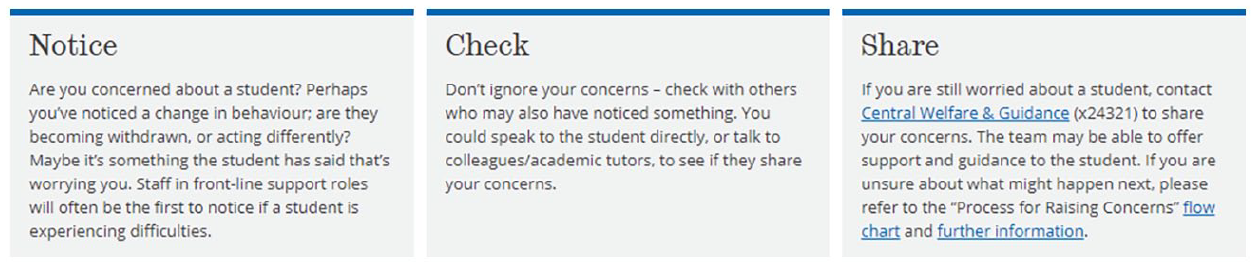
Notice, Check, Share (University of Sheffield).
Simple instructions such as those in Figure 1 inherit the ambiguity of, for example, the government’s Vulnerability Assessment Framework (for more detail, see Brown et al., 2017; Channel, 2012; Coppock, 2014) and cast a wide and uncertain net of potential vulnerability while bringing about the further responsibilisation of front-line staff. The alluring simplicity of ‘Notice, Check, Share’ echoes similar public-facing slogans such as ‘See it, Say it, Sorted’ or ‘Stay alert, Protect the NHS, Save lives’.
Reassurance
HEIs, as we have seen, have made clear efforts to comply with the Duty’s requirements; however, they are equally aware of the concerns and controversy that surrounds it (Zempi and Tripli, 2022). Consequently, HEIs have sought to reassure their audiences as to the intentions and effects of the Duty.
The University of Aberdeen (2020) characterised the ‘challenge’ of the Duty as one of, ‘balancing academic freedom with their statutory duties, while safeguarding students and staff’. The School of Oriental and African Studies (SOAS, 2021) spoke of ‘free and open debate of often controversial subjects’ as a ‘key element’ of university life, Teesside University (2021) stressed the importance of allowing, ‘staff and students to disagree and to hear messages they may not necessarily be comfortable with, as long as these are within the law’ and the University of Leicester (2021) demonstrated their record on this issue by clarifying that the protocols in place have meant only one external speaker has been declined. Evident here is an ethos of what de Certeau (1984: 142) would describe as an application of a ‘making do’ response towards a distinctive challenge of harmonising welfare and encouraging compliance. This presents an interesting curiosity in terms of how HEIs face the dilemma but also in how they channel their responses towards an everyday practice of safety in university life, where there are reassurances of eradicating problematic speakers, encouraging academic freedoms and maintaining safeguarding.
The Arts University of Bournemouth (2021) reminds its staff that they, ‘are not expected to be experts in recognising radicalisation’ and the University of Plymouth (2020) clarifies staffs’ role as one of being, ‘alert to the signs that someone could be at risk and raise concerns to the right person, so that trained professionals can sensitively and appropriately assess the situation and respond accordingly’. Evidently staff are not required to become experts in radicalisation; however, they are expected to ‘spot the signs’ (see Let’s Talk About It, 2021).
Other reassurances come in direct response to criticisms levelled at the Duty and the related concerns audiences may have. Rather than rejecting the criticisms outright, these reassurances opt to reassure their audiences that such negative consequences would not be tolerated in their institution; for example, the following excerpt from Herriot Watt’s (2021) ‘What is the Prevent Duty’ document:
There have been some well publicised criticisms of the Prevent Duty across print and social media. Specifically, there have been some concerns around targeting particular groups and individuals through the Prevent Duty. The University will not tolerate use of Prevent related activities as a method for targeting or marginalising individuals, groups, freedom of speech or academic freedom.
Indeed, the concerns around the potential for the Duty to vilify a particular group (often left unspecified) is an issue HEIs are mindful of and is often countered publicly. HEIs also reassure their audiences by clarifying how they have met their requirements in an environment of transparency and cooperation. For example, by making available their Duty action plan for scrutiny by an ‘independent equality assessment’ process (University of Salford, 2021) or through consultation with the Students’ Union (Leeds Beckett University, 2021).
For other HEIs their reassurances went one step further to directly contest the alleged negative consequences that could stem from the Duty on account of misconceptions and myths surrounding its purpose and operation. The London School of Economics (2021a) offers reassurances that the Duty does not target Muslims. This is a point it reinforces by providing statistics from Channel referrals in 2015 that demonstrate how only 37% of referrals were identified as Muslims.
The University of Leeds (2019) covers a range of other ‘misconceptions’ about the policy that addresses many of the criticisms often levelled at the Duty:
The Duty is not about snooping on our students and staff; interfering with academic freedom and freedom of expression; ignoring legal responsibilities relating to equality and diversity and promoting good campus relations; preventing research and teaching on sensitive topics; or ignoring our responsibilities around confidentiality and data protection.
We see similar ‘myth busting’ exercises from Glasgow University (2021):
Are lecturers being asked to spy on students? No. The implementation of this strategy is about equipping those who have a duty of care to young people with an understanding of the factors that could make someone vulnerable to the radicalisation process. Tutors help to safeguard students from drugs and alcohol misuse, bullying and mental health issues by signposting to the correct support. Radicalisation can have a similarly devastating effect on our young people and protecting them from the influence of extremist ideas is a part of the overall safeguarding role of the staff body.
In providing an explicit defence of the policy the HEIs reassure their audience as to the intention of the Duty. Indeed, myth busting is designed to alleviate the potential of misconstruing the extraordinary powers of the Duty by presenting as reasonable the levels of control it exerts – the message works to ultimately dampen fears of monitoring, surveillance and limitations on personal freedoms.
Reluctance and Resistance
As we have seen, at times HEIs present the Duty as something that fits comfortably with their existing commitments to the well-being of staff and students. However, this tone and language is not uniform across the sector and HEIs also demonstrate unease towards their new responsibilities. At the University of Surrey (2020) this meant mitigating against the ‘risk’ of the Duty conflicting with the University’s ‘core obligations to facilitate and promote free speech as well as to protect individual privacy and academic freedom’. This was achieved by presenting ‘Prevent Principles’ aimed at articulating, ‘how such conflicts should be dealt with and the scope for Prevent related changes to all other operational policies and procedures’.
Similarly, the University of Nottingham (2021) appears to partially sidestep the Duty by stressing its belief that social inclusion is the most effective means of achieving Prevent’s objectives rather than a slavish adherence to the Duty:
The University will continue its approach to manage Prevent as part of its welfare and safeguarding activities. We are committed to maintaining an inclusive and supportive environment where all members of the University community are encouraged to engage in debate and to pursue both academic and non-academic interests. At the heart of this, we will continue to encourage a culture whereby all members of the University community feel involved and socially included in university life and support others to do the same. We consider this the most effective means of reducing the likelihood of individuals becoming isolated and vulnerable.
This reluctant compliance becomes far more explicit elsewhere across the sector and is articulated clearly by the Vice Chancellor for the University of Warwick (2019), in the following excerpt, which sits alongside critical statements from both the University and College Union (UCU) and the National Union of Students (NUS) that cement the position of the HEI’s leadership:
The Prevent Duty requires the University to conduct itself in ways to seek to prevent anyone in our community or on our campus preparing, supporting or encouraging others into acts of terrorism. That aim, surely, is one around which we can have consensus. However where that consensus breaks down is over the means by which this is to be operationalised. Some fear that it may make universities into agents of surveillance; some suggest that the approach could be, in practice, Islamophobic. These are incredibly important and intense issues . . . As a Vice-Chancellor, indeed as the head of a major organisation, I’m not doing this through choice or desire and it is not because we are part of the government machinery. I need to ensure that Prevent is implemented because it is a statutory duty; it is the law.
The University of Cambridge’s (2021) Prevent guidance webpage notes the ‘considerable freedom’ that specified authorities have in ‘how they implement their responsibilities’. This is something the institution appears to have exercised in relation to the Government’s advice to consider the application of web or email filtering. Indeed, in saying that it was ‘not persuaded that filtering could be used effectively to prevent access to certain material, notwithstanding the lack of clarity on what to filter’, the University of Cambridge (2016) provided one of the more overtly defiant statements in relation to the Duty. It elaborated on this position by adding that filtering would also likely ‘hinder access to legitimate content, as well as access to sensitive material for legitimate reasons’.
These instances speak to issues we have raised in the opening section, where the ‘weak’ or those subject to authority foster their own powers, in this case through resistances that are again visibly present online. However, these examples are attributed to senior management and again, there is a juxtaposition of adhering to the Duty, and being seen to do so, alongside degrees of discomfort and reluctance in performing the tasks demanded. Indeed, what may be evident are those micro-resistances of everyday practices that for de Certeau are the ‘tricks’ of the small/weak over the big/powerful (also see Blauvelt, 2003).
Finally, despite being one of the HEIs that dismissed criticisms as misconception and myth, the London School of Economics (2021b) made public its response to the Government’s Prevent Duty Consultation. It provided several damning criticisms of the Duty around freedom of speech, the potential to stigmatise individuals and the potential to push extremist views ‘underground’, concluding that:
the difficulties the draft guidance poses for universities are so great that it supports the proposal by the Joint Committee on Human Rights, supported by the million+ group, that the CounterTerrorism and Security Bill be amended to remove universities from the list of specified authorities to which the new duty applies.
Clearly there is a desire to remove HEIs from the responsibility of performing a security role because of the many difficulties it presents, most pointedly those pertaining to human rights. This may be a telling example of something like Gardiner’s (2002) ‘Life-world’, where the values of the Duty assume a response from HEIs that challenge, amend or problem-solve the demands they face.
Conclusion
We began the article by introducing the Duty and its positioning in UK Higher Education; we also drew upon de Certeau in explaining how we might unpack the everyday realities of initiating the demands of the Duty. The everyday has precedents in attracting sociologists to scrutinise the ordinariness of daily life by raising those very ordinary moments into the exciting, telling and informative instances (see Back, 2015; Goffman, 1978; Latour, 1996; Lefebvre, 1991; Neal and Murji, 2015). It surreptitiously and overtly engages objects, ideas, actions or beliefs into its realm, by labelling and therefore politicising the meaning and intent of everyday realities (Lefebvre, 1991). To some degree this is about how something is appropriated through its usefulness or how it is identified or how it is claimed. What makes something ‘everyday’ may in fact be as simple as that object becoming familiar or taken-for-granted; yet this distinguisher is porous and open to interpretation. Driving the everyday are deep structures of repetitive and reproductive practices. This is what de Certeau wrestles with and moves beyond, for example, in considering the limitations of essentialism, where any object, animal or concept has a set of concrete attributes that identify it as that thing.
Indeed, committing to a counter-terrorism policy and responses to it may present differently in diversifying contexts, and one could add, are ultimately guided by the moral code of a society at a given time (see Durkheim, 1972). The everyday is an invitation to bring entities into popular culture, yet for many it is a way of disturbing preconceived or unconscious knowledges (see Garfinkel, 1967; Goffman, 1978) – an opportunity to make sense of what already makes sense. What becomes clearer when taking this approach is that the everyday affords a sense of re-inventing the extraordinary, because it is not everyday – it makes the extraordinary ordinary – and this is where it is useful in terms of the Duty. The Duty is a counter-terrorism response to activities that are extraordinary, dispersed to situations that have rendered it relatively ordinary. Much like Goffman (1978) we wanted to disturb the order to highlight how this is not an ordinary occurrence. Yet we remain mindful of the complexities of our task, as Guillaume and Huysmans (2019: 296) (when quoting Blanchot) stress, ‘it takes seriously Blanchot’s conception that the everyday seeks to write something that when written has escaped it’.
A driver to our thoughts has been how HEIs remain conscious of their responsibility to maintain the safety of their staff and students, compliance to the Duty and to pursue knowledge creation. This is the key to the politic of the newfound roles exerted on HEIs, most especially when there is a vacuum of direction from those mandating the Duty. As we have seen, a tactic has been to amalgamate new demands into existing structures and there has been a performative and habituated element to this as the Duty is extended into educational contexts. All of this speaks to the workings of de Certeau, as Amicelle et al. (2015: 300) allude to in other duty-bound situations:
Although these social actors often have no choice but to make do with compulsory devices, their ‘ways of operating’ are not necessarily passive and entirely guided by established rules. According to Michel de Certeau, usage should be analysed as a creative activity on its own. It is another form of production that ‘insinuates itself everywhere, silently and almost invisibly, because it does not manifest itself through its own products, but rather through its ways of using the products imposed’.
In taking ownership of the ‘usage’ of the Duty HEIs impose their interpretations and assurances as to how they understand their roles and how they promote the security obligations they meet.
We conclude the article by advancing three elements that the politic of the everyday and de Certeau help comprehend. First, its relevance to security and counter-terrorism initiatives. We deliberately chose HEI webpages and the documents contained therein as these sites provide a public-facing source of data that all HEIs maintain and update on a regular basis. Here is a site that can often be the first point of entry for a perspective student, perspective member of staff or inquisitive researcher. Once you have visited a few HEI webpages you begin to see how relatively mundane each is. Each offers standardised images and information on the HEI, its history, its location, its departments and student activities. However, within these sites is also the presentation of policy, rules and regulations, and security practices. Here, we can begin to see how HEIs are as Amicelle et al. (2015: 300) attest, ‘using the products imposed’. It offers ordinary elements but also the individualised convictions of how the HEIs are embracing the Duty. And so, this mandate begins to demonstrate the approaches taken, the priorities of HEIs and the heterogeneity of the Duty’s adoption.
Second, there is no escaping counter-terrorism is a demanding task – as is safeguarding staff and students. Indeed, HEIs have a duty of care to protect and ensure safety, including how they choose to review policy and implement strategies to limit potential exposure to provocative information, physical danger or hazardous material. HEIs often make clear the ‘low risk’ of extremism or untoward behaviours on campus. On the webpages rarely was there an emphasis on experiences of, for instance, hosting radical speakers, referring a student suspected of radicalisation or, more pressingly perhaps, success stories of preventing radicalisation or helping someone amend their ways (see Guardian, 2016; Henry Jackson Society, 2013; Independent, 2017). Instead, there appears to be a hesitancy in acknowledging what has previously happened (if at all). While each HEI presents individualised documents and approaches, rarely is the localised experience of dealing with Prevent recognised, instead the wording of the documents and their online presentation is framed in generic language. This, as de Certeau alludes, is evidence of the debilitating nature of the everyday, where in these instances the demand for compliance overrides institutional experience to the degree that there is a re-registering of events to present a sanitised version of a ‘well-governed’ or ‘low-risk’ campus (see Whiting et al., 2021: 523). Much like the reluctance of banks to highlight the levels of fraud they have faced, or their counter fraud measures as it creates the impression the bank is an unsafe place to lodge assets (see Ball et al., 2015).
Third, de Certeau (1984) speaks of ‘making do’, which is a response to putting into action what is expected. For him it might be the journey from A to B that has been hindered in some way, say by a traffic accident, and so the response is to work around the difficulty, finding a new route and ensuring the journey is completed. This we reason may be a consideration as to how HEIs have adopted and presented their Prevent responsibilities. The change initiated by the Duty in 2015, demanded that HEIs monitored their charges for potential extremist or radicalised behaviours. As we have seen, the performance of the Duty on HEI webpages does have moments of coherence, but for the most part demonstrates, ‘the tragic frailty of policy’ (Saltmarsh, 2015: 32). Our findings highlight just some of that frailty through the contentious movement of Prevent into safeguarding, the reassurances HEIs are keen to display or through the resistances some HEIs have clearly embarked upon.
De Certeau (1984; de Certeau and Mayol, 1998) asks us to look not at the product but at how people are using the product, making sense of that product and indeed how they are embracing their new product-led roles. Our intention has been to comprehend the activities of those actioned to perform Prevent-led duties and we have reviewed a small cog in the machinery of countering terrorism. As we have demonstrated, the everyday nature of HEI webpages and other public-facing materials can offer an insight into the politic of an extraordinary counter-terrorism measure and ordinary consequences.
Footnotes
Acknowledgements
We would like to thank the reviewers and editors for their invaluable comments, all of which certainly enhanced the article.
Funding
The authors disclosed receipt of the following financial support for the research, authorship and/or publication of this article: the research that informs the article was part of the Desecuritising Higher Education project that has been funded by the Joseph Rowntree Charitable Trust. However, the views expressed are not necessarily those of the Trust.
