




Abstract
This study reports on an unique opportunity to compare four quantitative/qualitative datasets from 2017 to 2021, before and after the activist Greta Thunberg became known to the general public. Through a mixed-methods approach, we develop a model to distinguish between three forms of climate reflexivity: (1) reflexivity as ranking; (2) reflexivity as recognising; and (3) reflexivity as qualifying. Our findings imply that in 2019 and the following years, Greta Thunberg became a unifying inspiration for young people already concerned with the climate crisis in Norway. Even though two indicators suggest that the COVID-19 pandemic did divert young people’s reflexivity from climate issues, we also find that a subset of the participants expresses rich reflexivity, addressing nature and the need for transition and solidarity. Finally, we argue these forms of reflexivity shape commonalities that may have relevance across social classes, identities and nation-states.
The Climate – a Common Issue?
I’ve learned you are never too small to make a difference. (Greta Thunberg at UN Climate Change COP24 Conference, December 2018)
In 2018–2019, environmental activist Greta Thunberg became world-famous due to media exposure of her climate engagement movement ‘Fridays for Future’ and her speeches delivered to world leaders at the United Nations (UN) and World Economic Forum. In 2019, many young Norwegians participated in school climate strikes, as did several million young people in 185 countries (de Moor et al., 2020). Many climate activists and organisations saw this heightened political engagement as a sign of young people dissenting to the existing political and economic status quo based on consumption and profit (O’Brien et al., 2018). Some researchers have argued that young people’s involvement is necessary to curb global warming and decrease emissions. Bastien and Holmarsdottir (2017) claim that youth drive innovation and can help the world reach the UN’s sustainability goals. News and popular science channels have framed young people’s engagement as a ‘riot’ (Thingsted, 2019). The political activity among today’s youth is not inherently comparable to the ideological and generational uprisings of the 1960s; however, the public protests are notable in the Scandinavian setting because other recent political engagements have been expressed in a quieter form, through social and moral considerations and personal responsibility rather than public and expressive acts of resistance (Lieberkind, 2020). On a global scale, the number of protestors worldwide may indicate that young people recognise the natural environment as a shared issue rather than a cause for special interest groups or activists.
The current study examines the role of reflexivity in young people’s climate engagement through a comparison of four quantitative and qualitative datasets collected from 2017 to 2021, before and after activist Greta Thunberg gained global prominence. The surveys do not specifically ask about climate concerns; however, the data drawn from the surveys enable identification and comparison of forms of climate reflexivity. New methodological and theoretical approaches are needed to investigate young people’s climate engagement across nations and diverse groups. The current study examines (1) in what ways a sample of young Norwegians developed climate reflexivity due to the influence of Greta Thunberg and the 2019 Fridays for Future campaign and (2) to what extent this reflexivity can be said to constitute collectiveness – or commonality – among young people.
It is critical to examine individuals’ capacity for reflexivity when discussing changes in young people’s climate awareness and engagement. In this study, climate reflexivity is understood as the sense that one is a part of a large natural environment in which the climate plays an important part and in which one’s actions have an impact. With commonality we understand some features or characteristics that are shared across sociological categories as identities, classes or nation-states. These features are pluralistic and multifaceted, yet held together in tension by common notions of something personal, social or political at stake (Blokker and Brighenti, 2011: 384–386; Thévenot, 2015).
The Norwegian Educational Context and Climate Attitudes among the Young
Norwegian youth engagement on climate issues should be considered in the context of the social-democratic norms that influence their perceptions of citizenship (Hayward et al., 2015) rather than the context of national petroleum policies. 1 As in other Nordic countries, the Norwegian educational system is considered a suitable arena for the promotion of societal values through a national core curriculum (Telhaug et al., 2006). In some nations, curricula have an implicit focus on climate, but Norway’s curriculum has included explicit references to climate change since 1987 (Schreiner et al., 2005: 24; The Royal Department for Church, Education and Research, 1987). The national curriculum taught when the study participants were school aged (roughly 1997–2020) explicitly acknowledges the importance of climate change in the chapter ‘The environmentally conscious human’ (Ministry of Church, Education and Research, 1996: 45–48). This chapter describes climate risk as transcending national and generational lines and lists consumption and waste as significant climate issues. The instructional material encourages fondness of nature, technical knowledge and consumption reduction.
In recent decades, the Norwegian media landscape has been dependent on government-funded broadcasting, regarded as relevant for citizens’ political knowledge (Jenssen, 2013). In the last 25 years, climate change and the natural environment have often been addressed in popular science programmes for young people, and direct campaigns have been implemented in children’s television. 2 Although Norwegian education policy has long highlighted climate dangers, it has not had a clear focus on climate justice, like in Scotland (McGregor and Christie, 2021: 653). Neither have Norwegian broadcasters, at least not before Greta Thunberg and her message gained international attention.
Most young Norwegians rank the climate crisis as one of the major challenges of our time (Livgard, 2019). In recent Norwegian elections, parties with environmental platforms have had strong support among young voters (Kleven, 2020). European youth are often referred to as ‘disengaged’; however, Lieberkind and Brun (2021) have termed Nordic youth ‘reserved citizens’ because they are passive about political participation but knowledgeable and democratically engaged in informal settings. Many young Norwegians believe in and reflexively understand the consequences of the climate crisis. However, prior to 2019, they seldom participated in mass demonstrations.
In recent decades, researchers have developed a better understanding of the urgency of the climate crisis and have established that climate change is a severe threat to biodiversity and modern society. The year 2020 was one of the three warmest ever recorded (World Meteorological Organization, 2020). Slowing global warming requires changes at many levels to reduce emissions and pollution. Climate negotiations have occurred regularly since 1995, but emissions have increased significantly since the 1990s (Doyle, 2019).
Reflexivity Theory and Engagement
The sociological study of contemporary reflexivity has been led by Giddens (1991), Bourdieu (Bourdieu and Wacquant, 1992), Beck et al. (1994) and Archer (2003, 2007, 2012). In addition, Thévenot (2002, 2015), Boltanski and Thévenot (2006) and Lamont (2012), we suggest, have also made valuable contributions that advance reflexivity theory.
Beck, Giddens and Bourdieu have contributed fruitful yet limited perspectives on reflexivity in modern society, all of which have been employed to study climate engagement. Their contributions have addressed and conceptualised the social transition of a period of rapid development that has significant implications for nature and life on earth in future generations. They have also contributed important perspectives that challenge the economic and bureaucratic understanding ingrained in political governance systems.
The most well-known perspective in the study of reflexivity is the theory of individualisation. Beck and Giddens argue that reflexivity is replacing routine action, traditions, roles and identities in modern society (Beck et al., 1994; Giddens, 1991). The theory of individualisation categorises contemporary society according to three factors: increased choice; reflexivity regarding identity; and privatisation of social and political problems to an individual level. Beck describes individualisation as a ‘double-edged sword’ in that it expands choice but inflicts a burden of continual decision making and responsibility. Reflexive individualisation can be interpreted as a path to gain political power and therefore to responsible citizenship. Individualisation may lead actors to become more responsible and empowered such that they feel compelled to resolve local, national and global environmental issues (Connolly and Prothero, 2008: 141). Dawson (2012: 313) terms this phenomenon ‘embedded individualisation’ and explains that it occurs as a function of reflexive knowledge of one’s responsibility to others. Beck (2010: 260–264) asserts that global risk can lead to cosmopolitanism, a mindset in which individuals orient themselves towards global dialogue and conflict. According to Beck (2010: 264), cosmopolitanism can awaken ‘enthusiasm for a greening of modernity’, thus redefining modernity. In The Politics of Climate Change, Giddens (2009) argues that strong states will help prevent future environmental catastrophes. According to Giddens, orthodox politics and the green movement are flawed, and the enabling state is the only entity capable of reshaping societal behaviour, establishing and enforcing environmentally friendly policies and investing in new energy sources.
There is currently no strong empirical basis for a relationship between the process of individualisation and the development of environmental interest or behaviour (Kent, 2009). Beck and Giddens have been accused of fuelling exaggerated notions of freedom of action, ignoring the significance of the subconsciousness of meaning in formation, and disregarding the continued impact of social class on people’s lives (Skeggs, 2002). Since the 1990s, it has become evident that there is a discrepancy between many young people’s green intentions and behaviours regarding modern consumer lifestyles, including shopping, use of electronic products and travel. Beck and Giddens’s individualisation theory could be interpreted to suggest that young people are reflexively aware of climate change and its consequences on a global or cosmopolitan level but ignorant about the relationship between climate change and their daily social and practical lives as modern consumers. Increased emissions are a function of income and consumption then, not reflexive intentions. How then can reflexive change be possible?
Bourdieu offers another perspective on reflexivity by recognising the individual’s capacity for reflexivity but prioritising the pre-conscious manifestation of one’s habitus, which is defined as the pre-reflective imprinting of subjectivity and early socialisation regarding one’s way of experiencing and being in the world (Bourdieu, 1998, 1999; Bourdieu and Wacquant, 1992). Bourdieu emphasises the beliefs, perceptions and lifestyles identified with specific social groups or within certain fields. This perspective is suitable for studying systematic reproduction and inequality. In a study conducted in the United States, Laidley (2013) found that climate change is a ‘classed’ issue in terms of people’s perceptions and discussions of social class in relation to it. And while it is, we also think that the case of Greta Thunberg and the demonstrations in 2019 show that people from different classes and geographical backgrounds may find some common, reflexive grounds.
The reflexivity concepts proposed by Beck, Giddens and Bourdieu are rich, they complement each other and differ from one another. These differences are outside the scope of this article. However, as concepts they are limited for two reasons. First, they share the presumption that individuals are always in a state of either reflexive consciousness or non-reflexive unconsciousness. Second, they presume that the categories of reflexivity are strongly related to specific categories of social groups (e.g. notions of class, capital, identity, nation-states or cosmopolitan mindsets). But none of these adequately explains transitions in youth’s climate reflexivity.
Archer (2003, 2007, 2012) has proposed a theory of different modes of reflexivity based on a series of interviews. According to Archer, individuals are not either reflexive or non-reflexive. Rather, individuals may act and think reflexively without articulating it. Transcending the duality of earlier reflexivity theories, Archer identifies four modes of reflexivity: communicative, autonomous, meta- and fractured. Based on Archer’s typology, Davidson and Stedman (2018) found that meta-reflexivity was the most powerful predictor of climate-friendly dispositions. Meta-reflexivity is attributed to agents who acknowledge an ethical responsibility to be part of the solution. Archer’s typology is a valuable contribution to the literature on reflexivity; however, her overemphasis on psychological aspects rather than cultural aspects fails to acknowledge that reflexivity is socially and historically constituted (Elster, 2017). Indeed, all the previously mentioned perspectives on reflexivity (Beck, Giddens, Bourdieu and Archer) are limited in that they downplay the relationship and tensions between reflexivity, individual engagement and cultural aspects.
According to Nairn (2019), there is an important relationship between reflexivity and collectivity. The dominant sociological perspectives on reflexivity may be insufficient to explain young people’s attitudes regarding climate change, particularly regarding the transitions of meaning and tensions that we observe in our data. Instead, we consider pragmatism and valuation practices as fruitful tools for this purpose (Lamont, 2012: 202–203; Thévenot, 2015). We consider reflexivity as an area of study that exists at the boundary between actors’ personal experiences and the social processes through which systems of meaning are qualified. Valuation of the natural environment as a commonality may be formatted as personal attachments (affective and familiar relation to nature), interests (plans or options regarding nature) or public qualifications (general worth of nature) (Thévenot, 2015; Thévenot et al., 2000; see also Eranti, 2018). As Blok (2013) notes, green worth is probably incoherent, morally diverse and full of cognitive tensions.
Personal attachments to nature may share commonalities – for example ‘the beauty of the moment’ – but such attachments are local, and often invisible to others. Interests and plans regarding nature – like hiking, skiing or beach clean-ups from ocean plastics, share commonalities in that they are formatted as options or common actions, although they come in a variety of flavours in different regions. At last commonality can be shared at a public level. Thévenot, Moody and Lafaye have argued that activists may value nature for characteristics involving its collective worth, heritage, traditions and local value, as well as the inspiration it provides (Thévenot et al., 2000: 246–252). These forms of worth are referring to different ideas of a ‘common humanity’ (Thévenot, 2002: 78, 79) – not inherently commensurable; however, they can be used to distinguish between different positions in a complex and contested reality. We hypothesise that Greta Thunberg may have contributed to a reformatting of the tensions between personal attachments, interests and public qualifications. A shift to a public orientation towards green worth would necessarily be slow and involve social formatting in which the climate and environment are neither taken for granted nor viewed as personal experiences but seen as contested and pluralistic or raised to a political level.
Despite the Norwegian government’s promotion of an environmentally friendly national curriculum, young Norwegians may not have been culturally ‘equipped’ (Thévenot, 2002) to qualify green worth in different situations or act upon their knowledge. The complex valuations of the contested worth of the natural environment have historically been reserved for adults: politicians, economists, experts and activists. This study examines the measurable and tangible statements that young Norwegians consider important in relation to climate and the environment when not presented with direct questions about climate and/or the environment. The reflexive ideas young people consider significant can be measured over time, and the current study accounts for young people’s engagement and highlights ideas they consider legitimate within their culture.
Analytical Approach
The data for the current study were drawn from four surveys that were part of a youth study conducted in 2017–2021. The project’s initial purpose was to openly explore the interests of today’s young people, important factors of their upbringing and their understanding of their generation and society in their own words. In 2020, we included questions about experiences of being young during the COVID-19 pandemic.
Currently, several research projects are being conducted among youth in Norway. The most notable study is Ungdata (Bakken, 2021), for which data are collected annually in most municipalities in Norway to ensure a broad and robust body of quantitative data related to youth. The Ungdata dataset consists of standardised national and locally adapted questions and provides little room for reflexivity and free response. Other studies of young Norwegians have included case studies that take a narrowly focused qualitative or phenomenological approach to cultural phenomena. The current study employs an open and explorative approach combined with the quantitative tools of large-scale surveys and randomised selection.
Selection
All data for the study were gathered in Norway. Norway is often ranked at the top of the UN’s Human Development Index (HDI), which is a quality-of-life measure that accounts for income, education level and life expectancy. However, Norway also has relatively high emissions per resident on a global scale, primarily due to oil and gas activities and a high mean income among citizens.
The survey data used in the current study represent a large group of young Norwegians who reflect upon society and their role models in ways that allow observation of various forms of climate reflexivity. The 2855 informants in the four survey samples were recruited through targeted ads on Facebook and Instagram that invited young people to participate in a research project. In November 2017, the first survey was sent to 19–20-year-olds in all counties in Norway. In December 2019, the second survey was sent using the same criteria. In May 2020, about two months into the COVID-19 pandemic in Norway, the third survey was distributed to 17–20-year-olds, and the final survey was distributed to 19–20-year-olds in April 2021. The potential scope of recruitment was stratified and varied. A slightly skewed cultural pattern is expected based on social background, gender and other cultural factors. In total, 1571 of the 2855 informants provided answers in our open-text questions. The majority of participants were women, and individuals whose parents had leadership responsibilities or higher education (i.e. members of the Norwegian middle class) were overrepresented in the sample. However, an ISCO08-test 3 indicates that all occupational classes are represented in the sample (Michalos, 2014). The data are likely influenced by self-selection into the study sample, and it is likely that informants who had a particular interest in participating in online surveys or had the desire, ability and time to participate in such surveys are overrepresented. These issues of representation could be problematic when investigating complex socio-demographic questions (Kalimeri et al., 2020). The data were collected on four different occasions; thus, the individual participants differ from survey to survey.
Valuation and Commonality
In the qualitative survey material, we were surprised to find that many informants wrote about climate and Greta Thunberg in the 2019 survey responses and decided to follow this line of inquiry. The open valuations young people make in responding to surveys involve more than writing phrases or giving accounts. Rather, the responses rely on forms of commonality that the young informants consider relevant and presume that researchers will understand. The respondents qualify (Thévenot et al., 2000) their responses to make their account accountable (Lamont, 2012). We find normative valuations in critiques as well as appraisals. Climate change and nature are commonly contested objects that many informants chose to signify and write about. In the qualitative analysis, we review and compare survey responses that recognise, valuate and/or qualify environmental worth, the importance of climate, nature and/or Greta Thunberg on a personal or general level. We also establish whether the informant chose to use a personal or collective pronoun (‘I’ or ‘we’).
A Model for Analysing Responses on Climate Reflexivity
One potential issue with examining respondent attitudes in questionnaires is that the researchers must construct the object of issue for the respondent a priori. For example, by stating that climate change may be of importance to the participant, the researcher implies its importance. Therefore, the sequence of the questions is an essential aspect of the methodology and research design. The surveys were constructed to encourage free responses before specific questions were asked regarding participants’ viewpoints on current debates in the Norwegian context. For the current study, we analysed and interpreted participant responses to three survey questions, which were presented in the following order:
Think of a person who inspires you – who is that person, and what qualities do they have?
How would you describe contemporary society in your own words?
How would you rank your concerns on climate change on a scale from 1–4?
Responses to questions 1 and 2 were collected in a free-text form in which the informants could write and signify what they found most important. There was no mention of climate, nature or the environment in the survey prior to the third question, which appeared at the end of the survey. The sequence of these questions enables observation of a spontaneous, not a priori, valuation in the qualitative data. In investigating the survey data, we developed a model to identify different forms of reflexive responses connoting the worth or importance of climate, nature or role models.
Different Forms of Climate Reflexive Responses
The categories in Table 1 were used to differentiate forms of reflexivity in participant responses on nature and climate. Responding to Question 3 requires a low level of climate reflexivity. In contrast, Questions 1 and 2 do not define any ‘contested’ object; thus, the informants may freely choose to articulate any concern as significant. Linking climate issues to role models or descriptions of contemporary society calls for either strong affectivity or heightened reflexivity and signifies that the informant recognises climate or environmental issues when they are not implied. Finally, some informants qualified their responses. These qualifications suggest that the informants are critically reflexive about recognising environmental concerns and can articulate valuations or traits they believe in or think will be commonly understood and link them to a problem description, solution or subject (e.g. Greta Thunberg).
Different forms of reflexive responses.
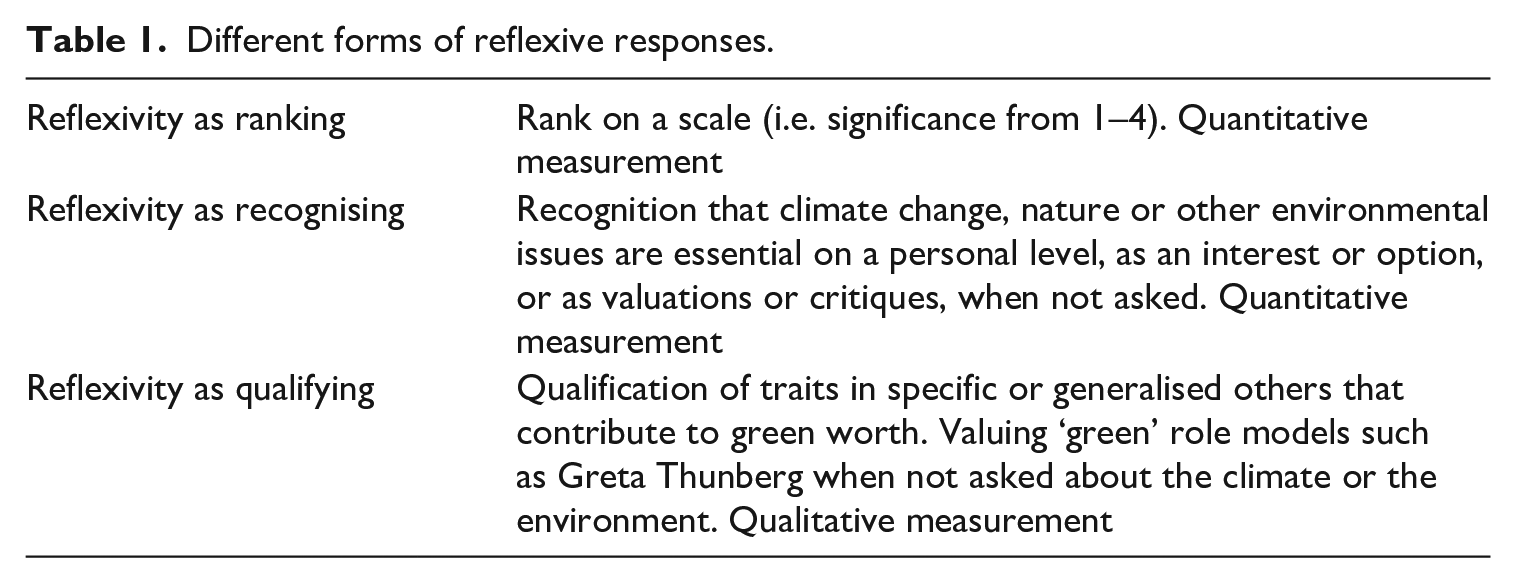
We believe this model captures reflexivity, whether in the form of quick ‘reflex’ responses, acting upon hunches or thorough articulations of qualifications. The next section will explore how young people’s responses to these indicators changed from 2017 to 2021.
Climate Reflexivity
Reflexivity as Ranking
Towards the end of the survey, informants were asked to rank how concerned they were about climate change on a scale from 1 to 4. The response options were ‘1: Not at all’, ‘2: To a small extent’, ‘3: To some extent’ and ‘4: To a great extent’. The responses are listed in Table 2.
Informants’ ranking of their concern with climate change (%).
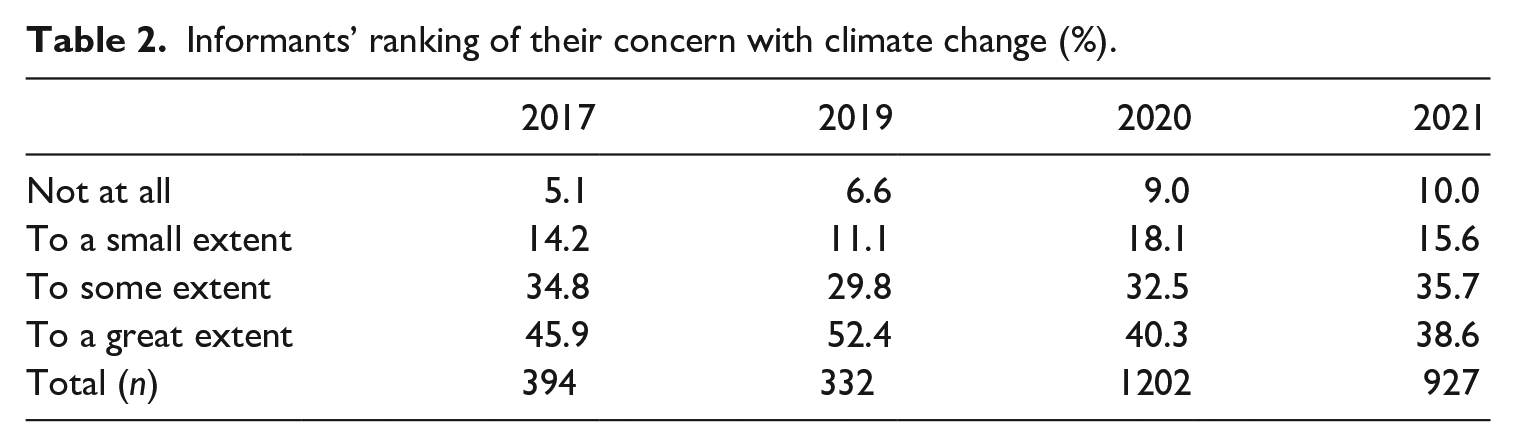
The results indicate that a slightly higher proportion of respondents selected that they were concerned ‘to a great extent’ in 2019 than in 2017. During this time, the combination of responses indicating concern ‘to some extent’ or ‘to a great extent’ increased slightly, from 80.7% to 82.2%. Similarly, the proportion of respondents who were ‘not at all’ concerned increased from 5.10% to 6.63%, and there was a similar reduction in the neighbouring category of being concerned ‘to a small extent’. After the start of the COVID-19 pandemic, the participant sample reported a lower degree of concern regarding climate change in scaled ranking. In 2020 and 2021, 73% and 74% of respondents reported being concerned ‘to some extent’ or ‘to a great extent’, respectively (Figure 1).
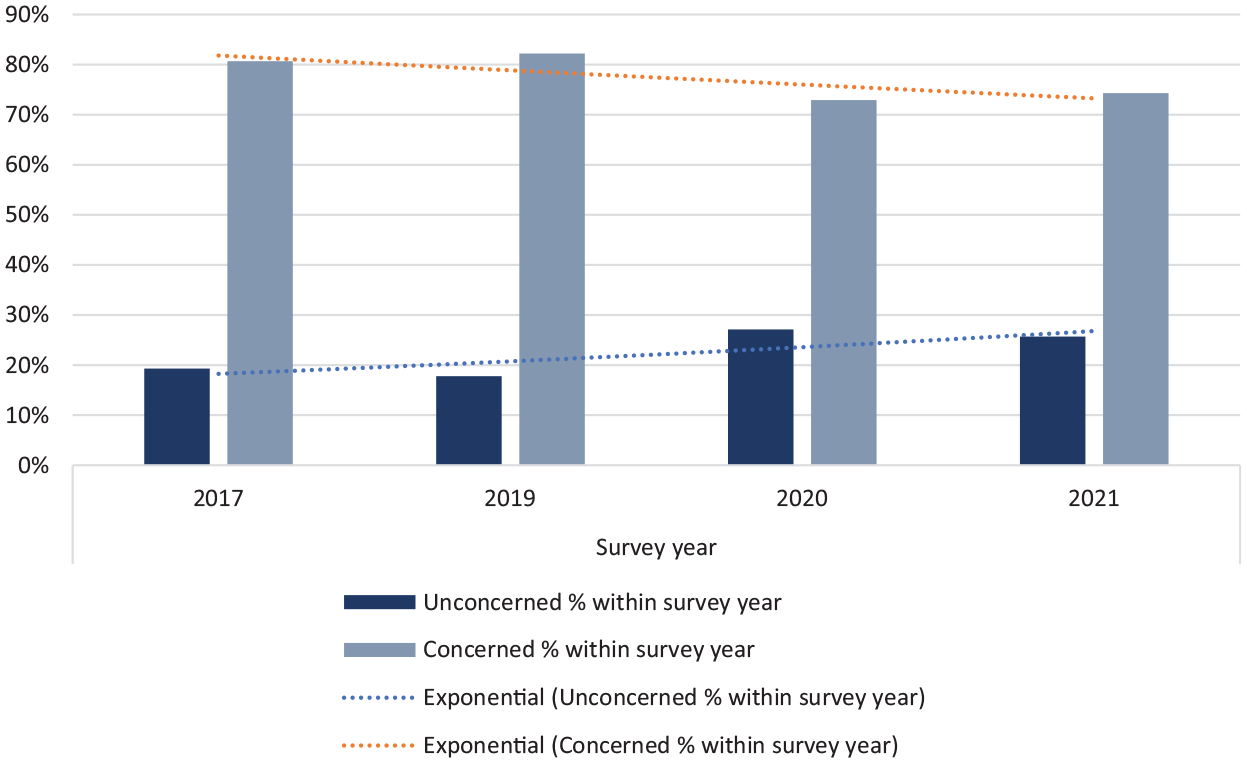
Dichotomous climate attitude (%).
Based on participant responses to Question 3, Greta Thunberg’s rise to prominence in 2018–2019 did not lead to a lasting change in climate reflexivity. Rather, the changes in 2020–2021 can be interpreted as a slight polarisation in respondents’ positioning.
Reflexivity as Recognising
The form of environmental reflexivity termed ‘reflexivity as recognising’ is reflected in survey responses in which informants mention climate issues or environmentalism as important societal issues without being prompted to do so. This form of reflexivity was identified in survey responses that involved free descriptions of contemporary society (Question 2). Reflexivity as recognising is different from reflexivity as ranking in that the informants independently identify what they valuate. The comparison between the datasets is operationalised to examine the words used, interpret their meanings and identify individual answers that mark the environment, climate change, nature or materialism as important, valued or contested in present-day society. The following are examples of survey responses that meet these criteria:
Everyone has the freedom to pursue whatever they choose, such as study or a job in whichever field they like. For me, the most pressing social issue is the climate debate, which I believe we must address. (Woman, age 19, 2017 survey) Climate change and the planet’s resource utilisation are the two biggest challenges, in my opinion. (Man, age 19, 2017 survey) The best thing about Norway is our beautiful nature that we can all experience freely. (Man, age 19, 2020 survey)
In these participant quotations, nature, climate change and the climate debate are formulated as options for action or something that connotes affection (e.g. ‘beautiful nature’). Individual answers are also considered reflexivity as recognition if they valuate climate, nature, sustainability, climate action or solidarity with the natural environment or if they critique consumerism or materialism, as in the following example:
We need to think more about the environment and eliminate the barriers that prohibit us from doing so. Things that are clearly not good are frequently viewed as ideals. Buying new items all the time, for example, is something that people [. . .] are admired for. (Woman, age 19, 2017 survey)
The analysis results indicate that a greater proportion of informants mentioned the climate crisis or expressed criticism of contemporary characteristics linked to environmental reflexivity in 2019 than in any other survey year (Table 3).
Responses recognising environment or climate as important when not asked (%).

There was a substantial increase in the proportion of informants who independently mentioned climate concerns from 2017 to 2019, which we interpret as an effect of Greta Thunberg’s message and media visibility in autumn 2019. After the outbreak of the COVID-19 pandemic in 2020, the proportion of respondents who recognised green worth as an important concern decreased sharply.
Few informants stated that they were inspired by ‘green’ role models in any survey year. In 2017, the role models identified as ‘green’ were scarce and did not share common characteristics. For example, Elon Musk (director of Tesla and SpaceX and founder of PayPal) was described as a ‘welldoer of the planet’, Bonderøven (a character from a Danish TV series broadcast on the national state channel in Norway) was described as being ‘concerned with nature’ and Markus Wegge (a TV personality who self-described as being against global warming prior to 2017) was named as someone who ‘cares for nature’. None of these individuals are connected to an environmentalist movement or organisation. Defining Elon Musk as a climate protagonist is controversial at best, and other informants who mentioned Musk did not connect him to environmental concerns.
Conversely, 20 survey respondents explicitly named Greta Thunberg as a positive role model in 2019. She appears to have been a unifying inspiration for young people attributing ‘green’ worth to role models, which they had previously attributed to less directly relevant figures. In 2020, Greta Thunberg was rarely mentioned as a role model, and in 2021, no informant mentioned Thunberg.
Reflexivity as Qualifying
In some responses that recognised climate issues or Greta Thunberg (Questions 1 and 2), participants used adjectives and verbs to substantiate and qualify their statements and to make their account accountable. This section will focus on the common meanings and pluralism of these qualifications. To explain valuations and examine different approaches to qualifying environmental statements, the following criteria were used:
Which valuations are used to legitimise or argue for the importance or solving of climate or environmental issues when describing contemporary society in open answers?
Which valuations were used to describe Greta Thunberg’s worth as a role model?
Through this analysis, we identified four distinct modes of valuation and qualification. These four modes do not represent the total pluralism of climate reflexivity; however, they are the distinct modes that emerged from data analysis in this study.
Environmentalism
Study informants shared valuations of nature, the planet or the environment throughout the survey period from 2017 to 2021. We term such valuations ‘green-ness’ or environmentalism, in line with Thévenot et al. (2000: 257–263). In these valuations, actions that support environmentalism, recycling, sustainability or being in harmony with nature are regarded as worthy. Important subjects related to nature included not only human beings but also ecology, the planet, forests, oceans and animal life. This first mode most closely reflects the substance of the Norwegian curriculum.
Participant statements typically claimed that humans must change our ‘way of life if we are to continue living comfortably on this planet’ and that the ‘most important challenge is to acknowledge the problem with the climate crisis, plastics and rainforests’. Participants also made arguments against having children. One woman (age 18) wrote in the 2019 survey, ‘We have to think about the earth and not just ourselves, and we must start to do things that benefit the earth and not just focus on [. . .] economic stability.’ Another woman (age 19) stated in the 2020 survey that, ‘The most important challenge is the climate crisis. COVID-19 is also associated with negative human impact on nature (we live too close to animals; this is how infections spread to humans).’
In the 2019–2021 survey responses, environmentalism was often expressed in critiques of materialism and individualism. Respondents described society as ‘self-absorbed’, obsessed with taking ‘selfies’ and ‘buying holiday houses’ 4 and ‘clothes we know are not made in healthy conditions’. ‘Materialism’ was described by respondents as ‘a negative aspect of today’s culture, particularly when it comes to Christmas and birthday presents’, and society was negatively labelled a ‘throw-away society’. Criticisms of the rich, described by one respondent as ‘wealthy individuals who own vast factories and are only concerned with their personal resources’, were also common in survey responses. One 2021 informant identified the ‘need to come up with a better solution for wind turbines than destroying untouched nature and destroying wildlife!’
Transition to a Sustainable Economy
Another set of participant valuations concerned reforms to the job market, industry and economy, which we categorise as references to market and industrial worth (Thévenot et al., 2000: 240–246). These concerns were prevalent in 2019 and present to a lesser degree in 2020 and 2021. Informants were explicit in their opinions regarding needed changes to the Norwegian economy and production. Several informants mentioned that the labour market must become more environmentally friendly. Some respondents described a ‘green shift’ that could create ‘new jobs for people working with oil’ and ‘replace the enormous need for fossil fuel’.
One informant stated, ‘The biggest challenge we have to solve is the climate crisis and how to stop drilling for oil and instead find something more sustainable.’ Another wrote, ‘The focus in climate politics is off, we need to direct attention towards making production in Norway as green as possible, in addition to finding new and better industries for businesses.’ A third respondent pointed out that, ‘sustainable energy provides new jobs and will make us ahead of other countries technologically and we will have an advantage if we go first. Besides, we have money for it.’ Others were concerned with the need to find ‘better solutions’ for environmentally friendly products, services and companies. Respondents’ critiques were often directed at politicians. For example, one respondent stated, ‘And it is about time politicians start to take this more seriously and treat it as a crisis. We are already on overtime.’ The use of the word ‘overtime’ is a reference to one of Greta Thunberg’s public statements.
Solidarity and Civic Worth
Participant valuations also concerned civic equality and solidarity (Thévenot et al., 2000: 246–249) and specifically referred to solidarity as a standard of valuation. Some respondent statements were directed against profit-driven thinking (e.g. ‘We must become a more supportive country that accepts more refugees and stops destroying the climate, even if it means that we make a little less money’), egoism (e.g. ‘Our problem is that everybody is self-centred. No one wants to do their part for others or the world, and no one believes that old patterns can be changed for the betterment of society’) or relationships with developing countries (e.g. ‘By producing more oil, we steal wealth and living standards from developing countries that will face the harshest consequences of the climate change we create’).
Some of the responses related to civic worth also demonstrate young people’s identification as a distinct group with values that differ from those of older generations. A sense of group identification is expressed through responses that claim a ‘large gap in the mindset of older and younger people’ or that the ‘most important challenges we must solve are the older generations’ know-it-all-attitude and tenacity’. Several informants identified young people as more active than older people in addressing the climate crisis (e.g. although ‘older people may want to ignore our frustration, there is nothing we need more than people like Greta Thunberg to stand up for us’). Participants named Greta Thunberg as a role model because she ‘mobilises and gather[s] crowds’ or because she ‘engages’ young people. One informant compared Greta Thunberg to Norwegian Prime Minister Einar Gerhardsen 5 and Martin Luther King, Jr. In these comparisons, Thunberg is described as sharing Gerhardsen’s ‘visions for a better world’ and courage to ‘fight for the society they believe is the best’, as well as ‘fighting for solidarity, [. . .] managing to make utopias real’.
Brave, Strong Greta
The fourth mode of valuation that is apparent in the 2019 data is the understanding of Greta Thunberg as a brave and strong individual. When Greta Thunberg spoke to elites and world leaders in Davos and at the UN, she addressed a group that young people rarely associate with. Respondents expressed admiration and gratitude for Thunberg’s accomplishments. They valued Thunberg’s courage and perseverance and expressed that she was brave to challenge world leaders and institutions such as the UN. One respondent wrote, ‘I am very inspired by Greta Thunberg [. . .]. She is extremely resourceful, and I greatly admire her efforts. She is brave and uses her voice to fight for something she believes in.’ Thunberg was compared to other modern women of power, including US Congresswoman Alexandria Ocasio-Cortez. One informant offered Thunberg as an example of ‘women who stand their ground, keep their chin up and do not want to be stopped by the world, and who actively work for a better future for everyone’.
Respondents’ valuations of Thunberg’s perseverance were most prominent in 2019, less apparent in 2020 and non-existent in 2017 and 2021. The valuations observed in the survey data suggest that Thunberg displays characteristic qualities that young people appreciate and admire. She is seen as a peer and a representative of her generation who stands up to elites and other powerful actors in society.
Green Worth and Collective Pronouns
Valuations qualifying green worth, such as environmentalism, transitions to sustainability or solidarity regarding climate change, are less present in the 2017 data than in later years. Such valuations are plentiful in descriptions of contemporary society in 2019. Although two reflexivity indicators from 2020–2021 suggest that the COVID-19 pandemic has diverted young people’s reflexivity from climate issues, rich ‘green’ valuations remain common in the 2020 and 2021 responses. This finding suggests that Greta Thunberg and her movement have inspired what Archer terms ‘meta-reflexivity’ (i.e. acknowledging an ethical responsibility to be part of the solution) and what we call ‘climate reflexivity’ (i.e. the sense that one is a part of a large natural environment in which the climate plays an important part and in which one’s actions have an impact) among a small subset of our informants.
Finally, our analysis documents an increase in the usage of the collective noun ‘we’, as opposed to ‘I’, in the results from how young people recognise climate as a concern (Question 2) (see Table 4).
Responses that refer to collective pronoun (%).
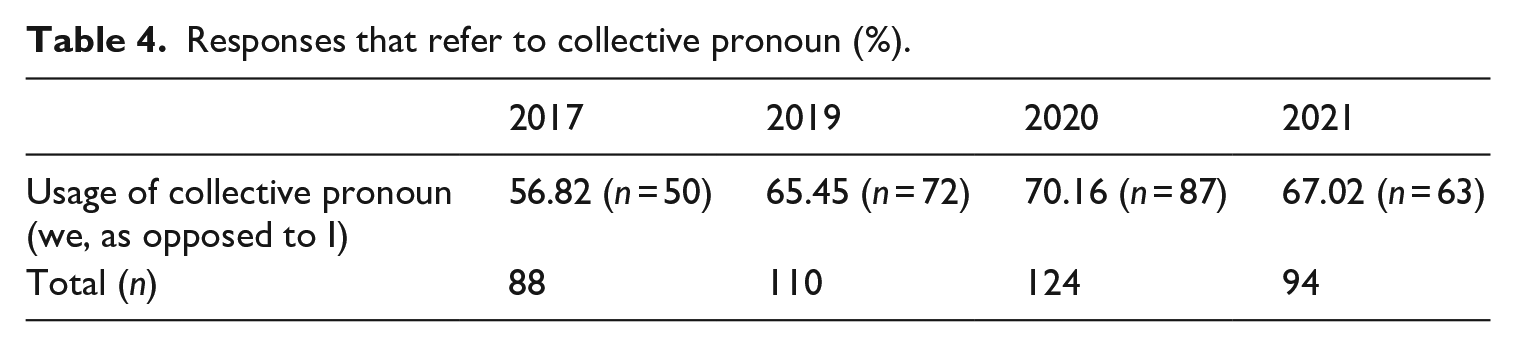
This finding may indicate an orientation towards collective thinking among participants.
Nurturing Climate Reflexivity as a Public Commonality
If humankind is to engage our resources to limit global warming and reduce the extinction of biodiversity, people must develop a reflexive understanding of the meaning and worth of the natural environment. This study of a sample of young Norwegians suggests that Greta Thunberg and her climate movement helped nurture such reflexivity among Norwegian youth. In what ways is climate reflexivity present in our data? We identified three forms of climate reflexivity in the analysed survey responses: ranking significance on a scale; recognising climate change, nature or other environmental issues when not directly asked about them; and qualifying ‘green’ traits or values. Young people’s climate engagement is often measured through surveys and ‘climate barometers’ (Livgard, 2019; Minter, 2018), which include predefined indicators for which young people are asked to rank issues on a scale of importance (e.g. from 1–5). These measurements align with the current study’s model of ‘reflexivity as ranking’. In the study sample, informants’ rankings of their concerns about climate change indicate that Greta Thunberg and her movement had a small observable effect in the 2019 sample and a negative effect in the following years. However, the models of ‘reflexivity as recognising’ and ‘reflexivity as qualifying’ suggest otherwise. In 2019, a larger share of young people than in 2017 reflexively recognised and qualified green worth and Greta Thunberg’s perseverance and determination as critical and exemplary characteristics for placing demands on governments and elites that benefit from the societal status quo. After the onset of the COVID-19 pandemic in 2020, fewer informants reflexively valuated green worth; however, those who did addressed the issues through rich references to untouched nature and animals, a need to transition the economy and the oil industry, and a need for solidarity. The representation and usage of the pronoun ‘we’ was more prevalent in 2019–2021 among climate-reflexive respondents than in 2017 (see Table 4).
To what extent can this reflexivity be said to constitute commonality among young people? Following Archer’s theory of reflexivity (2003, 2007, 2012), people may act and think reflexively without articulating it. According to Boltanski and Thévenot (2006), critical situations place demands on individuals and ‘force’ them to justify or express their reflexivity. Our model, which is aligned with Thévenot’s work on engagement and commonality (Blokker and Brighenti, 2011; Thévenot, 2015), suggests that there is also considerable reflexive work done between these positions. Climate reflexivity as a public commonality must be understood as nurtured between personal commitment, affectivity and what is considered legitimate in the broader community. We propose that Greta Thunberg and her movement contributed to reformatting climate reflexivity for young Norwegians who were already concerned about the climate, enabling them to relate their personal climate commitment and common interests to public and political forms of commonality in an environment in which the climate is seen as a contested and pluralistic issue. Thus, Thunberg and her message were a contributing factor that enabled climate reflexivity on multiple levels, building on the environmentalist foundation established by Norway’s educational system and national media policies.
One of these levels is a public commonality of green worth in the plural, ways of agreeing on what is important regarding the natural environment, accessible to all humans – a common humanity (Thévenot, 2002). Inherent in the informants’ expressions of public commonality are the belief that one can make a difference and a pluralism of ways in which such a difference can be understood. Our informants expressed a qualified commonality in nature in itself, transitions to a sustainable future regarding economy and industry, and solidarity and civic worth in a ‘green’ format, as well as in their perception of Greta Thunberg as a brave, strong and determined individual. To young Norwegian people, these valuations differ from the arguments of activists, as well as the climate policies and reductionist economic and bureaucratic valuations that centre on cost-effective market solutions (e.g. carbon taxes, cap and trade). However, as arguments with a moral sentiment, they are not detached from the public climate debate. We believe these arguments are solid enough to grow and transform in the years to come. This finding informs and alludes to the notion of climate justice (McGregor and Christie, 2021) as heterogenous and complex, and informed on an affective level as well as in a space of solidarity.
A strength of the modelled forms of climate reflexivity presented in this study is that these models offer a theoretical and empirically based perspective on the ways in which young people reconcile tensions between what they have learned through schools and other institutions and their experiences of personal and collective responsibility, whether expressed as ‘reflex responses’, affectivity or interests, or qualified articulations. These forms of reflexivity shape commonalities that may have relevance across social classes, identities and nation-states. Given the small study sample size and the significant societal changes during data collection due to the COVID-19 pandemic, the study findings regarding nature, economic and industrial transition, and solidarity, are not likely generalisable to other populations of young people. However, these findings can serve as indicators and a starting point for comparative analyses. In other regional contexts, climate reflexivity may be differently formatted and represented; yet where reflexivity is possible, there is always potential for agency and change.
Footnotes
Acknowledgements
We wish to express gratitude to Tomas Moe Skjølsvold, Kristoffer Eikemo, Eeva Luhtakallio, Anders Blok, Veikko Eranti, Anna Lund, Andrea Voyer, Audhild Løhre and Signe Ringdal for comments and remarks. We also want to thank three anonymous reviewers for their very constructive and useful remarks.
Funding
The authors disclosed receipt of the following financial support for the research, authorship and/or publication of this article: the study was funded by internal research funds at ILU, NTNU.
