




Abstract
Unequal gender outcomes in occupational success unravel through different channels in higher education. Using the AlmaLaurea dataset comprised of 80% of Italian graduates and 98 fields of study, this article investigates whether men and women receive similar returns on employment and earnings when choosing the same field of study. Two complementary perspectives are applied – Kanter’s theory of relative numbers and the status theory of gender – to examine the quantitative and qualitative differences between fields. The results show that the most gender ‘balanced’ fields of study are the most gender unequal in terms of earnings and employment. Separate analyses demonstrate that the status of a field interacts with its gender composition, and gender gaps in female-intensive nurturing fields shrink faster with an increasing proportion of women, albeit at higher absolute levels compared with non-nurturing fields. Therefore, nurturing fields of study should not necessarily be considered as levelling gender inequality in the labour market.
Keywords
Introduction
It is widely accepted that the field of study at the university level determines the future labour market trajectories of graduates, whether in income, occupational level or stability (Davies and Guppy, 1997; Gerber and Cheung, 2008). There is, however, a vast literature that shows how the distribution of men and women across fields of study is uneven and results in a profound gender gap in labour market returns in both Europe and the United States (Barone, 2011; Charles and Bradley, 2002, 2009; DiPrete and Buchmann, 2013). Current evidence illustrates that women are over-represented in the humanities and fields characterised by ‘care’ while men are over-represented in scientific and technical fields; and the higher rates of pay in jobs associated with the latter compared with the former are a primary contributor to the gender gap in income (Barone, 2011; Ma and Savas, 2014; Ochsenfeld, 2014). Therefore, the choice of field of study is among the most dominant explanations for unequal labour market returns between male and female graduates in the labour market.
In parallel to the abundant literature on the contribution of field-of-study choices to labour market inequality, some studies show an unexplained effect unrelated to the field of study chosen by men and women. Therefore, even after accounting for within-field of study segregation – examining women and men in the same field of study – a persistent gender gap in the labour market remains. For instance, a wage gap favouring men is found in the United States among bachelor’s degree graduates in the social sciences, humanities and business administration but not among advanced degree holders (Morgan, 2008). In the European context, the chances of obtaining a first significant job are higher for women than men in the social sciences and health-related fields of study, but in engineering and agriculture, these are higher for men than women (Smyth, 2005). In the Finnish context, women in technology and business are more likely to be unemployed in the initial years after graduation compared with men (Vuorinen-Lampila, 2016).
Against this backdrop, this article scrutinises the gender gap in employment and earnings across graduates from 98 fields of study in Italy for the 2010 cohort. It contributes to current debates by proposing two theoretical channels through which the gender gap occurs when men and women choose the same field of study. 1 The first explanation is ‘contextual’, and it relies on a well-known theory of relative numbers that suggests that a proportion of each gender in a group creates differential outcomes for men and women (Kanter, 1977). The underlying argument as to why relative numbers matter in each field of study touches upon different group cultures, exposure to particular models of behaviour and interactions between men and women.
The second explanation is ‘structural’ and relies on qualitative differences among fields of studies that result from status-related concerns (Ridgeway, 2001). Unlike the theory of relative numbers, the status theory of gender directly acknowledges the meaning attached to each gender. It stipulates that women are likely to be disadvantaged in all fields of study as a group, with the exception of those fields in which they are expected to have a comparative advantage by way of their perceived ‘natural’ abilities. These fields involve a high degree of care (physical or mental) for others, including teaching, care work and nursing (Campero and Fernandez, 2019; Charles and Bradley, 2009; Lueptow et al., 2001). We argue that these two channels are interwoven and lead to gender gaps among graduates in employment and earnings. Therefore, the underlying question is not only whether the gender composition of the field of study contributes to unequal labour market outcomes, but whether it does so to the same extent in fields where women are perceived to perform better due to their ‘natural’ abilities.
The (combined) test of two theories is performed on a unique administrative and survey dataset of Italian graduates – AlmaLaurea – that covers the academic histories and labour market outcomes of 80% of the student population. In Italy, tertiary educated women working full time earn around 70% of the earnings of men, similar to countries such as the United States but lower compared with the Organisation for Economic Co-operation and Development (OECD) average of 76% (OECD, 2021). This study has essential policy relevance for the contexts of high gender inequality, contributing to the understanding of why gender gaps in the labour market may persist despite the progress made by women in higher education. Advocates of diversifying gender segregation in fields of study argue that the increased participation of women in traditionally under-represented fields of study such as science, technology, engineering and math (STEM) would address not only educational segregation (Hill et al., 2010) but ultimately would narrow the persistent gender gap in the labour market. If, however, gender status beliefs interact with other factors, simply having more women in under- represented fields of study would not necessarily translate into more equality in the labour market. Thus, a suitable explanation for gender inequality patterns is essential for proposing a meaningful policy agenda.
Theory
We combine two complementary perspectives – Kanter’s Theory of Relative Numbers and Status Characteristics Theory – to examine the gender gap on the labour market among graduates. Kanter’s Theory of Relative Numbers posits that a substantial presence or absence of socially and culturally distinct individuals can influence the interaction between group members and their consequent behaviours. Group composition affects individuals in various ways, ranging from exposure to diversity or a hegemonic culture (Tolbert et al., 1999) to the role of networking and the presence of discriminatory practices that disadvantage minority group members (Kanter, 2006). In other words, the relative numbers can have both social and economic consequences for group members. The theory of relative numbers by Kanter (1977) stipulates that the size of a minority group has significant consequences for the experiences of individuals in a given environment, noting that there is more space for hostile behaviours against a minority if it is particularly small. In most cases, this theory has been employed to analyse group composition by gender (Kanter, 1977). It also has been applied in workplace and occupation-based studies (Campero and Fernandez, 2019).
Fields of study are particular examples of group formations and interactions that start early and impact on an individual’s career. For instance, women in female-intensive fields of study and men in male-intensive fields of study can create support networks and alliances that could bring them better opportunities in income and employment once they enter the labour market. Further, the gender composition of fields of study has direct consequences on the labour supply, which may influence potential discriminatory practices. However, Kanter’s typology, which uses gendered proportions as a contextual dimension, is rarely utilised in relation to fields of study, even though it can be easily extended to this type of environment. Some exceptions include Sax (1996), who studied the academic outcomes of students through the lens of Kanter’s theory, Mastekaasa and Smeby (2008) and Meyer and Strauß (2019), who focused on drop-outs in relation to gender composition of fields.
While Kanter’s theory of relative numbers in relation to field of studies might be used to explain a potential channel of the persistent gender gap in the labour market, it might be sensitive to individuals’ beliefs about gender and gender roles with regard to occupational achievement – as argued by the Status Characteristics Theory. There might be further (dis)advantage resulting from the interaction between status of gender with numerical representation of men and women. Cultural beliefs about gender, in the form of gender stereotypes, are relevant for everyday interactions as they shape individuals’ behaviour (Correll, 2004; Fiske et al., 2002) and their assessment of others (Ridgeway and Correll, 2004), therefore moderating how numerical representation of one gender in wider contexts relates to individual outcomes. These cultural beliefs are enacted in social contexts, where the interaction between men and women is likely to advantage one sex (e.g. women) over the other (e.g. men; Ridgeway and Smith-Lovin, 1999).
Ratio of Women in Fields of Study and Gender Gaps in Employment and Earnings
Kanter defined three major groups in relation to group composition: skewed groups that contain a large proportion of one gender, so-called ‘dominants’ (up to 85%), and a small minority of so-called ‘tokens’; the second group is tilted – the majority and minority are divided proportionally between 35 and 65%; the third and final group is balanced, with a 60:40 to 50:50% split in terms of each gender. Each ratio is expected to generate some specific behaviours. Tokens are expected to be the most disadvantaged; as a small minority they are more visible, and the dominant group becomes increasingly aware of their differences rather than their similarities (Kanter, 1977). Moreover, as they amount to a smaller number, it is more challenging for them to create an alliance that can foster their advantage in the group. Tilted groups are placed towards less extreme distributions, as dominants are just a majority and tokens are just a minority (Kanter, 2006). The minority in tilted groups is expected to be more advantaged than tokens, as the members of the minority group are sufficient to form coalitions and to influence the group culture for in-group benefits. Nevertheless, in tilted groups, the majority is expected to preserve their advantage over the minority, even though the degree of advantage is expected to be lower compared with a large majority of over 85%. Balanced groups are expected to provide the most inclusive environment, as they facilitate gender-balanced interactions and networking. This results in the better integration of all members, leading to the slightest gender-based difference between them, although balanced environments are not immune to subgroup formations, which can change positive inner-group dynamics. This typology is gender-neutral, implying that when members of either sex comprise less than some critical proportion of the group, it is consequential for the status and behaviour of the minority gender, assuming that men and women are similarly affected by under-representation (Spangler et al., 1978).
Considering the specific expectations of Kanter’s theory from the perspective of women’s representation, a hypothesis on the association between the gender composition of fields of study and labour market outcomes (in terms of earnings and employment) is stipulated in this article. Following the expected disadvantage of individuals in skewed groups and applying it to the chosen academic field of study, we hypothesise that men will have the largest bonus in employment and earnings within fields of study in which women are a significant minority (below 15%) (H1a). Following the expected advantage that women potentially experience in balanced and tilted groups where women are a majority, we hypothesise that men will have a smaller bonus in earnings and employment in fields of study with a relatively high proportion of women (above 65%) compared with skewed fields of study (H1b). Finally, we expect men to have the smallest bonus in employment and earnings in balanced fields of study compared with all others (H1c). In short, we expect a U-shaped relationship between the gender composition of the field of study and the gender gap in employment and earnings (e.g. the largest bonus for men in fields with a significant minority of women, the smallest bonus in balanced fields and a moderate bonus in fields with a majority of women).
Relative Numbers and the Moderating Role of Status Beliefs
Status theory assumes that a male bonus in professional outcomes appears on average independently of the field of study that women select. However, the comparative advantage that women have in tasks requiring nurturing abilities may compensate for their low status or even prevail over their initial disadvantage (Correll, 2004). For this reason, the under-representation of women in certain fields can have differential consequences for women’s and men’s labour market opportunities, depending on whether fields are considered ‘nurturing’. Beliefs in the ‘natural’ abilities of each gender result from widely shared stereotypical beliefs that are reflected in early socialisation processes and the organisation of everyday life (Charles and Bradley, 2002). Thus, these beliefs highlight the typical male and female features that are thought to be the basis for the distinction between more masculine and more feminine jobs. The fact that women are still primarily responsible for caregiving at home (Campero and Fernandez, 2019) has reinforced the perception that they are more suitable for ‘nurturing’ fields and professions (Lueptow et al., 2001).
Even though there is no clear definition of what exact subjects constitute ‘nurturing’ fields of study, they can be described as those that involve a high level of care work and the provision of help to others (Charles, 2005; Charles and Bradley, 2002; Ochsenfeld, 2016; Reskin, 1993). Within this definition, fields of study such as nursing, education and social work are not only female-dominated but are also considered ‘nurturing’ (Mastekaasa and Smeby, 2008). Williams and Best (1990) grouped nursing, elementary school teaching, librarianship and social work into female professions without specifying nurturing ability as the main criteria. Typically, the chosen academic majors for women also include education and various types of health professions (Brown and Corcoran, 1997). Charles and Bradley (2009) labelled all fields involving administrative duties and personal care as nurturing. Barone (2011: 159) focused on the care–technical divide in education and emphasised how women choose fields that have a symbolic affinity with traditional caregiving roles. Thus, fields of study such as nursing and social work clearly belong to ‘care’ jobs, but psychology or medicine can also be defined as traditional caring roles in certain circumstances. At the same time, many humanities majors studying history and the arts may later choose teaching professions involving the care of children, despite not being originally placed within the care sector (Teichler, 2007).
In this context, status theory highlights a division between masculine and feminine roles, which complements the vision of numerical representation as a key in explaining unequal gender labour market outcomes. Following a possible interaction between the two theoretical channels, there is likely an accumulation of female advantage (and compensation for any possible female disadvantage) when fields of study have a substantial majority of women and are also considered ‘nurturing’. This situation contrasts with fields of study that have a majority of women but are considered ‘non-nurturing’. Building on the intersection between Kanter’s theory and status theory, we complement H1 by further expecting that the influence of the gender composition in fields of study on the labour market might be unequal depending on whether the fields of study are classified as ‘nurturing’. Given that nurturing fields are made up predominantly of women, our interest lies in fields where women are the majority (above 65% as defined by Kanter). Consequently, we expect that the male bonus in employment and earnings in female-intensive fields will increase at a slower rate in ‘nurturing’ fields of study compared with ‘non-nurturing’ fields of study as individuals move from balanced fields to those with a female majority (H2). In order to illustrate the expectations derived from the two theories, the hypotheses are summarised in Table 1.
Overview of hypotheses.
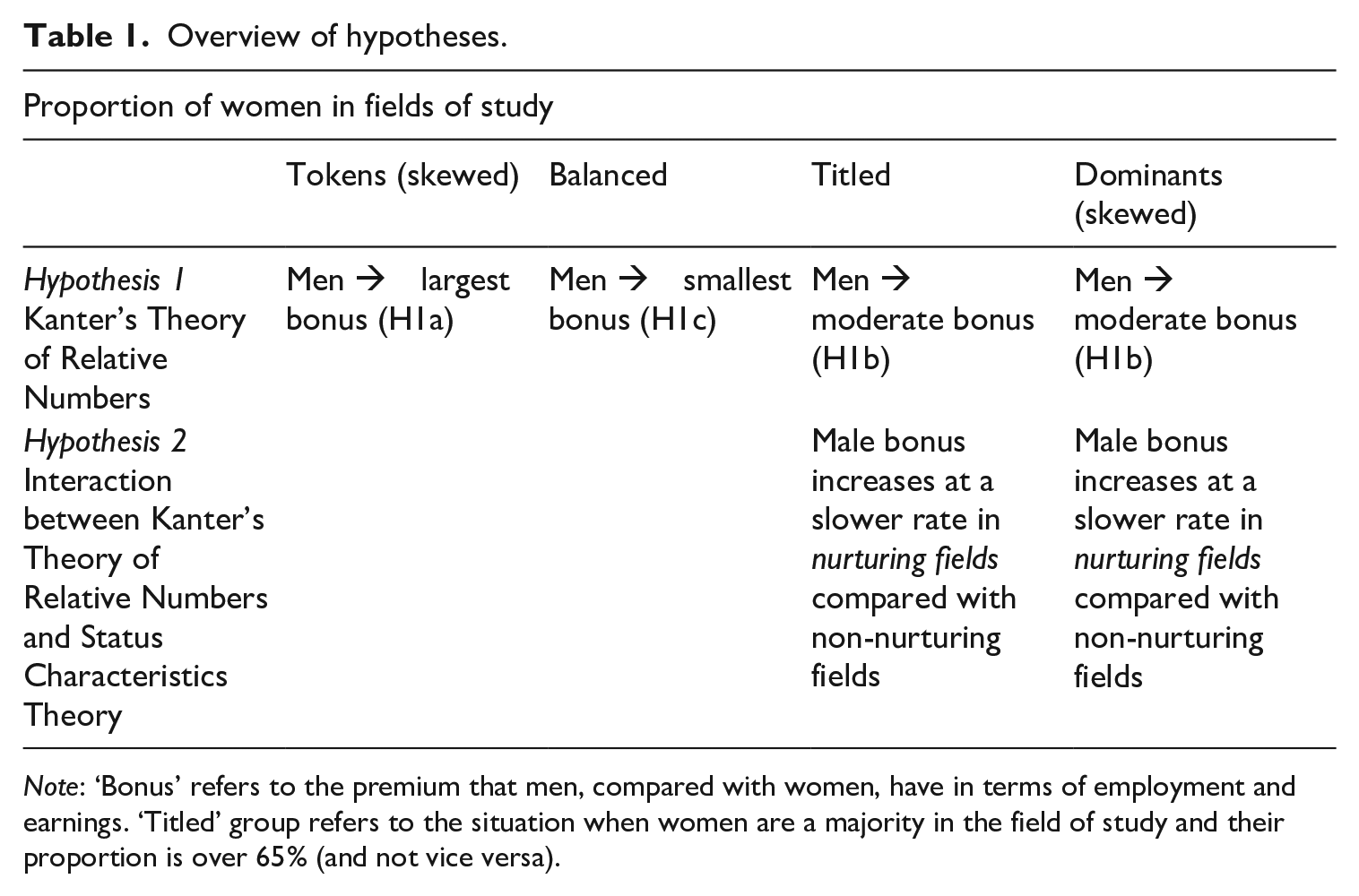
Note: ‘Bonus’ refers to the premium that men, compared with women, have in terms of employment and earnings. ‘Titled’ group refers to the situation when women are a majority in the field of study and their proportion is over 65% (and not vice versa).
Data and Variables
Sample
This article uses cross-sectional data from the Italian inter-university consortium AlmaLaurea, which provides both auxiliary and survey data on graduates from 64 universities. It focuses on the labour market outcomes of the 2010 graduate cohort five years after their graduation (2015). One significant advantage of this dataset lies in its exhaustiveness: it offers administrative information on demographic and academic characteristics for approximately 80% of Italian graduates. Although the initial dataset resembles the general population, the AlmaLaurea consortium further ensures its representativeness by using specifically designed weights that correct for the non-participation of specific universities in the original sample (AlmaLaurea, 2019). The administrative data are linked to the survey data Condizione Occupazionale dei Laureati, an optional survey that follows graduates’ employment five years after graduation for the 2010 graduate cohort, with a response rate of 72%. All respondents graduated either with long degrees that last between five to six years or short degrees with the format ‘3+2’ (Bachelor and Master).
The sample is restricted in several ways. First, it is restricted to respondents under the current age of 35, as the article focuses on early labour market outcomes, and by this age, the majority have already gained some work experience (Aina and Pastore, 2012). Second, the sample is restricted to native-born Italians, as migration processes might alter labour market access and earnings differentials. Third, graduates from the defence and security fields of study were excluded as they are shown to have different career trajectories from the general population of advanced degree holders (AlmaLaurea, 2014). After the listwise deletion of missing observations on all variables, the analytical sample consists of 56,820 individuals when employment status is used as a dependent variable, whereas the sample decreases to 39,111 in the analyses on earnings. The sample decreases when earnings are considered by excluding individuals who are unemployed but who participated in the survey (15%) and due to non-response on earnings (16%).
Dependent Variables
As we conduct the analysis for both employment and earnings, we conceptualise our approach as a two-step process, which inherently involves different samples. First, pertaining to all graduates, we analyse the first-order question of gender differences in employment outcomes across fields of study. Second, among those graduates who manage to obtain employment, we then analyse the second-order question of gender by field-of-study differences in wages.
The employment variable is a dummy that takes the value 1 if the individual is employed and 0 if the individual is unemployed and inactive (as the survey questionnaire does not distinguish between the two). Employed graduates are defined as those who work in full-time or part-time employment or are engaged in additional training financed by the employer. The earnings variable is an ordered category of net monthly earnings, with 13 intervals in which each observation falls. For the analyses, the upper and lower bounds of earnings are created and consequently logged to correct for the slightly skewed distribution of earnings. The latter enables us to obtain a percentage change in earnings with a change in independent variables and to obtain the percentage point difference between women’s and men’s earnings change.
Gender Composition of the (Sub)fields of Study
The AlmaLaurea dataset offers a detailed classification of fields of study that corresponds to the classes of degrees defined by the Italian Ministry of Education. In 2004, a reform was introduced (Ministerial Decree no. 270/2004) that specified the programmes and credits associated with each degree, creating so-called classes of degrees. These de facto represent fields of study in disaggregated form, where specific degrees are grouped under the same name according to the training objectives defined by the law (Ghiselli, 2019). The classification provided by AlmaLaurea amounts to 98 subfields, as we refer to them in the text. For example, degrees in engineering are classified into several groups according to the specific characteristics of programmes, therefore including subfields such as IT engineering, spatial engineering and others; the broad field of linguistics has subfields such as modern literature, cultural anthropology or musicology, all separately defined. For a complete list of subfields, see the online Appendix.
Moreover, the proportion of women is computed for each subfield of study from the AlmaLaurea administrative sample of graduates for 2010, ranging from the following: 7% in mechanical engineering, 12% in electrical engineering, 25% in civil engineering and 35% in geology up to relatively balanced proportions in history, statistics, economics and dentistry (from 40% to 50%). Women are a large majority in industrial biotechnology, nursing, communication and sociology and social sciences (from around 67% to 75%). They are also a majority in art, linguistics, psychology and early education (approaching or above 90%). For the purpose of the analyses, this variable is centred around its mean.
Nurturing Fields
There is no straightforward definition of nurturing vs non-nurturing subfields of study in the current literature. This article provides a definition by combining different scientific evidence. More precisely, nurturing subfields are defined as those that involve a high degree of physical or mental care for others (Lueptow et al., 2001: 26), also known as ‘caregiving’ (Barone, 2011; Campero and Fernandez, 2019; Charles, 2005; Charles and Bradley, 2002; Ochsenfeld, 2016; Reskin, 1993). A unique classification system was created for nurturing fields based on a literature review that identified fields of study as ‘caring’ while using the following keywords: ‘nurturing’, ‘caring’ or involving ‘caretaking’ tasks. The classification is further validated by cross-checking whether these fields of study are also described as nurturing in the description of the degree curriculum provided in the official documentation of the Italian Ministry of Education (2007). For instance, while psychology and cognitive science were not univocally described as nurturing, the reference to care is emphasised in the curriculum description of the ministry.
Consequently, the nurturing fields resulting from this classification process incorporate the following: psychology, social work, cognitive sciences, pedagogy, adult education, nursing and midwifery sciences, rehabilitation care, health care science, preventive health care, primary education and planning and management of educational services. Alternative classifications are also attempted by including and excluding fields with descriptions that might be sufficiently ambiguous to be regarded as both nurturing and non-nurturing. Examples of this are veterinary medicine, medicine, dentistry, pharmacy and industrial pharmacy. Our analysis reports the differences resulting from the varying definitions of ‘care’.
Control Variables
We include as control variables the following: academic achievement prior to choosing a field of study (high school final score, high school type), 2 current demographic characteristics (age, area of residence, marital status and number of children) and university awarding the degree. The AlmaLaurea dataset offers a unique advantage in tracking the respondent’s university: 64 dummies for Italian universities are included to account for the differences in the labour market outcomes due to university quality or prestige. In order to leverage the differences in levels of pay, models predicting net earnings are further adjusted for the sector of employment (public or private), region of employment and the number of hours worked (from <10 to >60 hours in 11 categories). High school scores and age are centred around the mean. Table 2 presents the descriptive statistics of selected variables for the sample of employed graduates and also for the sub-samples of nurturing and non-nurturing fields of study.
Descriptive statistics.
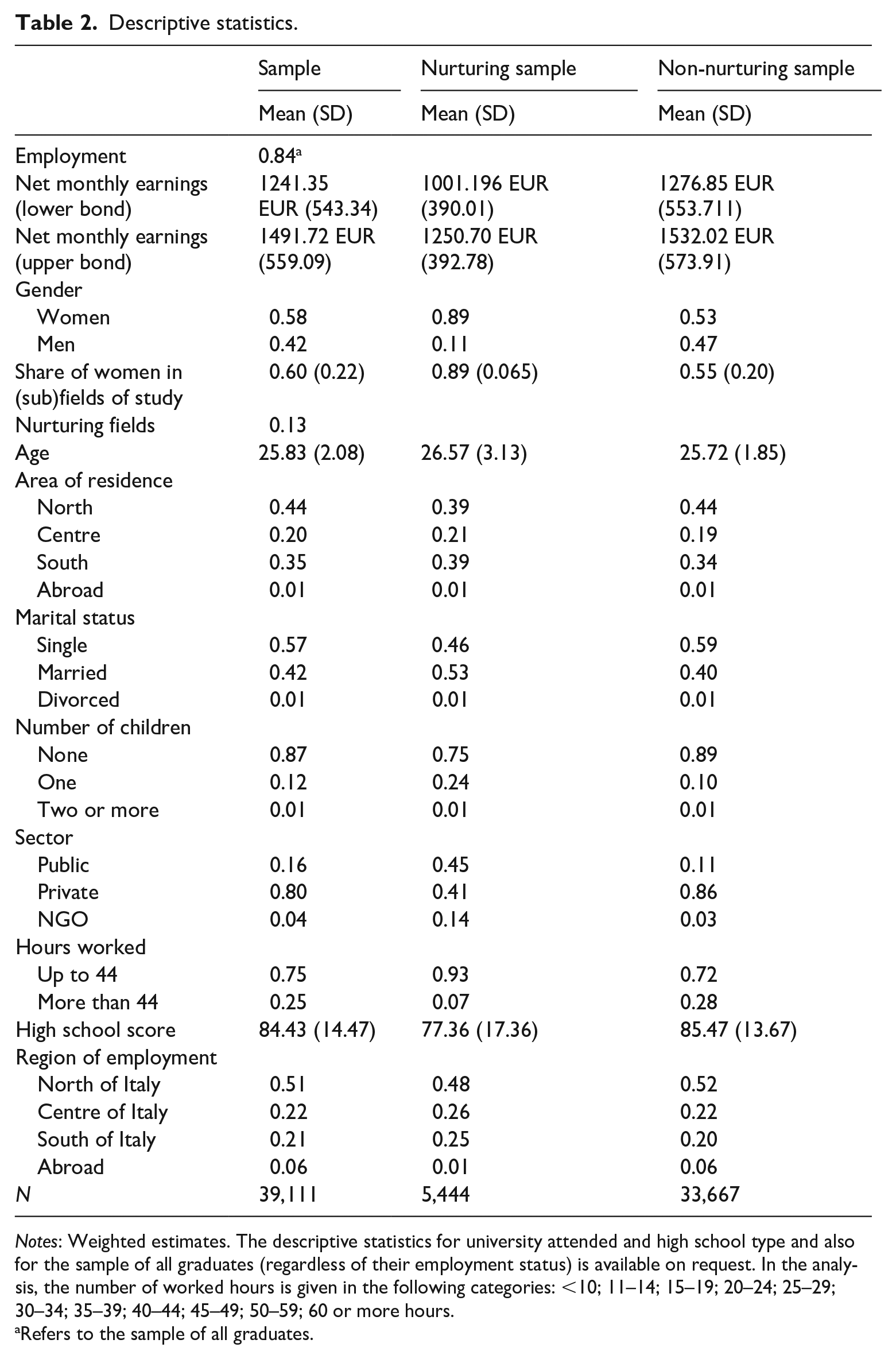
Notes: Weighted estimates. The descriptive statistics for university attended and high school type and also for the sample of all graduates (regardless of their employment status) is available on request. In the analysis, the number of worked hours is given in the following categories: <10; 11–14; 15–19; 20–24; 25–29; 30–34; 35–39; 40–44; 45–49; 50–59; 60 or more hours.
Refers to the sample of all graduates.
Methods
Following the theoretical expectations about a U-shaped relationship between the gender composition of the fields and the gender gaps in employment and earnings (H1a, H1b, H1c) in the first part of the analysis, we employ a model containing both a linear and a quadratic term of the women’s share in fields of study, which fit significantly better than the model with the linear term only. In particular, we focus on the interaction between the gender of the respondent and the linear and the quadratic term of share of women in each field of study for the entire sample. The results are presented graphically in the form of average marginal effects of gender for different share of women in various fields. We use binary logistic regressions to analyse employment and interval regressions for net earnings. Interval regression is an example of a linear model that is suitable when precise information on a variable is missing – it is instead given as an interval in which it falls (e.g. earnings range). The models rely on the lower and upper bound of the variable range as a dependent variable. All models are run with robust standard errors to account for heteroscedasticity, and the analyses are weighted to correct for non-response and sample design, ensuring the representativeness of the graduate population at the national level. The models include a range of control variables as mentioned in the ‘Data and Variables’ section. The analyses on earnings are repeated using linear regressions with logged income midpoints with identical results. Logged income midpoints are also used to perform both multiple imputation and Heckman regression that we report in the online Appendix (Figures A1 and A2). The results remain substantially unchanged regardless of whether multiple imputation or listwise deletion is used and whether the analysis is corrected for selection into employment.
The second part of the investigation replicates the analysis on sub-samples (nurturing vs non-nurturing fields of study). However, in order to test H2, the latter focuses exclusively on female-intensive fields of study (e.g. the share of women is higher than 65% as per Kanter), and we calculate the gaps using a model containing only a linear term of the women’s share in fields of study. In other words, we analyse the interaction between the gender of the respondent and the linear term of share of women in fields (Tables A1a and A1b, online Appendix, full regression results). The analyses are also extended to capture the entire distribution of women’s share for non-nurturing fields (Figure A4, online Appendix).
Analysis and Results
Testing Kanter’s Theory
Figures 1 to 3 show the average gender gap in employment and earnings among graduates with 95% confidence intervals. Although the interpretation is given using Kanter’s original typology, which includes five groups (from the ‘token’ to the ‘majority’), for more precision, the results are displayed in a disaggregated manner using a continuous share of women in all subfields.
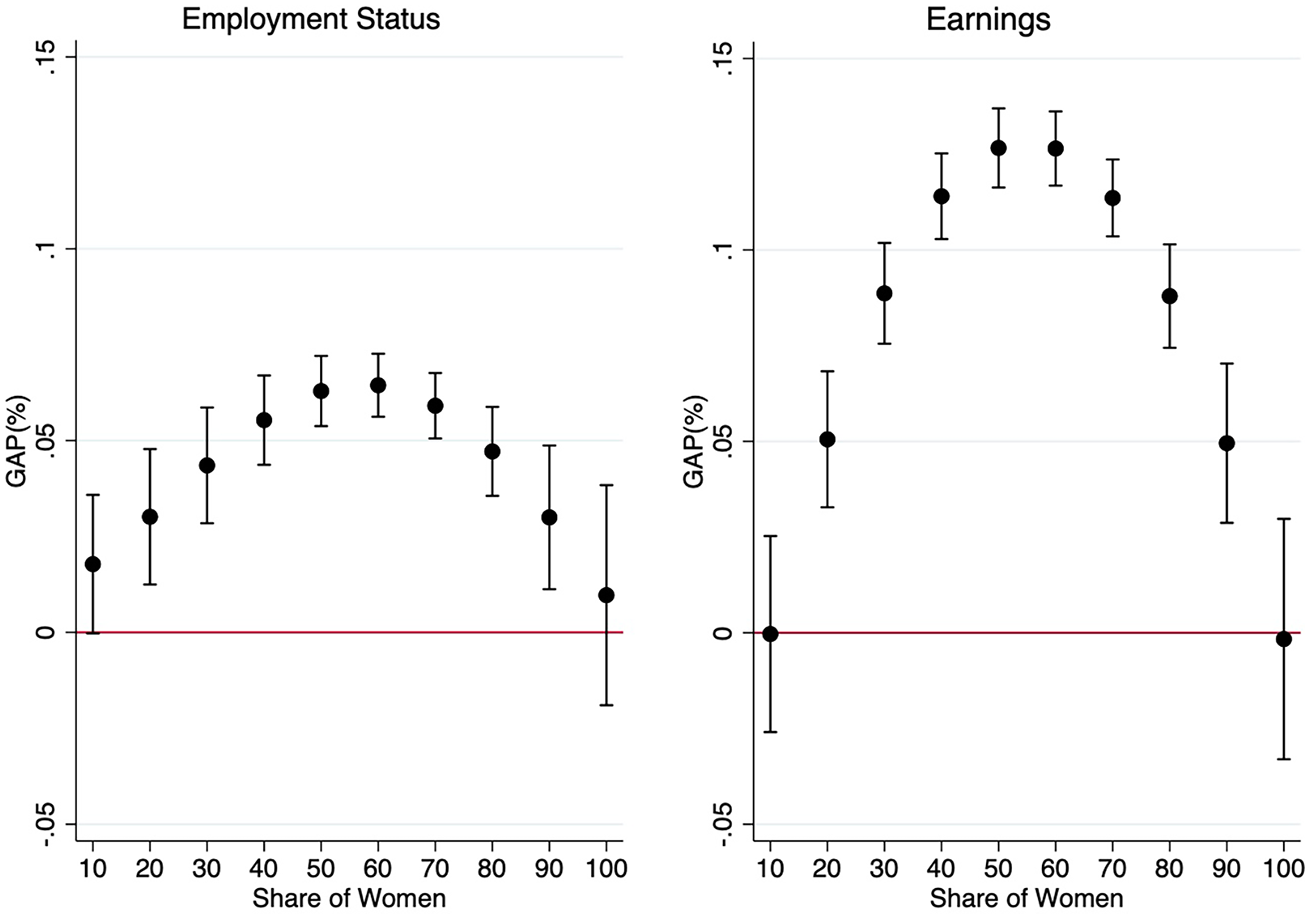
Male bonus in employment status and net monthly earnings, after adjusting for covariates. Predictions from logistic and interval regressions in online Table A1. Weighted estimates.
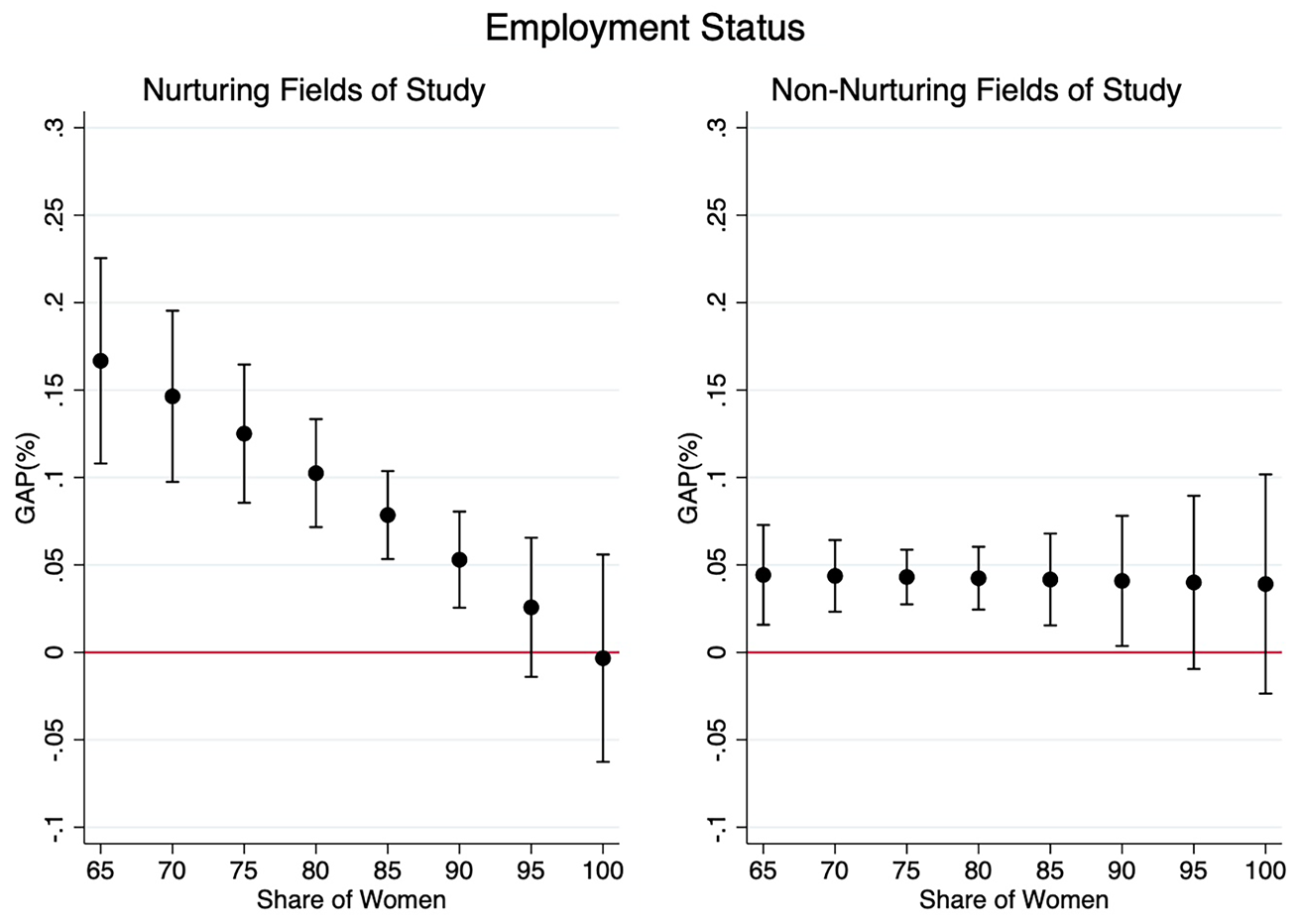
Male bonus in employment status for nurturing and non-nurturing fields of study, for fields of study with above 65% of share of women. Adjusted for covariates. Weighted estimates.
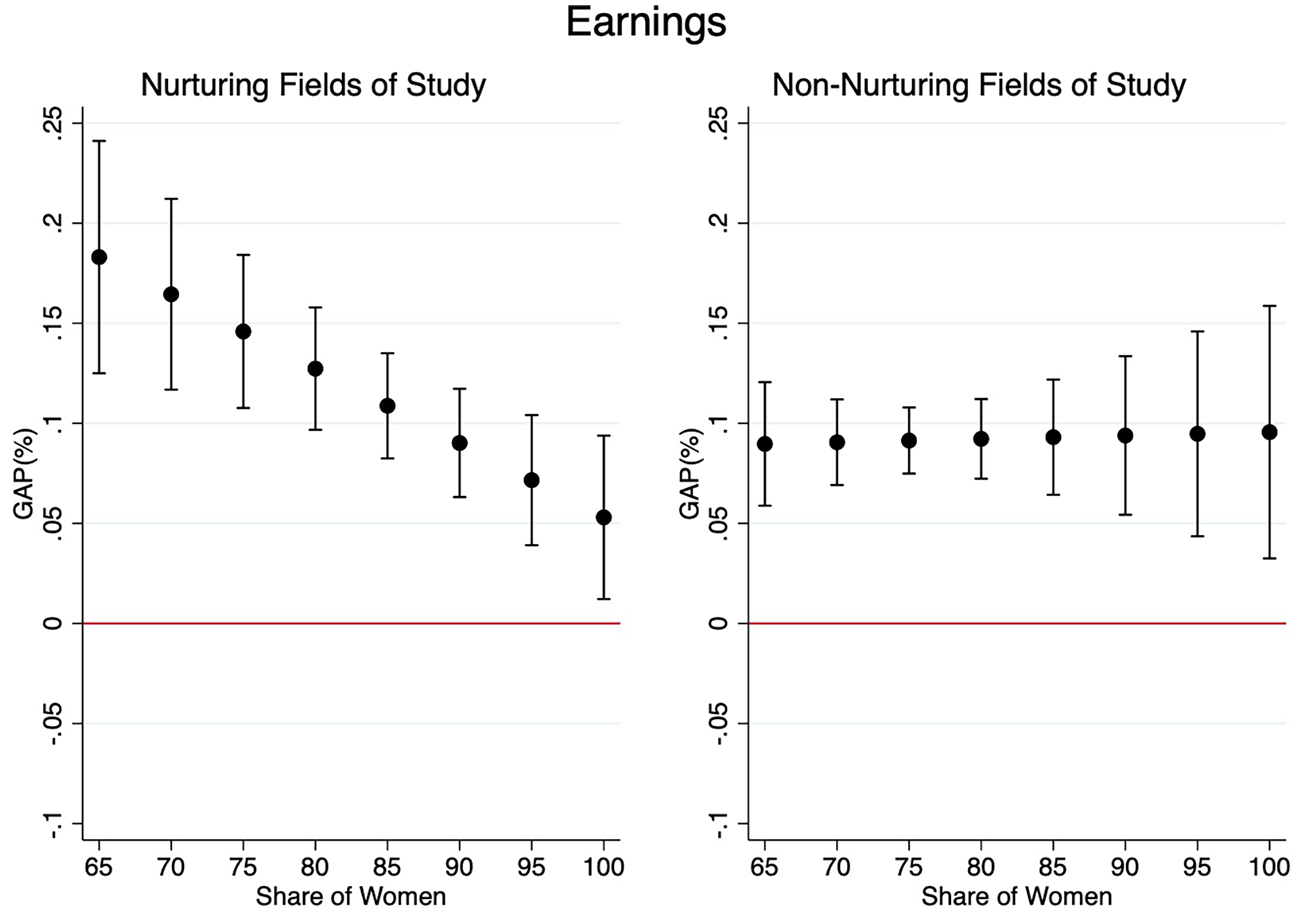
Male bonus in net monthly earnings for nurturing and non-nurturing fields of study for fields with above 65% of share of women. Adjusted for covariates. Weighted estimates.
Figure 1 illustrates the results of the two labour market outcomes discussed in the article: employment status and earnings among graduates. At first glance, it shows that men almost always have a labour market bonus, regardless of the gender composition of the field of study or the labour market outcome considered. Male bonus, however, follows an inverse U-shape: the bonus is smaller in fields of study with the lowest and the highest concentration of women. As shown in Figure 1, the most significant discrepancy in labour market outcomes is in earnings.
As predicted by Kanter (1977), Figure 1 indeed confirms that the proportion of individuals with certain characteristics in a group (e.g. gender) matters for employment outcomes. More specifically, the proportion of women is directly associated with employment and earnings gaps. Even though the figure illustrates the importance and the consequences of being a ‘token’ in any group, it also shows the importance of challenging a gender-neutral approach to tokenism (Zimmer, 1988). The prediction of Kanter (1977) that individuals who are ‘tokens’ are more disadvantaged than those belonging to the ‘balanced’ groups could not be proved for both genders. Contrary to hypothesis H1a, the male bonus is smallest when women are tokens, indicating some form of relative advantage for women in fields where they are fewer in number with respect to other fields. Neither is H1b proven as we find that the male bonus is rather small in fields in which men are tokens and is more similar to the gap found when women are tokens. Interestingly, contrary to H1c, women are most penalised in balanced groups even though these are, according to Kanter’s theory, meant to create more inclusive environments enabling lower gender gaps in occupational success. Information for more specific outcomes follows below.
Employment Status
When it comes to employment, there is a two percentage point difference between men and women in both the fields of study in which the share of women is lower than 10% (subfields such as mechanical, electrical and electronic engineering) and about three percentage points difference when the share is above 90% (subfields such as pedagogy, social services, modern European and American languages and elementary school teaching). When women represent more than 20% of the total number of graduates in a given field, the difference in employment starts to increase, ranging from about three percentage points up to about six percentage points in fields of study where women account for between 40–70% of graduates (subfields as different as environmental and territorial engineering, finance, urban planning, law, philosophy, veterinary medicine, nursing and midwifery).
Earnings
Earnings is the outcome with the steepest inverse U-shape patterns. As in the case of employment status, the fields of study with the lowest (under 20%) and the highest number of women (around 90%) are the least affected by the earnings gender gap. As the number of women in a given field of study increases, the earnings gap becomes visible, with men having a bonus of between five percentage points when women are above 20% of a given field of study, up to about 12 percentage points when the field of study is more gender-balanced at 50–60% (e.g. musicology and musical heritage, political science, philosophy, biomedical engineering, design). If transformed to earnings in the national currency (euro), this corresponds to somewhat less than 100 euro per month of male bonus when women are a minority or a majority, and between 150–170 euro difference per month for balanced fields (Figure A3, online Appendix).
In other words, even when the numerical presentation of women is high or balanced, men still benefit from higher earnings. Explanations of the earnings gender gap might be related to numerous factors such as discrimination fuelled by status beliefs (Auspurg et al., 2017), the perception that women are the less productive gender (Lueptow et al., 2001) or different levels of formal and informal responsibilities at work that are unequally attributed to men and women. 3
Nurturing vs Non-Nurturing Classifications of Female-Intensive Fields: Do They Matter?
Starting with women’s patterns of disadvantage in the labour market, the second part of the analysis focuses on highly female-intensive fields (above 65%) and evaluates the extent to which these patterns persist when nurturing and non-nurturing fields of study are considered separately. Regarding nurturing fields, the lowest representation of women is in nursing and midwifery sciences at 69% and science of technical health professions at 72%, and the highest in social work at 91%, pedagogy at 92% and primary education at 96%. Regarding non-nurturing fields, these include landscape architecture at 73% of women, philology at 77% and modern languages at above 87%. Figure 2 illustrates the employment status for nurturing and non-nurturing fields of study. Figure 3 shows earnings for both nurturing and non-nurturing fields when the share of women rises above 65%.
In nurturing fields of study, men are about 16 percentage points more likely to be employed than women when the threshold reaches around 65% of women in the field of study. This employment bonus for men slowly decreases as the share of women increases. For example, it is reduced to about 10 percentage points when there is around 80% of women in the field of study, and it reaches three percentage points and is insignificant when there is about 95% of women in a field of study. In non-nurturing fields of study, the employment bonus for men is more stable, oscillating around five percentage points.
As shown in Figure 3, the contrast between non-nurturing and nurturing fields is visible. The highest earnings gap for nurturing fields is found when there are 65–70% of women in a given field; at this level, men have an earnings bonus of about 18 percentage points. The earnings bonus for men decreases gradually when the number of women in a field increases. Yet, even when there is a high majority of women in a given field (e.g. above 95%), men continue to retain an earnings bonus of about seven percentage points. The comparison on earnings shows that nurturing fields have, on average, higher earnings gender gaps. For example, when there are around 75% women in a given field, in the non-nurturing fields, the male bonus is around nine percentage points. In contrast, it remains relatively high in nurturing fields, at 14 percentage points. When converted in the national currency (euro), the male bonus for female-intensive fields declines from above 200 to less than 50 euro in nurturing fields of study and circulates around 100–130 euro in non-nurturing fields (Figure A3 in the online Appendix).
Considering Figures 2 and 3, the male bonus in employment and earnings decreases at a faster rate as men move from balanced fields to those with a female majority in nurturing fields of study, while the male bonus for non-nurturing fields remains relatively constant. Nevertheless, the gaps in nurturing fields with a 70–80% presence of women are still higher than in equivalent non-nurturing fields. These differences between nurturing and non-nurturing fields are statistically significant, as shown by a significant three-way interaction between the gender composition in the field, the nurturing character of the field and individual gender on the whole sample. Overall, the results do not contradict H2, which expected a slower rise in male bonus for nurturing fields compared with non-nurturing when there is a passage from more balanced fields to those with a significant majority of women. The bonus is, however in decline rather than rise, due to a relatively higher male bonus in balanced fields, but there is a steeper decline in the male bonus in nurturing than non-nurturing fields in line with what would be predicted by the status theory of gender. This second part of the analysis complements the first by highlighting that women’s unequal labour market returns are not only a product of the numerical representation of women but also reflect the interaction with nurturing and non-nurturing fields of study. Moreover, the analysis also reveals that the male bonus overall is not smaller in nurturing than in non-nurturing fields, either in employment or earnings.
Varying Definitions of Nurturing Fields of Study
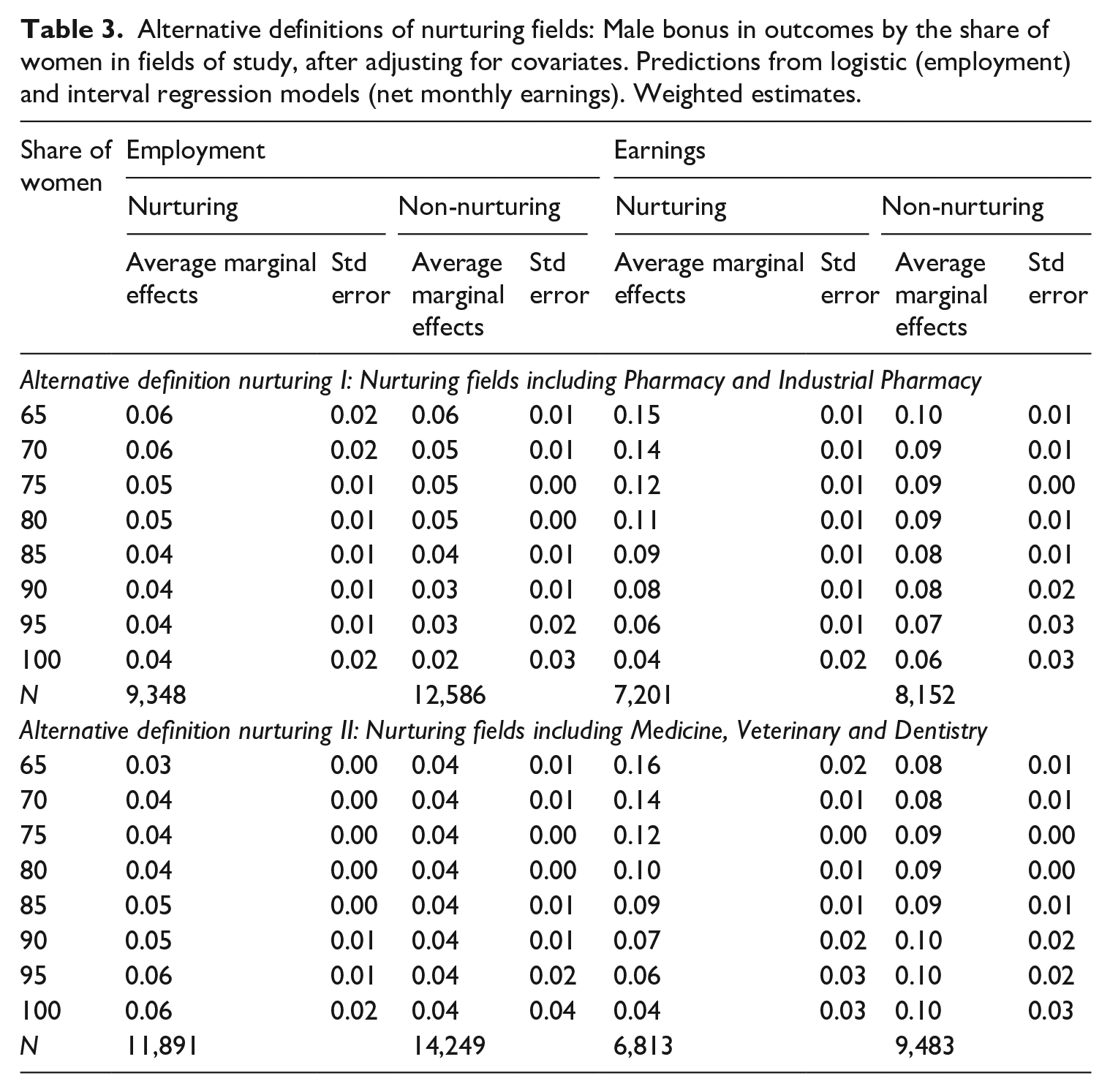
In this section, we expand upon the possibilities of how nurturing fields can be conceptualised and report the results. We have tested whether our findings are sensitive to the inclusion of two groups of fields: (1) pharmacy and industrial pharmacy; (2) medicine, veterinary medicine and dentistry. The findings are shown in Table 3. The analyses of both groups illustrate a lower employment gap in nurturing fields compared with the original classification and a similar pattern in the income gap when various classifications are used. As the employment gap shrinks substantially in favour of women when new classifications are employed, it can be concluded that medicine, dentistry, veterinary science and pharmacy might be considered levellers of gender inequality in employment. One likely explanation would be that these particular subfields are regulated by strict entry requirements that limit the supply of graduates. Thus, the limited numbers and highly regulated procedures following graduation attenuate competition between men and women (Mocetti et al., 2019).
Alternative definitions of nurturing fields: Male bonus in outcomes by the share of women in fields of study, after adjusting for covariates. Predictions from logistic (employment) and interval regression models (net monthly earnings). Weighted estimates.
Discussion and Conclusion
This article highlights that a field of study can be perceived as a channel for persistent inequality between male and female graduates in labour market. By comparing graduates in the same fields of study, we contribute to the explanation of the gender gap in labour market outcomes that occurs beyond women’s and men’s segregation in higher education. We combine two complementary perspectives that link the fields of study to the labour market outcomes of graduates – more precisely, their employment and earnings. The first perspective incorporates the immediate context of the field of study in the form of relative numbers of both genders; the second highlights the importance attached to gender roles in the definition of the field of study. Together they reflect the division between contextual and structural characteristics. The percentage of women in a given field of study is crucial for the expectation that a sufficient number of women can change its shared inter-group culture; simultaneously, structural characteristics like gender shape individuals’ beliefs and stereotypes, affecting the outcomes resulting from a choice of a particular field of study.
The findings of this article support the general principle of Kanter’s theory and illustrate the meaningful differences in outcomes related to the number of individuals in a certain group. However, the empirical analysis sheds further light on the theory considering the finding that the share of women in each field of study is not necessarily associated with its labour market outcome in the way that was originally predicted. Contrary to the hypotheses based on Kanter’s typology, the higher numerical representation of women does not necessarily lead to better outcomes. For example, token women in fields of study with a lower proportion of women overall (15–20%) tend to be similar to men in their occupational achievement.
In other words, the findings of this article suggest that women in mechanical, electrical, electronic, automation, aerospace or nuclear engineering fields of study face a lower degree of disadvantage in comparison to women in other disciplines. In fact, their higher visibility as a group seems to benefit women in such workplaces. This result might contrast some of the previous evidence. For example, Xu (2015) has shown that women in STEM suffer substantial income penalties within the first 10 years of employment compared with women in non-STEM fields. Our study, however, relies on a more refined measure compared with the STEM vs non-STEM classification, as it provides a comparison that applies a highly detailed classification of academic fields of study. It also scrutinises the gender gap five years after graduation when gender differences might not have reached their full potential. Therefore, it is still possible that the relatively smaller disadvantage that women encounter in male-dominated fields of study after graduation might translate into more considerable penalties later, although our study suggests some caution in generalising previous findings.
Moreover, the most gender-‘balanced’ fields of study are the most unequal in terms of earnings followed by employment, including political science, economics and business sciences, philosophy, design, architecture and mathematics. This finding is particularly insightful, as women in these fields, perhaps, experience a culture that has not become inclusive enough for female students as they enter once predominantly male fields of study. In other words, when fields that were considered male-dominated in the past become gender-balanced over time, it is likely that the gender culture that has favoured men within these sectors is still present (Torre, 2018). This preference can manifest itself in terms of a ‘glass ceiling’ that creates obstacles for women’s promotional and career advancement (Cotter et al., 2001). A lower employment rate among Italian (tertiary educated) women and its slow increase over time (OECD, 2021) may have also contributed to this phenomenon.
However, the presence of a large majority of women, for example, above 90%, in fields of study such as pedagogy, modern European and American languages and elementary school teaching tends to be associated with lower gender gaps in employment and earnings, indicating that the relationship between the gender composition of the field of study and the gender gap is actually an inverse U-shape. A significant predominance of women in specific fields might facilitate their inclusion in networks in which informal socialisation occurs. For example, it may strengthen the supply of women and create a culture more open to them (Blommaert et al., 2019).
A more refined picture develops of how inequality in the labour market is constructed by moving beyond the number of women in each field of study. When testing Kanter’s theory through the lens of status characteristics theory, the results show that the relative proportions of each gender are of limited value if the social and cultural contexts in which the interactions between men and women take place are not subject to consideration. Separate analyses for nurturing and non-nurturing highly female-intensive fields of study reveal that the status of a field of study does interact with the gender composition, and there is a steeper relative decline of male bonus that characterises nurturing fields of study when they move from balanced composition to a majority of women in terms of both employment and earnings. However, even though gender gaps in female-intensive fields of study that are perceived to appeal to the ‘natural’ abilities of women shrink faster, they are, on average, at comparatively higher absolute levels compared with non-nurturing fields of study in both outcomes. Previous empirical evidence has reported that higher earnings for men resulting from positions of authority, leadership and upward career mobility are strongly signalled in care-oriented professions (Simpson, 2004; Williams, 1992) such as nursing and teaching (Wilson et al., 2018), and these might serve as potential mechanisms through which the gap subsequently unfolds also in this case.
In sum, the fields of study perceived to appeal to the ‘natural’ abilities of women such as nursing and midwifery sciences, cognitive sciences, rehabilitation care, psychology or social services, in which they are believed to be ‘naturally’ better (Charles and Bradley, 2009; Correll and Benard, 2005), could not be necessarily considered as levelling gender inequality in the labour market. Specifically, the gender gap in employment and earnings is particularly pronounced in these fields of study. However, the exceptions to this are a large spectrum of medical fields of study that did not form a part of our more conservative definition of nurturing. Restrictive entry regulations into these fields of study alter employment opportunities and pay levels for female graduates, acting as a leveller to a certain extent. To conclude, the increase in the number of female students in industrialised countries has led to the higher representation of women in all disciplines, even to the point of disproportionality (Mastekaasa and Smeby, 2008). However, this article revealed two of the channels through which unequal gender outcomes in occupational success unravel and illustrated how they are perpetuated through higher education. These unequal returns persist in both the gender composition within a field of study and the lasting division between fields of study defined as ‘nurturing’ or ‘non-nurturing’. These two channels interact to reproduce gender inequality in the labour market and beyond. This article employs the Italian context as a case study but future research would benefit from cross-country comparison.
Supplemental Material
sj-docx-1-soc-10.1177_00380385221122400 – Supplemental material for Variations of Gender Gaps in the Labour Market Outcomes of Graduates across Fields of Study: A (Combined) Test of Two Theories
Supplemental material, sj-docx-1-soc-10.1177_00380385221122400 for Variations of Gender Gaps in the Labour Market Outcomes of Graduates across Fields of Study: A (Combined) Test of Two Theories by Diana Roxana Galos and Nevena Kulic in Sociology
Footnotes
Acknowledgements
This article was possible thanks to the Consorzio Interuniversitario AlmaLaurea that gave us permission to use their internal database. We are particularly grateful to Davide Cristofori and Silvia Ghiselli from the AlmaLauera office in Bologna for their support. We thank two anonymous reviewers for their insightful comments that have greatly improved the article. We have benefitted from the comments of participants in the following events: the Gender working group at the Institute for Employment research (IAB) in Nürnberg, May 2019; SISEC, Torino, 30 January–1 February 2020; Inequality over the life course, ECSR conference, 12–14 September 2019, University of Lausanne.
Authors’ Contribution
Both authors contributed equally and are listed in alphabetical order.
Funding
The authors received no financial support for the research, authorship and/or publication of this article.

Supplemental material
Supplemental material for this article is available online.
Notes
References
Supplementary Material
Please find the following supplemental material available below.
For Open Access articles published under a Creative Commons License, all supplemental material carries the same license as the article it is associated with.
For non-Open Access articles published, all supplemental material carries a non-exclusive license, and permission requests for re-use of supplemental material or any part of supplemental material shall be sent directly to the copyright owner as specified in the copyright notice associated with the article.
