




Abstract
Educational gradients in parental leave length are opposite for women and men: highly educated women return to work faster than those with low education while highly educated men are absent longer than less educated men. Explanations for the opposite gradients are typically made at the individual- or couple-level. To date, no quantitative study has documented whether the opposite educational gradients hold also within workplaces. In this study, we use employer–employee matched Swedish register data with fixed-effects models to examine whether the educational gradient applies also among co-workers in the same workplace. The results show that three-quarters of the educational effect typically attributed to the individual father disappeared when comparing fathers within workplaces. The educational gradient of mothers remained largely unchanged. These findings provide the first population-level evidence for the primacy of the workplace in determining fathers’ care choices.
Introduction
Gender differences in work interruptions following childbearing – here parental leave – is the main driver of gender inequality in the labor market, including wage developments and career progression (Kleven et al., 2019). A consistent and robust determinant of parental leave length for men and women alike is educational level, even when accounting for other important individual- and couple-level characteristics. For instance, highly educated women who have children return to work faster than those with low education (Brewster and Rindfuss, 2000; Stahl and Schober, 2018). For men, all studies so far show the opposite: highly educated men are absent from the workplace longer than less educated men (Sweden: Sundström and Duvander, 2002; Norway: Lappegård, 2008; Germany: Geisler and Kreyenfeld, 2011).
Quantitative studies on work interruptions are divided into separate literatures by gender and offer competing and somewhat irreconcilable explanations. For mothers, leave-taking is conceptualized as the time spent away from the labor market, with an emphasis on the work interruption itself (Desai and Waite, 1991). For fathers, leave-taking is conceptualized as the time the father spends with the child (Petts and Knoester, 2018), often neglecting that leave requires an absence from work. Explanations for the gradients have therefore been made specifically for women or men and rarely in relation to one another or acknowledging that they run in opposite directions. For women, the negative gradient is interpreted as the tradeoff between work and family being more pronounced among the highly educated and skilled (Buckles, 2008; Hook and Pettit, 2016), with highly educated individuals not just being more work-oriented but also having more to lose from being away from work in terms of career damage. For men, the positive gradient is instead understood to be driven by the well-documented link between education and gender egalitarian attitudes (Cunningham, 2008; Lesthaeghe and Surkyn, 1988; Sullivan, 2010), typically ignoring that the work–family tradeoff mechanism should be present for highly educated fathers as well (Lappegård, 2008).
In contrast, recent theoretical work has argued that the gendered workplace may be the framework needed to understand the opposite gender gradients (Hobson, 2014). In a corollary to the vast literature on the gendered organization (Acker, 1990) – in which gendered expectations on women as caregivers limit their career possibilities at the workplace – these studies argue that the same gendered expectations will also limit men’s possibilities for caregiving. Specifically, in a European context in which a long maternity leave is expected, father leave constitutes a gender deviation that may be interpreted as a ‘signal’ of less work commitment to the employer (Spence, 1973). A number of studies have documented that father leave carries a larger career penalty than mother leave of the same length (Albrecht et al., 1999; Evertsson, 2016; Rege and Solli, 2013). As documented in case studies of different workplaces, fathers articulate their leave-taking as not just a couple-level decision but in large part an adaptation to the specific workplace and the ‘standard’ of father leave it prescribes (Brandth and Kvande, 2001, 2016; Haas and Hwang, 2007; Hobson, 2014). These effects have been confirmed in experimental studies that suggest that when participants are asked to evaluate a claim to take leave, the gender deviance imposed by male care may be deemed both as a signal of poor work commitment and as worthy of a penalty such as demotion. In contrast, female care is not viewed as a transgression of gendered expectations and is therefore not penalized (Butler and Skattebo, 2004; Rudman and Mescher, 2013). This effect is likely larger in the European context of long maternity leaves than in the USA where non-utilization or very short parental leave is common also among women (Petts et al., 2022). While the organizational support for fathers to take leave from the particular workplace may vary by a number of different factors (Haas and Hwang, 2007), together comprising a ‘workplace regime’ of leave-taking, it induces a forcible adaptation of fathers’ leave-taking to the standard of the workplace, regardless of individual- and couple-level factors. Linking this discussion back to the discussion of educational gradients in the quantitative literature, we would expect fathers’ – but not mothers’ – leave-taking across educational levels to be similar within workplaces.
We utilize Swedish register data to connect all workers to their workplaces and thereby all workers to their colleagues. Because such employee–employer matched data is a rare data source in quantitative research, previous research on parental leave-taking has been limited to the study of individual- or couple-level characteristics. Even studies set up to include the workplace level still only include individual-level information on, for example, flexible work arrangements for that particular worker (Abendroth and den Dulk, 2011) and not the shared unobserved heterogeneity by all workers in a workplace that represents a workplace regime. This study is therefore the first to compare leave-use among colleagues with different educational levels that face the same workplace regime and assesses the relationship net of differential selection into workplaces. Moreover, we utilize the case of Sweden as a rare setting in which longer work interruptions among men can actually be observed. Whereas in most contexts father leave remains a speculation for the future, in Sweden mothers’ and fathers’ parental leave can be studied for a population of parental couples that face the same state-level conditions for leave-taking. These results may therefore indicate what parental leave patterns look like for men and women when norms and policies support men in taking parental leave.
Data and Methods
We use Swedish register data including all individuals who had their first child in any of the years 1993–2015. As Sweden is a context with high levels of non-marital cohabitation, we define a couple as two individuals who are biological parents to the same child, and who live in the same property (Thomson and Eriksson, 2013). We restrict our population to all individuals for which both partners were in gainful employment and for which the individual was registered at a workplace. Further, we restrict the sample to individuals who were eligible for income-replaced paid leave of the statutory 80% of previous earnings. The matching of individuals to workplaces includes people who were temporarily on leave, for any purpose. Finally, in order to estimate within-workplace effects, there must be more than one father/mother claiming parental leave in the father’s/mother’s workplace during the studied period. See the Online Appendix for robustness checks of these exclusion criteria. In total, our data include 401,144 fathers, nested in 65,461 workplaces, and 414,840 mothers, nested in 63,429 workplaces.
Fathers’ and mothers’ leave-taking (i.e. the two outcomes) are operationalized by the sum of the paid parental leave days taken by them during the two calendar years following the birth of the first child. Educational level was derived from the Swedish ‘SUN2000’ coding scheme (equivalent to the International Standard Classification of Education, ISCED 97), measured as the number of years in education.
We estimate separate models for men and women and conduct OLS models with and without workplace-level fixed effects. The models without workplace-level fixed effects resemble those used in previous quantitative research (Geisler and Kreyenfeld, 2011; Lappegård, 2008; Sundström and Duvander, 2002). They assume that all workplaces offer the same possibilities for leave-taking, and that these possibilities do not differ by gender, something qualitative research has shown is not true, as earlier discussed. In contrast, in the models with workplace fixed effects, we can examine whether colleagues within the same workplace behave differently or similarly by education. If they behave differently this would suggest that factors related to education differentiate behavior also within the workplace so that gender egalitarian attitudes of highly educated fathers determine a longer absence as compared with their less educated colleagues. In contrast, if they behave similarly, this would suggest that fathers working together follow the workplace understanding of appropriate gendered behavior, regardless of their educational level. If so, the positive educational gradient of fathers documented in previous research is driven mainly by differential sorting by educational level into workplaces that are more or less allowing of father leave.
In all models, we control for the childbirth year, the individual’s age and being foreign-born. We control for income as well to remove the effect of education that is mediated by income. We also control for partner characteristics to be consistent with much of the literature: partner’s age and education, and the individual’s share of total couple income. In the models with partner controls, being foreign born is entered as a couple-level categorical variable. Finally, to maintain as many observations as possible although leave eligibility varies according to the following characteristics, we include controls for whether the couple had a second child within the two-year window of study, whether the first birth was a multiple birth, and whether the parents were not registered as living together. For births out of a union, we enter partner characteristics of the separated partner as studies have shown that leave take-up of both former partners is common in separated couples in Sweden (Duvander and Korsell, 2017). As part of our robustness checks, we estimate all models excluding out of union births. We also control for month of birth to adjust for the possibility that paid leave may be taken up to two months before birth, which would lead to an underestimation of leave length for births early in the year.
Table 1 presents a description of the population under study and shows the differences among the mothers and fathers. The mean number of parental leave days taken was 73 for fathers and 351 for mothers. The variation in length of leave was higher for fathers than mothers, given that the standard deviation almost equaled the mean length of leave for fathers. The fathers were on average two years older than the mothers, both centered around age 30, which reflects the postponement of parenthood in Sweden and many other European countries. Women have more years of education on average than men, which is also a common trend in Europe (Klesment and van Bavel, 2017). In contrast, men have higher income than women on average. Almost 90% of the analytical population consists of mothers and fathers that were born in Sweden. By the end of the two years after entering parenthood that is included in the calculation of leave length, 38% had a second child. Only 10% of the analytical population gave birth to their first child when they were not in a cohabiting partnership.
Descriptive statistics of father and mother population.
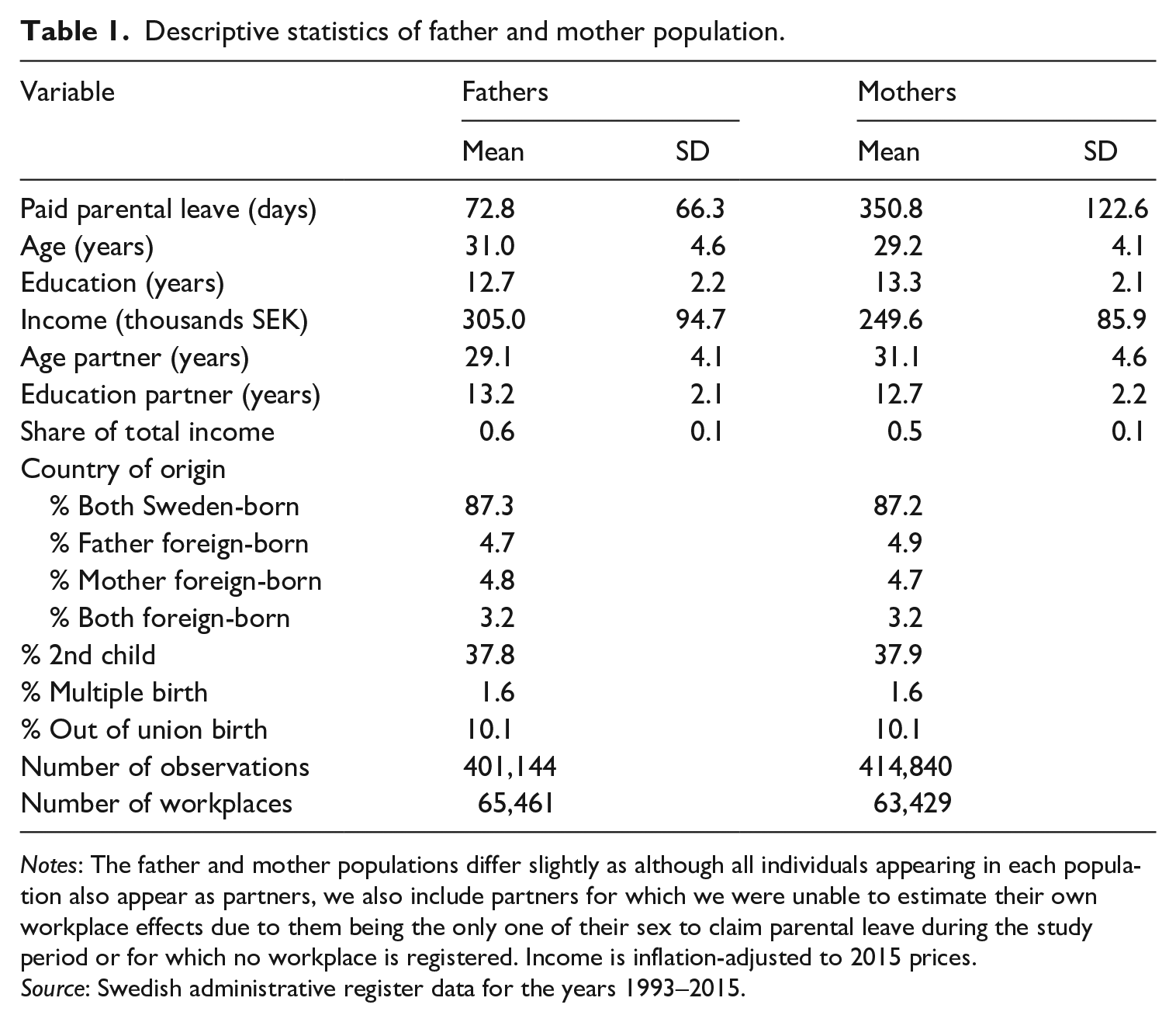
Notes: The father and mother populations differ slightly as although all individuals appearing in each population also appear as partners, we also include partners for which we were unable to estimate their own workplace effects due to them being the only one of their sex to claim parental leave during the study period or for which no workplace is registered. Income is inflation-adjusted to 2015 prices.
Source: Swedish administrative register data for the years 1993–2015.
Results
Figure 1 shows both the observed, descriptive trends (solid line) and the predicted parental leave length for fathers (left) and mothers (right) by years of education, and results from OLS models without workplace fixed effects (dashed line) and when including workplace fixed effects (dotted line). Note the different scales used on the Y-axis for mothers and fathers. Two important patterns emerge. First, the results confirm the opposing gradients for mothers and fathers shown in previous research. Whereas mothers’ time in parental leave decreases by her years in education, fathers’ parental leave increases by his years in education. From our OLS regression, we find that fathers with nine years of education (primary education) spend an estimated 80 days out of work caring for their child, as compared with an estimated 105 days for fathers with 17 years of education (Master’s degree). For mothers, the corresponding difference is 300 days for mothers with the lowest education, as compared with 232 days for the most educated mothers. Tables with results from full models are found in the Appendix, including the step-wise modelling of having only individual-level controls to adding partner-level controls. Due to space constraints, we do not discuss the relationships between these control variables and parental leave length, nor how they change with step-wise modeling.
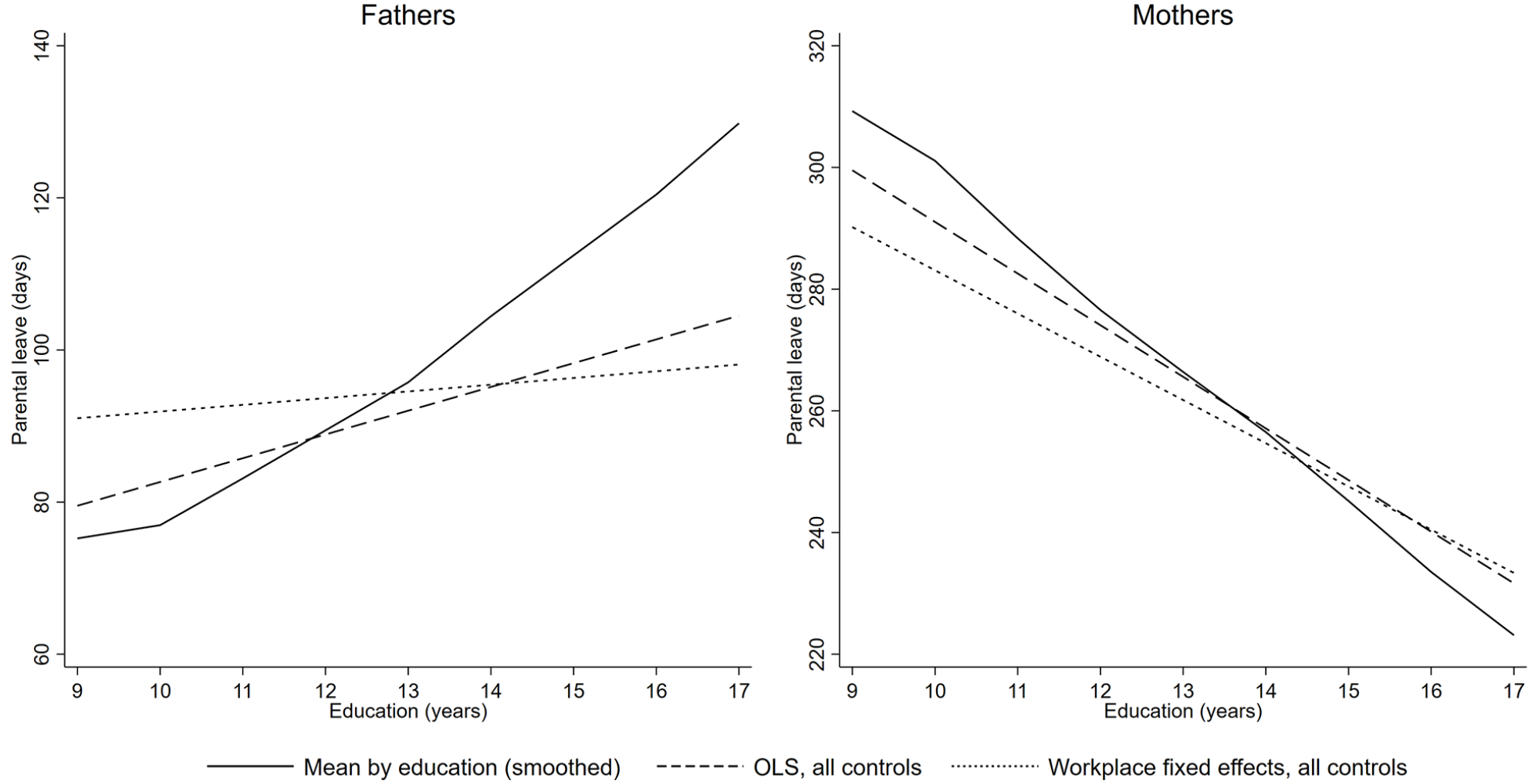
Parental leave of fathers (left) and mothers (right) by education.
Second, we see that adjusting for the workplace (fixed-effects models) flattens the slope of the curve markedly for fathers but not for mothers. For mothers, the estimate for a one-year increase in education changes from −8.5 to −7.1 days, which is a 16% reduction in effect size. For fathers, the estimate changes from 3.1 to 0.9 days, resulting in a 72% reduction. Within each given workplace, fathers with primary schooling only and fathers with a Master’s degree are therefore both found to take around three months of leave (91 days as compared with 98 days, respectively).
A number of robustness checks to confirm the results – including selection bias into paid work and more restrictive selections of the population – are included in the Online Appendix.
Conclusion
Past quantitative research on parental leave length has not been designed to account for the fact that women and men with different educational levels work in different kinds of workplaces. Our results suggest that inference drawn from studies that have not taken the workplace into account may have been compromised by interpreting workplace differences as individual-level effects.
Although the opposite educational gradients persist also within the workplace, we find surprisingly little difference between the leave lengths of high and low educated men within a workplace. For women, the steep educational gradient in leave-taking remains also within the workplace. Although almost all Swedish women, regardless of educational level, take long leaves, women working in the same workplace are only slightly more similar than women in the labor market overall. These results suggest that the educational gradient of fathers may not solely represent an individual-level effect, as such an effect should be evident within the workplace as well. If the educational gradient was driven only by individual-level gender egalitarian attitudes of highly educated fathers, we would expect to see a larger difference between highly educated fathers and their less educated colleagues.
Instead, this study may be interpreted as the first population-level evidence for claims made by a number of theoretical and qualitative studies, in which they argue that gendered norms of the workplace may effectively hinder fathers in making longer care claims. As argued by small-scale studies of the workplace, the construction of masculinities and workplace gendered norms may prescribe a certain ‘acceptable’ father leave at each workplace (Brandth and Kvande, 2001, 2016; Haas and Hwang, 2007; Hobson, 2014). Whereas mothers’ leave is anticipated and therefore accepted, managers and co-workers tend to view fathers’ leave as a signal of less work commitment (Haas and Hwang, 2007; Hobson, 2014; Rudman and Mescher, 2013). The results presented here – that male co-workers tend to make similar care claims regardless of educational level – support the idea that fathers adapt their care claims to the length of time that is ‘acceptable’ within their workplace.
Given that fixed-effects models adjust for workplace sorting, including selectivity into family-friendly workplaces, the differences between models without and with fixed effects could also be explained by these factors. However, for our results to go in line with this explanation, men must select themselves into such workplaces on the basis of their educational level to a larger extent than women do. There is little evidence that men seem to be selecting themselves into family-friendly workplaces to the same extent as women (Goldin, 2014), so we would not expect educational-specific self-selection to be particularly large among men. It is possible that other sources of selectivity may shape our results, but there is no literature thus far suggesting this is the case. Although the current research note cannot conclusively disentangle the different possible explanations, it is clear that the literature on leave-taking has conflated individual and workplace effects and that this error may bias the results differently for men and women.
Understanding father leave as an adaptation to constraints of the workplace rather than an individual- and couple-level decision may have important implications for policy making. For example, if father leave is mainly the result of an individual- or couple-level decision, we would expect economic incentives to affect the choices made by the couple. If father leave is instead mainly determined by the possibilities provided by the workplace, we would not expect economic incentives given to individual fathers to be effective for altering the workplace regime. This would explain why policies aiming to promote father leave through economic ‘bonuses’ have proved ineffective (Duvander and Johansson, 2012). A successful policy may instead need to function as a ‘right’ for fathers to make care claims at the workplace (Hobson, 2014).
Supplemental Material
sj-docx-1-soc-10.1177_00380385221109743 – Supplemental material for Parental Leave within the Workplace: A Re-assessment of Opposite Educational Gradients for Women and Men
Supplemental material, sj-docx-1-soc-10.1177_00380385221109743 for Parental Leave within the Workplace: A Re-assessment of Opposite Educational Gradients for Women and Men by Helen Eriksson, Sunnee Billingsley and Maria Brandén in Sociology
Footnotes
Appendix
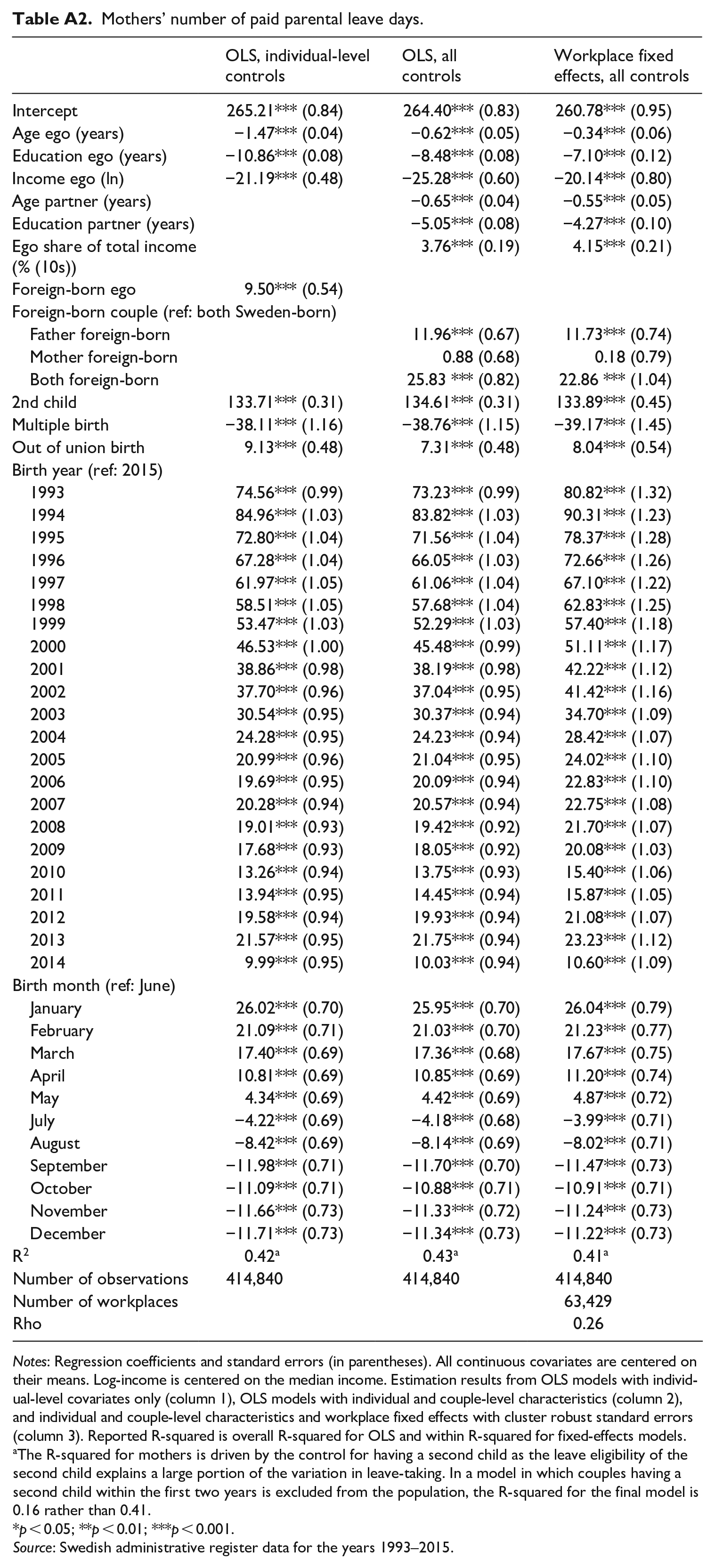
Mothers’ number of paid parental leave days.
| OLS, individual-level controls | OLS, all controls | Workplace fixed effects, all controls | |
|---|---|---|---|
| Intercept | 265.21*** (0.84) | 264.40*** (0.83) | 260.78*** (0.95) |
| Age ego (years) | −1.47*** (0.04) | −0.62*** (0.05) | −0.34*** (0.06) |
| Education ego (years) | −10.86*** (0.08) | −8.48*** (0.08) | −7.10*** (0.12) |
| Income ego (ln) | −21.19*** (0.48) | −25.28*** (0.60) | −20.14*** (0.80) |
| Age partner (years) | −0.65*** (0.04) | −0.55*** (0.05) | |
| Education partner (years) | −5.05*** (0.08) | −4.27*** (0.10) | |
| Ego share of total income (% (10s)) | 3.76*** (0.19) | 4.15*** (0.21) | |
| Foreign-born ego | 9.50*** (0.54) | ||
| Foreign-born couple (ref: both Sweden-born) | |||
| Father foreign-born | 11.96*** (0.67) | 11.73*** (0.74) | |
| Mother foreign-born | 0.88 (0.68) | 0.18 (0.79) | |
| Both foreign-born | 25.83 *** (0.82) | 22.86 *** (1.04) | |
| 2nd child | 133.71*** (0.31) | 134.61*** (0.31) | 133.89*** (0.45) |
| Multiple birth | −38.11*** (1.16) | −38.76*** (1.15) | −39.17*** (1.45) |
| Out of union birth | 9.13*** (0.48) | 7.31*** (0.48) | 8.04*** (0.54) |
| Birth year (ref: 2015) | |||
| 1993 | 74.56*** (0.99) | 73.23*** (0.99) | 80.82*** (1.32) |
| 1994 | 84.96*** (1.03) | 83.82*** (1.03) | 90.31*** (1.23) |
| 1995 | 72.80*** (1.04) | 71.56*** (1.04) | 78.37*** (1.28) |
| 1996 | 67.28*** (1.04) | 66.05*** (1.03) | 72.66*** (1.26) |
| 1997 | 61.97*** (1.05) | 61.06*** (1.04) | 67.10*** (1.22) |
| 1998 | 58.51*** (1.05) | 57.68*** (1.04) | 62.83*** (1.25) |
| 1999 | 53.47*** (1.03) | 52.29*** (1.03) | 57.40*** (1.18) |
| 2000 | 46.53*** (1.00) | 45.48*** (0.99) | 51.11*** (1.17) |
| 2001 | 38.86*** (0.98) | 38.19*** (0.98) | 42.22*** (1.12) |
| 2002 | 37.70*** (0.96) | 37.04*** (0.95) | 41.42*** (1.16) |
| 2003 | 30.54*** (0.95) | 30.37*** (0.94) | 34.70*** (1.09) |
| 2004 | 24.28*** (0.95) | 24.23*** (0.94) | 28.42*** (1.07) |
| 2005 | 20.99*** (0.96) | 21.04*** (0.95) | 24.02*** (1.10) |
| 2006 | 19.69*** (0.95) | 20.09*** (0.94) | 22.83*** (1.10) |
| 2007 | 20.28*** (0.94) | 20.57*** (0.94) | 22.75*** (1.08) |
| 2008 | 19.01*** (0.93) | 19.42*** (0.92) | 21.70*** (1.07) |
| 2009 | 17.68*** (0.93) | 18.05*** (0.92) | 20.08*** (1.03) |
| 2010 | 13.26*** (0.94) | 13.75*** (0.93) | 15.40*** (1.06) |
| 2011 | 13.94*** (0.95) | 14.45*** (0.94) | 15.87*** (1.05) |
| 2012 | 19.58*** (0.94) | 19.93*** (0.94) | 21.08*** (1.07) |
| 2013 | 21.57*** (0.95) | 21.75*** (0.94) | 23.23*** (1.12) |
| 2014 | 9.99*** (0.95) | 10.03*** (0.94) | 10.60*** (1.09) |
| Birth month (ref: June) | |||
| January | 26.02*** (0.70) | 25.95*** (0.70) | 26.04*** (0.79) |
| February | 21.09*** (0.71) | 21.03*** (0.70) | 21.23*** (0.77) |
| March | 17.40*** (0.69) | 17.36*** (0.68) | 17.67*** (0.75) |
| April | 10.81*** (0.69) | 10.85*** (0.69) | 11.20*** (0.74) |
| May | 4.34*** (0.69) | 4.42*** (0.69) | 4.87*** (0.72) |
| July | −4.22*** (0.69) | −4.18*** (0.68) | −3.99*** (0.71) |
| August | −8.42*** (0.69) | −8.14*** (0.69) | −8.02*** (0.71) |
| September | −11.98*** (0.71) | −11.70*** (0.70) | −11.47*** (0.73) |
| October | −11.09*** (0.71) | −10.88*** (0.71) | −10.91*** (0.71) |
| November | −11.66*** (0.73) | −11.33*** (0.72) | −11.24*** (0.73) |
| December | −11.71*** (0.73) | −11.34*** (0.73) | −11.22*** (0.73) |
| R2 | 0.42 a | 0.43 a | 0.41 a |
| Number of observations | 414,840 | 414,840 | 414,840 |
| Number of workplaces | 63,429 | ||
| Rho | 0.26 | ||
Notes: Regression coefficients and standard errors (in parentheses). All continuous covariates are centered on their means. Log-income is centered on the median income. Estimation results from OLS models with individual-level covariates only (column 1), OLS models with individual and couple-level characteristics (column 2), and individual and couple-level characteristics and workplace fixed effects with cluster robust standard errors (column 3). Reported R-squared is overall R-squared for OLS and within R-squared for fixed-effects models.
The R-squared for mothers is driven by the control for having a second child as the leave eligibility of the second child explains a large portion of the variation in leave-taking. In a model in which couples having a second child within the first two years is excluded from the population, the R-squared for the final model is 0.16 rather than 0.41.
p < 0.05; **p < 0.01; ***p < 0.001.
Source: Swedish administrative register data for the years 1993–2015.
Acknowledgements
An earlier version of the article was presented at the colloquium of the Stockholm University Demography Unit at the Department of Sociology (October 2020).
Funding
The authors disclosed receipt of the following financial support for the research, authorship, and/or publication of this article: financial support for the research has been provided by the Swedish Research Council for Health, Working Life and Welfare (Forte) (grant numbers 2019-00082 and 2021-01161).

Supplemental material
Supplemental material for this article is available online.
References
Supplementary Material
Please find the following supplemental material available below.
For Open Access articles published under a Creative Commons License, all supplemental material carries the same license as the article it is associated with.
For non-Open Access articles published, all supplemental material carries a non-exclusive license, and permission requests for re-use of supplemental material or any part of supplemental material shall be sent directly to the copyright owner as specified in the copyright notice associated with the article.
