




Abstract
Dominated by the ‘weak postsocialist civil society’ thesis, Central and Eastern Europe has generally been uninspiring for social movement scholars. In recent years, a growing body of scholarship has challenged this pessimistic notion, highlighting the emergence of grassroots activism. What remains under-researched, however, is the process of political subjectification of society’s apolitical segments through contentious practices. Informed by pragmatic sociology, this article explores three case studies – of student, civic and environmental movements, respectively – that demonstrate how citizens constituted themselves as collective political subjects by performatively enacting their citizenship through resistance in post-democratic Montenegro (2010–2015). Through analysis of news media sources and interviews with activists, this article postulates three trajectories of political subjectification – political becoming, political bonding and political embodying – by which citizens (re)gain their civic autonomy, allowing them to challenge dominant power relations and to attain political legitimacy to think, speak and act as relevant political actors on the public stage.
Keywords
Introduction
Sociology generally ascribes political subjectivity to active citizens: those virtuous members of society who do not see voting as the principal duty towards their political community, but instead remain proactive in-between elections. Scholars have used a wide range of adjectives – ‘radical’ (Mouffe, 1993), ‘monitorial’ (Schudson, 1998), ‘activist’ (Isin, 2009), ‘critical’ (Norris, 2011), ‘effective’ (Steele, 2017), among others – to describe these citizens and answer why, how and to what extent they exercise their civic autonomy outside of conventional political channels. Whereas this literature has discussed instances of active citizenship in the context of affluent western democracies, in this article I argue that Central and Eastern Europe’s (CEE) ‘post-democratic condition’ offers rich empirical material for the exploration of ‘performative citizenship’ (Isin, 2017), that is – the enactment of political subjectivity through contentious practices of society’s apolitical segments.
Social movement scholars have generally found postsocialist CEE uninspiring (cf. Baća, 2022; Bieber and Brentin, 2018; Jacobsson and Saxonberg, 2013; Kopecký and Mudde, 2003). The limited research that was initially conducted on the region portrays local civil societies as overtly passive, characterised by low social trust, widespread scepticism towards institutions, chronically weak associational life and mass withdrawal of citizens from the public sphere (Howard, 2003; Mendelson and Glenn, 2002). These findings on the lack of civic and political participation led to the development of the influential ‘weak postsocialist civil society’ thesis that ultimately shifted scholars’ gaze to advocacy-oriented non-governmental organisations (NGOs), identified as the key actors in postsocialist civil societies (cf. Ekiert and Kubik, 2014; Foa and Ekiert, 2017; Jacobsson and Saxonberg, 2013). Simply put, externally sponsored civil society building resulted in the professionalisation of associational life and civic engagement, ultimately culminating in a strong civic sector – a surrogate for a weak civil society – that was alienated from its constituency and, as such, detached from the genuine needs of society (Fagan and Sircar, 2018; Jacobsson, 2015; Kopecký and Mudde, 2003). This process of NGO-isation removed incentives for civil society building ‘from below’, which might have advanced the ‘organic’ creation of new democratic (counter-)cultures through contentious practices (Baća, 2022). The resulting socio-political configuration limited meaningful challenges to dominant power relations and, ultimately, solidified the civic sector as an ideological and logistical support for the development of western-style liberal market democracies, a strategic objective that was normalised as an apolitical and ahistorical necessity. Therefore, not only was the NGO sector disembedded from civil society, but it also became depoliticised.
In recent years, a growing body of scholarship has convincingly challenged the ‘weak postsocialist civil society’ thesis, mapping instead the vibrant life of social movements and variegated terrains of civic engagement beyond the professionalised civic sector (Baća, 2022; Bieber and Brentin, 2018; Fagan and Sircar, 2018; Jacobsson, 2015; Jacobsson and Saxonberg, 2013; Razsa and Kurnik, 2012; Štiks, 2015; Stubbs, 2012). These grassroots initiatives often criticise the liberal consensus of NGOs, both from the progressive left and the reactionary right. What remains understudied, however, is the process of their political subjectification, 1 that is – understanding why traditionally apolitical segments of society become political and how they comprehend their predicaments, articulate their grievances, make their demands, formulate their critiques and justify their positions on political grounds. 2 In analysing political subjectification through contention – that is, the constitution of citizens as political subjects by (re)claiming and performing their citizenship through acts of resistance – I use empirical material from contemporary Montenegro (2010–2015). Accordingly, the article is structured as follows: first, I argue that Montenegro represents a paradigmatic example of a postsocialist post-democracy and, as such, provides fertile ground for an exploration of political subjectification; second, I examine three case studies illustrating three distinct trajectories of political subjectification; and finally, I discuss the theoretical bearings of my empirical findings on political sociology and adjacent interdisciplinary fields.
Rethinking Political Subjectification in a Postsocialist Post-Democracy
With the emergence of illiberal democracies in East-Central Europe and the consolidation of stabilitocracies throughout Southeast Europe in recent years (Bieber, 2019), the ‘post-democratic condition [. . .] looks even more accurate’ in CEE than in its western neighbours, as the ‘substance of democracy has been challenged by the collusion between economic and political elites’ despite ‘formal democracy [being] now solidly established in most countries of the region’ (Pleyers, 2016: 8). The idea is that unlike old democracies in which neoliberal restructuring hollowed out the democratic substance and turned liberal democracies into post-democracies (Crouch, 2004), it was the elite-driven postsocialist transition that led directly from state socialism to the post-democratic condition in CEE.
Accordingly, instead of using terms such as ‘illiberal democracy’, ‘stabilitocracy’ or even ‘hybrid regime’ – notions that primarily denote the forms of government – I employ the concept of ‘post-democracy’, which has been demonstrated to be the most precise in accounting for the state–society relations developed in Montenegro under the rule of the Democratic Party of Socialists (DPS) from 1991 to 2020 (Baća, 2019). 3 The term denotes a condition characterised by the primacy of parliamentary democracy, which renders all other instances of (direct) democratic intervention undesirable (Rancière, 1999). In short, post-democracy turns political action into a purely formal procedure in which parties become disconnected from their base of support (Mair, 2013). Within such a configuration, politics is reduced to the technocratic administration of social issues and any substantial transformation is relegated to elite-pacts (Žižek, 1999). Since Montenegro has been the leading European Union candidate-country during the 2010–2015 period analysed here, the institutional politics of liberal democracy were strongly promoted by the international community, regardless of the ability of such institutions to actually uphold the rule of law or to provide credible venues for dissenting opinion (Baća, 2017c; Bieber, 2019).
This external insistence on and validation of stability at the expense of (more participatory forms of) democracy reinforced the post-democratic condition in Montenegro, which is in itself a product of two interrelated processes that characterised its postsocialist transformation. The first process can be described as horizontal depoliticisation: the non-anonymous nature of Montenegrin society – which consists of roughly 600,000 citizens living in a small territory marked by close personal and kinship ties – has weakened the social forces that produce contention in large ‘anonymous’ societies, making its civil society disengaged and compliant (Jovanović and Marjanović, 2002). The second process can be designated as vertical depoliticisation: the fusion of the reformed Communist Party and the state in the form of the DPS strengthened elite-mediated patronage networks as the key mechanisms for resolving existential-cum-political issues (Komar and Živković, 2016). As a result, anything that would elsewhere inspire collective action was primarily addressed and resolved in Montenegro through the merger of these horizontal (nepotistic) and vertical (clientelistic) patronage mechanisms.
This shrinking of the public space entailed a simultaneous contraction of the public sphere, ultimately leading to the post-democratic sidelining of socio-economic and socio-political issues from public debate (Marquand, 2004). In a word, as the political game became increasingly focused on ethnonational issues in the lead-up to and after state independence in 2006, Montenegro’s body politic has been divided by its elites into two antagonistic ethnopolitical subjectivities: ‘loyal Montenegrins’ and ‘disloyal Serbs’ (Morrison, 2009, 2018). The DPS used a populist ‘divide-and-conquer’ strategy to deepen and widen this gap by framing all challenges to its neoliberal policies and corrupt practices in ethnopolitical terms, effectively delegitimising any (direct) democratic interventions as essentially illegal activities conducted by ‘enemies of the state’ (Džankić and Keil, 2017; Komar and Živković, 2016; Morrison, 2018). Against this backdrop, Montenegro did develop a relatively strong civic sector, but its civil society was fairly weak in articulating and aggregating interests and identities ‘from below’ (Baća, 2017c; Jovanović and Marjanović, 2002). Accordingly, short-term, small-scale and low-key apolitical protest activities became the defining features of Montenegrin civil society, alongside widespread pessimism towards political participation as something that can change the status quo (Baća, 2017c; Komar and Živković, 2016). Therefore, a context where all politics has been reduced to ethnopolitics, and all civil society to NGOs with no tradition of social movements – and where people experienced a change of government at the ballot-box for the first time in 2020 and, before that, only incremental political alterations through elite-pacts – makes an ideal setting for studying the process of political subjectification.
To this end, I use empirical material from three instances of popular unrest in which Montenegrin citizens decided to abandon institutional venues of political participation and exert their political agency – namely, the student uprisings of 2010–2011, the ad hoc mobilisation of urbanites in 2015 and the environmental movement of 2010–2014 – to demonstrate how each exemplified a distinct trajectory of political subjectification. By taking a practice-oriented approach to the study of postsocialist civil society (Baća, 2022; Jacobsson and Korolczuk, 2020), coupled with varied insights from critical theory (Castoriadis, 1991; Isin, 2009; Rancière, 1999), I conceptualise these trajectories as: (1) political becoming, a process through which a traditionally apolitical demographic group (re)politicises its social role; (2) political bonding, a process through which ordinary citizens exercise their civic autonomy by forging new political bonds between hitherto antagonistic collectives; and (3) political embodying, a process through which localised citizen-led struggle is given universal attributes, standing in as a symbolic representation of other marginalised grievances in the polity. 4 Additionally, I draw from the research programme of pragmatic sociology by relying on the accounts of those I interviewed – especially on their reflexive insights in and on the ‘critical moments’ that ‘break the ordinary course of action’ (Boltanski and Thévenot, 1999: 360) – as a fundamental element of theory construction. Therefore, in order to grasp the nuances of different trajectories of political subjectification in the post-democratic condition, I investigate higher normative principles to which social actors appeal in order to defend their activist cause and to prove their political competencies.
Identifying Trajectories of Political Subjectification
In this section, I lay out three trajectories of political subjectification in post-democratic Montenegro from 2010 to 2015. I begin by tracing a wave of student uprisings to demonstrate how this notoriously apolitical group in Montenegro managed to politicise its social role. I then explore an ad hoc mobilisation of urbanites to demonstrate how they found common ground in civic values to set aside deep ethnopolitical differences and articulate a novel joint anti-government platform for collective action. I end by investigating a unique grassroots movement to demonstrate how a local(ised), single-issue environmental struggle became a nationwide movement by symbolically embodying numerous grievances that had been previously left unarticulated and/or unrepresented in the polity.
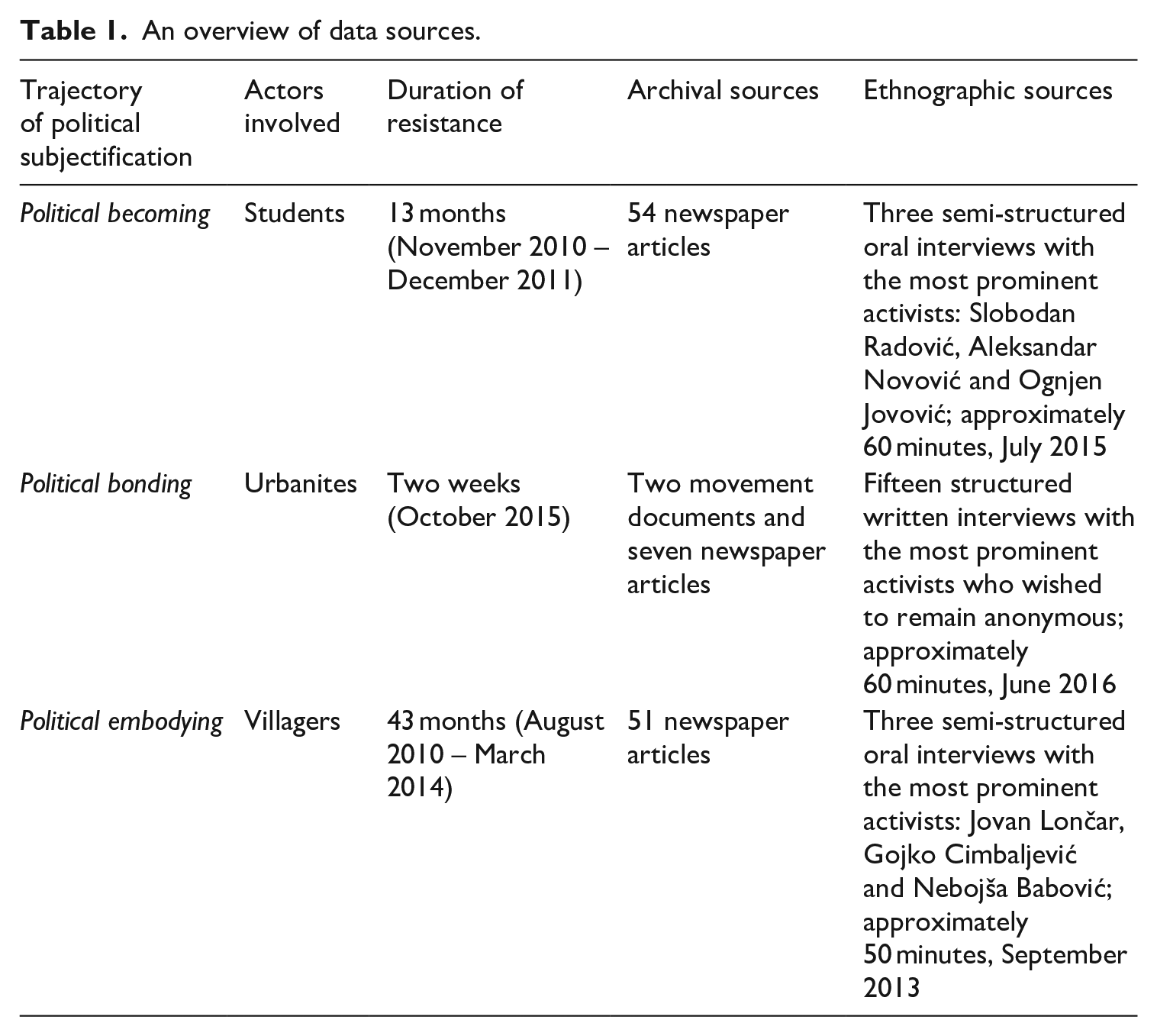
As shown in Table 1, my research design uses a three-step protocol and was based on an inductive approach through which I revisited qualitative data gathered during three separate yet methodologically and thematically interrelated projects investigating grassroots mobilisations in postsocialist Montenegro, selected for their political relevance and prominence in the media. 5 I began by constructing the narrative for each case study by analysing newspaper articles (N = 112) from high circulation dailies Vijesti, Dan and Pobjeda, as well as the weekly Monitor, and, where available, movement materials such as petitions (N = 2). During this step, I acquired key facts about the political subjectification of these actors (through their public reception) and developed basic thematic codes for later analysis. In the follow-up step, I conducted interviews (N = 21) in Serbo-Croatian with the most prominent activists of their respective movements to understand the reasons for and justifications of their actions described in the media. In the final step, interviews were coded to analyse the actors’ sense of (in)justice and the development of their political competencies with a focus on emergent themes, which were then cross-referenced with the key topics identified during the first step. By juxtaposing the analysis of my research subjects’ political voice on the public stage during the events (via newspaper articles) with analysis of their post festum reflections on these events (via the interviews), I was in a position to create a coherent account of the process of political subjectification and map its three trajectories: political becoming, political bonding and political embodying.
An overview of data sources.
Political Becoming: From Administratively Defined Students to Politically Empowered Citizens
This case study covers a wave of student uprisings that swept the University of Montenegro from November 2010 to December 2011, which ultimately initiated cross-sectoral anti-government protests in the first half of 2012. In tracing the political becoming of the student body, I distinguish three critical moments in which students developed political competence to ‘demand what is not theirs to demand’. The first involves informal gatherings and alternative organising to fight corrupt practices of the umbrella student organisation and publicise professional incompetence of the university management. The second includes blockades and occupations of university buildings to criticise neoliberal higher education policy reforms and associated austerity measures. The third moment involves protests that took place in the streets of two major cities to raise the student voice against the authoritarian rule of the DPS.
Due to numerous problems with the umbrella student organisation – including but not limited to unfair election processes for its members and inadequate representation of its constituency – discontented students began mobilising through informal deliberative forums for marginalised voices to be heard on these issues. Such gatherings were constructive and empowering to the extent they unfolded ‘without taboos and constraints’, addressing ‘all the problems [they] were facing, not only as students, but as members of an unequal society’ (Slobodan). Diagnostics developed at these events eventually rendered them ‘politically aware [. . .] in terms of jointly identifying and addressing the roots of social problems’ and made them feel ‘like citizens and not mere machines for the reproduction of knowledge’ (Slobodan). The planning of actions through horizontal consensus-based models was founded on principles of direct democracy in which ‘everyone was a member and a leader at the same time’, thus creating an intellectually stimulating and emotionally supportive environment for students to ‘freely express their frustration with how things work [. . .] at the university and beyond’ (Aleksandar). The ultimate effect of these spaces for encounters was articulation of a student’s sense of belonging to a distinct social group, with a set of its specific needs and interests. This newly founded identity began manifesting in flash mobs that purposively intruded into administratively controlled places to disrupt the routine flow of everyday life at the university. Since they increasingly viewed the problems they were encountering as students – incompetence, clientelism and cronyism – as yet another manifestation of issues that society was facing at large, disgruntled students began to understand their social role less within administrative parameters but rather rewriting it in political terms instead. With the process of their political becoming in motion, rebellious students continued to resist and transgress the institutional boundaries of their administratively defined social role in creative and disruptive ways.
Whether they were spending a night in the occupied campus buildings to symbolically assert that the university belongs to the students, or blocking the halls to express their dissatisfaction with higher education policy, discontented students performatively delimited autonomous spaces that not only made their voices audible and recognisable in public, but also facilitated an ideologically inclusive and emotionally supportive environment for their peers to publicly distance themselves from the official student representative structures and join their cause. These takeovers created an opportunity for ‘diverging voices to cumulatively produce the desired outcome – what [rebellious students] jokingly called then, the dictatorship of the studentariat’ (Aleksandar). This approach effectively turned their administrative demands into political discontent, not in the sense of ‘siding with political parties’, but by ‘taking actions, as free citizens, against those who were responsible for [students’] predicaments’ (Aleksandar). My respondents perceived themselves as victims of the neoliberal restructuring of higher education and the labour market, as their time was reduced to navigating between the precariousness of the transitional economy and the grip of patronage mechanisms as the only way of escaping existential uncertainty. Consequently, students became contentious not only to end the commercialisation, commodification and monetisation of knowledge, but to also initiate a radical transformation of a university system that was ‘dominated by the DPS apparatchiks’ (Ognjen), as well as to restore its autonomy through its liberation from the condition they characterised as ‘autocracy’ and ‘tyranny’. By jointly deciding that their actions ‘cannot be anything else but political’ in the sense of bringing ‘a new, different voice in the public sphere’ that would ‘speak about issues that were rarely spoken about’, activist students began working on ‘patenting a new, radically different student class’ (Ognjen). As their political messages appeared on banners such as ‘Death to corporatism, freedom to the university!’ and ‘Don’t want to join the party, just want a job!’, hundreds of students used their respective faculty buildings to protest against political clientelism and austerity measures that they characterised as an ‘allowance for science’. They were united in demanding a more democratic and inclusive system within university and higher education structures that would include students in decision-making processes that affected their lives and post-graduation employment prospects. At this point they were no longer acting as dissatisfied individuals nor as disgruntled administratively defined students, but as an empowered political collective with a sense of self, determined to make substantive change.
My respondents reflect on their collective actions as the key factor in developing ‘student class consciousness’ that was pivotal in taking their discontent outside of campuses. During the first prominent rally that rebellious students ‘saw as [their very own] 1968’, they idealistically called for the ‘awakening of students in the streets’ and publicly announced their detachment from the official student structures, criticising the class privilege of university professors and student representatives that had turned them into a part of ‘the ruling establishment’ and ‘servants of the system’ disinterested in protecting student welfare and defending the public good. The protest was not, however, organised as an expression of dissatisfaction related to narrow student interests, but was instead framed as a ‘struggle against government policies, austerity measures, [and] the lack of job opportunities and job stability’ (Slobodan). In the second prominent protest held in front of the Parliament of Montenegro, several hundred students demanded that parliamentarians acknowledge their existence. Under the slogans ‘Our leaders are our ideas!’, ‘Students unmute!’ and ‘Why do I need a degree when I have relatives in power?’, they were protesting against the systemic precarity and the widespread corruption in the country.
Now that these student groups were expressing dissent towards the system outside of formal student representative structures, the official student leadership had no option but to finally acknowledge their grievances and offer joint organisation of protests in order to convince a growing pool of discontented students that they were on their side. During the largest student rally in Montenegro’s history, several thousand students marched down the streets of the capital to highlight the combined effects of problems in the higher education sector and in labour policy on the student population. While unified in demanding improvements in higher education policy, curriculum and teaching standards, student material status and post-graduation paid internship opportunities, independent student groups differed from the umbrella student organisation in their expression of anti-establishment sentiment by calling for the liberation of the university from the DPS’s partitocratic grip and the reassertion of its autonomy. Despite the formal student leaders’ stance that academic affairs should not be politicised, rebellious student collectives were determined to address the structural causes of their predicaments and their future as a precarious workforce, and to proactively fight for the country’s constitutional identity as a ‘state of social justice’. As the official student leadership continued to fight only along corporatist lines for narrow student interests through a series of closed-door meetings with authorities, activist students turned to trade union and civil society activists for help, a collaboration that had its epilogue in a wave of (unsuccessful) anti-government protests popularly called the ‘Montenegrin Spring’ in the first half of 2012.
In conclusion, this case study demonstrates how a group of discontented students abandoned official student representative structures to contentiously pursue their goals, eventually creating the dynamics for mass protests against precarity, corruption and partitocracy. By doing so, they developed a sense of their specific needs and interests and, through political becoming, identified structural – and thus unabashedly political – causes of their predicaments. In breaking the public image of Montenegrin students as civically disengaged and politically passive, these disobedient student collectives not only developed a self-confident social identity, but also instigated public acknowledgement of their newly found political subjectivity. 6 As they gained competence to address issues they had been deemed unqualified to speak on, rebellious students became recognised as a legitimate political partner for civil society and trade union organisations in addressing key socio-political problems.
Political Bonding: Bridging Ethnonational Divides through Civic Values
In September 2015, the largest opposition coalition Democratic Front (DF) organised a sit-in protest in front of the Parliament of Montenegro. While its main demands were the establishment of the first free and fair elections, Serb ethnonationalist rhetoric and iconography were present among some participants, which added fuel to state propaganda that this weeks-long gathering was merely ‘nationalist’, ‘anti-Montenegrin’ and essentially ‘uncivil’, thus limiting the spread of the protest’s message beyond the DF’s core constituency. However, when the police violently raided the ‘tent city’ and arrested peaceful protesters in mid-October, a group of predominantly young urbanites initiated a petition in solidarity with the wronged citizens that would ultimately transform into #Građanski, a self-organised and inclusive network of discontented citizens. 7 They crafted two ‘open letters’ addressed to the government and the public, the Protest Letter (Građanski, 2015a) and the Protest Memorandum (Građanski, 2015b), which I treat as critical moments at which its signatories not only reasserted their civic autonomy by appealing to their constitutionally defined political subjectivity, but also offered ‘civic values’ as a political bond between their ethnopolitically divided fellow citizens for a joint action against the DPS regime.
Reflecting on their petitions, my respondents explain how their guiding idea was to put an end to ethnonational divisions that had split Montenegrin body politic into two camps: those who supported the DPS were seen as the ‘embodiment of Montenegrin identity and sovereignty’, while those who were against its rule – the majority of whom were ethnic Serbs – were delegitimised as ‘enemies of the state’, ‘anti-Montenegrin’ and thus framed as ‘disloyal citizens’ (Danilo). They view this oversaturation of the political field with ethnocultural content as an ‘artificial product of the [DPS] party machinery’ that ‘instrumentalises [ethnic/national differences] to shape public discourse within nationalistic parameters’ (Novak) and, with such highly affective issues at stake, easily exercises ‘emotional manipulation and control over impoverished people’ (Miroslav). This ‘merger of party affiliation and ethnonational belonging’ has colonised every aspect of Montenegrin life, its effects being ‘nowhere more evident than at the level of everyday life’ (Darko). For instance, my respondents found themselves in a position where ‘ethnonational identity [is imposed] without the right to object’: anyone who ‘expresses his or her criticism towards the DPS [policies and practices] ends up being viewed as a Serb nationalist’ (Radmila) and thus a disloyal citizen. 8
To overcome this ‘delegitimisation through [ethnopolitical] labelling’ (Borislav), #Građanski was established as a way of acting upon ‘civic responsibilities’ and ‘civic duties’ in defending the constitutionally guaranteed rights of all citizens, regardless of their ethnic/national belonging, political affiliation or ideological position. In light of the brutal raid of the ‘tent city’, my respondents saw it as their duty to embrace ‘civil disobedience and resistance to oppression’ (Radmila) and engage in the ‘organised action of people against state violence’ (Milorad), even if it meant ‘fighting for the rights of those whose politics [#Građanski] did not support’ (Ranko). By appealing to ‘civic values’ as the key source of political bonding between members of a political community, #Građanski called upon their fellow citizens to exercise their political agency not by simply forgetting or abandoning their symbolic and material conditions, but rather by momentarily disconnecting from inherited (politicised) identities to affirm solidarity with ‘those blatantly wronged by the DPS regime’ (Vojislav). They, however, faced a problem of how to communicate this message in a context where ideological divisions do not move along a ‘left–right’ spectrum but instead a ‘civic–ethnic’ axis. Namely, with the culmination of ethnopolitics throughout the former Yugoslavia in the 1990s, the notion of ‘civic(ness)’ became equated with the urban habitus, cosmopolitan outlook and elitist civility of the liberal middle class (Jansen, 2005). Consequently, anything that did not fit into the ideological-cum-aesthetical parameters of the dominant understanding of ‘civic values’ was delegitimised as ‘uncivil’ and thus ethnonationalist by default. As my respondents explain, this ‘civic worldview’ entails what its advocates should believe and do as political beings and with whom they should cooperate, which in particular excluded the maltreated protesters who were seen from this perspective as ‘backward’, ‘primitive’, ‘uneducated’, ‘traditionalist’, ‘(ethno)nationalist’, ‘uncivilised’, ‘radical’, ‘retrograde’, ‘barbaric’, ‘peasant’ or simply ‘ugly’, and therefore not worthy of sympathy, solidarity or support.
In a situation in which many who ‘adhered to the so-called civic values used every excuse not to solidarise with the wronged people’ (Nela), their ‘cultural-fascist rhetoric was employed to show [the protesters] as being unworthy of support’ despite them having ‘legitimate claims’ and the government ‘violating the constitution’ (Tanja). My respondents refused to accept this position as ‘civic’ (građanski), instead calling it ‘citizenist’ (građanistički). For them, this ‘citizenist discourse’ was one and the same as ethnonationalist rhetoric in its exclusionary zeal: it demonised the underclasses who were often defined primarily by their ethnicity/nationality. Guided by the idea that in today’s Montenegro ‘every individual and every group wants to be tolerated, but no one wants to show solidarity’ (Stevo), #Građanski declined to vilify members of the alleged ‘uncivil society’ ravaged by socio-economic restructuring – whom they saw as the ‘true losers of transition’ – and instead treated their conservatism and traditionalism as symptoms of broader social injustices they did not create but were victims of. They hoped the ‘underclass material interests’ would eventually ‘place them on the left instead of the right’ (Draško), and so they steered public debate towards the socio-economic dimensions of national identity as the ‘divisions that matter’ in that ‘the real problems [. . .] are essentially class-based’ (Sreten). In doing so, #Građanski strived for these issues to become a ‘unifying factor in fighting the divide-and-conquer politics’ and ultimately result in a broader coalition for ‘liberation from the dictatorial regime’ (Aleksandra). Underscoring ‘civil liberties, civic action, republican order, and social justice’ as the ‘essence of civic values’, my respondents described their political relation to the state as ‘anational republicanism’ predicated upon the ‘consensus that Montenegro is a country of its citizens, regardless of their ethnonational belonging or political affiliations’ and an awareness that ‘institutions arrested by political parties’ do not treat all citizens equally (Novak). In the resulting discourse, ‘civic values’ were no longer understood as falling within the ethical and aesthetical parameters of the liberal, if not outright apolitical middle class’s ‘urbanity’ and ‘civility’. They were framed instead as a manifestation of the progressive and contentious political activity of all concerned members of the political – and not ethnonational – community in the face of state oppression.
Establishing itself in opposition both to ethnonationalist and citizenist approaches to politics, #Građanski refused to view conflict resolution as a reconciliation between seemingly homogenous ethnonational-turned-political blocs, but rather as a joint action of a multitude of constitutionally defined ‘bearers of sovereignty’. For them, ‘civic values’ not only represented liberal (‘civil’) alternatives to ethnonationalist (‘uncivil’) politics as was the case in the 1990s; rather, they denoted an extra-institutional ‘course of action based on compromises between abundant diversities in the Montenegrin society’ and ‘the citizens’ awareness of the [need to protect] public, common good’ in the face of abuse of state power (Sreten). Guided by the idea to challenge the DPS regime not because a particular ethnonational identity was wronged, but because the constitutionally guaranteed political rights and civil liberties of members of a political community were negated, my respondents called upon their fellow citizens to disidentify with ethnopolitical categories and, hence, detach themselves from the party affiliations that thrived on these divisions. Accordingly, #Građanski explicitly stated that ‘at the moment when a repressive state apparatus openly carries out aggression against its own citizens, all existing divisions – of ethnicity/nationality, political party, ideology, religion, gender, sexuality, generational – disappear’ (Građanski, 2015a). By acting as ‘we the citizens of Montenegro’, their political bonds created an ad hoc social movement of autonomous political subjects that saw itself as ‘[standing] together in defence of Montenegro, its peace, statehood, and republican constitution, as well as the human and civil rights of all of [its citizens] regardless of [their] political, ideological, identity, or other differences’ (Građanski, 2015b), with the ultimate goal of reinstituting Montenegro’s constitutional identity as a ‘state of social justice’.
In conclusion, despite the failure of my respondents to achieve their objectives, the case of #Građanski demonstrates how a group of citizens momentarily created a radical space of inclusion for numerous anti-establishment sentiments through temporary political bonds between more than 10,000 of hitherto ethnopolitically divided citizens who answered their call and came to follow-up protests. This ad hoc mobilisation functioned as Montenegro’s autochthonous version of the ‘We are the 99%’ rebellion. Moreover, as opposed to previous elite-driven attempts at establishing ‘civic values’ as a symbolic unifier of an ethnonationally divided Montenegrin society, #Građanski reinvented these political bonds ‘from below’, by grounding ‘civic values’ in civil liberties, social justice, republican order, contentious politics and the dignity of (other) citizens, as well as in empathy and solidarity with wronged segments of society.
Political Embodying: Symbolically Representing the Unrepresented
A near four-year struggle against environmental degradation in the village of Beranselo stands as not only the most successful grassroots movement in contemporary Montenegro, but one of the most prominent instances of the ‘new left’ in the post-Yugoslav region (Štiks, 2015). In analysing how this inconspicuous citizen-led struggle in a small village became a new, transcendent political subjectivity that embodied the grievances of all those wronged by and discontented with the DPS regime nationwide, I distinguish two critical moments. The first is the coordinated and collective repertoires of political contention in physical spaces aimed at righting an environmental wrong, with the second being the spontaneous and individual tactics of everyday resistance in virtual spaces aimed at exposing this wrong, among others, as a symptom of structural injustices common throughout the country.
By the time contention began in 2010, the municipality of Berane had become home to an ecologically hazardous dumpsite holding half a million tonnes of unprocessed waste without any technical infrastructure for its storage. Whether the locals were petitioning the authorities to hear their grievances, using citizen science to prove that the location did not fulfil legal criteria and technical requirements for an acceptable regional landfill site or implementing their statutory right to organise a community referendum to prevent rubbish disposal in their settlement, the powers that be did not recognise their actions as legitimate. 9 My respondents explain that the officials’ chronic non-responsiveness eventually led the villagers to complement these attempts at ‘obedient citizenship’ with collective acts of civil disobedience. They ranged from daily pickets on access roads to the dumping ground and collective blockades of police-escorted garbage trucks, across performances to creatively expose the contradictions that lay in the discrepancies between what the authorities were saying and doing, to protests in the capital in which they criticised their political representatives for being silent about the systemic oppression of those they were supposed to represent. The locals were determined to challenge the decisions of those who ‘have never or will never live in Beranselo’ yet were using their living space as ‘an instant and cheap solution to a long-term problem [the government] had’ (Jovan), without previously consulting citizens whose livelihoods were directly endangered by the decision. In the face of the ‘infrastructure project’ that was turning their town ‘into a “garbage centre”’ and the north region as a whole into ‘the “Third World” within Montenegro’ (Jovan), Beranselo’s residents fought for answerability, responsibility and accountability from the local and national authorities.
Unlike comparable grassroots mobilisations against environmental degradation in rural Montenegro that remained single-issue affairs and local struggles, the resistance in Beranselo stopped being perceived only as a fight for a healthy environment, but was characterised instead by the public as a defence of constitutional order, civil society and human dignity, ultimately becoming a paradigmatic example of civic responsibility and civil courage, as well as a nationwide symbol of resistance to political oppression. 10 What differentiated the uprising in Beranselo from all these citizens’ initiatives were the individual, decentralised and uncoordinated acts of everyday resistance of creating and sharing images on social media platforms depicting the wrongs they had to suffer. These actions, performed daily by a number of non-activist ‘ordinary people’ who supported their cause, can be classified into two categories. The first category of action is the dissemination of unsettling visual representations of the dump and confrontations with the police, while the second is the creation of a Port Berane (Luka Berane) page on Facebook, which served an autonomous community-art project that lampooned the establishment through photoshopped pictures of a more desirable environment. 11 In a nutshell, Port Berane was envisaged as an ‘alternative history of Berane’: through the creative editing of images and usage of popular culture imagery, a former industrial town was symbolically relocated from a poor continental area to the wealthy coastal region where it became a ‘tourist giant’, a sarcastic utopia in which ‘[the ruling] elites used privatisation and corruption for the good of all its residents’ (Nebojša). Ultimately, this project (re)situated the resistance of the villagers within a wider socio-political context and deconstructed its apparent localised particularism, rendering Beranselo not as an isolated injustice but rather as a symptom of the structural violence common throughout postsocialist Montenegro.
Publicly visible resistance began with a billboard in the town square of Berane, where villagers displayed four disconcerting photographs of the dump. This gesture was not a provocation but a ‘desperate attempt’ to make the townsfolk ‘see where their trash ends up, where it is hidden – in the backyard of their town, but in [villagers’] homes’ (Jovan). Dissemination of images quickly became a viral awareness-raising tactic on social media as hundreds of pictures were shared on Facebook for everyone to see ‘what was really going on’. Visuals they produced were ‘pictures of a crime in progress, a crime against one village, one town, one region’, demonstrating that ‘official policies aimed at “protecting the environment” were nothing but a lie’ and that Beranselo’s residents ‘were not standing in the way of progress, as [the authorities] claimed’, but instead ‘preventing the [environmental] apocalypse’ (Gojko). Addressing the public directly through photographs unmediated by ‘words that can be twisted and turn everything into another [ethnopolitical] identity issue’ was of fundamental importance in providing ‘evidence of the injustices that everyone in Montenegro talks about, but is seldom able to support with facts’ and thereby giving to the public ‘proof that the other side, the official side, was lying’ (Nebojša). By converting images into a medium of everyday resistance through which the wrongs they had to suffer could not be symbolically polluted, nor co-opted by the hegemonic discourses of the DPS regime, this approach could not leave anyone indifferent, and no political narrative could defend and thus misrepresent the injustices revealed. Ultimately, these visuals turned the subjective gaze of a marginalised group into an objective concern of the local community and, gradually, the entire country.
In the non-anonymous society of Montenegro, Port Berane – as ‘the voice of the truly marginalised’ – gave an opportunity for every member of the community to ‘create an image and communicate their grievances [. . .] to say something [critical or subversive] and remain anonymous’, so ‘it wasn’t important who made the photos, but what they were showing – critique, difference and change’ (Gojko). When the dump became part of Port Berane’s imaginarium, it translated political oppression and structural injustices into visual representations of a concrete, tangible and visceral problem that could be widely identified and, therefore, identified with – a town in which privatisation, incompetence and corruption had not destroyed its infrastructure, local industry and people’s lives. By deconstructing the dominant neoliberal narrative of progress and overriding ethnopolitical cleavages in the name of civic unity against environmental-cum-social injustice, the placeholder of ‘Beranselo’ was not only resignified as a symptom of structural violence committed in the name of the government’s strategic goals that benefitted only the establishment, but eventually became an embodiment of emancipatory politics in Montenegro. Over time, rather than simply representing the residents of Beranselo and the concrete injustice they faced, the democratic claim of solidarity ‘We are all Beranselo!’ – made in the name of shared political goals rather than an identity associated with Beranselo – came to represent the multitudes of individuals and collectives demanding respect for human dignity and protection of the environment, questioning official policies and narratives, and renouncing the elite’s definition of politics in which the primary function of the political system is to serve the interests of the few.
In conclusion, waste disposal in Beranselo was officially halted and its residents and the rest of Montenegro celebrated victory in early 2014. 12 This case study, nevertheless, demonstrates how a local struggle became an egalitarian space of social inclusion, political enunciation and democratic innovations for the entire country, by connecting issues rarely spoken about in post-democratic Montenegro such as environmental harm, social injustice and constitutional abuse, and through highlighting these as shared and common problems. This was especially the case for those who were failed by electoral democracy and were unrepresented in the polity or wronged in the name of ‘economic development’ and ‘general progress’, to allow them an avenue to express solidarity and practise civil disobedience, address the public on a daily basis and fight the authorities without being (mis)perceived by their fellow citizens as ‘enemies of the state’ or ‘a threat to the public order’.
Concluding Discussion
In this article, I examined the performing of citizenship through civil resistance in postsocialist Montenegro. Given the post-democratic condition that prevailed in the analysed period (2010–2015), I considered the process of political subjectification through three case studies, focusing on how (apolitical) social actors came to comprehend their predicaments, articulate their grievances, make their demands, formulate their critiques and justify their positions on political grounds. By drawing on pragmatic sociology, I used my respondents’ reflexive insights and critical capacities – in particular their appeals to higher normative principles when legitimising their actions and defending their causes – to propose three trajectories of political subjectification. 13
In doing so, I moved away from approaches that view the ‘postsocialist condition’ as a mere ‘area studies problem’ that provides empirical material for theories developed from the historical experience of affluent western democracies, using instead the ‘postsocialist experience’ for knowledge- and theory-production in its own right. Accordingly, my article demonstrates how postsocialist civil society is ‘built’ outside of the civic sector, contesting the ‘weak postsocialist civil society’ thesis by identifying democratic counter-culture(s) emerging ‘from below’ in order to challenge dominant power relations through radical action. This piece also clarifies how needs, interests and identities articulated from the ground up often move beyond the liberal consensus permeating the civic sector. More importantly, these needs, interests and identities are clearly formulated in political terms (contrary to much of the scholarly literature that views civil societies in CEE as apolitical).
My findings suggest that the process of political subjectification entails escaping post-democratic constraints present in Montenegro by: (1) refusing to resolve issues through patronage networks; (2) going against the dominant political culture that promotes disengagement from public affairs; and (3) adhering to organised collective action as a fundamental expression of citizenship. Moreover, this process involves transcending the ethnopolitical cleavages that shape Montenegro’s electoral politics in three ways, including: (1) challenging socio-political relations that perpetuate this antagonism; (2) articulating and aggregating interests and identities from the ground up; and (3) (re)politicising other issues, in particular the socio-economic dimensions of everyday life, and bringing these into the centre of public debate. In other words, in a context where political opposition is depoliticised and thus delegitimised by the state as its ‘enemy’, political subjectification entails gaining recognition and, more importantly, legitimacy to think, speak and act on the public stage as a relevant political actor. 14
Reflexive accounts by my respondents provide three important inputs for political sociology and adjacent interdisciplinary fields that study civil society, social movements and contentious politics. The first case study investigated political becoming as a trajectory of political subjectification through which a traditionally apolitical group politicises its social role. The student uprisings of 2010–2011 demonstrated how deliberative forums and alternative forms of organising promoted sociality, community and autonomous interactions in which students were well positioned to understand the myriad problems they shared as a social group, despite coming from different class backgrounds, identity groups and ideological positions (enabling them to jointly identify the political causes of their common predicaments). Political becoming, hence, denotes a gradual transformation from the initial intent to fight only for one’s personal interest into a willingness to fight for broader causes that benefit all citizens.
The second case study investigated political bonding as a trajectory of political subjectification through which ordinary citizens exercise their civic autonomy by forging new political bonds between hitherto antagonistic collectives. The mobilisation of urbanites in October 2015 demonstrated how the ad hoc activist group #Građanski temporarily transcended the apolitical habitus of the urban middle class and the civic sector’s non-subversive ‘civility’. By advancing ‘civic values’ as a symbolic unifier for joint action, these activists displayed civil courage that momentarily created a political bond between hitherto ethnopolitically divided citizens, uniting them around the one and most important goal: the defence of the country’s constitutional order and the rights and liberties it guarantees.
The third case study investigated political embodying as a trajectory of political subjectification through which a localised citizen-led struggle attains universal attributes, effectively standing in for other marginalised grievances unrepresented in the polity. From 2010 to 2014, the grassroots environmental movement in rural Montenegro demonstrated how local villagers managed to mobilise the solidarity of their fellow citizens and thereby universalise resistance to a geographically specific wrong. In the process, instead of simply representing the grievances of Beranselo’s residents, the idea of ‘Beranselo’ came to embody all communities across the country that faced similar injustices, alongside the demand that they should ‘have a say’ in the decision making affecting their lives.
The lesson of these three cases is that political subjectification functions as disidentification through performativity during scenes of dispute. It occurs when people disconnect from their already existing identities and perform citizenship that, depending on the situation and relations, takes divergent trajectories in politically emancipating hitherto disengaged, estranged, if not antagonistic individuals and collectives, prompting them to pursue their common goals under new symbolic unifiers. This process is democratic to the extent that citizens not only interact with authorities on an equal footing, but also move in-between and beyond their extant political affiliations, social positions and cultural belongings. As such, political subjectification denotes not only an articulation of new political narratives, but a creation of novel, inclusive and egalitarian spaces of political enunciation, social inclusion and democratic innovations; of relations that motivate and empower citizens to contest the inegalitarian logic of the social order, challenge political authorities, question national dogmas, practise civil disobedience, diagnose the problems and provide alternative solutions.
Footnotes
Acknowledgements
This article was written during my postdoctoral research positions at the Centre for Advanced Studies, University of Rijeka, and the Institute for Advanced Study, New Europe College; thanks to the financial and academic support of these institutions. I also express my gratitude to Florian Bieber and Piotr Goldstein who provided critical input on earlier drafts, two anonymous reviewers for their constructive comments that sharpened the article’s argument and participants in my research projects for their invaluable insights. All errors and opinions remain mine alone.
Funding
The author received no financial support for the research, authorship and/or publication of this article.
